




An enduring feature of Leninist regimes is the fusion of the ruling political party and the bureaucratic state. Such fusion of political powers can in part be seen in the riot of terms used interchangeably to describe central authorities in China in both popular and academic discourses, including “the Chinese government,” “the Chinese Communist Party (CCP),” “the Party,” “the state” and “the party-state.”
Paradoxically, however, any step towards building a bureaucratic “state apparatus” (guogjia jiqi 国家机器) can yield unintended consequences for a party desirous of maintaining both political control and popular legitimacy. Economic and administrative organizations and their professional managers may drift from the preferences of political leaders; fragmented decision making may lead to bureaucratic inertia and conflict; miscommunicated information and mismatched incentives may lead to over-, under-, or symbolic implementation of policies; excessive red tape may generate inefficiency; and, perhaps most worrisomely, a lack of internal restraint and external oversight may engender corruption.
As a revolutionary party whose leaders played a starring role in overthrowing the ancien régime, the CCP, since its early days, has been wary of the many ways in which bureaucracy can be misused and abused by the individuals who inhabit it – political sins summarized in the lexicon of Chinese governance with a patent pejorative: bureaucratism (guanliaozhuyi 官僚主义). Before the Party took power, “bureaucratism” was understood to be the source of China's feudal backwardness and late-imperial misery. After the Party took power, “bureaucratism” remained a dangerous disease that detaches those who contract it from the wellspring of the Party's legitimacy, the people.
This concern was not unique to the CCP. It was Lenin who decried the “essence of bureaucratism” as a condition of “privileged persons cut off from the masses and standing above the masses.”Footnote 1 The American Revolution also fathered intense scepticism about how well state bureaucracies can serve the interest of “the people.” When Hamilton convinced Washington of the new republic's need to form a national bank – the forerunner of today's massive Federal Reserve bureaucracy – he faced fierce ideological opposition from Jefferson, Madison and other “founding fathers.” Although political life in revolutionary regimes must eventually routinize, revolutionary fervour often lives on in one way or another as a part of the nation's identity, even decades after the revolution.Footnote 2 Such fervour, regardless of its conduit, be it elite messaging or societal mobilization, cuts against the equally strong current of bureaucratization which Weber deemed an inescapable feature of modern society.
The CCP's foundational ideologies and struggles were explicitly anti-bureaucratic. Its leaders, who participated in the anti-monarchical revolution of 1911 and subsequent cultural reformation movements such as the May Fourth Movement (1919), envisioned a political project so transformational that it would undo all the maladies of “old society” (jiu shehui 旧社会). And nothing captured those maladies better than the term “bureaucratism,” a condition attributed to the pre-revolutionary society, which was ruled by feudal, exploitative elites and their corrupt KMT progeny. As early as 1933, Mao Zedong 毛泽东 famously declared that “we must throw this extremely evil fellow, bureaucratism, into the cesspool, because no comrade likes it.”Footnote 3 The Three Anti Campaign (1952), the Great Leap Forward (1958–1962) and the Cultural Revolution (1966–1976) were but the most pronounced manifestations of anti-bureaucratism.
Still, anti-bureaucratic ideology did not disappear after the end of the Mao era, even as state bureaucracies blossomed, strengthened and modernized under economic reform. All CCP leaders after Mao have continued to speak loudly and often against “bureaucratism.” As recently as 2020, the Party launched a campaign to study an edited volume of Xi Jinping's 习近平 speeches and writings condemning bureaucratism, deeming it an “enemy of the Party and enemy of the people.”Footnote 4 To the extent that the Party acknowledged its early mismanagement of the Covid-19 pandemic, it placed fault in “bureaucratism” among local officials.Footnote 5
When the need for a modern bureaucracy with which to govern collides with a ruling party's ideological anxiety over the ailments of bureaucratism, what kind of politics results? We contend that the outcome is a “ghost in the machine,” a term Gilbert Ryle coined to critically describe Cartesian mind–body dualism.Footnote 6 Like Ryle, who rejected the separation of the mind and the body – a rejection that ultimately found scientific support, we use this metaphor to describe the interdependent duality (instead of oppositional dualism) of the anti-bureaucratic “mind” within the bureaucratic “body” of Chinese politics.Footnote 7 Specifically, in our case, technocratic-rational imperatives prompt the ongoing transformation of the bureaucratic apparatus, but this machine is forever haunted by the ideological impulse of an anti-bureaucratic ghost. (Informatively, “machine” is a term many scholars, from Marx to Weber, have used to refer to the bureaucratic state.)
The Party is thus perpetually pinned between the desiderata of state-building and state-breaking, of regulation and revolution, of legality and morality, and of institutional capacity and political purity. Sometimes, the ghost prevails outright; other times the machine churns unmolested; but most often this duality of bureaucratic modernization and anti-bureaucratism is never fully resolved in either direction, but instead constitutes a dynamic equilibrium.
This article considers both the persistence and transformation of this anti-bureaucratic ghost in the bureaucratic machine as the CCP reaches 100 years of age. It begins with a historical analysis of the CCP's anti-bureaucratic ideology, emphasizing its roots and departure from that of the Soviets. We use speeches and writings by Party leaders and the secondary literature to apprehend the Party's conceptualization of bureaucratism and its evolution over time.
Having situated “bureaucratism” historically, we then examine anti-bureaucratism over the long run by tracing elite discourse. Taking an interactive approach that combines close reading with computational analysis,Footnote 8 we conduct a text analysis of all People's Daily (Renmin ribao 人民日报) articles between 1947 and 2020 and then complement this with a close reading of a stratified random sample (736 articles). We find striking endurance as well as subtle shifts in the substance of the CCP's anti-bureaucratic ideology. We show that bureaucratism is an umbrella term that expresses the revolutionary Party's fretfulness about losing its popular legitimacy, or, in the Party's words, becoming “detached from the people” (tuoli qunzhong 脱离群众).
Yet the substance of anti-bureaucratism varies over time. As the state transforms, new challenges emerge and the anti-bureaucratic ghost casts new shadows. Most interestingly, we find that the Party's critiques of bureaucratism have gravitated towards acute worries about “formalism” (xingshizhuyi 形式主义) in recent decades. Critiques of formalism are accompanied by a simultaneous rise in terminologies related to the “rationalization” (lixinghua 理性化), “routinization” (changguihua 常规化), “normalization” (biaozhunhua 标准化) and “standardization” (guifanhua 规范化) of rule. These parallel trends underscore the revolutionary regime's recognized need for bureaucratic capacity and rationality,Footnote 9 and thus the lasting duality of bureaucratization and anti-bureaucratic ideology in Chinese politics.
The Spirit of the Ghost
Emerging out of the whirlwind collapse of the last dynasty, repeated trampling by imperialism, failed constitutional reforms, a short-lived political revolution and the disintegration of the fleeting republic, the CCP revolutionaries looked long and hard towards the West for solutions, including parliamentary reformism, before they embraced Marxism. It was initially not the substance of Marxism but the success of Lenin's October Revolution that convinced many Chinese nationalists that Marxist-Leninism could save the nation, not only from imperialism but, more importantly, from itself.Footnote 10 The founders of the CCP wished to break China away from its past, a history of feudalism presided over by a “despotic bureaucracy.”Footnote 11 Anti-bureaucratism thus stood at the centre of the CCP's revolutionary ideology.
While preparing for Land Reform in Jiangxi in 1930, Mao wrote his “Xunwu investigation” (Xunwu diaocha 寻乌调查), a report expounding on the perennial exploitation of poor peasants in the region by feudal office holders. Mao described a court official in Xunwu county as a “bureaucratist” (guanliaozhuyizhe 官僚主义者), who “speaks pretty language, has good handwriting, is good-looking, and follows rules, like a Confucius.”Footnote 12 Mao's early education was in Confucian classics but he claimed that he “hated Confucius from the age of eight.”Footnote 13 For Mao, Confucius represented a crumbling remnant of China's feudal-bureaucratic past, while Mao himself personified the heroic captain of a vivacious socialist future. Even though the Party has toned down Mao's contempt for Confucianism in recent years, with Party historians unearthing the many times Mao spoke favourably of Confucius,Footnote 14 Mao's anti-bureaucratism continues to play a defining role in Chinese politics.
Mao was not alone among his contemporaries in his belief that bureaucratism results from the loss of revolutionary spirit. In his 1939 speech, “How to be a good communist” (Lun gongchandangyuan de xiuyang 论共产党员的修养), Liu Shaoqi 刘少奇 warned that earlier revolutionaries in Chinese history had turned into exploitative rulers after successfully taking power.Footnote 15 Liu urged Party members to consciously cultivate their revolutionary spirit and avoid falling into bureaucratism and corruption after revolutionary victory.Footnote 16
The CCP's ideology was, of course, inspired by Marxists, especially the Leninist interpretation of Marxism.Footnote 17 Liu argued that a good communist is a good student of Marxist-Leninism. But Chinese and classical Marxist anti-bureaucratism also differed.Footnote 18 Both saw bureaucracy as the vehicle of ruling-class domination. But European Marxists were more concerned with industrial capitalism whereas Chinese Marxists were more fixated on feudal patrimonialism.Footnote 19 Russia was geographically connected to Europe and many of its revolutionary leaders, including Lenin, were physically based in Western Europe when they composed their treatises; Lenin wrote The State and Revolution in Switzerland, of all places.Footnote 20
Perhaps owing to these European linkages, Lenin's inclination towards bureaucracy was more ambiguous than Mao's. Lenin both admonished and admired bureaucracy: his praise of the Russian post office as a model bureaucracy is well known. His writings railed against “anarchists” as much as against unrevolutionary and reformist “opportunists.”Footnote 21 After the October Revolution and towards the end of his life, Lenin gravitated further towards a favourable view of bureaucracy. He tried to distinguish “parasitic” state-bureaucrats from technical experts, whom he lauded, and refused to tar the latter with the epithet “bureaucracy.”Footnote 22 Mao, on the other hand, was far more derisive of bureaucracy-friendly opportunists than of anti-bureaucratic anarchists. The young Mao viewed anarchism sympathetically.Footnote 23 And, indeed, the elderly Mao revealed his anarchist side during the Cultural Revolution.
Ultimately, for most European Marxists, bureaucracy was a sick organizational structure, an institutional failure.Footnote 24 For the Chinese communists, whose ideology was distinctly voluntarist, bureaucracy was a sick way of life, a moral failure.Footnote 25 “Bureaucracy” was the main bugbear of Marxists, whereas “bureaucratism” – a “thought [and] style” (sixiang zuofeng 思想作风) – became the epicentre of Maoist diatribes.Footnote 26 European Marxists entertained all kinds of institutional reform; the CCP prioritized thought reform.
This is where the Chinese and the Soviets further diverged, and eventually split, in the first decade of the People's Republic of China (PRC).Footnote 27 The Soviets promoted economic development through technical competence; Mao emphasized moral suasion and mass mobilization. The Soviets championed loyal experts; Mao preferred “reds.”Footnote 28 After Krushchev's secret speech denouncing Stalin, Mao became leery of similar revisionism at home. Of particular relevance to Mao was the fading of revolutionary fervour and the re-emergence of the counter-revolutionary class within the state. Political authority devoid of revolutionary spirit was the essence of bureaucratism to Mao.
Perhaps the most extensive dissection of “bureaucratism” comes from Zhou Enlai 周恩来. His oft-cited 1963 essay, “Against bureaucratism” (Fandui guanliaozhuyi 反对官僚主义), outlines the “20 manifestations of bureaucratism,” which can be further distilled into four major problems: commandism, factionalism, corruption and inefficiency.Footnote 29 These subtypes would shape the Party's anti-bureaucratic ideology in the years to come, although different subtypes rose to the forefront of the Party's attentions in different time periods, precisely because the Party confronted different “real life” problems at different times.
First, Zhou warns that bureaucratic command can be “blind,” “arbitrary” and “coercive.”Footnote 30 Bureaucratic officials can be “arrogant,” “grandiose” and “detached from the masses.” This is the problem of bureaucratic commandism, an authoritarian style of cadres. Second, bureaucracy's “political apathy” causes it to “compete [with the Party] for power and fame.” Cadres might engage in factional politics and dilute the unity of the Party. Relatedly, lower-level bureaucrats may become detached from upper-level authorities. This is the problem of bureaucratic factionalism. Third, bureaucracy breeds “selfishness,” “embezzlement,” “hedonism” and “nepotism.” This is the problem of bureaucratic corruption. Fourth, bureaucrats can be “lost,” “confused,” “muddling through,” “useless” and “feeding on the position like a corpse” (shiweisucan 尸位素餐). This is the problem of bureaucratic inefficiency, which includes inertia and formalism, both of which can hinder policy implementation.
Zhou argues that bureaucratism, at its core, “suppresses democracy and oppresses the masses” (yazhi minzhu, qiya qunzhong 压制民主, 欺压群众); the Party's self-image, however, is unabashedly democratic, from Mao calling the regime a “people's democratic dictatorship,” to his contemporary counterparts putting the word democracy front and centre in the Party's “socialist core values” (shehuizhuyi hexin jiazhiguan 社会主义核心价值观).Footnote 31 To be sure, the CCP's conception of democracy is not Schumpeterian or parliamentarian: under Mao, it called for mass participation; after Mao, it called for policy responsiveness.Footnote 32 But this concern with losing touch with the masses lies at the heart of all the Party's anti-bureaucratic rhetoric because it threatens the Party's popular legitimacy.
Bureaucratism was a common target in early-PRC campaigns. Yet Mao decided that these campaigns had not gone far enough, writing in 1960 that: “Bureaucratism, this bad style inherited from old society, must be swept once a year, otherwise it blooms again in the spring breeze.”Footnote 33 Mao decided there had been “too many meetings, too few contacts with the masses; too many files and reports, too little learning from experiences; too much sitting in the office, too few careful investigations.”Footnote 34 Zhou's Reference Zhou1963 essay observed that even though the communist revolution had smashed the old regime, it had not completely eradicated bureaucratism, which continued as a remnant of the feudal exploitative class. This is reminiscent of Lenin's remark made five years after the October Revolution that the Russian state had been “overthrown [but] has not yet been overcome.”Footnote 35
To overcome the state, the seat of bureaucratism, Mao unleashed the Great Proletarian Cultural Revolution, which the Chinese media depicted as “a struggle between two roads, one toward Soviet-style bureaucratic development, and one toward a new Maoist style of non-bureaucratic development.”Footnote 36 The Cultural Revolution's main target was the “elitist, lethargic, careerist bureaucrat, a figure personifying the baneful influence of China's ‘feudal’ culture.”Footnote 37
The Cultural Revolution was simultaneously a clarion call against forms of stratification and corruption that had been cloaked by the socialist mirage, and a bellowing roar against the staleness and listlessness of post-revolutionary bureaucratic politics. Oral histories of the Cultural Revolution overwhelmingly capture two sentiments that drove ordinary people to participate in the violent movement: dissatisfaction with stratification and nostalgia for the revolution.Footnote 38 Mao taught that revolution must be energetic and politics must be passionate; bureaucracy, however, is spiritless. Regardless of Mao's intentions in launching the movement, be it a struggle to retake power from Liu Shaoqi or a genuine effort to reinject the state with ideological purification, the mass movement and subsequent purges utterly decimated the state and its functionaries. Yet while the Cultural Revolution saw the CCP's anti-bureaucratic ghost at its strongest, its spirit would persist long after Mao's passing.
The Churning of the Machine
While China's revolutionary party has always blasted bureaucratism, its revolutionary regime ultimately has had to find a way to coexist with bureaucracy. As Weber observed, bureaucracy is the fate of modern societies, be they democratic or authoritarian, socialist or capitalist. Although revolutions by definition seek the destruction of an old order, they must embark on bureaucratization after seizing power. Leninist parties are, of course, highly bureaucratic creatures.Footnote 39 Martin King Whyte argues that Mao the thinker differed from Mao the practitioner; in practice, he was in fact a “vigorous champion” of bureaucratization as a way to organize social and economic life, although not of rationalization.Footnote 40 In comparison, Mao's successors moved in the direction of rationalization, even though no bureaucracy has ever obtained the status of the Weberian ideal.Footnote 41
Even political campaigns – the poster children of anti-bureaucratic politics – rely on bureaucracy to carry them out.Footnote 42 Julia Strauss's study of Land Reform documents that the campaign required “an extraordinary expansion in the capacity of the state.”Footnote 43 Kristen Looney's research on rural development campaigns similarly finds that “mass mobilization was intended to transform society so that it would fully support rather than undermine existing bureaucratic structures.”Footnote 44 However, while state capacity may be high, rational-legality may be low whenever campaigns are the primary mode of policy implementation. Institutional strength – the capacity of bureaucratic institutions to enforce policies – is not the same as institutionalization, which is the routinization, normalization and standardization of rule.
But bureaucracies in the PRC have never been mere organizers of periodic campaigns. Even under Mao when mass campaigns were the star of the show, routinized implementation was by no means absent. For example, Ezra Vogel noted in 1970 that “under ordinary circumstances promotions within the apparatus are likely to be based on annual assessment when rational-bureaucratic considerations of competence are given greater weight,” even if “at the time of rectification campaigns, promotions and demotions are more likely to be based on political considerations.”Footnote 45
In the reform era, Elizabeth Perry observes a shift from mass to “managed” campaigns, representing not a clean break from the Mao era but a “complex amalgam” of inherited revolutionary spirit and pragmatic technocratic rule.Footnote 46 This amalgam can be seen in the profile of reform-era ruling elites as “red engineers” whose outlook is both pragmatic and political.Footnote 47
But anti-bureaucratism has never dissipated. Mao's successors have continued to condemn bureaucratism, seeing it as an enduring threat to the Party's connection with the people. Hu Jintao 胡锦涛 cautioned in 1995 that good leaders must “go deep into the masses, understand the mood of the masses, listen to the voices of the masses, care about the sufferings of the masses, and strive to solve practical problems of the masses.”Footnote 48 The ghost in the machine still finds expression in the Party's personnel decisions, its policy-implementation methods and its persistent interest in intra-Party discipline and anti-corruption.
Critiques of bureaucratism have seen a sharp increase under Xi Jinping, as the ensuing section will demonstrate. Moreover, Xi's critiques of bureaucratism almost always highlight its connection to “formalism” (xingshizhuyi 形式主义) and the lack of substantive governance – one of the four problems highlighted in Zhou's essay on bureaucratism. The Party describes formalism as bureaucratic behaviour that “pursues forms and not effects” (zhuiqiu xingshi, bu zhong shixiao 追求形式, 不重实效). A 2021 Wall Street Journal article explains the gist of “formalism” to its English-speaking readers as “the official epithet for box-ticking and ‘CYA’ behavior that prioritizes form over substance.”Footnote 49 The next section will delve further into formalism's connotations and why it has become a major problem.
These critiques of formalism are not merely a product of CCP leaders’ ideological predispositions but of identifiable empirical trends. Over the past few years, scholars and observers within China have noted increasing inertia and “formalism” among lower-level bureaucrats. Yet there is a key difference between the ways in which Party theoreticians and Chinese social scientists talk about “bureaucratism” and “formalism.” Party theoreticians consistently treat “bureaucratism” as a personal moral failure of individual cadres, in particular a “strong belief in the primacy of officials” (guanbenwei sixiang yanzhong 官本位思想严重) and “distorted view of power” (quanliguan niuqu 权力观扭曲); while formalism is attributed to “misplaced views on political performance” (zhengzhiguan cuowei 政绩观错位) and “lacking a sense of responsibility” (zerenxin queshi 责任心缺失).Footnote 50
By contrast, Chinese social scientists have turned to more structural, institutional explanations. Song Xiaoning and Tong Jian attribute contemporary bureaucratism to a major shift in the performance evaluation system, from GDP alone to multiple competing objectives, under which “the completion of one might cause a decline in score on another indicator.”Footnote 51 For example, cutting industrial capacity for the purpose of environmental protection has led to widespread unemployment in some localities, but social stability, environmental protection and GDP carry equal weight in performance evaluations. In this case, inaction becomes a “rational choice.”Footnote 52 Others note that when incentives are perverse – for example, when punishment rather than reward drives bureaucrats – bureaucratic behaviour becomes distorted.Footnote 53 As a result, Party leaders tend to emphasize thought reform to rectify bureaucratism, whereas scholars are more likely to prescribe institutional remedies.
Dead Letter or Living Faith?
If an anti-bureaucratic ghost haunts China’s bureaucratic machine, how can we tell? This question forces us to confront perennial questions about ideology in political life: does ideology matter? Does it drive “actions” or is it epiphenomenal to “reality”? As Whyte astutely questions, “the frequency with which anti-bureaucratic rhetoric is aired must give rise to some doubt about the seriousness of the underlying effort.” Perhaps “seeming to be opposed to bureaucracy is just one of those rituals that leaders of Leninist systems have to perform periodically … parallel to denunciations of big government by American presidents.”Footnote 54 Is the CCP’s anti-bureaucratic ideology a “dead letter” we can simply set aside, or a “living faith” by which the regime actually operates?Footnote 55
In this section, we examine the intensity and substance of the Party's anti-bureaucratic rhetoric over time. If the rhetoric evolves, we may surmise that anti-bureaucratic ideology is not meaningless ritual, but that it indeed reflects regime reactions to pressing political challenges. Furthermore, if shifting rhetoric nevertheless displays a stable core, we may conclude that anti-bureaucratic ideology still constitutes a living faith, even if, or precisely because, actual practice often deviates from it.
We use three types of data to examine transformations in the Party’s anti-bureaucratic ideology. In addition to speeches by leaders and writings by intellectuals, we turn to People’s Daily (Renmin ribao 人民日报). The Party’s official newspaper, People’s Daily is where the Party articulates its ideologies and communicates its policies. It is thus widely used in studies of official discourse.Footnote 56 We analyse the entire available corpus of People’s Daily articles between 1947 and 2020 (approximately 1.9 million total).Footnote 57 Of those 1.9 million articles, 14,667 mention “bureaucratism” – an average of 198 per year. We carefully read a random sample of 736 articles on bureaucratism stratified by year of publication (about 5 per cent of all articles that mention bureaucratism). All 736 condemn bureaucratism, suggesting that this word is always used as a pejorative. We then pair our qualitative interpretation with quantitative text analysis.
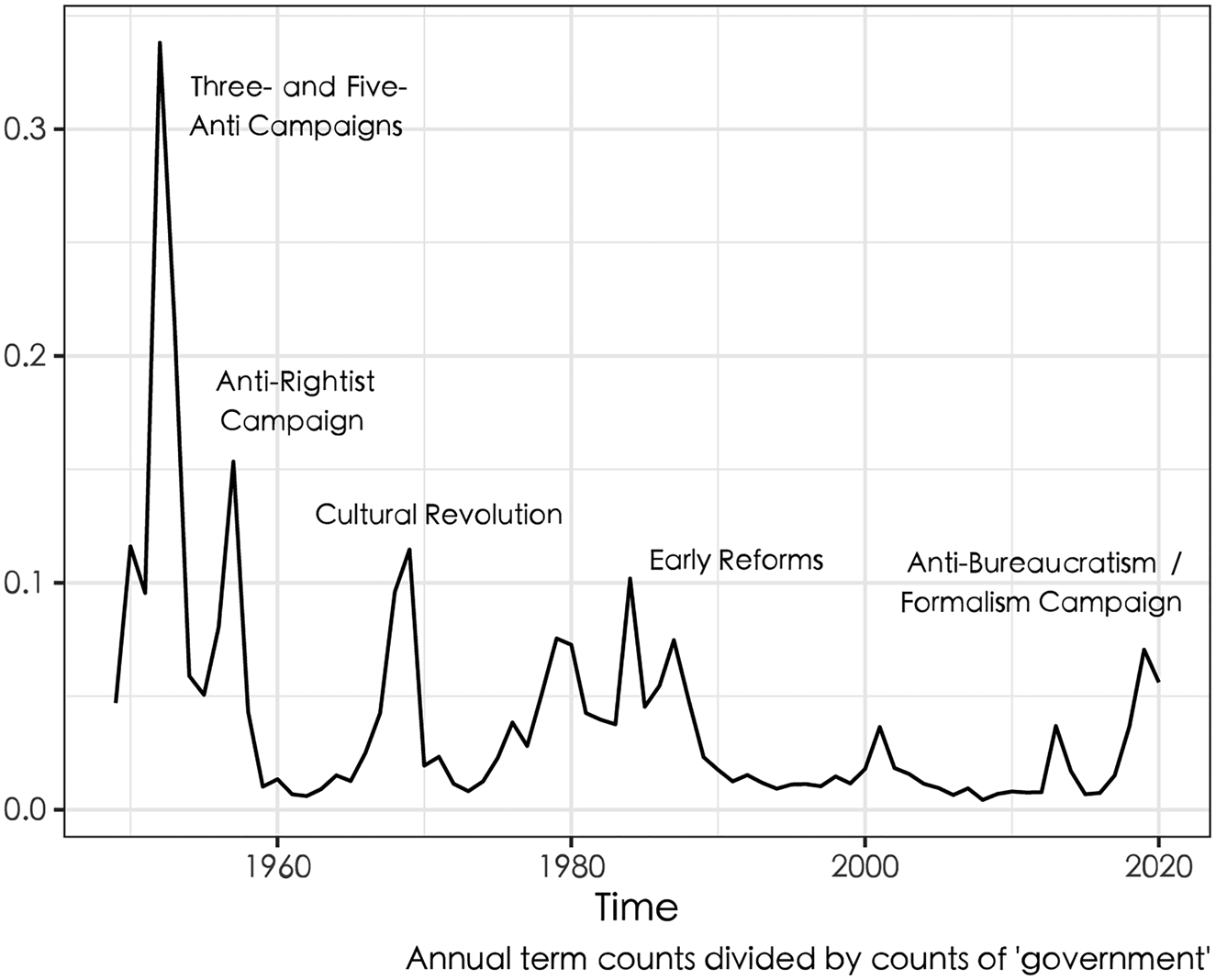
To track the intensity of the Party’s anti-bureaucratic rhetoric, we use a simple word count of “bureaucratism,” normalized by the word count of “government,” in each year.Footnote 58 The line in Figure 1 shows the intensity of anti-bureaucratic rhetoric in the People’s Daily between 1947 and 2020. Mentions of “bureaucratism” peaked during the Three Anti and Five Anti campaigns in the early 1950s, when “bureaucratism” was one of the nominal targets of the Three Anti's (alongside anti-corruption and anti-waste). The early 1950s was also a period of regime consolidation, when the Party sought to eradicate its perceived rivals, including landlords, private entrepreneurs and anyone who worked for the old regime. After this initial spike, mentions of bureaucratism peaked again during the 1957 Anti-Rightist Campaign, the Cultural Revolution, and in the mid-1980s when economic reform produced massive corruption and inequality. Anti-bureaucratic rhetoric declined in the 1990s and 2000s under Jiang Zemin 江泽民 and Hu Jintao, before making a strong return in recent years under Xi Jinping. But even during the two decades of the Jiang and Hu administrations, anti-bureaucratism never went away: an average of 122 articles mentioned it per year.
Intensity of “Bureaucratism” in People’s Daily
While informative, frequency of words does not tell us the full story. For instance, the intensity of Xi’s anti-bureaucratic rhetoric has led some to compare him to Mao, but careful observers note major differences – for instance, Xi’s eschewing of the rhetoric of class struggle and mass mobilization. Andrew Walder argues that while “[wielding] the symbolism” of Mao’s anti-bureaucratism, Xi is in fact a “lifelong bureaucrat for whom political stability and economic progress are the highest goals.”Footnote 59 But if Xi is a prototypical bureaucrat, why does he condemn bureaucratism with such ardour? Is “bureaucratism” simply a synonym for corruption, given Xi’s signature anti-corruption campaign, or is there more to it than that?
To examine the substance and evolution of anti-bureaucratism, we combine qualitative interpretation with quantitative text analysis. Specifically, to approximate the meaning of “bureaucratism,” we identify terms with the highest probabilities of appearing alongside it in the same sentence in the People’s Daily.Footnote 60 This method comes from the “distributional” hypothesis of linguistics: “you shall know a word by the company it keeps.”Footnote 61 We use “context word” to refer to the words that keep “bureaucratism” company. Our quantity of interest is the probability of a context word appearing, conditional on our keyword (“bureaucratism”) appearing. We estimate the probability of co-occurrence by counting all words that appear with “bureaucratism” in the same sentence, then dividing those counts by the total number of times “bureaucratism” appears in the same time interval.Footnote 62 This procedure is essentially the maximum likelihood estimate of bigram probability, with the slight modification that all other words in the sentence are considered instead of words that just follow one another directly.Footnote 63
Expressed formally, if x is our keyword of interest (“bureaucratism”) and y is a context word, and x,y denotes the two appearing in the same sentence, we estimate P(y|x) = C(x,y)/C(x), where C(x) is the number of times “bureaucratism” appears, and C(x,y) is the number of times “bureaucratism” and the context word co-occur in the same sentence within the same time period. This analysis allows us to estimate smoothed co-occurrence probabilities overtime, from which we draw the 30 most likely words to appear with “bureaucratism.”Footnote 64
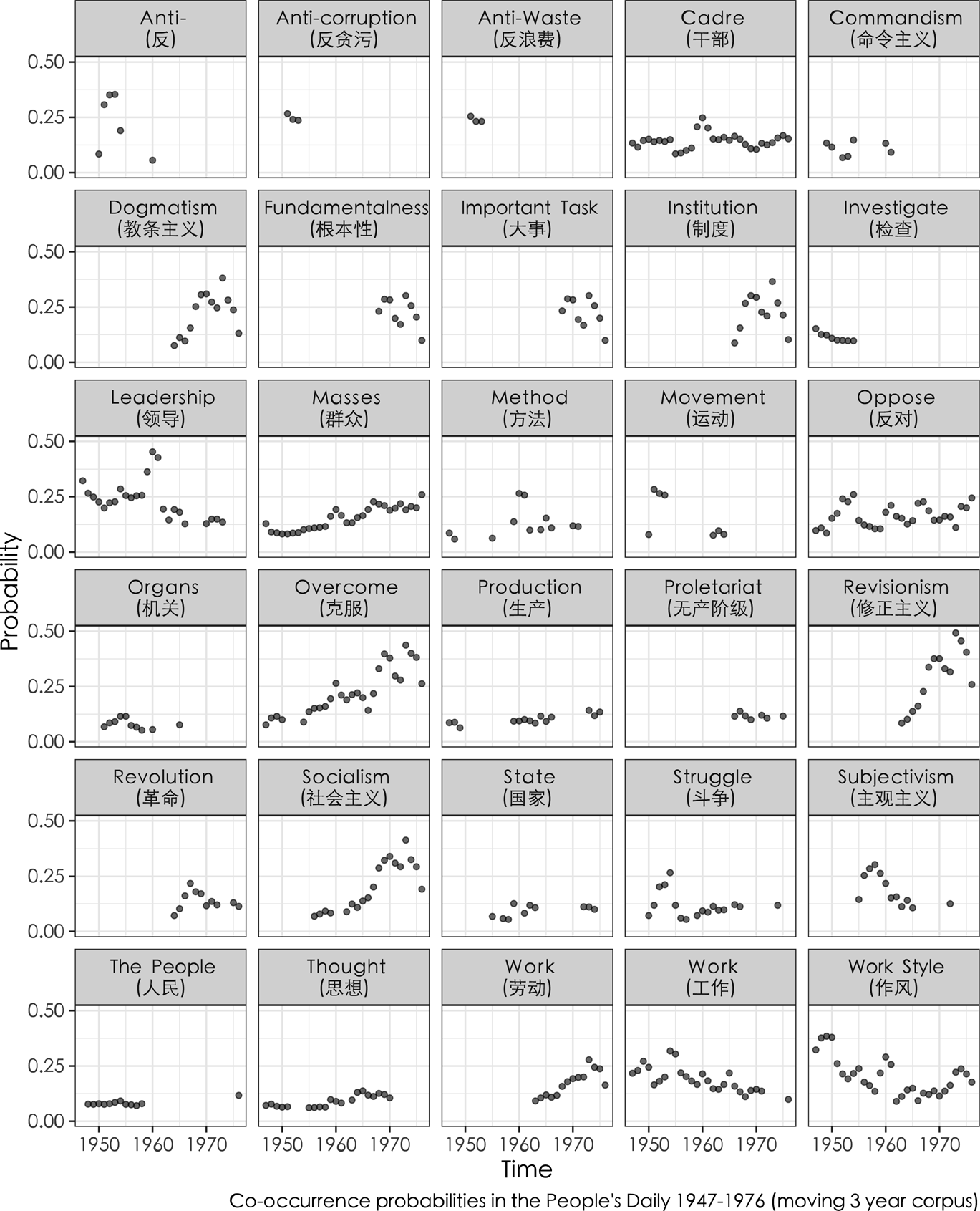
Figures 2 and 3 show these words, estimated separately for the Mao era and the post-Mao era, as well as the shifting probabilities of their co-occurrence.
Words Co-occurring with “Bureaucratism” in the Mao Era, 1947–1976
Words Co-occuring with “Bureaucratism” after Mao, 1977–2020
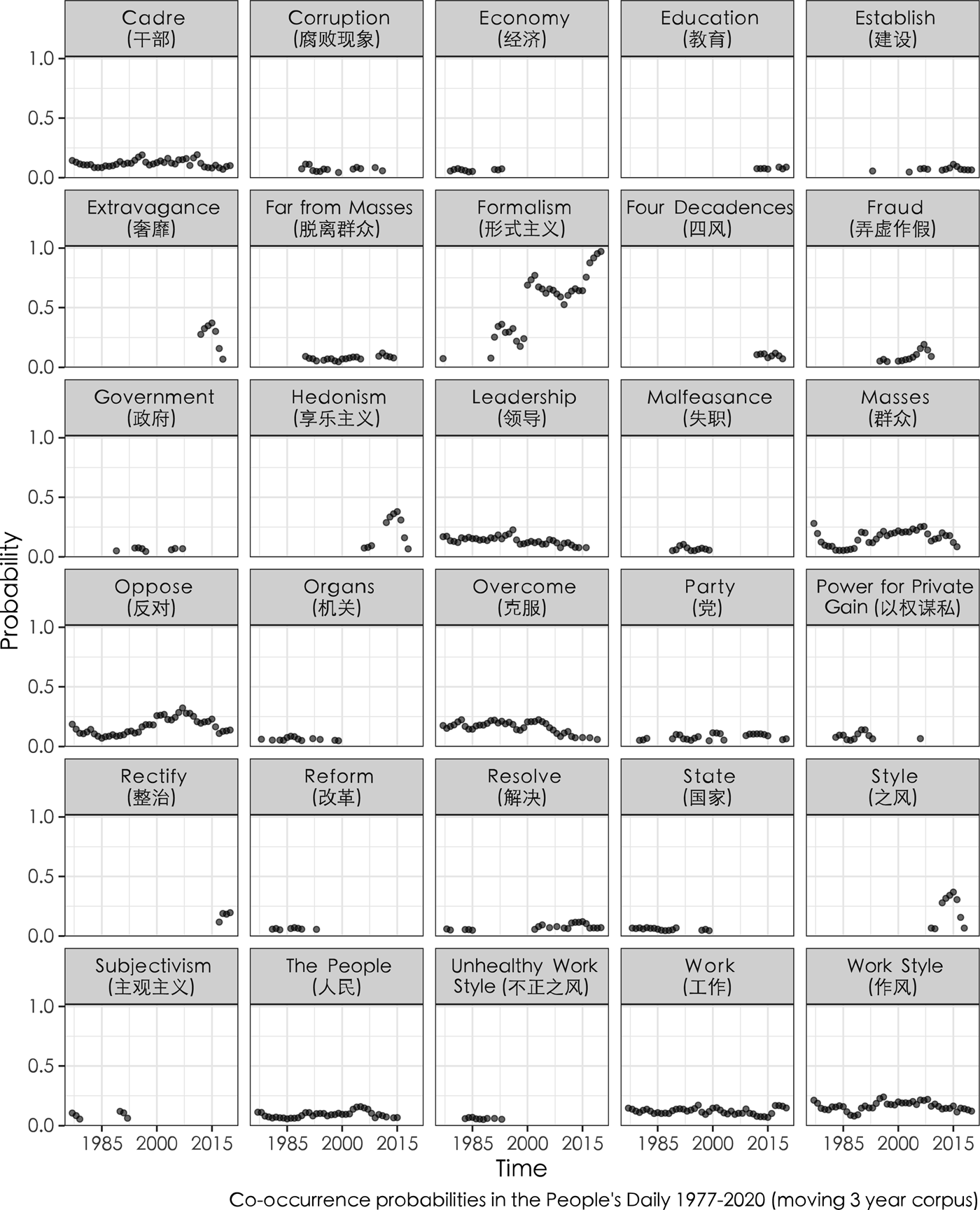
The co-occurrence probabilities in Figures 2 and 3 show that “bureaucratism” is depicted in People's Daily articles as a faulty “[work] style” (zuofeng 作风) of “cadres” (ganbu 干部) and “leadership” (lingdao 领导) that must be emphatically “opposed” (fandui 反对) and “overcome” (kefu 克服). It was to be “struggled against” (douzheng 斗争) in the Mao era and needs to be “resolved” (jiejue 解决) in the reform era.
Anti-bureaucratic rhetoric is always tied to the notion of the people: “people” (renmin 人民) or “masses” (qunzhong 群众) can be found as top words co-occurring with “bureaucratism” in both eras. Close readings of the articles show that critiques of bureaucratism persistently accompany anxieties that decision making will become “detached from the people” (tuoli qunzhong 脱离群众), “detached from reality” (tuoli shiji 脱离实际), with cadres no longer caring about “the interest of the people” (qunzhong liyi 群众利益).
As a “work style” (gongzuo zuofeng 工作作风), the Party sees bureaucratism as reflecting the moral failure of individual cadres, and thus it can be rectified by self-cultivation and increasing contacts with the people. For example, a 1974 opinion written by a cadre confesses that his past mistake of bureaucratism was rectified by participating in production alongside the workers. Workers purportedly told him “[in the past] we did not dare approach you. Now we can call you ‘Old Liu’ and can chat with you often and heart-to-heart. What a change!”Footnote 65 This emphasizes the Party's ultimate worry that bureaucratism threatens its popular legitimacy.
We also find gradual shifts in the CCP’s anti-bureaucratic rhetoric, reflecting different challenges the Party faced at different historical points. In the early PRC, bureaucratism often appeared alongside “imperialism” (diguozhuyi 帝国主义) and “feudalism” (fengjianzhuyi 封建主义), and it was often described as an “old thing” (jiu dongxi 旧东西) to be discarded. Figure 2 shows that under Mao, bureaucratism was closely tied to “commandism” (minglingzhuyi 命令主义), “subjectivism” (zhuguanzhuyi 主观主义), “revisionism” (xiuzhengzhuyi 修正主义) and “dogmatism” (jiaotiaozhuyi 教条主义). But there are also subtle shifts in emphasis. Before the Cultural Revolution, anti-bureaucratic critiques concentrated on “subjectivism” and “commandism.” During the Cultural Revolution, concerns shifted to Soviet “revisionism” and theoretical “dogmatism.”
Figure 3 shows the evolution of anti-bureaucratism after Mao. Three features stand out in this graph and in our qualitative reading. First, with marketization, conspicuous consumption and vast corruption, there was a vivid rise in association between “bureaucratism” and terms describing the “unhealthy style” (buzheng zhi feng 不正之风) of cadres, such as “fraud” (nongxuzuojia 弄虚作假), “extravagance” (shemi 奢靡), and “hedonism” (xianglezhuyi 享乐主义). Turning our attention back to Figure 1, discussions of “bureaucratism” rose in the 1980s, speaking to the vast corruption that emerged during market transition. It peaked again during Xi's anti-corruption campaign which took aim at the “hedonism” and “extravagance” of corrupt cadres.
Second, terms that co-occur with bureaucratism seem to have become more legalistic. For example, “corruption phenomenon” (fubai xianxiang 腐败现象), “malfeasance” (shizhi 失职) and “[political] power for private gain” (yiquan mousi 以权谋私) are increasingly used to describe corruption. This supports the intuition that anti-corruption efforts, like many other aspects of Chinese governance, are no longer exerted through mass mobilization but are channelled through formal–legal institutions.Footnote 66
Third, and most strikingly, we see a clear spike in the association of “bureaucratism” with “formalism.” By 2020, all mentions of “bureaucratism” in the People's Daily are accompanied by “formalism,” and formalism even surpasses “bureaucratism” in the number of mentions. Although “formalism” appears earlier, such as in Zhou's Reference Zhou1963 essay and other leaders’ speeches as well as People's Daily reporting, it is not until the reform era, and particularly so in recent years, that it has become a central concern of the Party, appearing almost hand-in-hand with “bureaucratism” (see Figure 4).
Instances of “Bureaucratism” and “Formalism” in People’s Daily

What is formalism and why has it become a growing worry for the CCP? China's communist revolutionaries originally adopted the term from European and Russian Marxists.Footnote 67 In Soviet Russia, for instance, anti-formalism campaigns under Stalin targeted arts that were believed to have focused on aesthetic forms over substantive content; however, since the only permissible content was that which adhered to the Party line, this “anti-formalism” ironically turned into another kind of formalism.
Chinese revolutionaries used “formalism” to refer to “feudalistic ritual behavior, aesthetic ornamentalism, empty rhetorical abstraction … [and] calcified institutional practices.”Footnote 68 In People's Daily, formalism appears alongside “empty talk” (konghua 空话), “word games” (wenzi youxi 文字游戏), “mountains of documents and oceans of meetings” (wenshanhuihai 文山会海), “complicated procedures” (chengxu fuza 程序复杂) and other performativity used by lower-level bureaucrats to deal with directives from upper-level authorities. In Xi Jinping's words, formalism is the practice that “replaces concrete implementation with garish forms” and “covers up tensions and problems with a glamorous appearance” (yong honghonglielie de xingshi daitile zhazhashishi de luoshi, yong guangxianliangli de waibiao yan'gaile maodun he wenti 用轰轰烈烈的形式代替了扎扎实实的落实,用光鲜亮丽的外表掩盖了矛盾和问题).Footnote 69 The divorce of formalistic procedures from substantive results is a problem extensively discussed in Weber's writings on rational bureaucracy. For a party that legitimizes itself by critiquing the inability of Western institutional forms to deliver the substantive results of better lives, formalism presents a major challenge. Xi warns that if such workstyle is not corrected, the Party will “lose people's hearts and lose power.”Footnote 70
Although formalism has always been a part of the CCP's vernacular, its recent ascendence is curious. In 2013, Xi named formalism as the first of the “four decadences” (sifeng wenti 四风问题), alongside bureaucratism, hedonism and extravagance (see Figure 3). An article on the Party's official website denounces both formalism and bureaucratism while drawing fine distinctions between them: “formalism plagues both upper-level and street-level (jiceng 基层) [bureaucrats],” while “bureaucratists are mostly upper-level cadres,” but “more often, [formalism and bureaucratism] are in bed with each other.”Footnote 71
Yet “formalism” is not merely a metaphysical abstraction conjured up by Party theoreticians. Rather, it reflects increasing recognition of policy implementation being ineffective and symbolic. Lower-level bureaucrats have learned to “look busy” without actually implementing higher-ups’ directives.Footnote 72 During the recent poverty alleviation campaign, observers found that cadres limited their efforts to filling out forms, taking (sometimes staged) pictures, and “walking through the scene” (zouguochang 走过场), all to leave traces of one's efforts, a practice also known as “trace-ism” (henjizhuyi 痕迹主义).
The Party seeks to rectify formalism and bureaucratism through political education. Meanwhile, scholars argue that bureaucrats engage in formalism not because they want to, but because they have to: as they face impossible demands from above with limited resources, bureaucrats use formalism as a means of blame avoidance. In their 2018 survey of poverty alleviation cadres, Wang Yahua and Shu Quanfeng found overwhelming “burnout” among cadres sent to the countryside to implement the poverty alleviation campaign, with nearly 80 per cent of them reporting physical and psychological exhaustion.Footnote 73
Wang Enxue describes this phenomenon as “grassroots fatigue” (jiceng pibei 基层疲惫).Footnote 74 His widely circulated opinion piece documents the excessive burdens shouldered by street-level bureaucrats owing to a “dramatic increase in ideological work … growing number of new tasks, new responsibilities, new demands … having to answer to multiple upper-level [bureaucratic] ‘mother-in-laws’ … [and] a vast amount of repetitive work.” These burdens lead in turn to “passiveness … fatigue … poor mood … complaints” and the “mechanical implementation” of policies. Wang, warning against the “resurgence of formalism,” urges central authorities to pay attention to the strains plaguing street-level bureaucrats.Footnote 75
Other scholars, like Fang Ning, argue that preventing formalism requires upper-level officials to allow flexibility and discretion to those bureaucrats responsible for implementing policies.Footnote 76 Fang diagnoses “formalism” as a symptom of rigid planning and unreasonable expectations set by upper-level authorities who fail to appreciate the “lack of resources and funds at the street level.”Footnote 77
Overall, scholarly discussion of formalism does not place blame on individual morality or the lack of revolutionary spirit. Instead, the focus is on the excessive demands and perverse incentives faced by street-level bureaucrats. This phenomenon is explored in broader research as “bureaucratic slack” and “performative governance.”Footnote 78
These observations eventually led the Party to announce a “Grassroots burden reduction year” (jiceng jianfu nian 基层减负年) in 2019 through a Central Committee Decree.Footnote 79 The Decree demanded a ten-page limit to policy documents, a 30 to 50 per cent reduction in the number of documents and meetings at the county level, and a significant reduction in the amount of supervision. Such steps sought to rectify the problems of “mountains of documents and oceans of meetings” and of “too many supervisions and performance evaluations.” These concerns resonate with the part of Zhou Enlai's essay on bureaucratic inefficiency and ineffectiveness. And the drastic nature of the policy response suggests that anti-bureaucratism is more than empty rhetoric.
Rising anxieties over “formalism” are also indicative of an under-appreciated development after Mao: efforts to institutionalize and even rationalize Chinese bureaucracies. Formalism may take “forms” to an extreme, but without “forms,” there would not be any formalism to speak of. Figure 5 shows normalized annual counts of “institutionalization” (zhiduhua 制度化), “standardization” (biaozhunhua 标准化) and “normalization” (guifanhua 规范化), which are all features of bureaucratic rationalization. Mentions of these terms steadily increase in the post-Mao era.
Intensity of “Institutionalization,” “Normalization” and “Standardization” in the People's Daily
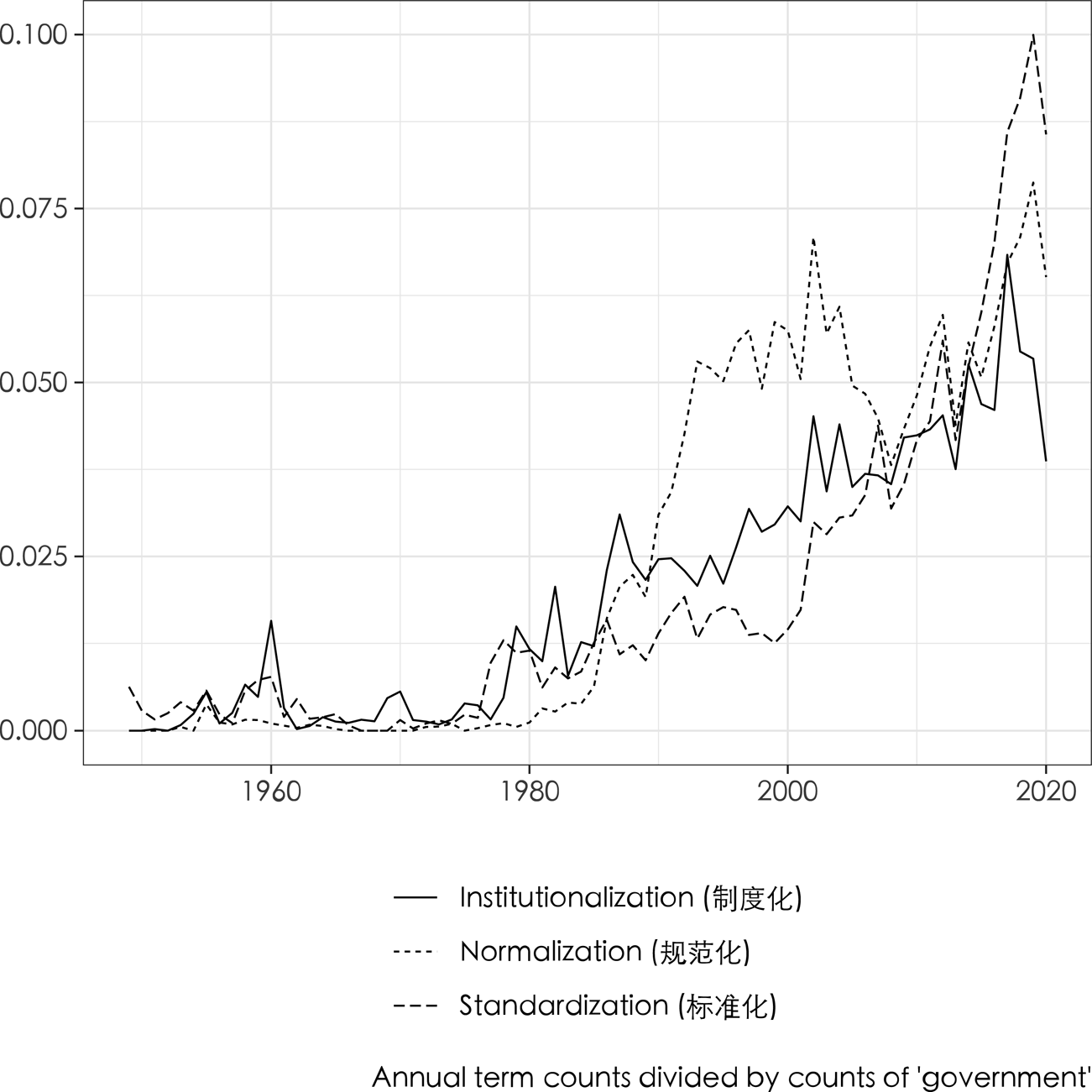
A sceptic may again question whether all of these words are “cheap talk.” Expressing interest in rational bureaucracy is not the same as having a rational bureaucracy. While it is beyond the scope of our study to demonstrate the transformation of Chinese bureaucracy, the very minimum these trend lines indicate is that, contrary to conventional wisdom, the CCP's interest in institutionalization has not declined under Xi. What differentiates Xi from his predecessors is how emphatically and explicitly he has brought the ghost of anti-bureaucratism back into China's bureaucratic machine.
Conclusion
Writing at the end of the Mao era, Harry Harding posited that CCP leaders faced a “philosophical dilemma … do the efficiency and rationality of modern bureaucracy outweigh the social and political costs that bureaucratization may impose?”Footnote 80 This “dilemma” of modernity has been the subject of a lasting wealth of social science literature. It was a fascination of Marx and Weber. It puzzled the state-builders of the PRC.
This article documents the persistence and transformation of the revolutionary Party's anti-bureaucratic spirit as it finds its way as a ruling regime. Liu Shaoqi's 1939 warning that the CCP must avoid previous revolutionaries’ mistake of succumbing to bureaucratism after taking power still haunts the Party today. “Bureaucratism” remains a core ideological concern of the Party because of the threat it poses to the regime's popular legitimacy. But different periods have witnessed different challenges. Under Mao, “bureaucratism” was used to critique first the old society, then Soviet revisionism and its Chinese sympathizers. After Mao, “bureaucratism” reflects the Party's trepidation about corruption and policy mis-implementation.
CCP leaders continue to navigate the tension between bureaucratization and anti-bureaucratism because it constitutes, in their conception, the very dilemma of single-party governance. Mao rejected bureaucratic rationalization only to see the steep human costs of keeping the revolutionary spirit alive. Mao's successors have embraced modernization and rationalization only to witness the challenges that they bring in turn. But at no point in time (perhaps with the exception of the Cultural Revolution) has the CCP abandoned this fine balancing act of carrying, on both shoulders, ideology and institutions, revolution and rationality, substantive ends and procedural means. The ghost remains as real as the machine. This balancing act appears to be a tension in theory, but it may well be a source of the Party's resilience in practice.
What's the use of examining rhetoric when it can often depart so far from actual practice? Perhaps the point lies precisely in identifying the gap between rhetoric and reality. As Frederic Wakeman puts it, “Ideologies remain vital not because they coincide with reality, but rather because those who believe in them know that while reality merely is, they would will it otherwise.”Footnote 81 This will to alter reality, in turn, constitutes a new reality in its own right. In the case of China, the repeated use of anti-corruption campaigns and the constant shaking up of state bureaucracies are but the best evidence of continuing anti-bureaucratic politics in action.
Nevertheless, intense anti-bureaucratic rhetoric and practices unfold in parallel fashion with efforts at institutionalization – even under Xi Jinping, when ideology and loyalty are believed to trump institutions and rationality. This, if anything, suggests the limitations to all kinds of “either/or” questions regarding China. Ideology and institutions need not always be at each other's throats, the theoretical tensions so astutely articulated by the Party's intellectual forebears notwithstanding.
Acknowledgements
The authors thank Ling Chen, Shuang Chen, Yanhua Deng, Josh Freedman, Xiang Gao, Kyle Jaros, Junyan Jiang, Parker Koch, Daniel Koss, Jeff Lockhart, Fengming Lu, Zhaotian Luo, Xiao Ma, Brendan McElroy, Elizabeth Perry, Meg Rithmire, Christian Sorace, Patricia Thornton, Yuhua Wang, Xiaohong Xu, John Yasuda, Yang Zhang, Ying Zhang, Xueguang Zhou and participants of the Political Science Speaker Series for their helpful feedback.
Conflicts of interest
None.
Biographies
Iza DING is assistant professor of political science at the University of Pittsburgh. Her research explores the antinomies emerging through economic and political modernization, such as development and environmentalism, bureaucracy and populism, and liberalism and nationalism. Her articles have appeared in Comparative Political Studies, Chinese Political Science Review, Democratization, Studies in Comparative and International Development and World Politics. Her forthcoming book, The Performative State: Public Scrutiny and Environmental Governance in China, is to be published by Cornell University Press.
Michael THOMPSON-BRUSSTAR is a PhD candidate in political science at the University of Michigan. His research examines bureaucratic control and the evolution of legal-administrative institutions in China.


 Open access

