


1. Introduction
Local governance relies on bureaucrats as agents to implement the policies made by political leaders. However, the preferences of these bureaucrats may diverge significantly compared to their political leaders, thus resulting in reduced levels of effort or misconduct (Brehm and Gates, Reference Brehm and Gates1999; Huber and Shipan, Reference Huber and Shipan2002). In politically centralized environments, such as one-party regimes, this agency problem is intensified by the challenge of effectively monitoring bureaucratic misbehaviors due to a lack of public participation and independent media organizations capable of supervising such actions (Lorentzen, Reference Lorentzen2013). Although regimes often adopt strengthened top-down monitoring strategies, solely relying on this approach is unlikely to effectively address the agency problem (Chen et al., Reference Chen, Pan and Xu2016; Huang et al., Reference Huang, Boranbay-Akan and Huang2019).
To complement traditional measures, some regimes have introduced public deliberative institutions that enable public communication between citizens and political leaders regarding complaints and policy requests (He, Reference He2008; Gueorguiev, Reference Gueorguiev2021). For instance, the government of Hangzhou in Zhejiang Province, China, established an online platform in the early 2000s to facilitate discussions on various social issues such as environmental protection and traffic problems. This platform encouraged public discourse, allowing citizens to freely express their suggestions and criticisms and providing responses from government officials (Chen, Reference Chen, Ethan and He2006). Moreover, in Vietnam, query sessions in the Vietnamese National Assembly enable delegates to quiz the prime minister, line ministers, and state bank governors regarding current issues and even directly question their performance (Malesky and Schuler, Reference Malesky and Schuler2010). Are these public deliberative institutions merely “window dressing”? If not, what are the underlying reasons?
The answers to these queries remain theoretically ambiguous. On one hand, public deliberation allows for a certain degree of freedom of expression. By encouraging information exchange between policymakers and citizens, public deliberation serves as a mechanism for decision-making and conflict resolution (Cohen, Reference Cohen and Benhabib1996; Gutmann and Thompson, Reference Gutmann and Thompson2004; He and Warren, Reference He and Warren2011). Therefore, we expect that public deliberation might introduce some democratic elements into the local governance of one-party regimes. On the other hand, in some regimes, violence is often the ultimate method of conflict resolution rather than reasoned discourse and voting (Svolik, Reference Svolik2012). Widespread information manipulation and censorship can severely restrict the spaces for public deliberation and legitimate bargaining (King et al., Reference King, Pan and Roberts2013; Chen and Xu, Reference Chen and Xu2017a).
In this paper, we examine how public deliberation shapes political trust among the general population in politically centralized environments, such as one-party states. Political trust, defined as trust in political institutions and their leaders, is essential for the stability of political systems (Almond and Verba, Reference Almond and Verba1963). Political trust plays a pivotal role in subduing collective actions and maintaining state stability (Shirk, Reference Shirk2008). For instance, waning political trust in local governments frequently triggers a surge in petitions in China; during such incidents, ordinary citizens outline allegations of misconduct by local authorities and forward them to the central government in Beijing (Li, Reference Li2008).
We argue that public deliberation can be conceptualized as a two-way communication process between citizens and government officials and has the potential to foster political trust. Specifically, public deliberation serves two functions: (1) incentivizing local governments to improve responsiveness (the responsiveness effect), and (2) generating narratives about local governance (the narrative effect). Firstly, citizens’ demands and concerns are publicized through deliberation, pressuring local bureaucrats to respond more promptly and subsequently influencing the formulation of public policies (Chen et al., Reference Chen, Pan and Xu2016). As well as boosting people’s sense of empowerment, this in turn enhances political representation and improves citizens’ perceptions of procedural fairness in policymaking (Halvorsen, Reference Halvorsen2003; Whiting, Reference Whiting2017; Van der Meer, Reference Van der Meer and Uslaner2018; Yang and Zhao, Reference Yang and Zhao2023). Secondly, public deliberation involves the government transmitting information to the public, including the policymaking process and government performance, thereby facilitating the spread of information among citizens. Political distrust often arises from the inability to acquire accurate and comprehensive information about government performance (Bok, Reference Bok, Nye, Zelikow and King1997; Cook et al., Reference Cook, Jacobs and Kim2010). Public deliberation ensures government performance is more discernible to the masses and thus generates narratives that improve public perceptions regarding local governments, even among non-beneficiaries of government actions (Pierson, Reference Pierson1993; Cook et al., Reference Cook, Jacobs and Kim2010). Together, these two effects explain why public deliberation can enhance political trust among the general population, even for those who neither participate in nor observe it directly.
In this paper, we apply the above argument to contemporary China. In 2005, local governments began introducing dianshi wenzheng, a China-style Topical Debate Program (TDP) resembling the BBC’s Question Time. TDPs serve as platforms for public deliberation at the local level in China. Public representatives, scholars, and local officials are invited to exchange opinions and ultimately seek solutions to socioeconomic issues. Through this process, citizens can outline a diverse range of demands and opinions and receive responses from local officials, potentially influencing future policymaking. TDPs also facilitate public oversight of the implementation of decisions made within their framework.
To examine the implications of our theory, we consider TDP broadcasts in China as deliberative events and exploit their variation across cities and time as the basis of a staggered difference-in-differences (DiD) design. Our analysis relies on three data sources: a manual collection of TDP inception dates in each prefecture-level city; the four waves of the China Family Panel Studies (CFPS) conducted in 2012, 2014, 2016, and 2018; and city-level Statistical Yearbooks. We find that TDP broadcasts significantly enhance the general population’s trust in local government officials in China. However, the positive impacts of TDPs tend to decrease 2 years after their initial broadcasts. This decline may occur due to the agenda control inherent in TDPs, which means that diverse voices are not sufficiently incorporated, and the limited resources available to local bureaucrats.
Moreover, we provide supportive evidence for the responsiveness effect and narrative effect. On the one hand, we find that TDP broadcasts increase public goods provision and foster more positive service attitudes among government employees. On the other hand, we show that the impacts of TDPs on political trust are more pronounced among respondents who frequently watch TV or browse the Internet for political information. This latter evidence is consistent with the narrative effect as individuals with high exposure to mass media are more likely to internalize the narratives presented in TDPs (Zaller, Reference Zaller1992).
Our paper closely relates to four classes of literature. First, it contributes to research on the role of public deliberation in politically centralized environments. While public deliberation has been recognized as an important aspect of electoral democracy, generating positive effects like enhancing political trust (e.g., Halvorsen, Reference Halvorsen2003; Grönlund et al., Reference Grönlund, Setälä and Herne2010; Minozzi et al., Reference Minozzi, Kennedy, Esterling, Neblo and Jewell2024), subsequent studies have shown that it also occurs within politically centralized environments, such as one-party states (He and Warren, Reference He and Warren2011; Qin and He, Reference Qin and He2022). He and Warren (Reference He and Warren2011) argue that the form of deliberative governance in one-party states differs from electoral democracy in terms of political empowerment, with tight agenda control affecting the functions of deliberation. Building on their seminal work, our study provides a large-scale empirical analysis of the political consequences of public deliberation in China. Our findings not only expand the empirical scope but also explore its dynamic effects. Additionally, our results highlight a trust-enhancing effect even among non-participants in the deliberative process, an aspect not sufficiently addressed in the existing literature. For example, Qin and He (Reference Qin and He2022) find, through interviews and a case study of public pricing hearings in Shanghai, that participants report greater satisfaction than non-participants. The narrative effect we propose could therefore contribute to understanding the complex functions of public deliberation.
Second, this paper contributes to the literature on authoritarian responsiveness. Previous studies have explored the incentive mechanisms for local officials in politically centralized environments, such as one-party regimes, to address citizens’ policy requests (Distelhorst and Hou, Reference Distelhorst and Hou2014, Reference Distelhorst and Hou2017; Chen et al., Reference Chen, Pan and Xu2016; Meng et al., Reference Meng, Pan and Yang2017; Lueders, Reference Lueders2022). For instance, Chen et al. (Reference Chen, Pan and Xu2016) use online field experiments to demonstrate how top-down monitoring systems and societal pressure from citizens influence local governments’ policy responsiveness in China. Distelhorst and Hou (Reference Distelhorst and Hou2017) employ audit studies to reveal how economic development enhances local governments’ incentives to respond. These studies typically measure government responsiveness based on either artificial complaints designed by researchers or exogenous socioeconomic conditions. However, many of the studies mentioned above in this paragraph often overlook the communication process where citizens express their opinions within the framework set by the government, serving as information input for governmental action. Drawing on the literature on deliberative authoritarian governance (e.g., He and Warren, Reference He and Warren2011; Qin and He, Reference Qin and He2022), this paper addresses this gap by focusing on a real-world scenario where selected citizens can publicly voice their opinions on television. We assess the overall political consequences of public deliberation, thereby providing a more comprehensive evaluation of the entire process of policy responsiveness driven by citizen-government communication.
Third, this paper fits into the broad literature on the sources of political trust in one-party regimes. Previous studies have shown a range of determinants of political trust in electoral democracies, including economic performance, accountability, representation, and individuals’ socialization experiences (Almond and Verba, Reference Almond and Verba1963; Hetherington and Rudolph, Reference Hetherington and Rudolph2008; Cho, Reference Cho2012). In contrast, a growing body of literature demonstrates that factors such as corruption, inequality, and property expropriation can influence political distrust (Zhou and Jin, Reference Zhou and Jin2018; Wang and Dickson, Reference Wang and Dickson2022; Sha, Reference Sha2023). Our study adds to this emerging literature by providing causal evidence regarding how governments use managed public deliberative platforms to mitigate tensions with citizens.
Finally, this paper complements the co-optation theory in politically centralized environments (Lust-Okar, Reference Lust-Okar2006; Gandhi, Reference Gandhi2008; Gandhi and Lust-Okar, Reference Gandhi and Lust-Okar2009). A substantial body of literature has studied how incumbents use quasi-democratic institutions, such as legislatures and political parties, to co-opt elites in potentially opposing factions (Gandhi, Reference Gandhi2008; Svolik, Reference Svolik2012). Unlike those quasi-democratic institutions that involve direct power-sharing with elites, we focus on local deliberative institutions that encourage public participation and enhance the ability of citizens to monitor local officials (Malesky and Schuler, Reference Malesky and Schuler2010; Stockmann and Luo, Reference Stockmann, Luo and Carpini2019). Specifically, we show that these public deliberative institutions serve as a commitment mechanism that forces local officials to respond to policy requests from citizens and fosters narratives about local governance, thereby strengthening citizens’ political trust. Our study contributes to the co-optation theory by emphasizing the importance of restructuring the power dynamics between ordinary citizens and local officials and enhancing citizen-government communication.
The rest of the paper is organized as follows. Section 2 theorizes our hypotheses. Section 3 introduces the TDPs in China. Section 4 describes our data and empirical strategies. Section 5 presents our empirical findings. Section 6 examines the mechanisms. Section 7 concludes the paper.
2. Theorization and hypotheses
The agency problem is prevalent across different regimes, especially within local governance in politically centralized environments, such as one-party states. For example, mayors of municipal governments rely on bureaucrats to implement policies and these bureaucrats may have different preferences, leading to reduced levels of effort or misconduct (Brehm and Gates, Reference Brehm and Gates1999; Huber and Shipan, Reference Huber and Shipan2002). Such actions may result in public dissatisfaction or even social turmoil. This issue is further complicated by the difficulty of effectively monitoring bureaucratic behavior due to the absence of public participation and independent media oversight (Lorentzen, Reference Lorentzen2013). The employment of stringent top-down monitoring strategies by the central government is not sufficient to resolve the agency problem (Chen et al., Reference Chen, Pan and Xu2016; Huang et al., Reference Huang, Boranbay-Akan and Huang2019).
To address the agency problem and improve local governance, regimes have established public deliberative institutions that enhance communication between citizens and local officials and encourage a certain level of public participation in supervising bureaucrats (Gueorguiev, Reference Gueorguiev2021). This is exemplified by TDPs in China. These programs act as public deliberative platforms with controlled agendas, allowing public representatives and officials to exchange opinions, discuss socioeconomic issues, and collectively seek solutions to problems. They also facilitate public oversight of the implementation of collective decisions. Designed to gather public opinions and policy preferences, TDPs aim to enhance government responsiveness and accountability, ultimately improving local governance.
We conceptualize the above-mentioned deliberative institutions as platforms for two-way communication between citizens and local government officials. For one, the demands and concerns of citizens are publicized through public deliberation, incentivizing local bureaucrats to respond more promptly and subsequently influencing the formulation of public policies (Halvorsen, Reference Halvorsen2003; Whiting, Reference Whiting2017; Van der Meer, Reference Van der Meer and Uslaner2018; Yang and Zhao, Reference Yang and Zhao2023). For another, public deliberation involves the local government transmitting information to citizens such as policymaking details and performance statistics. This generates narratives that improve the public perceptions of local governments, even among those who do not directly benefit from the policies in question (Pierson, Reference Pierson1993; Cook et al., Reference Cook, Jacobs and Kim2010). All of this contributes to the formation of political trust.
In terms of the first way of communication, citizens can express their demands, and government officials are incentivized to respond promptly, thus improving levels of political trust (Fournier et al., Reference Fournier, Van der Kolk, Carty, Blais and Rose2011). Regimes struggle to collect information about citizens’ preferences and policy outcomes (Lorentzen, Reference Lorentzen2013), so the information provided via public deliberations is highly valuable; the government can utilize these data to identify policy successes and failures and reduce the risk of collective action by ensuring policy demands are met (Distelhorst and Hou, Reference Distelhorst and Hou2017; Chen and Xu, Reference Chen and Xu2017b). Although local government officials may have been aware of the rankings of citizens’ policy preferences before deliberation, they might not fully grasp the intensity of those preferences. With limited resources and attention, they may postpone or neglect some issues without deliberation. However, when deliberation brings these issues into focus, local government officials become aware that both citizens and their superiors are paying attention to the issues. Under pressure from above and below to address publicly highlighted concerns, local government officials are motivated to respond effectively (Chen et al., Reference Chen, Pan and Xu2016), which leads to higher levels of political trust (Rivetti and Cavatorta, Reference Rivetti, Cavatorta, Zmerli and Van der Meer2017).
In addition to addressing citizens’ interests on a case-by-case basis during public deliberation, these specific concerns may later be incorporated into institutionalized policymaking, enhancing political representation and fostering political trust (Abramson, Reference Abramson1972; Yang and Zhao, Reference Yang and Zhao2023). Political representation refers to the institutional channels through which public interests and demands are expressed and integrated into the policymaking process. Through public deliberation, individuals see their interests represented in policymaking, leading to perceptions of procedural fairness, decision legitimacy, and increased empowerment and external political efficacy (Abney and Hutcheson, Reference Abney and Hutcheson1981; Bobo and Gilliam, Reference Bobo and Gilliam1990; Whiting, Reference Whiting2017).
In terms of the second way of communication, local governments can transmit information to citizens through public deliberation. Since citizens usually lack information about governance in one-party regimes (Stockmann and Luo, Reference Stockmann, Luo and Carpini2019), public deliberation can generate narratives that improve public perceptions of local governments, even among non-beneficiaries of policies (Pierson, Reference Pierson1993; Cook et al., Reference Cook, Jacobs and Kim2010). This is accomplished for several reasons. First of all, citizens participating in or observing public deliberation can become more knowledgeable regarding the political system and therefore more trusting of it (Cook et al., Reference Cook, Jacobs and Kim2010; Grönlund et al., Reference Grönlund, Setälä and Herne2010). Political distrust often arises from the inability to acquire accurate and comprehensive information about government performance (Bok, Reference Bok, Nye, Zelikow and King1997; Cook et al., Reference Cook, Jacobs and Kim2010). By engaging in public deliberation, either as participants or as observers, people can learn about policymaking processes and government performance, better understand policy issues, and become more tolerant and respectful of diverse views (Grönlund et al., Reference Grönlund, Setälä and Herne2010; Pincock, Reference Pincock, Nabatchi, Gastil, Leighninger and Weiksner2012). This educational effect is particularly crucial in regimes characterized by limited transparency in policy formulation (Hollyer et al., Reference Hollyer, Rosendorff and Vreeland2015).
Furthermore, most citizens have limited awareness regarding political issues and predominantly rely on cues from politicians, media, and other sources to comprehend political matters (Converse, Reference Converse and David1964; Zaller, Reference Zaller1992). Public deliberation can serve as a heuristic shortcut for audiences to evaluate the trustworthiness of governments. Importantly, public deliberation differs from the propaganda and information manipulation (Stockmann and Gallagher, Reference Stockmann and Gallagher2011). Deliberative institutions are not merely “window dressing” but can genuinely impact policymaking in politically centralized environments (Fishkin et al., Reference Fishkin, He, Luskin and Siu2010; He and Warren, Reference He and Warren2011). Consequently, audiences are more likely to be persuaded by the information conveyed through such institutions (Zaller, Reference Zaller1992), thereby increasing their level of political trust.
However, citizens with relatively high political awareness do not simply accept the persuasive message conveyed through public deliberation (Zaller, Reference Zaller1992). Instead, they assess both the input (e.g., responsiveness and accountability) and output (e.g., performance) of the government when determining their levels of political trust (Easton, Reference Easton1975; Listhaug and Jakobsen, Reference Listhaug, Jakobsen and Uslaner2018). During this process, individuals rely on their prior beliefs as a benchmark (Miller and Listhaug, Reference Miller, Listhaug and Norris1999; Van der Meer, Reference Van der Meer and Uslaner2018). In politically centralized environments, such as one-party regimes, these prior beliefs are developed in response to relatively weak government performance, responsiveness, and accountability (Chen et al., Reference Chen, Pan and Xu2016; Distelhorst and Hou, Reference Distelhorst and Hou2017). Public deliberation can transmit positive information regarding the government and produce desirable outcomes, such as improved government responsiveness and accountability, and better decision-making (Yang and Zhao, Reference Yang and Zhao2023). Even those who neither participate in nor watch public deliberation can still observe its beneficial outcomes. Moreover, non-beneficiaries of these outcomes may also be more inclined to believe that they can influence policymaking when they directly see or hear from others about fellow citizens actively participating in policymaking through public deliberation (Gastil et al., Reference Gastil, Knobloch, Kelly, Nabatchi, Gastil, Leighninger and Weiksner2012). In this context, citizens can update their beliefs about local government based on the informational signals sent through public deliberation, ultimately leading to an elevation in their levels of political trust (Newton, Reference Newton1999; Van der Meer, Reference Van der Meer and Uslaner2018). Based on this argument, we propose the following three testable hypotheses:
Hypothesis 1 Public deliberation improves political trust among citizens.
Hypothesis 2a (Responsiveness Effect) Public deliberation improves political trust among citizens by enhancing government responsiveness.
Hypothesis 2b (Narrative Effect) Public deliberation improves political trust among citizens by generating narratives that elevate their perceptions of local governments.
3. Introduction to topical debate programs in China
We test the above three hypotheses using a specific kind of public deliberative platform in China known as dianshi wenzheng, a Chinese TDP resembling the BBC’s Question Time. The majority of TDPs are either broadcast live or recorded and then aired on TV and/or the Internet, following a specific schedule (e.g., weekly and monthly). These programs are typically initiated and organized by local TV stations and carry distinct names, such as “Asking Politics in Hefei” and “Time for Political Inquiry.” TDPs have strong official backing as they are predominantly co-organized by local governments or local branches of the Chinese Communist Party (CCP), such as the Municipal Committee of the CCP and the Municipal Commission for Discipline Inspection.Footnote 1 A typical TDP is illustrated in Figure A10 of Section A6 in the Appendix, with local officials seated on the left side, a host occupying the center position, and representatives of the public and invited experts seated on the right. There are also numerous audiences at the bottom of the image.
The topics for TDPs are carefully chosen by TV stations from a pool of suggestions collected directly from local residents. Citizens provide these suggestions through various channels, such as WeChat, websites, email, etc. Subsequently, TV stations dispatch reporters to investigate certain topics, with those of interest then reported to local governments. Once topics have been finalized and approved by local governments, they will become part of future TDP broadcasts. These topics encompass a broad spectrum of socioeconomic fields ranging from housing and education to transportation and environmental concerns. Figure A11 of Section A6 in the Appendix demonstrates how frequently each topic is discussed in the TDPs for each city (if applicable) within our sample, with environmental protection and housing issues emerging as particularly popular subjects.
Public representatives and observers in TDPs are selected through a combination of volunteering and invitation. Citizens can volunteer as public representatives or observers, but due to limited quotas set by TV stations, only a few are able to participate. Additionally, stakeholders associated with relevant issues, ordinary citizens, local People’s Congress deputies, and members of the local committee of the Chinese People’s Political Consultative Conference (CPPCC) are also invited to partake as public representatives or observers. This diverse mix of participants adds richness and inclusivity, ensuring a well-rounded and engaging platform for public deliberation.
TDPs typically unfold in three distinct stages. Initially, a host introduces the predetermined agenda established by the local TV station under the influence of the local government.Footnote 2 During the second stage, public representatives outline their concerns and raise pertinent questions concerning socioeconomic and policy matters. In parallel, live broadcast audiences can also submit questions via the Internet or phone, and some of these inquiries will be addressed as part of the program. The third stage involves local officials responding to the questions posed by the public, seeking advice, and addressing their requests. The second and third stages often include some back-and-forth, enriched with comments and suggestions from invited experts. Ultimately, a consensus is frequently achieved with local officials agreeing to address the public’s demands, which may involve direct problem-solving or the formulation of new policies in the future. To ensure accountability, reporters will monitor the implementation of collective decisions and provide updates in later TDP episodes or through online platforms, encouraging active public supervision.
Although we expect that Chinese TDPs can enhance public levels of political trust, there are several theoretical reasons could dilute this effect in the long run. Firstly, local bureaucrats face resource constraints when responding to public demands (Dasgupta and Kapur, Reference Dasgupta and Kapur2020). Therefore, when public demands conflict with those of their superiors, local government officials with limited resources can only address the most urgent public demands and others are neglected. In other words, the multitasking nature of local governments prevents local bureaucrats from prioritizing all the issues raised during TDPs (Holmstrom and Milgrom, Reference Holmstrom and Milgrom1991; O’Brien and Li, Reference O’Brien and Li1999). Secondly, TDP agendas are often controlled by local governments, limiting discussions to non-sensitive topics such as environmental protection and education while prohibiting sensitive issues such as political reforms. Consequently, the level of information exchange between citizens and officials is restricted. Additionally, the participant selection process is not sufficiently representative as public representatives and observers are primarily chosen through a combination of volunteering and invitations rather than random sampling.
4. Data and empirical strategy
4.1. Data
Our analysis relies primarily on three data sources. The first data source specifies the dates on which a local TDP was first broadcast (if applicable) in 328 prefecture-level cities in mainland China. The second consists of four consecutive waves of the China Family Panel Studies (CFPS) survey. The final source includes city-level socioeconomic characteristics from the China City Statistical Yearbooks and China Statistical Yearbooks for Regional Economy.
4.1.1. TDPs and selection concerns
To begin with, we manually recorded the date on which a local TDP broadcast first took place in each of the 328 mainland cities. This process was reliant on information from government official websites, newspapers, and mass media, and the data collection procedure is described in detail in Section A1 in the Appendix. To ensure that TDP broadcasts serve as a good proxy for local public deliberation, we required that, for a TDP to be considered qualified, residents must be able to participate and engage in face-to-face discussions with government officials. Participation and face-to-face interaction strengthen direct contact between local officials and citizens and “force” local officials to respond directly to requests and questions proposed by citizens, thus ensuring TDPs are platforms for public deliberation rather than purely for propaganda. Only qualified TDP broadcasts have been included in our treatment.
Our key independent variable is TDP, which equals one if a qualified TDP has been aired by a local TV channel of a city in a given year; otherwise, it equals zero. In our analysis, once a city is treated, it remains treated for the remainder of the panel. In other words, once a city initiated a local TDP broadcast in a given year, TDP equals one for that city since that year. Analogously, we created a binary variable, TDP_province, equaling one if a qualified TDP at the provincial level has been aired in a province in a specific year.Footnote 3 This binary variable primarily functions as a control variable considering the potential confounding effects of provincial-level TDPs.
The first TDP, called yibashou shangdianshi, was broadcast in Lanzhou, Gansu Province, in 2005. However, this was only a regional policy innovation and did not trigger policy diffusion at that time. As indicated in Figure 1, there were only two cities, Lanzhou and Nanjing, with local TDP broadcasts before 2010. More cities began to broadcast local TDPs from 2011 onwards. Before 2017, the establishment of TDPs was a policy innovation and diffusion spontaneously conducted by local governments. At the end of 2016, the central government produced a document explicitly encouraging the creation of TDPs as a way to improve government responsiveness and transparency and enhance public participation in local governance.Footnote 4 Since this document merely listed TDPs as a method to improve government responsiveness without issuing a mandate, local governments retain significant discretion in establishing TDPs. Hence, the diffusion of TDPs largely remains a spontaneous act. As is shown in Figure 1, the central government’s involvement did not significantly change the growth pattern with regard to the number of cities adopting TDPs.
Number of cities with local TDP broadcasts.

The adoption of TDPs is primarily driven by the spontaneous initiatives of local governments. Therefore, certain city characteristics and the attributes of local political leaders may influence their implementation (Zhu and Zhang, Reference Zhu and Zhang2016). First, economic development provides a financial foundation for local governments to initiate TDPs while raising citizens’ and enterprises’ expectations for improved public goods and services. Consequently, economic development, fiscal capacity, and the current levels of public goods provision are possible determinants in establishing TDPs. Second, population and urbanization levels may affect the adoption of TDPs, which primarily address urban issues and require a sufficient audience base. Third, technological capacity, enabling TDP broadcasts via TV, the Internet, and mobile phones, may also play a crucial role in their implementation.Footnote 5 Finally, municipal party secretaries are key decision-makers in establishing local TDPs, and their personal characteristics may shape their decision-making.
For each of the socioeconomic dimensions mentioned above, we select several indicators to measure them. The data is from the China City Statistical Yearbooks and China Statistical Yearbooks for Regional Economy. We used the values of these variables measured in 2010 before our sample period (from 2012 to 2018). We compare cities with TDPs and those without across 24 socioeconomic variables in 2010. Furthermore, for the personal characteristics of municipal party secretaries, we select their years in office and educational levels. We compare the attributes of municipal party secretaries in cities that initiated TDPs in a given year with those in cities that had not adopted TDPs by that year. The balance test results reported in Tables A1 and A2 of Section A2 in the Appendix indicate significant differences between the two groups on only three dimensions: the natural log of population (ln(population)) and health institutions (ln(health_insititution)) and the share of employment in state-owned enterprises (SOE_share). As a result, we control for the influence of the three determinants of TDPs on our outcome variables in the estimation.
4.2.2. CFPS and political trust
Our second data source consists of four consecutive waves of the CFPS from 2012 to 2018. The CFPS, a nationally representative longitudinal survey of Chinese communities, families, and individuals, is conducted biannually by the Institute of Social Science Surveys of Peking University. Initiated in 2010, it has surveyed individuals from more than 14,000 households across 25 provinces in mainland China and includes detailed information on individual characteristics and public opinion. Thus far, six waves have been conducted in 2010, 2012, 2014, 2016, 2018, and 2020. Data from 2012, 2014, 2016, and 2018 has been used for our empirical analysis because the survey question referring to political trust first appeared in the 2012 wave.Footnote 6 We undertook several steps to clean the data. First, we excluded the sample from the four provincial-level municipalities (Beijing, Chongqing, Shanghai, and Tianjin) and the five Plan Directly Administered Cities (Dalian, Ningbo, Qingdao, Shenzhen, and Xiamen) because they are markedly different from prefecture-level cities in terms of political status and economic resources. We also removed respondents in autonomous prefectures.Footnote 7 Second, we excluded people working in government agencies, CCP organizations, People’s Congress, CPPCC, and military organizations because they are likely to hold much higher levels of political trust compared to the general population. Lastly, we excluded respondents who are under 18 or over 90 years old because they may be either too young or too old to answer some subjective survey questions.Footnote 8 Overall, our working sample includes 86,873 observations.
Our primary outcome of interest is political trust at the individual level, i.e., how much they trust political institutions and leaders (Almond and Verba, Reference Almond and Verba1963). In our case, we construct our dependent variable using the survey question in the CFPS: “Please rate your level of trust in local government officials.” Answers range from 0 to 10, with higher scores representing higher levels of trust. We use each respondent’s answer to measure his or her level of political trust in our baseline analysis. Moreover, we incorporate age, marital status, Hukou (urban or rural Hukou), employment status (employed or unemployed), and years of CCP membership as control variables.Footnote 9 Table 1 reports the descriptive statistics.
Descriptive statistics

Notes: Panel A reports individual-level descriptive statistics, and Panel B presents city-level descriptive statistics. In Panel B, we use the values for the year 2010 for the three control variables: Ln(population), SOE_share, and Ln(health_insititution).
4.2. Empirical strategy
Our empirical analysis relies on a staggered DiD specification to estimate the causal effect of public deliberation on political trust among the public:
 \begin{equation}Trus{t_{ict}} = \beta TD{P_{ct}} + {{{X}}_{{{ict}}}}{{\Gamma }} + {\lambda _i} + {\mu _t} + {Z_{c,2010}} \times {\mu _t}{{\Theta }} + {\varepsilon _{ict}},\end{equation}
 where i denotes an individual, c represents a city, and t indicates a year. Trustict is our outcome of interest, defined as individual i’s level of political trust in year t. TDPct is a binary variable, which equals one if a qualified TDP has been aired by a local TV channel of city c in year t and zero if this is not the case.Footnote 10 Xict is a vector of individual i’s demographic and socioeconomic characteristics, including age, marital status, Hukou, employment status, and years of CCP membership.  ${\lambda _i}$ refers to individual fixed effects, which control for individual-specific factors that do not change over time such as personal traits and inherent abilities. ${\mu _t}$ represents year fixed effects, which control for common time trends that affect all individuals equally, such as economic conditions or policy changes in a given year. Including these fixed effects helps ensure that the analysis focuses on within-individual variations over time and accounts for overall time-based changes. We also control for ${Z_{c,2010}} \times {\mu _t}$, a vector of the interactions between several predetermined socioeconomic characteristics of city c in the year 2010 and year dummies, to improve the conditional independence of the treatment. Specifically, we incorporate the natural log of population (ln(population)) and health institutions (ln(health_insititution)) and the share of employment in state-owned enterprises (SOE_share) according to the results of the balance test reported in Table A1 in Section A2 in the Appendix. We have removed cities with qualified TDP broadcasts before 2012 because they belong to the always treated group in our sample. The coefficient of interest is $\beta $, which captures the intention-to-treat (ITT) effect of TDPs on political trust. This is because it is not possible to distinguish between respondents who directly engage in or watch TDPs and those who do not in the CFPS dataset.Footnote 11 ${\varepsilon _{ict}}$ is the error term. To account for potential correlations in the error terms within the same city, we cluster the standard errors by city.
The validity of the DiD estimation relies on the parallel-trend assumption: the average change in the political trust of people living in the cities with TDP broadcasts and those without would have been the same in the absence of TDP broadcasts. Although this assumption is untestable, we use the event-study estimation to provide support for the parallel-trend assumption. The event-study estimation is also helpful in studying the dynamics of treatment effects. Specifically, we estimate the following specification:
 \begin{equation}Trus{t_{ict}} = \mathop \sum \limits_{s \geq - 5{\text{ }}, {\text{ }}s \ne - 1}^5 {\beta _s}{D_{{t_{c0}} + s}} + {\lambda _i} + {\mu _t} + {Z_{c,2010}} \times {\mu _t}{{\Theta }} + {\varepsilon _{ict}},\end{equation}
 where the dummy variables,  ${D_{{t_{c0}} + s}}$, jointly represent a window of time covering the first TDP broadcast in each city. Specifically, ${t_{c0}}$ represents the first year in which city c had a local TDP broadcast. ${D_{{t_{c0}} + s}}$ is a set of dummy variables indicating whether $t - {\text{ }}{t_{c0}} = s$ with $s = - 5, - 4, - 3, - 2,{\text{ }}0,{\text{ }}1,{\text{ }}2,{\text{ }}3,{\text{ }}4,{\text{ }}5 + .$ In other words, ${D_{{t_{c0}} + s}}$ equals one if, for city c in year t, the first TDP broadcast was s years away. For example, when $s = 5 + $, ${D_{{t_{c0}} + s}}$ is a binary variable taking the value of 1 if there have been at least five years since the first TDP broadcast in city c. We use the year prior to the first TDP broadcast ( $s = - 1$) as our reference group. Consequently, the parameters of interest identify the effects of TDPs s years following or preceding their first broadcast relative to the last pre-TDP event period in the sample.
5. Empirical findings
5.1. Baseline results
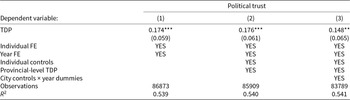
Table 2 reports our baseline results, with column 1 detailing the estimates controlling for individual and year fixed effects. The results indicate that broadcasting TDPs significantly improves political trust among individuals. In column 2, we additionally control for individual time-varying characteristics and a binary variable indicating whether there is a provincial-level TDP broadcast. The estimated effect of TDPs remains stable. In column 3, we add the interaction of city-level pre-determined variables, namely ln(population), SOE_share, and ln(health_insititution), with year dummy variables. The estimated effect of TDPs on political trust slightly decreases but remains statistically significant. We report additional results in Table A4 of Section A4 in the Appendix, including those obtained after controlling for the interactions between-year dummies and the other balanced predetermined city characteristics,Footnote 12 as well as province-specific time trends. The estimated coefficients remain positively significant.
Baseline results

Notes: The standard errors clustered at the city level are reported in parentheses. *, **, and *** indicate significance at the 10%, 5%, and 1% levels, respectively.
To assess the magnitude of the estimates, we observe that the sample mean of the level of political trust is 4.95 (the theoretical span is from 0 to 10). Accordingly, the estimates reported in column 3 of Table 2 indicate that TDPs increase political trust by 0.148, accounting for 3% of the sample mean. The magnitude appears small because we estimate the ITT effect of TDPs. In other words, we estimate the impact of broadcasts among the general population regardless of the extent to which individuals have received the information conveyed via these programs. We further compare the magnitude of our estimates with those of a recent study conducted by Minozzi et al. (Reference Minozzi, Kennedy, Esterling, Neblo and Jewell2024), who relied on a field experiment in the United States to evaluate the benefits of public deliberation. They find that participating in public deliberation increases individuals’ trust in government, leaders, and officeholders by 4%. Their study estimates the average treatment effect on the treated (ATT) of public deliberation on participants, so it is plausible that the magnitude of their estimates is higher than ours. Considering that the proportion of the general population in China actively participating in TDPs is likely to be very small, the impact of public deliberation on the participants in our study may be much higher.
A potential concern with our staggered DiD design is the plausibility of our baseline estimates. Specifically, the estimand of the two-way fixed effects regression specification used in equation (1) may not correspond with an intuitive causal parameter when there is heterogeneity in treatment effects across either time or units (Roth et al., Reference Roth, Sant’Anna, Bilinski and Poe2023). This is because it may include the “forbidden comparisons”: an early-treated unit is used as a control for later-treated units. We follow Goodman-Bacon (Reference Goodman-Bacon2021) to decompose the overall DiD estimates into four types. The results, reported in Table A3 of Section A3 in the Appendix, show that the total weight of the “forbidden comparisons” is 0.135, which is much smaller than that of the other two comparisons (0.865). The overall DiD estimates are also driven by the comparison between the never-treated group and the treated group. Overall, our baseline DiD estimates are sensible.
5.2. Event-study estimates
To check for potential pre-trends and study the dynamic effect of broadcasting TDPs on political trust, we estimate equation (2). We also present the event-study figures generated by several recently proposed estimators (Cengiz et al., Reference Cengiz, Dube, Lindner and Zipperer2019; Callaway and Sant’Anna, Reference Callaway and Sant’Anna2021; Gardner, Reference Gardner2022; Borusyak et al., Reference Borusyak, Jaravel and Spiess2024). These estimators provide more sensible estimands under the heterogeneity of treatment effects in settings with staggered treatment timing (Roth et al., Reference Roth, Sant’Anna, Bilinski and Poe2023). Figure 2 presents the event-study figures with a 90% confidence interval. Independent of the estimator used, the estimated coefficients for the years before the first TDP broadcasts are close to zero and statistically insignificant.Footnote 13 This suggests that there is no pre-trend, thus supporting the parallel-trend assumption. Additionally, Figure 2 demonstrates that the positive impact of TDPs begins to decrease two years after their initial broadcast in a given city.
Dynamic effects of TDPs on political trust.

Lastly, we conduct a sensitivity analysis for possible violations of the parallel-trend assumption using the method proposed by Rambachan and Roth (Reference Rambachan and Roth2023). We apply their method to our estimations. The results presented in Figure A7 of Section A3 in the Appendix show that the positive effect of TDPs on political trust persists despite a certain degree of violations of the parallel trend.
5.3. Discussion of the declining effect
The decline in the effect of TDPs on political trust over time is plausible for several reasons. From the supply side, the effectiveness of TDPs in addressing citizens’ demands and concerns may gradually decline due to two contributing factors. Firstly, local bureaucrats in developing countries are often heavily under-resourced relative to their responsibilities (Dasgupta and Kapur, Reference Dasgupta and Kapur2020). The functioning of TDPs is inexorably linked to pressure and oversight from high-ranking officials because the promotion and demotion of local Chinese officials are solely determined by superior organizational departments and CCP leaders. When public demands conflict with those of their superiors, local bureaucrats are only capable of addressing the most urgent issues highlighted by members of the public and others are neglected. Specifically, TDPs may initially attract the attention of local political leaders who push bureaucrats to address public demands. However, the multitasking nature of local governments prevents political leaders and bureaucrats from consistently focusing on specific issues raised during these broadcasts (Holmstrom and Milgrom, Reference Holmstrom and Milgrom1991; O’Brien and Li, Reference O’Brien and Li1999). Therefore, local bureaucrats may cease to address the same types of issues consistently.
Secondly, the agenda control inherent in TDPs restricts the exchange of information between citizens and local governments. As described in Section 3, although topics for TDPs are based on suggestions from citizens, they are carefully selected by TV stations and overseen by local governments. Consequently, relatively “easy” problems, such as traffic congestion, pollution control, and administrative misconduct of grassroots bureaucracies, are given high priority for resolution. However, certain public demands, especially those that are essential but would require substantial resources or extensive policy changes, may be postponed or neglected. This restriction of the public’s ability to express opinions and demands weakens the key function of TDPs, i.e., facilitating decision-making and conflict resolution (He and Warren, Reference He and Warren2011). Hence, the trust-enhancing effect of TDPs may be eroded in the long run.
On the demand side, audience engagement with TDPs may decline over time. The first few episodes of a TDP are intensely covered by local news media, attracting viewers due to their novelty. However, amid the plethora of competing television programs and mass media content, TDPs may gradually lose prominence without sustained media coverage (Badrinathan, Reference Badrinathan2021). Additionally, the declining effectiveness of TDPs and the agenda control within them may divert people’s attention away from these programs. Specifically, when people observe that only “easy” problems are addressed while more entrenched problems remain unresolved or undiscussed, their expectations for TDPs may wane over time, leading to a gradual loss of interest. However, the internalization of information conveyed by TDPs may require longer and more frequent exposure (Guess et al., Reference Guess, Nyhan and Reifler2020). Therefore, diminishing audience engagement may gradually erode TDPs’ impact on political trust.
5.4. Robustness checks
We conduct several robustness checks to corroborate our findings. Firstly, we attempt to exclude the effects of certain confounding policies on our estimates. Specifically, we consider three policies during our sample periods: the National Civilized City (NCC) campaign, business registration or administrative licensing system (ALS) reform, and the anti-corruption campaign.Footnote 14 These policies may have improved government performance, integrity, and public services, thereby enhancing political trust (Hetherington and Rudolph, Reference Hetherington and Rudolph2008; Winters and Weitz-Shapiro, Reference Winters and Weitz-Shapiro2013). We report the estimates of equation (1) controlling for the three confounding policies in Table A5 of Section A4 in the Appendix. The results show that our baseline findings remain stable.
Secondly, we use an alternative method to construct our dependent variable. In our baseline analysis, political trust is represented by a categorical variable with values ranging from 0 to 10. We redefine our dependent variable as a binary variable equaling one if a respondent’s original answer to the survey question is bigger than five; otherwise, it equals zero. Thirdly, we exclude a distinct category of qualified TDPs, which are predominantly held at the end of the year, from our treatment group. As they resemble temporary activities, these TDPs may not exert the same impact on political trust as those broadcast regularly throughout the year. Fourthly, we exclude CCP members and respondents holding administrative rolesFootnote 15 as these individuals may be more susceptible to the influence of TDPs and prone to overreporting their levels of political trust. The estimates in Table A6 of Section A4 in the Appendix demonstrate that our initial findings remain robust.
Lastly, we conduct a placebo test by randomly assigning TDP broadcasts to cities. Using this false TDP status variable, a placebo DiD estimation is conducted. The results presented in Figure A9 of Section A4 in the Appendix demonstrate that the false TDP status has no significant impact on political trust.
6. Mechanisms
In this section, we explore the mechanisms through which TDPs impact political trust. We posit that TDPs, as public deliberative platforms, incentivize local governments to improve responsiveness and generate narratives about local governance among citizens. Both of these channels can shape evaluations of the government among citizens and ultimately enhance their level of political trust.
6.1. Enhancing government responsiveness
We first examine whether TDP broadcasts enhance government responsiveness, proxied by public goods provision and government employees’ service attitudes. To measure public goods provision, we rely on the municipal government’s completed fixed assets investment in urban service facilities. These facilities cover six industries: roads and bridges, natural gas, landscaping, drainage, water supply, and urban environmental sanitation. The data originates from the China Urban Construction Statistical Yearbooks. We take the natural log of the original values. We re-estimate equation (1) with the local government’s investments in urban service facilities as the dependent variable and the estimates are reported in Table 3.
The effect of public deliberation on government responsiveness: investment in urban service facilities

Notes: The standard errors clustered at the city level are reported in parentheses. *, **, and *** indicate significance at the 10%, 5%, and 1% levels, respectively.
The results reported in Table 3 demonstrate that the broadcasts of TDPs significantly increase the local government’s investment in roads and bridges, natural gas, and landscaping by 19.7%, 23.1%, and 42.4%, respectively. The most prominent effect of TDPs is on the investment in landscaping. This is consistent with the results presented in Figure A11 in Section A6 in the Appendix that environmental protection is the most frequent topic of discussion within this context. However, we find that TDPs do not significantly influence government investment in the other three industries of drainage, water supply, and sanitation or the overall level of investment in urban service facilities. Overall, although public deliberation does improve local government responsiveness to some extent, it does not lead to a comprehensive increase in public goods provision.Footnote 16 This helps explain the findings presented in Figure 2, whereby the positive influence on political trust appears to be short-term in nature.
We also examine the effect of TDPs on the service attitudes of government employees, which is measured using citizens’ self-reported experiences of poor service from government employees. Specifically, we use the following CFPS survey question: “Have you had any of the following experiences in the last twelve months? (1) unfair treatment by government officials; (2) conflict with government officials; (3) unreasonable delay and stalling at a government agency; (4) unreasonable charges paid to a government agency.”Footnote 17 For each of these four experiences, we construct a binary variable equaling one if a respondent had that type of experience in the 12 months prior to answering the survey, and zero otherwise.Footnote 18 We also construct a binary variable equaling one if a respondent had any of these four types of experience in 12 months prior to answering the survey, and zero otherwise.
We re-estimate equation (1) using respondents’ experiences of poor service from government employees as the dependent variable. The results are reported in Table 4, with column 1 showing that TDP broadcasts reduce the probability of citizens experiencing any type of poor service from local government officials by 3.4%. In particular, the impact of TDPs is driven by a reduction in the likelihood of encountering unfair treatment by government officials and facing unreasonable delays, stalling, and charges at government agencies. Overall, these broadcasts significantly increase local government officials’ service attitudes. Together, the results reported in Tables 2 and 3 explain why public deliberation can enhance political trust among the general population. Specifically, even for citizens who neither participate in nor observe public deliberation directly, the improved government responsiveness can enhance their political trust.
The effect of public deliberation on government responsiveness: local government employees’ service attitudes

Notes: The standard errors clustered at the city level are reported in parentheses. *, **, and *** indicate significance at the 10%, 5%, and 1% levels, respectively.
6.2. Generating narratives about local governance
As discussed in Section 2, public deliberation can generate narratives that improve public perceptions of local governments and enhance people’s levels of political trust, even among those who do not benefit from the government actions. Considering that TDPs are TV programs (also available online), this hypothesis implies that individuals who frequently watch TV or browse the Internet for political information are more likely to be influenced by the narratives presented via these broadcasts (Zaller, Reference Zaller1992). To test this hypothesis, we examine whether the effects of TDPs on political trust are heterogeneous with respect to respondents’ exposure to mass media.
We utilize the frequency with which individuals obtain political news through mass media as an indicator of their exposure to it. Specifically, we rely on two survey questions in t che CFPS: (1) “On how many days have you obtained political news through television in the past week?” (2) “On how many days have you obtained political news through the Internet in the past week?”Footnote 19 For each question, we create a binary variable that equals one if a respondent’s answer exceeds the 75th percentile value of all responses in the 2014 wave and zero otherwise, denoted as high_tv_exposure and high_internet_exposure, respectively.Footnote 20 The values of the two variables are time-invariant and have been drawn from the 2014 wave. This helps alleviate the concern that TDP broadcasts could result in an increased number of individuals accessing political information via TV or the Internet, which may bias our estimates. While we admit that these proxies are imperfect because the CFPS does not directly ask whether respondents watched TDPs, they are the best available indicators in our context.
Table 5 reports the heterogeneous effect of TDPs on political trust based on respondents’ exposure to mass media. The estimates in columns 1 and 2 indicate that the positive effects of TDPs on political trust are more pronounced for individuals who frequently obtain political information through TV programs and the Internet. In particular, the results in column 1 demonstrate that broadcasting TDPs increases the level of political trust among people who frequently obtain political information on TV by 0.231, accounting for 4.67% of the sample mean. The magnitude of the effect is 56.7% higher compared to the baseline estimates reported in column 3 of Table 2. For people with less exposure to TV, the impact of TDPs is close to zero. Likewise, the estimates in column 2 suggest that individuals with high Internet exposure experience an increase in the value of political trust by 0.235. The magnitude of this effect closely mirrors that observed among respondents with high TV exposure. Overall, greater exposure to mass media correlates with a stronger trust-enhancing effect of TDPs.
Heterogeneous effects of public deliberation based on respondents’ exposure to mass media

Notes: The standard errors clustered to the city level are reported in parentheses. *, **, and *** indicate significance at the 10%, 5%, and 1% levels, respectively.
The evidence related to the narrative effect, shown in Table 5, is less direct than the empirical evidence supporting the responsiveness effect, presented in Tables 3 and 4. The empirical results regarding media exposure provide suggestive evidence, highlighting several theoretically relevant possibilities. For instance, individuals exposed to media such as television or the Internet do not necessarily have to be those who participated in TDP deliberations or directly benefited from the resulting policy improvements. Even if they did not observe the deliberative process itself, they may still learn about TDPs through news reports on television or the Internet. Exposure to such reporting or indirect coverage of TDPs could also influence citizens’ perceptions of the government. The fact that multiple explanations remain plausible suggests the general compatibility of our theoretical framework with a wide range of scenarios.
Combining the results from Tables 3, 4, and 5, we can infer that the two mechanisms we propose are both relevant. First, because TDPs can improve local governments’ policy responsiveness to citizens and enhance public services, those citizens who directly benefit from the improved services or policies exhibit higher trust in the government, even if they have not participated in or watched the deliberative process, or are unaware of TDPs. Second, for those who have watched TDPs through TV or online videos, or who have learned about TDPs through news coverage or media promotion, their trust in the government also increases, even if they do not directly benefit from the policy improvements.
6.3. Shaping citizens’ evaluations of local governments
Lastly, the nature of political trust is inherently evaluative: citizens gauge both the input (e.g., responsiveness) and output (e.g., performance) of the government in determining their levels of trust (Easton, Reference Easton1975; Listhaug and Jakobsen, Reference Listhaug, Jakobsen and Uslaner2018). Both the responsiveness and narrative effects of public deliberation can improve citizens’ subjective evaluations of local governments, ultimately leading to increased levels of political trust (Van der Meer, Reference Van der Meer and Uslaner2018). We examine whether public deliberation improves people’s satisfaction with the input and output of local governments. We use local governments’ performance in social affairs to measure their output, including health care, education, social security, and employment. Moreover, we rely on fighting crime, fair law enforcement, impartial handling of affairs, and maintaining government integrity to measure the input of local governments. The results in Table A8 of Section A5 in the Appendix provide suggestive evidence that TDPs enhance citizens’ subjective evaluations of local governments’ input and output.
7. Conclusion
Political trust functions as a form of glue that unifies the entire society. In democracies, political trust plays an increasingly pivotal role in countering the rising threat of populism and constraining the proliferation of anti-system parties in the post-pandemic era. In autocracies, political trust remains vital in dissuading collective actions and maintaining state stability. Nevertheless, our understanding of the sources of political trust remains somewhat limited.
This paper investigates the impact of public deliberation on political trust in China. It exploits the variation in TDP broadcasts, which serve as public deliberative platforms, across cities and time. Our findings show that public deliberation can significantly enhance political trust in China. Specifically, we provide evidence that public deliberation catalyzes local government responsiveness: it improves the level of public goods provision and fosters a more positive attitude among government employees toward serving the public. Public deliberation also generates narratives surrounding local governance, shaping the perceptions of the general population, even among those who neither participate in nor observe the deliberative process directly. Importantly, public deliberation can be considered as an input to local governance, and citizens’ political trust as an output. Hence, our results establish a positive link between the two, driven by improved government responsiveness and the narratives generated.
Nonetheless, our theoretical focus on the agency problem within local governments does not necessarily imply that we believe this is the only relevant mechanism for China’s local governance. In other words, our results serve as a marginal complement to the general argument by He and Warren (Reference He and Warren2011) and do not negate other mechanisms outlined in their theoretical framework.Footnote 21 In fact, we believe that much more empirical work should be conducted in the future to examine these possible mechanisms using rich datasets and rigorous causal methods. Furthermore, it is important to recognize that the positive impact of TDPs on political trust may diminish over time as local governments do not have sufficient resources to effectively multitask and retain control over the agenda of such programs. To better understand the role of public deliberation, more comparative work is needed to study a broader range of deliberative institutions with a richer set of power structures.
Supplementary material
The supplementary material for this article can be found at https://doi.org/10.1017/psrm.2025.10037. To obtain replication material for this article, please visit https://doi.org/10.7910/DVN/O15RGJ.
Acknowledgements
We would like to thank Associate Editor Nathalie Giger and the anonymous reviewers for their constructive comments and suggestions. We are also indebted to Mark Fey, Anderson Frey, Jefferson Lecio Leal, Alexander Lee, Shengqiao Lin, Zheng Ling, Edmund Malesky, Bonnie Meguid, Jennifer Pan, Casey Petroff, Samuel Popkin, Margaret Roberts, Susan Shirk, Yichun Si, Daniela Stockmann, Scott Tyson, Bahar Zafer, and seminar participants at the University of Rochester, as well as the 2024 APSA Annual Conference, for their helpful comments and discussions.
Competing interests
The authors declare none.
Funding statement
We acknowledge the support from the National Natural Science Foundation of China (grant numbers: 72474115, 72074133).




 Open access

