



There is a global trend towards the legalisation of assisted suicide and euthanasia. Proponents justify assisted suicide by arguing that when all reasonable treatment options have been exhausted, it enables individuals to retain control at the end of life and offers a peaceful and dignified death. However, this claim lacks empirical support of sufficient quality and rigour to meet contemporary standards of evidence-based medicine and drug regulation. Reference Zinchenko, Taylor and Hollins1
One emerging alternative, psychedelic therapy, remains conspicuously absent from mainstream debates concerning end-of-life care and assisted suicide. However, in addition to demonstrating efficacy in treatment-resistant psychiatric conditions, psychedelic therapy has also been shown to reduce distress in terminally ill individuals. This significant fact appears to have been overlooked in recent UK parliamentary debates.
Internationally, several jurisdictions have introduced regulated frameworks for the therapeutic use of psychedelics. In Canada, the Special Access Program permits the use of psilocybin on a case-by-case basis for life-threatening conditions unresponsive to conventional treatment, including end-of-life distress. Similarly, in Oregon (USA) legislation authorises supervised psilocybin use.
In this editorial, I argue that psychedelic therapy warrants consideration as a legitimate, evidence-based intervention that could reduce requests for assisted suicide. Without further research, psychedelic therapy risks continued marginalisation because of historical stigma and unjustified regulatory barriers. The focus is specifically on assisted suicide at the end of life, which is the subject of recent legislative proposals in the UK. 2
The suicidal state of mind
Suicidal states of mind are often regarded as symptoms of mental illness requiring treatment. However, in recent decades, the growing acceptance of assisted suicide has introduced a shift in this perspective. Not all suicidality is now considered inherently pathological. In the context of terminal illness, it is increasingly reframed as an understandable response to unbearable suffering.
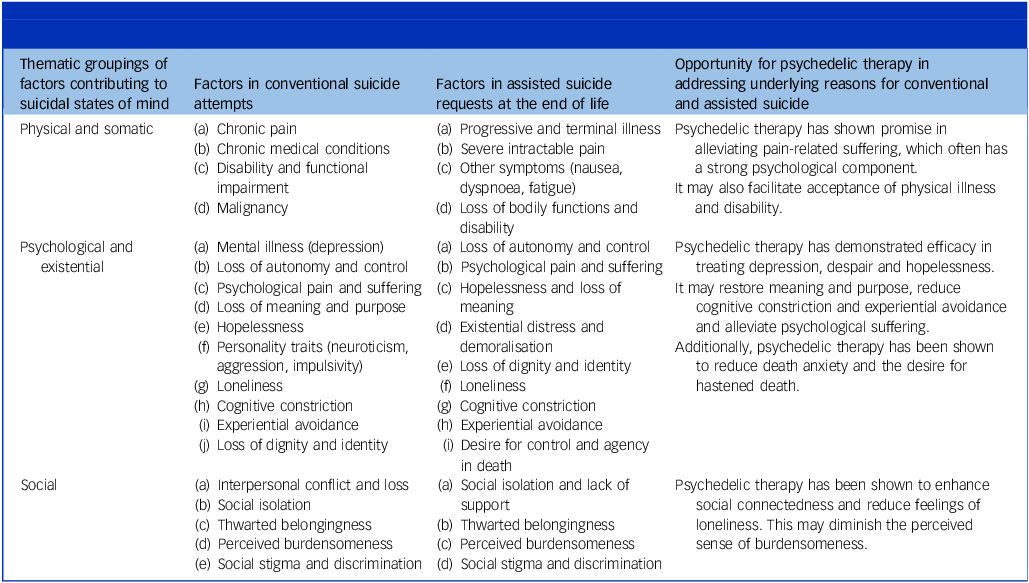
The reasons underlying suicide are varied and complex (see Table 1). However, certain recurrent themes have consistently been identified and may be broadly categorised into two domains: intrapsychic factors relating to the individual, and interpersonal factors relating to the social context. Reference Macintyre, Mansell, Pratt and Tai3
Comparison of similarities and differences between reasons underlying suicidal states of mind in conventional and assisted suicide and the potential role of psychedelic therapy. The lists are not exhaustive but condensed for illustrative purposes

Table 1 Long description
The table has four columns and three rows. The columns are labeled Thematic groupings of factors contributing to suicidal states of mind, Factors in conventional suicide attempts, Factors in assisted suicide requests at the end of life, and Opportunity for psychedelic therapy in addressing underlying reasons for conventional and assisted suicide. The rows are labeled Physical and somatic, Psychological and existential, and Social. Row 1: Physical and somatic, Factors in conventional suicide attempts, Chronic pain, Chronic medical conditions, Disability and functional impairment, Malignancy, Factors in assisted suicide requests at the end of life, Progressive and terminal illness, Severe intractable pain, Other symptoms (nausea, dyspnoea, fatigue), Loss of bodily functions and disability, Opportunity for psychedelic therapy in addressing underlying reasons for conventional and assisted suicide, Psychedelic therapy has shown promise in alleviating pain-related suffering, which often has a strong psychological component. It may also facilitate acceptance of physical illness and disability. Row 2: Psychological and existential, Factors in conventional suicide attempts, Mental illness (depression), Loss of autonomy and control, Psychological pain and suffering, Loss of meaning and purpose, Hopelessness, Personality traits (neuroticism, aggression, impulsivity), Loneliness, Cognitive constriction, Experiential avoidance, Loss of dignity and identity, Factors in assisted suicide requests at the end of life, Loss of autonomy and control, Psychological pain and suffering, Hopelessness and loss of meaning, Existential distress and demoralisation, Loss of dignity and identity, Loneliness, Cognitive constriction, Experiential avoidance, Desire for control and agency in death, Opportunity for psychedelic therapy in addressing underlying reasons for conventional and assisted suicide, Psychedelic therapy has demonstrated efficacy in treating depression, despair and hopelessness. It may restore meaning and purpose, reduce cognitive constriction and experiential avoidance and alleviate psychological suffering. Additionally, psychedelic therapy has been shown to reduce death anxiety and the desire for hastened death. Row 3: Social, Factors in conventional suicide attempts, Interpersonal conflict and loss, Social isolation, Thwarted belongingness, Perceived burdensomeness, Social stigma and discrimination, Factors in assisted suicide requests at the end of life, Social isolation and lack of support, Thwarted belongingness, Perceived burdensomeness, Social stigma and discrimination, Opportunity for psychedelic therapy in addressing underlying reasons for conventional and assisted suicide, Psychedelic therapy has been shown to enhance social connectedness and reduce feelings of loneliness. This may diminish the perceived sense of burdensomeness.
Intrapsychically, suicide can be conceptualised as a means of achieving a higher-order goal, often the cessation of intolerable suffering. It may be understood as a state of ‘experiential avoidance’, wherein the overwhelming drive is to escape or terminate distressing mental states. Paradoxically, suicidal ideation at the end of life may emerge from a conflict between a strong desire to continue living and the reality of being unable to do so. Since humans require a sense of control over their lives, when such a conflict is perceived as unresolvable, it can result in a profound sense of losing control over one’s circumstances. This can be deeply distressing, and suicide comes to be viewed as a means of reasserting control. Reference Macintyre, Mansell, Pratt and Tai3
Another common feature of suicidal states of mind is a narrowing of awareness regarding alternative possibilities, a phenomenon often described as ‘cognitive constriction’. This form of tunnel vision manifests as an intense focus on the cessation of suffering, while other considerations, such as relationships or alternative coping strategies, are excluded from awareness. Reference Macintyre, Mansell, Pratt and Tai3
At the same time, locating the suicidal state of mind solely within the individual is problematic, as suicide is also an inherently interpersonal phenomenon that arises in relation to others and within a broader social and cultural context. The experience of alienation and disconnection, in which individuals feel rejected and excluded from meaningful social relationships, often accompanies suicidal states of mind. A lack of social support and connectedness has been consistently identified as a significant risk factor for suicide. The perception of oneself as a burden to others, or to society more broadly, also significantly contributes to suicidal states of mind. Reference Macintyre, Mansell, Pratt and Tai3
Why do people seek out assisted suicide?
In terminal illness assisted suicide frameworks, such as those recently proposed in the UK, the focus tends to be on end-of-life suffering, existential distress and loss of control during the final stages of illness. Across multiple jurisdictions, requests for assisted suicide are frequently associated with symptoms directly related to physical illness, such as uncontrolled pain, loss of bodily functions and immobility. 4,Reference Fischer, Huber, Furter, Imhof, Mahrer Imhof and Schwarzenegger5
However, psychological, social and cultural factors also consistently contribute to such decisions. These include fear of future suffering, a desire to retain control over one’s circumstances, a perceived loss of dignity and a sense of being a burden to others. 4,Reference Fischer, Huber, Furter, Imhof, Mahrer Imhof and Schwarzenegger5 It is therefore important to consider whether there are meaningful commonalities with the mental states that result in conventional suicide (see Table 1).
As noted above, individuals seeking assisted suicide frequently cite pain as a reason for their request. However, pain encompasses both somatic and psychological experiential domains. Mental states can significantly influence the perception and severity of pain, while pain itself can alter affect and cognition, creating a bidirectional relationship that is difficult to disentangle and that can result in the experience of ‘total pain’.
Loss of function and self-identity resulting from terminal illness can also generate a profound psychological conflict and a sense of loss of control. This may result in cognitive constriction and a narrowing of attention, often linked with experiential avoidance. Suicide may then come to represent an opportunity to regain control over one’s internal and external experiences. Additionally, concerns regarding the need for care and feelings of social isolation, overlap with the experience of isolation and sense of being a burden, commonly identified in conventional suicide.
With all this in mind, at end of life, assisted suicide could begin to function as a form of socially sanctioned suicide, providing a legitimised means of avoiding particular experiential states associated with suffering and loss of agency.
Psychedelic phenomenology
Psychedelics include substances such as psilocybin or lysergic acid diethylamide (LSD) which act primarily as 5-HT2A receptor agonists. One of the most notable characteristics is their capacity to induce profound shifts in phenomenology, and even in consciousness itself. Mental states that are typically experienced as stable and persistent can be dramatically altered by a single dose, with effects that may endure well beyond the acute experience. At sufficiently high doses, psychedelics reliably induce changes across multiple experiential domains, including perception, affect and cognition.
The phenomenology of psychedelic experiences is highly varied; however, common themes such as profound loss of one’s ordinary sense of self or personal identity, self-transcendence, interconnectedness and being outside ordinary temporal and spatial constraints have been identified. Reference Griffiths, Johnson, Richards, Richards, McCann and Jesse6
Clinically relevant features of psychedelics include their ability to disrupt rigid and entrenched states of mind and their anti-suicidal properties. Even at high doses they demonstrate a strong safety profile, although they may contribute to persistent impairments in reality testing. Another notable effect is the reduction in experiential avoidance, a psychological pattern strongly linked to both depression and suicidality. Reference Zeifman, Wagner, Watts, Kettner, Mertens and Carhart-Harris7
Psychedelic therapy in palliative and end-of-life care
A common justification for assisted suicide is that, if all treatment options have been exhausted and the individual continues to suffer, the humane and compassionate response is to assist them in ending their life. However, this reasoning presupposes that all viable options have indeed been explored. Even setting aside the issue of inequitable access to evidence-based palliative care in the UK, which itself can offer individuals greater control over their ‘unbearable’ experiences, psychedelic therapy is a promising yet largely unexplored alternative in terminal illness.
Clinically significant anxiety, depression and existential distress are common experiences in terminal illness. These are associated with impaired social functioning, hopelessness, worse pain, a greater desire for hastened death and increased suicide rates. Unfortunately, conventional treatment approaches, including currently available medication and psychotherapy, demonstrate limited efficacy. Reference Ross, Agrawal, Griffiths, Grob, Berger and Henningfield8
Early research conducted in the 1960s and 1970s investigated the effects of LSD on pain and quality of life in patients with terminal cancer. In addition to its analgesic properties, LSD was noted to reduce distress, hopelessness and emotional suffering, which may themselves have contributed to pain. Participants also reported a diminished fear of death and improved emotional adjustment to dying. Reference Ross, Agrawal, Griffiths, Grob, Berger and Henningfield8
Beginning in 2011, a second wave of research began exploring psychedelic therapy for symptoms associated with life-threatening illness. Since then, a number of small studies have investigated psilocybin and LSD as treatments for anxiety in patients with advanced-stage cancer. These studies have demonstrated both acute and sustained reductions in anxiety and depression. Additionally, they reported reductions in demoralisation, hopelessness, loss of meaning and purpose and desire for hastened death. Sustained improvements in existential distress and attitudes towards death, including reductions in suicidal ideation, suggest an overall adjustment to the prospect of death. Furthermore, there have been no reported serious adverse events, indicating that psychedelic therapy can be delivered safely in life-threatening illness. Reference Ross, Agrawal, Griffiths, Grob, Berger and Henningfield8 Although potential adverse events require further evaluation within a broader risk–benefit analysis of these substances.
An important finding in the context of UK assisted suicide legislation is the durability of effect. In one study, at 6 months post-treatment, the majority of participants continued to exhibit clinically significant reductions in depression and anxiety. Importantly no serious or lasting adverse events were observed. Psilocybin was associated only with transient, dose-related, minor side-effects that resolved without medical intervention. Reference Griffiths, Johnson, Carducci, Umbricht, Richards and Richards9 This sustained benefit aligns closely with the 6-month prognosis window specified in the proposed legislation 2 and suggests that psychedelic therapy could provide meaningful relief lasting through to natural death, without the need for repeated interventions.
Current legal barriers to psychedelic therapy
One of the primary barriers to the use of psychedelics, both in research and clinical settings, is their current drug scheduling. In the UK, classic psychedelics are Schedule I substances under the Misuse of Drugs Regulations 2001. It is important to note that this scheduling largely reflects historical sociopolitical decisions rather than robust psychopharmacological or safety data.
This scheduling imposes significant restrictions on research and has substantially hindered the translation of research findings into clinical practice. For researchers, the requirement to obtain special licensing and permissions represents a considerable legal and administrative barrier to conducting larger studies in this field. Rescheduling of psychedelic substances would significantly facilitate further research, with potential benefits extending across psychiatry and palliative care.
The recently proposed Terminally Ill Adults (End of Life) Bill would grant the Secretary of State authority to approve substances for use in assisted suicide by regulations. 2 This provision would effectively bypass existing regulatory frameworks, including the Medicines and Healthcare products Regulatory Agency and the National Institute for Health and Care Excellence. Importantly, several substances used internationally for assisted suicide such as pentobarbital, are controlled drugs in the UK and are neither licensed nor available for human use. Reference Zinchenko, Taylor and Hollins1
A further argument can therefore be made that similar statutory powers could be extended under this Bill to allow the rescheduling of psychedelics.
Looking ahead
It is important to recognise the gravity of assisted suicide as a final and irreversible act, typically presented as an option only after all other avenues have been explored and exhausted. Given the profound psychological shifts psychedelics can induce and the overlap between their effects and the reasons often cited for requesting assisted suicide, psychedelic therapy is a treatment option that needs to be explored before the widespread introduction of assisted suicide.
Three potential policy trajectories can be identified.
-
(a) Psychedelics are rescheduled, evaluated and made available in specialist palliative care, alongside other evidence-based interventions before the legalisation and implementation of assisted suicide. This aligns with the principle that assisted suicide should only be considered once all reasonable therapeutic options have been exhausted.
-
(b) Psychedelics are rescheduled and become available, but are offered alongside assisted suicide as an alternative specialist palliative care option. This approach does not follow established medical norms of treatment escalation, which typically require that less invasive and potentially effective interventions are attempted prior to irreversible options.
-
(c) Assisted suicide is legalised and implemented while psychedelics remain inaccessible due to ongoing regulatory barriers. This is the most difficult to justify ethically, given emerging evidence that psychedelic therapy may alleviate end-of-life distress for some patients. Especially because the evidence base supporting the use of psychedelics is substantially stronger than that for drugs used in assisted suicide.
Given that the Bill’s scope is to allow terminally ill adults, ‘…subject to safeguards and protections…’ to access assistance in ending their life ‘…and for connected purposes,’ 2 it is reasonable to consider whether evaluating potentially effective treatments for existential distress could itself constitute such a safeguard or a connected purpose.
Acknowledgement
I am grateful to Professor Baroness Sheila Hollins for stimulating my thinking and prompting reflection on the lack of evidence and regulation surrounding drug use in assisted suicide.
Funding
This research received no specific grant from any funding agency, commercial or not-for-profit sectors.
Declaration of interest
R.Z. is a member of the Royal College of Psychiatrists and the British Medical Association and an ST8 in General Psychiatry and Medical Psychotherapy in the National Health Service (NHS). He is participating in the Royal College of Psychiatrists’ Parliamentary Scholars Scheme. This is an unpaid role undertaken within protected special interest time, in accordance with NHS England guidance for higher psychiatric specialty training. For the duration of the scheme, R.Z. is attached to the parliamentary team of Baroness Hollins in the House of Lords and has co-authored a number of articles with Baroness Hollins raising concerns about the Terminally Ill Adults (End of Life) Bill. He does not belong to any organisations that support or oppose the introduction of assisted suicide in the UK and does not receive any funding, honoraria or payment in addition to his NHS role as a specialty trainee in general psychiatry and medical psychotherapy.



eLetters
No eLetters have been published for this article.