




1. Introduction: the beauty of a good TV show
Do you have a favourite film or TV show; one that you come back to – again and again? I readily confess that, when it comes to repeated watching, it is probably the more than 30-year-old sci-fi show Star Trek: The Next Generation that wins out. You will find me – usually sunk into the favourite spot on my sofa (next to my put-upon husband who has to watch as well) – happily marvelling, again and again, at the gentle android Data’s latest attempt at becoming human; Captain Jean-Luc Picard’s prudent negotiations with the untrustworthy Kardassians; enigmatic bartender Guinan’s wise counsel preventing the chaos of alternative timelines; Warf’s selfless Klingon courage (and occasional hot-headedness) when protecting his human friends in crisis situations; chief engineer Jordi’s calm problem-solving genius when the Enterprise has broken down, again, in a life and death moment; and of course Dr Beverly Crusher’s commitment to heal the wounds of anybody – friend and foe – who ends up injured in her sick bay. Despite the wonky sets and outdated sci-fi tech, the big questions about human nature, morality, freedom, and friendship seem timeless to me. There are of course bad episodes (very bad ones!), but when the story and characters work, I happily and boldly go with the Star Trek crew where no one has gone before and marvel again, for the 100th time. What happens when a film or TV show delights our intellect and senses – as Star Trek TNG clearly does mine? What is it that a good film, or a good TV show, does when it draws us – the audience – out of ourselves and into its fictional world and the actively lived lives portrayed in it?
To explore these questions about the good of film and filmmaking, I will first look at the virtue of art more generally. To do so, I draw on Catholic philosopher Jacques Maritain’s Aquinas-inspired conception of the virtue of art. My aim for the rest of the paper is then to see how the artform of the moving image, and its processes of production and reception, map onto this.
2. What is the virtue of art?
Art, Maritain tells us, dwells in the sphere of making. This means that art is concerned – not with knowledge as such – but with how knowledge is used for the practical ends of perfecting a work, e.g., an episode of Star Trek. Footnote 1 Here, in the sphere of making, the artist, let’s say the filmmaker, focuses their intelligence and energy into the production of a ‘good episode’ – guided by the respective artform’s traditions, rules, and conventions, i.e., those that determine what constitutes a good film (or sci-fi show) in a certain time and place. Focused on the function and end of the artwork that is to be made, artistic virtue then operates quite differently to moral virtue. This is because moral virtue is firstly concerned with our human actions – the exercise of our free will for the common, human Good. Moral virtue is about doing and feeling the right thing, at the right time, in the right circumstances. Morality is about the perfection of a human being for human ends. In seeming opposition, artistic virtue is about the perfection of a piece of work for ends determined by the cultural object itself. ‘So Making is ordered to such-and-such a definite end, separate and self-sufficient, not to the common end of human life; and it relates to the peculiar good or perfection not of the man making, but of the work made’.Footnote 2
Yet, despite their different outlook on the stage of life, both artistic and moral virtue are also curiously bound together. ‘They cannot ignore or disregard one another, for man belongs in these two worlds, both as intellectual maker and as moral agent (…)’.Footnote 3 That is, both virtues are concerned with the use of human reason for the practical purposes of living a good life. Consequently, the artist is of course not just responsible to his/her work at the expense of the overall good of human existence. Human life needs Beauty and, with that, the artist’s intellectual creativity. At the same time, art is made for the reception of human beings and produced in the human sphere, where morality operates.Footnote 4 Thus, morality and art both strive, albeit in different (and perhaps often conflicting) ways, towards the perfection of human life. Hence, both sovereign spheres of art and morality are also unified. Both intend towards the higher Good of human happiness, which for Maritain, is ultimately a striving (and hope) for union with God. This is because God – as the mystery of (uncreated) Being – is not only the beginning but also the fulfilment and, with that, end of our human searching for Beauty, Truth, Goodness, and Love.Footnote 5
Followingly, the good filmmaker’s creation of a perfected work, like the good person’s perfected actions, also express a co-natural – knowledge of God. To put it differently, they are an expression, and foretaste, of this journey of formation towards (ultimate) Beauty and Love. Here, God, understood as Being itself, cannot be known directly through our limited human sensory apparatus. Yet, God’s nature – as Goodness, Beauty, Truth, and their ultimate Unity – also reveals itself in and through the material world and, thus, can be indirectly known and dwelled with. For example, the artist works with and through Beauty, in the act of making, when focused on the Good of the work to be made. In turn, the perfected artwork’s structure (its ‘integrity’) also gives account of this co-natural knowledge of Beauty and Being in the reception experience. This means that Beauty’s radiance – and by association its Truth (e.g., a film’s truthful depiction of human existence) – are then also indirectly encountered by the artwork’s audience – when they delight, through their intellect and senses, and are moved to watch the well-constructed Star Trek episode’s moving images of Picard’s prudent actions, Guinan’s wise counsel, Warf’s courageous acts, and Dr Crusher’s active caring.
In conclusion, the virtue of art is then indeed not unlike moral virtue. Both are concerned with the cultivation of a certain quality and habit of mind. This means that, to possess the virtue of art as a living intellectual habit, the artist must be able to translate between his intuition of what the work is going to be, and the practical circumstances and possibilities of bringing these ideas and intuitions to life in their historically and culturally specific artform. Art, like the moral virtue of prudence, is an intellectual virtue for Maritain, because Beauty first enters the sphere of making in the artist’s mind – their poetic intuition. Thence, creative or poetic intuition describe the artist’s cultivated attention for the arrival of a beautiful idea – not as an abstract concept or fully formed knowledge of what is to be done but as an intuitive sensing of an intellectual-emotional form or impulse that catalyses the production process. ‘A creative idea is not conceptual. It is an intellectual form, which contains the thing that will be brought into [material] existence’.Footnote 6
3. How does creative intuition work?
Following this rough sketch of Maritain conception of the virtue of artmaking, let us now look at how a practising filmmaker, such as US-American filmmaker and visual artist David Lynch, speaks about this initiating stage in the virtue of art: the arrival of an idea in creative intuition. This is an excerpt from a conversation with Paul Holdengräber at the Gilman Opera House in Brooklyn.Footnote 7
Lynch: An idea comes and you see it, and you hear it, and you know it.
Holdengräber: How does it come?
L: It comes like on a TV in your mind. (laughs, audience laughs too)
H: You know there’s a line I’ve always loved of Leonard Cohen. He said: If I knew where the good songs came from, I would go there more often.
L: Absolutely. We don’t do anything without an idea. So, they’re beautiful gifts. And I always say desiring an idea is like a bait on a hook, you must pull them in. And if you catch an idea that you love, that’s a beautiful, beautiful day. And you write that idea down, so you won’t forget it. And that idea that you caught might just be a fragment of the whole, whatever it is you’re working on. But now you have even more bait. Thinking about that small fragment that little fish will bring in more, and they’ll come in, and they’ll hook on. And more and more come in, and pretty soon you might have a script, or a chair, or a painting, or an idea for a painting.
H: But they come, as in small …
L: More often than not, small fragments. I like to think of it as in the other room. The puzzle is all together there. But they keep flipping in just one piece at a time.
H: (turns around theatrically) In the other room over there. In a sense, David, there’s always another room somewhere.
L: That’s a beautiful thing to think about.
H: Let’s think about it a bit.
L: You think about it (laughs, audience laughs too).
Although Lynch does not directly refer to Maritain’s philosophy of art-making of course, he uses the metaphor of fishing to locate, much like Maritain, the instigation of the act of making in the artist’s cultivated intellect and desire for Beauty. He depicts the artist’s receptive-active participation in the mystery of Being – never directly accessible in the always other room – as the act of hooking up bait in the artist’s’ mind, catching appearing (i.e., radiating) fragments of intellectual and emotional forms. The filmmaker is, of course, no contemplative mystic (even if she/he may be considered a kindred spirit).Footnote 8 As a result, the freedom of contemplation in creative intuition does not tend towards silence but expression. Poetic intuition must enter the operative sphere of artmaking, steeped in rules and conventions, history, and culture. Following the idea’s conception, the artist then intentionally directs Beauty’s creative inspiration towards the act of making – via his/her hands-on expertise as a skilled craftsperson in their field. ‘Poetic intuition is born in the unconscious, but it emerges from it; the poet is not unaware of this intuition, on the contrary it is his most precious light and the primary rule of his virtue of art’.Footnote 9
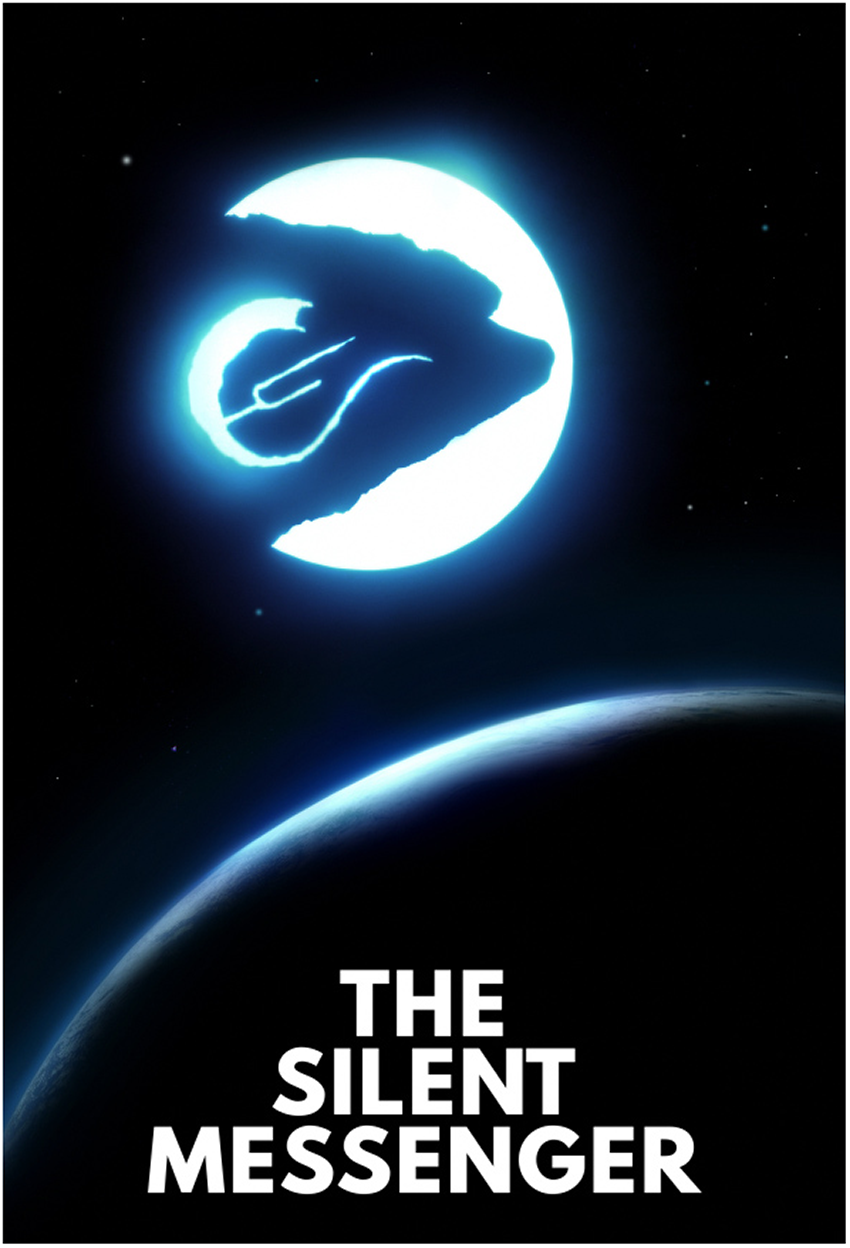
Film poster 1.

4. Making The Silent Messenger: from creative intuition into moving images
How does the filmmaker translate poetic intuition – as the primary rule of the virtue of art – into the hands-on realities of filmmaking? Let’s go back to a Sci-Fi example; a film in which I was involved in as performer and producer, the Sci-Fi mystery thriller The Silent Messenger. Footnote 10
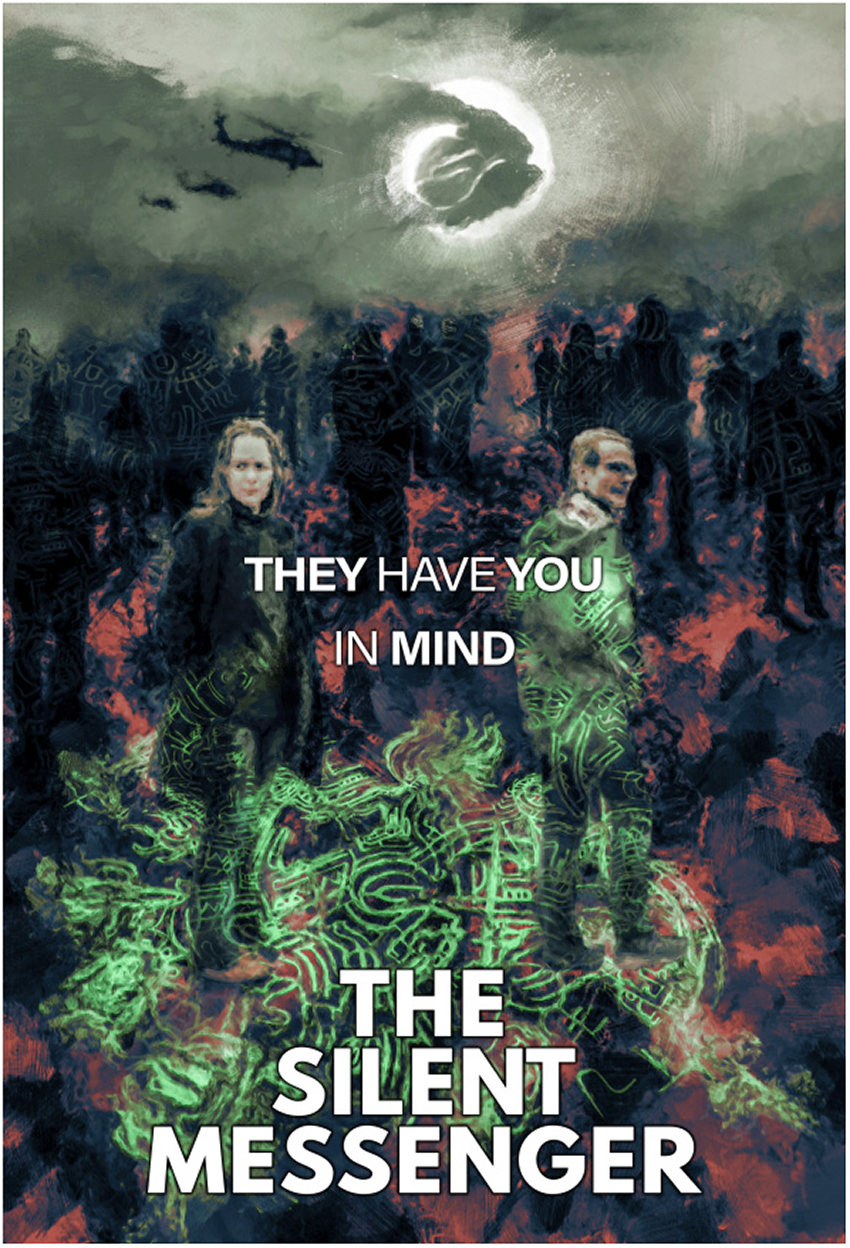
The film is about an asteroid marked with an alien symbol that appears in the solar system and causes humanity to have shared nightmares of an apocalypse. The asteroid is photographed by the Hubble telescope on its way past Earth. It will cause a total eclipse. Marked with a large alien symbol, it is proof of other intelligent life in the universe. Dr Lara Kemper, cognitive archaeologist, and her ex-husband, anthropologist William Thomas, seek out the symbols’ meaning when they and the rest of humanity begin to suffer from collective nightmares. Soon everyone is falling into trances and drawing further symbols of an unknown language.
Film poster 2.

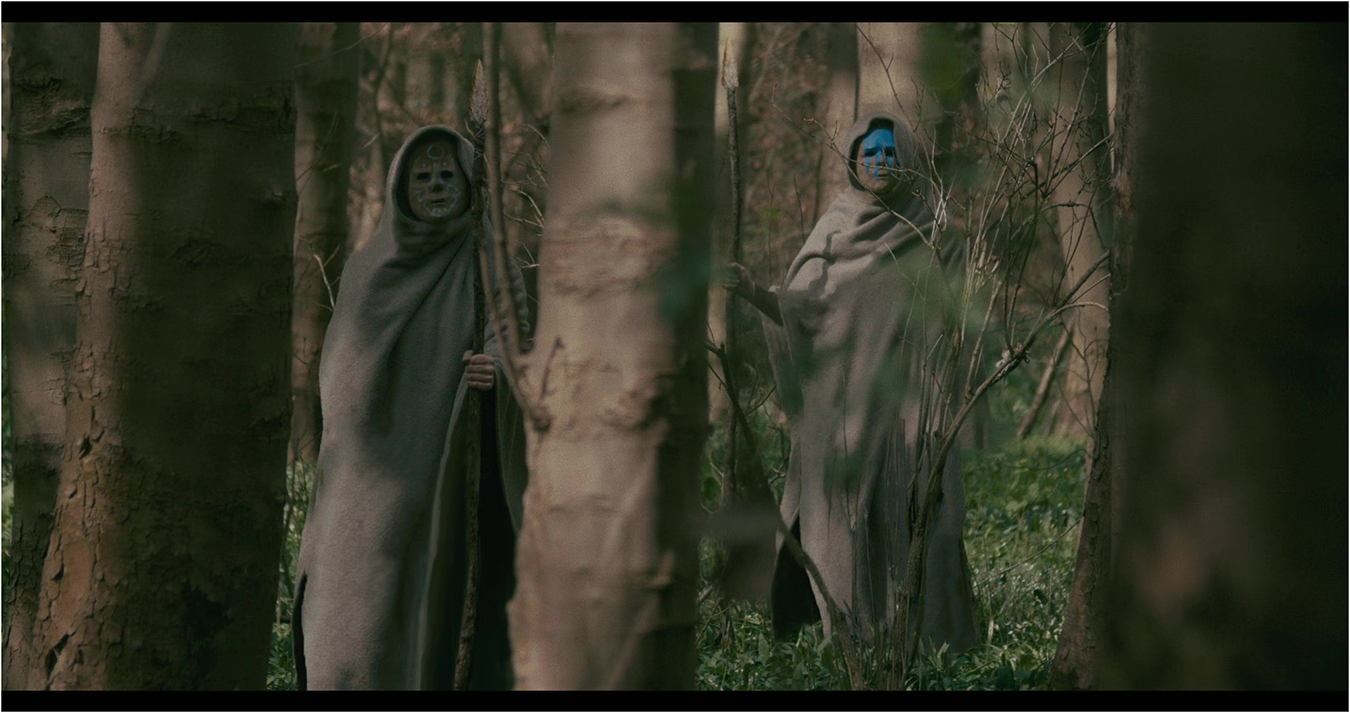
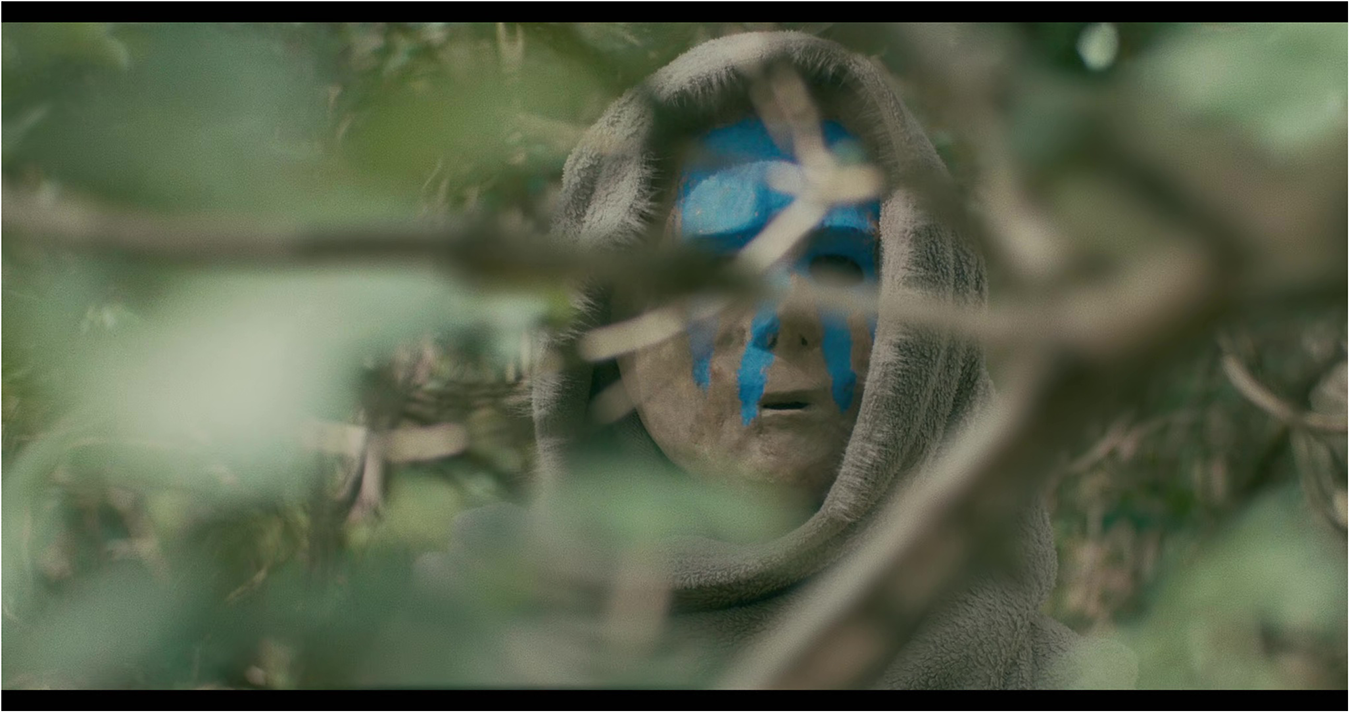
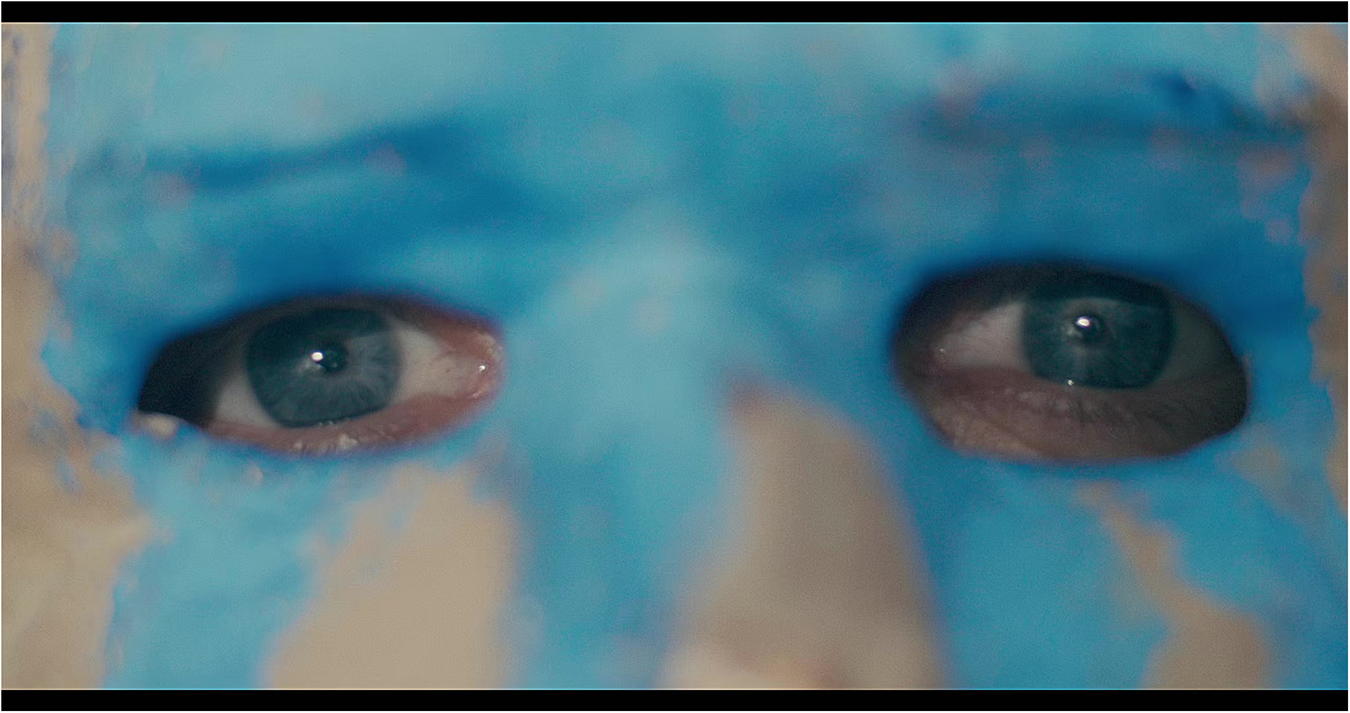
Lara and William wake to find they have drawn large symbols in blood on the ground in a specific spot in the city. The military cordons off the area and begins building a mysterious machine there. Lara and William begin to learn the secrets of the symbol, that their mind is being manipulated by a far greater intelligence to some unknown end. The still images below are the very last shots in The Silent Messenger. In the close-ups (images 6 and 7), you see me peering out of a forest at the watching audience, from behind a mask. Long before the story and script of the film came into form, our writer-director and one-man-crew, Simon Bishopp, saw this image – ‘like a TV on his mind’, as David Lynch put it. Only, Simon did not see these two specific images and just copied them of course. Simon saw or sensed an intellectual and material form, i.e., the image or idea of a (more general) figure – a Neolithic hunter looking out of a forest. This also meant that he did not yet know how this intellectual form would exactly translate into the film’s moving images.
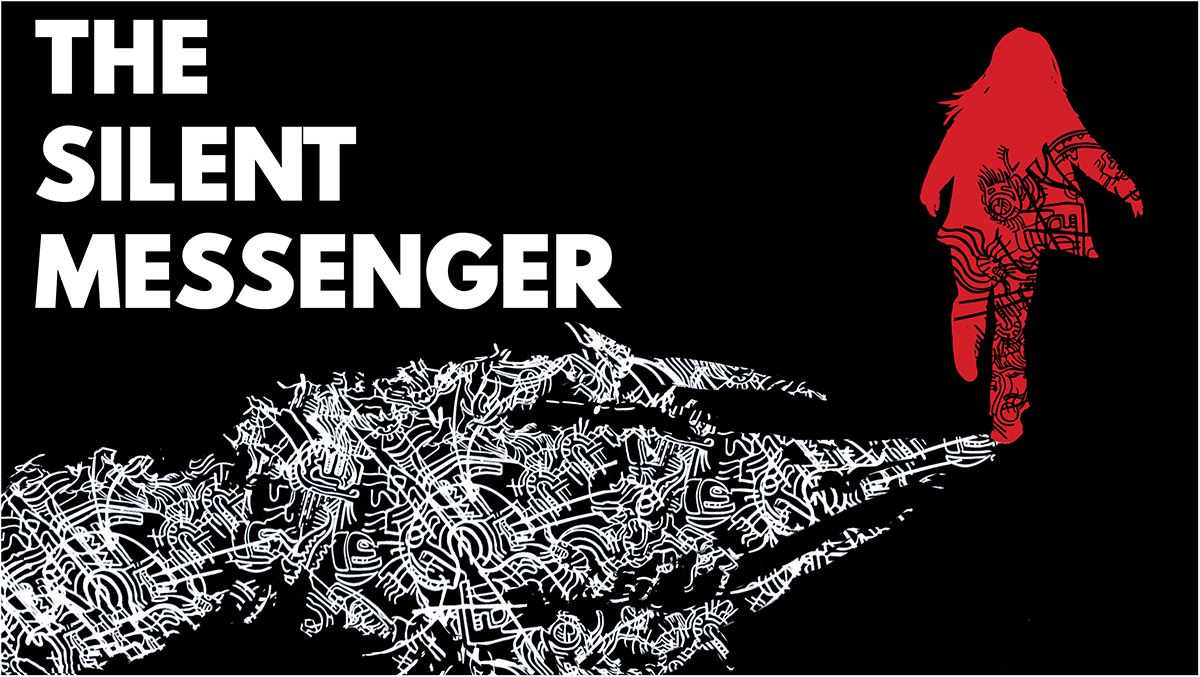
Film poster 3.

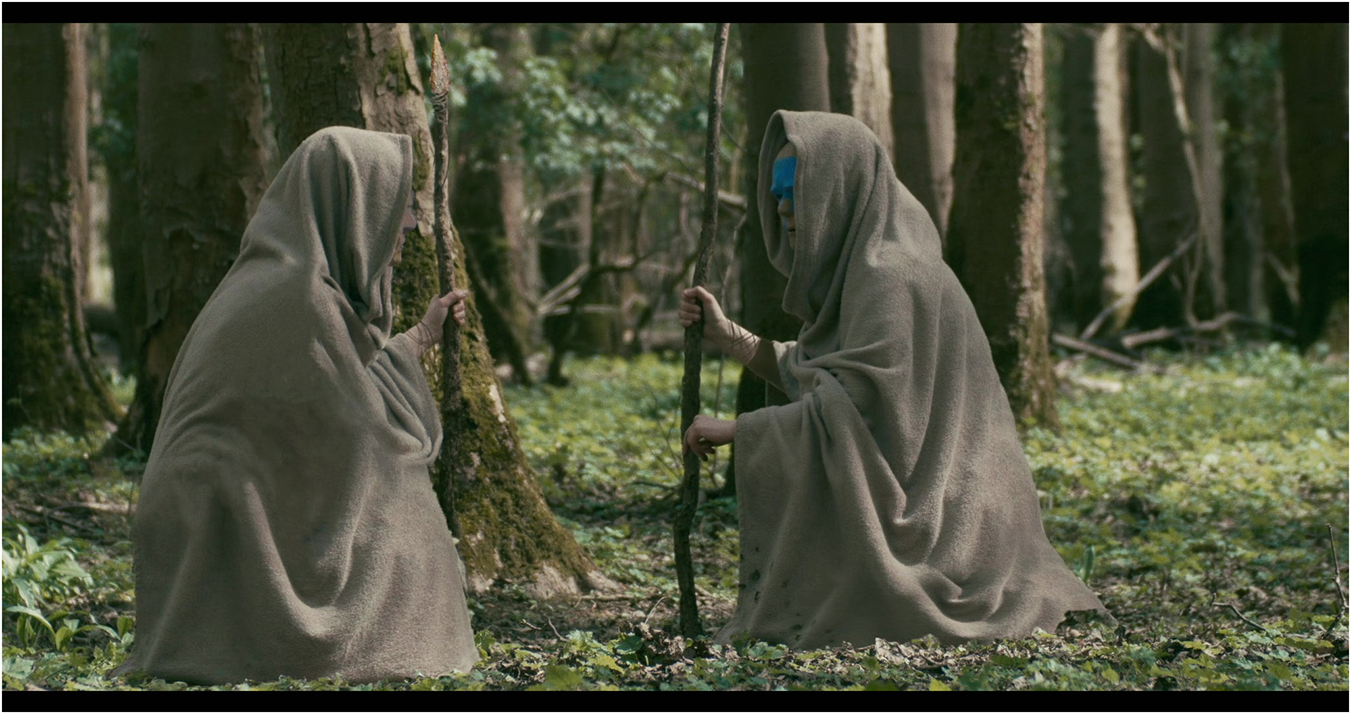
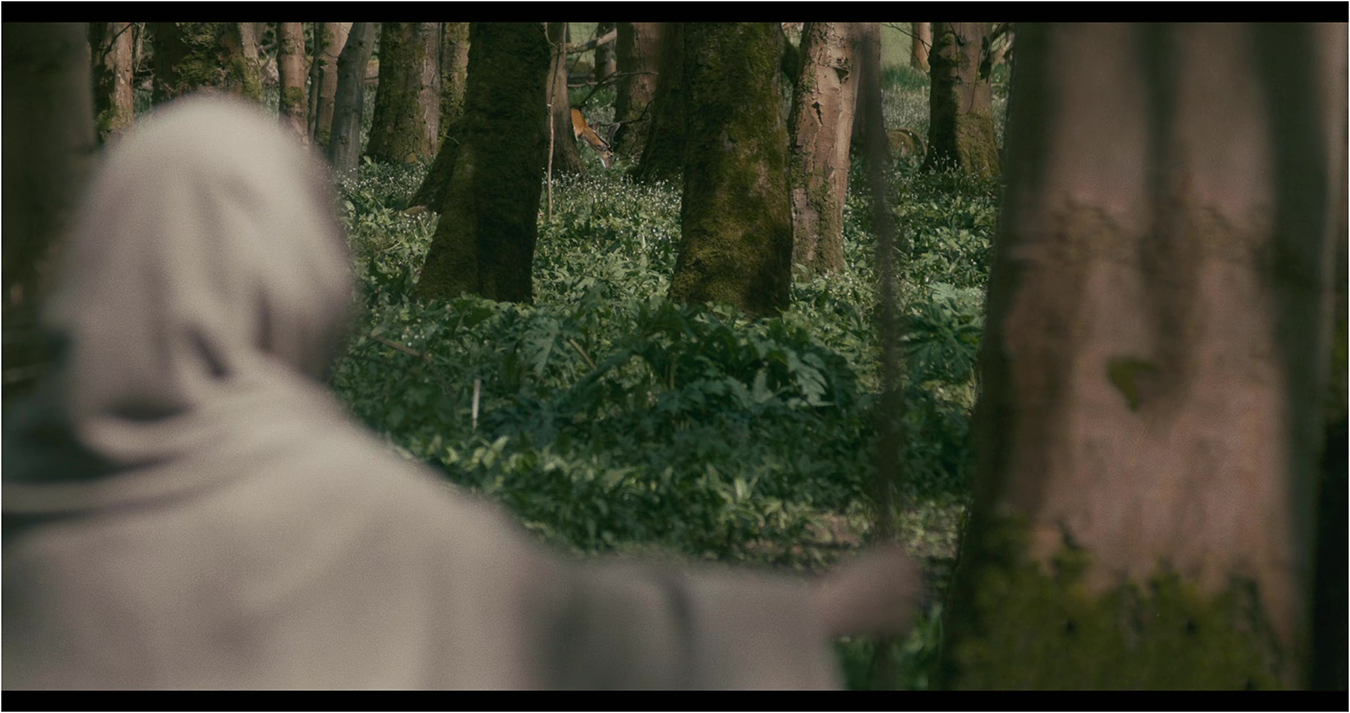
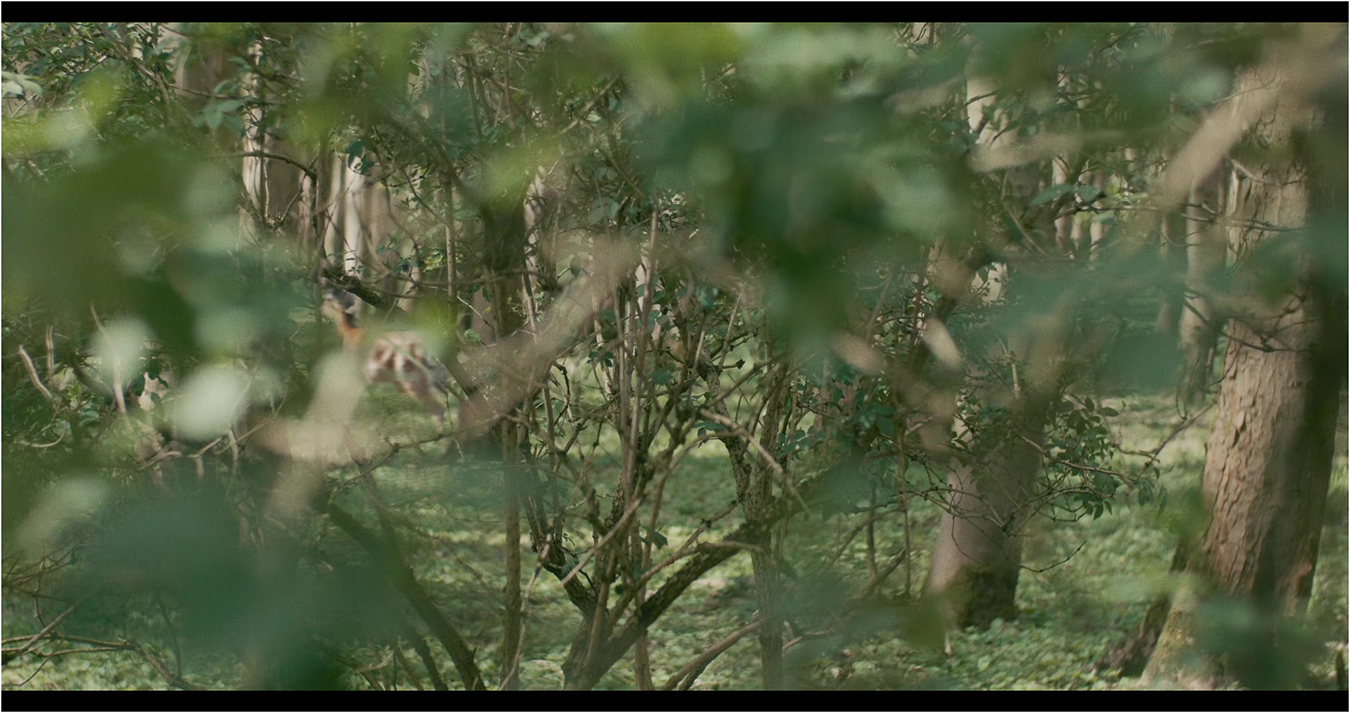
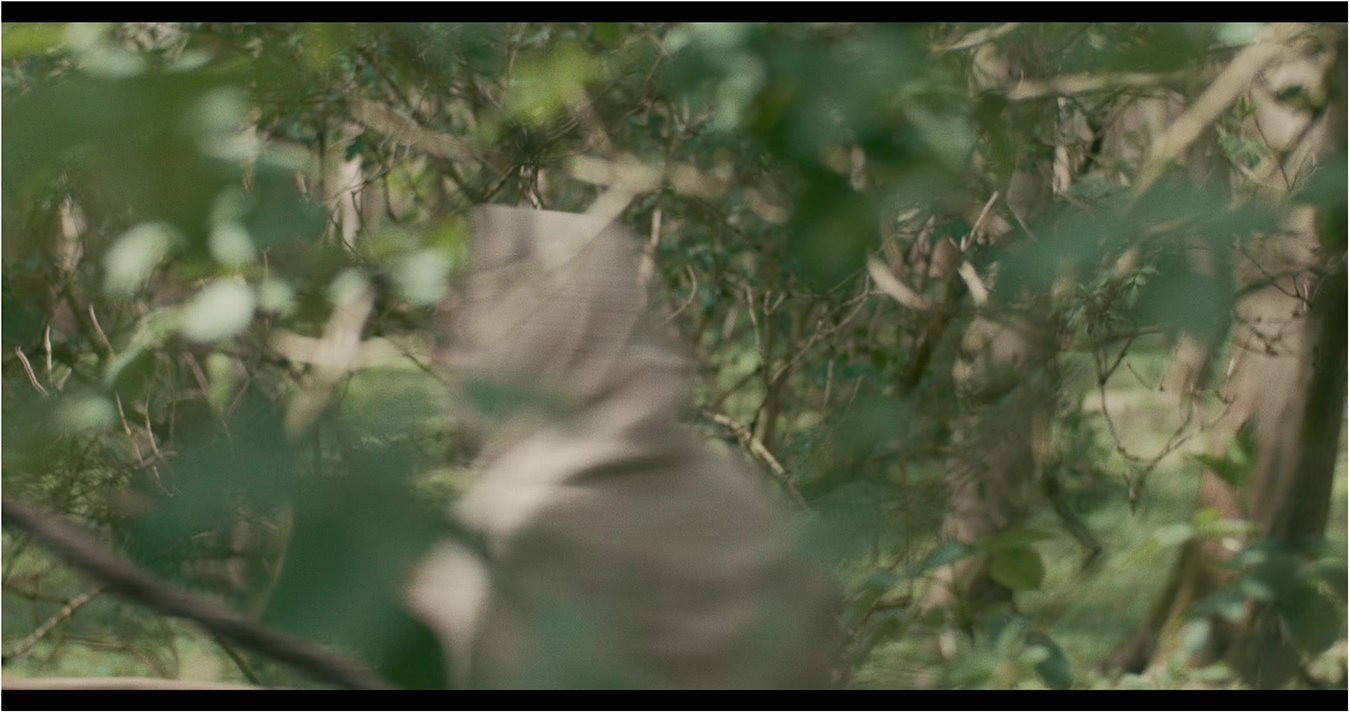
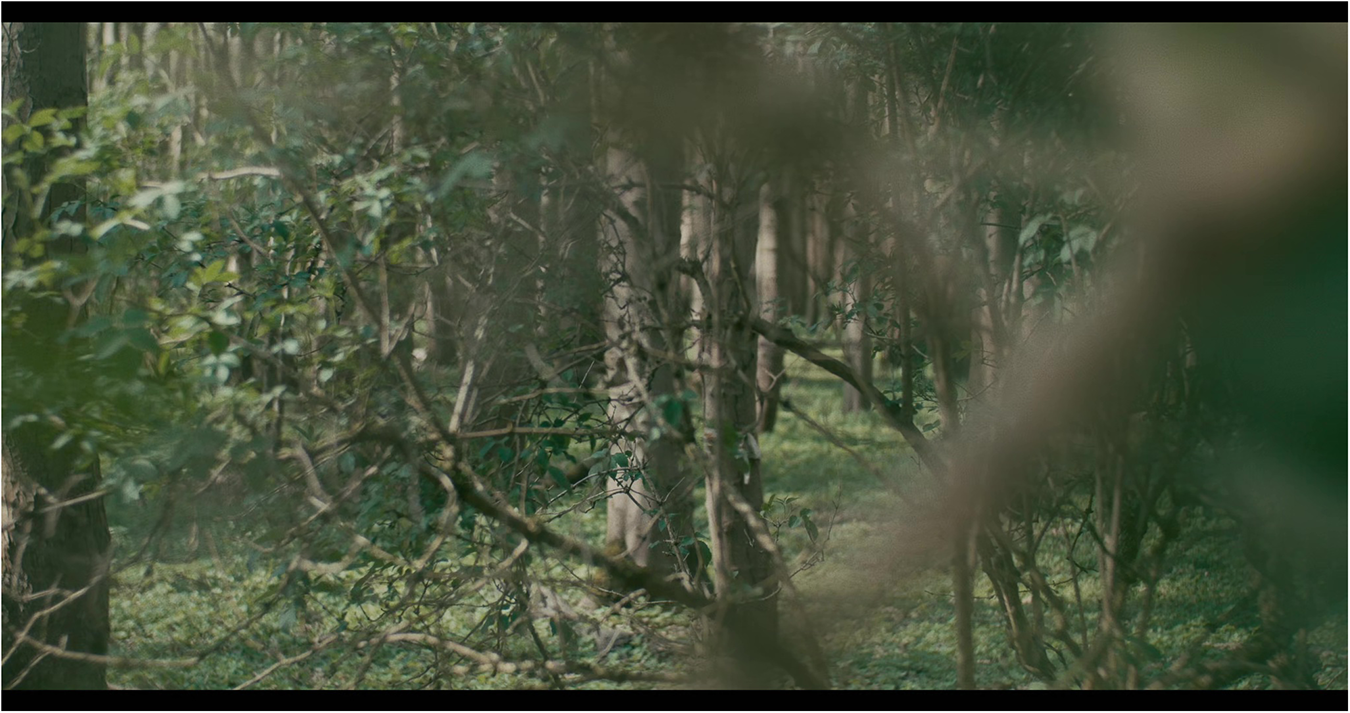
To give you a sense for how Simon realised this general, intuited image of the Neolithic hunter peering out of a forest in the completed film on screen, let’s have a look at the process of curating this final sequence of images (images 1-10) in the Silent Messenger. As indicated, the imitation (or mimesis) of a creative idea in the moving images of film is directed by the filmmaker and their ability to make appropriate, craft-related choices in the production process. The artist’s decisions are guided by the artform’s conventions (story structure, edits, etc.) and thus, the audience’s ability to understand what is presented, of course. More importantly, however, the final film is an expression of the artist’s ability to dialogue between their intuition, ideas, and aims for the work and their practical ability to realise these in the practicalities of the production process (which can then, in turn, also innovate said conventions). There were certainly different versions of The Silent Messenger’s ending. First, Simon, our writer-director, was never entirely happy with the depiction of the deer (images 3 and 4). He felt it was too Disney-ish. He was concerned that it was too ‘cute’ for the audience to identify with Lara and her (symbolic) hunt (for her new existence) - as depicted in images 3-5. Not unlike Maritain, Simon was worried that if poetic intuition was not translated ‘rightly’ into matter – through a solid sense of craft – the final work might suffer from ‘bad romanticism’, here, in the sentimental Disney-trope of facile depictions of human relationships to animals and nature. ‘Bad romanticism makes of inspiration an excuse for facility, or simple release of brute emotions or passions, or uncontrolled flux of shallow words and sentimentalism’.Footnote 11
Lara burial site.

Two neolithic hunters.

The hunters observe the deer.

The hunt.

Lara’s hunt.

Lara connects to the audience.

Close-up on Lara’s eyes behind the mask.

The hunt continues.

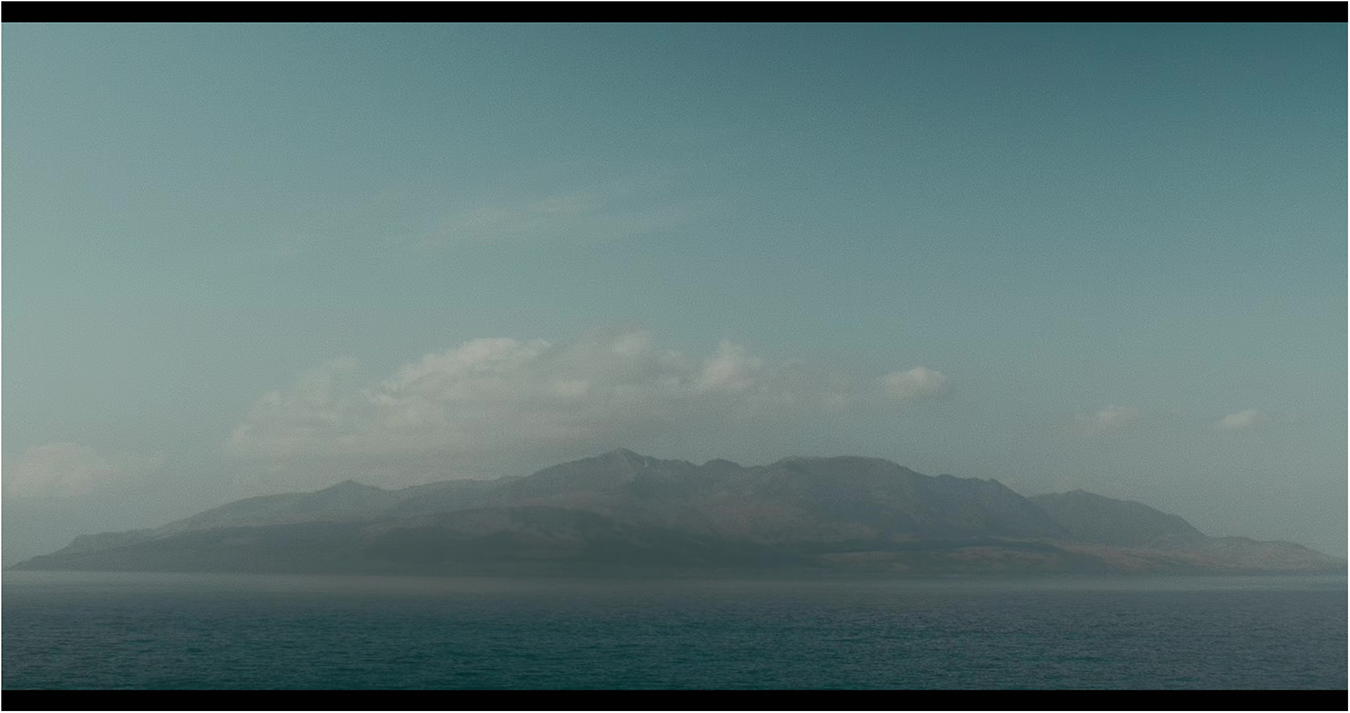
The Island.

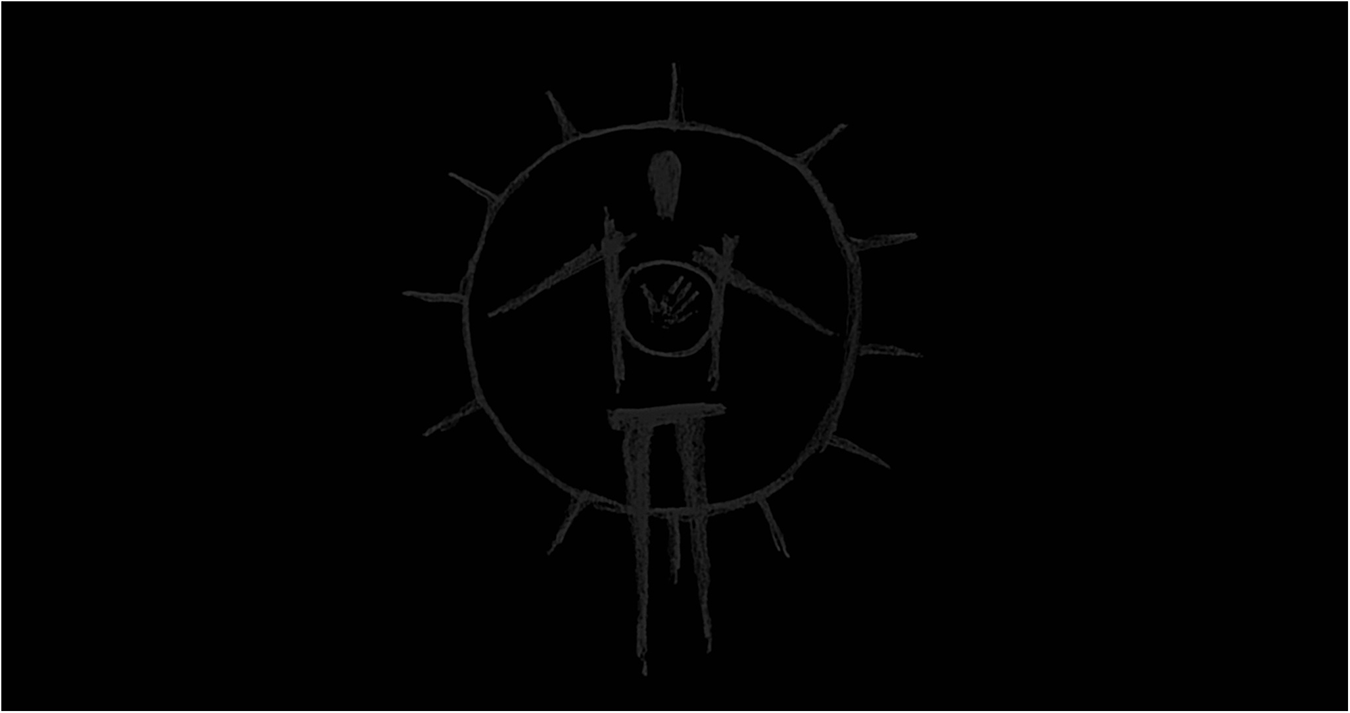
The Human Symbol.

In an earlier version of the scene, Lara’s masked address to the audience (as pictured in images 6 and 7) was indeed the very last moment in the film. Unsatisfied with this focus on the lone, isolated human figure, Simon added Lara’s sudden disappearance (her running away, image 8), ending with this final shot, held as the credits rolled; the crackling, moving branches the last reminders not only of Lara’s but of the other hunters’ transformed (images 1 and 2) existence.
Still discontented with what felt like an incomplete finale, Simon added the island shot (image 9), which he reworked from the first shot of the film, to properly bookend the story and give the film a sense of completion (and thus, ‘integrity’). In its final version, the Silent Messenger now closes on the three-note human symbol musical motif, stripped down to its most simple form and played only by a pan flute, instead of the violins used at the beginning of the film. The human symbol motif is playing over both final shots (images 8 and 9): an echo of Lara’s lost humanity, yet also perhaps a gentle prelude to a new beginning not yet fully revealed.
The very last addition to the conclusion of the film was the shot of the flickering image of the (neolithic) human symbol (image 10), following the musical motif in silence – aiming to end on the idea that we (i.e., the species human) are all connected in the search for our humanity.
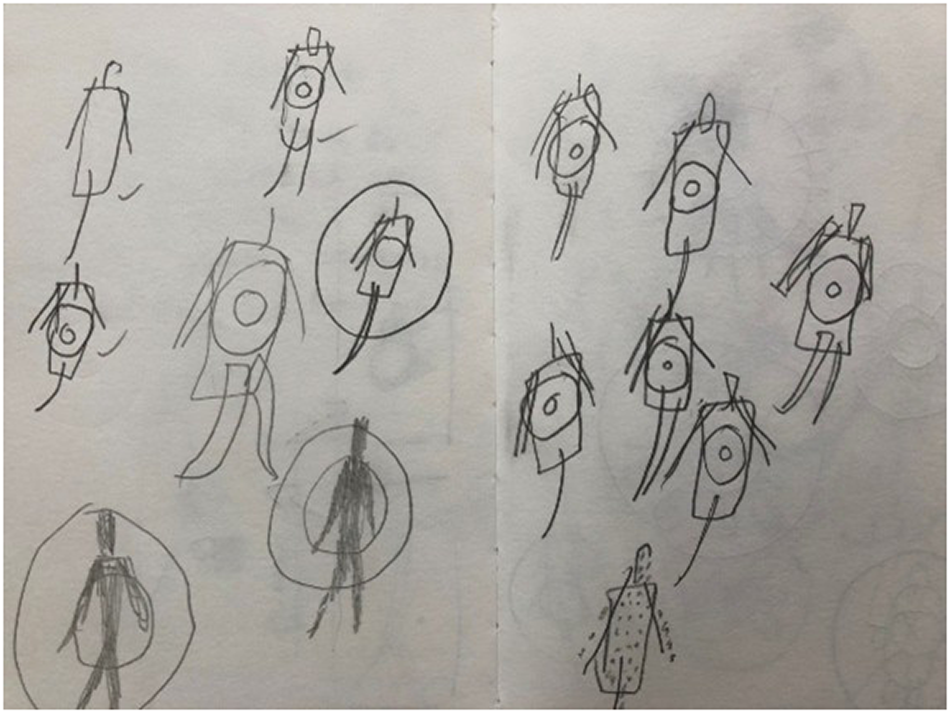
Here are some of Simon’s early drawings (his early concept art) of the human symbol, which, in the film, acts as the contrast to the predatory ‘alien symbol’, which seeks to possess the human mind.
As (briefly) illustrated in Simon’s work process, the virtue of art ‘cannot be reduced to a mere gushing forth of images separated from intelligence [e.g. the directed intention of the filmmaker], any more than to a discursus of logical reason’.Footnote 12
Early Drawing (Concept Art).

5. The creative spirit of poetry bound
In other words, the virtue of filmmaking (like the virtue of art) consists in the ‘right’ translation between the beautiful idea gifted in creative intuition and its intentional realisation in the messy process of production. As shown in Simon’s work process, poetry, or poetic intuition, is a ‘transcendental correlative’,Footnote 13 which cannot be merely copied and made into an object. Although the artist senses an intellectual or material form in creative intuition – Beauty (as such transcendental) always also evades conceptual and material capture. In short, poetic knowledge – although it intends towards the act of making – also stays free creative spirit, ‘an end beyond any end’.Footnote 14 Yet, to beautify human life and shine forth (in the material) to other human minds, the artist’s intellectual creativity must also enter the sphere of art. Hence, Beauty’s creative spirit must become bound and limited – via the artist’s intentional act of making – within a particular genus and category of art, e.g., film. Despite this necessary conversion into the artist’s working materials and techniques, the creative spirit of poetry ‘still remains free, because it always commands, and is the primary rule of art; it does not obey rules, the rules obey it’.Footnote 15
Here, we must keep in mind that, in the artform of film, the act of making is (almost) never purely ‘inspired’, nor fully under the control of the individual artist’s intention. Film is haunted by the impure – by budgets, resources, technology, marketing needs. Preserving the purity (and freedom) of poetic intuition (aka poetry) is its great problem. Badiou writes:
In the other arts, in music or painting, or even in dance and writing, you begin with purity. As Mallarmé said: “You begin with the purity of a blank page ….” With those other arts, the aim is to preserve purity in the production itself, to keep the silence in speech, to keep the blank page in the writing, to keep the invisible in the visible, to keep the silence in the sound. Being faithful to that original purity is the great problem of art.Footnote 16
When making a film (trivial or beautiful), poetic intuition enters a sphere of making that moves heavily. Where creative intuition seeks to dynamise operations and preserve its freedom and simplicity, in the film production, it is always in danger of being weighed down, too tightly bound to a demanding cultural object and its non-artistic needs for resources, paying audiences and subscribers. Film insists – for its potential integrity and clarity – on its conventions, the rules of its visual language, its means of production, its technological requirements: Recording and sound equipment, digital camera, lights, microphones, loudspeakers, computer and keyboard, software, storage devices, a projector, a screen, a TV. Given the artform of film’s tech-heavy conditions of production and distribution, film’s ‘impurity’ is perhaps best illustrated by the mistaken assumption that it is not the artists (involved in a production) who direct creative intuition via their craft-related skills (from camera operation to costume design), but the technology itself.
In other words, the filmmaker’s translation of intellectual-emotional forms into the matter of filmmaking may be falsely thought as a giving over of the artist’s mimesis to a seemingly self-directed technology or gadget, e.g. the camera. Compounded by the contemporary hype around ‘artificially intelligent’ video generators (e.g., Sora), seemingly capable of intentional, craft-related action, the filmmaker’s poetic intuition may be falsely conceived, not as the initiating stage in the virtue of (artist-directed) making, but as in service to the technology’s superior sign-making capacity (e.g., via the filmmaker’s mere ‘prompting’ of the machine’s capabilities). Contrary to this misled assumption about AI’s algorithm-led, pattern-recognition functionalities, the virtue of art (in film) is brought forth through the filmmaker’s intentional project of sight and sign-making; a mimesis which is aided by a culturally and historically specific (in this case: digital) technology, but certainly not performed by it. For example, as SobchackFootnote 17 rightly reminds us, the camera can indeed perform acts of vision that are impossible to the human eye.
Yet, this does not mean that it is the gadget that intends towards the objects of the world. The camera (equipped with different lenses) can carry out (artist-led) close-ups that keep objects or people (faces) ‘in focus’, when their integrity of form would otherwise dissociate or blur to the human eye. This does, however, not imply that the filmmaker merely intends towards the camera as an object. Instead, the artist intends towards the objects of the world through the lens of the camera. The filmmaker seeks to bring into appearance and visibility the things of the world in a way that enact her/his vision of the ‘real’ or desired relations between the things of the world (ideas, concepts, people, things). It is her/his directed project of sight, which leads the camera’s eye not vice versa.
6. The burden of poetry
As Simon’s work process demonstrates, creative intuition catalyses the filmmaker’s process of making of course. Yet, this does not (always, if ever) mean that the production is easy-going. Maritain’sFootnote 18 poets, perhaps much closer to the contemplative than the filmmaker, emphasise the invigorating dynamic between the peaceful ‘repose of the soul’ in creative intuition and their happy activity of making art. Here, habitual patterns of thought and making are, even if momentarily, whisked away; and poetic intuition is experienced as a grace that is lifting a momentary burden or anxiety – to quicken the act of making.Footnote 19 By way of contrast, when making the Silent Messenger, without a crew, Simon certainly spoke of burdens. But it was less an anxiety lifted by the grace of Beauty’s inspiration, but a mighty burden gifted by it. An inspired Sisyphus perhaps but one still rolling that boulder of a film production up the hill – scripting, storyboarding, shooting – only to realise that there are many more stones to be moved: actors, locations, editing, visual effects. In short, creative intuition is, although natural to the artist, neither necessarily frequent nor entirely reliable as a ‘positive’ dynamic catalyst. Poetic knowledge can take different form for different artists. ‘It may come in happiness and exaltation, it may come in distress and misery; it may force itself on the poet as a pang of conscience, obliging him to struggle, again and again with the deficiencies of expression.’Footnote 20
In the case of cinema and film, the filmmaker’s struggle to hold on to the freedom and simplicity of poetry (and its invigorating effects) can indeed be related to the artforms’ ‘deficiencies of expression’. After all, cinema/film is, as Badiou rightly reminds us, an ‘impure 7th artform’.Footnote 21 Cinema borrows from all the other arts – music, literature, architecture, painting, theatre-dance and keeps only their most popular aspects. Film is a greedy magpie, forever tempted to gratify the paying audience’s tastes and comforts too quickly. As a result of all this populist borrowing, film is resource intense. Although movies are often marketed as director-led, films are never, or very rarely, just made by a few artists. The Silent Messenger (made by one-man crew Simon and two performers, including myself) is a rare indie-film exception. Who does or does not count as the ‘filmmaker’ in Hollywood or art house cinema does not merely depend on the craftsperson’s role and contribution in the making of the film, but on budget sizes and shrewd marketing agendas.Footnote 22 Given the cost of production and the lure of short form content, film distribution needs to translate into ticket or merchandise sales, platform subscriptions. Rather than freeing the operative sphere from its conventions, the filmmaker’s (or production house’s) ‘vision’ – is perhaps too readily an excuse to pander to the audience’s (supposed, but more often wrongly judged) preferences for instant emotional gratification, an easy to navigate moral universe with clear heroes and villains, simplistic happy endings that ignore the tragic complexity of an actively lived human life; promising effort-less transformations that require no real change and no real learning (if you only believe in yourself), and ‘mind-less’ entertainment that distracts and numbs, rather than delights the audience’s intellect and senses.
7. Creating purity out of impurity
But, yet, despite the clutter, the vulgarity, despite poetic intuition’s desperate cry for liberation from the stifling demands of this young artform’s conventions, technology, and big budgets. Is there anybody (at least over the age of 25) who does not have a favourite movie? Is there anybody who does not remember a moment of sudden Beauty unlocked in an unsuspecting, trope-filled film experience? A flash of truth about human existence arising from moments of seeming sentimentality. The light and darkness of human intending in the world – disclosed with great integrity and clarity in a low budget TV show. The pleasure of willingly giving over to cinema’s temporal conceits; the joy of being present – with all senses – to a well-constructed moment in a narrative of a human life, lived and struggled in, in time. The joy of being played by a film’s unique time structure – its ways of concealing and revealing what it wishes us to know, or not, in each moment of its temporal unfolding. The pleasure of entering willingly into film’s dance of light; the play of its re-animated light pixels; the shining of light through a mobile film strip – where it unfolds its language, the interplay of its elements: its story, shot compositions, edits; the playful play of dialogue between word–image–music–silence. The moment of the birth of the questions that call for answers; the mysteries that need solving; the wounds that need tending to and healing; the love misunderstood, lost, found, and transfigured; friends and mentors turning out to be foes; foes becoming allies; the impossible journey braved, the hopeless task accepted; the tragedy that reveals a transformation, perhaps a miracle.
A moment of truth within the clutter of trivia, a disclosure of Beauty and Being through the conceit of a conjured reality that turns out to be no more than the digital play of pixels or the mechanical play of light on a white surface; a poetic knowledge glittering, despite the conceits of an always too cluttered, resource-intense artform. Yes. Film operates differently to the other arts. Rather than preserving the freedom and simplicity of creative intuition in the process of making, film is swallowed up by the impure. The filmmaker’s task, Badiou contends, is to find his/her way back to this initial purity in the production.
(…) Cinema works the other way around [It does not preserve purity]. The artist [filmmaker] starts out from disorder, from accumulation, from the impure and he tries to create purity. It is extremely difficult. (…) Cinema is a negative art because it proceeds from too many things to a sort of reconstituted simplicity (…) Ideally, cinema involves creating nothing out of complexity (…) Since the ideal of cinema is, at bottom, the purity of the visible, a visible that is transparent, a human body that is like an essential body, a horizon that is a pure horizon, a story that is an exemplary story.Footnote 23
Film strives towards the purity of the visible. It has the capacity to integrate, i.e. to bring into narrative and visual unity complex relations between the vulgar, the mundane, and the sacred in a way that can be seen and contemplated by all.
Even a small, indie science fiction film such as The Silent Messenger can reconstitute poetic simplicity when it ‘rightly’ unites seemingly incommensurable relations between people, objects, concepts, and ideas – marrying private, kitchen-sink drama with a detective mystery thriller, alien invasion sci-fi tropes about the end of the world, and philosophical-theological questions about the nature of our humanity and the connection between our rational, sign-making capacity and our freedom. No matter the audience’s cineliteracy, they are likely able to intuit – even consciously reflect – on the actively lived life presented in this Glasgow-based Sci-Fi scenario. Our protagonist Lara’s attempts at dealing with the grief of losing a child; her clear failings and weaknesses; her anger and incapacity to express her hurt – or her affection – to the ex-husband she once trusted; her self-inflicted isolation and pride at asking for help; but also her strength and courage when accepting the impossible task she is thrust into with the one person she would have perhaps rather stayed away from. Given film’s striving for the purity of the visible (e.g., the exemplar story), film always has a public orientation. It is the great democratic mass art. Film frames – and thereby re-presents – the material (and with that, public, social) dimension of an actively lived human life, summoning its viewers into paying attention to what they see and sense, so that their (hermeneutic) consciousness may be present in new ways to its objects, familiar world-relations and utopian/dystopian future horizons of human living and dying.Footnote 24
8. Film: the artform of movement, time, and space
But how exactly does film bring human life into public visibility? How is creative intuition reconstituted in this cluttered, tech-dependent artform? To start with, we need to look at film’s technological conditions. Its perceptual space, that which occupies our visual field when we watch a movie, relies on a technically precise timing of its frames to ensure the smoothness of the moving images through motion blur. Nowadays, this is 24 frames per second. The artform’s technical grounding in movement (even when we sit on a still image) constitutes its artistic material – its moving image – which unfolds in space and time. This means that time and space are the way that film ultimately constitutes creative intuition in visual expression, no matter if we consider this rendering of moving images a reconstitution, or a preservation, of poetic knowledge. As Lee CarruthersFootnote 25 explains, film does not merely reference time in an abstract manner. Time is instead activated in two ways: the filmmaker’s curation of the moving images during production, as well as the audience’s active presence to the moving images in the reception experience. Film’s integrity as an artform, and the way that poetry – as a transcendental correlative of Beauty – is bound and affectively known here, is firstly constituted temporally. Film unfolds its aesthetic unity in moving images over time. Thus, at its most basic, a viewer is also always habituated into being present, with their whole body, to a delimited temporal event; a narrative – with a beginning and an end; one that unfolds in its own rhythm and is brought to completion in time – just like our own lives.
In film, time and space are not abstract categories but the lived logic of its reconstituted simplicity; a purity of the visible that is only brought into full presence when the spectator ventures to participate in its unfolding meaning. Correspondingly, film’s truth cannot simply be absorbed abstractly. The temporal phenomenon of film’s unfolding, moving images requires the audience’s participation in the rhythms of film’s dialogue in-between image–sound-word–music–silence–light. The temporal structure of the respective film’s moving images, as in The Silent Messenger’s illustrated above, reflect both the filmmaker’s craft-related decisions and, with that, their own active, embodied intending towards the objects of the world. Film presents, as SobchackFootnote 26 explains, the filmmaker’s direct(ed) perceptual experience – the filmmaker’s vision. Here, film is a private vision made public – a shared sight – in an artform that ‘imitates the function of a human intentional subject who engages objects as significant’.Footnote 27 Yet, film also transcends the filmmaker’s vision. That is, the artform also manifests its own (human-enabled) vision through its technological body of moving images; its direct phenomenological presence to our senses; its lack of substance as mere play of light; and the temporal structure and lived spatial-temporal logic of its presentation.
Given the artform’s rootedness in space and time, film asserts the ontological goodness of creation. It claims the world and the human beings in it as objects worthy of intentional vision and of gaze, as worthy to be looked at with interest.Footnote 28 Film does not move like the disinterested, mechanical gaze of the surveillance camera, or the non-intelligent, algorithmic pattern-recognition of the latest AI video generator. Film inhabits the directed gaze of an interested, intending subject – via the filmmaker’s intentional, craft-related actions, which make their relations to the world not only visible but shareable. Here, in filmmaking and reception, ‘seeing’ is not merely conceived as data-processing perception. It is living intellectual habit – a reconstituted purity of vision and the visible. There is no such thing as general attention in the cinema, Sobchack writes. Attention is never merely a formal activity here. Instead, ‘cinema shows us the manifest bond between subject and world, subject and other’.Footnote 29
9. Bringing the world into vision: film teaches the art of seeing
The filmmaker curates a lived logic of space and time – of actively lived lives – in moving images. Consequently, the artform enacts not an abstract commentary on the act of seeing but ‘simply’ invites the viewer to be present to the filmmaker’s directed vision, as well as their own intending towards the world. The spectators’ (potential) reflection on their own acts of seeing is prepared (by the filmmaker, the artform’s condition) by putting the audience in direct relation to certain narrative contexts of meaning. Here, the spectator may be of course invited to be present to potential truths about human existence, which they would normally not (choose to) bring into visibility themselves. Yet, the filmmaker’s other vision can be recognised by the viewer (as true), because of the productive conditions, which ground our shared human experience (e.g., our shared tendency towards symbolic expression). In The Silent Messenger, the audience is, for example, called to share in the filmmaker’s attentive gaze onto Lara and William’s isolation and grief, their failed communication, and attempts at restoring sight and understanding.
Curiously then, the filmmaker practices a (hermeneutic) phenomenology of vision; one that does not simply look at what appears (as a mere act of interpretation) but performs the act of bringing things and people into being through an interrogative gaze (as a performative reflection of the act of seeing as interpretation).
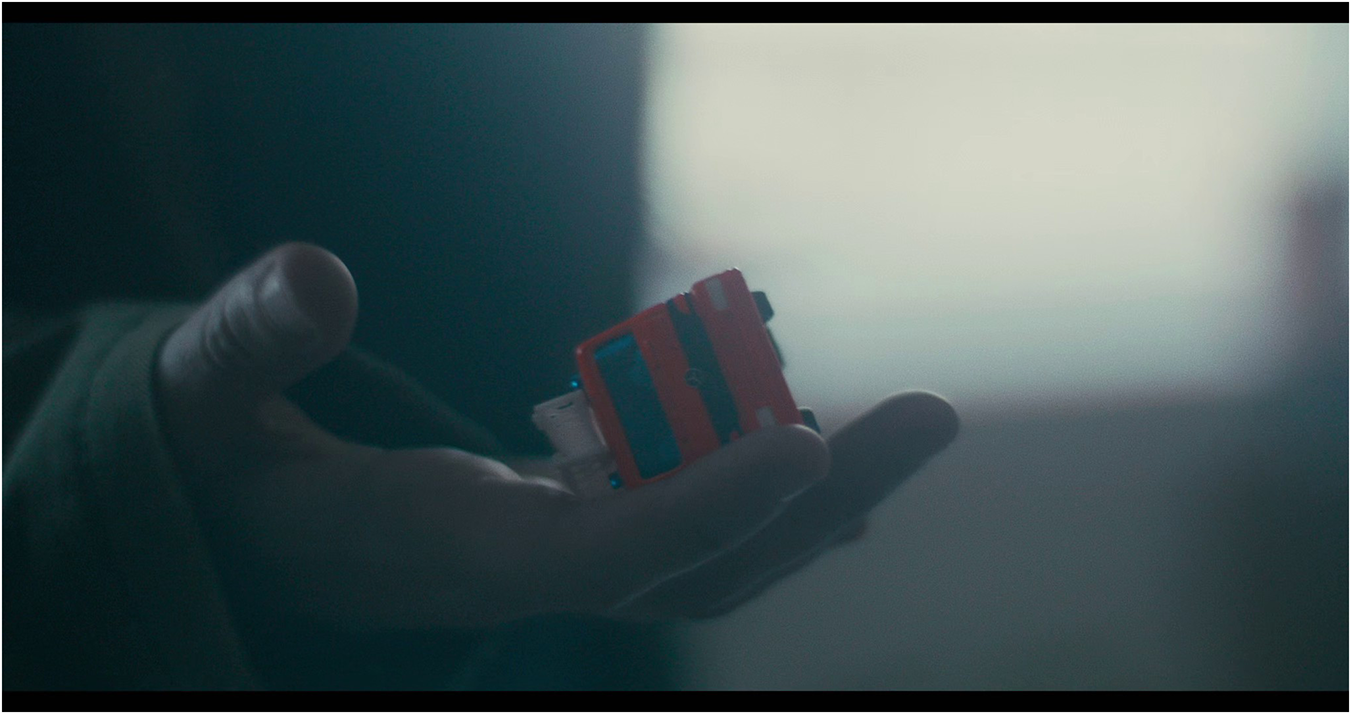
For the spectating audience, the filmmaker’s reconstitution of the purity of the visible – i.e., the curation of an exemplar vision of the world that emerges from her/his shared private sight – can be of course uncomfortable to watch and reflect upon. In the Silent Messenger, Lara and William’s grief is brought into visibility through a picturing of their son’s (painful) absence, sensed in the texture of everyday objects (e.g., the toy fire engine, see image 11).
Memories.

In other words, Simon brings into visibility those objects of the world, which – prior to the tragedy – oriented the protagonists’ family relationship towards mutual care and structured their relation to the world (beyond the family unit). In sum, the parents’ painful sight of their son’s absence is made visible through the filmmaker’s gaze of a ‘pure’ grief, i.e., an exemplar grief that must emerge from the specific, lived life of a human being. It is a sight (of pure grief) that is perhaps hard to bear, both for the protagonists in the story of course, but also, in turn, for the spectator. This is because the filmmaker’s eye ultimately performs a double gaze.
The visibility of the absence of the son is not only tragic because of the loss of the beloved person but because of the breakdown of the relationships of love, in which he was actively embedded. As such, the son’s visible absence is not only a reminder of, but a contrast to, the (former) happiness and fullness of a lived (family) life – marked by such mutual care. Here, the fullness of being is seen through the tragic absence of being. It is made visible in Lara’s and William’s reluctant interaction with everyday objects that echo (fragmented) memories, make their sadness and alienation felt and bring their inability to communicate into visual form (for the viewer). The audience’s reflection on their own vision (e.g., on the nature of grief) is conditioned by their ability to ‘bear the sight’ – through the patient, receptive-active attending to the film’s unfolding images of these actively lived lives (marked by tragedy). Even more importantly, the viewer’s ability to reflect on their own vision is also dependent on the filmmaker’s ‘purity of vision’ when bringing his project of sight into being. That is, given the impurity of the artform, the filmmaker must not betray the audience’s (patient) self-giving in the reception experience.
He/She must not curate gratuitous images of pain and grief, when these would (or could) ultimately overwhelm the viewer’s own rational capacity to be with (if not entirely ‘make sense’ of) the grief made visible here. The filmmaker’s purity of vision, their reconstitution of simplicity from the impurity of the artform, must in some sense mirror the spectator’s ‘simple’ self-giving gesture (of trust) in the reception experience. Hence, the artist’s enactment of her/his private sight as a ‘public vision’ (on film) must not be a monument to his/her ego to force a (alien) vision onto the audience.
10. Our moral capacity for gaze
Film’s visible, moving images show us that, although vision always manifests an intended choice; it also constitutes the movement of an always mobile and, with that, cultivatable gaze. As such, the virtue of filmmaking can only come into its full presence – via the purified vision of a filmmaker who grants the audience the (equally) free movement of their eye. In short, the filmmaker must not take the spectator’s mind hostage for external purposes emerging from the ‘impurity of the 7th art’ (e.g., the desperate need for ticket sales to recoup costs at all cost).
In the audience’s participation in the film’s intentional project of sight, the viewer intentionally (and generously) loses sight to host the filmmaker’s vision as their own. Yet, SobchackFootnote 30 reminds us, although we take the other’s vision into our own like a hospitable, self-forgetting host, we do not normally take the other’s vision as our own. In other words, unlike The Silent Messenger’s predatory alien symbols that seek to possess the human mind and co-opt human beings’ vision as their own – we (at least if cine-literate) recognise film’s vision as the intentionally constructed project of another human being (and can critique it as such). Yet, as indicated above, film – like the other mimetic arts – must not deny its potential for the seduction of the human mind.Footnote 31
As an image based artform that conjures (i.e., imitates) the actively lived lives of human beings (and their relation to the world), film has the capacity to immerse human beings in a reality and vision that may (potentially) ‘co-opt’ the audience’s self-directed project of sight. Given the filmmaker participates ‘rightly’ in the translation between creative intuition and matter, film’s presenting, playful structure calls the spectator to reflect on how they bring things and others (world) into visibility in their own lives’ intentional acts of vision. In sum, granted that the spectator’s senses are not deliberately co-opted (i.e., the filmmaker respects their free will and rational capacity), the audience learns also to see that they see. Yet, to ‘see a film’ in the first place, SobchackFootnote 32 adds, we already need to be able to notice that we see (even if this is also a product of how the virtue of film habituates our mind and body). Strangely, this means that the viewer’s loss of self/ego in the film reception experience is conditioned by their awareness that they have a self/ego, which they can lose when sharing the sight of another. Without firstly recognising their own self’s intentional acts of vision (good and bad), the viewer will be unable to freely turn their gaze towards the vision of another – or host it generously. Thence, without an awareness of their own intentional and, with that, moral capacity for gaze, the audience will either simply reject the other vision of film as merely ‘immoral’, or unthinkingly embrace it as just ‘natural’, because they cannot recognise the vision they are hosting as the vision of another intending subject in the world.
11. Bringing the virtue of film into presence
In conclusion, for the virtue of film to come into its full presence, the viewer must be able to freely turn their gaze towards that of another – through their awareness of their own moral capacity to ‘see’. For this to happen, the filmmaker is also required to reconstitute the purity of creative intuition from the impure elements of film. Here, he/she needs to resist the temptation to co-opt the audience’s vision (e.g., by playing to their brute emotions) for ulterior, external motives, such as the need to make money, recoup costs, or teach the audience a (moral) lesson. In summary, film – as an impure 7th art – binds the free creativity of poetic intuition to an object that is weighed down by the needs of money, resources, technological mediation, and the conventions of its visual language. Yet, film is also concerned with the ontological splendour of the perceptible and the conversion of our vision of each other and our relations in the world. For the artform to reconstitute the purity of the visible and, with that, revive the dynamism of poetry in filmmaking, both viewer and filmmaker need to accept the responsibility for their mobile gaze.
Thus, the audience must lose their self in the viewing experience to share the other’s sight, so they can compare this sight of an actively lived life (like Lara’s and William’s) to their own intentional, often equally clumsy, acts of bringing our relationships to the world into being. This can of course be a hard sight to bear. In our film’s story, William readily accepts the alien’s vision as his own (i.e., as natural), because of his guilt-fuelled inability to bear with his own and Lara’s shared sight of the tragedy of the death of their son. In short, he is not aware of his moral capacity for gaze and thus, his capacity (and responsibility) to freely turn his gaze towards the tragedy and away from the false vision (of life without suffering). Unlike William’s fate of being assimilated into a monument of the alien ego, in the film reception experience, the spectator enters the imaginary of film not only as a willing but as an active participant. Consequently, the viewer is not simply a bodily receptacle for the filmmaker’s will and desire – even if the filmmaker may of course fail in the reconstitution of poetry’s purity and virtue, to take the audience’s mind hostage through the magic of the populist, impure 7th art.
Here, we must however also keep in mind that, unlike in The Silent Messenger, the viewer is never possessed by a film’s presenting symbols – even if the filmmaker may of course use his skills and vision to co-opt the audience’s mind for external ends. Followingly, the virtue of film only comes into its full presence when the audience is recognised (by the filmmaker) as being part of the structure of the disclosure of Beauty and Being, i.e., the reconstitution of the purity of the visible. Like the filmmaker, the audience is invited to share a sight, to participate in the reconstitution of poetry – through the creative movement of their intellect and senses. Teaching us that the world is worthy of (relational) vision, we are thus reminded that our ‘seeing’ is an act of relating; of participating in another’s coming-into-full-presence. Film’s conceited play of light in moving images without substance conjures a vision of the world bound in space, time, and human relationships. Film reminds us, not only that the world is worthy of vision but that our perceptual relations to the world are no fixed things, certainly no predatory alien symbols. To the contrary, our purified vision – via the impure art of the moving image – is a creative participation in bringing the (beautiful, tragic) mystery of (human) being into existence.
Acknowledgements
This paper has been first presented at the 2025 ‘Thomism, Creativity and the Arts: Jacques and Raissa Maritain’ Symposium (at Blackfriars Hall, Oxford, UK). The author would like to express her gratitude to Fr Dominic White for organising this exciting symposium and to all attendees for the thoughtful comments and stimulating discussions. A very special thanks goes to filmmaker Simon Bishopp whose generous reflections on his work process, and provision of the posters and film images, have made this paper a delight to write.

 Open access

