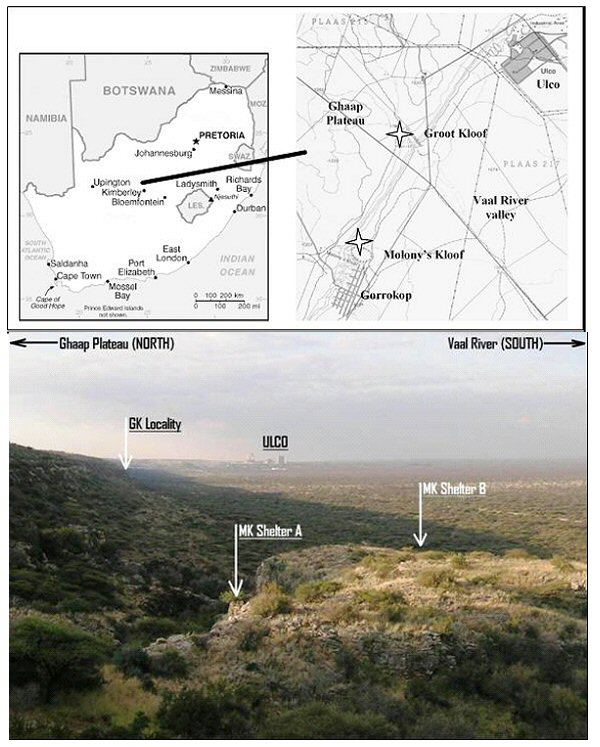


In 2004 a series of archaeological and fossil bearing deposits were surveyed on land owned by the Holcim Ltd cement works at Ulco, 70km north of Kimberley in the Northern Cape Province of South Africa (Figure 1). In June 2005, a multi-disciplinary project began to document changing palaeoclimatic, palaeoenvironmental and hominin settlement patterns in the Ghaap region for the last 300 000 years, contrasting data from the Vaal River, the Ghaap Plateau and its escarpment. The most notable feature of the Ghaap karst is the development of massive tufa fan deposits along the 200km length of the escarpment. The anthropological potential of such deposits has been known since the beginning of last Century with the discovery of the first African hominin, the 'Taung Child', at Buxton-Norlim in 1925 (Reference DartDart 1925). These tufa deposits record occupation of the region by hominins since the Pliocene and at Ulco the oldest fossil bearing deposits have been dated to ~248 ka (Reference Curnoe, Herries, Brink and HopleyCurnoe et al. 2006). The main archaeological sites along the escarpment consist of rockshelters that have been eroded into these tufa flows. Caves do not preferentially develop due to the massive bedded nature of the dolomite and lack of faulting and folding along the escarpment. However, small caves do form within the secondary limestone tufas.
Location of Ulco sites, along the escarpment of the Ghaap Plateau in Northern Cape Province, South Africa.

The rockshelters along the escarpment mostly sample the Holocene with Later Stone Age (LSA;<~32 000 years ago) and Herder occupations (<~2000 years ago; Reference Humphreys and ThackerayHumphreys & Thackeray 1983; Reference Johnson, Miller and FogelJohnson et al. 1997). There is only limited evidence of occupation during the late Upper Pleistocene (40 000-10 000 years ago) a period marked by the transition from the Middle Stone Age (MSA) to LSA. Early Stone Age (ESA) and MSA material, or potentially transitional Fauresmith material have been excavated from cemented channels fills at Groot Kloof (Reference Curnoe, Herries, Brink and HopleyCurnoe et al. 2006). On the plateau, both the site of Wonderwerk Cave and Kathu pan sample the LSA period (Reference MorrisMorris & Beaumont 2004). However, at both sites the sequences are sporadic but at Kathu Pan the sequence may suggest that the LSA in the region may be as old as 32 000 years (Reference MorrisMorris & Beaumont 2004).
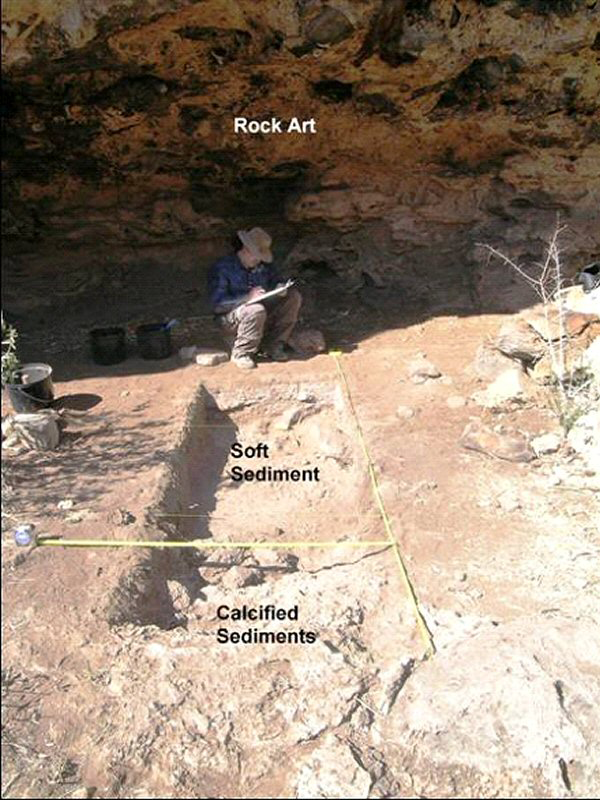
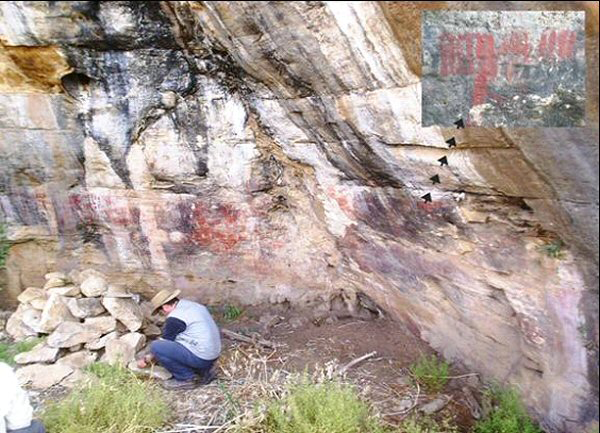
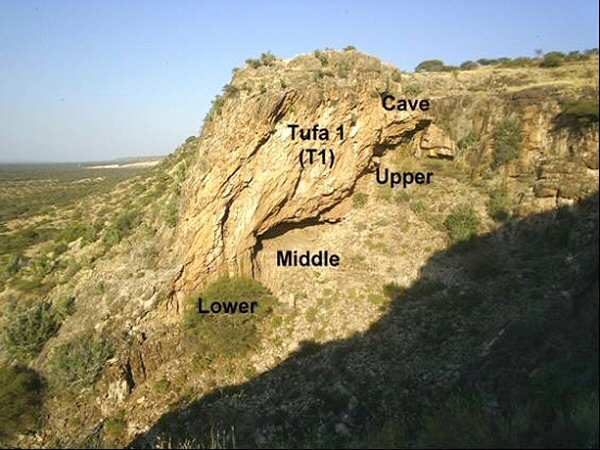
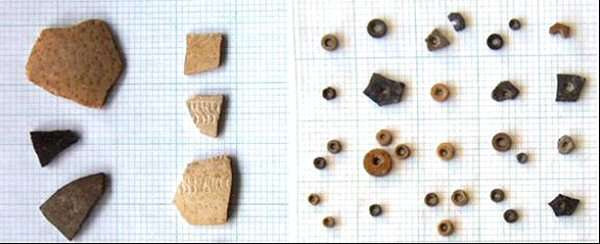
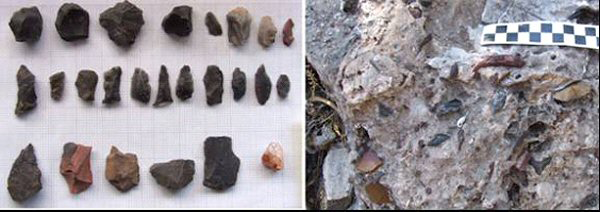
A survey was undertaken on a series of rock-shelters and caves at Molony's Kloof (MK; Figure 2, 3) and Groot Kloof (GK; Figure 4). Associated with these rock-shelters are surface finds indicating LSA and potentially MSA occupations. At MK shelter A (MK-A; Figure 2) excavations have revealed three distinct phases of occupation. Un-calcified sediments in the shelter preserve a recent non-Ceramic LSA occupation, probably from the last 500-1000 years. This is characterised by lithics made on black chert, sourced within the local dolomite, and numerous ostrich eggshell (OES) beads and pieces of engraved OES containers (Figure 5). Below this, an older occupation occurs whose date and cultural affinities have yet to be determined. Another much older phase of occupation is identified in a calcified talus deposit. This older phase of occupation is considered to represent a pre-Holocene LSA (Figure 6). Tools are made on a wider range of raw materials sourced from river pebbles and flaked quartz crystal is also present at most of the sites and during most time periods. The calcified talus deposits contain extinct species of fauna that represent a Florisian Land Mammal Age (FLMA) for the site (>10 000 years; Reference BrinkBrink 1988). Along with the presence of LSA (<32-25 ka; Morris & Beaumont 2004; Reference MitchellMitchell 2002) tools this gives a preliminary date of between 32 000 and 10 000 years for this deposit. The surface assemblage at MK-B is also similar to MK-A, but finds on the talus slope also include MSA elements and suggest a potentially longer depositional period. At Groot Kloof shelter C micro-lithic blades appear to occur more often. Also associated with all the rock shelters are finger paintings of various geometric designs (Figure 3). At most sites only red pigment occurs as simple lines of paint, sometimes linked by a basal or central line, although different phases can be identified. At others red, white and black pigments have been used in the same paintings and as different phases of painting.
Excavations in Molony's Kloof rockshelter A. Rock art adorn the conglomerate walls of the shelter. A Holocene, non-ceramic LSA with extensive OES production occurs in the soft sediment portion of the deposits. A pre-Holocene LSA occurs in the calcified deposits that forma talus slope to the rockshelter.

Geometric rock art at Molony's Kloof rockshelter B.

A cave and rockshelters eroded into a large ancient tufa flow at Groot Kloof. Geometric art occur on the walls of all the shelters. The cliff face is around 50m high.

Engraved and discoloured OES (left) and OES beads from excavations at Ulco (right).

LSA stone tools from soft sediments (left) and dense LSA bearing breccia at Molony's Kloof rockshelter A (right).

Analysis of the material from MK-A is ongoing and the project aims to excavate other shelters at MK and GK to contrast with the phases identified at MK-A. A comprehensive dating and palaeoclimatic/environmental program is also underway to date archaeological occupation in contrast to major wet phases as shown by the formation of tufa deposits.