





1 Introduction
Multiplicative structures on cohomology theories have been exploited fruitfully throughout the history of algebraic topology, ranging from the classical argument that the Hopf maps are stably nontrivial (using Steenrod operations on cohomology), over the simplification of Adams’ solution of the Hopf invariant one problem via Adams operations on topological K-theory [Reference Frank Adams and AtiyahAA66], to the resolution of the Kervaire invariant one problem by Hill, Hopkins, and Ravenel [Reference Hill, Hopkins and RavenelHHR16].
The latter crucially relies on having a refined notion of genuine commutative algebras in equivariant spectra, containing more information than mere $E_\infty $
algebras in the (
$E_\infty $
algebras in the ( $\infty $
-)categoryFootnote
1
of equivariant spectra. Classically, these objects have been defined as strictly commutative algebras in a good pointset level model of G-spectra (for G a finite group), like symmetric spectra or orthogonal spectra with G-action; borrowing terminology introduced by Schwede in the global case [Reference SchwedeSch18], we will refer to these pointset level models as ultra-commutative equivariant ring spectra. Many equivariant spectra of a more geometric nature, like real or complex equivariant homotopical bordism or topological K-theory can be explicitly written down as such ultra-commutative equivariant ring spectra, and this provides an extremely efficient way to encode a wealth of structure.
$\infty $
-)categoryFootnote
1
of equivariant spectra. Classically, these objects have been defined as strictly commutative algebras in a good pointset level model of G-spectra (for G a finite group), like symmetric spectra or orthogonal spectra with G-action; borrowing terminology introduced by Schwede in the global case [Reference SchwedeSch18], we will refer to these pointset level models as ultra-commutative equivariant ring spectra. Many equivariant spectra of a more geometric nature, like real or complex equivariant homotopical bordism or topological K-theory can be explicitly written down as such ultra-commutative equivariant ring spectra, and this provides an extremely efficient way to encode a wealth of structure.
However, there are unfortunately also various G-spectra of a more combinatorial or categorical flavor that morally should admit a “genuine” multiplication, but where writing down an ultra-commutative structure is hard or even out-of-reach. A prominent example of this is equivariant algebraic K-theory as considered for example in [Reference ShimakawaShi89, Reference Guillou and MayGM17, Reference MerlingMer17], where it took a great deal of recent effort [Reference Guillou, May, Merling and OsornoGMMO23, Reference YauYau24] (involving wrestling with a significant amount of challenging categorical combinatorics) to refine this to a construction that builds ultra-commutative G-ring spectra from suitable categorical input. Even now, the available constructions are confined to inputs of a $1$
-categorical nature, and it is not clear how one could adapt them to handle, for example, multiplicative structures on equivariant Waldhausen K-theory.
$1$
-categorical nature, and it is not clear how one could adapt them to handle, for example, multiplicative structures on equivariant Waldhausen K-theory.
On the other hand, higher category theory has allowed for a very clean understanding of multiplicative structures on nonequivariant algebraic K-theory: in particular, work of Gepner–Groth–Nikolaus [Reference Gepner, Groth and NikolausGGN15] essentially shows that there is one and only one multiplicative refinement of the nonequivariant K-theory of symmetric monoidal ( $\infty $
-)categories. It is natural to hope for a similarly satisfying higher categorical treatment in the equivariant case. However, the work of the aforementioned authors crucially relies on the universal property of the category of spectra, of which there is no equivariant analogue; moreover, such an approach could only ever produce
$\infty $
-)categories. It is natural to hope for a similarly satisfying higher categorical treatment in the equivariant case. However, the work of the aforementioned authors crucially relies on the universal property of the category of spectra, of which there is no equivariant analogue; moreover, such an approach could only ever produce $E_\infty $
algebras in the category of G-spectra, which as mentioned above falls short of the kind of structure we are looking for.
$E_\infty $
algebras in the category of G-spectra, which as mentioned above falls short of the kind of structure we are looking for.
Normed categories and normed algebras
As the $E_\infty $
operad is the terminal operad, algebras over any other operad admit a “forgetful” functor from
$E_\infty $
operad is the terminal operad, algebras over any other operad admit a “forgetful” functor from $E_\infty $
algebras. On the other hand, ultra-commutative ring spectra ought to be a more highly structured object than
$E_\infty $
algebras. On the other hand, ultra-commutative ring spectra ought to be a more highly structured object than $E_\infty $
ring spectra and instead come with a natural forgetful functor to
$E_\infty $
ring spectra and instead come with a natural forgetful functor to $E_\infty $
ring spectra, so we should not expect to be able to describe them using ordinary higher algebra.Footnote
2
We therefore need another way to encode the extra multiplicative structure present in an ultra-commutative G-ring spectrum compared to an ordinary
$E_\infty $
ring spectra, so we should not expect to be able to describe them using ordinary higher algebra.Footnote
2
We therefore need another way to encode the extra multiplicative structure present in an ultra-commutative G-ring spectrum compared to an ordinary $E_\infty $
ring.
$E_\infty $
ring.
For this it is useful to first look at the corresponding structure on the zeroth homotopy groups $(\pi _0^HR)_{H\subset G}$
of such an ultra-commutative G-ring spectrum R: this structure can be completely computed by a Yoneda argument, and the extra data precisely consists of certain norm maps
$(\pi _0^HR)_{H\subset G}$
of such an ultra-commutative G-ring spectrum R: this structure can be completely computed by a Yoneda argument, and the extra data precisely consists of certain norm maps
 $$\begin{align*}\mathrm{Nm}^H_K\colon \pi_0^KR\to\pi_0^HR \end{align*}$$
for all subgroup inclusions $K\subset H\subset G$
, which are morally given by sending a homotopy class
$K\subset H\subset G$
, which are morally given by sending a homotopy class $x\in \pi _0^KX$
to its
$x\in \pi _0^KX$
to its $|H/K|$
-fold power, with a specific, “twisted” action. These “twisted power operations” come from similarly defined maps
$|H/K|$
-fold power, with a specific, “twisted” action. These “twisted power operations” come from similarly defined maps
 $$\begin{align*}\mathrm{Nm}^H_K{\mathrm{Res}}^G_KR\to{\mathrm{Res}}^G_HR \end{align*}$$
on the pointset level, where ${\mathrm{Res}}$
denotes restriction and
${\mathrm{Res}}$
denotes restriction and $\mathop {\vphantom {t}\smash {\mathrm{Nm}}}^H_K$
is now literally given by an
$\mathop {\vphantom {t}\smash {\mathrm{Nm}}}^H_K$
is now literally given by an $|H/K|$
-fold smash product with a certain twisted action (the so-called Hill–Hopkins–Ravenel norm, in honor of [Reference Hill, Hopkins and RavenelHHR16]). It is therefore quite natural to define a normed G-ring spectrum as a G-spectrum R together with “coherent” maps
$|H/K|$
-fold smash product with a certain twisted action (the so-called Hill–Hopkins–Ravenel norm, in honor of [Reference Hill, Hopkins and RavenelHHR16]). It is therefore quite natural to define a normed G-ring spectrum as a G-spectrum R together with “coherent” maps
 $$\begin{align*}\mathbb S\to R,\qquad R{\wedge} R\to R,\qquad \mathrm{Nm}^H_K{\mathrm{Res}}^G_KR\to{\mathrm{Res}}^G_HR\ \mathrm{for}\ K\subset H\subset G. \end{align*}$$
Of course, the tricky part is to find a description that actually does take care of the infinite amount of homotopy coherence data implicit in the definition above. This was achieved by Bachmann and Hoyois [Reference Bachmann and HoyoisBH21]; building on ideas of Hill and Hopkins [Reference Hill and HopkinsHH14, Reference Hill and HopkinsHH16] and in line with the general philosophy of parametrized higher category theory [Reference Barwick, Dotto, Glasman, Nardin and ShahBDG+16], the key idea is to not view the category $\mathrm{Sp}_G$
of genuine G-spectra as an isolated object, but instead to consider the categories
$\mathrm{Sp}_G$
of genuine G-spectra as an isolated object, but instead to consider the categories $\mathrm{Sp}_G$
for all finite groups G at the same time, together with the contravariant functoriality in restrictions along group homomorphisms and the covariant functoriality in norm maps along subgroup inclusions. More formally, one can defineFootnote
3
a certain (finite) product-preserving functor
$\mathrm{Sp}_G$
for all finite groups G at the same time, together with the contravariant functoriality in restrictions along group homomorphisms and the covariant functoriality in norm maps along subgroup inclusions. More formally, one can defineFootnote
3
a certain (finite) product-preserving functor

from the category of spans [Reference BarwickBar17] of finite $1$
-groupoids, whose objects are finite groupoids and whose morphisms are given by diagrams
$1$
-groupoids, whose objects are finite groupoids and whose morphisms are given by diagrams

where the right-pointing morphism is in the wide subcategory ${\mathbb O}\subset {\mathbb {G}}$
of faithful maps; this functor sends a finite group G (viewed as a
${\mathbb O}\subset {\mathbb {G}}$
of faithful maps; this functor sends a finite group G (viewed as a $1$
-object groupoid) to the category
$1$
-object groupoid) to the category  of G-spectra, a left pointing, “backwards” morphism $G\xleftarrow {\;\;}H$
given by a group homomorphism
$G\xleftarrow {\;\;}H$
given by a group homomorphism $\varphi \colon H\to G$
to the restriction functor
$\varphi \colon H\to G$
to the restriction functor $\varphi ^*\colon \mathrm{Sp}_G\to \mathrm{Sp}_H$
, and a right-pointing, “forwards” morphism
$\varphi ^*\colon \mathrm{Sp}_G\to \mathrm{Sp}_H$
, and a right-pointing, “forwards” morphism  given by a subgroup inclusion $H\subset G$
to the Hill–Hopkins–Ravenel norm
$H\subset G$
to the Hill–Hopkins–Ravenel norm $\mathop {\vphantom {t}\smash {\mathrm{Nm}}}^G_H\colon \mathrm{Sp}_H\to \mathrm{Sp}_G$
; the usual smash product of G-spectra is encoded in the functoriality with respect to the (right-pointing) fold maps
$\mathop {\vphantom {t}\smash {\mathrm{Nm}}}^G_H\colon \mathrm{Sp}_H\to \mathrm{Sp}_G$
; the usual smash product of G-spectra is encoded in the functoriality with respect to the (right-pointing) fold maps  . We call such product-preserving functors $\operatorname {\mathrm {Span}}_{{\mathbb O}}({\mathbb {G}})\to \mathrm{Cat}$
normed global categories, and refer to
$\operatorname {\mathrm {Span}}_{{\mathbb O}}({\mathbb {G}})\to \mathrm{Cat}$
normed global categories, and refer to  as the normed global category of equivariant spectra. The category of normed G-algebras in any normed global category ${\mathcal {C}}^\otimes $
can then be rigorously defined as a certain category of functors over
${\mathcal {C}}^\otimes $
can then be rigorously defined as a certain category of functors over $\operatorname {\mathrm {Span}}_{{\mathbb O}}({\mathbb {G}})$
from
$\operatorname {\mathrm {Span}}_{{\mathbb O}}({\mathbb {G}})$
from $\operatorname {\mathrm {Span}}(\mathbb F_G)$
to the cocartesian unstraightening
$\operatorname {\mathrm {Span}}(\mathbb F_G)$
to the cocartesian unstraightening $\mathrm{Un}^{\mathrm{cc}}({\mathcal {C}}^\otimes )$
, that is, as a partially lax limit, and for
$\mathrm{Un}^{\mathrm{cc}}({\mathcal {C}}^\otimes )$
, that is, as a partially lax limit, and for  this yields a rigorous implementation of the heuristic above for what a normed G-ring spectrum should be.Footnote
4
this yields a rigorous implementation of the heuristic above for what a normed G-ring spectrum should be.Footnote
4
While the definition of normed algebras is considerably more involved than that of ultra-commutative G-ring spectra, they are often the more natural objects to consider in higher categorical contexts, and they are significantly easier to construct in this setting. As one example of this, combined work of Elmanto–Haugseng [Reference Elmanto and HaugsengEH23] as well as of Cnossen, Haugseng, and the first two authors of the present article [Reference Cnossen, Haugseng, Lenz and LinskensCHLL24] shows how various equivariant algebraic K-theory constructions refine (in one fell swoop) to produce normed G-ring spectra from input with extra symmetric monoidal structure; in particular, this gives a multiplicative equivariant algebraic K-theory functor producing normed G-ring spectra from stably symmetric monoidal categories with G-action.
Normed algebras vs. the pointset model
In view of the above discussion, it would be desirable to be able to freely move between these two approaches, thereby combining the best of both worlds. However, while the expectation that normed G-ring spectra should be equivalent to ultra-commutative G-ring spectra has been expressed at several places in the literature [Reference Bachmann and HoyoisBH21, Reference Nardin and ShahNS22], this comparison had resisted formal proof so far. As the first main result of the present paper, we close this gap. Let $\mathrm{UCom}_{G}$
denote the (
$\mathrm{UCom}_{G}$
denote the ( $\infty $
-)category obtained by Dwyer–Kan localizing the 1-category of strictly commutative algebras in symmetric G-spectra at the underlying stable equivalences. We prove the following theorem:
$\infty $
-)category obtained by Dwyer–Kan localizing the 1-category of strictly commutative algebras in symmetric G-spectra at the underlying stable equivalences. We prove the following theorem:
Theorem A (See Theorem 7.27).
Let G be a finite group. There exists an explicit equivalence

between the category of ultra-commutative G-ring spectra and the category of normed G-ring spectra. Moreover, this equivalence is natural in homomorphisms of finite groups and compatible with the forgetful functors to $\mathrm{Sp}_G$
.
$\mathrm{Sp}_G$
.
Maybe surprisingly, it is not clear that the right-hand side is in fact functorial in all group homomorphisms instead of merely the injective ones, and part of the work is understanding the functoriality of  . Both this as well as our proof of the individual equivalences (*) rely on global homotopy theory, which we will recall now:
Global ultra-commutativity
The above examples of bordism spectra and topological K-theory spectra share a common feature in that they do not exist merely for a fixed group G, but naturally come to us as a “compatible family” of genuine G-spectra for all finite groups G. Schwede’s framework of global homotopy theory provides a rigorous way to talk about such phenomena; in its original formulation [Reference SchwedeSch18], the basic objects of study are plain orthogonal or symmetric spectra, but viewed through a very fine-grained notion of weak equivalence, the global weak equivalences, that see equivariant information for all finite groups; for every such global spectrum X, we obtain a family of equivariant spectra by simply equipping X with the trivial G-action for all finite groups G.Footnote 5
One can then again define an ultra-commutative global ring spectrum simply as a strictly commutative algebra on the $1$
-categorical level, which similarly yields a family of ultra-commutative G-ring spectra for all G. The aforementioned examples of ultra-commutative equivariant bordism and topological K-theory spectra all arise via this procedure. In particular, despite its seeming naïveté, this approach allows one to capture various interesting examples, and it does so in an extremely efficient and compact way. The global formalism can often be exploited fruitfully even if one is only interested in phenomena for a fixed group G [Reference SchwedeSch17, Reference HausmannHau22, Reference SchwedeSch26, Reference Lenz, Linskens and PützstückLLP26].
$1$
-categorical level, which similarly yields a family of ultra-commutative G-ring spectra for all G. The aforementioned examples of ultra-commutative equivariant bordism and topological K-theory spectra all arise via this procedure. In particular, despite its seeming naïveté, this approach allows one to capture various interesting examples, and it does so in an extremely efficient and compact way. The global formalism can often be exploited fruitfully even if one is only interested in phenomena for a fixed group G [Reference SchwedeSch17, Reference HausmannHau22, Reference SchwedeSch26, Reference Lenz, Linskens and PützstückLLP26].
Unfortunately, similarly to the equivariant story, the concept of global ultra-commutativity is opaque to higher categorical techniques, and this makes them hard to produce via such methods. Accordingly, one would like to have a notion of a normed global ring spectrum defined in a higher categorical fashion. These were first introduced by the third author [Reference PützstückPüt25]. The construction relies on a certain normed global category of global spectra  ; this sends the trivial group to Schwede’s category $\mathrm{Sp}_{\mathrm{gl}}$
of global spectra, and more generally sends a finite group G to the category
$\mathrm{Sp}_{\mathrm{gl}}$
of global spectra, and more generally sends a finite group G to the category $\mathrm{Sp}_{G-\mathrm{gl}}$
of G-global spectra in the sense of [Reference LenzLen25]. The functoriality in backwards maps is again given by certain restriction functors, while the forward functoriality encodes G-global refinements of the smash product and the Hill–Hopkins–Ravenel norm; we refer the reader to Construction 5.1 below for a precise definition. Using this, one can then define G-global normed ring spectra as a certain category of functors
$\mathrm{Sp}_{G-\mathrm{gl}}$
of G-global spectra in the sense of [Reference LenzLen25]. The functoriality in backwards maps is again given by certain restriction functors, while the forward functoriality encodes G-global refinements of the smash product and the Hill–Hopkins–Ravenel norm; we refer the reader to Construction 5.1 below for a precise definition. Using this, one can then define G-global normed ring spectra as a certain category of functors  over
over $\operatorname {\mathrm {Span}}_{{\mathbb O}}({\mathbb {G}})$
. As in the equivariant context, we show:
$\operatorname {\mathrm {Span}}_{{\mathbb O}}({\mathbb {G}})$
. As in the equivariant context, we show:
Theorem B (See Theorem 5.7).
For every G, there exists an explicit equivalence

between the category of G-global ultra-commutative ring spectra (again defined as strictly commutative algebras in a pointset model) and the category of G-global normed ring spectra. Moreover, these equivalences are natural in homomorphisms of finite groups and compatible with the forgetful functors to $\mathrm{Sp}_{G\mathrm{-gl}}$
.
$\mathrm{Sp}_{G\mathrm{-gl}}$
.
Global ultra-commutative ring spectra from equivariant data
In [Reference Linskens, Nardin and PolLNP25], Nardin, Pol, and the second author made precise the heuristic that global spectra encode “compatible families of equivariant spectra” by producing an equivalence between the category of global spectra and a certain partially lax limit of the categories of H-equivariant spectra for varying H:
 $$ \begin{align} \mathrm{Sp}_{\mathrm{gl}}\simeq\mathop{\operatorname{\mathrm{lax\ lim}}^{\!\dagger\!}}_{H\in{\mathbb{G}}^{\mathrm{op}}}{}\mathrm{Sp}_H\hskip-2pt. \end{align} $$
In [Reference LinskensLin24], the second author generalized this comparison to G-global spectra for any finite group G, and moreover recast this comparison in terms of a universal property – the global category  of (G-)global spectra is obtained from the global category
  of equivariant spectra by freely adjoining certain parametrized colimits:
  is equivariantly presentable in the sense of [Reference Cnossen, Lenz and LinskensCLL25b], and the inclusion
  is the initial example of an equivariantly cocontinuous functor to a globally presentable global category; roughly speaking, this means that
  is obtained from
  by freely adjoining left adjoints to restrictions along surjective homomorphisms, such that these left adjoints satisfy a Beck–Chevalley condition for pullback squares of finite groupoids. As shown in [Reference LinskensLin24], any equivariantly presentable global category admits a globalization, that is, an initial equivariantly cocontinuous functor to a globally presentable category, and this globalization can be computed as a partially lax limit analogous to (†).
As the second main contribution of our paper, we investigate how the process of globalization interacts with norms. In particular, we show (Theorem 6.15) that the globalization of a normed category again admits a canonical normed structure, and that globalization sends categories of equivariant parametrized algebras to categories of global parametrized algebras (Theorem 7.16). Together with Theorems A and B above, this has the following concrete consequences, see Theorem 7.30:
Theorem C. The inclusion  (left adjoint to the forgetful functors) is the initial example of an equivariantly cocontinuous functor from the global category
  of equivariant ultra-commutative ring spectra to a globally presentable category.
Corollary D. There are equivalences
 $$\begin{align*}\mathrm{UCom}_{G\mathrm{-gl}}\simeq\mathop{\operatorname{\mathrm{lax\ lim}}^{\!\dagger\!}}\limits_{\varphi\colon H\to G}{}\,\mathrm{UCom}_H\end{align*}$$
natural in the finite group G and compatible with the forgetful functors.
Similarly to the nonmultiplicative comparison, we can view the special case $G=1$
as a rigorous version of the slogan that an ultra-commutative global ring spectrum encodes a compatible family of ultra-commutative equivariant ring spectra.
$G=1$
as a rigorous version of the slogan that an ultra-commutative global ring spectrum encodes a compatible family of ultra-commutative equivariant ring spectra.
Note that in view of Theorem A, each $\mathrm{UCom}_H$
is itself a certain partially lax limit of equivariant spectra. We also show that there is a more compact way to organize this information, expressing G-global ultra-commutative ring spectra as a single partially lax limit of equivariant spectra:
$\mathrm{UCom}_H$
is itself a certain partially lax limit of equivariant spectra. We also show that there is a more compact way to organize this information, expressing G-global ultra-commutative ring spectra as a single partially lax limit of equivariant spectra:
Theorem E (see Corollary 6.20).
There exists an equivalence
 $$\begin{align*}\mathrm{UCom}_{G\mathrm{-gl}}\simeq\mathop{\operatorname{\mathrm{lax\ lim}}^{\!\dagger\!}}_{H\in\operatorname{\mathrm{Span}}_{{\mathbb O}}({\mathbb{G}}_{/G})}\mathrm{Sp}_H \end{align*}$$
where the partially lax limit is lax away from faithful backwards maps  . Moreover, this equivalence is again natural in G, and it lifts the equivalence
 $$\begin{align*}\mathrm{Sp}_{G\mathrm{-gl}}\simeq \mathop{\operatorname{\mathrm{lax\ lim}}^{\!\dagger\!}}_{H\in({\mathbb{G}}_{/G})^{\mathrm{op}}}\mathrm{Sp}_H \end{align*}$$
from [Reference LinskensLin24].
Tambara models
By a result of Brun [Reference BrunBru07], the homotopy rings $(\pi _0^HR)_{H\subset G}$
of an equivariant ultra-commutative ring spectrum R naturally acquire the structure of a G-Tambara functor. Such a G-Tambara functor encodes three kinds of functoriality between the individual rings
$(\pi _0^HR)_{H\subset G}$
of an equivariant ultra-commutative ring spectrum R naturally acquire the structure of a G-Tambara functor. Such a G-Tambara functor encodes three kinds of functoriality between the individual rings $\pi _0^HR$
:
$\pi _0^HR$
:
-
1. a contravariant functoriality along subgroup inclusions (and conjugations by elements of G), resulting in ring homomorphisms ${\mathrm{Res}}^H_K\colon \pi ^H_0R\to \pi _0^KR$
for all
$K\subset H\subset G$
,
${\mathrm{Res}}^H_K\colon \pi ^H_0R\to \pi _0^KR$
for all
$K\subset H\subset G$
, -
2. a first covariant functoriality in subgroup inclusions, resulting in additive transfer homomorphisms
$\mathrm{Tr}^H_K\colon \pi _0^KR\to \pi _0^HR$
, and -
3. a second covariant functoriality in subgroup inclusions, resulting in the previously mentioned norm maps, which are multiplicative (but nonadditive!) maps
$\mathop {\vphantom {t}\smash {\mathrm{Nm}}}^H_K\colon \pi _0^KR\to \pi _0^HR$
.




These three kinds of functoriality have to satisfy various complicated compatibility conditions, which are most conveniently dealt with by hiding them in the composition law of a certain homotopy $1$
-category
$1$
-category ${\mathrm{h}}{\mathrm{Bispan}}(\mathbb F_G)$
of bispans in finite G-sets. Given this category, one may define G-Tambara functors as product preserving functors
${\mathrm{h}}{\mathrm{Bispan}}(\mathbb F_G)$
of bispans in finite G-sets. Given this category, one may define G-Tambara functors as product preserving functors ${\mathrm{h}}{\mathrm{Bispan}}(\mathbb F_G)\to \mathrm{Set}$
satisfying a suitable “grouplikeness” condition.
${\mathrm{h}}{\mathrm{Bispan}}(\mathbb F_G)\to \mathrm{Set}$
satisfying a suitable “grouplikeness” condition.
In [Reference Cnossen, Haugseng, Lenz and LinskensCHLL24], the first two authors have shown together with Cnossen and Haugseng that connective normed G-ring spectra can in fact be equivalently described as (“higher”) G-Tambara functors in spaces. In light of Theorem A above, we can recast this as follows:
Corollary F (See Theorem 8.17).
For any finite group G we have an equivalence
 $$\begin{align*}\mathrm{UCom}_{G,\ge0}\simeq\mathrm{Tamb}_G\subset\operatorname{\mathrm{Fun}}^\times({\mathrm{Bispan}}(\mathbb F_G),\operatorname{\mathrm{Spc}}) \end{align*}$$
between the category of connective ultra-commutative G-ring spectra and the category of G-Tambara functors in spaces.
Similarly, the homotopy groups of an ultra-commutative global ring spectrum naturally come with additive transfers and multiplicative norms along injective group homomorphisms [Reference SchwedeSch18, §5.1], assembling into the structure of a global Tambara functor. However, if one wants to carry out the program of [Reference Cnossen, Haugseng, Lenz and LinskensCHLL24] to compare normed algebras in global spectra with (higher) global Tambara functors, one soon runs into a serious obstacle: namely, [Reference Cnossen, Haugseng, Lenz and LinskensCHLL24] crucially relied on having two equivalent descriptions of the normed structure on  , one in terms of Mackey functors and the other one in terms of classical pointset models and Hill–Hopkins–Ravenel norms. The argument given in op. cit. that they are indeed equivalent used that the individual functors $\Sigma ^\infty \colon \operatorname {\mathrm {Spc}}_{G,*}\to \mathrm{Sp}_G$
already have (nonparametrized) universal properties in
$\Sigma ^\infty \colon \operatorname {\mathrm {Spc}}_{G,*}\to \mathrm{Sp}_G$
already have (nonparametrized) universal properties in $\operatorname {\mathrm {CAlg}}(\smash {\Pr ^{\mathrm{L}}})$
, which is no longer true for their global cousins. Fortunately, our results about the interplay of norms and globalization allow us to overcome this hurdle: we provide a Mackey functor description of the normed structure on
$\operatorname {\mathrm {CAlg}}(\smash {\Pr ^{\mathrm{L}}})$
, which is no longer true for their global cousins. Fortunately, our results about the interplay of norms and globalization allow us to overcome this hurdle: we provide a Mackey functor description of the normed structure on  refining the nonmultiplicative comparison of [Reference LenzLen22, Reference Cnossen, Lenz and LinskensCLL24, Reference PützstückPüt24] (see Theorem 8.15), and we use this together with the results of [Reference Cnossen, Haugseng, Lenz and LinskensCHLL24] to show:
Theorem G (See Theorem 8.20).
There is an equivalence
 $$\begin{align*}\mathrm{UCom}_{\mathrm{gl},\ge0}\simeq\mathrm{Tamb}_{\mathrm{gl}}\subset\operatorname{\mathrm{Fun}}^\times({\mathrm{Bispan}}({\mathbb{G}},{\mathbb O},{\mathbb O}),\operatorname{\mathrm{Spc}}) \end{align*}$$
between the category of connective ultra-commutative global ring spectra and the category of global Tambara functors in spaces.
We also provide a G-global generalization of this (see loc. cit.) as well as a version for the global commutative ring spectra with multiplicative deflations recently considered by Blumberg, Mandell, and Yuan [Reference Blumberg, Mandell and YuanBMY23], see Theorem 8.24.
Strategy and outline
The most natural approach to prove a comparison like Theorem A or Theorem B is to use a monadicity argument: once we know both sides are monadic over the same base, it suffices to construct a comparison functor that commutes with the forgetful functors, and then verify a Beck–Chevalley condition for the free functors. And indeed, in both cases there are natural comparison maps from the model categorical construction to the higher categorical one [Reference PützstückPüt25], which basically amount to changing the order in which we Dwyer–Kan localize or form normed algebras.
However, rigorously carrying out this monadicity argument requires not only having “formulæ” to compute the two free functors (in the sense of an unspecified equivalence), but to also understand how these descriptions interact with the comparison map. In particular, while Nardin and Shah [Reference Nardin and ShahNS22] already provide a formula for free normed G-algebras, it is not clear to the present authors how one could deduce Theorem A from this.
In the present paper, we circumvent this issue by providing a universal formula for the free functors, that is, one that is compatible with all normed functors. By construction of our comparison functor, this replaces the above problem with the problem of understanding in which sense the universal formula derives when we pass from the model categories of (equivariant or global) spectra to their Dwyer–Kan localizations. Unfortunately, it seems that this is still not viable in the equivariant case: the formula provided by Nardin and Shah is hard to understand in model categorical terms, and we can offer no simplification of their description.
Somewhat surprisingly (and fortunately for us!), it turns out that the global case is actually easier to handle from this perspective: the formula we prove is a straightforward “genuine” version of the usual formula $\coprod _{n\ge 0} (X^{\otimes n})_{h\Sigma _n}$
for free algebras in a presentably symmetric monoidal category, and the model categorical results of [Reference LenzLen25, Reference Lenz and StahlhauerLS26] are more than enough to understand how this formula derives, and hence prove Theorem B. Accordingly, as already alluded to above, the order in which we presented our results was purposefully misleading: we will not prove Theorem A directly, but only deduce it near the end of the whole paper from the global comparison; as the localization
$\coprod _{n\ge 0} (X^{\otimes n})_{h\Sigma _n}$
for free algebras in a presentably symmetric monoidal category, and the model categorical results of [Reference LenzLen25, Reference Lenz and StahlhauerLS26] are more than enough to understand how this formula derives, and hence prove Theorem B. Accordingly, as already alluded to above, the order in which we presented our results was purposefully misleading: we will not prove Theorem A directly, but only deduce it near the end of the whole paper from the global comparison; as the localization $\mathrm{Sp}_{G\mathrm{-gl}}\to \mathrm{Sp}_G$
is known to lift to a localization
$\mathrm{Sp}_{G\mathrm{-gl}}\to \mathrm{Sp}_G$
is known to lift to a localization $\mathrm{UCom}_{G\mathrm{-gl}}\to \mathrm{UCom}_G$
, this reduces to similarly exhibiting
$\mathrm{UCom}_{G\mathrm{-gl}}\to \mathrm{UCom}_G$
, this reduces to similarly exhibiting 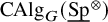 as a localization of
  . Both this localization result as well as the formula for free normed global algebra require developing of a great deal of (parametrized) higher algebra, and this actually accounts for the bulk of the present article.
We now turn to a linear overview of the paper.
In Section 2 we develop the basics of parametrized higher algebra needed throughout this article, in particular introducing parametrized operads and normed categories; rather than defining these concepts as fibrations internal to parametrized higher category theory as in [Reference Nardin and ShahNS22], we will follow [Reference Barkan, Haugseng and SteinebrunnerBHS25] in viewing them as ordinary fibrations over suitable span categories. We further define parametrized categories of normed algebras and prove a representability result for them that will be crucial in later sections.
In Section 3 we introduce a variant of the notion of distributivity, originally studied by Nardin [Reference NardinNar17], for our setup. We show that for a distributive normed category ${\mathcal {C}}^\otimes $
, the forgetful functor
${\mathcal {C}}^\otimes $
, the forgetful functor $\mathbb U$
from normed algebras in
$\mathbb U$
from normed algebras in ${\mathcal {C}}^\otimes $
to
${\mathcal {C}}^\otimes $
to ${\mathcal {C}}$
itself has a left adjoint
${\mathcal {C}}$
itself has a left adjoint $\mathbb P$
, and we provide a universal formula for this left adjoint (or, more precisely, for the composite
$\mathbb P$
, and we provide a universal formula for this left adjoint (or, more precisely, for the composite $\mathbb U\mathbb P$
). While all of this happens in a very general setting, we specialize this discussion to the context of global equivariant homotopy theory in Section 4.
$\mathbb U\mathbb P$
). While all of this happens in a very general setting, we specialize this discussion to the context of global equivariant homotopy theory in Section 4.
In Section 5 we introduce the normed global category of global spectra  and show that it is indeed distributive in the above sense. We go on to prove Theorem B, following the strategy outlined above.
We then shift gears in Section 6 and begin studying the interaction of globalization and normed structures. For this it will be convenient to exhibit the globalization construction as an instance of a more general rigidification construction due to Abellán [Reference AbellánAbe23], which admits a universal property for functors into it. We show that the rigidification of a normed category inherits a canonical normed structure, and that the resulting normed category again has a universal property. Combining this universal property with the representability result for categories of normed algebras we obtain Theorem E.
Building on this, Section 7 studies normed algebras in rigidifications of normed categories. We in particular explain how to assemble the categories  into a global category, and show that the globalization of the result is given by the global category of normed algebras in
  . This allows us to deduce Theorem A from its global counterpart, which then immediately yields Theorem E.
In Section 8 we shift gears once more, and introduce alternative descriptions of the normed categories  and
and  in terms of spectral Mackey functors. In the global case, this crucially relies on the results of Section 6 on the interaction of normed structures and rigidification. With these models at hand, we then use the results of [Reference Cnossen, Haugseng, Lenz and LinskensCHLL24] to describe G-global connective ultra-commutative ring spectra as space-valued Tambara functors, in particular proving Theorem G.
The paper concludes with three short appendices: in Appendix A we compare two different pointset models of ultra-commutative global ring spectra, while Appendix B is devoted to the proof of parametrized versions of smooth and proper basechange and the basechange results for functors of span categories established in [Reference Cnossen, Haugseng, Lenz and LinskensCHLL25]. Finally, we make precise in Appendix C that ultra-commutative equivariant or global ring spectra cannot be described using ordinary higher algebra.
2 Parametrized higher algebra
2.1 Recollections on categories of spans
We begin with some recollections on categories of spans, which will be vital for almost everything in this paper. For details, we refer the reader to [Reference Haugseng, Hebestreit, Linskens and NuitenHHLN23b].
Definition 2.1 ([Reference BarwickBar17, Definition 5.2], [Reference Haugseng, Hebestreit, Linskens and NuitenHHLN23b, Definition 2.1]).
An adequate triple $(\mathcal {C},\mathcal {C}_B,\mathcal {C}_F)$
consists of a category
$(\mathcal {C},\mathcal {C}_B,\mathcal {C}_F)$
consists of a category $\mathcal {C}$
together with two wide subcategories
$\mathcal {C}$
together with two wide subcategories $\mathcal {C}_B,\mathcal {C}_F \subset \mathcal {C}$
of “backwards” and “forwards” maps,Footnote
6
such that pullbacks of morphisms in
$\mathcal {C}_B,\mathcal {C}_F \subset \mathcal {C}$
of “backwards” and “forwards” maps,Footnote
6
such that pullbacks of morphisms in $\mathcal {C}_B$
along morphisms in
$\mathcal {C}_B$
along morphisms in $\mathcal {C}_F$
exist in
$\mathcal {C}_F$
exist in $\mathcal {C}$
, and both
$\mathcal {C}$
, and both $\mathcal {C}_B$
and
$\mathcal {C}_B$
and $\mathcal {C}_F$
are stable under pullback. We write
$\mathcal {C}_F$
are stable under pullback. We write $\operatorname {\mathrm {AdTrip}}$
for the category of adequate triples, where morphisms
$\operatorname {\mathrm {AdTrip}}$
for the category of adequate triples, where morphisms $(\mathcal {C},\mathcal {C}_B,\mathcal {C}_F) \to (\mathcal {D},\mathcal {D}_B,\mathcal {D}_F)$
are functors
$(\mathcal {C},\mathcal {C}_B,\mathcal {C}_F) \to (\mathcal {D},\mathcal {D}_B,\mathcal {D}_F)$
are functors $\mathcal {C} \to \mathcal {D}$
preserving forwards and backwards maps as well as pullbacks of forwards along backwards maps.
$\mathcal {C} \to \mathcal {D}$
preserving forwards and backwards maps as well as pullbacks of forwards along backwards maps.
Example 2.2. If $\mathcal {C}$
is any category, then
$\mathcal {C}$
is any category, then $(\mathcal {C},\mathcal {C},\operatorname {\mathrm {\iota }}\mathcal {C})$
,
$(\mathcal {C},\mathcal {C},\operatorname {\mathrm {\iota }}\mathcal {C})$
, $(\mathcal {C},\operatorname {\mathrm {\iota }}\mathcal {C},\mathcal {C})$
, and
$(\mathcal {C},\operatorname {\mathrm {\iota }}\mathcal {C},\mathcal {C})$
, and $(\mathcal {C},\operatorname {\mathrm {\iota }}\mathcal {C},\operatorname {\mathrm {\iota }}\mathcal {C})$
are adequate triples, where
$(\mathcal {C},\operatorname {\mathrm {\iota }}\mathcal {C},\operatorname {\mathrm {\iota }}\mathcal {C})$
are adequate triples, where $\operatorname {\mathrm {\iota }}\mathcal {C}\subset \mathcal {C}$
denotes the maximal subgroupoid.
$\operatorname {\mathrm {\iota }}\mathcal {C}\subset \mathcal {C}$
denotes the maximal subgroupoid.
Example 2.3. If $\mathcal {C}$
is a category admitting pullbacks, then
$\mathcal {C}$
is a category admitting pullbacks, then $(\mathcal {C},\mathcal {C},\mathcal {C})$
forms an adequate triple.
$(\mathcal {C},\mathcal {C},\mathcal {C})$
forms an adequate triple.
Quite often, the following special case will be enough for our needs.
Definition 2.4. We say that a category $\mathcal {C}$
together with a wide subcategory
$\mathcal {C}$
together with a wide subcategory $\mathcal {C}_F \subset \mathcal {C}$
is a span pair if
$\mathcal {C}_F \subset \mathcal {C}$
is a span pair if $(\mathcal {C},\mathcal {C},\mathcal {C}_F)$
is an adequate triple.
$(\mathcal {C},\mathcal {C},\mathcal {C}_F)$
is an adequate triple.
The main use of adequate triples is that they present the minimum necessary conditions to build a span category (called the effective Burnside category in Barwick’s original treatment [Reference BarwickBar17]). Namely by [Reference Haugseng, Hebestreit, Linskens and NuitenHHLN23b, Definition 2.12], there is a functor
 $$\begin{align*}\operatorname{\mathrm{Span}} \colon \operatorname{\mathrm{AdTrip}} \to \mathrm{Cat},\ (\mathcal{C},\mathcal{C}_B,\mathcal{C}_F) \mapsto \operatorname{\mathrm{Span}}_{B,F}(\mathcal{C}), \end{align*}$$
where the category $\operatorname {\mathrm {Span}}_{B,F}(\mathcal {C})$
has the same objects as
$\operatorname {\mathrm {Span}}_{B,F}(\mathcal {C})$
has the same objects as $\mathcal {C}$
, and morphisms from X to Y are given by spans
$\mathcal {C}$
, and morphisms from X to Y are given by spans

where b is a morphism in $\mathcal {C}_B$
and f is a morphism in
$\mathcal {C}_B$
and f is a morphism in $\mathcal {C}_F$
. Composition is by taking pullbacks in
$\mathcal {C}_F$
. Composition is by taking pullbacks in $\mathcal {C}$
.
$\mathcal {C}$
.
Given a span pair $(\mathcal {C},\mathcal {C}_F)$
, we will denote the span category associated to
$(\mathcal {C},\mathcal {C}_F)$
, we will denote the span category associated to $(\mathcal {C},\mathcal {C},\mathcal {C}_F)$
by
$(\mathcal {C},\mathcal {C},\mathcal {C}_F)$
by $\operatorname {\mathrm {Span}}_F(\mathcal {C})$
, or sometimes write
$\operatorname {\mathrm {Span}}_F(\mathcal {C})$
, or sometimes write $\operatorname {\mathrm {Span}}_{\mathrm{all},F}(\mathcal {C})$
for emphasis. Similarly, we will sometimes use
$\operatorname {\mathrm {Span}}_{\mathrm{all},F}(\mathcal {C})$
for emphasis. Similarly, we will sometimes use $\operatorname {\mathrm {Span}}_{B,\mathrm{all}}(\mathcal {C})$
to denote the category of spans associated to an adequate triple of the form
$\operatorname {\mathrm {Span}}_{B,\mathrm{all}}(\mathcal {C})$
to denote the category of spans associated to an adequate triple of the form $(\mathcal {C},\mathcal {C}_B,\mathcal {C})$
. Finally, if
$(\mathcal {C},\mathcal {C}_B,\mathcal {C})$
. Finally, if $\mathcal {C}$
admits pullbacks we will write
$\mathcal {C}$
admits pullbacks we will write $\operatorname {\mathrm {Span}}(\mathcal {C})$
for the span category associated to
$\operatorname {\mathrm {Span}}(\mathcal {C})$
for the span category associated to $(\mathcal {C},\mathcal {C},\mathcal {C})$
.
$(\mathcal {C},\mathcal {C},\mathcal {C})$
.
Let us collect some of the main results on span categories from [Reference Haugseng, Hebestreit, Linskens and NuitenHHLN23b].
Theorem 2.5. Let $(\mathcal {C},\mathcal {C}_B,\mathcal {C}_F)$
be an adequate triple.
$(\mathcal {C},\mathcal {C}_B,\mathcal {C}_F)$
be an adequate triple.
-
1. The category
$\operatorname {\mathrm {AdTrip}}$
has all limits and they are computed in
$\mathrm{Cat}$
. -
2. The functor
$\operatorname {\mathrm {Span}} \colon \operatorname {\mathrm {AdTrip}} \to \mathrm{Cat}$
is a right adjoint, hence preserves all limits. -
3. There is a natural equivalence
$\operatorname {\mathrm {Span}}_{B,F}(\mathcal {C})^{\mathrm{op}} \simeq \operatorname {\mathrm {Span}}_{F,B}(\mathcal {C})$
. -
4. We have inclusions of wide subcategories
sending a morphism
$$\begin{align*}\mathcal{C}_B^{\mathrm{op}} \hookrightarrow \operatorname{\mathrm{Span}}_{B,F}(\mathcal{C}) \qquad\mathrm{and}\qquad \mathcal{C}_F \hookrightarrow \operatorname{\mathrm{Span}}_{B,F}(\mathcal{C}), \end{align*}$$
$b \colon X \to Y$
in
$\mathcal {C}_B$
to the “backwards span”
$Y \xleftarrow {b} X = X$
, and a morphism
$f \colon Y \to Z$
in
$\mathcal {C}_F$
to the “forwards span” , respectively. Moreover, in the case that
$\mathcal {C}_B = \operatorname {\mathrm {\iota }}\mathcal {C}$
, the second inclusion induces an equivalence
$\mathcal {C}_F \simeq \operatorname {\mathrm {Span}}_{\simeq ,F}(\mathcal {C})$
. Analogously,
$\mathcal {C}_B^{\mathrm{op}} \simeq \operatorname {\mathrm {Span}}_{B,\simeq }(\mathcal {C})$
.
-
5. The backwards and forwards maps form an (orthogonal) factorization system
$(\operatorname {\mathrm {Span}}_{B,F}(\mathcal {C}),\mathcal {C}_B^{\mathrm{op}},\mathcal {C}_F)$
.





 , respectively. Moreover, in the case that


Proof. In the listed order, these results are [Reference Haugseng, Hebestreit, Linskens and NuitenHHLN23b, Lemma 2.4, Theorem 2.18, Lemma 2.14, Proposition 2.15, and Proposition 4.9].
2.2 Normed precategories and preoperads
For the remainder of this section, we fix a span pair $(\mathcal {F},\mathcal {N})$
.
$(\mathcal {F},\mathcal {N})$
.
Notation 2.6. We will denote maps in $\mathcal {N}$
as
$\mathcal {N}$
as  .
.
Definition 2.7. We let $\mathrm {Op}^\ast _{\mathcal {N}}(\mathcal {F})$
denote the subcategory of
$\mathrm {Op}^\ast _{\mathcal {N}}(\mathcal {F})$
denote the subcategory of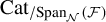 $\mathrm{Cat}_{/\operatorname {\mathrm {Span}}_{\mathcal {N}}(\mathcal {F})}$
whose objects are the
$\mathrm{Cat}_{/\operatorname {\mathrm {Span}}_{\mathcal {N}}(\mathcal {F})}$
whose objects are the $(\mathcal {F},\mathcal {N})$
-preoperads, defined to be those functors which admit cocartesian lifts for all morphisms in
$(\mathcal {F},\mathcal {N})$
-preoperads, defined to be those functors which admit cocartesian lifts for all morphisms in $\mathcal {F}^{{\mathrm{op}}}\subset \operatorname {\mathrm {Span}}_{\mathcal {N}}(\mathcal {F})$
, and whose morphisms are those functors over
$\mathcal {F}^{{\mathrm{op}}}\subset \operatorname {\mathrm {Span}}_{\mathcal {N}}(\mathcal {F})$
, and whose morphisms are those functors over $\operatorname {\mathrm {Span}}_{\mathcal {N}}(\mathcal {F})$
which preserve such lifts.
$\operatorname {\mathrm {Span}}_{\mathcal {N}}(\mathcal {F})$
which preserve such lifts.
Warning 2.8. Beware that the condition that $\mathcal {X} \to \operatorname {\mathrm {Span}}_{\mathcal {N}}(\mathcal {F})$
admits cocartesian lifts of morphisms in
$\mathcal {X} \to \operatorname {\mathrm {Span}}_{\mathcal {N}}(\mathcal {F})$
admits cocartesian lifts of morphisms in $\mathcal {F}^{{\mathrm{op}}}$
is strictly stronger than demanding that the pullback
$\mathcal {F}^{{\mathrm{op}}}$
is strictly stronger than demanding that the pullback $\mathcal {X} \times _{\operatorname {\mathrm {Span}}_{\mathcal {N}}(\mathcal {F})} \mathcal {F}^{{\mathrm{op}}}\to \mathcal {F}^{\mathrm{op}}$
be a cocartesian fibration.
$\mathcal {X} \times _{\operatorname {\mathrm {Span}}_{\mathcal {N}}(\mathcal {F})} \mathcal {F}^{{\mathrm{op}}}\to \mathcal {F}^{\mathrm{op}}$
be a cocartesian fibration.
Definition 2.9. We let $\mathrm {NCat}^\ast _{\mathcal {N}}(\mathcal {F})$
denote the category
$\mathrm {NCat}^\ast _{\mathcal {N}}(\mathcal {F})$
denote the category $\operatorname {\mathrm {Fun}}(\operatorname {\mathrm {Span}}_{\mathcal {N}}(\mathcal {F}),\mathrm{Cat})$
. We call objects of this category
$\operatorname {\mathrm {Fun}}(\operatorname {\mathrm {Span}}_{\mathcal {N}}(\mathcal {F}),\mathrm{Cat})$
. We call objects of this category $\mathcal {N}$
-normed
$\mathcal {N}$
-normed $\mathcal {F}$
-precategories. We view this as a nonfull subcategory of
$\mathcal {F}$
-precategories. We view this as a nonfull subcategory of $\mathrm {Op}^\ast _{\mathcal {N}}(\mathcal {F})$
via the identification of
$\mathrm {Op}^\ast _{\mathcal {N}}(\mathcal {F})$
via the identification of $\mathrm {NCat}^\ast _{\mathcal {N}}(\mathcal {F})$
with cocartesian fibrations over
$\mathrm {NCat}^\ast _{\mathcal {N}}(\mathcal {F})$
with cocartesian fibrations over $\operatorname {\mathrm {Span}}_{\mathcal {N}}(\mathcal {F})$
given by unstraightening.
$\operatorname {\mathrm {Span}}_{\mathcal {N}}(\mathcal {F})$
given by unstraightening.
Remark 2.10. Suppose $\mathcal {F} = \mathcal {N} = \mathbb {F}$
is the category of finite sets. Then by [Reference Barkan, Haugseng and SteinebrunnerBHS25, Corollary B], operads in the sense of Lurie correspond to a full subcategory of
$\mathcal {F} = \mathcal {N} = \mathbb {F}$
is the category of finite sets. Then by [Reference Barkan, Haugseng and SteinebrunnerBHS25, Corollary B], operads in the sense of Lurie correspond to a full subcategory of $\mathrm {Op}^\ast _{\mathbb {F}}(\mathbb {F})$
. This connection inspires our choice of notation. In §2.4 we will single out the correct category of
$\mathrm {Op}^\ast _{\mathbb {F}}(\mathbb {F})$
. This connection inspires our choice of notation. In §2.4 we will single out the correct category of $(\mathcal {F},\mathcal {N})$
-operads which generalize Lurie’s operads.
$(\mathcal {F},\mathcal {N})$
-operads which generalize Lurie’s operads.
Definition 2.11. Let $\mathcal {X}\to \operatorname {\mathrm {Span}}_{\mathcal {N}}(\mathcal {F})$
be a preoperad. Note that the pullback of
$\mathcal {X}\to \operatorname {\mathrm {Span}}_{\mathcal {N}}(\mathcal {F})$
be a preoperad. Note that the pullback of $\mathcal {X}$
along the inclusion
$\mathcal {X}$
along the inclusion $\mathcal {F}^{{\mathrm{op}}}\subset \operatorname {\mathrm {Span}}_{\mathcal {N}}(\mathcal {F})$
is a cocartesian fibration over
$\mathcal {F}^{{\mathrm{op}}}\subset \operatorname {\mathrm {Span}}_{\mathcal {N}}(\mathcal {F})$
is a cocartesian fibration over $\mathcal {F}^{{\mathrm{op}}}$
. In particular we obtain a functor
$\mathcal {F}^{{\mathrm{op}}}$
. In particular we obtain a functor
 $$\begin{align*}\mathrm{fgt}\colon \mathrm{Op}^\ast_{\mathcal{N}}(\mathcal{F})\to \operatorname{\mathrm{Fun}}(\mathcal{F}^{{\mathrm{op}}},\mathrm{Cat}). \end{align*}$$
For consistency of notation we denote $\operatorname {\mathrm {Fun}}(\mathcal {F}^{{\mathrm{op}}},\mathrm{Cat})$
by
$\operatorname {\mathrm {Fun}}(\mathcal {F}^{{\mathrm{op}}},\mathrm{Cat})$
by $\mathrm {Cat}^\ast (\mathcal {F})$
and call its objects
$\mathrm {Cat}^\ast (\mathcal {F})$
and call its objects $\mathcal {F}$
-precategories.
$\mathcal {F}$
-precategories.
Remark 2.12. Functors $\mathcal {F}^{\mathrm{op}}\to \mathrm{Cat}$
are typically called
$\mathcal {F}^{\mathrm{op}}\to \mathrm{Cat}$
are typically called $\mathcal {F}$
-categories in the literature, and they are the fundamental object of study in parametrized higher category theory [Reference Barwick, Dotto, Glasman, Nardin and ShahBDG+16]. As we will explain in Remarks 2.54 and 2.56, it will be more convenient for our purposes to reserve that name for functors satisfying an additional product preservation condition.
$\mathcal {F}$
-categories in the literature, and they are the fundamental object of study in parametrized higher category theory [Reference Barwick, Dotto, Glasman, Nardin and ShahBDG+16]. As we will explain in Remarks 2.54 and 2.56, it will be more convenient for our purposes to reserve that name for functors satisfying an additional product preservation condition.
Remark 2.13. We note that each of the categories $\mathrm {Op}^\ast _{\mathcal {N}}(\mathcal {F}), \mathrm {NCat}^\ast _{\mathcal {N}}(\mathcal {F})$
and
$\mathrm {Op}^\ast _{\mathcal {N}}(\mathcal {F}), \mathrm {NCat}^\ast _{\mathcal {N}}(\mathcal {F})$
and $\mathrm {Cat}^\ast (\mathcal {F})$
is a subcategory of a slice of
$\mathrm {Cat}^\ast (\mathcal {F})$
is a subcategory of a slice of $\mathrm{Cat}$
. For every S, the functor
$\mathrm{Cat}$
. For every S, the functor $S \times - \colon \mathrm{Cat} \to \mathrm{Cat}_{/S}$
is symmetric monoidal for the cartesian symmetric monoidal structures, and moreover factors through
$S \times - \colon \mathrm{Cat} \to \mathrm{Cat}_{/S}$
is symmetric monoidal for the cartesian symmetric monoidal structures, and moreover factors through $\mathrm{Cat}^{\mathrm{cc}}_{/S}$
, the category of cocartesian fibration over S; under the equivalence of the latter with
$\mathrm{Cat}^{\mathrm{cc}}_{/S}$
, the category of cocartesian fibration over S; under the equivalence of the latter with $\operatorname {\mathrm {Fun}}(S,\mathrm{Cat})$
, it is simply given by
$\operatorname {\mathrm {Fun}}(S,\mathrm{Cat})$
, it is simply given by $\mathrm{const} \colon \mathrm{Cat} \to \operatorname {\mathrm {Fun}}(S,\mathrm{Cat})$
. In particular, all of the above categories are canonically
$\mathrm{const} \colon \mathrm{Cat} \to \operatorname {\mathrm {Fun}}(S,\mathrm{Cat})$
. In particular, all of the above categories are canonically $\mathrm{Cat}$
-modules, and the forgetful functors
$\mathrm{Cat}$
-modules, and the forgetful functors $\mathrm {NCat}^\ast _{\mathcal {N}}(\mathcal {F}) \to \mathrm {Op}^\ast _{\mathcal {N}}(\mathcal {F}) \to \mathrm {Cat}^\ast (\mathcal {F})$
are canonically lax
$\mathrm {NCat}^\ast _{\mathcal {N}}(\mathcal {F}) \to \mathrm {Op}^\ast _{\mathcal {N}}(\mathcal {F}) \to \mathrm {Cat}^\ast (\mathcal {F})$
are canonically lax $\mathrm{Cat}$
-linear.
$\mathrm{Cat}$
-linear.
All of these $\mathrm{Cat}$
-module structures are adjoint to
$\mathrm{Cat}$
-module structures are adjoint to $\mathrm{Cat}$
-enrichments in the sense of Lurie, and we denote the resulting hom categories in
$\mathrm{Cat}$
-enrichments in the sense of Lurie, and we denote the resulting hom categories in $\mathrm {Op}^\ast _{\mathcal {N}}(\mathcal {F}), \mathrm {NCat}^\ast _{\mathcal {N}}(\mathcal {F})$
and
$\mathrm {Op}^\ast _{\mathcal {N}}(\mathcal {F}), \mathrm {NCat}^\ast _{\mathcal {N}}(\mathcal {F})$
and $\mathrm {Cat}^\ast (\mathcal {F})$
by
$\mathrm {Cat}^\ast (\mathcal {F})$
by
 $$\begin{align*}\operatorname{\mathrm{Fun}}_{\mathcal{F}}^{\mathcal{N}\mathrm{-lax}}(-,-), \quad \operatorname{\mathrm{Fun}}_{\mathcal{F}}^{\mathcal{N}\text{-}\otimes}(-,-), \quad \mathrm{and} \quad \operatorname{\mathrm{Fun}}_{\mathcal{F}}(-,-) \end{align*}$$
respectively.
More specifically, all of these categories canonically inherit the structure of an $(\infty ,2)$
-category from
$(\infty ,2)$
-category from $\mathrm{Cat}_{/S}$
, as we now briefly recall; for a detailed overview of the following, we refer the reader to [Reference Heyer and MannHM24, Appendices C and D]. By definition, an
$\mathrm{Cat}_{/S}$
, as we now briefly recall; for a detailed overview of the following, we refer the reader to [Reference Heyer and MannHM24, Appendices C and D]. By definition, an $(\infty ,2)$
-category is a
$(\infty ,2)$
-category is a $\mathrm{Cat}$
-enriched category, and an
$\mathrm{Cat}$
-enriched category, and an $(\infty ,2)$
-functor is a
$(\infty ,2)$
-functor is a $\mathrm{Cat}$
-enriched functor. There are two prominent models of enriched
$\mathrm{Cat}$
-enriched functor. There are two prominent models of enriched $\infty $
-categories, developed by Lurie [Reference LurieLur17, Definition 4.2.1.28] and by Gepner–Haugseng [Reference Gepner and HaugsengGH15] and Hinich [Reference HinichHin21], respectively, which were shown to be equivalent in a strong sense by Heine [Reference HeineHei23]. Using the Lurie model, if
$\infty $
-categories, developed by Lurie [Reference LurieLur17, Definition 4.2.1.28] and by Gepner–Haugseng [Reference Gepner and HaugsengGH15] and Hinich [Reference HinichHin21], respectively, which were shown to be equivalent in a strong sense by Heine [Reference HeineHei23]. Using the Lurie model, if $\mathcal {C}$
is a
$\mathcal {C}$
is a $\mathrm{Cat}$
-module such that the functor
$\mathrm{Cat}$
-module such that the functor $- \times c \colon \mathrm{Cat} \to \mathcal {C}$
admits a right adjoint for every
$- \times c \colon \mathrm{Cat} \to \mathcal {C}$
admits a right adjoint for every $c \in \mathcal {C}$
, then
$c \in \mathcal {C}$
, then $\mathcal {C}$
inherits the structure of an
$\mathcal {C}$
inherits the structure of an $(\infty ,2)$
-category [Reference Heyer and MannHM24, Example C.1.11] (although weaker conditions suffice), and the category of
$(\infty ,2)$
-category [Reference Heyer and MannHM24, Example C.1.11] (although weaker conditions suffice), and the category of $(\infty ,2)$
-functors between two such
$(\infty ,2)$
-functors between two such $\mathrm{Cat}$
-modules agrees with the category of lax
$\mathrm{Cat}$
-modules agrees with the category of lax $\mathrm{Cat}$
-linear functors [Reference Heyer and MannHM24, Example C.2.2]. Recall also from [Reference LurieLur17, Corollary 7.3.2.7] that a right adjoint of a
$\mathrm{Cat}$
-linear functors [Reference Heyer and MannHM24, Example C.2.2]. Recall also from [Reference LurieLur17, Corollary 7.3.2.7] that a right adjoint of a $\mathrm{Cat}$
-linear functor automatically obtains a lax
$\mathrm{Cat}$
-linear functor automatically obtains a lax $\mathrm{Cat}$
-linear structure, which thus upgrades the entire adjunction to one of
$\mathrm{Cat}$
-linear structure, which thus upgrades the entire adjunction to one of $(\infty ,2)$
-categories. In particular, in this case the natural adjunction equivalence of mapping spaces lifts to one of mapping categories.
$(\infty ,2)$
-categories. In particular, in this case the natural adjunction equivalence of mapping spaces lifts to one of mapping categories.
Remark 2.14. Let S be a category. Then a morphism $L\colon F\to G$
is a left adjoint in the
$L\colon F\to G$
is a left adjoint in the $(\infty ,2)$
-category
$(\infty ,2)$
-category $\operatorname {\mathrm {Fun}}(S, \mathrm{Cat})$
if it is a right adjointable natural transformation, by which we mean that
$\operatorname {\mathrm {Fun}}(S, \mathrm{Cat})$
if it is a right adjointable natural transformation, by which we mean that
-
1. For every
$X\in S$
the functor
$L_X$
admits a right adjoint
$R_X$
. -
2. For every morphism
$f\colon X\to Y$
, the Beck–Chevalley transformation is an equivalence.


This is the content of [Reference LurieLur17, Proposition 7.3.2.11], after applying the unstraightening equivalence. Dually, a morphism is a right adjoint if it is a left adjointable natural transformation. Specializing the above, we obtain a description of adjunctions in $\mathrm {Cat}^\ast (\mathcal {F})$
and
$\mathrm {Cat}^\ast (\mathcal {F})$
and $\mathrm {NCat}^\ast _{\mathcal {N}}(\mathcal {F})$
, which we will use throughout.
$\mathrm {NCat}^\ast _{\mathcal {N}}(\mathcal {F})$
, which we will use throughout.
Our goal now is to repeat some of the basic constructions on operads in our context.
Definition 2.15. Let $\mathcal {C}\colon \mathcal {F}^{{\mathrm{op}}}\to \mathrm{Cat}$
be an
$\mathcal {C}\colon \mathcal {F}^{{\mathrm{op}}}\to \mathrm{Cat}$
be an $\mathcal {F}$
-precategory.
$\mathcal {F}$
-precategory.
-
1. We write
$\operatorname {\mathrm {Triv}}(\mathcal {C})$
for the composition
$\mathrm{Un}^{\mathrm{cc}}(\mathcal {C}) \to \mathcal {F}^{\mathrm{op}} \to \operatorname {\mathrm {Span}}_{\mathcal {N}}(\mathcal {F})$
of the cocartesian unstraightening of
$\mathcal {C}$
with the inclusion
$\mathcal {F}^{\mathrm{op}} \hookrightarrow \operatorname {\mathrm {Span}}_{\mathcal {N}}(\mathcal {F})$
. -
2. Let
$p \colon \mathrm{Un}^{\mathrm{ct}}(\mathcal {C}) \to \mathcal {F}$
denote the cartesian unstraightening of
$\mathcal {C}$
. We define
$\mathcal {C}^{{\mathcal {N}\text{-}\amalg }}$
to be the functor where in the source we have taken the span category in
$$\begin{align*}\operatorname{\mathrm{Span}}(p) \colon \operatorname{\mathrm{Span}}_{\mathrm{ct},\mathcal{N}}(\mathrm{Un}^{\mathrm{ct}}(\mathcal{C})) \to \operatorname{\mathrm{Span}}_{\mathcal{N}}(\mathcal{F}), \end{align*}$$
$\mathrm{Un}^{\mathrm{ct}}(\mathcal {C})$
whose backwards maps are cartesian and whose forward maps are those lying over
$\mathcal {N}$
. These two subcategories determine an adequate triple by [Reference Haugseng, Hebestreit, Linskens and NuitenHHLN23b, Proposition 2.6] .


Lemma 2.16. Let $\mathcal {C}$
be an
$\mathcal {C}$
be an $\mathcal {F}$
-precategory.
$\mathcal {F}$
-precategory.
-
1. Both
$\operatorname {\mathrm {Triv}}(\mathcal {C})$
and
$\mathcal {C}^{{\mathcal {N}\text{-}\amalg }}$
are
$(\mathcal {F},\mathcal {N})$
-preoperads. -
2. There exists a natural map
${{\mathrm{incl}}}_{\mathcal {C}} \colon \operatorname {\mathrm {Triv}}(\mathcal {C}) \to \mathcal {C}^{{\mathcal {N}\text{-}\amalg }}$
of
$(\mathcal {F},\mathcal {N})$
-preoperads induced by the pullback square -
3. Suppose that
$\mathcal {C}$
is left
$\mathcal {N}$
-adjointable in the sense of [Reference Elmanto and HaugsengEH23, Definition 2.2.5], that is, for every in
${\mathcal {N}}$
the functor admits a left adjoint
$n_!$
and that every pullback in
$\mathcal {F}$
with horizontal maps in
$\mathcal {N}$
as indicated, is sent to a left adjointable square, meaning that the Beck–Chevalley transformation is an equivalence. Then
$$\begin{align*}n^{\prime}_!f^{\prime*}\to f^{*}n_! \end{align*}$$
$\mathcal {C}^{{\mathcal {N}\text{-}\amalg }}$
is a cocartesian fibration classifying an extension of
$\mathcal {C}$
to an
$\mathcal {N}$
-normed
$\mathcal {F}$
-precategory sending the forward maps to the left adjoints.





 in
in 
 admits a left adjoint


Proof. We note that $\mathcal {C}^{{\mathcal {N}\text{-}\amalg }}$
is Barwick’s unfurling construction, and all claims about it follow immediately from [Reference Haugseng, Hebestreit, Linskens and NuitenHHLN23b, Theorem 3.1, Example 3.4, Corollary 3.18].
$\mathcal {C}^{{\mathcal {N}\text{-}\amalg }}$
is Barwick’s unfurling construction, and all claims about it follow immediately from [Reference Haugseng, Hebestreit, Linskens and NuitenHHLN23b, Theorem 3.1, Example 3.4, Corollary 3.18].
It remains to see that $\operatorname {\mathrm {Triv}}(\mathcal {C})$
is a cocartesian fibration and that
$\operatorname {\mathrm {Triv}}(\mathcal {C})$
is a cocartesian fibration and that ${{\mathrm{incl}}}_{\mathcal {C}}$
preserves cocartesian lifts of backwards maps. The former follows immediately from the fact that
${{\mathrm{incl}}}_{\mathcal {C}}$
preserves cocartesian lifts of backwards maps. The former follows immediately from the fact that $\mathcal {F}^{{\mathrm{op}}}\to \operatorname {\mathrm {Span}}_{\mathcal {N}}(\mathcal {F})$
is itself an
$\mathcal {F}^{{\mathrm{op}}}\to \operatorname {\mathrm {Span}}_{\mathcal {N}}(\mathcal {F})$
is itself an $(\mathcal {F},\mathcal {N})$
-operad, which in turn follows immediately from the fact that the subcategory
$(\mathcal {F},\mathcal {N})$
-operad, which in turn follows immediately from the fact that the subcategory $\mathcal {F}^{{\mathrm{op}}}\subset \operatorname {\mathrm {Span}}_{\mathcal {N}}(\mathcal {F})$
is right cancelable.
$\mathcal {F}^{{\mathrm{op}}}\subset \operatorname {\mathrm {Span}}_{\mathcal {N}}(\mathcal {F})$
is right cancelable.
Finally, to see that the map ${{\mathrm{incl}}}_{\mathcal {C}}$
preserves cocartesian edges over
${{\mathrm{incl}}}_{\mathcal {C}}$
preserves cocartesian edges over $\mathcal {F}^{{\mathrm{op}}}$
we may appeal to the characterization of cocartesian edges in
$\mathcal {F}^{{\mathrm{op}}}$
we may appeal to the characterization of cocartesian edges in $\mathcal {C}^{{\mathcal {N}\text{-}\amalg }}$
from Theorem 3.1 of op. cit.
$\mathcal {C}^{{\mathcal {N}\text{-}\amalg }}$
from Theorem 3.1 of op. cit.
Example 2.17. Write  for the ${\mathcal {F}}$
-precategory represented by
${\mathcal {F}}$
-precategory represented by $A\in {\mathcal {F}}$
. Then we have
$A\in {\mathcal {F}}$
. Then we have  and
and  naturally in A. Under these identifications, the map
  is simply given by the inclusion of backwards maps.
The next crucial construction we wish to imitate is the envelope of operads. Thankfully, this has already been done by [Reference Barkan, Haugseng and SteinebrunnerBHS25] in the generality of an arbitrary factorization system $(S,E,M)$
. For later use, we recall the relevant definitions and results in this generality.
$(S,E,M)$
. For later use, we recall the relevant definitions and results in this generality.
Notation 2.18. We denote arrows in M by  and arrows in E by
  .
.
Definition 2.19. Consider a category S equipped with a subcategory $S_0$
. We let
$S_0$
. We let $\mathrm{Cat}^{S_0{\text{-}\mathrm{cc}}}_{/S}$
denote the subcategory of
$\mathrm{Cat}^{S_0{\text{-}\mathrm{cc}}}_{/S}$
denote the subcategory of $\mathrm{Cat}_{/S}$
on those objects
$\mathrm{Cat}_{/S}$
on those objects $\mathcal {X} \to S$
which are
$\mathcal {X} \to S$
which are $S_0$
-cocartesian fibrations, that is, admit cocartesian lifts for all morphisms in
$S_0$
-cocartesian fibrations, that is, admit cocartesian lifts for all morphisms in $S_0$
, and those morphisms which preserve these lifts.
$S_0$
, and those morphisms which preserve these lifts.
Of particular interest now is the case that $S_0 = E$
.
$S_0 = E$
.
Example 2.20. For $S=\operatorname {\mathrm {Span}}_{\mathcal {N}}({\mathcal {F}})$
equipped with its standard factorization system from Theorem 2.5(5), the category
$S=\operatorname {\mathrm {Span}}_{\mathcal {N}}({\mathcal {F}})$
equipped with its standard factorization system from Theorem 2.5(5), the category $\mathrm{Cat}_{/S}^{E{\text{-}\mathrm{cc}}}$
is equal to
$\mathrm{Cat}_{/S}^{E{\text{-}\mathrm{cc}}}$
is equal to $\mathrm {Op}^\ast _{\mathcal {N}}(\mathcal {F})$
, while
$\mathrm {Op}^\ast _{\mathcal {N}}(\mathcal {F})$
, while $\mathrm{Cat}^{\mathrm{cc}}_{/S}$
agrees with
$\mathrm{Cat}^{\mathrm{cc}}_{/S}$
agrees with $\mathrm {NCat}^\ast _{\mathcal {N}}(\mathcal {F})$
.
$\mathrm {NCat}^\ast _{\mathcal {N}}(\mathcal {F})$
.
Definition 2.21. We denote by  the full subcategory of $\operatorname {\mathrm {Ar}}(S)$
spanned by the maps in M. We view
$\operatorname {\mathrm {Ar}}(S)$
spanned by the maps in M. We view $\operatorname {\mathrm {Env}}(1)$
as a category over S via the target projection.
$\operatorname {\mathrm {Env}}(1)$
as a category over S via the target projection.
Definition 2.22. Let $\mathcal {X}\to S$
be an E-cocartesian fibration. We denote by
$\mathcal {X}\to S$
be an E-cocartesian fibration. We denote by $\operatorname {\mathrm {Env}}(\mathcal {X})$
the following pullback
$\operatorname {\mathrm {Env}}(\mathcal {X})$
the following pullback

We view $\operatorname {\mathrm {Env}}(\mathcal {X})$
as a category over S via the composite
$\operatorname {\mathrm {Env}}(\mathcal {X})$
as a category over S via the composite

Note that $\operatorname {\mathrm {Env}}(1)$
is
$\operatorname {\mathrm {Env}}(1)$
is $\operatorname {\mathrm {Env}}(-)$
applied to the final object
$\operatorname {\mathrm {Env}}(-)$
applied to the final object $1=\mathrm{id}_S$
of
$1=\mathrm{id}_S$
of $\mathrm{Cat}^{E\text{-}\mathrm{cc}}_{/S}$
, as the notation suggests. The following is [Reference Barkan, Haugseng and SteinebrunnerBHS25, Theorem E]:
$\mathrm{Cat}^{E\text{-}\mathrm{cc}}_{/S}$
, as the notation suggests. The following is [Reference Barkan, Haugseng and SteinebrunnerBHS25, Theorem E]:
Theorem 2.23. Let $(S,E,M)$
be a factorization system.
$(S,E,M)$
be a factorization system.
-
1. Let
$p\colon \mathcal {X}\to S$
be an E-cocartesian fibration. Then
$\operatorname {\mathrm {Env}}(\mathcal {X})$
is a cocartesian fibration. Moreover, a morphism in
$\operatorname {\mathrm {Env}}(\mathcal {X})$
corresponding to a pair is cocartesian if and only if
$p(f)$
belongs to E and f is a cocartesian lift of
$p(f)$
.
-
2. The functor
$\operatorname {\mathrm {Env}}(-)$
restrict to a functor As such it is a
$$\begin{align*}\operatorname{\mathrm{Env}}(-) \colon \mathrm{Cat}^{E\text{-}\mathrm{cc}}_{/S} \to \mathrm{Cat}^{\mathrm{cc}}_{/S}. \end{align*}$$
$\mathrm{Cat}$
-linear left adjoint to the inclusion
$\mathrm{Cat}^{\mathrm{cc}}_{/S} \hookrightarrow \mathrm{Cat}^{E\text{-}\mathrm{cc}}_{/S}$
, with unit
$\eta $
given at
$\mathcal {X}$
by the identity section
$e \mapsto (e, \mathrm{id}_{p(e)})$
.
-
3. The induced functor
$\operatorname {\mathrm {Env}}(-) \colon \mathrm{Cat}^{E\text{-}\mathrm{cc}}_{/S} \to (\mathrm{Cat}^{\mathrm{cc}}_{/S})_{/\operatorname {\mathrm {Env}}(1)}$
is fully faithful. In particular,
$\operatorname {\mathrm {Env}}(-) \colon \mathrm{Cat}^{E\text{-}\mathrm{cc}}_{/S} \to \mathrm{Cat}^{\mathrm{cc}}_{/S}$
is conservative.


Proof. The first item is the content of [Reference Barkan, Haugseng and SteinebrunnerBHS25, Proposition 2.2.2]. The adjunction in (2) is proven by combining Proposition 2.1.4 and Proposition 2.2.4 of op. cit, while $\mathrm{Cat}$
-linearity of
$\mathrm{Cat}$
-linearity of $\operatorname {\mathrm {Env}}(-)$
is proven in Proposition 5.3.4. Finally, (3) is Proposition 2.3.2 of op. cit.
$\operatorname {\mathrm {Env}}(-)$
is proven in Proposition 5.3.4. Finally, (3) is Proposition 2.3.2 of op. cit.
In view of Example 2.20 we may now apply this result to the case of $(\mathcal {F},\mathcal {N})$
-preoperads.
$(\mathcal {F},\mathcal {N})$
-preoperads.
Definition 2.24. We denote by
 $$\begin{align*}\operatorname{\mathrm{Env}}(-)\colon \mathrm{Op}^\ast_{\mathcal{N}}(\mathcal{F})\to \mathrm{NCat}^\ast_{\mathcal{N}}(\mathcal{F}) \end{align*}$$
the left adjoint to the inclusion functor $\mathrm {NCat}^\ast _{\mathcal {N}}(\mathcal {F})\hookrightarrow \mathrm {Op}^\ast _{\mathcal {N}}(\mathcal {F})$
obtained via the previous result. Since it is
$\mathrm {NCat}^\ast _{\mathcal {N}}(\mathcal {F})\hookrightarrow \mathrm {Op}^\ast _{\mathcal {N}}(\mathcal {F})$
obtained via the previous result. Since it is $\mathrm{Cat}$
-linear, this canonically upgrades to an adjunction of
$\mathrm{Cat}$
-linear, this canonically upgrades to an adjunction of $(\infty ,2)$
-categories in view of Remark 2.13.
$(\infty ,2)$
-categories in view of Remark 2.13.
Remark 2.25. By [Reference Haugseng, Hebestreit, Linskens and NuitenHHLN23a, Corollary 2.22], $\operatorname {\mathrm {Env}}(1) = \operatorname {\mathrm {Ar}}_{\mathcal {N}}(\operatorname {\mathrm {Span}}_{\mathcal {N}}(\mathcal {F}))$
is the category of spans in
$\operatorname {\mathrm {Env}}(1) = \operatorname {\mathrm {Ar}}_{\mathcal {N}}(\operatorname {\mathrm {Span}}_{\mathcal {N}}(\mathcal {F}))$
is the category of spans in $\operatorname {\mathrm {Ar}}_{\mathcal {N}}({\mathcal {F}})$
of the form
$\operatorname {\mathrm {Ar}}_{\mathcal {N}}({\mathcal {F}})$
of the form

where the left square is a pullback and all the marked arrows are, by our standing notational convention, in $\mathcal {N}$
. Unwinding the description of cocartesian edges given in Theorem 2.23, we find that such a diagram is t-cocartesian if and only if the map
$\mathcal {N}$
. Unwinding the description of cocartesian edges given in Theorem 2.23, we find that such a diagram is t-cocartesian if and only if the map  is an equivalence.
We now argue for the expected universal properties of $\operatorname {\mathrm {Triv}}(-)$
and
$\operatorname {\mathrm {Triv}}(-)$
and $(-)^{{\mathcal {N}\text{-}\amalg }}$
.
$(-)^{{\mathcal {N}\text{-}\amalg }}$
.
Proposition 2.26. The constructions $\operatorname {\mathrm {Triv}}(-)$
and
$\operatorname {\mathrm {Triv}}(-)$
and $(-)^{{\mathcal {N}\text{-}\amalg }}$
upgrade to
$(-)^{{\mathcal {N}\text{-}\amalg }}$
upgrade to $\mathrm{Cat}$
-linear left adjoints
$\mathrm{Cat}$
-linear left adjoints
 $$\begin{align*}\operatorname{\mathrm{Triv}}, (-)^{{\mathcal{N}\text{-}\amalg}} \colon \mathrm{Cat}^\ast(\mathcal{F}) \to \mathrm{Op}^\ast_{\mathcal{N}}(\mathcal{F}). \end{align*}$$
such that the natural transformation ${{\mathrm{incl}}} \colon \operatorname {\mathrm {Triv}} \Rightarrow (-)^{{\mathcal {N}\text{-}\amalg }}$
is
${{\mathrm{incl}}} \colon \operatorname {\mathrm {Triv}} \Rightarrow (-)^{{\mathcal {N}\text{-}\amalg }}$
is $\mathrm{Cat}$
-linear. Moreover:
$\mathrm{Cat}$
-linear. Moreover:
-
1.
$(-)^{{\mathcal {N}\text{-}\amalg }}$
preserves all limits, hence also admits a left adjoint. -
2. The functor
$\operatorname {\mathrm {Triv}}$
is fully faithful, and it is left adjoint to the forgetful functor
$\mathrm {Op}^\ast _{\mathcal {N}}(\mathcal {F})\to \mathrm {Cat}^\ast (\mathcal {F})$
, with unit given by the evident equivalence
$\mathrm{id}\simeq \mathrm{fgt}\circ \operatorname {\mathrm {Triv}}$
.


Remark 2.27. In view of Remark 2.13, $\operatorname {\mathrm {Triv}}$
and
$\operatorname {\mathrm {Triv}}$
and $(-)^{{\mathcal {N}\text{-}\amalg }}$
thus canonically upgrade to left adjoint 2-functors between 2-categories, and
$(-)^{{\mathcal {N}\text{-}\amalg }}$
thus canonically upgrade to left adjoint 2-functors between 2-categories, and ${{\mathrm{incl}}}$
becomes a 2-natural transformation.
${{\mathrm{incl}}}$
becomes a 2-natural transformation.
Proof of Proposition 2.26.
We begin by showing the first addendum, that $(-)^{{\mathcal {N}\text{-}\amalg }}$
preserves all limits. Note that the forgetful functor
$(-)^{{\mathcal {N}\text{-}\amalg }}$
preserves all limits. Note that the forgetful functor $\mathrm {Op}^\ast _{\mathcal {N}}(\mathcal {F}) \to \mathrm{Cat}_{/\operatorname {\mathrm {Span}}_{\mathcal {N}}(\mathcal {F})}$
is a conservative right adjoint. The composite of
$\mathrm {Op}^\ast _{\mathcal {N}}(\mathcal {F}) \to \mathrm{Cat}_{/\operatorname {\mathrm {Span}}_{\mathcal {N}}(\mathcal {F})}$
is a conservative right adjoint. The composite of $(-)^{{\mathcal {N}\text{-}\amalg }}$
with it factors as
$(-)^{{\mathcal {N}\text{-}\amalg }}$
with it factors as

where $\Phi $
sends a cartesian fibration
$\Phi $
sends a cartesian fibration $\mathcal {X} \to \mathcal {F}$
to the adequate triple
$\mathcal {X} \to \mathcal {F}$
to the adequate triple $(\mathcal {X}, \mathcal {X}_{\mathrm{ct}}, \mathcal {X} \times _{\mathcal {F}} \mathcal {N})$
over
$(\mathcal {X}, \mathcal {X}_{\mathrm{ct}}, \mathcal {X} \times _{\mathcal {F}} \mathcal {N})$
over $(\mathcal {F},\mathcal {F},\mathcal {N})$
(the former is indeed adequate by [Reference Haugseng, Hebestreit, Linskens and NuitenHHLN23b, Proposition 2.6]). By Theorem 2.5 limits in
$(\mathcal {F},\mathcal {F},\mathcal {N})$
(the former is indeed adequate by [Reference Haugseng, Hebestreit, Linskens and NuitenHHLN23b, Proposition 2.6]). By Theorem 2.5 limits in $\operatorname {\mathrm {AdTrip}}$
are computed pointwise and
$\operatorname {\mathrm {AdTrip}}$
are computed pointwise and $\operatorname {\mathrm {Span}}$
is a right adjoint, so that it remains to see that the functors
$\operatorname {\mathrm {Span}}$
is a right adjoint, so that it remains to see that the functors
 $$\begin{align*}\mathrm{Cat}_{/\mathcal{F}}^{\mathrm{ct}} \to \mathrm{Cat}_{/\mathcal{F}},\ \mathcal{X} \mapsto \mathcal{X}^{\mathrm{ct}} \quad\mathrm{and}\quad \mathrm{Cat}_{/\mathcal{F}}^{\mathrm{ct}} \to \mathrm{Cat}_{/\mathcal{N}},\ \mathcal{X} \mapsto \mathcal{X} \times_{\mathcal{F}} \mathcal{N} \end{align*}$$
preserve limits. The second functor factors as the right adjoint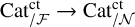 $\mathrm{Cat}_{/\mathcal {F}}^{\mathrm{ct}} \to \mathrm{Cat}_{/\mathcal {N}}^{\mathrm{ct}}$
followed by the forgetful
$\mathrm{Cat}_{/\mathcal {F}}^{\mathrm{ct}} \to \mathrm{Cat}_{/\mathcal {N}}^{\mathrm{ct}}$
followed by the forgetful $\mathrm{Cat}_{/\mathcal {N}}^{\mathrm{ct}} \to \mathrm{Cat}_{/\mathcal {N}}$
, which preserves limits by [Reference Gepner, Haugseng and NikolausGHN17, Theorem 1.2]. Analogously, the first functor actually also lands in
$\mathrm{Cat}_{/\mathcal {N}}^{\mathrm{ct}} \to \mathrm{Cat}_{/\mathcal {N}}$
, which preserves limits by [Reference Gepner, Haugseng and NikolausGHN17, Theorem 1.2]. Analogously, the first functor actually also lands in $\mathrm{Cat}^{\mathrm{ct}}_{/\mathcal {F}}$
, where under the equivalence with
$\mathrm{Cat}^{\mathrm{ct}}_{/\mathcal {F}}$
, where under the equivalence with $\operatorname {\mathrm {Fun}}(\mathcal {F}^{\mathrm{op}},\mathrm{Cat})$
it corresponds to postcomposing with the groupoid core functor, which clearly preserves limits.
$\operatorname {\mathrm {Fun}}(\mathcal {F}^{\mathrm{op}},\mathrm{Cat})$
it corresponds to postcomposing with the groupoid core functor, which clearly preserves limits.
Next, we will employ the adjoint functor theorem of [Reference LurieLur09, Corollary 5.5.2.9] to see that $(-)^{{\mathcal {N}\text{-}\amalg }}$
admits a right adjoint. The domain is clearly presentable and the codomain is by [Reference Barkan, Haugseng and SteinebrunnerBHS25, Proposition 2.3.7] and so it remains to see that the functor preserves colimits. This can be tested after postcomposing with the conservative left adjoint
$(-)^{{\mathcal {N}\text{-}\amalg }}$
admits a right adjoint. The domain is clearly presentable and the codomain is by [Reference Barkan, Haugseng and SteinebrunnerBHS25, Proposition 2.3.7] and so it remains to see that the functor preserves colimits. This can be tested after postcomposing with the conservative left adjoint $\operatorname {\mathrm {Env}}(-)$
and then evaluating at every
$\operatorname {\mathrm {Env}}(-)$
and then evaluating at every $A \in \operatorname {\mathrm {Span}}_{\mathcal {N}}(\mathcal {F})$
. We may consider the following pullbacks, where
$A \in \operatorname {\mathrm {Span}}_{\mathcal {N}}(\mathcal {F})$
. We may consider the following pullbacks, where $\pi _A$
denotes the composite
$\pi _A$
denotes the composite $\mathcal {N}_{/A} \to \mathcal {N} \to \mathcal {F}$
:
$\mathcal {N}_{/A} \to \mathcal {N} \to \mathcal {F}$
:

The bottom left square is a pullback by definition, while the bottom right is by the fact that forward maps in a span category are left cancelable.Footnote
7
The top right square is a pullback by definition of the envelope. The rectangle consisting of the top middle and right squares is a pullback by the definition of $\mathcal {C}^{{\mathcal {N}\text{-}\amalg }}$
and the fact that
$\mathcal {C}^{{\mathcal {N}\text{-}\amalg }}$
and the fact that $\operatorname {\mathrm {Ar}}(\mathcal {N}) \to \operatorname {\mathrm {Span}}_{\mathcal {N}}(\mathcal {F})$
factors as
$\operatorname {\mathrm {Ar}}(\mathcal {N}) \to \operatorname {\mathrm {Span}}_{\mathcal {N}}(\mathcal {F})$
factors as  . Finally, to see that the rectangle consisting of the entire top row is a pullback, recall that $\operatorname {\mathrm {Span}}$
is a right adjoint from the category of adequate triples. Viewing
$\operatorname {\mathrm {Span}}$
is a right adjoint from the category of adequate triples. Viewing $\mathcal {N}_{/A} \simeq \operatorname {\mathrm {Span}}_{\simeq ,\mathrm{all}}(\mathcal {N}_{/A})$
as span category with backwards maps only the equivalences, we compute that the pullback is the span category with forwards maps
$\mathcal {N}_{/A} \simeq \operatorname {\mathrm {Span}}_{\simeq ,\mathrm{all}}(\mathcal {N}_{/A})$
as span category with backwards maps only the equivalences, we compute that the pullback is the span category with forwards maps $\mathrm{Un}^{\mathrm{ct}}(\pi _A^*{\mathcal {C}})$
, and backwards morphisms the subcategory on cartesian morphisms lying over
$\mathrm{Un}^{\mathrm{ct}}(\pi _A^*{\mathcal {C}})$
, and backwards morphisms the subcategory on cartesian morphisms lying over $\operatorname {\mathrm {\iota }}(\mathcal {N}_{/A})$
. However a cartesian map lying over an equivalence is itself an equivalence, and thus the pullback has no nontrivial backwards maps.
$\operatorname {\mathrm {\iota }}(\mathcal {N}_{/A})$
. However a cartesian map lying over an equivalence is itself an equivalence, and thus the pullback has no nontrivial backwards maps.
We conclude that the following diagram commutes:

Each functor in the bottom composite commutes with colimits: for the first two and the last one this is clear and for $\mathrm{fgt}$
this was shown in [Reference RamziRam26, Corollary A.5]. Thus, the top composite preserves colimits for all
$\mathrm{fgt}$
this was shown in [Reference RamziRam26, Corollary A.5]. Thus, the top composite preserves colimits for all $A\in \mathcal {F}$
, and hence also
$A\in \mathcal {F}$
, and hence also $(-)^{{\mathcal {N}\text{-}\amalg }}$
does.
$(-)^{{\mathcal {N}\text{-}\amalg }}$
does.
Next, since $(-)^{{\mathcal {N}\text{-}\amalg }}$
preserves limits, it is symmetric monoidal for the cartesian symmetric monoidal structures. By Remark 2.13 the
$(-)^{{\mathcal {N}\text{-}\amalg }}$
preserves limits, it is symmetric monoidal for the cartesian symmetric monoidal structures. By Remark 2.13 the $\mathrm{Cat}$
-modules structures on both source and target are similarly defined by symmetric monoidal functors from
$\mathrm{Cat}$
-modules structures on both source and target are similarly defined by symmetric monoidal functors from $\mathrm{Cat}$
, and so it will suffice for
$\mathrm{Cat}$
, and so it will suffice for $\mathrm{Cat}$
-linearity to show that the diagram
$\mathrm{Cat}$
-linearity to show that the diagram

commutes as a diagram of symmetric monoidal functors or, equivalently, as a diagram of ordinary functors. This follows at once from the equivalences
 $$ \begin{align*} (\mathrm{const} K)^{{\mathcal{N}\text{-}\amalg}} &= \operatorname{\mathrm{Span}}_{\mathrm{ct},\mathcal{N}}(\mathrm{Un}^{\mathrm{ct}}(\mathrm{const} K)) \simeq \operatorname{\mathrm{Span}}(K_{\simeq,\mathrm{all}} \times ({\mathcal{F}},{\mathcal{F}},{\mathcal{N}}))\\ &\simeq \operatorname{\mathrm{Span}}_{\simeq,\mathrm{all}}(K)\times \operatorname{\mathrm{Span}}_{\mathcal{N}}({\mathcal{F}}) \simeq K \times \operatorname{\mathrm{Span}}_{\mathcal{N}}({\mathcal{F}})=\mathrm{const} K, \end{align*} $$
where $K_{\simeq ,\mathrm{all}}$
denotes K viewed as adequate triple with only forwards maps.
$K_{\simeq ,\mathrm{all}}$
denotes K viewed as adequate triple with only forwards maps.
On the other hand, $\operatorname {\mathrm {Triv}}(-)$
is clearly a
$\operatorname {\mathrm {Triv}}(-)$
is clearly a $\mathrm{Cat}$
-linear left adjoint, since we may simply restrict the
$\mathrm{Cat}$
-linear left adjoint, since we may simply restrict the $\mathrm{Cat}$
-linear adjunction
$\mathrm{Cat}$
-linear adjunction

induced by the inclusion $i\colon \mathcal {F}^{{\mathrm{op}}} \to \operatorname {\mathrm {Span}}_{\mathcal {N}}(\mathcal {F})$
to an adjunction between
$i\colon \mathcal {F}^{{\mathrm{op}}} \to \operatorname {\mathrm {Span}}_{\mathcal {N}}(\mathcal {F})$
to an adjunction between $\mathrm {Cat}^\ast (\mathcal {F})$
and
$\mathrm {Cat}^\ast (\mathcal {F})$
and $\mathrm {Op}^\ast _{\mathcal {N}}(\mathcal {F})$
. This also shows that the right adjoint of
$\mathrm {Op}^\ast _{\mathcal {N}}(\mathcal {F})$
. This also shows that the right adjoint of $\operatorname {\mathrm {Triv}}$
is
$\operatorname {\mathrm {Triv}}$
is $\mathrm{fgt} = i^*$
, with the evident unit. That
$\mathrm{fgt} = i^*$
, with the evident unit. That $\operatorname {\mathrm {Triv}}(-)$
is fully faithful follows immediately from the fact that
$\operatorname {\mathrm {Triv}}(-)$
is fully faithful follows immediately from the fact that $\mathcal {F}^{\mathrm{op}} \times _{\operatorname {\mathrm {Span}}_{\mathcal {N}}(\mathcal {F})}\mathcal {F}^{\mathrm{op}}$
is equivalent to
$\mathcal {F}^{\mathrm{op}} \times _{\operatorname {\mathrm {Span}}_{\mathcal {N}}(\mathcal {F})}\mathcal {F}^{\mathrm{op}}$
is equivalent to $\mathcal {F}^{\mathrm{op}}$
. Finally, in view of the pullback in Lemma 2.16 defining the natural map
$\mathcal {F}^{\mathrm{op}}$
. Finally, in view of the pullback in Lemma 2.16 defining the natural map ${{\mathrm{incl}}}\colon \operatorname {\mathrm {Triv}} \Rightarrow (-)^{{\mathcal {N}\text{-}\amalg }}$
, it follows immediately that
${{\mathrm{incl}}}\colon \operatorname {\mathrm {Triv}} \Rightarrow (-)^{{\mathcal {N}\text{-}\amalg }}$
, it follows immediately that ${{\mathrm{incl}}}$
is also a
${{\mathrm{incl}}}$
is also a $\mathrm{Cat}$
-linear transformation.
$\mathrm{Cat}$
-linear transformation.
2.3 Parametrized categories of normed algebras
As an upshot of the above, we can now give various equivalent definitions of parametrized categories of parametrized algebras:
Definition 2.28. We denote the right adjoint of the 2-functor $(-)^{{\mathcal {N}\text{-}\amalg }}$
by
$(-)^{{\mathcal {N}\text{-}\amalg }}$
by

We call  the
the $\mathcal {F}$
-precategory of
$\mathcal {F}$
-precategory of $\mathcal {N}$
-normed algebras in
$\mathcal {N}$
-normed algebras in $\mathcal {O}$
. By slight abuse of notation, we will use the same notation for the composition with the forgetful functor
$\mathcal {O}$
. By slight abuse of notation, we will use the same notation for the composition with the forgetful functor $\mathrm {NCat}^\ast _{\mathcal {N}}(\mathcal {F}) \to \mathrm {Op}^\ast _{\mathcal {N}}(\mathcal {F})$
, which is right adjoint to the composite
$\mathrm {NCat}^\ast _{\mathcal {N}}(\mathcal {F}) \to \mathrm {Op}^\ast _{\mathcal {N}}(\mathcal {F})$
, which is right adjoint to the composite ${\operatorname {\mathrm {Env}}}\big ((-)^{{\mathcal {N}\text{-}\amalg }}\big )$
.
${\operatorname {\mathrm {Env}}}\big ((-)^{{\mathcal {N}\text{-}\amalg }}\big )$
.
For $\mathcal {C} \in \mathrm {NCat}^\ast _{\mathcal {N}}(\mathcal {F})$
and
$\mathcal {C} \in \mathrm {NCat}^\ast _{\mathcal {N}}(\mathcal {F})$
and $\mathcal {D} \in \mathrm {Cat}^\ast (\mathcal {F})$
we thus obtain natural equivalences
$\mathcal {D} \in \mathrm {Cat}^\ast (\mathcal {F})$
we thus obtain natural equivalences

Similarly, we obtain an equivalence
 $$\begin{align*}\operatorname{\mathrm{Fun}}_{\mathcal{F}}(\mathcal{D},\mathrm{fgt}(\mathcal{C})) \simeq \operatorname{\mathrm{Fun}}_{\mathcal{F}}^{\mathcal{N}\text{-}\otimes}(\operatorname{\mathrm{Env}}(\operatorname{\mathrm{Triv}}(\mathcal{D})),\mathcal{C}). \end{align*}$$
Given an object $A\in \mathcal {F}$
, we continue to let
$A\in \mathcal {F}$
, we continue to let  denote the presheaf represented by A, considered as an object of $\mathrm {Cat}^\ast (\mathcal {F})$
. As recalled in [Reference Cnossen, Lenz and LinskensCLL25a, Lemma 2.2.7], there is an equivalence
$\mathrm {Cat}^\ast (\mathcal {F})$
. As recalled in [Reference Cnossen, Lenz and LinskensCLL25a, Lemma 2.2.7], there is an equivalence

which is natural in both A and $\mathcal {D}$
. Combining this with the equivalence above and with Example 2.17, we obtain natural equivalences
$\mathcal {D}$
. Combining this with the equivalence above and with Example 2.17, we obtain natural equivalences

Definition 2.29. Precomposition by the transformation
 $$\begin{align*}\operatorname{\mathrm{Env}}({{\mathrm{incl}}}) \colon \operatorname{\mathrm{Env}}(\operatorname{\mathrm{Triv}}(-)) \Rightarrow \operatorname{\mathrm{Env}}((-)^{{\mathcal{N}\text{-}\amalg}})\end{align*}$$
induces for every $\mathcal {C}\in \mathrm {NCat}^\ast _{\mathcal {N}}(\mathcal {F})$
a functor
$\mathcal {C}\in \mathrm {NCat}^\ast _{\mathcal {N}}(\mathcal {F})$
a functor

of $\mathcal {F}$
-precategories, defined so that the following square commutes
$\mathcal {F}$
-precategories, defined so that the following square commutes

naturally in $A\in \mathcal {F}$
.
$A\in \mathcal {F}$
.
Definition 2.30. Given an $\mathcal {F}$
-precategory
$\mathcal {F}$
-precategory $\mathcal {C}$
, we refer to
$\mathcal {C}$
, we refer to $\lim _{\mathcal {F}^{\mathrm{op}}} \mathcal {C}$
as the underlying category of
$\lim _{\mathcal {F}^{\mathrm{op}}} \mathcal {C}$
as the underlying category of $\mathcal {C}$
. Note that if
$\mathcal {C}$
. Note that if $\mathcal {F}$
admits a final object
$\mathcal {F}$
admits a final object $1$
, then
$1$
, then $\lim _{\mathcal {F}^{\mathrm{op}}} \mathcal {C} \simeq \mathcal {C}(1)$
.
$\lim _{\mathcal {F}^{\mathrm{op}}} \mathcal {C} \simeq \mathcal {C}(1)$
.
Lemma 2.31. There is an equivalence natural in $\mathcal {N}$
-normed
$\mathcal {N}$
-normed $\mathcal {F}$
-precategories
$\mathcal {F}$
-precategories $\mathcal {C}$

which is compatible with the structure maps  of the defining limit.
Proof. We want to show that the unique diagram

is a colimiting cocone in $\mathrm {Op}^\ast _{{\mathcal {N}}}({\mathcal {F}})$
, where
$\mathrm {Op}^\ast _{{\mathcal {N}}}({\mathcal {F}})$
, where $1$
denotes the final object of
$1$
denotes the final object of $\mathrm {Cat}^\ast ({\mathcal {F}})$
, so that
$\mathrm {Cat}^\ast ({\mathcal {F}})$
, so that $1^{\mathcal {N}\text{-}\amalg }=\operatorname {\mathrm {Span}}_{\mathcal {N}}({\mathcal {F}})$
is the final
$1^{\mathcal {N}\text{-}\amalg }=\operatorname {\mathrm {Span}}_{\mathcal {N}}({\mathcal {F}})$
is the final $({\mathcal {F}},{\mathcal {N}})$
-preoperad. As
$({\mathcal {F}},{\mathcal {N}})$
-preoperad. As $(-)^{\mathcal {N}\text{-}\amalg }$
is a left adjoint, it suffices for this that the colimit of the
$(-)^{\mathcal {N}\text{-}\amalg }$
is a left adjoint, it suffices for this that the colimit of the  ’s in
’s in $\mathrm {Cat}^\ast ({\mathcal {F}})$
is terminal. As
$\mathrm {Cat}^\ast ({\mathcal {F}})$
is terminal. As $\operatorname {\mathrm {Fun}}({\mathcal {F}}^{\mathrm{op}},\operatorname {\mathrm {Spc}})\hookrightarrow \operatorname {\mathrm {Fun}}({\mathcal {F}}^{\mathrm{op}},\mathrm{Cat})=\mathrm {Cat}^\ast ({\mathcal {F}})$
is both a left and a right adjoint, this just amounts to the well known fact that the colimit of the Yoneda embedding is terminal.
$\operatorname {\mathrm {Fun}}({\mathcal {F}}^{\mathrm{op}},\operatorname {\mathrm {Spc}})\hookrightarrow \operatorname {\mathrm {Fun}}({\mathcal {F}}^{\mathrm{op}},\mathrm{Cat})=\mathrm {Cat}^\ast ({\mathcal {F}})$
is both a left and a right adjoint, this just amounts to the well known fact that the colimit of the Yoneda embedding is terminal.
For later use, let us record two further descriptions of  :
:
Lemma 2.32. Let $A\in {\mathcal {F}}$
be arbitrary and let
$A\in {\mathcal {F}}$
be arbitrary and let $\pi \colon {\mathcal {F}}_{/A}\to {\mathcal {F}}$
denote the forgetful functor. Then we have an equivalence natural in
$\pi \colon {\mathcal {F}}_{/A}\to {\mathcal {F}}$
denote the forgetful functor. Then we have an equivalence natural in $\mathcal {N}$
-normed
$\mathcal {N}$
-normed $\mathcal {F}$
-precategories
$\mathcal {F}$
-precategories $\mathcal {C}$

Passing to underlying categories gives  .
.
Proof. We have a $\mathrm{Cat}$
-linear adjunction
$\mathrm{Cat}$
-linear adjunction

Using that $\operatorname {\mathrm {Span}}(\pi )$
is itself cocartesian over
$\operatorname {\mathrm {Span}}(\pi )$
is itself cocartesian over ${\mathcal {F}}^{\mathrm{op}}$
, one easily checks that this restricts to a
${\mathcal {F}}^{\mathrm{op}}$
, one easily checks that this restricts to a $\mathrm{Cat}$
-linear adjunction
$\mathrm{Cat}$
-linear adjunction $\mathrm {Op}^\ast _{{\mathcal {N}}}({\mathcal {F}}_{/A})\rightleftarrows \mathrm {Op}^\ast _{{\mathcal {N}}}({\mathcal {F}})$
. We therefore have
$\mathrm {Op}^\ast _{{\mathcal {N}}}({\mathcal {F}}_{/A})\rightleftarrows \mathrm {Op}^\ast _{{\mathcal {N}}}({\mathcal {F}})$
. We therefore have

naturally in ${\mathcal {C}}$
and in
${\mathcal {C}}$
and in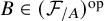 $B\in ({\mathcal {F}}_{/A})^{\mathrm{op}}$
.
$B\in ({\mathcal {F}}_{/A})^{\mathrm{op}}$
.
We call an object $A\in {\mathcal {F}}$
productive if every
$A\in {\mathcal {F}}$
productive if every $B\in {\mathcal {F}}$
admits a product
$B\in {\mathcal {F}}$
admits a product $A\times B$
in
$A\times B$
in ${\mathcal {F}}$
.
${\mathcal {F}}$
.
Lemma 2.33. For every productive $A\in {\mathcal {F}}$
, we have an equivalence
$A\in {\mathcal {F}}$
, we have an equivalence

natural in ${\mathcal {C}}\in \mathrm {NCat}^\ast _{{\mathcal {N}}}({\mathcal {F}})$
. Moreover, this equivalence is also natural with respect to arbitrary maps between productive objects of
${\mathcal {C}}\in \mathrm {NCat}^\ast _{{\mathcal {N}}}({\mathcal {F}})$
. Moreover, this equivalence is also natural with respect to arbitrary maps between productive objects of ${\mathcal {F}}$
, and is compatible with the forgetful functors to
${\mathcal {F}}$
, and is compatible with the forgetful functors to $\mathcal {C}(A)$
.
$\mathcal {C}(A)$
.
Proof. The forgetful map $\pi \colon {\mathcal {F}}_{/A}\to {\mathcal {F}}$
has a right adjoint
$\pi \colon {\mathcal {F}}_{/A}\to {\mathcal {F}}$
has a right adjoint $\rho $
, given by sending
$\rho $
, given by sending $B\in {\mathcal {F}}$
to
$B\in {\mathcal {F}}$
to $\mathrm{pr}\colon A\times B\to A$
. In particular
$\mathrm{pr}\colon A\times B\to A$
. In particular $\rho $
is cofinal, so that restriction along
$\rho $
is cofinal, so that restriction along $\rho ^{\mathrm{op}}$
induces an equivalence
$\rho ^{\mathrm{op}}$
induces an equivalence $\mathcal {C}(A) = \lim _{(\mathcal {F}_{/A})^{\mathrm{op}}} \pi ^*\mathcal {C} \simeq \lim _{\mathcal {F}^{\mathrm{op}}} \mathcal {C}(A \times -)$
.
$\mathcal {C}(A) = \lim _{(\mathcal {F}_{/A})^{\mathrm{op}}} \pi ^*\mathcal {C} \simeq \lim _{\mathcal {F}^{\mathrm{op}}} \mathcal {C}(A \times -)$
.
We will now see that an analogous argument works for the span categories. Namely, a straightforward computation using [Reference Bachmann and HoyoisBH21, Corollary C.21] shows that $\rho $
induces a left adjoint on spans, such that the units and counits are backwards maps. Moreover, the square
$\rho $
induces a left adjoint on spans, such that the units and counits are backwards maps. Moreover, the square

commutes. It follows from [Reference LinskensLin24, Proposition 4.16] that restriction along $\operatorname {\mathrm {Span}}(\rho )$
induces an equivalence
$\operatorname {\mathrm {Span}}(\rho )$
induces an equivalence

and one easily checks that this has the desired naturality properties.
We will now make the $\mathcal {N}$
-normed
$\mathcal {N}$
-normed $\mathcal {F}$
-precategories
$\mathcal {F}$
-precategories  and the map
  explicit. To this end, it will be convenient to restrict our attention to the case where $\mathcal {N} \subset \mathcal {F}$
is left cancelable, as will be the case in all examples of interest to us.
$\mathcal {N} \subset \mathcal {F}$
is left cancelable, as will be the case in all examples of interest to us.
Definition 2.34. A span pair $(\mathcal {F},\mathcal {N})$
is called left cancelable if it satisfies the following property: given any composable maps
$(\mathcal {F},\mathcal {N})$
is called left cancelable if it satisfies the following property: given any composable maps $f,g$
in
$f,g$
in $\mathcal {F}$
such that
$\mathcal {F}$
such that $fg$
and f belong to
$fg$
and f belong to ${\mathcal {N}}$
, also g belongs to
${\mathcal {N}}$
, also g belongs to ${\mathcal {N}}$
.
${\mathcal {N}}$
.
For the remainder of this subsection, we fix a left cancelable span pair $(\mathcal {F},\mathcal {N})$
.
$(\mathcal {F},\mathcal {N})$
.
Construction 2.35. The target projection $t \colon \operatorname {\mathrm {Ar}}_{\mathcal {N}}(\mathcal {F}) \to \mathcal {F}$
is a cartesian fibration classifying the functoriality of the slices
$t \colon \operatorname {\mathrm {Ar}}_{\mathcal {N}}(\mathcal {F}) \to \mathcal {F}$
is a cartesian fibration classifying the functoriality of the slices $\mathcal {N}_{/B}$
in pullbacks along arbitrary maps
$\mathcal {N}_{/B}$
in pullbacks along arbitrary maps $A \to B$
in
$A \to B$
in $\mathcal {F}$
. We denote this cartesian straightening by
$\mathcal {F}$
. We denote this cartesian straightening by $\mathcal {N}_{/-} \colon \mathcal {F}^{\mathrm{op}} \to \mathrm{Cat}$
. Now let
$\mathcal {N}_{/-} \colon \mathcal {F}^{\mathrm{op}} \to \mathrm{Cat}$
. Now let $A \in \mathcal {F}$
and consider the pullback on the left:
$A \in \mathcal {F}$
and consider the pullback on the left:

Clearly $tp$
is a cartesian fibration, and a general morphism in it can be depicted as the diagram on the right. It is
$tp$
is a cartesian fibration, and a general morphism in it can be depicted as the diagram on the right. It is $tp$
-cartesian precisely if the square is a pullback. We denote the cartesian straightening of
$tp$
-cartesian precisely if the square is a pullback. We denote the cartesian straightening of $tp$
by
$tp$
by

In fact, $\mathcal {F}_{/A} \times _{\mathcal {F}} \mathcal {N}_{/-} \in \mathrm {Cat}^\ast (\mathcal {F})$
is covariantly functorial in A via postcomposition; this follows immediately from the fact that given
$\mathcal {F}_{/A} \times _{\mathcal {F}} \mathcal {N}_{/-} \in \mathrm {Cat}^\ast (\mathcal {F})$
is covariantly functorial in A via postcomposition; this follows immediately from the fact that given $f \colon A \to B$
in
$f \colon A \to B$
in $\mathcal {F}$
, the functor
$\mathcal {F}$
, the functor $f_! \colon \mathcal {F}_{/A} \to \mathcal {F}_{/B}$
over
$f_! \colon \mathcal {F}_{/A} \to \mathcal {F}_{/B}$
over $\mathcal {F}$
is a map of cartesian fibrations. We therefore obtain a functor
$\mathcal {F}$
is a map of cartesian fibrations. We therefore obtain a functor
 $$\begin{align*}\mathcal{F}_{/\bullet} \times_{\mathcal{F}} \mathcal{N}_{/-} \colon \mathcal{F} \to \mathrm{Cat}^\ast(\mathcal{F}),\ A \mapsto \mathcal{F}_{/A} \times_{\mathcal{F}} \mathcal{N}_{/-}. \end{align*}$$
Lemma 2.36. Let $(\mathcal {F},\mathcal {N})$
be a left cancelable span pair and
$(\mathcal {F},\mathcal {N})$
be a left cancelable span pair and $\mathcal {F}_{/\bullet } \times _{\mathcal {F}} \mathcal {N}_{/-}$
as constructed above. Then:
$\mathcal {F}_{/\bullet } \times _{\mathcal {F}} \mathcal {N}_{/-}$
as constructed above. Then:
-
1. For
$X \in \mathcal {F}$
, the
$\mathcal {F}$
-precategory
$\mathcal {F}_{/X} \times _{\mathcal {F}} \mathcal {N}_{/-}$
is left
$\mathcal {N}$
-adjointable in the sense of Lemma 2.16(3). We denote the resulting
$\mathcal {N}$
-normed
$\mathcal {F}$
-precategory by Note that by construction,.
-
2. The induced functor
is right
$\mathcal {N}$
-coadjointable in the sense of [Reference Elmanto and HaugsengEH23, Variant 2.2.10, Remark 2.2.11]. Concretely, this means that for any morphism the
$\mathcal {N}$
-normed
$\mathcal {F}$
-functor induced by postcomposition admits a right adjoint
$n^*$
(given by pulling back), and every pullback square of the form (1)is sent to a right-adjointable square, so that the following square commutes via the Beck–Chevalley transformation


 .
.


 the
the 


Proof. Let $X \in \mathcal {F}$
, and consider a map
$X \in \mathcal {F}$
, and consider a map  in
in $\mathcal {N}$
. Clearly the pullback
$\mathcal {N}$
. Clearly the pullback $n^* \colon \mathcal {N}_{/B} \to \mathcal {N}_{/A}$
admits a left adjoint given by postcomposition with n, and similarly one checks that we obtain an adjunction
$n^* \colon \mathcal {N}_{/B} \to \mathcal {N}_{/A}$
admits a left adjoint given by postcomposition with n, and similarly one checks that we obtain an adjunction

For example, the unit map at some  is given by the map $\varphi $
in the following commutative diagram
$\varphi $
in the following commutative diagram

Note that $\varphi $
is indeed a map in
$\varphi $
is indeed a map in $\mathcal {N}$
by left cancellability, and this is one of the crucial points where this assumption is needed.
$\mathcal {N}$
by left cancellability, and this is one of the crucial points where this assumption is needed.
The fact that the pullback square (1) induces a left-adjointable square, that is, that the induced square

is horizontally left adjointable, is a simple but tedious exercise in pullback pasting.
For the second claim, we have to show that  is right $\mathcal {N}$
-coadjointable. Since 2-functors preserve adjointable squares (see, e.g., [Reference Heyer and MannHM24, Lemma D.2.7]), it suffices to show that
$\mathcal {N}$
-coadjointable. Since 2-functors preserve adjointable squares (see, e.g., [Reference Heyer and MannHM24, Lemma D.2.7]), it suffices to show that $\mathcal {F}_{/\bullet } \times _{\mathcal {F}} \mathcal {N}_{/-} \colon \mathcal {F} \to \mathrm {Cat}^\ast (\mathcal {F})$
is right
$\mathcal {F}_{/\bullet } \times _{\mathcal {F}} \mathcal {N}_{/-} \colon \mathcal {F} \to \mathrm {Cat}^\ast (\mathcal {F})$
is right $\mathcal {N}$
-coadjointable.
$\mathcal {N}$
-coadjointable.
So fix  in
in $\mathcal {N}$
. We need to show that the
$\mathcal {N}$
. We need to show that the $\mathcal {F}$
-functor
$\mathcal {F}$
-functor $n_! \colon \mathcal {F}_{/A} \times _{\mathcal {F}} \mathcal {N}_{/-} \to \mathcal {F}_{/B} \times _{\mathcal {F}} \mathcal {N}_{/-}$
induced by postcomposing with n admits a right adjoint. For some fixed
$n_! \colon \mathcal {F}_{/A} \times _{\mathcal {F}} \mathcal {N}_{/-} \to \mathcal {F}_{/B} \times _{\mathcal {F}} \mathcal {N}_{/-}$
induced by postcomposing with n admits a right adjoint. For some fixed $X \in \mathcal {F}$
, one checks that pullback along induces a right adjoint
$X \in \mathcal {F}$
, one checks that pullback along induces a right adjoint
 $$\begin{align*}n^*(X) \colon \mathcal{F}_{/B} \times_{\mathcal{F}} \mathcal{N}_{/X} \to \mathcal{F}_{/A} \times_{\mathcal{F}} \mathcal{N}_{/X} \end{align*}$$
to $n_!(X)$
. By Remark 2.14 the condition for these to assemble into a right adjoint to the
$n_!(X)$
. By Remark 2.14 the condition for these to assemble into a right adjoint to the $\mathcal {F}$
-functor
$\mathcal {F}$
-functor $n_!$
is that for each
$n_!$
is that for each $f \colon X \to Y$
the square
$f \colon X \to Y$
the square

is vertically right adjointable, which is again a simple exercise in pullback pasting.
Finally, it remains to see that a pullback square as in (1)

which is horizontally right adjointable, that is, that the Beck–Chevalley transformation $f^{\prime }_!n^{\prime *} \Rightarrow n^*f_!$
of
$f^{\prime }_!n^{\prime *} \Rightarrow n^*f_!$
of $\mathcal {F}$
-functors is an equivalence. This can be checked pointwise at some
$\mathcal {F}$
-functors is an equivalence. This can be checked pointwise at some $X \in \mathcal {F}$
, where the argument is entirely analogous to the horizontal left adjointability of (2) considered above.
$X \in \mathcal {F}$
, where the argument is entirely analogous to the horizontal left adjointability of (2) considered above.
Proposition 2.37. Let $(\mathcal {F},\mathcal {N})$
be a left-cancelable span pair. There is a natural equivalence
$(\mathcal {F},\mathcal {N})$
be a left-cancelable span pair. There is a natural equivalence

Moreover, under this identification the map  is given by the inclusion
 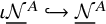 of the pointwise groupoid core.
Proof. Recall from Example 2.17 that  is naturally equivalent to $\operatorname {\mathrm {Span}}_{\mathcal {N}}(\mathcal {F}_{/A})\to \operatorname {\mathrm {Span}}_{\mathcal {N}}(\mathcal {F})$
, so that its envelope is then given by
$\operatorname {\mathrm {Span}}_{\mathcal {N}}(\mathcal {F}_{/A})\to \operatorname {\mathrm {Span}}_{\mathcal {N}}(\mathcal {F})$
, so that its envelope is then given by

Identifying $\operatorname {\mathrm {Ar}}_{\mathcal {N}}(\operatorname {\mathrm {Span}}_{\mathcal {N}}(\mathcal {F}))$
as in Remark 2.25 and appealing to Theorem 2.5, we see that
$\operatorname {\mathrm {Ar}}_{\mathcal {N}}(\operatorname {\mathrm {Span}}_{\mathcal {N}}(\mathcal {F}))$
as in Remark 2.25 and appealing to Theorem 2.5, we see that  is naturally equivalent to the category
 $$ \begin{align} \operatorname{\mathrm{Span}}_{\mathrm{pb},\mathcal{N}}(\operatorname{\mathrm{Ar}}_{\mathcal{N}}(\mathcal{F})\times_{\mathcal{F}}\mathcal{F}_{/A}), \end{align} $$
whose morphisms are spans of the form

On the other hand, (3) also precisely agrees with  by definition, see Definition 2.15 and Construction 2.35.
By Lemma 2.16(2) and the definition of the envelope, we obtain pullback squares

Note that a general morphism (4) in  is cocartesian precisely if the map
  is an equivalence (cf. the description of cocartesian morphisms in $\operatorname {\mathrm {Env}}(1)= \operatorname {\mathrm {Ar}}_{\mathcal {N}}(\operatorname {\mathrm {Span}}_{\mathcal {N}}(\mathcal {F}))$
from Remark 2.25). Thus,
$\operatorname {\mathrm {Env}}(1)= \operatorname {\mathrm {Ar}}_{\mathcal {N}}(\operatorname {\mathrm {Span}}_{\mathcal {N}}(\mathcal {F}))$
from Remark 2.25). Thus,  is precisely the subcategory on the cocartesian morphisms. The identification of $\operatorname {\mathrm {Env}}({{\mathrm{incl}}})$
therefore follows from the general fact that for any functor
$\operatorname {\mathrm {Env}}({{\mathrm{incl}}})$
therefore follows from the general fact that for any functor $F \colon \mathcal {C} \to \mathrm{Cat}$
with cocartesian straightening
$F \colon \mathcal {C} \to \mathrm{Cat}$
with cocartesian straightening $p \colon \mathcal {X} \to \mathcal {C}$
, the inclusion
$p \colon \mathcal {X} \to \mathcal {C}$
, the inclusion $\mathcal {X}_{\mathrm{cc}} \hookrightarrow \mathcal {X}$
of the subcategory of cocartesian morphisms corresponds under cocartesian straightening to the natural transformation
$\mathcal {X}_{\mathrm{cc}} \hookrightarrow \mathcal {X}$
of the subcategory of cocartesian morphisms corresponds under cocartesian straightening to the natural transformation $\operatorname {\mathrm {\iota }} F \Rightarrow F$
.
$\operatorname {\mathrm {\iota }} F \Rightarrow F$
.
Corollary 2.38. There is a commutative square, natural in $\mathcal {C} \in \mathrm {NCat}^\ast _{\mathcal {N}}(\mathcal {F})$
and
$\mathcal {C} \in \mathrm {NCat}^\ast _{\mathcal {N}}(\mathcal {F})$
and $A \in \mathcal {F}^{\mathrm{op}}$
,
$A \in \mathcal {F}^{\mathrm{op}}$
,

where the bottom horizontal equivalence evaluates at  .
.
Proof. After Proposition 2.37, the only nontrivial fact is the identification of the bottom arrow. However, combining the fact that $\operatorname {\mathrm {Triv}}$
is fully faithful and that the natural Yoneda equivalence
$\operatorname {\mathrm {Triv}}$
is fully faithful and that the natural Yoneda equivalence  is given by evaluating at
  , we see that the bottom horizontal equivalence in the square is given by the composite

so the claim follows from the description of the unit $\eta $
of Theorem 2.23.
$\eta $
of Theorem 2.23.
Remark 2.39. We may summarize the previous result as follows. The top equivalence of the commutative square identifies  as the free $\mathcal {N}$
-normed
$\mathcal {N}$
-normed $\mathcal {F}$
-precategory with an
$\mathcal {F}$
-precategory with an $\mathcal {N}$
-normed algebra in degree A, while the bottom identifies its groupoid core
$\mathcal {N}$
-normed algebra in degree A, while the bottom identifies its groupoid core  as the free $\mathcal {N}$
-normed
$\mathcal {N}$
-normed $\mathcal {F}$
-precategory with an object in degree A. The commutativity of the square shows that the object
$\mathcal {F}$
-precategory with an object in degree A. The commutativity of the square shows that the object  is the universal $\mathcal {N}$
-normed
$\mathcal {N}$
-normed $\mathcal {F}$
-algebra in degree A.
$\mathcal {F}$
-algebra in degree A.
Corollary 2.40. The functor of $\mathcal {N}$
-normed
$\mathcal {N}$
-normed $\mathcal {F}$
-precategories
$\mathcal {F}$
-precategories

classified by  is an equivalence. If A is terminal, it is the unique such equivalence.
Proof. The claimed equivalence follows immediately from the identification of the equivalence

with $\operatorname {\mathrm {ev}}_{\mathrm{id}_A,\mathrm{id}_A}$
from Corollary 2.38. In the case that A is terminal, we see that it does not have any automorphisms in
$\operatorname {\mathrm {ev}}_{\mathrm{id}_A,\mathrm{id}_A}$
from Corollary 2.38. In the case that A is terminal, we see that it does not have any automorphisms in $\operatorname {\mathrm {Span}}_{\mathcal {N}}(\mathcal {F})$
, hence by the Yoneda lemma also
$\operatorname {\mathrm {Span}}_{\mathcal {N}}(\mathcal {F})$
, hence by the Yoneda lemma also $\operatorname {\mathrm {hom}}_{\operatorname {\mathrm {Span}}_{\mathcal {N}}(\mathcal {F})}(A,-)$
does not have any automorphisms, which yields the uniqueness of the equivalence.
$\operatorname {\mathrm {hom}}_{\operatorname {\mathrm {Span}}_{\mathcal {N}}(\mathcal {F})}(A,-)$
does not have any automorphisms, which yields the uniqueness of the equivalence.
Example 2.41. In the case of classical symmetric monoidal categories, which as mentioned in Remark 2.10 is recovered by the special case $(\mathcal {F},\mathcal {N}) = (\mathbb {F},\mathbb {F})$
, the above results exhibit the cocartesian symmetric monoidal category of finite sets
$(\mathcal {F},\mathcal {N}) = (\mathbb {F},\mathbb {F})$
, the above results exhibit the cocartesian symmetric monoidal category of finite sets $\mathbb {F}^\amalg $
as the free symmetric monoidal category with a commutative algebra object, and its groupoid core
$\mathbb {F}^\amalg $
as the free symmetric monoidal category with a commutative algebra object, and its groupoid core $\operatorname {\mathrm {\iota }} \mathbb {F}^\amalg $
(which is the commutative monoid
$\operatorname {\mathrm {\iota }} \mathbb {F}^\amalg $
(which is the commutative monoid $\coprod _{n \geq 0} B\Sigma _n$
) as the free symmetric monoidal category on one object. In both cases, the universal object is given by the one-point set.
$\coprod _{n \geq 0} B\Sigma _n$
) as the free symmetric monoidal category on one object. In both cases, the universal object is given by the one-point set.
We close this discussion by recording some convenient properties of the ${\mathcal {F}}$
-precategories of the form
${\mathcal {F}}$
-precategories of the form  .
.
Definition 2.42. Let $\mathcal {C}$
be an
$\mathcal {C}$
be an $\mathcal {F}$
-precategory.
$\mathcal {F}$
-precategory.
-
1. For a small category K, we say that
$\mathcal {C}$
admits fiberwise K-colimits if
${\mathcal {C}}(A)$
has K-colimits for every
$A\in \mathcal {F}$
, and for every
$f\colon A\to B$
in
$\mathcal {F}$
the functor
$f^* \colon {\mathcal {C}}(B)\to {\mathcal {C}}(A)$
preserves K-colimits. -
2. If
${\mathcal {K}}$
is a class of small categories, then we say that
${\mathcal {C}}$
has fiberwise
${\mathcal {K}}$
-colimits if it has fiberwise K-colimits for every
$K\in {\mathcal {K}}$
. -
3. An
$\mathcal {F}$
-functor
$F \colon \mathcal {C} \to \mathcal {D}$
is said to preserve
$\mathcal {K}$
-colimits if each
$F(A) \colon \mathcal {C}(A) \to \mathcal {D}(A)$
does.






All of these definitions apply analogously to $\mathcal {N}$
-normed
$\mathcal {N}$
-normed $\mathcal {F}$
-precategories
$\mathcal {F}$
-precategories $\mathcal {C}$
, for example, by viewing them as
$\mathcal {C}$
, for example, by viewing them as $\operatorname {\mathrm {Span}}_{\mathcal {N}}(\mathcal {F})^{\mathrm{op}}$
-precategories.
$\operatorname {\mathrm {Span}}_{\mathcal {N}}(\mathcal {F})^{\mathrm{op}}$
-precategories.
Remark 2.43. Let $\mathcal {C}$
be an
$\mathcal {C}$
be an $\mathcal {F}$
-precategory and K an ordinary category. Using the internal hom
$\mathcal {F}$
-precategory and K an ordinary category. Using the internal hom  and the $\mathrm{Cat}$
-tensoring of
$\mathrm{Cat}$
-tensoring of $\mathrm {Cat}^\ast (\mathcal {F})$
, we see that it is also cotensored via
$\mathrm {Cat}^\ast (\mathcal {F})$
, we see that it is also cotensored via

where the second equivalence is an instance of the natural equivalences

In particular, it follows that $\mathcal {C}$
admits fiberwise K-colimits precisely if the diagonal functor
$\mathcal {C}$
admits fiberwise K-colimits precisely if the diagonal functor $\mathcal {C} \to \mathcal {C}^K$
admits a left adjoint, cf. Remark 2.14. Similarly, a functor
$\mathcal {C} \to \mathcal {C}^K$
admits a left adjoint, cf. Remark 2.14. Similarly, a functor $F \colon \mathcal {C} \to \mathcal {D}$
preserves K-colimits precisely if the following square is vertically left adjointable:
$F \colon \mathcal {C} \to \mathcal {D}$
preserves K-colimits precisely if the following square is vertically left adjointable:

Again, everything applies verbatim to $\mathcal {N}$
-normed
$\mathcal {N}$
-normed $\mathcal {F}$
-precategories.
$\mathcal {F}$
-precategories.
Lemma 2.44. Let $\mathcal {C} \colon \operatorname {\mathrm {Span}}_{\mathcal {N}}(\mathcal {F}) \to \mathrm{Cat}$
be an
$\mathcal {C} \colon \operatorname {\mathrm {Span}}_{\mathcal {N}}(\mathcal {F}) \to \mathrm{Cat}$
be an $\mathcal {N}$
-normed
$\mathcal {N}$
-normed $\mathcal {F}$
-precategory.
$\mathcal {F}$
-precategory.
-
1. The forgetful functor
is conservative. -
2. If
$\mathcal {K}$
is a class of small categories and
$\mathcal {C}$
admits fiberwise
$\mathcal {K}$
-colimits, then also admits fiberwise
$\mathcal {K}$
-colimits, and
$\mathbb {U}$
preserves them.
 is conservative.


 admits fiberwise

Proof. The first claim is immediate from the fact that  is essentially surjective, and $\mathbb {U}$
is given by restricting along this. For the second claim, recall that
$\mathbb {U}$
is given by restricting along this. For the second claim, recall that  is the right adjoint in a $\mathrm{Cat}$
-linear adjunction. In particular, it preserves the
$\mathrm{Cat}$
-linear adjunction. In particular, it preserves the $\mathrm{Cat}$
-cotensoring. Since it is also a 2-functor, it therefore sends the adjunction
$\mathrm{Cat}$
-cotensoring. Since it is also a 2-functor, it therefore sends the adjunction

witnessing that $\mathcal {C}$
has fiberwise K-colimits for
$\mathcal {C}$
has fiberwise K-colimits for $K \in \mathcal {K}$
to the analogous adjunction
$K \in \mathcal {K}$
to the analogous adjunction

which then shows that also  admits fiberwise K-colimits.
We will later identify reasonable conditions on $\mathcal {C}$
so that this forgetful functor is monadic, see Corollary 3.48.
$\mathcal {C}$
so that this forgetful functor is monadic, see Corollary 3.48.
Corollary 2.45. Let $\mathcal {C}$
be an
$\mathcal {C}$
be an $\mathcal {N}$
-normed
$\mathcal {N}$
-normed $\mathcal {F}$
-precategory. Then
$\mathcal {F}$
-precategory. Then  is left $\mathcal {N}$
-adjointable in the sense of Lemma 2.16(3), and thus defines an
$\mathcal {N}$
-adjointable in the sense of Lemma 2.16(3), and thus defines an $\mathcal {N}$
-normed
$\mathcal {N}$
-normed $\mathcal {F}$
-precategory
$\mathcal {F}$
-precategory

Proof. This follows immediately from the fact that $\operatorname {\mathrm {Fun}}_{\mathcal {F}}^{\mathcal {N}}(-,\mathcal {C}) \colon \mathrm {NCat}^\ast _{\mathcal {N}}(\mathcal {F})^{\mathrm{op}} \to \mathrm{Cat}$
is a 2-functor (the mapping-functor of the 2-category
$\operatorname {\mathrm {Fun}}_{\mathcal {F}}^{\mathcal {N}}(-,\mathcal {C}) \colon \mathrm {NCat}^\ast _{\mathcal {N}}(\mathcal {F})^{\mathrm{op}} \to \mathrm{Cat}$
is a 2-functor (the mapping-functor of the 2-category $\mathrm {NCat}^\ast _{\mathcal {N}}(\mathcal {F})$
), the identification
$\mathrm {NCat}^\ast _{\mathcal {N}}(\mathcal {F})$
), the identification  from Corollary 2.38, and the fact that
  is right $\mathcal {N}$
-coadjointable by Lemma 2.36(3).
$\mathcal {N}$
-coadjointable by Lemma 2.36(3).
2.4 Parametrized operads
In this section we will single out the analogue of operads amongst the $(\mathcal {F},\mathcal {N})$
-preoperads. For later use we will introduce the definition in the generality of an arbitrary factorization system.
$(\mathcal {F},\mathcal {N})$
-preoperads. For later use we will introduce the definition in the generality of an arbitrary factorization system.
Definition 2.46. Let $(S,E,M)$
be a factorization system such that E and S have finite products and the inclusion
$(S,E,M)$
be a factorization system such that E and S have finite products and the inclusion $E\hookrightarrow S$
preserves them. We call a functor
$E\hookrightarrow S$
preserves them. We call a functor $p\colon \mathcal {X}\to S$
an (S,E,M)-operad if
$p\colon \mathcal {X}\to S$
an (S,E,M)-operad if
-
1. p is E-cocartesian, that is, admits cocartesian lifts for maps in E,
-
2.
$\mathcal {X}$
has finite products, -
3. p preserves finite products, and
-
4. for all
$X,Y\in \mathcal {X}$
the projections
$X\gets X\times Y\to Y$
are p-cocartesian.


We define $\mathrm {Op}_{M}(S,E)\subset \mathrm{Cat}^{E\text{-}\mathrm{cc}}_{/S}$
as the full subcategory spanned by the
$\mathrm {Op}_{M}(S,E)\subset \mathrm{Cat}^{E\text{-}\mathrm{cc}}_{/S}$
as the full subcategory spanned by the $(S,E,M)$
-operads.
$(S,E,M)$
-operads.
Example 2.47. The above definition is inspired by the example where $(S,E,M) = (\operatorname {\mathrm {Span}}(\mathbb {F}),\mathbb {F}^{\mathrm{op}},\mathbb {F})$
is the canonical factorization system on the category of spans of finite sets, where we will refer to the subcategory
$(S,E,M) = (\operatorname {\mathrm {Span}}(\mathbb {F}),\mathbb {F}^{\mathrm{op}},\mathbb {F})$
is the canonical factorization system on the category of spans of finite sets, where we will refer to the subcategory $\mathbb {F}^{\mathrm{op}} \subset \operatorname {\mathrm {Span}}(\mathbb {F})$
as the inert morphisms. By work of Barkan–Haugseng–Steinebrunner, the resulting category of
$\mathbb {F}^{\mathrm{op}} \subset \operatorname {\mathrm {Span}}(\mathbb {F})$
as the inert morphisms. By work of Barkan–Haugseng–Steinebrunner, the resulting category of $(S,E,M)$
-operads is equivalent to the usual category
$(S,E,M)$
-operads is equivalent to the usual category $\mathrm {Op}$
of operads as defined by Lurie. More specifically, it follows from [Reference HaugsengHau23, Theorem 2.1.11, Proposition 2.2.6, Proposition 2.2.10] that the category
$\mathrm {Op}$
of operads as defined by Lurie. More specifically, it follows from [Reference HaugsengHau23, Theorem 2.1.11, Proposition 2.2.6, Proposition 2.2.10] that the category $\mathrm {Op}$
is equivalent to the subcategory
$\mathrm {Op}$
is equivalent to the subcategory $\mathrm {Op}(\operatorname {\mathrm {Span}}(\mathbb {F})) \subset \mathrm{Cat}_{/\operatorname {\mathrm {Span}}(\mathbb {F})}$
on objects
$\mathrm {Op}(\operatorname {\mathrm {Span}}(\mathbb {F})) \subset \mathrm{Cat}_{/\operatorname {\mathrm {Span}}(\mathbb {F})}$
on objects $p \colon \mathcal {O} \to \operatorname {\mathrm {Span}}(\mathbb {F})$
satisfying
$p \colon \mathcal {O} \to \operatorname {\mathrm {Span}}(\mathbb {F})$
satisfying
-
(1′) p has cocartesian lifts of inert (i.e., backwards) morphisms.
-
(2′) For
$X \in \mathcal {O}$
over n in
$\operatorname {\mathrm {Span}}(\mathbb {F})$
, the p-cocartesian morphisms
$X \to X_i$
over the spans
${\rho _i = (n \xleftarrow {i} * = *)}$
exhibit X as the product
$\prod _{i=1}^n X_i$
in
$\mathcal {O}$
. -
(3′) The functor
$\mathcal {O}_n \to \prod _{i=1}^n \mathcal {O}_1$
given by cocartesian transport over the maps
$\rho _i$
, is essentially surjective.


and morphisms over $\operatorname {\mathrm {Span}}(\mathbb {F})$
which preserve finite products.
$\operatorname {\mathrm {Span}}(\mathbb {F})$
which preserve finite products.
Note that $(1')$
is literally the same as condition
$(1')$
is literally the same as condition $(1)$
. We claim that given this, the conditions
$(1)$
. We claim that given this, the conditions $(2')$
and
$(2')$
and $(3')$
are equivalent to conditions
$(3')$
are equivalent to conditions $(2)$
–
$(2)$
– $(4)$
of Definition 2.46. In particular, together with the above results we thus have an equivalence
$(4)$
of Definition 2.46. In particular, together with the above results we thus have an equivalence
 $$\begin{align*}\mathrm{Op} \simeq \mathrm{Op}_{\mathbb{F}}(\operatorname{\mathrm{Span}}(\mathbb{F}),\mathbb{F}^{\mathrm{op}}). \end{align*}$$
To see the claim, fix $p \colon \mathcal {O} \to \operatorname {\mathrm {Span}}(\mathbb {F})$
which admits cocartesian lifts of inerts. If p also satisfies
$p \colon \mathcal {O} \to \operatorname {\mathrm {Span}}(\mathbb {F})$
which admits cocartesian lifts of inerts. If p also satisfies $(2')$
and
$(2')$
and $(3')$
, then it will satisfy
$(3')$
, then it will satisfy $(2)$
–
$(2)$
– $(4)$
by [Reference HaugsengHau23, Lemma 2.2.7]. Conversely, suppose that p satisfies
$(4)$
by [Reference HaugsengHau23, Lemma 2.2.7]. Conversely, suppose that p satisfies $(2)$
–
$(2)$
– $(4)$
, that is, is a
$(4)$
, that is, is a $(\operatorname {\mathrm {Span}}(\mathbb {F}),\mathbb {F}^{\mathrm{op}},\mathbb {F})$
-operad. Then it also satisfies
$(\operatorname {\mathrm {Span}}(\mathbb {F}),\mathbb {F}^{\mathrm{op}},\mathbb {F})$
-operad. Then it also satisfies $(2')$
and
$(2')$
and $(3')$
by the following lemma.
$(3')$
by the following lemma.
Lemma 2.48. Let $p \colon \mathcal {X} \to S$
be an
$p \colon \mathcal {X} \to S$
be an $(S,E,M)$
-operad.
$(S,E,M)$
-operad.
-
1. Let
$A,B \in S$
. Then the cocartesian transport along the projections induces an equivalence with inverse given by taking the product in
$\mathcal {X}$
. Moreover,
$\mathcal {X}_1$
is the terminal category. -
2. Suppose
$f \colon X \to Y$
and
$g \colon X \to Z$
are edges in
$\mathcal {X}$
lying over E. Then
$(f,g) \colon X \to Y \times Z$
is cocartesian if and only if both f and g are cocartesian.

 with inverse given by taking the product in


Proof. It is easy to see from the assumptions on p that the supposed inverse  factors through $\mathcal {X}_{A \times B}$
and defines a section of the cocartesian transport
$\mathcal {X}_{A \times B}$
and defines a section of the cocartesian transport $\Phi \colon \mathcal {X}_{A \times B} \to \mathcal {X}_A \times \mathcal {X}_B$
. In particular,
$\Phi \colon \mathcal {X}_{A \times B} \to \mathcal {X}_A \times \mathcal {X}_B$
. In particular, $\Phi $
is essentially surjective. To see that
$\Phi $
is essentially surjective. To see that $\Phi $
is also fully faithful, consider
$\Phi $
is also fully faithful, consider $X,Y \in \mathcal {X}_{A \times B}$
. We have the following two commutative diagrams
$X,Y \in \mathcal {X}_{A \times B}$
. We have the following two commutative diagrams

The bottom square on the right is a pullback since $X \to \mathrm{pr}_{A!}X$
is cocartesian. The vertical maps are fiber sequences, which give the top equivalence, which is also the left factor in the vertical equivalence in the left diagram, the other factor coming from the analogous diagram for B. Also the vertical maps in the left square are fiber inclusions. By assumption on p, we know that
$X \to \mathrm{pr}_{A!}X$
is cocartesian. The vertical maps are fiber sequences, which give the top equivalence, which is also the left factor in the vertical equivalence in the left diagram, the other factor coming from the analogous diagram for B. Also the vertical maps in the left square are fiber inclusions. By assumption on p, we know that  , so that the bottom and hence also the top map in that square is an equivalence. By 2-out-of-3, we then conclude that $\Phi $
is fully faithful.
$\Phi $
is fully faithful.
It remains to show that the fiber over the terminal object $1 \in S$
is contractible. By assumption,
$1 \in S$
is contractible. By assumption, $\mathcal {X}$
has a terminal object
$\mathcal {X}$
has a terminal object $\mathbf{1}$
, which is contained in the fiber over 1, where it is in particular terminal again. It therefore suffices to show that all objects of
$\mathbf{1}$
, which is contained in the fiber over 1, where it is in particular terminal again. It therefore suffices to show that all objects of $\mathcal {X}_1$
are equivalent (say, in
$\mathcal {X}_1$
are equivalent (say, in $\mathcal {X}$
). So let
$\mathcal {X}$
). So let $X \in \mathcal {X}_1$
and pick a product
$X \in \mathcal {X}_1$
and pick a product $X \times \mathbf{1}$
in
$X \times \mathbf{1}$
in $\mathcal {X}$
. By assumption, p sends this to
$\mathcal {X}$
. By assumption, p sends this to $1 \times 1 \simeq 1$
, hence both projections lie over equivalences, so are themselves equivalences, giving
$1 \times 1 \simeq 1$
, hence both projections lie over equivalences, so are themselves equivalences, giving $X \simeq X \times \mathbf{1} \simeq \mathbf{1}$
.
$X \simeq X \times \mathbf{1} \simeq \mathbf{1}$
.
For the second claim in this lemma, suppose $f \colon Y \to Z$
and
$f \colon Y \to Z$
and $g \colon X \to Z$
are edges in
$g \colon X \to Z$
are edges in $\mathcal {X}$
. If
$\mathcal {X}$
. If $(f,g) \colon X \to Y \times Z$
is cocartesian, then clearly f and g are too since by assumption on p projections are cocartesian. For the converse, we obtain the following commutative diagram, where maps labeled “
$(f,g) \colon X \to Y \times Z$
is cocartesian, then clearly f and g are too since by assumption on p projections are cocartesian. For the converse, we obtain the following commutative diagram, where maps labeled “ $\mathrm{cc}$
” are cocartesian (and exist by assumption), and vertical maps are fiberwise
$\mathrm{cc}$
” are cocartesian (and exist by assumption), and vertical maps are fiberwise

Since cocartesian maps compose, we see that the top right corner is actually $(pf)_!X$
, and hence the right vertical map is an equivalence since f is cocartesian. But this map is the image of the middle vertical map under
$(pf)_!X$
, and hence the right vertical map is an equivalence since f is cocartesian. But this map is the image of the middle vertical map under $(\mathrm{pr}_{pY})_! \colon \mathcal {X}_{pY \times pZ} \to \mathcal {X}_{pY}$
. The same argument shows that its image under
$(\mathrm{pr}_{pY})_! \colon \mathcal {X}_{pY \times pZ} \to \mathcal {X}_{pY}$
. The same argument shows that its image under $(\mathrm{pr}_{pZ})_!$
is an equivalence, and since these functors induce an equivalence
$(\mathrm{pr}_{pZ})_!$
is an equivalence, and since these functors induce an equivalence $\mathcal {X}_{pY \times pZ} \to \mathcal {X}_{pY} \times \mathcal {X}_{pZ}$
, it follows that the middle vertical map is already an equivalence, and hence
$\mathcal {X}_{pY \times pZ} \to \mathcal {X}_{pY} \times \mathcal {X}_{pZ}$
, it follows that the middle vertical map is already an equivalence, and hence $(f,g)$
is cocartesian.
$(f,g)$
is cocartesian.
Corollary 2.49. Let S be a category with finite products and let $F\colon S\to \mathrm{Cat}$
be a functor with cocartesian unstraightening
$F\colon S\to \mathrm{Cat}$
be a functor with cocartesian unstraightening $p\colon \mathrm{Un}^{\mathrm{cc}}(F)\to S$
. Then the following are equivalent:
$p\colon \mathrm{Un}^{\mathrm{cc}}(F)\to S$
. Then the following are equivalent:
-
1. F preserves finite products.
-
2.
$\mathrm{Un}^{\mathrm{cc}}(F)$
has finite products, the functor p preserves them, and for every
$X,Y\in \mathrm{Un}^{\mathrm{cc}}(F)$
the projections
$X\gets X\times Y\to Y$
are p-cocartesian. -
3.
$\mathrm{Un}^{\mathrm{cc}}(F)$
has finite products, the functor p preserves them, and an edge
$X\to Y\times Z$
is cocartesian if and only if the projections
$X\to Y$
and
$X\to Z$
are.


Proof. Note that (2) implies that p is an $(S,S,\operatorname {\mathrm {\iota }} S)$
-operad. Hence the implications
$(S,S,\operatorname {\mathrm {\iota }} S)$
-operad. Hence the implications $(2) \Rightarrow (1),(3)$
follow from the above lemma. Moreover, the implication (3)
$(2) \Rightarrow (1),(3)$
follow from the above lemma. Moreover, the implication (3) $\Rightarrow $
(2) is clear since the identity on
$\Rightarrow $
(2) is clear since the identity on $X \times Y$
is always cocartesian, hence by (3) also the projections
$X \times Y$
is always cocartesian, hence by (3) also the projections $X \leftarrow X \times Y \to Y$
are cocartesian.
$X \leftarrow X \times Y \to Y$
are cocartesian.
It remains to show (1) $\Rightarrow $
(2). Let
$\Rightarrow $
(2). Let $p \colon \mathcal {X} \to S$
denote the cocartesian unstraightening of F, and let
$p \colon \mathcal {X} \to S$
denote the cocartesian unstraightening of F, and let $A,B\in S$
,
$A,B\in S$
, $X\in \mathcal {X}_A$
, and
$X\in \mathcal {X}_A$
, and $Y\in \mathcal {X}_B$
be arbitrary. As F preserves products, there is a unique
$Y\in \mathcal {X}_B$
be arbitrary. As F preserves products, there is a unique $Z\in \mathcal {X}_{A\times B}$
whose cocartesian pushforwards along the projections
$Z\in \mathcal {X}_{A\times B}$
whose cocartesian pushforwards along the projections $A\gets A\times B\to B$
are given by X and Y, respectively. It therefore suffices to show that any
$A\gets A\times B\to B$
are given by X and Y, respectively. It therefore suffices to show that any $Y\in \mathcal {X}_{A\times B}$
is the product of its cocartesian pushforwards. This follows by running the argument for part (1) of the previous lemma backwards.
$Y\in \mathcal {X}_{A\times B}$
is the product of its cocartesian pushforwards. This follows by running the argument for part (1) of the previous lemma backwards.
Namely, we let $X \in \mathcal {X}$
be arbitrary and consider the following commutative diagram
$X \in \mathcal {X}$
be arbitrary and consider the following commutative diagram

where we are interested in showing that $\Psi $
is an equivalence, and have taken vertical fibers over an arbitrary
$\Psi $
is an equivalence, and have taken vertical fibers over an arbitrary $(f,g) \colon pS \to A \times b$
to reduce to showing that
$(f,g) \colon pS \to A \times b$
to reduce to showing that $\psi $
is an equivalence. This in turn follows by 2-out-of-3, since the top vertical maps are equivalences by the universal property of cocartesian morphisms, and the top horizontal map is an equivalence since F preserves finite products. It remains to see that the unique object
$\psi $
is an equivalence. This in turn follows by 2-out-of-3, since the top vertical maps are equivalences by the universal property of cocartesian morphisms, and the top horizontal map is an equivalence since F preserves finite products. It remains to see that the unique object $\mathbf{1} \in \mathcal {X}_1 = F(1) = *$
is terminal in
$\mathbf{1} \in \mathcal {X}_1 = F(1) = *$
is terminal in $\mathcal {X}$
. For
$\mathcal {X}$
. For $X \in \mathcal {X}$
, we have
$X \in \mathcal {X}$
, we have
 $$\begin{align*}\mathcal{X}(X,\mathbf{1}) \simeq \mathcal{X}(X,1)_{pX \to 1} \simeq \mathcal{X}_1((pX \to 1)_!X,1) = *.\\[-33pt] \end{align*}$$
Another source of examples of $(S,E,M)$
-operads comes from the following result.
$(S,E,M)$
-operads comes from the following result.
Proposition 2.50. Let $(S,E,M)$
be a factorization system such that E and S have finite products preserved by the inclusion. Assume moreover that finite products of maps in M are again in M. Consider the envelope
$(S,E,M)$
be a factorization system such that E and S have finite products preserved by the inclusion. Assume moreover that finite products of maps in M are again in M. Consider the envelope
 $$\begin{align*}\operatorname{\mathrm{Env}}\colon\mathrm{Cat}_{/S}^{E{\text{-}\mathrm{cc}}}\to\mathrm{Cat}_{/S}^{\mathrm{cc}} \simeq \operatorname{\mathrm{Fun}}(S,\mathrm{Cat}). \end{align*}$$
Then $p \colon \mathcal {X} \to S$
in
$p \colon \mathcal {X} \to S$
in $\mathrm{Cat}^{E{\text{-}\mathrm{cc}}}_{/S}$
is an
$\mathrm{Cat}^{E{\text{-}\mathrm{cc}}}_{/S}$
is an $(S,E,M)$
-operad if and only if
$(S,E,M)$
-operad if and only if $\operatorname {\mathrm {Env}}(p)$
straightens to a product-preserving functor
$\operatorname {\mathrm {Env}}(p)$
straightens to a product-preserving functor $S\to \mathrm{Cat}$
.
$S\to \mathrm{Cat}$
.
Proof. The assumptions guarantee that $\operatorname {\mathrm {Ar}}_M(S)$
has finite products, preserved by both the source and target map. Suppose first that p is an
$\operatorname {\mathrm {Ar}}_M(S)$
has finite products, preserved by both the source and target map. Suppose first that p is an $(S,E,M)$
-operad. It follows that for every
$(S,E,M)$
-operad. It follows that for every $\mathcal {X}$
with finite products and any finite product preserving
$\mathcal {X}$
with finite products and any finite product preserving $p\colon \mathcal {X}\to S$
the pullback
$p\colon \mathcal {X}\to S$
the pullback $\operatorname {\mathrm {Env}}(\mathcal {X}) = \mathcal {X}\times _S\operatorname {\mathrm {Ar}}_M(S)$
again admits finite products, preserved by both projections, and in particular by
$\operatorname {\mathrm {Env}}(\mathcal {X}) = \mathcal {X}\times _S\operatorname {\mathrm {Ar}}_M(S)$
again admits finite products, preserved by both projections, and in particular by $\mathcal {X}\times _S\operatorname {\mathrm {Ar}}_M(S)\to \operatorname {\mathrm {Ar}}_M(S)\to S$
. In view of Corollary 2.49 it only remains to show that if
$\mathcal {X}\times _S\operatorname {\mathrm {Ar}}_M(S)\to \operatorname {\mathrm {Ar}}_M(S)\to S$
. In view of Corollary 2.49 it only remains to show that if $p\colon \mathcal {X}\to S$
is an
$p\colon \mathcal {X}\to S$
is an $(S,E,M)$
-operad, then any
$(S,E,M)$
-operad, then any  is the product of its pushforwards to A and B.
For this we use the description of cocartesian edges recalled in Theorem 2.23. Namely, the cocartesian lift of $\mathrm{pr}_B$
starting at
$\mathrm{pr}_B$
starting at $(X,f)$
has second component given by the unique square
$(X,f)$
has second component given by the unique square

and first component given by the cocartesian edge $X\to p_{B!}X$
; the cocartesian lift of
$X\to p_{B!}X$
; the cocartesian lift of $\mathrm{pr}_A$
is given analogously. As products in
$\mathrm{pr}_A$
is given analogously. As products in $\mathcal {X}\times _S\operatorname {\mathrm {Ar}}_M(S)$
are componentwise, we are reduced to proving that
$\mathcal {X}\times _S\operatorname {\mathrm {Ar}}_M(S)$
are componentwise, we are reduced to proving that ${C_A\gets C\to C_B}$
is a product diagram in S, since then also
${C_A\gets C\to C_B}$
is a product diagram in S, since then also $(p_B)_!X \leftarrow X \to (p_A)_!X$
is a product diagram in
$(p_B)_!X \leftarrow X \to (p_A)_!X$
is a product diagram in $\mathcal {X}$
by Lemma 2.48(1).
$\mathcal {X}$
by Lemma 2.48(1).
For this, we observe that since E admits and the inclusion $E \subset S$
preserves products, the map
$E \subset S$
preserves products, the map  lies in E. By construction, the composite

agrees with the map f, which belongs to M. As also $j_A\times j_B$
belongs to M (being a product of maps in M), uniqueness of factorizations shows that
$j_A\times j_B$
belongs to M (being a product of maps in M), uniqueness of factorizations shows that $(p_A,p_B)$
is an equivalence as desired.
$(p_A,p_B)$
is an equivalence as desired.
For the converse, suppose that $\operatorname {\mathrm {Env}}(\mathcal {X})$
is (the unstraightening of a) product preserving functor, so that by Corollary 2.49
$\operatorname {\mathrm {Env}}(\mathcal {X})$
is (the unstraightening of a) product preserving functor, so that by Corollary 2.49 $\operatorname {\mathrm {Env}}(\mathcal {X})$
admits finite products preserves by
$\operatorname {\mathrm {Env}}(\mathcal {X})$
admits finite products preserves by  , and projections are cocartesian. Note that by definition we have the following pullback squares

Given $X,Y \in \mathcal {X}$
we can take the products
$X,Y \in \mathcal {X}$
we can take the products $pX \times pY$
in S and
$pX \times pY$
in S and  in
in $\operatorname {\mathrm {Env}}(\mathcal {X})$
. Since
$\operatorname {\mathrm {Env}}(\mathcal {X})$
. Since $tq$
preserves finite products, we get
$tq$
preserves finite products, we get $pV = pX \times pY$
. Moreover, the projection
$pV = pX \times pY$
. Moreover, the projection $(Z,f) \to (X,\mathrm{id}_{pX})$
is
$(Z,f) \to (X,\mathrm{id}_{pX})$
is $tq$
-cocartesian, so by the description of cocartesian edges in Theorem 2.23(1) we get that
$tq$
-cocartesian, so by the description of cocartesian edges in Theorem 2.23(1) we get that $pZ \to pX$
lies in E and that
$pZ \to pX$
lies in E and that $Z \to X$
is p-cocartesian. Analogously,
$Z \to X$
is p-cocartesian. Analogously, $pZ \to pY$
lies in E, hence by assumption
$pZ \to pY$
lies in E, hence by assumption $f \colon pZ \to pX \times pY$
is both in E and M, hence an equivalence. In particular,
$f \colon pZ \to pX \times pY$
is both in E and M, hence an equivalence. In particular, $(Z,f)$
is equivalent in
$(Z,f)$
is equivalent in $\operatorname {\mathrm {Env}}(\mathcal {X})$
to
$\operatorname {\mathrm {Env}}(\mathcal {X})$
to $(Z,\mathrm{id}_{pX \times pY})$
, and it then follows from the left pullback square that Z is a product of X and Y in
$(Z,\mathrm{id}_{pX \times pY})$
, and it then follows from the left pullback square that Z is a product of X and Y in $\mathcal {X}$
. By this construction and the uniqueness of products, it is clear that p preserves products, and that projections are p-cocartesian. Thus p is an
$\mathcal {X}$
. By this construction and the uniqueness of products, it is clear that p preserves products, and that projections are p-cocartesian. Thus p is an $(S,E,M)$
-operad.
$(S,E,M)$
-operad.
We now apply these definitions to the case of $(S,E,M) = (\operatorname {\mathrm {Span}}_{\mathcal {N}}({\mathcal {F}}),\mathcal {F}^{\mathrm{op}},\mathcal {N})$
.
$(S,E,M) = (\operatorname {\mathrm {Span}}_{\mathcal {N}}({\mathcal {F}}),\mathcal {F}^{\mathrm{op}},\mathcal {N})$
.
Definition 2.51. We say a span pair $(\mathcal {F},\mathcal {N})$
is weakly extensive if
$(\mathcal {F},\mathcal {N})$
is weakly extensive if
-
1.
$\mathcal {F}$
has finite coproducts, -
2. the morphisms in
$\mathcal {N}$
are closed under finite coproducts, and -
3. the functor
is an equivalence for every
$$\begin{align*}\amalg \colon \prod_{i=1}^{n} \mathcal{F}^{\mathcal{N}}_{/A_i} \to \mathcal{F}^{\mathcal{N}}_{/\amalg_i A_i} \end{align*}$$
$n\geq 0$
and
$A_0,\dots ,A_n\in \mathcal {F}$
, where
$\mathcal {F}^{\mathcal {N}}_{/A_i} \subset \mathcal {F}_{/A_i}$
is the full subcategory on those maps which belong to
$\mathcal {N}$
.


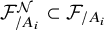

We say that $(\mathcal {F},\mathcal {N})$
is extensive if furthermore
$(\mathcal {F},\mathcal {N})$
is extensive if furthermore
-
4.
$\mathcal {N}$
contains the maps
$\emptyset \to A$
and
$(\mathrm{id},\mathrm{id})\colon A \amalg A \to A$
for all A, and -
5. condition (3) holds for
$\mathcal {F}_{/A}$
in place of the full subcategories
$\mathcal {F}^{\mathcal {N}}_{/A}$
, that is,
$\mathcal {F}$
is an extensive category.


By [Reference Cnossen, Haugseng, Lenz and LinskensCHLL24, Proposition 2.2.5] if $(\mathcal {F},\mathcal {N})$
is weakly extensive then
$(\mathcal {F},\mathcal {N})$
is weakly extensive then $\operatorname {\mathrm {Span}}_{\mathcal {N}}(\mathcal {F})$
admits finite products and the inclusion
$\operatorname {\mathrm {Span}}_{\mathcal {N}}(\mathcal {F})$
admits finite products and the inclusion $\mathcal {F}^{{\mathrm{op}}}\subset \operatorname {\mathrm {Span}}_{\mathcal {N}}(\mathcal {F})$
preserves finite products. Hence we obtain a notion of
$\mathcal {F}^{{\mathrm{op}}}\subset \operatorname {\mathrm {Span}}_{\mathcal {N}}(\mathcal {F})$
preserves finite products. Hence we obtain a notion of $(\mathcal {F},\mathcal {N})$
-operads by specializing the definitions above.
$(\mathcal {F},\mathcal {N})$
-operads by specializing the definitions above.
Definition 2.52. Let $(\mathcal {F},\mathcal {N})$
be a weakly extensive span pair. We say an
$(\mathcal {F},\mathcal {N})$
be a weakly extensive span pair. We say an $(\mathcal {F},\mathcal {N})$
-preoperad
$(\mathcal {F},\mathcal {N})$
-preoperad $\mathcal {O}$
is an
$\mathcal {O}$
is an $(\mathcal {F},\mathcal {N})$
-operad if it is a
$(\mathcal {F},\mathcal {N})$
-operad if it is a $(\operatorname {\mathrm {Span}}_{\mathcal {N}}(\mathcal {F}),\mathcal {F}^{{\mathrm{op}}},\mathcal {N})$
-operad in the sense of Definition 2.46. We denote the resulting full subcategory of
$(\operatorname {\mathrm {Span}}_{\mathcal {N}}(\mathcal {F}),\mathcal {F}^{{\mathrm{op}}},\mathcal {N})$
-operad in the sense of Definition 2.46. We denote the resulting full subcategory of $\mathrm {Op}^\ast _{\mathcal {N}}(\mathcal {F})$
by
$\mathrm {Op}^\ast _{\mathcal {N}}(\mathcal {F})$
by $\mathrm {Op}_{\mathcal {N}}(\mathcal {F})$
.
$\mathrm {Op}_{\mathcal {N}}(\mathcal {F})$
.
Definition 2.53. We say an $\mathcal {F}$
-precategory
$\mathcal {F}$
-precategory $\mathcal {C}\colon \mathcal {F}^{{\mathrm{op}}}\to \mathrm{Cat}$
is an
$\mathcal {C}\colon \mathcal {F}^{{\mathrm{op}}}\to \mathrm{Cat}$
is an $\mathcal {F}$
-category if it is product preserving. This defines a full subcategory
$\mathcal {F}$
-category if it is product preserving. This defines a full subcategory $\mathrm {Cat}(\mathcal {F})$
of
$\mathrm {Cat}(\mathcal {F})$
of $\mathrm {Cat}^\ast (\mathcal {F})$
.
$\mathrm {Cat}^\ast (\mathcal {F})$
.
Remark 2.54. We will typically apply this to the case where $\mathcal {F}=\mathbb F[T]$
is the finite coproduct completion of an arbitrary category T. In this case,
$\mathcal {F}=\mathbb F[T]$
is the finite coproduct completion of an arbitrary category T. In this case, $\mathbb F[T]$
-categories can be equivalently described as functors
$\mathbb F[T]$
-categories can be equivalently described as functors $T^{\mathrm{op}}\to \mathrm{Cat}$
, and are known as T-categories [Reference Barwick, Dotto, Glasman, Nardin and ShahBDG+16, Reference ShahSha23, Reference NardinNar16, Reference Cnossen, Lenz and LinskensCLL25a]. While it may seem silly at first to consider
$T^{\mathrm{op}}\to \mathrm{Cat}$
, and are known as T-categories [Reference Barwick, Dotto, Glasman, Nardin and ShahBDG+16, Reference ShahSha23, Reference NardinNar16, Reference Cnossen, Lenz and LinskensCLL25a]. While it may seem silly at first to consider $\mathbb F[T]$
-categories instead of T-precategories, the reason for this is that only the former allows to encode the interaction with norms.
$\mathbb F[T]$
-categories instead of T-precategories, the reason for this is that only the former allows to encode the interaction with norms.
Definition 2.55. We say an $\mathcal {N}$
-normed
$\mathcal {N}$
-normed $\mathcal {F}$
-precategory
$\mathcal {F}$
-precategory $\mathcal {C}\colon \operatorname {\mathrm {Span}}_{\mathcal {N}}(\mathcal {F})\to \mathrm{Cat}$
is an
$\mathcal {C}\colon \operatorname {\mathrm {Span}}_{\mathcal {N}}(\mathcal {F})\to \mathrm{Cat}$
is an $\mathcal {N}$
-normed
$\mathcal {N}$
-normed $\mathcal {F}$
-category if one of the two by Corollary 2.49 equivalent conditions hold:
$\mathcal {F}$
-category if one of the two by Corollary 2.49 equivalent conditions hold:
-
1.
$\mathcal {C}$
preserves finite products, -
2. The cocartesian unstraightening of
$\mathcal {C}$
is an
$(\mathcal {F},\mathcal {N})$
-operad.


We denote the resulting full subcategory of $\mathrm {NCat}^\ast _{\mathcal {N}}(\mathcal {F})$
by
$\mathrm {NCat}^\ast _{\mathcal {N}}(\mathcal {F})$
by $\mathrm {NCat}_{\mathcal {N}}(\mathcal {F})$
.
$\mathrm {NCat}_{\mathcal {N}}(\mathcal {F})$
.
Remark 2.56. By definition, $\mathcal {N}$
-normed
$\mathcal {N}$
-normed $\mathcal {F}$
-precategories are nothing else than
$\mathcal {F}$
-precategories are nothing else than $\operatorname {\mathrm {Span}}_{\mathcal {N}}({\mathcal {F}})^{\mathrm{op}}$
-precategories, with the
$\operatorname {\mathrm {Span}}_{\mathcal {N}}({\mathcal {F}})^{\mathrm{op}}$
-precategories, with the ${\mathcal {N}}$
-normed
${\mathcal {N}}$
-normed ${\mathcal {F}}$
-categories precisely corresponding to the
${\mathcal {F}}$
-categories precisely corresponding to the $\operatorname {\mathrm {Span}}_{\mathcal {N}}({\mathcal {F}})^{\mathrm{op}}$
-categories. This is the key reason why it is advantageous to work with precategories wherever possible: the category of
$\operatorname {\mathrm {Span}}_{\mathcal {N}}({\mathcal {F}})^{\mathrm{op}}$
-categories. This is the key reason why it is advantageous to work with precategories wherever possible: the category of $\operatorname {\mathrm {Span}}_{\mathcal {N}}({\mathcal {F}})^{\mathrm{op}}$
-categories does not fit into the original framework of parametrized higher category theory [Reference Barwick, Dotto, Glasman, Nardin and ShahBDG+16] (as
$\operatorname {\mathrm {Span}}_{\mathcal {N}}({\mathcal {F}})^{\mathrm{op}}$
-categories does not fit into the original framework of parametrized higher category theory [Reference Barwick, Dotto, Glasman, Nardin and ShahBDG+16] (as $\operatorname {\mathrm {Span}}_{\mathcal {N}}({\mathcal {F}})^{\mathrm{op}}$
is not a free coproduct completion) nor into the more general toposic framework of [Reference MartiniMar21, Reference Martini and WolfMW24] (as product preserving presheaves on
$\operatorname {\mathrm {Span}}_{\mathcal {N}}({\mathcal {F}})^{\mathrm{op}}$
is not a free coproduct completion) nor into the more general toposic framework of [Reference MartiniMar21, Reference Martini and WolfMW24] (as product preserving presheaves on $\operatorname {\mathrm {Span}}_{\mathcal {N}}({\mathcal {F}})^{\mathrm{op}}$
are typically not a topos), but by working with precategories we can still apply a lot of foundational results from parametrized category theory.
$\operatorname {\mathrm {Span}}_{\mathcal {N}}({\mathcal {F}})^{\mathrm{op}}$
are typically not a topos), but by working with precategories we can still apply a lot of foundational results from parametrized category theory.
All our constructions restrict to the above full subcategories, under reasonable assumptions on the pair $(\mathcal {F},\mathcal {N})$
:
$(\mathcal {F},\mathcal {N})$
:
Theorem 2.57. Let $(\mathcal {F},\mathcal {N})$
be a weakly extensive span pair.
$(\mathcal {F},\mathcal {N})$
be a weakly extensive span pair.
-
1. The functor
$\mathrm{fgt} \colon \mathrm {Op}^\ast _{\mathcal {N}}(\mathcal {F})\to \mathrm {Cat}^\ast (\mathcal {F})$
restricts to a functor
$$\begin{align*}\hspace{4em}\mathrm{fgt} \colon \mathrm{Op}_{\mathcal{N}}(\mathcal{F})\to \mathrm{Cat}(\mathcal{F}). \end{align*}$$
-
2. The functor
$\operatorname {\mathrm {Triv}} \colon \mathrm {Cat}^\ast (\mathcal {F})\to \mathrm {Op}^\ast _{\mathcal {N}}(\mathcal {F})$
restricts to a functor
$$\begin{align*}\hspace{4em}\operatorname{\mathrm{Triv}}\colon \mathrm{Cat}(\mathcal{F})\to \mathrm{Op}_{\mathcal{N}}(\mathcal{F}). \end{align*}$$
-
3. The functor
$(-)^{{\mathcal {N}\text{-}\amalg }}\colon \mathrm {Cat}^\ast (\mathcal {F})\to \mathrm {Op}^\ast _{\mathcal {N}}(\mathcal {F})$
restricts to a functor
$$\begin{align*}\hspace{4em}(-)^{{\mathcal{N}\text{-}\amalg}} \colon \mathrm{Cat}(\mathcal{F})\to \mathrm{Op}_{\mathcal{N}}(\mathcal{F}). \end{align*}$$
-
4. The functor
$\operatorname {\mathrm {Env}}\colon \mathrm {Op}^\ast _{\mathcal {N}}(\mathcal {F})\to \mathrm {NCat}^\ast _{\mathcal {N}}(\mathcal {F})$
restricts to a functor
$$\begin{align*}\hspace{4em}\operatorname{\mathrm{Env}}\colon\mathrm{Op}_{\mathcal{N}}(\mathcal{F})\to \mathrm{NCat}_{\mathcal{N}}(\mathcal{F}). \end{align*}$$
-
5. If
$({\mathcal {F}},{\mathcal {N}})$
is even extensive, then restricts to a functor


 restricts to a functor
Proof.
-
1. Suppose
$p\colon \mathcal {O}\to \operatorname {\mathrm {Span}}_{\mathcal {N}}(\mathcal {F})$
is an
$(\mathcal {F},\mathcal {N})$
-operad. Then the pullback of p to
$\mathcal {F}^{{\mathrm{op}}}$
is a cocartesian fibration which satisfies the conditions of Corollary 2.49(2). We conclude by said corollary that its straightening is a product preserving functor, that is,
$\mathrm{fgt}(\mathcal {O})$
is an
$\mathcal {F}$
-category. -
2. Suppose
${\mathcal {C}}$
is an
$\mathcal {F}$
-category. Then its unstraightening satisfies the conditions of Corollary 2.49(2) as a functor to
$\mathcal {F}^{{\mathrm{op}}}$
. However the inclusion
$\mathcal {F}^{{\mathrm{op}}}\hookrightarrow \operatorname {\mathrm {Span}}_{\mathcal {N}}(\mathcal {F})$
is product preserving, and so
$\operatorname {\mathrm {Triv}}({\mathcal {C}})$
is an
$(\mathcal {F},\mathcal {N})$
-operad. -
3. Consider the cartesian unstraightening
$p\colon \mathrm{Un}^{\mathrm{ct}}({\mathcal {C}})\to {\mathcal {F}}$
of an
${\mathcal {F}}$
-category
${\mathcal {C}}$
. By the dual of Corollary 2.49,
$\mathrm{Un}^{\mathrm{ct}}({\mathcal {C}})$
admits coproducts. We will verify the assumptions of [Reference Bachmann and HoyoisBH21, Corollary C.21(2)] to show that
$\operatorname {\mathrm {Span}}_{\mathrm{ct},{\mathcal {N}}}(\mathrm{Un}^{\mathrm{ct}}({\mathcal {C}}))$
admits products, computed as coproducts in
$\mathrm{Un}^{\mathrm{ct}}({\mathcal {C}})$
. To begin we show that is a functor of adequate triples. The fact that
$$\begin{align*}\hspace{4em}\amalg\colon \mathrm{Un}^{\mathrm{ct}}({\mathcal{C}})\times \mathrm{Un}^{\mathrm{ct}}({\mathcal{C}})\to \mathrm{Un}^{\mathrm{ct}}({\mathcal{C}}) \end{align*}$$
$\mathrm{Un}^{\mathrm{ct}}({\mathcal {C}})$
preserves maps lying over maps in
${\mathcal {N}}$
follows from the fact that p preserves coproducts and Definition 2.51(2). That
$\amalg $
preserves cartesian edges follows by Corollary 2.49
$^{{\mathrm{op}}}(3)$
. From this it follows immediately that
$\amalg $
preserves ambigressive pullback squares, since any square in
$\mathrm{Un}^{\mathrm{ct}}({\mathcal {C}})$
over a pullback square in
${\mathcal {F}}$
such that two parallel sides are p-cartesian is a pullback square, see [Reference Haugseng, Hebestreit, Linskens and NuitenHHLN23b, proof of Proposition 2.6].
Next, we show that the unit and counit of the
$\amalg \dashv \Delta $
adjunction are cartesian edges. In the first case this follows from the fact that the diagonal is p-cartesian, once again using Corollary 2.49
$^{{\mathrm{op}}}(3)$
. In the second case this follows from the fact that the coprojections are p-cartesian by (2) of the above cited lemma. Finally, we have to show that the unit and counit naturality squares for maps in
$\mathcal {N}$
are pullback squares. This follows immediately from the above characterization of pullback squares in
$\mathrm{Un}^{\mathrm{ct}}({\mathcal {C}})$
combined with the fact that the squares are pullbacks in
$\mathcal {F}$
by [Reference Cnossen, Haugseng, Lenz and LinskensCHLL24, Remark 2.2.3 and Proposition 2.2.4]. We conclude that
${\mathcal {C}}^{{\mathcal {N}\text{-}\amalg }}= \operatorname {\mathrm {Span}}_{\mathrm{ct},\mathcal {N}}(\mathrm{Un}^{\mathrm{ct}}({\mathcal {C}}))$
admits products computed as coproducts in
$\mathrm{Un}^{\mathrm{ct}}({\mathcal {C}})$
. Using this, the fact that
$p \colon \mathrm{Un}^{\mathrm{ct}}(\mathcal {C}) \to \mathcal {F}$
satisfies the dual of Corollary 2.49, and that backwards maps in
$\operatorname {\mathrm {Span}}_{\mathrm{ct},\mathrm{all}}(\mathrm{Un}^{\mathrm{ct}}(\mathcal {C}))$
are
$\operatorname {\mathrm {Span}}(p)$
-cocartesian, it follows that
$\mathcal {C}^{{\mathcal {N}\text{-}\amalg }}$
is an
$(\mathcal {F},\mathcal {N})$
-operad.
-
4. The fact that
$\operatorname {\mathrm {Env}}$
restricts as claimed follows immediately by applying Proposition 2.50 to
$(S,E,M) = (\operatorname {\mathrm {Span}}_{\mathcal {N}}(\mathcal {F}),\mathcal {F}^{\mathrm{op}},\mathcal {N})$
. The conditions of this cited proposition are satisfied by the definition of a weakly extensive span pair, see Definition 2.51. -
5. Let
$X,Y\in {\mathcal {F}}$
arbitrary. Then the coproduct diagram
$X\hookrightarrow X\amalg Y\hookleftarrow Y$
lifts through the forgetful functor
$\pi \colon {\mathcal {F}}_{/X\amalg Y}\to {\mathcal {F}}$
to a coproduct diagram in
${\mathcal {F}}_{/X\amalg Y}$
. It will therefore suffice to show that is an
${\mathcal {F}}_{/X\amalg Y}$
-category. In view of Lemma 2.32 we may therefore assume, after replacing
$({\mathcal {F}},{\mathcal {N}})$
by
$({\mathcal {F}}_{/X\amalg Y},{\mathcal {F}}_{/X\amalg Y}\times _{\mathcal {F}}{\mathcal {N}})$
, that
$X\amalg Y$
is final.In this case the extensivity of
$\mathcal {F}$
implies that
$\mathcal {F}\simeq \mathcal {F}_{/X\amalg Y} \simeq \mathcal {F}_{/X}\times \mathcal {F}_{/Y}$
. Under this equivalence the objects X and Y correspond to the objects
$(\mathrm{id}_X,\emptyset )$
and
$(\emptyset ,\mathrm{id}_Y)$
respectively. Now note that the equivalence
$\mathcal {F}_{/\emptyset }\simeq \ast $
shows that
$\emptyset $
is a strict initial object in any extensive category, that is, every map
$X\to \emptyset $
is an equivalence. A simple computation shows that products by strict initial objects always exist (and are given by
$\emptyset $
), and so we conclude that for every
$A\in \mathcal {F}$
, the products
$X\times A$
and
$Y\times A$
exists, and that is a coproduct diagram in
$\mathcal {F}$
. In particular, we obtain an equivalence via the restrictions for any
${\mathcal {N}}$
-normed
${\mathcal {F}}$
-category
${\mathcal {C}}$
. Since is corepresented on
$\mathrm {NCat}_{{\mathcal {N}}}({\mathcal {F}})$
, we conclude that via the restrictions. Lemma 2.33 then identifies this with the natural map, finishing the proof.





 is an
is an 




 via the restrictions for any


 is corepresented on

 , finishing the proof.
Corollary 2.58. Let $(\mathcal {F},\mathcal {N})$
be an extensive left cancelable span pair, and suppose that
$(\mathcal {F},\mathcal {N})$
be an extensive left cancelable span pair, and suppose that $\mathcal {C}$
is an
$\mathcal {C}$
is an $\mathcal {N}$
-normed
$\mathcal {N}$
-normed $\mathcal {F}$
-category which admits fiberwise sifted colimits. Then
$\mathcal {F}$
-category which admits fiberwise sifted colimits. Then  is a fiberwise cocomplete $\mathcal {F}$
-category which is left
$\mathcal {F}$
-category which is left $\mathcal {N}$
-adjointable.
$\mathcal {N}$
-adjointable.
Proof. By Theorem 2.57(5) and Lemma 2.44  is an
is an $\mathcal {F}$
-category admitting fiberwise sifted colimits. Moreover, Corollary 2.45 (which requires the assumption of left-cancellability) shows that it is left
$\mathcal {F}$
-category admitting fiberwise sifted colimits. Moreover, Corollary 2.45 (which requires the assumption of left-cancellability) shows that it is left $\mathcal {N}$
-adjointable. Since
$\mathcal {N}$
-adjointable. Since $\mathcal {N}$
contains all fold maps by extensivity and
$\mathcal {N}$
contains all fold maps by extensivity and  is an
is an $\mathcal {F}$
-category (and not just a precategory), this also gives fiberwise finite coproducts by [Reference Cnossen, Lenz and LinskensCLL25a, Proposition 4.2.14].
$\mathcal {F}$
-category (and not just a precategory), this also gives fiberwise finite coproducts by [Reference Cnossen, Lenz and LinskensCLL25a, Proposition 4.2.14].
3 Distributivity and free functors
Let ${\mathcal {C}}$
be an
${\mathcal {C}}$
be an $\mathcal {N}$
-normed
$\mathcal {N}$
-normed $\mathcal {F}$
-precategory, and consider the forgetful functor
$\mathcal {F}$
-precategory, and consider the forgetful functor

from the precategory of ${\mathcal {N}}$
-normed algebras in
${\mathcal {N}}$
-normed algebras in ${\mathcal {C}}$
to
${\mathcal {C}}$
to ${\mathcal {C}}$
itself. In this section we will provide conditions for the existence of a left adjoint of
${\mathcal {C}}$
itself. In this section we will provide conditions for the existence of a left adjoint of $\mathbb U$
, that is, for the existence of free normed algebras in
$\mathbb U$
, that is, for the existence of free normed algebras in ${\mathcal {C}}$
, and prove a formula computing it.
${\mathcal {C}}$
, and prove a formula computing it.
Recall that even in the classical case of symmetric monoidal categories, one needs to impose conditions on the interaction between colimits and the symmetric monoidal structure to understand free commutative algebras. More specifically, we may require that the tensor product preserves colimits in each variable separately. This condition can be split up into the tensor product preserving sifted colimits as a functor ${\mathcal {C}}\times {\mathcal {C}} \to {\mathcal {C}}$
, and requiring that coproducts should distribute over the tensor product in the sense that we have specific equivalences
${\mathcal {C}}\times {\mathcal {C}} \to {\mathcal {C}}$
, and requiring that coproducts should distribute over the tensor product in the sense that we have specific equivalences
 $$\begin{align*}(A\amalg B)\otimes(C\amalg D)\simeq (A\otimes C)\amalg(A\otimes D)\amalg (B\otimes C)\amalg (B\otimes D). \end{align*}$$
We begin by introducing an analogue of this in our context.
3.1 Distributivity
Phrasing the condition of distributivity for $\mathcal {N}$
-normed
$\mathcal {N}$
-normed $\mathcal {F}$
-categories requires many more conditions on the pair
$\mathcal {F}$
-categories requires many more conditions on the pair $(\mathcal {F},\mathcal {N})$
. For later use we in fact introduce a more general context, in which we single out a class
$(\mathcal {F},\mathcal {N})$
. For later use we in fact introduce a more general context, in which we single out a class $\mathcal {M}\subset \mathcal {F}$
of “indexed coproducts” which we would like our norms to “distribute” along.
$\mathcal {M}\subset \mathcal {F}$
of “indexed coproducts” which we would like our norms to “distribute” along.
Definition 3.1. We call a triple $(\mathcal {F},\mathcal {N},\mathcal {M})$
of a category
$(\mathcal {F},\mathcal {N},\mathcal {M})$
of a category $\mathcal {F}$
together with two wide subcategories
$\mathcal {F}$
together with two wide subcategories $\mathcal {N},\mathcal {M}\subset \mathcal {F}$
a distributive context if
$\mathcal {N},\mathcal {M}\subset \mathcal {F}$
a distributive context if
-
1.
$(\mathcal {F},\mathcal {N})$
is a weakly extensive left cancelable span pair. -
2.
$(\mathcal {F},\mathcal {M})$
is a span pair. -
3. For every
in
$\mathcal {N}$
, the pullback functor
$n^*\colon \mathcal {M}_{/B}\to \mathcal {M}_{/A}$
admits a right adjoint
$n_*$
, and for any pullback in
$\mathcal {F}$
with
$n,n'\in \mathcal {N}$
as indicated, the Beck–Chevalley transformation between functors
$$\begin{align*}f^*n_*\to n^{\prime}_*g^* \end{align*}$$
$\mathcal {M}_{/A}\to \mathcal {M}_{/B'}$
is an equivalence.
-
4. Both
$\mathcal {M}$
and
$\mathcal {F}$
admit finite coproducts, preserved by the inclusion
$\mathcal {M}\hookrightarrow \mathcal {F}$
. -
5.
$\mathcal {M}$
is the right class of a factorization system
$({\mathcal {E}},\mathcal {M})$
on
$\mathcal {F}$
. -
6.
$(\mathcal {F},\mathcal {E},\mathcal {N})$
is an adequate triple. -
7. Maps in
$\mathcal {E}$
are closed under coproducts in
$\mathcal {F}$
.


 in
in 


Remark 3.2. In the language of [Reference Elmanto and HaugsengEH23, Reference Cnossen, Haugseng, Lenz and LinskensCHLL25, Reference Cnossen, Haugseng, Lenz and LinskensCHLL24], the first three conditions (sans left cancellability) say that $(\mathcal {F},\mathcal {N},\mathcal {M})$
is a bispan triple.
$(\mathcal {F},\mathcal {N},\mathcal {M})$
is a bispan triple.
Notation 3.3. Recall that we denote maps in $\mathcal {N}$
by
$\mathcal {N}$
by  . We will further denote maps in $\mathcal {M}$
by
$\mathcal {M}$
by  and maps in $\mathcal {E}$
by
$\mathcal {E}$
by  .
.
Remark 3.4. Let T be any category. Recall that a wide subcategory $P\subset T$
is called an orbital subcategory [Reference Cnossen, Lenz and LinskensCLL25a, Definition 4.2.2] if the finite coproduct completions
$P\subset T$
is called an orbital subcategory [Reference Cnossen, Lenz and LinskensCLL25a, Definition 4.2.2] if the finite coproduct completions $\mathbb F[P]\subset \mathbb F[T]$
form a span pair; we call T itself orbital if it is an orbital subcategory of itself, that is, if
$\mathbb F[P]\subset \mathbb F[T]$
form a span pair; we call T itself orbital if it is an orbital subcategory of itself, that is, if $\mathbb F[T]$
has all pullbacks.
$\mathbb F[T]$
has all pullbacks.
If $P\subset T$
is orbital, then the span pair
$P\subset T$
is orbital, then the span pair $(\mathbb F[T],\mathbb F[P])$
is always extensive [Reference Cnossen, Haugseng, Lenz and LinskensCHLL24, Example 3.1.9]. Assume now that we are given a factorization system
$(\mathbb F[T],\mathbb F[P])$
is always extensive [Reference Cnossen, Haugseng, Lenz and LinskensCHLL24, Example 3.1.9]. Assume now that we are given a factorization system $(E,M)$
on T. Then
$(E,M)$
on T. Then $\mathbb F[M]$
is the right half of a factorization system on
$\mathbb F[M]$
is the right half of a factorization system on $\mathbb F[T]$
, with the left class given by those maps in
$\mathbb F[T]$
, with the left class given by those maps in $\mathbb F[T]$
that decompose as finite coproducts of maps in E (i.e., compared to
$\mathbb F[T]$
that decompose as finite coproducts of maps in E (i.e., compared to $\mathbb F[E]$
we exclude fold maps).
$\mathbb F[E]$
we exclude fold maps).
We therefore see that given a category T with a wide subcategory $P\subset T$
and a factorization system
$P\subset T$
and a factorization system $(M,E)$
, the triple
$(M,E)$
, the triple $(\mathbb F[T], \mathbb F[P], \mathbb F[M])$
is a distributive context whenever the following assumptions are satisfied:
$(\mathbb F[T], \mathbb F[P], \mathbb F[M])$
is a distributive context whenever the following assumptions are satisfied:
-
1. Both P and M are orbital subcategories of T.
-
2.
$(T,E)$
is a span pair. -
3. For every
$n\colon x\to y$
in
$\mathbb F[P]$
the pullback
$n^*\colon \mathbb F[M]_{/y}\to \mathbb F[M]_{/y}$
admits a right adjoint
$n_*$
satisfying the basechange condition from Remark 3.2.


We further remark that in the case that $T=M=P$
, the second condition is automatic and the third condition simplifies to
$T=M=P$
, the second condition is automatic and the third condition simplifies to $\mathbb F[T]$
being locally cartesian closed.
$\mathbb F[T]$
being locally cartesian closed.
Example 3.5. We specialize the previous remark to $T=M=P=\mathrm{Glo}$
the (
$T=M=P=\mathrm{Glo}$
the ( $2$
-) category of finite connected
$2$
-) category of finite connected $1$
-groupoids, so that
$1$
-groupoids, so that  is the category of finite $1$
-groupoids (which clearly has all pullbacks). As
$1$
-groupoids (which clearly has all pullbacks). As ${\mathbb {G}}$
is locally cartesian closed (e.g., by straightening–unstraightening), we see that
${\mathbb {G}}$
is locally cartesian closed (e.g., by straightening–unstraightening), we see that $({\mathbb {G}},{\mathbb {G}},{\mathbb {G}})$
is a distributive context. On the other hand, the subcategory
$({\mathbb {G}},{\mathbb {G}},{\mathbb {G}})$
is a distributive context. On the other hand, the subcategory ${\vphantom {\mathrm{t}}\smash {\mathrm{Orb}}}\subset \mathrm{Glo}$
of faithful functors is an orbital subcategory by [Reference Cnossen, Lenz and LinskensCLL25a, Example 4.2.5], so writing
${\vphantom {\mathrm{t}}\smash {\mathrm{Orb}}}\subset \mathrm{Glo}$
of faithful functors is an orbital subcategory by [Reference Cnossen, Lenz and LinskensCLL25a, Example 4.2.5], so writing  we also obtain a distributive context $({\mathbb {G}},{\mathbb O},{\mathbb {G}})$
. This latter context is the example we are most interested in the bulk of this paper.
$({\mathbb {G}},{\mathbb O},{\mathbb {G}})$
. This latter context is the example we are most interested in the bulk of this paper.
Example 3.6. Varying the previous example, we can also consider the factorization system on $\mathrm{Glo}$
with right class given by
$\mathrm{Glo}$
with right class given by ${\vphantom {\mathrm{t}}\smash {\mathrm{Orb}}}$
and left class
${\vphantom {\mathrm{t}}\smash {\mathrm{Orb}}}$
and left class $\mathrm{Surj}$
given by the full functors of connected finite
$\mathrm{Surj}$
given by the full functors of connected finite $1$
-groupoids [Reference Linskens, Nardin and PolLNP25, Remark 6.14]. We will write
$1$
-groupoids [Reference Linskens, Nardin and PolLNP25, Remark 6.14]. We will write $\mathbb E$
for the left class of the corresponding factorization system on
$\mathbb E$
for the left class of the corresponding factorization system on ${\mathbb {G}}$
with right class
${\mathbb {G}}$
with right class ${\mathbb O}$
.
${\mathbb O}$
.
By [Reference Cnossen, Lenz and LinskensCLL25a, Lemma 5.2.3], we have an equivalence ${\mathbb O}_{/G}\simeq \operatorname {\mathrm {Fun}}(G,\mathbb F)$
natural in
${\mathbb O}_{/G}\simeq \operatorname {\mathrm {Fun}}(G,\mathbb F)$
natural in $G\in {\mathbb {G}}^{\mathrm{op}}$
; in particular, the pullback maps
$G\in {\mathbb {G}}^{\mathrm{op}}$
; in particular, the pullback maps ${\mathbb O}_{/G}\to {\mathbb O}_{/H}$
have right adjoints satisfying the Beck–Chevalley condition, so that also
${\mathbb O}_{/G}\to {\mathbb O}_{/H}$
have right adjoints satisfying the Beck–Chevalley condition, so that also $({\mathbb {G}}, {\mathbb {G}}, {\mathbb O})$
and
$({\mathbb {G}}, {\mathbb {G}}, {\mathbb O})$
and $({\mathbb {G}},{\mathbb O},{\mathbb O})$
are distributive contexts. The latter context will be our main example throughout Section 7.
$({\mathbb {G}},{\mathbb O},{\mathbb O})$
are distributive contexts. The latter context will be our main example throughout Section 7.
Example 3.7. Write $\mathbb F_G$
for the category of finite G-sets, which is equivalently the finite coproduct completion of the category of finite transitive G-sets. As
$\mathbb F_G$
for the category of finite G-sets, which is equivalently the finite coproduct completion of the category of finite transitive G-sets. As $\mathbb F_G$
has pullbacks and is locally cartesian closed, we see that also
$\mathbb F_G$
has pullbacks and is locally cartesian closed, we see that also $(\mathbb F_G,\mathbb F_G,\mathbb F_G)$
is a distributive context.
$(\mathbb F_G,\mathbb F_G,\mathbb F_G)$
is a distributive context.
Let us now discuss the notion of distributivity for $\mathcal {N}$
-normed
$\mathcal {N}$
-normed $\mathcal {F}$
-categories associated to a distributive context. For this we need some definitions.
$\mathcal {F}$
-categories associated to a distributive context. For this we need some definitions.
Definition 3.8 (cf. [Reference Elmanto and HaugsengEH23, Definition 2.4.1, 2.4.3]).
Consider a distributive context $(\mathcal {F},\mathcal {N},\mathcal {M})$
together with morphisms
$(\mathcal {F},\mathcal {N},\mathcal {M})$
together with morphisms  in
in $\mathcal {M}$
and
$\mathcal {M}$
and  in
in $\mathcal {N}$
. We call a diagram
$\mathcal {N}$
. We call a diagram

a distributivity diagram for m and n if the square is a pullback, $m'$
is again in
$m'$
is again in $\mathcal {M}$
, and the composite
$\mathcal {M}$
, and the composite

is an equivalence for all $\varphi \colon D\to C$
in
$\varphi \colon D\to C$
in $\mathcal {F}$
. To connect to Definition 3.1, the universal property of a distributivity diagram precisely witnesses
$\mathcal {F}$
. To connect to Definition 3.1, the universal property of a distributivity diagram precisely witnesses $m'$
as a right adjoint object for pullback along n and ensures that the Beck–Chevalley transformations in (3) are equivalences [Reference Elmanto and HaugsengEH23, Remark 2.4.5 and Lemma 2.4.6]. As such, distributivity diagrams are necessarily unique if they exist.
$m'$
as a right adjoint object for pullback along n and ensures that the Beck–Chevalley transformations in (3) are equivalences [Reference Elmanto and HaugsengEH23, Remark 2.4.5 and Lemma 2.4.6]. As such, distributivity diagrams are necessarily unique if they exist.
Remark 3.9. Note that since we check the universal property of a distributivity diagram against all maps $\varphi $
in
$\varphi $
in $\mathcal {F}$
(and not just
$\mathcal {F}$
(and not just $\varphi $
in
$\varphi $
in $\mathcal {M}$
), this notion is invariant under enlarging
$\mathcal {M}$
), this notion is invariant under enlarging $\mathcal {M}$
and
$\mathcal {M}$
and $\mathcal {N}$
, that is, if
$\mathcal {N}$
, that is, if $(\mathcal {F},\mathcal {N}',\mathcal {M}')$
is another distributive context such that
$(\mathcal {F},\mathcal {N}',\mathcal {M}')$
is another distributive context such that $\mathcal {M}'\supset \mathcal {M}$
,
$\mathcal {M}'\supset \mathcal {M}$
, $\mathcal {N}'\supset \mathcal {N}$
, then a distributivity diagram with respect to
$\mathcal {N}'\supset \mathcal {N}$
, then a distributivity diagram with respect to $(\mathcal {F},\mathcal {N},\mathcal {M})$
is also a distributivity diagram with respect to
$(\mathcal {F},\mathcal {N},\mathcal {M})$
is also a distributivity diagram with respect to $(\mathcal {F},\mathcal {N}',\mathcal {M}')$
.
$(\mathcal {F},\mathcal {N}',\mathcal {M}')$
.
Remark 3.10. We observe that given a distributivity diagram (5), the diagram

defines a commutative square in $\operatorname {\mathrm {Span}}_{\mathcal {N},\mathrm{all}}(\mathcal {F}) \simeq \operatorname {\mathrm {Span}}_{\mathcal {N}}(\mathcal {F})^{{\mathrm{op}}}$
. By [Reference Elmanto and HaugsengEH23, Proposition 2.5.9] it is in fact a pullback square in
$\operatorname {\mathrm {Span}}_{\mathcal {N},\mathrm{all}}(\mathcal {F}) \simeq \operatorname {\mathrm {Span}}_{\mathcal {N}}(\mathcal {F})^{{\mathrm{op}}}$
. By [Reference Elmanto and HaugsengEH23, Proposition 2.5.9] it is in fact a pullback square in $\operatorname {\mathrm {Span}}_{\mathcal {N}}(\mathcal {F})^{\mathrm{op}}$
. Moreover, as shown there, a pullback of the cospan above exists in
$\operatorname {\mathrm {Span}}_{\mathcal {N}}(\mathcal {F})^{\mathrm{op}}$
. Moreover, as shown there, a pullback of the cospan above exists in $\operatorname {\mathrm {Span}}_{\mathcal {N}}(\mathcal {F})^{{\mathrm{op}}}$
if and only if a distributivity diagram for m and n exists.
$\operatorname {\mathrm {Span}}_{\mathcal {N}}(\mathcal {F})^{{\mathrm{op}}}$
if and only if a distributivity diagram for m and n exists.
On the other hand, the inclusion ${\mathcal {F}}\hookrightarrow \operatorname {\mathrm {Span}}_{\mathcal {N}}({\mathcal {F}})^{\mathrm{op}}$
sends pullback squares of the form
${\mathcal {F}}\hookrightarrow \operatorname {\mathrm {Span}}_{\mathcal {N}}({\mathcal {F}})^{\mathrm{op}}$
sends pullback squares of the form

to pullback squares by Proposition 2.5.7 of op. cit. By writing any map in $\operatorname {\mathrm {Span}}_{\mathcal {N}}(\mathcal {F})^{{\mathrm{op}}}$
as a composite of maps in
$\operatorname {\mathrm {Span}}_{\mathcal {N}}(\mathcal {F})^{{\mathrm{op}}}$
as a composite of maps in $\mathcal {N}^{{\mathrm{op}}}$
and
$\mathcal {N}^{{\mathrm{op}}}$
and $\mathcal {F}$
, we conclude that
$\mathcal {F}$
, we conclude that $(\mathcal {F},\mathcal {N},\mathcal {M})$
satisfies (2) and (3) of Definition 3.12 if and only if
$(\mathcal {F},\mathcal {N},\mathcal {M})$
satisfies (2) and (3) of Definition 3.12 if and only if $(\operatorname {\mathrm {Span}}_{\mathcal {N}}(\mathcal {F})^{{\mathrm{op}}},\mathcal {M})$
is a span pair.
$(\operatorname {\mathrm {Span}}_{\mathcal {N}}(\mathcal {F})^{{\mathrm{op}}},\mathcal {M})$
is a span pair.
Remark 3.11. Note that the inclusion ${\mathbb O}\hookrightarrow {\mathbb {G}}$
preserves pullbacks (as
${\mathbb O}\hookrightarrow {\mathbb {G}}$
preserves pullbacks (as ${\mathbb O}$
is left cancelable and closed under basechange); as also the notions of distributivity diagrams agree, we conclude that the inclusion
${\mathbb O}$
is left cancelable and closed under basechange); as also the notions of distributivity diagrams agree, we conclude that the inclusion $\operatorname {\mathrm {Span}}({\mathbb O})\hookrightarrow \operatorname {\mathrm {Span}}_{\mathbb O}({\mathbb {G}})^{\mathrm{op}}$
preserves pullbacks along forward maps.
$\operatorname {\mathrm {Span}}({\mathbb O})\hookrightarrow \operatorname {\mathrm {Span}}_{\mathbb O}({\mathbb {G}})^{\mathrm{op}}$
preserves pullbacks along forward maps.
We are now ready to introduce the main definition.
Definition 3.12. Let $(\mathcal {F},\mathcal {N},\mathcal {M})$
be a distributive context. We say an
$(\mathcal {F},\mathcal {N},\mathcal {M})$
be a distributive context. We say an $\mathcal {N}$
-normed
$\mathcal {N}$
-normed $\mathcal {F}$
-precategory
$\mathcal {F}$
-precategory $\mathcal {C} \colon \operatorname {\mathrm {Span}}_{\mathcal {N}}(\mathcal {F}) \to \mathrm{Cat}$
is
$\mathcal {C} \colon \operatorname {\mathrm {Span}}_{\mathcal {N}}(\mathcal {F}) \to \mathrm{Cat}$
is $\mathcal {M}$
-distributive if
$\mathcal {M}$
-distributive if
-
1.
$\mathcal {C}$
has fiberwise sifted colimits (Definition 2.42), that is, it factors through the subcategory
$\mathrm{Cat}(\mathrm{sift}) \subset \mathrm{Cat}$
of categories admitting sifted colimits and functors preserving them; -
2. given a map
$m \colon A \to B$
in
$\mathcal {M}$
, the induced restriction
$m^* \colon \mathcal {C}(B) \to \mathcal {C}(A)$
admits a left adjoint
$m_! \colon \mathcal {C}(A) \to \mathcal {C}(B)$
; -
3. for all
$f\colon C\to B$
in
$\mathcal {F}$
,
${\mathcal {C}}$
sends the pullback square in
$\mathcal {F}$
to a (vertically) left adjointable square, that is, the Beck–Chevalley transformation
$m^{\prime }_!f^{\prime *} \to f^*m_!$
is an equivalence; and
-
4. for every distributivity diagram (5), the commutative square
obtained by applying
${\mathcal {C}}$
to the commutative square in
$\operatorname {\mathrm {Span}}_{\mathcal {N}}(\mathcal {F})$
from Remark 3.10 is horizontally left adjointable, that is, the Beck–Chevalley transformation
$m^{\prime }_!n^{\prime }_\otimes \varepsilon ^* \to n_\otimes m_!$
is an equivalence.







In the special case where $\mathcal {M} = \mathcal {F}$
, we will simply call
$\mathcal {M} = \mathcal {F}$
, we will simply call $\mathcal {C}$
a distributive
$\mathcal {C}$
a distributive $\mathcal {N}$
-normed
$\mathcal {N}$
-normed $\mathcal {F}$
-precategory.
$\mathcal {F}$
-precategory.
Remark 3.13. If $(\mathcal {F},\mathcal {N})$
is extensive and
$(\mathcal {F},\mathcal {N})$
is extensive and $\mathcal {C}$
is an
$\mathcal {C}$
is an $\mathcal {N}$
-normed
$\mathcal {N}$
-normed $\mathcal {F}$
-category (i.e., preserves finite products), then each
$\mathcal {F}$
-category (i.e., preserves finite products), then each ${\mathcal {C}}(A)$
carries a natural symmetric monoidal structure by restricting
${\mathcal {C}}(A)$
carries a natural symmetric monoidal structure by restricting ${\mathcal {C}}$
along the unique product-preserving functor
${\mathcal {C}}$
along the unique product-preserving functor $\operatorname {\mathrm {Span}}(\mathbb F)\to \operatorname {\mathrm {Span}}_{\mathcal {N}}(\mathcal {F})$
sending the singleton to A.
$\operatorname {\mathrm {Span}}(\mathbb F)\to \operatorname {\mathrm {Span}}_{\mathcal {N}}(\mathcal {F})$
sending the singleton to A.
Condition (1) then implies that the tensor product preserves sifted colimits (as a functor $\mathcal {C}(A)\times \mathcal {C}(A)\to \mathcal {C}(A)$
or, equivalently, in each variable separately). On the other hand, if also
$\mathcal {C}(A)\times \mathcal {C}(A)\to \mathcal {C}(A)$
or, equivalently, in each variable separately). On the other hand, if also $\mathcal {M}$
contains fold maps, then specializing the distributivity condition (4) to the case where
$\mathcal {M}$
contains fold maps, then specializing the distributivity condition (4) to the case where $n\colon A\amalg A\to A$
and
$n\colon A\amalg A\to A$
and $m\colon (A\amalg A)\amalg (A\amalg A)\to A\amalg A$
are fold maps, shows (after a straightforward, but somewhat tedious computation) that the tensor product preserves finite coproducts in each variable separately, hence preserves all colimits in each variable separately.
$m\colon (A\amalg A)\amalg (A\amalg A)\to A\amalg A$
are fold maps, shows (after a straightforward, but somewhat tedious computation) that the tensor product preserves finite coproducts in each variable separately, hence preserves all colimits in each variable separately.
In general, one should think of $(-)_!$
as “summation,” while
$(-)_!$
as “summation,” while $(-)_\otimes $
is “multiplication.” The final condition implies that we may distribute these operations, analogously to how one distributes addition and multiplication in rings. For a more precise explanation of this analogy we refer the reader to [Reference Elmanto and HaugsengEH23, Section 1.2].
$(-)_\otimes $
is “multiplication.” The final condition implies that we may distribute these operations, analogously to how one distributes addition and multiplication in rings. For a more precise explanation of this analogy we refer the reader to [Reference Elmanto and HaugsengEH23, Section 1.2].
Remark 3.14. Our notion of distributivity is inspired by [Reference Elmanto and HaugsengEH23]. By the discussion in Remark 3.10, see also Theorem 2.5.2 of op. cit., we can rephrase the third and fourth conditions as a Beck–Chevalley condition for maps in $\operatorname {\mathrm {Span}}_{{\mathcal {N}}}({\mathcal {F}})^{\mathrm{op}}$
: they are equivalent to every pullback square
$\operatorname {\mathrm {Span}}_{{\mathcal {N}}}({\mathcal {F}})^{\mathrm{op}}$
: they are equivalent to every pullback square

in $\operatorname {\mathrm {Span}}_{{\mathcal {N}},\mathrm{all}}({\mathcal {F}})\simeq \operatorname {\mathrm {Span}}_{{\mathcal {N}}}({\mathcal {F}})^{\mathrm{op}}$
with the vertical maps in
$\operatorname {\mathrm {Span}}_{{\mathcal {N}},\mathrm{all}}({\mathcal {F}})\simeq \operatorname {\mathrm {Span}}_{{\mathcal {N}}}({\mathcal {F}})^{\mathrm{op}}$
with the vertical maps in $\mathcal {M}\subset {\mathcal {F}}\subset \operatorname {\mathrm {Span}}_{{\mathcal {N}},\mathrm{all}}({\mathcal {F}})$
being vertically left adjointable. We also say that the left adjoints for maps in
$\mathcal {M}\subset {\mathcal {F}}\subset \operatorname {\mathrm {Span}}_{{\mathcal {N}},\mathrm{all}}({\mathcal {F}})$
being vertically left adjointable. We also say that the left adjoints for maps in $\mathcal {M}$
satisfy basechange with respect to all maps in
$\mathcal {M}$
satisfy basechange with respect to all maps in $\operatorname {\mathrm {Span}}_{\mathcal {N}}({\mathcal {F}})^{\mathrm{op}}$
.
$\operatorname {\mathrm {Span}}_{\mathcal {N}}({\mathcal {F}})^{\mathrm{op}}$
.
Remark 3.15. For an (“atomic”) orbital category T such that $\mathbb F[T]$
is locally cartesian closed, we expect that an
$\mathbb F[T]$
is locally cartesian closed, we expect that an $\mathbb {F}[T]$
-normed
$\mathbb {F}[T]$
-normed $\mathbb {F}[T]$
-category is distributive if and only if it is a distributive T-symmetric monoidal T-category in the sense of [Reference Nardin and ShahNS22, Definition 3.2.3].
$\mathbb {F}[T]$
-category is distributive if and only if it is a distributive T-symmetric monoidal T-category in the sense of [Reference Nardin and ShahNS22, Definition 3.2.3].
Example 3.16. Consider the distributive context $({\mathbb {G}},{\mathbb O},{\mathbb {G}})$
from Example 3.5; we will refer to (
$({\mathbb {G}},{\mathbb O},{\mathbb {G}})$
from Example 3.5; we will refer to ( ${\mathbb {G}}$
-)distributive
${\mathbb {G}}$
-)distributive ${\mathbb O}$
-normed
${\mathbb O}$
-normed ${\mathbb {G}}$
-categories as distributive normed global categories.Footnote
8
In Theorem 5.10 we will show that the categories of G-global spectra from [Reference LenzLen25, Chapter 3] assemble into a distributive normed global category.
${\mathbb {G}}$
-categories as distributive normed global categories.Footnote
8
In Theorem 5.10 we will show that the categories of G-global spectra from [Reference LenzLen25, Chapter 3] assemble into a distributive normed global category.
Example 3.17. If ${\mathcal {C}}\colon \operatorname {\mathrm {Span}}(\mathbb F)\to \mathrm{Cat}$
is any symmetric monoidal category, then we can form the right Kan extension
${\mathcal {C}}\colon \operatorname {\mathrm {Span}}(\mathbb F)\to \mathrm{Cat}$
is any symmetric monoidal category, then we can form the right Kan extension ${\mathcal {C}}^\flat $
along the unique product-preserving functor
${\mathcal {C}}^\flat $
along the unique product-preserving functor $\operatorname {\mathrm {Span}}(\mathbb F)\hookrightarrow \operatorname {\mathrm {Span}}_{{\mathbb O}}({\mathbb {G}})$
which preserves the final object. One can give the following description of the resulting functoriality, c.f. [Reference PützstückPüt25, Example 3.1]: on objects,
$\operatorname {\mathrm {Span}}(\mathbb F)\hookrightarrow \operatorname {\mathrm {Span}}_{{\mathbb O}}({\mathbb {G}})$
which preserves the final object. One can give the following description of the resulting functoriality, c.f. [Reference PützstückPüt25, Example 3.1]: on objects, $\mathcal {C}^\flat $
is given by
$\mathcal {C}^\flat $
is given by  with the evident functoriality in backwards maps. If $G\amalg G\to G$
is a fold map, then the functoriality in the corresponding forward map is given by the tensor product in
$G\amalg G\to G$
is a fold map, then the functoriality in the corresponding forward map is given by the tensor product in ${\mathcal {C}}$
, with the diagonal action. In other words, the restriction of
${\mathcal {C}}$
, with the diagonal action. In other words, the restriction of $\mathcal {C}^\flat $
along
$\mathcal {C}^\flat $
along $\operatorname {\mathrm {Span}}(\mathbb {F}) \to \operatorname {\mathrm {Span}}_{\mathbb O}({\mathbb {G}}),\ * \mapsto G$
classifies the pointwise symmetric monoidal structure on
$\operatorname {\mathrm {Span}}(\mathbb {F}) \to \operatorname {\mathrm {Span}}_{\mathbb O}({\mathbb {G}}),\ * \mapsto G$
classifies the pointwise symmetric monoidal structure on $G\text{-}\mathcal {C}$
. Finally, if G is a finite group, and
$G\text{-}\mathcal {C}$
. Finally, if G is a finite group, and $H\subset G$
is a subgroup, then the norm
$H\subset G$
is a subgroup, then the norm $\mathop {\vphantom {t}\smash {\mathrm{Nm}}}^G_H$
of an H-object is given by
$\mathop {\vphantom {t}\smash {\mathrm{Nm}}}^G_H$
of an H-object is given by $X^{\otimes |G/H|}$
with a specific G-action. If
$X^{\otimes |G/H|}$
with a specific G-action. If ${\mathcal {C}}$
is actually a symmetric monoidal
${\mathcal {C}}$
is actually a symmetric monoidal $1$
-category, the G-action can be explicitly written down in terms of the symmetry isomorphisms of
$1$
-category, the G-action can be explicitly written down in terms of the symmetry isomorphisms of ${\mathcal {C}}$
, and
${\mathcal {C}}$
, and $\mathop {\vphantom {t}\smash {\mathrm{Nm}}}^G_H$
is known as the symmetric monoidal norm.
$\mathop {\vphantom {t}\smash {\mathrm{Nm}}}^G_H$
is known as the symmetric monoidal norm.
We call ${\mathcal {C}}^\flat $
the Borel normed global category associated to
${\mathcal {C}}^\flat $
the Borel normed global category associated to ${\mathcal {C}}$
; it is distributive whenever
${\mathcal {C}}$
; it is distributive whenever ${\mathcal {C}}$
is cocomplete and the tensor product preserves colimits in each variable separately, see [Reference Elmanto and HaugsengEH23, Proposition 3.2.8].
${\mathcal {C}}$
is cocomplete and the tensor product preserves colimits in each variable separately, see [Reference Elmanto and HaugsengEH23, Proposition 3.2.8].
Example 3.18. Consider the distributive context $({\mathbb {G}},{\mathbb O},{\mathbb O})$
from Example 3.6; in analogy with the terminology of [Reference Cnossen, Lenz and LinskensCLL25b] we will refer to
$({\mathbb {G}},{\mathbb O},{\mathbb O})$
from Example 3.6; in analogy with the terminology of [Reference Cnossen, Lenz and LinskensCLL25b] we will refer to ${\mathbb O}$
-distributive
${\mathbb O}$
-distributive ${\mathbb O}$
-normed
${\mathbb O}$
-normed ${\mathbb {G}}$
-categories as equivariantly distributive normed global categories.
${\mathbb {G}}$
-categories as equivariantly distributive normed global categories.
Every distributive normed global category is in particular also equivariantly distributive. In Proposition 7.24 we will moreover show that the categories of genuine G-spectra assemble into an equivariantly distributive normed global category (which however, crucially, is not ${\mathbb {G}}$
-distributive).
${\mathbb {G}}$
-distributive).
Example 3.19. Recall the distributive context $(\mathbb F_G,\mathbb F_G,\mathbb F_G)$
from Example 3.7. Product preserving functors
$(\mathbb F_G,\mathbb F_G,\mathbb F_G)$
from Example 3.7. Product preserving functors $\operatorname {\mathrm {Span}}(\mathbb F_G)\to \mathrm{Cat}$
are known as G-symmetric monoidal G-categories [Reference Nardin and ShahNS22] or normed G-categories [Reference Cnossen, Haugseng, Lenz and LinskensCHLL24]. Taking Remark 3.15 for granted, the corresponding notion of distributivity is explored in [Reference NardinNar17, Reference Nardin and ShahNS22]. Contrary to what one might expect, this distributive context will play no serious role in the present paper.
$\operatorname {\mathrm {Span}}(\mathbb F_G)\to \mathrm{Cat}$
are known as G-symmetric monoidal G-categories [Reference Nardin and ShahNS22] or normed G-categories [Reference Cnossen, Haugseng, Lenz and LinskensCHLL24]. Taking Remark 3.15 for granted, the corresponding notion of distributivity is explored in [Reference NardinNar17, Reference Nardin and ShahNS22]. Contrary to what one might expect, this distributive context will play no serious role in the present paper.
The next goal of this section is to construct free algebras in distributive $\mathcal {N}$
-normed
$\mathcal {N}$
-normed $\mathcal {F}$
-precategories. The result we will prove is:
$\mathcal {F}$
-precategories. The result we will prove is:
Theorem 3.20. Let $\mathcal {C}$
be a distributive
$\mathcal {C}$
be a distributive $\mathcal {N}$
-normed
$\mathcal {N}$
-normed $\mathcal {F}$
-precategory. Then:
$\mathcal {F}$
-precategory. Then:
-
1. The forgetful functor
admits a parametrized left adjoint
$\mathbb {P}$
, which exhibits as monadic over
$\mathcal {C}(A)$
for all
$A\in \mathcal {F}$
. Moreover, the functors
$\mathbb {P}$
are oplax natural in normed functors of
$\mathcal {N}$
-normed
$\mathcal {F}$
-precategories.
-
2. If
$\mathcal {F}$
admits a final object
$1\in \mathcal {C}$
, we may compute
$\mathbb {U}\mathbb {P}\colon \mathcal {C}(1)\to \mathcal {C}(1)$
as the composite where
$\mathrm{colim}$
denotes the left adjoint to restriction along . This composite is again oplax natural in normed functors, as is the identification with
$\mathbb U\mathbb P$
.


 as monadic over


 . This composite is again oplax natural in normed functors, as is the identification with
We will in fact prove this theorem by much more abstract and general considerations in parametrized category theory. We begin with this now, and only return to the question of constructing free algebras in distributive normed categories in Section 3.4.
3.2 Distributed colimits
This subsection and the one following it will be quite different from the rest of this paper in that we will require a good deal of parametrized higher category theory. The reader more interested in our applications to equivariant homotopy theory may take the previous theorem on faith and proceed to Section 4.
Convention 3.21. Throughout, we fix a factorization system $(T,E,M)$
such that M and T have finite coproducts, and the inclusion
$(T,E,M)$
such that M and T have finite coproducts, and the inclusion $M\hookrightarrow T$
preserves them. The reader is welcome to think of
$M\hookrightarrow T$
preserves them. The reader is welcome to think of $T = \operatorname {\mathrm {Span}}_{\mathcal {N}}(\mathcal {F})^{{\mathrm{op}}}$
for a weakly extensive span pair
$T = \operatorname {\mathrm {Span}}_{\mathcal {N}}(\mathcal {F})^{{\mathrm{op}}}$
for a weakly extensive span pair $(\mathcal {F},\mathcal {N})$
, even more so if it is part of a distributive context.
$(\mathcal {F},\mathcal {N})$
, even more so if it is part of a distributive context.
Warning 3.22. Compared to the rest of this paper, our basic object of study will be contravariant functors $T^{\mathrm{op}}\to \mathrm{Cat}$
instead of covariant functors
$T^{\mathrm{op}}\to \mathrm{Cat}$
instead of covariant functors $\operatorname {\mathrm {Span}}_{\mathcal {N}}({\mathcal {F}})\to \mathrm{Cat}$
. This results in various conventions being the opposite of the conventions used elsewhere in this paper: for example, when we specialize T as indicated above, then the norms will correspond to the left class E of the factorization system on T.
$\operatorname {\mathrm {Span}}_{\mathcal {N}}({\mathcal {F}})\to \mathrm{Cat}$
. This results in various conventions being the opposite of the conventions used elsewhere in this paper: for example, when we specialize T as indicated above, then the norms will correspond to the left class E of the factorization system on T.
This is unfortunate, but unavoidable: we will heavily rely on the existing parametrized literature, and in particular on [Reference Martini and WolfMW24, Reference Cnossen, Lenz and LinskensCLL25b]Footnote 9 , which use the contravariant convention (for good reason).
Definition 3.23. We define the T-precategory  given in level $A\in T$
by
$A\in T$
by $\operatorname {\mathrm {Fun}}((T_{/A})^{{\mathrm{op}}},\mathrm{Cat})$
, with functoriality induced by postcomposition.
$\operatorname {\mathrm {Fun}}((T_{/A})^{{\mathrm{op}}},\mathrm{Cat})$
, with functoriality induced by postcomposition.
Definition 3.24. We write  for the full subcategory given in degree A by the essential image of the fully faithful inclusion

To see that this definition makes sense, we first have to show:
Lemma 3.25.
 is indeed a subcategory of
  . Moreover, a $T_{/A}$
-precategory
$T_{/A}$
-precategory $\mathcal {C}$
is contained in
$\mathcal {C}$
is contained in  if and only if it is a $T_{/A}$
-category and lies in the image of
$T_{/A}$
-category and lies in the image of ${{\mathrm{incl}}}_!$
.
${{\mathrm{incl}}}_!$
.
Proof. Note that the inclusion ${{\mathrm{incl}}}_!\colon \operatorname {\mathrm {PSh}}(M_{/A})\hookrightarrow \operatorname {\mathrm {PSh}}(T_{/A})$
preserves pullbacks by [Reference Cnossen, Lenz and LinskensCLL25b, Lemma 3.14 and Proposition 3.33] and the final object for trivial reasons, hence it preserves all finite limits. Moreover both its right adjoint as well as the inclusion
${{\mathrm{incl}}}_!\colon \operatorname {\mathrm {PSh}}(M_{/A})\hookrightarrow \operatorname {\mathrm {PSh}}(T_{/A})$
preserves pullbacks by [Reference Cnossen, Lenz and LinskensCLL25b, Lemma 3.14 and Proposition 3.33] and the final object for trivial reasons, hence it preserves all finite limits. Moreover both its right adjoint as well as the inclusion
 $$\begin{align*}P_\Sigma(M_{/A}) = \operatorname{\mathrm{Fun}}^\times((M_{/A})^{\mathrm{op}},\operatorname{\mathrm{Spc}}) \hookrightarrow \operatorname{\mathrm{PSh}}(M_{/A}) \end{align*}$$
preserves all limits. Thus, all of these functors induce functors on complete Segal objects by [Reference MartiniMar21, Lemma 3.3.1], where ${{\mathrm{incl}}}_!$
is again left adjoint to restriction. Identifying categories with complete Segal objects in spaces, we may thus work with coefficients in
${{\mathrm{incl}}}_!$
is again left adjoint to restriction. Identifying categories with complete Segal objects in spaces, we may thus work with coefficients in $\operatorname {\mathrm {Spc}}$
instead of
$\operatorname {\mathrm {Spc}}$
instead of $\mathrm{Cat}$
.
$\mathrm{Cat}$
.
Now the left Kan extension ${{\mathrm{incl}}}_! \colon \operatorname {\mathrm {PSh}}(M_{/A}) \hookrightarrow \operatorname {\mathrm {PSh}}(T_{/A})$
restricts from free cocompletions to free sifted cocompletions. In fact, since
${{\mathrm{incl}}}_! \colon \operatorname {\mathrm {PSh}}(M_{/A}) \hookrightarrow \operatorname {\mathrm {PSh}}(T_{/A})$
restricts from free cocompletions to free sifted cocompletions. In fact, since $M_{/A} \subset T_{/A}$
preserves finite coproducts, we see that if
$M_{/A} \subset T_{/A}$
preserves finite coproducts, we see that if ${{\mathrm{incl}}}_!X$
preserves finite products, so does
${{\mathrm{incl}}}_!X$
preserves finite products, so does $X = ({{\mathrm{incl}}}_!X)|_{M_{/A}}$
, so that we get the following pullback square of large categories
$X = ({{\mathrm{incl}}}_!X)|_{M_{/A}}$
, so that we get the following pullback square of large categories

We need to show that the composite inclusion assembles into a T-subcategory. Because the square is a pullback, it suffices to check this for the bottom horizontal inclusion, which was done in [Reference Cnossen, Lenz and LinskensCLL25b, Theorem 4.24], and for the right vertical inclusion. For this it remains to see that given a morphism $f \colon A \to B$
in T, restriction along
$f \colon A \to B$
in T, restriction along $(T_{/f})^{\mathrm{op}} \colon (T_{/A})^{\mathrm{op}} \to (T_{/B})^{\mathrm{op}}$
preserves finite product preserving presheaves. This follows from the fact that
$(T_{/f})^{\mathrm{op}} \colon (T_{/A})^{\mathrm{op}} \to (T_{/B})^{\mathrm{op}}$
preserves finite product preserving presheaves. This follows from the fact that $T_{/f}$
preserves finite coproducts, as for both source and target they are computed in T. The addendum follows immediately from the fact that the above square is a pullback.
$T_{/f}$
preserves finite coproducts, as for both source and target they are computed in T. The addendum follows immediately from the fact that the above square is a pullback.
Given any full subcategory  , the general theory of parametrized category theory as developed by Martini–Wolf [Reference Martini and WolfMW24] gives us a notion of
  -cocompleteness of T-precategories, which we will now recall.
Definition 3.26 (cf. [Reference Martini and WolfMW24, Proposition 4.1.12 and Proposition 4.2.4]).
Let T be any category, and let ${\mathcal {C}},{\mathcal {K}}$
be T-precategories. We say that
${\mathcal {C}},{\mathcal {K}}$
be T-precategories. We say that ${\mathcal {C}}$
admits
${\mathcal {C}}$
admits ${\mathcal {K}}$
-colimits, if the functor
${\mathcal {K}}$
-colimits, if the functor  admits a parametrized left adjoint $\mathrm{colim}_{\mathcal {K}}$
, that is, an internal left adjoint in the
$\mathrm{colim}_{\mathcal {K}}$
, that is, an internal left adjoint in the $(\infty ,2)$
-category
$(\infty ,2)$
-category $\mathrm{Cat}^*(T)$
. Here
$\mathrm{Cat}^*(T)$
. Here  denotes the internal hom in the cartesian closed category $\mathrm{Cat}^*(T)$
.
$\mathrm{Cat}^*(T)$
.
Moreover, we say that a functor $F\colon {\mathcal {C}}\to {\mathcal {D}}$
of T-precategories preserves
$F\colon {\mathcal {C}}\to {\mathcal {D}}$
of T-precategories preserves $\mathcal {K}$
-colimits if the square
$\mathcal {K}$
-colimits if the square

is vertically left adjointable.
Example 3.27 (see [Reference Martini and WolfMW24, Example 4.1.14 and Remark 4.1.15]).
If ${\mathcal {K}}=\mathrm{const}(K)$
for some category K, then
${\mathcal {K}}=\mathrm{const}(K)$
for some category K, then ${\mathcal {C}}$
has
${\mathcal {C}}$
has ${\mathcal {K}}$
-colimits if and only if it has fiberwise K-colimits in the sense of Definition 2.42, that is, every
${\mathcal {K}}$
-colimits if and only if it has fiberwise K-colimits in the sense of Definition 2.42, that is, every ${\mathcal {C}}(A)$
has K-colimits, and for every
${\mathcal {C}}(A)$
has K-colimits, and for every $f\colon A\to B$
in T the restriction functor
$f\colon A\to B$
in T the restriction functor $f^*\colon {\mathcal {C}}(B)\to {\mathcal {C}}(A)$
preserves K-colimits.
$f^*\colon {\mathcal {C}}(B)\to {\mathcal {C}}(A)$
preserves K-colimits.
Definition 3.28 (see [Reference Martini and WolfMW24, Definition 5.2.1]).
Let  be a full subcategory. We say that a T-precategory ${\mathcal {C}}$
is
${\mathcal {C}}$
is  -cocomplete if $\pi _A^*{\mathcal {C}}$
has
$\pi _A^*{\mathcal {C}}$
has ${\mathcal {K}}$
-colimits for every
${\mathcal {K}}$
-colimits for every $A\in T$
and
$A\in T$
and  ; here $\pi _A\colon T_{/A}\to T$
is the forgetful functor, with induced functor
$\pi _A\colon T_{/A}\to T$
is the forgetful functor, with induced functor $\pi _A^*\colon \mathrm{Cat}^*(T)\to \mathrm{Cat}^*(T_{/A})$
.
$\pi _A^*\colon \mathrm{Cat}^*(T)\to \mathrm{Cat}^*(T_{/A})$
.
Similarly, we say that $F\colon {\mathcal {C}}\to {\mathcal {D}}$
preserves
$F\colon {\mathcal {C}}\to {\mathcal {D}}$
preserves  -colimits (or is
  -cocontinuous) if $\pi _A^*F$
preserves
$\pi _A^*F$
preserves ${\mathcal {K}}$
-colimits for every
${\mathcal {K}}$
-colimits for every $A\in T$
and
$A\in T$
and  .
.
Example 3.29. Assume  is a subcategory of $A\mapsto T_{/A}$
(viewed as a subcategory of
$A\mapsto T_{/A}$
(viewed as a subcategory of  by means of the Yoneda embedding). Then [Reference Cnossen, Lenz and LinskensCLL25a, Lemma 2.3.14] shows that being
  -cocomplete is equivalent to the following “pointwise” conditions:
-
1. For every
$A\in T$
and every object
$f\colon B\to A$
of , the functor
$f^*\colon {\mathcal {C}}(A)\to {\mathcal {C}}(B)$
has a left adjoint
$f_!$
. -
2. For every pullback square
the Beck–Chevalley transformation
$f^{\prime }_!\beta ^*\to \alpha ^*f_!$
is an equivalence (note that
$f^{\prime }_!$
exists, as
$f'=\alpha ^*(f)$
in ).


 , the functor


 ).
).
Example 3.30. Let $U\subset T$
be a wide subcategory closed under basechange (i.e.,
$U\subset T$
be a wide subcategory closed under basechange (i.e., $(T,U)$
is a span pair) and define
$(T,U)$
is a span pair) and define  for each $A\in T$
as the full subcategory spanned by the maps
$A\in T$
as the full subcategory spanned by the maps $B\to A$
in U; we will also refer to
$B\to A$
in U; we will also refer to  -cocomplete categories as U-cocomplete.
Specializing the previous example, we see that a T-precategory ${\mathcal {C}}$
is
${\mathcal {C}}$
is  -cocomplete if and only if it is left U-adjointable, that is, for every $f\colon B\to A$
in U the restriction
$f\colon B\to A$
in U the restriction $f^*\colon {\mathcal {C}}(A)\to {\mathcal {C}}(B)$
admits a left adjoint, satisfying basechange with respect to pullbacks in T.
$f^*\colon {\mathcal {C}}(A)\to {\mathcal {C}}(B)$
admits a left adjoint, satisfying basechange with respect to pullbacks in T.
In particular, Remark 3.14 shows that if $({\mathcal {F}},{\mathcal {N}},{\mathcal {M}})$
is a distributive context, then the last two conditions in the definition of
$({\mathcal {F}},{\mathcal {N}},{\mathcal {M}})$
is a distributive context, then the last two conditions in the definition of ${\mathcal {M}}$
-distributivity are equivalent to
${\mathcal {M}}$
-distributivity are equivalent to ${\mathcal {M}}$
-cocompleteness in the above sense. Combining this with Example 3.27, we may note that any cocomplete
${\mathcal {M}}$
-cocompleteness in the above sense. Combining this with Example 3.27, we may note that any cocomplete $\operatorname {\mathrm {Span}}_{\mathcal {N}}(\mathcal {F})^{\mathrm{op}}$
-precategory is a distributive
$\operatorname {\mathrm {Span}}_{\mathcal {N}}(\mathcal {F})^{\mathrm{op}}$
-precategory is a distributive $\mathcal {N}$
-normed
$\mathcal {N}$
-normed $\mathcal {F}$
-precategory.
$\mathcal {F}$
-precategory.
Our goal for the remainder of this subsection will be to prove the following theorem, which provides a concrete characterization of  -cocompleteness:
Theorem 3.31. Let $(T,E,M)$
be a factorization system such that
$(T,E,M)$
be a factorization system such that $(T,M)$
is a span pair and M and T have finite coproducts, preserved by the inclusion
$(T,M)$
is a span pair and M and T have finite coproducts, preserved by the inclusion $M\hookrightarrow T$
. Then a T-precategory
$M\hookrightarrow T$
. Then a T-precategory ${\mathcal {C}}$
is
${\mathcal {C}}$
is  -cocomplete provided that
-
1. it has fiberwise sifted colimits, that is the functor
${\mathcal {C}}\colon T^{{\mathrm{op}}}\to \mathrm{Cat}$
factors through the nonfull subcategory
$\mathrm{Cat}(\mathrm {sift}) \subset \mathrm{Cat}$
, and -
2. for every
$m\colon A\to B$
in M the restriction
$m^*$
has a left adjoint
$m_!$
satisfying basechange for pullbacks in T, that is, for every pullback in T such that m (and so
$m'$
) is in M, the associated Beck–Chevalley transformation is an equivalence.
$$\begin{align*}m^{\prime}_!g^* \to f^* m_! \end{align*}$$


The proof of Theorem 3.31 will require some preparations.
Lemma 3.32 (cf. [Reference Cnossen, Lenz and LinskensCLL25b, Lemma 4.7–Lemma 4.9]).
Let T be arbitrary, let K be a small (nonparametrized) category, and let ${\mathcal {C}}$
be a T-precategory which has fiberwise K-colimits. Then for every
${\mathcal {C}}$
be a T-precategory which has fiberwise K-colimits. Then for every $A \in T$
, the class of
$A \in T$
, the class of $T_{/A}$
-precategories
$T_{/A}$
-precategories ${\mathcal {I}}$
such that
${\mathcal {I}}$
such that $\pi _A^*{\mathcal {C}}$
has
$\pi _A^*{\mathcal {C}}$
has ${\mathcal {I}}$
-colimits is closed under K-colimits.
${\mathcal {I}}$
-colimits is closed under K-colimits.
Proof. Replacing T by $T_{/A}$
, we may assume that A is terminal. Let
$T_{/A}$
, we may assume that A is terminal. Let ${\mathcal {I}}_\bullet \colon K\to \mathrm{Cat}_{T}$
be a diagram such that
${\mathcal {I}}_\bullet \colon K\to \mathrm{Cat}_{T}$
be a diagram such that ${\mathcal {C}}$
has
${\mathcal {C}}$
has ${\mathcal {I}}_k$
-colimits for all
${\mathcal {I}}_k$
-colimits for all $k\in K$
, that is, each
$k\in K$
, that is, each

has a left adjoint. We have to show that

has a left adjoint. For this we will show more generally that given $g=(g_k)\colon {\mathcal {C}}\to \lim _{K^{\mathrm{op}}}{\mathcal {D}}_k$
such that each individual
$g=(g_k)\colon {\mathcal {C}}\to \lim _{K^{\mathrm{op}}}{\mathcal {D}}_k$
such that each individual $g_k$
has a left adjoint
$g_k$
has a left adjoint $f_k$
, then the total map has a left adjoint.
$f_k$
, then the total map has a left adjoint.
Note first that we have a pointwise left adjoint by [Reference Horev and YanovskiHY17, Theorem B] ${}^{\mathrm{op}}$
. By [Reference Martini and WolfMW24, Corollary 3.2.11] it then only remains to show that these pointwise left adjoints f satisfy the Beck–Chevalley condition with respect to restriction along maps in T. For this, we unravel the construction of f from [Reference Horev and YanovskiHY17] partially as follows:
${}^{\mathrm{op}}$
. By [Reference Martini and WolfMW24, Corollary 3.2.11] it then only remains to show that these pointwise left adjoints f satisfy the Beck–Chevalley condition with respect to restriction along maps in T. For this, we unravel the construction of f from [Reference Horev and YanovskiHY17] partially as follows:
-
1. For
$(X_k)\in \lim _{K^{\mathrm{op}}}{\mathcal {D}}_k(B)$
, the value
$f(X_k)$
is given as colimit over K of some diagram with
$k\mapsto f_k(X_k)$
. -
2. The counit
$fg=\mathrm{colim}_{k\in K} f_kg_k(X)\to X$
is induced by a cocone given at
$k\in K$
by the counit of
$f_k\dashv g_k$
. -
3. The unit
$X\to gf(X)$
is given after restricting to each component by the composite
$X\to g_kf_k(X)\to g_k\mathrm{colim}_{k\in K} f_k(X)$
.




It follows that the Beck–Chevalley map for commuting f with restriction along $\alpha \colon A\to B$
in T is given by the composite
$\alpha \colon A\to B$
in T is given by the composite

Here the first Beck–Chevalley map is an equivalence since each $f_k$
is a T-functor, while the second Beck–Chevalley map is an equivalence as restrictions in
$f_k$
is a T-functor, while the second Beck–Chevalley map is an equivalence as restrictions in ${\mathcal {C}}$
preserve K-colimits by assumption.
${\mathcal {C}}$
preserve K-colimits by assumption.
Lemma 3.33. Assume M has finite coproducts. Then the inclusion
 $$\begin{align*}\operatorname{\mathrm{Fun}}^\times(M^{\mathrm{op}},\mathrm{Cat})\hookrightarrow\operatorname{\mathrm{Fun}}(M^{\mathrm{op}},\mathrm{Cat})\end{align*}$$
has a left adjoint which we denote by ${{\mathrm{shfy}}}$
. The functor
${{\mathrm{shfy}}}$
. The functor ${{\mathrm{shfy}}}$
sends a finite coproduct
${{\mathrm{shfy}}}$
sends a finite coproduct  of representables to the functor
  represented by the coproduct
  in M.
in M.
Proof. We can identify the source with complete Segal objects in the free sifted cocompletion $P_\Sigma (M) = \operatorname {\mathrm {Fun}}^\times (M^{\mathrm{op}},\operatorname {\mathrm {Spc}})$
of M, which is presentable by [Reference LurieLur09, Proposition 5.5.8.10(1)]. Hence also
$P_\Sigma (M) = \operatorname {\mathrm {Fun}}^\times (M^{\mathrm{op}},\operatorname {\mathrm {Spc}})$
of M, which is presentable by [Reference LurieLur09, Proposition 5.5.8.10(1)]. Hence also $\operatorname {\mathrm {Fun}}^\times (M^{\mathrm{op}},\mathrm{Cat})$
is presentable, and since the inclusion clearly preserves filtered colimits and all limits, the existence of the left adjoint
$\operatorname {\mathrm {Fun}}^\times (M^{\mathrm{op}},\mathrm{Cat})$
is presentable, and since the inclusion clearly preserves filtered colimits and all limits, the existence of the left adjoint ${{\mathrm{shfy}}}$
follows via the Adjoint Functor Theorem. The statement about representables follows at once by comparing corepresented functors using the Yoneda Lemma.
${{\mathrm{shfy}}}$
follows via the Adjoint Functor Theorem. The statement about representables follows at once by comparing corepresented functors using the Yoneda Lemma.
Lemma 3.34. Let $(T,E,M)$
be as in Theorem 3.31, let
$(T,E,M)$
be as in Theorem 3.31, let ${\mathcal {C}}$
be a T-precategory such that restrictions along maps in M admit left adjoints satisfying the Beck–Chevalley condition, and let
${\mathcal {C}}$
be a T-precategory such that restrictions along maps in M admit left adjoints satisfying the Beck–Chevalley condition, and let $A\in T$
. Then
$A\in T$
. Then $\pi _A^*{\mathcal {C}}$
has
$\pi _A^*{\mathcal {C}}$
has ${{\mathrm{incl}}}_!{{\mathrm{shfy}}}(\coprod _{k=1}^n B_k\times I_k)$
-colimits for all
${{\mathrm{incl}}}_!{{\mathrm{shfy}}}(\coprod _{k=1}^n B_k\times I_k)$
-colimits for all $B_1,\dots ,B_n\in M_{/A}$
and all categories
$B_1,\dots ,B_n\in M_{/A}$
and all categories $I_1,\dots ,I_n$
with terminal objects.
$I_1,\dots ,I_n$
with terminal objects.
Warning 3.35. It is tempting to assume that ${\mathcal {C}}$
is a T-category and then try and argue via adjointness here. However, while this extra assumption would guarantee equivalences
${\mathcal {C}}$
is a T-category and then try and argue via adjointness here. However, while this extra assumption would guarantee equivalences $\operatorname {\mathrm {Fun}}_{T_{/A}}({{\mathrm{incl}}}_!{{\mathrm{shfy}}}(X),\pi _A^*{\mathcal {C}})\simeq \operatorname {\mathrm {Fun}}_{M_{/A}}(X,\pi _A^*({\mathcal {C}}|_M))$
, this does not lift to a statement about
$\operatorname {\mathrm {Fun}}_{T_{/A}}({{\mathrm{incl}}}_!{{\mathrm{shfy}}}(X),\pi _A^*{\mathcal {C}})\simeq \operatorname {\mathrm {Fun}}_{M_{/A}}(X,\pi _A^*({\mathcal {C}}|_M))$
, this does not lift to a statement about $T_{/A}$
-parametrized functor categories (for example, the categories on the right do not even a priori assemble into a
$T_{/A}$
-parametrized functor categories (for example, the categories on the right do not even a priori assemble into a $T_{/A}$
-category).
$T_{/A}$
-category).
Proof of Lemma 3.34.
We have to show that the restriction

admits a left adjoint. To this end, we observe that it factors as

so it will be enough to construct left adjoints to these two maps individually.
For the first map, we observe that ${{\mathrm{shfy}}}(\coprod _{k=1}^nB_k)$
is the object represented by the coproduct
${{\mathrm{shfy}}}(\coprod _{k=1}^nB_k)$
is the object represented by the coproduct  in
in $M_{/A}$
, and since left Kan extension preserves representables, also
$M_{/A}$
, and since left Kan extension preserves representables, also $\mathrm{incl}_!{{\mathrm{shfy}}}(\coprod _{k=1}^nB_k)$
is represented by B in
$\mathrm{incl}_!{{\mathrm{shfy}}}(\coprod _{k=1}^nB_k)$
is represented by B in $T_{/A}$
. Thus the first map above can be identified with
$T_{/A}$
. Thus the first map above can be identified with  , which has a left adjoint by assumption on ${\mathcal {C}}$
.
${\mathcal {C}}$
.
For the second map, we observe that the projection $\coprod _{k=1}^n B_k\times I_k\to \coprod _{k=1}^n B_k$
admits a right adjoint by picking out the terminal objects of the
$\coprod _{k=1}^n B_k\times I_k\to \coprod _{k=1}^n B_k$
admits a right adjoint by picking out the terminal objects of the $I_k$
’s. It will therefore suffice that
$I_k$
’s. It will therefore suffice that $\mathrm{incl}_!\circ {{\mathrm{shfy}}}$
sends adjoint functors of
$\mathrm{incl}_!\circ {{\mathrm{shfy}}}$
sends adjoint functors of $M_{/A}$
-precategories to adjoint functors of
$M_{/A}$
-precategories to adjoint functors of $T_{/A}$
-precategories.
$T_{/A}$
-precategories.
For this, we will upgrade each of the functors

to functors of $(\infty ,2)$
-categories. This is trivial for the middle inclusion. As this inclusion moreover preserves cotensors, [Reference Mazel-Gee and SternMGS24, Lemma A.2.14(2)] shows that it admits an
$(\infty ,2)$
-categories. This is trivial for the middle inclusion. As this inclusion moreover preserves cotensors, [Reference Mazel-Gee and SternMGS24, Lemma A.2.14(2)] shows that it admits an $(\infty ,2)$
-left adjoint L; the underlying functor of L is then necessarily left adjoint to the underlying functor of the inclusion, that is, equivalent to
$(\infty ,2)$
-left adjoint L; the underlying functor of L is then necessarily left adjoint to the underlying functor of the inclusion, that is, equivalent to ${{\mathrm{shfy}}}$
, providing the desired enrichment of the first functor in the above composite. Finally, we obtain the enrichment on
${{\mathrm{shfy}}}$
, providing the desired enrichment of the first functor in the above composite. Finally, we obtain the enrichment on $\mathrm{incl}_!$
in the same way from the evident enrichment of its right adjoint (or alternatively by identifying it with restriction along the localization
$\mathrm{incl}_!$
in the same way from the evident enrichment of its right adjoint (or alternatively by identifying it with restriction along the localization $T_{/A}\to M_{/A}$
).
$T_{/A}\to M_{/A}$
).
Proof of Theorem 3.31.
Let $A\in T$
be arbitrary. We want to show that
$A\in T$
be arbitrary. We want to show that $\pi _A^*{\mathcal {C}}$
has all
$\pi _A^*{\mathcal {C}}$
has all $\operatorname {\mathrm {Fun}}^\times ((M_{/A})^{\mathrm{op}},\mathrm{Cat})$
-colimits. For this we first note that by the previous lemma it has
$\operatorname {\mathrm {Fun}}^\times ((M_{/A})^{\mathrm{op}},\mathrm{Cat})$
-colimits. For this we first note that by the previous lemma it has $\mathrm{incl}_!{{\mathrm{shfy}}}\big (\coprod _{k=1}^rB_k\times [n_k]\big )$
-colimits for all
$\mathrm{incl}_!{{\mathrm{shfy}}}\big (\coprod _{k=1}^rB_k\times [n_k]\big )$
-colimits for all $B_k\in M_{/A}$
and
$B_k\in M_{/A}$
and $n_k\ge 0$
. To complete the proof, it will now suffice by Lemma 3.32 that
$n_k\ge 0$
. To complete the proof, it will now suffice by Lemma 3.32 that $\operatorname {\mathrm {Fun}}^\times ((M_{/A})^{\mathrm{op}},\mathrm{Cat})\subset \operatorname {\mathrm {Fun}}((T_{/A})^{\mathrm{op}},\mathrm{Cat})$
is generated under sifted colimits by objects of this form.
$\operatorname {\mathrm {Fun}}^\times ((M_{/A})^{\mathrm{op}},\mathrm{Cat})\subset \operatorname {\mathrm {Fun}}((T_{/A})^{\mathrm{op}},\mathrm{Cat})$
is generated under sifted colimits by objects of this form.
As $\mathrm{incl}_!\colon \operatorname {\mathrm {Fun}}((M_{/A})^{\mathrm{op}},\mathrm{Cat})\to \operatorname {\mathrm {Fun}}((T_{/A})^{\mathrm{op}},\mathrm{Cat})$
is a fully faithful left adjoint, it will suffice to prove the corresponding statement for
$\mathrm{incl}_!\colon \operatorname {\mathrm {Fun}}((M_{/A})^{\mathrm{op}},\mathrm{Cat})\to \operatorname {\mathrm {Fun}}((T_{/A})^{\mathrm{op}},\mathrm{Cat})$
is a fully faithful left adjoint, it will suffice to prove the corresponding statement for $\operatorname {\mathrm {Fun}}^\times ((M_{/A})^{\mathrm{op}},\mathrm{Cat})\subset \operatorname {\mathrm {Fun}}((M_{/A})^{\mathrm{op}},\mathrm{Cat})$
. Identifying
$\operatorname {\mathrm {Fun}}^\times ((M_{/A})^{\mathrm{op}},\mathrm{Cat})\subset \operatorname {\mathrm {Fun}}((M_{/A})^{\mathrm{op}},\mathrm{Cat})$
. Identifying $\mathrm{Cat}$
with complete Segal spaces, we see that the right-hand side is a localization of
$\mathrm{Cat}$
with complete Segal spaces, we see that the right-hand side is a localization of $\operatorname {\mathrm {PSh}}(\Delta \times M_{/A})$
, so every object in it can be written as a (single) colimit of objects of the form
$\operatorname {\mathrm {PSh}}(\Delta \times M_{/A})$
, so every object in it can be written as a (single) colimit of objects of the form $B\times [n]$
for
$B\times [n]$
for $B\in M_{/A}$
and
$B\in M_{/A}$
and $n\ge 0$
. Using the Bousfield–Kan formula, we may rewrite this colimit as a
$n\ge 0$
. Using the Bousfield–Kan formula, we may rewrite this colimit as a $\Delta ^{\mathrm{op}}$
-shaped colimit of coproducts. Applying the left adjoint
$\Delta ^{\mathrm{op}}$
-shaped colimit of coproducts. Applying the left adjoint ${{\mathrm{shfy}}} \colon \operatorname {\mathrm {Fun}}((M_{/A})^{\mathrm{op}},\mathrm{Cat})\to \operatorname {\mathrm {Fun}}^\times ((M_{/A})^{\mathrm{op}},\mathrm{Cat})$
, we then see that any object of
${{\mathrm{shfy}}} \colon \operatorname {\mathrm {Fun}}((M_{/A})^{\mathrm{op}},\mathrm{Cat})\to \operatorname {\mathrm {Fun}}^\times ((M_{/A})^{\mathrm{op}},\mathrm{Cat})$
, we then see that any object of $\operatorname {\mathrm {Fun}}^\times ((M_{/A})^{\mathrm{op}},\mathrm{Cat})$
is a sifted colimit of objects of the form
$\operatorname {\mathrm {Fun}}^\times ((M_{/A})^{\mathrm{op}},\mathrm{Cat})$
is a sifted colimit of objects of the form
 $$\begin{align*}{{\mathrm{shfy}}}\left(\coprod_{i\in I} B_i\times[n_i]\right). \end{align*}$$
Filtering I by its finite subsets, we can write this as a filtered (hence a fortiori sifted) colimit of objects of above form, finishing the proof.
3.3 Distributed Kan extensions
As in Convention 3.21, we let $(T,E,M)$
denote a factorization system such that
$(T,E,M)$
denote a factorization system such that $(T,M)$
is a span pair, M and T have finite coproducts, and the inclusion
$(T,M)$
is a span pair, M and T have finite coproducts, and the inclusion $M \hookrightarrow T$
preserves them. The reader is again welcome to think of
$M \hookrightarrow T$
preserves them. The reader is again welcome to think of $T = \operatorname {\mathrm {Span}}_{\mathcal {N}}(\mathcal {F})^{{\mathrm{op}}}$
for a weakly extensive span pair
$T = \operatorname {\mathrm {Span}}_{\mathcal {N}}(\mathcal {F})^{{\mathrm{op}}}$
for a weakly extensive span pair $(\mathcal {F},\mathcal {N})$
.
$(\mathcal {F},\mathcal {N})$
.
Having just set up a basic theory of colimits in this setting, we now turn our attention to left Kan extensions:
Remark 3.36. Let $f\colon {\mathcal X}\to {\mathcal Y}$
be a T-functor and
$f\colon {\mathcal X}\to {\mathcal Y}$
be a T-functor and ${\mathcal {C}}$
be a T-precategory. [Reference Martini and WolfMW24, Theorem 6.3.5] provides a sufficient criterion for the existence of a left Kan extension, that is, a left adjoint
${\mathcal {C}}$
be a T-precategory. [Reference Martini and WolfMW24, Theorem 6.3.5] provides a sufficient criterion for the existence of a left Kan extension, that is, a left adjoint $f_!$
to the restriction
$f_!$
to the restriction  : analogously to the nonparametrized situation, it is enough that $\pi _A^*{\mathcal {C}}$
has
$\pi _A^*{\mathcal {C}}$
has $(\pi _A^*{\mathcal X}\times _{\pi _A^*{\mathcal Y}}\pi _A^*{\mathcal Y}_{/Y})$
-colimits for every
$(\pi _A^*{\mathcal X}\times _{\pi _A^*{\mathcal Y}}\pi _A^*{\mathcal Y}_{/Y})$
-colimits for every $A\in T$
and
$A\in T$
and $Y\in {\mathcal Y}(A)$
. If this criterion is satisfied, we will say that the left Kan extension is pointwise. Remark 6.3.6 of op. cit. shows that in this case a parametrized analogue of Kan’s pointwise formula holds: the square
$Y\in {\mathcal Y}(A)$
. If this criterion is satisfied, we will say that the left Kan extension is pointwise. Remark 6.3.6 of op. cit. shows that in this case a parametrized analogue of Kan’s pointwise formula holds: the square

is horizontally left adjointable, where we abbreviate  .
.
As the main result of this subsection, we will give a criterion for when we can compute a left Kan extension along a T-functor f in terms of the left Kan extension along the underlying M-functor $f|_M$
. To state this result in full glory, we first have to upgrade the assignment
$f|_M$
. To state this result in full glory, we first have to upgrade the assignment $f\mapsto f|_M$
to a parametrized functor:
$f\mapsto f|_M$
to a parametrized functor:
Construction 3.37. Let $\alpha \colon S\to T$
be any functor. The functor
$\alpha \colon S\to T$
be any functor. The functor $\alpha ^*\colon \mathrm {Cat}^\ast (T)\to \mathrm {Cat}^\ast (S)$
preserves products, yielding for any T-precategories
$\alpha ^*\colon \mathrm {Cat}^\ast (T)\to \mathrm {Cat}^\ast (S)$
preserves products, yielding for any T-precategories ${\mathcal X},{\mathcal {C}}$
a natural equivalence
${\mathcal X},{\mathcal {C}}$
a natural equivalence $\alpha ^*({\mathcal X}\times {\mathcal {C}})\simeq (\alpha ^*{\mathcal X})\times (\alpha ^*{\mathcal {C}})$
. Adjoining over in one variable yields maps
$\alpha ^*({\mathcal X}\times {\mathcal {C}})\simeq (\alpha ^*{\mathcal X})\times (\alpha ^*{\mathcal {C}})$
. Adjoining over in one variable yields maps  natural in ${\mathcal X}$
and
${\mathcal X}$
and ${\mathcal {C}}$
.
${\mathcal {C}}$
.
Specializing to the inclusion $M\hookrightarrow T$
, we obtain functors
$M\hookrightarrow T$
, we obtain functors

and naturality squares

for any $f\colon {\mathcal X}\to {\mathcal Y}$
.
$f\colon {\mathcal X}\to {\mathcal Y}$
.
Lemma 3.38. Let $A\in M$
arbitrary. Then the above square agrees in degree A up to equivalence with the analogous naturality square
$A\in M$
arbitrary. Then the above square agrees in degree A up to equivalence with the analogous naturality square

where we write $\pi _A$
for both of the forgetful functors
$\pi _A$
for both of the forgetful functors $T_{/A}\to T$
and
$T_{/A}\to T$
and $M_{/A}\to M$
.
$M_{/A}\to M$
.
Proof. [Reference Cnossen, Lenz and LinskensCLL25a, Corollary 2.2.11(ii)] shows that the comparison maps

are invertible. As Beck–Chevalley maps compose, this identifies the two naturality squares

and the lemma follows by evaluating at the terminal object $\mathrm{id}_A\in M_{/A}$
.
$\mathrm{id}_A\in M_{/A}$
.
We can now state our criterion:
Theorem 3.39. Let $f\colon {\mathcal X}\to {\mathcal Y}$
be a map of small T-categories. Assume that for every
$f\colon {\mathcal X}\to {\mathcal Y}$
be a map of small T-categories. Assume that for every  in
in $E\subset T$
, the map
$E\subset T$
, the map $e^*\colon {\mathcal Y}(C)\to {\mathcal Y}(B)$
is a right fibration and the naturality square
$e^*\colon {\mathcal Y}(C)\to {\mathcal Y}(B)$
is a right fibration and the naturality square

is a pullback. Then the pointwise left Kan extension functors

exist for every  -cocomplete T-precategory ${\mathcal {C}}$
, and the Beck–Chevalley transformations populating the following squares are equivalences:
${\mathcal {C}}$
, and the Beck–Chevalley transformations populating the following squares are equivalences:

Moreover, if f is fully faithful, then so are $f_!$
and
$f_!$
and $f|_{M!}$
.
$f|_{M!}$
.
Remark 3.40. The pullback condition in the above theorem corresponds to the notion of equifiberedness from [Reference Barkan and SteinebrunnerBS22, Reference Barkan, Haugseng and SteinebrunnerBHS25].
The proof of Theorem 3.39 will consist of two steps: first, we will establish an even more general (but harder to verify) criterion ensuring that the T-parametrized Kan extension exists and can be computed in M-categories, and then we will show that the assumptions of the theorem imply the assumptions of the general criterion. So let’s begin with the former:
Lemma 3.41. Let $f\colon {\mathcal X}\to {\mathcal Y}$
be a functor of small T-precategories such that for all
$f\colon {\mathcal X}\to {\mathcal Y}$
be a functor of small T-precategories such that for all $A\in T,Y\in {\mathcal Y}(A)$
the slice
$A\in T,Y\in {\mathcal Y}(A)$
the slice $T_{/A}$
-precategory
$T_{/A}$
-precategory $\pi _A^*({\mathcal X})_{/Y}$
is contained in
$\pi _A^*({\mathcal X})_{/Y}$
is contained in  . Then the parametrized pointwise left Kan extensions
  and
and $f|_{M!}$
exist for every
$f|_{M!}$
exist for every  -cocomplete T-precategory ${\mathcal {C}}$
, and the Beck–Chevalley maps considered in Theorem 3.39 are equivalences. Moreover, if f is fully faithful, then so are
${\mathcal {C}}$
, and the Beck–Chevalley maps considered in Theorem 3.39 are equivalences. Moreover, if f is fully faithful, then so are $f_!$
and
$f_!$
and $f|_{M!}$
.
$f|_{M!}$
.
Proof. The assumption on the slices and the fact that $\mathcal {C}$
is
$\mathcal {C}$
is  -cocomplete guarantees by [Reference Martini and WolfMW24, Theorem 6.3.5] (recalled in Remark 3.36 above) the existence of the pointwise parametrized Kan extensions

The cited theorem further shows that both of these functors are fully faithful whenever f is.
To show that the Beck–Chevalley transformation populating the left hand square is invertible, we may argue pointwise for every $A\in T$
. By Lemma 3.38, we are then reduced to showing that the Beck–Chevalley transformation associated to
$A\in T$
. By Lemma 3.38, we are then reduced to showing that the Beck–Chevalley transformation associated to

is an equivalence, that is, this square is (horizontally) left adjointable. The composites

for varying $f\colon B\to A$
in M and
$f\colon B\to A$
in M and $Y\in {\mathcal {C}}(B)$
are jointly conservative, so it suffices to check that the Beck–Chevalley map is invertible after applying each of these.
$Y\in {\mathcal {C}}(B)$
are jointly conservative, so it suffices to check that the Beck–Chevalley map is invertible after applying each of these.
Consider now the pasting

where the vertical maps in the middle square are the composite of the first two maps in (9). The middle square is left adjointable by the lemma, as $M_{/f}$
agrees up to equivalence with the forgetful functor
$M_{/f}$
agrees up to equivalence with the forgetful functor $(M_{/A})_{/f}\to M_{/B}$
. On the other hand, the bottom square is left adjointable by the pointwise formula (Remark 3.36). As Beck–Chevalley maps compose, we are therefore reduced to showing that the total pasting is left adjointable.
$(M_{/A})_{/f}\to M_{/B}$
. On the other hand, the bottom square is left adjointable by the pointwise formula (Remark 3.36). As Beck–Chevalley maps compose, we are therefore reduced to showing that the total pasting is left adjointable.
By naturality and functoriality of $\mathrm{res}$
, this pasting can be rewritten as
$\mathrm{res}$
, this pasting can be rewritten as

with the top maps induced by restriction along $T_{/f}$
. This time, the top square is left adjointable by the lemma, while the middle square is so by the pointwise formula, so we are reduced to showing that the bottom square is left adjointable. For this, we will show that both vertical maps are actually equivalences.
$T_{/f}$
. This time, the top square is left adjointable by the lemma, while the middle square is so by the pointwise formula, so we are reduced to showing that the bottom square is left adjointable. For this, we will show that both vertical maps are actually equivalences.
As $M\subset T$
is left cancelable (being the right class of a factorization system), the inclusion
$M\subset T$
is left cancelable (being the right class of a factorization system), the inclusion $i\colon M_{/B}\hookrightarrow T_{/B}$
is fully faithful, hence so is the left Kan extension functor
$i\colon M_{/B}\hookrightarrow T_{/B}$
is fully faithful, hence so is the left Kan extension functor $i_!$
. By
$i_!$
. By $\mathrm{Cat}$
-linearity of
$\mathrm{Cat}$
-linearity of $i_!\dashv i^*$
, we conclude that
$i_!\dashv i^*$
, we conclude that $\mathrm{res}\colon \operatorname {\mathrm {Fun}}_{T_{/B}}({\mathcal {A}},{\mathcal {B}})\to \operatorname {\mathrm {Fun}}_{M_{/B}}(i^*{\mathcal {A}},i^*{\mathcal {B}})$
is invertible whenever the
$\mathrm{res}\colon \operatorname {\mathrm {Fun}}_{T_{/B}}({\mathcal {A}},{\mathcal {B}})\to \operatorname {\mathrm {Fun}}_{M_{/B}}(i^*{\mathcal {A}},i^*{\mathcal {B}})$
is invertible whenever the $T_{/B}$
-precategory
$T_{/B}$
-precategory ${\mathcal {A}}$
is left Kan extended from
${\mathcal {A}}$
is left Kan extended from $M_{/B}$
. But this holds for
$M_{/B}$
. But this holds for  (for trivial reasons) as well as for the slice $\pi _B^*{\mathcal X}_{/Y}$
(by assumption). This finishes the proof that the first of the two Beck–Chevalley transformations is invertible.
$\pi _B^*{\mathcal X}_{/Y}$
(by assumption). This finishes the proof that the first of the two Beck–Chevalley transformations is invertible.
For the right hand square, recall that any T-precategory can be extended uniquely to a limit preserving functor $\operatorname {\mathrm {PSh}}(T)^{\mathrm{op}}\to \mathrm{Cat}$
. By [Reference Martini and WolfMW24, Corollary 3.2.11], we then see that
$\operatorname {\mathrm {PSh}}(T)^{\mathrm{op}}\to \mathrm{Cat}$
. By [Reference Martini and WolfMW24, Corollary 3.2.11], we then see that  admits a left adjoint for every $A\in \operatorname {\mathrm {PSh}}(T)$
, satisfying basechange for restrictions along arbitrary maps in
$A\in \operatorname {\mathrm {PSh}}(T)$
, satisfying basechange for restrictions along arbitrary maps in $\operatorname {\mathrm {PSh}}(T)$
. Consider now the pasting
$\operatorname {\mathrm {PSh}}(T)$
. Consider now the pasting

where we write $1_T\in \operatorname {\mathrm {PSh}}(T), 1_M\in \operatorname {\mathrm {PSh}}(M)$
for the terminal objects,
$1_T\in \operatorname {\mathrm {PSh}}(T), 1_M\in \operatorname {\mathrm {PSh}}(M)$
for the terminal objects, $i_!\colon \operatorname {\mathrm {PSh}}(M)\to \operatorname {\mathrm {PSh}}(T)$
for the left Kan extension functor, and
$i_!\colon \operatorname {\mathrm {PSh}}(M)\to \operatorname {\mathrm {PSh}}(T)$
for the left Kan extension functor, and $\alpha \colon i_!1_M\to 1_T$
for the unique map. We want to show that the total rectangle is left adjointable. By what we just said, the top rectangle is left adjointable, while the above shows (after evaluating at
$\alpha \colon i_!1_M\to 1_T$
for the unique map. We want to show that the total rectangle is left adjointable. By what we just said, the top rectangle is left adjointable, while the above shows (after evaluating at $1_M$
) that the bottom rectangle is left adjointable. The middle rectangle is again left adjointable since the vertical maps are invertible. Using once more that Beck–Chevalley maps compose, we conclude.
$1_M$
) that the bottom rectangle is left adjointable. The middle rectangle is again left adjointable since the vertical maps are invertible. Using once more that Beck–Chevalley maps compose, we conclude.
To prove that the comma categories are contained in  we use the following criteria.
Lemma 3.42. A $T_{/A}$
-precategory
$T_{/A}$
-precategory ${\mathcal {C}}$
is left Kan extended from
${\mathcal {C}}$
is left Kan extended from $M_{/A}$
if and only if the restriction functor
$M_{/A}$
if and only if the restriction functor $e^*\colon {\mathcal {C}}(C)\to {\mathcal {C}}(B)$
is an equivalence for every
$e^*\colon {\mathcal {C}}(C)\to {\mathcal {C}}(B)$
is an equivalence for every  in
in $T_{/A}\times _TE$
.
$T_{/A}\times _TE$
.
Proof. By [Reference Cnossen, Lenz and LinskensCLL25b, proof of Proposition 3.33], the inclusion $i\colon M_{/A}\hookrightarrow T_{/A}$
admits a left adjoint
$i\colon M_{/A}\hookrightarrow T_{/A}$
admits a left adjoint $\lambda $
, which is a localization at
$\lambda $
, which is a localization at $T_{/A}\times _TE$
. We can then identify
$T_{/A}\times _TE$
. We can then identify $i_!\simeq \lambda ^*$
, and the claim is an instance of the universal property of localization.
$i_!\simeq \lambda ^*$
, and the claim is an instance of the universal property of localization.
Lemma 3.43. Let $f\colon {\mathcal X}\to {\mathcal Y}$
be a functor of T-categories satisfying the assumptions of Theorem 3.39. Then it also satisfies the assumptions of Lemma 3.41, that is, for all
$f\colon {\mathcal X}\to {\mathcal Y}$
be a functor of T-categories satisfying the assumptions of Theorem 3.39. Then it also satisfies the assumptions of Lemma 3.41, that is, for all $A \in T, Y \in \mathcal {Y}(A)$
the slice
$A \in T, Y \in \mathcal {Y}(A)$
the slice $T_{/A}$
-category
$T_{/A}$
-category $(\pi _A^*{\mathcal X})_{/Y}$
is contained in
$(\pi _A^*{\mathcal X})_{/Y}$
is contained in  .
.
Proof. As ${\mathcal X}$
and
${\mathcal X}$
and ${\mathcal Y}$
are T-categories,
${\mathcal Y}$
are T-categories, $\smash {(\pi _A^*{\mathcal X})_{/Y}}$
is a
$\smash {(\pi _A^*{\mathcal X})_{/Y}}$
is a $\smash {T_{/A}}$
-category, and so the restriction to
$\smash {T_{/A}}$
-category, and so the restriction to $M_{/A}$
is an
$M_{/A}$
is an $M_{/A}$
-category. To prove that
$M_{/A}$
-category. To prove that $(\pi _A^*{\mathcal X})_{/Y}$
is in
$(\pi _A^*{\mathcal X})_{/Y}$
is in  it therefore suffices to prove that it is left Kan extended from $M_{/A}$
, see Lemma 3.25. By the previous lemma, we have to show that
$M_{/A}$
, see Lemma 3.25. By the previous lemma, we have to show that $e^*\colon (\pi _A^*{\mathcal X})_{/Y}(C)\to (\pi _A^*{\mathcal X})_{/Y}(B)$
is an equivalence for every map
$e^*\colon (\pi _A^*{\mathcal X})_{/Y}(C)\to (\pi _A^*{\mathcal X})_{/Y}(B)$
is an equivalence for every map

in $T_{/A}\times _TE$
. Plugging in the definitions, this is the map
$T_{/A}\times _TE$
. Plugging in the definitions, this is the map
 $$ \begin{align} {\mathcal X}(C)\times_{{\mathcal Y}(C)}\operatorname{\mathrm{Ar}}({\mathcal Y}(C))\times_{{\mathcal Y}(C)}\{\gamma^*Y\}\to {\mathcal X}(B)\times_{{\mathcal Y}(B)}\operatorname{\mathrm{Ar}}({\mathcal Y}(B))\times_{{\mathcal Y}(B)}\{e^*\gamma^*Y\} \end{align} $$
induced by $e^*\colon {\mathcal X}(C)\to {\mathcal X}(B)$
and
$e^*\colon {\mathcal X}(C)\to {\mathcal X}(B)$
and $e^*\colon {\mathcal Y}(C)\to {\mathcal Y}(B)$
. As the latter is a right fibration,
$e^*\colon {\mathcal Y}(C)\to {\mathcal Y}(B)$
. As the latter is a right fibration,
 $$ \begin{align} e^*\colon\operatorname{\mathrm{Ar}}({\mathcal Y}(C))\times_{{\mathcal Y}(C)}\{\gamma^*y\}\to\operatorname{\mathrm{Ar}}({\mathcal Y}(B))\times_{{\mathcal Y}(B)}\{e^*\gamma^*Y\} \end{align} $$
is an equivalence, see, for example, [Reference LurieLur26, Tag 0199 ]. Rewriting

using the second assumption and the pasting law for pullbacks, we then conclude that (11) is a basechange of the equivalence (12), hence itself an equivalence.
The lemma above, when combined with Lemma 3.41, amounts to a proof of Theorem 3.39.
3.4 Free normed algebras
We now return to a distributive context $(\mathcal {F},\mathcal {N},\mathcal {M})$
, and explain how we can apply the previous abstract results to deduce the existence of free algebras. Namely, we will specialize the above to obtain a notion of
$(\mathcal {F},\mathcal {N},\mathcal {M})$
, and explain how we can apply the previous abstract results to deduce the existence of free algebras. Namely, we will specialize the above to obtain a notion of  -cocompleteness of $\mathcal {N}$
-normed
$\mathcal {N}$
-normed $\mathcal {F}$
-precategories
$\mathcal {F}$
-precategories $\mathcal {C}$
, which holds whenever
$\mathcal {C}$
, which holds whenever $\mathcal {C}$
is
$\mathcal {C}$
is $\mathcal {M}$
-distributive. In order to do this, we first have to produce a factorization system on
$\mathcal {M}$
-distributive. In order to do this, we first have to produce a factorization system on $\operatorname {\mathrm {Span}}_{\mathcal {N}}(\mathcal {F})^{\mathrm{op}} = \operatorname {\mathrm {Span}}_{\mathcal {N},\mathrm{all}}(\mathcal {F})$
with right class given by
$\operatorname {\mathrm {Span}}_{\mathcal {N}}(\mathcal {F})^{\mathrm{op}} = \operatorname {\mathrm {Span}}_{\mathcal {N},\mathrm{all}}(\mathcal {F})$
with right class given by $\mathcal {M} \subset \mathcal {F} \subset \operatorname {\mathrm {Span}}_{\mathcal {N}}(\mathcal {F})^{\mathrm{op}}$
. For this, note first that there are two wide subcategory inclusions
$\mathcal {M} \subset \mathcal {F} \subset \operatorname {\mathrm {Span}}_{\mathcal {N}}(\mathcal {F})^{\mathrm{op}}$
. For this, note first that there are two wide subcategory inclusions
 $$\begin{align*}\operatorname{\mathrm{Span}}_{{\mathcal{E}},\mathcal{N}}(\mathcal{F}) \subset \operatorname{\mathrm{Span}}_{\mathcal{N}}(\mathcal{F}) \quad\mathrm{and}\quad \mathcal{M}^{{\mathrm{op}}}\simeq \operatorname{\mathrm{Span}}_{\mathcal{M},\simeq}(\mathcal{F}) \subset \operatorname{\mathrm{Span}}_{\mathcal{N}}(\mathcal{F}). \end{align*}$$
Proposition 3.44. Suppose $(\mathcal {F},\mathcal {N},\mathcal {M})$
is a distributive context. Then the pair
$(\mathcal {F},\mathcal {N},\mathcal {M})$
is a distributive context. Then the pair $(\mathcal {M}^{\mathrm{op}}, \operatorname {\mathrm {Span}}_{{\mathcal {E}},\mathcal {N}}(\mathcal {F}))$
defines a factorization system on
$(\mathcal {M}^{\mathrm{op}}, \operatorname {\mathrm {Span}}_{{\mathcal {E}},\mathcal {N}}(\mathcal {F}))$
defines a factorization system on $\operatorname {\mathrm {Span}}_{\mathcal {N}}(\mathcal {F})$
.
$\operatorname {\mathrm {Span}}_{\mathcal {N}}(\mathcal {F})$
.
Proof. In view of [Reference Barkan and SteinebrunnerBS22, Proposition A.0.4], the notion of a factorization system $(\mathcal {C},\mathcal {C}_L,\mathcal {C}_R)$
on a category
$(\mathcal {C},\mathcal {C}_L,\mathcal {C}_R)$
on a category $\mathcal {C}$
is equivalent to the statement that
$\mathcal {C}$
is equivalent to the statement that $(\mathcal {C}_L,\mathcal {C}_R)$
uniquely factors
$(\mathcal {C}_L,\mathcal {C}_R)$
uniquely factors $\mathcal {C}$
in the sense of Definition A.0.1 of op. cit. So we want to show that
$\mathcal {C}$
in the sense of Definition A.0.1 of op. cit. So we want to show that $(\mathcal {M}^{\mathrm{op}},\operatorname {\mathrm {Span}}_{{\mathcal {E}},\mathcal {N}}(\mathcal {F}))$
uniquely factors
$(\mathcal {M}^{\mathrm{op}},\operatorname {\mathrm {Span}}_{{\mathcal {E}},\mathcal {N}}(\mathcal {F}))$
uniquely factors $\operatorname {\mathrm {Span}}_{\mathcal {N}}(\mathcal {F})$
.
$\operatorname {\mathrm {Span}}_{\mathcal {N}}(\mathcal {F})$
.
We know from Theorem 2.5(5) above that $(\mathcal {F}^{\mathrm{op}},\mathcal {N})$
uniquely factors
$(\mathcal {F}^{\mathrm{op}},\mathcal {N})$
uniquely factors $\operatorname {\mathrm {Span}}_{\mathcal {N}}(\mathcal {F})$
, and by assumption that
$\operatorname {\mathrm {Span}}_{\mathcal {N}}(\mathcal {F})$
, and by assumption that $(\mathcal {M}^{\mathrm{op}},\mathcal {E}^{\mathrm{op}})$
uniquely factors
$(\mathcal {M}^{\mathrm{op}},\mathcal {E}^{\mathrm{op}})$
uniquely factors $\mathcal {F}^{\mathrm{op}}$
. Therefore, an application of Proposition A.0.2 of op. cit. shows that the triple
$\mathcal {F}^{\mathrm{op}}$
. Therefore, an application of Proposition A.0.2 of op. cit. shows that the triple $(\mathcal {M}^{\mathrm{op}},\mathcal {E}^{\mathrm{op}},\mathcal {N})$
uniquely factors
$(\mathcal {M}^{\mathrm{op}},\mathcal {E}^{\mathrm{op}},\mathcal {N})$
uniquely factors $\operatorname {\mathrm {Span}}_{\mathcal {N}}(\mathcal {F})$
. Now again Theorem 2.5(5) tells us that
$\operatorname {\mathrm {Span}}_{\mathcal {N}}(\mathcal {F})$
. Now again Theorem 2.5(5) tells us that $(\mathcal {E}^{\mathrm{op}},\mathcal {N})$
uniquely factors
$(\mathcal {E}^{\mathrm{op}},\mathcal {N})$
uniquely factors $\operatorname {\mathrm {Span}}_{{\mathcal {E}},\mathcal {N}}(\mathcal {F})$
, and hence another application of their Proposition A.0.2 yields that
$\operatorname {\mathrm {Span}}_{{\mathcal {E}},\mathcal {N}}(\mathcal {F})$
, and hence another application of their Proposition A.0.2 yields that $(\mathcal {M}^{{\mathrm{op}}},\operatorname {\mathrm {Span}}_{{\mathcal {E}},\mathcal {N}}(\mathcal {F}))$
uniquely factors
$(\mathcal {M}^{{\mathrm{op}}},\operatorname {\mathrm {Span}}_{{\mathcal {E}},\mathcal {N}}(\mathcal {F}))$
uniquely factors $\operatorname {\mathrm {Span}}_{\mathcal {N}}(\mathcal {F})$
, as desired.
$\operatorname {\mathrm {Span}}_{\mathcal {N}}(\mathcal {F})$
, as desired.
Taking opposites, we obtain the desired factorization system $(\operatorname {\mathrm {Span}}_{\mathcal {N},\mathcal {E}}(\mathcal {F}), \mathcal {M})$
on
$(\operatorname {\mathrm {Span}}_{\mathcal {N},\mathcal {E}}(\mathcal {F}), \mathcal {M})$
on $\operatorname {\mathrm {Span}}_{\mathcal {N}}(\mathcal {F})^{\mathrm{op}}$
. Since
$\operatorname {\mathrm {Span}}_{\mathcal {N}}(\mathcal {F})^{\mathrm{op}}$
. Since $(\mathcal {F},\mathcal {N})$
is a weakly extensive span pair, [Reference Cnossen, Haugseng, Lenz and LinskensCHLL24, Proposition 2.2.5(1)] shows that the coproduct in
$(\mathcal {F},\mathcal {N})$
is a weakly extensive span pair, [Reference Cnossen, Haugseng, Lenz and LinskensCHLL24, Proposition 2.2.5(1)] shows that the coproduct in $\mathcal {F}$
gives a product in
$\mathcal {F}$
gives a product in $\operatorname {\mathrm {Span}}_{\mathcal {N}}(\mathcal {F})$
. In other words,
$\operatorname {\mathrm {Span}}_{\mathcal {N}}(\mathcal {F})$
. In other words, $\operatorname {\mathrm {Span}}_{\mathcal {N}}(\mathcal {F})^{\mathrm{op}}$
admits coproducts and the inclusion
$\operatorname {\mathrm {Span}}_{\mathcal {N}}(\mathcal {F})^{\mathrm{op}}$
admits coproducts and the inclusion $\mathcal {F} \subset \operatorname {\mathrm {Span}}_{\mathcal {N}}(\mathcal {F})^{\mathrm{op}}$
preserves them. Moreover, since we assumed that
$\mathcal {F} \subset \operatorname {\mathrm {Span}}_{\mathcal {N}}(\mathcal {F})^{\mathrm{op}}$
preserves them. Moreover, since we assumed that $\mathcal {M}$
has finite coproducts preserved by
$\mathcal {M}$
has finite coproducts preserved by $\mathcal {M} \subset \mathcal {F}$
, we have now verified all assumptions necessary to apply the definitions and results of the previous subsection to the current setting. In particular, we obtain a notion of
$\mathcal {M} \subset \mathcal {F}$
, we have now verified all assumptions necessary to apply the definitions and results of the previous subsection to the current setting. In particular, we obtain a notion of  -cocompleteness for $\mathcal {N}$
-normed
$\mathcal {N}$
-normed $\mathcal {F}$
-precategories. Using Theorem 3.31, we can then show:
$\mathcal {F}$
-precategories. Using Theorem 3.31, we can then show:
Proposition 3.45. Let $(\mathcal {F},\mathcal {N},\mathcal {M})$
be a distributive context and let
$(\mathcal {F},\mathcal {N},\mathcal {M})$
be a distributive context and let $\mathcal {C}$
be an
$\mathcal {C}$
be an $\mathcal {M}$
-distributive
$\mathcal {M}$
-distributive ${\mathcal {N}}$
-normed
${\mathcal {N}}$
-normed ${\mathcal {F}}$
-precategory. Then
${\mathcal {F}}$
-precategory. Then $\mathcal {C}$
is
$\mathcal {C}$
is  -cocomplete.
Proof. By Remark 3.10, $(\operatorname {\mathrm {Span}}_{\mathcal {N}}(\mathcal {F})^{\mathrm{op}},\mathcal {M})$
is a span pair, and so we may sensibly apply Theorem 3.31 to the factorization system
$(\operatorname {\mathrm {Span}}_{\mathcal {N}}(\mathcal {F})^{\mathrm{op}},\mathcal {M})$
is a span pair, and so we may sensibly apply Theorem 3.31 to the factorization system $(\operatorname {\mathrm {Span}}_{\mathcal {N},\mathcal {E}}(\mathcal {F}),\mathcal {M})$
and our
$(\operatorname {\mathrm {Span}}_{\mathcal {N},\mathcal {E}}(\mathcal {F}),\mathcal {M})$
and our $\mathcal {M}$
-distributive
$\mathcal {M}$
-distributive $\mathcal {N}$
-normed
$\mathcal {N}$
-normed $\mathcal {F}$
-precategory
$\mathcal {F}$
-precategory $\mathcal {C}$
. Point (1) of Definition 3.12 precisely spells out the definition of
$\mathcal {C}$
. Point (1) of Definition 3.12 precisely spells out the definition of $\mathcal {C}$
having fiberwise sifted colimits, while point (2) is identical to the second condition of Theorem 3.31. Finally, we have seen in Example 3.30 that points (3) and (4) of our definition of
$\mathcal {C}$
having fiberwise sifted colimits, while point (2) is identical to the second condition of Theorem 3.31. Finally, we have seen in Example 3.30 that points (3) and (4) of our definition of $\mathcal {M}$
-distributivity are equivalent to the adjoints
$\mathcal {M}$
-distributivity are equivalent to the adjoints $m_!$
satisfying basechange along all maps in
$m_!$
satisfying basechange along all maps in $\operatorname {\mathrm {Span}}_{\mathcal {N}}(\mathcal {F})^{{\mathrm{op}}}$
.
$\operatorname {\mathrm {Span}}_{\mathcal {N}}(\mathcal {F})^{{\mathrm{op}}}$
.
In particular, we may consider the case $\mathcal {M} = \mathcal {F}$
(hence
$\mathcal {M} = \mathcal {F}$
(hence $\mathcal {E} = \operatorname {\mathrm {\iota }}\mathcal {F}$
and
$\mathcal {E} = \operatorname {\mathrm {\iota }}\mathcal {F}$
and $\operatorname {\mathrm {Span}}_{\mathcal {E},\mathcal {N}}(\mathcal {F}) = \mathcal {N}$
) and apply the results of Section 3.3 to distributive
$\operatorname {\mathrm {Span}}_{\mathcal {E},\mathcal {N}}(\mathcal {F}) = \mathcal {N}$
) and apply the results of Section 3.3 to distributive ${\mathcal {N}}$
-normed
${\mathcal {N}}$
-normed ${\mathcal {F}}$
-precategories. We will explain now how this allows us to produce free normed algebras:
${\mathcal {F}}$
-precategories. We will explain now how this allows us to produce free normed algebras:
Lemma 3.46 (cf. [Reference Nardin and ShahNS22, Proposition 4.3.3 and Theorem 4.3.4]).
Suppose $f\colon \mathcal {O}\to \mathcal {O}'$
is a map of
$f\colon \mathcal {O}\to \mathcal {O}'$
is a map of $(\mathcal {F},\mathcal {N})$
-operads and that
$(\mathcal {F},\mathcal {N})$
-operads and that $\mathcal {C}$
is a distributive
$\mathcal {C}$
is a distributive $\mathcal {N}$
-normed
$\mathcal {N}$
-normed $\mathcal {F}$
-precategory. Then the restriction
$\mathcal {F}$
-precategory. Then the restriction
 $$\begin{align*}\operatorname{\mathrm{Env}}(f)^*\colon {\operatorname{\mathrm{Fun}}_{\mathcal{F}}^{\mathcal{N}\text{-}\otimes}(\operatorname{\mathrm{Env}}(\mathcal{O}'), \mathcal{C})} \to {\operatorname{\mathrm{Fun}}_{\mathcal{F}}^{\mathcal{N}\text{-}\otimes}(\operatorname{\mathrm{Env}}(\mathcal{O}), \mathcal{C})} \end{align*}$$
along the envelope of f admits a left adjoint given by pointwise left Kan extension. Moreover, the Beck–Chevalley map

is an equivalence.
Proof. We will show that a left adjoint to $\operatorname {\mathrm {Env}}(f)^*$
exists by applying Theorem 3.39 for the factorization system
$\operatorname {\mathrm {Env}}(f)^*$
exists by applying Theorem 3.39 for the factorization system $(\mathcal {N}^{{\mathrm{op}}},\mathcal {F})$
on
$(\mathcal {N}^{{\mathrm{op}}},\mathcal {F})$
on $\operatorname {\mathrm {Span}}_{\mathcal {N}}(\mathcal {F})^{{\mathrm{op}}}$
. To check the hypotheses, we note that by the previous proposition,
$\operatorname {\mathrm {Span}}_{\mathcal {N}}(\mathcal {F})^{{\mathrm{op}}}$
. To check the hypotheses, we note that by the previous proposition, ${\mathcal {C}}$
is
${\mathcal {C}}$
is  -cocomplete. Also, the source and target of $\operatorname {\mathrm {Env}}(f)$
are both
$\operatorname {\mathrm {Env}}(f)$
are both $\mathcal {N}$
-normed
$\mathcal {N}$
-normed $\mathcal {F}$
-categories by Theorem 2.57.
$\mathcal {F}$
-categories by Theorem 2.57.
Next, consider a map  in
in $\mathcal {N}$
. Note that for an
$\mathcal {N}$
. Note that for an $\mathcal {N}$
-normed
$\mathcal {N}$
-normed $\mathcal {F}$
-precategoryFootnote
10
restriction along n, viewed as a morphism in
$\mathcal {F}$
-precategoryFootnote
10
restriction along n, viewed as a morphism in $\mathcal {N}^{{\mathrm{op}}}$
, is what we have typically denoted
$\mathcal {N}^{{\mathrm{op}}}$
, is what we have typically denoted $n_\otimes $
. We may then observe that by the characterization of the cocartesian morphisms in
$n_\otimes $
. We may then observe that by the characterization of the cocartesian morphisms in $\operatorname {\mathrm {Env}}(\mathcal {O})$
from Theorem 2.23 (see also [Reference Barkan, Haugseng and SteinebrunnerBHS25, Proposition 2.3.3]), for an arbitrary
$\operatorname {\mathrm {Env}}(\mathcal {O})$
from Theorem 2.23 (see also [Reference Barkan, Haugseng and SteinebrunnerBHS25, Proposition 2.3.3]), for an arbitrary $(\mathcal {F},\mathcal {N})$
-preoperad
$(\mathcal {F},\mathcal {N})$
-preoperad $\mathcal {O}$
the functor
$\mathcal {O}$
the functor $n_\otimes \colon \operatorname {\mathrm {Env}}(\mathcal {O})(B)\to \operatorname {\mathrm {Env}}(\mathcal {O})(C)$
is equivalent to the basechange of the postcomposition functor
$n_\otimes \colon \operatorname {\mathrm {Env}}(\mathcal {O})(B)\to \operatorname {\mathrm {Env}}(\mathcal {O})(C)$
is equivalent to the basechange of the postcomposition functor $\mathcal {N}_{/B}\to \mathcal {N}_{/C}$
, and hence a right fibration.
$\mathcal {N}_{/B}\to \mathcal {N}_{/C}$
, and hence a right fibration.
Finally, unpacking the definitions we find that the naturality square

can be written as the pullback

of pullback squares, so it is itself a pullback. We conclude by applying Theorem 3.39.
Theorem 3.47. Let $\mathcal {C}$
be a distributive
$\mathcal {C}$
be a distributive $\mathcal {N}$
-normed
$\mathcal {N}$
-normed $\mathcal {F}$
-precategory. Then the forgetful functor
$\mathcal {F}$
-precategory. Then the forgetful functor

admits a left adjoint $\mathbb {P}$
, and for each
$\mathbb {P}$
, and for each $A \in \mathcal {F}$
we have an equivalence of adjunctions natural in A
$A \in \mathcal {F}$
we have an equivalence of adjunctions natural in A

Moreover, $\mathbb {P}$
is oplax natural with respect to normed functors
$\mathbb {P}$
is oplax natural with respect to normed functors $\mathcal {C} \to \mathcal {D}$
.
$\mathcal {C} \to \mathcal {D}$
.
Proof. Recall from Proposition 2.37 that $i_A$
is equivalent to the map
$i_A$
is equivalent to the map

and that the diagram

commutes naturally in A by definition. Note that  is a map of $(\mathcal {F},\mathcal {N})$
-operads by Theorem 2.57. So by the previous lemma, we deduce the existence of a left adjoint
$(\mathcal {F},\mathcal {N})$
-operads by Theorem 2.57. So by the previous lemma, we deduce the existence of a left adjoint  to restriction which clearly makes the diagram above commute.
It remains to check that the pointwise left adjoints constructed above are natural in A. Said differently, we have to show that the various $\mathbb {P}(A)$
assemble into a parametrized left adjoint of
$\mathbb {P}(A)$
assemble into a parametrized left adjoint of $\mathbb {U}$
, that is, given a map
$\mathbb {U}$
, that is, given a map $f\colon A\to B$
in
$f\colon A\to B$
in $\mathcal {F}$
with induced functor
$\mathcal {F}$
with induced functor  , the Beck–Chevalley transformation filling the diagram

is invertible. However, we note that the square

is a pullback since  is conservative. On the other hand,
  is a (pointwise) right fibration, and hence the claim follows from parametrized smooth/proper basechange (see Proposition B.1 and Proposition B.5).
Finally, the oplax naturality is obtained from the naturality of $\mathbb {U}$
by passing to left adjoints, see [Reference Haugseng, Hebestreit, Linskens and NuitenHHLN23a, Corollary F].
$\mathbb {U}$
by passing to left adjoints, see [Reference Haugseng, Hebestreit, Linskens and NuitenHHLN23a, Corollary F].
As promised, we can now deduce:
Corollary 3.48. Suppose ${\mathcal {C}}$
is a distributive
${\mathcal {C}}$
is a distributive ${\mathcal {N}}$
-normed
${\mathcal {N}}$
-normed ${\mathcal {F}}$
-precategory and let
${\mathcal {F}}$
-precategory and let $A\in \mathcal {F}$
. Then the forgetful functor
$A\in \mathcal {F}$
. Then the forgetful functor  is a monadic right adjoint.
Proof. Since $\mathbb {U}$
admits a left adjoint
$\mathbb {U}$
admits a left adjoint $\mathbb {P}$
by the previous result, and moreover is conservative and preserves sifted colimits by Lemma 2.44, this follows from the Barr–Beck–Lurie theorem, see [Reference LurieLur17, Theorem 4.7.3.5].
$\mathbb {P}$
by the previous result, and moreover is conservative and preserves sifted colimits by Lemma 2.44, this follows from the Barr–Beck–Lurie theorem, see [Reference LurieLur17, Theorem 4.7.3.5].
Finally we may obtain the advertised formula for free algebras.
Corollary 3.49. Assume ${\mathcal {F}}$
has a terminal object
${\mathcal {F}}$
has a terminal object $1$
, and let
$1$
, and let ${\mathcal {C}}$
be any distributive
${\mathcal {C}}$
be any distributive ${\mathcal {N}}$
-normed
${\mathcal {N}}$
-normed ${\mathcal {F}}$
-precategory. Then
${\mathcal {F}}$
-precategory. Then $\mathbb U\mathbb P\colon {\mathcal {C}}(1)\to {\mathcal {C}}(1)$
is equivalent to the functor
$\mathbb U\mathbb P\colon {\mathcal {C}}(1)\to {\mathcal {C}}(1)$
is equivalent to the functor

where $\mathcal {N}_{/-} \colon \mathcal {F}^{\mathrm{op}} \to \mathrm{Cat}$
is given by
$\mathcal {N}_{/-} \colon \mathcal {F}^{\mathrm{op}} \to \mathrm{Cat}$
is given by $A\mapsto \mathcal {N}_{/A}$
with functoriality via pullback. Moreover, this equivalence is itself oplax natural in normed functors
$A\mapsto \mathcal {N}_{/A}$
with functoriality via pullback. Moreover, this equivalence is itself oplax natural in normed functors ${\mathcal {C}}\to {\mathcal {D}}$
.
${\mathcal {C}}\to {\mathcal {D}}$
.
Proof. The result follows from the following commutative diagram:

The middle left square commutes by Theorem 3.39 while the left bottom square commutes by the pointwise formula for left Kan extensions (Remark 3.36), since the comma category $\operatorname {\mathrm {\iota }} \mathcal {N}_{/-} \times _{\mathcal {N}_{/-}} (\mathcal {N}_{/-})_{/\mathrm{id}_1}$
is equivalent to
$\operatorname {\mathrm {\iota }} \mathcal {N}_{/-} \times _{\mathcal {N}_{/-}} (\mathcal {N}_{/-})_{/\mathrm{id}_1}$
is equivalent to $\operatorname {\mathrm {\iota }} \mathcal {N}_{/-}$
. Commutativity of the rest of the diagram is clear. Since the right vertical composite is the identity on
$\operatorname {\mathrm {\iota }} \mathcal {N}_{/-}$
. Commutativity of the rest of the diagram is clear. Since the right vertical composite is the identity on $\mathcal {C}(1)$
, the claim follows. All maps except the horizontal ones on the left are natural in normed functors
$\mathcal {C}(1)$
, the claim follows. All maps except the horizontal ones on the left are natural in normed functors $\mathcal {C}^\otimes \to \mathcal {D}^\otimes $
. The squares on the left are (by definition) horizontally right adjointable, and the right adjoints are all natural with respect to normed functors
$\mathcal {C}^\otimes \to \mathcal {D}^\otimes $
. The squares on the left are (by definition) horizontally right adjointable, and the right adjoints are all natural with respect to normed functors $\mathcal {C}^\otimes \to \mathcal {D}^\otimes $
, so that the left adjoints inherit an oplax naturality using [Reference Haugseng, Hebestreit, Linskens and NuitenHHLN23a, Corollary F].
$\mathcal {C}^\otimes \to \mathcal {D}^\otimes $
, so that the left adjoints inherit an oplax naturality using [Reference Haugseng, Hebestreit, Linskens and NuitenHHLN23a, Corollary F].
Combining the three previous results proves Theorem 3.20.
4 Free normed global algebras
Recall from Examples 3.5 and 3.16 that we have a distributive context $({\mathbb {G}},{\mathbb O},{\mathbb {G}})$
, where
$({\mathbb {G}},{\mathbb O},{\mathbb {G}})$
, where ${\mathbb {G}}$
is the (
${\mathbb {G}}$
is the ( $\infty $
-)category of finite 1-groupoids and
$\infty $
-)category of finite 1-groupoids and ${\mathbb O}$
denotes the wide subcategory of
${\mathbb O}$
denotes the wide subcategory of ${\mathbb {G}}$
spanned by the faithful functors. Following the conventions in Example 3.19, we refer to
${\mathbb {G}}$
spanned by the faithful functors. Following the conventions in Example 3.19, we refer to ${\mathbb {G}}$
-(pre)categories as global (pre)categories, and to
${\mathbb {G}}$
-(pre)categories as global (pre)categories, and to ${\mathbb O}$
-normed
${\mathbb O}$
-normed ${\mathbb {G}}$
-(pre)categories as normed global (pre)categories. Given such normed global precategories
${\mathbb {G}}$
-(pre)categories as normed global (pre)categories. Given such normed global precategories $\mathcal {C}$
and
$\mathcal {C}$
and ${\mathcal {D}}$
, we write
${\mathcal {D}}$
, we write

for the category of normed global functors and the global precategory of (equivariantly) normed algebras in $\mathcal {C}$
, respectively. Moreover, it will be convenient to introduce the following suggestive notation for the functoriality of a normed global category.
$\mathcal {C}$
, respectively. Moreover, it will be convenient to introduce the following suggestive notation for the functoriality of a normed global category.
Notation 4.1. Let $\mathcal {C}$
be a normed global category.
$\mathcal {C}$
be a normed global category.
-
1. For every injective group homomorphism
$H \hookrightarrow G$
we have a restriction functor induced by the span
$$\begin{align*}{\mathrm{Res}}_H^G\colon {\mathcal{C}}(G)\to {\mathcal{C}}(H) \end{align*}$$
$G\hookleftarrow H = H$
. A left adjoint, if it exists, gives an induction functor
$$\begin{align*}{\mathrm{Ind}}_H^G \colon \mathcal{C}(H) \to \mathcal{C}(G). \end{align*}$$
-
2. For every surjective group homomorphism
we have an inflation functor induced by the span
$$\begin{align*}{\mathrm{Inf}\hspace{.1em}}^G_K\colon {\mathcal{C}}(G) \to {\mathcal{C}}(K) \end{align*}$$
; we will use the same notation in the case that K is the empty groupoid. A left adjoint, if it exists, gives a subduction functor
$$\begin{align*}{\mathrm{Sub}}_K^G \colon \mathcal{C}(K) \to \mathcal{C}(G). \end{align*}$$
-
3. For every injective group homomorphism
$H \hookrightarrow G$
we have norm functor induced by the span
$$\begin{align*}\mathrm{Nm}_H^G \colon {\mathcal{C}}(H)\to {\mathcal{C}}(G) \end{align*}$$
$H=H\hookrightarrow G$
. We will employ the same notation when H is the empty groupoid, in which case this is given for a normed global category by the inclusion of the symmetric monoidal unit.


 we have an inflation functor
 ; we will use the same notation in the case that K is the empty groupoid. A left adjoint, if it exists, gives a subduction functor



Note that in each case we commit a slight abuse of notation, as the functors actually depend on the specific morphisms of groupoids induced by the maps of groups, which are left implicit.
Recall from Example 3.5 the notion of distributive normed global (pre)categories. We will find use for the following slight weakening of this notion.
Definition 4.2. We say a normed global precategory ${\mathcal {C}}$
is weakly distributive if it satisfies the following conditions:
${\mathcal {C}}$
is weakly distributive if it satisfies the following conditions:
-
1. Each
${\mathcal {C}}(A)$
has sequential colimits, and these are preserved by the restriction and norm functors. -
2. Given a map
$f\colon G\to K$
in
${\mathbb {G}}$
, the restriction
$f^*\colon {\mathcal {C}}(K)\to {\mathcal {C}}(G)$
has a left adjoint
$f_!$
. -
3. The left adjoints satisfy basechange along all maps in
$\operatorname {\mathrm {Span}}_{{\mathbb O}}({\mathbb {G}})^{\mathrm{op}}$
. Just as in Definition 3.12 this decomposes into two separate conditions.


Remark 4.3. The only difference between weak distributivity in the sense of the preceding definition and distributivity in the sense of Definition 3.12 is that for the former we do not assume the existence of all fiberwise sifted colimits, but only the sequential ones. This additional flexibility will become useful in the next section in order to apply our theorem to a certain normed global $1$
-category whose underlying category is given by the category of flat symmetric spectra, since we do not even know whether the latter admits reflexive coequalizers.
$1$
-category whose underlying category is given by the category of flat symmetric spectra, since we do not even know whether the latter admits reflexive coequalizers.
Let us quickly record the following stability property of weakly distributive global categories, which will be useful later.
Lemma 4.4. If $\mathcal {C}$
is a weakly distributive normed global precategory and
$\mathcal {C}$
is a weakly distributive normed global precategory and $G \in {\mathbb {G}}$
, then
$G \in {\mathbb {G}}$
, then $\mathcal {C}(- \times G)$
is again weakly distributive.
$\mathcal {C}(- \times G)$
is again weakly distributive.
Proof. That $\mathcal {C}(- \times G)$
again has fiberwise sequential colimits is immediate, as is the existence of left adjoints to restrictions. Finally, basechange for such maps will follow easily from the fact that
$\mathcal {C}(- \times G)$
again has fiberwise sequential colimits is immediate, as is the existence of left adjoints to restrictions. Finally, basechange for such maps will follow easily from the fact that

preserves pullbacks along backwards maps, for which we argue now. It suffices to show that $-\otimes G$
preserves pullbacks of forwards and backwards maps along backwards maps separately. The latter is immediate from the fact
$-\otimes G$
preserves pullbacks of forwards and backwards maps along backwards maps separately. The latter is immediate from the fact $- \times G \colon {\mathbb {G}} \to {\mathbb {G}}$
preserves pullbacks and
$- \times G \colon {\mathbb {G}} \to {\mathbb {G}}$
preserves pullbacks and ${\mathbb {G}}^{\mathrm{op}} \subset \operatorname {\mathrm {Span}}_{\mathbb O}({\mathbb {G}})$
sends pullbacks in
${\mathbb {G}}^{\mathrm{op}} \subset \operatorname {\mathrm {Span}}_{\mathbb O}({\mathbb {G}})$
sends pullbacks in ${\mathbb {G}}$
to pullbacks in
${\mathbb {G}}$
to pullbacks in $\operatorname {\mathrm {Span}}_{\mathbb O}({\mathbb {G}})$
. For the former, it suffices to show that
$\operatorname {\mathrm {Span}}_{\mathbb O}({\mathbb {G}})$
. For the former, it suffices to show that $-\times G\colon {\mathbb {G}}\to {\mathbb {G}}$
preserves distributivity diagrams. Borrowing the notation of Definition 3.8, this follows immediately from the following commutative diagram
$-\times G\colon {\mathbb {G}}\to {\mathbb {G}}$
preserves distributivity diagrams. Borrowing the notation of Definition 3.8, this follows immediately from the following commutative diagram

The vertical equivalences are the adjunction equivalences, while the left and right squares commutes by basechange and naturality, respectively.
In this section we will prove the key computational input for Theorem B:
Theorem 4.5. Let ${\mathcal {C}}$
be a weakly distributive normed global category and let G be any finite group. Then
${\mathcal {C}}$
be a weakly distributive normed global category and let G be any finite group. Then  has a left adjoint $\mathbb P$
, and there exists an equivalence
$\mathbb P$
, and there exists an equivalence

natural in $X\in {\mathcal {C}}(G)$
, with the convention that
$X\in {\mathcal {C}}(G)$
, with the convention that $\Sigma _{-1}=\emptyset $
is the empty groupoid. Moreover, these equivalences can be chosen oplax naturally in
$\Sigma _{-1}=\emptyset $
is the empty groupoid. Moreover, these equivalences can be chosen oplax naturally in ${\mathcal {C}}$
. In particular, we have for every further weakly distributive normed global category
${\mathcal {C}}$
. In particular, we have for every further weakly distributive normed global category ${\mathcal {D}}$
, every normed global functor
${\mathcal {D}}$
, every normed global functor $F\colon {\mathcal {C}}\to {\mathcal {D}}$
, and every
$F\colon {\mathcal {C}}\to {\mathcal {D}}$
, and every $X\in {\mathcal {C}}(G)$
a commutative diagram
$X\in {\mathcal {C}}(G)$
a commutative diagram

Remark 4.6. As per our conventions explained above, the zeroth summand ${\mathrm{Sub}}^G_{\Sigma _0\times G}\mathop {\vphantom {t}\smash {\mathrm{Nm}}}^{\Sigma _0\times G}_\emptyset {\mathrm{Inf}\hspace {.1em}}^G_\emptyset $
is the constant functor with value the symmetric monoidal unit in
${\mathrm{Sub}}^G_{\Sigma _0\times G}\mathop {\vphantom {t}\smash {\mathrm{Nm}}}^{\Sigma _0\times G}_\emptyset {\mathrm{Inf}\hspace {.1em}}^G_\emptyset $
is the constant functor with value the symmetric monoidal unit in ${\mathcal {C}}(G)$
.
${\mathcal {C}}(G)$
.
Example 4.7. Assume $\mathcal {C}$
is a symmetric monoidal category such that the tensor product commutes with colimits in each variable. Applying the above to
$\mathcal {C}$
is a symmetric monoidal category such that the tensor product commutes with colimits in each variable. Applying the above to $G=1$
and the Borel category
$G=1$
and the Borel category ${\mathcal {C}}^\flat $
(Example 3.17) recovers the classical formula
${\mathcal {C}}^\flat $
(Example 3.17) recovers the classical formula
 $$\begin{align*}\coprod_{n=0}^\infty (X^{\otimes n})_{h\Sigma_n} \simeq \mathbb U\mathbb P(X), \end{align*}$$
with the usual convention that  is the symmetric monoidal unit. Accordingly, we suggest to think of the left hand side of (13) as a genuine symmetric powers construction.
4.1 Understanding

The proof of Theorem 4.5 will be an application of Theorem 3.20 in the case of the distributive context $(\mathcal {F},\mathcal {N},\mathcal {M}) = ({\mathbb {G}},{\mathbb O},{\mathbb {G}})$
from Example 3.5. Therefore we will require an understanding of
$(\mathcal {F},\mathcal {N},\mathcal {M}) = ({\mathbb {G}},{\mathbb O},{\mathbb {G}})$
from Example 3.5. Therefore we will require an understanding of  .
.
Definition 4.8. We define  to be the category of finite ${G}$
-sets for a finite groupoid
${G}$
-sets for a finite groupoid ${G}\in {\mathbb {G}}$
. These clearly assemble into a strict functor
${G}\in {\mathbb {G}}$
. These clearly assemble into a strict functor  of 2-categories which we call the global category of finite equivariant sets.
Lemma 4.9 [Reference Cnossen, Lenz and LinskensCLL25a, Lemma 5.2.3].
There is an equivalence of global categories  . In particular, applying $(-)^{{\mathbb O}\text{-}\amalg }$
gives an equivalence of normed global categories
$(-)^{{\mathbb O}\text{-}\amalg }$
gives an equivalence of normed global categories  .
.
We will require the following “monoidal Borelification principle.” Recall the terminology of Example 3.17.
Theorem 4.10 [Reference PützstückPüt25, Theorem C].
The (monoidal) global Borelification functors sit in a pullback square

In particular, a normed global category is Borel precisely if its underlying global category is Borel.
Remark 4.11. The functor  is right Kan extended from its value at the trivial group $1\in {\mathbb {G}}$
, that is,
$1\in {\mathbb {G}}$
, that is,  is the Borel global category associated to $\mathbb F$
in the sense of Example 3.17.
$\mathbb F$
in the sense of Example 3.17.
By the monoidal Borelification principle, it follows that the normed structure  is equivalently the monoidal Borelification of the cocartesian symmetric monoidal category of finite sets $\mathbb {F}^\amalg $
, and so we denote it
$\mathbb {F}^\amalg $
, and so we denote it  .
.
Remark 4.12. The result above and Corollary 2.40 together show that we have unique equivalences

of normed global categories. At a finite group G these are given on objects by

(see [Reference Cnossen, Lenz and LinskensCLL25a, Lemma 5.2.3] for the description of the second map).
To understand $\mathbb {U}\mathbb {P}$
, it suffices by Theorem 3.20(2) to understand colimits over the global space
$\mathbb {U}\mathbb {P}$
, it suffices by Theorem 3.20(2) to understand colimits over the global space  .
.
Construction 4.13. For any $n\ge 0$
, we write
$n\ge 0$
, we write  for the map picking out the tautological $\Sigma _n$
-set
$\Sigma _n$
-set $\{1,\dots ,n\}\in \mathbb F_{\Sigma _n}$
under the Yoneda equivalence.
$\{1,\dots ,n\}\in \mathbb F_{\Sigma _n}$
under the Yoneda equivalence.
More concretely, note that the source and target can be obtained as strict functors ${\mathbb {G}}^{\mathrm{op}}\to \mathrm{Cat}_1$
of 2-categories. Then we may write down a strictly natural transformation
${\mathbb {G}}^{\mathrm{op}}\to \mathrm{Cat}_1$
of 2-categories. Then we may write down a strictly natural transformation  given at a group H by sending an object $\varphi \colon H\to \Sigma _n$
to
$\varphi \colon H\to \Sigma _n$
to $\varphi ^*\{1,\dots ,n\}$
and the map in
$\varphi ^*\{1,\dots ,n\}$
and the map in  corresponding to the $2$
-cell
$2$
-cell $\Sigma _n\ni \sigma \colon \varphi \Rightarrow \psi $
in
$\Sigma _n\ni \sigma \colon \varphi \Rightarrow \psi $
in ${\mathbb {G}}$
to the map
${\mathbb {G}}$
to the map $\varphi ^*\{1,\dots ,n\}\to \psi ^*\{1,\dots ,n\}$
given by
$\varphi ^*\{1,\dots ,n\}\to \psi ^*\{1,\dots ,n\}$
given by $\sigma $
. As this by design sends the identity of
$\sigma $
. As this by design sends the identity of $\Sigma _n$
to
$\Sigma _n$
to $\{1,\dots ,n\}$
, this necessarily agrees with
$\{1,\dots ,n\}$
, this necessarily agrees with $\chi _n$
.
$\chi _n$
.
We now define a map

of global spaces as the map given on the n-th coproduct summand by $\chi _n$
.
$\chi _n$
.
Proposition 4.14 (cf. [Reference SchwedeSch22, Example 11.5]).
The map $\chi $
is an equivalence of global categories.
$\chi $
is an equivalence of global categories.
Proof. Let H be a finite group. The above explicit description makes it clear that  defines an equivalence onto the full subcategory spanned by H-sets of cardinality n. As for varying n these form a partition of $\operatorname {\mathrm {\iota }}\mathbb F_H$
, the claim follows.
$\operatorname {\mathrm {\iota }}\mathbb F_H$
, the claim follows.
Notation 4.15. Note that by uniqueness of left adjoints, the composite
 $$\begin{align*}\operatorname{\mathrm{Env}}(\operatorname{\mathrm{Triv}}(-)) \colon \mathrm{Cat}({\mathbb{G}}) = \operatorname{\mathrm{Fun}}^\times({\mathbb{G}}^{\mathrm{op}},\mathrm{Cat}) \to \operatorname{\mathrm{Fun}}^\times(\operatorname{\mathrm{Span}}_{\mathbb O}({\mathbb{G}}),\mathrm{Cat}) = \mathrm{NCat}_{{\mathbb O}}({\mathbb{G}}) \end{align*}$$
is equivalent to left Kan extension along ${\mathbb {G}}^{\mathrm{op}} \subset \operatorname {\mathrm {Span}}_{\mathbb O}({\mathbb {G}})$
. For ease of notation, we will denote the composite by
${\mathbb {G}}^{\mathrm{op}} \subset \operatorname {\mathrm {Span}}_{\mathbb O}({\mathbb {G}})$
. For ease of notation, we will denote the composite by  for the remainder of this section. It will also be useful to distinguish a normed global category from its underlying global category notationally. Therefore we will write ${\mathcal {C}}^\otimes $
for a generic normed global category and
${\mathcal {C}}^\otimes $
for a generic normed global category and ${\mathcal {C}}$
for its underlying global category.
${\mathcal {C}}$
for its underlying global category.
Viewing ${\mathcal {C}}^\otimes $
as a limit preserving functor
${\mathcal {C}}^\otimes $
as a limit preserving functor $\operatorname {\mathrm {PSh}}(\operatorname {\mathrm {Span}}_{\mathbb O}({\mathbb {G}})^{\mathrm{op}})^{\mathrm{op}}\to \mathrm{Cat}$
, [Reference Cnossen, Lenz and LinskensCLL25a, Corollary 2.2.8] provides equivalences
$\operatorname {\mathrm {PSh}}(\operatorname {\mathrm {Span}}_{\mathbb O}({\mathbb {G}})^{\mathrm{op}})^{\mathrm{op}}\to \mathrm{Cat}$
, [Reference Cnossen, Lenz and LinskensCLL25a, Corollary 2.2.8] provides equivalences
 $$\begin{align*}\mathcal{C}^\otimes(\operatorname{\mathrm{Ext}}(X)) \simeq \operatorname{\mathrm{Fun}}_{\mathrm{gl}}^{\otimes}(\operatorname{\mathrm{Ext}}(X),\mathcal{C}^\otimes) \simeq \operatorname{\mathrm{Fun}}_{\mathrm{gl}}(X, \mathcal{C}) \simeq \mathcal{C}(X) \end{align*}$$
natural in X. Recall moreover that for X the represented functor  ,
,  admits a unique equivalence to
  by Remark 4.12.
Lemma 4.16. Let ${\mathcal {C}}^\otimes $
be a weakly distributive normed global precategory. Then
${\mathcal {C}}^\otimes $
be a weakly distributive normed global precategory. Then ${\mathcal {C}}^\otimes $
has
${\mathcal {C}}^\otimes $
has  -colimits (as a $\operatorname {\mathrm {Span}}_{{\mathbb O}}({\mathbb {G}})^{\mathrm{op}}$
-precategory) in the sense of Definition 3.28.
$\operatorname {\mathrm {Span}}_{{\mathbb O}}({\mathbb {G}})^{\mathrm{op}}$
-precategory) in the sense of Definition 3.28.
Proof. Note that by Proposition 4.14 we have an equivalence of global spaces

so applying the left adjoint $\operatorname {\mathrm {Ext}}$
yields an equivalence
$\operatorname {\mathrm {Ext}}$
yields an equivalence

of normed global categories. Since $\mathcal {C}^\otimes $
is weakly distributive, it admits
$\mathcal {C}^\otimes $
is weakly distributive, it admits $\operatorname {\mathrm {Ext}}(G)$
-colimits for every
$\operatorname {\mathrm {Ext}}(G)$
-colimits for every $G \in {\mathbb {G}}$
(Example 3.30). Moreover,
$G \in {\mathbb {G}}$
(Example 3.30). Moreover, $\mathcal {C}^\otimes $
admits fiberwise sequential colimits, so the claim now follows from Lemma 3.32.
$\mathcal {C}^\otimes $
admits fiberwise sequential colimits, so the claim now follows from Lemma 3.32.
Proof of Theorem 4.5.
In view of Lemmas 4.4 and 2.33 we may assume without loss of generality that $G=1$
.
$G=1$
.
Suppose first that ${\mathcal {E}}^\otimes $
is a distributive (and not just weakly distributive) normed global precategory. Then Remark 4.12 and Theorem 3.20 shows that a left adjoint
${\mathcal {E}}^\otimes $
is a distributive (and not just weakly distributive) normed global precategory. Then Remark 4.12 and Theorem 3.20 shows that a left adjoint $\mathbb P$
of
$\mathbb P$
of $\mathbb U$
exists and provides an equivalence
$\mathbb U$
exists and provides an equivalence $\varphi $
between
$\varphi $
between $\mathbb U\mathbb P$
and the composite
$\mathbb U\mathbb P$
and the composite

such that $\varphi $
is oplax natural in normed functors. Using Notation 4.15 and the
$\varphi $
is oplax natural in normed functors. Using Notation 4.15 and the $\mathrm{Cat}$
-linear adjunction
$\mathrm{Cat}$
-linear adjunction $\operatorname {\mathrm {Ext}} \colon \mathrm {Cat}^\ast ({\mathbb {G}}) \rightleftarrows \mathrm {NCat}^\ast _{{\mathbb O}}({\mathbb {G}}) \colon \mathrm{fgt}$
with counit
$\operatorname {\mathrm {Ext}} \colon \mathrm {Cat}^\ast ({\mathbb {G}}) \rightleftarrows \mathrm {NCat}^\ast _{{\mathbb O}}({\mathbb {G}}) \colon \mathrm{fgt}$
with counit $\varepsilon $
we can rewrite this composite as
$\varepsilon $
we can rewrite this composite as

If ${\mathcal {C}}^\otimes $
is now any weakly distributive normed global precategory, then the
${\mathcal {C}}^\otimes $
is now any weakly distributive normed global precategory, then the $\operatorname {\mathrm {Span}}_{{\mathbb O}}({\mathbb {G}})^{\mathrm{op}}$
-parametrized Yoneda embedding [Reference MartiniMar21] of
$\operatorname {\mathrm {Span}}_{{\mathbb O}}({\mathbb {G}})^{\mathrm{op}}$
-parametrized Yoneda embedding [Reference MartiniMar21] of $\mathcal {C}^{\otimes ,{\mathrm{op}}}$
gives rise to the fully faithful [Reference MartiniMar21, Corollary 4.7.16] and colimit-preserving [Reference Martini and WolfMW24, Proposition 5.2.9op] embedding
$\mathcal {C}^{\otimes ,{\mathrm{op}}}$
gives rise to the fully faithful [Reference MartiniMar21, Corollary 4.7.16] and colimit-preserving [Reference Martini and WolfMW24, Proposition 5.2.9op] embedding

Note that ${\widehat {\mathcal {C}}}^\otimes $
is cocomplete by another application of [Reference Martini and WolfMW24, Proposition 5.2.9op] and therefore in particular distributive (Examples 3.27 and 3.30).
${\widehat {\mathcal {C}}}^\otimes $
is cocomplete by another application of [Reference Martini and WolfMW24, Proposition 5.2.9op] and therefore in particular distributive (Examples 3.27 and 3.30).
We now claim that  restricts on full subcategories to a left adjoint
  of
of $\mathbb {U}(1)$
. Note that a normed global functor
$\mathbb {U}(1)$
. Note that a normed global functor  factors through $\mathcal {C}^\otimes $
if and only if it does so after precomposing by the essentially surjective
$\mathcal {C}^\otimes $
if and only if it does so after precomposing by the essentially surjective  . Thus, to see that $\mathbb {P}(1)$
restricts as desired, it suffices to check that
$\mathbb {P}(1)$
restricts as desired, it suffices to check that $\mathbb {U}\mathbb {P}(1) \colon \widehat {\mathcal {C}}(1) \to \widehat {\mathcal {C}}(1)$
restricts to
$\mathbb {U}\mathbb {P}(1) \colon \widehat {\mathcal {C}}(1) \to \widehat {\mathcal {C}}(1)$
restricts to $\mathcal {C}^\otimes (1) \to \mathcal {C}^\otimes (1)$
. But this follows from the description (14), the fact that
$\mathcal {C}^\otimes (1) \to \mathcal {C}^\otimes (1)$
. But this follows from the description (14), the fact that $\mathcal {C}^\otimes \hookrightarrow \widehat {\mathcal {C}}^\otimes $
preserves colimits, and that
$\mathcal {C}^\otimes \hookrightarrow \widehat {\mathcal {C}}^\otimes $
preserves colimits, and that $\mathcal {C}^\otimes $
admits
$\mathcal {C}^\otimes $
admits  -colimits by the previous lemma.
Thus  admits a left adjoint $\mathbb {P}(1)$
, and
$\mathbb {P}(1)$
, and $\varphi $
(for
$\varphi $
(for ${\mathcal {E}}^\otimes =\widehat {\mathcal {C}}^\otimes $
) restricts to an equivalence
${\mathcal {E}}^\otimes =\widehat {\mathcal {C}}^\otimes $
) restricts to an equivalence $\psi $
between the endofunctor
$\psi $
between the endofunctor $\mathbb U\mathbb P$
of
$\mathbb U\mathbb P$
of ${\mathcal {C}}^\otimes (1)$
and the composite (14) for
${\mathcal {C}}^\otimes (1)$
and the composite (14) for ${\mathcal {E}}^\otimes ={\mathcal {C}}^\otimes $
. As the Yoneda embedding is functorial, the equivalence
${\mathcal {E}}^\otimes ={\mathcal {C}}^\otimes $
. As the Yoneda embedding is functorial, the equivalence $\psi $
is again oplax natural in normed functors.
$\psi $
is again oplax natural in normed functors.
We have thus shown that for all weakly distributive normed global precategories, $\mathbb {U}\mathbb {P}$
is computed by the composite (14). Therefore it only remains to identify this composite for any weakly distributive normed global category (as opposed to a precategory) with the genuine symmetric powers.
$\mathbb {U}\mathbb {P}$
is computed by the composite (14). Therefore it only remains to identify this composite for any weakly distributive normed global category (as opposed to a precategory) with the genuine symmetric powers.
Under the equivalence  , the rightmost arrow corresponds to the functor $(X_n)_{n\in \mathbb N}\mapsto \coprod _{n\ge 0}\mathrm{Sub}^{1}_{\Sigma _n}X_n$
. It therefore remains to identify the composite
$(X_n)_{n\in \mathbb N}\mapsto \coprod _{n\ge 0}\mathrm{Sub}^{1}_{\Sigma _n}X_n$
. It therefore remains to identify the composite  or equivalently
  with the map ${\mathop {\vphantom {t}\smash {\mathrm{Nm}}}_{\Sigma _{n-1}}^{\Sigma _n}}\circ {{\mathrm{Inf}\hspace {.1em}}^1_{\Sigma _{n-1}}}$
. This amounts to saying that the composite
${\mathop {\vphantom {t}\smash {\mathrm{Nm}}}_{\Sigma _{n-1}}^{\Sigma _n}}\circ {{\mathrm{Inf}\hspace {.1em}}^1_{\Sigma _{n-1}}}$
. This amounts to saying that the composite

in $\operatorname {\mathrm {PSh}}(\operatorname {\mathrm {Span}}_{{\mathbb O}}({\mathbb {G}}))$
is the Yoneda image of the zig-zag
$\operatorname {\mathrm {PSh}}(\operatorname {\mathrm {Span}}_{{\mathbb O}}({\mathbb {G}}))$
is the Yoneda image of the zig-zag $1 \leftarrow \Sigma _{n-1} \hookrightarrow \Sigma _n$
(recall that
$1 \leftarrow \Sigma _{n-1} \hookrightarrow \Sigma _n$
(recall that $\operatorname {\mathrm {Ext}}$
sends representable functors to corepresentable ones). By the nonparametrized Yoneda lemma, this can be checked by plugging in the identity span
$\operatorname {\mathrm {Ext}}$
sends representable functors to corepresentable ones). By the nonparametrized Yoneda lemma, this can be checked by plugging in the identity span  . Since this lies in the image of the unit
  , naturality and the triangle identity tell us that we need to compute the image of $\mathrm{id}_{\Sigma _n}$
under
$\mathrm{id}_{\Sigma _n}$
under  , where the last equivalence is that of Remark 4.12. By the remark, we know that the inverse of this equivalence sends $1 \leftarrow \Sigma _{n-1} \hookrightarrow \Sigma _n$
to the tautological
$1 \leftarrow \Sigma _{n-1} \hookrightarrow \Sigma _n$
to the tautological $\Sigma _n$
-set
$\Sigma _n$
-set $\Sigma _n/\Sigma _{n-1}$
, which is also the image of
$\Sigma _n/\Sigma _{n-1}$
, which is also the image of $\mathrm{id}_{\Sigma _n}$
under
$\mathrm{id}_{\Sigma _n}$
under $\chi _n$
, as desired.
$\chi _n$
, as desired.
Remark 4.17. If G is a finite group, then Theorem 3.20 applies just as well to the distributive context $(\mathbb F_G,\mathbb F_G,\mathbb F_G)$
from Example 3.19, showing that for a distributive normed G-category
$(\mathbb F_G,\mathbb F_G,\mathbb F_G)$
from Example 3.19, showing that for a distributive normed G-category ${\mathcal {C}}^\otimes $
, the forgetful functor
${\mathcal {C}}^\otimes $
, the forgetful functor  has a left adjoint $\mathbb P$
given in degree
$\mathbb P$
given in degree $G/G$
by the formula
$G/G$
by the formula

where  is the normed functor classifying the object X, and
  is the full G-subcategory of equivariant sets with precisely n elements; this formula also appears as [Reference Nardin and ShahNS22, Example 4.3.7], where a specific model of the unstraightening of
  is denoted $\mathbf {O}_{G\times \Sigma _n,\Gamma _n}$
.
$\mathbf {O}_{G\times \Sigma _n,\Gamma _n}$
.
However, unlike in the global case, there does not seem to be a simple way to express this parametrized colimit in terms of restrictions, norms, and inductions (there are no inflations nor subductions for G-categories).
5 Ultra-commutative global ring spectra as parametrized algebras
In this section, we construct the normed global category of global spectra  and prove Theorem B from the introduction. A suitable global comparison functor
  was already constructed in [Reference PützstückPüt25], but we recall the constructions for the convenience of the reader.
Construction 5.1. Consider the symmetric monoidal $1$
-category of flat symmetric spectra
$1$
-category of flat symmetric spectra $\mathrm{Sp}^{\Sigma ,\otimes }_{\mathrm{flat}}$
[Reference Hovey, Shipley and SmithHSS00, Reference ShipleyShi04], with symmetric monoidal product given by the usual smash product. We form the associated Borel normed global category
$\mathrm{Sp}^{\Sigma ,\otimes }_{\mathrm{flat}}$
[Reference Hovey, Shipley and SmithHSS00, Reference ShipleyShi04], with symmetric monoidal product given by the usual smash product. We form the associated Borel normed global category $(\mathrm{Sp}^{\Sigma ,\otimes }_{\mathrm{flat}})^\flat $
in the sense of Example 3.17. Recall that this means that
$(\mathrm{Sp}^{\Sigma ,\otimes }_{\mathrm{flat}})^\flat $
in the sense of Example 3.17. Recall that this means that $(\mathrm{Sp}^{\Sigma ,\otimes }_{\mathrm{flat}})^\flat (G)=\operatorname {\mathrm {Fun}}(G,\mathrm{Sp}^{\Sigma }_{\mathrm{flat}})$
naturally in
$(\mathrm{Sp}^{\Sigma ,\otimes }_{\mathrm{flat}})^\flat (G)=\operatorname {\mathrm {Fun}}(G,\mathrm{Sp}^{\Sigma }_{\mathrm{flat}})$
naturally in $G\in {\mathbb {G}}^{\mathrm{op}}$
, with the covariant functoriality in fold maps encoding the smash product, and the norm
$G\in {\mathbb {G}}^{\mathrm{op}}$
, with the covariant functoriality in fold maps encoding the smash product, and the norm $\mathop {\vphantom {t}\smash {\mathrm{Nm}}}^G_H$
for finite groups
$\mathop {\vphantom {t}\smash {\mathrm{Nm}}}^G_H$
for finite groups $H\subset G$
given by the classical,
$H\subset G$
given by the classical, $1$
-categorical symmetric monoidal norm (which in this case is known as the Hill–Hopkins–Ravenel norm).
$1$
-categorical symmetric monoidal norm (which in this case is known as the Hill–Hopkins–Ravenel norm).
We now equip $(\mathrm{Sp}^{\Sigma ,\otimes }_{\mathrm{flat}})^\flat $
at level G with the G-global weak equivalences of [Reference LenzLen25, Definition 3.1.28]. By [Reference LenzLen25, Lemma 3.1.50 and Proposition 3.1.62] and [Reference Lenz and StahlhauerLS26, Corollary 5.19] both restrictions and norms preserve G-global weak equivalences between flat symmetric spectra, and so
$(\mathrm{Sp}^{\Sigma ,\otimes }_{\mathrm{flat}})^\flat $
at level G with the G-global weak equivalences of [Reference LenzLen25, Definition 3.1.28]. By [Reference LenzLen25, Lemma 3.1.50 and Proposition 3.1.62] and [Reference Lenz and StahlhauerLS26, Corollary 5.19] both restrictions and norms preserve G-global weak equivalences between flat symmetric spectra, and so $(\mathrm{Sp}^{\Sigma ,\otimes }_{\mathrm{flat}})^\flat $
improves to a diagram in relative categories. Pointwise inverting the G-global weak equivalences, we obtain the normed global category of global spectra
$(\mathrm{Sp}^{\Sigma ,\otimes }_{\mathrm{flat}})^\flat $
improves to a diagram in relative categories. Pointwise inverting the G-global weak equivalences, we obtain the normed global category of global spectra  . By construction, the localization functors assemble into a normed global functor
  .
.
Remark 5.2. By cofibrant replacement in the flat model structures of [Reference LenzLen25, Theorem 3.1.40], the underlying global category  can be identified with the global category of global spectra constructed in [Reference Cnossen, Lenz and LinskensCLL25a] as the analogous localization of the Borel category of all (not necessarily flat) symmetric spectra. In particular, by the main theorem of op. cit. it has a universal property as the “free globally presentable equivariantly stable global category.” We will return to this universal property as well as alternative (less model-categorical) descriptions of
  and
and  in Section 8.
Remark 5.3. Building on the previous remark, one can equivalently obtain  as an analogous localization of the Borelification of all symmetric spectra. However, in this case the norms a priori have to be derived, and it is not clear whether the localization functor is actually normed or just lax normed.Footnote
11
For the details of this construction we refer the reader to [Reference PützstückPüt25, Construction 4.13].
as an analogous localization of the Borelification of all symmetric spectra. However, in this case the norms a priori have to be derived, and it is not clear whether the localization functor is actually normed or just lax normed.Footnote
11
For the details of this construction we refer the reader to [Reference PützstückPüt25, Construction 4.13].
We now recall the construction of the global comparison functor  from [Reference PützstückPüt25, Construction 4.23].
Construction 5.4. Since L is a normed global functor, we obtain an induced global functor

By [Reference PützstückPüt25, Proposition 3.12], the left hand side is equivalent to the global category $\big (\operatorname {\mathrm {CAlg}}(\mathrm{Sp}^{\Sigma ,\otimes }_{\mathrm{flat}})\big )^\flat $
in a way that is compatible with the evident forgetful functors to
$\big (\operatorname {\mathrm {CAlg}}(\mathrm{Sp}^{\Sigma ,\otimes }_{\mathrm{flat}})\big )^\flat $
in a way that is compatible with the evident forgetful functors to $(\mathrm{Sp}^{\Sigma ,\otimes }_{\mathrm{flat}})^\flat $
. In particular, we see that the composite
$(\mathrm{Sp}^{\Sigma ,\otimes }_{\mathrm{flat}})^\flat $
. In particular, we see that the composite

inverts all G-global weak equivalences. It therefore descends to a functor

where the source denotes the localization of $\big ({\operatorname {\mathrm {CAlg}}(\mathrm{Sp}^{\Sigma ,\otimes }_{\mathrm{flat}})}\big )^\flat $
at the G-global weak equivalences. In summary, we then have a commutative diagram
$\big ({\operatorname {\mathrm {CAlg}}(\mathrm{Sp}^{\Sigma ,\otimes }_{\mathrm{flat}})}\big )^\flat $
at the G-global weak equivalences. In summary, we then have a commutative diagram

As the left hand vertical map lies over the forgetful functors to $(\mathrm{Sp}^{\Sigma ,\otimes }_{\mathrm{flat}})^\flat $
, the universal property of localization implies that
$(\mathrm{Sp}^{\Sigma ,\otimes }_{\mathrm{flat}})^\flat $
, the universal property of localization implies that $\Phi $
fits into a commutative diagram
$\Phi $
fits into a commutative diagram

Remark 5.5. Similarly to Remark 5.2, the category $\operatorname {\mathrm {CAlg}}(G\mathrm{-Sp}^\Sigma )$
carries a positive flat G-global model structure [Reference Lenz and StahlhauerLS26, Proposition 5.7], such that the cofibrant objects are in particular flat spectra when we forget the ring structure [Reference ShipleyShi04, Corollary 4.3]. Analogously to Remark 5.2, we therefore could have equivalently defined
$\operatorname {\mathrm {CAlg}}(G\mathrm{-Sp}^\Sigma )$
carries a positive flat G-global model structure [Reference Lenz and StahlhauerLS26, Proposition 5.7], such that the cofibrant objects are in particular flat spectra when we forget the ring structure [Reference ShipleyShi04, Corollary 4.3]. Analogously to Remark 5.2, we therefore could have equivalently defined  by localizing the Borel global category of all commutative algebras in symmetric spectra.
Remark 5.6. In [Reference SchwedeSch18, Theorem 5.4.3], Schwede introduces a global model structure on the category of strictly commutative algebras in orthogonal spectra, and calls the objects of the resulting localization ultra-commutative global ring spectra. Schwede’s model structure records equivariant information for all compact Lie groups, but as we show in Appendix A, once one restricts to information about finite groups, the resulting $\infty $
-category can be equivalently modeled by Hausmann’s global model structure on
$\infty $
-category can be equivalently modeled by Hausmann’s global model structure on $\operatorname {\mathrm {CAlg}}(\mathrm{Sp}^\Sigma )$
[Reference HausmannHau19, Theorem 3.5], which literally agrees with the flat (
$\operatorname {\mathrm {CAlg}}(\mathrm{Sp}^\Sigma )$
[Reference HausmannHau19, Theorem 3.5], which literally agrees with the flat ( $1$
-)global model structure from Remark 5.2. In other words, the underlying category
$1$
-)global model structure from Remark 5.2. In other words, the underlying category $\mathrm{UCom}_{\mathrm{gl}}$
of
$\mathrm{UCom}_{\mathrm{gl}}$
of  is given by Schwede’s category of ultra-commutative global ring spectra, localized at the global family of finite groups.
We can now state the following precise version of Theorem B from the introduction:
Theorem 5.7. The functor  is an equivalence.
The proof will occupy the rest of this section. Before we dive into the details, let us give a general overview of the proof strategy: By construction,  is compatible with the forgetful functors $\mathbb U$
to
$\mathbb U$
to  . We will show below that both of these forgetful functors are monadic right adjoints; by abstract nonsense about monadicity, the theorem will then follow once we can show that $\Phi $
also commutes with the left adjoints to the forgetful functors (via the Beck–Chevalley map), and the hard part is understanding the two left adjoints.
$\Phi $
also commutes with the left adjoints to the forgetful functors (via the Beck–Chevalley map), and the hard part is understanding the two left adjoints.
In §5.1 we will show that  is distributive. By our earlier results, this implies that
  indeed admits a left adjoint $\mathbb {P}^{\mathrm{par}}$
(for “parametrized”) such that the resulting adjunction is monadic; at the same time, it will also provide a formula for the left adjoint. We will also show that the
$\mathbb {P}^{\mathrm{par}}$
(for “parametrized”) such that the resulting adjunction is monadic; at the same time, it will also provide a formula for the left adjoint. We will also show that the $1$
-categorical model
$1$
-categorical model $(\mathrm{Sp}^{\Sigma ,\otimes }_{\mathrm{flat}})^\flat $
is at least weakly distributive, which again provides us with an explicit identification of the left adjoint
$(\mathrm{Sp}^{\Sigma ,\otimes }_{\mathrm{flat}})^\flat $
is at least weakly distributive, which again provides us with an explicit identification of the left adjoint  (for “model”). Note that while this description could have been easily obtained by hand, the advantage of our approach is that we immediately get for free that this identification is compatible with the normed functor L, which is a key ingredient of the proof of Theorem 5.7.
In §5.2 we show that $\mathbb {P}^{\mathrm{mod}}$
can be left derived to a functor
$\mathbb {P}^{\mathrm{mod}}$
can be left derived to a functor  left adjoint to the forgetful functor $\mathbb U$
, and that the resulting adjunction is still monadic.
$\mathbb U$
, and that the resulting adjunction is still monadic.
In §5.3 we will then combine all of the above pieces to compare the left adjoints $\mathbb {P}^{\mathrm{par}}$
and
$\mathbb {P}^{\mathrm{par}}$
and $\mathbb {P}^{\mathrm{der}}$
and deduce the theorem. This will proceed by in turn comparing both of these left adjoints to
$\mathbb {P}^{\mathrm{der}}$
and deduce the theorem. This will proceed by in turn comparing both of these left adjoints to $\mathbb {P}^{\mathrm{mod}}$
: as already mentioned, the comparison between
$\mathbb {P}^{\mathrm{mod}}$
: as already mentioned, the comparison between $\mathbb {P}^{\mathrm{mod}}$
and
$\mathbb {P}^{\mathrm{mod}}$
and $\mathbb {P}^{\mathrm{par}}$
will follow almost for free from Theorem 4.5; the comparison between
$\mathbb {P}^{\mathrm{par}}$
will follow almost for free from Theorem 4.5; the comparison between $\mathbb {P}^{\mathrm{mod}}$
and
$\mathbb {P}^{\mathrm{mod}}$
and $\mathbb {P}^{\mathrm{der}}$
on the other hand relies on some model categorical results from [Reference LenzLen25, Reference Lenz and StahlhauerLS26].
$\mathbb {P}^{\mathrm{der}}$
on the other hand relies on some model categorical results from [Reference LenzLen25, Reference Lenz and StahlhauerLS26].
5.1 Distributivity of global spectra
As promised, we begin by proving that the normed global categories involved are (weakly) distributive. We first consider the easier $1$
-categorical case:
$1$
-categorical case:
Lemma 5.8. The normed global category $(\mathrm{Sp}^{\Sigma ,\otimes }_{\mathrm{flat}})^{\flat }$
is weakly distributive.
$(\mathrm{Sp}^{\Sigma ,\otimes }_{\mathrm{flat}})^{\flat }$
is weakly distributive.
Proof. We consider the fully faithful normed inclusion $(\mathrm{Sp}^{\Sigma ,\otimes }_{\mathrm{flat}})^{\flat }\subset (\mathrm{Sp}^{\Sigma ,\otimes })^{\flat }$
induced by the symmetric monoidal inclusion
$(\mathrm{Sp}^{\Sigma ,\otimes }_{\mathrm{flat}})^{\flat }\subset (\mathrm{Sp}^{\Sigma ,\otimes })^{\flat }$
induced by the symmetric monoidal inclusion $\mathrm{Sp}^{\Sigma ,\otimes }_{\mathrm{flat}}\subset \mathrm{Sp}^{\Sigma ,\otimes }$
. The right-hand side is the monoidal global Borelification of a presentably symmetric monoidal category, hence distributive (Example 3.17). To show that the full normed subcategory
$\mathrm{Sp}^{\Sigma ,\otimes }_{\mathrm{flat}}\subset \mathrm{Sp}^{\Sigma ,\otimes }$
. The right-hand side is the monoidal global Borelification of a presentably symmetric monoidal category, hence distributive (Example 3.17). To show that the full normed subcategory $(\mathrm{Sp}^{\Sigma ,\otimes }_{\mathrm{flat}})^{\flat }$
is weakly distributive, it therefore suffices to show that flat spectra are closed under sequential colimits and the left adjoints to restrictions. For the closure under sequential colimits, note that by definition a spectrum is flat if and only if for every
$(\mathrm{Sp}^{\Sigma ,\otimes }_{\mathrm{flat}})^{\flat }$
is weakly distributive, it therefore suffices to show that flat spectra are closed under sequential colimits and the left adjoints to restrictions. For the closure under sequential colimits, note that by definition a spectrum is flat if and only if for every $n\ge 0$
a certain natural latching map
$n\ge 0$
a certain natural latching map $L_n X\to X_n$
is a cofibration of simplicial sets, that is, levelwise injective. The latching object
$L_n X\to X_n$
is a cofibration of simplicial sets, that is, levelwise injective. The latching object $L_nX$
is defined as a certain colimit of the entries
$L_nX$
is defined as a certain colimit of the entries $X_m$
of X, and in particular it preserves sequential colimits. The claim therefore follows as sequential colimits of injections of sets are injections again.
$X_m$
of X, and in particular it preserves sequential colimits. The claim therefore follows as sequential colimits of injections of sets are injections again.
In the same way one shows that flat spectra are closed under coproducts (which is also a formal consequence of them being the cofibrant objects of a model category) as well as quotients by group actions (which is not formal, and uses that injections of G-sets have complements). Since any left adjoint to restriction is given on underlying nonequivariant spectra by a quotient of a finite coproduct by a group action, this proves the remaining closure properties.
Remark 5.9. We do not know whether $(\mathrm{Sp}^{\Sigma ,\otimes }_{\mathrm{flat}})^\flat $
is even distributive. Note that the subcategory
$(\mathrm{Sp}^{\Sigma ,\otimes }_{\mathrm{flat}})^\flat $
is even distributive. Note that the subcategory $\mathrm{Sp}^\Sigma _{\mathrm{flat}}$
is not closed under all colimits in
$\mathrm{Sp}^\Sigma _{\mathrm{flat}}$
is not closed under all colimits in $\mathrm{Sp}^\Sigma $
(for example, because it contains all free symmetric spectra and these generate
$\mathrm{Sp}^\Sigma $
(for example, because it contains all free symmetric spectra and these generate $\mathrm{Sp}^\Sigma $
under colimits) – however, this does not rule out that
$\mathrm{Sp}^\Sigma $
under colimits) – however, this does not rule out that $\mathrm{Sp}^\Sigma _{\mathrm{flat}}$
might have all colimits (still preserved by the smash product), which would imply distributivity of
$\mathrm{Sp}^\Sigma _{\mathrm{flat}}$
might have all colimits (still preserved by the smash product), which would imply distributivity of $(\mathrm{Sp}^{\Sigma ,\otimes }_{\mathrm{flat}})^\flat $
.
$(\mathrm{Sp}^{\Sigma ,\otimes }_{\mathrm{flat}})^\flat $
.
We now move on to the other global category appearing in our comparison.
Theorem 5.10. The normed global category  is distributive.
The proof will require some preparations. We begin with the following lemma, which will be instrumental in proving that restrictions and norms for  preserve $\Delta ^{\mathrm{op}}$
-indexed colimits.
$\Delta ^{\mathrm{op}}$
-indexed colimits.
Lemma 5.11. For any finite group G, geometric realization in $G\mathrm{-Sp}^\Sigma $
preserves G-global weak equivalences.
$G\mathrm{-Sp}^\Sigma $
preserves G-global weak equivalences.
Proof. There is a (simplicial) injective G-global model structure on $G\mathrm{-Sp}^\Sigma $
, whose cofibrations are just the levelwise injections [Reference LenzLen25, Corollary 3.1.46]. By definition, a simplicial object in
$G\mathrm{-Sp}^\Sigma $
, whose cofibrations are just the levelwise injections [Reference LenzLen25, Corollary 3.1.46]. By definition, a simplicial object in $G\mathrm{-Sp}^\Sigma $
is then Reedy cofibrant with respect to this model structure, if and only if it is levelwise given by Reedy cofibrant diagrams in
$G\mathrm{-Sp}^\Sigma $
is then Reedy cofibrant with respect to this model structure, if and only if it is levelwise given by Reedy cofibrant diagrams in $\mathrm{SSet}$
. But every simplicial object in
$\mathrm{SSet}$
. But every simplicial object in $\mathrm{SSet}$
is Reedy cofibrant, hence so is every simplicial object in
$\mathrm{SSet}$
is Reedy cofibrant, hence so is every simplicial object in $G\mathrm{-Sp}^\Sigma $
. As geometric realization in any simplicial model category is left Quillen for the Reedy model structure, the claim follows from Ken Brown’s Lemma.
$G\mathrm{-Sp}^\Sigma $
. As geometric realization in any simplicial model category is left Quillen for the Reedy model structure, the claim follows from Ken Brown’s Lemma.
Verifying the basechange condition for the left adjoints to restrictions will be significantly more involved. Ultimately, we want to reduce this to the case of the normed global $1$
-category
$1$
-category $(\mathrm{Sp}^{\Sigma ,\otimes }_{\mathrm{flat}})^\flat $
considered above; however, while the localization functor
$(\mathrm{Sp}^{\Sigma ,\otimes }_{\mathrm{flat}})^\flat $
considered above; however, while the localization functor  preserves restrictions and norms, it does not commute with left adjoints in general as the latter do not preserve weak equivalence between flat spectra as a consequence of [Reference LenzLen25, Example 3.1.51]. The following lemma will serve as a replacement:
Lemma 5.12. Let $f\colon H\to G$
be a homomorphism of finite groups. Then the restriction
$f\colon H\to G$
be a homomorphism of finite groups. Then the restriction $f^*\colon \mathrm{Sp}_{G\mathrm{-gl}}\to \mathrm{Sp}_{H\mathrm{-gl}}$
admits a left adjoint
$f^*\colon \mathrm{Sp}_{G\mathrm{-gl}}\to \mathrm{Sp}_{H\mathrm{-gl}}$
admits a left adjoint $f_!$
. If
$f_!$
. If $X\in H\mathrm{-Sp}^\Sigma _{\mathrm{flat}}$
, then the Beck–Chevalley map
$X\in H\mathrm{-Sp}^\Sigma _{\mathrm{flat}}$
, then the Beck–Chevalley map $f_!LX\to Lf_!X$
is an equivalence in each of the following cases:
$f_!LX\to Lf_!X$
is an equivalence in each of the following cases:
-
1. The H-symmetric spectrum X is cofibrant in the projective H-global model structure of [Reference LenzLen25, Theorem 3.1.41].
-
2. The underlying
$\ker (f)$
-symmetric spectrum of X is cofibrant in the projective
$\ker (f)$
-global model structure. -
3. The subgroup
$\ker (f)$
acts levelwise freely on X outside the basepoint.


Moreover, $(1)\Rightarrow (2)\Rightarrow (3)$
.
$(1)\Rightarrow (2)\Rightarrow (3)$
.
To simplify our terminology, we will simply refer to the cofibrant objects of the H-global projective model structure as projective below.Footnote 12
Proof. [Reference LenzLen25, Lemma 3.1.49] shows that $f_!\colon H\mathrm{-Sp}^\Sigma \to G\mathrm{-Sp}^\Sigma $
is left Quillen for the projective model structures. We conclude that
$f_!\colon H\mathrm{-Sp}^\Sigma \to G\mathrm{-Sp}^\Sigma $
is left Quillen for the projective model structures. We conclude that $f^*\colon \mathrm{Sp}_{G\mathrm{-gl}}\to \mathrm{Sp}_{H\mathrm{-gl}}$
has a left adjoint given as the left derived functor of
$f^*\colon \mathrm{Sp}_{G\mathrm{-gl}}\to \mathrm{Sp}_{H\mathrm{-gl}}$
has a left adjoint given as the left derived functor of $f_!$
; in particular, the Beck–Chevalley map is an equivalence on projectively cofibrant spectra.
$f_!$
; in particular, the Beck–Chevalley map is an equivalence on projectively cofibrant spectra.
We now observe that $(1)\Rightarrow (2)$
by [Reference Lenz and StahlhauerLS26, Proposition 1.44] while
$(1)\Rightarrow (2)$
by [Reference Lenz and StahlhauerLS26, Proposition 1.44] while $(2)\Rightarrow (3)$
by [Reference LenzLen25, Remark 3.1.22]. It then only remains to show that the Beck–Chevalley map
$(2)\Rightarrow (3)$
by [Reference LenzLen25, Remark 3.1.22]. It then only remains to show that the Beck–Chevalley map $f_!LX\to Lf_!X$
is invertible whenever
$f_!LX\to Lf_!X$
is invertible whenever $\ker (f)$
acts freely on X. Unraveling definitions, this amounts to saying that if
$\ker (f)$
acts freely on X. Unraveling definitions, this amounts to saying that if $p\colon X'\to X$
is a projectively cofibrant replacement, then
$p\colon X'\to X$
is a projectively cofibrant replacement, then $f_!(p)$
is a G-global weak equivalence, which is a direct consequence of [Reference LenzLen25, Proposition 3.1.54].
$f_!(p)$
is a G-global weak equivalence, which is a direct consequence of [Reference LenzLen25, Proposition 3.1.54].
Remark 5.13. Note that restriction along $f\colon H\to G$
does not preserve projectivity unless f is injective, that is, we can’t avoid the above problem by defining
$f\colon H\to G$
does not preserve projectivity unless f is injective, that is, we can’t avoid the above problem by defining  in terms of the projective model structures instead. In fact, as explained in a more general context in [Reference Lenz and StahlhauerLS26, Remark 2.13], having to deal with two different model structures and their interplay is unavoidable: if we could find for every G a model structure on G-symmetric spectra with weak equivalences the G-global weak equivalences and such that restrictions are both left and right Quillen, this would for every $p\colon G\to 1$
force the inflation
$p\colon G\to 1$
force the inflation $p^*\colon \mathrm{Sp}_{\mathrm{gl}}\to \mathrm{Sp}_{G\mathrm{-gl}}$
to be fully faithful, so that in particular
$p^*\colon \mathrm{Sp}_{\mathrm{gl}}\to \mathrm{Sp}_{G\mathrm{-gl}}$
to be fully faithful, so that in particular $p_*p^*\mathbb S\simeq \mathbb S$
. However, the tom Dieck splitting shows that the two sides are not even nonequivariantly equivalent unless G is trivial.
$p_*p^*\mathbb S\simeq \mathbb S$
. However, the tom Dieck splitting shows that the two sides are not even nonequivariantly equivalent unless G is trivial.
Corollary 5.14. Let $f\colon H\to G$
be any map in
$f\colon H\to G$
be any map in ${\mathbb O}$
. Then
${\mathbb O}$
. Then  has a left adjoint $f_!$
. Moreover, the Beck–Chevalley transformation
$f_!$
. Moreover, the Beck–Chevalley transformation $f_!L\to Lf_!$
is an equivalence.
$f_!L\to Lf_!$
is an equivalence.
Proof. The map f can be factored into a sequence of maps each of which is a coproduct of injective homomorphisms together with fold maps $K\amalg K\to K$
(for varying finite groups K). Because
$K\amalg K\to K$
(for varying finite groups K). Because  preserves products, it therefore suffices to treat the case that $f\colon H\to G$
is an injective group homomorphism or a fold map
$f\colon H\to G$
is an injective group homomorphism or a fold map $f\colon G\amalg G\to G$
.
$f\colon G\amalg G\to G$
.
The first case is an immediate consequence of Lemma 5.12, as the third condition is vacuous for injective homomorphisms. On the other hand, in the second case $f_!$
is simply given by the coproduct, so the claim follows from the fact that the coproduct of G-symmetric spectra preserves G-global weak equivalences by [Reference LenzLen25, Lemma 3.1.43].
$f_!$
is simply given by the coproduct, so the claim follows from the fact that the coproduct of G-symmetric spectra preserves G-global weak equivalences by [Reference LenzLen25, Lemma 3.1.43].
Finally, we will need the following lemma producing projective $(G\times H)$
-global spectra for us:
$(G\times H)$
-global spectra for us:
Lemma 5.15. Let $G,H$
be finite groups, and let
$G,H$
be finite groups, and let $X\in G\mathrm{-Sp}^\Sigma , Y\in H\mathrm{-Sp}^\Sigma $
be projective. Then the
$X\in G\mathrm{-Sp}^\Sigma , Y\in H\mathrm{-Sp}^\Sigma $
be projective. Then the $(G\times H)$
-symmetric spectrum
$(G\times H)$
-symmetric spectrum ${\mathrm{Inf}\hspace {.1em}}^G_{G \times H}X{\wedge } {\mathrm{Inf}\hspace {.1em}}^{H}_{G \times H} Y$
is again projective.
${\mathrm{Inf}\hspace {.1em}}^G_{G \times H}X{\wedge } {\mathrm{Inf}\hspace {.1em}}^{H}_{G \times H} Y$
is again projective.
Beware that ${\mathrm{Inf}\hspace {.1em}}^G_{G \times H}X$
alone will not be projective unless
${\mathrm{Inf}\hspace {.1em}}^G_{G \times H}X$
alone will not be projective unless $H=1$
or
$H=1$
or $X=0$
, and similarly for
$X=0$
, and similarly for ${\mathrm{Inf}\hspace {.1em}}^H_{G \times H}Y$
.
${\mathrm{Inf}\hspace {.1em}}^H_{G \times H}Y$
.
Proof. We will more generally show that the pushout product of any G-global projective cofibration with an H-global projective cofibration is a $(G\times H)$
-global projective cofibration. As usual, it suffices to consider the case of generating cofibrations, which by [Reference LenzLen25, Proposition 3.1.20] are precisely those of the form
$(G\times H)$
-global projective cofibration. As usual, it suffices to consider the case of generating cofibrations, which by [Reference LenzLen25, Proposition 3.1.20] are precisely those of the form
 $$\begin{align*}\boldsymbol{\Sigma}(A,-){\wedge}_{\Sigma_A} X_+{\wedge} (\partial\Delta^n\hookrightarrow\Delta^n)_+ \end{align*}$$
where $\boldsymbol {\Sigma }$
is the indexing category for symmetric spectra,
$\boldsymbol {\Sigma }$
is the indexing category for symmetric spectra, $A\in \boldsymbol {\Sigma }$
,
$A\in \boldsymbol {\Sigma }$
, $n\ge 0$
, and X is a transitive
$n\ge 0$
, and X is a transitive $(\Sigma _A\times G)$
-set such that the G-action is free. As coproducts of cofibrations are cofibrations, we see that the above is more generally a cofibration for any (not necessarily transitive)
$(\Sigma _A\times G)$
-set such that the G-action is free. As coproducts of cofibrations are cofibrations, we see that the above is more generally a cofibration for any (not necessarily transitive) $(\Sigma _A\times G)$
-set with free G-action.
$(\Sigma _A\times G)$
-set with free G-action.
Similarly, a set of generating cofibrations for the H-global projective model structure is given by the maps
 $$\begin{align*}\boldsymbol{\Sigma}(B,-){\wedge}_{\Sigma_B} Y_+{\wedge} (\partial\Delta^m\hookrightarrow\Delta^m)_+ \end{align*}$$
for $(\Sigma _B\times H)$
-sets Y with free H-action. The pushout product of two such maps is then given by
$(\Sigma _B\times H)$
-sets Y with free H-action. The pushout product of two such maps is then given by
 $$ \begin{align} \boldsymbol{\Sigma}(A\amalg B,-){\wedge}_{\Sigma_{A\amalg B}} Z_+{\wedge} \big((\partial\Delta^n\hookrightarrow\Delta^n){\scriptstyle\square}(\partial\Delta^m\hookrightarrow\Delta^m)\big)_+ \end{align} $$
where $\scriptstyle \square $
refers to the pushout product in simplicial sets and
$\scriptstyle \square $
refers to the pushout product in simplicial sets and $Z=\Sigma _{A\amalg B}\times _{\Sigma _A\times \Sigma _B}(X\times Y)$
. By assumption on X and Y,
$Z=\Sigma _{A\amalg B}\times _{\Sigma _A\times \Sigma _B}(X\times Y)$
. By assumption on X and Y, $G\times H$
acts freely on
$G\times H$
acts freely on $X\times Y$
, and hence on Z. Accordingly, the left adjoint functor
$X\times Y$
, and hence on Z. Accordingly, the left adjoint functor $\boldsymbol {\Sigma }(A\amalg B,-){\wedge }_{\Sigma _{A\amalg B}} Z_+{\wedge } (-)$
sends generating cofibrations of simplicial sets to
$\boldsymbol {\Sigma }(A\amalg B,-){\wedge }_{\Sigma _{A\amalg B}} Z_+{\wedge } (-)$
sends generating cofibrations of simplicial sets to $(G\times H)$
-global projective cofibrations of
$(G\times H)$
-global projective cofibrations of $(G\times H)$
-symmetric spectra. Thus, it already sends all cofibrations of simplicial sets to
$(G\times H)$
-symmetric spectra. Thus, it already sends all cofibrations of simplicial sets to $(G\times H)$
-global projective cofibrations, and in particular (15) is a
$(G\times H)$
-global projective cofibrations, and in particular (15) is a $(G\times H)$
-global projective cofibration by the pushout product axiom for ordinary simplicial sets.
$(G\times H)$
-global projective cofibration by the pushout product axiom for ordinary simplicial sets.
Proof of Theorem 5.10.
We recommend the reader skips this argument on first reading, and instead enjoys a nice book or a beautiful walk.
As shown in [Reference Cnossen, Haugseng, Lenz and LinskensCHLL24, proof of Proposition 5.5.7], flat symmetric spectra are closed under geometric realization and the smash product functor $\mathrm{Sp}^\Sigma \times \mathrm{Sp}^\Sigma \to \mathrm{Sp}^\Sigma $
preserves geometric realizations up to isomorphism. In particular, we see that all norms in
$\mathrm{Sp}^\Sigma \times \mathrm{Sp}^\Sigma \to \mathrm{Sp}^\Sigma $
preserves geometric realizations up to isomorphism. In particular, we see that all norms in $(\mathrm{Sp}^{\Sigma ,\otimes }_{\mathrm{flat}})^\flat $
preserve geometric realizations up to isomorphism. By [Reference Lenz and StahlhauerLS26, Corollary 5.19] and Lemma 5.11 both norms and geometric realization are homotopical, so we conclude that norms in
$(\mathrm{Sp}^{\Sigma ,\otimes }_{\mathrm{flat}})^\flat $
preserve geometric realizations up to isomorphism. By [Reference Lenz and StahlhauerLS26, Corollary 5.19] and Lemma 5.11 both norms and geometric realization are homotopical, so we conclude that norms in  preserve $\Delta ^{\mathrm{op}}$
-shaped colimits. An analogous argument shows that they also preserve all filtered colimits (using that they are again homotopical [Reference LenzLen25, Corollary 3.1.46]), hence all sifted colimits. On the other hand, restrictions of
$\Delta ^{\mathrm{op}}$
-shaped colimits. An analogous argument shows that they also preserve all filtered colimits (using that they are again homotopical [Reference LenzLen25, Corollary 3.1.46]), hence all sifted colimits. On the other hand, restrictions of  even preserve arbitrary colimits, as they are left adjoints by [Reference LenzLen25, Lemma 3.1.50]. This verifies condition (1) of Definition 3.12.
As recalled in Remark 5.2, the underlying global category  is cocomplete, so the left adjoints to restriction satisfy basechange with respect to maps in ${\mathbb {G}}$
. This shows (2) and (3) of Definition 3.12; it remains to verify (4), the Beck–Chevalley condition for commuting norms with left adjoints to restrictions. This, however, will involve substantial work.
${\mathbb {G}}$
. This shows (2) and (3) of Definition 3.12; it remains to verify (4), the Beck–Chevalley condition for commuting norms with left adjoints to restrictions. This, however, will involve substantial work.
We consider a pullback diagram in $\operatorname {\mathrm {Span}}_{{\mathbb O}}({\mathbb {G}})^{\mathrm{op}}$
(cf. Remark 3.10) of the form
$\operatorname {\mathrm {Span}}_{{\mathbb O}}({\mathbb {G}})^{\mathrm{op}}$
(cf. Remark 3.10) of the form

We may factor $C\to D$
as a coproduct of surjective homomorphisms (i.e., a map in
$C\to D$
as a coproduct of surjective homomorphisms (i.e., a map in $\mathbb E$
) followed by a map in
$\mathbb E$
) followed by a map in ${\mathbb O}$
. Because Beck–Chevalley maps compose, it suffices to prove that norms commute with each class of maps separately.
${\mathbb O}$
. Because Beck–Chevalley maps compose, it suffices to prove that norms commute with each class of maps separately.
Assume first that $C\to D$
is in
$C\to D$
is in ${\mathbb O}$
, hence so is
${\mathbb O}$
, hence so is $A\to B$
by Remark 3.11. By Corollary 5.14,
$A\to B$
by Remark 3.11. By Corollary 5.14,  commutes with the left adjoints to restriction along
  and
and  . As L is essentially surjective, the adjointability for $(\mathrm{Sp}^{\Sigma ,\otimes }_{\mathrm{flat}})^\flat $
proven in Lemma 5.8 implies the corresponding statement for
$(\mathrm{Sp}^{\Sigma ,\otimes }_{\mathrm{flat}})^\flat $
proven in Lemma 5.8 implies the corresponding statement for  .
.
Next, we consider the case that $C\to D$
is in
$C\to D$
is in $\mathbb E$
. To begin, we decompose B into its components, which induces decompositions of D and C by pulling back. As coproducts in
$\mathbb E$
. To begin, we decompose B into its components, which induces decompositions of D and C by pulling back. As coproducts in ${\mathbb {G}}$
yield products in
${\mathbb {G}}$
yield products in $\operatorname {\mathrm {Span}}_{{\mathbb O}}({\mathbb {G}})^{\mathrm{op}}$
by semiadditivity, and since pullbacks are stable under products, we may then decompose (16) into a (co)product of pullbacks. As adjointability of each of these summands implies adjointability of the original diagram, we have reduced to the case that B is a group (viewed as a
$\operatorname {\mathrm {Span}}_{{\mathbb O}}({\mathbb {G}})^{\mathrm{op}}$
by semiadditivity, and since pullbacks are stable under products, we may then decompose (16) into a (co)product of pullbacks. As adjointability of each of these summands implies adjointability of the original diagram, we have reduced to the case that B is a group (viewed as a $1$
-object groupoid).
$1$
-object groupoid).
We now want to prove adjointability by reducing to the underived statement again. As remarked above, L does not commute with left adjoints to restriction in general, so some care will be needed. As before, we will call a G-symmetric spectrum projective whenever it is cofibrant in the G-global projective model structure. More generally, for $G\in {\mathbb {G}}$
with components
$G\in {\mathbb {G}}$
with components $G_1,\dots ,G_n$
, we will call
$G_1,\dots ,G_n$
, we will call $X\in (\mathrm{Sp}^\Sigma _{\mathrm{flat}})^\flat (G)$
projective if its restriction to each individual
$X\in (\mathrm{Sp}^\Sigma _{\mathrm{flat}})^\flat (G)$
projective if its restriction to each individual $G_i$
is projective in the above sense.
$G_i$
is projective in the above sense.
Let now  be the decomposition of
  . Then the lower right path from C to B through the diagram (16) sends
  to
to $\smash {\bigotimes _{i=1}^n \mathop {\vphantom {t}\smash {\mathrm{Nm}}}^B_{D_i} p_{i!}(X)}$
. By Lemma 5.12 and the fact that L is a normed functor, this can be computed by taking for each i a projective representative
$\smash {\bigotimes _{i=1}^n \mathop {\vphantom {t}\smash {\mathrm{Nm}}}^B_{D_i} p_{i!}(X)}$
. By Lemma 5.12 and the fact that L is a normed functor, this can be computed by taking for each i a projective representative $\overline {X}_i$
of
$\overline {X}_i$
of $X_i$
in
$X_i$
in $C_i\mathrm{-Sp}^\Sigma $
and performing the quotients and norms on the pointset level. We claim that plugging the same representatives into the upper left path still computes the corresponding derived functors; as adjointability holds on the pointset level by another application of Lemma 5.8, this will then finish the proof.
$C_i\mathrm{-Sp}^\Sigma $
and performing the quotients and norms on the pointset level. We claim that plugging the same representatives into the upper left path still computes the corresponding derived functors; as adjointability holds on the pointset level by another application of Lemma 5.8, this will then finish the proof.
The only step in the upper left path of the diagram that needs deriving (given that we work in flat symmetric spectra throughout) is the final step: to compute the left adjoint to restriction along $A\to B$
, we ought to take an A-projective replacement. We want to show that this cofibrant replacement does not change the homotopy type of the resulting B-global spectrum, that is, the Beck–Chevalley map
$A\to B$
, we ought to take an A-projective replacement. We want to show that this cofibrant replacement does not change the homotopy type of the resulting B-global spectrum, that is, the Beck–Chevalley map $f_!L\overline Y\to Lf_!\overline Y$
is invertible where
$f_!L\overline Y\to Lf_!\overline Y$
is invertible where  .
.
Write $A=\coprod _{i=1}^nA_i$
and let K be the disjoint union of the kernels of the components
$A=\coprod _{i=1}^nA_i$
and let K be the disjoint union of the kernels of the components $A_i\to B$
; by Lemma 5.12 it will be enough to show that the restriction of
$A_i\to B$
; by Lemma 5.12 it will be enough to show that the restriction of $\overline {Y}$
to K is projective. Consider for this the following pullback in
$\overline {Y}$
to K is projective. Consider for this the following pullback in ${\mathbb {G}}$
:
${\mathbb {G}}$
:

By the universal property of the pullback, $K\to A$
factors through L, and by left cancellability the resulting map
$K\to A$
factors through L, and by left cancellability the resulting map $K\to L$
is in
$K\to L$
is in ${\mathbb O}$
.Footnote
13
${\mathbb O}$
.Footnote
13
As restrictions along injective homomorphisms preserve projectivity by [Reference Lenz and StahlhauerLS26, Proposition 3.1.44], it will suffice to show that the restriction of $\overline Y$
to L is projective. Passing through the pullback-preserving functor
$\overline Y$
to L is projective. Passing through the pullback-preserving functor ${\mathbb {G}} \to \operatorname {\mathrm {Span}}_{{\mathbb O}}({\mathbb {G}})^{\mathrm{op}}$
, we may interpret (17) as a pullback in
${\mathbb {G}} \to \operatorname {\mathrm {Span}}_{{\mathbb O}}({\mathbb {G}})^{\mathrm{op}}$
, we may interpret (17) as a pullback in $\operatorname {\mathrm {Span}}_{{\mathbb O}}({\mathbb {G}})^{\mathrm{op}}$
when we view it as a diagram of forward maps. Pasting pullback squares in
$\operatorname {\mathrm {Span}}_{{\mathbb O}}({\mathbb {G}})^{\mathrm{op}}$
when we view it as a diagram of forward maps. Pasting pullback squares in $\operatorname {\mathrm {Span}}_{{\mathbb O}}({\mathbb {G}})^{{\mathrm{op}}}$
, we see that we can compute L as the pullback of
$\operatorname {\mathrm {Span}}_{{\mathbb O}}({\mathbb {G}})^{{\mathrm{op}}}$
, we see that we can compute L as the pullback of $C=C\to D$
along the composite
$C=C\to D$
along the composite

in $\operatorname {\mathrm {Span}}_{{\mathbb O}}({\mathbb {G}})^{\mathrm{op}}$
, which is a certain span
$\operatorname {\mathrm {Span}}_{{\mathbb O}}({\mathbb {G}})^{\mathrm{op}}$
, which is a certain span  . While it is not hard to compute
  explicitly, all that we will need below is that it is a set (i.e., a discrete groupoid), as it admits a faithful map to $1$
.
$1$
.
To summarize, we have now reduced to showing that for a pullback diagram

in $\operatorname {\mathrm {Span}}_{{\mathbb O}}({\mathbb {G}})^{\mathrm{op}}$
with S discrete, the composite
$\operatorname {\mathrm {Span}}_{{\mathbb O}}({\mathbb {G}})^{\mathrm{op}}$
with S discrete, the composite $\mathop {\vphantom {t}\smash {\mathrm{Nm}}}^L_Mq^*$
preserves projectivity. As usual, we can reduce this further by factoring the right vertical span into its forwards and backwards part. The pullback along
$\mathop {\vphantom {t}\smash {\mathrm{Nm}}}^L_Mq^*$
preserves projectivity. As usual, we can reduce this further by factoring the right vertical span into its forwards and backwards part. The pullback along  can then be simply computed in ${\mathbb {G}}$
, where it has the form
${\mathbb {G}}$
, where it has the form

with  again a coproduct of surjections and with
  faithful; in particular, restriction along the latter preserves projectivity. As an upshot (replacing D by S and C by T), we have reduced further to the case that
  is the identity, that is, our diagram has the form

with D a finite set, and $C\to D$
of the form
$C\to D$
of the form $\coprod _{d\in D}C_d\to D$
with groups
$\coprod _{d\in D}C_d\to D$
with groups $C_d$
.
$C_d$
.
We are now finally at the point where all the maps can easily be made explicit via the translation between pullback squares in spans and distributivity diagrams from Remark 3.10: we have $L=\prod _{d\in D}C_d$
,
$L=\prod _{d\in D}C_d$
, $M=L\times D$
, and the map
$M=L\times D$
, and the map $q\colon M\to C$
is given on
$q\colon M\to C$
is given on $\{d\}\times L$
by projecting to the d-th factor and then including. Thus, if
$\{d\}\times L$
by projecting to the d-th factor and then including. Thus, if $\overline X_d\in C_d\mathrm{-Sp}^\Sigma _{\mathrm{flat}}$
, then
$\overline X_d\in C_d\mathrm{-Sp}^\Sigma _{\mathrm{flat}}$
, then $\mathop {\vphantom {t}\smash {\mathrm{Nm}}}^L_Mq^*(\overline X_d)_{d\in D}=\bigwedge _{d\in D}{\mathrm{Inf}\hspace {.1em}}^L_{C_d} \overline X_d$
. Applying Lemma 5.15 inductively shows that this is indeed projective. This, finally, completes the proof.
$\mathop {\vphantom {t}\smash {\mathrm{Nm}}}^L_Mq^*(\overline X_d)_{d\in D}=\bigwedge _{d\in D}{\mathrm{Inf}\hspace {.1em}}^L_{C_d} \overline X_d$
. Applying Lemma 5.15 inductively shows that this is indeed projective. This, finally, completes the proof.
5.2 Monadicity
In this subsection we will introduce the left adjoint of the forgetful functor  and show that the resulting adjunction is monadic.
Construction 5.16. As recalled in Remark 5.5, $\operatorname {\mathrm {CAlg}}(G\mathrm{-Sp}^\Sigma )$
admits a model structure transferred from the positive flat G-global model structure on
$\operatorname {\mathrm {CAlg}}(G\mathrm{-Sp}^\Sigma )$
admits a model structure transferred from the positive flat G-global model structure on $G\mathrm{-Sp}^\Sigma $
; in particular, the adjunction
$G\mathrm{-Sp}^\Sigma $
; in particular, the adjunction

is a Quillen adjunction for the positive flat model structure on the source. We conclude that  admits a left adjoint $\mathbb {P}^{\mathrm{der}}$
, given by the left derived functor of
$\mathbb {P}^{\mathrm{der}}$
, given by the left derived functor of $\mathbb {P}^{\mathrm{mod}}$
. The Beck–Chevalley transformation
$\mathbb {P}^{\mathrm{mod}}$
. The Beck–Chevalley transformation
 $$ \begin{align} \alpha\colon\mathbb{P}^{\mathrm{der}}\circ L\to {\mathcal L}\circ\mathbb{P}^{\mathrm{mod}} \end{align} $$
associated to the commutative square

is an equivalence whenever $X\in G\mathrm{-Sp}^\Sigma _{\mathrm{flat}}$
is actually positively flat, that is, cofibrant in the positive flat G-global model structure.
$X\in G\mathrm{-Sp}^\Sigma _{\mathrm{flat}}$
is actually positively flat, that is, cofibrant in the positive flat G-global model structure.
Lemma 5.17. The left adjoints $\mathbb P^{\mathrm{der}}$
assemble into a global functor
$\mathbb P^{\mathrm{der}}$
assemble into a global functor  left adjoint to $\mathbb {U}$
.
$\mathbb {U}$
.
Proof. It suffices to verify the Beck–Chevalley condition, which follows immediately from the observation that also the restrictions are left Quillen for the positive flat model structures, see [Reference Lenz and StahlhauerLS26, Lemma 5.10].
Lemma 5.18. The adjunction

is monadic for every finite group G.
Proof. By Lemma 5.11, geometric realizations in $G\mathrm{-Sp}^\Sigma $
are homotopical. As the forgetful functor
$G\mathrm{-Sp}^\Sigma $
are homotopical. As the forgetful functor $\mathbb U\colon \operatorname {\mathrm {CAlg}}(G\mathrm{-Sp}^\Sigma )\to G\mathrm{-Sp}^\Sigma $
of simplicial
$\mathbb U\colon \operatorname {\mathrm {CAlg}}(G\mathrm{-Sp}^\Sigma )\to G\mathrm{-Sp}^\Sigma $
of simplicial $1$
-categories preserves geometric realization up to isomorphism, we conclude that also geometric realizations in
$1$
-categories preserves geometric realization up to isomorphism, we conclude that also geometric realizations in $\operatorname {\mathrm {CAlg}}(G\mathrm{-Sp}^\Sigma )$
are homotopical, and that the resulting functor
$\operatorname {\mathrm {CAlg}}(G\mathrm{-Sp}^\Sigma )$
are homotopical, and that the resulting functor  on localizations preserves $\Delta ^{\mathrm{op}}$
-indexed colimits. As it is also conservative by definition, the claim follows from Barr–Beck–Lurie [Reference LurieLur17, Theorem 4.7.3.5].
$\Delta ^{\mathrm{op}}$
-indexed colimits. As it is also conservative by definition, the claim follows from Barr–Beck–Lurie [Reference LurieLur17, Theorem 4.7.3.5].
5.3 The comparison
We have constructed $\mathbb {P}^{\mathrm{der}}\colon \mathrm{Sp}_{\mathrm{gl}}\to \mathrm{UCom}_{\mathrm{gl}}$
as the left derived functor of
$\mathbb {P}^{\mathrm{der}}\colon \mathrm{Sp}_{\mathrm{gl}}\to \mathrm{UCom}_{\mathrm{gl}}$
as the left derived functor of
 $$\begin{align*}\mathbb{P}^{\mathrm{mod}}\colon\mathrm{Sp}^\Sigma_{\mathrm{flat}}\to\operatorname{\mathrm{CAlg}}(\mathrm{Sp}^\Sigma_{\mathrm{flat}}),\ X\mapsto\bigvee_{n\ge0} X^{{\wedge} n}/\Sigma_n \end{align*}$$
Note that as predicted by Theorem 4.5, this agrees with the formula
 $$ \begin{align} X\mapsto\bigvee_{n\ge 0} {\mathrm{Sub}}_{\Sigma_n}^1\mathrm{Nm}^{\Sigma_n}_{\Sigma_{n-1}}{\mathrm{Inf}\hspace{.1em}}^1_{\Sigma_{n-1}}X, \end{align} $$
interpreted in the normed global category $(\mathrm{Sp}^{\Sigma ,\otimes }_{\mathrm{flat}})^\flat $
. We want to establish the analogous description for
$(\mathrm{Sp}^{\Sigma ,\otimes }_{\mathrm{flat}})^\flat $
. We want to establish the analogous description for $\mathbb {P}^{\mathrm{der}}$
, which will ultimately amount to showing that each of the individual constituents of (19) already computes the corresponding derived functor when X is positively flat. As usual, the only tricky part will be the final subduction
$\mathbb {P}^{\mathrm{der}}$
, which will ultimately amount to showing that each of the individual constituents of (19) already computes the corresponding derived functor when X is positively flat. As usual, the only tricky part will be the final subduction ${\mathrm{Sub}}_{\Sigma _n}^1 = (-)/\Sigma _n$
, and in light of Lemma 5.12 this boils down to a question about the freeness of the action. The following folklore result will turn out to be precisely what we need:
${\mathrm{Sub}}_{\Sigma _n}^1 = (-)/\Sigma _n$
, and in light of Lemma 5.12 this boils down to a question about the freeness of the action. The following folklore result will turn out to be precisely what we need:
Lemma 5.19. Let Y be a positively flat symmetric spectrum. Then the $\Sigma _n$
-action on
$\Sigma _n$
-action on $Y^{{\wedge } n}$
via permuting the factors is levelwise free.
$Y^{{\wedge } n}$
via permuting the factors is levelwise free.
Proof. Applying [Reference HarperHar15, Proposition 7.7*] with $B=\mathbb S,X=0$
shows that
$B=\mathbb S,X=0$
shows that $(Y^{{\wedge } n})_m$
is cofibrant in the projective model structure on
$(Y^{{\wedge } n})_m$
is cofibrant in the projective model structure on $\operatorname {\mathrm {Fun}}(\Sigma _n,\mathrm{SSet}_*)\cong \operatorname {\mathrm {Fun}}(\Sigma _n,\mathrm{SSet})_*$
. As the cofibrant objects of the latter are precisely the
$\operatorname {\mathrm {Fun}}(\Sigma _n,\mathrm{SSet}_*)\cong \operatorname {\mathrm {Fun}}(\Sigma _n,\mathrm{SSet})_*$
. As the cofibrant objects of the latter are precisely the $\Sigma _n$
-simplicial sets on which
$\Sigma _n$
-simplicial sets on which $\Sigma _n$
acts freely outside the basepoint [Reference StephanSte16, Proposition 2.16], this proves the claim.
$\Sigma _n$
acts freely outside the basepoint [Reference StephanSte16, Proposition 2.16], this proves the claim.
Putting everything together, we are now ready to prove our comparison theorem:
Proof of Theorem 5.7.
Fix a finite group G. By construction, we have a commutative diagram

By Lemma 5.18 and Corollary 3.48, respectively, the two forgetful functors are part of monadic adjunctions

so it will suffice by [Reference LurieLur17, Corollary 4.7.3.16] that the Beck–Chevalley map $\beta \colon \mathbb {P}^{\mathrm{par}}\to \Phi \circ \mathbb {P}^{\mathrm{der}}$
is an equivalence of functors
$\beta \colon \mathbb {P}^{\mathrm{par}}\to \Phi \circ \mathbb {P}^{\mathrm{der}}$
is an equivalence of functors  . For this we consider the pasting of the square from Construction 5.16 with the above:

By the compatibility of mates with pastings, the Beck–Chevalley map associated to the total square agrees with the composite

where $\alpha $
is the Beck–Chevalley transformation of the left square. As every object of
$\alpha $
is the Beck–Chevalley transformation of the left square. As every object of  is of the form $LX$
for a positively flat G-symmetric spectrum X (by cofibrant replacement in the G-global positive model structure), and since
$LX$
for a positively flat G-symmetric spectrum X (by cofibrant replacement in the G-global positive model structure), and since $\alpha _X$
is an equivalence for any such X by Construction 5.16, it suffices by 2-out-of-3 that the Beck–Chevalley map associated to the pasting (20) is an equivalence when restricted to positively flat G-symmetric spectra X.
$\alpha _X$
is an equivalence for any such X by Construction 5.16, it suffices by 2-out-of-3 that the Beck–Chevalley map associated to the pasting (20) is an equivalence when restricted to positively flat G-symmetric spectra X.
For this, recall the definition of $\Phi $
from Construction 5.4, and note that the composite rectangle (20) is equivalent to
$\Phi $
from Construction 5.4, and note that the composite rectangle (20) is equivalent to

The Beck–Chevalley map of the left hand square is invertible as both horizontal maps are equivalences; using once more that Beck–Chevalley maps compose, it will therefore suffice that the Beck–Chevalley map $\gamma $
of the right hand square is an equivalence for every positively flat
$\gamma $
of the right hand square is an equivalence for every positively flat $X\in G\mathrm{-Sp}^\Sigma _{\mathrm{flat}}$
.
$X\in G\mathrm{-Sp}^\Sigma _{\mathrm{flat}}$
.
For this, we write $\mathbb P^{\mathrm{bor}}$
for the left adjoint of the middle vertical functor. Note that the adjunctions
$\mathbb P^{\mathrm{bor}}$
for the left adjoint of the middle vertical functor. Note that the adjunctions

are now both instances of Theorem 4.5. Whether the Beck–Chevalley map $\gamma $
is an equivalence can be checked after applying the conservative functor
$\gamma $
is an equivalence can be checked after applying the conservative functor $\mathbb U$
, and the aforementioned Theorem 4.5 provides us with a commutative diagram
$\mathbb U$
, and the aforementioned Theorem 4.5 provides us with a commutative diagram

(where we write $\mathop {\vphantom {t}\smash {\mathrm{Nm}}}^{\Sigma _n}_{\Sigma _{n-1}}$
instead of
$\mathop {\vphantom {t}\smash {\mathrm{Nm}}}^{\Sigma _n}_{\Sigma _{n-1}}$
instead of $\mathop {\vphantom {t}\smash {\mathrm{Nm}}}^{\Sigma _n\times G}_{\Sigma _{n-1}\times G}$
etc. for simplicity). It will therefore be enough by
$\mathop {\vphantom {t}\smash {\mathrm{Nm}}}^{\Sigma _n\times G}_{\Sigma _{n-1}\times G}$
etc. for simplicity). It will therefore be enough by $2$
-out-of-
$2$
-out-of- $3$
that the lower horizontal map is an equivalence for positively cofibrant X. This follows at once by combining the following observations:
$3$
that the lower horizontal map is an equivalence for positively cofibrant X. This follows at once by combining the following observations:
-
1. L commutes with all restrictions/inflations and norms (by construction).
-
2. L preserves coproducts by [Reference LenzLen25, Lemma 3.1.43].
-
3. For every positively flat X, the Beck–Chevalley map
is an equivalence by Lemma 5.12 combined with Lemma 5.19.
$$\begin{align*}{\mathrm{Sub}}_{\Sigma_n}^1 L(X^{{\wedge} n}) = {\mathrm{Sub}}_{\Sigma_n}^1L\mathrm{Nm}^{\Sigma_n}_{\Sigma_{n-1}}{\mathrm{Inf}\hspace{.1em}}_{\Sigma_{n-1}}^1X \to L({\mathrm{Sub}}_{\Sigma_n}^1\mathrm{Nm}^{\Sigma_n}_{\Sigma_{n-1}}{\mathrm{Inf}\hspace{.1em}}_{\Sigma_{n-1}}^1 X) \end{align*}$$

Remark 5.20. It might be tempting to try and simplify the above argument by replacing $\mathrm{Sp}^{\Sigma ,\otimes }_{\mathrm{flat}}$
with the subcategory of positively flat symmetric spectra throughout. However, this is not a symmetric monoidal subcategory of
$\mathrm{Sp}^{\Sigma ,\otimes }_{\mathrm{flat}}$
with the subcategory of positively flat symmetric spectra throughout. However, this is not a symmetric monoidal subcategory of $\mathrm{Sp}^\Sigma $
as the unit (the sphere) is not positively flat.
$\mathrm{Sp}^\Sigma $
as the unit (the sphere) is not positively flat.
Remark 5.21. Roughly speaking, the above proof relied on being able to give a “uniform” description for the free algebra functors that simultaneously captures the case of strict algebras on the pointset level as well as the case of parametrized algebras on the $\infty $
-categorical level, with this description being simple enough to control the process of deriving it. In view of Remark 4.17, it is not immediately clear how to adapt this strategy to give a parametrized description of strictly commutative G-equivariant ring spectra. Instead, we will deduce the latter comparison in Section 7 from the global comparison, building on the results of [Reference Cnossen, Lenz and LinskensCLL25b].
$\infty $
-categorical level, with this description being simple enough to control the process of deriving it. In view of Remark 4.17, it is not immediately clear how to adapt this strategy to give a parametrized description of strictly commutative G-equivariant ring spectra. Instead, we will deduce the latter comparison in Section 7 from the global comparison, building on the results of [Reference Cnossen, Lenz and LinskensCLL25b].
6 Norms in a globalized world
Having proven the equivalence of ultra-commutative global ring spectra and normed algebras, we will now begin our process of understanding the situation at a fixed group G. As we just mentioned, our approach will be to reduce to the global statement, by exploiting the strong connection between global and equivariant spectra. This connection is for our purposes best explained by the main result of [Reference LinskensLin24], which expresses the global category of global spectra as a globalization of the global category of equivariant spectra. We will begin by recalling this construction.
6.1 Partially lax functors and rigidification
Consider a pair $(T,M)$
of a category T together with a wide subcategory
$(T,M)$
of a category T together with a wide subcategory $M \subset T$
. In the following we will need to consider functors of T-(pre)categories which are lax away from M. More specifically, in the unstraightened picture, this consists of a functor between cocartesian fibrations over
$M \subset T$
. In the following we will need to consider functors of T-(pre)categories which are lax away from M. More specifically, in the unstraightened picture, this consists of a functor between cocartesian fibrations over $T^{\mathrm{op}}$
which is only required to preserve cocartesian edges over
$T^{\mathrm{op}}$
which is only required to preserve cocartesian edges over $M^{\mathrm{op}}$
. We will refer to such functors as
$M^{\mathrm{op}}$
. We will refer to such functors as $\neg M$
-lax T-functors.
$\neg M$
-lax T-functors.
Definition 6.1. We write $\mathrm {Cat}^\ast (T)^{{\neg M\mathrm{-lax}}}$
for the subcategory of
$\mathrm {Cat}^\ast (T)^{{\neg M\mathrm{-lax}}}$
for the subcategory of $\mathrm{Cat}_{/T^{{\mathrm{op}}}}$
spanned by the cocartesian fibrations and morphisms which preserve cocartesian edges over maps in
$\mathrm{Cat}_{/T^{{\mathrm{op}}}}$
spanned by the cocartesian fibrations and morphisms which preserve cocartesian edges over maps in $M^{{\mathrm{op}}}$
. If T furthermore has finite coproducts, we write
$M^{{\mathrm{op}}}$
. If T furthermore has finite coproducts, we write $\mathrm {Cat}(T)^{{\neg M\mathrm{-lax}}}$
for the full subcategory of
$\mathrm {Cat}(T)^{{\neg M\mathrm{-lax}}}$
for the full subcategory of $\mathrm {Cat}^\ast (T)^{{\neg M\mathrm{-lax}}}$
spanned by the (unstraightenings of) T-categories.
$\mathrm {Cat}^\ast (T)^{{\neg M\mathrm{-lax}}}$
spanned by the (unstraightenings of) T-categories.
Notation 6.2. As usual, these categories canonically enhance to $(\infty ,2)$
-categories, and we denote the hom category between
$(\infty ,2)$
-categories, and we denote the hom category between ${\mathcal {C}}$
and
${\mathcal {C}}$
and ${\mathcal {D}}$
by
${\mathcal {D}}$
by $\operatorname {\mathrm {Fun}}_T^{{\neg M\mathrm{-lax}}}({\mathcal {C}},{\mathcal {D}})$
.
$\operatorname {\mathrm {Fun}}_T^{{\neg M\mathrm{-lax}}}({\mathcal {C}},{\mathcal {D}})$
.
Example 6.3. We may apply the previous definition to the pair $(\operatorname {\mathrm {Span}}_{\mathcal {N}}(\mathcal {F})^{{\mathrm{op}}},\mathcal {F})$
, obtaining a category
$(\operatorname {\mathrm {Span}}_{\mathcal {N}}(\mathcal {F})^{{\mathrm{op}}},\mathcal {F})$
, obtaining a category $\mathrm {Cat}^\ast (\operatorname {\mathrm {Span}}_{\mathcal {N}}(\mathcal {F})^{{\mathrm{op}}})^{{\neg \mathcal {F}\mathrm{-lax}}}$
. This is equivalent to the full subcategory of
$\mathrm {Cat}^\ast (\operatorname {\mathrm {Span}}_{\mathcal {N}}(\mathcal {F})^{{\mathrm{op}}})^{{\neg \mathcal {F}\mathrm{-lax}}}$
. This is equivalent to the full subcategory of $\mathrm {Op}^\ast _{\mathcal {N}}(\mathcal {F})$
spanned by the
$\mathrm {Op}^\ast _{\mathcal {N}}(\mathcal {F})$
spanned by the $\mathcal {N}$
-normed
$\mathcal {N}$
-normed $\mathcal {F}$
-precategories. Similarly, the category
$\mathcal {F}$
-precategories. Similarly, the category $\mathrm {Cat}(\operatorname {\mathrm {Span}}_{\mathcal {N}}(\mathcal {F})^{{\mathrm{op}}})^{{\neg \mathcal {F}\mathrm{-lax}}}$
is equivalent to the full subcategory of
$\mathrm {Cat}(\operatorname {\mathrm {Span}}_{\mathcal {N}}(\mathcal {F})^{{\mathrm{op}}})^{{\neg \mathcal {F}\mathrm{-lax}}}$
is equivalent to the full subcategory of $\mathrm {Op}_{\mathcal {N}}(\mathcal {F})$
spanned by the
$\mathrm {Op}_{\mathcal {N}}(\mathcal {F})$
spanned by the $\mathcal {N}$
-normed
$\mathcal {N}$
-normed $\mathcal {F}$
-categories. We will therefore denote these categories by
$\mathcal {F}$
-categories. We will therefore denote these categories by $\mathrm {NCat}^\ast _{\mathcal {N}}(\mathcal {F})^{\mathcal {N}\mathrm{-lax}}$
and
$\mathrm {NCat}^\ast _{\mathcal {N}}(\mathcal {F})^{\mathcal {N}\mathrm{-lax}}$
and $\mathrm {NCat}_{\mathcal {N}}(\mathcal {F})^{\mathcal {N}\mathrm{-lax}}$
respectively.
$\mathrm {NCat}_{\mathcal {N}}(\mathcal {F})^{\mathcal {N}\mathrm{-lax}}$
respectively.
Example 6.4. In the case $\operatorname {\mathrm {Span}}_{\mathcal {N}}(\mathcal {F}) = \operatorname {\mathrm {Span}}(\mathbb {F})$
, we see that
$\operatorname {\mathrm {Span}}_{\mathcal {N}}(\mathcal {F}) = \operatorname {\mathrm {Span}}(\mathbb {F})$
, we see that $\mathrm {NCat}_{\mathcal {N}}(\mathcal {F})^{\mathcal {N}\mathrm{-lax}}$
is the category of symmetric monoidal categories and lax symmetric monoidal functors.
$\mathrm {NCat}_{\mathcal {N}}(\mathcal {F})^{\mathcal {N}\mathrm{-lax}}$
is the category of symmetric monoidal categories and lax symmetric monoidal functors.
Definition 6.5. Observe that the (unstraightened) Yoneda embedding defines a functor  . We define the M-rigidification of a T-precategory ${\mathcal {C}}$
to be the functor
${\mathcal {C}}$
to be the functor

In the special case $(T,M) = ({\mathbb {G}},{\mathbb O})$
, we will refer to
$(T,M) = ({\mathbb {G}},{\mathbb O})$
, we will refer to $\mathrm{Rig}_M^T{\mathcal {C}}$
as the globalization of
$\mathrm{Rig}_M^T{\mathcal {C}}$
as the globalization of ${\mathcal {C}}$
, following [Reference LinskensLin24], and denote it by
${\mathcal {C}}$
, following [Reference LinskensLin24], and denote it by $\mathrm{Glob}({\mathcal {C}})$
. This construction clearly assembles into a functor
$\mathrm{Glob}({\mathcal {C}})$
. This construction clearly assembles into a functor $\mathrm{Rig}_M^T \colon \mathrm {Cat}^\ast (T)^{{\neg M\mathrm{-lax}}} \to \mathrm {Cat}^\ast (T)$
.
$\mathrm{Rig}_M^T \colon \mathrm {Cat}^\ast (T)^{{\neg M\mathrm{-lax}}} \to \mathrm {Cat}^\ast (T)$
.
Remark 6.6. It is worthwhile to unwind the definition of $\mathrm{Rig}_M^T{\mathcal {C}}(A)$
. This category is given by the category of
$\mathrm{Rig}_M^T{\mathcal {C}}(A)$
. This category is given by the category of $\neg M$
-lax functors
$\neg M$
-lax functors  , that is, by the category of those functors

which preserve cocartesian lifts of maps in $M^{\mathrm{op}}$
. Given an object
$M^{\mathrm{op}}$
. Given an object $B\to A$
over A,
$B\to A$
over A, $s(B)$
is an object of
$s(B)$
is an object of ${\mathcal {C}}(B) \subset \mathrm{Un}^{\mathrm{cc}}({\mathcal {C}})$
, the fiber over B. Given a map
${\mathcal {C}}(B) \subset \mathrm{Un}^{\mathrm{cc}}({\mathcal {C}})$
, the fiber over B. Given a map $f\colon B\to B'$
of objects over A, we obtain a map
$f\colon B\to B'$
of objects over A, we obtain a map $s_f\colon f^*s(B')\to s(B)$
by factoring the map
$s_f\colon f^*s(B')\to s(B)$
by factoring the map $s(B')\to s(B)$
into a cocartesian edge followed by an edge in the fiber
$s(B')\to s(B)$
into a cocartesian edge followed by an edge in the fiber ${\mathcal {C}}(B)$
. The condition for s to be
${\mathcal {C}}(B)$
. The condition for s to be $\neg M$
-lax implies that
$\neg M$
-lax implies that $s_f$
is an equivalence whenever f is in M.
$s_f$
is an equivalence whenever f is in M.
Definition 6.7. Consider the T-functor $\Delta \colon {\mathcal {C}}\to \mathrm{Rig}_M^T{\mathcal {C}}$
given at
$\Delta \colon {\mathcal {C}}\to \mathrm{Rig}_M^T{\mathcal {C}}$
given at $A\in T$
by
$A\in T$
by

the inclusion of honest T-functors into $\neg M$
-lax T-functors
$\neg M$
-lax T-functors  . One can show, see [Reference LinskensLin24, Construction 4.7], that each functor $\Delta (A)$
admits a right adjoint
$\Delta (A)$
admits a right adjoint
 $$\begin{align*}\mathrm{ev}_A\colon \mathrm{Rig}_M^T{\mathcal{C}}(A)\rightarrow {\mathcal{C}}(A), \end{align*}$$
which is given by evaluating at  . Evaluating the Beck–Chevalley transformation $f^* \mathrm {ev}_{B'}\to \mathrm {ev}_Bf^*$
associated to a map
$f^* \mathrm {ev}_{B'}\to \mathrm {ev}_Bf^*$
associated to a map $f\colon B\rightarrow B'$
at some
$f\colon B\rightarrow B'$
at some $s \in \mathrm{Rig}_M^T\mathcal {C}(B')$
, we find that it is precisely given by the lax structure map
$s \in \mathrm{Rig}_M^T\mathcal {C}(B')$
, we find that it is precisely given by the lax structure map $s_f\colon f^*s(B')\rightarrow s(B)$
. In particular, it is an equivalence for
$s_f\colon f^*s(B')\rightarrow s(B)$
. In particular, it is an equivalence for $f\in M$
. Therefore [Reference LinskensLin24, Lemma 3.19] implies that the functors
$f\in M$
. Therefore [Reference LinskensLin24, Lemma 3.19] implies that the functors $\mathrm {ev}_A$
assemble into an
$\mathrm {ev}_A$
assemble into an $\neg M$
-lax functor, and ultimately into a natural transformation
$\neg M$
-lax functor, and ultimately into a natural transformation
 $$\begin{align*}\mathrm{ev}\colon \mathrm{Rig}_M^T \Rightarrow \mathrm{id}_{\mathrm{Cat}^\ast(T)^{\neg M\mathrm{-lax}}}. \end{align*}$$
A beautiful observation of Abellán gives the following universal property of this construction.
Theorem 6.8 [Reference AbellánAbe23, Theorem 4].
The natural transformation $\mathrm {ev}\colon \mathrm{Rig}_M^T \Rightarrow \mathrm{id}$
exhibits
$\mathrm {ev}\colon \mathrm{Rig}_M^T \Rightarrow \mathrm{id}$
exhibits
 $$\begin{align*}\mathrm{Rig}_M^T \colon \mathrm{Cat}^\ast(T)^{{\neg M\mathrm{-lax}}}\to \mathrm{Cat}^\ast(T) \end{align*}$$
as a right adjoint to the inclusion $\mathrm {Cat}^\ast (T) \hookrightarrow \mathrm {Cat}^\ast (T)^{{\neg M\mathrm{-lax}}}$
. Moreover, the adjunction
$\mathrm {Cat}^\ast (T) \hookrightarrow \mathrm {Cat}^\ast (T)^{{\neg M\mathrm{-lax}}}$
. Moreover, the adjunction ${{\mathrm{incl}}}\dashv \mathrm{Rig}_M^T$
is
${{\mathrm{incl}}}\dashv \mathrm{Rig}_M^T$
is $\mathrm{Cat}$
-linear.
$\mathrm{Cat}$
-linear.
Proof. We claim that the (honest) T-functor $\Delta \colon {\mathcal {C}}\to \mathrm{Rig}_M^T{\mathcal {C}}$
is a compatible unit of the putative adjunction of categories. The triangle identities are verified in the proof of [Reference LinskensLin24, Theorem 4.10]. Finally, note that the left adjoint
$\Delta \colon {\mathcal {C}}\to \mathrm{Rig}_M^T{\mathcal {C}}$
is a compatible unit of the putative adjunction of categories. The triangle identities are verified in the proof of [Reference LinskensLin24, Theorem 4.10]. Finally, note that the left adjoint ${{\mathrm{incl}}}$
is obviously
${{\mathrm{incl}}}$
is obviously $\mathrm{Cat}$
-linear.
$\mathrm{Cat}$
-linear.
Let us now mention the key example for our purposes, justifying the name “globalization” for  :
:
Example 6.9. For every finite group G, we define $G\mathrm{-Sp}^\Sigma _{\mathrm{equiv.~proj.}}$
as the full subcategory of the category of G-symmetric spectra spanned by those objects that are cofibrant in the equivariant projective model structure of [Reference HausmannHau17, Theorem 4.8]. By [Reference Cnossen, Lenz and LinskensCLL25b, Lemma 9.3] these assemble into a global subcategory
$G\mathrm{-Sp}^\Sigma _{\mathrm{equiv.~proj.}}$
as the full subcategory of the category of G-symmetric spectra spanned by those objects that are cofibrant in the equivariant projective model structure of [Reference HausmannHau17, Theorem 4.8]. By [Reference Cnossen, Lenz and LinskensCLL25b, Lemma 9.3] these assemble into a global subcategory  of the global $1$
-category
$1$
-category $(\mathrm{Sp}^\Sigma )^\flat $
, and this improves to a diagram in relative categories by equipping G-symmetric spectra with the equivariant stable weak equivalences of [Reference HausmannHau17, Definition 2.35]. We denote the corresponding localization by
$(\mathrm{Sp}^\Sigma )^\flat $
, and this improves to a diagram in relative categories by equipping G-symmetric spectra with the equivariant stable weak equivalences of [Reference HausmannHau17, Definition 2.35]. We denote the corresponding localization by  and call it the global category of equivariant spectra.
The inclusions $G\mathrm{-Sp}^\Sigma _{\mathrm{equiv.~proj.}}\hookrightarrow G\mathrm{-Sp}_{\mathrm{flat}}^\Sigma $
are then homotopical for the G-global weak equivalences on the target by [Reference LenzLen25, Proposition 3.3.1], so we obtain a global functor
$G\mathrm{-Sp}^\Sigma _{\mathrm{equiv.~proj.}}\hookrightarrow G\mathrm{-Sp}_{\mathrm{flat}}^\Sigma $
are then homotopical for the G-global weak equivalences on the target by [Reference LenzLen25, Proposition 3.3.1], so we obtain a global functor  . This admits an $\neg {\mathbb O}$
-lax right adjoint
$\neg {\mathbb O}$
-lax right adjoint  , induced pointwise by the localization functors, see [Reference Cnossen, Lenz and LinskensCLL25b, Lemma 9.12].
Comparing the universal properties of both sides (see [Reference Cnossen, Lenz and LinskensCLL25a, Theorem 7.3.2] and [Reference Cnossen, Lenz and LinskensCLL25b, Theorem 9.4], respectively), the second author showed [Reference LinskensLin24, Theorem 5.14] that we have an equivalence  fitting into a commutative diagram

In other words,  is the universal $\neg {\mathbb O}$
-lax functor to
$\neg {\mathbb O}$
-lax functor to  .
.
Remark 6.10. Note that in the previous example, the globalization of the global $\infty $
-category
$\infty $
-category  turned out to be a global $\infty $
-category again. This is not a coincidence: [Reference LinskensLin24, Lemma 4.4] shows that
$\infty $
-category again. This is not a coincidence: [Reference LinskensLin24, Lemma 4.4] shows that $\mathrm{Glob}$
restricts to a functor
$\mathrm{Glob}$
restricts to a functor $\mathrm{Cat}({\mathbb {G}})^{\lnot {\mathbb O}\mathrm{-lax}}\to \mathrm{Cat}({\mathbb {G}})$
.
$\mathrm{Cat}({\mathbb {G}})^{\lnot {\mathbb O}\mathrm{-lax}}\to \mathrm{Cat}({\mathbb {G}})$
.
The previous example does not yet give us any control of the multiplicative norm functors present on both sides of the equivalence. We will now explain how to achieve this. Suppose $(\mathcal {F},\mathcal {N},{\mathcal {M}})$
is a distributive context, and recall that this demands the existence of a factorization system
$(\mathcal {F},\mathcal {N},{\mathcal {M}})$
is a distributive context, and recall that this demands the existence of a factorization system $(\mathcal {E},{\mathcal {M}})$
on
$(\mathcal {E},{\mathcal {M}})$
on $\mathcal {F}$
. Given an
$\mathcal {F}$
. Given an ${\mathcal {N}}$
-normed
${\mathcal {N}}$
-normed ${\mathcal {F}}$
-precategory, we can form the
${\mathcal {F}}$
-precategory, we can form the ${\mathcal {M}}$
-rigidification of its underlying
${\mathcal {M}}$
-rigidification of its underlying $\mathcal {F}$
-precategory; on the other hand, we can also consider its “
$\mathcal {F}$
-precategory; on the other hand, we can also consider its “ ${\mathcal {M}}$
-rigidification as an
${\mathcal {M}}$
-rigidification as an $\mathcal {N}$
-normed
$\mathcal {N}$
-normed $\mathcal {F}$
-precategory,” that is, the rigidification with respect to the pair
$\mathcal {F}$
-precategory,” that is, the rigidification with respect to the pair $(\operatorname {\mathrm {Span}}_{\mathcal {N}}(\mathcal {F})^{{\mathrm{op}}},\operatorname {\mathrm {Span}}_{{\mathcal {M}},{\mathcal {N}}}(\mathcal {F})^{{\mathrm{op}}})$
. Our next goal is to compare the two, for which we first fix some notation:
$(\operatorname {\mathrm {Span}}_{\mathcal {N}}(\mathcal {F})^{{\mathrm{op}}},\operatorname {\mathrm {Span}}_{{\mathcal {M}},{\mathcal {N}}}(\mathcal {F})^{{\mathrm{op}}})$
. Our next goal is to compare the two, for which we first fix some notation:
Notation 6.11. We will use the notation

and denote $\mathrm{Cat}^*(\mathcal {F})^{\neg \mathcal {M}\mathrm{-lax}}$
by
$\mathrm{Cat}^*(\mathcal {F})^{\neg \mathcal {M}\mathrm{-lax}}$
by $\mathrm {Cat}^\ast (\mathcal {F})^{\mathcal {E}\mathrm{-lax}}$
. We will refer to morphisms in either category as
$\mathrm {Cat}^\ast (\mathcal {F})^{\mathcal {E}\mathrm{-lax}}$
. We will refer to morphisms in either category as $\mathcal {E}$
-lax functors. We will also denote functor categories in either category by
$\mathcal {E}$
-lax functors. We will also denote functor categories in either category by $\operatorname {\mathrm {Fun}}^{{{\mathcal {E}}\mathrm{-lax}}}(-,-)$
, potentially with a subscript if there is ambiguity.
$\operatorname {\mathrm {Fun}}^{{{\mathcal {E}}\mathrm{-lax}}}(-,-)$
, potentially with a subscript if there is ambiguity.
Finally, we will denote the functor
 $$\begin{align*}\mathrm{Rig}_{\operatorname{\mathrm{Span}}_{\mathcal{M},\mathcal{N}}(\mathcal{F})^{{\mathrm{op}}}}^{\operatorname{\mathrm{Span}}_{\mathcal{N}}(\mathcal{F})^{{\mathrm{op}}}} \colon \mathrm{NCat}^\ast_{\mathcal{N}}(\mathcal{F})^{{\mathcal{E}\mathrm{-lax}}}\to \mathrm{NCat}^\ast_{\mathcal{N}}(\mathcal{F}) \end{align*}$$
by $\mathrm{Rig}^\otimes $
and the functor
$\mathrm{Rig}^\otimes $
and the functor $\mathrm{Rig}_{\mathcal {M}}^{\mathcal {F}}\colon \mathrm {Cat}^\ast (\mathcal {F})^{{\mathcal {E}\mathrm{-lax}}} \to \mathrm {Cat}^\ast (\mathcal {F})$
by
$\mathrm{Rig}_{\mathcal {M}}^{\mathcal {F}}\colon \mathrm {Cat}^\ast (\mathcal {F})^{{\mathcal {E}\mathrm{-lax}}} \to \mathrm {Cat}^\ast (\mathcal {F})$
by $\mathrm{Rig}$
.
$\mathrm{Rig}$
.
Below, we will show that the canonical functor $\mathrm{Rig}\to \mathrm{fgt} \circ \mathrm{Rig}^\otimes $
is an equivalence. However, this will rely on a slightly different universal property of the envelope construction than we have previously used, which we will quickly discuss now.
$\mathrm{Rig}\to \mathrm{fgt} \circ \mathrm{Rig}^\otimes $
is an equivalence. However, this will rely on a slightly different universal property of the envelope construction than we have previously used, which we will quickly discuss now.
Definition 6.12. Let S be a category equipped with a factorization system $(E,M)$
. We say a wide subcategory
$(E,M)$
. We say a wide subcategory $E_0\subset E$
is factorization stable if for every commutative square
$E_0\subset E$
is factorization stable if for every commutative square

in which the horizontal edges are in E and the vertical edges are in M, if the map  is in
is in $E_0$
then so is the map
$E_0$
then so is the map  . We will denote by $(E_0,M)$
the wide subcategory of S spanned by arrows which may be written as composites of the form
$(E_0,M)$
the wide subcategory of S spanned by arrows which may be written as composites of the form

which is indeed a subcategory of S as $E_0$
is factorization stable.
$E_0$
is factorization stable.
Recall that given a subcategory $S_0\subset S$
we write
$S_0\subset S$
we write $\mathrm{Cat}^{{S_0}{\text{-}\mathrm{cc}}}_{/S}$
for the subcategory of
$\mathrm{Cat}^{{S_0}{\text{-}\mathrm{cc}}}_{/S}$
for the subcategory of $\mathrm{Cat}_{/S}$
spanned by the
$\mathrm{Cat}_{/S}$
spanned by the $S_0$
-cocartesian fibrations and on morphisms by those functors which preserve cocartesian edges over morphisms in
$S_0$
-cocartesian fibrations and on morphisms by those functors which preserve cocartesian edges over morphisms in $S_0$
.
$S_0$
.
Proposition 6.13. The envelope construction $\operatorname {\mathrm {Env}}(-)$
defines a
$\operatorname {\mathrm {Env}}(-)$
defines a $\mathrm{Cat}$
-linear left adjoint to the inclusion
$\mathrm{Cat}$
-linear left adjoint to the inclusion $\mathrm{Cat}^{{E_0}{\text{-}\mathrm{cc}}}_{/S}\hookrightarrow \mathrm{Cat}^{{(E_0,M)}{\text{-}\mathrm{cc}}}_{/S}$
.
$\mathrm{Cat}^{{E_0}{\text{-}\mathrm{cc}}}_{/S}\hookrightarrow \mathrm{Cat}^{{(E_0,M)}{\text{-}\mathrm{cc}}}_{/S}$
.
Note that the maximal case $E_0=E$
is precisely [Reference Barkan, Haugseng and SteinebrunnerBHS25, Theorem E], recalled as Theorem 2.23 above. As the other extreme, the minimal case
$E_0=E$
is precisely [Reference Barkan, Haugseng and SteinebrunnerBHS25, Theorem E], recalled as Theorem 2.23 above. As the other extreme, the minimal case $E_0=\operatorname {\mathrm {\iota }} S$
appears as [Reference Barkan, Haugseng and SteinebrunnerBHS25, Proposition 2.1.4].
$E_0=\operatorname {\mathrm {\iota }} S$
appears as [Reference Barkan, Haugseng and SteinebrunnerBHS25, Proposition 2.1.4].
Proof. By the special case $E_0=\operatorname {\mathrm {\iota }} S$
just cited, it suffices to show that
$E_0=\operatorname {\mathrm {\iota }} S$
just cited, it suffices to show that $\operatorname {\mathrm {Env}}$
preserves
$\operatorname {\mathrm {Env}}$
preserves $E_0$
-cocartesian fibrations, and that for each
$E_0$
-cocartesian fibrations, and that for each $E_0$
-cocartesian fibration
$E_0$
-cocartesian fibration ${\mathcal X}$
and
${\mathcal X}$
and $(E_0,M)$
-cocartesian fibration
$(E_0,M)$
-cocartesian fibration ${\mathcal Y}$
, a map
${\mathcal Y}$
, a map $\operatorname {\mathrm {Env}}({\mathcal X})\to {\mathcal Y}$
in
$\operatorname {\mathrm {Env}}({\mathcal X})\to {\mathcal Y}$
in $\mathrm{Cat}_{/S}^{M{\text{-}\mathrm{cc}}}$
preserves
$\mathrm{Cat}_{/S}^{M{\text{-}\mathrm{cc}}}$
preserves $E_0$
-cocartesian lifts if and only if the composite
$E_0$
-cocartesian lifts if and only if the composite ${\mathcal X}\to \operatorname {\mathrm {Env}}({\mathcal X})\to {\mathcal Y}$
with the unit does so.
${\mathcal X}\to \operatorname {\mathrm {Env}}({\mathcal X})\to {\mathcal Y}$
with the unit does so.
For the first claim, let $p\colon {\mathcal X}\to S$
be
$p\colon {\mathcal X}\to S$
be $E_0$
-cocartesian. Then the basechange
$E_0$
-cocartesian. Then the basechange $\operatorname {\mathrm {Env}}({\mathcal X})={\mathcal X}\times _{S}\operatorname {\mathrm {Ar}}_M(S) \to \operatorname {\mathrm {Ar}}_M(S)$
admits cocartesian lifts over all maps in
$\operatorname {\mathrm {Env}}({\mathcal X})={\mathcal X}\times _{S}\operatorname {\mathrm {Ar}}_M(S) \to \operatorname {\mathrm {Ar}}_M(S)$
admits cocartesian lifts over all maps in $\operatorname {\mathrm {Ar}}_M(S)$
whose source is a map in
$\operatorname {\mathrm {Ar}}_M(S)$
whose source is a map in $E_0$
, hence in particular over all maps of the form
$E_0$
, hence in particular over all maps of the form

that is, where both source and target lie in $E_0$
. On the other hand, by the special case
$E_0$
. On the other hand, by the special case $E_0=E$
(Theorem 2.23 above), each of these maps is itself cocartesian for
$E_0=E$
(Theorem 2.23 above), each of these maps is itself cocartesian for $t\colon \operatorname {\mathrm {Ar}}_M(S)=\operatorname {\mathrm {Env}}(\mathrm{id}_S)\to S$
, and conversely any cocartesian lift of a map in
$t\colon \operatorname {\mathrm {Ar}}_M(S)=\operatorname {\mathrm {Env}}(\mathrm{id}_S)\to S$
, and conversely any cocartesian lift of a map in $E_0$
has this form by factorization stability. Thus, the composite
$E_0$
has this form by factorization stability. Thus, the composite $\operatorname {\mathrm {Env}}({\mathcal X})\to \operatorname {\mathrm {Ar}}_M(S)\to S$
has cocartesian lifts for maps in
$\operatorname {\mathrm {Env}}({\mathcal X})\to \operatorname {\mathrm {Ar}}_M(S)\to S$
has cocartesian lifts for maps in $E_0$
, as claimed.
$E_0$
, as claimed.
For the second claim, we can essentially repeat the argument of Barkan–Haugseng–Steinebrunner: Retracing our steps shows that the $E_0$
-cocartesian edges in
$E_0$
-cocartesian edges in $\operatorname {\mathrm {Env}}({\mathcal X})$
are precisely given by the pairs of an
$\operatorname {\mathrm {Env}}({\mathcal X})$
are precisely given by the pairs of an $E_0$
-cocartesian edge in
$E_0$
-cocartesian edge in ${\mathcal X}$
and a map in
${\mathcal X}$
and a map in $\operatorname {\mathrm {Ar}}_M(S)$
of the form (21). In particular, the unit
$\operatorname {\mathrm {Ar}}_M(S)$
of the form (21). In particular, the unit ${\mathcal X}\to \operatorname {\mathrm {Env}}({\mathcal X})$
preserves cocartesian edges over
${\mathcal X}\to \operatorname {\mathrm {Env}}({\mathcal X})$
preserves cocartesian edges over $E_0$
, and we see that any
$E_0$
, and we see that any $\operatorname {\mathrm {Env}}({\mathcal X})\to {\mathcal Y}$
over S preserves
$\operatorname {\mathrm {Env}}({\mathcal X})\to {\mathcal Y}$
over S preserves $E_0$
-cocartesian lifts to objects of the form
$E_0$
-cocartesian lifts to objects of the form $(x,\mathrm{id}_{p(x)})$
if and only if its restriction to
$(x,\mathrm{id}_{p(x)})$
if and only if its restriction to ${\mathcal X}$
preserves
${\mathcal X}$
preserves $E_0$
-cocartesian lifts. However, a general object
$E_0$
-cocartesian lifts. However, a general object  is itself the target of the cocartesian lift of m to $(x,\mathrm{id}_{p(x)})$
. If we now let
$(x,\mathrm{id}_{p(x)})$
. If we now let $e\colon y\to z$
be any map in
$e\colon y\to z$
be any map in $E_0$
, then factoring
$E_0$
, then factoring $em$
with respect to
$em$
with respect to $(E,M)$
yields, by factorization stability, a diagram of the form (21), which we can lift to a diagram in
$(E,M)$
yields, by factorization stability, a diagram of the form (21), which we can lift to a diagram in $\operatorname {\mathrm {Env}}({\mathcal X})_{\mathrm{cc}}$
sending the top left vertex to
$\operatorname {\mathrm {Env}}({\mathcal X})_{\mathrm{cc}}$
sending the top left vertex to $(x,\mathrm{id}_{p(x)})$
, and hence sending the lower left vertex to our fixed general object
$(x,\mathrm{id}_{p(x)})$
, and hence sending the lower left vertex to our fixed general object $(x,m)$
. If
$(x,m)$
. If $\operatorname {\mathrm {Env}}({\mathcal X})\to {\mathcal Y}$
is also a map in
$\operatorname {\mathrm {Env}}({\mathcal X})\to {\mathcal Y}$
is also a map in $\mathrm{Cat}_{/S}^{M{\text{-}\mathrm{cc}}}$
, then it sends the given cocartesian lifts of the vertical maps to cocartesian edges, and by the above it sends the lift of the top horizontal map to a cocartesian edge. Thus, right cancellability of cocartesian edges in
$\mathrm{Cat}_{/S}^{M{\text{-}\mathrm{cc}}}$
, then it sends the given cocartesian lifts of the vertical maps to cocartesian edges, and by the above it sends the lift of the top horizontal map to a cocartesian edge. Thus, right cancellability of cocartesian edges in ${\mathcal Y}$
shows that it also sends the fixed lift of the lower horizontal map to a cocartesian edge; this is precisely what we had to prove.
${\mathcal Y}$
shows that it also sends the fixed lift of the lower horizontal map to a cocartesian edge; this is precisely what we had to prove.
We may apply this to the factorization system $(\mathcal {F}^{{\mathrm{op}}},\mathcal {N})$
on
$(\mathcal {F}^{{\mathrm{op}}},\mathcal {N})$
on $\operatorname {\mathrm {Span}}_{\mathcal {N}}(\mathcal {F})$
equipped with the subcategory
$\operatorname {\mathrm {Span}}_{\mathcal {N}}(\mathcal {F})$
equipped with the subcategory $\mathcal {M}^{\mathrm{op}}\subset \mathcal {F}^{\mathrm{op}}$
; one easily checks that this is factorization stable, since
$\mathcal {M}^{\mathrm{op}}\subset \mathcal {F}^{\mathrm{op}}$
; one easily checks that this is factorization stable, since ${\mathcal {M}}$
is closed under basechange in
${\mathcal {M}}$
is closed under basechange in $\mathcal {F}$
. Note that with these choices, an
$\mathcal {F}$
. Note that with these choices, an $\mathcal {E}$
-lax functor of
$\mathcal {E}$
-lax functor of $\mathcal {N}$
-normed
$\mathcal {N}$
-normed $\mathcal {F}$
-precategories, as defined in Notation 6.11, is precisely a functor which preserves cocartesian edges over morphisms in
$\mathcal {F}$
-precategories, as defined in Notation 6.11, is precisely a functor which preserves cocartesian edges over morphisms in $(E_0,M) \simeq \operatorname {\mathrm {Span}}_{\mathcal {M},\mathcal {N}}(\mathcal {F})$
. In keeping with previous notation, we will write
$(E_0,M) \simeq \operatorname {\mathrm {Span}}_{\mathcal {M},\mathcal {N}}(\mathcal {F})$
. In keeping with previous notation, we will write $\mathrm {Op}^\ast _{\mathcal {F}}(\mathcal {N})^{{\neg \mathcal {M}\mathrm{-lax}}}$
for the category of
$\mathrm {Op}^\ast _{\mathcal {F}}(\mathcal {N})^{{\neg \mathcal {M}\mathrm{-lax}}}$
for the category of $\mathcal {F}^{{\mathrm{op}}}$
-cocartesian fibrations over
$\mathcal {F}^{{\mathrm{op}}}$
-cocartesian fibrations over $\operatorname {\mathrm {Span}}_{\mathcal {N}}(\mathcal {F})$
and functors which preserve cocartesian edges over
$\operatorname {\mathrm {Span}}_{\mathcal {N}}(\mathcal {F})$
and functors which preserve cocartesian edges over $\mathcal {M}^{{\mathrm{op}}}$
. We may specialize the previous proposition to this context, and passing to full subcategories gives the following corollary.
$\mathcal {M}^{{\mathrm{op}}}$
. We may specialize the previous proposition to this context, and passing to full subcategories gives the following corollary.
Corollary 6.14. The envelope construction defines a $\mathrm{Cat}$
-linear left adjoint to the inclusion
$\mathrm{Cat}$
-linear left adjoint to the inclusion
 $$\begin{align*}\mathrm{NCat}^\ast_{\mathcal{N}}(\mathcal{F})^{{\mathcal{E}\mathrm{-lax}}} \hookrightarrow \mathrm{Op}^\ast_{\mathcal{N}}(\mathcal{F})^{{\neg \mathcal{M}\mathrm{-lax}}}. \end{align*}$$
In particular, we obtain a natural equivalence
 $$\begin{align*}\operatorname{\mathrm{Fun}}^{{\mathcal{E}\mathrm{-lax}}}(\operatorname{\mathrm{Env}}(\mathcal{O}),{\mathcal{C}}) \simeq \operatorname{\mathrm{Fun}}^{{\neg \mathcal{M}\mathrm{-lax}}}(\mathcal{O},{\mathcal{C}}) \end{align*}$$
for all $\mathcal {N}$
-normed
$\mathcal {N}$
-normed $\mathcal {F}$
-preoperads
$\mathcal {F}$
-preoperads $\mathcal {O}$
and
$\mathcal {O}$
and $\mathcal {N}$
-normed
$\mathcal {N}$
-normed $\mathcal {F}$
-precategories
$\mathcal {F}$
-precategories ${\mathcal {C}}$
.
${\mathcal {C}}$
.
We can now prove the main result of this subsection.
Theorem 6.15. Suppose $(\mathcal {F},\mathcal {N},{\mathcal {M}})$
is a distributive context. Then the Beck–Chevalley transformation filling the square
$(\mathcal {F},\mathcal {N},{\mathcal {M}})$
is a distributive context. Then the Beck–Chevalley transformation filling the square

is an equivalence. In particular, given any $\mathcal {N}$
-normed
$\mathcal {N}$
-normed $\mathcal {F}$
-precategory
$\mathcal {F}$
-precategory ${\mathcal {C}}$
, there is a unique pair of an
${\mathcal {C}}$
, there is a unique pair of an $\mathcal {N}$
-normed structure on
$\mathcal {N}$
-normed structure on $\mathrm{Rig}({\mathcal {C}})$
together with an extension of
$\mathrm{Rig}({\mathcal {C}})$
together with an extension of $\operatorname {\mathrm {ev}} \colon \mathrm{Rig}({\mathcal {C}})\to {\mathcal {C}}$
to an
$\operatorname {\mathrm {ev}} \colon \mathrm{Rig}({\mathcal {C}})\to {\mathcal {C}}$
to an ${\mathcal {E}}$
-lax
${\mathcal {E}}$
-lax $\mathcal {N}$
-normed functor.
$\mathcal {N}$
-normed functor.
Proof. Let ${\mathcal {C}}^\otimes $
be an
${\mathcal {C}}^\otimes $
be an $\mathcal {N}$
-normed
$\mathcal {N}$
-normed $\mathcal {F}$
-precategory, with underlying
$\mathcal {F}$
-precategory, with underlying $\mathcal {F}$
-precategory
$\mathcal {F}$
-precategory $\mathcal {C}$
. Recall from Corollary 2.40 that the represented
$\mathcal {C}$
. Recall from Corollary 2.40 that the represented $\operatorname {\mathrm {Span}}_{\mathcal {N}}(\mathcal {F})^{\mathrm{op}}$
-precategory
$\operatorname {\mathrm {Span}}_{\mathcal {N}}(\mathcal {F})^{\mathrm{op}}$
-precategory  is equivalent to
  , where the latter
  refers to the $\mathcal {F}$
-precategory represented by A. So we may compute
$\mathcal {F}$
-precategory represented by A. So we may compute

where the second equivalence is precisely that of the previous corollary. Let us write $i\colon \mathcal {F}^{{\mathrm{op}}} \hookrightarrow \operatorname {\mathrm {Span}}_{\mathcal {N}}(\mathcal {F})$
for the canonical inclusion. Recall from the proof of Proposition 2.26 that the adjunction
$i\colon \mathcal {F}^{{\mathrm{op}}} \hookrightarrow \operatorname {\mathrm {Span}}_{\mathcal {N}}(\mathcal {F})$
for the canonical inclusion. Recall from the proof of Proposition 2.26 that the adjunction $\operatorname {\mathrm {Triv}}\dashv \mathrm{fgt}$
was obtained by restricting the adjunction
$\operatorname {\mathrm {Triv}}\dashv \mathrm{fgt}$
was obtained by restricting the adjunction $i_!\dashv i^*$
on slice categories. However, a simple inspection shows that this adjunction also restricts to a
$i_!\dashv i^*$
on slice categories. However, a simple inspection shows that this adjunction also restricts to a $\mathrm{Cat}$
-linear adjunction
$\mathrm{Cat}$
-linear adjunction

Therefore we obtain further natural equivalences

By inspection, the resulting equivalence $\mathrm{Rig}^\otimes ({\mathcal {C}}^\otimes )|_{\mathcal {F}^{\mathrm{op}}} \simeq \mathrm{Rig}({\mathcal {C}})$
of
$\mathrm{Rig}^\otimes ({\mathcal {C}}^\otimes )|_{\mathcal {F}^{\mathrm{op}}} \simeq \mathrm{Rig}({\mathcal {C}})$
of $\mathcal {F}$
-precategories fits into a commutative diagram
$\mathcal {F}$
-precategories fits into a commutative diagram

that is, it agrees with the Beck–Chevalley transformation filling the square (22).
For the final statement, we see that $\mathrm{Rig}^\otimes (\mathcal {C}^\otimes )$
and the counit of the adjunction provide the claimed
$\mathrm{Rig}^\otimes (\mathcal {C}^\otimes )$
and the counit of the adjunction provide the claimed $\mathcal {N}$
-normed structure on
$\mathcal {N}$
-normed structure on $\mathrm{Rig}(\mathcal {C})$
and
$\mathrm{Rig}(\mathcal {C})$
and $\operatorname {\mathrm {ev}} \colon \mathrm{Rig}(\mathcal {C}) \to \mathcal {C}$
, and uniqueness of this extension follows from the universal property of
$\operatorname {\mathrm {ev}} \colon \mathrm{Rig}(\mathcal {C}) \to \mathcal {C}$
, and uniqueness of this extension follows from the universal property of $\mathrm{Rig}^\otimes $
together with conservativity of the forgetful functor.
$\mathrm{Rig}^\otimes $
together with conservativity of the forgetful functor.
Notation 6.16. Justified by the previous results, given an $\mathcal {N}$
-normed
$\mathcal {N}$
-normed $\mathcal {F}$
-precategory
$\mathcal {F}$
-precategory $\mathcal {C}$
, we will typically identify
$\mathcal {C}$
, we will typically identify $\mathrm{Rig}({\mathcal {C}})$
and
$\mathrm{Rig}({\mathcal {C}})$
and $\mathrm{Rig}^\otimes ({\mathcal {C}})$
. As a special case, given a normed global precategory
$\mathrm{Rig}^\otimes ({\mathcal {C}})$
. As a special case, given a normed global precategory ${\mathcal {C}}$
, we may canonically view
${\mathcal {C}}$
, we may canonically view $\mathrm{Glob}({\mathcal {C}})$
as a normed global precategory (only occasionally denoted
$\mathrm{Glob}({\mathcal {C}})$
as a normed global precategory (only occasionally denoted $\mathrm{Glob}^\otimes $
for emphasis). Note that Remark 6.10 shows that if
$\mathrm{Glob}^\otimes $
for emphasis). Note that Remark 6.10 shows that if ${\mathcal {C}}$
was a normed global category, then so is
${\mathcal {C}}$
was a normed global category, then so is $\mathrm{Glob}({\mathcal {C}})$
.
$\mathrm{Glob}({\mathcal {C}})$
.
Theorem 6.15 also gives us a different description of the category of normed algebras in a rigidification, which we record now.
Theorem 6.17. Let ${\mathcal {C}}$
be an
${\mathcal {C}}$
be an $\mathcal {N}$
-normed
$\mathcal {N}$
-normed $\mathcal {F}$
-precategory. Then
$\mathcal {F}$
-precategory. Then

naturally in ${\mathcal {C}}$
and A, where the partially lax limit is with respect to the marking
${\mathcal {C}}$
and A, where the partially lax limit is with respect to the marking $(\mathcal {F}_{/A}\times _{\mathcal {F}} {\mathcal {M}})^{{\mathrm{op}}}$
. Moreover, this equivalence fits into a diagram
$(\mathcal {F}_{/A}\times _{\mathcal {F}} {\mathcal {M}})^{{\mathrm{op}}}$
. Moreover, this equivalence fits into a diagram

commuting naturally in ${\mathcal {C}}$
, where
${\mathcal {C}}$
, where ${{\mathrm{incl}}}$
is the map from Lemma 2.16(2).
${{\mathrm{incl}}}$
is the map from Lemma 2.16(2).
Proof. We may compute:

where the first equivalence follows by adjunction, the second by the universal property of $\mathrm{Rig}({\mathcal {C}})$
, and the third by Corollary 6.14. Commutativity of (23) is then a direct consequence of naturality of the individual adjunction equivalences.
$\mathrm{Rig}({\mathcal {C}})$
, and the third by Corollary 6.14. Commutativity of (23) is then a direct consequence of naturality of the individual adjunction equivalences.
For the equivalence of the last term with the partially lax limit in the statement, recall that the cocartesian unstraightening of  is
is $\operatorname {\mathrm {Span}}_{\mathcal {N}}(\mathcal {F}_{/A})\to \operatorname {\mathrm {Span}}_{\mathcal {N}}(\mathcal {F})$
, and that an edge is cocartesian over
$\operatorname {\mathrm {Span}}_{\mathcal {N}}(\mathcal {F}_{/A})\to \operatorname {\mathrm {Span}}_{\mathcal {N}}(\mathcal {F})$
, and that an edge is cocartesian over ${\mathcal {M}}^{{\mathrm{op}}}$
if it is in the subcategory
${\mathcal {M}}^{{\mathrm{op}}}$
if it is in the subcategory $(\mathcal {F}_{/A}\times _{\mathcal {F}} {\mathcal {M}})^{{\mathrm{op}}}\subset \operatorname {\mathrm {Span}}_{\mathcal {N}}(\mathcal {F}_{/A})$
. Recall further that
$(\mathcal {F}_{/A}\times _{\mathcal {F}} {\mathcal {M}})^{{\mathrm{op}}}\subset \operatorname {\mathrm {Span}}_{\mathcal {N}}(\mathcal {F}_{/A})$
. Recall further that  is by definition the category of functors $\operatorname {\mathrm {Span}}_{\mathcal {N}}(\mathcal {F}_{/A})\to \mathrm{Un}^{\mathrm{cc}}({\mathcal {C}})$
over
$\operatorname {\mathrm {Span}}_{\mathcal {N}}(\mathcal {F}_{/A})\to \mathrm{Un}^{\mathrm{cc}}({\mathcal {C}})$
over $\operatorname {\mathrm {Span}}_{\mathcal {N}}(\mathcal {F})$
which preserve cocartesian edges over
$\operatorname {\mathrm {Span}}_{\mathcal {N}}(\mathcal {F})$
which preserve cocartesian edges over ${\mathcal {M}}^{{\mathrm{op}}}$
. Pulling back to
${\mathcal {M}}^{{\mathrm{op}}}$
. Pulling back to $\operatorname {\mathrm {Span}}_{\mathcal {N}}(\mathcal {F}_{/A})$
, this is equivalent to the full subcategory of sections of the cocartesian fibration
$\operatorname {\mathrm {Span}}_{\mathcal {N}}(\mathcal {F}_{/A})$
, this is equivalent to the full subcategory of sections of the cocartesian fibration
 $$\begin{align*}\mathrm{Un}^{\mathrm{cc}}(\mathcal{C})\times_{\operatorname{\mathrm{Span}}_{\mathcal{N}}(\mathcal{F})}\operatorname{\mathrm{Span}}_{\mathcal{N}}(\mathcal{F}_{/A}) \to \operatorname{\mathrm{Span}}_{\mathcal{N}}(\mathcal{F}_{/A}) \end{align*}$$
spanned by those sections which send maps in $(\mathcal {F}_{/A}\times _{\mathcal {F}} {\mathcal {M}})^{{\mathrm{op}}}$
to cocartesian edges. By definition, this is the partially lax limit of the functor
$(\mathcal {F}_{/A}\times _{\mathcal {F}} {\mathcal {M}})^{{\mathrm{op}}}$
to cocartesian edges. By definition, this is the partially lax limit of the functor

where we mark $\operatorname {\mathrm {Span}}_{\mathcal {N}}(\mathcal {F}_{/A})$
by the subcategory
$\operatorname {\mathrm {Span}}_{\mathcal {N}}(\mathcal {F}_{/A})$
by the subcategory $(\mathcal {F}_{/A}\times _{\mathcal {F}} {\mathcal {M}})^{{\mathrm{op}}}$
.
$(\mathcal {F}_{/A}\times _{\mathcal {F}} {\mathcal {M}})^{{\mathrm{op}}}$
.
6.2 Applications to (global) equivariant homotopy theory
We may now specialize the above discussion to $({\mathbb {G}},{\mathbb O},{\mathbb O})$
to obtain a normed version of the identification
$({\mathbb {G}},{\mathbb O},{\mathbb O})$
to obtain a normed version of the identification  .
.
Construction 6.18. We begin by constructing a normed enhancement  of the global category of equivariant spectra
  introduced in Example 6.9. Namely, consider once more for each finite group G the full subcategory $G\mathrm{-Sp}_{\mathrm{equiv.proj.}}^\Sigma \subset G\mathrm{-Sp}^\Sigma $
spanned by those G-symmetric spectra that are cofibrant in the projective equivariant model structure [Reference HausmannHau17, Theorem 4.8]. We have seen in Example 6.9 that the restriction
$G\mathrm{-Sp}_{\mathrm{equiv.proj.}}^\Sigma \subset G\mathrm{-Sp}^\Sigma $
spanned by those G-symmetric spectra that are cofibrant in the projective equivariant model structure [Reference HausmannHau17, Theorem 4.8]. We have seen in Example 6.9 that the restriction $f^*\colon G\mathrm{-Sp}^\Sigma \to H\mathrm{-Sp}^\Sigma $
along any homomorphism
$f^*\colon G\mathrm{-Sp}^\Sigma \to H\mathrm{-Sp}^\Sigma $
along any homomorphism $f\colon H\to G$
of finite groups defines a homotopical functor
$f\colon H\to G$
of finite groups defines a homotopical functor $G\mathrm{-Sp}_{\mathrm{equiv.proj.}}^\Sigma \to H\mathrm{-Sp}_{\mathrm{equiv.proj.}}^\Sigma $
. On the other hand, [Reference HausmannHau17, Proposition 6.1 and Theorem 6.7] show that the smash product and Hill–Hopkins–Ravenel norms similarly restrict to homotopical functors. Thus, we obtain a normed global subcategory
$G\mathrm{-Sp}_{\mathrm{equiv.proj.}}^\Sigma \to H\mathrm{-Sp}_{\mathrm{equiv.proj.}}^\Sigma $
. On the other hand, [Reference HausmannHau17, Proposition 6.1 and Theorem 6.7] show that the smash product and Hill–Hopkins–Ravenel norms similarly restrict to homotopical functors. Thus, we obtain a normed global subcategory  which we can localize to a normed global category
  with underlying global category
  . This admits a normed global functor
  induced by the inclusion of equivariantly projective into flat symmetric spectra.
Recall from Example 3.6 the factorization system $({\mathbb O},\mathbb E)$
on
$({\mathbb O},\mathbb E)$
on ${\mathbb {G}}$
.
${\mathbb {G}}$
.
Corollary 6.19. The inclusion  admits an $\mathbb E$
-lax normed right adjoint, and this exhibits
$\mathbb E$
-lax normed right adjoint, and this exhibits  as the normed globalization of
  .
.
Proof. By [Reference PützstückPüt25, Proposition 4.21] the pointwise right adjoints assemble into an $\mathbb E$
-lax normed functor. As its underlying functor
$\mathbb E$
-lax normed functor. As its underlying functor  is an (un-normed) globalization by Example 6.9, the result is a consequence of Theorem 6.15.
Combining Theorems 5.7 and 6.17, we obtain Theorem E from the introduction:
Corollary 6.20. There is a natural (in $G \in {\mathbb {G}}^{\mathrm{op}}$
) equivalence
$G \in {\mathbb {G}}^{\mathrm{op}}$
) equivalence
 $$\begin{align*}\mathrm{UCom}_{G\mathrm{-gl}} \simeq \mathop{\operatorname{\mathrm{lax\ lim}}^{\!\dagger\!}}\limits_{H\in\operatorname{\mathrm{Span}}_{{\mathbb O}}({\mathbb{G}}_{/G})} \mathrm{Sp}_H, \end{align*}$$
where we mark the faithful backwards maps. Moreover, this lifts the equivalence
 $$\begin{align*}\mathrm{Sp}_{G\mathrm{-gl}}\simeq\mathop{\operatorname{\mathrm{lax\ lim}}^{\!\dagger\!}}\limits_{H\in({\mathbb{G}}_{/G})^{\mathrm{op}}} \mathrm{Sp}_H \end{align*}$$
from Example 6.9.
Remark 6.21. In [Reference Blumberg, Mandell and YuanBMY23, Definition 6.5], Blumberg, Mandell and Yuan define the category of global commutative ring spectra with multiplicative deflations as the partially lax limit of a certain diagram $\operatorname {\mathrm {Span}}({\mathbb {G}})\to \mathrm{Cat}, G\mapsto \mathrm{Sp}_G$
. As we will show in Theorem 8.9, the restriction of this diagram to
$\operatorname {\mathrm {Span}}({\mathbb {G}})\to \mathrm{Cat}, G\mapsto \mathrm{Sp}_G$
. As we will show in Theorem 8.9, the restriction of this diagram to $\operatorname {\mathrm {Span}}_{\mathbb O}({\mathbb {G}})$
agrees with
$\operatorname {\mathrm {Span}}_{\mathbb O}({\mathbb {G}})$
agrees with  , so specializing the above Corollary to $G=1$
, we see that any global commutative ring spectrum with multiplicative deflations indeed has an underlying ultra-commutative ring spectrum in the sense of [Reference SchwedeSch18], affirming [Reference Blumberg, Mandell and YuanBMY23, Remark 6.6]. We will say more about multiplicative deflations in §8.5.
$G=1$
, we see that any global commutative ring spectrum with multiplicative deflations indeed has an underlying ultra-commutative ring spectrum in the sense of [Reference SchwedeSch18], affirming [Reference Blumberg, Mandell and YuanBMY23, Remark 6.6]. We will say more about multiplicative deflations in §8.5.
On the other hand, also the partially lax limit

where we mark all backwards maps has been considered before: these are the global algebras of [Reference YuanYua23]. The above corollary then exhibits these global algebras as the full subcategory of $\mathrm{UCom}_{\mathrm{gl}}$
spanned by those ultra-commutative global ring spectra whose underlying global spectrum is in the essential image of the inclusion
$\mathrm{UCom}_{\mathrm{gl}}$
spanned by those ultra-commutative global ring spectra whose underlying global spectrum is in the essential image of the inclusion $\mathrm{Sp}\hookrightarrow \mathrm{Sp}_{\mathrm{gl}}$
. Note that this is different from being contained in the essential image of the fully faithful left adjoint
$\mathrm{Sp}\hookrightarrow \mathrm{Sp}_{\mathrm{gl}}$
. Note that this is different from being contained in the essential image of the fully faithful left adjoint $\operatorname {\mathrm {CAlg}}(\mathrm{Sp})\to \mathrm{UCom}_{\mathrm{gl}}$
of the forgetful functor, see [Reference Lenz and StahlhauerLS26, Warning 6.28]. Thus, a global algebra does indeed carry more structure than just an ordinary
$\operatorname {\mathrm {CAlg}}(\mathrm{Sp})\to \mathrm{UCom}_{\mathrm{gl}}$
of the forgetful functor, see [Reference Lenz and StahlhauerLS26, Warning 6.28]. Thus, a global algebra does indeed carry more structure than just an ordinary $E_\infty $
ring spectrum.
$E_\infty $
ring spectrum.
7 Globalizing ultra-commutative G-ring spectra
Once again, for this section we fix a distributive context $(\mathcal {F},\mathcal {N},{\mathcal {M}})$
. However, this time we make the additional assumption that
$(\mathcal {F},\mathcal {N},{\mathcal {M}})$
. However, this time we make the additional assumption that $\mathcal {N}$
is contained in
$\mathcal {N}$
is contained in ${\mathcal {M}}$
. The reader should have
${\mathcal {M}}$
. The reader should have $({\mathbb {G}},{\mathbb O},{\mathbb O})$
in mind.
$({\mathbb {G}},{\mathbb O},{\mathbb O})$
in mind.
7.1 Global categories of equivariant algebras
Let ${\mathcal {C}}$
be an
${\mathcal {C}}$
be an ${\mathcal {M}}$
-distributive
${\mathcal {M}}$
-distributive $\mathcal {N}$
-normed
$\mathcal {N}$
-normed $\mathcal {F}$
-precategory, and write
$\mathcal {F}$
-precategory, and write ${\mathcal {C}}|_{{\mathcal {M}}}$
for the restriction of
${\mathcal {C}}|_{{\mathcal {M}}}$
for the restriction of ${\mathcal {C}}$
to a (distributive)
${\mathcal {C}}$
to a (distributive) $\mathcal {N}$
-normed
$\mathcal {N}$
-normed ${\mathcal {M}}$
-precategory. We are going to investigate the connection between
${\mathcal {M}}$
-precategory. We are going to investigate the connection between  and
and 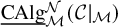 , that is, between the $\mathcal {F}$
-precategory of
$\mathcal {F}$
-precategory of ${\mathcal {N}}$
-normed algebras in
${\mathcal {N}}$
-normed algebras in $\mathrm{Rig}^\otimes {\mathcal {C}}$
versus the
$\mathrm{Rig}^\otimes {\mathcal {C}}$
versus the $\mathcal {M}$
-precategory of
$\mathcal {M}$
-precategory of $\mathcal {N}$
-normed algebras in
$\mathcal {N}$
-normed algebras in ${\mathcal {C}}|_{\mathcal {M}}$
. We will see that the latter is naturally a right Bousfield localization of the former. We begin with the following definition.
${\mathcal {C}}|_{\mathcal {M}}$
. We will see that the latter is naturally a right Bousfield localization of the former. We begin with the following definition.
Definition 7.1. We say a functor $\mathcal {X}\to \operatorname {\mathrm {Span}}_{\mathcal {N}}(\mathcal {F})$
is an
$\mathcal {X}\to \operatorname {\mathrm {Span}}_{\mathcal {N}}(\mathcal {F})$
is an ${\mathcal {M}}$
-partial
${\mathcal {M}}$
-partial $(\mathcal {F},\mathcal {N})$
-operad if it is a
$(\mathcal {F},\mathcal {N})$
-operad if it is a $(\operatorname {\mathrm {Span}}_{\mathcal {N}}(\mathcal {F}), \mathcal {M}^{\mathrm{op}}, \operatorname {\mathrm {Span}}_{{\mathcal {E}},\mathcal {N}}(\mathcal {F}))$
-operad in the sense of Definition 2.46, i.e.
$(\operatorname {\mathrm {Span}}_{\mathcal {N}}(\mathcal {F}), \mathcal {M}^{\mathrm{op}}, \operatorname {\mathrm {Span}}_{{\mathcal {E}},\mathcal {N}}(\mathcal {F}))$
-operad in the sense of Definition 2.46, i.e.
-
1.
$\mathcal {X}\to \operatorname {\mathrm {Span}}_{\mathcal {N}}(\mathcal {F})$
admits cocartesian lifts of maps in
$\mathcal {M}^{{\mathrm{op}}}$
, -
2.
$\mathcal {X}$
has finite products which are preserved by the map to
$\operatorname {\mathrm {Span}}_{\mathcal {N}}(\mathcal {F})$
, and -
3. for every two objects
$X,Y\in \mathcal {X}$
, the projection maps
$X \times Y\to X,Y$
are cocartesian.


We denote the category of ${\mathcal {M}}$
-partial
${\mathcal {M}}$
-partial $(\mathcal {F},\mathcal {N})$
-operads by
$(\mathcal {F},\mathcal {N})$
-operads by $\mathrm {Op}_{{\mathcal {N}}}(\mathcal {F}\mathbin {|}\hspace {-1pt} {\mathcal {M}})$
. Maps of
$\mathrm {Op}_{{\mathcal {N}}}(\mathcal {F}\mathbin {|}\hspace {-1pt} {\mathcal {M}})$
. Maps of ${\mathcal {M}}$
-partial
${\mathcal {M}}$
-partial $(\mathcal {F},\mathcal {N})$
-operads are given by maps of
$(\mathcal {F},\mathcal {N})$
-operads are given by maps of ${\mathcal {M}}^{{\mathrm{op}}}$
-cocartesian fibrations.
${\mathcal {M}}^{{\mathrm{op}}}$
-cocartesian fibrations.
Example 7.2. For ${\mathcal {M}} = \mathcal {F}$
this recovers the
${\mathcal {M}} = \mathcal {F}$
this recovers the $(\mathcal {F},\mathcal {N})$
-operads of Definition 2.52.
$(\mathcal {F},\mathcal {N})$
-operads of Definition 2.52.
Connected to this definition is the following lemma.
Lemma 7.3. The inclusion $i\colon \operatorname {\mathrm {Span}}_{\mathcal {N}}({\mathcal {M}}) \to \operatorname {\mathrm {Span}}_{\mathcal {N}}(\mathcal {F})$
induces a
$i\colon \operatorname {\mathrm {Span}}_{\mathcal {N}}({\mathcal {M}}) \to \operatorname {\mathrm {Span}}_{\mathcal {N}}(\mathcal {F})$
induces a $\mathrm{Cat}$
-linear adjunction
$\mathrm{Cat}$
-linear adjunction

Proof. The existence of the adjunction above on $\mathcal {M}^{\mathrm{op}}$
-cocartesian fibrations is analogous to the construction of the adjunction
$\mathcal {M}^{\mathrm{op}}$
-cocartesian fibrations is analogous to the construction of the adjunction $\operatorname {\mathrm {Triv}}\dashv \mathrm{fgt}$
in Proposition 2.26. As the inclusion i preserves finite products, we conclude that the adjunction restricts to the categories of operads, analogously to Theorem 2.57(2).
$\operatorname {\mathrm {Triv}}\dashv \mathrm{fgt}$
in Proposition 2.26. As the inclusion i preserves finite products, we conclude that the adjunction restricts to the categories of operads, analogously to Theorem 2.57(2).
Construction 7.4. Consider the inclusion $\mathcal {M}_{/A} \subset \mathcal {F}_{/A}$
, which gives the square
$\mathcal {M}_{/A} \subset \mathcal {F}_{/A}$
, which gives the square

naturally in $A\in {\mathcal {M}}$
. Recall that the right vertical map is precisely
$A\in {\mathcal {M}}$
. Recall that the right vertical map is precisely  . Amusingly, the left hand map is also
  in
in $\mathrm {Op}_{\mathcal {N}}({\mathcal {M}})$
, but now
$\mathrm {Op}_{\mathcal {N}}({\mathcal {M}})$
, but now  is the ${\mathcal {M}}$
-groupoid represented by
${\mathcal {M}}$
-groupoid represented by $A\in {\mathcal {M}}$
and
$A\in {\mathcal {M}}$
and $(-)^{{\mathcal {N}\text{-}\amalg }}$
is the functor
$(-)^{{\mathcal {N}\text{-}\amalg }}$
is the functor $\mathrm {Cat}({\mathcal {M}})\to \mathrm {Op}_{\mathcal {N}}({\mathcal {M}})$
. To avoid confusion, we will denote the former by
$\mathrm {Cat}({\mathcal {M}})\to \mathrm {Op}_{\mathcal {N}}({\mathcal {M}})$
. To avoid confusion, we will denote the former by  and the latter by
  . With this notation, the square above gives a morphism

in $\mathrm {Op}_{\mathcal {N}}(\mathcal {F}\mathbin {|}\hspace {-1pt} {\mathcal {M}})$
, naturally in
$\mathrm {Op}_{\mathcal {N}}(\mathcal {F}\mathbin {|}\hspace {-1pt} {\mathcal {M}})$
, naturally in $A \in \mathcal {M}$
. This in turn induces a functor
$A \in \mathcal {M}$
. This in turn induces a functor

where the first equivalence above is Theorem 6.17 and the second follows by the adjunction of the previous lemma. Moreover, this is natural in $A\in {\mathcal {M}}$
, and so we obtain an
$A\in {\mathcal {M}}$
, and so we obtain an $\mathcal {M}$
-functor
$\mathcal {M}$
-functor

Theorem 7.5. Let ${\mathcal {C}}$
be an
${\mathcal {C}}$
be an ${\mathcal {M}}$
-distributive
${\mathcal {M}}$
-distributive ${\mathcal {N}}$
-normed
${\mathcal {N}}$
-normed $\mathcal {F}$
-precategory. Then the
$\mathcal {F}$
-precategory. Then the ${\mathcal {M}}$
-functor
${\mathcal {M}}$
-functor $\mathrm{fgt}$
is a localization. Moreover, it admits a parametrized left adjoint
$\mathrm{fgt}$
is a localization. Moreover, it admits a parametrized left adjoint

whose essential image is even an $\mathcal {F}$
-subprecategory of
$\mathcal {F}$
-subprecategory of  .
.
Before we prove the theorem, let us note the following immediate consequence:
Corollary 7.6. Under the above assumptions, there is a unique pair of an extension of  to an
to an $\mathcal {F}$
-precategory
$\mathcal {F}$
-precategory  together with an extension of $\mathcal L$
to an
$\mathcal L$
to an $\mathcal {F}$
-functor
$\mathcal {F}$
-functor 
Definition 7.7. We call this extension  the
the $\mathcal {F}$
-precategory of
$\mathcal {F}$
-precategory of $\mathcal {N}$
-normed
$\mathcal {N}$
-normed ${\mathcal {M}}$
-algebras in
${\mathcal {M}}$
-algebras in ${\mathcal {C}}$
.
${\mathcal {C}}$
.
Remark 7.8. Passing to right adjoints, the corollary shows that the forgetful functors assemble into an ${\mathcal {E}}$
-lax
${\mathcal {E}}$
-lax $\mathcal {F}$
-functor
$\mathcal {F}$
-functor  which is pointwise a Dwyer–Kan localization. We can therefore interpret the functoriality of
  with respect to general maps in $\mathcal {F}$
as the left derived functors of the corresponding restrictions in
$\mathcal {F}$
as the left derived functors of the corresponding restrictions in  .
.
We now turn to the proof of Theorem 7.5. We will use Theorem 3.39 to construct the pointwise left adjoints.
Lemma 7.9. Let ${\mathcal {C}}$
be an
${\mathcal {C}}$
be an ${\mathcal {M}}$
-distributive
${\mathcal {M}}$
-distributive ${\mathcal {N}}$
-normed
${\mathcal {N}}$
-normed ${\mathcal {F}}$
-precategory, and let
${\mathcal {F}}$
-precategory, and let $f\colon \mathcal {O}\to \mathcal {O}'$
be a map in
$f\colon \mathcal {O}\to \mathcal {O}'$
be a map in $\mathrm {Op}_{{\mathcal {N}}}({\mathcal {F}}\mathbin {|}\hspace {-1pt}{\mathcal {M}})$
. Then
$\mathrm {Op}_{{\mathcal {N}}}({\mathcal {F}}\mathbin {|}\hspace {-1pt}{\mathcal {M}})$
. Then $f^*\colon \operatorname {\mathrm {Fun}}^{{\neg {\mathcal {M}}\mathrm{-lax}}}(\mathcal {O}',{\mathcal {C}})\to \operatorname {\mathrm {Fun}}^{{\neg {\mathcal {M}}\mathrm{-lax}}}(\mathcal {O},{\mathcal {C}})$
has a left adjoint
$f^*\colon \operatorname {\mathrm {Fun}}^{{\neg {\mathcal {M}}\mathrm{-lax}}}(\mathcal {O}',{\mathcal {C}})\to \operatorname {\mathrm {Fun}}^{{\neg {\mathcal {M}}\mathrm{-lax}}}(\mathcal {O},{\mathcal {C}})$
has a left adjoint $f_!$
given by pointwise left Kan extension along
$f_!$
given by pointwise left Kan extension along $\operatorname {\mathrm {Env}}(f)$
, where
$\operatorname {\mathrm {Env}}(f)$
, where $\operatorname {\mathrm {Env}}$
denotes the envelope with respect to the factorization system
$\operatorname {\mathrm {Env}}$
denotes the envelope with respect to the factorization system $({\mathcal {M}}^{\mathrm{op}},\operatorname {\mathrm {Span}}_{{\mathcal {E}},{\mathcal {N}}}({\mathcal {F}}))$
.
$({\mathcal {M}}^{\mathrm{op}},\operatorname {\mathrm {Span}}_{{\mathcal {E}},{\mathcal {N}}}({\mathcal {F}}))$
.
Below we will be able to treat the notion of a pointwise Kan extension as a black box; the curious reader is referred back to Remark 3.36.
Proof. To prove this, observe that by adjunction $f^*$
is equivalent to the restriction
$f^*$
is equivalent to the restriction
 $$ \begin{align} \operatorname{\mathrm{Fun}}_{\mathcal{F}}^{\mathcal{N}\text{-}\otimes}(\operatorname{\mathrm{Env}}(\mathcal{O}'),{\mathcal{C}}) \to \operatorname{\mathrm{Fun}}_{\mathcal{F}}^{\mathcal{N}\text{-}\otimes}(\operatorname{\mathrm{Env}}(\mathcal{O}),{\mathcal{C}}) \end{align} $$
along $\operatorname {\mathrm {Env}}(f)$
. We apply Theorem 3.39 to exhibit a left adjoint to restriction along
$\operatorname {\mathrm {Env}}(f)$
. We apply Theorem 3.39 to exhibit a left adjoint to restriction along $\operatorname {\mathrm {Env}}(\gamma _A)$
. To check the hypotheses, note that
$\operatorname {\mathrm {Env}}(\gamma _A)$
. To check the hypotheses, note that
-
•
${\mathcal {C}}$
is
${\mathcal {M}}$
-distributive and so -cocomplete by Proposition 3.45. -
• The envelopes
$\operatorname {\mathrm {Env}}(\mathcal {O})$
and
$\operatorname {\mathrm {Env}}(\mathcal {O}')$
are
$\mathcal {N}$
-normed
$\mathcal {F}$
-categories by Proposition 2.50 (applied to
$(S,E,M) = (\operatorname {\mathrm {Span}}_{\mathcal {N}}(\mathcal {F}),\mathcal {M}^{\mathrm{op}},\operatorname {\mathrm {Span}}_{\mathcal {E},\mathcal {N}}(\mathcal {F}))$
). -
• That the required maps are right fibrations and that the required squares are pullbacks follows exactly as in the proof of Lemma 3.46.


 -cocomplete by Proposition


Having checked the hypotheses, we obtain that (24) admits a left adjoint given by pointwise left Kan extension.
Remark 7.10. We continue to write $\operatorname {\mathrm {Env}}$
for the envelope with respect to the factorization system
$\operatorname {\mathrm {Env}}$
for the envelope with respect to the factorization system $({\mathcal {M}}^{\mathrm{op}},\operatorname {\mathrm {Span}}_{{\mathcal {E}},{\mathcal {N}}}({\mathcal {F}}))$
. By [Reference Haugseng, Hebestreit, Linskens and NuitenHHLN23b, Corollary 2.22], we can identify
$({\mathcal {M}}^{\mathrm{op}},\operatorname {\mathrm {Span}}_{{\mathcal {E}},{\mathcal {N}}}({\mathcal {F}}))$
. By [Reference Haugseng, Hebestreit, Linskens and NuitenHHLN23b, Corollary 2.22], we can identify $\operatorname {\mathrm {Env}}(1)=\operatorname {\mathrm {Ar}}_{\operatorname {\mathrm {Span}}_{{\mathcal {E}},{\mathcal {N}}}({\mathcal {F}})}(\operatorname {\mathrm {Span}}_{\mathcal {N}}({\mathcal {F}}))$
with the category of spans in (a subcategory of)
$\operatorname {\mathrm {Env}}(1)=\operatorname {\mathrm {Ar}}_{\operatorname {\mathrm {Span}}_{{\mathcal {E}},{\mathcal {N}}}({\mathcal {F}})}(\operatorname {\mathrm {Span}}_{\mathcal {N}}({\mathcal {F}}))$
with the category of spans in (a subcategory of) $\operatorname {\mathrm {Fun}}(\Lambda ^2_0,{\mathcal {F}})$
, whose morphisms are of the form
$\operatorname {\mathrm {Fun}}(\Lambda ^2_0,{\mathcal {F}})$
, whose morphisms are of the form

and hence the envelope of  is given for any $A\in {\mathcal {F}}$
by the span category
$A\in {\mathcal {F}}$
by the span category

The map $\gamma _A$
from Construction 7.4 is fully faithful as
$\gamma _A$
from Construction 7.4 is fully faithful as ${\mathcal {M}}\subset {\mathcal {F}}$
is left cancelable and
${\mathcal {M}}\subset {\mathcal {F}}$
is left cancelable and ${\mathcal {N}}\subset {\mathcal {M}}$
, hence also
${\mathcal {N}}\subset {\mathcal {M}}$
, hence also $\operatorname {\mathrm {Env}}(\gamma _X)$
is fully faithful. We may therefore identify the envelope of
$\operatorname {\mathrm {Env}}(\gamma _X)$
is fully faithful. We may therefore identify the envelope of  with the full subcategory of the above given by those objects where the topmost vertical maps to A belong to ${\mathcal {M}}$
.
${\mathcal {M}}$
.
Observation 7.11. The description from Remark 7.10 makes it clear that each category  carries a factorization system, given by the standard factorization system on a span category consisting of backwards and forwards maps.
Proposition 7.12. The above defines a parametrized factorization system in the sense of [Reference ShahSha21, Definition 3.1], that is, given any span  , the structure map
  restricts to a map between the left parts of the factorization systems as well as to a map between the right parts.
Similarly, if $A\to A'$
is any map in
$A\to A'$
is any map in ${\mathcal {F}}$
, then the functor
${\mathcal {F}}$
, then the functor  induced by the pushforward preserves the above factorization systems.
Proof. We begin by observing that the final statement about the pushforward functoriality in A is immediate from the definitions.
Next, we consider the functoriality with respect to backwards maps $B\gets B'$
. The cocartesian pushforward g of a map f in
$B\gets B'$
. The cocartesian pushforward g of a map f in  is then uniquely characterized by being a map in the fiber over $B'$
that fits into a square
$B'$
that fits into a square

where the horizontal maps are cocartesian over $B\gets B'$
. By Theorem 2.23, these cocartesian lifts are precisely given by the backwards maps of the form
$B\gets B'$
. By Theorem 2.23, these cocartesian lifts are precisely given by the backwards maps of the form

As backwards maps are right cancelable, we immediately see that if f is a backwards map, then so is g.
Now assume that f is a forwards map instead. We first compute the composite

of f followed by a cocartesian lift of $B\gets B'$
. The map
$B\gets B'$
. The map $U'\times _UW\to W$
is in
$U'\times _UW\to W$
is in ${\mathcal {M}}$
(being a basechange of a map in
${\mathcal {M}}$
(being a basechange of a map in ${\mathcal {M}}$
), that is, the backwards part of the resulting span is a cocartesian lift of
${\mathcal {M}}$
), that is, the backwards part of the resulting span is a cocartesian lift of $B\gets B'$
. As the forward part is evidently fiberwise, we conclude that it computes the cocartesian pushforward of f; in particular, the latter is indeed a forward map, as we wanted to show.
$B\gets B'$
. As the forward part is evidently fiberwise, we conclude that it computes the cocartesian pushforward of f; in particular, the latter is indeed a forward map, as we wanted to show.
Finally, we consider the functoriality in forward maps  . Using Theorem 2.23 once more, we see that its cocartesian lifts are precisely the forward maps of the form

Thus, the functoriality is simply given by postcomposition in the lowermost square, which evidently preserves backwards maps and forward maps separately.
Proposition 7.13. Let ${\mathcal {C}}$
be an
${\mathcal {C}}$
be an $\mathcal {M}$
-distributive
$\mathcal {M}$
-distributive $\mathcal {N}$
-normed
$\mathcal {N}$
-normed $\mathcal {F}$
-precategory. Then
$\mathcal {F}$
-precategory. Then  has a (strong) left adjoint $\mathbb P$
.
$\mathbb P$
.
Proof. By Theorem 6.17, $\mathbb U$
is given in degree A up to natural equivalence by
$\mathbb U$
is given in degree A up to natural equivalence by

hence equivalently by

where we take envelopes with respect to the factorization system $({\mathcal {M}}^{\mathrm{op}},\operatorname {\mathrm {Span}}_{{\mathcal {E}},{\mathcal {N}}}({\mathcal {F}}))$
on
$({\mathcal {M}}^{\mathrm{op}},\operatorname {\mathrm {Span}}_{{\mathcal {E}},{\mathcal {N}}}({\mathcal {F}}))$
on $\operatorname {\mathrm {Span}}_{\mathcal {N}}({\mathcal {F}})$
. By Lemma 7.9, this has a left adjoint
$\operatorname {\mathrm {Span}}_{\mathcal {N}}({\mathcal {F}})$
. By Lemma 7.9, this has a left adjoint $\mathbb P(A)$
given by pointwise left Kan extension, so it only remains to verify the Beck–Chevalley condition with respect to restriction along any
$\mathbb P(A)$
given by pointwise left Kan extension, so it only remains to verify the Beck–Chevalley condition with respect to restriction along any $f\colon A\to B$
in
$f\colon A\to B$
in $\mathcal {F}$
.
$\mathcal {F}$
.
Arguing as before, this amounts to showing that applying $\operatorname {\mathrm {Fun}}^{\mathcal {N}\text{-}\otimes }_{\mathcal {F}}(-,{\mathcal {C}})$
to
$\operatorname {\mathrm {Fun}}^{\mathcal {N}\text{-}\otimes }_{\mathcal {F}}(-,{\mathcal {C}})$
to

results in a horizontally left adjointable square. For this we note that by Proposition 7.12, the horizontal maps are given by the inclusions of the left halves of parametrized factorization systems, and that the right hand vertical map also preserves the right parts of these factorization systems. The claim will therefore follow from Lemma B.6 (applied with $T=\operatorname {\mathrm {Span}}_{\mathcal {N}}({\mathcal {F}})^{\mathrm{op}}$
) once we show that the map induced by
$T=\operatorname {\mathrm {Span}}_{\mathcal {N}}({\mathcal {F}})^{\mathrm{op}}$
) once we show that the map induced by  on the right halves of the factorization systems is a (pointwise) right fibration. But this map is simply a basechange of ${\mathcal {F}}_{/f}\colon {\mathcal {F}}_{/A}\to {\mathcal {F}}_{/B}$
, hence indeed a right fibration.
${\mathcal {F}}_{/f}\colon {\mathcal {F}}_{/A}\to {\mathcal {F}}_{/B}$
, hence indeed a right fibration.
Remark 7.14. We conjecture that for an $\mathcal {M}$
-distributive
$\mathcal {M}$
-distributive $\mathcal {N}$
-normed
$\mathcal {N}$
-normed $\mathcal {F}$
-category
$\mathcal {F}$
-category ${\mathcal {C}}$
,
${\mathcal {C}}$
, $\mathrm{Rig}({\mathcal {C}})$
is distributive. This would fit into the general pattern observed in [Reference LinskensLin24], that the rigidification of
$\mathrm{Rig}({\mathcal {C}})$
is distributive. This would fit into the general pattern observed in [Reference LinskensLin24], that the rigidification of ${\mathcal {C}}$
can in some cases equivalently be understood as the free cocompletion of
${\mathcal {C}}$
can in some cases equivalently be understood as the free cocompletion of ${\mathcal {C}}$
under certain (parametrized) colimits. Given such a fact, the previous proposition would follow immediately from our general results about the existence of free functors for normed algebras in a distributive category.
${\mathcal {C}}$
under certain (parametrized) colimits. Given such a fact, the previous proposition would follow immediately from our general results about the existence of free functors for normed algebras in a distributive category.
Proof of Theorem 7.5.
Fix any $A\in \mathcal {F}$
. As the first step, we will prove that the functor
$A\in \mathcal {F}$
. As the first step, we will prove that the functor  admits a fully faithful left adjoint $\mathcal L(A)$
; in particular, this shows that
$\mathcal L(A)$
; in particular, this shows that $\mathrm{fgt}(A)$
is a localization.
$\mathrm{fgt}(A)$
is a localization.
Recall that the map $\operatorname {\mathrm {Env}}(\gamma _A)$
from Construction 7.4 is actually fully faithful (Remark 7.10), hence so is the pointwise left Kan extension along it (cf. Theorem 3.39), giving the desired left adjoint
$\operatorname {\mathrm {Env}}(\gamma _A)$
from Construction 7.4 is actually fully faithful (Remark 7.10), hence so is the pointwise left Kan extension along it (cf. Theorem 3.39), giving the desired left adjoint $\mathcal {L}(A)$
to
$\mathcal {L}(A)$
to $\mathrm{fgt}(A)$
. We will now show that the essential images of these fully faithful left adjoints form an
$\mathrm{fgt}(A)$
. We will now show that the essential images of these fully faithful left adjoints form an $\mathcal {F}$
-subprecategory; already from them being an
$\mathcal {F}$
-subprecategory; already from them being an $\mathcal {M}$
-subprecategory it will then follow by abstract nonsense about Bousfield localizations that the
$\mathcal {M}$
-subprecategory it will then follow by abstract nonsense about Bousfield localizations that the $\mathcal L(A)$
’s assemble into an
$\mathcal L(A)$
’s assemble into an $\mathcal {M}$
-functor left adjoint to
$\mathcal {M}$
-functor left adjoint to $\mathrm{fgt}$
.
$\mathrm{fgt}$
.
To prove the claim, we first recall that  has an ${\mathcal {F}}$
-strong left adjoint
${\mathcal {F}}$
-strong left adjoint $\mathbb {P}$
by Proposition 7.13. Then the following diagram commutes for each
$\mathbb {P}$
by Proposition 7.13. Then the following diagram commutes for each $A\in {\mathcal {F}}$
because the corresponding diagram of right adjoints commutes:
$A\in {\mathcal {F}}$
because the corresponding diagram of right adjoints commutes:

here $\Delta $
is the strong
$\Delta $
is the strong ${\mathcal {F}}$
-functor from Definition 6.7. As both the top horizontal and right vertical arrows are part of
${\mathcal {F}}$
-functor from Definition 6.7. As both the top horizontal and right vertical arrows are part of $\mathcal {F}$
-functors, it follows that for every
$\mathcal {F}$
-functors, it follows that for every $f\colon B\to A$
in
$f\colon B\to A$
in $\mathcal {F}$
and every
$\mathcal {F}$
and every $X\in {\mathcal {C}}(A)$
we have
$X\in {\mathcal {C}}(A)$
we have
 $$\begin{align*}f^*\mathcal L\mathbb P(X)\simeq f^*\mathbb P\Delta (X)\simeq \mathbb P\Delta (f^*X)\simeq \mathcal L\mathbb P(f^*X)\in\operatorname{\mbox{ess im}}(\mathcal L). \end{align*}$$
Moreover, by [Reference LurieLur17, Proposition 4.7.3.14], the monadicity of  over
over ${\mathcal {C}}(A)$
(see Corollary 3.48) implies that
${\mathcal {C}}(A)$
(see Corollary 3.48) implies that  is generated under sifted colimits by the essential image of $\mathbb P$
, so that the essential image of
$\mathbb P$
, so that the essential image of $\mathcal {L}(A)$
is generated under sifted colimits by objects of the form
$\mathcal {L}(A)$
is generated under sifted colimits by objects of the form $\mathcal {L}\mathbb P(X)$
. As the essential image of the fully faithful left adjoint
$\mathcal {L}\mathbb P(X)$
. As the essential image of the fully faithful left adjoint $\mathcal {L}(B)$
is closed under arbitrary colimits and since
$\mathcal {L}(B)$
is closed under arbitrary colimits and since $f^*$
preserves sifted colimits by Lemma 2.44(2), the claim follows.
$f^*$
preserves sifted colimits by Lemma 2.44(2), the claim follows.
Remark 7.15. The above proof shows that we can extend the ${\mathcal {M}}$
-functor
${\mathcal {M}}$
-functor  in a unique way to an $\mathcal {F}$
-functor
$\mathcal {F}$
-functor  such that $\mathcal L\mathbb P\simeq \mathbb P\Delta $
as
$\mathcal L\mathbb P\simeq \mathbb P\Delta $
as $\mathcal {F}$
-functors. In particular, we get a natural extension of
$\mathcal {F}$
-functors. In particular, we get a natural extension of  to an
to an ${\mathcal {E}}$
-lax
${\mathcal {E}}$
-lax $\mathcal {F}$
-functor
$\mathcal {F}$
-functor  by passing to right adjoints. However, this extension will in general not be a strong $\mathcal {F}$
-functor, see Warning 7.29.
$\mathcal {F}$
-functor, see Warning 7.29.
7.2 Globalizing equivariant algebras
With the above results at hand, it is now no longer difficult to prove the main abstract result of this section:
Theorem 7.16. Let $(\mathcal {F},\mathcal {N},{\mathcal {M}})$
be a distributive context such that
$(\mathcal {F},\mathcal {N},{\mathcal {M}})$
be a distributive context such that $\mathcal {N} \subset {\mathcal {M}}$
and let
$\mathcal {N} \subset {\mathcal {M}}$
and let ${\mathcal {C}}$
be an
${\mathcal {C}}$
be an ${\mathcal {M}}$
-distributive
${\mathcal {M}}$
-distributive $\mathcal {N}$
-normed
$\mathcal {N}$
-normed $\mathcal {F}$
-precategory. Then
$\mathcal {F}$
-precategory. Then  (see Remark 7.8) is the universal ${\mathcal {E}}$
-lax
${\mathcal {E}}$
-lax $\mathcal {F}$
-functor.
$\mathcal {F}$
-functor.
The proof of the theorem will rely on a monadicity argument, and the following lemma will turn out to precisely provide the required Beck–Chevalley condition:
Proposition 7.17. Let ${\mathcal {C}}$
be an
${\mathcal {C}}$
be an ${\mathcal {M}}$
-distributive
${\mathcal {M}}$
-distributive ${\mathcal {N}}$
-normed
${\mathcal {N}}$
-normed ${\mathcal {F}}$
-precategory. Then the Beck–Chevalley transformation
${\mathcal {F}}$
-precategory. Then the Beck–Chevalley transformation
 $$\begin{align*}\mathbb P_{\mathcal{M}}\circ\operatorname{\mathrm{ev}}\to\mathrm{fgt}\circ\mathbb P_{\mathcal{F}} \end{align*}$$
induced by the commutative square

of ${\mathcal {M}}$
-precategories is an equivalence.
${\mathcal {M}}$
-precategories is an equivalence.
Proof. We can check the Beck–Chevalley condition after evaluating at each $A\in {\mathcal {M}}$
. For this we observe that we may identify (25) in degree A with the square obtained by applying
$A\in {\mathcal {M}}$
. For this we observe that we may identify (25) in degree A with the square obtained by applying $\operatorname {\mathrm {Fun}}^{{\mathcal {N}}\mathrm-\otimes }_{\mathcal {F}}(-,{\mathcal {C}})$
to the square
$\operatorname {\mathrm {Fun}}^{{\mathcal {N}}\mathrm-\otimes }_{\mathcal {F}}(-,{\mathcal {C}})$
to the square

where  again refers to the presheaf on $\mathcal {M}$
represented by A (with unstraightening
$\mathcal {M}$
represented by A (with unstraightening $(\mathcal {M}_{/A})^{{\mathrm{op}}}$
),
$(\mathcal {M}_{/A})^{{\mathrm{op}}}$
),  is the corresponding ${\mathcal {F}}$
-presheaf, and
${\mathcal {F}}$
-presheaf, and $\operatorname {\mathrm {Env}}$
always refers to the envelope for
$\operatorname {\mathrm {Env}}$
always refers to the envelope for ${\mathcal {M}}^{\mathrm{op}}\subset \operatorname {\mathrm {Span}}_{\mathcal {N}}({\mathcal {F}})$
. By Lemma 7.9, the restrictions along the vertical maps admit left adjoints given by pointwise left Kan extension. Recall now from Remark 7.10 that we may identify
${\mathcal {M}}^{\mathrm{op}}\subset \operatorname {\mathrm {Span}}_{\mathcal {N}}({\mathcal {F}})$
. By Lemma 7.9, the restrictions along the vertical maps admit left adjoints given by pointwise left Kan extension. Recall now from Remark 7.10 that we may identify  for any $B\in {\mathcal {F}}$
with the inclusion of the span categories whose morphisms look as follows:
$B\in {\mathcal {F}}$
with the inclusion of the span categories whose morphisms look as follows:

Under this identification, the vertical maps in (26) are precisely given by the inclusion of the backwards arrows of these two span categories. By Proposition 7.12, the backwards and forwards maps assemble into a parametrized factorization system on  ; it is then clear that this restricts to a parametrized factorization system on
  . The basechange condition will therefore once more be an instance of Lemma B.6, once we show that the induced functor on forward maps is a pointwise right fibration. But this map is given in degree B by the full inclusion

which is a sieve as ${\mathcal {N}}\subset {\mathcal {M}}$
, hence in particular a right fibration.
${\mathcal {N}}\subset {\mathcal {M}}$
, hence in particular a right fibration.
Proof of Theorem 7.16.
We may equivalently show that the strong $\mathcal {F}$
-functor
$\mathcal {F}$
-functor

induced by $\mathrm{fgt}$
is an equivalence. For this we consider the commutative diagram
$\mathrm{fgt}$
is an equivalence. For this we consider the commutative diagram

of strong $\mathcal {F}$
-functors. Recall that the left functor is a monadic right adjoint at every level by Corollary 3.48. On the other hand, we claim
$\mathcal {F}$
-functors. Recall that the left functor is a monadic right adjoint at every level by Corollary 3.48. On the other hand, we claim $\mathrm{Rig}(\mathbb {U})$
is also a monadic right adjoint: It is conservative because
$\mathrm{Rig}(\mathbb {U})$
is also a monadic right adjoint: It is conservative because $\mathbb {U}$
is and admits a left adjoint since
$\mathbb {U}$
is and admits a left adjoint since $\mathbb {U}$
does and
$\mathbb {U}$
does and $\mathrm{Rig}$
is a 2-functor; moreover, since
$\mathrm{Rig}$
is a 2-functor; moreover, since $\mathrm{Rig}$
is the right adjoint in a
$\mathrm{Rig}$
is the right adjoint in a $\mathrm{Cat}$
-linear adjunction, it is compatible with the cotensoring, so it follows from Remark 2.43 that also
$\mathrm{Cat}$
-linear adjunction, it is compatible with the cotensoring, so it follows from Remark 2.43 that also $\mathrm{Rig}(\mathbb {U})$
preserves fiberwise sifted colimits.
$\mathrm{Rig}(\mathbb {U})$
preserves fiberwise sifted colimits.
Therefore it suffices by [Reference LurieLur17, Corollary 4.7.3.16] to show that the Beck–Chevalley map $\mathrm{Rig}(\mathbb {P}) \to \smash {\widehat {\smash {\mathrm{fgt}}\vphantom {t}}}\circ \mathbb {P}$
is invertible. By the (2-)universal property of
$\mathrm{Rig}(\mathbb {P}) \to \smash {\widehat {\smash {\mathrm{fgt}}\vphantom {t}}}\circ \mathbb {P}$
is invertible. By the (2-)universal property of $\mathrm{Rig}$
, this can be checked after postcomposing with the universal
$\mathrm{Rig}$
, this can be checked after postcomposing with the universal ${\mathcal {E}}$
-lax functor
${\mathcal {E}}$
-lax functor  . As moreover the Beck–Chevalley map $\mathbb P\circ \operatorname {\mathrm {ev}}\to {\operatorname {\mathrm {ev}}}\circ {\mathrm{Rig}(\mathbb P)}$
associated to the right hand square in
$\mathbb P\circ \operatorname {\mathrm {ev}}\to {\operatorname {\mathrm {ev}}}\circ {\mathrm{Rig}(\mathbb P)}$
associated to the right hand square in

is invertible by $2$
-functoriality of
$2$
-functoriality of $\mathrm{Rig}$
, we altogether see that the Beck–Chevalley map for the left hand square (i.e., the one in question) is invertible if and only if the Beck–Chevalley map for the total rectangle is so. But the latter can be checked on underlying
$\mathrm{Rig}$
, we altogether see that the Beck–Chevalley map for the left hand square (i.e., the one in question) is invertible if and only if the Beck–Chevalley map for the total rectangle is so. But the latter can be checked on underlying ${\mathcal {M}}$
-precategories, which is precisely the content of Proposition 7.17.
${\mathcal {M}}$
-precategories, which is precisely the content of Proposition 7.17.
We now specialize to the case $({\mathcal {F}},{\mathcal {N}},{\mathcal {M}})=({\mathbb {G}},{\mathbb O},{\mathbb O})$
, corresponding to (global) equivariant homotopy theory.
$({\mathcal {F}},{\mathcal {N}},{\mathcal {M}})=({\mathbb {G}},{\mathbb O},{\mathbb O})$
, corresponding to (global) equivariant homotopy theory.
Definition 7.18. Suppose ${\mathcal {C}}$
is an equivariantly distributive normed global category. Then we obtain a global categoryFootnote
14
${\mathcal {C}}$
is an equivariantly distributive normed global category. Then we obtain a global categoryFootnote
14
 of
of ${\mathbb O}$
-normed
${\mathbb O}$
-normed ${\mathbb O}$
-algebras in
${\mathbb O}$
-algebras in ${\mathcal {C}}$
.
${\mathcal {C}}$
.
Remark 7.19. Given a normed global category $\mathcal {C}$
and a finite group G, note that
$\mathcal {C}$
and a finite group G, note that

The latter agrees with the definition of normed G-algebras considered in [Reference Bachmann and HoyoisBH21, Section 9.2]. Similarly, one can use [Reference Barkan, Haugseng and SteinebrunnerBHS25, Section 5.2] to see that this also agrees with the definition of G-commutative algebras in a G-symmetric monoidal G- $\infty $
-category (Example 3.19) used in [Reference Nardin and ShahNS22], see [Reference Cnossen, Haugseng, Lenz and LinskensCHLL24, Remark 5.6.4].
$\infty $
-category (Example 3.19) used in [Reference Nardin and ShahNS22], see [Reference Cnossen, Haugseng, Lenz and LinskensCHLL24, Remark 5.6.4].
We can combine the above results with the other universal property of $\mathrm{Rig}=\mathrm{Glob}$
from [Reference LinskensLin24] to obtain a universal property of the inclusion
$\mathrm{Rig}=\mathrm{Glob}$
from [Reference LinskensLin24] to obtain a universal property of the inclusion  . To state this we will need a couple of definitions:
Definition 7.20. A global precategory is called fiberwise presentable if it factors through the nonfull subcategory $\Pr ^{\mathrm{L}}\subset \mathrm{Cat}$
of presentable categories and left adjoint functors.
$\Pr ^{\mathrm{L}}\subset \mathrm{Cat}$
of presentable categories and left adjoint functors.
Definition 7.21. A global precategory ${\mathcal {C}}\colon {\mathbb {G}}^{\mathrm{op}}\to \mathrm{Cat}$
is called equivariantly presentable if it is fiberwise presentable and left
${\mathcal {C}}\colon {\mathbb {G}}^{\mathrm{op}}\to \mathrm{Cat}$
is called equivariantly presentable if it is fiberwise presentable and left ${\mathbb O}$
-adjointable (i.e.,
${\mathbb O}$
-adjointable (i.e., ${\mathbb O}$
-cocomplete in the sense of Example 3.30). We call
${\mathbb O}$
-cocomplete in the sense of Example 3.30). We call ${\mathcal {C}}$
globally presentable if it is fiberwise presentable and left
${\mathcal {C}}$
globally presentable if it is fiberwise presentable and left ${\mathbb {G}}$
-adjointable (i.e.,
${\mathbb {G}}$
-adjointable (i.e., ${\mathbb {G}}$
-cocomplete).
${\mathbb {G}}$
-cocomplete).
Remark 7.22. Recall that a commutative square of functors all of which admit both adjoints is horizontally right adjointable if and only if it is vertically left adjointable. In particular, globally presentable categories are also right ${\mathbb {G}}$
-coadjointable (“
${\mathbb {G}}$
-coadjointable (“ ${\mathbb {G}}$
-complete”).
${\mathbb {G}}$
-complete”).
Corollary 7.23. Let ${\mathcal {C}}$
be an equivariantly distributive normed global category whose underlying global category is fiberwise presentable (hence equivariantly presentable). Then:
${\mathcal {C}}$
be an equivariantly distributive normed global category whose underlying global category is fiberwise presentable (hence equivariantly presentable). Then:
-
1.
is equivariantly presentable. -
2.
is globally presentable. -
3.
is the initial equivariantly cocontinuous (i.e., left
${\mathbb O}$
-adjointable) functor from to a globally presentable category.
 is equivariantly presentable.
 is globally presentable.
 is the initial equivariantly cocontinuous (i.e., left
 to a globally presentable category.
Proof. By Theorem 2.57(5), Example 3.5, and Remark 6.10 all of these are indeed global categories (as opposed to precategories). Now given (1) and (2), point (3) will immediately follow from Theorem 7.16 via [Reference LinskensLin24, Theorem 4.10].
The accessibility of the categories in points (1) and (2) follows from [Reference LurieLur09, Proposition 5.4.7.11], see also Remark 5.4.7.13 there. Applying Corollary 2.58, we see that  is also fiberwise cocomplete, hence fiberwise presentable.
On the other hand, by [Reference LinskensLin24, Theorem 4.6], the underlying global category of $\mathrm{Glob}({\mathcal {C}})$
is globally presentable. Now recall that
$\mathrm{Glob}({\mathcal {C}})$
is globally presentable. Now recall that  is conservative and admits a global left adjoint $\mathbb P$
. So we may show that more generally a fiberwise presentable global precategory
$\mathbb P$
. So we may show that more generally a fiberwise presentable global precategory ${\mathcal {D}}$
which admits a conservative global right adjoint
${\mathcal {D}}$
which admits a conservative global right adjoint $\mathbb {U}\colon {\mathcal {D}}\to {\mathcal {C}}$
to a globally presentable global precategory
$\mathbb {U}\colon {\mathcal {D}}\to {\mathcal {C}}$
to a globally presentable global precategory ${\mathcal {C}}$
is again globally presentable.
${\mathcal {C}}$
is again globally presentable.
Let $f \colon X \to Y$
in
$f \colon X \to Y$
in ${\mathbb {G}}$
. Then
${\mathbb {G}}$
. Then $\mathbb {U} f^* \simeq f^*\mathbb {U}$
preserves limits, so by conservativity also
$\mathbb {U} f^* \simeq f^*\mathbb {U}$
preserves limits, so by conservativity also $f^* \colon \mathcal {D}(Y) \to \mathcal {D}(X)$
preserves limits. As it also preserves colimits by assumption, the adjoint functor theorem shows that it admits both adjoints. Thus, instead of proving that
$f^* \colon \mathcal {D}(Y) \to \mathcal {D}(X)$
preserves limits. As it also preserves colimits by assumption, the adjoint functor theorem shows that it admits both adjoints. Thus, instead of proving that $\mathcal {D}$
is left
$\mathcal {D}$
is left ${\mathbb {G}}$
-adjointable, we may equivalently show that it is right
${\mathbb {G}}$
-adjointable, we may equivalently show that it is right ${\mathbb {G}}$
-coadjointable. Using that
${\mathbb {G}}$
-coadjointable. Using that $\mathbb {U}$
is a conservative
$\mathbb {U}$
is a conservative ${\mathbb {G}}$
-right adjoint, this reduces to the fact that
${\mathbb {G}}$
-right adjoint, this reduces to the fact that $\mathcal {C}$
is right
$\mathcal {C}$
is right ${\mathbb {G}}$
-coadjointable; namely, consider the following pullback square in
${\mathbb {G}}$
-coadjointable; namely, consider the following pullback square in ${\mathbb {G}}$
and two induced commutative rectangles:
${\mathbb {G}}$
and two induced commutative rectangles:

Evidently, the rectangles have equivalent pastings. We want to show that the right square of the middle rectangle is vertically right adjointable. The squares with horizontal maps given by $\mathbb {U}$
are vertically right adjointable because they are horizontally left adjointable by existence of
$\mathbb {U}$
are vertically right adjointable because they are horizontally left adjointable by existence of $\mathbb {P}$
. Moreover, the left square in the right rectangle is right adjointable by global presentability of
$\mathbb {P}$
. Moreover, the left square in the right rectangle is right adjointable by global presentability of $\mathcal {C}$
. Since Beck–Chevalley maps compose and
$\mathcal {C}$
. Since Beck–Chevalley maps compose and $\mathbb {U}$
is conservative, we conclude.
$\mathbb {U}$
is conservative, we conclude.
Now we turn to the equivariant presentability of  . As mentioned, each
  is accessible. Since $\mathcal {L}$
is a fully faithful global functor which is pointwise left adjoint, it then follows that
$\mathcal {L}$
is a fully faithful global functor which is pointwise left adjoint, it then follows that  is closed under fiberwise colimits in
  ; we conclude that it is fiberwise cocomplete, hence fiberwise presentable. Moreover, since $\mathcal {L}$
is an
$\mathcal {L}$
is an ${\mathbb O}$
-left adjoint, the fact that
${\mathbb O}$
-left adjoint, the fact that  is left ${\mathbb O}$
-adjointable implies that also
${\mathbb O}$
-adjointable implies that also  is so, analogously to how we verified right ${\mathbb {G}}$
-coadjointability of
${\mathbb {G}}$
-coadjointability of  above.
7.3 Equivariant ultra-commutative ring spectra as normed algebras
We will now compare the global category  to the more classical definition of genuine commutative G-ring spectra in terms of model categories. We start with the following (thankfully easier) equivariant analogue of Theorem 5.10:
Proposition 7.24. The normed global category  of Construction 6.18 is equivariantly distributive.
Proof. By [Reference Cnossen, Haugseng, Lenz and LinskensCHLL24, Proposition 5.5.7] the norm $\mathop {\vphantom {t}\smash {\mathrm{Nm}}}^G_H\colon \mathrm{Sp}_H\to \mathrm{Sp}_G$
preserves sifted colimits for every group G and every subgroup H; as each
$\mathop {\vphantom {t}\smash {\mathrm{Nm}}}^G_H\colon \mathrm{Sp}_H\to \mathrm{Sp}_G$
preserves sifted colimits for every group G and every subgroup H; as each $\mathrm{Sp}_G$
is presentably symmetric monoidal (see, e.g., Example 5.4.7 of op. cit.), we conclude that all norms preserve sifted colimits. On the other hand, [Reference Cnossen, Lenz and LinskensCLL25b, Theorem 9.4] shows that restrictions in
$\mathrm{Sp}_G$
is presentably symmetric monoidal (see, e.g., Example 5.4.7 of op. cit.), we conclude that all norms preserve sifted colimits. On the other hand, [Reference Cnossen, Lenz and LinskensCLL25b, Theorem 9.4] shows that restrictions in  (along maps in ${\mathbb {G}}$
) even preserve all colimits.
${\mathbb {G}}$
) even preserve all colimits.
Next, we recall that since $\mathrm{Sp}^{\Sigma ,\otimes }$
is presentably symmetric monoidal,
$\mathrm{Sp}^{\Sigma ,\otimes }$
is presentably symmetric monoidal, $(\mathrm{Sp}^{\Sigma ,\otimes })^\flat $
is distributive (Example 3.17). Since
$(\mathrm{Sp}^{\Sigma ,\otimes })^\flat $
is distributive (Example 3.17). Since  is defined as a localization of the full subcategory
  , it now suffices to observe that by [Reference HausmannHau17, §5.2] also the left adjoints ${\mathrm{Ind}}_H^G \colon (\mathrm{Sp}^{\Sigma ,\otimes })^\flat (H)\to (\mathrm{Sp}^{\Sigma ,\otimes })^\flat (G)$
restrict to homotopical functors on projectively cofibrant objects for every subgroup inclusion
${\mathrm{Ind}}_H^G \colon (\mathrm{Sp}^{\Sigma ,\otimes })^\flat (H)\to (\mathrm{Sp}^{\Sigma ,\otimes })^\flat (G)$
restrict to homotopical functors on projectively cofibrant objects for every subgroup inclusion $H \subset G$
, and similarly for the coproducts (as in any model category).
$H \subset G$
, and similarly for the coproducts (as in any model category).
Construction 7.25. Just like its G-global (flat) counterpart, the equivariant projective model structure on G-symmetric spectra has a positive analogue, also constructed in [Reference HausmannHau17, Theorem 4.8], whose cofibrant objects are those G-equivariantly projectively cofibrant spectra X such that $X_0=0$
. Accordingly, we have a further global subcategory
$X_0=0$
. Accordingly, we have a further global subcategory  spanned by these objects, and the inclusion induces an equivalence on Dwyer–Kan localizations.
By [Reference HausmannHau17, Theorem 6.15], the positive projective model structure transfers to the category of commutative algebras. Thus, the categories $\operatorname {\mathrm {CAlg}}(G\mathrm{-Sp}^{\Sigma ,\otimes })_{\mathrm{pos.~equiv.~proj.}}$
for varying G assemble into a full global subcategory
$\operatorname {\mathrm {CAlg}}(G\mathrm{-Sp}^{\Sigma ,\otimes })_{\mathrm{pos.~equiv.~proj.}}$
for varying G assemble into a full global subcategory

improving to a diagram in relative categories. We caution the reader that the underlying G-symmetric spectrum of an object of $\operatorname {\mathrm {CAlg}}(G\mathrm{-Sp}^{\Sigma ,\otimes })_{\mathrm{pos.~equiv.~proj.}}$
need not be cofibrant in the (positive) G-equivariant projective model structure again.Footnote
15
On the other hand, the left adjoints
$\operatorname {\mathrm {CAlg}}(G\mathrm{-Sp}^{\Sigma ,\otimes })_{\mathrm{pos.~equiv.~proj.}}$
need not be cofibrant in the (positive) G-equivariant projective model structure again.Footnote
15
On the other hand, the left adjoints $\mathbb P\colon G\mathrm{-Sp}^\Sigma \to \operatorname {\mathrm {CAlg}}(G\mathrm{-Sp}^\Sigma )$
do indeed restrict accordingly by definition of a transferred model structure, so they assemble into a global functor
$\mathbb P\colon G\mathrm{-Sp}^\Sigma \to \operatorname {\mathrm {CAlg}}(G\mathrm{-Sp}^\Sigma )$
do indeed restrict accordingly by definition of a transferred model structure, so they assemble into a global functor

and by Ken Brown’s Lemma they preserve G-equivariant weak equivalences. Thus, writing  for the corresponding localization of the target and conflating the localization of the source with
  , we arrive at a global functor
  .
.
Construction 7.26. By [Reference Lenz and StahlhauerLS26, Lemma 6.27] the inclusions
 $$\begin{align*}\operatorname{\mathrm{CAlg}}(G\mathrm{-Sp}^{\Sigma,\otimes})_{\mathrm{pos.~equiv.~proj.}}\hookrightarrow \operatorname{\mathrm{CAlg}}(G\mathrm{-Sp}^{\Sigma,\otimes})_{\mathrm{flat}} \end{align*}$$
are homotopical for the G-equivariant weak equivalences on the source and the G-global weak equivalences on the target, and as explained after loc. cit., the resulting functor on Dwyer–Kan localizations is fully faithful, with its right adjoint being a localization at the G-equivariant weak equivalences.
As in the previous construction, we can then localize this to a fully faithful inclusion  , which by construction fits into a commutative diagram

We can now finally prove Theorem A from the introduction:
Theorem 7.27. There is an equivalence of global categories

compatible with the free functors from  . In view of Remark 7.19, this gives for every finite group G an equivalence

between normed algebras in  and the Dwyer–Kan localization of the 1-category of strictly commutative algebras in G-symmetric spectra, compatible with the forgetful functors to $\mathrm{Sp}_G$
.
$\mathrm{Sp}_G$
.
Proof. By Theorem 7.5 together with Remark 7.15, we have a fully faithful inclusion  compatible with the free functors. On the other hand, we also have a fully faithful inclusion
  compatible with the free functors by the previous construction. It thus suffices to show that the essential images of these two embeddings match up under the equivalence
  from Theorem 5.7.
To prove the claim, we may work at a fixed group G, and we may equivalently show that the right adjoints of the above embeddings invert the same maps in  . The right adjoint of
  is simply the forgetful functor $\mathrm{fgt}$
, so it inverts precisely those maps whose underlying map in
$\mathrm{fgt}$
, so it inverts precisely those maps whose underlying map in $\mathrm{Sp}_{G\mathrm{-gl}}$
forgets to an equivalence in
$\mathrm{Sp}_{G\mathrm{-gl}}$
forgets to an equivalence in $\mathrm{Sp}_G$
. On the other hand, the right adjoint to
$\mathrm{Sp}_G$
. On the other hand, the right adjoint to $\mathrm{UCom}_G\hookrightarrow \mathrm{UCom}_{G\mathrm{-gl}}$
is also just the forgetful functor, so the maps inverted by it admit the same description. The claim follows, as the equivalence
$\mathrm{UCom}_G\hookrightarrow \mathrm{UCom}_{G\mathrm{-gl}}$
is also just the forgetful functor, so the maps inverted by it admit the same description. The claim follows, as the equivalence  from Theorem 5.7 is compatible with the forgetful functors to
  .
.
Corollary 7.28. There are equivalences
 $$\begin{align*}\mathrm{UCom}_G \simeq \mathop{\operatorname{\mathrm{lax\ lim}}^{\!\dagger\!}}\limits_{H\in\operatorname{\mathrm{Span}}(\mathbb{F}_{G})}\mathrm{Sp}_H \end{align*}$$
for all finite groups G, where we mark the backwards maps.
Proof. The above theorem gives an equivalence

and the latter is precisely the definition of the partially lax limit in the statement.
Warning 7.29. The forgetful functors $\mathbb U\colon \mathrm{UCom}_{G}\to \mathrm{Sp}_G$
assemble into an
$\mathbb U\colon \mathrm{UCom}_{G}\to \mathrm{Sp}_G$
assemble into an $\mathbb E$
-lax global functor
$\mathbb E$
-lax global functor  right adjoint to $\mathbb P$
, but as we will now show, this lax functor is not strong, and hence by the above theorem neither is the forgetful functor
$\mathbb P$
, but as we will now show, this lax functor is not strong, and hence by the above theorem neither is the forgetful functor  . This highlights the subtlety in constructing a global category of normed ${\mathbb O}$
-algebras in the global category of equivariant spectra.Footnote
16
${\mathbb O}$
-algebras in the global category of equivariant spectra.Footnote
16
If X is cofibrant in the model structure on $\operatorname {\mathrm {CAlg}}(G\text{-}\mathrm{Sp}^\Sigma )$
transferred from the positive projective model structure, then its restriction along
$\operatorname {\mathrm {CAlg}}(G\text{-}\mathrm{Sp}^\Sigma )$
transferred from the positive projective model structure, then its restriction along $\alpha \colon H\to G$
can be computed directly on the pointset level. However, the restriction of its underlying G-spectrum is obtained by first taking a projectively cofibrant replacement
$\alpha \colon H\to G$
can be computed directly on the pointset level. However, the restriction of its underlying G-spectrum is obtained by first taking a projectively cofibrant replacement $f\colon X'\to X$
in
$f\colon X'\to X$
in $G\text{-}\mathrm{Sp}^\Sigma $
, and then restricting
$G\text{-}\mathrm{Sp}^\Sigma $
, and then restricting $X'$
; unraveling definitions, the Beck–Chevalley map is precisely given by
$X'$
; unraveling definitions, the Beck–Chevalley map is precisely given by $\alpha ^*(f)\colon \alpha ^*(X')\to \alpha ^*(X)$
.
$\alpha ^*(f)\colon \alpha ^*(X')\to \alpha ^*(X)$
.
Now let $F_1=\boldsymbol {\Sigma }(1,-){\wedge } S^1$
be the symmetric spectrum representing the functor
$F_1=\boldsymbol {\Sigma }(1,-){\wedge } S^1$
be the symmetric spectrum representing the functor $Y\mapsto \Omega Y_1$
and let
$Y\mapsto \Omega Y_1$
and let $X=\mathbb P(F_1)$
. As
$X=\mathbb P(F_1)$
. As $F_1$
is cofibrant in the positive projective model structure, X is cofibrant in the transferred model structure. On the other hand, one directly computes that
$F_1$
is cofibrant in the positive projective model structure, X is cofibrant in the transferred model structure. On the other hand, one directly computes that $X\cong \bigvee _{n\ge 0}\boldsymbol {\Sigma }(n,-){\wedge }_{\Sigma _n}S^n$
in the
$X\cong \bigvee _{n\ge 0}\boldsymbol {\Sigma }(n,-){\wedge }_{\Sigma _n}S^n$
in the $1$
-category of symmetric spectra. Fix now a cofibrant replacement
$1$
-category of symmetric spectra. Fix now a cofibrant replacement $X'\to X$
in the nonequivariant projective model structure; we want to show that there is some group G such that
$X'\to X$
in the nonequivariant projective model structure; we want to show that there is some group G such that $X'\to X$
is not a weak equivalence with respect to the trivial action, that is,
$X'\to X$
is not a weak equivalence with respect to the trivial action, that is, $X'\to X$
is not a global weak equivalence.
$X'\to X$
is not a global weak equivalence.
We will prove more generally that there is no global weak equivalence $X'\simeq X$
at all. To this end, observe that by [Reference LenzLen25, Proposition 3.3.1] the global stable homotopy type modeled by
$X'\simeq X$
at all. To this end, observe that by [Reference LenzLen25, Proposition 3.3.1] the global stable homotopy type modeled by $X'$
is contained in the essential image of the left adjoint
$X'$
is contained in the essential image of the left adjoint $\mathrm{Sp}\hookrightarrow \mathrm{Sp}_{\mathrm{gl}}$
of the forgetful functor, that is,
$\mathrm{Sp}\hookrightarrow \mathrm{Sp}_{\mathrm{gl}}$
of the forgetful functor, that is, $X'$
maps trivially into any global spectrum Y with trivial underlying nonequivariant spectrum. It therefore suffices to find such a Y into which X maps nontrivially, or equivalently, into which one of the
$X'$
maps trivially into any global spectrum Y with trivial underlying nonequivariant spectrum. It therefore suffices to find such a Y into which X maps nontrivially, or equivalently, into which one of the $\boldsymbol {\Sigma }(n,-){\wedge }_{\Sigma _n}S^n$
maps nontrivially.
$\boldsymbol {\Sigma }(n,-){\wedge }_{\Sigma _n}S^n$
maps nontrivially.
We will do this for the summand  (an analogous argument works for every $n\ge 2$
). Namely, observe that Z corepresents the functor
$n\ge 2$
). Namely, observe that Z corepresents the functor $Y\mapsto \mathrm{maps}^{\Sigma _2}(S^2, Y_2)$
in the simplicially enriched
$Y\mapsto \mathrm{maps}^{\Sigma _2}(S^2, Y_2)$
in the simplicially enriched $1$
-category of symmetric spectra, hence the functor
$1$
-category of symmetric spectra, hence the functor $Y\mapsto \pi _0^{\Sigma _2}(Y)$
on the global stable homotopy category. It therefore suffices to take any global spectrum with trivial underlying spectrum but nontrivial
$Y\mapsto \pi _0^{\Sigma _2}(Y)$
on the global stable homotopy category. It therefore suffices to take any global spectrum with trivial underlying spectrum but nontrivial $\pi _0^{\Sigma _2}$
, and of course such global spectra abound. A concrete example of such a Y is as follows: let
$\pi _0^{\Sigma _2}$
, and of course such global spectra abound. A concrete example of such a Y is as follows: let  be the Burnside ring global Mackey functor (corepresenting evaluation at the trivial group $1$
), and let
$1$
), and let  be the functor to the constant global Mackey functor at $\mathbb Z$
classifying
$\mathbb Z$
classifying $1\in \mathbb Z$
. Then f is an isomorphism at the trivial group, but not injective at the group
$1\in \mathbb Z$
. Then f is an isomorphism at the trivial group, but not injective at the group $\Sigma _2$
(as
$\Sigma _2$
(as $\mathbb A(\Sigma _2)$
has rank
$\mathbb A(\Sigma _2)$
has rank $2$
), so its kernel is a global Mackey functor M with
$2$
), so its kernel is a global Mackey functor M with $M(1)=0, M(\Sigma _2)\not =0$
. Then the global Eilenberg–MacLane spectrum
$M(1)=0, M(\Sigma _2)\not =0$
. Then the global Eilenberg–MacLane spectrum $HM$
has the desired properties.
$HM$
has the desired properties.
Theorem 7.30. The inclusion  has an $\mathbb E$
-lax right adjoint, and this exhibits
$\mathbb E$
-lax right adjoint, and this exhibits  as the globalization of
  . In other words, we have equivalences
 $$\begin{align*}\mathrm{UCom}_{G\mathrm{-gl}}\simeq\mathop{\operatorname{\mathrm{lax\ lim}}^{\!\dagger\!}}_{H\in({\mathbb{G}}_{/G})^{{\mathrm{op}}}}\mathrm{UCom}_H, \end{align*}$$
where $({\mathbb {G}}_{/G})^{{\mathrm{op}}}$
is marked by the maps over G whose underlying map in
$({\mathbb {G}}_{/G})^{{\mathrm{op}}}$
is marked by the maps over G whose underlying map in ${\mathbb {G}}$
is in
${\mathbb {G}}$
is in ${\mathbb O}$
. Moreover, this equivalence is natural in
${\mathbb O}$
. Moreover, this equivalence is natural in $G\in {\mathbb {G}}^{\mathrm{op}}$
and compatible with the forgetful functors to
$G\in {\mathbb {G}}^{\mathrm{op}}$
and compatible with the forgetful functors to $\mathrm{UCom}_G$
.
$\mathrm{UCom}_G$
.

8 Norms, Mackey functors, and Tambara functors
While we defined our normed categories of global and equivariant spectra by suitably deriving constructions on the level of model categories (as these are easiest to construct, and enable the comparison to ultra-commutative ring spectra), one can also attempt to construct them in a purely $\infty $
-categorical fashion, using the Mackey functor description of equivariant and global spectra [Reference Clausen, Mathew, Naumann and NoelCMNN24, Reference Cnossen, Lenz and LinskensCLL24]. The purpose of this section is to first carry out the Mackey functor approach, and then to show that this is equivalent to our model categorical construction. Beyond the relevance of comparing these two a priori very different approaches, this will also allow us to deduce a description for connective ultra-commutative global and G-equivariant ring spectra as spectral Tambara functors, see Theorems 8.17 and 8.20.
$\infty $
-categorical fashion, using the Mackey functor description of equivariant and global spectra [Reference Clausen, Mathew, Naumann and NoelCMNN24, Reference Cnossen, Lenz and LinskensCLL24]. The purpose of this section is to first carry out the Mackey functor approach, and then to show that this is equivalent to our model categorical construction. Beyond the relevance of comparing these two a priori very different approaches, this will also allow us to deduce a description for connective ultra-commutative global and G-equivariant ring spectra as spectral Tambara functors, see Theorems 8.17 and 8.20.
For the normed structure on equivariant spectra/Mackey functors, this will basically amount to reorganizing the arguments given for a fixed group G in [Reference Cnossen, Haugseng, Lenz and LinskensCHLL24]. However, these arguments ultimately rely on the fact that the suspension spectrum functor $\Sigma ^\infty \colon \operatorname {\mathrm {Spc}}_{G,*}\to \mathrm{Sp}_{G}$
already has a nonparametrized universal property in
$\Sigma ^\infty \colon \operatorname {\mathrm {Spc}}_{G,*}\to \mathrm{Sp}_{G}$
already has a nonparametrized universal property in $\operatorname {\mathrm {CAlg}}(\Pr ^{\mathrm{L}})$
, so this line of reasoning cannot be applied to the categories of G-global spectra. Instead, the key new input for the global case will be Theorem 6.15 above, which will allow us to reduce this to the equivariant case.
$\operatorname {\mathrm {CAlg}}(\Pr ^{\mathrm{L}})$
, so this line of reasoning cannot be applied to the categories of G-global spectra. Instead, the key new input for the global case will be Theorem 6.15 above, which will allow us to reduce this to the equivariant case.
8.1 Mackey functor models of equivariant and global stable homotopy theory
We begin by recalling the Mackey functor models of equivariant and global spectra from [Reference Clausen, Mathew, Naumann and NoelCMNN24, Reference Cnossen, Lenz and LinskensCLL24], at this point without norms.
Construction 8.1. We write  for the global category

and  for the global category

In particular, the functoriality is given in both cases by the universal property of $P_\Sigma $
or, equivalently [Reference Haugseng, Hebestreit, Linskens and NuitenHHLN23b, Theorem 8.1], by left Kan extension.
$P_\Sigma $
or, equivalently [Reference Haugseng, Hebestreit, Linskens and NuitenHHLN23b, Theorem 8.1], by left Kan extension.
Remark 8.2. Via straightening–unstraightening, we can identify ${\mathbb {G}}^\flat $
with the contravariant functor
${\mathbb {G}}^\flat $
with the contravariant functor ${\mathbb {G}}_{/-}\colon X\mapsto {\mathbb {G}}_{/X}$
, where the functoriality is via pullback. We claim that this restricts to an equivalence between
${\mathbb {G}}_{/-}\colon X\mapsto {\mathbb {G}}_{/X}$
, where the functoriality is via pullback. We claim that this restricts to an equivalence between ${\mathbb O}^\flat $
and the full subcategory
${\mathbb O}^\flat $
and the full subcategory ${\mathbb {G}}_{/-}\times _{{\mathbb {G}}}{\mathbb O}$
, or equivalently, that a map
${\mathbb {G}}_{/-}\times _{{\mathbb {G}}}{\mathbb O}$
, or equivalently, that a map $A\to B$
of (finite) groupoids over X is faithful if and only if the induced map
$A\to B$
of (finite) groupoids over X is faithful if and only if the induced map $A_x\to B_x$
on fibers is a faithful for every
$A_x\to B_x$
on fibers is a faithful for every $x\in X$
. But indeed, since a map of spaces is a summand inclusion iff its fibers are either empty or contractible,
$x\in X$
. But indeed, since a map of spaces is a summand inclusion iff its fibers are either empty or contractible, $f\colon A\to B$
is faithful if and only if for every
$f\colon A\to B$
is faithful if and only if for every $b\in B$
the fiber
$b\in B$
the fiber $f^{-1}(b)$
is a discrete groupoid. As this agrees with the fiber of
$f^{-1}(b)$
is a discrete groupoid. As this agrees with the fiber of $A_x\to B_x$
for x the image of b by the pasting law, the claim then follows.
$A_x\to B_x$
for x the image of b by the pasting law, the claim then follows.
In particular, one may equivalently define  with the evident functoriality. This “unstraightened” perspective on global Mackey functors is used in [Reference Cnossen, Lenz and LinskensCLL24], and we will freely apply results from loc. cit. for our present definition, leaving the straightening–unstraightening translation implicit.
Similarly, one observes that ${\mathbb {G}}^\flat \simeq {\mathbb {G}}_{/-}$
identifies
${\mathbb {G}}^\flat \simeq {\mathbb {G}}_{/-}$
identifies $\mathbb F^\flat $
with the full global subcategory
$\mathbb F^\flat $
with the full global subcategory ${\mathbb O}_{/-}\subset {\mathbb {G}}_{/-}$
whose objects are the faithful functors. Combining this with the equivalence
${\mathbb O}_{/-}\subset {\mathbb {G}}_{/-}$
whose objects are the faithful functors. Combining this with the equivalence $({{\mathbb O}_{/X}})_{/Y\to X}\simeq {\mathbb O}_{/Y}$
for every
$({{\mathbb O}_{/X}})_{/Y\to X}\simeq {\mathbb O}_{/Y}$
for every $Y\to X$
in
$Y\to X$
in ${\mathbb O}$
, we can then identify the restriction of
${\mathbb O}$
, we can then identify the restriction of  along
along $\mathbb F_G\simeq {\mathbb O}_{/G}\to {\mathbb O}$
with
$\mathbb F_G\simeq {\mathbb O}_{/G}\to {\mathbb O}$
with $X\mapsto {\operatorname {\mathrm {Fun}}}^\times \big ({\operatorname {\mathrm {Span}}}\big ((\mathbb F_G)_{/X}\big ),{\operatorname {\mathrm {Spc}}}\big )$
, which is the perspective taken in [Reference Cnossen, Haugseng, Lenz and LinskensCHLL24].
$X\mapsto {\operatorname {\mathrm {Fun}}}^\times \big ({\operatorname {\mathrm {Span}}}\big ((\mathbb F_G)_{/X}\big ),{\operatorname {\mathrm {Spc}}}\big )$
, which is the perspective taken in [Reference Cnossen, Haugseng, Lenz and LinskensCHLL24].
As promised, the above is equivalent to our model categorical approach:
Theorem 8.3.
-
1.
is equivariantly presentable, and there is a unique equivalence sending the sphere
$\mathbb S$
to the delooping of
$\hom (1,-)\colon \operatorname {\mathrm {Span}}(\mathbb F)\to \operatorname {\mathrm {CMon}}$
.
-
2.
is globally presentable, and there exists a unique equivalence sending
$\mathbb S$
to the delooping of
$\hom (1,-)\colon \operatorname {\mathrm {Span}}_{{\mathbb O}}({\mathbb {G}})\to \operatorname {\mathrm {CMon}}$
.
-
3. The inclusion
$i\colon \mathbb F\hookrightarrow {\mathbb {G}}$
induces an equivariantly cocontinuous fully faithful functor sitting inside a commutative diagram (27)Moreover,
$i_!$
has an
$\mathbb E$
-lax right adjoint
$i^*$
, and this exhibits as the globalization of .
 is equivariantly presentable, and there is a unique equivalence


 is globally presentable, and there exists a unique equivalence


 sitting inside a commutative diagram


 as the globalization of
  .
.
Proof. We will prove the claims in a peculiar order.
We begin by proving the second statement, which follows immediately by combining [Reference Cnossen, Lenz and LinskensCLL25a, Theorem 7.3.2] with [Reference Cnossen, Lenz and LinskensCLL24, Corollary 9.17].
Next, we will show that  is equivariantly presentable and that
  is equivariantly cocontinuous; from this the corresponding statement about the pointwise stabilizations will then follow via [Reference Cnossen, Lenz and LinskensCLL25b, Lemma 8.5]. To prove both claims, it suffices to show that the essential image of
  is closed under ordinary colimits and the left adjoints to restrictions along maps in ${\mathbb O}$
. The first statement is clear since
${\mathbb O}$
. The first statement is clear since $i_!$
is a fully faithful left adjoint. For the second statement, it suffices to observe that for any injective homomorphism
$i_!$
is a fully faithful left adjoint. For the second statement, it suffices to observe that for any injective homomorphism  , a left adjoint to $\operatorname {\mathrm {Span}}(\alpha ^*)\colon \operatorname {\mathrm {Span}}_{{\mathbb O}}(\operatorname {\mathrm {Fun}}(G,{\mathbb {G}}))\to \operatorname {\mathrm {Span}}_{{\mathbb O}}(\operatorname {\mathrm {Fun}}(H,{\mathbb {G}}))$
is given by
$\operatorname {\mathrm {Span}}(\alpha ^*)\colon \operatorname {\mathrm {Span}}_{{\mathbb O}}(\operatorname {\mathrm {Fun}}(G,{\mathbb {G}}))\to \operatorname {\mathrm {Span}}_{{\mathbb O}}(\operatorname {\mathrm {Fun}}(H,{\mathbb {G}}))$
is given by $\operatorname {\mathrm {Span}}(\alpha _!)$
, by a straightforward application of [Reference Bachmann and HoyoisBH21, Corollary C.21], and that the functor
$\operatorname {\mathrm {Span}}(\alpha _!)$
, by a straightforward application of [Reference Bachmann and HoyoisBH21, Corollary C.21], and that the functor $\alpha _!\colon \operatorname {\mathrm {Fun}}(H,{\mathbb {G}})\to \operatorname {\mathrm {Fun}}(G,{\mathbb {G}})$
restricts to
$\alpha _!\colon \operatorname {\mathrm {Fun}}(H,{\mathbb {G}})\to \operatorname {\mathrm {Fun}}(G,{\mathbb {G}})$
restricts to $\operatorname {\mathrm {Fun}}(H,\mathbb F)\to \operatorname {\mathrm {Fun}}(G,\mathbb F)$
(being given on underlying nonequivariant objects simply by a finite coproduct).
$\operatorname {\mathrm {Fun}}(H,\mathbb F)\to \operatorname {\mathrm {Fun}}(G,\mathbb F)$
(being given on underlying nonequivariant objects simply by a finite coproduct).
Next, we note that  is equivariantly semiadditive in the sense of [Reference Cnossen, Lenz and LinskensCLL25a, Example 4.5.2]: namely, since we have just shown that it is equivariantly cocomplete, we may check this on underlying ${\mathbb O}$
-categories, where this is an instance of [Reference Cnossen, Lenz and LinskensCLL24, Corollary 9.14] (for
${\mathbb O}$
-categories, where this is an instance of [Reference Cnossen, Lenz and LinskensCLL24, Corollary 9.14] (for $P=T={\vphantom {\mathrm{t}}\smash {\mathrm{Orb}}}$
). Thus,
$P=T={\vphantom {\mathrm{t}}\smash {\mathrm{Orb}}}$
). Thus,  is equivariantly stable by [Reference Cnossen, Lenz and LinskensCLL25b, Lemma 8.8], and so the universal property of
  [Reference Cnossen, Lenz and LinskensCLL25b, Theorem 9.4] shows that there is a unique equivariantly cocontinuous functor
  sending $\mathbb S$
to the delooping of
$\mathbb S$
to the delooping of $\operatorname {\mathrm {hom}}(1,-)$
. We want to show that
$\operatorname {\mathrm {hom}}(1,-)$
. We want to show that $\Phi $
is an equivalence, which can be checked on underlying
$\Phi $
is an equivalence, which can be checked on underlying $\mathbb O$
-categories, where this follows by combining [Reference Cnossen, Lenz and LinskensCLL25b, Theorem 9.5] with [Reference Cnossen, Lenz and LinskensCLL24, Corollary 9.14] (for
$\mathbb O$
-categories, where this follows by combining [Reference Cnossen, Lenz and LinskensCLL25b, Theorem 9.5] with [Reference Cnossen, Lenz and LinskensCLL24, Corollary 9.14] (for $P=T={\vphantom {\mathrm{t}}\smash {\mathrm{Orb}}}$
again).
$P=T={\vphantom {\mathrm{t}}\smash {\mathrm{Orb}}}$
again).
Now we can prove the rest of the third statement. All maps in (27) are equivariantly cocontinuous, so to verify commutativity it will be enough to compare the images of the sphere spectrum. By construction, the upper path sends this to the delooping $\psi $
of
$\psi $
of $\hom (1,-)\colon \operatorname {\mathrm {Span}}_{\mathbb O}({\mathbb {G}}) \to \operatorname {\mathrm {CMon}}$
. An easy Yoneda argument now shows that
$\hom (1,-)\colon \operatorname {\mathrm {Span}}_{\mathbb O}({\mathbb {G}}) \to \operatorname {\mathrm {CMon}}$
. An easy Yoneda argument now shows that $i_!$
sends the delooping of
$i_!$
sends the delooping of $\hom (1,-)\colon \operatorname {\mathrm {Span}}(\mathbb F)\to \operatorname {\mathrm {CMon}}$
to
$\hom (1,-)\colon \operatorname {\mathrm {Span}}(\mathbb F)\to \operatorname {\mathrm {CMon}}$
to $\psi $
, so also the lower path through the diagram also sends
$\psi $
, so also the lower path through the diagram also sends $\mathbb S$
to
$\mathbb S$
to $\psi $
, as claimed. Finally, with commutativity of (27) established,
$\psi $
, as claimed. Finally, with commutativity of (27) established,  being left adjoint to a globalization by Example 6.9 immediately shows that so is $i_!$
.
$i_!$
.
8.2 Norms for equivariant Mackey functors
Before we can describe the norms on  and
and  , we have to deal with the unstable situation. For this, recall that a map $f\colon X\to Y$
of (pointed or unpointed) simplicial sets with G-action is called a G-equivariant weak equivalence if the induced map
$f\colon X\to Y$
of (pointed or unpointed) simplicial sets with G-action is called a G-equivariant weak equivalence if the induced map $f^H\colon X^H\to Y^H$
is a weak homotopy equivalence for every
$f^H\colon X^H\to Y^H$
is a weak homotopy equivalence for every $H\subset G$
, or equivalently if the geometric realization
$H\subset G$
, or equivalently if the geometric realization $|f|$
is a G-equivariant homotopy equivalence (i.e., there exists an equivariant map
$|f|$
is a G-equivariant homotopy equivalence (i.e., there exists an equivariant map $g\colon |Y|\to |X|$
together with homotopies through equivariant maps from
$g\colon |Y|\to |X|$
together with homotopies through equivariant maps from $|f|g$
,
$|f|g$
, $g|f|$
to the respective identities).
$g|f|$
to the respective identities).
Proposition 8.4. Write ${\mathrm{SSet}}_*^\otimes $
for the symmetric monoidal
${\mathrm{SSet}}_*^\otimes $
for the symmetric monoidal $1$
-category of finite pointed simplicial sets, where the symmetric monoidal structure is the smash product. Then the associated Borel normed
$1$
-category of finite pointed simplicial sets, where the symmetric monoidal structure is the smash product. Then the associated Borel normed $1$
-category
$1$
-category $({\mathrm{SSet}}_*^\otimes )^\flat $
can be localized with respect to the equivariant weak equivalences, yielding a normed global category
$({\mathrm{SSet}}_*^\otimes )^\flat $
can be localized with respect to the equivariant weak equivalences, yielding a normed global category  .
.
The restriction along $\operatorname {\mathrm {Span}}(\mathbb F_G)\simeq \operatorname {\mathrm {Span}}({\mathbb O}_{/G})\to \operatorname {\mathrm {Span}}_{{\mathbb O}}({\mathbb {G}})$
of this normed global category is denoted
$\operatorname {\mathrm {Span}}(\mathbb F_G)\simeq \operatorname {\mathrm {Span}}({\mathbb O}_{/G})\to \operatorname {\mathrm {Span}}_{{\mathbb O}}({\mathbb {G}})$
of this normed global category is denoted  in [Reference Cnossen, Haugseng, Lenz and LinskensCHLL24, Section 5].
Proof. Factoring a general map in ${\mathbb {G}}$
as usual, we have to show that for every homomorphism
${\mathbb {G}}$
as usual, we have to show that for every homomorphism $f\colon G\to H$
of finite groups the restriction
$f\colon G\to H$
of finite groups the restriction $f^*\colon \operatorname {\mathrm {Fun}}(G,{\mathrm{SSet}}_*)\to \operatorname {\mathrm {Fun}}(H,{\mathrm{SSet}}_*)$
is homotopical, that the smash product of G-simplicial sets preserves weak equivalences in each variable, and that for every
$f^*\colon \operatorname {\mathrm {Fun}}(G,{\mathrm{SSet}}_*)\to \operatorname {\mathrm {Fun}}(H,{\mathrm{SSet}}_*)$
is homotopical, that the smash product of G-simplicial sets preserves weak equivalences in each variable, and that for every $H\subset G$
the symmetric monoidal norm
$H\subset G$
the symmetric monoidal norm $\operatorname {\mathrm {Fun}}(H,{\mathrm{SSet}}_*)\to \operatorname {\mathrm {Fun}}(G,{\mathrm{SSet}}_*)$
is again homotopical. The first statement is clear from the definitions, while the remaining statements are verified in [Reference Cnossen, Haugseng, Lenz and LinskensCHLL24, Proposition 5.2.11].
$\operatorname {\mathrm {Fun}}(H,{\mathrm{SSet}}_*)\to \operatorname {\mathrm {Fun}}(G,{\mathrm{SSet}}_*)$
is again homotopical. The first statement is clear from the definitions, while the remaining statements are verified in [Reference Cnossen, Haugseng, Lenz and LinskensCHLL24, Proposition 5.2.11].
Lemma 8.5. The inclusion  is pointwise a sifted cocompletion.
Proof. Note that the functors $\operatorname {\mathrm {Span}}(\mathbb F_G)\simeq \operatorname {\mathrm {Span}}({\mathbb O}_{/G})\to \operatorname {\mathrm {Span}}_{{\mathbb O}}({\mathbb {G}})$
are jointly essentially surjective: if X is a general object in
$\operatorname {\mathrm {Span}}(\mathbb F_G)\simeq \operatorname {\mathrm {Span}}({\mathbb O}_{/G})\to \operatorname {\mathrm {Span}}_{{\mathbb O}}({\mathbb {G}})$
are jointly essentially surjective: if X is a general object in ${\mathbb {G}}$
with decomposition into components
${\mathbb {G}}$
with decomposition into components $X\simeq \coprod _{i=1}^n X_i$
, then X lives over the group
$X\simeq \coprod _{i=1}^n X_i$
, then X lives over the group $\prod _{i=1}^nX_i$
via the faithful map
$\prod _{i=1}^nX_i$
via the faithful map $\coprod _{i=1}^nX_i\to \prod _{i=1}^nX_i$
given by the “identity matrix.” Thus, we may check the claim after restricting to each
$\coprod _{i=1}^nX_i\to \prod _{i=1}^nX_i$
given by the “identity matrix.” Thus, we may check the claim after restricting to each $\operatorname {\mathrm {Span}}(\mathbb F_G)$
, where this appears as [Reference Cnossen, Haugseng, Lenz and LinskensCHLL24, Corollary 5.2.7].
$\operatorname {\mathrm {Span}}(\mathbb F_G)$
, where this appears as [Reference Cnossen, Haugseng, Lenz and LinskensCHLL24, Corollary 5.2.7].
We can now introduce our normed enhancement of  :
:
Construction 8.6. The cartesian symmetric monoidal structure on $\mathbb F$
induces a normed structure
$\mathbb F$
induces a normed structure  on the Borelification as before. Applying $\operatorname {\mathrm {Span}}$
pointwise, we obtain a normed global category
$\operatorname {\mathrm {Span}}$
pointwise, we obtain a normed global category  . Finally, passing to pointwise sifted cocompletion yields
  .
.
Remark 8.7. If G is any finite group, then the restriction of  along
along $\operatorname {\mathrm {Span}}(\mathbb F_{G})\simeq \operatorname {\mathrm {Span}}({\mathbb O}_{/G})\to \operatorname {\mathrm {Span}}_{{\mathbb O}}({\mathbb {G}})$
recovers the normed G-category
$\operatorname {\mathrm {Span}}(\mathbb F_{G})\simeq \operatorname {\mathrm {Span}}({\mathbb O}_{/G})\to \operatorname {\mathrm {Span}}_{{\mathbb O}}({\mathbb {G}})$
recovers the normed G-category  of [Reference Cnossen, Haugseng, Lenz and LinskensCHLL24, Section 5] (up to straightening–unstraightening as before).
Proposition 8.8. There is a unique equivariantly cocontinuous normed global functor  sending $S^0$
to
$S^0$
to $\hom (1,-)\colon \operatorname {\mathrm {Span}}(\mathbb F)\to \operatorname {\mathrm {Spc}}$
.
$\hom (1,-)\colon \operatorname {\mathrm {Span}}(\mathbb F)\to \operatorname {\mathrm {Spc}}$
.
Proof. The argument is essentially the same as for a fixed group, cf. [Reference Cnossen, Haugseng, Lenz and LinskensCHLL24, Proposition 5.3.1].
For uniqueness, we first claim that there is at most one equivariantly cocontinuous  sending $S^0$
to
$S^0$
to $\hom (1,-)$
. Indeed, by the universal property of sifted cocompletion, this is equivalent to saying that there is a unique functor
$\hom (1,-)$
. Indeed, by the universal property of sifted cocompletion, this is equivalent to saying that there is a unique functor  sending $S^0$
to
$S^0$
to $\hom (1,-)$
and commuting with left adjoints to restrictions. As every element of
$\hom (1,-)$
and commuting with left adjoints to restrictions. As every element of  can be written as $n_!f^*S^0$
for f a map in
$n_!f^*S^0$
for f a map in ${\mathbb {G}}$
and n a map in
${\mathbb {G}}$
and n a map in ${\mathbb O}$
, any such
${\mathbb O}$
, any such $\psi $
will necessarily land in the Yoneda image of
$\psi $
will necessarily land in the Yoneda image of  , so it will in particular be enough to show that there is a unique functor
  sending $S^0$
to
$S^0$
to $1$
and commuting with left adjoints to restrictions. As
$1$
and commuting with left adjoints to restrictions. As  is Borel (since
  is Borel and $\operatorname {\mathrm {Span}}$
preserves limits), this is equivalent to saying that there is a unique finite coproduct preserving functor
$\operatorname {\mathrm {Span}}$
preserves limits), this is equivalent to saying that there is a unique finite coproduct preserving functor $\mathbb F_*\to \operatorname {\mathrm {Span}}(\mathbb F)$
sending
$\mathbb F_*\to \operatorname {\mathrm {Span}}(\mathbb F)$
sending $S^0$
to
$S^0$
to $1$
. This follows again from the universal property of
$1$
. This follows again from the universal property of $\mathbb F_*$
in
$\mathbb F_*$
in $\mathrm{Cat}^\amalg $
.
$\mathrm{Cat}^\amalg $
.
For uniqueness of the normed structure, we observe that it is similarly enough to show uniqueness of a normed structure on  . Using the monoidal Borelification principle once more, this is equivalent to uniqueness of a normed structure on $\mathbb F_*\to \operatorname {\mathrm {Span}}(\mathbb F)$
, which follows from idempotency of both sides in
$\mathbb F_*\to \operatorname {\mathrm {Span}}(\mathbb F)$
, which follows from idempotency of both sides in $\operatorname {\mathrm {CAlg}}(\mathrm{Cat}^\amalg )$
, see [Reference HarpazHar20, Corollary 5.5].
$\operatorname {\mathrm {CAlg}}(\mathrm{Cat}^\amalg )$
, see [Reference HarpazHar20, Corollary 5.5].
It remains to construct one such normed global left adjoint, for which we basically run the above argument backwards: the unique coproduct preserving functor $\mathbb F_*\to \operatorname {\mathrm {Span}}(\mathbb F)$
sending
$\mathbb F_*\to \operatorname {\mathrm {Span}}(\mathbb F)$
sending $S^0$
to
$S^0$
to $1$
has a unique symmetric monoidal structure by idempotency, inducing
$1$
has a unique symmetric monoidal structure by idempotency, inducing  . Using the universal property of sifted cocompletion, this then extends to
  , and it only remains to check that this is equivariantly cocontinuous. As in the proof of Lemma 8.5, this can be checked after restricting to $\operatorname {\mathrm {Span}}(\mathbb F_G)$
for every finite group G; the resulting functor of normed G-categories then admits the analogous description to the above, using the monoidal Borelification for G-categories instead of the one for global categories. However, for this functor it was verified in [Reference Cnossen, Haugseng, Lenz and LinskensCHLL24, proof of Proposition 5.3.1] that it is a G-equivariant left adjoint.
$\operatorname {\mathrm {Span}}(\mathbb F_G)$
for every finite group G; the resulting functor of normed G-categories then admits the analogous description to the above, using the monoidal Borelification for G-categories instead of the one for global categories. However, for this functor it was verified in [Reference Cnossen, Haugseng, Lenz and LinskensCHLL24, proof of Proposition 5.3.1] that it is a G-equivariant left adjoint.
Theorem 8.9. There exists a unique pair of
-
1. a normed structure on
such that all norms preserve sifted colimits and each is a presentably symmetric monoidal category, and -
2. a normed structure on the stabilization map
.
 such that all norms preserve sifted colimits and each
  is a presentably symmetric monoidal category, and
 .
.Moreover, there exists a unique normed equivalence  making the following diagram of normed global categories and normed functors commute:

Proof. By [Reference Cnossen, Haugseng, Lenz and LinskensCHLL24, Lemma 5.5.3 and Proposition 5.5.4], the stabilization map  lifts uniquely to a map in $\operatorname {\mathrm {CAlg}}(\Pr ^{\mathrm{L}})$
, and this is the universal example of a map inverting
$\operatorname {\mathrm {CAlg}}(\Pr ^{\mathrm{L}})$
, and this is the universal example of a map inverting  in either $\operatorname {\mathrm {CAlg}}(\Pr ^{\mathrm{L}})$
or
$\operatorname {\mathrm {CAlg}}(\Pr ^{\mathrm{L}})$
or $\operatorname {\mathrm {CAlg}}({\mathrm{Cat}}(\mathrm{sift}))$
. This immediately proves the first half.
$\operatorname {\mathrm {CAlg}}({\mathrm{Cat}}(\mathrm{sift}))$
. This immediately proves the first half.
For the second half, we observe that by Proposition 5.5.6 of op. cit. the composite  is given by universally inverting $\mathop {\vphantom {t}\smash {\mathrm{Nm}}}^X_1S^1$
in
$\mathop {\vphantom {t}\smash {\mathrm{Nm}}}^X_1S^1$
in $\operatorname {\mathrm {CAlg}}({\mathrm{Cat}}(\mathrm{sift}))$
whenever X is connected. The same then holds for general X by product preservation. As also the map
$\operatorname {\mathrm {CAlg}}({\mathrm{Cat}}(\mathrm{sift}))$
whenever X is connected. The same then holds for general X by product preservation. As also the map  admits the same pointwise description as a consequence of [Reference Gepner and MeierGM23, Theorem C.7] (cf. [Reference Cnossen, Haugseng, Lenz and LinskensCHLL24, proof of Proposition 5.5.6]), the claim follows.
Warning 8.10. Since the norms of  do not preserve all colimits, the norms of
  cannot be simply obtained by taking the Lurie tensor product of
  with
with $\mathrm{Sp}$
. Moreover, the norms for
$\mathrm{Sp}$
. Moreover, the norms for  will no longer be given by left Kan extension along maps of span categories.
8.3 Norms for global Mackey functors
Let us enhance  to a normed global category:
Lemma 8.11. The triple $({\mathbb {G}},{\mathbb O},{\mathbb O})$
is a ring context in the sense of [Reference Cnossen, Haugseng, Lenz and LinskensCHLL24, Definition 4.3.2].
$({\mathbb {G}},{\mathbb O},{\mathbb O})$
is a ring context in the sense of [Reference Cnossen, Haugseng, Lenz and LinskensCHLL24, Definition 4.3.2].
Proof. It is clear that ${\mathbb {G}}$
has pullbacks, and we already mentioned in Remark 3.4 that
${\mathbb {G}}$
has pullbacks, and we already mentioned in Remark 3.4 that $({\mathbb {G}},{\mathbb O})$
and
$({\mathbb {G}},{\mathbb O})$
and $({\mathbb {G}},{\mathbb {G}})$
are extensive span pairs by virtue of being free finite coproduct completions of orbital pairs. It then only remains to show that for every
$({\mathbb {G}},{\mathbb {G}})$
are extensive span pairs by virtue of being free finite coproduct completions of orbital pairs. It then only remains to show that for every $m\colon X\to Y$
in
$m\colon X\to Y$
in ${\mathbb O}$
the pullback functor
${\mathbb O}$
the pullback functor $m^*\colon {\mathbb {G}}_{/Y}\to {\mathbb {G}}_{/X}$
has a right adjoint
$m^*\colon {\mathbb {G}}_{/Y}\to {\mathbb {G}}_{/X}$
has a right adjoint $m_*$
mapping
$m_*$
mapping ${\mathbb {G}}_{/X}\times _{{\mathbb {G}}}{\mathbb O}$
to
${\mathbb {G}}_{/X}\times _{{\mathbb {G}}}{\mathbb O}$
to ${\mathbb {G}}_{/Y}\times _{{\mathbb {G}}}{\mathbb O}$
. After straightening, this corresponds to saying that
${\mathbb {G}}_{/Y}\times _{{\mathbb {G}}}{\mathbb O}$
. After straightening, this corresponds to saying that $m^*\colon \operatorname {\mathrm {Fun}}(Y,{\mathbb {G}})\to \operatorname {\mathrm {Fun}}(X,{\mathbb {G}})$
has a right adjoint restricting to
$m^*\colon \operatorname {\mathrm {Fun}}(Y,{\mathbb {G}})\to \operatorname {\mathrm {Fun}}(X,{\mathbb {G}})$
has a right adjoint restricting to $\operatorname {\mathrm {Fun}}(X,{\mathbb O})\to \operatorname {\mathrm {Fun}}(Y,{\mathbb O})$
. This is immediate from the pointwise formula for right Kan extensions, as faithful functors are closed under limits.
$\operatorname {\mathrm {Fun}}(X,{\mathbb O})\to \operatorname {\mathrm {Fun}}(Y,{\mathbb O})$
. This is immediate from the pointwise formula for right Kan extensions, as faithful functors are closed under limits.
Construction 8.12. As $({\mathbb {G}},{\mathbb O},{\mathbb O})$
is a (semi)ring context, [Reference Cnossen, Haugseng, Lenz and LinskensCHLL24, Lemma 4.1.7] extends
$({\mathbb {G}},{\mathbb O},{\mathbb O})$
is a (semi)ring context, [Reference Cnossen, Haugseng, Lenz and LinskensCHLL24, Lemma 4.1.7] extends $\operatorname {\mathrm {Span}}_{{\mathbb O}}({\mathbb {G}}^\flat )$
to a normed global category
$\operatorname {\mathrm {Span}}_{{\mathbb O}}({\mathbb {G}}^\flat )$
to a normed global category $\operatorname {\mathrm {Span}}_{{\mathbb O}}({\mathbb {G}}^\flat )^\otimes $
, such that the norm
$\operatorname {\mathrm {Span}}_{{\mathbb O}}({\mathbb {G}}^\flat )^\otimes $
, such that the norm $n_\otimes $
along
$n_\otimes $
along $n\colon A\to B$
is given by left Kan extension along
$n\colon A\to B$
is given by left Kan extension along $\operatorname {\mathrm {Span}}(n_*)$
.Footnote
17
$\operatorname {\mathrm {Span}}(n_*)$
.Footnote
17
By the monoidal Borelification principle, this normed structure can also be uniquely characterized by what it does on the underlying category $\operatorname {\mathrm {Span}}_{{\mathbb O}}({\mathbb {G}})$
. Simply by definition, this is obtained via the functoriality of
$\operatorname {\mathrm {Span}}_{{\mathbb O}}({\mathbb {G}})$
. Simply by definition, this is obtained via the functoriality of $\operatorname {\mathrm {Span}}$
from the cartesian symmetric monoidal structure on
$\operatorname {\mathrm {Span}}$
from the cartesian symmetric monoidal structure on ${\mathbb {G}}$
.
${\mathbb {G}}$
.
By [Reference Cnossen, Haugseng, Lenz and LinskensCHLL24, Proposition 3.3.1] this then again yields a normed structure on  via free sifted cocompletion, see also [Reference Cnossen, Haugseng, Lenz and LinskensCHLL24, Definition 4.1.9].
Remark 8.13. The argument from the proof of Lemma 8.11 applies verbatim to show that the pullback functor $f^*\colon {\mathbb {G}}_{/Y}\to {\mathbb {G}}_{/X}$
more generally has a right adjoint
$f^*\colon {\mathbb {G}}_{/Y}\to {\mathbb {G}}_{/X}$
more generally has a right adjoint $f_*$
restricting to
$f_*$
restricting to ${\mathbb {G}}_{/X}\times _{{\mathbb {G}}}{\mathbb O}\to {\mathbb {G}}_{/Y}\times _{{\mathbb {G}}}{\mathbb O}$
for every f in
${\mathbb {G}}_{/X}\times _{{\mathbb {G}}}{\mathbb O}\to {\mathbb {G}}_{/Y}\times _{{\mathbb {G}}}{\mathbb O}$
for every f in ${\mathbb {G}}$
(and not just those maps in
${\mathbb {G}}$
(and not just those maps in ${\mathbb O}$
), that is, also
${\mathbb O}$
), that is, also $({\mathbb {G}},{\mathbb {G}},{\mathbb O})$
is a ring context. One then obtains a “globally normed” global category
$({\mathbb {G}},{\mathbb {G}},{\mathbb O})$
is a ring context. One then obtains a “globally normed” global category  extending
  in the same way as the previous construction (i.e., with norms for arbitrary maps of groupoids, not only for the faithful ones). We will return to this observation in §8.5.
Theorem 8.14. There exists a unique pair of
-
1. an enhancement of
to a normed global category such that each is presentably symmetric monoidal and all norms preserve sifted colimits, together with -
2. an extension of the stabilization map
to a normed functor.
 to a normed global category
  such that each
  is presentably symmetric monoidal and all norms preserve sifted colimits, together with
 to a normed functor.
Proof. A significant part of this argument is analogous to the equivariant case handled in [Reference Cnossen, Haugseng, Lenz and LinskensCHLL24, §5.5] and recalled in Theorem 8.9 above, and accordingly we will be a bit terse about this part.
Fix $X\in {\mathbb {G}}$
and equip
$X\in {\mathbb {G}}$
and equip  with the symmetric monoidal structure encoded in the normed structure. By [Reference Cnossen, Haugseng, Lenz and LinskensCHLL25, Lemma 5.5.3], the stabilization map
  lifts uniquely to a map in $\operatorname {\mathrm {CAlg}}(\mathrm{Pr}^{\mathrm{L}})$
, and the resulting map is the symmetric monoidal inversion of
$\operatorname {\mathrm {CAlg}}(\mathrm{Pr}^{\mathrm{L}})$
, and the resulting map is the symmetric monoidal inversion of  in
in $\operatorname {\mathrm {CAlg}}(\Pr ^{\mathrm{L}})$
. Combining [Reference Bachmann and HoyoisBH21, Proposition 4.1] with [Reference Cnossen, Haugseng, Lenz and LinskensCHLL25, Lemma 5.5.2], we then see that this is also a symmetric monoidal inversion in
$\operatorname {\mathrm {CAlg}}(\Pr ^{\mathrm{L}})$
. Combining [Reference Bachmann and HoyoisBH21, Proposition 4.1] with [Reference Cnossen, Haugseng, Lenz and LinskensCHLL25, Lemma 5.5.2], we then see that this is also a symmetric monoidal inversion in $\operatorname {\mathrm {CAlg}}({\mathrm{Cat}}(\mathrm{sift}))$
; in particular, not only do symmetric monoidal left adjoints inverting
$\operatorname {\mathrm {CAlg}}({\mathrm{Cat}}(\mathrm{sift}))$
; in particular, not only do symmetric monoidal left adjoints inverting  lift uniquely through it, but this holds more generally for any sifted colimit preserving symmetric monoidal functor inverting
  .
.
With this universal property at hand, it will be enough to show that for any map

in $\operatorname {\mathrm {Span}}_{{\mathbb O}}({\mathbb {G}})$
the functor
$\operatorname {\mathrm {Span}}_{{\mathbb O}}({\mathbb {G}})$
the functor  preserves sifted colimits, and that
  is inverted by
  .
.
For the statement about sifted colimits, it suffices to observe that $n_\otimes f^*$
is given by restricting a left adjoint
$n_\otimes f^*$
is given by restricting a left adjoint $ \operatorname {\mathrm {Fun}}(\operatorname {\mathrm {Span}}_{{\mathbb O}}({\mathbb {G}}^\flat (X)),\operatorname {\mathrm {Spc}}) \to \operatorname {\mathrm {Fun}}(\operatorname {\mathrm {Span}}_{{\mathbb O}}({\mathbb {G}}^\flat (Y)),\operatorname {\mathrm {Spc}}) $
to the categories of product preserving functors, and the latter are closed under sifted colimits.
$ \operatorname {\mathrm {Fun}}(\operatorname {\mathrm {Span}}_{{\mathbb O}}({\mathbb {G}}^\flat (X)),\operatorname {\mathrm {Spc}}) \to \operatorname {\mathrm {Fun}}(\operatorname {\mathrm {Span}}_{{\mathbb O}}({\mathbb {G}}^\flat (Y)),\operatorname {\mathrm {Spc}}) $
to the categories of product preserving functors, and the latter are closed under sifted colimits.
For the invertibility of  in
in  , note first that
  is invertible in ${\mathrm{SpMack}}(Z)$
and that both
${\mathrm{SpMack}}(Z)$
and that both $f^*$
and
$f^*$
and $n_\otimes $
admit natural symmetric monoidal structures. It therefore suffices to show that each
$n_\otimes $
admit natural symmetric monoidal structures. It therefore suffices to show that each  admits a symmetric monoidal structure. Comparing the universal properties of symmetric monoidal inversion of $S^1$
and of usual (nonmonoidal) stabilization, it suffices to construct such a structure on the composite
$S^1$
and of usual (nonmonoidal) stabilization, it suffices to construct such a structure on the composite  . But we can also factor this as
  , where the second map comes with a symmetric monoidal structure by design, while
  even has a normed structure induced by the unique symmetric monoidal structure on $\mathbb F\hookrightarrow {\mathbb {G}}$
.
$\mathbb F\hookrightarrow {\mathbb {G}}$
.
Using this, we can now state our comparison result:
Theorem 8.15.
-
1. The normed global functor
lifts uniquely to a normed global functor . -
2. This normed global functor has an
$\mathbb E$
-lax right adjoint , which exhibits as the normed globalization of . -
3. There is a preferred equivalence
of normed global categories.
 lifts uniquely to a normed global functor
  .
.
 , which exhibits
  as the normed globalization of
  .
. of normed global categories.
We will need one additional ingredient for the proof:
Lemma 8.16. The normed global functor  has an $\mathbb E$
-lax right adjoint
$\mathbb E$
-lax right adjoint $i^*$
.
$i^*$
.
Proof. Note that $i_!$
has a pointwise right adjoint
$i_!$
has a pointwise right adjoint $i^*$
, which is simply given by restriction along
$i^*$
, which is simply given by restriction along ${\mathrm {Span}}(i^\flat )$
(as i preserves coproducts).
${\mathrm {Span}}(i^\flat )$
(as i preserves coproducts).
If  is a map in ${\mathbb O}$
, then
${\mathbb O}$
, then  is given by left Kan extension along $ {\mathrm {Span}}(m^*)\colon {\mathrm {Span}}(\mathbb F^\flat (B))\to {\mathrm {Span}}(\mathbb F^\flat (A))$
, and similarly for
$ {\mathrm {Span}}(m^*)\colon {\mathrm {Span}}(\mathbb F^\flat (B))\to {\mathrm {Span}}(\mathbb F^\flat (A))$
, and similarly for  . By an easy application of [Reference Bachmann and HoyoisBH21, Proposition C.21], the vertical arrows in

have a left adjoints induced by the left adjoints $\mathbb F^\flat (A)\to \mathbb F^\flat (B)$
and
$\mathbb F^\flat (A)\to \mathbb F^\flat (B)$
and $\mathbb G^\flat (A)\to \mathbb G^\flat (B)$
. The diagram without the spans is vertically left adjointable by direct inspection, hence so is (28). By
$\mathbb G^\flat (A)\to \mathbb G^\flat (B)$
. The diagram without the spans is vertically left adjointable by direct inspection, hence so is (28). By $2$
-functoriality of
$2$
-functoriality of $ {\mathrm {Fun}}^\times (-, {\mathrm {Spc}})$
, we conclude that
$ {\mathrm {Fun}}^\times (-, {\mathrm {Spc}})$
, we conclude that $i_!$
commutes with left adjoints to restrictions along m, so that
$i_!$
commutes with left adjoints to restrictions along m, so that $i^*$
commutes with restrictions along m.
$i^*$
commutes with restrictions along m.
It remains to show that $i^*$
commutes with norms, for which it suffices that for every map
$i^*$
commutes with norms, for which it suffices that for every map  in
in ${\mathbb O}$
, the square
${\mathbb O}$
, the square

is vertically right adjointable, or equivalently that the diagram where we passed to right adjoints everywhere is vertically right adjointable (for this to make sense, we had to get rid of product preservation). For this we want to apply [Reference Cnossen, Haugseng, Lenz and LinskensCHLL25, Theorem 4.1.5] to the diagram

with the standard factorization systems on the span categories:
-
1. For any
$C\in {\mathbb {G}}$
, the map
$i\colon \mathbb F^\flat (C)\hookrightarrow {\mathbb O}^\flat (C)$
is a sieve and hence in particular a right fibration. Setting
$C=A,B$
we see that both vertical maps in (30) restrict to right fibrations on the monic parts of the factorization systems. -
2. The diagram
is horizontally left adjointable (as it is so before applying presheaves), hence vertically right adjointable. Thus, also the diagram obtained by passing to right adjoints everywhere is vertically right adjointable.


With these established, the aforementioned [Reference Cnossen, Haugseng, Lenz and LinskensCHLL25, Theorem 4.1.5] applies to show that (29) is vertically right adjointable, as claimed.
Proof of Theorem 8.15.
By the universal property of symmetric monoidal inversion in $\operatorname {\mathrm {CAlg}}({\mathrm{Cat}}(\mathrm{sift}))$
,
$\operatorname {\mathrm {CAlg}}({\mathrm{Cat}}(\mathrm{sift}))$
,  induces a normed global functor
  sitting in a commutative diagram

In particular, the underlying global functor  is the functor $i_!$
from Theorem 8.3, hence left adjoint to a globalization. Theorem 6.15 will then show that also the right adjoint to
$i_!$
from Theorem 8.3, hence left adjoint to a globalization. Theorem 6.15 will then show that also the right adjoint to  is a normed globalization, as soon as we show that this right adjoint commutes strongly with norms.
We will show that the $\mathbb E$
-lax right adjoint
$\mathbb E$
-lax right adjoint  from the previous lemma lifts to
  ; as this lift will then be the desired right adjoint by $2$
-functoriality of symmetric monoidal inversion, this will in particular imply the claim.
$2$
-functoriality of symmetric monoidal inversion, this will in particular imply the claim.
Observe first that  preserves fiberwise colimits: namely, sifted colimits are computed in the whole functor category (on which $i^*$
admits a right adjoint via right Kan extension), while coproducts are computed as products (which it preserves as
$i^*$
admits a right adjoint via right Kan extension), while coproducts are computed as products (which it preserves as $i^*$
at the same time is a right adjoint). Thus, we in particular see that
$i^*$
at the same time is a right adjoint). Thus, we in particular see that  , so that $i^*$
indeed induces a functor
$i^*$
indeed induces a functor  by the universal property of symmetric monoidal inversion.
Altogether, we have shown that  is left adjoint to the universal $\mathbb E$
-lax functor to
$\mathbb E$
-lax functor to  . As
. As  is similarly left adjoint to the universal $\mathbb E$
-lax functor to
$\mathbb E$
-lax functor to  by Corollary 6.19, the equivalence
  from Theorem 8.9 then globalizes to
  , as desired.
8.4 Ultra-commutative global ring spectra as global Tambara functors
In [Reference Cnossen, Haugseng, Lenz and LinskensCHLL24, Theorems 5.6.1 and 5.6.3], Cnossen, Haugseng and a nonempty subset of the present authors showed that connective equivariant spectra assemble into a full normed subcategory of  , and that equivariant normed algebras in this can be identified with space-valued Tambara functors. In light of our Theorem 7.27, we can restate this as follows:
Theorem 8.17. For every finite group G, the subcategory $\mathrm{UCom}_{G,\ge 0}$
of connective ultra-commutative G-equivariant ring spectra is equivalent to the full subcategory of
$\mathrm{UCom}_{G,\ge 0}$
of connective ultra-commutative G-equivariant ring spectra is equivalent to the full subcategory of
 $$\begin{align*}\operatorname{\mathrm{Fun}}^\times({\mathrm{Bispan}}(\mathbb F_{G}),\operatorname{\mathrm{Spc}}) \end{align*}$$
spanned by the $G$
-Tambara functors, that is, those functors F such that for every
$G$
-Tambara functors, that is, those functors F such that for every $X\in \mathbb F_{G}$
the h-space structure
$X\in \mathbb F_{G}$
the h-space structure $F(X)\times F(X)\to F(X)$
induced by the bispan
$F(X)\times F(X)\to F(X)$
induced by the bispan

is grouplike.
Remark 8.18. For more details about categories of bispans we refer the reader to [Reference Cnossen, Haugseng, Lenz and LinskensCHLL24, §2.3].
Recall that a G-global spectrum X is called connective [Reference LenzLen25, Definition 3.4.11] if the underlying equivariant spectrum of $\varphi ^*X$
is connective for every
$\varphi ^*X$
is connective for every $\varphi \colon H\to G$
. As an equivariant spectrum is connective iff its associated spectral Mackey functor factors through
$\varphi \colon H\to G$
. As an equivariant spectrum is connective iff its associated spectral Mackey functor factors through $\mathrm{Sp}_{\ge 0}\subset \mathrm{Sp}$
, an easy diagram chase shows that the equivalence
$\mathrm{Sp}_{\ge 0}\subset \mathrm{Sp}$
, an easy diagram chase shows that the equivalence  restricts to an equivalence between the global subcategory given in degree G by the connective global spectra and the one given in degree G by the product preserving functors $\operatorname {\mathrm {Span}}_{{\mathbb O}}({\mathbb {G}}^\flat (G))\to \mathrm{Sp}_{\ge 0}$
.
$\operatorname {\mathrm {Span}}_{{\mathbb O}}({\mathbb {G}}^\flat (G))\to \mathrm{Sp}_{\ge 0}$
.
Proposition 8.19. The full global subcategory  is closed under norms, and the normed stabilization map factors as

Moreover, $S^\otimes $
has a fully faithful lax normed right adjoint
$S^\otimes $
has a fully faithful lax normed right adjoint  .
.
Proof. Identifying $ \operatorname {\mathrm {Fun}}^\times (\operatorname {\mathrm {Span}}_{{\mathbb O}}({\mathbb {G}}^\flat (X)),\operatorname {\mathrm {Spc}}) \simeq \operatorname {\mathrm {Fun}}^\times (\operatorname {\mathrm {Span}}_{{\mathbb O}}({\mathbb {G}}^\flat (X)),\operatorname {\mathrm {CMon}}), $
the stabilization map is simply given by postcomposition with the Bousfield localization
$ \operatorname {\mathrm {Fun}}^\times (\operatorname {\mathrm {Span}}_{{\mathbb O}}({\mathbb {G}}^\flat (X)),\operatorname {\mathrm {Spc}}) \simeq \operatorname {\mathrm {Fun}}^\times (\operatorname {\mathrm {Span}}_{{\mathbb O}}({\mathbb {G}}^\flat (X)),\operatorname {\mathrm {CMon}}), $
the stabilization map is simply given by postcomposition with the Bousfield localization $\operatorname {\mathrm {CMon}}\to \mathrm{Sp}_{\ge 0}$
. From this description, it is evident that the stabilization map factors through a left Bousfield localization
$\operatorname {\mathrm {CMon}}\to \mathrm{Sp}_{\ge 0}$
. From this description, it is evident that the stabilization map factors through a left Bousfield localization  . Since the stabilization map is normed,
  inherits the normed structure from
  and S canonically upgrades to a normed functor, as desired.
We can now prove the following global version of Theorem 8.17:
Theorem 8.20. For every finite group G, the category $\mathrm{UCom}_{G\text{-}\mathrm{gl},\geq 0}$
of connective ultra-commutative G-global ring spectra is equivalent to the full subcategory of
$\mathrm{UCom}_{G\text{-}\mathrm{gl},\geq 0}$
of connective ultra-commutative G-global ring spectra is equivalent to the full subcategory of
 $$\begin{align*}\operatorname{\mathrm{Fun}}^\times({\mathrm{Bispan}}({\mathbb{G}}_{/G},{\mathbb{G}}_{/G}\times_{{\mathbb{G}}}{\mathbb O},{\mathbb{G}}_{/G}\times_{{\mathbb{G}}}{\mathbb O}),\operatorname{\mathrm{Spc}}) \end{align*}$$
spanned by the $G$
-global Tambara functors, that is, those functors F such that for every
$G$
-global Tambara functors, that is, those functors F such that for every $X\in {\mathbb {G}}_{/G}$
the h-space structure
$X\in {\mathbb {G}}_{/G}$
the h-space structure $F(X)\times F(X)\to F(X)$
induced by the bispan
$F(X)\times F(X)\to F(X)$
induced by the bispan

is grouplike.
Proof. We claim that we have a commutative diagram

The left square uses the normed equivalence  of Theorem 8.15 together with the fact that the equivalence of Theorem 5.7 is compatible with the forgetful functors $\mathbb {U}$
, and we can check connectivity after applying
$\mathbb {U}$
, and we can check connectivity after applying $\mathbb {U}$
. The right square uses the fully faithful lax-normed right adjoint
$\mathbb {U}$
. The right square uses the fully faithful lax-normed right adjoint $\iota $
of the above proposition; note that the induced map on cocartesian unstraightenings is again fully faithful as its left adjoint is a localization. Hence the postcomposition functor
$\iota $
of the above proposition; note that the induced map on cocartesian unstraightenings is again fully faithful as its left adjoint is a localization. Hence the postcomposition functor $\iota \circ -$
is also fully faithful.
$\iota \circ -$
is also fully faithful.
It is now clear that the top horizontal composite identifies $\mathrm{UCom}_{G\text{-}\mathrm{gl},\geq 0}$
with the full subcategory
$\mathrm{UCom}_{G\text{-}\mathrm{gl},\geq 0}$
with the full subcategory  on those normed algebras whose underlying G-global Mackey functor M factors through $\mathrm{CGrp}\subset \operatorname {\mathrm {CMon}}$
, that is, those such that the h-space structure
$\mathrm{CGrp}\subset \operatorname {\mathrm {CMon}}$
, that is, those such that the h-space structure $M(X)\times M(X)\to M(X)$
induced by
$M(X)\times M(X)\to M(X)$
induced by

is grouplike. Finally, applying [Reference Cnossen, Haugseng, Lenz and LinskensCHLL24, Theorem 4.3.6] to the ring context $({\mathbb {G}}_{/G}, {\mathbb {G}}_{/G}\times _{{\mathbb {G}}}{\mathbb O},{\mathbb {G}}_{/G}\times _{{\mathbb {G}}}{\mathbb O})$
identifies
$({\mathbb {G}}_{/G}, {\mathbb {G}}_{/G}\times _{{\mathbb {G}}}{\mathbb O},{\mathbb {G}}_{/G}\times _{{\mathbb {G}}}{\mathbb O})$
identifies ${\mathcal {C}}$
with the category of G-global Tambara functors.
${\mathcal {C}}$
with the category of G-global Tambara functors.
8.5 Multiplicative deflations
Recall from Remark 8.13 that also $({\mathbb {G}},{\mathbb {G}},{\mathbb O})$
is a ring context. Applying Construction 8.12 in this context then provides an extension of
$({\mathbb {G}},{\mathbb {G}},{\mathbb O})$
is a ring context. Applying Construction 8.12 in this context then provides an extension of  to a “globally normed global category,” that is, a functor
  , such that for every surjective group homomorphism $p\colon G\to G/N$
the functor
$p\colon G\to G/N$
the functor

is given by left Kan extension along
 $$\begin{align*}\operatorname{\mathrm{Span}}(p_*)\colon\operatorname{\mathrm{Span}}_{{\mathbb O}}({\mathbb{G}}^\flat(G))\to\operatorname{\mathrm{Span}}_{{\mathbb O}}({\mathbb{G}}^\flat(G/N)). \end{align*}$$
Lemma 8.21. There exists a unique pair of
-
1. an extension of
to , and -
2. an extension of the stabilization map
to a globally normed functor .
 to
to  , and
, and to a globally normed functor
  .
.Moreover, in this extension the norms $\Phi ^N$
along surjective group homomorphisms actually preserve all colimits.
$\Phi ^N$
along surjective group homomorphisms actually preserve all colimits.
Proof. Arguing as before (and with Theorem 8.14 at hand), for the existence and uniqueness it suffices that  is invertible for every normal subgroup $N\leq G$
. We will show that (32) is actually a left adjoint; this will immediately imply
$N\leq G$
. We will show that (32) is actually a left adjoint; this will immediately imply  , which is inverted by $\ell $
by definition, and it will also imply that its stabilization
$\ell $
by definition, and it will also imply that its stabilization  is again cocontinuous.
To prove that (32) is a left adjoint, we observe that $p_*=(-)^{hN}\colon {\mathbb {G}}^\flat (G)\to {\mathbb {G}}^\flat (G/N)$
preserves finite coproducts, so that
$p_*=(-)^{hN}\colon {\mathbb {G}}^\flat (G)\to {\mathbb {G}}^\flat (G/N)$
preserves finite coproducts, so that $\operatorname {\mathrm {Span}}(p_*)$
preserves finite products. Accordingly,
$\operatorname {\mathrm {Span}}(p_*)$
preserves finite products. Accordingly,
 $$\begin{align*}\operatorname{\mathrm{Span}}(p_*)^*\hskip-1pt\colon{\operatorname{\mathrm{Fun}}}\big({\operatorname{\mathrm{Span}}}_{{\mathbb O}}\big({\mathbb{G}}^\flat(G/N)\big),{\operatorname{\mathrm{Spc}}}\big)\to{\operatorname{\mathrm{Fun}}}\big({\operatorname{\mathrm{Span}}}_{{\mathbb O}}\big({\mathbb{G}}^\flat(G)\big),{\operatorname{\mathrm{Spc}}}\big) \end{align*}$$
restricts to the desired right adjoint.
Construction 8.22. Analogously, one obtains globally normed categories  and
and  . As the inclusion $i\colon \mathbb F\hookrightarrow {\mathbb {G}}$
preserves all limits, we can then lift (31) to a commutative diagram
$i\colon \mathbb F\hookrightarrow {\mathbb {G}}$
preserves all limits, we can then lift (31) to a commutative diagram

of globally normed categories.
Theorem 8.23.
-
1. The functor
admits an
$\mathbb E$
-lax right adjoint
$i^*$
, and this is the universal
$\mathbb E$
-lax
$\operatorname {\mathrm {Span}}({\mathbb {G}})$
-functor to . -
2. There is an equivalence
(33)natural in
$G\in {\mathbb {G}}^{\mathrm{op}}$
and sitting in a commutative triangle of partially lax functors.
 admits an


 .
.


For $G=1$
, the right-hand side in (33) is the category of global commutative ring spectra with multiplicative deflations from [Reference Blumberg, Mandell and YuanBMY23] mentioned in Remark 6.21.
$G=1$
, the right-hand side in (33) is the category of global commutative ring spectra with multiplicative deflations from [Reference Blumberg, Mandell and YuanBMY23] mentioned in Remark 6.21.
Proof. Arguing precisely as in the proof of Lemma 8.16 (which, by direct inspection, never used that the map denoted $n\colon A\to B$
there was actually contained in
$n\colon A\to B$
there was actually contained in ${\mathbb O}\subset {\mathbb {G}}$
) we see that
${\mathbb O}\subset {\mathbb {G}}$
) we see that $i_!$
has an
$i_!$
has an $\mathbb E$
-lax right adjoint
$\mathbb E$
-lax right adjoint  . By Theorem 6.15, the universal property can then be checked on underlying global categories, which is part of Theorem 8.3. With this established, the second statement is an instance of Theorem 6.17.
Finally, we can also give a Tambara functor description for the connective objects:
Theorem 8.24.
-
1. The connective G-global spectra for varying G assemble into a globally normed global subcategory
. -
2. The stabilization map
induces a Bousfield localization onto . The essential image of the (fully faithful, lax normed) right adjoint consists precisely of the grouplike Mackey functors. -
3. For every
$G\in {\mathbb {G}}$
there is an equivalence between and the full subcategory of spanned by the Tambara functors (defined as before).
$$\begin{align*}\operatorname{\mathrm{Fun}}^\times({\mathrm{Bispan}}({\mathbb{G}}_{/G},{\mathbb{G}}_{/G},{\mathbb O}_{/G}),\operatorname{\mathrm{Spc}}) \end{align*}$$
 .
. induces a Bousfield localization onto
  . The essential image of the (fully faithful, lax normed) right adjoint consists precisely of the grouplike Mackey functors.
 and the full subcategory of
In particular, for $G=1$
this means that connective global commutative ring spectra with multiplicative deflations can equivalently be viewed as Tambara functors
$G=1$
this means that connective global commutative ring spectra with multiplicative deflations can equivalently be viewed as Tambara functors ${\mathrm{Bispan}}({\mathbb {G}},{\mathbb {G}},{\mathbb O})\to \operatorname {\mathrm {Spc}}$
.
${\mathrm{Bispan}}({\mathbb {G}},{\mathbb {G}},{\mathbb O})\to \operatorname {\mathrm {Spc}}$
.
Proof. As we have already improved the stabilization to a globally normed functor  , the first two statements follow precisely as in Proposition 8.19. The final statement is then again a consequence of [Reference Cnossen, Haugseng, Lenz and LinskensCHLL24, Theorem 4.3.6].
A Orthogonal spectra vs. symmetric spectra
Convention A.1. In this appendix only, we will refer to ordinary $1$
-categories as categories and to
$1$
-categories as categories and to $(\infty ,1)$
-categories as
$(\infty ,1)$
-categories as $\infty $
-categories (unlike in the rest of this paper, where category means
$\infty $
-categories (unlike in the rest of this paper, where category means $(\infty ,1)$
-category).
$(\infty ,1)$
-category).
Schwede originally introduced ultra-commutative global ring spectra in terms of a certain global model structure on the category of strictly commutative algebras in orthogonal spectra [Reference SchwedeSch18, Theorem 5.4.3]. We will write $\mathrm{UCom}_{\mathrm{gl}}^{\mathrm{Lie}}$
for the associated
$\mathrm{UCom}_{\mathrm{gl}}^{\mathrm{Lie}}$
for the associated $\infty $
-category (with the superscript indicating that Schwede’s model comes with genuine fixed points for all compact Lie groups, and not just all finite groups). On the other hand, our reference model for ultra-commutative global ring spectra (and all other kinds of spectra) is based on symmetric spectra, following [Reference HausmannHau17, Reference HausmannHau19], and the goal of this short appendix is to compare these two.
$\infty $
-category (with the superscript indicating that Schwede’s model comes with genuine fixed points for all compact Lie groups, and not just all finite groups). On the other hand, our reference model for ultra-commutative global ring spectra (and all other kinds of spectra) is based on symmetric spectra, following [Reference HausmannHau17, Reference HausmannHau19], and the goal of this short appendix is to compare these two.
Construction A.2. The category $\mathrm{Sp}^O$
of orthogonal spectra in the category
$\mathrm{Sp}^O$
of orthogonal spectra in the category $\mathrm{Top}$
of compactly generated weak Hausdorff spaces comes with a forgetful functor
$\mathrm{Top}$
of compactly generated weak Hausdorff spaces comes with a forgetful functor $\mathrm{Sp}^O\to \mathrm{Sp}^\Sigma (\mathrm{Top})$
to the category of symmetric spectra in
$\mathrm{Sp}^O\to \mathrm{Sp}^\Sigma (\mathrm{Top})$
to the category of symmetric spectra in $\mathrm{Top}$
. Postcomposing with the singular complex functor, we obtain a functor
$\mathrm{Top}$
. Postcomposing with the singular complex functor, we obtain a functor $i^*\colon \mathrm{Sp}^O\to \mathrm{Sp}^\Sigma $
to the category of symmetric spectra in simplicial sets, as considered in the main text.
$i^*\colon \mathrm{Sp}^O\to \mathrm{Sp}^\Sigma $
to the category of symmetric spectra in simplicial sets, as considered in the main text.
The functor $i^*$
has a left adjoint
$i^*$
has a left adjoint $i_!$
, given explicitly as a composition
$i_!$
, given explicitly as a composition

The second arrow has a natural symmetric monoidal structure by [Reference Mandell, May, Schwede and ShipleyMMSS01, Proposition 3.3], while the first inherits one from the fact that geometric realization preserves products (see also §19 of op. cit.). In summary, we have an adjunction

with symmetric monoidal left adjoint, so that $i^*$
admits a unique lax symmetric monoidal structure making unit and counit into symmetric monoidal transformations. In particular, (A.1) lifts to an adjunction
$i^*$
admits a unique lax symmetric monoidal structure making unit and counit into symmetric monoidal transformations. In particular, (A.1) lifts to an adjunction

We can now state our comparison:
Theorem A.3. The right adjoint $i^*$
in (A.2) descends to a functor of
$i^*$
in (A.2) descends to a functor of $\infty $
-categories
$\infty $
-categories $\mathrm{UCom}_{\mathrm{gl}}^{\mathrm{Lie}}\to \mathrm{UCom}_{\mathrm{gl}}$
, and this functor is a right Bousfield localization at the “
$\mathrm{UCom}_{\mathrm{gl}}^{\mathrm{Lie}}\to \mathrm{UCom}_{\mathrm{gl}}$
, and this functor is a right Bousfield localization at the “ ${\mathcal F}$
in-global weak equivalences,” that is, the weak equivalences of the
${\mathcal F}$
in-global weak equivalences,” that is, the weak equivalences of the ${\mathcal F}$
in-global model structure of [Reference SchwedeSch18, Theorem 4.3.17].
${\mathcal F}$
in-global model structure of [Reference SchwedeSch18, Theorem 4.3.17].
In other words, once one forgets that manifolds of positive dimension exist, there is no difference between Schwede’s original approach and Hausmann’s model used in this paper.
For the proof of the theorem, we recall several model category structures on the categories involved:
Proposition A.4.
-
1. The flat cofibrations of orthogonal spectra and the global (weak) equivalences of [Reference SchwedeSch18, Definition 4.1.3] are part of a model structure on
$\mathrm{Sp}^O$
, called the global model structure. This also has a variant where the cofibrations are instead only the positive flat cofibrations (i.e., flat cofibrations
$f\colon X\to Y$
such that
$f_0$
is a homeomorphism). -
2. The positive global model structure on
$\mathrm{Sp}^O$
transfers to
$\operatorname {\mathrm {CAlg}}(\mathrm{Sp}^O)$
, that is, the latter has a model structure where the weak equivalences and fibrations are created by the forgetful functor. -
3. The flat cofibrations of symmetric spectra and the global weak equivalences (as considered in this paper) are part of a global model structure on
$\mathrm{Sp}^\Sigma $
. Again, this has a variant where the cofibrations are the positive flat cofibrations. -
4. The positive global model structure on
$\mathrm{Sp}^\Sigma $
transfers to
$\operatorname {\mathrm {CAlg}}(\mathrm{Sp}^\Sigma )$
.


Proof. The first statement is [Reference SchwedeSch18, Theorem 4.3.18 and Proposition 4.3.33], while the second one can be found as Theorem 5.4.3 of op. cit. The statements about the symmetric spectrum models appear as [Reference HausmannHau19, Theorem 2.18 and Theorem 3.5].
Theorem A.5 (Hausmann).
The adjunction (A.1) is a Quillen adjunction when we equip both sides with the global model structures, or when we equip both sides with the positive global model structures. In each case, the right adjoint is homotopical, and the induced functor on Dwyer–Kan localizations is a right Bousfield localization at the ${\mathcal F}$
in-global weak equivalences.
${\mathcal F}$
in-global weak equivalences.
Proof. Orthogonal spectra also carry a ${\mathcal F}$
in-global model structure with the
${\mathcal F}$
in-global model structure with the ${\mathcal F}$
in-global weak equivalences as weak equivalences and fewer cofibrations, see [Reference SchwedeSch18, Theorem 4.3.17]. Combining [Reference HausmannHau19, Proposition 2.19 and Theorem 5.3] shows that (A.1) is a Quillen equivalence for this model structure, and as noted in the proof there, the right adjoint is homotopical. This proves the statement about the usual global model structures.
${\mathcal F}$
in-global weak equivalences as weak equivalences and fewer cofibrations, see [Reference SchwedeSch18, Theorem 4.3.17]. Combining [Reference HausmannHau19, Proposition 2.19 and Theorem 5.3] shows that (A.1) is a Quillen equivalence for this model structure, and as noted in the proof there, the right adjoint is homotopical. This proves the statement about the usual global model structures.
For the part about the positive global model structures it only remains to show that $i_!\dashv i^*$
is a Quillen adjunction. As the positive global model structure has the same weak equivalences as, but fewer cofibrations than the usual global one, it is clear that
$i_!\dashv i^*$
is a Quillen adjunction. As the positive global model structure has the same weak equivalences as, but fewer cofibrations than the usual global one, it is clear that $i_!$
sends acyclic cofibrations to weak equivalences. It therefore only remains to show that
$i_!$
sends acyclic cofibrations to weak equivalences. It therefore only remains to show that $i_!$
sends cofibrations to cofibrations. For this it suffices to observe that the slice of the inclusion
$i_!$
sends cofibrations to cofibrations. For this it suffices to observe that the slice of the inclusion $i\colon \boldsymbol {\Sigma }\to \mathbf {O}$
between the topologically enriched indexing categories for symmetric and orthogonal spectra, respectively, over the trivial inner product space is contractible, so that
$i\colon \boldsymbol {\Sigma }\to \mathbf {O}$
between the topologically enriched indexing categories for symmetric and orthogonal spectra, respectively, over the trivial inner product space is contractible, so that $(i_!X)_0\cong |X_0|$
naturally in
$(i_!X)_0\cong |X_0|$
naturally in $X\in \mathrm{Sp}^\Sigma $
.
$X\in \mathrm{Sp}^\Sigma $
.
Proof of Theorem A.3.
We equip both sides of the adjunction (A.2) with the transferred model structures recalled in Proposition A.4. The previous theorem then immediately shows that $i^*$
is homotopical right Quillen, and hence
$i^*$
is homotopical right Quillen, and hence $i_!$
is in particular left Quillen.
$i_!$
is in particular left Quillen.
To see that the left derived functor $\mathbf {L}i_!$
is fully faithful, it then suffices to show that the derived unit
$\mathbf {L}i_!$
is fully faithful, it then suffices to show that the derived unit $\mathrm{id}\to i^*\mathbf {L}i_!$
is an equivalence, or equivalently, that the ordinary unit
$\mathrm{id}\to i^*\mathbf {L}i_!$
is an equivalence, or equivalently, that the ordinary unit $X\to i^*i_!X$
is a global weak equivalence for any cofibrant
$X\to i^*i_!X$
is a global weak equivalence for any cofibrant $X\in \operatorname {\mathrm {CAlg}}(\mathrm{Sp}^\Sigma )$
. This can be checked on underlying symmetric spectra, where this is a consequence of the previous theorem as X is in particular flat as a symmetric spectrum by [Reference ShipleyShi04, Corollary 4.3].
$X\in \operatorname {\mathrm {CAlg}}(\mathrm{Sp}^\Sigma )$
. This can be checked on underlying symmetric spectra, where this is a consequence of the previous theorem as X is in particular flat as a symmetric spectrum by [Reference ShipleyShi04, Corollary 4.3].
We conclude that $\mathbf {L}i_!\dashv i^*$
is a right Bousfield localization. As
$\mathbf {L}i_!\dashv i^*$
is a right Bousfield localization. As $i^*$
inverts precisely the
$i^*$
inverts precisely the ${\mathcal F}$
in-global weak equivalences by yet another application of the previous theorem, this completes the proof.
${\mathcal F}$
in-global weak equivalences by yet another application of the previous theorem, this completes the proof.
Remark A.6. Using analogous arguments, one deduces from [Reference HausmannHau17, Theorem 7.5] that $\mathrm{UCom}_G$
can be equivalently described as the Dwyer–Kan localization at the G-equivariant weak equivalences of the category of strictly commutative algebras in orthogonal spectra with G-action, as considered in [Reference Mandell and MayMM02, Section III.8].
$\mathrm{UCom}_G$
can be equivalently described as the Dwyer–Kan localization at the G-equivariant weak equivalences of the category of strictly commutative algebras in orthogonal spectra with G-action, as considered in [Reference Mandell and MayMM02, Section III.8].
B Basechange lemmas
B.1 Smooth and proper basechange
This appendix follows §§3.2–3.3 in that our basic objects of study are T-precategories for some fixed category T, cf. Warning 3.22. The reader should think of the cases $T = \mathcal {F}$
and
$T = \mathcal {F}$
and $T= \operatorname {\mathrm {Span}}_{\mathcal {N}}(\mathcal {F})^{\mathrm{op}}$
for a span pair
$T= \operatorname {\mathrm {Span}}_{\mathcal {N}}(\mathcal {F})^{\mathrm{op}}$
for a span pair $(\mathcal {F},\mathcal {N})$
, which recovers the setting of (
$(\mathcal {F},\mathcal {N})$
, which recovers the setting of ( $\mathcal {N}$
-normed)
$\mathcal {N}$
-normed) $\mathcal {F}$
-precategories from the main text. Our first goal is to prove a T-parametrized version of the classical smooth/proper basechange theorem for Kan extensions, see, for example, [Reference CisinskiCis19, Theorem 6.4.13].Footnote
18
$\mathcal {F}$
-precategories from the main text. Our first goal is to prove a T-parametrized version of the classical smooth/proper basechange theorem for Kan extensions, see, for example, [Reference CisinskiCis19, Theorem 6.4.13].Footnote
18
Recall from [Reference MartiniMar21, Definition 4.4.4] and the discussion right below it that a functor $p \colon \mathcal {X} \to \mathcal {Y}$
of T-precategories is proper if for any diagram of pullback squares
$p \colon \mathcal {X} \to \mathcal {Y}$
of T-precategories is proper if for any diagram of pullback squares

if i is initial in the sense of [Reference MartiniMar21, Section 4.3], then so is j. Dually, we say that p is smooth if $p^{\mathrm{op}} \colon \mathcal {X}^{\mathrm{op}} \to \mathcal {Y}^{\mathrm{op}}$
is proper, or equivalently if for any pullback square as above, if i is final then so is j. The most important class of such functors come from left and right fibrations, that is, those functors internally right orthogonal to initial and final functors, respectively:
$p^{\mathrm{op}} \colon \mathcal {X}^{\mathrm{op}} \to \mathcal {Y}^{\mathrm{op}}$
is proper, or equivalently if for any pullback square as above, if i is final then so is j. The most important class of such functors come from left and right fibrations, that is, those functors internally right orthogonal to initial and final functors, respectively:
Proposition B.1 [Reference MartiniMar21, Proposition 4.4.7].
Any left (right) fibration of T-precategories is smooth (proper).
Importantly, being a left or right fibration of T-precategories is a pointwise condition:
Proposition B.2. A T-functor $p \colon \mathcal {X} \to \mathcal {Y}$
is a left (right) fibration of T-precategories if and only if
$p \colon \mathcal {X} \to \mathcal {Y}$
is a left (right) fibration of T-precategories if and only if $p(A) \colon \mathcal {X}(A) \to \mathcal {Y}(A)$
is a left (right) fibration for each
$p(A) \colon \mathcal {X}(A) \to \mathcal {Y}(A)$
is a left (right) fibration for each $A \in T$
.
$A \in T$
.
Proof. By [Reference MartiniMar21, Section 3.5] we can equivalently view T-precategories as complete Segal objects in $\operatorname {\mathrm {PSh}}(T)$
. Let
$\operatorname {\mathrm {PSh}}(T)$
. Let $\mathcal {X}_\bullet \to \mathcal {Y}_\bullet $
be the map of complete Segal objects in
$\mathcal {X}_\bullet \to \mathcal {Y}_\bullet $
be the map of complete Segal objects in $\operatorname {\mathrm {PSh}}(T)$
corresponding to p under this equivalence, so that for every
$\operatorname {\mathrm {PSh}}(T)$
corresponding to p under this equivalence, so that for every $A \in T$
the category
$A \in T$
the category $\mathcal {X}(A)$
corresponds to the complete Segal space
$\mathcal {X}(A)$
corresponds to the complete Segal space $\mathcal {X}_\bullet (A)$
.
$\mathcal {X}_\bullet (A)$
.
By [Reference MartiniMar21, Proposition 4.1.3] p is a left fibration of T-precategories if and only if a certain map $\mathcal {X}_n \to \mathcal {X}_0 \times _{\mathcal {Y}_0} \mathcal {Y}_n$
defined using the simplicial structure is an equivalence, for every
$\mathcal {X}_n \to \mathcal {X}_0 \times _{\mathcal {Y}_0} \mathcal {Y}_n$
defined using the simplicial structure is an equivalence, for every $n \geq 1$
. This can be checked after evaluating at each
$n \geq 1$
. This can be checked after evaluating at each $A \in T$
, which by another application of the cited Proposition (this time for
$A \in T$
, which by another application of the cited Proposition (this time for $T = 1$
) is equivalent to
$T = 1$
) is equivalent to $\mathcal {X}(A) \to \mathcal {Y}(A)$
being a left fibration for every
$\mathcal {X}(A) \to \mathcal {Y}(A)$
being a left fibration for every $A \in T$
.
$A \in T$
.
Lemma B.3. Consider a cartesian square of small T-precategories

If p is smooth, then the commutative square

is vertically left and horizontally right adjointable.
Dually, if p is proper, the square is vertically right and horizontally left adjointable.
Proof. Note that since  is a complete and cocomplete T-precategory [Reference Martini and WolfMW24, Proposition 5.2.9], it follows that all functors in the second square admit both adjoints [Reference Martini and WolfMW24, Corollary 6.3.7]. It then follows by abstract nonsense that the square is horizontally left (right) adjointable if and only if it is vertically right (left) adjointable. Thus it suffices to focus on vertical adjointability.
By the (natural) straightening–unstraightening equivalence of [Reference MartiniMar21, Theorem 4.5.1] (and passing to global sections) we can identify the square in question with

where $\mathsf {LFib}(-)$
is the category of left fibrations of T-precategories with given base, and the maps are given by pullback. Now by [Reference Martini and WolfMW24, Remark 5.5.5], if p is smooth (proper), then it is
$\mathsf {LFib}(-)$
is the category of left fibrations of T-precategories with given base, and the maps are given by pullback. Now by [Reference Martini and WolfMW24, Remark 5.5.5], if p is smooth (proper), then it is $\mathsf {LFib}$
-smooth (
$\mathsf {LFib}$
-smooth ( $\mathsf {LFib}$
)-proper in the sense of Definition 5.5.1 of op. cit., as discussed in the remark. This allows us to apply Proposition 5.5.3 of op. cit. to deduce that the above square is vertically left (right) adjointable.
$\mathsf {LFib}$
)-proper in the sense of Definition 5.5.1 of op. cit., as discussed in the remark. This allows us to apply Proposition 5.5.3 of op. cit. to deduce that the above square is vertically left (right) adjointable.
Lemma B.4. Consider a functor $f \colon \mathcal {X} \to \mathcal {Y}$
of T-precategories, and let
$f \colon \mathcal {X} \to \mathcal {Y}$
of T-precategories, and let  denote the T-parametrized Yoneda embedding [Reference MartiniMar21, §4.7] of some T-precategory $\mathcal {C}$
. We have a commutative square
$\mathcal {C}$
. We have a commutative square

which is vertically right adjointable if the pointwise right Kan extension (see Remark 3.36 ${}^{\mathrm{op}}$
) along f exists in
${}^{\mathrm{op}}$
) along f exists in $\mathcal {C}$
. Dually, if we use the fully faithful colimit-preserving
$\mathcal {C}$
. Dually, if we use the fully faithful colimit-preserving  instead, then the resulting square is left adjointable if the pointwise left Kan extension along f exists in $\mathcal {C}$
.
$\mathcal {C}$
.
Proof. This is immediate from the pointwise formula for right Kan extensions (Remark 3.36) and the fact that the Yoneda embedding y preserves all limits by [Reference Martini and WolfMW24, Proposition 4.4.8].
Proposition B.5. Consider again a cartesian square of T-precategories as in (B.1) and let $\mathcal {C}$
be another T-precategory. We obtain a commutative diagram
$\mathcal {C}$
be another T-precategory. We obtain a commutative diagram

If p is proper (smooth), then the square is vertically right (left) adjointable or horizontally left (right) adjointable as soon as the requisite adjoints exist and are given by pointwise Kan extensions.
Proof. We will prove that if p is proper and the pointwise right Kan extensions $p_*,q_*$
exist in
$p_*,q_*$
exist in $\mathcal {C}$
, then the square is vertically right adjointable. The other cases are handled analogously.
$\mathcal {C}$
, then the square is vertically right adjointable. The other cases are handled analogously.
We can check the equivalence of the Beck–Chevalley map $f^*p_* \Rightarrow q_*g^*$
in each degree
$f^*p_* \Rightarrow q_*g^*$
in each degree $A \in T$
separately. Using that we have an equivalence
$A \in T$
separately. Using that we have an equivalence  which is natural in $\mathcal {X}$
and A, we may replace
$\mathcal {X}$
and A, we may replace  with
with $\mathcal {C}$
and prove that the right square in the following pasting is vertically right adjointable, given that both vertical right adjoints exist and p is proper:
$\mathcal {C}$
and prove that the right square in the following pasting is vertically right adjointable, given that both vertical right adjoints exist and p is proper:

Here the fully faithful left horizontal inclusions are induced by the T-parametrized Yoneda embedding  and currying.
We can check the vertical right-adjointability of the right square after postcomposing with the bottom left fully faithful functor. Moreover, note that the left square is vertically right adjointable by Lemma B.4. Since Beck–Chevalley maps compose, we are thus reduced to proving that the entire rectangle is vertically right adjointable. However, note that since pre- and postcomposition commute, this rectangle can be rewritten as

Here, the right square is again vertically right adjointable by Lemma B.4. Since $p \times \mathcal {C}^{\mathrm{op}}$
is a pullback of p it is again proper, and using once more that Beck–Chevalley maps compose, we are thus reduced to the case
$p \times \mathcal {C}^{\mathrm{op}}$
is a pullback of p it is again proper, and using once more that Beck–Chevalley maps compose, we are thus reduced to the case  , which was handled in Lemma B.3.
B.2 Demure basechange
Recall from [Reference ShahSha21, Definition 3.1], that a factorization system on a T-precategory $\mathcal {X}$
consists of two wide subcategories
$\mathcal {X}$
consists of two wide subcategories $E,M\subset \mathcal {X}$
such that
$E,M\subset \mathcal {X}$
such that $(E(A),M(A))$
is a factorization system on
$(E(A),M(A))$
is a factorization system on $\mathcal {X}(A)$
for every
$\mathcal {X}(A)$
for every $A\in T$
. In this section we will prove the following application of proper basechange:
$A\in T$
. In this section we will prove the following application of proper basechange:
Lemma B.6. Let $\mathcal {X}$
and
$\mathcal {X}$
and $\mathcal {X}'$
be two T-precategories both equipped with parametrized factorization systems
$\mathcal {X}'$
be two T-precategories both equipped with parametrized factorization systems $(E,M)$
and
$(E,M)$
and $(E',M')$
, respectively, and let
$(E',M')$
, respectively, and let $f\colon \mathcal {X}\to \mathcal {X}'$
be a T-functor with the following properties:
$f\colon \mathcal {X}\to \mathcal {X}'$
be a T-functor with the following properties:
-
1. f maps E to
$E'$
. -
2. f maps M to
$M'$
, and the resulting map
$M\to M'$
is a right fibration.


Let $\mathcal {C}$
be another T-precategory and consider the commutative diagram
$\mathcal {C}$
be another T-precategory and consider the commutative diagram

where $i \colon E \hookrightarrow \mathcal {X}$
and
$i \colon E \hookrightarrow \mathcal {X}$
and $i' \colon E' \hookrightarrow \mathcal {X}'$
denote the inclusions. Then the square is vertically left adjointable or horizontally right adjointable as soon as the requisite adjoints exist and are given by pointwise Kan extensions.
$i' \colon E' \hookrightarrow \mathcal {X}'$
denote the inclusions. Then the square is vertically left adjointable or horizontally right adjointable as soon as the requisite adjoints exist and are given by pointwise Kan extensions.
For the proof we will need another lemma:
Lemma B.7. Let $\mathcal {X}$
be a T-precategory with a parametrized factorization system
$\mathcal {X}$
be a T-precategory with a parametrized factorization system $(E,M)$
, and let
$(E,M)$
, and let $\mathcal {C}$
be any T-precategory. Assume that the pointwise left Kan extension along
$\mathcal {C}$
be any T-precategory. Assume that the pointwise left Kan extension along $i\colon \operatorname {\mathrm {\iota }}\mathcal {X}=\operatorname {\mathrm {\iota }} M\hookrightarrow M$
exists in
$i\colon \operatorname {\mathrm {\iota }}\mathcal {X}=\operatorname {\mathrm {\iota }} M\hookrightarrow M$
exists in $\mathcal {C}$
. Then also the left Kan extension along
$\mathcal {C}$
. Then also the left Kan extension along $j\colon E\hookrightarrow \mathcal {X}$
exists and is pointwise. Moreover, the Beck–Chevalley transformation
$j\colon E\hookrightarrow \mathcal {X}$
exists and is pointwise. Moreover, the Beck–Chevalley transformation

is an equivalence.
Proof. We will show that the inclusion
 $$\begin{align*}\operatorname{\mathrm{\iota}}\big((\pi_A^*M)_{/X}\big)=(\pi_A^*M)_{/X}\times_{\pi_A^*M}\operatorname{\mathrm{\iota}}(\pi_A^*\mathcal{X})\hookrightarrow (\pi_A^*\mathcal{X})_{/X}\times_{\pi_A^*\mathcal{X}}\pi_A^*E \end{align*}$$
is final in the sense of [Reference Martini and WolfMW24, Proposition 4.6.1]. The lemma will then follow from the pointwise formula.
To prove the claim, we replace $\mathcal {X}$
by
$\mathcal {X}$
by $\pi _A^*\mathcal {X}$
; we then have to show that the inclusion
$\pi _A^*\mathcal {X}$
; we then have to show that the inclusion $\operatorname {\mathrm {\iota }}(M_{/X})\hookrightarrow \mathcal {X}_{/X}\times _{\mathcal {X}} E$
is final, for which we will show that it admits a parametrized left adjoint. By [Reference Cnossen, Haugseng, Lenz and LinskensCHLL25, proof of Proposition 4.1.4]
$\operatorname {\mathrm {\iota }}(M_{/X})\hookrightarrow \mathcal {X}_{/X}\times _{\mathcal {X}} E$
is final, for which we will show that it admits a parametrized left adjoint. By [Reference Cnossen, Haugseng, Lenz and LinskensCHLL25, proof of Proposition 4.1.4] ${{\mathrm{incl}}}$
has a pointwise left adjoint
${{\mathrm{incl}}}$
has a pointwise left adjoint $\lambda $
. As
$\lambda $
. As ${{\mathrm{incl}}}$
is fully faithful,
${{\mathrm{incl}}}$
is fully faithful, $\lambda $
is a localization; the Beck–Chevalley condition with respect to restrictions of
$\lambda $
is a localization; the Beck–Chevalley condition with respect to restrictions of $\mathcal {X}$
then amounts to saying that if
$\mathcal {X}$
then amounts to saying that if $f\colon B\to B'$
is any map in T, then
$f\colon B\to B'$
is any map in T, then $f^*$
sends maps inverted by
$f^*$
sends maps inverted by $\lambda (B')$
to maps inverted by
$\lambda (B')$
to maps inverted by $\lambda (B)$
. But every map is inverted by
$\lambda (B)$
. But every map is inverted by $\lambda (B)$
as its target is a groupoid, so the claim follows.
$\lambda (B)$
as its target is a groupoid, so the claim follows.
Proof of Lemma B.6.
Assume that the pointwise left Kan extensions along i and $i'$
exist. In view of Lemma B.4, we may assume that
$i'$
exist. In view of Lemma B.4, we may assume that $\mathcal {C}$
is cocomplete (and complete). We can now simply repeat the proof of the nonparametrized version of the lemma given in [Reference Cnossen, Haugseng, Lenz and LinskensCHLL25, Lemma 4.1.6], replacing references to Proposition 4.1.4 of op. cit. by references to the previous lemma, and replacing the appeal to (ordinary, nonparametrized) smooth/proper basechange by a reference to Proposition B.5.
$\mathcal {C}$
is cocomplete (and complete). We can now simply repeat the proof of the nonparametrized version of the lemma given in [Reference Cnossen, Haugseng, Lenz and LinskensCHLL25, Lemma 4.1.6], replacing references to Proposition 4.1.4 of op. cit. by references to the previous lemma, and replacing the appeal to (ordinary, nonparametrized) smooth/proper basechange by a reference to Proposition B.5.
Now assume instead that the pointwise right Kan extensions along f and $f|_E$
exist. We may dually reduce to the case that
$f|_E$
exist. We may dually reduce to the case that $\mathcal {C}$
is complete and cocomplete. But then the two Beck–Chevalley maps are actually total mates of each other, so one is invertible if and only if the other one is so. Thus, the claim follows from the above.
$\mathcal {C}$
is complete and cocomplete. But then the two Beck–Chevalley maps are actually total mates of each other, so one is invertible if and only if the other one is so. Thus, the claim follows from the above.
C Ultra-commutativity and ordinary higher algebra
The goal of this appendix is to prove a precise version of the slogan that ultra-commutativity cannot be encoded in ordinary higher algebra. We begin with the equivariant case:
Proposition C.1. Let $G\not =1$
be any finite group, let
$G\not =1$
be any finite group, let $\mathcal O$
be an operad (in the nonparametrized sense), and let
$\mathcal O$
be an operad (in the nonparametrized sense), and let $X\in \mathcal O_1$
be any object. Then there does not exist an equivalence
$X\in \mathcal O_1$
be any object. Then there does not exist an equivalence $\mathrm{UCom}_G\simeq {\mathrm{Alg}}_{\mathcal O}(\mathrm{Sp}_G)$
fitting into a commutative diagram
$\mathrm{UCom}_G\simeq {\mathrm{Alg}}_{\mathcal O}(\mathrm{Sp}_G)$
fitting into a commutative diagram

Proof. As the geometric fixed point functor $\Phi ^G\colon \mathrm{Sp}_G\to \mathrm{Sp}$
is symmetric monoidal and cocontinuous, it admits a lax symmetric monoidal right adjoint R, yielding an induced adjunction
$\Phi ^G\colon \mathrm{Sp}_G\to \mathrm{Sp}$
is symmetric monoidal and cocontinuous, it admits a lax symmetric monoidal right adjoint R, yielding an induced adjunction ${\mathrm{Alg}}_{\mathcal O}(\Phi ^G)\dashv {\mathrm{Alg}}_{\mathcal O}(R)$
. We note that both adjoints commute with the forgetful functors
${\mathrm{Alg}}_{\mathcal O}(\Phi ^G)\dashv {\mathrm{Alg}}_{\mathcal O}(R)$
. We note that both adjoints commute with the forgetful functors $\operatorname {\mathrm {ev}}_X$
; thus, passing to total mates shows that the left adjoint
$\operatorname {\mathrm {ev}}_X$
; thus, passing to total mates shows that the left adjoint ${\mathrm{Alg}}_{\mathcal O}(\Phi _G)$
commutes with both
${\mathrm{Alg}}_{\mathcal O}(\Phi _G)$
commutes with both $\operatorname {\mathrm {ev}}_X$
and its left adjoint
$\operatorname {\mathrm {ev}}_X$
and its left adjoint $\mathbb P^{\mathcal O}_X$
, so that
$\mathbb P^{\mathcal O}_X$
, so that
 $$ \begin{align} \Phi^G\circ{\operatorname{\mathrm{ev}}_X}\circ\mathbb P^{\mathcal O}_X\simeq{\operatorname{\mathrm{ev}}_X}\circ\mathbb P^{\mathcal O}_X\circ\Phi^G. \end{align} $$
In the same way one shows that the inclusion $\mathrm{Sp}_{\ge 0}\hookrightarrow \mathrm{Sp}$
commutes with
$\mathrm{Sp}_{\ge 0}\hookrightarrow \mathrm{Sp}$
commutes with ${\operatorname {\mathrm {ev}}_X}\circ \mathbb P^{\mathcal O}_X$
; in particular,
${\operatorname {\mathrm {ev}}_X}\circ \mathbb P^{\mathcal O}_X$
; in particular, ${\operatorname {\mathrm {ev}}_X}\circ \mathbb P^{\mathcal O}\colon \mathrm{Sp}\to \mathrm{Sp}$
preserves the full subcategory of connective spectra. Combining this with the equivalence (C.1), we conclude that
${\operatorname {\mathrm {ev}}_X}\circ \mathbb P^{\mathcal O}\colon \mathrm{Sp}\to \mathrm{Sp}$
preserves the full subcategory of connective spectra. Combining this with the equivalence (C.1), we conclude that ${\operatorname {\mathrm {ev}}_X}\circ \mathbb P^{\mathcal O}\colon \mathrm{Sp}_G\to \mathrm{Sp}_G$
preserves the full subcategory
${\operatorname {\mathrm {ev}}_X}\circ \mathbb P^{\mathcal O}\colon \mathrm{Sp}_G\to \mathrm{Sp}_G$
preserves the full subcategory ${\mathcal X}$
spanned by all G-spectra such that
${\mathcal X}$
spanned by all G-spectra such that $\Phi ^GX$
is connective. To prove the proposition, it will then suffice to show that the analogous composite
$\Phi ^GX$
is connective. To prove the proposition, it will then suffice to show that the analogous composite $\mathbb U\mathbb P\colon \mathrm{Sp}_G\to \mathrm{UCom}_G\to \mathrm{Sp}_G$
does not preserve
$\mathbb U\mathbb P\colon \mathrm{Sp}_G\to \mathrm{UCom}_G\to \mathrm{Sp}_G$
does not preserve ${\mathcal X}$
.
${\mathcal X}$
.
For this, we let  . Then $\Phi ^G(X)\simeq \Omega \Phi ^G\Sigma ^\infty _+G\simeq \Omega \Sigma ^\infty _+(G^G)=0$
, so
$\Phi ^G(X)\simeq \Omega \Phi ^G\Sigma ^\infty _+G\simeq \Omega \Sigma ^\infty _+(G^G)=0$
, so $X\in {\mathcal X}$
. To show that
$X\in {\mathcal X}$
. To show that $\mathbb U\mathbb P(X)\notin {\mathcal X}$
, we begin by observing that X is modeled on the pointset level by the G-symmetric spectrum
$\mathbb U\mathbb P(X)\notin {\mathcal X}$
, we begin by observing that X is modeled on the pointset level by the G-symmetric spectrum $\boldsymbol {\Sigma }(1,-){\wedge } G_+$
, so we compute as in Warning 7.29 that
$\boldsymbol {\Sigma }(1,-){\wedge } G_+$
, so we compute as in Warning 7.29 that $\mathbb U\mathbb P(X)$
is modelled by
$\mathbb U\mathbb P(X)$
is modelled by $\bigvee _{n\ge 0}\boldsymbol {\Sigma }(n,-){\wedge }_{\Sigma _n}(G^n)_+$
. We now let
$\bigvee _{n\ge 0}\boldsymbol {\Sigma }(n,-){\wedge }_{\Sigma _n}(G^n)_+$
. We now let $n=|G|$
, and we pick an arbitrary enumeration
$n=|G|$
, and we pick an arbitrary enumeration $g_1,\dots ,g_n$
of the elements of G. This then defines an injective homomorphism
$g_1,\dots ,g_n$
of the elements of G. This then defines an injective homomorphism $\sigma \colon G\to \Sigma _n$
characterized by
$\sigma \colon G\to \Sigma _n$
characterized by $g.g_i=g_{\sigma (g)(i)}$
for all
$g.g_i=g_{\sigma (g)(i)}$
for all $g\in G$
and
$g\in G$
and $1\le i\le n$
(in other words,
$1\le i\le n$
(in other words, $\sigma $
classifies the left regular action on G, transported to
$\sigma $
classifies the left regular action on G, transported to $\{1,\dots ,n\}$
via the chosen enumeration). The isotropy of
$\{1,\dots ,n\}$
via the chosen enumeration). The isotropy of $(g_1,\dots ,g_n)$
in the
$(g_1,\dots ,g_n)$
in the $(G\times \Sigma _n)$
-set
$(G\times \Sigma _n)$
-set $G^n$
(with G acting via left multiplication and
$G^n$
(with G acting via left multiplication and $\Sigma _n$
via permuting the compontents) consists precisely of the elements
$\Sigma _n$
via permuting the compontents) consists precisely of the elements $(g,\sigma (g))$
, so the inclusion of the orbit of
$(g,\sigma (g))$
, so the inclusion of the orbit of $(g_1,\dots ,g_n)$
exhibits
$(g_1,\dots ,g_n)$
exhibits  as a summand of $\boldsymbol {\Sigma }(n,-){\wedge }_{\Sigma _n}(G^n)_+$
and hence of
$\boldsymbol {\Sigma }(n,-){\wedge }_{\Sigma _n}(G^n)_+$
and hence of $\mathbb U\mathbb P(X)$
; thus, it will suffice to show that
$\mathbb U\mathbb P(X)$
; thus, it will suffice to show that $\Phi ^G(D_\sigma )$
is not connective.
$\Phi ^G(D_\sigma )$
is not connective.
To this end we observe that the $\Sigma _n$
-spectrum
$\Sigma _n$
-spectrum $\boldsymbol {\Sigma }(n,-)$
is isomorphic on the pointset level to the norm of the
$\boldsymbol {\Sigma }(n,-)$
is isomorphic on the pointset level to the norm of the $\Sigma _{n-1}$
-spectrum
$\Sigma _{n-1}$
-spectrum $\boldsymbol {\Sigma }(1,-)$
,where
$\boldsymbol {\Sigma }(1,-)$
,where $\Sigma _{n-1}$
acts trivially. It follows that
$\Sigma _{n-1}$
acts trivially. It follows that $\boldsymbol {\Sigma }(n,-)$
is an inverse with respect to the smash product of the
$\boldsymbol {\Sigma }(n,-)$
is an inverse with respect to the smash product of the $\Sigma _n$
-spectrum
$\Sigma _n$
-spectrum $\Sigma ^\infty S^n$
where
$\Sigma ^\infty S^n$
where $\Sigma _n$
acts on
$\Sigma _n$
acts on $S^n$
by permutation. Thus,
$S^n$
by permutation. Thus, $D_\sigma $
is inverse to the G-spectrum
$D_\sigma $
is inverse to the G-spectrum $\sigma ^*\Sigma ^\infty S^n$
, and the ordinary spectrum
$\sigma ^*\Sigma ^\infty S^n$
, and the ordinary spectrum $\Phi ^G(D_\sigma )$
is inverse to
$\Phi ^G(D_\sigma )$
is inverse to $\Phi ^G(\sigma ^*\Sigma ^\infty S^n)\simeq \Sigma ^\infty (\sigma ^*S^n)^G$
. The fixed-point space
$\Phi ^G(\sigma ^*\Sigma ^\infty S^n)\simeq \Sigma ^\infty (\sigma ^*S^n)^G$
. The fixed-point space $(\sigma ^*S^n)^G$
is a sphere again, and its dimension d equals the dimension of the
$(\sigma ^*S^n)^G$
is a sphere again, and its dimension d equals the dimension of the $\sigma (G)$
-fixed points of the permutation representation
$\sigma (G)$
-fixed points of the permutation representation ${\mathbb {R}}^n$
. We therefore have
${\mathbb {R}}^n$
. We therefore have $\Phi ^G(D_\sigma )\simeq \Omega ^d\mathbb S$
and hence in particular
$\Phi ^G(D_\sigma )\simeq \Omega ^d\mathbb S$
and hence in particular $\pi _{-d}\Phi ^G(D_\sigma )\cong {\mathbb {Z}}$
. However,
$\pi _{-d}\Phi ^G(D_\sigma )\cong {\mathbb {Z}}$
. However, $d\ge 1$
as
$d\ge 1$
as $(1,\dots ,1)$
is a nonzero
$(1,\dots ,1)$
is a nonzero $\Sigma _n$
-fixed point of
$\Sigma _n$
-fixed point of ${\mathbb {R}}^n$
; thus,
${\mathbb {R}}^n$
; thus, $\Phi ^G(D_\sigma )$
is nonconnective, and hence so is
$\Phi ^G(D_\sigma )$
is nonconnective, and hence so is $\Phi ^G(\mathbb U\mathbb P(X))$
.
$\Phi ^G(\mathbb U\mathbb P(X))$
.
Similarly we have the following global version:
Proposition C.2. Let G be any finite group (the case $G=1$
is allowed), let
$G=1$
is allowed), let $\mathcal O$
be an operad, and let
$\mathcal O$
be an operad, and let $X\in \mathcal O_1$
be arbitrary. Then there does not exist an equivalence
$X\in \mathcal O_1$
be arbitrary. Then there does not exist an equivalence $\mathrm{UCom}_{G\mathrm{-gl}}\simeq {\mathrm{Alg}}_{\mathcal O}(\mathrm{Sp}_{G\mathrm{-gl}})$
fitting into a commutative diagram
$\mathrm{UCom}_{G\mathrm{-gl}}\simeq {\mathrm{Alg}}_{\mathcal O}(\mathrm{Sp}_{G\mathrm{-gl}})$
fitting into a commutative diagram
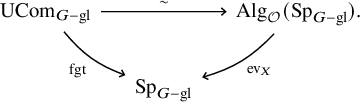
Proof. Write $\mathbb P^{\mathcal O}_X$
for the left adjoint to
$\mathbb P^{\mathcal O}_X$
for the left adjoint to $\operatorname {\mathrm {ev}}_X$
. If
$\operatorname {\mathrm {ev}}_X$
. If $G\not =1$
then one argues as in the previous proposition to show that
$G\not =1$
then one argues as in the previous proposition to show that ${\operatorname {\mathrm {ev}}_X}\circ \mathbb P^{\mathcal O}_X$
preserves the full subcategory
${\operatorname {\mathrm {ev}}_X}\circ \mathbb P^{\mathcal O}_X$
preserves the full subcategory ${\mathcal X}$
of those G-global spectra whose underlying G-spectrum has connective geometric fixed points, and
${\mathcal X}$
of those G-global spectra whose underlying G-spectrum has connective geometric fixed points, and  is again an example of an element of ${\mathcal X}$
whose image under
${\mathcal X}$
whose image under $\mathbb U\mathbb P\colon \mathrm{Sp}_{G\mathrm{-gl}}\to \mathrm{UCom}_{G\mathrm{-gl}}\to \mathrm{Sp}_{G\mathrm{-gl}}$
is no longer contained in
$\mathbb U\mathbb P\colon \mathrm{Sp}_{G\mathrm{-gl}}\to \mathrm{UCom}_{G\mathrm{-gl}}\to \mathrm{Sp}_{G\mathrm{-gl}}$
is no longer contained in ${\mathcal X}$
.
${\mathcal X}$
.
It therefore only remains to treat the case $G=1$
. For this we argue as before to see that
$G=1$
. For this we argue as before to see that ${\operatorname {\mathrm {ev}}_X}\circ \mathbb P^{\mathcal O}_X$
preserves the essential image
${\operatorname {\mathrm {ev}}_X}\circ \mathbb P^{\mathcal O}_X$
preserves the essential image ${\mathcal Y}$
of the unique symmetric monoidal left adjoint
${\mathcal Y}$
of the unique symmetric monoidal left adjoint $\mathrm{Sp}\to \mathrm{Sp}_{\mathrm{gl}}$
. However, we saw in Warning 7.29 that the symmetric spectrum
$\mathrm{Sp}\to \mathrm{Sp}_{\mathrm{gl}}$
. However, we saw in Warning 7.29 that the symmetric spectrum $\boldsymbol {\Sigma }(1,-){\wedge } S^1$
models an element of
$\boldsymbol {\Sigma }(1,-){\wedge } S^1$
models an element of ${\mathcal Y}$
(in fact, this is just the sphere spectrum) such that its image under
${\mathcal Y}$
(in fact, this is just the sphere spectrum) such that its image under $\mathbb U\mathbb P$
does not belong to
$\mathbb U\mathbb P$
does not belong to ${\mathcal Y}$
.
${\mathcal Y}$
.
Acknowledgments
The authors thank Clark Barwick, Bastiaan Cnossen, Stefan Schwede, and the anonymous referee for feedback on the paper. T.L. would like to thank Jan Steinebrunner for an enlightening exchange about equifiberedness. S.L. would like to thank Bastiaan Cnossen for many interesting discussions related to this project, and Fernando Abellán for explaining the relevance of [Reference AbellánAbe23] to the notion of globalization developed in [Reference LinskensLin24]. It proved invaluable for the present work. P.P. thanks Maxime Ramzi for a helpful discussion on free symmetric monoidal categories.
Competing interests
The authors have no competing interests to declare.
Financial support
T.L. is an associate member of the Hausdorff Center for Mathematics at the University of Bonn (DFG GZ 2047/1, project ID 390685813).
S.L. is an associate member of the SFB 1085 Higher Invariants.
P.P.’s contribution to this project was funded by the Deutsche Forschungsgemeinschaft (DFG, German Research Foundation) – Project-ID 427320536 – SFB 1442, as well as under Germany’s Excellence Strategy EXC 2044/2 -390685587, Mathematics Münster: Dynamics–Geometry–Structure.


 in the main text: one via model categories (Construction
 to a functor


 given by the isovariant maps, and so a Yoneda computation shows that for a general normed global category


 Open access

