

Map of the Ancash region showing the location of principal sites mentioned in the text (redrawn from SRTM 90 data).

The Ancash region of Peru (Figure 1) has long been a focus for debates about archaeological theories on the development and nature of social complexity in the Central Andes. Best known to students is the Larco - Tello 'Chavín' debate on the origins of Andean civilization, its antiquity and coastal, highland or Amazonian origins (Reference TelloTello 1923, 1929, 1960; Larco 1938; Reference PattersonPatterson 1994; Reference BurgerBurger 1992). Since, with the onset of direct dating, the location issue was seemingly resolved in favour of the valley oases of the Pacific coast (e.g. Shady et al. 2001) archaeological research in northern Peru has largely remained confined there. However, fieldwork across the Ancash sierra conducted over the last decade has begun producing results with wider implications for understanding diversity in social complexity.
Mutliple cultural changes across the northern edge of the Puna Andes (Reference WeberbauerWeberbauer 1911; Reference DollfussDollfuss 1992) can now be tracked thanks to refined chronologies for both the western Cordillera Negra range (Reference LauLau 2001, 2002; in press) and the inter-Andean valleys of central Conchucos, to the East of the continental watershed (Herrera & Advíncula 2001; Herrera, Lane & Advíncula 2002; Lane, Herrera & Grimaldo 2004; Reference OrsiniOrsini 2003). Across this region research into mortuary, ceremonial and hydraulic architecture is illuminating complex relations between modes of low scale social organization. It can be argued that these were based on the idiom of kinship.
At a recent round table discussion seminar prompted by the publication of a collection of essays on the Ancash highlands (Ibarra 2003), scholars from Europe, North- and South America contributed a range of perspectives grounded in landscape theory, historical materialism, and culture history by recourse to ongoing ethnoarchaeological (Gabriel Ramón) and archaeological field research in the Cordillera Negra (Kevin Lane, George Lau), southern and central Conchucos (Wilhelm Diessl, Bebel Ibarra & Nathaniel Van Valkenburgh; Alexander Herrera & Carolina Orsini) and the Santa valley (Alexander Herrera & Kevin Lane). Three principal themes addressed were ancestor veneration and the study of mortuary structures and their associated stone art (cf. Dillehay 1995; Reference IsbellIsbell 1997; Reference DulantoDulanto 2002; Reference LauLau 2002; Reference HastorfHastorf 2003); the social role of enclosed, patio-group civic architecture (cf. Reference IsbellIsbell 1989, 1991; Tschauner n.d., 2003); and patterns of high altitude land use (cf. Flores Ochoa 1968; Flannery et al. 1989).
After the Chavín era (c. 800-200 BC) formal collective mortuary structures, above ground chullpa and below ground machay, appear to become almost ubiquitous. It is commonly agreed that chullpa and machay relate to the practice of keeping human remains in bundles, possibly for oracular consultations and mortuary rituals such as those described by European clergymen (Reference TaylorTaylor 1987 [1608-?]; Reference ArriagaArriaga 1999 [1621]). Along with more recent looting, however, the campaigns to 'extirpate idolatry' - which included burning ancestral mummies and clothes, confiscating 'idolatrous' belongings and destroying sacred huaca effigies and buildings, as well as physical punishment - greatly complicate the process of finely resolving the breadth of the formal diversity of these mortuary structures in space and time.
On formal grounds it is tempting to consider the UNESCO world heritage site at Chavín de Huántar, not as the place of origin or focal point of the 'mother civilization of the Andes (Reference TelloTello 1960), but as a highly elaborate supra-regional chullpa-type structure. Similarities in exterior design, internal plan and construction technique between the highly elaborate 'temple' of Chavín de Huántar (c.800?-200BC) and some of the larger and later above ground structures were already pointed out by Reference TelloTello (1932).
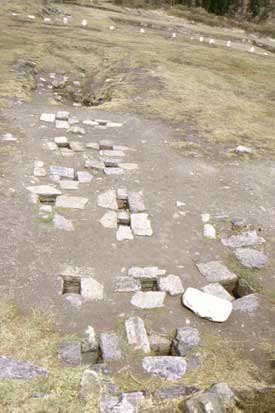
Vertical stone-lined canals above a galley situated in front of the main façade of the Castillo or 'New Temple' at Chavín de Huántar, Ancash.

There is little doubt that the practice of keeping human remains in bundles is an old and common Andean social practice, which was pivotal to social integration (Dillehay 1995). In the valley to the north of Chavín, at the site of Gotushjirka in the Yanamayo valley of central Conchucos, the remains of cotton cloth bundles containing human skeletal parts, exotic shell and metal ornaments - accompanied by few pottery vessels - were excavated in an artificial cave dating back at least to the EH-EIP transition (c.200 BC).
In the Santa valley, to the west of Chavín, chullpa structures dating to the Early Intermediate Period (200 BC-600 AD) and Middle Horizon (600-1200 AD) periods, are internally subdivided, having narrow galleries, multiple chambers or symmetrically arranged accesses. Some of the later galleries at Chavín have vertical stone-lined canals, which connect the inner chamber or gallery to the surface (Figure 2), a feature they share in common with later Machay structures These channels probably served for liquid offerings or libations, as well as for oracular consultations in rituals of communion with the ancestral dead.
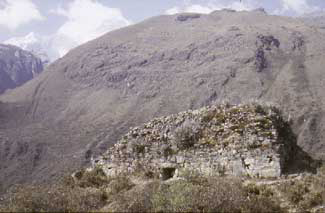
The handful of very large chullpa located at the centre of the necropoli of Honco Pampa (Reference TschaunerTschauner 2003; Reference IsbellIsbell 1989, 1991), Willkawaín (Reference BennettBennett 1944) and Katiamá (Reference ZakyZaky 1978) have long commanded researchers' attention. However, at these and other such sites studied recently, including Keushu (Figure 3) and Pueblo Viejo (Herrera 2000; Herrera & Advíncula 2001), it is not only the internal plan of each building which is rigidly structured. At these sites the spatial relations between structures were also orchestrated.
The paramount hilltop chullpa tomb at Keushu necropolis (Prov. Yungay) stands at the base of Huandoy glacier, beside a seasonal lake and overlooks a patio group cluster. (Photo: A. Herrera).

Across the Ancash highlands small scale above ground mortuary architecture, often carefully laid out in stone (e.g. Reference OrsiniOrsini 2003) and associated with stone sculpture is wide spread by 200 AD (Reference SchaedelSchaedel 1952; Reference LauLau 2000; Reference WegenerWegener 2001; Herrera 2003b). Stark regional and even micro-regional differences suggest that social identities may have found expression in mortuary architecture. From this perspective, the study of this regional diversity is a way of tracking the historical trajectories of categories of social adscription (Reference BarthBarth 1969).
By the Late Intermediate Period and Late Horizon (c.1200-1532AD) the range of mortuary structures across the region appears to become broader. It encompasses, at one end of the scale, small chambers below rocks, often at the edge of settled areas. Their distribution is generalised throughout the region. At the other end, in eastern Ancash and neighbouring Huánuco there is a profusion of multi-storey towers, hilltop necropoli (Ibarra 2001) and cliff-edge structures, some painted (Figure 4). It remains to be seen whether their concentration on both sides of the upper Marañón valley is the result of differentials in destruction during the Colonial and Republican periods, or if this patterning indeed delineates a major pre-Columbian boundary area.
Painted cliff-edge mortuary structure at Diablomachay (Prov. Llata, Huánuco) (Photo: D. Cabrel).

In sum, there is a broad range of spatial relations between mortuary structures, including face-to-face opposition, serial contiguity and abutment (generally, but not only of smaller structures), whose temporality is only beginning to be understood. It seems worthy of serious consideration that these spatial material relations were designed to evoke, embody and cement ideal social relations between groups of kin. Given the centrality of ancestor veneration in sixteenth century social organization, it is hardly far fetched to consider the large necropoli as focal places and collective ritual stages on which the integration of highland corporate groups was played out during much, if not most of later Andean prehistory.
Regional diversity in highland social organisation is also becoming apparent in the study of formal spaces interpreted as places for ritual activities. Circular Patio-Group (CPG) civic architecture (Tschauner n.d., 2003) is now being studied in both Conchucos and the Callejón de Huaylas by teams led by Orsini (2002) and Herrera (2000; Herrera & Advíncula 2001, Herrera, Lane & Advíncula 2002). CPG are minimally defined as circular to oblong structures with a single access leading onto a central patio, about 15 to 35m across, which can be square, circular or D-shaped in plan. Formally they are related to the North-Andean tradition of gallery-rooms best known from the Huamachuco region, which have long been thought to be more than dwellings (Reference MccownMcCown 1945; Reference TopicTopic 1986; for central Conchucos see Laurencic et al. 2001; Herrera 2003a).
Long and complex 'life-histories' of CPG are being reconstructed on the basis of recent survey fieldwork and excavations in central Conchucos. Preliminary results suggest that such structures were foci of collective social action, perhaps for as long as a millennium (300-1300 AD?). At Gotushjirka (Distr. San Nicolás, Prov. Fitzcarrald) more than ten CPG appear to have been used simultaneously. At nearby Warijirka the number is easily treble, whereas from the site of Balcón de Judas (Distr. Chacas, Prov. Asunción) only one CPG structure is known. At the two former sites long steps or ramps along the sides lead towards one or more raised benches, or stages, opposite the access. Detection of a flutter echo in CPG structure E-VIII at Gotushjirka suggests that activities in the patio were accompanied by sound: singing, music and possibly dance. Ritual practices included the distribution of food and drink.
At Honco Pampa CPG structures with rooms around a square patio are interpreted, on the basis of standing architecture, as elite compounds (Reference IsbellIsbell 1989, 1991; Reference TschaunerTschauner 2003). In neighbouring Conchucos the excavated CPG point to stages on which social integration was enacted, ritually negotiated and maintained. These interpretations are not mutually exclusive. The precise relationship between contemporary CPG,as well as between these and mortuary structures provide challenging avenues for investigation. Abandonment of CPG architecture does not appear to be simultaneous across the region. Two instances of architectural encasing - channelling access through a niched rectangular building before accessing the CPG - have been noted at sites on opposite sides of the Llanganuco pass (4800m), Keushu (Distr. Yungay) and Quishuar (Distr. Yanama). Further east, at Marcajirca de Juncay (Distr. Yauya), extant reuse has a domestic character, and may be related to an increase in high altitude herding during the XIII-XV centuries.
In a way, the emphasis on architecture at the Cambridge meeting pre-empted the cautionary note sounded by Ramón's initial efforts to refine understanding of the distribution and changes over time in ceramic technologies by recourse to ethnoarchaeology. The spatial and temporal patterning - and possible overlap- of ceramic technologies may in future complicate Andeanists' ongoing reliance on pottery for relative dating.
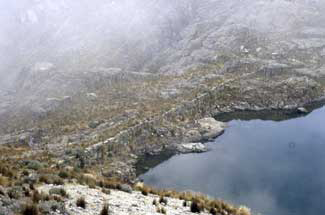
High altitude water reservoir at Yanacocha Hembra (Prov. Pamparomás). The dam wall is c. 50m long, 3m high and 2.5m wide (Photo: K. Lane).

Camelid herding has been found by Lane (2000; Lane, Herrera & Grimaldo 2004) to be a central motive for the construction of hydraulic systems and watershed management in the Puna above the Nepeña valley. The runoff water from dammed lakes on the uppermost western slope of the Cordillera Negra (c. 5000m altitude) feeds a system of high altitude streams, canals and terraces (Figure 5). In this way silt and moisture are accumulated and artificial wetlands or bofedales created, providing improved pastures. The scale of these high-altitude systems is substantial. Silt reservoirs in the Chorrillos - Chaclancayo Valley spread over several kilometres, yet they are mostly individually small (c.10-30 sq. m). In contrast, the silt dam at Collpa (Distr. Pamparomás) is over 5m tall and 100m long, resulting in 84ha pasture area within its catchment. The moisture retained in these sediments provides excellent pasture even in the driest of dry seasons, for high altitude economies based on camelid herding. The result is an estimated threefold increase in carrying capacity per hectare. Preliminary feasibility studies suggest that it may be possible to alleviate the extreme poverty prevalent in this particular region through the rehabilitation of irrigation techniques discovered through archaeological research.
In conclusion, these changing perspectives on Andean social organization put pressure on the heuristic value of culture historical labels, such as Chavín or Recuay, in furthering our understanding of social processes of identity formation, as well as the negotiation of social order. Current highland research agenda thus includes a definition of multiple scales of regional analysis at which linkages between mortuary and civic architecture, mechanisms of social integration and social memory may best be understood. Together with the nomenclature, chronology and typology of mortuary and civic structures these issues were discussed at length at the Cambridge Round Table.
Long-term study of social processes in the Ancash sierra, as well as of their place within long-range patterns of interaction with the Pacific coast and the eastern lowlands to the West and east, and between the Puna and the Equatorial Páramo Andes to the north promises to continue influencing research into the mechanisms of social complexity.