


Introduction
Cognitive models of post-traumatic stress disorder (PTSD) (Ehlers and Clark, Reference Ehlers and Clark2000) conceptualise the disorder as being influenced by specific pre-disposing vulnerability factors (e.g. pre-existing beliefs, coping resources, cognitive processing during trauma); active post-traumatic cognitive maintenance processes (e.g. post-traumatic appraisals, hypervigilance, incomplete trauma memory encoding); and counterproductive strategies aimed at controlling perceived threat and symptoms, perpetuating symptoms long-term (Murray and El-Leithy, Reference Murray and El-Leithy2022). A substantive amount of research has examined some elements of these models, most notably cognitive appraisals (Foa and Rothbaum, Reference Foa and Rothbaum1998; McNally and Woud, Reference McNally and Woud2019; Mitchell et al., Reference Mitchell, Hanna, Brennan, Curran, McDermott, Ryan and Dyer2018). However, less is known about how different pre-disposing cognitive factors and peri-traumatic cognitive operations interact, which may contribute to the development of PTSD symptomatology (Corrigan et al., Reference Corrigan, Hanna and Dyer2020). Understanding such vulnerability factors is beneficial for improving the early identification of at-risk individuals immediately following trauma exposure and for shaping effective PTSD interventions (McNally and Woud, Reference McNally and Woud2019).
Current understanding of peri-traumatic processing suggests that two key forms of encoding processing are relevant during exposure to traumatic stimuli: data-driven processing and conceptually driven processing. Data-driven processing (DDP) refers to bottom-up processing of perceptual, sensory, and environmental cues, while conceptually driven processing (CDP) refers to top-down processing of meaning, self-referential perspective, and the incorporation of the event into autobiographical context (Ehlers and Clark, Reference Ehlers and Clark2000). During trauma exposure, an imbalance between these two processes, i.e. heightened levels of data-driven processing relative to conceptually driven processing, is considered to deleteriously impact on the integration of the trauma memory into existing schematic structures, thereby increasing the likelihood of PTSD re-experiencing symptoms (Corrigan et al., Reference Corrigan, Hanna and Dyer2020; Ehlers and Clark, Reference Ehlers and Clark2000; Lensvelt et al., Reference Lensvelt-Mulders, van Der Hart, van Ochten, van Son, Steele and Breeman2008). This imbalance also leads to prioritisation of attentional biases towards threatening stimuli, which, in turn, may contribute to enhanced hyperarousal, current sense of threat, and overall emotional distress (Foa and Kozak, Reference Foa and Kozak1986). Experimental research (Corrigan et al., Reference Corrigan, Hanna and Dyer2020) identifies the specific attentional bias subtype integral to this purported mechanism was maintenance bias, as an important mediating construct in the subsequent development of PTSD and anxiety disorders (Bradley et al., Reference Bradley, Hanna, Wilson, Scott, Quinn and Dyer2016; Clauss et al., Reference Clauss, Gorday and Bardeen2022; Mullen et al., Reference Mullen, Hanna, Bradley, Rogers, Jordan and Dyer2021). This means greater overall time spent fixating upon trauma-related stimuli, rather than other forms of spatial attention, including vigilance bias (orienting to trauma-related stimuli faster) and delayed-disengagement (difficulty withdrawing attention from stimuli). Higher levels of pre-existing trait dissociation and DDP were found to be significant predictors of maintained attention post-trauma exposure (Corrigan et al., Reference Corrigan, Hanna and Dyer2020).
While peri-traumatic processing is highly salient in trauma memory encoding, pre-existing assumptions/beliefs may potentially moderate this process (Ehlers and Clark, Reference Ehlers and Clark2000). It is speculated a central feature in PTSD development is when a traumatic event is experienced as either (1) violating relatively inflexible pre-existing positive beliefs about the self, world, and others (e.g. ‘I am safe’); or (2) reinforcing relatively inflexible pre-existing negative beliefs about the self, world, and others (e.g. ‘I am unsafe’) (Ehlers and Clark, Reference Ehlers and Clark2000; Janoff-Bulman and Frieze, Reference Janoff-Bulman and Frieze1983). This hypothesis has received support (Ali et al., Reference Ali, Dunmore, Clark and Ehlers2002; Bryant and Guthrie Reference Bryant and Guthrie2005; Schweizer et al., Reference Schweizer, Renner, Sun, Becker-Asano and Tuschen-Caffier2019); however, evidence is less clear regarding the exact relationships between such assumptions and in vivo cognitive processes (e.g. attentional biases, DDP) and how these interactions later engender post-traumatic reactions.
Cognitive flexibility, while theoretically relevant to PTSD maintenance, has garnered limited empirical attention. Cognitive flexibility is defined as the ability to adapt one’s coping and thinking styles, including memory and attention (Kindt et al., Reference Kindt, van den Hout, Arntz and Drost2008; Martin and Rubin, Reference Martin and Rubin1995). Flexible coping strategies have been shown to help individuals reduce PTSD symptoms by enhancing the capacity to hold multiple alternative viewpoints (Shigemoto and Robitschek, Reference Shigemoto and Robitschek2020). Ben-Zion and colleagues (Reference Ben-Zion, Fine, Keynan, Admon, Green, Halevi, Fonzo, Achituv, Merin, Sharon, Halpern, Liberzon, Etkin, Hendler and Shalev2018) reported that better overall cognitive flexibility was associated with lower levels of maladaptive attentional biases and symptoms of PTSD long-term in trauma-exposed samples. Normative processing of aversive traumatic experiences over time is likely to require some flexibility in resolving cognitive operations. Individuals who lack such flexibility may develop PTSD, in part, because it engenders the development of rigid, excessive, or unhelpful appraisals that perpetuate symptoms (Ehlers and Clark, Reference Ehlers and Clark2008; Haim-Nachum and Levy Gigi, Reference Haim-Nachum and Levy-Gigi2021; Halligan et al., Reference Halligan, Michael, Clark and Ehlers2003).
Each of the constructs discussed thus far is present in the Ehlers and Clark (Reference Ehlers and Clark2000) cognitive model of PTSD. The present analogue study aimed to examine the roles of pre-disposing cognitive assumptions/beliefs, cognitive flexibility, and peri-traumatic processing (i.e. DDP and CDP) on attentional changes and trauma memory recall. Previous investigations have only measured some of these variables in isolation (James et al., Reference James, Lau-Zhu, Clark, Visser, Hagenaars and Holmes2016; Lazarov et al., Reference Lazarov, Suarez-Jimenez, Tamman, Falzon, Zhu, Edmondson and Neria2019; McNally and Woud, Reference McNally and Woud2019; Woud et al., Reference Woud, Kleim and Cwik2019). The current study used an experimental paradigm to examine the changing inter-relationships between the variables over time, to investigate the temporality of each construct by examining both pre- and post-trauma exposure. It was hypothesised that as a proxy-PTSD reaction participants would have significantly greater attentional bias towards trauma-related images and state anxiety immediately after exposure, and would reduce closer to pre-exposure values at follow-up (i.e. 5–10 days later). Moreover, it was predicted that there would be significantly higher DDP relative to CDP post-exposure, but higher CDP relative to DDP at follow-up as a result of normative trauma processing over time. Lastly, it was hypothesised that higher levels of negative assumptions (i.e. about the self, world, and others) and poorer cognitive flexibility would predict greater post-exposure levels of attentional bias towards trauma-relevant images; DDP relative to CDP; state anxiety; and memory recall difficulties.
Method
Participants
A non-clinical opportunity sample was recruited in a Northern Ireland university and community setting, assessed through an online screening battery to determine eligibility. Inclusion criteria were (1) 18 years old or older; and (2) normal or corrected to normal vision. Exclusion criteria were (1) involvement in a major or serious road traffic collision in their lifetime; (2) clinical levels of PTSD; and (3) high risk of motion sickness.
All individuals who met the criteria where subsequently invited to take part in the study; in total 75 participants attended, with 68 participants providing full complete data. The majority of the participants were female (62.2%, n=46), with 5.4% self-describing gender (n=4), and 17.6% unknown gender (n=13). Participant age ranged from 18 to 48 years old, where the mean age was 22 years (SD=6.05), with 18.6% unknown (n=14). The majority of the sample were university students (90.6%, n=68) with the remainder recruited from the community.
Materials
Virtual reality film stimuli (analogue trauma exposure)
A 6-minute first-person perspective virtual reality (VR) film of a road traffic collision developed by the UK Fire and Rescue Service in Leicestershire (n.d.) (‘VF4 360’) was used. The film has been shown to induce sub-clinical levels of trauma symptoms at a statistically significant but low enough level so as not to cause lasting effects to the individual’s wellbeing. The intention was to mimic cognitive processes that occur in some individuals when experiencing a trauma event. This VR film has been used in previous research on trauma processes (Corrigan et al., Reference Corrigan, Hanna and Dyer2020) and is described in greater detail by Baptie and colleagues (Reference Baptie, Andrade, Bacon and Norman2021).
This non-interactive VR film was presented using an untethered Oculus/Samsung Gear VR headset. This film gives the viewer an immersive 360-degree view, from the point-of-view of being a front-seat passenger in a car crash. Participants were instructed to remain seated, but were encouraged to move their head to look around the virtual space. Audio triggers included sounds of the crash impact, sirens, and passengers crying. Visual triggers included blood, life-threatening injuries, paramedics’ attempts to resuscitate another passenger, and the fire service cutting the roof off the car.
Memory task
The memory task in this study follows the procedure of Halligan et al. (Reference Halligan, Clark and Ehlers2002), whereby a verbal free-recall of the content and order of the VR film is audio-recorded for later blind scoring. Participants were asked to describe in as much detail as possible the film they watched, making sure to try to do so in the correct order of the sequence of events. The number of correct events recalled (the event content score) divided by the number of events recalled in the correct sequence (the event order score) comprised an overall memory score of the event, as validated in other investigations (Corrigan et al., Reference Corrigan, Hanna and Dyer2020).
Attention stimuli
The current study used protocols developed in previous research (Bradley et al., Reference Bradley, Hanna, Wilson, Scott, Quinn and Dyer2016; Corrigan et al., Reference Corrigan, Hanna and Dyer2020; Mullen et al., Reference Mullen, Hanna, Bradley, Rogers, Jordan and Dyer2021). A library of images was developed by Corrigan and colleagues (Reference Corrigan, Hanna and Dyer2020) from the International Affective Picture System (Lang and Bradley, Reference Lang and Bradley2007). Trauma aversive images, generally aversive images, and general neutral images were compiled and verified by independent judges to meet a threshold for aversiveness and anxiety-provocation, and pair-matched on image characteristic variables (e.g. complexity and colour). These images were presented as a stimulus for eye tracking equipment to track viewer attention. Each image pairing was presented once per trial, with a total of three trials (pre-exposure, immediate post-exposure, and 5–10 days post-exposure). Before presentation of the subsequent image pairs, a central fixation cross was shown to re-establish a baseline central view. Each image slide was presented for 2000 ms each. A total of 40 image pairs were presented in randomised order, comprising the two image pairing conditions (1) 20 paired a trauma aversive image with a generally aversive image (TAGA) and (2) 20 paired a trauma aversive image and a generally neutral image (TAGN). Two types of pairings were used to control for potential biases to generally aversive images rather than trauma aversive images. This was a free-gaze paradigm, where participants were simply instructed to take in the details of the images, and always return their gaze to the central fixation cross when presented.
Eye-tracking equipment
Eye-tracking of attention towards images was detected using the Eyelink Portable Duo eye-tracker (SR Research), using video recording of combined pupil and corneal reflection. The eye-tracker sat below screen level of a 17.3-inch ASUS laptop display presenting the visual stimuli. Multiple types of fixation pattern can be observed by recording static gaze within specific areas of interest measured in milliseconds or frequency. The fixation types measured represent the form of attentional biases validated in previous research by Bradley and colleagues (Reference Bradley, Hanna, Wilson, Scott, Quinn and Dyer2016) and Corrigan and colleagues (Reference Corrigan, Hanna and Dyer2020): measures of vigilance bias were the direction of first fixation and first fixation time (speed of initial fixation); measure of delayed-disengagement bias was first fixation duration upon the image type initially oriented to; and measures of maintenance bias were dwell time (the cumulative duration of fixations of each stimuli type), and fixation count (the frequency of fixations).
Self-report measures
Post-traumatic Stress Disorder Checklist for DSM-5 (PCL-5; Weathers et al., Reference Weathers, Litz, Herman, Huska and Keane1994). This 20-item self-report Likert scale questionnaire (from 0 ‘not at all’ to 4 ‘extremely’) corresponds to the DSM-5 PTSD symptoms over the period of the past month (e.g. ‘Having difficulty concentrating?’). The internal consistency is very good (α=0.91 demonstrated by Haim-Nachum and Levy-Gigi, Reference Haim-Nachum and Levy-Gigi2021). This questionnaire used at screening excluded participants who scored more than the established cut-off score of 31/80 or if they met scoring criteria of endorsing any individual cluster of symptoms.
The Life Events Checklist (LEC-5; Weathers et al., Reference Weathers, Blake, Schnurr, Kaloupek, Marx and Keane2013). This 17-item self-report measure was designed to screen for life events known to potentially result in PTSD and distress. The LEC allows the respondent to signify whether the event happened to them, was witnessed, learned about, or experienced as part of their job (such as in the military or as a first responder), e.g. ‘transportation accident’. This measure has been shown to have good test–retest reliability.
World Assumptions Questionnaire (WAQ; Kaler, Reference Kaler2009). This 22-item self-report questionnaire uses a Likert scale (from 0 ‘strongly agree’ to 6 ‘strongly disagree’) where lower scores reflect more negative assumptions about the self, world, and others. Four subscales reflect the controllability of events, comprehensibility and predictability of people, trustworthiness and goodness of people, and safety and vulnerability (e.g. ‘Most people can be trusted’). The WAQ displays good internal reliability (α=.82) and test–retest reliability (α=.67 demonstrated by Haeny et al., Reference Haeny, Woerner, Overstreet, Hicks, Ahuja, Amstadter and Sartor2021). This measure is not loaded to any specific event or trauma as it assesses general pre-existing beliefs.
Cognitive Flexibility Scale (CFS; Martin and Rubin, Reference Martin and Rubin1995). This self-report measure is a 12-item questionnaire using a Likert scale (from 0 ‘strongly agree’ to 6 ‘strongly disagree’) assessing three factors (awareness that in any given situation there are options and alternatives; willingness to be flexible and adapt to the situation; and self-efficacy in being flexible), e.g. ‘I avoid new and unusual situations’. Lower scores reflect poorer cognitive flexibility. Internal consistency of the CFS is good (α=0.77 demonstrated by Haim-Nachum and Levy-Gigi, Reference Haim-Nachum and Levy-Gigi2021).
State Trait Anxiety Inventory (STAI; Spielberger et al., Reference Spielberger, Gorsuch and Lushene1970). This 40-item self-report measure is used to assess situational state anxiety (items 1–20) and trait anxiety (items 21–40), scored on a Likert scale of 1 (not at all) to 4 (very much so), e.g. ‘I feel calm’. Higher scores reflect greater anxiety. In a student sample this questionnaire shows high internal consistency (Cronbach’s α between 0.84 and 0.93 demonstrated by Fonseca-Pedrero et al., Reference Fonseca-Pedrero, Paino, Santaren-Rosell, Lemos-Giraldez and Muniz2012).
Cognitive Processing Questionnaire Ehlers, (Reference Ehlers1998). This self-report questionnaire includes measures of data-driven processing and conceptually driven processing of trauma material. The 8-item DDP scale measures perceptual and sensory levels of processing, e.g. ‘I could not think clearly’. The internal consistency is reported to be satisfactory in an analogue trauma study with a student sample (α=.69 demonstrated by Halligan et al., Reference Halligan, Clark and Ehlers2002). The CDP scale has 7 items that refer to the meaning and context of an event, e.g. ‘I felt cut off from my past’, where a higher score reflects less self-referent CDP. This questionnaire has satisfactory internal consistency (α=0.76 demonstrated by Halligan et al., Reference Halligan, Clark and Ehlers2002). The current study examined these questionnaires individually, alongside the DDP versus CDP differential determined by subtracting CDP from DDP as a measure of relative usage.
Procedure
The current experimental study is a quantitative prospective design consisting of three parts: an online screening questionnaire, and two in-person experimental sessions spaced 5–10 days apart. The follow-up time frame of 5–10 days was chosen as it has been used repeatedly in analogue trauma exposure studies (Laposa and Rector, Reference Laposa and Rector2012; Schweizer et al., Reference Schweizer, Renner, Sun, Becker-Asano and Tuschen-Caffier2019) with particular focus on how the consolidation of trauma memory processing occurs across time (Halligan et al., Reference Halligan, Clark and Ehlers2002). Measurements were taken at pre-exposure to a trauma analogue VR film, post-exposure immediately following the VR film, and at a delay of 5–10 days follow-up.
Volunteers were asked to complete an online screening questionnaire and those who met inclusion criteria were subsequently presented online with the PCL-5 and LEC-5, and measures of pre-existing assumptions/beliefs and cognitive flexibility (WAQ and CFS). Participants who met all criteria were contacted via email, and experimental sessions commenced several weeks later.
Session 1 involved (1) baseline (Time 1) measurement of STAI and attention stimuli task; (2) exposure to the VR stimuli; (3) immediate post-exposure (Time 2) measurement of STAI, attention stimuli, cognitive processing scale, and memory recall task.
Session 2 involved repeating measurements from Time 2 at delayed post-exposure (Time 3). A debriefing sheet was emailed to each participant after study completion.
Analysis
A difference score for each image condition was calculated, where positive scores reflect greater fixation on the trauma aversive image relative to a general image, and negative scores reflect greater fixation on either a generally aversive or a generally neutral image relative to the trauma aversive image.
Mixed effect linear models (MLMs) with a random intercept were used to measure the effect of two independent variables: image pairing condition [TAGA vs TAGN]; and time [pre-exposure (Time 1) vs immediate post-exposure (Time 2); pre-exposure (Time 1) vs one-week post-exposure (Time 3)] on the dependent variable of attentional biases. The independent variable of Time was then used against the dependent variables of state anxiety, cognitive processing, and memory recall. Assumptions of the MLMs were met.
To examine how world assumptions (WAQ) and cognitive flexibility (CFS) impact on changes in cognition and anxiety following trauma exposure, multiple linear regressions were performed on each immediate post-exposure measure (Time 2) of the following dependent variables: (1) attentional bias measures; (2) cognitive processing scale; (3) memory recall, and (4) state anxiety. Independent variables in each regression were (1) baseline scores for the specific dependent variables where relevant to control for prior levels and gauge change (e.g. Time 1: pre-exposure attentional biases); (2) WAQ scores; and (3) CFS scores. All statistical assumptions for multiple linear regressions were satisfactory.
Results
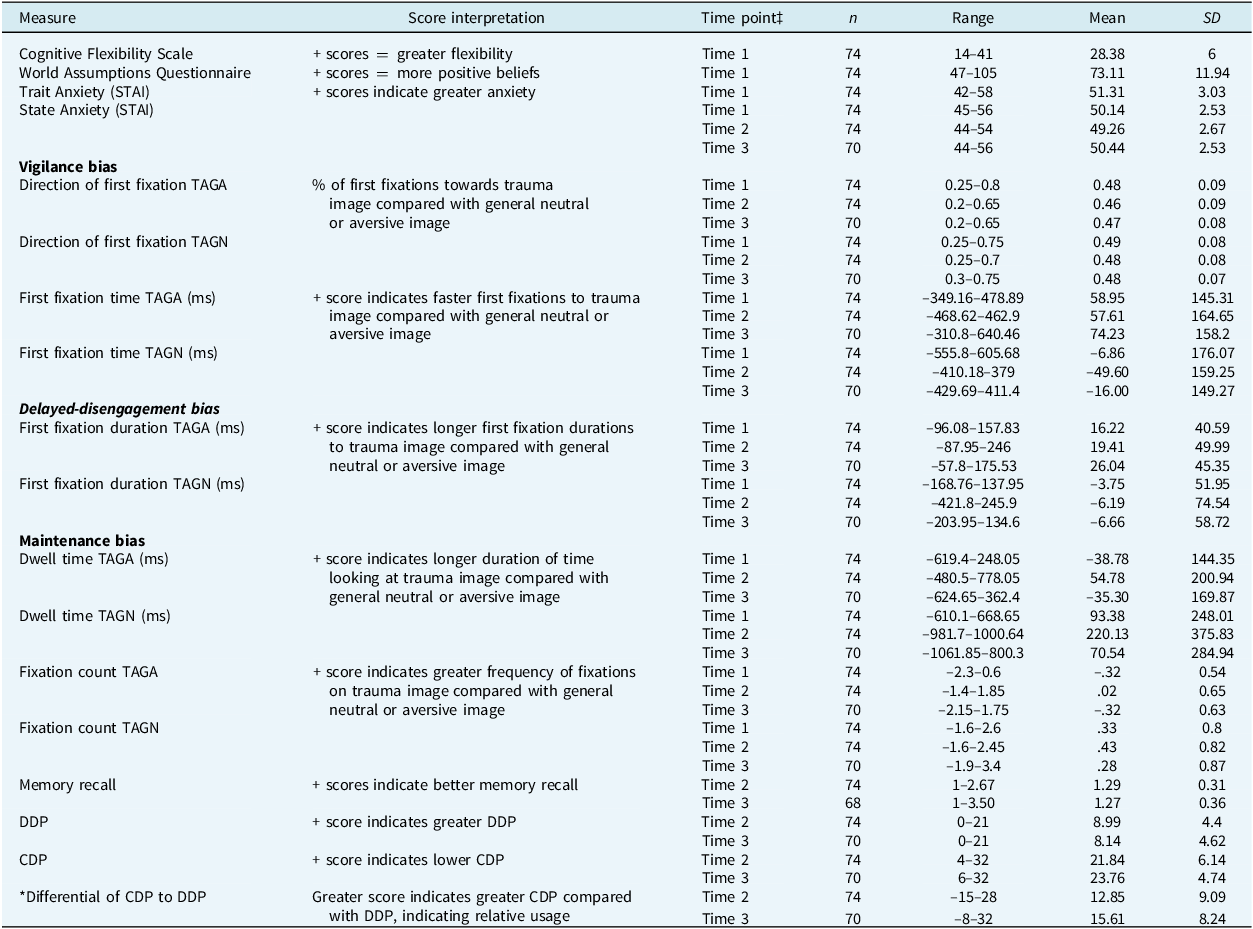
Table 1 shows descriptive statistics for each variable including means, ranges, and standard deviations.
Descriptive statistics of range, observed means, and standard deviations for each outcome measure for each time point of data collection

SD, standard deviation; STAI, State Trait Anxiety Inventory; TAGA, Trauma Aversive General Aversive image pairing condition; TAGN, Trauma Aversive General Neutral image pairing condition; DDP, data=-driven processing; CDP, conceptually driven processing.
*Differential of CDP to DDP calculated by CDP – DDP. ‡Data collection time point: refers to Time 1 pre-exposure; Time 2 immediate post-exposure; Time 3 one-week follow-up.
Attentional biases – pre-exposure, post-exposure and follow-up (changes over time), and image pairing condition
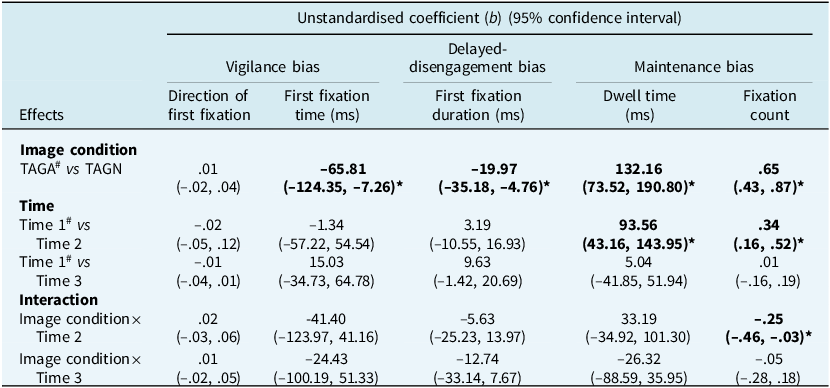
Table 2 summarises the results of the MLMs for each measure of attentional bias. A significant effect of image condition (TAGA vs TAGN) was observed for all attentional biases, except direction of first fixation.
Multilevel mixed effects model of attention bias (eye-tracking) variables showing changes over time and image condition (n=74)

ms = milliseconds. *Significant (p<.05) values are in bold. All values rounded up to 2 decimal places. #Reference group. TAGA, trauma aversive general aversive image pairing condition; TAGN, trauma aversive general neutral image pairing condition.
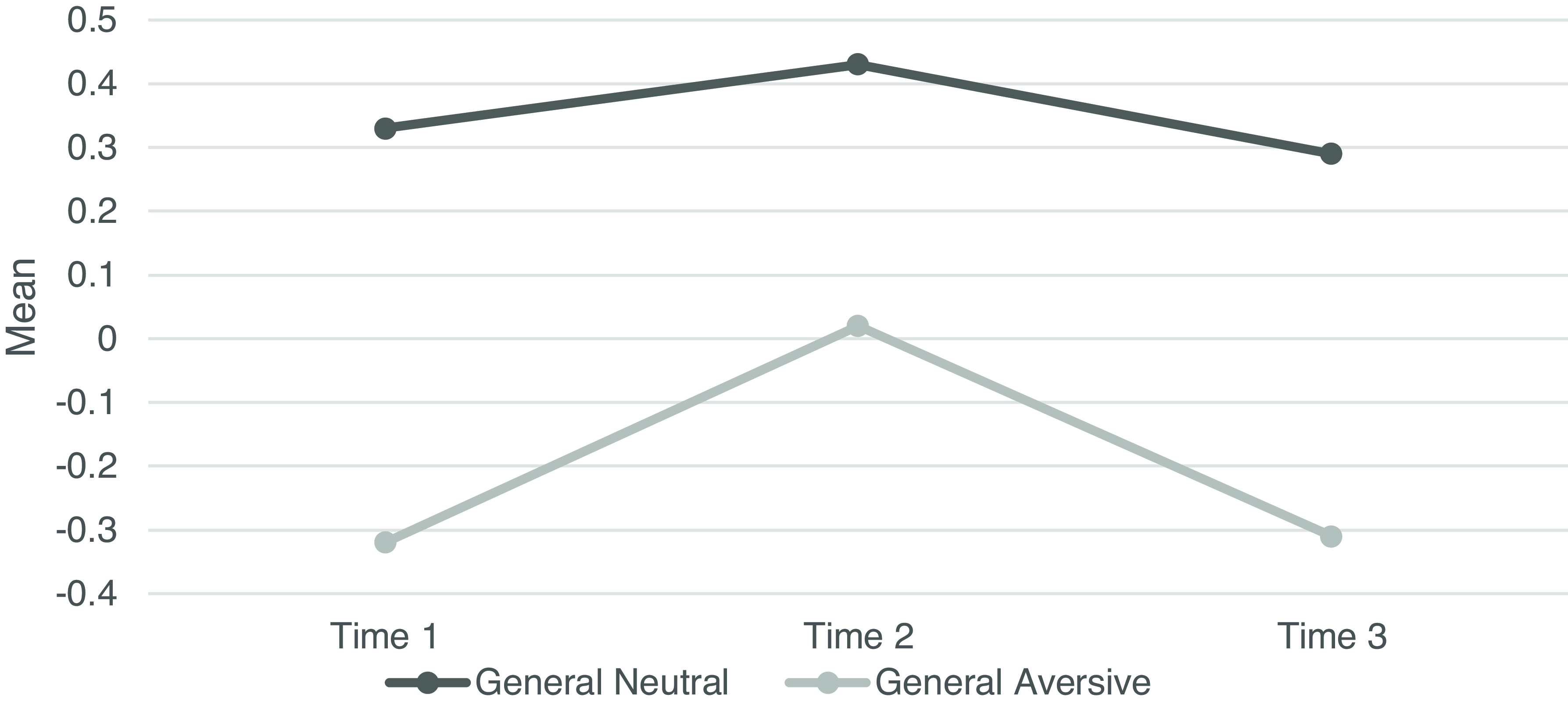
Significant changes over time were observed for the maintenance bias variable of dwell time (b=93.56; p<.01) between pre-exposure (Time 1) and immediate post-exposure (Time 2). This suggests analogue trauma exposure elicits a specific increase in the maintenance subtype of attentional bias. The direction of increase indicates at Time 2 participants gazed significantly longer at trauma aversive images compared with either general aversive or general neutral images. A significant interaction was found for another index of maintenance bias, fixation count, suggesting that the effect of exposure (time) varied for the two image conditions. The difference scores between trauma aversive and general neutral images (TAGN) were at consistently high levels and exhibited less change over time, whereas the difference scores between trauma aversive and general aversive images (TAGA) were low pre-exposure and increased substantively between Time 1 and Time 2, as can be seen in the interaction plot (Fig. 1). As expected for all attentional bias types and for both image conditions, the effect was non-significant for the Time 1 vs Time 3 comparison (image condition and Time 3, b=–.05; p=0.66). This suggests the interaction effect of the exposure and image condition did not produce longer-term attentional bias deviations.
Fixation count attention bias variable interaction plot between time and image pairing condition.

State anxiety, cognitive processing, and memory recall changes over time
The MLM results of the STAI state anxiety measure demonstrate that trauma exposure caused a significant decrease in state anxiety levels (b=–.88; p<.01) between Time 1 and Time 2, and no significant difference between Time 1 and Time 3 (b=.32; p=–.35).
The cognitive processing variables showed a significant decrease in DDP (b=–.83; p<.01) and a significant increase in CDP (b=1.95; p<.01) between Time 2 and Time 3. The differential of these two scales demonstrated an increasing trend from post-exposure to follow-up, indicating greater CDP relative to DDP over time after exposure, which would be expected in normal trauma processing (b=2.79; p<.01). No significant differences were found for memory recall from immediately post-exposure to follow-up (b=–.02; p=.62).
Analysis of predictors – pre-existing assumptions (WAQ) and cognitive flexibility (CFS) predicting changes over time
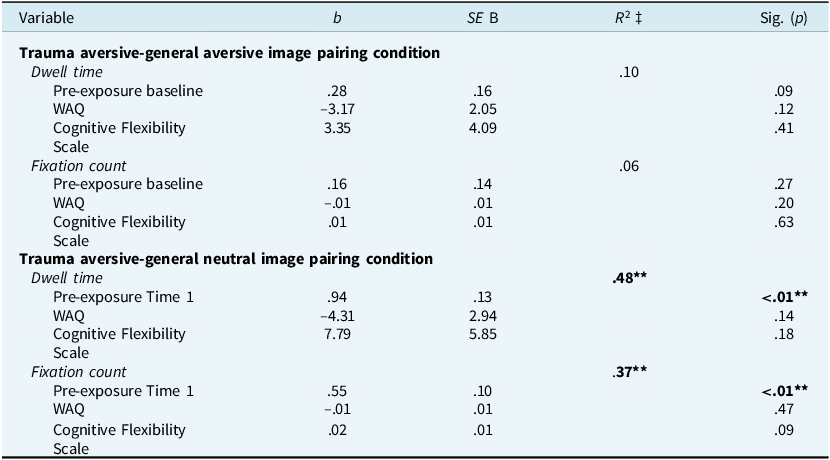
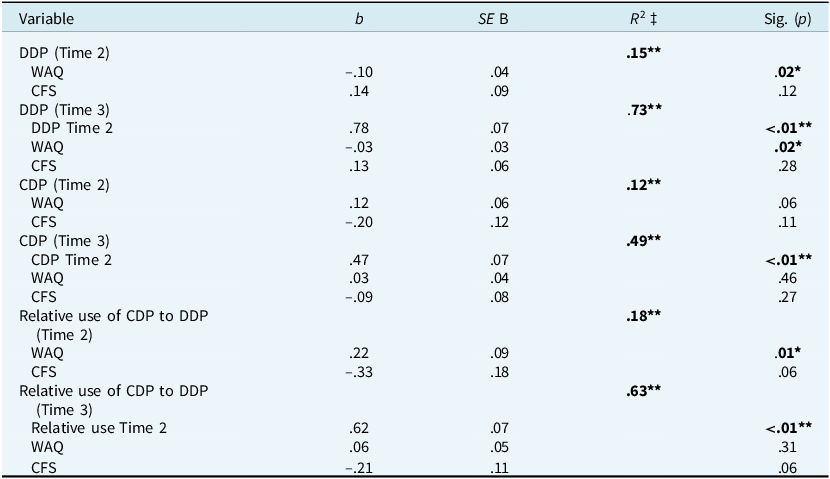
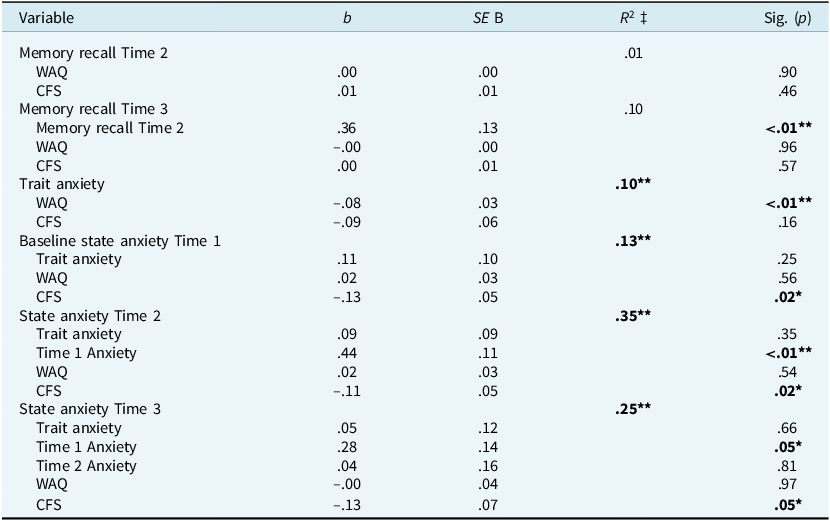
Variables that showed significant change in response to the experimental paradigm were included in regression analyses, outlined in Tables 3–5. When pre-exposure baseline scores of attentional bias were controlled for, WAQ and CFS were not significant predictors of immediate post-exposure changes in maintenance attentional bias for either image pairing condition. With regards to cognitive processing, WAQ was a significant predictor of DDP both post-exposure (b=–.10; p=.02) and at follow-up (b=–.03; p=.02), indicating more negative pre-existing beliefs are predictive of greater DDP post-trauma. WAQ was also a significant predictor of the differential of CDP-DDP at post-exposure (b=.22, p=.01), but not at follow-up. Moreover, WAQ and CFS were not significant predictors of CDP, or memory recall at post-exposure or follow-up.
Summary of multiple regressions for pre-existing beliefs and cognitive flexibility predicting immediate post-exposure maintenance attention bias (n=74)

Pre-exposure baseline: each measure of eye-tracking performed before exposure to analogue trauma paradigm entered as a predictor. **p <0.01. ‡Bold and * indicates significant ANOVA result.
Summary of multiple regressions for pre-existing beliefs and cognitive flexibility predicting cognitive processing (n=74)

DDP, data-driven processing; CDP, conceptually driven processing; ratio of CDP to DDP = CDP – DDP. *p <0.05, **p <0.01. ‡Bold and * indicates significant ANOVA result.
Summary of multiple regressions for pre-existing beliefs and cognitive flexibility predicting memory recall and anxiety (n=74)

Anxiety measured using State Trait Anxiety Inventory (STAI). *p<0.05, **p<0.01.
‡Bold and * indicates significant ANOVA result.
In terms of anxiety measures, the WAQ was a significant predictor of baseline trait anxiety (b=–.08; p<.01). CFS was found to be a significant predictor of state anxiety at baseline (b=–.13; p<.01) post-exposure (b=–.11; p=.02) and follow-up (b=–.13; p=.05) when previous state/trait anxiety scores were controlled. This suggests lower cognitive flexibility predicted greater state anxiety at each time point.
Discussion
The present experimental study found the primary form of attentional bias in operation after analogue trauma exposure is maintenance bias. Following trauma exposure, individuals did not orient to threat-related images faster, but they did sustain attention and overly fixate on threat stimuli for longer. As hypothesised, analyses clearly demonstrated a significant increase in this attentional subtype towards trauma salient stimuli relative to general aversive or neutral stimuli immediately post-exposure. These differences attenuated at follow-up, suggesting longer-term return to normative attentional processing, as demonstrated in previous research (Bradley et al., Reference Bradley, Hanna, Wilson, Scott, Quinn and Dyer2016; Corrigan et al., Reference Corrigan, Hanna and Dyer2020). Such findings provide support for Ehlers and Clark’s (Reference Ehlers and Clark2000) model of PTSD where symptoms are maintained by an ongoing sense of threat through retriggering of perceptual stimuli dwelled upon in the environment. The theorised role of the level of DDP relative to CDP as a risk and protective factor for PTSD also received support. As attentional biases decreased from post-exposure to follow-up, DDP significantly decreased and CDP increased across the same time period. Therefore, an improvement in cognitive processing occurred alongside an improvement in proxy post-trauma reactions. It also emerged that negative assumptions may play a role in cognitive processing as they were significant predictors of both greater DDP and the relative use of DDP to CDP. Lastly, greater cognitive flexibility did not have a significant impact on post-exposure processing or biases but did significantly relate to lower levels of state anxiety at all three time points, implying this cognitive trait is a general protective factor against anxiety reactions within trauma exposed samples.
Incomplete trauma memory encoding after exposure to a psychological trauma both predicts and maintains post-traumatic stress reactions (Dalgleish, Reference Dalgleish and Yule1999; Halligan et al., Reference Halligan, Clark and Ehlers2002; Murray and El-Leithy, Reference Murray and El-Leithy2022). The current study progressed the evidence provided by Corrigan and colleagues (Reference Corrigan, Hanna and Dyer2020) who demonstrated the significance of DDP, by showing the importance of its relative use to CDP. Ehlers and Clark (Reference Ehlers and Clark2000) assert that normative processing of traumatic material occurs when the cognitive system elaborates and integrates new contextual information with the original trauma experience to form a balanced, effective memory of the event. As in real-world trauma experiences, initially the heightened sensory nature of the trauma activates the autonomic nervous system provoking greater DDP. Then, as deeper elaboration of autobiographical information occurs over time, greater CDP would take place, as was observed in the present study (Kindt et al., Reference Kindt, van den Hout, Arntz and Drost2008). This provides empirical support for the proposed mechanism of trauma-focussed CBT. Intervention elements such as imaginal reliving are likely to be effective because they directly attempt to enhance CDP in individuals who have developed PTSD as a result of disproportionate levels of DDP (Lyttle et al., Reference Lyttle, Dorahy, Hanna and Huntjens2010; Murray and El-Leithy, Reference Murray and El-Leithy2022). Future studies examining these peri-traumatic cognitive operations would benefit from measuring the relative use of DDP and CDP, as opposed to either in isolation as in previous studies (e.g. Corrigan et al., Reference Corrigan, Hanna and Dyer2020).
The theorised role of negative pre-existing beliefs of oneself, the world, and others, inducing impaired trauma processing also received support. More negative assumptions were highlighted as important for specifically peri-traumatic DDP and the relative use of DDP compared with CDP, and not for broader cognitive processing post-trauma such as attentional bias formation or memory recall. In other words, a predominance of sensory processing at the time of trauma is predicted by more negative prior beliefs, comparable to an early-stage cognitive bias or priming. This is in line with dominant theories (Dalgleish,Reference Dalgleish and Yule1999; Ehlers and Clark, Reference Ehlers and Clark2000) whereby pre-existing beliefs were thought to impact cognitive processing of how well new information is incorporated during the trauma experience, leading to more negative cognitive appraisals and rumination of the trauma and sequelae, resulting in and maintaining PTSD symptoms. An established understanding is that DDP is predictive of PTSD development; however, it is a novel finding that DDP may be predicted by world assumptions mediating this dysfunctional processing after analogue trauma exposure, warranting further exploration.
Cognitive flexibility was not predictive of DDP, CDP, or attentional bias as originally hypothesised. This is unexpected as cognitive flexibility is understood as being the rigidity of held beliefs which may influence the ability to engage in CDP and integration of information alongside existing beliefs. However, cognitive flexibility was predictive of state anxiety, and world assumptions were predictive of trait anxiety. This could suggest that pre-existing beliefs are a longer lasting trait characteristic, while cognitive flexibility as measured by the CFS could be more subject to change as a state characteristic dependent on current emotional states or sense of control (Gabrys et al., Reference Gabrys, Dixon and Anisman2017; Martin and Rubin, Reference Martin and Rubin1995). Future research into the relationship between these variables could improve understanding of the role of flexibility, as current evidence already suggests the therapeutic benefit of trauma-focused CBT improving flexibility of thought to target pre-existing global beliefs or trauma appraisals (Murray and El-Leithy, Reference Murray and El-Leithy2022). Investigation into other neuropsychological measures of flexibility linked to attention switching and inhibition may better reflect executive control processes in attention biases (Ben-Zion et al., Reference Ben-Zion, Fine, Keynan, Admon, Green, Halevi, Fonzo, Achituv, Merin, Sharon, Halpern, Liberzon, Etkin, Hendler and Shalev2018).
As CDP increased at follow-up, it was unexpected that there were no concomitant improvements in memory recall, which would be hypothesised since theoretical models posit that more elaborate cognitive processing from CDP elicits enhanced memory integration and therefore greater recall (Halligan et al., Reference Halligan, Clark and Ehlers2002). However, memory integration is complex, and the inability to integrate trauma-event information into self-referential memory rather than general memory of the event is more indicative of PTSD reactions (Buck et al., Reference Buck, Kindt, Van Den Hout, Steens and Linders2006). Neither pre-existing assumptions nor cognitive flexibility were predictive of memory recall at either time point. However, if memory disorganisation more affected by severity and duration of trauma event rather than pre-existing vulnerability factors, analogue trauma studies may be unlikely to replicate this reaction (Su and Chen, Reference Su and Chen2018). The absence of change in memory recall may reflect the short VR film length and artificial laboratory setting, enabling participants to encode memory more effectively. Future research on the relationship between cognitive processing and memory recall of longer VR trauma exposures is warranted to address this issue.
The present study makes a unique contribution as it is one of only a few experimental investigations to employ a longitudinal design to examine cognitive processing during and after trauma exposure. The findings demonstrate both how normative processing of mildly traumatic material occurs, and how unhelpful deviations in attention, memory, and information processing resolves over time. This study also reinforces the safety of analogue trauma paradigms regarding the absence of lasting negative effects for participants. Practitioners can use results of analogue trauma paradigms to aid understanding of the cognitive model of PTSD. This includes the importance of targeting regulation of the hyperarousal associated with attentional bias, memory elaboration through imaginal reliving, and improving cognitive flexibility and negative pre-existing beliefs using thought challenging. Furthermore, rapidly increasing evidence has demonstrated the use of virtual reality exposure therapy treatment of PTSD in clinical practice (Kothgassner et al., Reference Kothgassner, Goreis, Kafka, Van Eickels, Plener and Felnhofer2019), providing an alternative approach to a traditional exposure hierarchy or imaginal reliving.
Limitations of the current study include utilising a less representative sample of predominantly students; however, this is less relevant for studies seeking to further theoretical understanding (Martínez-Mesa et al., Reference Martínez-Mesa, González-Chica, Duquia, Bonamigo and Bastos2016). The analogue trauma paradigm limits ecological validity; however, the current study is valuable for understanding theory and the mechanism of development of proxy-PTSD acute stress reactions. The statistically significant change in attentional bias demonstrates a post-traumatic reaction of attentional priming did occur, even in the absence of self-reported subjective distress, as eye-tracking with healthy control participants not exposed to trauma does not produce this effect (Lazarov et al., Reference Lazarov, Suarez-Jimenez, Tamman, Falzon, Zhu, Edmondson and Neria2019). Anticipatory anxiety may explain the unexpected direction of change in self-reported anxiety (Gainsburg and Earl, Reference Gainsburg and Earl2018), limiting the experimental effects post-intervention. While steps were taken to minimise any placebo effects (e.g. concealing purpose of study), it would be useful to include a neutral VR control group in future studies. A potential source of bias may come from the sensitivity, subjectivity, or specificity of all self-report questionnaires that attempt to assess complicated constructs including self-reported anxiety. However, the alternative of using objective tasks which artificially impact processing by manipulating a DDP or CDP style may inflate findings and still only infer processing style (Kindt et al., Reference Kindt, van den Hout, Arntz and Drost2008; Lyttle et al., Reference Lyttle, Dorahy, Hanna and Huntjens2010).
Future research into additional relationships between these variables is warranted, such as between flexibility and pre-existing beliefs; anxiety and attention; and whether cognitive processing is predictive of attentional bias and memory recall. The extent to which beliefs or trauma appraisals mediate attentional bias and information processing biases requires additional investigation; particularly to compare overall ‘trait’ global beliefs such as shame and self-blame, state cognitions such as dissociation, perceived ability to cope with trauma, and primary or secondary appraisals (Bonanno and Burton, Reference Bonanno and Burton2013; Corrigan et al., Reference Corrigan, Hanna and Dyer2020; Dorahy et al., Reference Dorahy, Corry, Shannon, Webb, McDermott, Ryan and Dyer2013; Lyttle et al., Reference Lyttle, Dorahy, Hanna and Huntjens2010).
Conclusion
The present investigation is the first analogue trauma experimental study to comprehensively measure changes in multiple forms of cognitive processing over time. Clear evidence was found that the main type of attentional bias in operation after trauma exposure is maintenance bias. Moreover, the theorised role of pre-morbid negative assumptions and their relation to DDP and CDP both in the immediate post-trauma exposure and later recovery periods was also supported. This study also provides an example of the benefit of using rapidly advancing technology such as VR analogue trauma paradigms and eye-tracking equipment to provide tangible evidence to otherwise theoretical constructs. More investigation is required to understand the interactions between memory integration, cognitive processing, appraisals, flexibility, and attention bias.
Supplementary material
To view supplementary material for this article, please visit https://doi.org/10.1017/S1352465825101021
Data availability statement
Original data are available upon request.
Acknowledgements
Permission was granted by John Paul Corrigan for reproduction of study methodology and materials. With thanks to Sam Hutton at SR Research for his invaluable support in set-up and analysis of eye-tracking data.
Author contributions
Rebecca McClements: Conceptualization (lead), Data curation (lead), Formal analysis (lead), Funding acquisition (lead), Investigation (lead), Methodology (lead), Project administration (lead), Resources (lead), Software (lead), Validation (lead), Visualization (lead), Writing - original draft (lead), Writing - review & editing (lead); Julie-Ann Jordan: Conceptualization (equal), Formal analysis (equal), Methodology (equal), Project administration (equal), Supervision (equal), Writing - review & editing (equal); David Curran: Conceptualization (equal), Methodology (equal), Project administration (equal), Supervision (equal), Validation (equal), Visualization (equal), Writing - review & editing (equal); Donncha Hanna: Conceptualization (equal), Methodology (equal), Project administration (equal), Supervision (equal), Validation (equal), Visualization (equal), Writing - review & editing (equal); J.P. Corrigan: Conceptualization (equal), Methodology (equal), Supervision (supporting), Writing - review & editing (supporting); Kevin Dyer: Conceptualization (equal), Methodology (equal), Project administration (equal), Supervision (equal), Validation (equal), Visualization (equal), Writing - review & editing (equal).
Financial support
This research was completed by the first author for the qualification of Doctorate in Clinical Psychology. There were no financial contributions or supports receieved.
Competing interests
This research was completed by the first author for the qualification of Doctorate in Clinical Psychology. There were no conflicts of interest or financial contributions that could have impacted the results of the study. Non-financial contributions were made by SR Research support, with collaboration on the final analysis.
Ethical standards
Ethical approval was granted by Queen’s University Belfast (EPS 21_295), abiding by the Ethical Principles of Psychologists and Code of Conduct. Informed consent was gained by all participants to provide their anonymised data for the use of research.


 Open access


Comments
No Comments have been published for this article.