


1 Introduction
Litigation is expensive, particularly when the dispute continues until the trial stage. Although figures are often shrouded in politics and exaggeration, there is evidence that the cost of litigation has been steadily rising by approximately 12% annually since 1980 (Reference LuuLuu, 1993). More recent figures suggest that nearly 90% of U.S. businesses are involved in litigation, with corporations engaged in an average of 37 lawsuits at any one time (Insurance Journal, 2005). Furthermore, while only one in twenty civil disputes reach court, trials account for 50% of all spending on litigation (Trubek, Sarat, Felstiner, Kritzer, & Grossman, 1983). The considerable cost imbalance which exists between disputes resolved at trial and through settlement means that a small reduction in the number of disputes which go to trial can result in a large reduction in the overall cost of litigation. There is therefore significant benefit to be gained from reducing the number of civil disputes which reach the trial stage. In the case of non-legal disputes, such as those involving acts of terrorism or inter-state conflict, the consequences of failed negotiation go beyond mere dollars and cents with people’s lives also in the balance.
In order to increase the chance of a negotiated outcome, there must first be some understanding of why negotiations fail. Early research that focused on legal settings attempted to explain litigant behavior through the application of economic utility models (Reference GouldGould, 1973; Reference PosnerPosner, 1973; Reference ShavellShavell, 1982), a theoretical orientation that has been favored by at least some legal practitioners (Cooter & Rubinfield, 1989). Consistent with this, U.S. Federal Court Judge Randall Rader proposed that litigants determine the value of a lawsuit by multiplying the probability of winning in court by the amount they are likely to win and then subtracting the legal costs (Reference RaderRader, 2000). Based on this calculation, a settlement offer is accepted if it is higher than the this value. By this account, negotiations fail due to differing estimates of the probability of winning at trial by plaintiffs and defendants.
1.1 Cognitive processes in dispute negotiation
As is well known, economic utility models fail to take into account the nature of the cognitive processes that intervene in decision making. It is for this reason that attention has focused on how individuals represent the facts of the dispute, the probabilities of different outcomes, and the nature and value of what is at stake.
Several studies have attempted to account for the failure of negotiations in terms of the different ways in which plaintiffs and defendants may represent the facts of the case (e.g., Korobkin & Guthrie, 1994; Reference RachlinskiRachlinski, 1996; Reference van Koppenvan Koppen, 1990). Such studies have focused on the effect of framing on decision making. Introduced by Reference Kahneman and TverskyKahneman and Tversky (1979), framing refers to alternative evaluations of outcomes in terms of either gains or losses from a given reference point which, in turn, influences an individual’s risk preferences. Decisions made in the context of gains are said to be positively framed and are generally characterized by risk aversion — that is, by a preference for a certain outcome over a gamble of equal expected utility. In contrast, decisions made in the context of losses are said to be negatively framed and are characterized by risk seeking behavior, illustrated by the rejection of a certain outcome in favor of a gamble with equal expected utility (Reference Kahneman, Tversky, Kahneman and TverskyKahneman & Tversky, 1983).
Reference Tversky and KahnemanTversky and Kahneman (1981) illustrated the effect of framing with the “Asian disease” problem. In this problem, participants are told to imagine that the U.S. is preparing for the outbreak of an unusual Asian disease, which is expected to kill 600 people. They are then presented with a choice between two alternative programs framed either positively or negatively. In the positive frame, participants were given the choice was between the certain outcome that 200 people will be saved and a risky outcome of 1/3 probability that 600 people will be saved and 2/3 probability that no people will be saved. In this condition, Tversky and Kahneman found that the majority of participants preferred the certain outcome. Framed negatively, the choice was between the certain outcome that 400 people will die against the risky outcome of 1/3 probability that no one will die and 2/3 probability that everyone will die. In this case, they found that the majority of participants preferred the risky outcome.
Tversky and Kahneman explained the effect of framing in terms of a non-linear subjective value function that is monotonic and concave for gains (lives saved) and monotonic and convex for losses (lives lost) as illustrated in Figure 1. Because of the properties of this function, the value of a certain gain, v(200), is greater than the value of a gamble of equal expected utility, 2/3.v(0) + 1/3.v(600). For the same reason, the value of a certain loss is less than the value of a gamble of equal expected utility.
Hypothetical value function illustrating the effect of framing. For gains, expressed as the number of lives saved, the value of the certain outcome, v(200) is greater than expected value of the gamble,  · v(600). For losses, expressed as the number of lives lost, the opposite is true.

Although defined in terms of the expected value of the gamble, this is not the comparison that people actually make. According to prospect theory (Kahneman & Tversky, 1979), subjective probabilities also undergo a non-linear transformation via a weighting function, w(p). Called decision weights in order to distinguish them from true probabilities, they are assumed to be used to generate the subjective value of the two choices. Thus, for gains, the perceived value of the certain outcome for the Asian disease problem is equal to w(1) · v(200), while the perceived value of the gamble is equal to 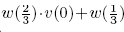 · v(600). If the former is greater than the latter, then the person should be risk averse and prefer the certain outcome to the gamble.
A critical aspect of framing concerns the ability to evaluate prospects from different reference points. This is illustrated in Figure 2, which demonstrates a hypothetical timeline in relation to the Asian disease problem. The timeline involves two events, here labeled incident and prospect. The incident corresponds to the information that 600 lives are expected to be lost. The prospect corresponds to the information that there are two treatment programs each with a particular outcome structure. Differential framing of this problem corresponds to a shift between two reference points, labeled A and B. Point A corresponds to the state of affairs before the incident, while point B corresponds to the state of affairs after the incident. Relative to A, the set of outcomes are evaluated as losses while relative to B, the same outcomes are evaluated as gains.
Evaluation of outcomes from two reference points, A and B. Outcomes are evaluated as losses relative to A but are evaluated as gains relative to B.

The structure illustrated in Figure 2 may be readily extended to a litigated dispute. This is shown in Figure 3 and corresponds to the hypothetical scenario which we used in the two experiments to be described later. It illustrates the set of events that confront the plaintiff or aggrieved party in the dispute. In this case, the incident corresponds to information that the plaintiff has lost some amount of money (in the present scenario, this is equal to $20,000). The prospect corresponds to a choice between a settlement offer of $10,000 (the certain outcome) and the gamble associated with going to court. This is presented as a 50% chance of receiving $20,000 if they win at trial and a 50% chance of receiving nothing if they lose at trial. However, as in the Asian disease problem, the plaintiff may evaluate this prospect relative to two different reference points. Relative to point A, the outcomes are evaluated as losses while relative to point B, they are evaluated as gains.
Plaintiff’s evaluation of outcomes from two reference points, A and B. Outcomes are evaluated as losses relative to A but are evaluated as gains relative to B.

Figure 4 presents the same scenario, this time from the defendant’s point of view. In this case, the incident corresponds to information that the defendant has acquired the equivalent of $20,000 (the legitimacy of which is disputed by the plaintiff), and the prospect corresponds to a choice between a settlement offer of $10,000 and the gamble of going to court which entails a 50% chance of paying $20,000 if they lose and a 50% chance of paying nothing if they win. Yet the defendant may evaluate this prospect with respect to the same two reference points as the plaintiff. In this case, however, relative to A, the outcomes are evaluated as gains while relative to B, they are evaluated as losses.
Defendant’s evaluation of outcomes from two reference points, A and B. Outcomes are evaluated as gains relative to A but are evaluated as losses relative to B.

1.1.1 Effects of framing on litigation
Prior research investigating the effect of framing on litigation outcomes has focused on the proposition that plaintiffs and defendants tend to adopt positive and negative frames, respectively, and that this determines their different propensities to settle. In one of the first studies to examine this question, Reference van Koppenvan Koppen (1990) presented participants with two hypothetical scenarios involving the purchase of a puppy. In the plaintiff scenario, participants were told that shortly after they had paid for the puppy, it had died from a congenital defect and that they were now suing the breeder for a refund. In the defendant scenario, the puppy had died prior to the payment being finalized and they were now being sued by the breeder for this payment. Although not made explicit, van Koppen assumed that both plaintiffs and defendants would evaluate their options from a post-incident reference point, corresponding to B in Figures 3 and 4, and that, as a consequence, plaintiffs would be in a positive or gain frame, while defendants would be in a negative or loss frame. In two of four experiments, van Koppen found the expected result; plaintiffs tended to be risk averse and prepared to accept a relatively low fraction of the amount in dispute while defendants tended to be more risk taking and prepared to pay only a similarly low fraction of the disputed amount.
Although van Koppen found some results consistent with the hypothesis that plaintiffs tend to be risk averse and defendants risk seeking, the objective facts of the case varied between the two scenarios, so it is not possible to attribute the observed differences entirely to framing. In a later study, Rachlinski (1996; Experiment 1) replicated the main result found by van Koppen using a scenario that was closer in form to the Asian disease problem. Participants were presented with the same legal dispute from either the plaintiff’s or defendant’s point of view. They were then asked to choose between two options; accepting a fixed settlement or going to trial with an equivalent expected outcome. For example, in one scenario the amount in dispute was $100,000 and the two alternatives were either to accept a settlement offer of $30,000 or to go to trial where there was a 30% chance of winning and receiving $100,000 and a 70% chance of losing and receiving effectively nothing. Overall, the results were consistent with differential framing of plaintiffs and defendants with 82% of plaintiffs choosing to settle compared with only 45% of defendants.
Both Reference van Koppenvan Koppen (1990) and Reference RachlinskiRachlinski (1996) presented positively framed scenarios to plaintiffs and negatively framed scenarios to defendants. While the results they found are consistent with the effects of framing, they may also be attributed to effects of the different legal roles. A potential effect of role has been highlighted in a series of studies of two-party price negotiations conducted by Neale, Bazerman and colleagues (Reference Blount, Thomas-Hunt and NealeBlount, Thomas-Hunt, & Neale, 1996; Reference Neale and BazermanNeale & Bazerman, 1985; Reference Neale, Huber and NorthcraftNeale, Huber, & Northcraft, 1987). In two-party price negotiation, two parties identify a mutually satisfactory settlement agreement for the exchange of goods and services. These types of transactions, such as buying a car, occur daily and form the foundation of a market economy. Transactions of this nature are also structurally similar to litigious negotiations in which two parties negotiate over the value (i.e. the proposed settlement) that should be assigned to a given legal infraction.
In the context of price negotiation research, “role” refers to the assignment of an individual to be either a buyer or a seller. Numerous studies have found that in power-balanced (symmetrical) negotiations, where role is an arbitrary assignment, buyers consistently outperform sellers. That is, buyers complete transactions of greater average value than sellers (see for example Reference Bazerman, Magliozzi and NealeBazerman, Magliozzi, & Neale, 1985; Reference Neale and BazermanNeale & Bazerman, 1985; Reference Neale, Huber and NorthcraftNeale et al., 1987). To explain this, Reference Neale, Huber and NorthcraftNeale et al. (1987) suggested that adopting a role induced a re-framing of the stakes. On this view, sellers tend to adopt a positive frame since they stand to gain something of determinate value (money) from the transaction while buyers tend to adopt a negative frame since they stand to lose the same amount. Sellers therefore will tend to be risk averse and prepared to enter into a transaction for a lower amount than the objective value of the item in question. Similarly, buyers will tend to be relatively risk seeking and less prepared to pay more than the objective value of the item. The parallel with plaintiffs, who may be viewed as sellers of their right to sue, and defendants who may be viewed as buyers of that right, is clear.
Reference Neale, Huber and NorthcraftNeale et al. (1987) investigated the effect of frame and role by comparing two price negotiation conditions. In the role present condition, participants were assigned the role of either buyer or seller and instructed to agree upon a price mix of negotiable commodities that included discount terms, delivery time, and financing terms. In the role absent condition, negotiators were assigned meaningless roles (“Phrablies” and “Grizzats”) as were the negotiable commodities, relabelled “slatkins,” “drigglers” and “finmals.” In all other respects the two conditions were identical. Frame was manipulated by presenting the value of the negotiable commodities in terms of profits (positive frame) or in terms of expenses (negative frame). In the role absent condition, there was an effect of frame but no effect of role. Negotiators in a positive frame were relatively risk averse and completed more transactions at a lower average profit than negotiators in a negative frame. In the role present condition, similar results were found only for number of transactions completed. However, in this condition, buyers generated more profit per transaction than sellers and for both roles there was no effect of frame. This result suggests that adopting a socially defined role may affect negotiation behaviour independently of frame. To the extent that similar factors may be at work in litigation, it suggests that the effect on decision making of being a plaintiff or defendant may be independent of the different ways of framing the outcomes.
In order to distinguish the effects of role and frame, it is necessary to vary frame for both plaintiffs and defendants. One previous study by Reference Korobkin and GuthrieKorobkin and Guthrie (1994) attempted to do this for plaintiffs. In this study, participants were told that they had been involved in a motor vehicle accident in which they had sustained damages worth $28,000 and that according to their lawyer they would receive either $10,000 or $28,000 at trial, depending on how the judge interpreted a clause in the relevant insurance policy. They were also told that the defendant (the insurance company) had made a final offer of $21,000, and were asked to indicate whether they would accept such an offer. Participants were then given further information that placed them into either a positive or negative frame. In the positive frame, participants were told that their total damages consisted of $14,000 in medical bills that had already been paid by their health insurance fund and a further $14,000 corresponding to the value of their motor vehicle. In the negative frame, participants were told that their total damages consisted of $4,000 in medical bills that had already been paid by their health insurance fund and a further $24,000 corresponding to the value of their motor vehicle. Faced with these alternatives, Korobkin and Guthrie found that 90% of positively framed plaintiffs would either probably or definitely accept the offer, while only 64% of the negatively framed plaintiffs responded in the same way.Footnote 1
Although Korobkin and Guthrie concluded that framing can alter a plaintiff’s propensity to settle, their results are not easily interpreted for two reasons. First, for both frames, the reference point is ambiguous and, second, from any reference point, the nature of the outcomes objectively differs between frames. Figure 5 presents the structures of the positive and negative frames used by Reference Korobkin and GuthrieKorobkin and Guthrie (1994) in the same form as shown in Figures 2 to 4. It is apparent that, unlike the Asian disease problem, the scenarios used by Korobkin and Guthrie create three events on the timeline. These are defined by the incident, corresponding to the total damages incurred through the accident, initial recompense of medical bills, and the final prospect. As a result, there are three distinct reference points, A, B, and C, and only from point A do the outcomes of the prospect differ between the two frames. This means that if the difference in settlement rates is to be attributed to the difference in framing, it can only be because some proportion of participants chose to evaluate the prospect from the pre-incident point A. The problem is that there is nothing in the scenario which would suggest that they should do this and, if they were to do so, it would contradict the interpretation offered by both Reference van Koppenvan Koppen (1990) and Reference RachlinskiRachlinski (1996) of their results for which they assumed that plaintiffs would evaluate the prospect from the post-incident point B (or C). Furthermore, it is also apparent that from any of the three reference points, the values of the outcomes differed between the two framing conditions. It is therefore difficult to attribute the results to the effect of framing alone.
Outcome structures used by Korobkin & Guthrie (1994). (a) Positive or gain frame. (b) Negative or loss frame.

1.1.2 The present study
Studies of the effect of framing on litigation have not yet satisfactorily resolved two questions. The first concerns the issue of whether plaintiffs and defendants are bound by the role they play to adopt a positive and negative frame, respectively, or whether they can be induced to adopt alternative frames. In terms of the structures shown in Figures 3 and 4, this question asks whether it is possible for litigants to alter their point of reference from the post-incident point B to the pre-incident point A. The second question concerns whether the effect of legal role is completely reducible to an effect of framing or whether, as suggested by the results of Reference Neale, Huber and NorthcraftNeale et al. (1987), the explicit roles of plaintiff and defendant affect decision making independently of how the dispute is framed.
In the present study, participants received a questionnaire containing four different legal scenarios each of which dealt with a civil dispute over the sum of $20,000. Each scenario was presented in one of four forms defined by the factorial combination of legal role, plaintiff vs. defendant, and frame, positive vs. negative. For plaintiffs, positively framed scenarios described potential outcomes in terms of gains relative to the situation following the initial loss of income, corresponding to point B in Figure 3. Negatively framed scenarios, on the other hand, described potential outcomes in terms of losses relative to the situation that would have been obtained had the initial loss of income not occurred, corresponding to point A in Figure 3. For defendants, positively framed scenarios described potential outcomes in terms of gains relative to the situation that would have been obtained had the initial increase in income not occurred, corresponding to point A in Figure 4. Negatively framed scenarios described potential outcomes in terms of losses relative to the situation following the increase in income, corresponding to point B in Figure 4. In each scenario, participants were told that a single settlement offer of $10,000 was on the table. They were also told that if this offer was rejected and the case went to trial, there was a 50% chance of either being awarded or having to pay the entire sum of $20,000 and a 50% chance of being awarded or having to pay nothing. Participants read each scenario in turn and were asked if they would accept or reject the settlement offer. We expected to find an effect of both role and frame on the decision to settle, however the size of these effects and the nature of their interaction was unknown.
2 Experiment 1
2.1 Method
2.1.1 Participants
The participants were 170 psychology students at the University of Adelaide who received course credit for their participation. They were aged between 17 and 44 (M = 19.5, SD = 3.7) and were randomly assigned to one of four groups.
2.1.2 Materials
Participants completed a questionnaire consisting of four legal scenarios. (Excerpts are in the Appendix, in the versions used in Experiment 2.) Each scenario was presented in one of four test conditions defined by the factorial combination of role (plaintiff or defendant) and frame (positive or negative). Thus, each scenario could be presented to participants either as a positively framed plaintiff (P+), a negatively framed plaintiff (P–), a positively framed defendant (D+) or a negatively framed defendant (D–). The assignment of scenarios to each role/frame combination was counterbalanced across four different versions of the questionnaire. In each version, the four scenarios were always presented in the same order. In version 1, the order of conditions was P+, P–, D–, D+. The order was D–, D+, P+, P– in version 2, P–, D–, D+, P+ in version 3, and D+, P+, P–, D– in version 4.
Each scenario outlined the facts of a legal dispute which could plausibly be presented in both positive and negative frames for both the plaintiff and the defendant. The first scenario involved a defamation claim between a shop owner and a newspaper. The second scenario outlined a property dispute between an investor and a bed-and-breakfast operator. The third scenario was a contractual dispute between two business partners regarding entitlement to income. The fourth scenario described an inheritance dispute between two cousins. In each case, it was stated that the plaintiff was suing the defendant for $20,000, and that the chance of winning at trial was 50%. If the plaintiff won at trial then the defendant would have to pay the full $20,000. Alternatively, if the plaintiff lost at trial then the defendant would have to pay nothing. For simplicity, there were no legal costs associated with the case. Each participant was told that a settlement offer of $10,000 had been made and they were asked if they would be prepared to accept it.
Each scenario established the relevant legal role by means of an initial statement of the form: “You are the plaintiff/defendant in a litigation suit…” The relevant frame was established through alternative wording of the trial outcomes and the offer. For example, in the first scenario, the trial outcome in the P+ condition is described as follows,
“Your lawyer has estimated that you have a 50% chance that the judge will rule in your favor and your will receive $20,000 in compensation and a 50% chance that the judge will rule against you and you will receive nothing in compensation”
Similarly, the settlement offer in this condition is described in the following way,
“If you accept this offer, you will receive $10,000 in compensation”
In the D– condition, the phrase, “receive … in compensation”, was replaced by the phrase “pay … in compensation”. In the P– condition, this phrase was replaced by the phrase, “lose … in income”, while in the D+ condition, it was replaced by the phrase, “keep … in new income”.
2.1.3 Design and Procedure
Participants were randomly allocated to one of four groups corresponding to the version of the questionnaire they received. They were asked to read and respond to all four scenarios in the order in which they were presented. They were instructed to consider each scenario separately and to make their decision solely on the basis of the details provided, without regard to legal fees or court costs. They were also asked not to view the scenarios as moral dilemmas, as both plaintiffs and defendants would feel that their position was correct.
2.2 Results
Figure 6 shows the overall proportion of accepted settlements averaged over scenario as a function of legal role and frame. The data were analyzed using logistic regression in which each response was treated as an independent observation.Footnote 2 This analysis revealed a significant effect of frame, χ2 (1) = 54.18, p < 0.0001, with litigants in a positive frame being more likely to settle than litigants in a negative frame, whether they were a plaintiff or a defendant. There was no overall effect of either scenario, χ2(3) = 2.46, p = 0.482, or role, χ2 (1) = 3.49, p = 0.062, and none of the interactions between frame and any other variable was significant (all p’s greater than 0.1). However, we did find an unexpected interaction between role and scenario, χ2(3) = 35.81, p < 0.0001.
Proportion of settlement acceptances as a function of legal role (plaintiff vs. defendant) and frame (positive vs. negative) averaged across scenarios in Experiment 1. The probability of settlement was 0.77 and 0.49 for plaintiffs in a positive and negative frame, respectively. For defendants in positive and negative frames, the probability of settlement was 0.70 and 0.43, respectively.

The interaction between legal role and scenario is shown in Figure 7 which plots the proportion of accepted settlements as a function of legal role and frame separately for each scenario. Analysis of each scenario revealed a significant effect of role in Scenario 1, χ2 (1) = 4.20, p = 0.040, with plaintiffs more likely to settle than defendants; a non-significant effect in Scenario 2, χ2 (1) = 0.004; a significant effect in Scenario 3, χ2 (1) = 10.82, p = 0.001, with defendants more likely to settle than plaintiffs; and a significant effect in Scenario 4, χ2 (1) = 24.20, p < 0.0001, with plaintiffs more likely to settle than defendants. The effect of frame was significant in all four scenarios and the interaction between role and frame was significant only in Scenario 4, χ2 (1) = 5.15, p < 0.023.
Proportion of settlement acceptances as a function of legal role and frame for each scenario in Experiment 1.

Experiment 1 revealed three main results. First, consistent with prospect theory, the decision to settle a simulated legal dispute is strongly influenced by frame. In all four scenarios, a litigant in a positive frame was more likely to accept the settlement offer than a litigant in a negative frame. When induced to be in a positive frame and thereby choosing between gains, participants in this study were consistently risk averse — that is, they were more likely to accept the settlement offer (certain outcome) and less likely to go to trial (uncertain outcome). Conversely, negatively framed participants, choosing between losses, were more risk taking — they were less likely to accept the settlement offer and more likely to go to trial. While this finding is broadly consistent with previous research (for example Reference Korobkin and GuthrieKorobkin & Guthrie, 1994; Reference RachlinskiRachlinski, 1996; Reference van Koppenvan Koppen, 1990), this is the first demonstration of an effect of framing that is independent of role while holding the objective facts of the case constant.
As well as being consistent across all four scenarios, the effect of frame was also substantial, with the overall proportion of acceptances increasing from 0.46 for litigants in a negative frame to 0.74 for litigants in a positive frame. This demonstrates that it is possible to induce a considerable change in the behavior of both plaintiffs and defendants by manipulating how each frames the dispute. This is consistent with the finding in other fields of negotiation that framing could play a role in both the exacerbation or resolution of conflict (see for example Reference Neale and BazermanNeale & Bazerman, 1992).
The second main result is that the effect of legal role on the decision to settle was independent of the effect of frame. This is inconsistent with the view that plaintiffs are always more risk averse than defendants and thus more likely to settle (e.g., Reference van Koppenvan Koppen, 1990; Reference RachlinskiRachlinski, 1996).
The third main result was unexpected. Although there was little or no overall difference between plaintiffs and defendants in their propensity to settle, the effect of legal role varied considerably between the different scenarios. In fact, in marked contrast to the view that plaintiffs are always more risk averse than defendants, the results for Scenario 3 showed that it is possible, under some circumstances, for plaintiffs to be less likely to settle than defendants, independently of how they frame the dispute. A superficially similar result was reported by Reference GuthrieGuthrie (2000) who found that defendants were more willing to settle than plaintiffs in “frivolous” litigation, in which plaintiffs have little or no chance of winning at trial. In this case, according to prospect theory, plaintiffs over-weight their small probability of winning while defendants under-weight their high probability of winning, leading to a preference inversion. However, this mechanism does not directly explain the present results since both plaintiffs and defendants were told that they had equal chances of winning at trial.
Although the probability of winning at trial was fixed at 50%, it may have been possible that participants departed from this amount in estimating their own subjective probability of winning, although not to the extent examined by Reference GuthrieGuthrie (2000). This estimation could have been based on the content of each scenario and the participants” general knowledge and experience of the law. If there were systematic differences between scenarios in the subjective chance of winning at trial, this would affect settlement rates and could account for the variable effect of role. Experiment 2 investigated this possibility by asking participants to provide estimates of their chance of winning at trial.
3 Experiment 2
3.1 Method
3.1.1 Participants
The participants in this study were 408 psychology students from the University of Adelaide who participated in order to receive course credit. They were aged between 16 and 39 (M = 19.6, SD = 4.03) and were randomly assigned to one of 8 groups depending upon the version and type of questionnaire they received (see below).
3.1.2 Materials
This experiment used the same questionnaires containing the same four legal scenarios and instructions as used in Experiment 1. The only difference was that participants were asked the following question:
“Your lawyer has advised that you have a 50% chance of winning in court. Based on the details provided, what chance (as a percentage) do YOU think you have of winning in court?”
There were four versions of each questionnaire as in Experiment 1. In addition, there were also two types of questionnaire. In type A, the question above was asked immediately following the request for the participant to decide whether or not to accept the settlement offer. In type B, the question was asked before the request was made for the participant to decide to accept or to reject the settlement offerFootnote 3.
3.1.3 Design and Procedure
Participants were randomly allocated to one of 8 groups defined by the combination of the two types and four versions of the questionnaire. Otherwise, the procedure was identical to that used in Experiment 1.
3.2 Results and Discussion
Figure 8 shows the proportion of accepted settlements averaged over scenario as a function of questionnaire type, legal role, and frame. The pattern of results is similar to that found in Experiment 1. The data were analyzed using logistic regression with factors of questionnaire type, scenario, role, and frame.Footnote 4 This revealed a significant effect of frame, χ2 (1) = 64.05, p < 0.0001, and, in contrast to Experiment 1, a significant effect of role, χ2 (1) = 10.55, p = 0.001. The interaction between scenario and role was also significant, χ2(3) = 199.62, p < 0.0001, as in Experiment 1. However, unlike in Experiment 1, there was a significant interaction scenario and frame, χ2 (1) = 14.21, p = 0.003. No other main effects or interactions were significant.
Proportion of settlement acceptances as a function of questionnaire type (A vs. B), legal role (plaintiff vs. defendant), and frame (positive vs. negative) averaged over scenarios in Experiment 2. The probability of the plaintiff settling was 0.75 and 0.50 for positive and negative frames, respectively. The probability of the defendant settling was 0.63 in the positive frame and 0.49 in the negative frame.

Figure 9 shows the pattern of results for each scenario and reveals the variable effect of role and frame across the four scenarios. Separate analyses of questionnaire type, role, and frame for each scenario revealed that the effect of frame was significant in all four scenarios, χ2 (1) = 13.13, 63.12, 7.50, and 9.96, respectively. In each case, a positively framed litigant was more likely to settle than a negatively framed litigant. In contrast to Experiment 1, the effect of role was significant (p < 0.02) in all four scenarios, χ2 (1) = 61.31, 6.60, 58.72, and 88.34, respectively. Plaintiffs were more likely than defendants to settle in Scenarios 1 and 4, and less likely to settle in Scenarios 2 and 3. No other effect was significant (p < 0.01) in any scenario.
Proportion of settlement acceptances as a function of questionnaire type, legal role, and frame for each scenario in Experiment 2.

Despite being informed that there was always a 50% chance of winning at trial, participants provided a wide range of estimates for what they believed to be the actual chance. Figure 10 shows the average subjective probability of losing at trial as a function of questionnaire type, role, and frame for each scenario. These estimates covered the full range from zero to one and were approximately normally distributed with an overall mean of 0.476 and a standard deviation of 0.197. Analysis of variance revealed a main effect of frame, F(1,1600) = 7.81, MSE = 2166.1, p = 0.005, with a positive frame leading to a greater subjective probability of losing than a negative frame (M = 0.488 and M = 0.465, respectively). There was also a main effect of role, F(1,1600) = 60.39, MSE = 16742.1, p < 0.0001, with plaintiffs perceiving themselves as having a greater chance of losing than defendants (M = 0.509 and M = 0.444, respectively). As Figure 10 also shows, the interaction between scenario and role was highly significant, F(3,1600) = 188.85, MSE = 52360.6, p < 0.0001. No other effects were significant.
Average subjective probability of losing at trial as a function of questionnaire type, legal role and frame for each scenario.

The present data also show evidence of a self-serving bias — the propensity for individuals in a given role to over-estimate their probability of winning at trial. In order to investigate this, the defendant’s subjective probability of losing was converted into the subjective probability of winning which corresponds to the defendant’s subjective probability that the plaintiff should lose. Any effect of role in the analysis of these data would indicate a self-serving bias (or its opposite). Analysis of variance revealed such a main effect, F(1,1600) = 32.0, MSE = 8871.3, p < 0.0001, with plaintiffs estimating their chance of losing as being less than that estimated by defendants (M = 0.509 and M = 0.556, respectively). There was also a small but significant interaction between role and frame, F(1,1600) = 7.81, MSE = 2166.1, p < 0.01, with frame affecting plaintiffs’ perceived chances of losing (Ms = 0.527 and 0.489 for positive and negative frames, respectively), while having little or no effect on defendants’ perceived chance of the plaintiffs losing (Ms = 0.558 and 0.553 for positive and negative frames, respectively).
It is clear from a comparison of Figures 9 and 10 that variability in the effect of role on the probability of accepting a settlement across scenario is strongly related to corresponding variation in the subjective probability of losing at trial. For both plaintiffs and defendants, a high perceived chance of losing at trial is correlated with an increased chance of accepting the settlement offer. In order to test this hypothesis more formally, the data from Experiment 2 were re-analyzed using subjective probability of losing (or winning) as a covariate. This revealed, as expected, that perceived probability of winning is a very strong predictor of settlement, χ2 (1) = 533.5, p < 0.0001. Furthermore, once variation in subjective probability has been controlled for, the main effect of role is completely eliminated, χ2 (1) = 0.03, p = 0.873. In contrast, the effect of frame remains significant, χ2 (1) = 68.78, p < 0.0001, as is the interaction between frame and scenario, χ2 (3) = 11.06, p = 0.011. There is now a significant main effect of scenario, χ2 (3) = 8.67, p = 0.034, and the interaction between scenario and role, while much reduced, remains statistically significant, χ2 (1) = 18.9, p < 0.001.
Analysis of the individual scenarios revealed a similar pattern, with subjective probability highly significant (p < 0.001) in all scenarios. When the effect of this covariate is removed, the effect of frame remains significant (p < 0.01) in three of the four scenarios, χ2 (1) = 14.68, 54.2, 10.37 and 6.58, respectively. The effect of role, while still significant (p < 0.01) in two of the four scenarios, was substantially reduced, χ2 (1) = 6.65, 0.10, 9.10 and 4.96, respectively. The interaction between role and frame is not significant (p < 0.01) in any scenario.
3.2.1 The effects of role, frame, and perceived chance of losing
It is possible to combine the results of Experiment 2 in a single figure that demonstrates the effects of role, frame, and perceived chance of winning on the probability of accepting the settlement offer. According to prospect theory, the offer will be accepted if its subjective value is greater than the subjective value of going to trial. An individual in a positive frame, whether plaintiff or defendant, should therefore settle if,

where v(.) is a subjective value function that takes a quantity (money in this case) as its argument, and w(.) is a weighting function applied to the subjective probability of winning at trial, p. According to Reference Kahneman and TverskyKahneman and Tversky (1979), people tend to assign greater weight or importance to probabilities close to zero and relatively less importance to probabilities close to one. A similar equation can be written for an individual in a negative frame. In this case, such an individual should settle if,

In other words, they will settle if the perceived value of the settlement offer is greater than the expected value of going to trial. This, in turn, is determined by the weighted subjective probability of winning at trial, and losing nothing, and the weighted subjective probability of losing at trial and losing the full amount.
In the present study, the objective values of the settlement offer, $10,000, and the award, $20,000, were both fixed. According to prospect theory, the subjective values of these quantities are therefore also fixed for a given individual. We assume that these values are also fixed across individuals. This means that, after re-arranging the terms in the above equationsFootnote 5, for an individual in a positive frame, the settlement offer will be accepted whenever,

while, for an individual in a negative frame, the offer will be accepted whenever,

As Figure 10 shows, the average subjective probability of losing at trial varies across the set of conditions defined by the levels of role, frame, and scenario. We assume that within each such condition, subjective probability is approximately normally distributed with a mean and standard deviation corresponding to the observed mean and standard deviation for that condition. We also assume, as a first approximationFootnote 6, that w(p) = p. In this case, the above two equations can be expressed in terms of the subjective probability of losing, q = 1 − p. Thus, an individual in a positive frame should settle whenever q > 1 − r +, and an individual should settle whenever q > r −, from which it follows that, if (1 −r +) < r −, then a framing effect will be observed.Footnote 7 According to prospect theory, the value function, v(.), is concave for gains and convex for losses which means that r + > 0.5 and r − > 0.5. Therefore, prospect theory predicts that (1 − r +) < r −.
Figure 11 illustrates the proposed relationship between framing, subjective probability of losing at trial, and the probability of accepting the settlement offer. The distribution indicated by a dashed line describes the probability of losing at trial in a positively framed condition of the present experiment. The distribution indicated by a solid line describes the probability of losing at trial in a negatively framed condition corresponding to the same scenario, role, and questionnaire type. The distributions are shown as being slightly different to accommodate the finding that the perceived chance of losing was greater when in a positive frame than when in a negative frame. The variances of the two distributions may also differ. The two vertical lines correspond to the criteria, (1 – r +) and r −, defined above. According to the proposed model, the probability of accepting the settlement offer in the positively framed condition is equal to the area under the corresponding distribution to the right of the positive criterion, (1 − r +). Similarly, the probability of accepting the settlement offer in the negatively framed condition is equal to the area under the corresponding distribution to the right of the negative criterion, r −. For the purposes of fitting this model, we assumed that subjective probability was normally distributed within each condition, defined by a unique combination of questionnaire type, scenario, role, and frame, and that the two criteria, r + and r −, were independently normally distributed with a constant standard deviation across conditions. This has the effect of augmenting the variance of each distribution of subjective probability in each condition by a fixed amount.Footnote 8 Let mi and si be the mean and the augmented standard deviation of the subjective probability of losing at trial for condition i. Let pi be the probability of accepting the settlement offer in condition i, and let Φ(.) be the normal cumulative distribution function. Then, for positively framed conditions, 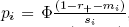 , while for negatively framed conditions
 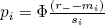 .
.
Hypothetical distributions of the subjective probability of losing at trial in relation to settlement criteria for positively framed (dashed line) and negatively framed (solid line) judgments. The probability of settling in each distribution is given by the area to the right of the corresponding criterion, (1 − r +) for positively framed judgments and r − for negatively framed judgments.

Figure 12 shows the observed probability of accepting the settlement offer as a function of the subjective probability of losing at trial for each combination of role, frame, scenario, and questionnaire type. The model fit the data reasonably well, χ2 (29) = 40.97, p = 0.069, although, as Figure 12 shows, there are features of these data that it fails to capture. Figure 12 also shows two curves corresponding to functions that approximate the fitted model. For these functions, displayed for illustrative purposes only, the variance was constrained to be constant across all conditions (i.e., si = s for all i). Since variance estimates did not differ substantially between the different conditions, these functions also fit the data quite well. The dashed line corresponds to positively framed conditions while the solid line corresponds to negatively framed conditions derived from the best fitting maximum likelihood estimates of r + and r −, respectively. These values were found to be 0.634 and 0.475, and, according to the derivations given above, may be interpreted as the relative value of a gain or loss of $10,000 compared to a similar gain or loss of $20,000. The values that we obtained indicate that for this sample of participants and conditions, a gain of $10,000 is perceived as equivalent to 63.4% of a gain of $20,000 while a loss of $10,000 is perceived as equivalent to 47.5% of a loss of $20,000. The estimate of r + is thus consistent with prospect theory which proposes that the subjective value function is negatively accelerating for gains. The estimate for r − is not as consistent since it is less than 0.5 and thus indicates a negatively, rather than positively, accelerating value function for losses. However, the estimate is very close to 0.5 and, if the true value is slightly greater than 0.5, this would be consistent with the proposal from prospect theory that the value function for losses is both positively accelerating and relatively steeper (i.e., accelerating less) than the value function for gains.
The probability of accepting the settlement offer as function of role, frame, and the subjective probability of losing for each scenario and questionnaire type. The dashed line shows the best fitting constant variance function for positively framed conditions. The solid line shows the best fitting constant variance function for negatively framed conditions.

Figure 12 also illustrates two additional effects. First, it demonstrates the general trend for participants to become less risk taking as their subjective probability of losing increases. This agrees with both prospect theory and commonsense — if you think you are going to lose at trial then, if you are the defendant, you are more likely to pay a relatively higher sum to settle and, if you are the plaintiff, you are more likely to accept a relatively smaller sum to settle. Yet, these results directly contradict the conclusion reached by Reference van Koppenvan Koppen (1990) that litigants become more risk taking as their subjective probability of losing increases. The present finding is also inconsistent with Reference GuthrieGuthrie (2000), who proposed that risk preferences are a function of only role and the probability of losing.
The second effect shown by Figure 12 concerns the relative effects of framing and legal role. One of the principal results of the present study is that while there is a consistent effect of framing on the probability of accepting the settlement offer across all scenarios, there is no overall effect of role. However, that being said, there remains a significant interaction between role and scenario, even after accounting for differences in the perceived chance of losing. As the data shown in Figure 12 suggests, their may be a residual effect of role in different scenarios. In this case, role may interact in idiosyncratic ways with the contents of the particular case to affect propensity to settle independently of the perceived chance of losing. This appears to be most apparent in Figure 12 in relation to the two data points corresponding to D–. These points both relate to Scenario 4 and suggests that there is something about the content of this scenario that encourages defendants to settle over and above the effects of framing or the perceived chance of losing. We can offer no obvious explanation for this particular effect.
4 Conclusions
The principal result of the present study is that the likelihood of accepting an offer to settle out of court is determined by two factors; the frame or reference point from which the offer is evaluated and the subjective probability of losing (or winning) at trial. This is the first study that examined the effect of frame independently of role and helps to clarify the results of earlier studies of decision making by litigants. In two experiments involving over 500 participants, plaintiffs and defendants were equally susceptible to framing manipulations, a result that is inconsistent with the view that plaintiffs are always be risk-averse and defendants are always risk-seeking. Although it may very well be the case that plaintiffs will tend to adopt a gain frame and defendants similarly a loss frame, the present results suggest that this is not immutable and that some latitude exists to re-frame the respective parties. In so doing, the likelihood of reaching a settlement may increase, particularly if the defendant can be induced to adopt a positive or gain frame. It is important to note, however, that no attempt was made in the present study to place plaintiffs and defendants in different frames within the same dispute. Rather, individuals were asked to evaluate a fixed settlement offer in one of the two roles. To pursue this question further, it would be necessary to place plaintiffs and defendants involved in the same dispute into different frames in a manner analogous to similar work in the area of two party price negotiations (see for example Neale & Bazerman, 1992).
We were able to manipulate frame relatively easily in the present study as the participants were all involved in simulated legal disputes. As is the problem with most applied research conducted in the laboratory, it is unclear the extent to which participants took on the roles they were given, and how easy it would be to manipulate frame in real disputes. It is also unclear what effect the instruction to disregard legal fees had on participants and how this might be different for real litigants. Further research is required to determine the extent to which actual litigants adopt variable reference points in their evaluations, the extent to which these are fixed or are labile throughout negotiations, and how easily they may be influenced by third parties, such as lawyers.
Appendix: Selections from scenarios
Scenario 1: Plaintiff (positive frame)
You are the plaintiff in a litigation suit, for which the details are as follows. You are the owner of a small gourmet deli. Recently, a local newspaper published a series of articles entitled “Are these the city’s worst employers?” The articles discussed a number of small businesses in the area and accused them of underpaying their staff and providing sub-standard working conditions. While no names were given, you feel that as a consequence of these articles, customers stayed away and your business suffered $20,000 in lost income.
You have been to see your lawyer and he has advised that you have a claim for restitution. Your lawyer has entered into negotiations with the newspaper on your behalf. You are seeking $20,000 in compensation. The newspaper denies the claim on the basis that they did not identify your business, and that the descriptions given in the articles could have referred to any number of businesses.
You have been involved in lengthy legal negotiations with the newspaper and no settlement has been reached. You have decided to pursue the matter in court and a trial date has now been set. Your lawyer has advised that the success of your case depends on whether or not the judge feels you can be definitively identified from the facts given in the articles. Your lawyer has estimated that you have a 50% chance that the judge will rule in your favour and you will receive $20,000 in compensation and a 50% chance that the judge will rule against you and you will receive nothing in compensation.
The night before the trial is due to begin, your lawyer calls to tell you that the newspaper has offered to settle out of court. If you accept this offer, you would receive $10,000 in compensation. This is the final offer before the trial and your decision must be made before the morning.
Will you accept the offer? [yes] [no]
Your lawyer has advised that you have a 50% chance of winning in court. Based on the details provided, what chance (as a percentage) do YOU think you have of winning in court?
Approximately _______% chance of winning.
Scenario 1: Plaintiff (negative frame)
[…]
You have been involved in lengthy legal negotiations with the newspaper and no settlement has been reached. You have decided to pursue the matter in court and a trial date has now been set. Your lawyer has advised that the success of your case depends on whether or not the judge feels you can be definitively identified from the facts given in the articles. Your lawyer has estimated that you have a 50% chance that the judge will rule in your favour and you will lose no income and a 50% chance that the judge will rule against you and you will lose $20,000 in income.
The night before the trial is due to begin, your lawyer calls to tell you that the newspaper has offered to settle out of court. If you accept this offer, you would lose $10,000 in income. This is the final offer before the trial and your decision must be made before the morning.
[Same questions.]
Scenario 1: Defendant (positive frame)
You are the defendant in a litigation suit, for which the details are as follows. You are the editor of a free, local newspaper. You recently published a series of articles entitled “Are these the city’s worst employers?” The articles discussed a number of small businesses in the area and accused them of underpaying their staff and providing sub-standard working conditions. While no names were given, as a consequence of these articles, your circulation grew and you gained $20,000 in additional advertising income.
However, the owner of a local gourmet deli has brought an action against you for restitution of lost income. She claims that as a consequence of these articles, customers stayed away from her business and she suffered $20,000 in lost income. She is seeking $20,000 in compensation. You deny the claim on the basis that you did not identify her business and that the descriptions given in the articles could have referred to any number of businesses.
You have been involved in lengthy legal negotiations with the deli owner and no settlement has been reached. She has decided to pursue the matter in court and a trial date has now been set. Your lawyer has advised that the success of your case depends on whether or not the judge feels the deli can be definitively identified from the facts given in the articles. Your lawyer has estimated that you have a 50% chance that the judge will rule in your favour and you will keep $20,000 in new income and a 50% chance that the judge will rule against you and you will keep none of the new income.
The night before the trial is due to begin, your lawyer calls to tell you that the deli owner has offered to settle out of court. If you accept this offer, you would keep $10,000 in new income. This is the final offer before the trial and your decision must be made before the morning.
Scenario 1: Defendant (negative frame)
[…]
You have been involved in lengthy legal negotiations with the deli owner and no settlement has been reached. She has decided to pursue the matter in court and a trial date has now been set. Your lawyer has advised that the success of your case depends on whether or not the judge feels the deli can be definitively identified from the facts given in the articles. Your lawyer has estimated that you have a 50% chance that the judge will rule in your favour and you will have to pay no compensation and a 50% chance that the judge will rule against you and you will have to pay $20,000 in compensation.
The night before the trial is due to begin, your lawyer calls to tell you that the deli owner has offered to settle out of court. If you accept this offer, you would have to pay $10,000 in compensation. This is the final offer before the trial and your decision must be made before the morning.
Scenario 2: Plaintiff (positive frame)
You are the plaintiff in a litigation suit, for which the details are as follows. You are the owner of an investment property 200km from the city. Recently, the bed and breakfast next door to your property built an extra cabin. You have discovered that this extra cabin actually extends onto your property.
You have been to see your lawyer and he has advised that you have a claim for restitution. Your lawyer has entered into negotiations with the bed and breakfast on your behalf. Since land value in the area is rising rapidly, you are facing a loss of $40,000 in from the expected increase in the future value of the land. The bed and breakfast has refused to pay that much, claiming they should only have to pay the current market value of the land, which is half that amount. In this case you would face a loss of $20,000 in future earnings.
You have been involved in lengthy legal negotiations with the bed and breakfast and no settlement has been reached. You have decided to pursue the matter in court and a trial date has now been set. Your lawyer has advised that the success of your case depends on the judge’s interpretation of a council by-law which determines how a dispute of this kind is to be resolved. Your lawyer has estimated that you have a 50% chance that the judge will rule in your favour and you will receive $40,000 in compensation and a 50% chance that the judge will rule against you and you will receive only $20,000 in compensation.
The night before the trial is due to begin, your lawyer calls to tell you that the bed and breakfast has offered to settle out of court. If you accept this offer, you would receive $30,000 in compensation. This is the final offer before the trial and your decision must be made before the morning.
Scenario 3: Plaintiff (positive frame)
You are the plaintiff in a litigation suit, for which the details are as follows. You are part-owner of a gym. While you were overseas, your partner installed a vending machine on the premises without consulting you. During this time, the machine generated $40,000 in income. On your return, you claim that as you are an equal partner in the gym, you are owed half of the profits and that you have suffered $20,000 in lost income.
You have been to see your lawyer and he has advised that you have a claim for restitution. Your lawyer has entered into negotiations with your partner on your behalf. You are seeking $20,000 in lost income. Your partner denies the claim on the basis that the vending machine was not part of the gym.
You have been involved in lengthy legal negotiations with your partner and no settlement has been reached. You have decided to pursue the matter in court and a trial date has now been set. Your lawyer has advised that the success of your case depends on whether or not the judge feels that the vending machine was part of the joint business enterprise. Your lawyer has estimated that you have a 50% chance that the judge will rule in your favour and you will receive $20,000 of the profits and a 50% chance that the judge will rule against you and you will receive none of the profits.
The night before the trial is due to begin, your lawyer calls to tell you that your partner has offered to settle out of court. If you accept this offer, you would receive $10,000 of the profits. This is the final offer before the trial and your decision must be made before the morning.
Scenario 4: Plaintiff (positive frame)
You are the plaintiff in a litigation suit, for which the details are as follows. Your aunt recently died and, having no children of her own, left the bulk of her estate to you and your cousin. As prescribed by the will, you each received $10,000. However, your cousin also received a portfolio of shares, worth approximately $20,000. You believe that the portfolio should have gone to you since your aunt had promised it to you before she died.
You have been to see your lawyer and he has advised that you have a claim for possession. Your lawyer has entered into negotiations with your cousin on your behalf. You claim you should receive a total of $30,000 from your aunt’s estate. Your cousin denies the claim, stating that the will left the portfolio to her.
You have been involved in lengthy legal negotiations with your cousin and no agreement has been reached. You have decided to pursue the matter in court and a trial date has now been set. Your lawyer has advised that the success of your case depends on whether or not the judge accepts your evidence of your aunt’s promise to give you the portfolio. Your lawyer has estimated that you have a 50% chance that the judge will rule in your favour and you will receive $30,000 from your aunt’s estate and a 50% chance that the judge will rule against you and you will receive only $10,000.
The night before the trial is due to begin, your lawyer calls to tell you that your cousin has offered to settle out of court. If you accept this offer, you would receive $20,000 from the estate. This is the final offer before the trial and your decision must be made before the morning.


 Open access

