


Since August 2004, organisations within the National Health Service have been legally obliged to ensure adherence to the European Working Time Directive (EWTD). This health and safety legislation enforces a number of limitations on the duration and organisation of clinical experience. Both before and after the enactment of the legislation, concerns have been raised with regard to the influence of these limitations on present-day training needs and the future clinical acumen of doctors. Such concerns have been commonplace in a range of specialties (Reference Chesser, Bowman and PhillipsChesser et al, 2002) and the problems and potential solutions have been well discussed (Reference Brown and BhugraBrown & Bhugra, 2005).
We have noted a significant fall in the pass rate of those sitting MRCPsych part II examinations, from 47.95% (269 of 561) in Spring 2004, to 43.73% (244 of 558) in Autumn 2004, and to 40.64% (278 of 684) in Spring 2005. The difference between the two Spring values is significant (Fisher's exact test, P=0.01). Suggestions have been made that this might relate to a reduction in clinical experience following the advent of the EWTD. Only 12% of senior house officers (SHOs) disagree that on-call time is important for the MRCPsych; 33% are undecided. Similarly, 94% of SHOs agree or strongly agree that on-call time is an important part of the training (Reference Callaghan, Hanna and BrownCallaghan et al, 2005).
It is the purpose of our paper to examine the experience of the on-call SHO within our trust in order to examine where specific skills are being lost, and to provoke discussion of the issue. It seems self-evident that a reduction in working hours will lead to a loss of skills. Hence, it is necessary to consider the most efficient use of SHO time.
Method
Our trust is a medium-sized mental health trust, and is broadly divided into two regions: North and South Bedfordshire. The total population served is approximately 550 000. We conducted the data collection in North Bedfordshire, where there are six SHOs operating a 1 in 6 on-call system, supporting a population of 270 000. In our trust we have adhered to the EWTD through the application of a 24 h nurse-led accident and emergency (A&E) liaison system, with the on-call SHO providing service to the psychiatric wards, and back-up for the liaison nurse on a non-residential basis.
We retrospectively examined available case notes for patients seen by the liaison nurse team between 1 October 2004 and 31 January 2005, covering 267 liaison A&E assessments. We considered these cases in terms of their presenting features and SHO follow-up.
Results
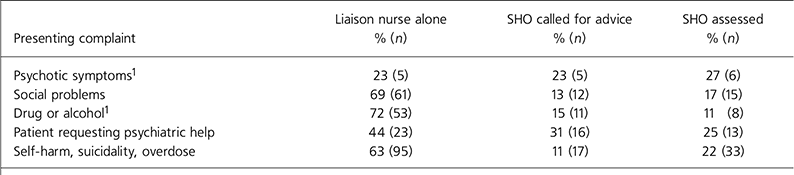
Our results showed that under the current system the majority of patients are now seen without any SHO intervention whatsoever. Fifty-nine per cent (n=157) of cases were attended only by a liaison nurse, and received neither SHO assessment nor telephone advice. The liaison nurse telephoned the on-call SHO for advice in 17% of cases (n=45), complete SHO assessment making up 20% (n=53). An analysis of assessment type according to presenting symptom is shown in Table 1. Note that for each presenting complaint, the percentages do not necessarily total 100%. Specifically in the case of psychotic symptoms, 5 of the 22 patients were directly assessed by the crisis resolution and home treatment team, bypassing the SHO. In one case the patient had absconded before the SHO could be involved.
Assessment type according to presenting symptom
| Presenting complaint | Liaison nurse alone % (n) | SHO called for advice % (n) | SHO assessed % (n) |
|---|---|---|---|
| Psychotic symptoms1 | 23 (5) | 23 (5) | 27 (6) |
| Social problems | 69 (61) | 13 (12) | 17 (15) |
| Drug or alcohol1 | 72 (53) | 15 (11) | 11 (8) |
| Patient requesting psychiatric help | 44 (23) | 31 (16) | 25 (13) |
| Self-harm, suicidality, overdose | 63 (95) | 11 (17) | 22 (33) |
An incidental finding of our data collection was that the initiation of a crisis resolution and home treatment service further reduced the number of patients seen. We compared periods of 2 months before and after the introduction of this service: the percentage of patients with SHO input fell from 43% (62) to 30% (34). Application of Fisher's exact test yields a P value of 0.0379.
Discussion
The liaison nurses alone assess a large proportion of patients (59%). It is clear that current SHOs are receiving only a fraction of previous experience, particularly where the presenting problem is judged to be ‘social’ or to have an aspect of substance misuse. Other presenting features such as a history suggestive of psychosis are much more likely to be referred to the SHO; however, even in these cases the number of patients assessed has fallen.
Six per cent of our patients (n=16) presented with symptoms that could only be described as social. We found that 2 of our 16 patients went on to be admitted. This only serves to underscore the necessity of depth of skills, particularly in risk assessment.
It is clear that in terms of quantity our current SHOs will have decreased experience of emergency psychiatry. It can be argued that, given more time for assessment, each emergency case will provide richer experience. Moreover, it does not necessarily follow that less time in emergency psychiatry makes for worse psychiatrists. Extra time can be spent developing other skill areas. However, our data suggest specific deficits in particular presentations, and it is the opinion of the authors that consideration should be given to ensure opportunity in these scenarios.
How, then, can we modify our systems to still adhere to the EWTD and to ensure appropriate training? A number of options for ensuring an adequate skill base have been discussed. First, the development of crisis resolution and home treatment teams since the publication of the Department of Health's Mental Health Policy Implementation Guide (Department of Health, 2001) represents an opportunity for efficacious gain of emergency assessment skills. It is not surprising that a service designed to reduce in-patient care has led to a reduction in coverage by SHOs who work within the hospital. We believe it is feasible to designate a defined period with the crisis resolution and home treatment team, at a time agreed within the team. Such a method has been tried within our own trust and has met with enthusiasm from all involved.
The second option is a specific requirement for experience of emergency psychiatry within agreed learning plans at the start of training. Despite having clear disadvantages (the experience of medicine should be its own gain, not a battle for signatures), this would standardise and ensure sufficient training quality, and could be integrated into the existing log-book system.
A third option is encouragement of the liaison nurse to contact the SHO or to make joint assessments. Both of these alternatives would take the SHO away from other responsibilities. Joint assessment is plainly more expensive, and some would argue that this system represents replication of work. However, it has the benefit of allowing the SHO to gain from working with an individual with a wide breadth of experience of the hospital system.
Fourth, fully shift-based systems have the flexibility to allow adherence to EWTD and full on-call experience. This would have an impact on continuity of patient care and the ability to provide training to SHOs (e.g. during night shifts).
Finally, modified traditional on-call systems with regularly scheduled full on responsibility can maintain structure for SHOs, and maintain on-call experience. However, by their nature they make planning within teams erratic and unpredictable, and are not flexible enough to cope with the varying level of need encountered in psychiatry. Senior house officers find themselves on call on their firm's busiest days, over-stretching them or their teams.
Limitations
Our data are only representative of the modified traditional on-call system in use in North Bedfordshire and cannot be broadly generalised to other systems. We hope to extend our research into the South Bedfordshire area, and to contrast their system, which is organised according to the last option described above.
Declaration of interest
None.


 Open access


eLetters
No eLetters have been published for this article.