


Introduction
The Russian invasion of Ukraine is a key juncture in European politics. EU countries’ initial reactions to the war have been marked by a level of unity that surprised many including the Russian foreign minister. European governments reacted swiftly. Upon the invasion, 8 EU Presidents signed a letter calling for Ukraine’s admission to the EU. Moreover, the EU imposed extensive personal sanctions on members of Putin’s regime as well as its business associates, while also enacting sanctions on state enterprises, banks and other Russian organizations. The EU also announced a partial ban on Russian energy sales. Most of all, European states have contributed significant military resources to Ukraine, for example, by training the Ukrainian military and by levying additional military supplies from their own national reserves. In another unprecedented move, the EU activated the Temporary Protection Directive for the first time in history to welcome Ukrainian refugees and facilitate their relocation across states.
Some of these measures, especially the energy embargo and economic sanctions, were seen as extremely hard by European governments because of potential negative economic impacts in the short run, by pressuring prices for consumers and fuelling inflation (Chen et al. Reference Chen, Jiang, Wang and Wang2023; Liadze et al. Reference Liadze, Macchiarelli, Mortimer-Lee and Juanino2023). The delivery of heavy weapons was also debated, especially in countries that, for historical reasons, have not engaged not engaged in aiding an active defensive war effort. It seems plausible that the European public makes distinctions in their support for aid and policies that interfere directly with their perceived interests, on the one hand, and those that do not, on the other hand (Silva et al. 2022).
As the war drags on, the question is how long this initial unity in response across Europe lasts and how it is carried by public opinion? It is important to identify potential fault-lines in mass attitudes across and within EU member states on whether and how their countries should aid Ukraine in this war. While often debated, mass public opinion is particularly important in this conflict (Brighi and Giusti, Reference Brighi and Giustu2023), as solutions involve core state powers such as the use of coercive force, fiscal commitment, and administrative and institutional capacity, which cannot be simply left to technocrats or even elite-driven decision-making but needs democratic legitimization.
In this article, we ask where the publics of 16 EU countries and the UK stand on aiding Ukraine during the first year of Russia’s invasion. Why is public opinion in some countries more committed to aiding Ukraine than in others? Has the support changed over the course of the war? If so where and for which policies? Finally, how does support for Ukraine help differ across societal groups and cleavages? The results will help us understand political support for Ukraine in Europe and highlight what we still need to know. To answer these questions, I use the EUI-YouGov Survey April 2022 with 16 EU countries plus UK including 23,000 respondents as well as a second Global YouGov survey which includes ten of the original EU countries with 10,200 respondents who were asked in September 2022.
Background
There is a debate in international relations about whether and how public opinion shapes foreign policy (Kertzer 2020). While there is disagreement between elite cue (top-down) models of preference formation and value and orientation-based (bottom-up) models, both recognize that relative to domestic issues, in foreign policy, elected officials are a disproportionate source of information for the public (Berinsky Reference Berinsky2007). Indeed, the publics often seem to follow their political parties for guidance on foreign policy issues (Baum and Groeling Reference Baum and Groeling2010). Some might go as far as to argue that public opinion hardly matters which is, for example, demonstrated in the war in Afghanistan. Despite broad unpopularity of this war, participation within NATO effectively insulated states against public opinion by tying the process to multilateral politics, assuring continued military aid and intervention (Kreps Reference Kreps2010). Moreover, although doves and hawks exist in the European public, foreign policy offers more than any other policy arena the opportunity for consensus and cross-party agreement especially when facing an external enemy (Zaller Reference Zaller1992). This should not simply be reflected in swift elite decision-making but also in how united the public reacts to a conflict (Bennett et al. Reference Bennett, Flickinger, Baker, Rhine and Bennett1996). First results indicate exactly that; namely, that the majority of Europeans sees the war on Ukraine as an attack against all of Europe and seems united in reacting to the aggressor (Hoffman, 2023). Yet, we like to understand whether this image is correct and whether any European public or group is diverging from the seeming consensus.
Overall, not much has been published on public opinion on the war in Ukraine (see some exceptions by Genschel Reference Genschel2022; Moise et al., 2023 and others in the reference list). However, what do we know about it and more generally, how does the public react to an aggression on the same continent against a third country? Here, we like to highlight inter- and intra-EU member states fault-lines that help us understand any differential support and potentially any decline in support over time. There are four dimensions of these public reactions that interest us here in particular. First of all, we can expect that generally support for Ukraine depends on the overall perceived urgency of the conflict, which is shaped by its geographical proximity, the potential for the conflict to spread in the region and the perceived need to create regional stability (Otter Reference Otter2003). This particular war has been one of the very few on European soil since WWII. Watching bombs fall on houses much like one’s own raises empathy and fear (Bayram and Holmes Reference Bayram and Holmes2019; see also Karakiewicz-Krawczyk et al. Reference Karakiewicz-Krawczyk, Zdziarski, Landowski, Nieradko-Heluszko, Kotwas, Szumilas, Knyszyńska and Karakiewicz2022). The proximity of the war and the perception of the aggressor has caused anxiety in the majority of Europeans (Hoffman, 2023). Both feelings of fear of the aggressor and empathy for people under attack should be linked to the response to the war (ibid). Clearly, the few studies that exist agree on a few insights: support for helping Ukraine is indeed high (ibid). Thus, in general, we expect overall high support for aid and help to Ukraine across European Union member states, but the support should be highest in those countries in closer proximity to the aggressor.
Second, public support depends on the type of aid or help in question. In a conflict even relatively close to home, it is easier to agree to lower cost measures such as humanitarian aid and opening of borders to receive refugees. Clearly, when more conflictual views in society are involved, for example, about supporting a war effort actively, even on the defensive side, opinions will drift more apart. Some will prefer to keep a neutral stance, while others reject any weapon deliveries straight out for moral reasons. The most difficult support is being amassed when the public perceives there to be a conflict with one’s personal or one’s country’s interests (Kim Reference Kim2013; Herrmann et al. Reference Herrmann, Tetlock and Visser1999). This might be the case with heavy financial commitments, which appear to reduce the budget available for important domestic purposes. Furthermore, economic sanctions or embargos on energy transfer from the aggressor should also solicit more doubts on full-blown support (Bøggild et al. 2023; Hoffman, 2023). Moreover, the least support should of course be given to measures that ask for soldiers from one’s own country to go to Ukraine and help in the defence effort, though this is for now only a hypothetical scenario. Of course, while doubts may occur, they can be overruled by the perceived urgency and importance of the case. In sum, we expect highest support for “easier” forms of aid such as humanitarian aid and the acceptance of refugees, however, most doubts and much less unity about measures that require some sort of sacrifice such as energy sanctions, economic sanctions and involvement of own troops.
Third, different aspects play a role at the inter-country level in the support for more difficult measures for Ukraine: economic, political and cultural ties to Russia, Ukraine or the community in which Europeans are embedded should matter. For one, economic interests in this conflict might shape how the publics see the solidarity to Ukraine: such interests are reflected in the dependence on sanctioned products, above all Russian gas and oil, or pre-war pro-Russian trade relations. Similarly, we have to keep in mind general historical and contemporary relationships with the aggressor, which should make the public more sympathetic based on their experiences (Walt 1987; Pupcenoks et al. 2022; Fernàndez et. al., Reference Fernàndez, Vandendriessche, Saz-Carranza, Agell and Franco2023). For example, we should find less support for Ukraine in countries that have historically friendly voluntary relationships with Russia. This expectation is complicated for former satellite states of the Eastern Block which were annexed by Russia or the Soviet Union. Those states that kept a bit of more independence under the Soviet umbrella, such as Romania and Bulgaria, have preserved perhaps the most positive ties with Russia today. Bulgaria is a particular outlier here, as the Soviet Union developed strong ties and trust towards the country, which also did not feature a dissident movement (Baeva Reference Baeva2012; Dragišić, Reference Dragišić2022). Romania took historically an independent path from the Soviet Union, which might have left more room for Russia friendliness. Overall, while falling short of being able to offer a full-blown analysis of historical relationships with Russia here, we should be looking out for such differentiations across Eastern European countries. Greece is another special case with historical ties to Russia (Curanović, Reference Curanović2007), but also with a problematic relation to NATO (Chourchoulis and Kourkouvelas Reference Chourchoulis and Kourkouvelas2016).
Finally, what are some of the intra-country fault-lines in the context of the Ukraine war? The two elucidated here are left–right dimensions of politics as well as whether people support the incumbent government party or parties of the opposition. For one, an individual’s ideology should matter for supporting Ukraine (Braghiroli 2023). There are two reasons for this. First, the left has been traditionally closer to the Soviet Union/now Russia, but this should mostly be true for the communist or formerly communist left and not in all countries in Europe. For example, the five-star movement in Italy, the communist party of Greece, La France Insoumise (LFI) and Die Linke in Germany have developed rather close ties with Russia, though more mainstream left parties such as Labour in the UK or the SPD in Germany, the PD in Italy and the Socialists in France have not. Yet also on the political right do we find examples of the radical right with close ties to Russia, such as the National Rally in France, the AfD in Germany, Hungary’s Jobbik and the Northern League in Italy have all been found to keep close ties with Russia and some even received funding from Russia (Braghiroli 2023; Braghiroli and Makarychev Reference Braghiroli and Makarychev2016). Overall, it seems clear that both the radical left and radical right identifiers should be less supportive of helping Ukraine because of their relationships with Russia and ideological closeness to the Russian cause. Second, left oriented people should in general be more supportive of Ukraine than right-leaners, as left ideological orientation is related to support of foreign aid (Brech and Potrafke Reference Brech and Potrafke2014; Imbeau, 1988; Thérien and Noel Reference Thérien and Noel2000).
The second potential domestic fault-line is that of incumbent and opposition supporters. There are in general stronger fears on the side of incumbents to make the right decision on foreign policy (Gelpi and Grieco Reference Gelpi and Grieco2015). Incumbents are pressured from many sides—potential multilateral relations especially within the European Union, the legislature, the opposition, and the public. They are the ones to be on the forefront of reacting to a conflict and setting the tone and that tone is scrutinized but also sets an example. This is often believed to cause the rally around the flag effect where supporters of the incumbent party but also supporters of the opposition are rallying around these actions of the government (Murray 2017). In this particular war, imposed by Russia, Europeans forged ahead to punish Russia and to deliver much help to Ukraine—all governments and their respective parties were drawn into this wave of support. The rally effect can wear off, that is despite the rally effect, opposition parties and their supporters can take a more critical stance as they are not the ones to call the shots. The question is whether this fault-line is visible and whether it might shape support for Ukraine when the opposition is winning the next election. Thus, identifying differential support between incumbency and opposition supporters is giving us a first understanding of how Ukraine aid might develop in the long run.
In sum, the article makes several contributions to the study of public opinion on this important war against Ukraine. First, it delivers the first large-scale study of European public opinion on this war including 17 countries in a two-wave design. Second, the study accounts for inter-country as well as intra-country fault-lines that potentially caution us about future expectations of support for Ukraine in that it uncovers its weak spots as well as decline. Third, the study enriches theories on public opinion on foreign policy, the rally around the flag effect, and theories of international solidarity in military crises and contributes to debates on European polity formation that have highlighted the security logic as a potential driver of EU polity building (Kelemen and McNamara Reference Kelemen and McNamara2022).
Data and measures
In order to test these expectations, we use the EUI-YouGov Survey conducted in April 2022 with 16 EU countries plus the UK, including Bulgaria, Croatia, Denmark, Finland, France, Germany, Greece, Hungary, Italy, Lithuania, Netherlands, Poland, Romania, Slovakia, Spain, Sweden and United Kingdom. The survey, which includes about 23,000 respondents, was fielded by YouGov using its online panel. This survey is part of a larger project on European solidarity in times of crisis (see Hemerijck et al., 2022).Footnote 1 Measures of public support for Ukraine were developed specifically for this survey and range from a variety of different approaches to helping Ukraine.
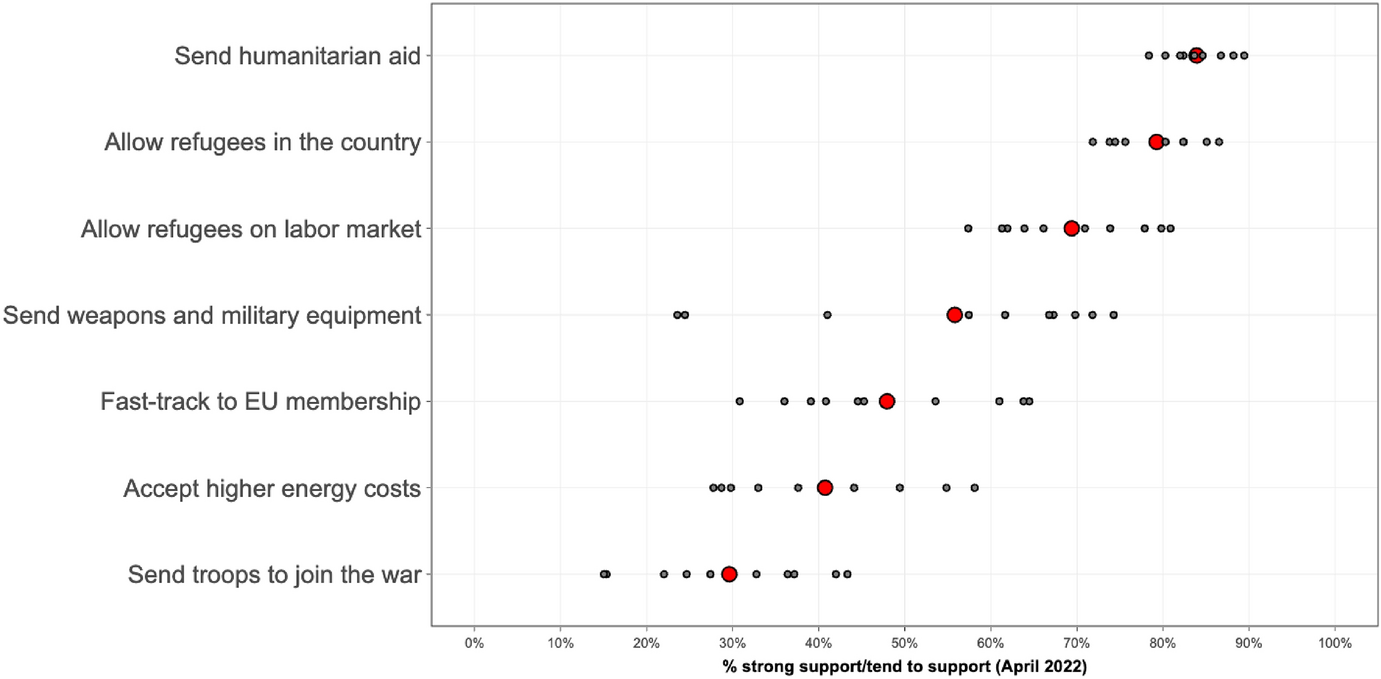
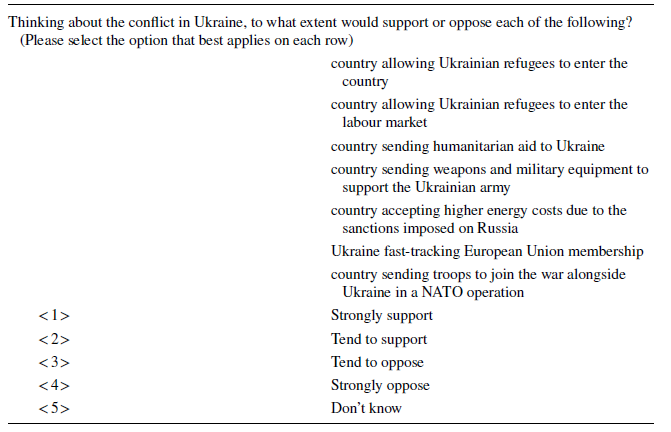
More specifically, these measures consist of a battery of items ranging from sending humanitarian aid, accepting refuges, to sending weapons and military equipment, fast-tracking EU membership, accepting higher energy costs and even sending troops to join the Ukrainian war effort (exact wording can be found in Appendix). These items were asked on a four-point scale, and they are graphed in Fig. 1 showing the percentage for the two positive answers (strongly support, tend to support).
Overall Support for Ukraine Help. Note: Red dots resemble overall sample averages of those who strongly support/tend to support Ukraine on a particular measure, whereas grey dots are country averages of these responses per Ukraine aid measure. Data source: EUI-YouGov Solidarity in Europe survey (SiE), 2022

In order to understand longitudinal support, we utilize a second data collection from the YouGov global survey in September/October 2022. This survey contains the exact same questions of support for Ukraine and is conducted in 10 of the original countries in Europe, including Denmark, Greece, France, Germany, Hungary, Italy, Poland, Spain, Sweden, and United Kingdom. This survey allows us to verify the longitudinal stability and longevity of Ukraine support across Europe.
Results: support for Ukraine across EU countries
Figure 1 clearly shows that overall support for Ukraine is high across 16 European Union member countries and the UK. The red dot symbolizes the sample mean across all countries per specific aid measure, whereas the grey dots stand for the specific country means. Two insights emerge instantaneously: (1) support varies a lot depending on the specific measure confirming our expectation about differential support across measures; and (2) the support varies a lot between countries and particularly for the seemingly more difficult actions of help.
The agreement to sending humanitarian aid to Ukraine (82%), allowing refugees from Ukraine to enter respective European countries (78%), and their labour markets (69%) is overwhelming across the countries asked. It seems most difficult for Europeans to envision sending troops to join the war alongside Ukraine in a NATO operation (still 30% support this), as it is related to very personal sacrifices. Similarly, less than the majority of Europeans is ready to accept higher energy costs due to the sanctions imposed on Russia (though still 40% support it). Though, fast-tracking Ukraine’s EU membership is at 48%. Overall, the results confirm very strong support for Ukraine on most measures showing a stable majority across countries being in favour of help. This support diminishes when the proposed help stands in potential contrast to self-interest or values. For example, on accepting higher energy costs which explicitly hints at a sacrifice of a very personal nature, support is at significantly less than half of the sampled EU population. Thus, it really depends on what is asked of Europeans.
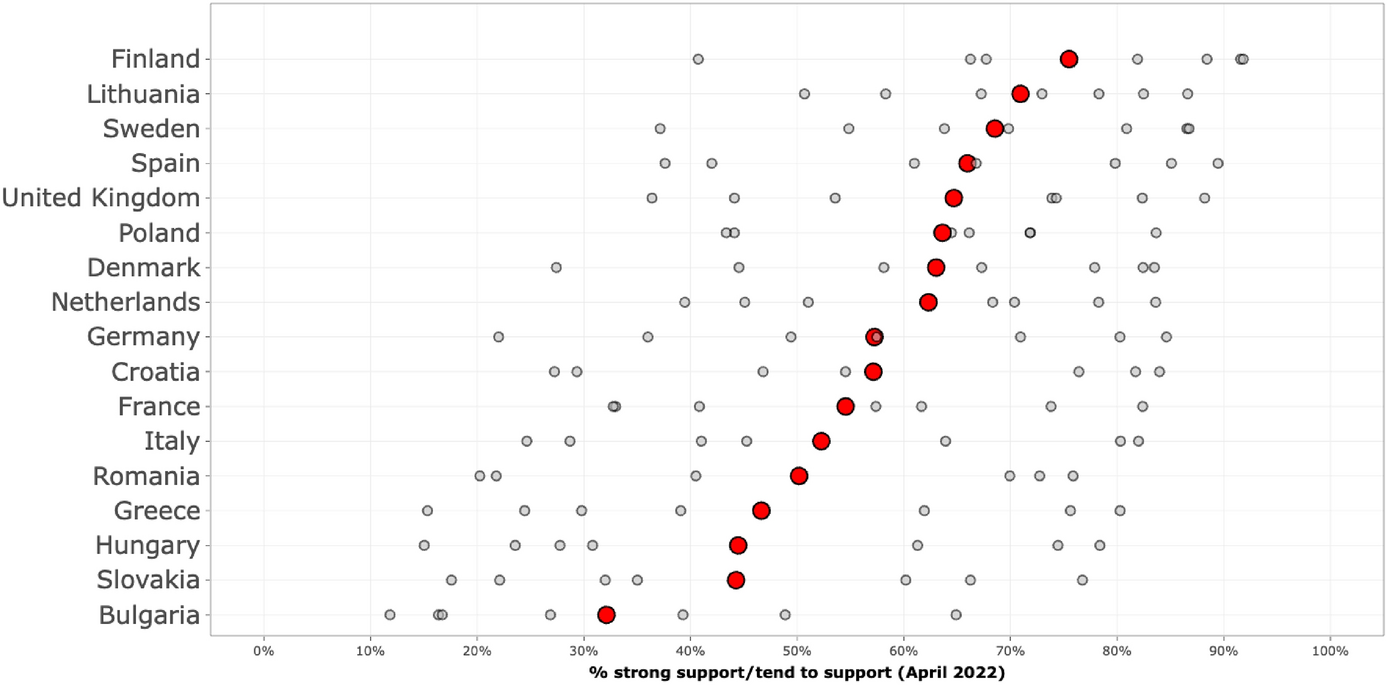
In Fig. 2, the same measures of Ukraine support are shown, but now taking the average of all seven of them across countries (presented by the red dots). The grey dots represent where the country stands on each single measure discussed earlier. In fact, this figure shows clearly that Europeans are not overwhelmingly united in their reaction to the war. Finland, Lithuania and Sweden, Spain, the UK and to a degree also Poland, Denmark and the Netherlands are clearly ahead of the curve with the highest support using the average across all measures (nearly two-thirds of public and more), whereas Bulgaria, Slovakia, Hungary and Greece are much behind, below 50%, confirming the fault-lines within Europe. At first sight, the support is highest in countries fairly close to the conflict (though not exclusively), and indeed for publics in countries that share a border with Russia. These countries include Finland, Lithuania, Poland and with a sea border also Sweden, which are the top supporters of Ukraine. In the top-three supporters, we clearly see that all measures are supported above the majority, except one, which is the sending of troops to Ukraine; although even here Lithuanians show majority support for this idea. Average support is lower in some Eastern European countries and especially those that had relatively close Russian ties at the time of the Cold War, e.g. Bulgaria (see Nehring Reference Nehring2022). Other reasons for lack of Ukraine support include domestic (often populist) mobilization against the encompassing aid to Ukraine either by the governmental party (Hungary), former government party leadership (Slovakia), and by the Orthodox church (in Greece) (Curanović, Reference Curanović2007). More on this below.
Support for Ukraine across all issues by country. Note: Red dots resemble sample country averages of those who strongly support/tend to support Ukraine across all aid measures, whereas grey dots are averages of these responses per Ukraine aid measure and country. Data source: EUI-YouGov Solidarity in Europe survey (SiE), 2022

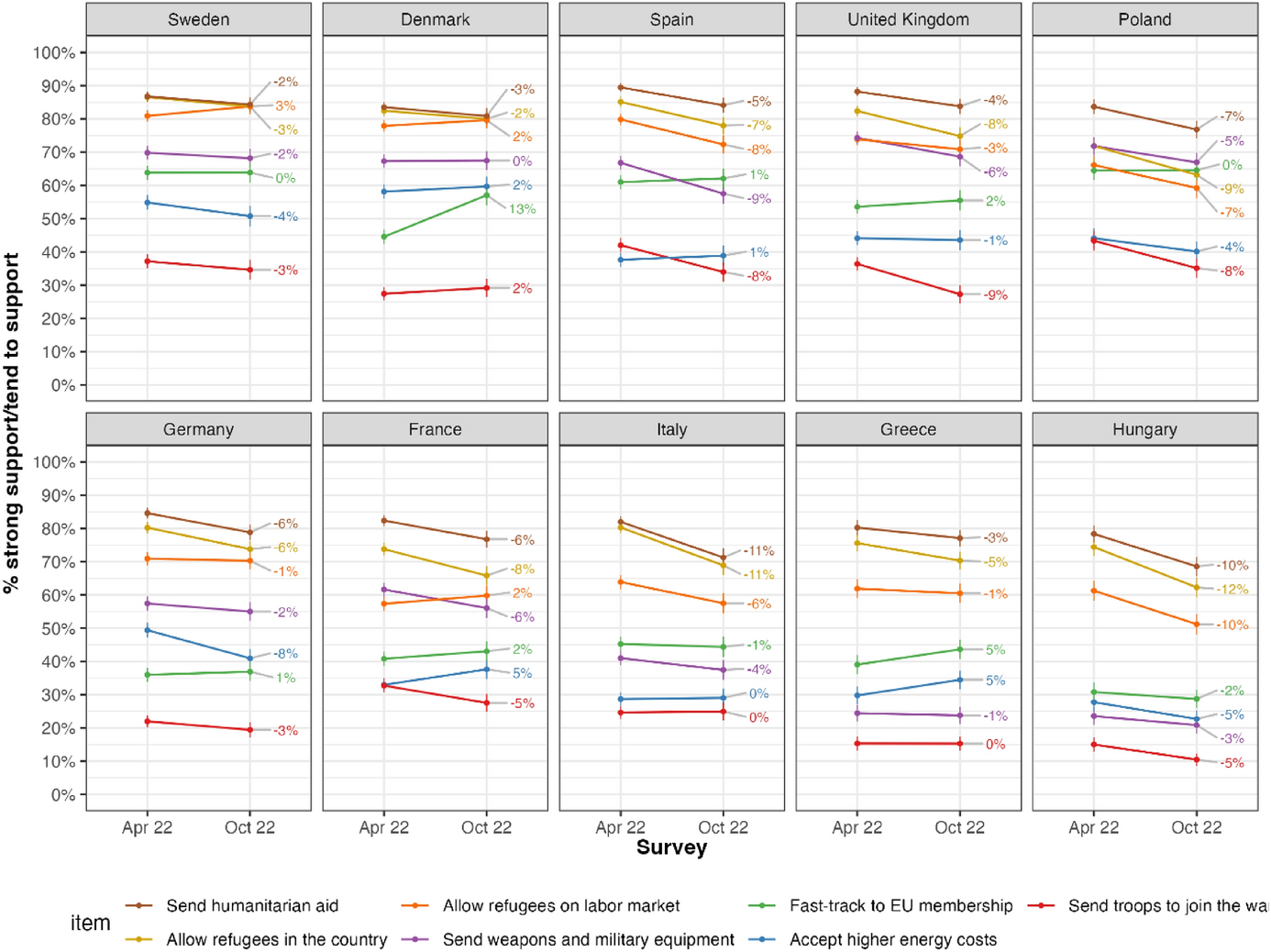
One major question is whether support for Ukraine remains stable over time. Since the invasion by Russia has been dragging on for much longer than anticipated, the question is whether Europeans stick to their high-level support for Ukraine overall or whether they tire to be enthusiastic defenders of Ukraine. Moreover, how is support developing in countries that seem to have major opposition within public opinion? First reports seem to indicate that indeed overall public opinion support remains high and stable (Hoffmann 2023). How is this reflected in the data at hand? For this analysis, we graph the 10 European countries for which we were able to conduct a second measurement of Ukraine support in the fall of 2022 in Fig. 3.
Over-time support for Ukraine in ten European countries. Note: The dots indicate average Ukraine aid support per country at two time points: April and September 2022. Numbers indicate the point change for the specific Ukraine aid measures in the 10 countries that are comparable across time. Data source: EUI-YouGov Solidarity in Europe survey (SiE), (2022)
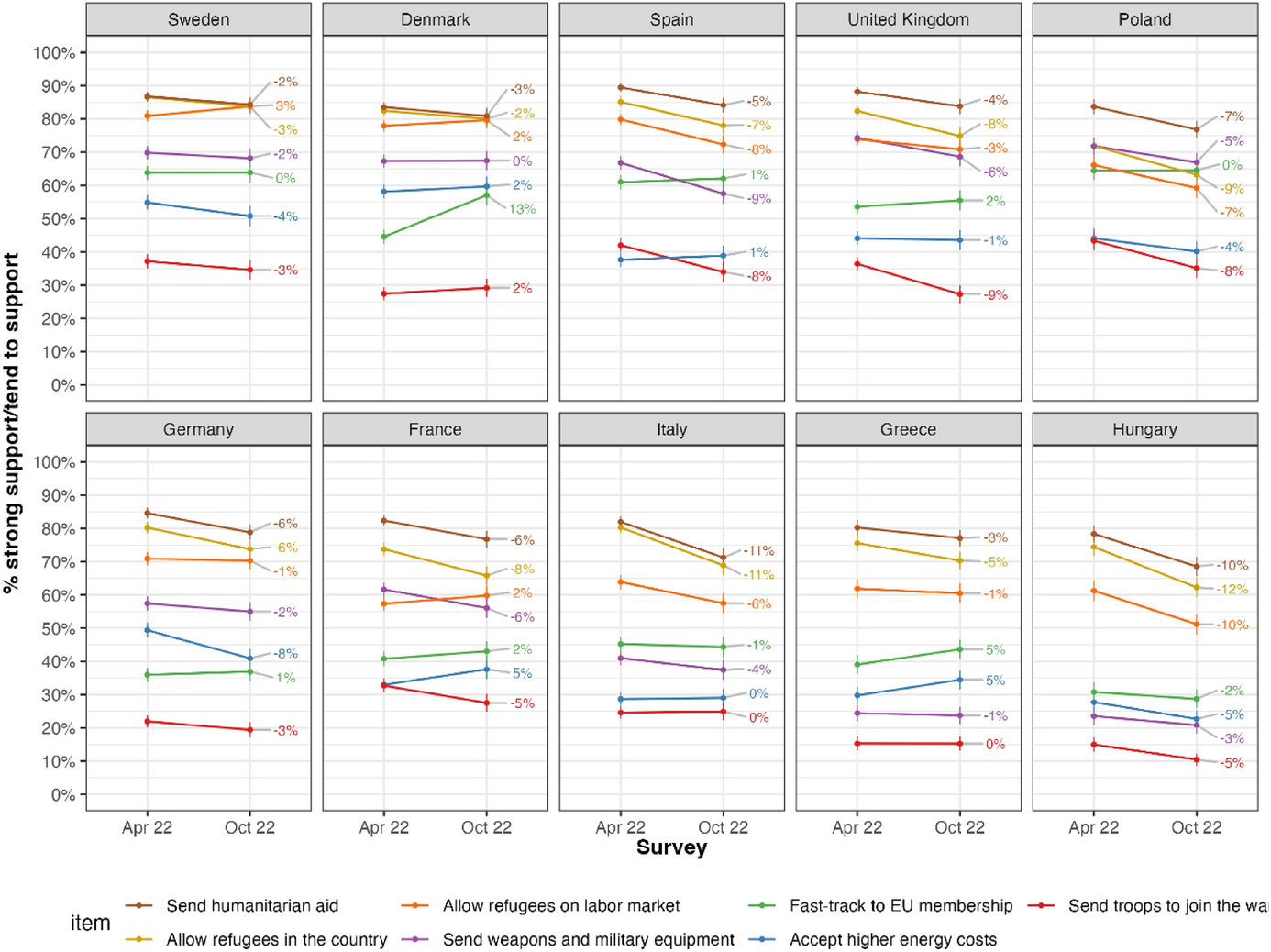
At first sight, the picture is relatively clear: support for Ukraine remains high and relatively stable in these ten cases. The most drastic cases loose about 10 points of support between April and September of 2022. This is particularly true for the easier forms of aid such as humanitarian aid, acceptance of refugees generally and in the labour market, particularly in Italy and Hungary, two relatively low support countries. However, also Poland and Spain loose points on these particular measures. A plausible explanation is that there is a ceiling effect and that the extremely high public support on these three measures in the beginning of the war is declining a bit to normalize at continuing high levels. Other drastic movements are the somewhat declining support to send one’s own troops to Ukraine, a measure that already captured the lowest support out of all measures. This support declined visibly in Spain, the UK as well as in Poland by around 8 or 9 points. While there was no discussion about sending one’s own troops, the issue was most likely shaped by the drastic images that accompanied this war in the media. The acceptance of higher energy costs as a result of sanctions remained relatively stable but took a dive in Germany. Germany’s dependency on Russian oil and gas is one potential reason. But the economic costs of the war are projected to burden (beyond Ukraine and Russia itself) mostly Germany, France and Italy (Liadze et al., Reference Liadze, Macchiarelli, Mortimer-Lee and Juanino2022). Yet last fall, this scepticism could mostly be felt in Germany, where we saw the stronger declines on acceptance of high energy costs. Further economic consequences will mostly be felt further down the road.
Generally, the acceptance of fast-track EU-membership of Ukraine received stable support except for Denmark where people increased support when they most likely followed the prime minister’s initiative to highlight that EU membership is an important element of the path to peace (President of Ukraine 2022; Szumski 2022). In sum, with the exception of humanitarian aid and acceptance of refuges, and some decline in acceptance of higher energy costs because of sanctions, support for Ukraine is diminishing only minimally and remains as high as in the beginning of the war in the ten European countries in our over-time sample.
Now that we know how support for Ukraine is distributed across many European Union countries and over time, we can look more specifically at the intra-country political dynamics to understand overall differences in support for those on the right and left as well as for supporters of government parties and members of the opposition. Any polarization within our societies informs us about the future of support for Ukraine.
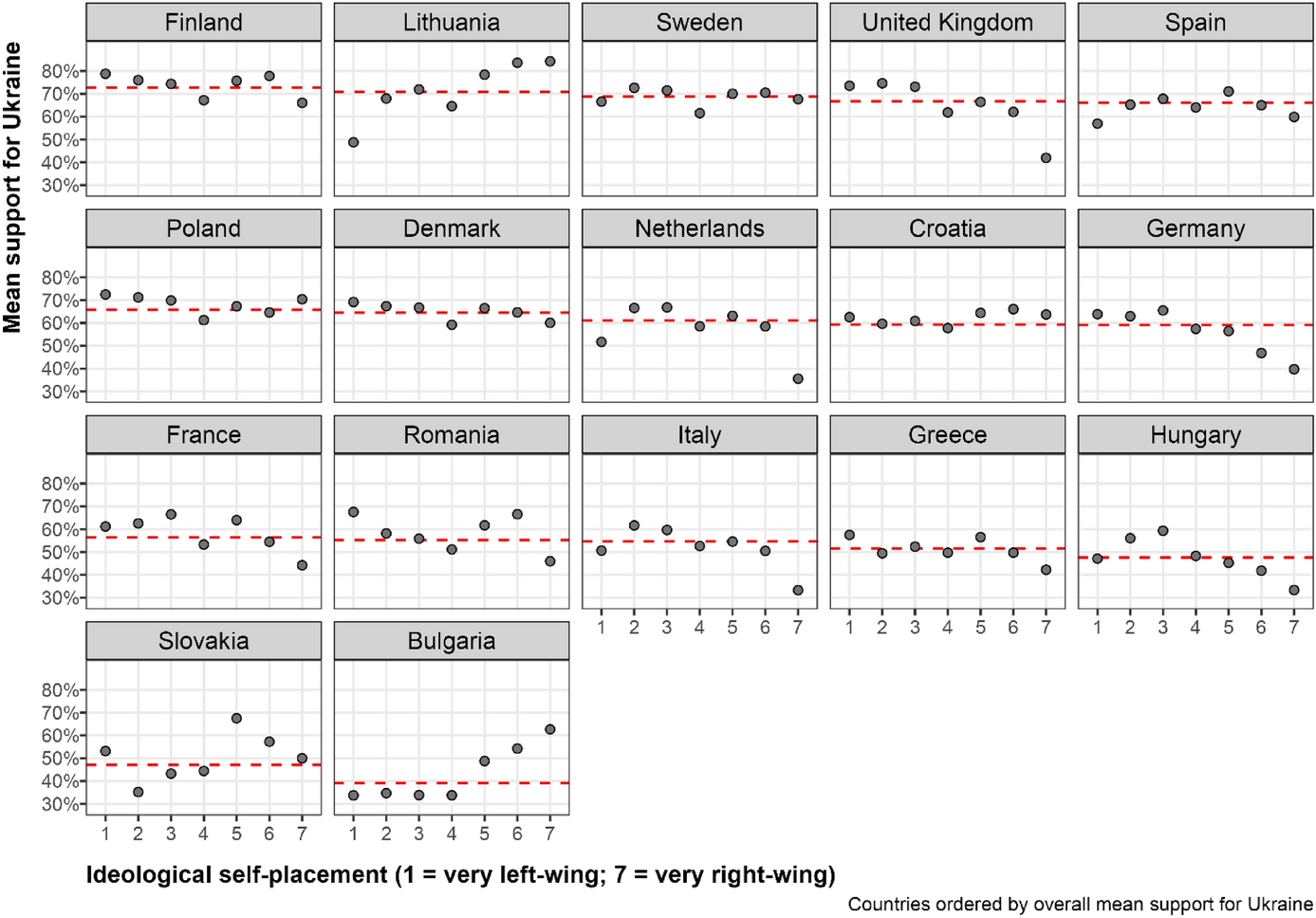
In order to examine left and right differences we utilize a left and right self-placement scale and plot the overall help for Ukraine along the left and right scale in 17 European countries. The country analyses are ordered by overall support starting with the country with the highest support, e.g. Finland and ending with the lowest support country Bulgaria. The red dotted line indicates the average support per country. Overall, we do not see a clear-cut tendency in our data. In some countries those who identify with the right are significantly more inclined to help Ukraine than those who identify with the left (Lithuania, Bulgaria, and to some extent Slovakia and Croatia), whereas other cases demonstrate that left-wingers are more supportive. The latter is minimally true in United Kingdom, Poland, France, Germany and a few other cases.
Overall, though, one pattern stands out: in ten out of 17 cases we find that those who identify extreme right are much less supportive of Ukraine than the average population and clearly less than those who identify with the political centre. This is true especially in the Netherlands, Germany, Italy, Greece, Hungary, and the UK, but also France, Romania, Finland and Spain. Again, this trend is reversed in Lithuania and Bulgaria and to a certain extent also in Croatia and Slovakia where those on the right are generally more supportive of aiding Ukraine than many other groups in the population. Only few cases are noted where the supporters of the extreme left turn out to be least helpful to Ukraine: Lithuania and Spain and minimally Bulgaria. This result indicates that Ukrainian support cuts across the left and right cleavage in Europe and does not follow a pre-determined pattern of leftists doves and rightist hawks or any other clear left–right pattern. It is still too early to tell whether the Ukraine war might contribute to a new cleavage or division in European societies beyond the left–right, and whether that division, for example, is related to explicit relations with Russia. These results need further unpacking to understand how the support for Ukraine matches onto partisan cleavages in Europe and how it unfolds in the future and why in some countries those who identify with the radical right are much less supportive than the remaining population (Ivaldi and Zankina 2023). Of course, this result needs to be double checked against the actual stances of political parties in speeches, social media accounts or other party materials and compared to actual policy support decided by parties in government and parliament. However, it is a first indication of a rift that might divide parties on this issue in the long run (Fig. 4).
Ideology and support for Ukraine. Note: The dots indicate average support for aiding Ukraine per country along the left–right self-placement scale (measured from 1 very left to 7 very right). Data source: EUI-YouGov Solidarity in Europe survey (SiE), (2022)

Finally, we turn to one more intra-country pattern of interest. Supporters of parties might be divided on helping Ukraine because they support either the incumbency or the opposition parties. Naturally, on the one hand, government parties need to be more engaged in their reaction to a war in Europe, whereas opposition parties might be able to utilize a position of deliberation or waiting. On the other hand, we might be able to see a rally ‘round the flag effect that captures supporters of the opposition just as much as those of incumbents, as they do feel threatened by the war. Thus, in this final step of our analysis, we turn to dividing the sample into supporters of the government and supporters of the opposition. This will also tell us whether any future expected changes in the government composition might lead to any policy changes regarding Ukraine.
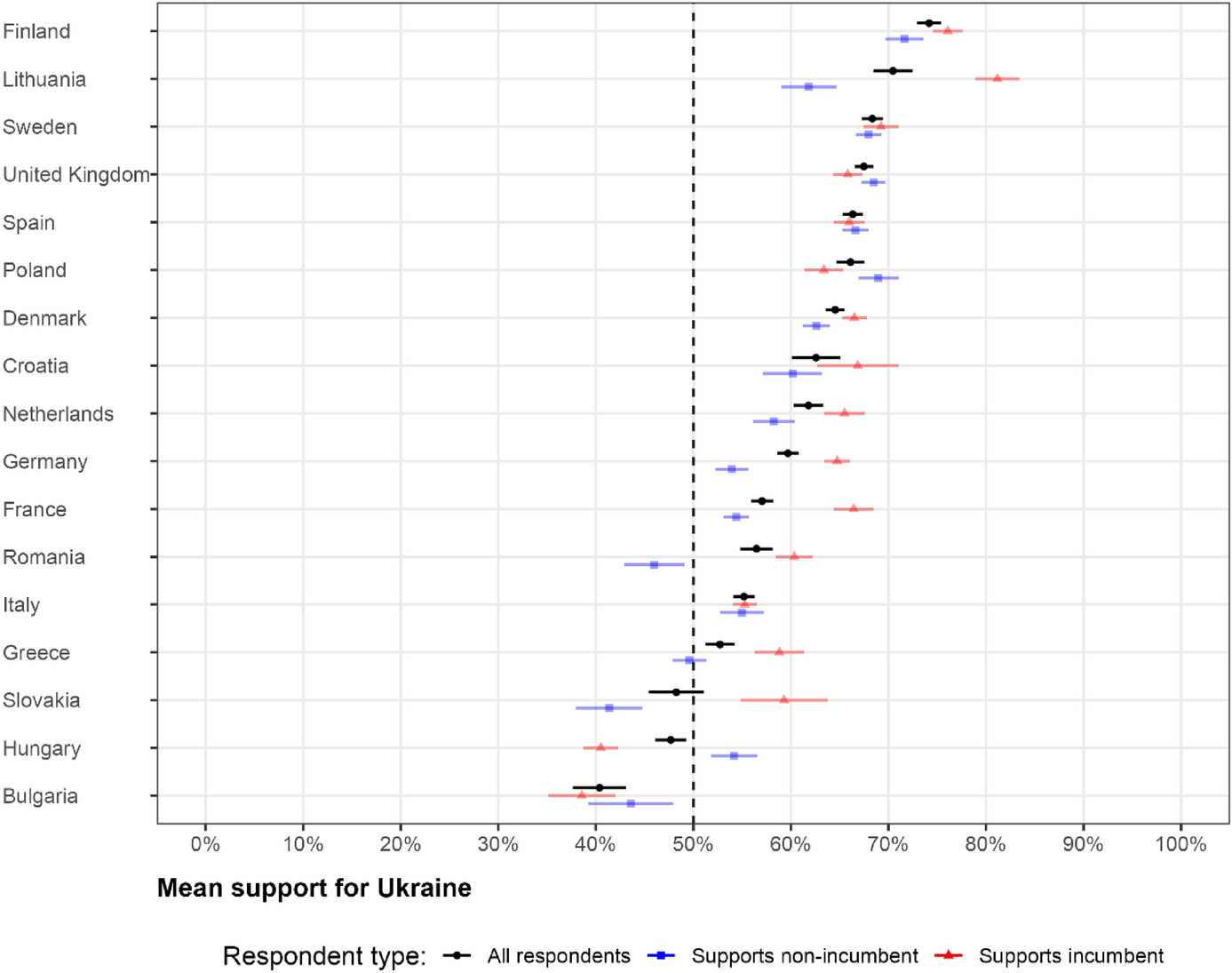
For this analysis, we recoded the question which asked about the respondent’s party they feel most close to in an effort to categorize support for the government in power at the time of the survey and the support for parties of the opposition. This distinction allows us to understand whether the supporters of the government and opposition parties are polarized on the issue of their country helping Ukraine. In this analysis, respondents who did not choose a political party that they feel close to from a provided list of the main political parties in the country were excluded from the analysis. The blue coloured dots in Fig. 5 stand for opposition supporters and the red dots for incumbents, whereas the black dots indicate the overall sample mean in April 2022 by country.
Support for Ukraine help by incumbent and opposition party. Note: The figure shows the per cent of those who strongly support/tend to support aid to Ukraine by feeling close to either governing or opposition parties (by country). Data source: EUI-YouGov Solidarity in Europe survey (SiE), (2022)

Figure 5 indicates that those close to incumbent parties are more in favour of helping Ukraine than opposition supporters, following the logic that incumbent parties are generally more pro-active to a war on their continent. However, there are some exceptions to this rule: in Hungary, the supporters of prime minister Orban’s party are less supportive of helping Ukraine than the supporters of the opposition. Similarly, in the UK and in Poland, we also see that the opposition supporters seem to be more solidaristic than the supporters of the party in government. In other cases, there is no distinction between the two types of party supporters; for example, in Spain, Sweden and in Italy differences are not significant. Overall, we can conclude that except for Lithuania and Bulgaria, countries with lower overall Ukraine support show indeed a higher level of polarization between government party and opposition party supporters. These results can be indicative of future cleavages or divisions that might determine how steadfast the public and parties are in their support of the war. The generally lower Ukraine support with regard to those feeling closer to the opposition might foreshadow the potential of change, should new parties come to power in elections across EU countries.
Conclusion
This article has introduced the first results of a 17-country-public opinion-survey across Europe to understand where the public stands on the invasion of Russia in Ukraine and the help that countries should give to Ukraine. As we discussed above, this aid can be offered in various forms, but an important distinction is between easier forms of humanitarian aid and acceptance of refugees, and difficult ones which are often related to help that has consequences for economic and financial self-interest. Indeed, while overall support is high, we need to make a number of differentiations. Support is significantly lower everywhere for more difficult forms of assistance such as acceptance of higher energy costs because of sanctions against Russia or sending one’s own troops. Yet fault-lines exist even within these findings. While publics in countries that border Russia are most supportive of Ukraine across all seven forms of assistance, former Russia friends are least supportive. Moreover, the supporters of the radical right are least supportive in a number of countries, whereas in some countries also radical left supporters are less solidaristic with Ukraine. Without a clear pattern, however, we must conclude that opinions on Ukraine seem to form a new cleavage across left and right parties—support for Ukraine does not neatly overlay or replicate the left–right cleavage.
Finally, supporters of opposition parties are generally —though with some exceptions — less inclined to aid Ukraine which might foreshadow some policy change once such parties gain power. Overall, Europe is somewhat less united on the issue of helping Ukraine than it seems at first sight when looking at policies or statements of political leaders. The new fault-lines are not necessarily following a known pattern, the question is whether these fault-lines deepen, how political parties further align along the issue of Ukraine solidarity and whether this division plays a role for citizens in their future vote.
Acknowledgements
The author likes to thank the team of the EUI-YouGov Solidarity in Europe survey (SiE) including YouGov and is grateful for excellent research assistance provided by John Hicks, Thomas Gareau Paquette, Sonya Pallapothu and Avni Aghi. Earlier versions of this article also received helpful comments from the panel on the Ukraine war at the ECPR General Conference in Innsbruck in the summer of 2022; the guest editors of this special issue, as well as by the participants of the SiE workshop at the European University Institute in January 2023.
Funding
Open access funding provided by European University Institute - Fiesole within the CRUI-CARE Agreement.
Appendix
See Table 1
Wording of the Ukraine help questions
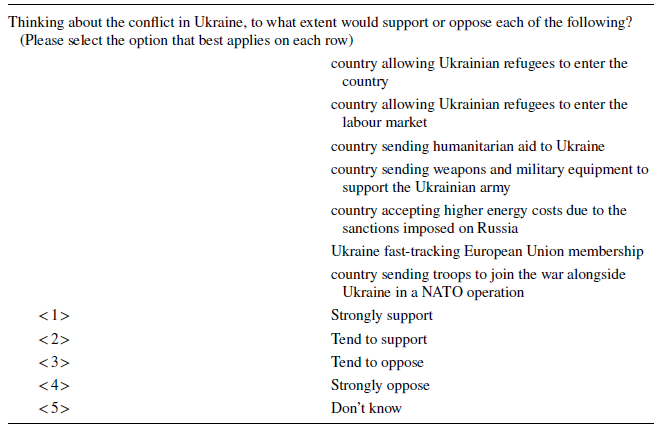
For several analyses, the two support options were collapsed to indicate the percentage of support.

 Open access

