





Introduction
Palliative care aims to holistically address end-of-life needs and relieve the physical, psychological, social, and spiritual suffering of terminal disease (World Health Organization (WHO) 2021). The provision of end-of-life care has been deemed a fundamental human right by the World Health Organization (Ahmedzai et al. Reference Ahmedzai, Costa and Blengini2004; WHO 2020). By 2066, approximately 25% of the global population will be >65 years. There is an associated predicted increase in the number of people dying with complex palliative needs (Australian Bureau of Statistics (ABS) 2018; Australian Government, Department of Health 2019). Therefore, palliative care in Australia needs pragmatic research that may improve its inpatient and community service provision of care and reduce distress from symptoms in this growing population.
There is an increasing biomedical emphasis on non-pharmacological, person-centered interventions for palliative care patients that do not impair quality of life in the face of advanced disease (Beuth Reference Beuth, Beuth and Moss2005). The physical and psychological symptoms experienced at the end of life may impact the person’s participation in day-to-day activities (occupations) that bring them meaning (Badger et al. Reference Badger, Macleod and Honey2016). End of life may be described as a period of occupational deprivation, a constraint in which distress and disempowering environments may be barriers to the person’s ability to participate in the activities they enjoy (Keesing and Rosenwax Reference Keesing and Rosenwax2011; Wilcock and Townsend Reference Wilcock, Townsend, Boyt Schell and Gillen2019). Occupational therapy aims to dynamically assess and positively influence patients’ well-being through goal-oriented occupations (American Occupational Therapy Association 2020; Wilding and Whiteford Reference Wilding and Whiteford2007). The occupational therapist practising within the biomedical palliative care context works on maximizing the person’s opportunities to participate in meaningful activities, often by modifying these activities in the face of deteriorating function (South Australia Health 2015; Eva and Morgan Reference Eva and Morgan2018; Occupational Therapy of Australia, Ltd (OTAL) 2015). Moreover, the scope of practice specifies that occupational therapists have a duty of care to deliver and justify evidence-based advanced practices with vulnerable populations and their carers (Occupational Therapy of Australia, Ltd (OTAL) 2015).
Virtual reality (VR) therapeutic modalities, such as meditation, may alleviate psychological distress and physical pain of palliative care patients while exploring client-specified goals: coping with pain, reminiscence, or relaxation. Suitable VR experience content has been described as low-immersion, effective and accepted by palliative care participants in previous studies. Researchers have noted that VR interventions’ participant burden was minimal, with participants reporting sadness due to reminiscences stating that the benefits outweighed the harm (Brungardt et al. Reference Brungardt, Wibben and Tompkins2021; Kabir et al. Reference Kabir, Rice and Bush2020; Perna et al. Reference Perna, White and Minton2021). VR, therefore, offers an option to occupational therapists for use in palliative care settings.
VR technology simulates a visual environment using 360° videos and sounds generated by a computer connected with a headset/goggles and headphones to create varying levels of immersion based on the sensorimotor interaction available within the environment, for example, to go for a bushwalk (Kardong et al. Reference Kardong, Farra and Alinier2019). VR has most widely been applied in mental health promotion (Wiederhold and Bouchard Reference Wiederhold and Bouchard2014). Research supports the hypothesis that VR provides safe and effective results to alleviate chronic pain (Jones et al. Reference Jones, Moore and Rose2016; Pourmand et al. Reference Pourmand, Davis and Marchak2018). VR has been recommended as a safe adjunct to conventional medicine symptom management of palliative care and patients with cancer (Johnson et al. Reference Johnson, Bauler and Vos2020; Niki et al. Reference Niki, Okamoto and Maeda2019). Studies in Japan and Canada have demonstrated the effectiveness and safety of VR travel as reminiscence therapy on relieving symptom burden in palliative care patients and their carers (Kabir et al. Reference Kabir, Rice and Bush2020; Niki et al. Reference Niki, Okamoto and Maeda2019). The act of reviewing one’s life, or reminiscence therapy, may alleviate a person’s psychological distress and promote spiritual well-being (Wang et al. Reference Wang, Chow and Chan2017). The most significant treatment effects were observed in reducing depression and anxiety symptoms of palliative care patients (Kabir et al. 2019; Niki et al. Reference Niki, Okamoto and Maeda2019). Brungardt et al. (Reference Brungardt, Wibben and Tompkins2021) evidenced the feasibility and patient acceptability of VR as a music therapy intervention in a palliative care service in the United States, with 82% of 23 participants reporting high satisfaction. A United Kingdom study utilized VR as a distraction intervention in palliative care, in which 93% of the 15 participants reported perceived positive experiences and 100% requested additional sessions (Nwosu et al. Reference Nwosu, Mills and Roughneen2021). The benefits of VR for palliative care patients may include relieving boredom, a respite from the inpatient environment, and promoting relaxation and joy (Nwosu et al. Reference Nwosu, Mills and Roughneen2021; Perna et al. Reference Perna, White and Minton2021) in addition to its non-pharmacological analgesic effects (Jones et al. Reference Jones, Moore and Rose2016; Pourmand et al. Reference Pourmand, Davis and Marchak2018). For example, modified end-of-life goals, such as travelling to the beach or visiting a place of significance in one’s life, may be achieved using VR (Kabir et al. Reference Kabir, Rice and Bush2020). VR interventions may also provide opportunities for sharing experiences and meaning-making with carers (Nwosu et al. Reference Nwosu, Mills and Roughneen2021). The international practice-based research of VR interventions in palliative care may not be relevant to the Australian circumstances of practice, which emphasize community-based palliative care and allied health services to alleviate psychosocial distress (Eagar et al. Reference Eagar, Watters and Currow2010).
The Canadian Occupational Performance Measure (COPM) is an individualized framework that has been developed by occupational therapists and directly aligns with palliative care’s overarching aim to holistically assess and provide flexible, person-centered care (Australian Government, Department of Health 2019; Law et al. Reference Law, Baptiste and McColl1990). The COPM may be used as a foundation for end-of-life goal setting (Enlow et al. Reference Enlow, Fleischer and Hardman2020) by positioning the person as the expert in identifying occupational problems. The COPM score changes in satisfaction and performance reflect participants’ perception change between initial assessment and reassessment post-intervention (Tuntland et al. Reference Tuntland, Aaslund and Langeland2016). This adapted outcome measure focuses on capturing the client’s unique perspective regarding the occupational problems they would like to address in the VR intervention. Research supports the COPM as a feasible, responsive, reliable, and valid measure of the effectiveness of occupational therapy interventions from the person’s perspective in subacute settings (Roe et al. Reference Roe, Brown and Thyer2020) and for palliative care patients in an acute setting (Enlow et al. Reference Enlow, Fleischer and Hardman2020).
The Palliative Care Outcomes Collaboration (PCOC) is an Australian federally developed, standardized and validated quality and clinical protocol (Eagar et al. Reference Eagar, Watters and Currow2010) to assist clinicians in the monitoring of palliative patients. The PCOC aims to standardize, measure, and improve palliative care for individuals and carers through assessment that reports quantitative data on patients’ care at 3 levels: phase of care, episode of care, and demographic/clinical information (Clapham and Holloway Reference Clapham and Holloway2018). The PCOC Symptom Assessment Scale (SAS) of pain and fatigue is part of the standard practice to track symptoms and initiate potential actions, such as a medical review (Clapham and Holloway Reference Clapham and Holloway2018). The PCOC SAS has been established as suitable for use in palliative care with excellent validity and fair to substantial inter-rater and intra-rater reliability, as evidenced in a multi-site national study in Australia (Daveson et al. Reference Daveson, Allingham and Clapham2021). The PCOC SAS rates participant’s distress from symptoms, not necessarily reflecting symptom severity.
This study built on previous research and evaluated the impact of VR interventions on occupational participation and distress from symptoms. The adapted COPM and existing Australian standardized palliative care clinical assessments were utilized to analyze VR interventions’ impact (Eagar et al. Reference Eagar, Watters and Currow2010). No other studies have demonstrated the effectiveness of VR interventions with palliative care patients from an occupational therapy perspective in Australia.
Methods
The study was approved by the Gold Coast Hospital and Health Service and Bond University’s Human Research Ethics Committees (HREC) (HREC/2021/QGC/77839, approval date: 24 September 2021). This study follows STROBE reporting guidelines for observational cohort studies (von Elm et al. Reference von Elm, Altman and Egger2007) and the Template for Intervention Description and Replication (TIDieR) checklist to describe the intervention (Hoffmann et al. Reference Hoffmann, Glasziou and Boutron2014). The STROBE (STrengthening the Reporting of OBservational studies in Epidemiology) Statement is a set of guidelines designed to improve the quality and transparency of reporting in observational studies. It consists of a comprehensive checklist comprising 22 essential items that researchers may include when summarising observational study findings (von Elm et al. Reference von Elm, Altman and Egger2007).
Study design
A single-site pilot prospective mixed methods observational cohort study was undertaken using a pre-post intervention research design to establish the effect of VR interventions on occupational participation and distress from symptoms. Quantitative data were collected using patient-rated and a wireless pulse oximeter before and immediately after the intervention. The research assistant served as the data collector and performed data analysis for this study. This paper reports the quantitative results of the pilot. The second component of the pilot explored qualitative data collected via field notes from observations of the participants and the research assistant to describe participants’ experience and perceptions of the VR interventions.
Setting
The pilot was conducted at a single-center inpatient and community specialist palliative care service at a teaching hospital in Australia. This multi-professional site included a hospital-based 20-bed inpatient palliative care ward and care provided in the community (Supportive and Specialist Community Palliative Care Service: SSPCS, Gold Coast Hospital and Health Service). Recruitment occurred from November 2021 through March 2022; patients who were accepted to the SSPCS and met the eligibility criteria were introduced to the study consecutively.
Participants
Eligible participants included adults (>18 years old) who were assessed by the clinical care team and screened for suitability and safety for the VR intervention. These participants received specialist palliative care within the inpatient palliative care ward at the hospital or in the community through palliative care allied health home visits. Referrals were received from the SSPCS multidisciplinary team members and based on the weekly review of the caseload census. Prior to performing any study-related action, informed consent was obtained from each participant. The multimodal Participant Information and Consent Form (PICF) described the VR intervention itself, the technology’s capabilities and prior trial information to address participant’s lack of familiarity with VR technology. This information was discussed with the participant by the treating occupational therapist or the research assistant, ensuring adequate time was provided to consider participation and answer any questions. A copy of the signed PICF was provided to the participant and documented in the medical record. The following inclusion criteria was set: patients who were able to give informed consent, follow basic commands and alert, had Resource Utilisation Group Activities of Daily Living Scale (RUG-ADL) scores between 4 and 17 (Morgan et al. Reference Morgan, Brown and Cerdor2020), Palliative Care Phase 1 to 3 (Masso et al. Reference Masso, Allingham and Banfield2015), had Australian-modified Karnofsky Performance Scale (AKPS) scores higher than 20, were able to remain seated or in the supine position, were able to notify the treating occupational therapist of any distress verbally or physically during the VR intervention. Patients who had delirium, dementia or severe cognitive decline, had severe vision or hearing loss, had a loss of upper limb function, had recent or current flu-like symptoms, had a history of motion sickness, nausea or vertigo, had facial or head conditions such as open wounds were excluded. Patients with seizure history were required to be medically assessed and written clearance documented by the medical registrar or consultant.
Intervention
Participants used wireless Oculus Go™ headsets plus motion controllers (Facebook Technologies 2021) while seated. Prior to the VR intervention, the clinical assistant consulted with the patient, oriented them to the equipment, established the patient’s goals for the session and administered the pre-intervention outcome measures. In this context, end-of-life goals may include VR modified activities such as visiting a meaningful destination for reminiscence therapy or experiencing an immersive guided meditation in a natural environment (Kabir et al. Reference Kabir, Rice and Bush2020). During the pre-intervention consultation time, the treating occupational therapist discussed the participant’s goals and occupation-related problems following the modified COPM. Questions included: what types of environments and activities help you feel relaxed and calm? What activity would bring the most meaning to your time?
This process occurred in the participant’s home or in the inpatient setting. The treating occupational therapist or clinical assistant was present throughout the intervention to monitor the participant’s tolerance and enjoyment. A social worker from the service was available to provide support and mitigate risk in the event of participant psychological distress. The intervention is further described in the TIDieR checklist in the supplementary materials.
Data collection and outcome measures
Participants’ perceptions of satisfaction and performance regarding their occupation-related problems were self-rated using the modified COPM. Immediately before and after the VR intervention therapy, participants’ heart rate was measured using a wireless pulse oximeter, and symptoms were evaluated using the PCOC data. Pre- and post-intervention outcome measure data, participant demographic information, and observational field notes were recorded in writing using de-identified clinical data sheets. These were checked by the research assistant for completeness and accuracy upon each administration of the VR intervention.
Primary outcome: COPM
Using the COPM framework, participants defined occupational problems that were meaningful but challenging to perform and rated the importance of each problem on a 1–10 point scale, with 10 indicating “very important.” (Law et al. Reference Law, Baptiste and McColl1990) They subsequently prioritized a maximum of 5 of the most critical occupations, rating their performance and satisfaction on a scale from 1 to 10, with higher scores indicating higher performance or satisfaction. Performance and satisfaction scores were then reassessed by the participant after the intervention. These differences in performance and satisfaction scores were the primary outcome measure.
Secondary outcomes
PCOC data were used to determine a patient’s eligibility and as quantitative outcome measures. The quantitative data were used to test the hypothesis that the VR intervention reduced distress from symptoms of participants. The PCOC data collected pre- post-intervention included measurements from the self-reported PCOC SAS of pain and fatigue, using the self-rated numeric scale from 0 to 10, with higher numbers indicating higher levels of distress regarding common symptoms such as pain, nausea, bowel problems, fatigue, difficulty sleeping, and breathing (Daveson et al. Reference Daveson, Allingham and Clapham2021).
The measurement of heart rate collected from a noninvasive wireless pulse oximeter may correlate to activating the parasympathetic nervous system and may indicate a reduction of physiological distress (Arza et al. Reference Arza, Garzón-Rey and Lázaro2019).
Bias
Due to the limitations of the study timeline and the specialist palliative care service’s workflow, allocation bias was anticipated in the pilot sample, as participants were not randomized (Hoffmann et al. Reference Hoffmann, Bennett and Mar2017). Observer bias was anticipated as it was not possible to blind the participants and the treating clinicians from awareness of the VR intervention.
Sample size
Ten participants were deemed an appropriate and feasible pilot study cohort as not to overburden the existing occupational therapy workflow of the SSPCS. It was also realistic to select 10 participants, approximately 1 per week, who would meet inclusion criteria based on their current health status, physical and cognitive abilities.
Statistical methods and variables
Exploratory data analysis with SPSS Version 28 software was performed using data from the Clinical Data Sheet. Nominal categorical demographic/intervention data were coded into binary numerical labels. Descriptive analysis summaries of categorical variables were used to determine N (%) of categorical variables. Descriptive analysis summaries of numerical variables described the mean of the participants’ age, mean AKPS and RUG-ADL scores, PCOC Phase count, mean length of VR session time, mean pre-consultation, goal setting and post-intervention time, and mean referral to intervention in days.
Paired samples t-tests were conducted to evaluate the impact of the VR intervention on the participant’s COPM scores, PCOC SAS distress from pain scores, PCOC SAS distress from fatigue scores, and heart rate. Mean differences and standardized mean differences of COPM scores, PCOC scores, and heart rate were the pre- and post-outcome scores investigated. Statistical significance of p< .05 was utilized for all analyses. A 2-tailed paired t-test was used to describe numerical multivariate data of COPM, PCOC SAS scores, and heart rate (beats per minute).
Results
Participants
There were 24 participants identified as eligible for the study. The research team approached patients that represented the cohort in a pragmatic approach. Participants were invited based on their clinical suitability, discussion with the clinicians, and the availability of trained staff in the palliative care team. Five passed away before they could be recruited or in the middle of the recruitment process. A total of 3 participants were excluded due to inability to attend the treatment sessions as a result of decline in palliative phase or cognitive impairment due to disease progression. The length of time between referral date to intervention date was on average 9 days. Our final sample included data from 10 participants, who provided informed consent and completed pre- and post-assessments, collected and analyzed during November and December 2021 and in March 2022.
Descriptive data
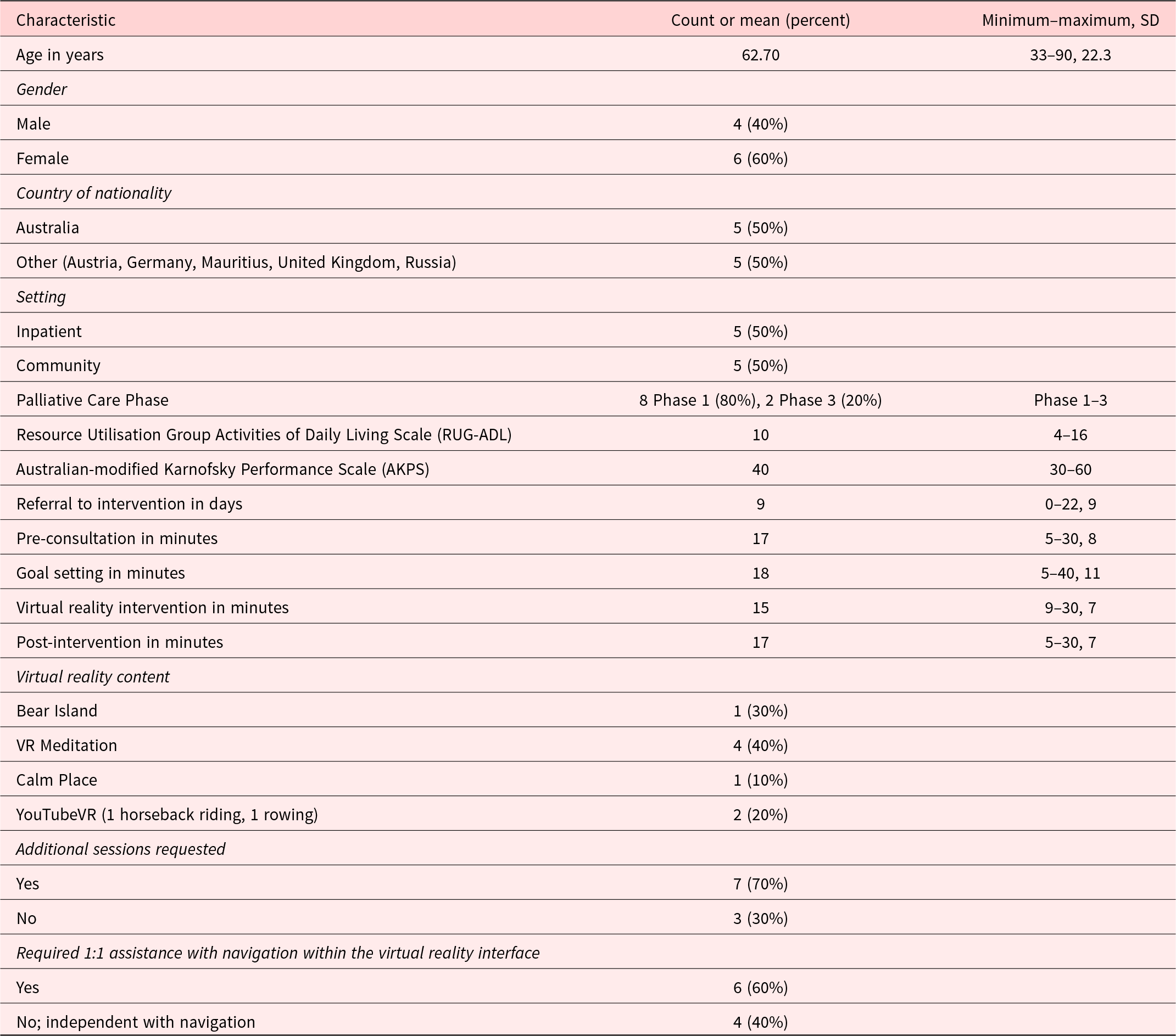
Descriptive data are summarized in Table 1. Of the 10 participants selected, 40% were male, and 60% were female. The mean age of the participants was 62.7 years, (ranged from 33 to 90 years, ±22.3 years), and the majority (80%) received the VR intervention while in Palliative Care Phase 1. The remaining 20% received the VR intervention while in Palliative Care Phase 3. The PCOC Phase describes clinically meaningful periods in a patient’s condition, such as a functional or psychosocial decline (Masso et al. Reference Masso, Allingham and Banfield2015). Half of the participants (5) received the VR intervention while admitted as an inpatient, and half (5) in the community setting. Half of the participants (5) were of Australian nationality, and half (5) with backgrounds from diverse countries of origin. The average VR intervention session length was 15 minutes (±7 minutes). The total end-to-end average time spent from the pre-intervention consultation to post-assessment was 67 minutes. Each participant completed 1 VR intervention session, and 70% requested additional sessions. No participants experienced adverse side effects or negative physical responses from the VR intervention. VR content was tailored based on participant goals and included familiar environments such as beaches, mountains, and activities participants could no longer perform physically. Two of the VR applications (VR Meditation and YouTubeVR) afforded users with choice to personalize experiences by choosing locations meaningful to them (Facebook Technologies 2022; Google Reference Google2022). Sixty percent of the participants required assistance with navigation within the VR application’s interface during the treatment.
Participant features and demographics (n = 10)

Note: RUG-ADL score range = 4–18; AKPS score range = 10–100; Palliative Care Phase = 1–5: 1: stable, 2: unstable, 3: deteriorating, 4: terminal, 5: bereavement/post death.
Outcome data
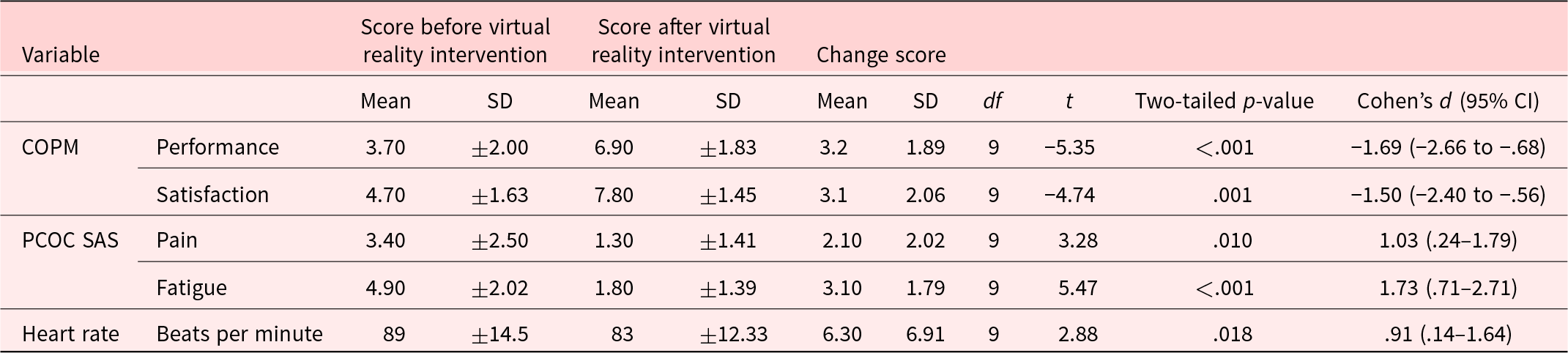
Ourcome data is summarised in Table 2. Paired sample t-tests showed a significant improvement in the COPM performance and satisfaction scores of participants before the VR intervention (performance: M = 3.70, SD = 2.00; satisfaction: M = 4.70, SD = 7.80, t(9) = −5.35, p = < .001) and after the VR intervention (performance: M = 6.90, SD = 1.83; satisfaction: M = 7.80, SD = 1.45, t(9) = −4.74, p = .001). The mean increase in the performance score was 3.20, with a 95% confidence interval ranging from −4.55 to −1.84. The mean increase in the satisfaction score was 3.10, with a 95% confidence interval ranging from −4.57 to −1.62. Clinically significant improvement in the COPM was defined as equal to or greater than 2 point change pre-post-intervention (Law et al. Reference Law, Baum and Dunn2005). The Cohen’s d statistics for both performance (1.69) and satisfaction (1.50) indicated a large effect size.
Comparison of outcome scores between pre- and post-intervention assessment

Note: Canadian Occupational and Performance Measure (COPM) is an individualized self-rated outcome measure administered to assess occupational performance and satisfaction, with scores ranging from 1 to 10; the Palliative Care Outcomes Collaboration (PCOC) is a federally developed and validated and standardized quality and clinical protocol. PCOC assessments report quantitative data on patient care at 3 levels: phase of care, episode of care, and demographic/clinical information. Subsections of the PCOC include the Symptom Assessment Scale (SAS), a self-rated 11-point numerical scale (0–10) that measures the patient’s level of distress related to 7 problems: difficulty sleeping, appetite problems, nausea, bowel problems, breathing problems, fatigue, and pain. PCOC SAS scores range from 0 to 10.
Notably, among the self-rated distress from symptom scales, statistical analysis revealed that VR interventions resulted in significant improvement in the self-reported SAS distress from fatigue scores of participants before and after the VR intervention. There was a significant difference in the distress from fatigue before (SAS fatigue: M = 4.90, SD = 2.02) and after the intervention (M = 1.80, SD = 1.39); t(9) = 5.47, p = < .001. The mean decrease in the SAS distress from fatigue score was 3.10 with a 95% confidence interval ranging from .71 to 2.71. Statistical analysis showed that there was a significant difference in the measurement of heart rate pre-intervention (M = 89, SD = 14.5) and post-intervention (M = 83, SD = 12.33); t(9) = 2.88, p = .018. The mean decrease in heart rate was 6.30 beats per minute with a 90% confidence interval ranging from .14 to 1.64.
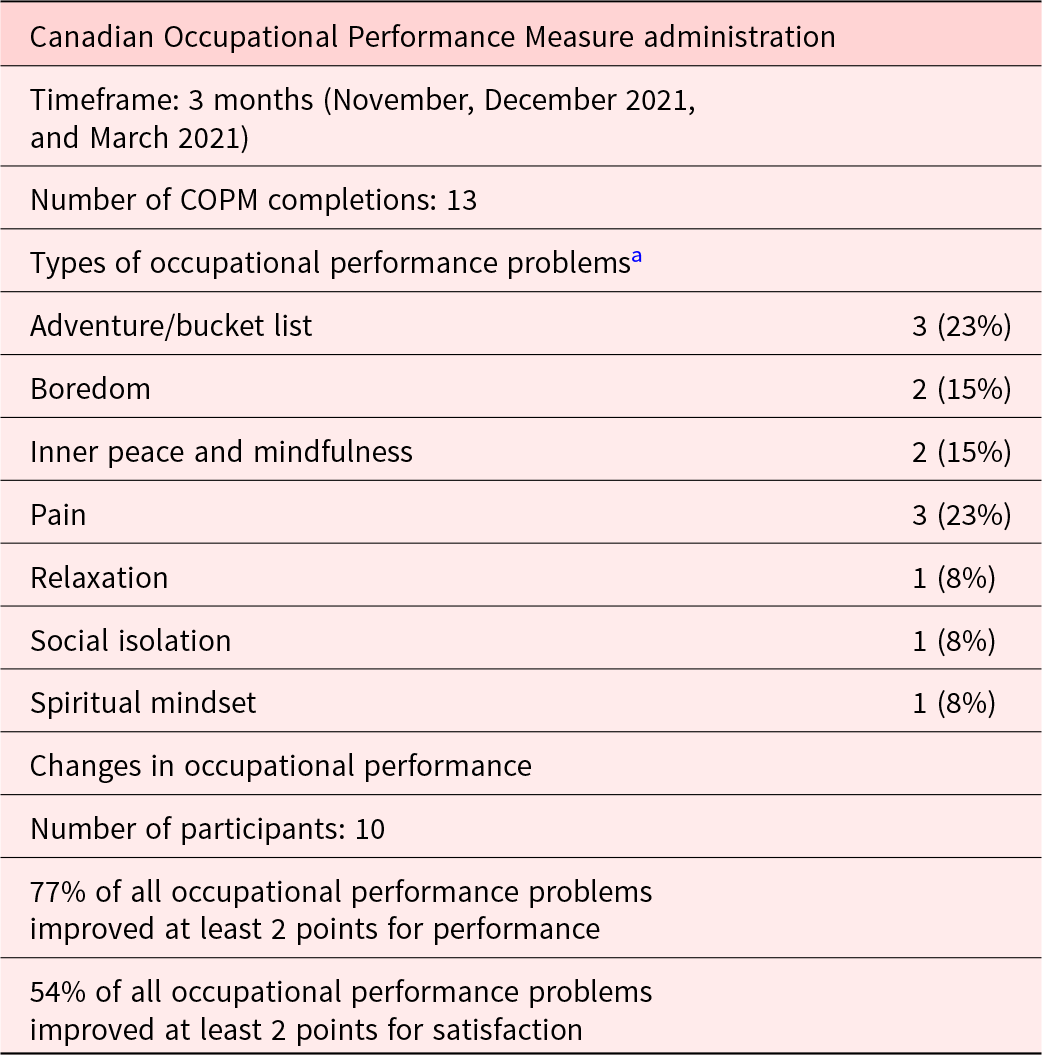
Table 3 summarizes the types of occupational problems identified and overall rates of occupational performance issues that improved. Occupational performance problems included the ability to adventure or achieve a bucket list activity (23%), boredom (15%), inner peace and mindfulness (15%), coping with pain (23%), relaxation (8%), social isolation (8%), and connection to a spiritual mindset (8%). Four of the seven types of problems reflected the participants’ orientation toward internal states of mind as important to them. Of these palliative care patients, 77% demonstrated significant improvements in their COPM performance scores, and 54% demonstrated significant improvement in their COPM satisfaction scores.
Canadian Occupational Performance Measure (COPM) data summary

a Three patients defined more than 1 problem according to the adapted Canadian Occupational Performance Measure. Summary table template adapted from Colquhoun et al. (Reference Colquhoun, Letts and Law2010).
Discussion
Historically occupational therapy within the palliative care context is focused on providing aids and equipment to maintain the terminally ill person’s sense of independence with their daily routines (Keesing and Rosenwax Reference Keesing and Rosenwax2011). Being restricted to the home, hospital, or bed is particularly detrimental for this population, disrupting valued occupations and causing a loss of previous roles and social isolation. The central focus of this pilot study focused on the value of VR and occupational participation as central to the occupational therapist’s practice as a method to empower the dying person and prompt a change in engagement. The aim of this study is well-aligned with occupational therapy’s foundational belief in the positive relationship between occupation and health (American Occupational Therapy Association 2020). The occupational therapist’s role in palliative care must facilitate opportunities for patients to engage in meaningful occupations while acknowledging the person’s experience of the dichotomy of living and dying (Occupational Therapy of Australia, Ltd (OTAL) 2015; SA Health 2015). However, providing occupation-based services in a hospital palliative care setting has been described as extremely difficult (Keesing and Rosenwax Reference Keesing and Rosenwax2011). The results of this pilot study indicate that VR therapy may be an effective person-centered intervention that addresses the occupational needs of palliative care patients.
This pilot is one of the first studies internationally to examine measurable occupational performance outcomes alongside palliative patients’ distress from symptoms and experience of virtual reality interventions. It adds to the growing evidence that VR interventions are a safe and effective non-pharmacological method to reduce patients’ distress from symptoms. Overall, 90% of participants from this pilot reported perceived positive experiences. This evidence accords with previous studies examining patient acceptability of VR as a distraction therapy to relieve boredom and promote relaxation and joy (Brungardt et al. Reference Brungardt, Wibben and Tompkins2021; Nwosu et al. Reference Nwosu, Mills and Roughneen2021; Perna et al. Reference Perna, White and Minton2021). Consistent with Kabir et al. (Reference Kabir, Rice and Bush2020), our results demonstrated virtual reality as an effective method to achieve modified end-of-life goals, such as experiencing a meaningful place in one’s life. Additionally, our pilot indicated that virtual reality interventions have the potential to develop and extend the skills of occupational therapists. Furthermore, the results of the VR interventions may be generalizable to palliative care patients in other settings and replicated by other palliative care services in Australia.
Participants in the pilot study experienced significant improvements in their distress from pain and fatigue scores after the virtual reality intervention, in agreement with the base of research related to virtual reality and chronic pain or pain associated with terminal disease (Johnson et al. Reference Johnson, Bauler and Vos2020; Jones et al. Reference Jones, Moore and Rose2016; Pourmand et al. Reference Pourmand, Davis and Marchak2018). Correspondingly, previous studies using virtual reality interventions in palliative care settings demonstrated virtual reality therapy as effective in promoting mental health and reducing psychological distress (Kabir et al. 2019; Niki et al. Reference Niki, Okamoto and Maeda2019; Wiederhold and Bouchard Reference Wiederhold and Bouchard2014). Statistical analysis of the results of this pilot also showed a significant reduction in participants’ heart rate post-intervention, which may indicate an activation of the parasympathetic nervous system and a reduction of physiological stress (Arza et al. Reference Arza, Garzón-Rey and Lázaro2019). The VR headsets provided a portable and customizable environment that, when administered, had a beneficial effect of reducing the impacts of the clinical environment and aiding patients with limited cognitive capacity for interactions (Gerber et al. Reference Gerber, Jeitziner and Wyss2017).
Strengths and limitations of the pilot
Given the high attrition rates (30–50%) common in the palliative care context, the pilot’s retention rate (70%) of participants was notable (Lunney et al. Reference Lunney, Foley and Lipson2003; Wohleber et al. Reference Wohleber, McKitrick and Davis2012). The research assistant performing the interventions had no other clinical duties and therefore was afforded the time necessary to gain knowledge of the customization quality and the variability within each VR application. The availability of resources is necessary to curate the appropriate person-centered experience for each participant, 50% of whom were diverse in nationality. Participants had the opportunity to overcome the geographical isolation and barriers caused by the COVID-19 pandemic through VR interventions.
The pilot had several limitations. Its sample size was small across a single inpatient and community setting, and the findings should be interpreted with caution. However, a large effect size was found for all the statistically significant variables. Due to the nature of the interventions, blinding the participants and the clinical assistant was not possible, and there was no comparator group. There was potential allocation bias in the sampling methods, as participants could not be randomized (Hoffmann et al. Reference Hoffmann, Bennett and Mar2017). The simultaneous role of the clinical assistant and researcher may have introduced positive observer bias. As our protocol consisted of 1 standalone VR intervention, only transient effects were investigated.
The choice of VR software was limited to what was available in a free library. Technical obstacles were also observed. The Oculus Go headsets™ required pairing to a single Apple device and could not be used by multiple devices (Facebook Technologies 2021). Internet connectivity issues were encountered when accessing the hospital’s guest Wi-Fi connection. Cellular mobile internet was used as a workaround; however, this impacted the video quality. Services interested in this adjunct therapy may wish to consider availability and budget for compatible devices and mobile data costs.
Interpretation and generalizability
The pilot demonstrated promising outcomes for patients. Considerations for future research should include validating results across a larger sample and expanding the frequency of sessions to study the sustainability of the effects of periodic VR interventions. Future studies may also consider an in-depth investigation of clinician perspectives.
Supplementary material
The supplementary material for this article can be found at https://doi.org/10.1017/S1478951524000245.
Author contributions
Study design – JC, BMS, ZH, and LH. Data collection – JC, ZH, and RPJ. Paper writing – JC. Critique and review of the final manuscript – JC, BMS, ZH, and LH. All authors approve of the publishing work and are in agreement for accountability.
Funding
The Specialist and Supportive Palliative Care Service acquired 5 portable and wireless Oculus Go™ headsets and motion controllers ($25,000) for the specific purpose of use of improving patient occupational therapy care through “The Improvers” grant through Queensland Health in 2018).
Competing interests
The authors declare no conflict of interest.
Ethical approval
Reference Number: HREC/2021/QGC/77839. Approval Date: 24 September 2021.


 Open access

