


Introduction
Racial attitudes are considered to be highly stable, changing very little over an individual’s lifetime (Goldman and Hopkins Reference Goldman and Hopkins2020; Henry and Sears Reference Henry and Sears2009). They are typically rooted in mostly unchanging socio-psychological predispositions, such as racial resentment, social dominance orientation (SDO), and authoritarianism (Azevedo et al. Reference Azevedo, Marques and Micheli2022; Duckitt and Sibley Reference Duckitt and Sibley2007; Tuch and Hughes Reference Tuch and Hughes2011). However, recent findings demonstrate that racial attitudes are more malleable than previously understood (Hopkins and Washington Reference Hopkins and Washington2020) and have become polarized in the contemporary era (Engelhardt Reference Engelhardt2019; Ollerenshaw and Jardina Reference Ollerenshaw and Jardina2023). Most notably, as police violence against Black Americans became a salient topic on the party agenda following George Floyd’s murder in 2020, cross-sectional data showed that racial attitudes toward Black Lives Matter (BLM) became increasingly polarized along partisan lines (Reny and Newman Reference Reny and Newman2021). Building upon this work, I examine individual-level changes in racial attitudes toward BLM over an extended time period and determine if partisanship or other socio-psychological predispositions predict this change. I focus my study on White Americans because they are one of the main racial groups that demonstrate prominent attitudinal shifts toward BLM during the 2020 movement and onward (Griffin et al. Reference Griffin, Quasem, Sides and Tesler2021; Parker et al. Reference Parker, Horowitz and Anderson2020).
Using the 2016–2020–2024 American National Election Studies (ANES) Panel data, I undertake a variety of analyses to investigate two questions: (1) Did attitudes toward BLM polarize in and after 2020? (2) What factors are associated with BLM polarization? In alignment with prior research (Fiorina and Abrams Reference Fiorina and Abrams2008; Lelkes Reference Lelkes2016; Mehlhaff Reference Mehlhaff2024), I define polarization as a growing divergence in attitudes toward the movement—both in overall evaluations and in widening gaps across key orientations such as partisanship, racial resentment, SDO, and authoritarianism. In other words, I am interested in societal polarization and the factors that underlie it.
This paper makes three important contributions. First, while existing work on BLM attitudes relies on cross-sectional data, I employ panel data to assess how individuals’ feelings about BLM changed over time as the movement grew more salient between 2016 and 2020 and then less salient between 2020 and 2024. Second, I show that BLM attitudes did grow more polarized over time, particularly between 2016 and 2020. Third, I show that affect toward BLM grew more polarized along both partisan and social–psychological lines in recent years. Democrats and Republicans grew farther apart in their assessments of BLM, but so did people with high and low levels of racial resentment, SDO, and authoritarianism.
In the next section, I explain how 2020’s marked increase in the salience of the BLM movement provides the opportunity to analyze changes in BLM evaluations among White individuals. I then examine the factors associated with BLM polarization.
Partisanship, Social–Psychological Orientations, and Polarization Toward BLM
Originating in response to the 2012 murder of Trayvon Martin by George Zimmerman, the BLM movement calls for the dismantling of “any system that perpetuates violence against Black people, including prisons and police” (“About Black Lives Matter (n.d.)”). While media outlets devoted some attention to the movement in 2012 and onward, the amount of media and public attention during the second wave of the BLM movement in 2020 was immense. This wave occurred after George Floyd was killed by police during the arrest process over allegations claiming that he purchased goods using a counterfeit bill. Floyd’s death and the subsequent BLM movement that followed became politically salient across the nation (Anoll et al. Reference Anoll, Engelhardt and Israel-Trummel2022; Curtis Reference Curtis2022), prompted an increase in antiracist discourse (Dunivin et al. Reference Dunivin, Yan, Ince and Rojas2022), and led to increased policy demands for racial equality on a national scale (Stafford Reference Stafford2020).
The 2020 BLM wave was unique in that, as the issue of police brutality became a topic on the party agenda and sparked the attention of Americans, public opinion towards BLM seemingly changed. First, political parties typically assume divergent platforms regarding race and racial issues, wherein Democrats emphasize racial equality and social justice-oriented policies on their national political agenda, while Republicans have veered away from endorsing progressive racial policies since the Civil Rights Movement (Carmines and Stimson Reference Carmines and Stimson1989). Prior to Floyd’s death, police brutality and the demands of BLM were not on the national agendas of the Democratic or Republican parties. However, the public reaction to Floyd’s death brought these issues to the forefront of the parties’ platform. This event occurred in the midst of a highly polarized presidential campaign, implying that BLM polarization occurred largely along partisan lines (“Joe Biden’s Remarks on Civil Unrest and Nationwide Protests” 2020; Plott Reference Plott2021).
Moreover, a substantial number of people who supported the movement in 2020 were White individuals (Parker et al. Reference Parker, Horowitz and Anderson2020), pointing to a possible shift in this group’s racial attitudes. As the years passed, however, White support for BLM diminished (Horowitz et al. Reference Horowitz, Hurst and Braga2023), raising questions about whether changes in White racial attitudes toward BLM were long-lasting. In brief, White individuals became conscious about police brutality against Black Americans once the 2020 movement became nationally salient. Consequently, they displayed fluctuating evaluations of BLM over time.
Considering these factors, the emergence of the BLM movement in and after 2020 provides a window for analyzing the widening gap in BLM evaluations among White individuals. Given the sheer magnitude of the movement, it would be plausible to expect attitudinal shifts toward BLM to be durable. However, various studies have shown that the BLM movement only generated temporary changes in racial attitudes (Griffin et al. Reference Griffin, Quasem, Sides and Tesler2021; Horowitz et al. Reference Horowitz, Hurst and Braga2023; Thomas and Horowitz Reference Thomas and Horowitz2020). These studies primarily employed cross-sectional data, which makes it challenging to investigate if individuals exhibited long-term racial attitude changes. To mitigate this concern, this paper employs ANES panel data in order to examine individual-level change in attitudes towards BLM over an eight-year period, thus providing insight into whether these shifts were long-lasting.
Important predictors of interest associated with BLM polarization are partisanship and socio-psychological orientations. To start, Engelhardt (Reference Engelhardt2021a) shows that partisanship influences changes in racial attitudes, and Tesler (Reference Tesler2012) notes that political topics have become more racialized. For instance, Donald Trump labeled BLM protestors as “thugs” and “looters” (Astor Reference Astor2020) and emphasized the need for law and order (Plott Reference Plott2021), while Joe Biden called for reforms to reverse systemic racism (“Joe Biden’s Remarks on Civil Unrest and Nationwide Protests” 2020). Multiple studies (Griffin et al. Reference Griffin, Quasem, Sides and Tesler2021; Reny and Newman Reference Reny and Newman2021) demonstrate asymmetric BLM polarization along partisan lines, in which Democrats exhibited heightened support for BLM, while Republicans’ attitudes toward BLM remained stable from 2016 to 2020. This phenomenon may be driven by cues from partisan actors. Once Floyd became viral in 2020 and garnered the attention of the mass populace, elite leaders offered frames that shaped how citizens processed and interpreted the movement (Campbell et al. Reference Campbell, Converse, Miller and Stokes1960; Zaller Reference Zaller1992).
Such partisan messaging ultimately exacerbated divergent BLM attitudes among White individuals. Engelhardt (Reference Engelhardt2021b), for example, finds that liberal actors use rhetoric that praises racial diversity and acknowledges discrimination, whereas conservative actors employ language that tends to invalidate racism. Partisanship is unique, as it has the ability to shape “which sources of information people pay attention to and how they process the information they receive” (Engelhardt Reference Engelhardt2021a, 1064). In the wake of Floyd’s death, conservative media outlets began to emphasize looters and rioters, while the liberal media focused on the systemic issues associated with police brutality (Aaro Reference Aaro2020; Asmelash Reference Asmelash2020). These cues then influenced public opinion about BLM along partisan lines, with Brown and Mourão (Reference Brown and Mourão2022) showing that more Fox News consumption was associated with lower support for BLM protests, while more CNN viewership was related to greater support.
Concurrently, numerous studies (Azevedo et al. Reference Azevedo, Marques and Micheli2022; Duckitt and Sibley Reference Duckitt and Sibley2007; Tuch and Hughes Reference Tuch and Hughes2011) have shown that there are a set of orientations aside from party identification that typically underlie racial attitudes: racial resentment, SDO, and authoritarianism. Considering this information, it is quite plausible that changes in BLM attitudes have also occurred along the lines of these orientations, where people with high levels of each sociopsychological orientation will grow relatively more negative in their BLM evaluations than those with low levels of these orientations.
Racial resentment is defined as the belief that Black individuals violate American values such as self-reliance, individual initiative, and an ethic of hard work (Kinder and Sanders Reference Kinder and Sanders1996). Studies have shown an inverse relationship between racial resentment and BLM ratings (Riley and Peterson Reference Riley and Peterson2020). There have also been declines in levels of racial resentment (Engelhardt Reference Engelhardt2019) and anti-Black stereotyping (Jardina and Ollerenshaw Reference Jardina and Ollerenshaw2022) among White Democrats over time.
Next, SDO refers to a preference for group-based tiered hierarchies (Sidanius and Pratto Reference Sidanius and Pratto1999). It is a predictor of negative BLM attitudes (Holt and Sweitzer Reference Holt and Sweitzer2020), rooted in a desire to preserve group inequality and maintain the current social order.
Lastly, authoritarianism is the preference for conventional norms over individual autonomy (Hetherington and Weiler Reference Hetherington and Weiler2009; Stenner Reference Stenner2005). Studies show that individuals with high levels of authoritarianism are more likely to evaluate Black Americans more negatively (Brandt and Reyna Reference Brandt and Reyna2014) and to perceive diversity as a threat (Velez and Lavine Reference Velez and Lavine2017).
I argue that all three of these orientations should be associated with BLM polarization, where individuals with high levels of racial resentment, SDO, and authoritarianism will grow increasingly divergent from those with low levels from 2016 to 2020, and this divergence will remain durable from 2020 to 2024.
H1: In 2016, BLM attitudes were related to party identification, racial resentment, SDO, and authoritarianism, and these relationships grew stronger, relative to 2016, between 2016 and 2020.
-
a. The difference in BLM attitudes between White Democrats and White Republicans widened between 2016 and 2020.
-
b. The difference in BLM attitudes between White individuals with low and high levels of racial resentment widened between 2016 and 2020.
-
c. The difference in BLM attitudes between White individuals with low and high levels of SDO widened between 2016 and 2020.
-
d. The difference in BLM attitudes between White individuals with low and high levels of authoritarianism widened between 2016 and 2020.
H2: From 2020 to 2024, BLM polarization will remain durable along the lines of racial resentment, SDO, party identification, and authoritarianism.
Research Design
Data
I employ ANES (American National Election Studies) panel data from 2016 to 2024 to test BLM polarization and the association between BLM and socio-psychological orientations. The ANES conducted face-to-face as well as virtual interviews. The panel data were collected in six waves: 2016 pre-election, 2016 post-election, 2020 pre-election, 2020 post-election, 2024 pre-election, and 2024 post-election. In total, there are 2,670 respondents in the 2016–2020 panel and 2,070 respondents in the 2016–2020–2024 panel.Footnote 1 It is important to note that the panel sample remained representative despite respondent attrition between 2016 and 2024 after employing panel weights (“American National Election Studies” 2025). Overall, all regression analyses in this study use the sample weights design for the 2016–2020-2024 ANES panel. The sample is a subset of non-Hispanic White participants for the pre- and post-election surveys. The overall sample size is 1,644 respondents.
For this project, the independent variables of interest are racial resentment, SDO, authoritarianism, and party identification.Footnote 2 The dependent variable is the BLM feeling thermometer. Racial resentment is measured using the scale developed by Kinder and Sanders (Reference Kinder and Sanders1996). Two of the questions were reverse-coded. Next, all four questions were summated into one variable and then rescaled from 0 to 1. Social dominance orientation is measured utilizing the scale created by Sidanius and Pratto (Reference Sidanius and Pratto1999). For this measure, two questions were reverse-coded, and then all four variables were combined together into one measure and rescaled from 0 to 1. Lastly, authoritarianism is measured by asking respondents to choose which quality trait they believe is more important between a series of pairs (Hetherington and Weiler Reference Hetherington and Weiler2009; Stenner Reference Stenner2005). The pairs are independence or respect for elders, curiosity or good manners, obedience or self-reliance, and being considerate or well-behaved. The third pair is reverse-coded, and then all variables are combined together into one measure and rescaled from 0 to 1.
For all descriptive analyses (see section 3.2), the BLM feeling thermometer is a continuous variable that ranges from 0 to 100. It is rescaled to range from 0 to 1 for all other analyses. The control variables are income, gender, education, age, and region. Region is a dummy variable that was coded as 1 if the respondent lives in the South and 0 otherwise. Gender is also a dummy variable that was coded as 1 if the respondent identifies as female and 0 otherwise. All the other control variables were all recoded to range from 0 to 1.
Descriptive Trends in BLM Attitudes (2016–2024)
To analyze changes in attitudes toward the BLM movement, I first examine descriptive trends. In this case, polarization would illustrate a growing divergence in overall evaluations toward BLM. In 2016, the ANES was mixed-mode (face-to-face and online). In 2020 and 2024, all respondents conducted the survey online. Thus, the only group that had a consistent mode for all three waves was the online-only group. To prevent any misestimations of racial liberalization patterns due to a shift in modes for interviewees from 2016 to 2020, all descriptive statistics are subsets of White respondents who conducted the survey online for all three waves.
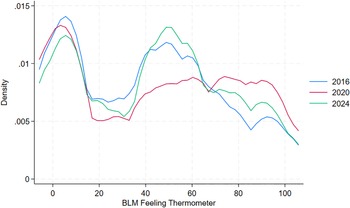
Figure 1 is a kdensity graph showing BLM feelings in 2016, 2020, and 2024 among White respondents. In all three years, there is a bimodal density distribution. From 2016 to 2020, attitudes toward BLM slightly decreased near the 50-point mark of the feeling thermometer and increased near the high end of the scale. From 2020 to 2024, attitudes toward BLM increased near the 50-point mark and slightly decreased near the high end of the scale. Lastly, between 2016 and 2024, a notable increase emerges in attitudes toward BLM near the 50-point mark, and there is an additional increase near the tail end of the scale. These results suggest that BLM attitudes were polarized, especially in 2020, and that they remained so in 2024, although polarization levels did slightly decrease.
Density plot of BLM feeling thermometer for White Americans in 2016, 2020, and 2024.

Findings
The Factors Underlying Polarization in BLM Attitudes
To examine the association of partisan and social–psychological orientations with changes in BLM ratings from 2016 to 2020 and 2020 to 2024, I estimate lagged-dependent-variable regression models. Specifically, I regress BLM ratings in one panel wave (either 2020 or 2024) on BLM ratings in the previous wave (either 2016 or 2020) and the values of party identification, racial resentment, SDO, and authoritarianism in the previous wave (either 2016 or 2020). Because the regression models include the lagged value of BLM ratings as an independent variable, the coefficients on the other independent variables indicate whether values of those variables in 2016 (or 2020) are associated with a changeFootnote 3 in BLM ratings between 2016 and 2020 (or between 2020 and 2024).
In each table, I display five sets of regression estimates. The first four models consider the relationship between only one orientation (party ID, SDO, racial resentment, and authoritarianism) and change in BLM attitudes. In the fifth model, I compare the relationship between party ID and BLM change to the relationship between socio-psychological orientations and BLM change. However, because these socio-psychological factors are associated with one another, including them all as separate independent variables in the same model raises concerns about multicollinearity potentially depressing their various coefficient estimates. To alleviate these concerns, I combined each socio-psychological variable (i.e., racial resentment, SDO, and authoritarianism) into a principal component factor analysis and then used the factor scores to create a new variable, which was then applied in the fifth model.Footnote 4
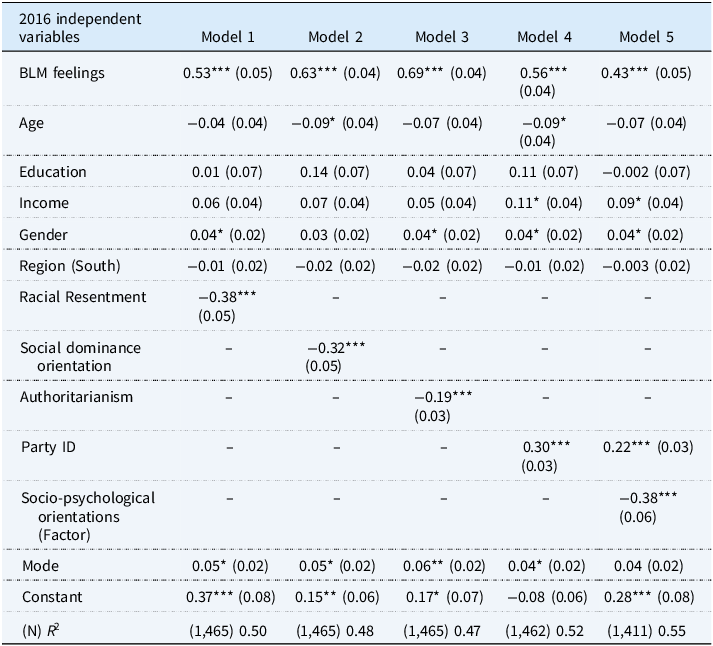
The regressions are shown in Tables 1 and 2. Table 1 displays the effect of 2016 socio-psychological and political orientations on 2020 BLM attitudes. Table 2 illustrates the effect of 2020 orientations on 2024 BLM attitudes. Beginning at Table 1, the racial resentment regression coefficient of 0.38 signifies the degree to which individuals with high levels of racial resentment in 2016 were more likely than those with low levels to grow more negative in their feelings about BLM between 2016 and 2020, holding all other variables constant (Model 1). Similar results emerged with 2016 SDO and 2016 authoritarianism. White individuals with high levels of SDO or authoritarianism, respectively, had a higher likelihood of developing more negative BLM attitudes from 2016 to 2020 compared to those with low levels (Models 2 and 3). Markedly, there is a statistically significant link between 2016 party ID and BLM attitudes. The 2016 party ID regression coefficient of 0.30 shows the degree to which 2016 strong Democrats were more likely than 2016 strong Republicans to grow more positive in their feelings about BLM, holding all other independent variables constant (Model 4). Overall, the results remain robust even when incorporating party affiliation and the socio-psychological factors together in the same model (Model 5). In this model, the 2016 socio-psychological regression displays the degree to which individuals with high levels of racial resentment, SDO, and authoritarianism in 2016 were more likely than those with low levels to grow more negative in their feelings about BLM between 2016 and 2020, holding all control variables (including party ID) constant. Additionally, 2016 Democrats had a higher likelihood of developing more positive BLM attitudes from 2016 to 2020 than 2016 Republicans, holding all controls (including socio-psychological orientations) constant.
The effect of 2016 socio-psychological and political orientations on 2020 BLM feelings (OLS estimates)

Source: 2016–2020–2024 American National Election Studies Panel.
Note: The top values in each cell are unstandardized coefficients from an OLS regression model. Standard errors are in parentheses.
***p < 0.001; **p < 0.01; *p < 0.05.
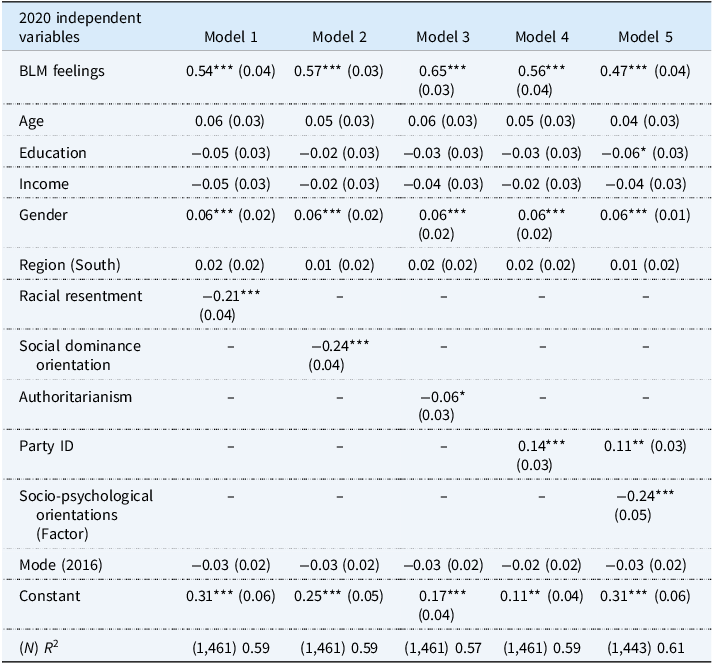
The effect of 2020 socio-psychological and political orientations on 2024 BLM feelings (OLS estimates)

Source: 2016–2020–2024 American National Election Studies Panel.
Note: The top values in each cell are unstandardized coefficients from an OLS regression model. Standard errors are in parentheses.
***p < 0.001; **p < 0.01; *p < 0.05.
The relationship between partisan and socio-psychological orientations in 2020 and changes in BLM ratings from 2020 to 2024 is assessed in Table 2. Overall, there was a slight depolarizing effect among White Americans as the regression coefficient for each orientation decreased, yet the direction of the coefficient remains the same. In Table 2, respondents with high levels of racial resentment were more likely than those with low levels in 2020 to develop more negative BLM feelings (Model 1). Similar results emerge for authoritarianism and SDO. Individuals with high levels of authoritarianism or SDO had a high likelihood of displaying more negative BLM attitudes from 2020 to 2024 (Models 2 and 3). Lastly, the 2020 party ID regression coefficient of 0.14 shows the degree to which strong Democrats in 2020 were more likely than strong Republicans to grow more positive in their feelings about BLM (Model 4). These findings remain robust when including the factor variable for socio-psychological orientations and party ID in one model (Model 5). When comparing the 2016–2020 and 2020–2024 regressions, the data shows that BLM polarization occurred along the lines of racial resentment, SDO, authoritarianism, and party identification from 2016 to 2020. From 2020 to 2024, the intensity of BLM polarization remained relatively durable, albeit slightly diminished.
Are BLM Ratings the Polarizer or the Polarized?
All of the results thus far suggest that factors such as party ID, racial resentment, SDO, and authoritarianism are associated with change over time in individuals’ evaluations of BLM. This implies that these factors are the reason why people are changing their assessments of BLM. However, it is possible that the direction of influence is exactly the opposite. Perhaps what appears to be party identification, racial resentment, and other socio-psychological orientations spurring change in BLM evaluations is actually BLM attitudes encouraging change in partisan and socio-psychological orientations. For example, perhaps what is going on is not that Democrats are growing more positive in their assessments of BLM, while Republicans grow more negative, but rather people who feel positively about BLM are becoming more likely to identify as Democratic, while people who dislike BLM grow more likely to identify as Republican.
To account for this possibilityFootnote 5, I extend the lagged-dependent-variable models estimated above to become cross-lagged effects models. In these models, two equations are estimated. Using party ID as an example, one equation represents a regression of BLM ratings in one time period on BLM ratings in the previous time period and party identification in the previous time period. In the other equation, party identification in one time period is regressed on its own value in the previous time period and BLM ratings in the previous time period. As such, the cross-lagged effects model captures the possibility that party identification in 2016 (or 2020) is associated with a change in BLM ratings between 2016 and 2020 (or between 2020 and 2024) and that BLM ratings in 2016 (or 2020) are associated with a change in party identification between 2016 and 2020 (or between 2020 and 2024).
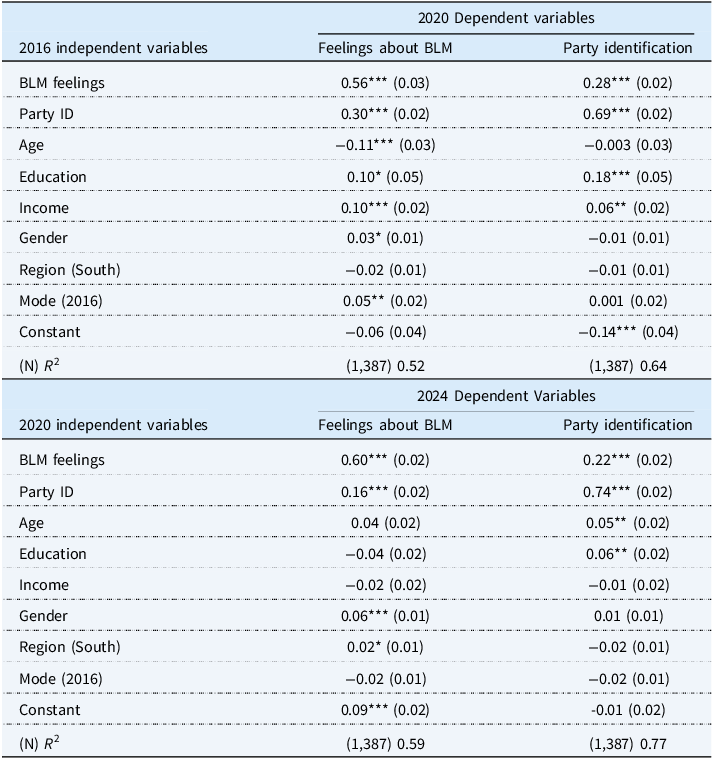
The estimates for the cross-lagged relationship between partisanship and BLM ratings are shown in Table 3. The results show statistically significant cross-lagged effects in both directions. Feelings about BLM were, in fact, associated with partisan change over this time period. Higher ratings of BLM in 2016 were related to increases in Democratic party identification between 2016 and 2020, and stronger BLM support in 2020 was connected to growth in Democratic partisanship between 2020 and 2024.
Estimates of cross-lagged effects between feelings about black lives matter and party identification

Source: 2016–2020–2024 American National Election Studies Panel.
Note: The top values in each cell are unstandardized coefficients from seemingly unrelated regression models estimated separately for 2020 and 2024 dependent variables. Standard errors are in parentheses.
***p < 0.001; **p < 0.01; *p < 0.05.
At the same time, the results of the lagged-dependent-variable models in Tables 1 and 2 still hold here. Democrats in 2016 were more likely than Republicans in 2016 to become more positive in their feelings about BLM between 2016 and 2020. Similar results emerge from the 2020–2024 panel wave. A stronger Democratic party affiliation in 2020 is associated with a higher likelihood of more positive BLM feelings from 2020 to 2024, as compared to Republicans.
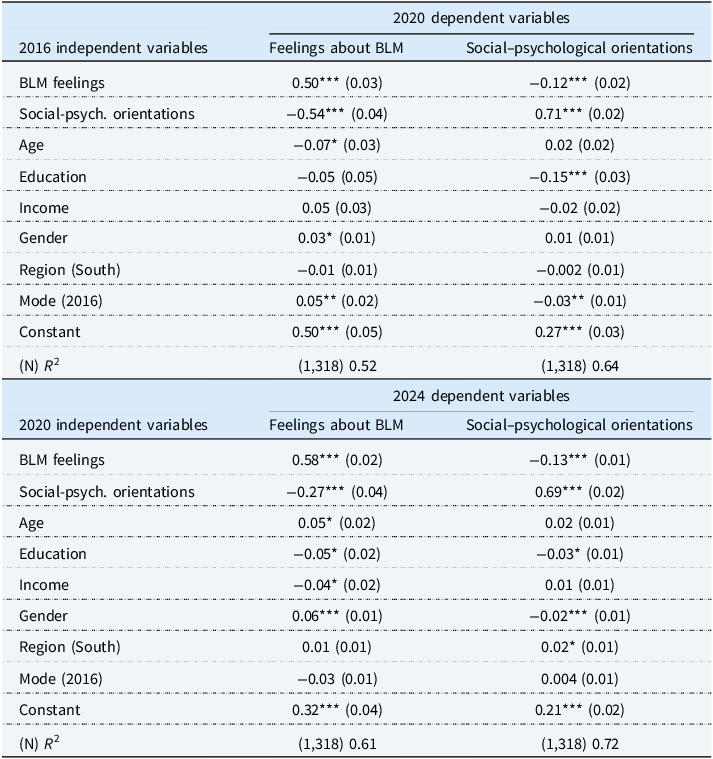
Table 4 displays the cross-lagged effects between socio-psychological orientations and BLM changes from 2016 and 2020 and from 2020 to 2024. Similar to the lagged-dependent-variable models in the last column of Tables 1 and 2, each socio-psychological variable is combined into a principal component factor analysis, and then the factor scores are used to generate a new variable. The results indicate that, like party identification, race-related social–psychological orientations are endogenous to feelings about BLM. Whites with positive feelings about BLM in 2016 were more likely than Whites with negative BLM ratings to grow less racially resentful, less authoritarian, and lower in social dominance orientation between 2016 and 2020. And the same thing is true between 2020 and 2024. Higher ratings of BLM in 2020 are associated with decreases in these orientations between 2020 and 2024.
Estimates of cross-lagged effects between feelings about black lives matter and social–psychological orientations

Source: 2016–2020–2024 American National Election Studies Panel.
Note: The top values in each cell are unstandardized coefficients from seemingly unrelated regression models estimated separately for 2020 and 2024 dependent variables. Standard errors are in parentheses.
***p < 0.001; **p < 0.01; *p < 0.05.
However, these social–psychological orientations are still connected to change in BLM ratings. Respondents with high levels of racial resentment, SDO, and authoritarianism in 2016 were more likely than those with low levels to express more negative feelings about BLM between 2016 and 2020. Additionally, individuals with elevated levels of socio-psychological orientations in 2020 were more likely than those with low levels to display more negative BLM ratings between 2020 and 2024.
In sum, BLM attitudes were both polarized and a polarizer during the 2016–2024 time period. They grew more polarized along the lines of partisanship, racial resentment, SDO, and authoritarianism. But they also were associated with polarizing change in these factors. The bottom line is that, taken together, the lagged-dependent-variable regressions and the cross-lagged models provide support for hypotheses H1a, H1b, H1c, and H1d as well as H2.
Discussion and Conclusion
Overall, the results from this study demonstrate that White attitudes toward BLM have become increasingly polarized. The factors that underlie this polarization are party ID, racial resentment, SDO, and authoritarianism. The predictors associated with more negative feelings toward BLM over time are high levels of racial resentment, SDO, authoritarianism, and a Republican party affiliation. The factors associated with an increase in positive BLM attitudes over time are low levels of these same socio-psychological orientations and a Democratic party identification. Overall, BLM polarization increased from 2016 to 2020 as the movement gained attention from the mass populace and remained robust from 2020 to 2024.
The results of this study make three important contributions to our understanding of the Black Lives Matter movement and White attitudes toward it. First, panel data analysis demonstrates that BLM attitudinal shifts were long-lasting among White individuals. Although previous studies have shown that White feelings towards BLM have reverted back to near baseline levels, empirical analyses mainly utilized cross-sectional data. By examining individual-level effects over time, the data shows that BLM polarization has remained durable even into 2024. Along these same lines, the findings of this study demonstrate that politically salient events bring political topics to the forefront of individuals’ minds, which has the potential to cause long-lasting changes in White racial attitudes. Put differently, Floyd’s death and the BLM movement were placed in the spotlight for the general public to witness, ultimately leading to polarization in this case.
Second, this study confirms prior work illustrating party identification as an important factor driving BLM polarization while concurrently showcasing that racial resentment, SDO, and authoritarianism are also significant predictors of BLM polarization. As such, greater attention and analysis should be devoted toward examining BLM evaluations as an outcome of interest, particularly among White Americans.
Third, the results here suggest that racial attitudinal polarization is a trend that is rapidly emerging among the mass public and across different racial groups. Public opinion literature has typically focused on ideological consistency and divergence as well as perceived and affective polarization. Although racial attitudes were originally considered to be fixed, evidence shows they can fluctuate, especially in response to the discourse of political leaders (Horowitz et al. Reference Horowitz, Brown and Cox2019) and social movements (Parker et al. Reference Parker, Horowitz and Anderson2020). As the political climate becomes increasingly racialized, it is essential that we investigate racial attitudinal shifts in response to an ever-changing political system.
Supplementary material
The supplementary material for this article can be found at https://doi.org/10.1017/rep.2026.10078.
Acknowledgements
I thank Geoffrey Layman, David Campbell, Jeffrey Harden, Dianne Pinderhughes, members of the Rooney workshop, anonymous reviewers, and the editors for their helpful comments and suggestions.
Funding statement
No funding was received for this research.


 Open access

