

Introduction
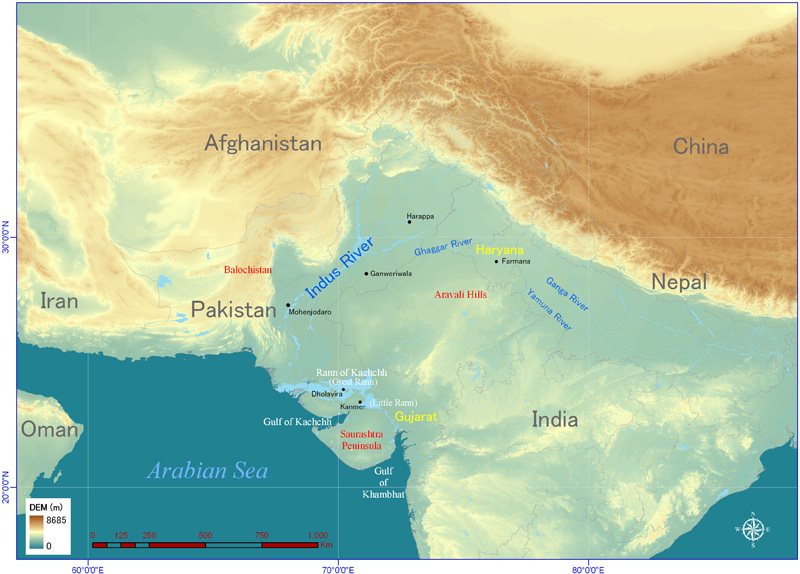
The Harappan civilisation (Figure 1) flourished in part due to its successful agricultural practices (Reference KenoyerKenoyer 1998; Reference WeberWeber et al. 2010). However over-reliance on macrobotanical finds (especially seed grains) has limited our understanding of the histories of plants like vegetables, fruits, nuts, roots and tubers whose remains might not survive the carbonisation process. Direct evidence of plant use from items such as ceramic vessels used for storing, cooking and serving plant foods is also significantly limited or missing from Harappan archaeology. As a result, questions relating to plant food, its processing, preparation and social and cultural patterning of use have yet to be answered. With the help of microfossils such as starch grains we can begin to answer some of these questions for the first time in Harappan archaeology.
Location map with Harappan sites.

Starch grains at Farmana
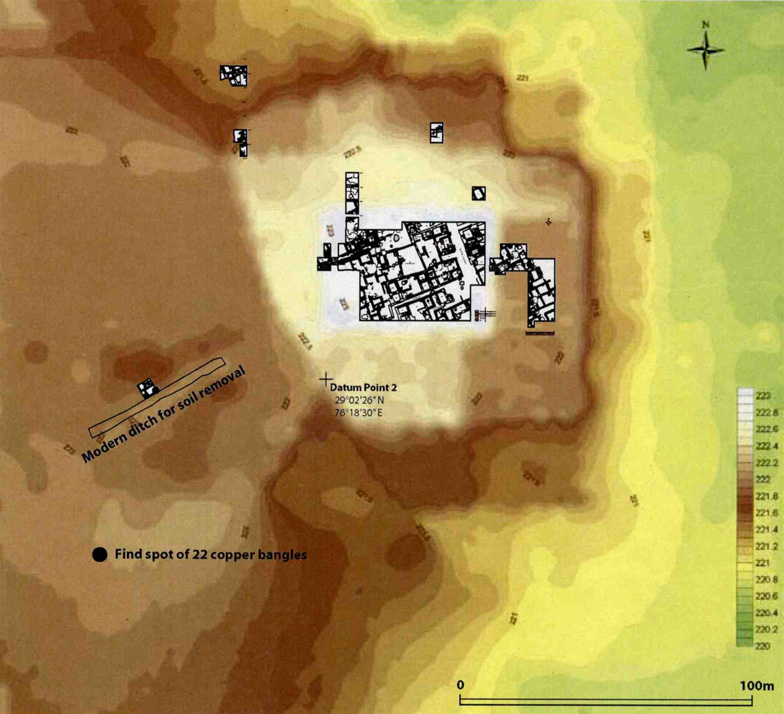
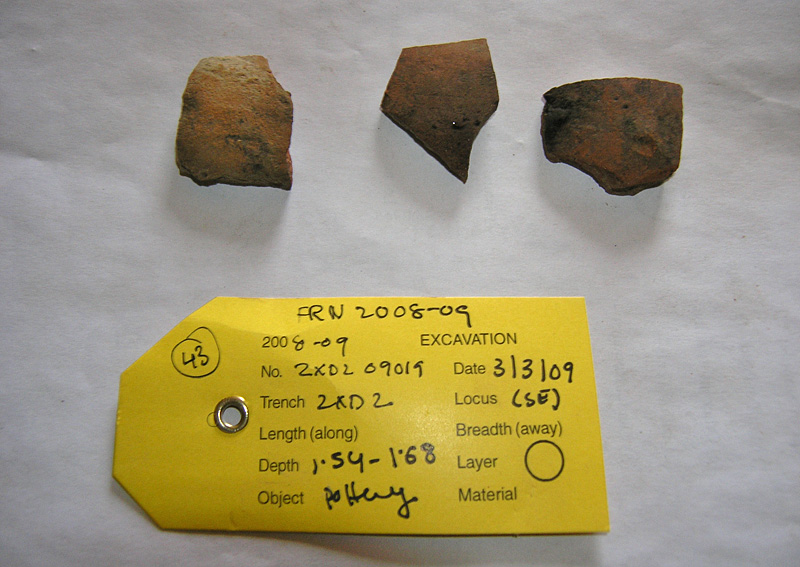
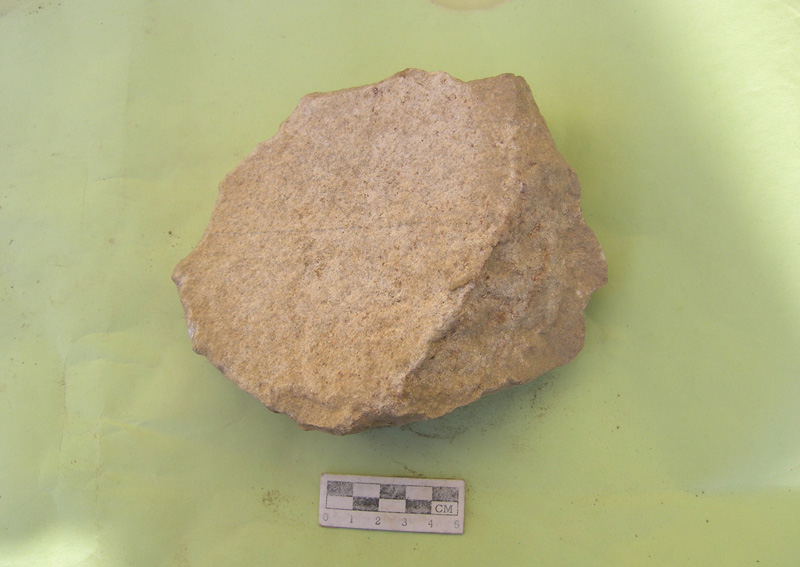
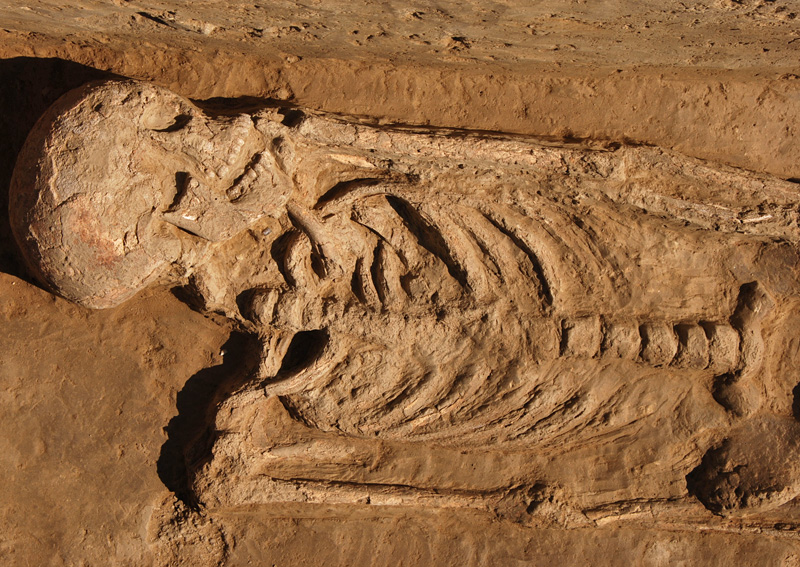
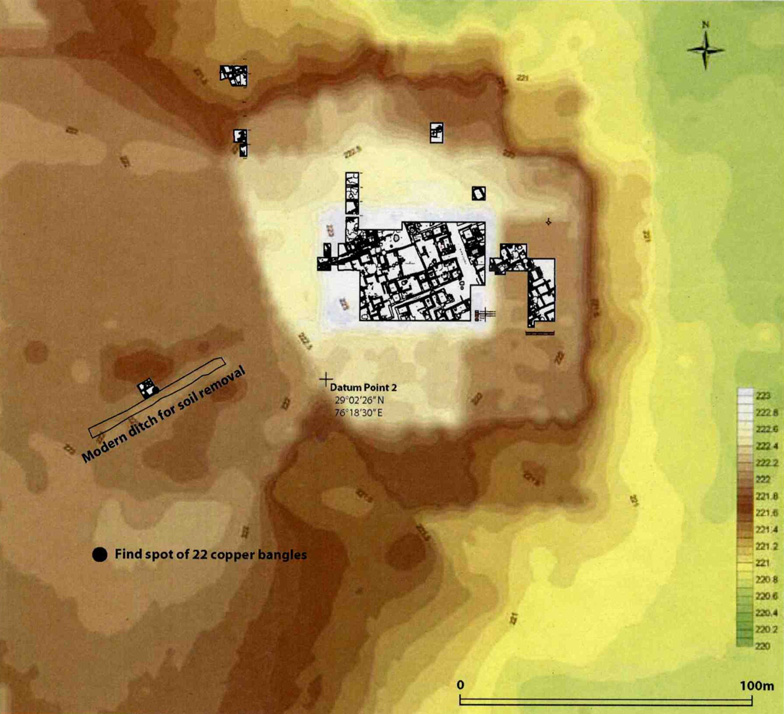
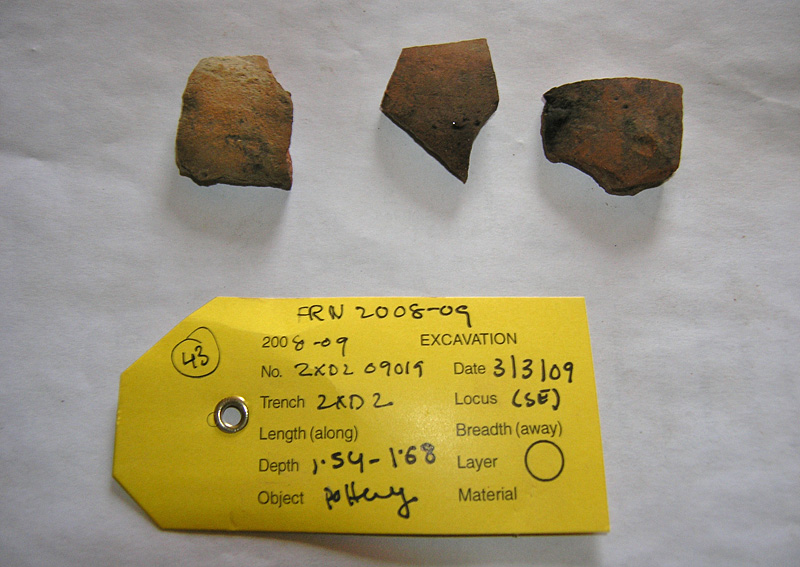
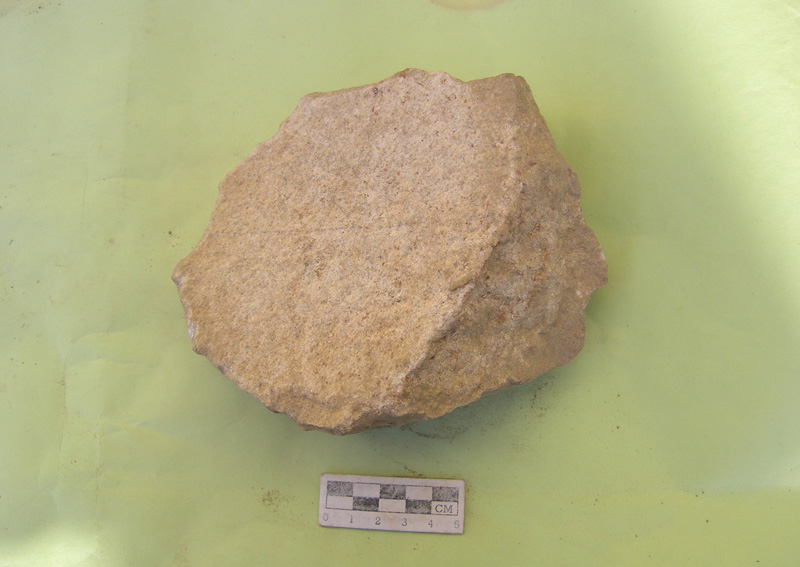
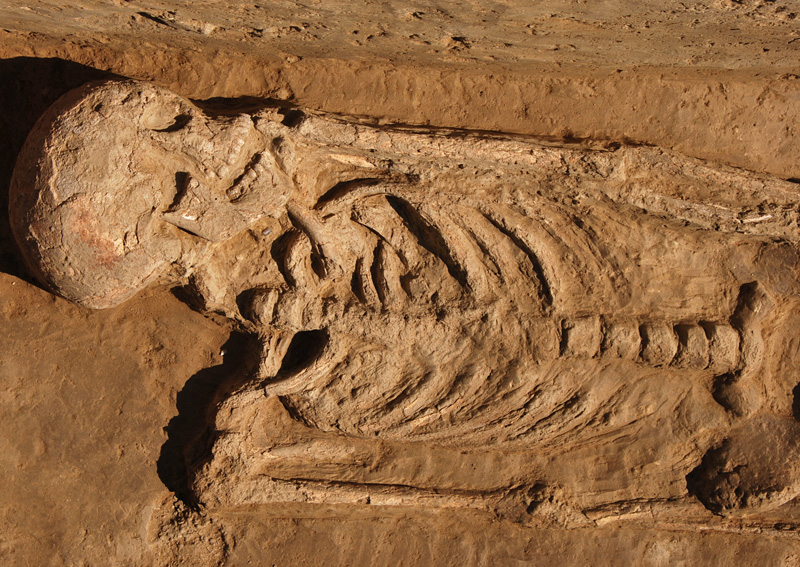
We conducted a pilot study of starches at the Harappan site of Farmana to gain insights from direct evidence of plant processing and dietary practices at the site. The Harappan site of Farmana (2600-2200 BC), located in the Ghaggar Valley, Haryana, India offered a unique opportunity to carry out such a study. Its size, extensive structural and material remains, and the recently identified cemetery makes it one of the most important Harappan sites in the region (Shinde et al. 2010) (Figure 2). Starch granules were extracted from 50 different surfaces including surfaces of pottery vessels, stone tools and dental calculus of human burials from Farmana (Figures 3-5).
The Harappan site of Farmana.
Surfaces studied for starch grain analysis: pottery from settlement.
Surfaces studied for starch grain analysis: grinder.
Surfaces studied for starch grain analysis: human teeth.
Starch grains are plant microfossils with distinctive features such as size and shape, and exhibiting certain physical features (such as hila, lamellae, dimples, cracks, fissures) which are genetically controlled. These features, when carefully studied, can be used to identify plant taxa (Banks & Greenwood 1975; Torrence & Barton 2006; Reference LoyLoy 1994; Reference ReichertReichert 1913). In recent years starch grain analysis has been used to study plant use, food preparation, ceramic residue analysis and tool use in various parts of the world (Henry & Piperno 2007; Reference KashyapKashyap 2006; Reference PerryPerry 2004, Piperno et al. 2000, 2004; Zarillo et al. 2008). However no such studies have been done in the Harappan context.
Results
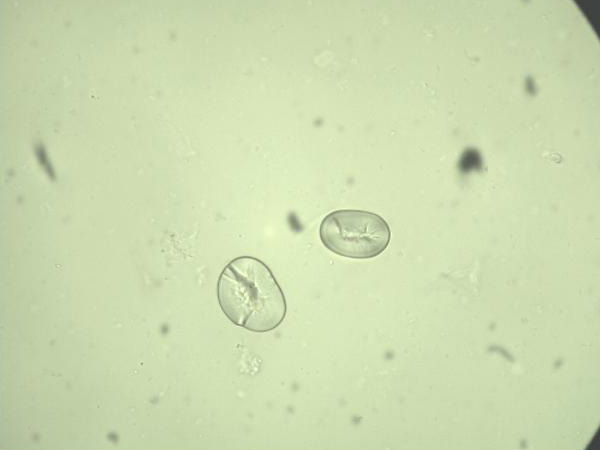
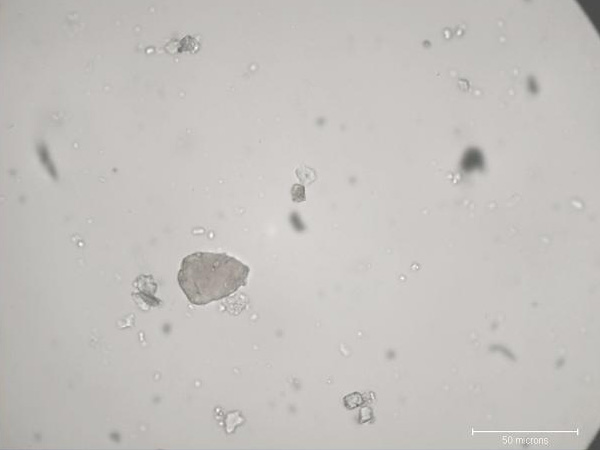
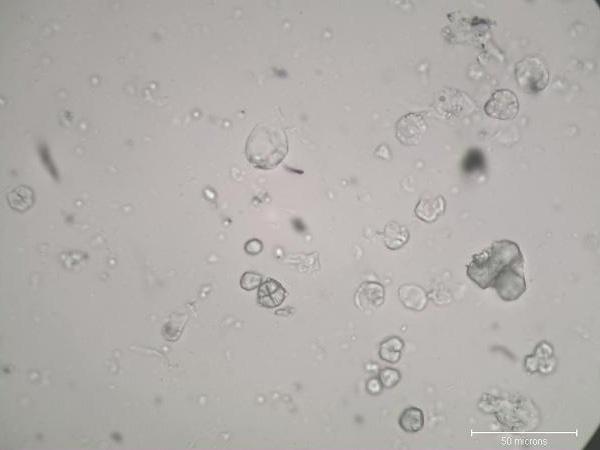
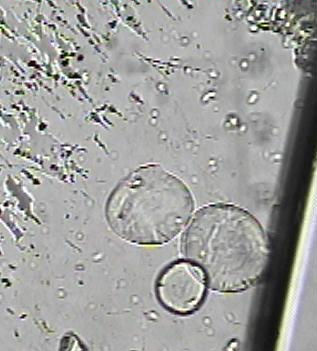
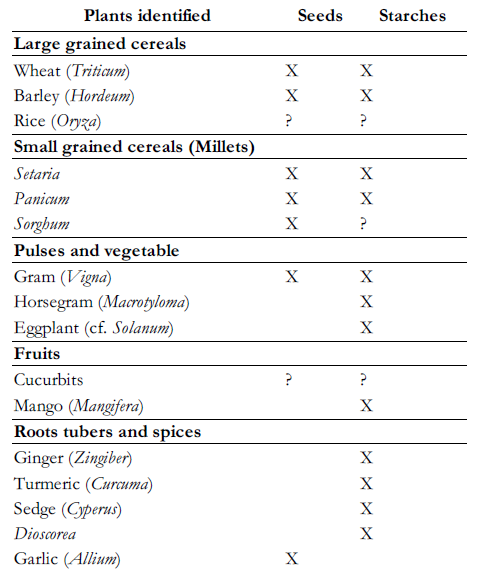
Our research is providing the first direct evidence for which plants were being used, processed and consumed at the site (Figures 6-9: each image 50µm; Table 1). We have successfully identified starches belonging to barley (Figure 9), millets (Figure 8) and mango from a variety of grinders and pounding stones. Starches of lentils and large and small grained cereals were recovered from the interior surface of storage jars, as for example the starch from Macrotyloma sp. illustrated in Figure 6. Solanum (cf. eggplant), zingiber (cf. ginger) and curcuma (cf. turmeric) (Figure 7) starches were extracted from a cooking pot or handi (a deep narrow-mouthed cooking vessel).
Archaeological starch of Macrotyloma sp. from storage jar.

Archaeological starch of cooked curcuma from handi or cooking pot.

Archaeological starch of small millets from dental calculus.

Archaeological starch of damaged Hordeum from dental calculus.

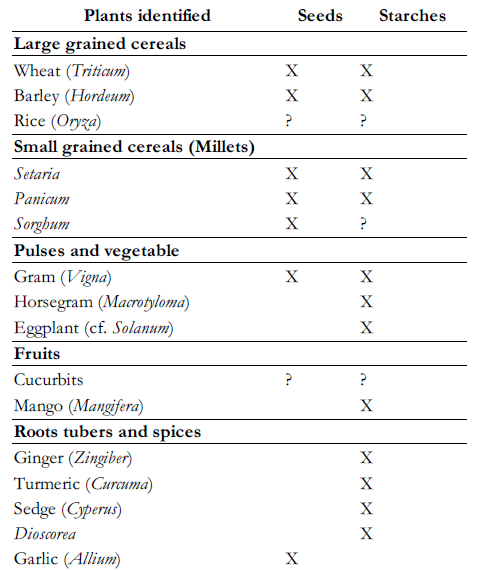
X = Present | ? = More research needed
Our goal is to eventually link stylistic variation in pottery recovered from Farmana to functional activities involving plant use. To understand how the cooking affects the starches we are also conducting a series of experiments using clay pots to cook recipes gathered from our ethnographic research at the current village of Farmana. To date we have cooked vegetable curries, chutneys, and roasted and boiled roots and tubers. Our preliminary data from these experiments demonstrate that cooking causes structural and morphological changes in starch granules. What plants are being cooked together, the length of time the plants are cooked and the material in which the plants are cooked also has a direct impact on starch preservation (Kashyap & Weber in press a).
Our success in extracting and identifying starches in human calculus from burials represents an innovation in South Asian archaeology. The study from 10 different individuals shows that the Harappans had a broad diet which included small grained-cereals, pulses, fruits, vegetables and roots and tubers, with wheat and barley apparently underrepresented in the starches. We have recently extended our dental calculus study to include cattle teeth (Kashyap & Weber in press b). By understanding cattle diet we hope to gain better insight into dung fuel use and the macrobotanical seed record from Harappan hearths. It seems that cattle are eating many of the same things as people including cooked starches.
Conclusions
Starch grain analysis is still at an early stage of development, especially in South Asia where the extent of comparative collections is somewhat limited. The project at Farmana has not only opened up a new avenue of archaeological research in South Asia, but has clarified biases that exist in the Harappan archaeobotanical record by showing that additional plant species were being exploited but not necessarily preserved in the carbonised seed record. Starch finds corroborate the conclusions drawn from the analysis of the macrobotanical remains of wheat, barley, millets (indigenous millets: Panicum and Setaria) and pulses (South west Asian and tropical pulse Macrotyloma). In addition, we have added tropical pulses (Vigna species), millets (of African origin, cf. Sorghum), vegetables such as cucurbits and eggplants — this being one of the earliest evidence of eggplants in South Asia, the earliest occurring in Bagor (Reference KashyapKashyap 2006) —, fruits like mango and date, and roots and tubers like Dioscorea, Zingiber and Curcuma species to the Harappan diet at Farmana (Table 1). Our study is thus making a new contribution to understanding human dietary behaviour in South Asia.
Acknowledgements
This study was made possible by NSF Grant (# 0092261). Any opinions, findings, and conclusions or recommendations expressed in this material are those of the authors and do not necessarily reflect the views of the National Science Foundation. We would like to thank Drs. Vasant Shinde (Deccan College, India) and Toshiki Osada (Research Institute of Humanity and Nature, Japan) for inviting us to join the excavation and giving access to Farmana material. We would like to thank Angel Gregory (Washington State University Vancouver) for helping us with the literature search.