





Introduction
Under what conditions citizens accept public institutions as legitimate authorities is a key question in political science. Public faith in political institutions is a crucial precondition for democracy and effective government (see Arif and Dutta Reference Arif and Dutta2024), and citizens’ trust in institutions directly affects compliance with public law and policy (Devine et al. Reference Devine, Valgarðsson, Smith, Jennings, Scotto di Vettimo, Bunting and McKay2024). The same applies to public institutions at the international level: international organisations (IOs) frequently face crises of legitimacy, which may gravely undermine their functioning (Sommerer et al. Reference Sommerer, Agné, Zelli and Bes2022). We are currently witnessing a political ‘backlash’ against globalisation and the IOs comprising the liberal international order (LIO) (Börzel and Zürn Reference Börzel and Zürn2021; Walter Reference Walter2021).
But what drives public attitudes towards IOs? Citizens were traditionally perceived to be an inconsequential audience for IOs, with states and organised non-state actors dominating international governance. Yet recent decades include numerous examples where citizens impact IOs directly, from Brexit to the isolationism advocated by Trump supporters in the United States. The intensification of public contestation of IOs has greatly increased scholarly interest in public attitudes towards IOs and their drivers (see eg Dellmuth et al. Reference Dellmuth, Scholte, Tallberg and Verhaegen2022a; Dellmuth and Schlipphak Reference Dellmuth and Schlipphak2020; Steffek Reference Steffek2023). These include both demand- and supply-side drivers, such as individual-level socioeconomic and identitarian factors, country-level political and media contexts (Dellmuth et al. Reference Dellmuth, Scholte, Tallberg and Verhaegen2022b, Reference Dellmuth, Scholte, Tallberg and Verhaegen2022a), and the specific features of IOs (Tallberg and Zürn Reference Tallberg and Zürn2019).
Little interest has been paid, however, to how citizens’ attitudes towards political representation shape their attitudes towards IOs. The comparative politics literature has recently made great headway in studying citizens’ populist attitudes as a challenge to representative democracy (Akkerman, Mudde and Zaslove Reference Akkerman, Mudde and Zaslove2014; Castanho Silva et al. Reference Castanho Silva, Jungkunz, Helbling and Littvay2020; Jungkunz, Fahey and Hino Reference Jungkunz, Fahey and Hino2021). Citizens holding stronger populist attitudes (ie ‘populist citizens’) conceive of society as split into two antagonistic groups, ‘the pure people’ versus ‘the corrupt elite’, and believe that politics should be an expression of the general will of the pure people (Mudde Reference Mudde2004: 543). Others have positioned citizens’ technocratic attitudes as an equal and related challenge (Bertsou Reference Bertsou2022; Bertsou and Caramani Reference Bertsou and Caramani2020a; Bertsou and Pastorella Reference Bertsou and Pastorella2017): citizens holding stronger technocratic attitudes (ie ‘technocratic citizens’) prefer government to be run by elites based on a scientific approach to government (see also Marlier, Kaltenegger and Ennser-Jedenastik Reference Marlier, Kaltenegger and Ennser-Jedenastik2024).
Technocratic and populist norms and ideas are intimately related not only to each other (Caramani Reference Caramani2017) but also to the crisis of legitimacy faced by IOs (van der Veer and Meibauer Reference van der Veer and Meibauer2024): the foundational logic of many IOs is one that is deeply technocratic (Steffek Reference Steffek2021), and many IOs draw heavily on technocratic standards for legitimation, such as non-partisanship, rationality, and performance (Bexell, Jönsson and Uhlin Reference Bexell, Jönsson and Uhlin2022; Rauh and Zürn Reference Rauh and Zürn2020; Zürn Reference Zürn2018). The challenge to IO authority, on the other hand, is often grounded in populist norms and ideas: political actors draw on these to project the Manichean antagonism between the ‘pure people’ and the ‘corrupt elite’ onto the international stage (Copelovitch and Pevehouse Reference Copelovitch and Pevehouse2019) and to reject the internationalisation and depoliticisation that occurs in many IOs in the name of reclaiming national sovereignty and popular authority (Destradi, Plagemann and Taş Reference Destradi, Plagemann and Taş2022; Jenne Reference Jenne2021; Löfflmann Reference Löfflmann2022).
Despite the growing interest in technocracy and populism generally, and their relevance to the legitimacy of IOs specifically, no study has thus far examined whether citizens’ technocratic and populist attitudes structurally shape their attitudes towards IOs.Footnote 1 Such an investigation is warranted for two reasons. First, only Kiratli and Schlipphak (Reference Kiratli and Schlipphak2024) directly probe the linkage between populist and IO attitudes but omit technocratic attitudes as an explanatory factor, despite their relevance to IOs and their close association with populist attitudes (Bertsou and Caramani Reference Bertsou and Caramani2020a). Second, recent research on political leaders raises doubts over the extent to which populist and technocratic ideologies actually drive stance towards IOs: Van der Veer and Meibauer (Reference van der Veer and Meibauer2024) find that the (de)legitimation of IOs by national leaders is primarily driven by utilitarian and strategic calculations, not by their technocratic or populist tendencies. Whether citizens operate on a similar logic is largely an open question. In a world where voters increasingly reject traditional forms of institutionalised international cooperation at the ballot box, it is vital to understand the linkages between technocratic and populist attitudes and IO attitudes.
To address this lacuna, we examine the influence of populist and technocratic attitudes on trust in IOs. We leverage a novel and representative survey of citizens in five European countries. Using pre-validated scales (Akkerman et al. Reference Akkerman, Mudde and Zaslove2014; Bertsou and Caramani Reference Bertsou and Caramani2020a), we provide a detailed examination of the (inter)relationship between citizens’ technocratic and populist attitudes on the one hand, and their attitudes towards four diverse IOs on the other. Our findings show that the relationships between technocratic, populist, and IO attitudes are far more complex than suggested by a simplistic notion that technocratic (populist) citizens’ trust (distrust) IOs. Instead, citizens’ trust in IOs is only partially explained by their technocratic and populist attitudes, and these associations are strongly conditional on the IO under evaluation and citizens’ ideological positioning. We discuss the implications of our findings for the literatures on IO legitimacy, technocracy, and populism.
Theory
We follow the sociological understanding of IO legitimacy as coined by Tallberg and Zürn (Reference Tallberg and Zürn2019: 586), for whom ‘authority refers to the recognition that an institution has the right to make decisions and interpretations within a particular area, [whereas] legitimacy refers to the perception that these rights are appropriately exercised’. It is this linkage between authority and legitimacy that is crucial to the literature on IO legitimacy (Zürn Reference Zürn2018): legitimacy is not an inherent feature of IOs, but the product of (de)legitimation practices by political actors that shape public attitudes towards the IO in question (Bexell et al. Reference Bexell, Jönsson and Uhlin2022; De Vries, Hobolt and Walter Reference De Vries, Hobolt and Walter2021; Tallberg and Zürn Reference Tallberg and Zürn2019). The relative remoteness of IOs in the daily lives of citizens and the limited visibility of IOs in public spheres make public attitudes towards IOs especially susceptible to cueing by elites (Dellmuth and Tallberg, Reference Dellmuth and Tallberg2021) and explains why IOs themselves have greatly increased self-legitimation efforts in recent decades (Dingwerth, Schmidtke and Weise Reference Dingwerth, Schmidtke and Weise2019; Ecker-Ehrhardt Reference Ecker-Ehrhardt2018; von Billerbeck Reference von Billerbeck2020a).
Still, research on public attitudes towards IOs has found several individual-level factors that predict citizen attitudes towards IOs. Dellmuth et al. (Reference Dellmuth, Scholte, Tallberg and Verhaegen2022b, Reference Dellmuth, Scholte, Tallberg and Verhaegen2022a) show that citizens view IOs more favourably when they have more trust in domestic institutions, a higher socioeconomic status, when they hold more left-wing and progressive attitudes, and when they identify more strongly as members of a global community. These findings are consistent with the more extensive literature on support for regional integration and the EU, where research identifies three approaches – a utilitarian, identarian, and institutional approach – to explaining support (see Hobolt and de Vries Reference Hobolt and de Vries2016). Consistent in these literatures is the notion that poor economic performance decreases the popularity of IOs (Kiratli Reference Kiratli2022), and that trust in national institutions and trust in IOs is correlated (eg Torgler Reference Torgler2008; Voeten Reference Voeten2020).
Important for our present argument is that earlier studies have also shown that the degree to which citizens feel represented matters for their attitudes towards IOs. For example, when EU citizens perceive that they are unrepresented, they become more Eurosceptic, even when their economy performs well (Mcevoy Reference Mcevoy2016; Rohrschneider Reference Rohrschneider2002). Similarly, Lee and Lim (Reference Lee and Lim2022) have found that a difference in citizens’ understanding of IOs shapes their preferences for political representation in IOs: some centralise IO accountability to citizens, whereas others prioritise state representation in IOs. In this line we must also place the scant and mixed evidence for the relationship between populist attitudes and attitudes towards IOs: at the country level, Destradi and Plagemann (Reference Destradi and Plagemann2024) find that governments ruled by populist leaders showcase negative attitudes towards the LIO in the UN General Assembly. In terms of public opinion, some find a strong association between populist attitudes and IO-critical attitudes (Kiratli and Schlipphak Reference Kiratli and Schlipphak2024), while others find weak evidence linking citizens’ IO attitudes and the degree of populism in domestic politics when measured at the level of the political system at large (Dellmuth et al. Reference Dellmuth, Scholte, Tallberg and Verhaegen2022a).
While these above-mentioned advances are important, we lack a theory of how citizens’ attitudes on representation shape their attitudes towards IOs that is sufficiently informed by the specificities of IOs and the idiosyncratic foundations of their authority. We argue that this is because technocracy, as the foundational principle of IO authority, has thus far been largely neglected in the study of citizen attitudes towards IOs. In what follows, we seek to remedy this by providing a comprehensive theoretical argument for why technocracy, populism, and IO legitimacy should structurally be related to one another when considering IO attitudes among general publics.
Technocratic and populist attitudes as challenges to democratic representation
Both technocracy and populism are often conceptualised as forms of power, representation, or as ideologies that constitute challenges to representative democracy; either independently (Mudde Reference Mudde2004; Mudde and Kaltwasser Reference Mudde and Kaltwasser2017) or jointly as two sides of a singular challenge to pluralism and liberal democracy (Bertsou and Caramani Reference Bertsou and Caramani2020b; Caramani Reference Caramani2017; Rummens Reference Rummens2023). They are most often understood as thin ideologies, which implies they combine with other, thicker ideologies such as ethno-nationalism in the case of populism (Mudde Reference Mudde2004; Neuner and Wratil Reference Neuner and Wratil2022), or neoliberalism in the case of technocracy (cf Bertsou, Caramani and Koedam Reference Bertsou, Caramani and Koedam2024; Bertsou and Caramani Reference Bertsou and Caramani2020b; Rummens Reference Rummens2023). Given the significant debate over the conceptual nature of populism and, to a lesser extent, technocracy (see eg Aslanidis Reference Aslanidis2015; Stanley Reference Stanley2008), we will maintain the less controversial notion of ‘attitudes’ here.
Technocratic attitudes originate in a deep distrust of citizens in career politicians, who are assumed to lack the competence to provide adequate input to political processes and to be unwilling to govern responsibly as they serve specific constituencies (Caramani Reference Caramani2017; Fischer Reference Fischer1990; Radaelli Reference Radaelli1999). Those holding technocratic attitudes instead prefer a scientific approach to government, which is rooted in a depoliticisation of public policy and is instead based on objective analysis, scientific evidence, and rationality (Bertsou and Caramani Reference Bertsou and Caramani2020b). Such individuals prefer political power to be wielded by a knowledge elite that is capable of deducing the common good objectively through reason and which relies on competence, neutrality, efficiency, and expertise as its source of legitimacy (Fischer Reference Fischer1990; Putnam Reference Putnam1977; Radaelli Reference Radaelli1999). This knowledge elite subsequently decides on both the means and ends of public policy.Footnote 2
Individuals with technocratic attitudes believe government ought to be a value-free process and that conflicts of interests are irrelevant. They thus conceive of government as apolitical and neutral, but, in practice, technocratic government remains a fundamentally political process: it relies on the ‘covert politicization’ of public policy, where a knowledge elite decides on the ends of policy but masks its normativity by legitimating decision-making as objective, rational, and value-free (Tortola in Bertsou and Caramani Reference Bertsou and Caramani2020b: 69). Finally, technocracy is anti-pluralist: whereas representative democracy conceives of society as a collective of diverse groups with different interests, those with technocratic attitudes view society either as a unitary whole (Caramani Reference Caramani2017), or dissolve the collective entirely into atomised individuals (Rummens Reference Rummens2023: 8).
Individuals with populist attitudes, on the other hand, consider ‘society to be ultimately separated into two homogeneous and antagonistic groups, “the pure people” versus “the corrupt elite”, and [believe] that politics should be an expression of the volonté générale (general will) of the people’ (Mudde Reference Mudde2004: 543). The first element of this ‘Manichean divide’ centres on the ‘true people’, whose will is personified by a strong populist leader who presents herself as the sole authority with an understanding of this collective will (Lacatus and Meibauer Reference Lacatus and Meibauer2022). Hence, populism has a similarly holistic view of societies, which identifies a unitary ‘will’ instead of an objective ‘common good’ (Caramani Reference Caramani2017). Like technocracy, this makes populism fundamentally anti-pluralist.
The second important element of the Manichean divide is the ‘corrupt elite’, which populist leaders in turn vow to unseat once coming into power (Moffitt Reference Moffitt2015; Rooduijn Reference Rooduijn2014). The central claim made by populists is that the ‘true people’ have been forgotten or are being actively ignored by unaccountable, self-serving elites and dysfunctional institutions (Canovan Reference Canovan1999). In line with the thin-ideology conception of populism, this ‘corrupt elite’ can take many forms, from the bankers and economic elites driving globalisation in the case of left-wing populism, to the cosmopolitan liberals driving progressive cultural agendas and allowing for mass migration in the case of right-wing populism (see eg Moffitt Reference Moffitt2020; Mouffe Reference Mouffe2018; Mudde Reference Mudde2007). Both populist attitudes, and more recently technocratic attitudes, have been found to be prevalent among general publics (Akkerman et al. Reference Akkerman, Mudde and Zaslove2014; Bertsou Reference Bertsou2022; Bertsou and Caramani Reference Bertsou and Caramani2020a).
Technocratic and populist attitudes and IO legitimacy
IOs are traditionally seen as typical cases of technocratic governance (Mounk Reference Mounk2018; Radaelli Reference Radaelli1999; Steffek Reference Steffek2021). The literature on IO legitimacy places a strong emphasis on the technocratic basis of IO authority (Bexell et al. Reference Bexell, Jönsson and Uhlin2022; Rauh and Zürn Reference Rauh and Zürn2020; Steffek Reference Steffek2021; Zürn Reference Zürn2018). The ‘postnational’ liberal order that arose after WWII was largely the result of a push towards the circumvention of the nation state by functionalists such as David Mitrany and Ernst Haas (Börzel and Zürn Reference Börzel and Zürn2021; Steffek Reference Steffek2021). These functionalists theorised that international governance should be organised based on function and rationality, not community. ‘Technocratic internationalism’ became the prevailing foundational logic underpinning IOs and international bureaucracy specifically, which Steffek (Reference Steffek2021: 16) defines as a ‘programmatic intellectual attitude that combines two elements of reform: cooperation across borders and expert rule’.
The legitimation of 21st-century IOs remains most often grounded in a functional, Weberian logic that centralises the efficiency gains brought about by shifting problem-solving capacity to the international level, as well as the rational-legal expertise and the political neutrality of international administrations (Bexell et al. Reference Bexell, Jönsson and Uhlin2022; Dingwerth et al. Reference Dingwerth, Schmidtke and Weise2019; Steffek Reference Steffek2021). Delegation to such IOs places public authority at arm’s length from citizens and national legislatures, transferring it instead to IOs that appeal predominantly to technocratic norms, such as non-partisanship, rationality, and performance (Dellmuth et al. Reference Dellmuth, Scholte, Tallberg and Verhaegen2022b; Rauh and Zürn Reference Rauh and Zürn2020; von Billerbeck Reference von Billerbeck2020b). This technocratic legitimation of IO authority favours the curtailing of their political responsiveness under the auspices of ‘responsible’ and expertise-driven governance and the domination of IO decision-making by executive and judicial powers.
Populism, on the other hand, is often seen as a key aspect of the challenge to international authority, with the caveat that much of this research is based on populism among opposition forces. Populism comes in different flavors, not all of which are opposed to globalisation (Verbeek and Zaslove Reference Verbeek, Zaslove, Kaltwasser, Taggart, Espejo and Ostiguy2017). However, given the technocratic origins of IOs, many of these flavors do extend the Manichean divide of the ‘true people’ versus ‘corrupt elites’ to the global stage, by alleging that globalisation and supranationalism have eroded popular sovereignty. While specific populist grievances with IOs vary across economic, cultural, and institutional dimensions (De Vries et al. Reference De Vries, Hobolt and Walter2021), a frustration with the technocratic qualities of IOs is often a core feature of the populist challenge to IOs (Neblo and Wallace Reference Neblo and Wallace2021; Zürn Reference Zürn2018).
Populist challengers tend to depict IOs as elitist bodies that shield decision-making processes from popular influence (Dellmuth and Tallberg Reference Dellmuth and Tallberg2021). Left-wing populists criticise the neoliberal bias of IOs or portray them as barriers to more inclusive transnational politics (Katsambekis Reference Katsambekis2022), while right-wing populists challenge the political liberalism embodied by these IOs, especially concerning immigration and trade integration (Chryssogelos Reference Chryssogelos2020; Jenne Reference Jenne2021). Populist movements outside the Western sphere may view IOs as tools of neocolonial dominance (Zürn Reference Zürn2018). The common thread is the perceived imposition of international constraints on the ‘will of the people’, leading populists to advocate for measures such as increased national control, reduced international cooperation, or even the revocation of IO memberships (Chryssogelos Reference Chryssogelos2020; Löfflmann Reference Löfflmann2022). Recent research suggests that the escalating challenges to IO authority have compelled defenders of IOs to broaden the basis of legitimation from technocratic to democratic principles (Dingwerth et al. Reference Dingwerth, Schmidtke and Weise2019; Rauh and Zürn Reference Rauh and Zürn2020). This shift has prompted IOs to become more responsive to policy concerns (Rauh and van der Veer Reference Rauh and van der Veer2024) and to engage extensively in self-legitimation (von Billerbeck Reference von Billerbeck2020b; Ecker-Ehrhardt Reference Ecker-Ehrhardt2018; Sommerer et al. Reference Sommerer, Agné, Zelli and Bes2022).
Prior research also indicates that attitudes towards IOs are especially amenable to cueing by political entrepreneurs (Bexell et al. Reference Bexell, Jönsson and Uhlin2022; De Vries et al. Reference De Vries, Hobolt and Walter2021). For example, based on a recent survey experiment with German citizens, Kiratli and Schlipphak (Reference Kiratli and Schlipphak2024) show that citizens with populist attitudes are more susceptible to negative cues about IOs that point out typical populist grievances with IOs. Given the discussion above, we should expect that, on average, citizens that hold stronger technocratic attitudes also have more favourable attitudes towards IOs. This association should hold across the three subdimensions: expertise, elitism, and anti-politics should each be associated to more positive IO attitudes. Conversely, citizens with stronger populist attitudes should generally hold more negative IO attitudes.
H1a: Citizens holding stronger technocratic attitudes will on average hold more positive attitudes towards IOs.
H1b: Citizens holding stronger populist attitudes will on average hold more negative attitudes towards IOs.
Populist cueing of attitudes towards IOs
Our argument so far is based on the assumption that populists position themselves as outsiders seeking to challenge the technocratic foundations of IO authority. However, the general associations between citizens’ technocratic and populist attitudes and their attitudes towards IOs, as hypothesised above, likely masks a more complex relationship in cases where populists are no longer challengers but have come to power. This is because the cues that citizens receive regarding IOs from populists in power may vary considerably across political contexts.
First, recent research finds that while populists in government may be more likely to politicise IOs, they are not consistently hostile to international institutions (van der Veer and Meibauer Reference van der Veer and Meibauer2024). Populists in power may actively legitimate IOs for strategic reasons (Destradi et al. Reference Destradi, Plagemann and Taş2022; Spandler and Söderbaum Reference Spandler and Söderbaum2023): they need to engage (potential) global partners to achieve their policy goals, and, once elected, have a newfound interest in maintaining their country’s embeddedness in IOs (Destradi and Plagemann Reference Destradi and Plagemann2019). Italy’s Georgia Meloni, for example, made a stark, positive shift towards the EU upon taking office. Similarly, when in government, it is more difficult for populists to present themselves as ‘outsiders’ fighting ‘a corrupt elite’, given that they now have a say in IOs as well as control over the extent to which they allow IOs to ‘constrain’ their country.Footnote 3 The realities of holding governmental responsibilities – including partial dependence on IOs – thus moderate the extent to which populists can delegitimate IOs without repercussion (see eg van der Veer Reference van der Veer2022).
Second, recent insights from the comparative politics literature give further cause to expect that populism in power may also alter the relationship between technocratic attitudes and attitudes towards IOs. Caramani (Reference Caramani2017) has argued that technocracy and populism share important commonalities at a conceptual level. Subsequent contributions have developed the concept of technocratic populism as a distinct class of populism, to address the increasing prevalence of populist politicians that strategically combine ‘the opposition between the corrupt, incompetent elite and honest people, hostility to the administration […], legitimacy based on output efficiency […] and the focus on the administrative and management reform of governance implemented by “neutral” experts’ (Drápalová and Wegrich Reference Drápalová and Wegrich2021: 644; see also Bickerton and Accetti Reference Bickerton and Accetti2021; Buštíková and Guasti Reference Buštíková and Guasti2019).Footnote 4 Among these are Italy’s Five Star Movement, Spain’s Podemos, and ANO in the Czech Republic, which have all been in government.
As a result, the cues that voters receive regarding IOs by populists in government may firstly be more positive than the cues they receive from populists in opposition. Recent evidence, for example, suggests that citizens in countries with populists in power who themselves hold populist attitudes are more satisfied with democracy and their economic conditions (Aytaç, Çarkoğlu and Elçi Reference Aytaç, Çarkoğlu and Elçi2021): this effect is explained by the increased susceptibility of populist citizens to positive cues by populist leaders about the state of democracy and the economy.Footnote 5 Citizens with stronger technocratic attitudes may in turn view IOs less favourably. One possible reason is that technocratic citizens may dislike the notion that ‘their’ populist government is involved in the decision-making of the IO in question. Another is that by co-opting technocratic rhetoric, right-wing populist governments especially may shift citizens’ understanding of who are classified as ‘experts’ (eg from policy professionals to businessmen, see Guasti and Buštíková Reference Guasti and Buštíková2020) and ‘corrupt elites’ (eg from ‘the government’ to judges, academics, and journalists). Such shifts may actually reduce the extent to which citizens associate IOs with experts and elites.
This is not to imply that populists in power – such as Hungary’s Viktor Orbán, the Netherlands’ Geert Wilders, or Donald Trump in the United States – do not regularly lament the ‘globalist elites’ steering IOs and their constraints on national sovereignty. However, changes occur in the tone and substance of the cues citizens receive about IOs from populists in office (van der Veer and Meibauer Reference van der Veer and Meibauer2024). Specifically, as the cues citizens receive about IOs from populists in power may both become less negative – or even positive – on the one hand, and muddied by the incorporation of technocratic elements on the other, we should also expect the associations between populist attitudes and technocratic attitudes and IO attitudes to weaken in these countries.
H2a: The positive association between technocratic attitudes and attitudes towards IOs is weaker in countries that have experience with more populist governments.
H2b: The negative association between populist attitudes and attitudes towards IOs is weaker in countries with experience with more populist governments.
Methodology
To evaluate these hypotheses, we fielded a survey in five European countries – Belgium, Germany, Italy, the Netherlands, and Türkiye – between 15 April and 4 May 2023. The samples of approximately 1000 respondents per country are representative in terms of gender, age, education, and geographical distribution (see online Appendix). We chose these countries because they offer important variation in terms of their experience with populism, technocracy, and their support for the LIO. Germany and the Netherlands are traditional supporters of the LIO, which, at the time of fielding, had no experience with populism in power. Italy is a LIO supporter which has ample experience with both technocratic and populist governments. Türkiye is a member of key IOs including the UN and NATO (or nominally seeks accession in case of the EU) and has abundant experience with populism in power and to a lesser degree with technocratic appointments (Alexiadou, Spaniel and Gunaydin Reference Alexiadou, Spaniel and Gunaydin2022). In Belgium, Vlaams Belang, a populist party, leads the polls since 2019, but this has not resulted in populists (or technocrats) attaining national office (Vittori et al. Reference Vittori, Pilet, Rojon and Paulis2023).
We measure attitudes towards four IOs: the European Union (EU), the North Atlantic Treaty Organization (NATO), the World Trade Organization (WTO), and the International Atomic Energy Agency (IAEA). All of these organisations are broadly understood to be part of the LIO and fulfil important tasks in global governance. Together they present a mix of IOs that vary in terms of their primary focus (mainly economic or security) and purpose (mainly political or technical, see the online Appendix for details). We capture IO attitudes by asking whether our respondents trust each of the four IOs on a scale from 1 to 7, with higher scores indicating higher trust. IO attitudes are complex and multidimensional constructs that include both utilitarian and moral components and trust measures tap into both components better than alternative items (Dellmuth and Schlipphak Reference Dellmuth and Schlipphak2020; Tallberg and Zürn Reference Tallberg and Zürn2019).
We rely on established and previously validated scales to capture our main individual-level predictors: we measure respondents’ populist attitudes by using the validated and widely used 7-item scale developed by Akkerman et al. (Reference Akkerman, Mudde and Zaslove2014).Footnote 6 We measure technocratic attitudes using the 10-item scale developed and validated by Bertsou and Caramani (Reference Bertsou and Caramani2020a). We use the mean score for each (sub)dimension and discuss the distribution of these attitudes for each country in detail in the analysis below.
We further control for respondents’ age, gender, education (standardised via ISCED classification), and self-placement on a 10-point left-right axis. While we do not have employment status or income, controlling for education allows us to capture respondents’ socioeconomic status to a degree. We control for respondents’ generalised trust in government by averaging their scores on five items that ask whether respondents trust their national government to do the right thing when it comes to the welfare state, taxes, education policy, climate change, and nuclear disarmament. We furthermore create two country-level predictors that capture country experience with populist and technocratic governments. We follow the methodology used by van der Veer and Meibauer (Reference van der Veer and Meibauer2024), which we explain further in the Appendix. The two measures are highly negatively correlated at both the country-level (r = −0.918, p = 0.030 for n = 5) and in our full sample (r = −0.918, p < 0.001) and are strongly collinear when included together in our regression models. Consequently, we opt to only include the populism score in our analyses. We centre all individual-level predictors around their respective grand means (Enders Reference Enders, Scott, Simonoff and Marx2013) and standardise continuous predictor variables by two standard deviations to aid interpretability (Gelman and Hill Reference Gelman and Hill2007). This yields coefficient estimates that correspond to a change in Y given a one-unit (two SD) change in X, while all other variables are held at their respective means.
Our estimation strategy is based on a series of (frequentist and Bayesian) multilevel, nonlinear link function models, including Generalised Linear Mixed Models with a logit link (GLMM, or logistic multilevel regression) that predict whether respondents score above 4 on our trust measures, and a Cumulative Linked Mixed Model (CLMM) that allows the prediction of ordinal responses. All models include a random intercept that controls for nesting effects at the country level. Besides the cross-level interactions required for H2a-b, we include interactions between populist and technocratic attitudes to account for their commonalities, and between both attitudes and left-right placement since these attitudes interact with political ideology in important ways (Bertsou et al. Reference Bertsou, Caramani and Koedam2024; Rooduijn and Akkerman Reference Rooduijn and Akkerman2017). We provide further details on our methodology, estimation strategy, and robustness checks in our Appendix.
Results
Figure 1 offers an overview of the distributions of our key attitudinal measures. Panel A shows that the distribution of technocratic and populist attitudes across our five countries is skewed to the higher end of the scales. For technocratic attitudes, Europeans score relatively high on the subdimensions of expertise and anti-politics, while elitist attitudes are distributed around the mean. Populist attitudes are also distributed across the higher end of the scale. This finding is not only congruent with the recent surge of populist parties across the continent but also with research indicating that technocratic politics rises alongside populism (Bertsou and Caramani Reference Bertsou and Caramani2020a; Bickerton and Accetti Reference Bickerton and Accetti2021). The country profiles are comparable, but Türkiye stands out: comparatively, Turks have a very strong preference for expertise and also score higher than most Europeans on the anti-politics and populist dimensions.
Distribution of technocratic, populist, and IO attitudes measures across countries.

Panels B show the distribution of trust in our four IOs across countries. Again, trust in these organisations is clustered around the middle of the scale, with relatively high numbers of respondents reporting moderate to strong distrust in all IOs. Germany is the exception here, where a majority of respondents actually express comparatively high levels of trust in IOs. The most striking finding, however, is the relatively low levels of differentiation between IOs. We observe strong correlations between our measures of trust for all four IOs across our sample (from r = 0.585 in case of the EU and IAEA to r = 0.674 for NATO and the WTO). While an intuitive explanation for this may be that respondents do not differentiate between IOs due to lack of knowledge or interest, recent research suggests that the level of Europeans who are uninformed (as compared to informed or misinformed) about IOs is relatively low (Stoeckel et al. Reference Stoeckel, Mérola, Thompson, Lyons and Reifler2024). Instead, we consider it more likely that these high correlations are driven by shared underlying causes.
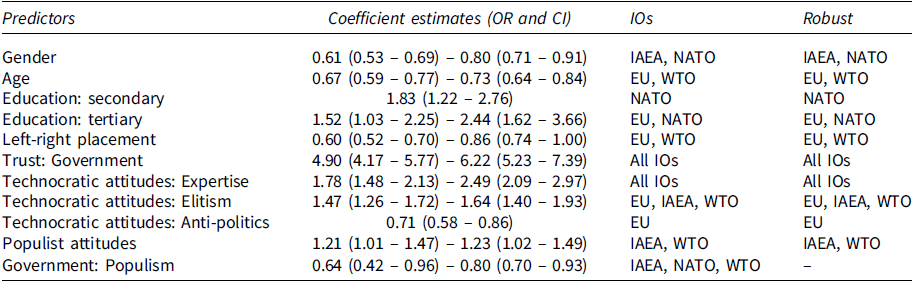
We turn to our statistical models next, for which we summarise predictors’ main associations to our IO trust measures in Table 1. These models include all predictors and interactions, as well as a random country intercept. As Table 1 indicates, we find strong support for H1a on two out of the three dimensions of technocratic attitudes. Across IOs, one-unit increases in citizen preferences for expertise (hereafter: Expertise) are associated with 78%–149% increases in the odds that a respondent trusts the IO in question. This effect is robust across different model specifications and significant and credible in all cases. The same holds for citizens’ elitist attitudes (hereafter: Elitism), albeit less strongly: a one-unit increase in Elitism is associated with 47%–64% increases in the odds of trusting all IOs except NATO.Footnote 7 Again, these coefficients are statistically significant and robust across specifications. Both sets of findings consistently support H1a in that as expected, Expertise and Elitism credibly predict trust in IOs. The findings for anti-politics attitudes (Anti-politics), however, do not support H1a: here, a one-unit increase yields a robust 29% decrease in the odds that our respondents trust the EU, whereas the estimates for the other IOs are small and not statistically meaningful. Taken together, these estimates suggest that, as expected, citizens that value expertise-driven government by elites report higher trust in IOs. However, citizens that report disdain for the political establishment and political compromise report lower trust in the EU (arguably our most ‘political’ IO) and, unexpectedly, do not report higher trust in our technical IOs.
Meaningful coefficient estimates across IOs

Note: This table presents statistically meaningful (in terms of direction and confidence) associations between our main predictors and trust in our four IOs as encountered in our fully specified, frequentist GLMMs (EU7, IAEA7, NATO7, and WTO7, see Appendix). For parsimony, we list the range of meaningful coefficients across IOs with associated 95% confidence intervals, the IOs for which trust is credibly predicted by these estimates, and for which IOs these associations are robust under alternative specifications (CLMM/Bayesian GLMM).
Contrary to H1b, populist attitudes are not credibly associated with significantly lower trust odds in our sample. Instead, we find that populist attitudes are actually associated with significant and robust increases of 21–23% in the odds of trust in the IAEA and the WTO in some of our specifications, while holding other covariates at their mean values. For the remaining IOs, no significant decreases in odds are found except for a small (9%) and non-robust decrease in the odds that a respondent reports a higher trust score for the CLMM predicting trust in the EU (see Appendix). This lack of a consistently negative and unconditional association between populist and IO attitudes in the cases of all four IOs is striking, as it both undermines the commonplace assumption that populist citizens are more critical of IOs and the recent findings of Kiratli and Schlipphak (Reference Kiratli and Schlipphak2024), who find a consistently negative association between the two attitudes.
Beyond these main predictors of interest, it is worth noting that several other main effects produce significant estimates. The most striking of these are the strong, positive, and highly significant effects that trust in government produces on trust in all four IOs: these effects are the strongest among the coefficients in our models and underline similar findings by Dellmuth et al. (Reference Dellmuth, Scholte, Tallberg and Verhaegen2022b, 2022a). We also find that women tend to report lower trust for the two security-oriented IOs (IAEA and NATO), whereas older respondents report lower trust in the economics-oriented IOs (EU and WTO). Moreover, higher levels of education among respondents do not automatically translate into higher levels of trust except in the case of the EU (secondary) and NATO (secondary and tertiary), while stronger right-wing (left-wing) views significantly increase (decrease) odds of trust in our economic IOs (holding other covariates at their respective means). Finally, we observe significantly negative associations between the country-level predictor for populist government experience and trust in all IOs except the EU, but these associations are not robust under more conservative Bayesian specifications of our GLMMs. So far, these findings make clear that while some predictors predict trust in IOs more generally (eg Expertise), others are sector (eg left-right) or IO-specific (eg Anti-politics).
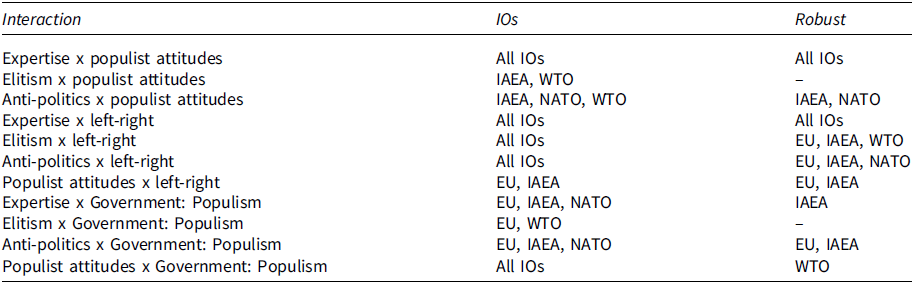
Next, we turn to our interaction terms. For these, we provide a summary table (Table 2) that summarises which interaction terms are meaningful, significant, and robust across our IOs. As nonlinearity is inherent to interaction effects in nonlinear link function models (Brambor, Clark and Golder Reference Brambor, Clark and Golder2006), we inspect these interaction effects using marginal effect plots derived from the frequentist GLMMs. Figures 2, 3 and 4 include visualisations of the meaningful interactions for selected IOs, which plot the probability that a respondent trusts an IO across the observed values of a predictor, for low (mean-SD) and high (mean + SD) values of the moderator. We provide figures for all interactions and all four IOs in the Appendix.
Meaningful interactions across IOs

Marginal effects: Technocratic and populist attitudes x populism in government.

Marginal effects: Technocratic attitudes x populist attitudes.

Marginal effects: Technocratic and populist attitudes x left-right placement.

H2a and H2b hypothesise that the expected associations between technocratic (H1a) and populist (H1b) attitudes and IO trust weaken in political contexts where populists attain office. H2a, which suggests that cues from populists in government muddle the positive association between technocratic and IO attitudes, is corroborated by evidence of meaningful interactions between Expertise and Government: Populism. For all IOs except the WTO, the positive association between expertise and IO trust weakens as Government: Populism increases (see Figure 2), especially for higher values of Expertise. However, this finding is only robust for the IAEA under our most conservative specifications, which shrink coefficients for cross-level interactions more strongly than other model coefficients. Similarly, we find initial evidence that the positive associations between Elitism and trust in the EU and WTO weaken as Government: Populism increases, but neither estimate is robust. We do, however, find fairly robust evidence suggesting that the association between Anti-politics and IO trust meaningfully varies across contexts with and without populism in government: when Government: Populism is low, increases in Anti-politics yield decreases in trust in the EU, NATO, and the IAEA. Yet when Government: Populism is high, the association turns positive for all three IOs. These interactions are significant for all three IOs, but robust only for the EU and IAEA. While this finding offers partial support for H2a, this interaction may also be driven by respondents who view IOs as a helpful constraint on the national political agenda of their populist government (see also Pospieszna, Onderco and van der Veer Reference Pospieszna, Onderco and van der Veer2023). Overall, these results provide conditional and partially robust support for H2a.
The models offer comparable results for H2b: across all four IOs, the interactions between populist attitudes and Government: Populism are significant across sections of the X-axis. For the EU, NATO, and the WTO, populism in government turns weakly negative associations between populist attitudes and IO trust (strongly) positive. For the IAEA, the associations across high and low Government: Populism contexts remain the same, but respondents with average populist attitudes report slightly higher trust scores in contexts with less populism in government. While this suggests that, as hypothesised, populist citizens are cued regarding IOs vastly differently, and more positively, by populist politicians in government, these findings are only robust for the WTO. The fact that the IAEA is the only IO where populist attitudes also increase the probability of trust in a low Government: Populism-scenario can be explained by the fact that the IAEA has recently been legitimised extensively by right-wing populists due to their support for its inspections of Iranian nuclear facilities (van der Veer and Meibauer Reference van der Veer and Meibauer2024).
Further exploration of conditionalities
Finally, we explore several relevant conditionalities of the associations hypothesised in H1a-b on some of our covariates. First, as Figure 3 shows, there are meaningful interactions between technocratic and populist attitudes. The positive association between Expertise and IO trust is especially prevalent among citizens with weak populist attitudes, which suggests populist citizens do not appear to associate IOs with expertise-driven decision-making, even if they value expertise in government. This interaction is significant and robust across all IOs. Our models suggest that the positive associations between Elitism and trust occur primarily among populist citizens. While this may suggest that only populist citizens associate IOs with elites (and trust IOs more if they hold elitist attitudes as well), the evidence for these interactions is IO-specific (IAEA, WTO) and not robust in any case. Significant interactions between Anti-politics and populist attitudes suggest anti-political attitudes are associated with decreased levels of trust in all IOs for non-populist citizens, whereas they are associated with increases in trust for populist citizens for all IOs except the EU. These interactions are only robust for our security-oriented IOs. Surprisingly, this suggests that non-populist citizens associate security-oriented IOs with politics, whereas populist citizens may perceive them as largely apolitical organisations.
Finally, Figure 4 shows the interactions between technocratic and populist attitudes, and left-right placement. These further indicate that both associations (H1a-b) are conditional on left-right placement. First, the positive association between Expertise and IO trust is especially pronounced on the left of the political spectrum and weak or insignificant on the right. The opposite holds for Elitism, where stronger elitist attitudes produce far higher trust scores on the right while having little impact on the left. This suggests that while left-leaning citizens associate IOs with expertise, right-leaning citizens may associate IOs primarily with (neoliberal) elites. Similarly, anti-political preferences yield increases in the probability that citizens trust IOs on the right while they decrease probabilities of trust on the left, suggesting left-right placement conditions perceptions of the politicization of IOs. Only in case of the EU does an increase in Anti-politics not produce a meaningful difference in the probability of trust on the right, whereas it does yield a strong decrease in the probability of trust on the left. These interactions are significant across IOs and robust for (nearly) all IOs.
The interaction term between left-right placement and populist attitudes paints a more complicated picture. For the EU, stronger populist attitudes are associated with increased probabilities of trust on the right, while on the left, they significantly decrease the probability of trust. Populist attitudes also significantly increase the probability of trust in the IAEA on the right, while on the left they yield no significant difference. Both terms are robust, whereas for NATO and the WTO, the interactions are not meaningful in any specification. This suggests that much like populist leaders, populist citizens on the left and right may view IOs rather differently, and that these attitudes are informed more by utilitarian and IO-specific considerations as compared to a generalised, negative, and typically ‘populist’ disposition towards IOs (van der Veer and Meibauer Reference van der Veer and Meibauer2024).
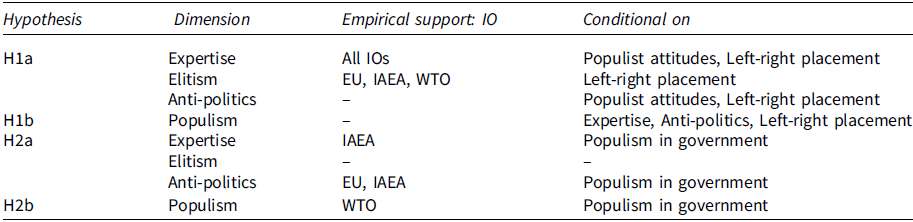
Taken together, these results suggest that on average trust in IOs is higher among (1) left-wing citizens who value expertise-driven government and hold weak populist attitudes, (2) right-wing citizens who value government by elites, and (3) left-wing, non-populist citizens who hold weak anti-politics attitudes. For security-oriented IOs, trust is higher among (4) right-wing, populist citizens that hold stronger anti-politics attitudes. Our results also provide tentative (IO-specific and not always robust) support for claims that citizens’ experiences with populist government moderates these relationships: (5) populism in power weakens the associations between Expertise, Elitism, Anti-politics, and populist attitudes on the one hand, and trust in IOs on the other. Overall, we thus find strong, robust but conditional support for H1a, mixed support for H1b, and tentative support for H2a-b. Table 3 summarises the robust empirical support for our hypotheses.
Summary of empirical support

Conclusion
Citizen trust in public institutions is a crucial precondition for democracy and effective government. Moreover, whether citizens feel represented by institutions matters for their acceptance of the decisions those institutions produce. The same holds for public institutions at the international level: when they are evaluated negatively, this harms their capacity to foster international cooperation and to achieve transnational public goods. In this article, we provided a first, joint analysis of the relationship between citizen attitudes towards alternative models of political representation – technocracy and populism – on the one hand, and their attitudes towards IOs on the other. We argued this relationship is important, since technocratic ideals have historically played a crucial role in the legitimation of IOs (Steffek Reference Steffek2021; Tallberg and Zürn Reference Tallberg and Zürn2019), whereas populist ideals play an important role in the delegitimation of IOs (Löfflmann Reference Löfflmann2022; Spandler and Söderbaum Reference Spandler and Söderbaum2023).
Our analysis of original survey data from five European countries covering four IOs indicates that citizens’ trust in IOs is only partially explained by their technocratic and populist attitudes, and these associations are often conditional on the IO under evaluation and citizens’ ideological positioning. The complex conditionality underpinning these associations mirrors recent findings in the context of political elites (van der Veer and Meibauer Reference van der Veer and Meibauer2024) and suggests, first, that in terms of public opinion, technocratic and populist attitudes are indeed best understood as ‘thin’ ideologies that interact with ‘thick’ ideologies (see eg Neuner and Wratil Reference Neuner and Wratil2022; Rummens Reference Rummens2023). Second, our analysis of country-level variation also suggests part of this complexity stems from the vastly different cues citizens receive from populists when they attain office (van der Veer and Meibauer Reference van der Veer and Meibauer2024), which suggests recent evidence for the negative association between populist and IO attitudes by Kiratli and Schlipphak (Reference Kiratli and Schlipphak2024) may only apply to political contexts in which populists have been confined to opposition.
This study makes an important contribution to the literature on IO legitimacy and legitimation by showing that citizen attitudes towards different models of representation are structurally, albeit conditionally, related to their evaluations of IOs. In doing so, we extend the debate on the drivers of IO legitimacy to include not only IO characteristics (eg Harteveld, van der Meer, and Vries Reference Harteveld, van der Meer and Vries2013; Tallberg and Zürn Reference Tallberg and Zürn2019), socioeconomic status, institutional trust (Dellmuth et al. Reference Dellmuth, Scholte, Tallberg and Verhaegen2022b, 2022a) and whether citizens feel represented (Wratil and Wäckerle Reference Wratil and Wäckerle2023), but also to include citizens’ preferences for how they are represented. Moreover, this study shows empirically that citizens’ attitudes towards alternative models of representation, and technocratic and populist attitudes in particular, indeed shape their attitudes towards institutions at regional and global levels (Bertsou and Caramani Reference Bertsou and Caramani2020a; Bickerton and Accetti Reference Bickerton and Accetti2021).
This study remains subject to a number of limitations. First, it is important to note that our observational analysis does not provide us with the leverage to make definitive claims on our difference-in-cueing mechanism. The inclusion of Türkiye and Italy in our analysis does suggest that citizens are susceptible to changes in IO (de)legitimation dynamics that occur when traditionally IO-critical populist parties take control of government. However, national governments are of course not the only source offering cues about IOs to citizens: especially in Europe, EU politicians are increasingly visible in national public spheres. Future research should expand on recent studies that investigate audiences’ receptiveness of legitimacy cues (eg Ghassim Reference Ghassim2024; cf Kiratli and Schlipphak Reference Kiratli and Schlipphak2024; Schlipphak, Meiners and Kiratli Reference Schlipphak, Meiners and Kiratli2022). A more explicit focus on the effects of cues regarding how citizens are represented is warranted, while taking into account the complex constellations of citizen preferences for different models of representation and how they interact with differences across political contexts.
Moreover, our survey did not provide direct measures that tap into citizens’ positioning on the transnational (or demarcation-integration) cleavage (Hooghe and Marks Reference Hooghe and Marks2018). While we cannot rule out that the exclusion of such measures may confound our analysis, we do include both education and left-right placement. Especially the meaning of the latter has increasingly shifted to include the transnational cleavage in the eyes of European voters (Bornschier et al. Reference Bornschier, Häusermann, Zollinger and Colombo2021). Indeed, the conditionality we observe of populist attitudes on ideological positioning suggests that the validity of our findings in this respect is warranted. Finally, future research should probe whether these findings extend beyond a European context.
For international institutions fighting for survival in an era of politicisation, our findings indicate that there is no easy solution. The complexity of associations driving trust in IOs implies that IOs must adopt equally diversified action and communication strategies that are sensitive to differences among citizens and balance competing citizen demands. This implies a difficult balancing act between competing virtues, from efficacy to responsiveness. What is clear is that citizens value being represented, even if they disagree about who should do so. Our findings suggest that populists in power may both be allies and opponents for legitimacy-seeking IOs.
Supplementary material
To view supplementary material for this article, please visit https://doi.org/10.1017/S147567652510008X
Data availability statement
The data used in this study are subject to a two-year embargo, per the ethics approval governing their collection. They will be available from 21 May 2027 from https://doi.org/10.25397/eur.29117747. The data and replication material were supplied to the European Journal of Political Research for the purpose of replication upon acceptance of the article.
Acknowledgements
We are grateful for comments on earlier versions of this manuscript by Andrej Zaslove, Haley Swedlund, Soetkin Verhaegen, and the participants of the 2025 JIOD workshop in Amsterdam. All errors remain our own. This study was supported with funding from the Dutch Research Council (grant no. V I.Veni.221R.014) and funding by the Stanton Foundation for the project ‘Nuclear Politics in Europe’, which funded the data collection for this paper.
Competing interests
We have no conflicts of interest to disclose.





 Open access

