
Skip to main content Accessibility help
×
  • Cited by 4
    • Show more authors
    • You may already have access via personal or institutional login
    • Select format
    • Publisher:
      Cambridge University Press
      Publication date:
      13 March 2020
      02 April 2020
      ISBN:
      9781108658508
      9781108494519
      9781009376235
      Dimensions:
      (228 x 152 mm)
      Weight & Pages:
      0.71kg, 428 Pages
      Dimensions:
      (229 x 152 mm)
      Weight & Pages:
      0.63kg, 430 Pages
    You may already have access via personal or institutional login
  • Selected: Digital
    Add to cart View cart Buy from Cambridge.org

    Book description

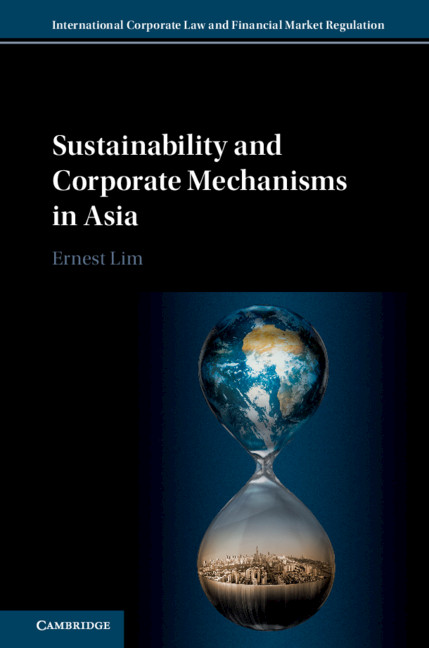
    This is the first book to provide a comparative and critical analysis of why and how six corporate mechanisms - (1) sustainability reporting; (2) board gender diversity; (3) constituency directors; (4) stewardship codes; (5) directors' duty to act in the company's best interests; and (6) liability on companies, shareholders and directors - have been or can be used to promote sustainability in the four leading common law jurisdictions in Asia (Singapore, Hong Kong, India and Malaysia). A central challenge is, whether and if so, how the corporate mechanisms should be reconceptualised to promote sustainability in an environment that is characterised by controlling shareholders, particularly the government in state-owned enterprises. Because controlling shareholders are the norm for the majority of the world's companies, and state-owned enterprises play a significant role, this book has important insights on the problems and prospects of advancing sustainability in concentrated and mixed ownership jurisdictions.

    Reviews

    ‘Sustainability and Corporate Mechanisms in Asia is an important, erudite and accomplished work. It should be read by the very directors, C-suite executives, policy makers and leaders responsible for corporate social responsibility in the very companies which are the focus of his book. I recommend it without hesitation to anybody who has an interest or stake in corporations and sustainability in Asia. Because, as Lim has eloquently and persuasively argued throughout his book, there is not only a clear and positive correlation between sustainability and a company’s financial performance, but because corporate sustainability ‘is a morally good thing to do’.’

    Edmund Lee Source: Modern Law Review

    'Ernest Lim has written a uniquely important and informative book on sustainability in Asia. It sets out the case for sustainability and the way in which it can be effectively implemented with exceptional clarity and insight. It will be an invaluable guide for those interested in the principles, practices and policies that should guide the adoption of sustainability in Asia.'

    Colin Mayer - CBE, FBA, Peter Moores Professor of Management Studies, Saïd Business School, University of Oxford, and Academic Lead, British Academy Future of the Corporation Programme

    'In this important contribution, Professor Ernest Lim shifts the academic debate about corporate sustainability from a focus on corporate actors and their behavior to a focus on corporate governance and legal mechanisms. The book identifies six such mechanisms - sustainability reporting, board gender diversity, constituency directors, stewardship codes, director duties, and liability - and provides a comprehensive, clear, and cogent analysis of their use in Hong Kong, India, Malaysia, and Singapore. Professor Lim also draws broader lessons about these mechanisms for corporate governance, including the role of state-owned enterprises and controlling shareholders.'

    Frank Partnoy - Adrian A. Kragen Professor of Law, University of California, Berkeley School of Law

    'The obligations of businesses to play a leading role in addressing our global climate crisis are increasingly pressing. Yet the scope and contours of those obligations remain ill-defined. Professor Lim’s careful and thorough work brings precious clarity. His work will be helpful and enlightening to scholars, business leaders, governments, and NGOs across Asia - and beyond.'

    Kent Greenfield - Dean’s Distinguished Scholar, Boston College Law School

    'Professor Lim's highly original work adds important nuances to the ongoing debates through its convincing demonstration that the common law family is a far more heterogeneous group in respect of corporate sustainability than assumed by advocates of the 'legal origins matter' thesis … His rich and nuanced account of how these mechanisms have intertwined and interacted with broader institutional conditionalities in the four jurisdictions in addressing the sustainability question is solidly grounded in the comparative literature while revealing a distinctive Asian perspective. Importantly, the case studies offer fresh comparative insights with implications that go beyond the four surveyed jurisdictions.’

    Xi Chao Source: Journal of Comparative Law

    Refine List

    Actions for selected content:

    Select all | Deselect all
    • View selected items
    • Export citations
    • Download PDF (zip)
    • Save to Kindle
    • Save to Dropbox
    • Save to Google Drive

    Save Search

    You can save your searches here and later view and run them again in "My saved searches".

    Please provide a title, maximum of 40 characters.
    ×

    Contents


    Page 1 of 2


    Page 1 of 2


    Metrics

    Altmetric attention score

    Full text views

    Total number of HTML views: 0
    Total number of PDF views: 0 *
    Loading metrics...

    Book summary page views

    Total views: 0 *
    Loading metrics...

    * Views captured on Cambridge Core between #date#. This data will be updated every 24 hours.

    Usage data cannot currently be displayed.

    Accessibility standard: Unknown

    Why this information is here

    This section outlines the accessibility features of this content - including support for screen readers, full keyboard navigation and high-contrast display options. This may not be relevant for you.

    Accessibility Information

    Accessibility compliance for the HTML of this book is currently unknown and may be updated in the future.
