

Introduction
As the year opened, Prime Minister Rishi Sunak managed to get the controversial Rwanda scheme passed through Parliament (for details, see Middleton Reference Middleton2024), with flights expected to depart over the summer. Although the latest general election had to be called by law was January 2025, speculation mounted in the first part of the year that there would be an autumn election. However, with Rwanda safely passed, a slight improvement in inflation—albeit little improvement in the polls—Sunak called a general election for 4 July. A large number of long-serving MPs stood down at the election, including former Prime Minister Theresa May. The result was decisive—the Conservatives experienced the worst defeat in their history and were reduced to just 121 MPs. Former Prime Minister Liz Truss lost her seat as did eight sitting Cabinet ministers. Labour won a landslide, and Sir Keir Starmer became the new Prime Minister; however, the party only received 34 per cent of the public vote. The election saw success for the Liberal Democrats, Reform and the Greens and the decline of the Scottish National Party (SNP).
Four by-elections were also held in 2024, and while Labour won three, they lost the Labour-held constituency of Rochdale to an independent candidate. There were substantial leadership changes across British politics. In Scotland, First Minister Humza Yousaf resigned after an ill-judged attempt to end a power-sharing agreement with the Scottish Greens. He was replaced by John Swinney, who led the party for just over a fortnight before he was plunged into a general election campaign. Nigel Farage dramatically announced his takeover of Reform during the general election campaign, before finally winning a seat at Westminster. With Sunak's departure from office, the Conservatives also needed to elect a new leader; Kemi Badenoch was elected as Leader of the Conservative Party and Leader of the Opposition on 2 November 2024.
Election report
With an election due at the latest by January 2025, speculation continued to mount that it would be called in the autumn of 2024, when Sunak would have been in office for two years. Indeed, in January, when pushed to name an election date, he told the country to expect one in the second half of the year. However, in the early evening of 22 May, Sunak unexpectedly stood outside Number 10 and announced a general election would take place on 4 July and that he would ‘fight for every vote’ (BBC 2024a). As he spoke, it began to rain, and by the end of his speech, he was soaking wet. With the Rwanda scheme finally passed through Parliament and the first deportations due over summer, alongside easing inflation, Sunak decided this was the best option.
In total, 132 MPs stood down, the highest number since 2010. Of these, 75 were Conservatives, many of whom had played prominent roles in the party's previous 14 years in government. They included former Prime Minister Theresa May, former Deputy Prime Minister Dominic Raab, three former Chancellors (Sajid Javid and Nadhim Zahawi who served under Johnson, and Kwasi Kwarteng who served under Truss), Chair of the 1922 Committee Graham Brady, Deputy Speaker Eleanor Laing, former Cabinet ministers Michael Gove, Chris Grayling, Andrea Leadsom, John Redwood, Ben Wallace and Matt Hancock. Mike Freer, Conservative MP for Finchley and Golders Green, announced he would step down after receiving death threats and his constituency office being attacked. Twelve MPs elected in 2019 stood down; of these, eight were Conservatives.
Thirty-four Labour MPs announced they would not stand again, including the Mother of the House Harriet Harman, who had served continuously since 1982, as well as Margaret Beckett, the first female Foreign Secretary. The Green Party's Caroline Lucas, their only serving MP, announced her retirement, as well as nine SNP MPs, including their former Westminster leader Ian Blackford, and Mhari Black, who at the time of her election in 2015 was the youngest MP elected in over 150 years.
The campaign itself was characterised by an exuberant display by Liberal Democrat leader Sir Ed Davey, who undertook a range of different stunts to draw attention to the party and their messages. These included falling into a lake, building sandcastles on the beach and bungee jumping. The campaign also coincided with commemorations for the 80th Anniversary of D-Day; Rishi Sunak and Keir Starmer attended both the UK and French commemorations. However, Sunak left the latter early, ostensibly to film an interview. This caused significant controversy and saw Labour's lead in the polls grow further. Just a week later, the Guardian (Crerar Reference Crerar2024) reported that a Conservative candidate had placed a bet on the date of the election on the basis of insider information, with the Gambling Commission conducting a wider inquiry investigating other Conservative candidates, members of the police and members of several parties.
One of the main issues of the campaign was the economy, with Sunak claiming during the first televised debate that Treasury officials had costed Labour policies and found they would raise taxes by £2000. The most senior civil servant at the Treasury, James Bowler, criticised the Conservatives for claiming the figure had been produced by civil servants (BBC 2024b). Nonetheless, the claim continued to feature in the party's campaign. Immigration was also a feature of both Conservative and Labour campaigns, with Labour pledging a new Border and Security Command and the Conservatives pressing ahead with their Rwanda plan. The latter also released a campaign advert showing Labour preparing a red carpet for new immigrants on a British beach (Conservatives 2024) that coincided with World Refugee Day. Labour's campaign focused on five missions (Labour 2024): housing, the National Health Service, security, energy (including the creation of a new publicly owned organisation Great British Energy) and opportunity—central to these missions was the need for economic growth fueled by increased investment. At the heart of many of Davey's stunts was an urgent need to address water quality and hold water companies to account for their actions. He visited sites including Lake Windermere, where United Utilities had spilled sewage on multiple occasions, and swam in the sea in Norfolk to highlight his party's policy that bathing areas would be kept free from sewage.
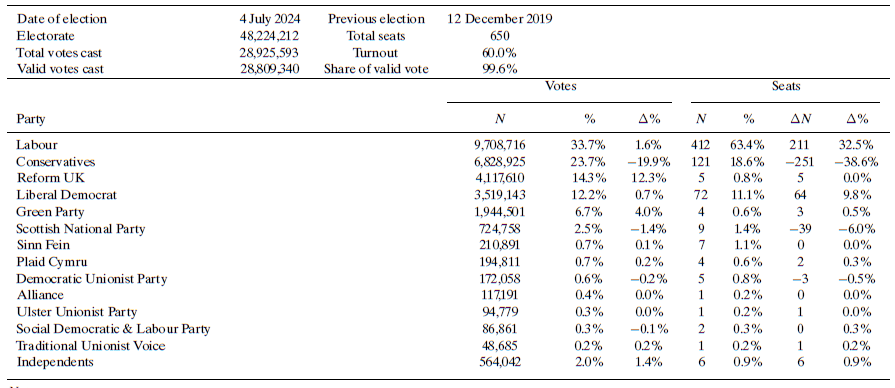
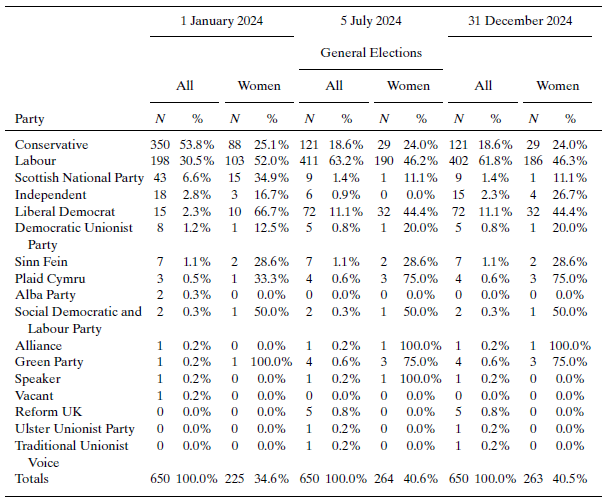
As seen in Table 1, the result was a decisive defeat for the incumbent Conservative administration, who lost 251 seats. Inevitably, these included some notable figures: Father of the House Peter Bottomley, former Deputy Prime Minister Thérèse Coffey and Chair of the Defence Select Committee Tobias Ellwood, as well as Cabinet members David T. C. Davies, Michelle Donelan, Mark Harper, Grant Shapps and Gillian Keegan. Leader of the House of Commons Penny Mordaunt and notably former Prime Minister Liz Truss also lost their seats.

Notes:
1. Constituency boundaries changed prior to the election, although number of seats remained the same. Estimates of number of seats gained therefore based on notional results.
2. Only parties that won seats in 2024 are included.
3. The E&W Greens and Scottish Greens vote number is aggregated.
Source: Cracknell et al. (Reference Cracknell, Baker and Pollock2024).
Although Labour won a landslide majority, with 412 MPs, their share of the vote was the lowest for a governing party in British political history. Indeed, whereas the 2019 result had been declared a massive defeat for the party, 2024 saw them lose half a million votes and claim victory. However, four Labour MPs lost their seats, three to independents and one to the Green Party. The election was a substantial success for smaller parties, including the Liberal Democrats, who gained 64 MPs, which made them the third largest party in the Commons. Yet it was also a substantial defeat for the SNP under their new leader John Swinney: They went from 48 seats to just nine. The Alba Party, founded by former First Minister Alex Salmond (who died in November 2024), lost both their MPs; the Workers Party of Britain also lost their sole MP. The Green Party gained three MPs—their best ever result. Reform UK received the third highest vote share nationally and gained five MPs. Traditional Ulster Voice, a party that emerged from former Democratic Unionist Party (DUP) politicians and led by Jim McAllister, won their first Westminster seat.
Local elections were also held in England on 2 May. These included 12 directly elected mayoral elections, of which three (North East, York and Yorkshire and East Midlands) were inaugural. Andy Street, who had served as Conservative West Midlands Metro Mayor since 2017, was defeated, leaving Ben Houchen as the sole representative of the party amongst the metro mayors. For councils, the Conservatives saw the worst performance by a governing party since 1996 and were pushed into third place behind Labour and the Liberal Democrats.
Sadiq Khan won his record third term as Mayor of London with 43.8 per cent of the vote, a 3.8 per cent increase on 2021. He had consistently polled ahead of the Conservative candidate in second place.
Cabinet report
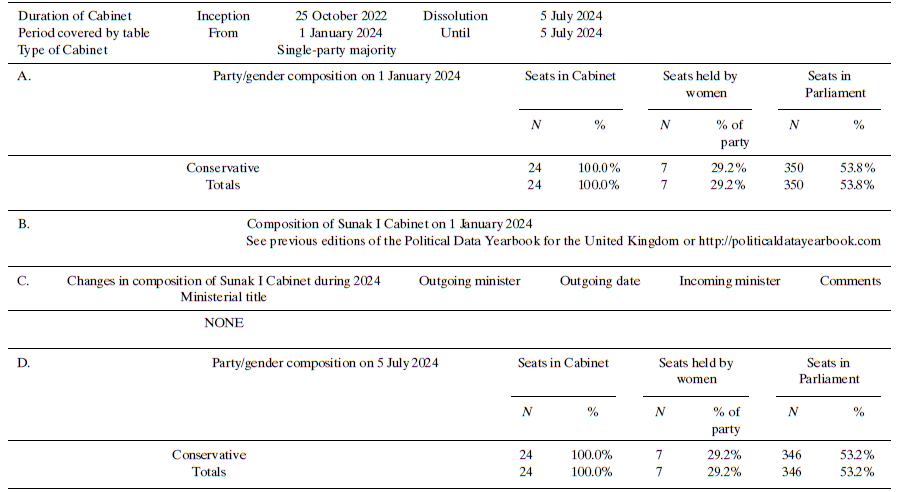
At the start of the year, the government had taken office on 13 December 2019 and was a single-party majority government as shown in Table 2. After a substantial reshuffle by Sunak in November 2023, there were no changes to the Cabinet prior to the general election.

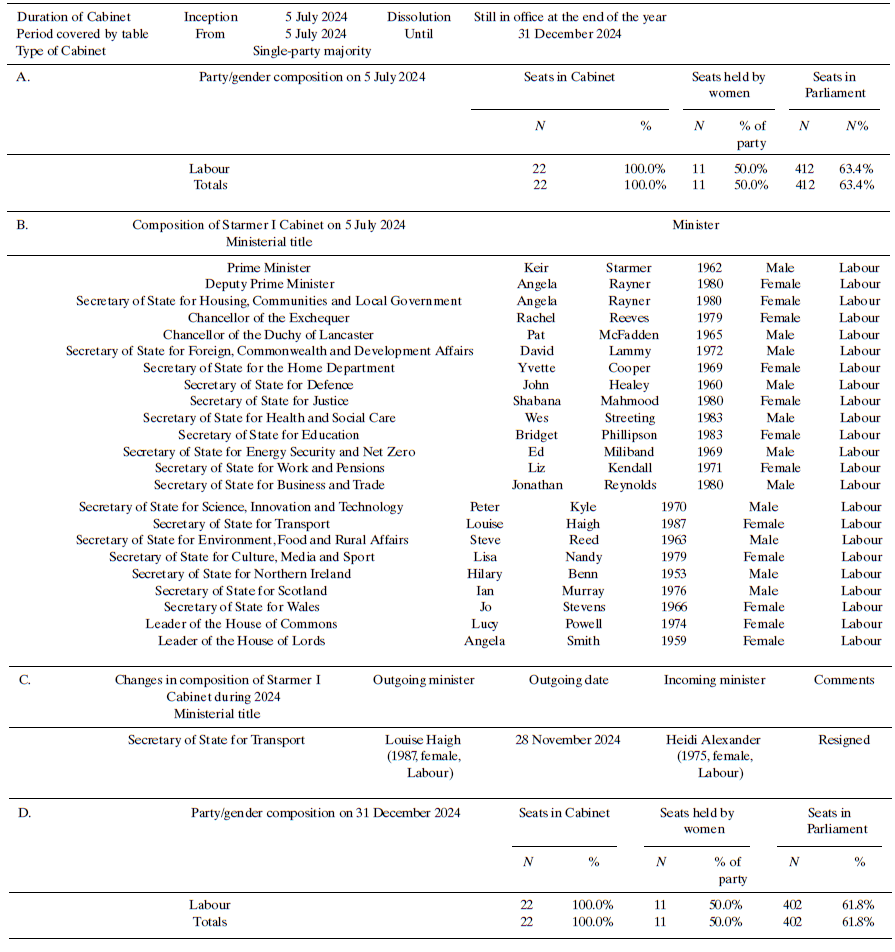
The current Labour government took office on 5 July 2024 and is a single-party majority government as shown in Table 3. Starmer's Cabinet was nearly identical to his Shadow Cabinet with two main exceptions. First, Jonathan Ashworth, a prominent figure in the Labour campaign, had been widely expected to join the Cabinet, but he was defeated in his Leicester South constituency. Shadow Attorney General Emily Thornberry, who had been a prominent figure in Starmer's Shadow Cabinet, did not receive a Cabinet position. She later expressed her shock at the decision. The new Shadow Cabinet is notable for several reasons. First, most (92 per cent) Cabinet ministers were educated at a state school; the ‘most diverse in educational background ever recorded’ (Sutton Trust 2024), making a drastic shift from the 19 per cent of Sunak's Cabinet. Second, for the first time in British politics, the Cabinet is gender-balanced. Rachel Reeves became the first ever female Chancellor of the Exchequer, while Angela Rayner became only the second female Deputy Prime Minister. While the Cabinet contained many members who had only ever served in Shadow positions, Starmer also appointed five Cabinet ministers who had ministerial experience in the previous Labour government. Of these, Pat McFadden (the new Chancellor of the Duchy of Lancaster) and David Lammy (the new Foreign Secretary) had served in junior ministerial positions. The new Secretary of State for Northern Ireland, Hilary Benn, had served in the Cabinet under both Blair and Brown, and Yvette Cooper, the new Home Secretary, had served as Secretary of State for Work and Pensions under Brown. Last, former Labour leader Ed Miliband joined the Cabinet as Secretary of State for Energy Security and Net Zero; he had served in the Cabinet under Brown. Starmer also appointed three non-political experts to more junior ministerial positions, including Patrick Vallance, the government's former Chief Scientific Adviser during the coronavirus pandemic, businessman James Timpson and lawyer Richard Herman as Attorney General.

Source: HM Government (2024).
There was a single personnel change before the end of the year. Secretary of State for Transport Louise Haigh, the youngest ever female Cabinet minister, resigned after it emerged she had pleaded guilty to fraud by false representation in 2014, prior to becoming an MP. She was replaced by Heidi Alexander, who had served as Deputy Mayor of London for Transport between 2018 and 2021.
Parliament report
Four by-elections were held in 2024, all taking place prior to the general election. The first two were held on 15 February. One was held in Wellingborough after the sitting MP, Sir Peter Bone, had been ousted via a recall petition in December 2023. His partner stood as the Conservative candidate but was defeated by Labour's Gen Kitchen, who went on to retain the seat at the subsequent general election. The other was held in Kingswood, where the incumbent MP Chris Skidmore had in 2022 announced his intention to stand down at the next election. However, the junior minister under May and Johnson announced on 5 January that he was standing down immediately in protest over Sunak planning new oil and gas licences. The seat was gained by Labour's Damien Egan. Long-serving Labour MP and former junior minister Tony Lloyd died on 17 January, triggering a by-election in the Rochdale constituency on 29 February. Simon Danczuk, Labour MP for the seat between 2010 and 2017, stood for Reform and came sixth. The seat was won by Workers Party leader George Galloway, who lost the seat at the general election. Labour only managed fourth place; its candidate Azhar Ali had the party's support withdrawn after making controversial comments regarding Israel. This was the party's first loss at a by-election since Hartlepool in 2021. The fourth by-election took place in Blackpool South and was triggered after the sitting independent (formerly Conservative) MP Scott Benton had been investigated over breaches of lobbying regulations. This resulted in a suspension from Parliament that triggered a recall petition, but before this could be held, Benton resigned. The seat was won by Labour's Chris Webb, who went on to retain it at the general election.
William Wragg, MP for Hazel Grove since 2015, resigned the party whip on 9 April after it emerged that he had been blackmailed into providing private contact details for other Conservative MPs. He had previously announced that he would not contest his seat at the upcoming election. Three Conservative MPs had the party whip withdrawn in 2024. The first was Mark Menzies, MP for Fylde, who was suspended in April due to allegations of misusing campaign funds. Several days later, Menzies announced he would not contest his seat at the forthcoming election. In January 2024, Conservative Deputy Chairman Lee Anderson resigned from his position in order to vote for an amendment on the Rwanda Bill. He was suspended by the party on 24 February after making controversial comments regarding London Mayor Sadiq Khan. Anderson defected to Reform on 11 March, becoming the party's first MP. Lucy Allan, MP for Telford, publicly endorsed the Reform candidate in her constituency and was suspended by the party three days before Parliament was dissolved. She had already announced that she would not contest the seat.
Christina Rees, MP for Neath, was readmitted to the Labour Party on 1 February after being suspended since October 2022 but immediately announced that she would be standing down at the forthcoming election. Labour saw multiple suspensions in 2024. These included Kate Osamor, who had the whip withdrawn for four months over comments made in relation to Holocaust Memorial Day. Lloyd Russell-Moyle, MP for Brighton Kemptown, was suspended on 29 May after an allegation predating his time as an MP was made regarding his behaviour. As Parliament was due to be dissolved the following day, it was not possible to investigate this in time, and he was barred from contesting his seat for Labour. On 23 July, seven Labour MPs had the whip withdrawn after voting in support of an SNP amendment that would end the restrictions on child benefit to two children. They were from the left-wing of the party and included prominent figures under Corbyn's leadership: former Shadow Chancellor John McDonnell and former Shadow Cabinet members Rebecca Long-Bailey and Richard Burgeon, as well as MPs Ian Byrne, Imran Hussein, Apsana Begum and Zarah Sultana. Rosie Duffield, MP for Canterbury, resigned from Labour in October over her unhappiness with government policy, sitting as an independent. Mike Amesbury, MP for Runcorn and Helsby, was suspended by Labour in October after footage emerged of him punching a member of the public. He was formally charged with common assault in November. Leader of the Democratic Unionist Party since 2021, Jeffrey Donaldson, MP for Lagan Valley, was suspended by the party on 29 March after being charged with rape. He did not contest his seat at the general election.
Information on the composition of the House of Commons in 2024 can be found in Table 4.

Note: 4 July 2024 was the polling day.
Source: UK Parliament (2024a).
House of Lords
Among Special Honours granted in February 2024 were several Conservatives, including donor Stuart Marks and former MP Paul Goodman. Labour awarded peerages to former Trade Union boss John Hannatt, former Chief Scientific Adviser Patrick Vallance and former Home Secretary Jacqui Smith. Plaid Cymru's Carmen Smith became the youngest Lord at 28. July saw the Dissolution Honours awarded. For the Conservatives, recipients were mostly MPs who had stepped down ahead of the election. They included the former Prime Minister Theresa May, Eleanor Laing (the former Deputy Speaker), Graham Brady (former Head of the 1922 Committee), Chris Grayling (former Cabinet minister under Cameron and May) and Alok Sharma (former Cabinet minister under May, Johnson and Sunak). Former MP Craig Mackinlay was also awarded a peerage; he had become a quadruple amputee after recovering from sepsis and had made his reentry to the Commons only hours before Sunak announced July's election. Liam Booth-Smith, Sunak's Chief of Staff throughout his time as Prime Minister, also joined the Lords.
Labour awarded peerages to several former junior ministers as well as Margaret Beckett (former Foreign Secretary), John Cryer (former Chair of the Parliamentary Labour Party), Harriet Harman (former Deputy Cabinet minister under Blair and Brown), Margaret Hodge (former junior minister) and former Deputy Speaker Rosie Winterton. Former Leader of the Liberal Democrats in the London Assembly, Caroline Pidgeon, was awarded a peerage by the party, and Tom Elliot, former Leader of the Ulster Unionist Party, also joined the Lords.
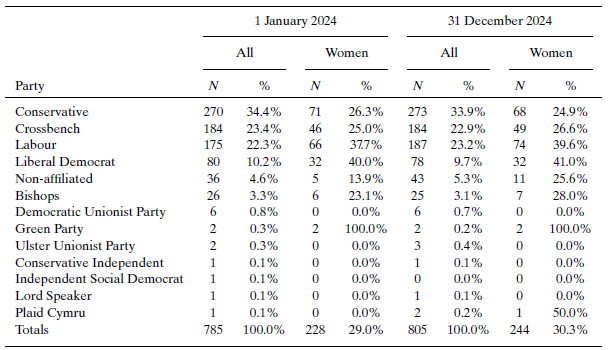
Information on the composition of the House of Lords in 2024 can be found in Table 5.

Source: UK Parliament (2024b).
Political party report
The day after the election, Rishi Sunak once more stood outside Number 10, this time announcing his resignation with his wife by his side. He apologised to the country and accepted responsibility for the election defeat. He also announced that he would step down as Conservative leader once arrangements were in place to appoint his successor. On 22 July, he formally stepped down, and six candidates announced their intentions to stand over the next six days. They included Tom Tugendhat who had also contested the leadership in 2022, former Cabinet minister Mel Stride, former Home Secretary Priti Patel, former Cabinet minister Robert Jendrick, former Home Secretary James Cleverly and former Cabinet minister Kemi Badenoch. Two rounds of MP voting eliminated Patel and Stride, with Jendrick leading both votes. The remaining four candidates were able to make their case at the Conservative Party conference, before two more rounds of MP voting eliminated Tugendhat and Cleverly. Kemi Badenoch and Robert Jendrick then went to the party ballot, and on 2 November, Badenoch was announced as the new Conservative leader, with 56.5 per cent of the party member vote (Pannell 2024).
On 25 April, First Minister and SNP leader Humza Yousaf announced the termination of the Bute House Agreement, the power-sharing agreement between the SNP and the Scottish Greens. This came after the Greens had made a series of public criticisms of SNP policy, in particular the scrapping of climate change targets. The Scottish Conservatives called for a vote of confidence in Yousaf—the likely result hung on a single Member of the Scottish Parliament (MSP), Ash Regan, who was Yousaf's former challenger for the SNP leadership. Amid mounting pressure, Yousaf announced his resignation on 29 April. Keen to see a swift resolution, the party elected John Swinney unopposed, who took up office as leader of the SNP on 6 May and First Minister on 8 May. Swinney had formerly led the party between 2000 and 2004 and had served as Deputy First Minister throughout Sturgeon's leadership.
Richard Tice, Reform UK's leader since 2021, led the party through the early stages of the 2024 general election campaign before a surprise announcement on 3 June that former leader Nigel Farage would be replacing him. Farage also announced that he would be standing for election in Clacton. Tice subsequently became Chairman of Reform, before taking up the position of Deputy Leader on 11 July. Leader of the DUP, Jeffrey Donaldson, was suspended by the party in March after he was charged with rape. His leadership was immediately terminated, and he was replaced by Gavin Robinson, MP for Belfast East. The changes in political party leaderships over the course of 2024 can be seen in Table 6.

Notes:
1. Yousaf resigned on 29 April, but did not officially step down as party leader until 8 May.
2. Sunak resigned on 5 July, but remained in place until the leadership election process was completed on 2 November.
Sources: Cochrane (2024); Horton (Reference Horton2024); McClafferty and O'Neill (Reference McClafferty and O'Neill2024); Pannell (Reference Pannell2024).
The gulf between the Conservative and Labour in the polls narrowed slightly throughout the first half of the year. In January, Labour led the Conservatives by 24 percentage points (YouGov 2024a), whereas polling in the final days of the campaign gave Labour a 20-percentage point lead (Pack Reference Pannell2024). By the end of the year, it was clear that the Labour honeymoon had been short—their poll lead had now narrowed to six points (Opinium 2024).
For the party leaders, Sunak began the year with 65 per cent believing he was doing a bad job as Prime Minister, which rose to 72 per cent by the end of the year (YouGov 2024b). After a little over a month in office, 26 per cent believed Keir Starmer was doing a good job as Prime Minister, but 43 per cent thought he was doing a bad job—this rose to 61 per cent by the end of the year (YouGov 2024c).
Institutional change report
There were major institutional changes made in 2024 that affected the Welsh Senedd. The Senedd Cymru (Members and Elections) Act 2024, which passed into law on 24 June, increased the number of members from 60 to 96. It also changed the electoral system from the Additional Member System to a Closed List Proportional Representation system, with 16 constituencies each electing six Members of Senedd. These changes will apply to the next Senedd election, due in 2026.
Issues in national politics
The Rwanda scheme, a plan first introduced by Johnson in 2022, had aimed to move illegal immigrants who had entered the United Kingdom to Rwanda for processing. It had proved controversial, and at the end of 2023, the Supreme Court had ruled it illegal. As 2024 opened, the government introduced a bill that determined Rwanda as a safe country to address this ruling. The government was also rebuked by the Office for National Statistics over inaccurate claims about immigration figures that overstated the numbers of illegal immigrants removed from the United Kingdom. It also emerged the Sunak had expressed doubts over the scheme during his time as Chancellor. Parliament held a late-night sitting on 22 April, involving multiple votes, before the Lords dropped opposition and the Bill passed. By 1 May, footage was released of immigration officers detaining migrants, although the government admitted it had lost contact with the majority of the 5700 identified as likely first removals under the scheme. The first flights were to take off over the summer, and Sunak made clear that no flights would take place until after the election. One of Keir Starmer's first announcements as Prime Minister was to make it clear that the Rwanda scheme was ‘dead’ (Francis Reference Francis2024), instead pledging to tackle immigration through targeting people-smuggling gangs. On 29 July, a stabbing attack took place at a children's dance class in Southport; three young girls were killed. Amid rumours that the attacker was an asylum seeker, an initial protest outside a Southport mosque turned into a riot. Over the next six days, a series of anti-immigration riots and protests took place across England and Northern Ireland, the largest unrest since the riots of 2011. Businesses were looted, police officers were injured and hotels housing asylum seekers were attacked. More than 1500 people were arrested (National Police Chiefs’ Council 2024), and counter-protests were held. Starmer said rioters would feel the ‘full force of the law’, and the courts treated them as a priority, with the first sentences being handed down by 7 August. By September, 960 people had been charged.
The year 2024 also saw significant movement on the Post Office scandal, where hundreds of postmasters had been wrongfully prosecuted for errors on a faulty accounting system (BBC 2024b). An ITV drama on the scandal was broadcast in January, significantly raising public awareness of the issue, leading to millions signing online petitions and more victims coming forward. On 9 January, former Chief Executive Officer of the Post Office, Paula Vennells, handed back her Commander of the British Empire (CBE) award, and on 27 January, the Chairman of the Post Office, Henry Staunton, was fired by then-Business Secretary Kemi Badenoch. The Post Office scandal finally came to an end in May 2024, with hundreds of convictions of postmasters quashed (BBC 2024c). The new Labour government published details of a compensation scheme announced by the former government. The public hearings during the enquiry into the scandal concluded in December, and Alan Bates, one of the key campaigners, was awarded a knighthood in the New Year Honours.
A few days after entering office, new Chancellor Rachel Reeves gave a speech in which she prioritised economic growth and revealed that the state of the country's finances was worse than expected. She also announced that the Winter Fuel Allowance—a universal payment given to all pensioners to help with utility bills—would now be means-tested. This caused considerable controversy, as it had not appeared in the manifesto or been discussed during the campaign. The Office for Budget Responsibility, an independent body reviewing the government's finances, reported at the end of October that the Conservative administration had not detailed a £9.5 billion overspend at the time of the March budget (Labiak & Sheridan Reference Labiak and Sheridan2024). Reeves claimed further that this has accumulated to £22 billion of unfunded spending by the end of July, which meant that caution needed to be adopted in future policy commitments. Reeves gave her first budget on 30 October, announcing a series of commitments including raising National Insurance contributions for employers, increasing the rate of Capital Gains Tax and introducing Value Added Tax (VAT) on private school fees.
As the year opened, Rishi Sunak pledged £2.5 billion to Ukraine, demonstrating the United Kingdom's continued support. This was accompanied by an additional £500 million in April, making this the largest financial commitment to Ukraine since the conflict began. Shortly after taking office, Keir Starmer recommitted to £3 billion a year for the next five years, and President Zelenskyy became the first foreign leader to visit the new Prime Minister in July, followed by a further visit in October. There was some continuity between administrations in their approach to the Israel–Gaza conflict, with both Starmer and Sunak asserting that Israel had a right to defend itself and calling for a ceasefire. The head-to-head BBC election debate on 26 June was interrupted by audible chanting by pro-Palestinian protesters. The International Criminal Court (ICC) issued an arrest warrant for Israel Prime Minister Benjamin Netanyahu in November, and Starmer confirmed the government's support for the ICC.


 Open access

