



Equal Temperament and Pitch Symmetry
Equal Temperaments as Approximations of Just Intonation
By the time that twelve-tone equal temperament (12TET) had secured its near hegemony over how Western musicians conceptualise tuning in the early twentieth century,Footnote 1 composers and theorists were already seeking new intonational resources.Footnote 2 There was an explosion of interest in extended equal temperaments in the 1920s, led by composers including Julián Carrillo, Alois Hába and Ivan Wyschnegradsky.Footnote 3 During this time, the quarter-tone emerged as the default microtonal interval for Western composers.Footnote 4 Since the 1950s, however, quarter-tones and 24TET have been of relatively little interest to those specialising in intonation. With exceptions, such as Franck Jedrzejewski and Alain Louvier, who followed Wyschnegradsky in examining 24TET's modal repertoire,Footnote 5 those most interested in intonation have generally taken up other equal temperaments or followed Harry Partch into just intonation.
Both these groups tend to agree that simple, just intervals are the desirable product of tuning systems.Footnote 6 Simple pitch ratios can create striking consonances and allow complex intervals to be tuned by ear.Footnote 7 Some equal temperaments (ETs) closely approximate just intervals, offering the resources of just intonation within a framework that allows for easier keyboard transposition and notational consistency. These pragmatic approximations have drawn theorists and composers to ETs, especially to prime-number ETs such as 17, 19, 31 and 53TET and higher-order 12-based ETs such as 36, 48, 60 and 72TET. 72TET particularly closely approximates many just intervals up to the eleventh limit and has been favoured by composers including Ezra Sims, Georg Friedrich Haas and Julia Werntz.Footnote 8
The preference for close approximations of just intervals has led microtonal theorists to be critical of 12TET. James Tenney is representative when he criticises the temperament's harmonic capabilities due to its poor approximations of intervals beyond the third limit.Footnote 9 By this logic, Tenney argues, 24TET has little more to recommend it:Footnote 10 while it adds excellent approximations of 11-based intervals, its approximations of other limits inherit the flaws of 12TET.Footnote 11 The result is that quarter-tones have developed somewhat of a bad reputation among microtonalists; Sims is not atypical when he states that they ‘run counter to Western (all human, I suspect) acoustical instincts’.Footnote 12
Equal temperaments might be understood, however, not through their proximity to just intonation but for their own qualities. Robert Hasegawa documents Haas’ appreciation for ETs, noting that Haas disavows partisan advocacy of just intonation and values the beating, ‘false’ sounds of ETs.Footnote 13 Hasegawa shows how the friction between equal temperament and just intonation is generative in Haas’ work.Footnote 14 Haas’ combination of equal tempered and just chords is influenced by a work of Hermann Markus Preßl in which the tritone becomes a stand-in for equal temperament and the perfect fifth a symbol of just intonation.
Haas’ ‘hybrid’ approach, as described by Hasegawa, is striking in that it values aspects of 12TET unrelated to either its practicality or the approximation of just intervals. Haas’ music reveals alternative merits to the familiar tuning system: desirable beating, vertical symmetry and cyclicality. Haas nonetheless reiterates familiar dichotomies between just intonation and equal temperament: his equal-tempered sonorities are rough and clangorous; his just-intonation harmonies are fused and resonant. Hasegawa argues convincingly that the equal-tempered sonorities of Haas’ in vain (2000) act as a symbolic form of darkness and pessimism that may even be attached to the politics of the far right.Footnote 15
In this article I embrace Haas’ hybrid approach, considering how the principle of symmetry can interact generatively with just intonation. I initially use tritones to outline the aesthetics of symmetry, then consider how this aesthetic might be used microtonally. This leads me to the quarter-tone-based intervals that bisect the perfect fourth and fifth, which provide a glimpse of fascinating new scalic systems. Discussions of these quarter-tone points of symmetry need not restate the familiar contrast between resonant just intonation and dissonant equal temperament; I reframe the contrast between proportion and symmetry as conceptual rather than sonic and as complementary rather than contradictory.
Symmetry and Proportion, Equal and Just, Tritone and Fifth
The tritone and fifth can act as stand-ins for equal temperament and just intonation because both bisect the octave in different ways: the tritone symmetrically, the fifth proportionally. Symmetrical and proportional subdivisions are conceptually easier in equal temperament and just intonation respectively.
The tritone has a long-standing reputation as a problem interval. At 600¢, its exact bisection of the octave is a distant 18¢ from the simplest just tritone, 7:5. Gann colourfully describes approximating the tritone in just intonation as an ‘unyielding bugaboo’.Footnote 16 The tritone's obstinacy is a figment of our logarithmic audiation of pitch. We hear each doubling of frequency (from A 220 Hz to A 440 Hz, for example) as a matched pitch class, as octave equivalents (see the solid lines in Figure 1). As the tessitura rises, each hertz-value increase in frequency adds less to the perceived pitch. For example, a 3:2 perfect fifth sounds the same size in any octave despite its hertz value doubling each time (see the dotted lines in Figure 1).
Comparing octaves, fifths and tritones in hertz space and 12TET.
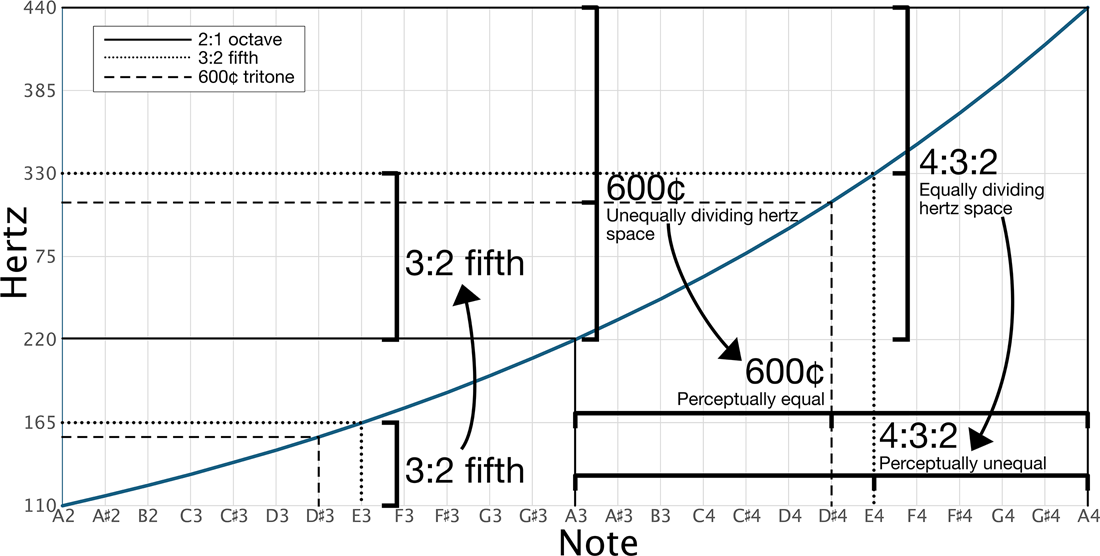
If an octave is bisected in half in hertz space,Footnote 17 the result is an audible asymmetry: the higher interval sounds smaller than the lower interval. In Figure 1, the dotted line divides the hertz space between A3 and A4 equally but sounds closer to A4. It creates two intervals, a 3:2 perfect fifth (A3-E4) and a 4:3 perfect fourth (E4-A4); these can be shown in a single ratio as 4:3:2. The dashed line in Figure 1 shows the 600¢ tritone, which is perceived as equidistant between A3 and A4 but whose hertz value is closer to A4.
These two subdivisions are known as the arithmetic mean (the fifth, equally dividing hertz space) and the geometric mean (the tritone, equally dividing perceptual space). Arithmetic means are easy to find with frequency ratios: simply find the average of the two numbers in the ratio, doubling the terms if needed to produce a whole number. To find geometric means, frequency ratios must be re-expressed – for example, in exponents – to allow for logarithmic subdivision. This always produces irrational numbers and so cannot be simply expressed in frequency ratios. Cent values do this logarithmic work for us, meaning that the geometric mean can be found by simply halving the cent values of an interval.
In summary, the whole-number ratios of just intonation conceptually facilitate the proportional splitting of intervals by their arithmetic means, while equal-tempered semitones and cents make symmetrical, geometric means easy to find. This clarifies Haas’ understanding of the fifth and the tritone as synecdoches of just intonation and equal temperament. They stand in for the principles of symmetry and proportion, which are conceptually facilitated within the two contrasting systems.
This is not to say that proportional logic cannot function in equal temperaments, nor symmetry in just intonation. Both systems can approximate the other to within the margin of noticeable difference. Just intonation can approximate the tritone to within 3¢ with a 17:12 ratio; 12TET's perfect fifth is only 2¢ from a 3:2. The viability of this approach is evident in the music of those composers, like Haas and Sims, who use 72TET to approximate just intonation.
The Aesthetics of Symmetry
What musical fruit might these conceptual resources bear? The aesthetics of musical proportion have been laid out by many just-intonation composers and theorists,Footnote 18 and four aspects of this logic have been especially useful in my own work:
• Simple ratios allow for the resonant tuning of musical consonances.
• Frequency ratios make the combination tones of an interval easy to calculate, as you can simply add and subtract the two numbers to produce the sum and difference tones. This both aids tuning and suggests new and unexpected harmonic resources.
• Frequency ratios place an interval on the harmonic series, providing new contexts for familiar sonorities.
• Breaking ratios down into their prime factors provides new ways to understand intervals based on shared or contrasting primes.
The aesthetics of symmetry, however, have been of less interest to microtonal composers. To illuminate them, I start by considering the tritone, using this familiar symmetrical resource to understand the aesthetics of symmetry before applying them to unfamiliar quarter-tone contexts. The tritone is a wonderful musical tool. Its symmetrical subdivision of the octave lends it a central role in modes of limited transposition and tritone substitutions. In both instances, symmetrical musical structures create a compelling logic that can be grasped aurally despite the dissonance of the underlying intervals.
Self-Similarity and Modes of Limited Transposition
The simplest form of symmetrical self-similarity is the audible halving of an interval: an arpeggiation of C–F♯–C, for example. Contrary motion is another familiar resource which, when both voices begin on a shared pitch or octave equivalent, converges on the tritone point of symmetry. A more musically sophisticated version is found in modes of limited transposition. A mode will be of limited transposition if it repeats self-similarly on an equal subdivision of the octave (in 12TET: tritone, major third, minor third, whole tone). As the tritone is the simplest subdivision (a halving), any other subdivision that is a multiple of two will also be self-similar at the tritone. Of the seven modes of limited transposition in 12TET, only one (Messiaen's third mode) is not self-similar at the tritone.Footnote 19 In the six remaining modes, every note is accompanied by its tritone transposition, creating a unique combination of dissonance and consistency.
The symmetrical self-similarity of music written in modes of limited transposition is aurally striking. Melodic fragments can be repeated cyclically without leaving the mode, resulting in musical recursion. Compare, for example, the patterns within the minor tetrachords of the octatonic and diatonic scales in Figure 2. Continuing the patterns produces different results: the diatonic version ascends through the circle of fifths; the octatonic version remains grounded in the tonic of C. The asymmetrical mode is cyclical; the symmetrical mode is recursive.
Tetrachord patterns in the octatonic and diatonic scales.

Axes of Symmetry and Tritone Substitutions
In A Geometry of Music, Dimitri Tymoczko explains the tritone's special role in voice-leading.Footnote 20 He argues that the evenness with which chords fill out the octave is an important constituent of their capability for certain types of harmonic motion. He discusses ‘even chords’ – chords of n notes that equally divide the octave n times, such as the tritone and the augmented third chord – and ‘nearly even’ chords – chords close to even chords, with one note altered by a step, say, such as perfect fifths, major triads.Footnote 21
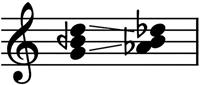
Any nearly even chord can reach a transposition of itself via the even chord it resembles with smooth voice-leading (see Figure 3a). Moreover, particularly neat voice-leading is possible when moving from an n-note nearly even chord to its transposition by the octave divided by n, such as a dyad transposed by the octave divided by two (that is, a tritone) (see Figure 3b).Footnote 22 In these kinds of movement – from, say, a perfect fifth to its tritone transposition – voices move in contrary motion and by small steps, like a semitone. As with modes of limited transposition, the tritone has a special role as the simplest even chord. Tritone relationships facilitate simple voice-leading in any n-note chord where n is an even number.
Voice-leading examples.

The 12TET tritone substitution is an example of this (see Figure 3c). In the tritone substitution, a nearly even dyad – the perfect fifth – is combined with an even dyad – a tritone. The combination is a nearly even tetrachord: a dominant or half-diminished 7th chord. These chords can move smoothly to both their minor third and tritone transpositions. When moving by a tritone, the two notes related by a tritone remain static while the perfect fifth shifts around them. Their fixity of pitch is contraposed with their plasticity of function: the two notes switch roles as third and seventh in the chord. These tritones act as an axis of symmetry, something that can be more easily visualised by projecting the transformation on to a pitch circle, either of semitones (see Figure 4a.i) or fifths (see Figure 4a.ii).
Tritone substitutions.
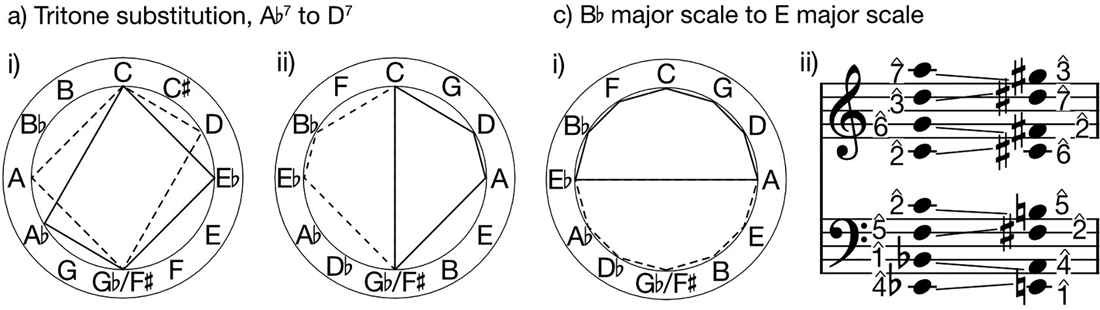
The proximity of the perfect fifth to its tritone transposition has ramifications for 12TET's circle of fifths and its diatonic scales, as Ernő Lendvai argued.Footnote 23 As every fifth can reach its tritone substitution with stepwise semitone motion, so can the diatonic scale reach its tritone transposition. As in the tritone substitution of a dominant seventh, each note of each dyad exchanges roles as it moves from one scale to the other: the dominant moves to the supertonic as the supertonic moves to the dominant (see Figure 4c.ii).Footnote 24 If this movement is projected on to the circle of fifths (see Figure 4c.i), one can see the scale being reflected in the axis of the tritone. These tritone relationships combine harmonic distance with efficient voice-leading, creating music like the coronation scene from Modest Mussorgsky's Boris Godunov, which fuses clanging dissonance with irresistible harmonic logic.
Tritone Aesthetics
These two instances provide a sense of what pitch symmetry might sound like. The self-similar structures of modes of limited transposition combine dissonance with consistency and recursion. The symmetrical axes of tritone substitutions join harmonic distance to efficient voice-leading, resulting in a combination of fixity of the axis pitches and flexibility of their function.
Tritones, Just and Hybrid
Symmetrical relationships are most easily conceptualised within equal temperaments but still function within just intonation. Just approximations of the tritone preserve enough of its symmetry for its aesthetics to be audible. If tritone relationships are approximated in just intonation, the fixity of the tritone point of symmetry is lost, because the just tritones are not exactly symmetrical. For example, the dominant 7th chord might be approximated in just intonation as a 4:5:6:7 chord, with a 7:5 tritone at its heart. Suppose this chord is transposed by that same interval, a 7:5. In this case, the 5:4 third of the first chord must drop by 35¢ to become the 7:5 of 7:5, a 49:40. This is the effect that Harry Partch describes as ‘tonality flux’, in which the change in a note's harmonic function in just intonation necessitates microtonal voice-leading.Footnote 25 A similar effect occurs if modes of limited transposition are repeated at the 7:5 rather than at 600¢. The further the approximation is from the 600¢ tritone, the more the aesthetic of fixity is lost: compare, for example, a tritone substitution to alternating dominant sevenths at a perfect fourth.
Instead of searching for a just tritone, one might use a 600¢ tritone within just intonation. Hasegawa describes the combination of just intonation and equal temperament as a ‘hybrid system’.Footnote 26 Haas often uses this approach, writing in sixth-tone notation that indicates ‘not exact twelfth-, sixth-, and quartertones [but] the corresponding intervals of the overtone series’.Footnote 27 This provides a close approximation of just intervals alongside 12TET. This 12TET undergirding allows for the closer tritone substitutions of in vain. Haas alternates between the seven-limit dominant 7th chords on equal tempered B♭ and E.Footnote 28 Here, the thirds and sevenths of the two tritones differ by 17¢. Haas allows these clashing notes to overlap, creating what he calls a Klangspaltung (tone-splitting) effect.Footnote 29
Notably, Haas replaces the harmonic tritone with its just equivalent rather than altering the tritone by which the two chords are related. Harmonic just intervals are sensitive to differences in tuning, as the co-presence of both notes allows for the audiation of combination tones and beats. For example, a 7:5 mistuned by 5¢ produces a dissonant difference tone that resolves when the interval is moved in tune. By contrast, an equal-tempered tritone is not much altered by a 5¢ deviation, as both have equally dissonant difference tones. In Haas’ tritone substitution, he replaces the harmonic 600¢ tritone with a 7:5, creating a noticeably more consonant chord, but maintains a transpositional tritone of 600¢. This does not reduce the consonance of the passage, changing only the nature of the Klangspaltung.
Thinking with Symmetry
These just-intonation and hybrid versions of tritone-based harmony are effective harmonic devices. While they lose the equal-tempered tritone's fixity, they gain aspects of harmonic resonance by virtue of their simple intervallic structures. They seem to me, however, fundamentally to be versions of equal-tempered logic that are de-tempered into just intonation. We can regard the imperfect symmetries of just intonation as approximations of the perfect symmetries of equal temperament, just as we might view the imperfect consonances of equal temperament as approximations of the perfect consonances of just intonation.
Tenney argues that we hear a 400¢ third as an invocation of a 5:4 third;Footnote 30 I propose that, in the above contexts, we should think of the 7:5 tritone as invoking a 600¢ tritone. I do not intend this as a psycho-acoustic statement, unlike Tenney's contested claim;Footnote 31 rather, I mean it conceptually: it is intellectually productive to view near-symmetries as approximations of exact symmetries, as it suggests harmonic resources we might otherwise overlook.
Nevertheless, there are contexts in which symmetry is not just conceptual but audible. Some self-similar passages stand out, as when we hear an interval melodically subdivided by its point of symmetry or a tetrachord repeated at the tritone. In these contexts, substituting a 7:5 for the 600¢ tritone does not alter our aural recognition of the melodic device of symmetrical division despite the larger size of the higher interval. In other contexts, such as the tritone substitutions or more complex forms of self-similarity, the structural symmetry is only audible by virtue of the aesthetic properties discussed earlier.
Understanding near-symmetries as invoking symmetrical logic does not prevent us from considering other logics. A 7:5 tritone might in one moment be used in a symmetrical axis melodic transformation and in the next be part of a network of proportional harmonic relationships. The ability to recontextualise music with symmetrical and proportional logic is one of the benefits of the hybrid systems that Hasegawa describes.
Symmetry and Proportion beyond the Tritone
Bisecting Superparticular Intervals
Symmetrical logic can be extended beyond the tritone by subdividing intervals other than the octave. The options are vast: one could choose any interval and any number of subdivisions.Footnote 32 I have focused on bisecting the perfect fourth and fifth, as these inversionally related intervals are musically salient: they are the first new interval classes in the harmonic series after the octave and form the backbone of conventional tonal harmony.
Subdividing Perfect Intervals
Quarter-tones do an excellent job in approximating the geometric means of the just fourth and fifth, as these perfect intervals are themselves well approximated in 12TET. The 3:2 fifth is geometrically divided by the 351¢ neutral third, the 4:3 fourth by 249¢ subminor third. When placed inside their respective intervals, they form triads: the neutral triad (for example, C–E half ♭–G) and the subminor stack (for example, C–D half ♯–F).Footnote 33 While the neutral third has a straightforward just equivalent, the 11:9 neutral third, the subminor third does not. The simple 7:6 subminor third is audibly asymmetrical, while the 15:13 is fairly complex. I use the 7:6 to approximate subminor logic in just intonation, with good effects despite the substantial tonality flux in axis transformations.
One might expect the neutral and subminor third to sound conspicuously dissonant, like the tritone. However, the triadic quality of both intervals reduces their harshness. To my ears, the neutral third retains something of the tritone's clang, while the subminor third is surprisingly consonant. As a result, the fascinating symmetrical logics it produces evade the traditional dichotomy between consonant proportion and dissonant symmetry. Their symmetrical logic also eases their tuning: the neutral third sits between the major and minor third and the ear can become accustomed to splitting the difference. The subminor third is small enough to be found melodically by arpeggiating the subminor stack and listening for asymmetries.
Self-Similarity and Axes within Perfect Intervals
It is important not to overstate the analogy between the neutral and subminor thirds and the tritone. The tritone bisects the octave, which is unique due to the phenomenon of octave equivalence. But imagining ourselves within a system of fifth or fourth equivalence produces interesting results. This approach recalls both Wyschnegradsky's espaces non-octaviants (an important influence on Haas) and the Bohlen–Pierce scale.Footnote 34, Footnote 35
Quarter-tone modes of limited transposition within the fourth and fifth produce non-octaving scales in which every note is accompanied by a neutral or subminor note above and below it (see Figure 5a). The result is a concatenated series of symmetrical triadic structures. Like conventional modes of limited transposition, these scales combine dissonance with self-similarity, though the recursiveness of the return to the octave equivalent is lost.
Non-octave systems in 24TET, using symmetry within a system of fourth and fifth equivalence.

Using the same conceit, the axis transformations of the tritone can be mapped within the fourth and fifth. Figure 5b shows tetrachords which combine the even intervals (neutral and subminor third) with nearly even intervals (in this case, a major and minor third). The tetrachords are then transposed by the even intervals, shown by the upwards arrows in Figure 5b. These transpositions are then transformed to maintain fifth or fourth equivalence, shown by the left–right arrows in Figure 5b. The result is a pair of closely related tetrachords reflected around neutral and subminor third axes. Like the modes of limited transposition in Figure 5a, these tetrachords can be iterated at the fourth and fifth to produce dizzying self-similar patterns.
Combining Tritone Symmetry with Subdivisions of the Fourth and Fifth
While these approaches interest me, a more interesting resource is latent in the symmetrical triads. As discussed earlier, the fourth and fifth are nearly even dyads that sit close in harmonic space to their tritone substitutions. If the tritone substitution between fifth and fourth is combined with the equal subdivisions of these intervals, a new kind of tritone substitution is produced (see Figure 6). The fifths move around both the tritone axis of the octave and their own internal neutral and subminor axes. To my mind, this progression is a closer relative of the tritone substitution than the tetrachordal transformations shown in Figure 5.
Symmetrical triads within fifths moving by a tritone.
Moreover, within 24TET, the neutral and subminor thirds play a special role. They are two of three intervals that can produce a non-chromatic, complete intervallic circle. In other words, when neutral and subminor thirds are stacked on top of each other, they cycle through all 24 pitches in the temperament. These cyclical intervals are to 24TET what the perfect fifth is 12TET, and, like the perfect fifth, these interval circles can be used to generate scales. These scales, which I call the neutral and subminor scales, have formed the backbone of my composition since 2019.
This approach to quarter-tones was pioneered by Wyschnegradsky, who focused on 24TET's other cyclical interval, the superperfect fourth.Footnote 36 While Wyschnegradsky's work is of great interest, I find the musical resources of the superperfect fourth prohibitively dissonant, comprised as they are of subdivided major sevenths. The cyclical potential of the neutral third has been examined by Louvier and Gayle Young,Footnote 37 while Charles Ives glancingly referred to the potential of the ‘minor lesser scale’, the subminor.Footnote 38
These composers did not, however, describe these ideas as resources of symmetry and perhaps, as a result, they missed the relationship of these fourth and fifth-based scales to the tritone. Just as the symmetrical triads of these scales can be transformed along a tritone axis, as in Figure 6, so can the scales themselves. If both scales are mapped on their intervallic circles (see Figure 7a), isomorphic scales share a spine of perfect intervals (solid lines). The pitches omitted from this shared spine are instead shared with the scale that is a tritone distant (dashed lines). The result is a complementary group of four tritone-related scales (see Figure 7b). Each tritone-related pair constitutes an all-interval set within 24TET.Footnote 39
Axis transformation in 24TET.Footnote 41
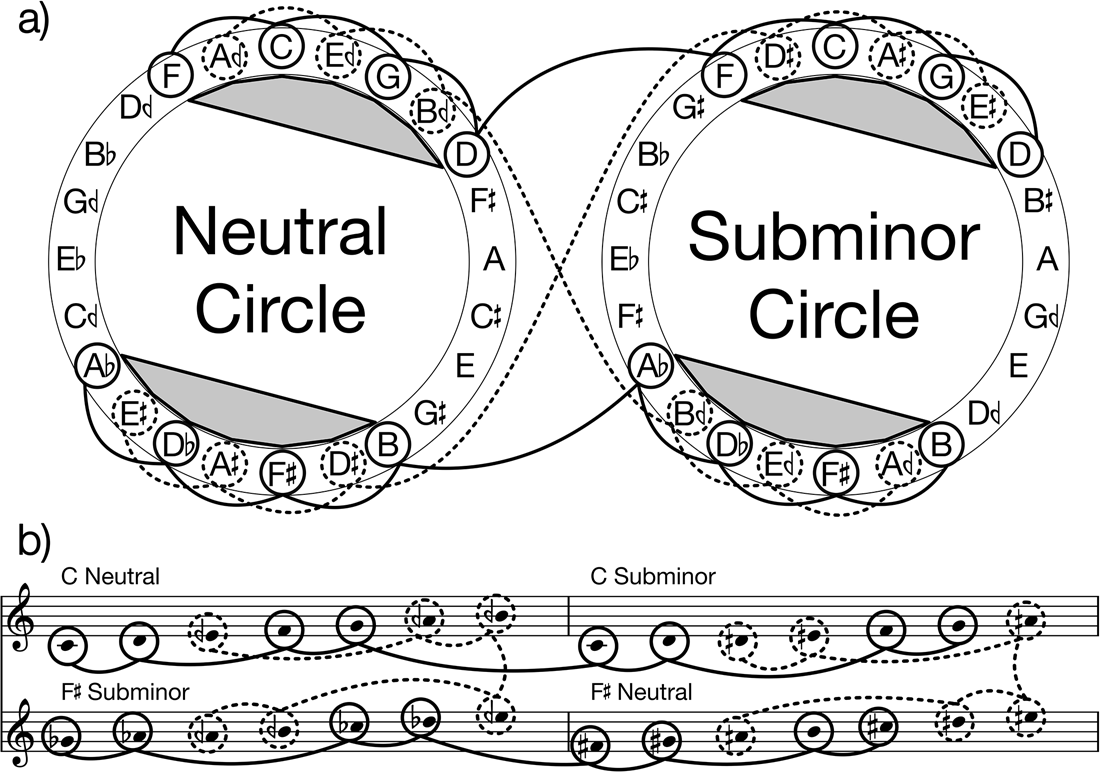
As with tritone symmetries, these axis structures can be approximated in just intonation. Within a hybrid system, these can be transposed by a 600¢ tritone to produce an axis of symmetry with tonality fluxes between the tritone-related pitches. Reframing the symmetries of the neutral–subminor axis within the proportional language of just intonation suggests other harmonic resources. In my trio Wound Honey, for example, the just intervals of the neutral–subminor axis are recontextualised with their sum and difference tones, producing resonant chords related to the neutral and subminor scales but with strikingly different sonorities.Footnote 40
Conclusion
These quarter-tone resources provide a glimpse of the usefulness of symmetrical aesthetics. They suggest the value of dialogue between equal temperaments and just intonation, illustrating how the process of approximation can shed new light on the nature of the harmonic resources at hand. Quarter-tones and tritones may sometimes clang, but when wielded with intent, these dissonant sounds can produce fascinating harmonic results.


 Open access

