


In 1879, disaster struck the coast of Maine; that spring, the menhaden did not return. Although reports indicated that the fish were “as plentiful as ever” further south in New England, the forty or fifty ships that ventured into the Gulf of Maine for menhaden that season all returned empty-handed.Footnote 1 Over a decade of intensive fishing had finally taken its toll.Footnote 2 What had just years before been the most lucrative fishery in the state was now marked by total failure, and the catch for the year plummeted from more than one million pounds to an estimated one hundred barrels of fish.Footnote 3
The small and oily Atlantic menhaden (Brevoortia tyrannus) is a member of the herring family, and it lives in enormous schools throughout the northwestern Atlantic Ocean, particularly along the Atlantic and Gulf Coasts of the United States. Although its numbers are now diminished, it is thought that menhaden once comprised the largest fish population in American waters. Each year, enormous schools of this surface-dwelling creature migrate up and down the East Coast following blooms of phytoplankton, the menhaden’s primary food source. Maine is the end point of this annual journey for many adult fish, and by the time these schools arrive there at the end of May they are larger, fatter, and richer in oil than at any other point in their life cycle.Footnote 4 It was this richness that nineteenth-century fishermen and industrialists harnessed to their own ends, using menhaden as bait to catch everything from cod to mackerel and striped bass, or sending it into reduction factories that pressed these fish into oil for industry and ground their bodies into fish scrap to be used as fertilizer for agriculture.
The collapse of the most northernly population of menhaden had immediate and dramatic effects on the coastal Maine economy: boats remained docked, factories stood silent, and nearly 1,000 men were out of work.Footnote 5 Among the hardest hit, at least initially, were the factory operators, who had by this point invested millions of dollars into their reduction equipment and menhaden steamers.Footnote 6 The loss was felt all along the Eastern seaboard as well. Fertilizer producers scrambled to replace the fish meal in their fertilizing blends and fishermen struggled not only in procuring menhaden for bait but also in catching fish more generally. Menhaden were among the most important sources of food for other fish in the region, so when the menhaden disappeared, so too did its predators.
This paper aims to understand the ways in which the menhaden collapse fundamentally altered one of these many supply chains: the commercial fertilizer firm. It presents a case study of a single fertilizer manufacturer, the Pacific Guano Company, and asks how this firm was able to maintain relatively stable output despite being reliant on a resource in the midst of an ecological upheaval. Key to the firm’s resilience were new understandings of soil and fertility that meant that fish scrap and the nitrogen it contained could be abstracted from the fish itself. The collapse of the Maine menhaden population compelled this fertilizer firm to apply these abstractions in concrete ways and to seek novel sources of not just fish but also of other ingredients that were chemically similar but could be procured from less volatile supply chains.
Following the menhaden collapse, the Pacific Guano Company’s major new source of organic material was the industrial meat packer, which supplied the firm with nitrogen-rich slaughterhouse waste that could easily be incorporated into the Pacific Guano Company’s fertilizing blends. (These blends were called “guanos,” which became a generic term for fertilizer by the end of the nineteenth century.) Although the firm only reluctantly made this material shift, this change enabled the Pacific Guano Company to survive the upheaval in the fish scrap market while also reinforcing a mode of scientific agriculture that saw fertilizers not as specific ingredients but as interchangeable inputs.
Modern scholars of business management call the deliberate reshaping of a firm’s physical and knowledge-based resources “resource recombination,” and it is seen as essential in determining firm resilience during large-scale and often sudden supply chain disruptions.Footnote 7 There is a rich vein of scholarship seeking to understand the ways in which firms, both past and present, have achieved stability in times of crisis. These upheavals, however, have largely been defined as geopolitical upheavals, financial shifts, or one-time natural disasters; few scholars have yet looked at how an enterprise responds when an ecological system breaks down around it.Footnote 8
In environmental history, by contrast, fishery collapses are synonymous with crises and are emblematic of the often-fraught relationship between the demands of human markets and the limits of the natural world. While such texts have adeptly identified the causes of these declines—pollution, overfishing, the damming of rivers—very few move beyond the collapses themselves to explore the impact of such environmental upheavals on human systems more broadly. Fewer still see the role of business in these stories as anything more complex than as exploiter.Footnote 9
This paper thus seeks to broaden the geographical and human contexts surrounding a fishery collapse. It does so by relying on the business records of the Pacific Guano Company, a collection of executive correspondence, account ledgers, insurance documents, and experimental notebooks dating from approximately 1866 to 1889. On the surface, this archive records the day-to-day practice of a company struggling to adapt to a major supply chain disruption. On a deeper level, it reveals a story of profound ecological change filtered through the lens of shipment records and fertilizer formulas.
This environmental story, however, is markedly different from the one the Pacific Guano Company told its customers. Although the firm clearly dealt with the disruption of the menhaden meal market by changing its purchasing and production habits, there is no explicit mention of the catastrophe unfolding in the fish scrap market in any of its papers. More striking is the fact that the firm never publicly revealed it was now using slaughterhouse waste, along with other often frowned-upon sources of nitrogen in its fertilizer blends.
It is tempting to frame this behavior through the lens of the existing literature on fertilizer fraud in the United States. Adulterated fertilizer and correspondingly false advertising was rampant in the latter half of the nineteenth century, an era when the expansion and multiplication of supply chains made it increasingly difficult for consumers to understand the origins of the products they were consuming.Footnote 10 By printing advertisements that featured only fish while selling products that contained significant quantities of meat, the Pacific Guano Company was, on some level, misleading its customers.
And yet the Pacific Guano Company was never accused of selling fraudulent wares and, by all chemical accountings, the quantity of nitrogen in their products—the primary ingredient farmers were looking for in a fertilizer—matched what was listed on their labels. The behavior of the enterprise was well within the standards of their time and these standards, both in business practice and in fertilizer production, were what helped the firm to survive the fish market upheaval. In the fledgling field of agricultural chemistry, the body of a cow and the body of a fish were chemically and economically the same. Such equivalence simultaneously expanded the number of materials that could be used as fertilizers while fundamentally erasing much of the biological differences between these ingredients. By understanding their own soil in terms of its chemical makeup, farmers themselves separated nitrogen and nitrogen sources, and it was this intellectual gap that fundamentally enabled the Pacific Guano Company to adapt its production. In turn, by folding fish and livestock together in the privacy of their factory, the Pacific Guano Company simultaneously survived the shock of the menhaden collapse and obscured it from public view. This type of hidden substitution thus demonstrates that resource recombination can both benefit from and contribute to a lack of full consumer understanding of the origins and ecological impact of the products they consume.
The Firm and Its Fertilizers
The Pacific Guano Company, located in Woods Hole, Massachusetts, was one of the largest consumers of fish scrap in the United States.Footnote 11 Founded in 1859 with nearly $1 million from investors in Boston, the company was a joint venture between shipbuilder Asa Shiverick and local businessman Prince Crowell. Both sought to use the era’s growing obsession with agricultural improvement to bolster their incomes on their cargo ships. As a direct result, the Pacific Guano Company’s initial aim was to import bird guano from abroad and manufacture it into fertilizer locally.
Guano is the combination of the excrement, feathers, and bones accumulated at long-standing colonies of sea birds. It is incredibly rich in both nitrogen and phosphorus, two elements essential to plant growth. This chemical composition created a substance that was coveted throughout much of the nineteenth century as a valuable source of fertilizer for agriculture. During this period, soil fertility was considered one of the leading environmental issues of the Western world. Scientific understandings of the earth were seen as central to combating nutrient loss, and most historians credit German chemist Justus von Liebig with causing this chemical turn.Footnote 12 His 1840 work, Organic Chemistry in Its Application to Agriculture and Physiology, identified what Liebig saw as the essential elements of soil—namely, nitrogen, phosphorus, and potassium—and he argued that problems with soil fertility were the result of deficiencies of these elements.Footnote 13
This new understanding of soil lent itself to a new branch of science called agricultural chemistry, one in which the chemical composition of plants and fields could be quantified and inventoried and different elements could be substituted like for like.Footnote 14 Inspired by this chemical turn as well as by the dramatic agricultural changes that had occurred in Great Britain since the 1760s, many American farmers and their bureaucratic allies sought out new means to minimize nutrient loss and maximize productivity.Footnote 15 Discussions on the minutiae of ideal crop rotation, farm layout, livestock breeding, and crop selection were disseminated widely by a growing number of farm journals, agricultural societies, and agricultural fairs.Footnote 16 As canals and railroads increasingly connected previously isolated rural areas to more regional markets, they brought in turn the greater influence of these periodicals, each filled with the latest information on how to improve one’s farming practices.Footnote 17
The proper composition of fertilizers figured heavily into this new agricultural science, and farmers focused on nitrogen in particular to produce greater yields. As is now widely known, nitrogen is essential to myriad biological processes in both plants and animals. It enables nucleic acid chains to chemically bond with each other; plays a central role in protein synthesis and reproduction; and is an important part of chlorophyll, which helps plants convert sunlight into energy, thus forming the basis of much of life on Earth.Footnote 18 The amount of nitrogen present in the soil is what primarily determines the amount that a plant may grow, known in agricultural studies as “the law of the minimum.”Footnote 19
Traditional methods of fertilization, such as crop rotation, planting leguminous plants, and spreading livestock manure, intuitively aim to increase nitrogen availability and had long been practiced before the element of nitrogen was identified chemically. With the advent of agricultural chemistry, however, farmers no longer had to search for greater sources of organic matter generally, such as manure or muck, but rather for new sources of this specific element.Footnote 20 As a result, fertilizers could now come from an increasing number of materials, including chalk, marl, and bone.Footnote 21 Those that contained nitrogen were subsequently measured and valued according to their ammonia content; ammonia is a combination of nitrogen and hydrogen (NH3), a chemical arrangement that makes nitrogen more readily available to plants.
The most famous of these new ammonia sources was undoubtedly guano, which first reached the West via the sea islands of Peru. Although English chemist Humphrey Davy experimented with it as early as 1805, guano was not widely used worldwide until the British started trading it as a commodity in the 1840s.Footnote 22 From this point, its fame as a fertilizing substance spread rapidly and its potency was soon proclaimed by the vast network of American agricultural periodicals. As the Maine Farmer explained in 1844, the substance was “so stimulating in its nature as to require but very little to manure an acre. Some consider 35 bushels on an acre equivalent to 70 loads of good rotten dung.”Footnote 23
The British monopoly on the trade meant that limited quantities of Peruvian guano reached the United States, which is why, in the mid-nineteenth century, American entrepreneurs sought alternative supply sources and started importing guano from the Caribbean and far-flung islands in the Pacific. By 1850, guano comprised some 40 percent of the fertilizers used in the whole of the United States.Footnote 24 This, however, was not enough to fulfill demand. Desperate to keep up with the “guano mania” sweeping the Western world, in 1856 the US Congress passed the Guano Islands Act, which allowed United States citizens to seize control of any island, rock, or key area with substantial guano deposits not already under the control of foreign powers. This law led directly to the annexation of both Christmas and Midway Islands, among many others.Footnote 25
The Pacific Guano Company was founded at the peak of this guano obsession. In 1864, the company took possession of Howland Island, a guano-rich area in the Pacific Ocean near Hawai’i, built thirty-three ships to haul the bird excrement back to Massachusetts, and erected a state-of-the-art manufacturing plant to produce fertilizer on a waterfront area called Penzance Point in Woods Hole. Although Howland Island was rich in bird life, the high levels of rainfall it received leached its guano deposits of much of the nitrogen-rich organic material that made guano such a valuable fertilizer. What remained to be harvested was essentially a guano rock, one that was full of phosphate of lime but not much else. The aim of the guano works at Woods Hole, then, was to take this phosphorus—another of Liebig’s essential components of soil—and restore to it this lost organic nutriment. To do this, the firm turned to menhaden.
Using menhaden as a fertilizer was initially an Indigenous practice in the northeastern United States, but it became increasingly industrialized in the middle of the nineteenth century as entrepreneurs sought to fulfill the growing national demand for fertilizers.Footnote 26 Large steam-powered vessels using purse seine nets caught the massive schools of fish that swarmed the shores of New York’s Long Island Sound and along the coast of Maine. These catches were subsequently brought to fish reduction factories, where they were boiled, pressed for their oil, and then dried to transform them into a nitrogen-rich substance called fish scrap that could be easily spread on fields.Footnote 27 Initially, most of this production was located on Long Island, but in the early 1870s the center of the industry shifted northward to Maine. By 1876, the state had become the largest menhaden processor in the country, producing roughly 70 percent of the nation’s total output of oil and scrap.Footnote 28
The value of this fish guano or fish manure, as it became known, undoubtedly lay in its price. Calculating the nutrients per pound in both Peruvian guano and menhaden scrap, a writer in the Maine Farmer in March 1855 stated that in terms of nitrogen content, the “Peruvian guano is worth $50 per ton” and “this fish manure is worth $45 per ton.” The fish guano, however, was sold at only $34 per ton. Menhaden scrap “therefore is much the cheaper fertilizer.”Footnote 29
The founders of the Pacific Guano Company chose Woods Hole for the location of their fertilizer firm because it not only had access to Atlantic Ocean trade routes but also, as an 1864 company pamphlet explained, was “where the menhaden fish chiefly swarm.”Footnote 30 To supplement the bird guano that company vessels were bringing back from Howland Island, company chemists manufactured large quantities of sulfuric acid and used it to “digest” the dried and pressed remains of the menhaden caught locally. This acidified fish scrap was then mixed with Howland Island guano and subsequently sold by the Pacific Guano Company as a variety of fertilizers, the most popular of which they called “Soluble Pacific Guano.”
In 1865, the Woods Hole plant produced its first batch of roughly 700 tons of fertilizer, an amount that increased by nearly a factor of five by 1866.Footnote 31 The demand for their product quickly surpassed the guano stores of Howland Island; within the next few years, the company took possession of a series of uninhabited guano islands throughout the Caribbean and off the coast of Honduras.Footnote 32 These guano stores were quickly exhausted as well, and the firm rapidly sought alternative sources of fertilizing material.
In the 1850s, scientists and entrepreneurs discovered large deposits of rock phosphates outside of Charleston, South Carolina. Chemical analyses revealed that these minerals had similar chemical compositions to the phosphatic rock guano imported from around the globe.Footnote 33 By the mid-1860s, land-mining corporations and affiliated fertilizer companies were established around the deposits. In 1869, with its own supply of foreign bird guano already declining, the Pacific Guano Company leased a portion of Chisholm Island outside Charleston with the intention of shipping phosphates to its Woods Hole plant. The phosphate yields there were so high, however, that the firm soon built a second fertilizer factory in Charleston.Footnote 34
This phosphate was subsequently mixed into the company’s fertilizers in both Massachusetts and South Carolina, amounting to a total annual production of 16,000 tons by 1870.Footnote 35 Most of this fertilizer was purchased by the commodity growers of the South and Mid-Atlantic states. The company’s advertising materials were filled with testimonials from these cash crop farmers, all boasting of their great success by using fertilizer from the Pacific Guano Company. “Gentlemen,” began one from a grower from Halifax County, Virginia, in 1874, “I used the Pacific Guano, which I bought … last spring, under about twenty thousand hills of tobacco on very common land and found it to be just what it was recommended to be.” He continued, “I was so well pleased with the results that I shall use it on my next plot, as I consider it superior to any other Guano heretofore used by me.”Footnote 36 “Gentlemen,” began another from a farmer in Windsor, Connecticut, in 1879, “I have sold and used your Soluble Pacific Guano for the last four years, and for growing corn, tobacco, grass, grain and vegetables of all kinds, I find it indispensable.”Footnote 37
From the opening of the Chisholm Island factory, bird guano played virtually no role in the formula for the fertilizers made at Woods Hole. A ledger of the company’s receipts and shipments from 1870 and 1871 recorded fish scrap, South Carolina phosphate, and oil of vitriol as the only items being received at Woods Hole and “completed guano” as the sole item being shipped from there.Footnote 38 By the end of the decade, this formula remained roughly the same, and while the ingredient blends were slightly more complex, guano was still not one of them. A record for “Crude and Manufactured Material on Hand at Woods Holl,” dated September 10, 1877, stated that at that moment the plant had just four tons of bird guano on hand. This was slightly more than the available 2 tons of muriate potash (an important source of potassium), but far less than the 24 tons of nitrate of soda, 130 tons of bone ash, 480 tons of kainite, 732 tons of dried fish scrap, 735 tons of South Carolina phosphate, 825 tons of brimstone, and 1,468 tons of crude fish scrap.Footnote 39 The lists from 1879 of the company’s fertilizer formulas and experiments included all of these materials but no bird guano whatsoever.Footnote 40 Such findings support the idea that the firm was inclined to substitute chemically similar materials from its early days of production.
Throughout the 1870s, the company relied largely on menhaden both for its physical products and its major marketing efforts. In the latter, the firm was open about the fact that they no longer used bird waste in their fertilizers. Peruvian guano, the company explained in its sales pamphlets, was an imperfect fertilizing material, one that was alternatively “deficient” for crops or “over-stimulated the roots to the exhaustion of the natural fertility in the soil.”Footnote 41 What the Pacific Guano Company produced was similar yet superior to natural guano. Fundamentally, the company argued: “The base of this fertilizer is identically the same as that of Peruvian Guano, namely, SALT WATER FISH.”Footnote 42 Where guano fertilizers depended on unreliable birds to digest sea creatures into desirable organic materials, the Pacific Guano Company relied on chemistry to tame the ocean and convert “its myriad swarms of fish into a source of this important element.”Footnote 43 “The ingredients now used,” they proclaimed, “were adopted as a combination as perfect as science combined with practiced experience could devise.” The results were thus “superior to those attained by the use of any other Fertilizer.”Footnote 44
Although there are no ledgers remaining from the company’s first decade of operation, it is likely that much of this fish scrap initially came from around Woods Hole itself. Letters exchanged throughout the 1870s indicated a particularly strong relationship, both personal and professional, between Prince Crowell’s son Azariah, who took over Pacific Guano Company during this period, and a local fishing captain named Isaiah Spindel. The two co-owned a local fishing company, the Woods Holl Weir Company, that regularly supplied the Pacific Guano Company with “loads of fish” throughout the 1870s.Footnote 45 This local production, supplemented by more cart loads of fish from the Bay Weir Company and a man only referred to as Rogers, was essential to the firm’s image.Footnote 46 As an 1876 newspaper article on the firm explained, the “Pacific Guano Company was prosperous” as “it had plenty of phosphate … and the sea at its doors swarming with endless menhaden.”Footnote 47 The firm’s own marketing materials further emphasized this fact: “The fish that swarm along the shores of Woods Holl and vicinity are captured in seines,” soon to be converted into valuable fertilizers for the land.Footnote 48
The firm’s demand for menhaden scrap rapidly surpassed this local supply. As early as 1872, the company recorded purchasing most of its scrap from producers on Long Island, with just over a third of the scrap that year coming from Maine.Footnote 49 In 1874, Crowell’s ledger noted that the company had acquired just 40 tons of fish locally.Footnote 50 When processed, this would account for less than 1 percent of the total menhaden scrap recorded by the firm that year.Footnote 51 By the end of the 1870s, this purchased scrap, which amounted from 5,000 to 5,500 tons annually, was transformed into roughly 18,000 tons of fertilizer at Woods Hole.Footnote 52 When combined with the production from the Charleston plant, which focused on a phosphorus-heavy fertilizer called compound acid phosphate, the firm’s annual production exceeded 45,000 tons.Footnote 53 This was, by the company’s own estimation, “probably a larger trade than is done by any other six Fertilizer Companies in America combined.”Footnote 54 Although statistics on national fertilizer production at this time do not appear to exist, this statement is at least somewhat supported by the sheer amount of menhaden scrap the firm used. Comparing company records to statistics compiled by the Maine Department of Agriculture, by the late 1870s the Pacific Guano Company’s Woods Hole factory was using approximately 11 percent of the entire national stockpile of menhaden scrap for its fertilizer production.Footnote 55 This fish scrap, in turn, is estimated to have comprised roughly a quarter of all the commercial fertilizer material used throughout the country during this period.Footnote 56
To keep up with the firm’s growing network of menhaden scrap suppliers, shipment tracking and new sourcing of fish scrap became a central part of the company’s correspondence during much of the late 1870s. In February 1878, for example, Asa Shiverick noted a delivery of dried scrap from the Rhode Island-based firm Luce Brothers and later that year Azariah Crowell started a lengthy correspondence with the Tuthill factory in Greenpoint, Brooklyn, about acquiring crude scrap.Footnote 57 In February 1879, in preparation for the next season, Crowell continued his search for scrap by writing to Joseph Church & Company in Tiverton, Rhode Island.Footnote 58 Such diligence in sourcing is further indication of the extent to which the Pacific Guano Company was dependent on the menhaden fisheries during this period. This reliance therefore meant that the collapse of the Maine menhaden fishery left this firm particularly exposed to the risk of failure.
The Firm’s Response to the Collapse
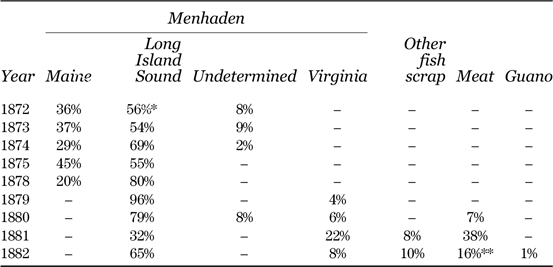
Immediately following the 1879 menhaden collapse, the prices the Pacific Guano Company paid for dried scrap shot up from roughly $20 to $30 per ton to an average of $80 per ton.Footnote 59 Understandably, none of the scrap the firm acquired that year came from Maine; most came instead from the Long Island Sound. A newcomer to the firm’s acquisition ledger in 1879 was a menhaden firm located in Black River, Virginia, but this only provided 187 tons of scrap, some 4 percent of the total received.Footnote 60 On April 28, 1879, the acquisition ledger included an unusual note, indicating that the company had already fallen short by roughly 44.5 tons of the crude scrap necessary for their fertilizer production.Footnote 61 By the end of the year, this deficit had increased to nearly 650 tons of scrap, approximately 13 percent of the total scrap the company acquired in the year immediately prior (Table 1).Footnote 62
Percentage of Receipts of Nitrogen-Rich Materials, 1872–1882
Source: Compiled from Volume 3: Daybook, Woods Hole, January 1878–March 1883, Volume 19: Shipments, Expense, and Volume 20: Notes, Assets, 1873–1891, Mss. 621 1861–1889 (1912), Records of the Pacific Guano Company and Associated Businesses, Baker Library Special Collections, Harvard Business School.
* Includes menhaden caught locally in Woods Hole.
** Includes ground horn.
The following year a new entry appeared on the Pacific Guano ledgers: meat. In September 1880, the company received its first shipment of “dry meat” via railroad from Boston. This amount was small, comprising roughly only 386 tons, or 7 percent of the total organic material received, but it was nearly enough to bridge the deficit of nitrogenous material the company experienced in 1879.Footnote 63
Seemingly not content with this new source of nitrogen, however, the year 1881 began with a flurry of activity on the part of the Pacific Guano Company to quantitatively identify new sources of ammonia for their ever-increasing fertilizer output. In May 1881, an agent from the company J. M. Glidden sent Crowell a sample of rockweed seaweed, asking, “What is your opinion regarding this article for use, provided we can get a quantity of it dry, and ground up fine, will it pay to use it?”Footnote 64 Later that year, Glidden sent a similar message, this time including samples of “prepared lobster chum sent to us by Mr. Plummer of Gloucester.”Footnote 65 Glidden’s agent asked that Crowell analyze it immediately, explaining, “I understand there is a very large supply which in all probability we can obtain if we so desire, and therefore await the result of your analysis with interest.” The note also indicated the potential importance of the chum, with the emphasis included by its original author: “You will be very careful that even the existence of the material—to say nothing of its value if it has any—does not in any way go outside of the company.”Footnote 66 Presumably aware of the disruption of the menhaden market, others outside the firm too sent Crowell similar shipments of potential new sources of nitrogen. In June 1881, for example, Crowell received a letter regarding a “sample of dried cods heads,” which asked him to “make a moisture determination in addition to the usual analysis of ammonia and phosphoric acid.”Footnote 67
Among those clamoring for Crowell’s attention and purchasing power at this time were the owners of the menhaden factories in Maine, who, in their own moment of crisis, had begun their quest for new species to process. Their primary targets were the spiny dogfish (Squalus acanthias) that abounded all along the Atlantic Seaboard of the United States.Footnote 68 A small member of the shark family, spiny dogfish are a slow-growing species that live primarily along the ocean bottom, meaning they cannot be caught in large numbers with the same nets used to harvest the menhaden that swarmed on the surface. What is more, dogfish are also far less oily than menhaden. Instead of being thrown into the reduction machines whole, a dogfish had to be broken into its constituent parts to be made useful, with its fatty liver transformed into oil and its body dried and then turned into scrap.Footnote 69 Altogether, this made the dogfish more difficult and expensive to catch and process.
Nonetheless, with no other viable alternatives to be found, dogfish processing began to take off in Maine. In 1881, a New England newspaper noted that “Boothbay boasts a growing dog-fish industry,” with local fishermen earning 1 cent per fish caught via long-line.Footnote 70 The next year, local reducer Frank Gallup bragged to the US Fish Commission about the great potential of this new enterprise: “I have this season converted the …[menhaden] factory, formerly owned by Gallup & Holmes into using the fish and can handle during their stay here 1,000,000 fish.” The new industry, Gallup claimed, was founded “upon scientific principles, and … promises to be a success.”Footnote 71
The results, however, were disappointing. Industrialists throughout the country previously relied on Maine menhaden oil for a number of purposes, notably as a lubricant for machinery or as an oil base for paint. Demand for such oils did not lessen after the menhaden collapse and, in their attempts to keep these clients, Maine reducers began pressing dogfish whole to try to extract as much oil from their bodies as possible. These efforts appear to not have worked. In summer 1882, Crowell received a letter from Gallup stating that the fish “contain but a small percentage of oil, not enough to extract by pressure.” This, Gallup explained, “accounts for the first failure” of their new efforts.Footnote 72
To keep their ties with the fertilizer firms, menhaden reducers offered to further process the dogfish scrap to make it more financially appealing. In a letter dated July 3, 1882, Crowell wrote about an agreement he had made with Maine factory owner Luther Maddocks to purchase dogfish scrap pretreated with acid phosphate. “Under such an arrangement,” Crowell wrote, “would be a saving to the Pacific Guano Co. of forty dollars and fifty cents per 1000 based on menhaden scrap at $3.25 for unit of ammonia and a saving of 15% per unit of ammonia.”Footnote 73 Nothing appears to have come of this agreement long-term, however. Aside from a letter dated September 25, 1882, from a Boston businessman inquiring about the method by which the Maine firm was “preparing dog fish in such a manner that he can successfully extract the oil from their carcasses,” there is no further mention of this species in the Pacific Guano Company’s letter books.Footnote 74
While these arrangements were being negotiated in Maine, the Pacific Guano Company continued to seek out other marine products for their fertilizer blends. In 1881 and into 1882, the company received “fish skins” and “dried scrap herring” from the area surrounding Boston, which comprised 8 percent and 10 percent, respectively, of the total organic material the company recorded in their ledger for those years.Footnote 75 Emerging menhaden fisheries in the Chesapeake Bay too provided some additional scrap, with shipments coming from this region making up approximately 22 percent of the firm’s total organic material for 1881.Footnote 76 To shore up the shaky supply chains, Crowell also began establishing contractual arrangements with fishing firms to ensure that he had priority to purchase whatever amount of fish they caught. “Promised Land,” likely short for promised landing, accompanied two fish scrap shipments in 1881; by 1882, this increased to four landings, comprising 17 percent of the total fish recorded in the ledger.Footnote 77
Despite its best efforts to expand its sourcing network, by the end of the 1881 fishing season, the firm had only received 1,755 tons of menhaden scrap. This was down significantly from the 5,000 tons it received in 1879, the year of the collapse. Seemingly faced with no better alternative, in November 1881, Crowell again turned to meat, purchasing 1,250 tons, or 38 percent of the total weight of organic material recorded in the ledger, from the Armour Packing Company in Chicago.Footnote 78 This purchase included not just dried meat but also dried blood and tankage, the condensed products of the tank water in which livestock carcasses were boiled to extract any remaining bits of flesh.
Using meat scraps in fertilizer in this way was novel for the Pacific Guano Company, but it was not a new practice in the United States more broadly. The phenomenon of so-called blood manures dates from the mid-1850s, and the availability of these products was intimately tied to the rise of the industrial slaughterhouse. Most of the early companies that produced fertilizer from meat byproducts were initially located in cities either with their own slaughterhouses or directly connected to the Midwest by rail.Footnote 79
Over the next few decades, meat gradually became an essential ingredient in American fertilizer production, but it is unclear from the available sources exactly, based on price and other factors, how and why this shift happened.Footnote 80 While newspaper articles as early as 1865 reported fertilizer works being constructed in Chicago to use the offal and blood of slaughterhouses, it was estimated that by 1872 only about half of this waste was used.Footnote 81 By the late 1870s, agricultural stations in Connecticut, North Carolina, Maine, and Michigan all reported that fertilizers based on dried blood, tankage, and meat scraps were sold in their states, but they give no indication as to quantity and distribution.Footnote 82 What is more, in some regions, slaughterhouse waste was viewed as less desirable than other fertilizing materials. A US government report in 1873 includes that “we have in this refuse the material for a class of fertilizers comparing favorably with our best nitrogenous manures,” yet slaughterhouse waste remained “in need of greater care” in its manufacture.Footnote 83 This sentiment is echoed in an 1878 article in the American Agriculturist, which classified “blood manure” as still an “experimental fertilizer.”Footnote 84
Crowell never indicated what he personally thought of slaughterhouse waste, but what is evident from the Pacific Guano Company papers is that this firm only began to use meat in their blends directly following the disruption of the menhaden market in 1879. How price factored into this decision is not immediately clear. According to a company letter, the price of menhaden scrap had stabilized to roughly $30 per ton by 1882. This was far cheaper than the current price of slaughterhouse waste, which was costing the firm roughly $55 per ton, and yet the firm sourced 16 percent of its fertilizing materials for that year from slaughterhouses located in Boston, Montreal, and South America.Footnote 85 Availability of each ingredient was likely a factor in this purchasing behavior. A higher nitrogen content in some of this slaughterhouse waste too may have justified this increased spending, but the company’s records offer no indication of the nitrogen values of individual shipments. Modern chemical analyses demonstrate that some slaughterhouse waste samples have, on average, slightly more nitrogen than fish meal, but this difference is minimal (10–13 percent nitrogen for meat and 10–12 percent nitrogen for fish).Footnote 86 It is likely that logistical changes also contributed to this increased cost—it was more expensive for meat scraps to arrive in Woods Hole by rail via middlemen than fish scraps that typically arrived on company-owned boats—but, again, it is not possible to definitively say why these purchasing decisions were made.
It is clear, however, that Crowell did not want to rely solely on slaughterhouses as an alternative nitrogen source, as in 1882 the company began supplementing its fish and meat with shipments of bird guano.Footnote 87 These small guano shipments, ranging from 600 pounds to 18 tons, were supplemented by additional purchases of “damaged guano,” or bird guano that had gotten wet and was in an active state of decay.Footnote 88 While damaged guano was priced at $10 per ton and thus had immediate cost advantages, the fact that it was decomposing meant it rapidly lost its nitrogen content and its corresponding fertilizing powers. As a result, its use was highly discouraged in agricultural circles.Footnote 89 The firm also purchased 40 tons of ground horn that year, another byproduct of the industrial slaughterhouse, made quite literally from ground cow horns, and one that commentators claimed was “much less useful to the farmer” and whose “presence in fertilizer is good evidence of fraud.”Footnote 90 These last two purchases were reputationally risky for the Pacific Guano Company, which is likely why they remained less than 2 percent of the organic materials present in the account books in 1882.Footnote 91
With the firm acquiring larger quantities of meat and other sources of nitrogen, the Pacific Guano Company’s formulas adapted accordingly. In 1879, as the crisis in the menhaden market was unfolding, the company’s fertilizer formulas still included large quantities of fish scrap. The Beet Root Formula, for example, noted in the records on October 21, 1879, called for 530 pounds of Charleston phosphate and 850 pounds of dried fish scrap, along with smaller amounts of sulfuric acid, muriate potash, and sulfate ammonia, resulting in a total weight of 2,000 pounds for the blend.Footnote 92 Similarly, the 1879 formula intended for “New York or New England” called for 900 pounds of acid phosphate and 670 pounds of dried fish scrap for its similar 2,000 pound blend.Footnote 93 In both, fish scrap provided a large amount of the total weight of the required materials: 42.5 percent in the former and 33.5 percent in the latter.
The firm’s fertilizer formulas shifted dramatically starting in 1880, and most of both the established and experimental formulas now included either meat or blood in addition to fish scrap. A formula for 2,200 pounds of fertilizer produced in Woods Hole, dated September 13, 1880, called for 130 pounds of meat and 500 pounds of dried fish scrap. Another 2,200 pound formula, dated October 13 of that year, used 220 pounds of meat and 425 pounds of fish scrap.Footnote 94 The proportion of fish scrap was only 23 percent and 19 percent, respectively, in the two formulas.
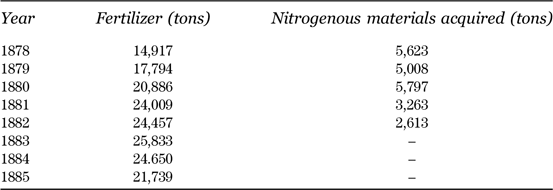
Even with this uncertainty and change, the Pacific Guano Company’s fertilizer production increased (Table 2), and the firm likely further reduced the proportion of fish in many of their blends as a result. By January 1882, the once 33.5 percent fish formula for New York and New England had been adjusted to their new meat-based fertilizer products. In a letter to an associate dated January 4, Crowell explained that the new 2,000-pound formula contained only 150 pounds of dried fish scrap but 300 pounds of meat, effectively reducing the proportion of fish scrap in the blend to just 7.5 percent.Footnote 95
Fertilizer Production in Woods Hole, 1878–1885
Source: Compiled from Volume 3: “Daybook, Woods Hole, January 1878–March 1883” and Volume 18: “Shipments, Receipts,” Mss. 621 1861–1889 (1912), Baker Library Special Collections, Harvard Business School, Records of the Pacific Guano Company and Associated Businesses.
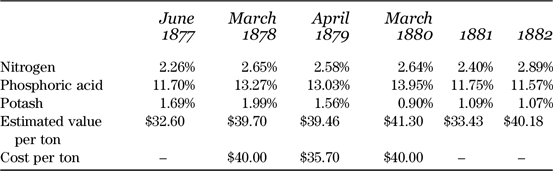
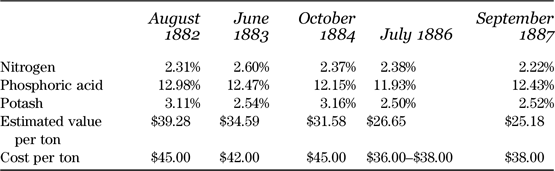
While the quantity of fish the firm received and used gradually diminished, the amount of nitrogen in their Soluble Pacific Guano remained remarkably consistent. Independent analyses performed by state chemists in North Carolina and Connecticut repeatedly demonstrated that the nitrogen in Soluble Pacific Guano remained between 2.2 percent and 2.9 percent of the fertilizing blend (Tables 3 and 4). According to these accounts, this percentage was always in line with or even exceeded the percentage of nitrogen listed on the fertilizer’s label.
Analyses of Soluble Pacific Guano in North Carolina, 1877–1882
Source: Data compiled from the Annual Reports of North Carolina Agricultural Experiment Station, 1878–1884 (Raleigh, NC, 1885).
Analyses of Soluble Pacific Guano in Connecticut, 1882–1887
Source: Data compiled from bulletins nos. 71, 72, 75, 81, 88, 89, and 92 of the Connecticut Agricultural Experiment Station, vols. 70–93 (1882–1887).
What is more notable about this consistency is that it occurred while the firm substantially reduced the amount of nitrogenous materials it was acquiring at its Woods Hole plant (see Table 2). Given the popularity of Soluble Pacific Guano, it is likely that the firm decided to keep the nutrient content of this fertilizer unchanged. Whether they achieved this through fish or through meat, however, is unclear, as these independent analyses did not require ingredient lists. The Pacific Guano Company ledgers end in March 1883, so how the firm compensated for the growing gap between nitrogen input and fertilizer output in the rest of their production is unknown. The company may have diminished the amount of nitrogen in other fertilizing blends, or it may have switched its production toward lower nitrogen blends in general. By 1886, the firm had introduced a product called Nobusque that had half the nitrogen of Soluble Pacific Guano, but the company records do not give any indications as to what motivated them to do so.Footnote 96
Internally, the firm’s procurement and formulations were shifting in dramatic ways, but externally the firm’s public image was largely unchanged. Throughout the 1880s, fish remained central to their brand and no mention of meat (or ground horn or damaged guano) was ever made in any of the public materials found in the firm’s papers, neither in advertisements nor in Crowell’s correspondence with customers. The company’s advertising does hint to the changing geography of the firm’s menhaden supply chain, but such references are subtle. In 1881, for example, company pamphlets no longer emphasized the importance of the fisheries surrounding Woods Hole but instead claimed that “our source of ammonia is from the menhaden fish taken upon the Eastern coast.”Footnote 97 The wording in the 1886 version of a similar pamphlet changed even further, stating:
Soluble Pacific Guano stimulates but maintains the soil, because with 3 per cent of Ammonia derived, like that of Peruvian Guano, mostly from fish, it contains also about 11 per cent of Phosphoric Acid, of which 6 1/2 per cent is Soluble and 3 per cent Potash.Footnote 98
By and large, however, these materials emphasized the fact that fish remained fish and it did not focus on where it came from.
Conclusion
The Pacific Guano Company went bankrupt in 1889. The exact reason for their insolvency is unknown, though some historians attribute it to financial mismanagement or even theft within the firm.Footnote 99 Contemporaneous commentators, however, speculated that the firm’s failure was a direct result of poor accounting combined with the exorbitant cost of shipping bird guano from the Pacific, further underscoring just how little the public understood the increasing complexity of nitrogen sourcing and fertilizer production.Footnote 100
Scholars of the rise of the industrial food system have centered much of their work on this knowledge gap, arguing that the increasing distance between producer and consumer created a space between the consumer and the natural world. In some instances, this distance enabled fraud; in most others it engendered ignorance. As William Cronon argued, forgetfulness was one of the primary byproducts of the growth of industrial food.Footnote 101 However, nineteenth-century consumers did not “forget” the changing role of nature in industrial fertilizer production because they never understood how nature was involved in the first place. This paper thus demonstrates that the Pacific Guano Company’s resilience hinged upon the fact that farmers now thought of nitrogen as separate from the environments that produced it and that the firm itself fostered broader public ignorance of how nitrogen is produced by keeping the changes to their fertilizer blends only within the company. The story of Pacific Guano Company’s adaptation is therefore embedded in and paralleled by a story of environmental erasure. It thus begs further reflection on the place of transparency and consumer awareness in firm resilience and successful instances of material resource recombination.
Dr. Rude is a postdoctoral researcher at the Centre d’Histoire at SciencesPo in Paris. Her work is supported by Fonds Latour.


 Open access

