




The Office of Compline, sung to plainchant adapted to English words, has become ‘firmly fixed in the Anglican tradition’.Footnote 1 Writing in 1993, David Hiley recorded that the Plainsong & Medieval Music Society’s An Order for Compline (1929) was the Society’s best-seller and that sales ‘long ago passed the 10,000’. According to the PMMS, ‘stability of form, text and chant’ contributed to its popularity.Footnote 2 In addition, as the text was drawn from the 1928 Book of Common Prayer, it was the first setting of a Compline service that enjoyed some measure of official sanction in the Church of England. And broadcasts on BBC radio from 1940 to 1994 in a series originally titled ‘Lighten our Darkness’ brought this setting to the attention of a wider audience and further contributed to its quasi-canonical status.Footnote 3
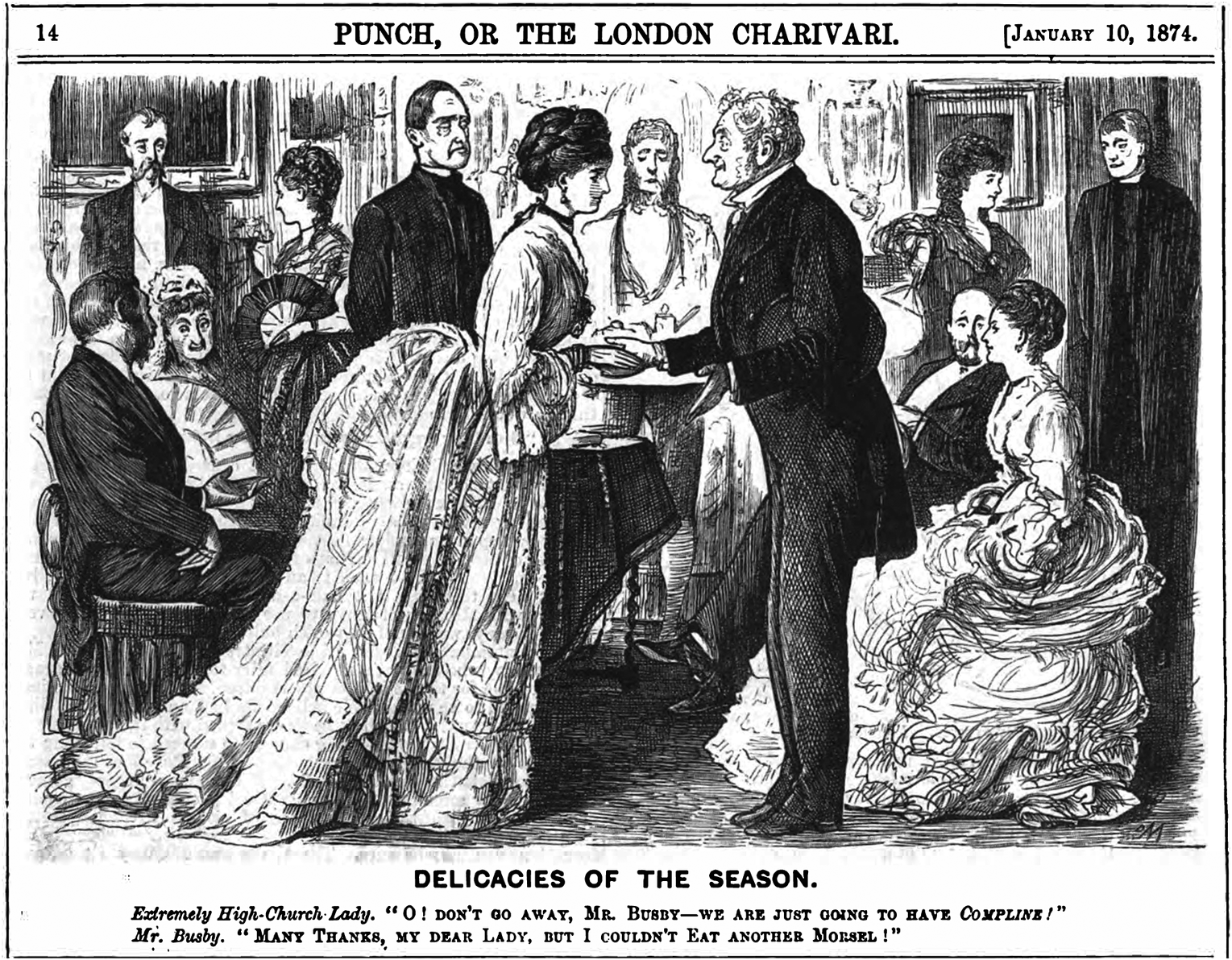
For all the present-day affection for sung Compline, the use of a devotion beyond the statutory provision of the 1662 Book of Common Prayer was once perceived as Anglo-Catholic obscurantism, as parodied in the 10 January 1874 issue of Punch (Figure 1). As an undergraduate in the 1840s, when Henry Liddon recited Compline in his rooms, fellow students would joke behind his back about the excessive number of candles he lit.Footnote 4 In later life, as vice-principal of Cuddesdon College, Liddon compiled a simple form of Compline for ordinands in his Hours of Prayer for Daily Use (1856).Footnote 5 Two years later, Samuel Wilberforce, as bishop of Oxford, established a commission of enquiry into allegations that the college was sowing ‘the seeds of Romish perversion in the counties of Oxfordshire, Berkshire and Buckinghamshire’ by practices which included devotions ‘concocted from the seven canonical hours of the Romish Church’. In the event, the commissioners commended the Cuddesdon prayer book as ‘highly valuable’, but nevertheless recommended rewriting because it was ‘cast in a form that bears an unfortunate resemblance to the Breviary of the Church of Rome’.Footnote 6 An anonymous polemicist rose to the College’s defence:
Truly ‘unfortunate’ it is that it was not so disguised and wrapped up as to suit the Protestant palate; the contents may be the same – that is not the question. Call your Antiphons ‘The Golden Treasury’, and your book itself, ‘Gospel Manna, or Crumbs of Comfort for Starving Souls’; date it Clapham instead of Cuddesdon, and let Seeley publish it, and in the ‘portfolio’ of the ‘record’ you may hope for a Protestant canonization.Footnote 7
Subterfuge was indeed the solution adopted in the revised Prayers in Use at Cuddesdon College. Here Compline was simply designated ‘Evening’ and antiphons were renamed ‘the text’.Footnote 8
Punch, 10 January 1874, 14.
This article will examine the transformation of Compline from the esoteric devotion of Tractarian clergy to a musical ‘fixture’ in the English choral repertoire. It will analyse six musical settings produced for use in the Church of England from the beginning of the Oxford Movement, customarily dated to John Keble’s 1833 Assize Sermon, to the 1929 edition of the Plainsong & Medieval Music Society. This was a period in which English liturgical music flourished. Choral foundations were reformed and new parish choirs aspired to the standards of the revitalised cathedrals.Footnote 9 Plainchant assumed a central place in the repertoire. Indefatigable ambassadors for the cause, Thomas and Frederick Helmore toured the country to form choirs and teach simple plainsong psalm-tones for Prayer Book liturgy. The 1861 issue of The Ecclesiologist named this eruption of interest among scholars and performers a ‘Plain Song revival’.Footnote 10
To analyse the English Compline settings in the light of the developing understanding and performance of chant, this study will focus on two antiphons: Miserere mihi Domine et exaudi orationem meam (‘Have mercy upon me, O Lord, and hear my prayer’, Psalm 4:2) is the usual antiphon for the Compline psalms; and Salva nos Domine vigilantes, custodi nos dormientes, ut vigilemus in Christo et requiescamus in pace (‘Save us, O Lord, while waking, and guard us while sleeping, that we may keep watch in Christ and rest in peace’) is used through the greater part of the year where, according to ‘secular’ (non-monastic) use, the Nunc Dimittis (Luke 2:29–32) is recited.Footnote 11 As will be shown, the first settings of Compline were dependent on limited information culled from generalist musicological treatises or manuscript antiphonaries that happened to be locally available to the editors. But new editions, performance practices championed by the monks of Solesmes, and the publication of selected manuscripts in edited facsimiles transformed successive settings of Compline, whose editors pursued the conflicting aims of establishing ‘authentic’ readings and rhythmic performances of chants that they nevertheless completely rewrote to substitute English words for the Latin. It is hoped that examining their sources and approaches will shed new light on developing scholarship of medieval chant in England in the nineteenth and early twentieth centuries, increase knowledge of associated organisations and, as some of these settings remain in current use, illuminate how sung Compline became a staple of the English choral repertoire.
Early nineteenth-century settings of Compline: Albany Christie’s Day Hours and John Chambers’s Psalter
Throughout the period under consideration, the statutory Church of England evening service remained Evensong according to the 1662 Book of Common Prayer, altered only by the abbreviations permitted in 1872.Footnote 12 Evensong incorporates elements of the pre-Reformation service of Compline, including the Nunc Dimittis and the collect Illumina, quaesumus, Domine, tenebras nostras (‘Lighten our darkness, we beseech thee, O Lord’).Footnote 13 But private use of an independent office of Compline never quite died out. Forms were included in the Primers authorised by Henry VIII in 1545 and Elizabeth I in 1559–60.Footnote 14 The latter was used by Bishop Cosin to compile A Collection of Private Devotions, which ran to twelve editions between 1627 and 1719.Footnote 15 Another enduring form was edited from John Austin’s Devotions in the Ancient Way of Offices (1668) by Susanna Hopton and published by George Hickes; eight editions were issued between 1700 and 1765.Footnote 16 The 1761 prayer book authorised by the nonjuring bishop William Cartwright also included Compline; Cartwright’s handwritten instructions and as-yet undeciphered musical notation at the beginning of a British Library copy attest to a practice of singing the offices.Footnote 17
In the nineteenth century, a number of clergy influenced by the ideals of the Oxford Movement created new forms.Footnote 18 For instance, though John Henry Newman advocated public observance of Prayer Book Matins and Evensong, he indicated that the canonical hours of the Roman Breviary might nevertheless inform the ‘character and matter for our private devotions, over and above what our Reformers have thought fit to adopt into our public services’. Newman himself published an English translation of Compline in the seventy-fifth of the Tracts for the Times in 1836, and he contributed his translation of the office hymn Te lucis ante terminum (‘Now that the day-light dies away’) to the Roman Breviary translation project of Samuel Wood and Robert Williams.Footnote 19
In the 1840s and 1850s, only a limited repertoire of music was available for Breviary services in English. Texts might be sung to a monotone, or elements of the liturgy could be assembled piecemeal from psalters and hymnals, including Helmore’s Psalter Noted (1849) and Helmore and Neale’s Hymnal Noted (1851, 1854).Footnote 20 But several complete settings of Compline were published during this period. The earliest I have identified are in The Day Hours of the Church by Albany Christie (1844) and The Psalter, or Seven Ordinary Hours of Prayer by John Chambers (1852).
Albany Christie (1817–91), a fellow of Oriel College, Oxford, was an associate of Newman and stayed with him at The College in Littlemore in 1842. There the community recited the Roman Breviary; Compline was usually said in Latin, though English was sometimes used when guests were present.Footnote 21 Newman was himself an accomplished musician. His knowledge of plainchant psalm-tones is shown by his account of procuring a copy of the ‘Gregorian tones’ while travelling in Rome in 1833.Footnote 22 In his 1840 correspondence with John Bloxam, who had served as Newman’s curate, he related his plans to teach children in the Parish to ‘chant’ services in Church:
What do you think of the idea of having them to practise one evening of the week in Church? putting on my surplice and giving the blessing at the end to keep them from irreverence, and thus in fact (though it must not be said) having a sort of Breviary Service of Psalms.Footnote 23
Just such ‘breviary services of psalms’ could be sung using Christie’s Day Hours.
Though this book is designated as the first part of an intended multi-volume set, it is the only one that was published. It contains ‘the ordinary offices through the year’, including Lauds, Prime, Terce, Sext, None, Vespers and Compline for each day of the week. Translations of psalms, canticles and readings are from the Prayer Book and the King James Bible. Music is printed for the opening responses of the offices, the psalms and canticles, and the hymns.
The complete list of psalm-tones in the preface indicates some of Christie’s musical sources, including settings of Catholic liturgy printed by Novello. Christie also reproduced tones that he found in early modern treatises on music, including Franchinus Gaffurius’s Practica Musicae (1491). The copy he consulted in the Bodleian Library was apparently so damaged that he had to supplement missing information by referring to John Hawkins’s General History of the Science and Practice of Music (1776).Footnote 24
It is striking that Christie did not consult antiphonaries, seemingly obvious sources of music for the liturgical texts he wished to set. The reason perhaps lies in the difficulty in accessing the necessary books. While precious few copies of the printed Sarum Antiphonary (1519–20) survived in public collections, the widespread scarcity of chant books for contemporary Catholic services was remedied only by the publication of the Mechlin Gradual and Vesperal four years later in 1848.Footnote 25 Christie therefore resorted to books on music theory and history in his university library. Reading these in isolation from complete sources of information about singing the Daily Office occasionally led to misunderstandings. For instance, Pietro Cerone’s 1613 treatise El Melopeo y Maestro attributes certain responsories to the sixth tone (‘Sexto Tono’). On this basis, Christie erroneously claimed that responsories are sung to the sixth psalm-tone. Had he been able to consult an antiphonary or to hear a sung recitation, he would have realised that, while the melodies of some responsories may be ascribed to the sixth mode, they are not psalm-tones.Footnote 26
Christie provided only limited music for Compline. Psalms 4, 31, 91 and 134 are printed with the text of the Miserere (translated ‘Have mercy upon me, O Lord, and hearken unto my prayer’), and the Nunc Dimittis with the Salva nos (‘Save us, O Lord, when we are awake, guard us when we are asleep, that we may be with Christ when we awake, and may rest in peace’).Footnote 27 As no music is supplied for any antiphons in the volume, nor is any direction given regarding their performance, users must decide for themselves whether to read them as unsung texts, recite them to a monotone, or omit them entirely. A psalm-tone in modern notation, labelled ‘tone 2’, is supplied for all the psalmody and the Nunc Dimittis, and the texts are pointed for recitation.Footnote 28 As only one hymn tune is printed in Christie’s book, Newman’s translation of Te lucis ante terminum is sung in the same way as every other hymn. The result is a repetitive and unvaried musical setting that makes excessive use of a single psalm-tone and an overly familiar hymn tune.
Among those who sang Christie’s Day Hours were the sisters of the Community of S. Mary the Virgin, Wantage, who used the book from 1844. The annotations and emendations in surviving copies in the Convent archives show how some of the book’s limitations were overcome in practice. Hymn translations by John Mason Neale from The Hymnal Noted were pasted over versions that Christie printed. This allowed the community to use Christie’s book without being restricted by the limited provision of hymnody. Several changes were also made by hand to the antiphons. Ann Norton suggested that these were based on the musical settings in John Chambers’s Psalter, the extensive repertory of liturgical chant in English discussed later. Thus, by supplementing Christie’s book with hymns and antiphons from other sources, its limitations were overcome. The sisters continued to use the book even after more extensive sources of music for the canonical hours had been published in English; they abandoned it only in 1858 when, along with many other religious communities, they adopted The Day Hours of the Church of England. Footnote 29
Christie’s older contemporary, John Chambers (1805–93), was one of the foremost members of the Ecclesiological (Cambridge Camden) Society, the learned organisation devoted to studying liturgy and Church architecture.Footnote 30 In the preface to his Divine Worship in England in the XIII. XIV. and XIX. Centuries he wrote:
The purpose which the author has had in view in this work is … to discover, set forth, and fix such a correct and reverential standard of Ritual and Ceremonial in Public Worship and in the Celebration of the Holy Eucharist, as shall serve for a pattern to those who are now labouring to restore to the services of the Church somewhat of their pristine dignity, beauty, propriety, solemnity, significance, and devoutness.Footnote 31
Chambers’s study of pre-Reformation liturgy thus had the practical goal of prompting and informing a ‘restoration’ of Church of England worship according to the practices he brought to light.
Chambers was a member of the Ecclesiologists’ musical committee. His principal contribution to knowledge of medieval liturgical music was The Psalter, or Seven Ordinary Hours of Prayer According to the Use of the Illustrious and Excellent Church of Sarum (1852). The title page specifies that the services were ‘for private, or coenobial use’, showing that monastic communities were among the intended audience. Translations of Matins, Lauds, Prime, Terce, Sext, None, Vespers, and Compline, as well as devotions including the Litany of the Saints and Vigils of the Dead, were based not on the Prayer Book Psalter and the King James Bible, but rather on the Catholic Douay-Rheims version.Footnote 32
Although Chambers provided the music for certain services to be sung complete, numerous essential settings were omitted. For instance, the service for Sunday Vespers contains Magnificat antiphons for only five Sundays of the year (the Second Sunday of Advent, the First Sunday of Lent, Easter Day, Pentecost and Trinity Sunday). It would therefore be impossible to use this office on a weekly basis.Footnote 33
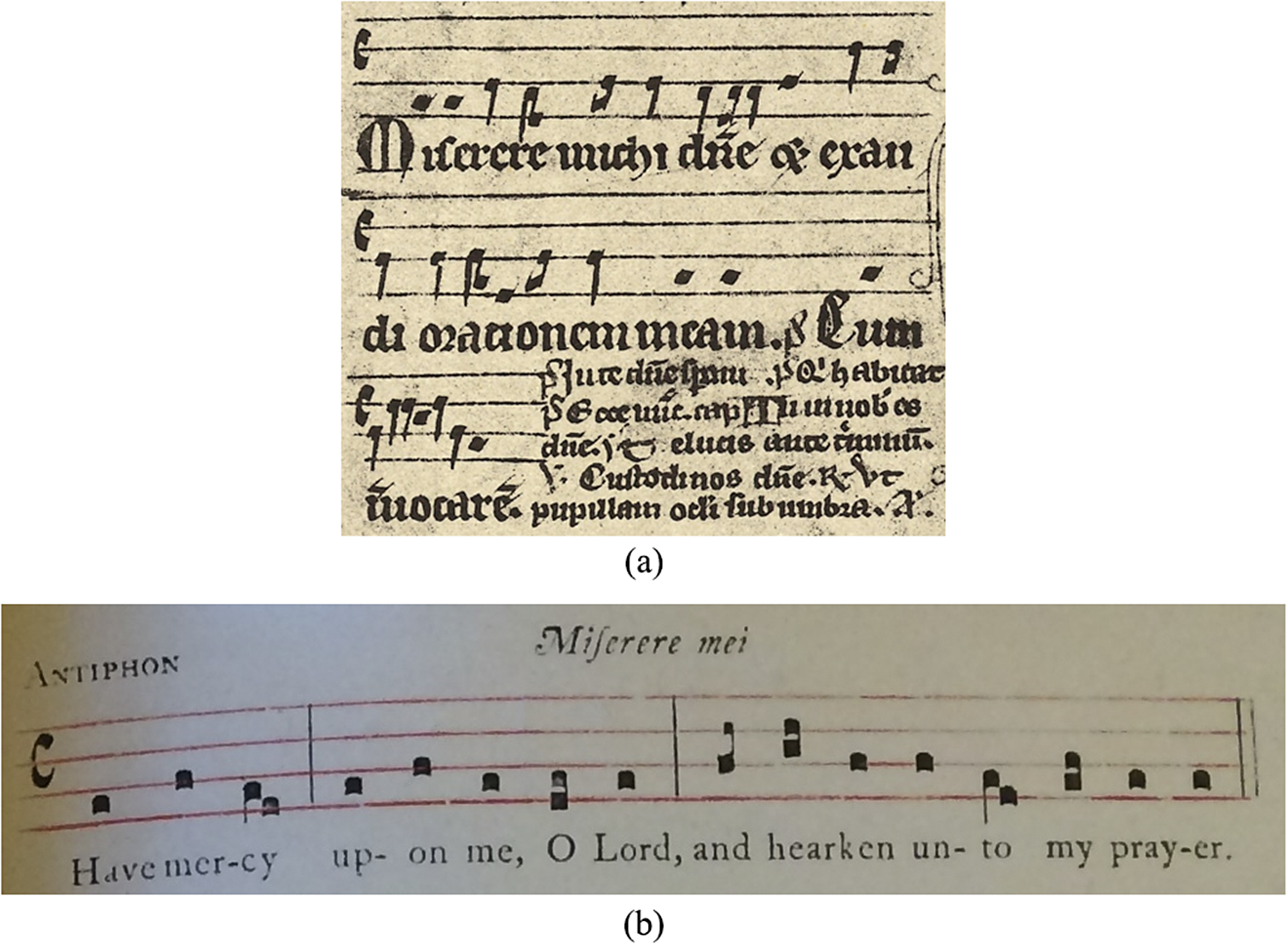
Chambers identified his principal sources of music in the preface: the antiphonal Salisbury Cathedral MS 152 (dated to c.1460), the noted breviary British Library, Lansdowne, 463 (mid-fifteenth century), and the ordinal British Library, Arundel, 130 (1446–61).Footnote 34 Chambers did not explain the editorial principles that guided him in setting English texts to chant melodies, but some can be deduced by examining the music for Compline. Following his sources, Chambers included twenty-two distinct offices for the different seasons and holy days. Miserere is presented in ‘Compline I’, which contains the full service together with the proper texts for Advent. Salva nos is in Compline VI, for use between Epiphany and Lent. A comparison of these chants and their Latin sources shows that Chambers replicated the original melodies as closely as possible in the English versions.
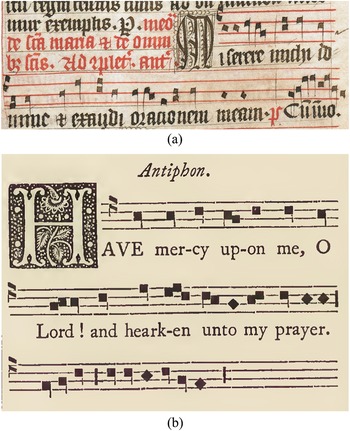
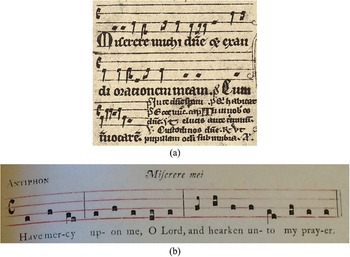
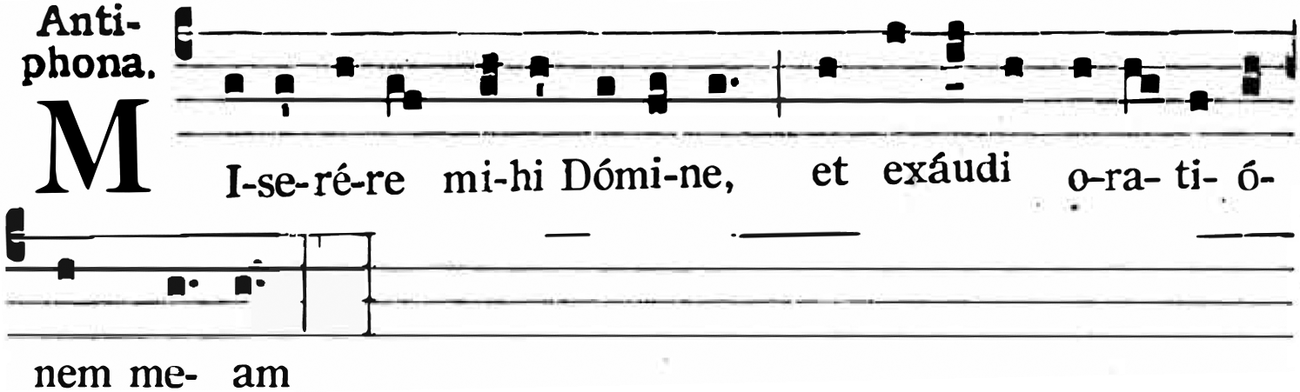
Though Miserere and Salva nos are found in both the Salisbury and the Lansdowne manuscripts, a comparison shows that Chambers referred to the latter. The Latin and English versions of Miserere are shown in Figure 2.
(a) From the British Library Collection: Lansdowne, 463, fol. 28v. (b) Chambers, The Psalter, 355.
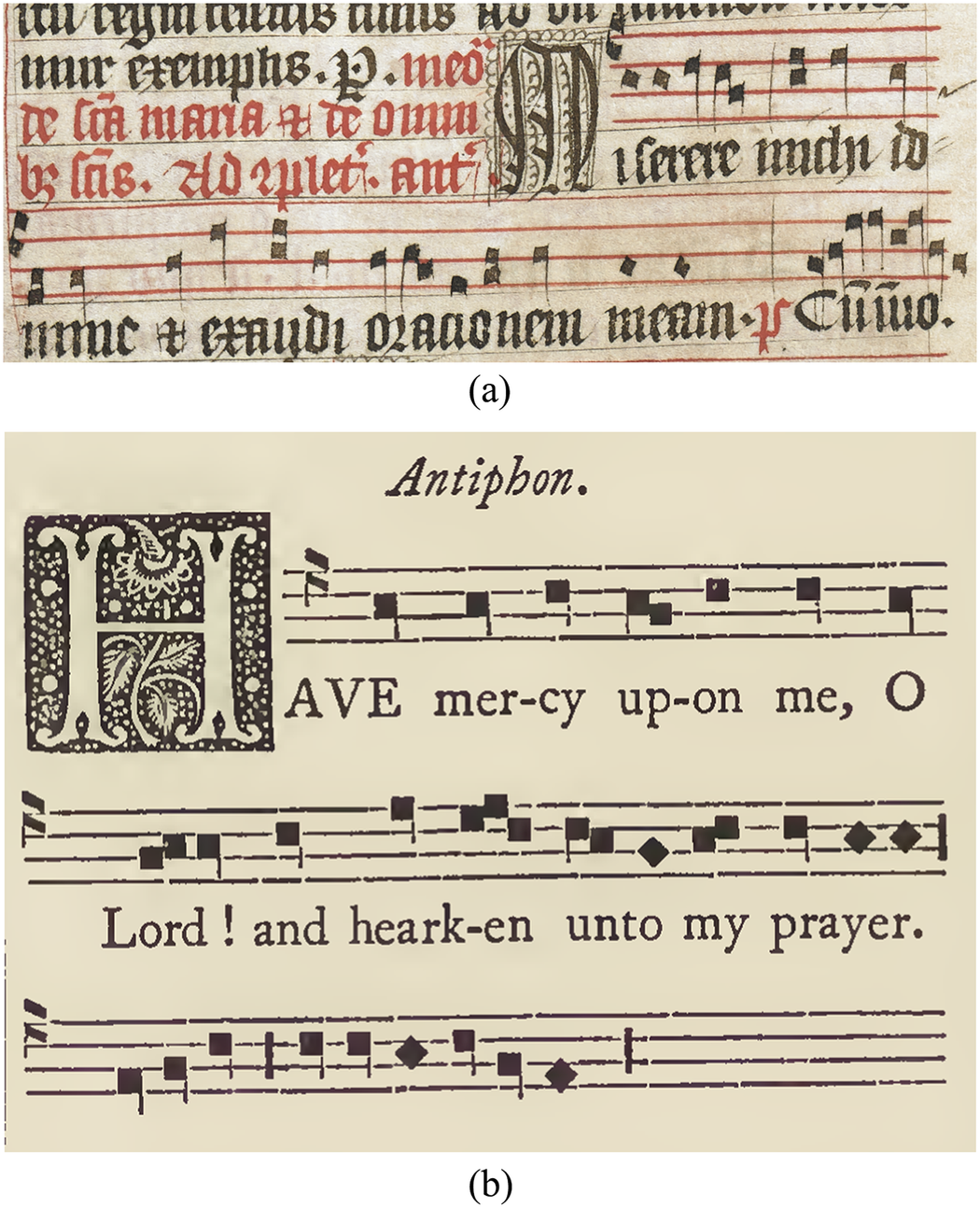
Chambers generally reproduced the source melody closely, without adapting it to reflect different accentual patterns in the English. For instance, in the manuscript, the accented penultimate syllable of the word ‘miserere’ is sung to a higher tone (A) than the two preceding syllables (on G). In the English, this ‘tonic accent’Footnote 35 might have been placed on the accented penultimate syllable of the word ‘mercy’. But Chambers refrained from changing the melody, preferring to replicate the sequence G–G–A regardless of the textual accentuation.
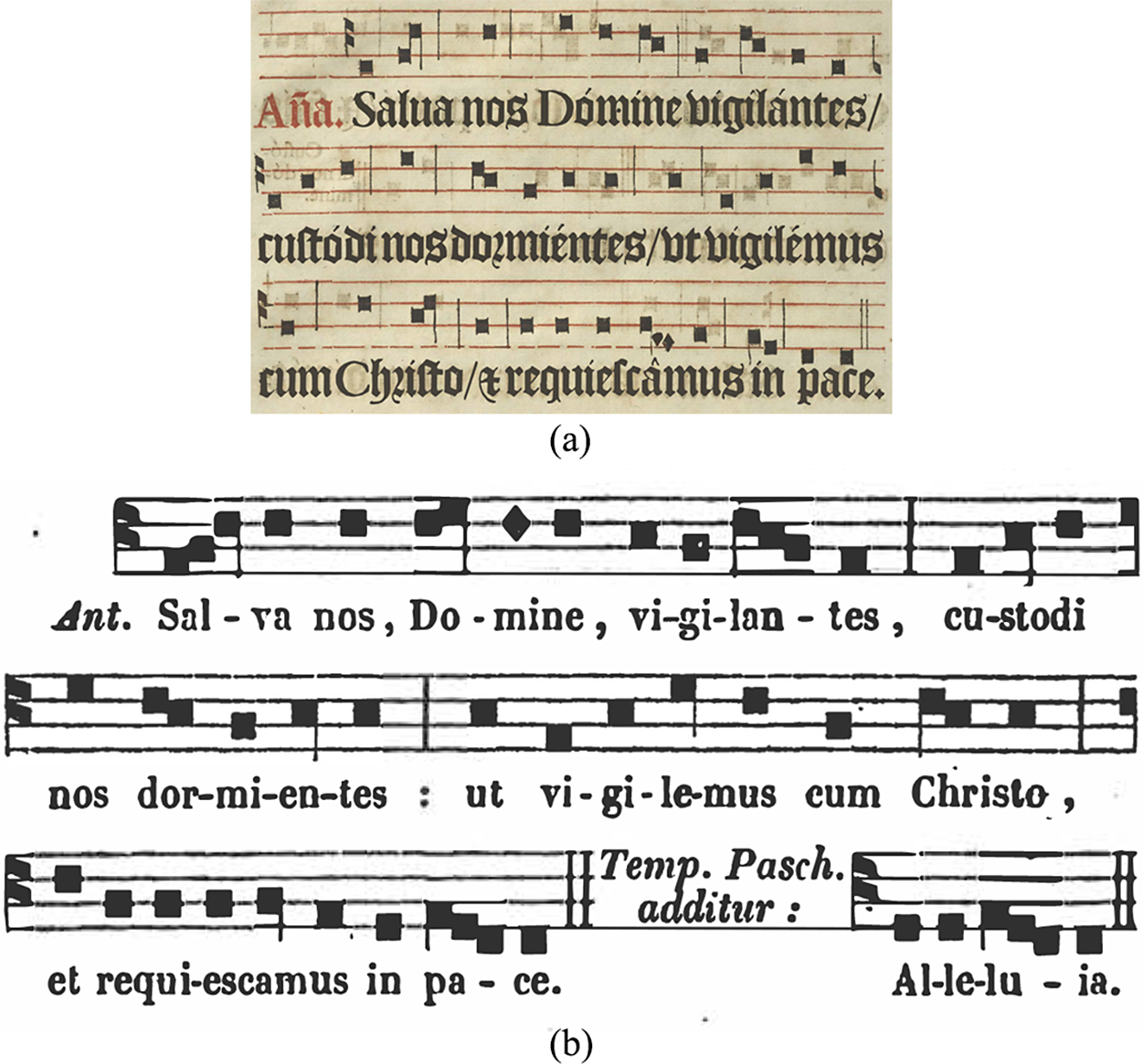
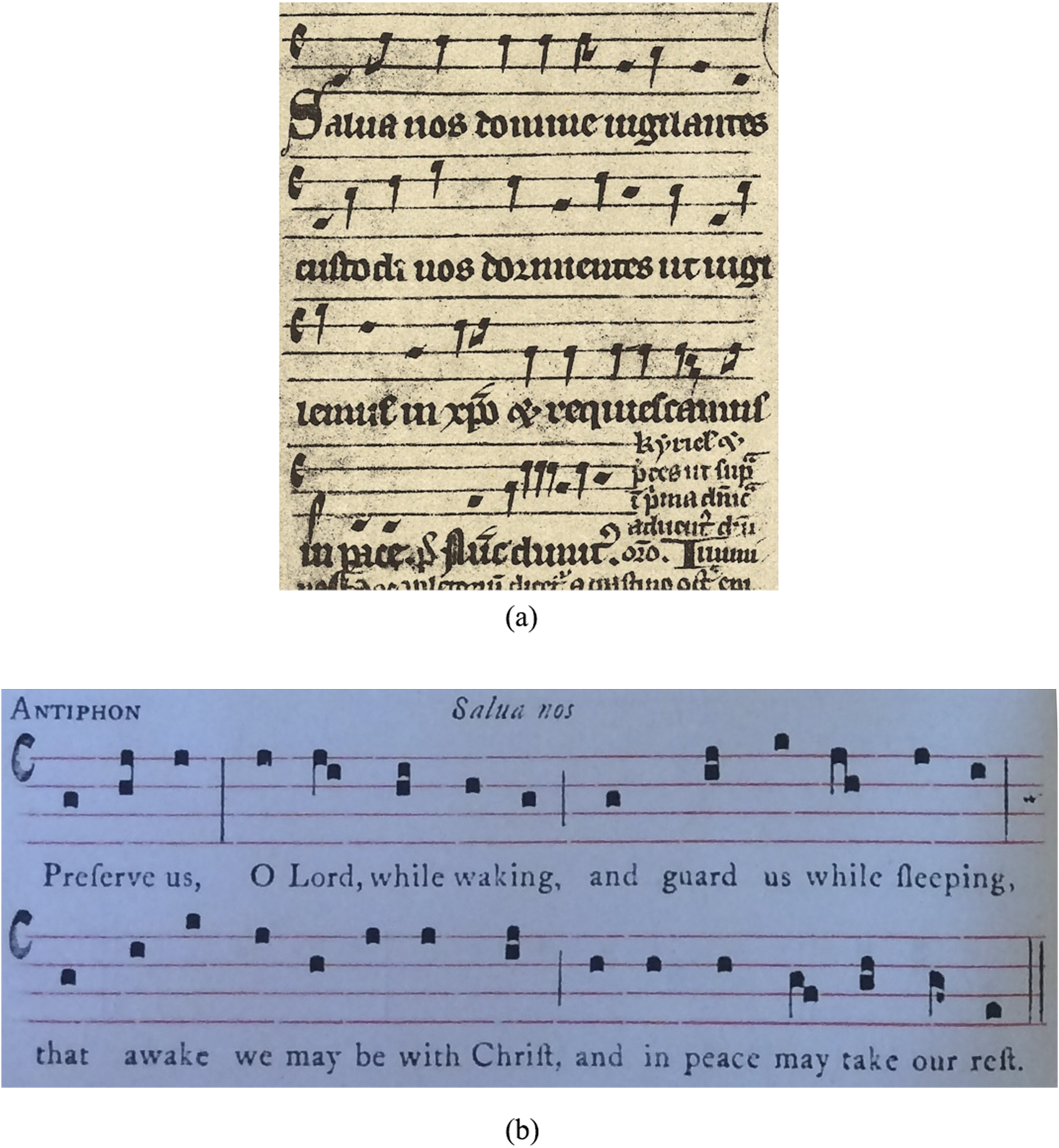
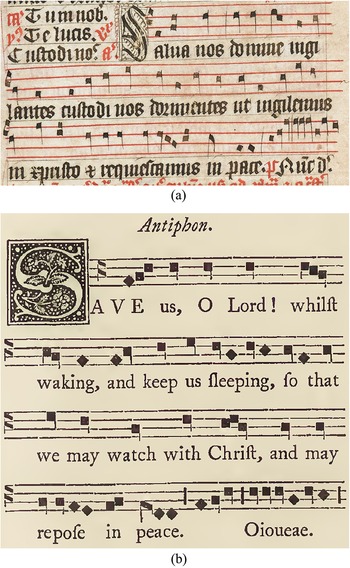
Transcription errors make it difficult to use Chambers’s setting in practice. In the case of Miserere, the psalm-tone has been notated a third lower than it should be. An error in notation is also found in Chambers’s Salva nos (Figure 3). In the manuscript source, the penultimate word ‘in’ (of ‘in pace’) is sung to a cephalicus (liquescent clivis), the liquescence being due to the final ‘n’ followed by another consonant.Footnote 36 Even though there is no consonant cluster at the equivalent point in the English antiphon, Chambers nevertheless used the same liquescent neume to set the word ‘peace’. This transcription also contravenes the principles that only the last note of a neumatic group may liquesce and that liquescence is not found on the final syllable of a chant.Footnote 37
(a) From the British Library Collection: Lansdowne, 463, fol. 28v. (b) Chambers, The Psalter, 363.
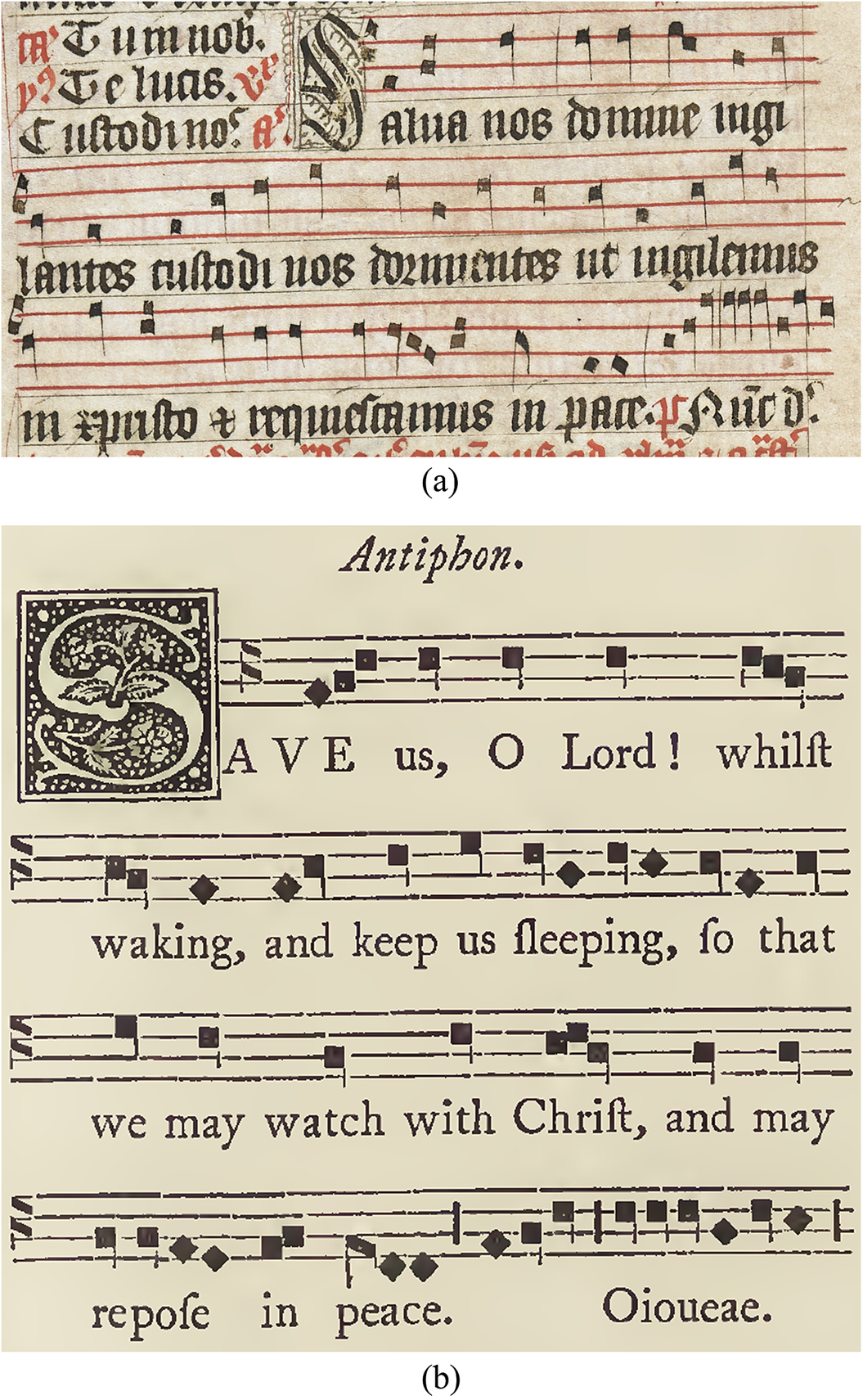
The anomaly shows Chambers’s limited understanding of liquescence. Many of the sources cited in Dom Mocquereau’s seminal ‘Neumes-accents liquescents ou semi-vocaux’Footnote 38 were written by German, French and Belgian contemporaries of Chambers and published only after he had completed his Psalter. Although Chambers could have made use of Guido of Arezzo’s description as printed in the second volume of Martin Gerbert’s Scriptores ecclesiastici de musica sacra,Footnote 39 he was evidently either unaware of this text or of its significance for his project.
Chambers’s Psalter never achieved widespread use.Footnote 40 One reason is that the beautiful imitation of decorated source manuscripts – with illuminated initials, generous margins, and copperplate and woodcut images – came at a prohibitive cost to potential buyers. In a list of titles printed by J. Masters from 1856, the book was priced at 36 shillings, a different ballpark to Helmore’s Psalter Noted which was a mere 2s 6d.Footnote 41 Further reasons are suggested by the anonymous review in The Ecclesiologist. The inclusion of medieval Catholic liturgy and Douay-Rheims translations led the author to ask ‘whether any Bishop can authorise, or permit, the coenobial use of a version that contains these litanies, and which deserts the Prayer Book version?’ The reviewer also noted a difficulty arising from the typography: ‘We have looked in vain in this volume for any explanation of the flag-like musical note so freely employed.’Footnote 42 The unexplained replication of liquescence from Chambers’s sources thus served to confuse rather than inform users of the Psalter.
Christie’s Day Hours and Chambers’s Psalter reveal the difficulties faced by the editors of early English settings of Compline in acquiring and understanding plainchant melodies and their sources. While Christie struggled to derive information about singing the canonical hours from tattered early modern treatises on music theory, Chambers’s replication of signs he did not fully understand led him to publish settings that were difficult or impossible to sing. The Wantage sisters used these settings only through makeshift combinations that allowed them to construct fuller choral offices.
Charles Walker and The Plain-Song Reason Why
The Rev’d Charles Walker wrote The Plain-Song Reason Why (1875) as an introduction both to singing plainchant and to setting English words to chant melodies. He justified this creative programme of study in the preface:
The Church has Psalters enough to spare. It wants an Antiphonarium and a Gradual – a book that shall provide for every want, giving not only the psalms and canticles for the choir-office, but the antiphons and hymns throughout the year.Footnote 43
In the absence of an English antiphonary or gradual, Walker advocated a DIY approach by providing tools to adapt chants for English liturgy. He also guided by example. The appendix contains a musical setting of ComplineFootnote 44 based primarily on the Mechlin Vesperal, then in common use among Catholic choirs in England.Footnote 45 Examining Walker’s adaptation shows how he put advice on adapting plainchant melodies into practice and thereby helped to fill the perceived lack of musical settings of English liturgy.
Charles Walker served as Curate at St Michael’s Church in Brighton, a centre of Anglo-Catholic worship.Footnote 46 He wrote several liturgical books, including the popular manual of High Church ceremonies titled The Ritual Reason Why (1866).Footnote 47 As shown by its title, The Plain-Song Reason Why is a sequel about music for Anglo-Catholic services. The author was well read in the scholarship then available. His account of contemporary efforts to accord liturgical chant ‘its rightful pre-eminence and primitive purity’ includes a critical evaluation of the Mechlin Gradual and Vesperal (both 1848), whose editors ‘introduced a considerable number of reforms into the text, some of them sound, and some of them more or less arbitrary’. Walker was also familiar with the 1871 Gradual published at Regensburg by Franz Xaver Haberl, a leader of the Cecilian Movement, and the printer Friedrich Pustet. He noted that the latter was ‘just about to issue the Vesperale’ and predicted that, given Papal support for his editions, they would ‘sooner or later (unless something very unforeseen occurs), swallow up all others’. This showed remarkable foresight: only after decades of research and lobbying would the Benedictine monks of Solesmes succeed in supplanting Pustet’s editions with their own.Footnote 48
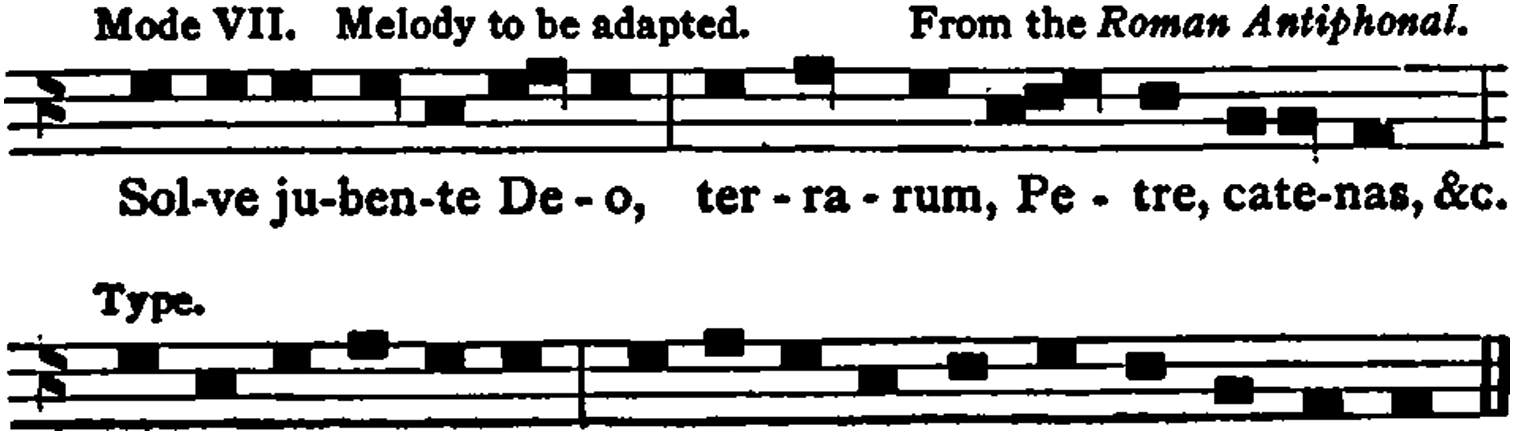
Walker’s instructions on setting English texts to plainchant melodies are presented in the chapter titled ‘Hints on analysis, adaptation, composition, harmonization, and transposition’. The reader is told to examine a Latin chant and to ‘reduce’ its melody ‘to its simplest terms, by the omission of repeated and accessory notes’.Footnote 49 An example of such ‘reduction’ is shown in Figure 4.
Walker, Plain-Song, 129.
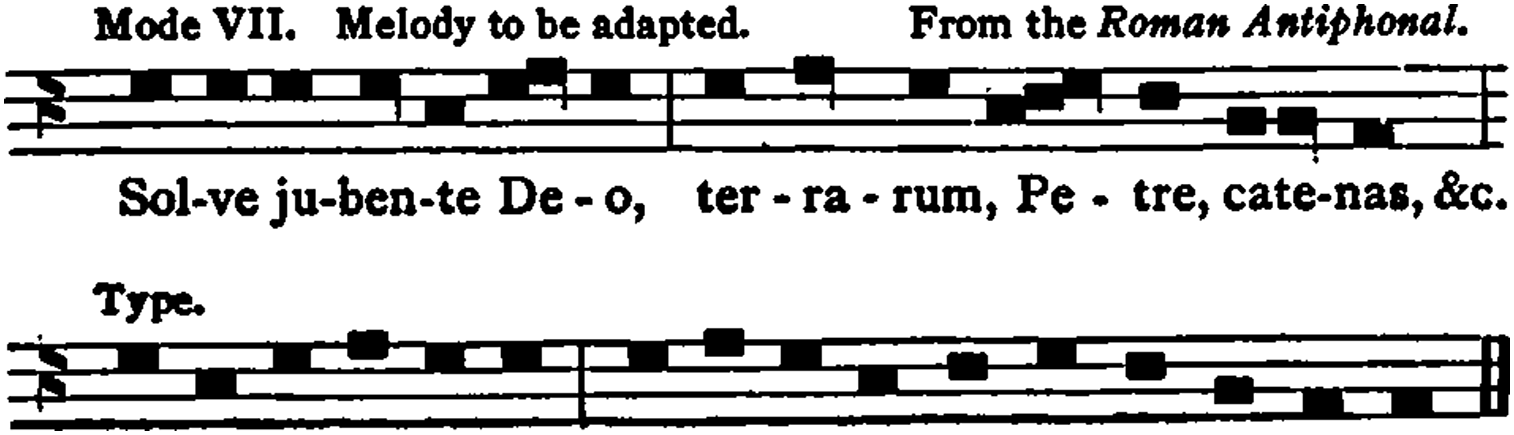
According to Walker, the resulting ‘fundamental melody’ or ‘type’ may now be adapted to new texts. Providing that notes originally sung to accented syllables coincide with accented syllables in the English, the melody can freely be lengthened through the repetition of tones or shortened by singing several notes as a melisma. With regard to the latter technique, Walker advised, ‘Where it is necessary to slur notes … this should be done on an accented rather than an unaccented syllable’.Footnote 50
Walker put these principles into practice in his ‘Office of Compline Noted’. After the opening responses and Psalms 4, 31, 91 and 134, John Mason Neale’s translation of Te lucis ante terminum (‘Before the ending of the day’) is provided with several melodies for different liturgical seasons and festivals. Following the Nunc Dimittis and concluding responses, Walker indicated that a ‘Commemoration of Our Lady’ may be recited, and the service includes the Ave Maria. Though much is adapted from the Mechlin Vesperal, Walker also cited an unnamed Sarum source. In his Plain Suggestions for a Ceremonial after Sarum Use, he reported the preference of some clergy for ‘rites which are of home growth, rather than … an adaptation of the ritual system of a foreign (albeit a sister) communion’.Footnote 51 In the Office of Compline, therefore, Walker sought to please everyone by translating contemporary Catholic as well as medieval English sources. Texts and music drawn from the former are labelled ‘Rome’; the latter are designated ‘Sarum’.
Walker’s Miserere and Salva nos were among those adapted from Mechlin chants. To understand the finished product, it is necessary to go back yet one step further in the chants’ history, and to examine the sources of the Mechlin Vesperal itself. A comparison of those listed in the prefaceFootnote 52 shows that the Mechlin Miserere and Salva nos were adapted from the versions published by Plantin in Antwerp in 1571. However, as Walker noted, the Mechlin editors ‘corrected’ their sources (‘cum cantu emendato’ is printed on the title-page). According to the preface, this involved the ‘restoration’ of the hymns and antiphons through the elimination of certain melismas:
We have made every effort that individual syllables, which in the old-fashioned style were loaded down as if by a mass of useless notes (as was stated above), should flow as easily as possible in our version, being pronounced no differently in song as in conversation.Footnote 53
A comparison of the Antwerp 1571 and Mechlin 1848 editions of the first word of the antiphon Salva nos illustrates the revision process (Figure 5). In the former, the accented syllable Sal– is sung to a punctum (G) and the unaccented –va to a podatus (A–C). But the Mechlin editors, in order to relieve the unaccented syllable from bearing a melisma, directed that Sal– be sung to three tones (G–A–C) and –va only to one (C).
(a) Psalterium (Antwerp: Plantin, 1571), 462. Reproduced by permission of the University Library of Munich; shelfmark: University Library LMU Munich, 2 Liturg., 135. (b) Vesperale Romanum (Mechlin), lii.
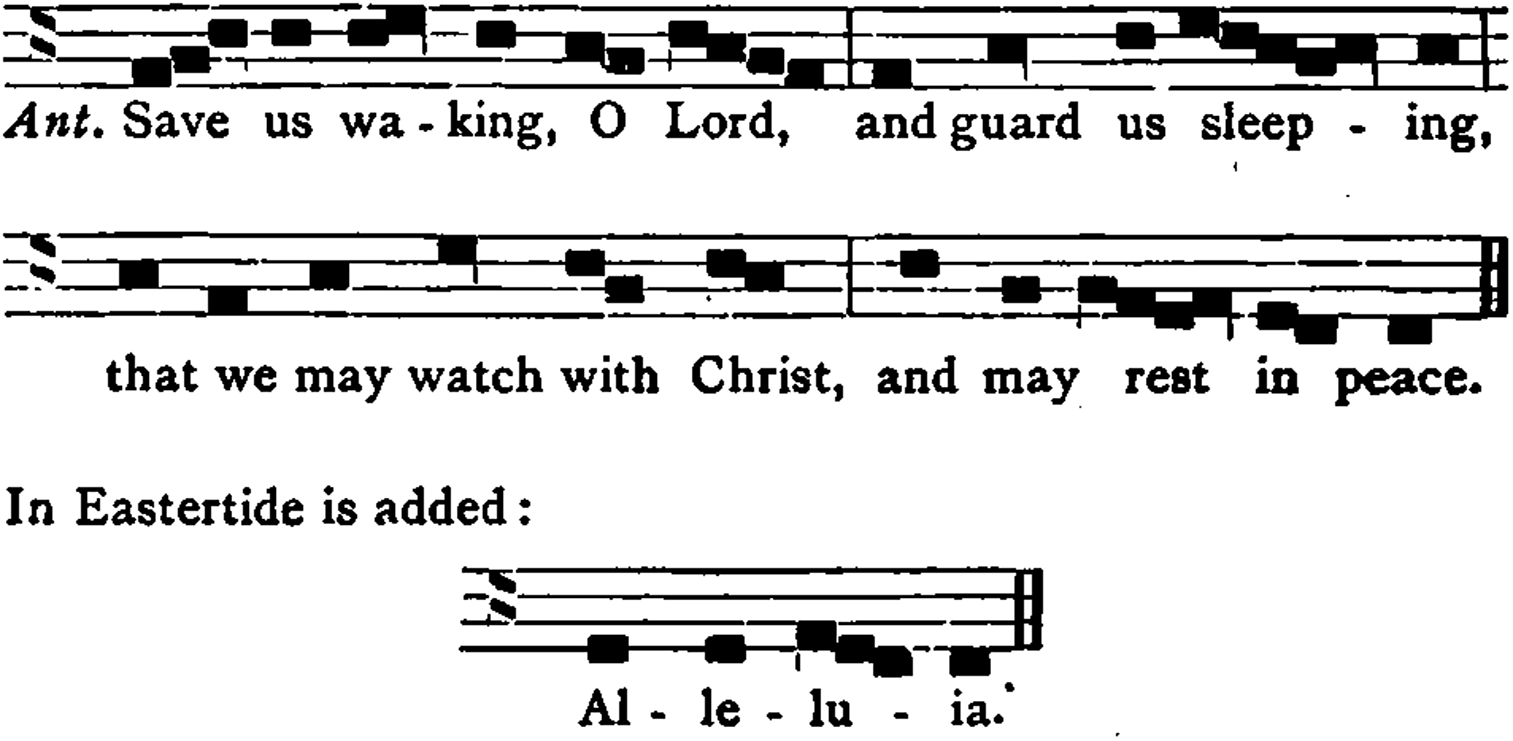
As we have seen, Walker’s own approach to setting English words to plainchant favoured placing melismas on accented syllables. He thus exaggerated a tendency already present in his source. For instance, Walker’s setting of the first word of Salva nos (‘Save’; see Figure 6) bears the melisma (G–A–C), just like the Mechlin edition. But the words ‘Lord’ and ‘rest’ bear four-note melismas, and the first syllable of ‘sleeping’ is sung to five tones. The resulting florid melody is quite unlike the sources on which it is based.
Walker, Plain-Song, 186.
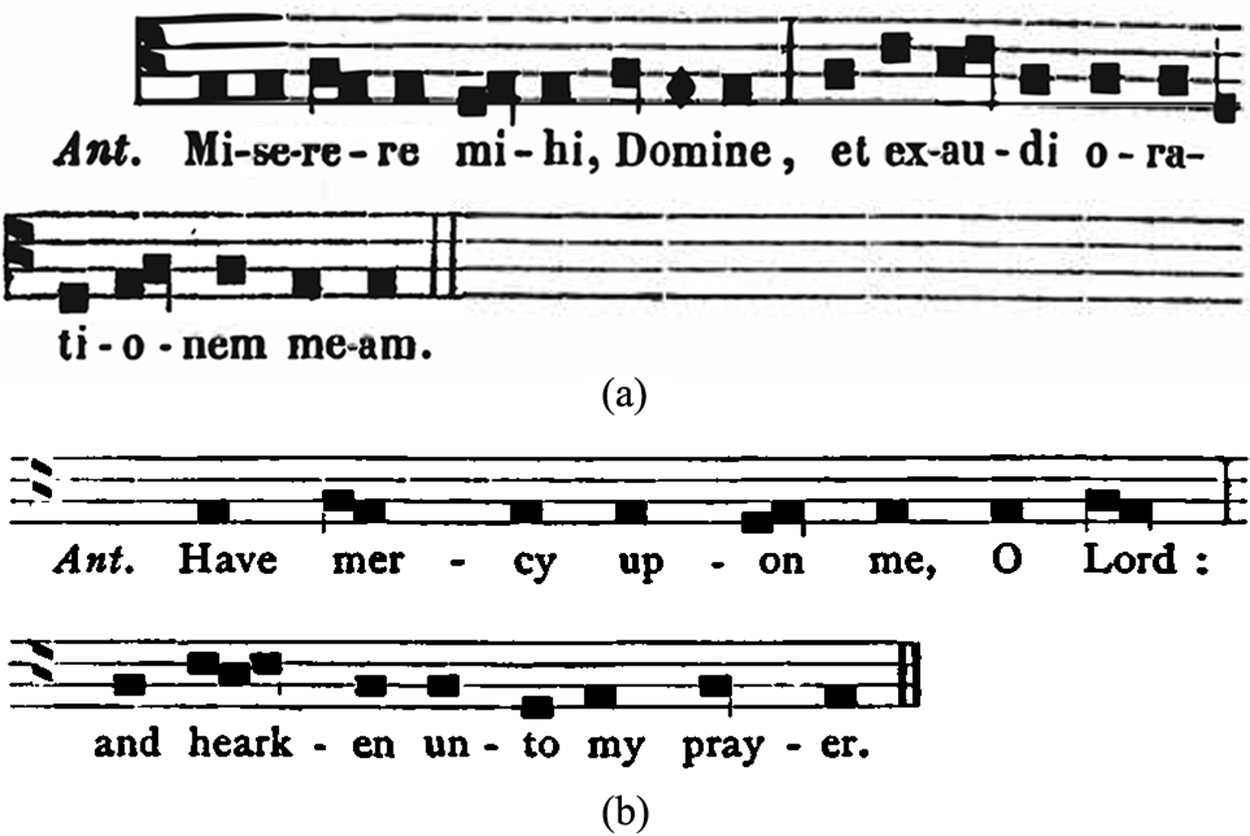
Walker’s Miserere demonstrates his method of expanding and contracting parts of the chant. Every pitch in the Mechlin chant is represented (Figure 7). But the three syllables of ‘Have mercy’ are set to the music for the four syllables of ‘Miserere’ by omitting a repeated note (G) and by ensuring that the melisma falls on an accented syllable in the English. The result may be contrasted to Chambers’s setting, discussed earlier. While Chambers tended to reproduce the melody of his source, regardless of English accentuation, Walker produced a melody intended to fit the accentuation of the English words in the same way as it did the Latin.
(a) Vesperale Romanum (Mechlin), xlix. (b) Walker, Plain-Song, 182.
A further difference between the publications of Chamber and Walker is that Walker issued settings of Compline as pamphlets. Unfortunately, a diligent search has uncovered no surviving copies. But according to an 1876 advertisement in The Musical Times and the 1889 Catalogue of the Guildhall Library of the City of London, Novello printed two editions of ‘The Order of Compline Noted’. The first was ‘The Roman Order’. Based on the Mechlin Vesperal and printed in duodecimo, it was priced at 3 pence. The second was ‘the same, with the Sarum Order in addition’, priced at 6 pence.Footnote 54 These inexpensive pamphlets would save choirs and congregations the expense of buying Chambers’s costly Psalter to sing the office.
Walker’s access to information and sources of plainchant was of a different order to that of his predecessors. Rather than depending on information in generalist musicological treatises or on an independent study of a limited corpus of manuscripts, he had access to the new Mechlin editions, informed himself of their editorial principles, and maintained an up-to-date knowledge of chant publications. In limiting melismas to accented syllables, he reapplied a principle that underlay the Mechlin editors’ own ‘corrections’. Though this avoided the Scylla of replicating the source melody without regard for the accentuation of the English text, it fell foul of the Charybdis of overloading accented syllables with excessive melismas that were not in the sources.
The Community of S. Mary the Virgin and the edition of Palmer and Frere
The Community of S. Mary the Virgin originated in the efforts of William Butler, Vicar of the Parish of Wantage on the outskirts of Oxford, to establish a sisterhood to run a village school. The first sisters arrived in 1848. They observed the offices of Lauds, Prime, Sext, None and Compline, with Matins and Evensong being said in the parish church.Footnote 55 As noted earlier, the sisters initially used Christie’s Day Hours until, from 1858, they adopted The Day Hours of the Church of England. In the absence of musical settings tailored specifically for the latter, the sisters used Helmore and Neale’s Psalter Noted and Hymnal Noted alongside until at least 1883.Footnote 56
The musical life of the sisterhood developed during the course of the nineteenth century. While, in 1866, members of the parish choir were drafted in to sing the first performance of the Missa de angelis in the Chapel, by 1873 the setting was sung by the sisters themselves. In 1896, the community’s revised constitution confirmed the normative use of plainchant and Sister Emma was appointed as precentrix.Footnote 57
The sisters printed and published a wealth of music for their own use and for distribution. After importing type for plainchant, which could not be obtained in England, Sister Emma embarked on printing projects including the Sarum Psalter, The Order of Vespers and The Order of Compline. Footnote 58 The first edition of the latter is dated 1896. The title page indicates that the musical notation is ‘from the Salisbury antiphonal’ and was adapted by George Herbert Palmer (1846–1926) and Walter Frere (1863–1938).
Palmer served as choirmaster at St Barnabas (Pimlico), St Mary the Virgin (Primrose Hill) and Cowley St John (Oxford). A favourite at the convent, he regularly visited Wantage from 1890 to take choir rehearsals. As a learned member of the committee of the Gregorian Association and the council of the PMMS, Palmer was known during his lifetime as ‘the Dom Pothier of the English Church’.Footnote 59
The co-author, Walter Frere, was chairman of the PMMS from 1903 to 1929. Frere was a founding member of the Community of the Resurrection in Oxford and was elected as superior in 1902, the year the community purchased its grounds at Mirfield. He later served as bishop of Truro from 1923 to 1935.Footnote 60 Frere’s best-known contribution to plainchant in English was the 1902 revision of Helmore’s Psalter Noted that was co-edited by Henry Briggs: titled A Manual of Plainsong for Divine Service, it remains affectionately known as ‘Briggs and Frere’. Frere also edited the facsimile Graduale Sarisburiense (1894) and Antiphonale Sarisburiense (1901–25) published by the PMMS.
In the introduction to the Graduale Sarisburiense, Frere articulated one reason for his interest in medieval English sources of liturgical chant:
The Sarum Gradual is then in its contents marvellously the same as the first Antiphonale which came with St. Gregory’s mission to England; and St. Augustine, could he have come to life in the XVIth Century, and been given the latest Sarum Gradual from the Paris press, would probably have had some difficulty in finding his place, and greater difficulty in following the Guidonian notation, but he would have known almost every piece in the book.Footnote 61
According to Frere, the Sarum sources of chant afforded a direct line to the melodies brought to England by Augustine of Canterbury at the behest of Gregory the Great himself, the reviser or promulgator of ‘Gregorian’ chant.Footnote 62 The implication is that ‘foreign’ manuscripts were of lesser pedigree. By publishing the Sarum chant, therefore, Frere aimed to disseminate uniquely valuable evidence regarding the origins of Western liturgical music.
Palmer and Frere’s setting of Compline is based on the chants in Cambridge University Library, Mm.II.9, which Frere later reproduced in Antiphonale Sarisburiense. It provides a complete service for ordinary use, followed by twenty-two further orders for particular seasons and holy days. The ordinary Compline includes the opening responses, and Psalms 4, 31:1–6, 91 and 134 are pointed with superscript numerals to indicate how they may be sung to different psalm-tones. Ferial and solemn melodies are provided for Neale’s translation of Te lucis ante terminum. The Nunc Dimittis is pointed for different tones, as determined by the antiphons supplied for various occasions. Prayers of confession and responses conclude the Office.
Frere’s settings of English words to plainchant were informed by his study of melodic formulae or ‘themes’ in medieval chant manuscripts. In the preface to the Antiphonale Sarisburiense, he explained:
An antiphon theme is complete in itself. It may be enlarged for a long text, or compressed for a short text, but its unity is preserved. Naturally it falls into certain divisions, and each division is modified internally so as to fit the corresponding section of the words, but this modification does not destroy the unity of the whole.Footnote 63
François Gevaert had presented a similar thesis in his 1895 monograph, La mélopée antique dans le chant de l’Église latine. Frere was familiar with Gevaert’s work, as is evident from his correspondence with Dom Mocquereau of Solesmes in 1895:
I can better appreciate the analysis of the antiphons [in Gevaert’s essay] because I have done a little myself as the necessary groundwork for a new edition of the Horae diurnae in English for the use of our monks and nuns and for the faithful in general. The most developed antiphons often depart too much from the type to which [Gevaert] assigns them for the classification to be truly valuable, but it is interesting enough nevertheless. Although I would change his distribution in several instances, I find that it is generally well done.Footnote 64
This shows that, in the year before the Wantage Compline setting was published, Frere was already engaged in the study of antiphon melodies that he later published in the preface to the Antiphonale Sarisburiense in 1925, and that his purpose was to prepare an English antiphonal. By uncovering the principles by which a given antiphon ‘theme’ was adapted to different Latin texts, he wished to discover how it might be set to English ones. Setting any given English antiphon to a plainchant melody might involve analysing not only Latin equivalents, but also the various different antiphons that shared the same ‘theme’.
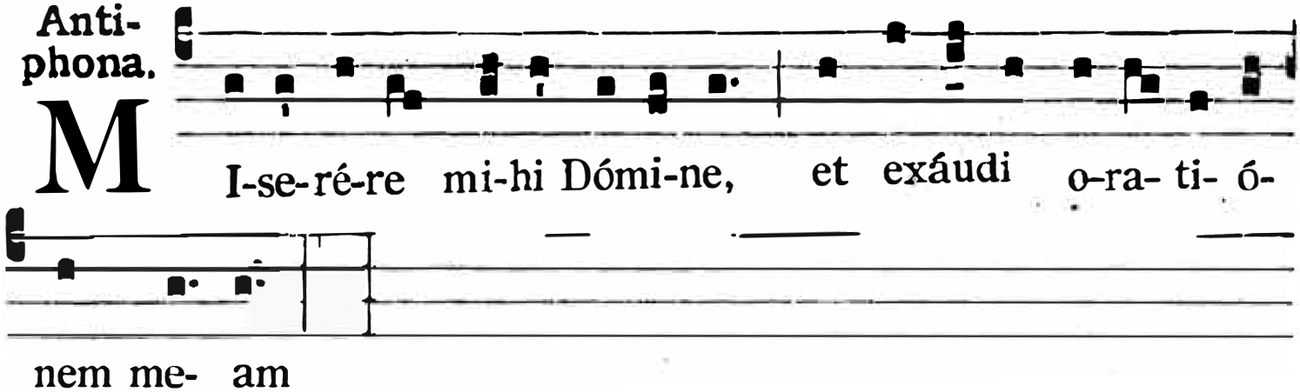
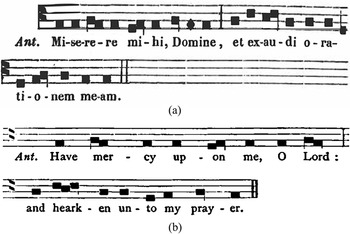
Frere’s comparative study of antiphon melodies underlies the settings of Miserere and Salva nos in the Wantage Compline. The former is shown with its source in Figure 8.
(a) Frere, Antiphonale, 101 (second pagination). (b) Convent of S. Mary, 1896), 5.
The method of setting this English antiphon differs from Chambers’s close imitation of the original melody and from Walker’s attempt to match stressed syllables by expanding or compressing the intervening parts of the chant. Although it resembles the source, some details may be illuminated by Frere’s analysis of similar antiphons in the preface to the Antiphonale Sarisburiense. Here the Miserere is classified as a mode 8 antiphon of the first ‘theme’. Frere notated this latter by comparing three examples (Figure 9).
Frere, Antiphonale, 73.

These antiphons account for some details of the Wantage Miserere. Faced with several possible ways to set ‘Have mercy upon’ to the melody of ‘Miserere michi’, the editors chose not to represent the podatus of the first syllable of michi (G–A) in the English. The result bears comparison to Justificeris and Deus adiuvat, in which separate syllables are set to the tones G and A. Indeed, the melody of the first two words of this latter is exactly the same as that of the words ‘Have mercy upon’. This shows that the editors did not set the English words to their own arbitrary rearrangement of the neumes of the equivalent Latin antiphon but, by comparing specimens that Frere considered to be of the same ‘theme’, to the melody of a completely different chant.
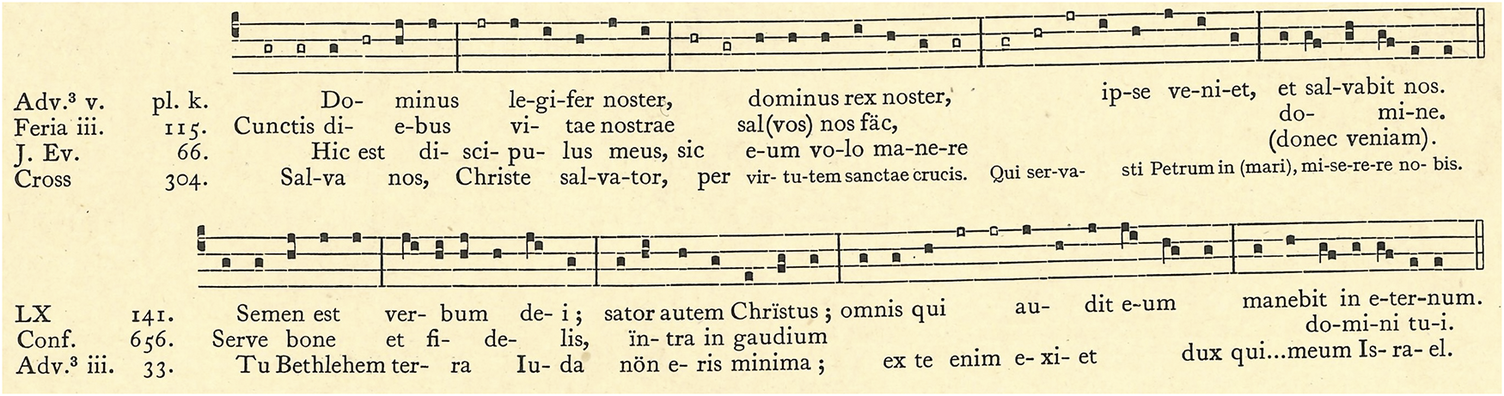
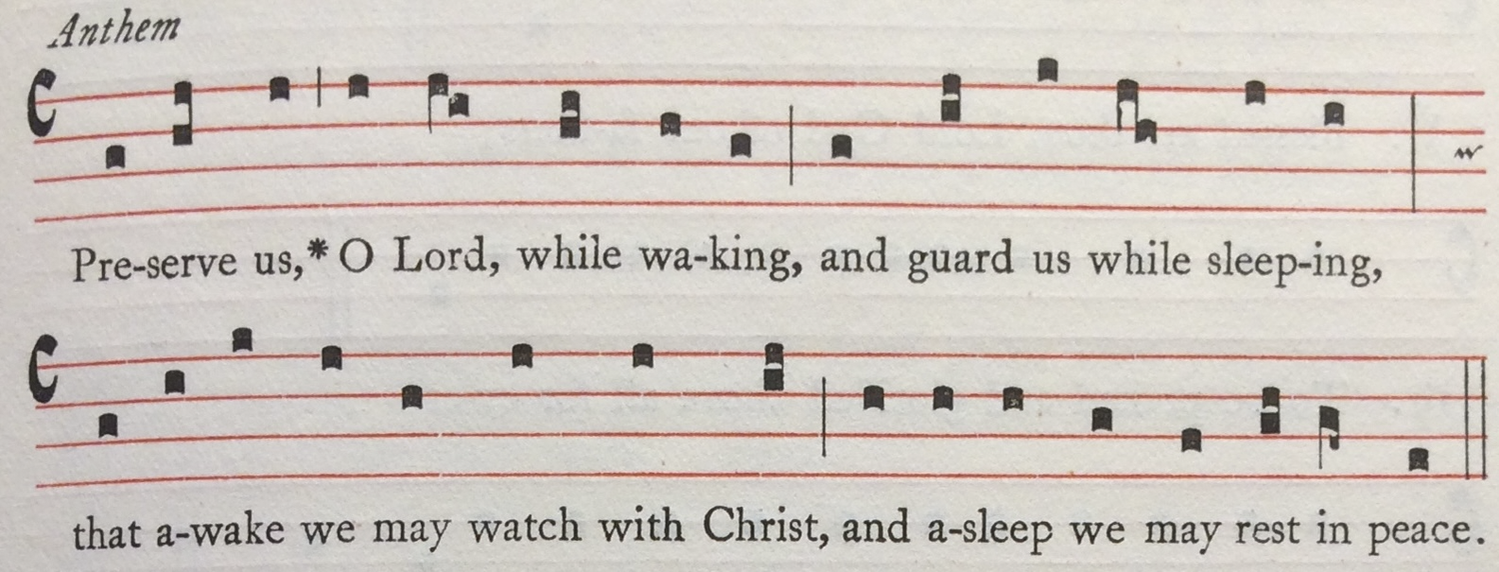
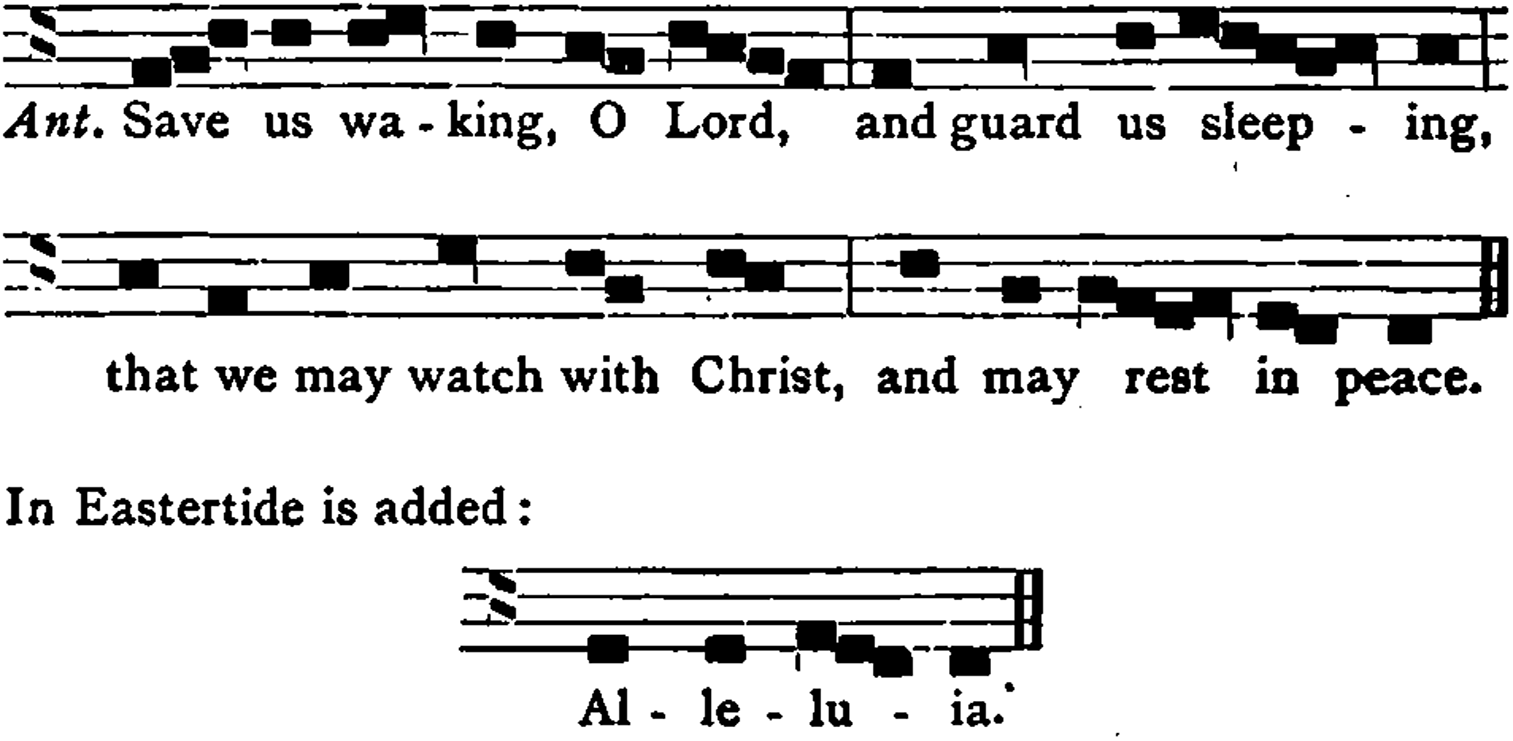
Frere assigned the Salva nos (Figure 10) to the third ‘theme’ of the third mode. Had the editors of the Wantage setting sought to replicate the melody of their source, either of the words ‘peace’ or ‘may’ in the final phrase might have been set to a climacus (A–G–F) corresponding to the neume-group on the penultimate syllable of requiescamus. Instead, the last four words are set to the closing formula of other antiphons that Frere considered to be of the same ‘theme’, including Dominus legifer noster (Figure 11). The reason may be that the last words of this latter (salvabit nos) and the English text ‘may take our rest’ are both accented on the antepenultimate syllable and end in a monosyllabic word.
(a) Frere, Antiphonale, 101 (second pagination). (b) Palmer and Frere, Order of Compline, 8.
Frere, Antiphonale, 69.
These settings of Miserere and Salva nos show that the editors balanced a desire to use sources with the equivalent meaning against the benefit of using ones with equivalent accentuation patterns. Frere’s thematic analysis provided a way through the impasse. Attributing the development of the Latin antiphon corpus itself to a process of enlarging or curtailing ‘elastic’ melodic themes to given texts,Footnote 65 he sought out underlying compositional principles that could be reapplied to English translations.
Frere’s detailed attempt to trace the original compositional processes of Latin chant sits incongruously alongside his aim to translate the repertoire into modern English. An ecclesiological motivation is evident. Worship in ‘such a tongue as the people understandeth’ was axiomatic in the reformed Church of England.Footnote 66 Frere aimed to produce music for vernacular worship that nevertheless stood in the tradition of Sarum chant that he traced, via Augustine of Canterbury, back to Gregory the Great. By adapting equivalent Latin chants according to editorial methods attributed to the composers of the originals, Frere sought to establish the Church of England’s worship upon a native musical heritage and thereby to bring it closer than any other church’s liturgy to the fons et origo of Western sacred music.Footnote 67
The Compline settings produced by Frere’s painstaking comparison of antiphon melodies were of lasting value. Over nine editions were published at S. Mary’s Convent between 1896 and 2008. With the exception of the most recent, these were not only used by the sisters, but also made available to the public. For instance, correspondence in the convent archives from the years 1965 and 1968 regarding a proposed new edition reveals that users included the chaplaincy of King’s College London and the Convent of St John the Baptist, Clewer.Footnote 68 A further revision was undertaken in preparation for the 2001 edition, and the translations of the Psalms in the Alternative Service Book (1980) replaced the Prayer Book Psalter. However, many musical settings were retained from previous versions. The Salva nos in the 2001 and 2008 editions differs little from the version that Palmer and Frere prepared over a century earlier.Footnote 69 As the most recent edition remains in use at S. Mary’s Convent, their work continues to be heard in contemporary sung services.
Francis Burgess (1879/80–1948)
The Rev’d Francis Burgess, musical director of the Gregorian Association from 1910 to 1948, was the younger contemporary of Palmer and Frere. He served under the former as organist at St Mary the Virgin, Primrose Hill, until 1902.Footnote 70 He also worked with Frere on the council of the PMMS. Burgess published plainchant editions independently of the Society which, as Hughes suggested, therefore reached a different audience:
He tried and succeeded in getting plainsong used in places where our own publications, either on account of the square notation or because of a certain atmosphere of typography and olde Englysshe spelling which occasionally marks those of a certain period round the turn of the century, may have proved unattractive.Footnote 71
By comparison with other English settings of Compline issued during his lifetime, Burgess’s stands out because of its use of modern notation, the provision of harmonisations and accompaniments, and its reliance on recently published plainchant editions.
‘Sunday Compline’ was part of a series for Parish choirs titled The Anglo-Catholic Choir Books and originally published by the Plainchant Publications Committee. Together with music for Vespers, Tenebrae and the Ordinary of the Mass, it was issued around 1924. Burgess provided music for the opening responses, psalmody (4, 91 and 134), Neale’s translation of Te lucis ante terminum, reading, responsory, Nunc Dimittis and closing responses. He supplied monophonic antiphons and psalm-tones as well as organ accompaniments and choral harmonisations designated ‘fa-burden’.Footnote 72
In a footnote, Burgess explained that the psalmody might be performed in a manner that resembles the late medieval alternatim performance of chant and improvised harmony:
As soon as the Cantors have intoned the first half of the opening verse of the Psalm, all sit down, the verse being concluded by the men of the Choir. From verse 2. to the end of the Psalm is sung antiphonally, either between Choir & Cantors, Boys & Men, or Plainchant & Faburden.Footnote 73
It is evident from this description that Burgess wrote for a male-voice church choir that sings public services of ‘Sunday Compline’ to monophonic and harmonised plainchant. His setting therefore differs from earlier publications intended for individuals or religious communities. The need for a sung parish service of Compline was due to the growing use of this Office as a public devotion in the late nineteenth century. The Act of Uniformity Amendment Act of 1872 had made provision for a ‘third service’ on Sundays, in addition to the statutory morning and evening offices, to be composed of hymns, anthems, Bible readings and Prayer Book liturgy.Footnote 74 Public services of Compline could be arranged along these lines, and St Paul’s Cathedral began to offer services ‘on the model of Compline’ in 1873.Footnote 75
Burgess’s provision of harmonised chant for a church choir also reflects the growth of English polyphonic choral repertoire in the late Victorian and Edwardian periods. As Hillsman, Rainbow and Temperley demonstrated, choirs founded in Tractarian churches in the mid-nineteenth century to sing psalms and canticles to monophonic plainchant tones expanded their repertoire to include polyphonic anthems and service settings.Footnote 76 Among these were new works by composers including Stainer, Parry and Stanford. But Hillsman also pointed out a subsequent revival of interest in plainchant in the early twentieth century when new styles of performance were adopted. For instance, in imitation of the practices advocated by the Benedictines of Solesmes, a ‘fast, light, [and] graceful’ performance of English plainchant settings became common, ‘with notes having more or less equal value’.Footnote 77 In the case of Burgess’s ‘Sunday Compline’, innovations include accompaniments, harmonisations and the use of modern notation with short rhythmic values that suggest a relatively fast tempo (as discussed further below). These features facilitated the performance of Compline in a different style and in new settings, and the sung Office could now form part of the Sunday programme of Parish services offered by organists and choirs who expected to sing in four-part harmony.
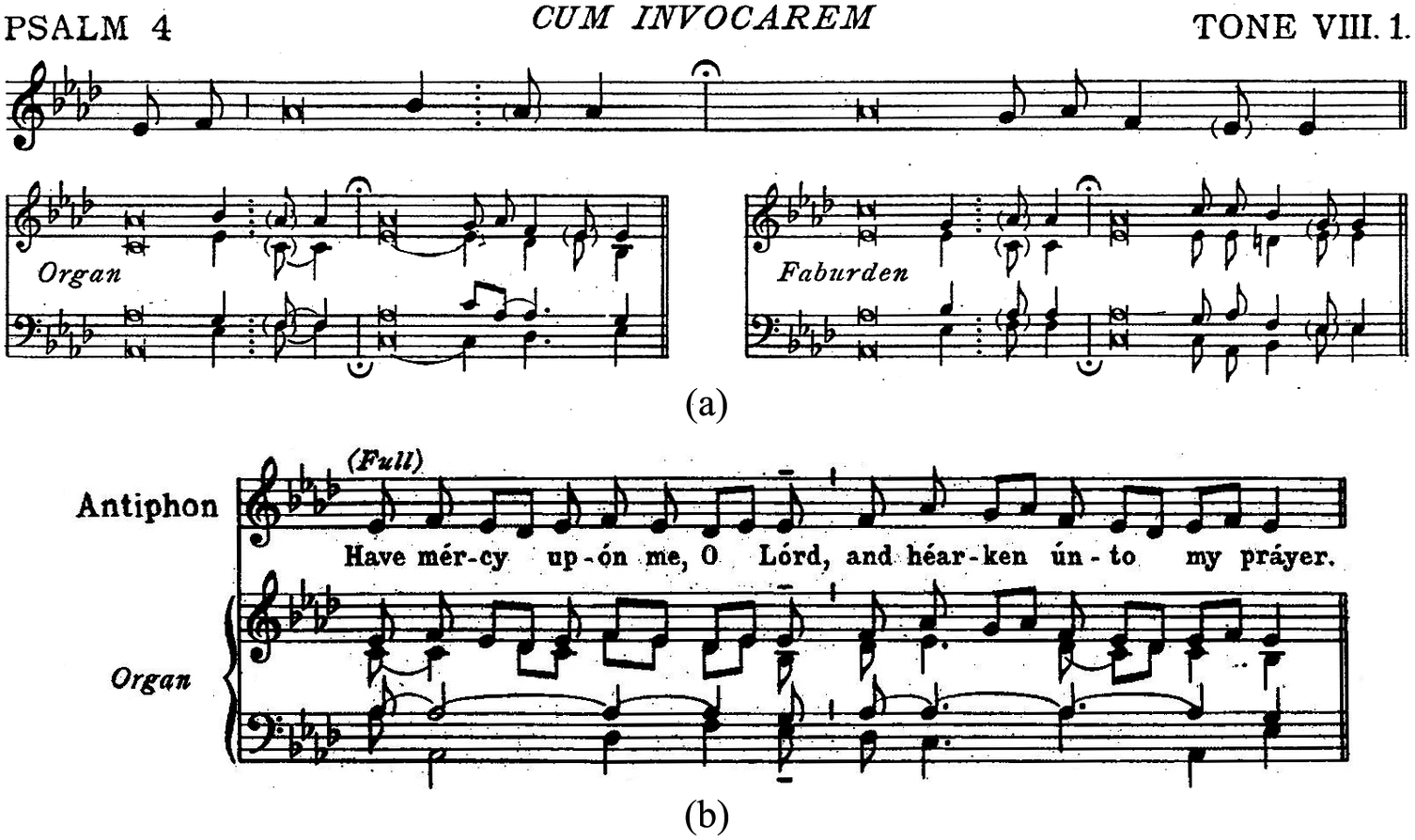
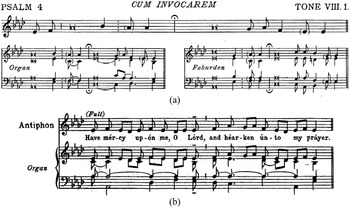
Burgess provided English settings of the antiphons Miserere and Salva nos. Space permits a consideration only of the former (Figure 12) to illustrate how he wished the psalmody and canticle of Compline to be performed.
Burgess, Sunday Compline, 2–3.
Burgess based many of his English settings of plainchant on contemporary Catholic sources.Footnote 78 The edition that corresponds most closely with his Miserere is the 1912 Vatican Antiphonale Romanum (Figure 13). Designated as ‘restored and edited’ on the title page, it was based on the 1891 Liber Antiphonarius that Dom Pothier had published shortly before leaving Solesmes. Though informed by painstaking research into the readings of medieval manuscripts, it did not take into account many of Dom Mocquereau’s later ideas regarding the pitch and rhythm of medieval chant, nor did it use his rhythmic signs.Footnote 79
Antiphonale sacrosanctae Romanae Ecclesiae pro diurnis horis (Rome, 1912), 47.

A comparison with Burgess’s setting shows that he adapted the melody to the English text by omitting repeated notes, separating the constituent tones of some melismas to assign notes to individual syllables, and (vice versa) by combining tones to set English syllables melismatically. The final notes of the two phrases are lengthened, the first by the addition of a horizontal line and the latter by use of a crotchet. In his introduction to the English Gradual, Burgess explained that the former means that a note should be ‘slightly broadened and lengthened’ while the latter indicates ‘lengthening to nearly double’ the note’s normal duration.Footnote 80 The system resembles use of the horizontal episema and the punctum-mora in recent Solesmes publications. A version of the Antiphonale Romanum containing these rhythmic signs was issued in 1924, the very year Burgess is thought to have published his (undated) setting of Compline. Here the lengthening (mora vocis) of the final puncta of the two phrases is marked with dots (Figure 14). If Burgess did refer to this ‘rhythmic edition’ shortly before publishing ‘Sunday Compline’, he could perhaps have used it to emend a final draft.
Antiphonale sacrosanctae Romanae Ecclesiae pro diurnis horis (Paris, 1924), 58.
Burgess explained his approach to accompanying chant in The Teaching & Accompaniment of Plainsong (1914). There he confessed that, on the grounds of ancient precedent, ‘the instrumental accompaniment of Plainsong is artistically indefensible’. Accompaniments were solely a concession to necessity, and he insisted that they be as unobtrusive as possible. Burgess eschewed chromatic accompaniments, such as were included in Stainer’s The Gregorian Tones (1867), on the grounds that ‘in order to be appropriate, an accompaniment must be drawn from the same source as the notes of the melody’.Footnote 81 He therefore allowed accompaniments that use the notes of the ‘white-note’ (diatonic) scale, permitting the sole chromatic inflection of B-flat. These might be transposed to suit the vocal range of the singers.
Burgess favoured a relatively slow rate of harmonic change in accompaniments for plainchant, which consequently permitted a faster tempo.Footnote 82 This was becoming a common performance practice in England, as Hillsman showed by comparing the plainchant accompaniments in the first and second editions of the English Hymnal, published in 1906 and 1933 respectively. In the former, note-against-note harmonisations result in a rapid rate of harmonic change that necessitates a relatively slow tempo. In the second edition, the melody is normally transcribed as quavers rather than minims, and is accompanied by sustained harmonies.Footnote 83 Burgess likewise used quavers as the normal note value in ‘Sunday Compline’, and he suggested they be performed at a metronome speed of 176.Footnote 84 The harmonies that accompany the Miserere change not on every note of the chant, but on every accented syllable of the text. This relatively slow rate of harmonic change permits the faster tempo that Burgess intended, emphasises textual accentuation, and encourages a lighter execution of unaccented syllables.
Though Burgess’s edition presents the organ accompaniment and the fa-burden harmonisation of the psalm-tones side by side, they reflect different approaches to harmonising plainchant. In the former, the psalm-tone is played in the upper voice and the notes are limited entirely to the diatonic scale. By contrast, the fa-burden setting, which presents the psalm-tone in the tenor, ends with a perfect cadence in E-flat major by means of chromatic inflection, the D-natural serving as the leading-note. In this regard the setting resembles Morley’s harmonisation of the eighth tone, which similarly ends with a perfect cadence in the dominant.Footnote 85 Evidently the way to make an ‘appropriate’ organ accompaniment, namely use of the diatonic scale, did not apply to his fa-burden setting which resembles a sixteenth-century harmonisation of the same psalm-tone.
The music in Burgess’s Compline is thus eclectic. It includes plainchant melodies that were well known from previous editions, fa-burden settings that resemble early modern four-part plainchant harmonisations, and organ accompaniments of Burgess’s own devising. These permitted the performance of Compline in new circumstances, the Church organ now supporting a relatively fast performance of chant sung by a choir in both unison and harmony at increasingly popular public services of ‘Sunday Compline’.
The Plainsong & Medieval Music Society, Walter Frere and John Henry Arnold
Writing in the second edition of Grove’s Dictionary of Music and Musicians, A. Fuller-Maitland detailed the aims of the PMMS as follows:
(1) To be a centre of information in England for students of Plain-song and Mediæval Music … (2) To publish facsimiles of important MSS., translations of foreign works on the subject, adaptations of the plain-song to the English use, and such other works as may be desirable. (3) To form a catalogue of all plain-song and measured music in England, dating not later than the middle of the 16th century. (4) To form a thoroughly proficient choir.Footnote 86
In accordance with the goal of publishing ‘adaptations of the plain-song to the English use’, An Order for Compline was issued in 1929. This is an edition of the service printed in the 1928 Proposed Book of Common Prayer, the revision of the 1662 Prayer Book that was rejected by parliament. Though no editor is named, the original compiler has been identified as John Henry Arnold (1887–1956). But, as will be shown, the guiding hand of Walter Frere, chairman of the PMMS from 1903 to 1929, is apparent in both the text and music.Footnote 87
Frere had a prominent role in drafting the order of Compline in the 1928 Prayer Book. In Some Principles of Liturgical Reform (1911), he had already suggested that Compline might serve as a ‘popular’ service for parishioners who would prefer a Sunday evening service to afternoon Evensong – exactly the type of service Burgess’s ‘Sunday Compline’ catered for. He envisioned a simple, unvarying liturgy, including a reading, sermon and hymn.Footnote 88 When drafts of the revised Prayer Book were drawn up, Compline was included. Frere considered the proposals as a member of the Advisory Committee, and his recommendations influenced the form of the Office. The final order was included in an appendix of the new Prayer Book. It comprises opening responses, psalmody (4, 31:1–6, 91 and 134), a reading, hymn, Nunc Dimittis, confession and closing prayers.Footnote 89
The PMMS prepared a musical setting in advance of the Prayer Book’s publication. According to Hughes, Frere advised that the revised book would be used whether parliament approved it or not, and that music should be published forthwith. However the majority urged caution and only music for Compline was prepared.Footnote 90 The new Prayer Book was narrowly rejected in the House of Commons in 1927 and, after further changes, again in 1928. The following year, ‘during the present emergency’, the archbishops gave permission for it to be used nevertheless.Footnote 91 Though not authorised by parliament, a liturgy for Compline was now sanctioned in the Church of England for the first time.
The PMMS setting is a sixteen-page booklet which might be used by a choir or congregation as an order of service in its own right. The editor, John Arnold, was an authority on plainchant who composed the accompaniments in the second edition of the English Hymnal mentioned earlier. Arnold also revised and enlarged Briggs and Frere’s Manual of Plainsong, publishing the new edition in 1951.
Like Chambers, Palmer and Frere, Arnold drew on Sarum sources. But unlike his predecessors, he would not have needed to consult manuscripts directly. Not only had Frere published the facsimile Antiphonale Sarisburiense, but he had also co-edited an English setting of its Compline chants for the Wantage sisters. It would not have been possible for Arnold simply to reproduce Frere and Palmer’s setting because its extensive provision for liturgical seasons and holy days is different from the unvarying order in the 1928 Prayer Book. But reference to Frere and Palmer’s settings of particular chants is suggested by a comparison of Miserere and Salva nos.
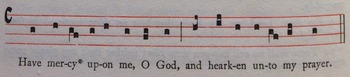
Though the 1928 Prayer Book does not include an antiphon to the psalmody, Arnold supplied an English Miserere in a footnote. Evidently for optional use, singers were free to recite the psalms without an antiphon, a practice familiar from the psalters of Helmore and of Briggs and Frere. Presumably the addition was made to bring the edition into closer correspondence with existing English settings. By 1929, then, the practice of singing Compline in English and the repertoire of chants for the service had become sufficiently established that the absence of the Miserere would be thought an omission.
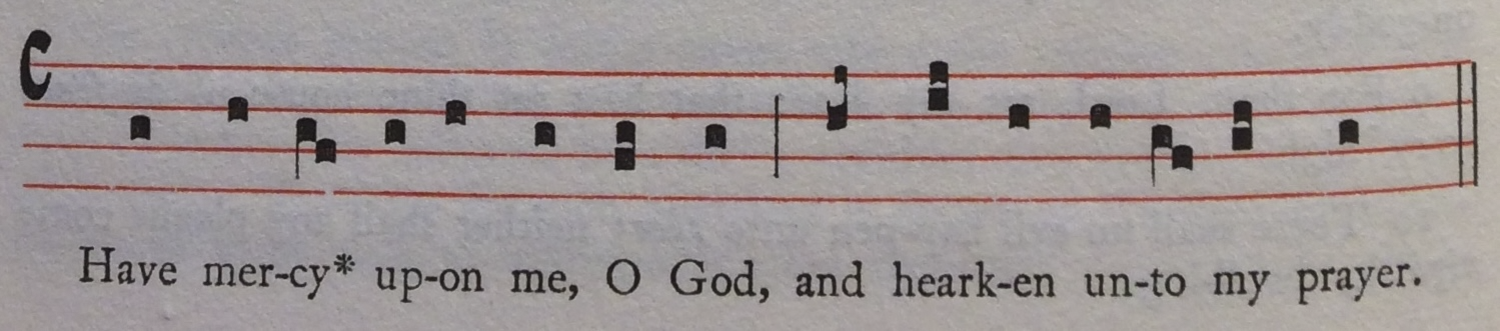
Similarities between Arnold’s Miserere and that in the Wantage Compline confirm that his setting was informed by this edition. Comparing Figure 15 to Figure 8b shows that, besides the treatment of the word ‘prayer’ as one syllable rather than two, the melodies are identical. Differences in notation and typography include the placement of the C clef and the indication of the incipit by an asterisk rather than a bar line. Arnold substituted ‘God’ where the Wantage setting has ‘Lord’, thus bringing the text into conformity with the Prayer Book translation of Psalm 4:1.
John Arnold, An Order for Compline (London, 1929), 6.
A similar editorial approach underlies Arnold’s Salva nos (Figure 16). Besides a change to accommodate an additional syllable in the Prayer Book’s translation, his melody is the same as that of Palmer and Frere (see Figure 10).
Arnold, An Order (1929), 9.
It would not have been possible for Arnold to work from the same manuscript source as Palmer and Frere and independently propose similar settings. As demonstrated earlier, Palmer and Frere’s Miserere and Salva nos were informed not only by the melodies of the equivalent Latin antiphons, but also by the melodic formulae that Frere had identified as their ‘themes’. This shows that Arnold’s work differed from that of the earlier editors studied here. Chambers, Walker, Burgess, Palmer and Frere set English antiphons to melodies from particular Latin manuscripts and contemporary editions. Arnold, though, adapted Palmer and Frere’s earlier English settings. The consolidation of a repertoire of Compline chant in English meant that a new edition could now be edited in the light of older ones without recourse to ‘external’ Latin sources.
Setting the 1928 Compline service required considerable ingenuity, as is evident in Arnold’s treatment of the closing versicle taken from Psalm 4:
The placement of this text was debated in the Prayer Book revision process.Footnote 93 In the printed Sarum Antiphonal, it occurs earlier in the service, between the Lord’s Prayer and the Creed, where it may be sung to a monotone with a simple inflection.Footnote 94 In the 1928 Prayer Book, it is anomalously placed after the collects, among the concluding responses. Lacking a direct precedent to indicate how a response so placed should be sung, Arnold proposed two solutions. While it might be recited simply to an inflected monotone, an elaborate setting based on the responsory In pacem idipsum is also provided. As one of only two Compline responsories according to the Sarum Use, this was a notable part of medieval English liturgy and was set to elaborate polyphonic settings by John Taverner, Thomas Tallis and others.Footnote 95 An English plainchant setting had been published by Palmer and Frere in the Wantage Compline service.Footnote 96 Unfortunately the text in the 1928 Prayer Book (from Psalm 4:8–9) does not correspond exactly to the Sarum responsory and the Wantage setting (from Psalms 4:8 and 132:4). Arnold therefore set the text of Psalm 4:9 to the music for Psalm 132:4 and omitted the doxology and closing response. The resulting florid versicle and response, which stand out at the conclusion of an otherwise mainly syllabic setting of the Office, is a hallmark of the PMMS’s Compline and has been included in recent editions that have been influenced by it.
Arnold’s Compline was not, therefore, a simple ‘copy and paste’ of Frere’s work. As an unvarying order with few proper texts for particular seasons, it is different from the twenty-three forms for various liturgical seasons and holy days in the Wantage edition. Similarities emerge where particular chants from Frere and Palmer’s setting could easily be adapted to the texts of the 1928 Book of Common Prayer. As Frere was partly responsible for the text of the new Prayer Book, and as he advised the PMMS regarding liturgical revision during his term as chairman, it is unsurprising that he should have arranged for the edition of Compline he co-edited to be available to Arnold. This meant that Frere’s painstaking analysis of antiphons that underlay the Wantage setting of Compline also informed the PMMS edition.
‘Firmly fixed in the Anglican tradition’
The settings analysed above show how the different editions of English Compline published from 1844 to 1929 established a new choral repertoire. Successive versions compiled in the light of developments in chant scholarship remedied earlier deficiencies. The limitations of Christie’s edition and the misunderstanding of liquescence in Chambers’s Psalter arose from the limited sources of music and secondary scholarship available to them. While Walker’s settings were informed by the editorial methods underlying the ‘correction’ of chants in the 1848 Mechlin Vesperal, Burgess adapted the chants that were ‘restored and edited’ in the 1912 Antiphonale Romanum and promoted a faster performance of plainchant as advocated by the Benedictines of Solesmes. The 1896 edition of Frere and Arnold drew on Frere’s study of antiphon ‘themes’, conducted with reference to the recent work of François Gevaert. For all the inherent contradictions of deploying a form-critical investigation of medieval chant to adapt the melodies to fit new English texts, the process was carried out with an understanding of chant melody far more sophisticated than that of Chambers, who simply substituted English for Latin words, or Walker, whose simplistic methods were bound to yield monotonous or florid results.
The changing circumstances in which English Compline was performed also contributed to the consolidation of its repertoire. While early monophonic settings were part of the daily round of monastic services, the organ accompaniments and harmonisations in Burgess’s version permitted a public performance of Compline by a four-part church choir. Permission for a ‘third service’, and the subsequent incorporation of Compline into the Book of Common Prayer, turned Compline from a recondite Anglo-Catholic devotion into a mainstream provision. Wider public experience of sung Compline led to the music produced by the aforementioned editors becoming a ‘fixture’ in the English choral repertoire.
In recent decades, multiple editions of Compline have been produced in the wake of the Church of England’s liturgical series titled Common Worship. A complete musical setting of its modern-language Compline was edited by John Harper and published by the Royal School of Church Music in 2005. The melody of Salva nos, now in modern notation, is similar to the 1929 PMMS edition and differs only where the Common Worship translation varies from the text in the 1928 Prayer Book. However, in the section entitled ‘Daily, Seasonal and Other Variations’, this melody has been adapted to ten further antiphon texts for the seasons and holy days of the year.Footnote 97 Any of the Nunc Dimittis antiphons in Common Worship: Daily Prayer may therefore be recited to a similar melody without singers needing to learn a new chant.
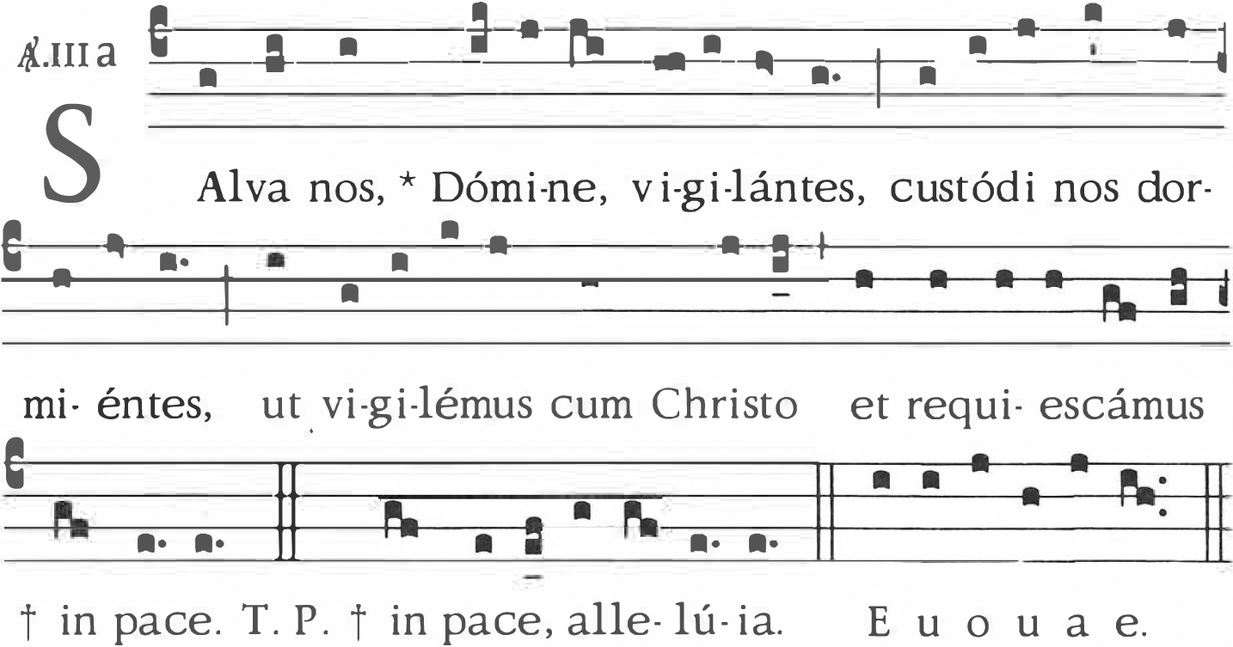
A musical setting of Common Worship Compline was also published in 2001 by Peter Wilton, then director of the Gregorian Association. As stated on the title page, texts are set to ‘plainsong and related simple chant’, including Anglican chant and harmonised plainchant psalm-tones. Wilton’s setting of Salva nos is reproduced in Figure 17. In the English settings examined earlier, the podatus in the incipit rises to C, the note which serves as the reciting note of the mode 3 psalm-tone. Here, though, both the podatus on the second word (‘us’) and the psalm-tone rise to B. The melodic shape of chants ascribed to the third mode was a source of acrimonious debate in the editing of the early twentieth-century Vatican plainchant editions. In 1905, when Dom Mocquereau urged the use of B on the grounds that it was found in the oldest manuscripts, members of the Vatican commission objected on the grounds that C was of long-standing use.Footnote 98 B appeared only in publications that represented the preferences of the Solesmes editors, and the Psalterium Monasticum of 1981 presented Salva nos in this way (Figure 18). Although the source of Wilton’s setting is not indicated, a comparison shows that it follows the practice of Solesmes in this regard.
Peter Wilton, Night Prayer (Compline): According to the Order in Common Worship (Maidenhead, 2001), 32–3.
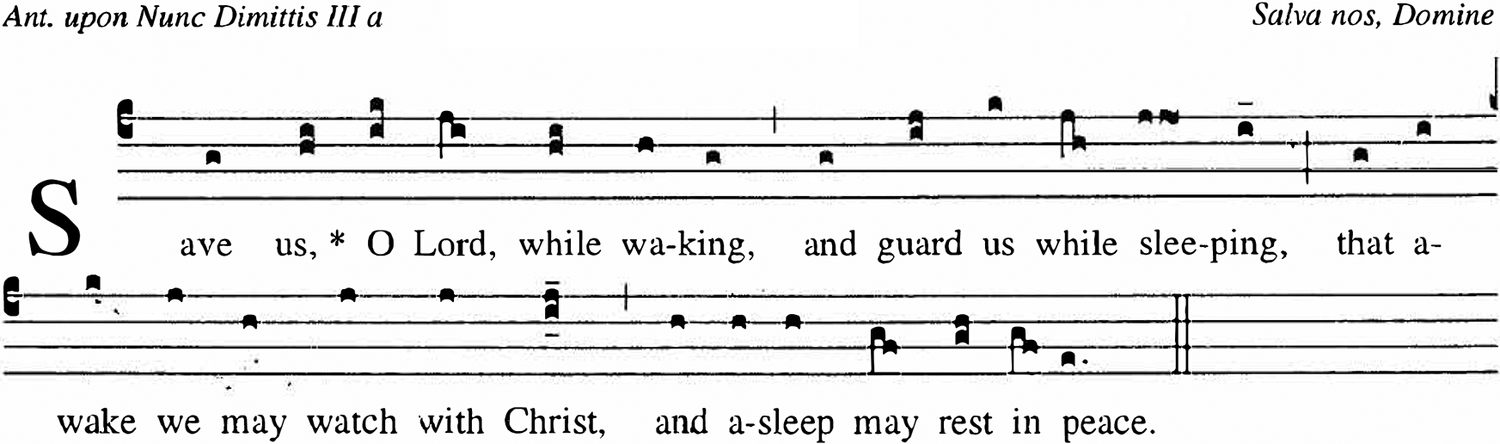
Psalterium cum canticis Novi & Veteris Testamenti iuxta Regulam S.P.N. Benedicti (Sablé-sur-Sarthe, 1981), 358.
Present-day choirs are therefore presented with a choice of Compline settings that are informed by recent chant scholarship, new liturgical texts and the needs of singers of different abilities. Within this mixed economy, Arnold’s setting remains prominent, partly due to the publication of the second edition in 2005 for use with Common Worship liturgy. Several other recent publications perpetuate its performance, among them the 2012 Customary of Our Lady of Walsingham. The sung setting of Compline includes the Salva nos and the distinctive response ‘We will lay us down in peace’ as set by Arnold.Footnote 99 The Compline service published in 2011 in the second volume of English Church Music differs from that of the PMMS in its use of modern notation and in the indication of music that might be sung by the decani and cantoris sides of a cathedral choir. But the transcription of the Miserere, Salva nos and the response ‘We will lay us down in peace’ allow such a choir to sing Arnold’s settings.Footnote 100
In the preface to this volume of English Church Music, the inclusion of music for Compline is attributed to the ‘resurgence’ of interest in singing this Office.Footnote 101 Examples include the performance of Compline at the annual Edington Festival of Music within the Liturgy. The weekly services sung at St Mark’s Cathedral Episcopal Cathedral in Seattle attract 10,000 online listeners.Footnote 102 In March 2015, the Compline service sung by Leicester Cathedral choir was of national significance in England as it served as the vigil before the reinterment of Richard III.Footnote 103 The contemporary performance of Compline retains a relationship to the settings produced during the English plainchant revival. This is primarily through the republication and performance of music from Arnold’s edition, which was itself informed by the scholarship of Palmer and Frere. The singing of this setting of Miserere, Salva nos and the distinctive response based on In pace idipsum is an ongoing testimony that it has become ‘firmly fixed in the Anglican tradition, and remains the best loved and most valued of the sung office services based on medieval chant’.Footnote 104








 Open access

