

Planetary geoscience was effectively born when Christiaan Huygens took his first look at planet Mars on Friday 28 November 1659. As one of the leading scientists of his time, Huygens was known for constructing his own telescopes to observe stars, planets and nebulae whenever the clear and spacious skies above the Netherlands allowed. Huygens observed the planet Mars during the heydays of its 1659 opposition. On the night of 28 November he succeeded in sketching the first albedo feature on a different planet in our solar system. The roughly triangular dark-coloured patch was originally christened the Hourglass Sea, suggesting it to be an area of open water. Perhaps the landscape surrounding him in the Netherlands prompted Huygens to interpret the newly discovered feature as a wet area on the planet's surface. The attribution of traits to an albedo feature on another planet based on terrestrial landscapes may well be considered as the first-ever attempt at ‘comparative planetology’. The albedo feature can still be recognised at the surface of Mars today as Syrtis Major. Any modest amateur telescope can provide a view superior to that of Huygens’, allowing the observation of the very first geological feature ever identified on another rocky planet.
This special issue appears more than three and a half centuries after Huygens’ observation of Mars and aims to highlight the state of the art in the Dutch planetary geosciences. While this volume is not comprehensive, it provides an overview of the breadth of planetary geoscience topics currently studied in the Netherlands. This branch of science has become a truly interdisciplinary effort in which scientists from geosciences, biology and astronomy cooperate. It builds on decades of Earth-based geoscience research, which is now being applied at the forefront of scientific exploration of our solar system, to understand the diversity and evolution of interiors, surface conditions, landscapes and atmospheres of objects in our solar system. While this scientific field is relatively young, it is also evolving rapidly.
Evolution of planetary geoscience in the Netherlands
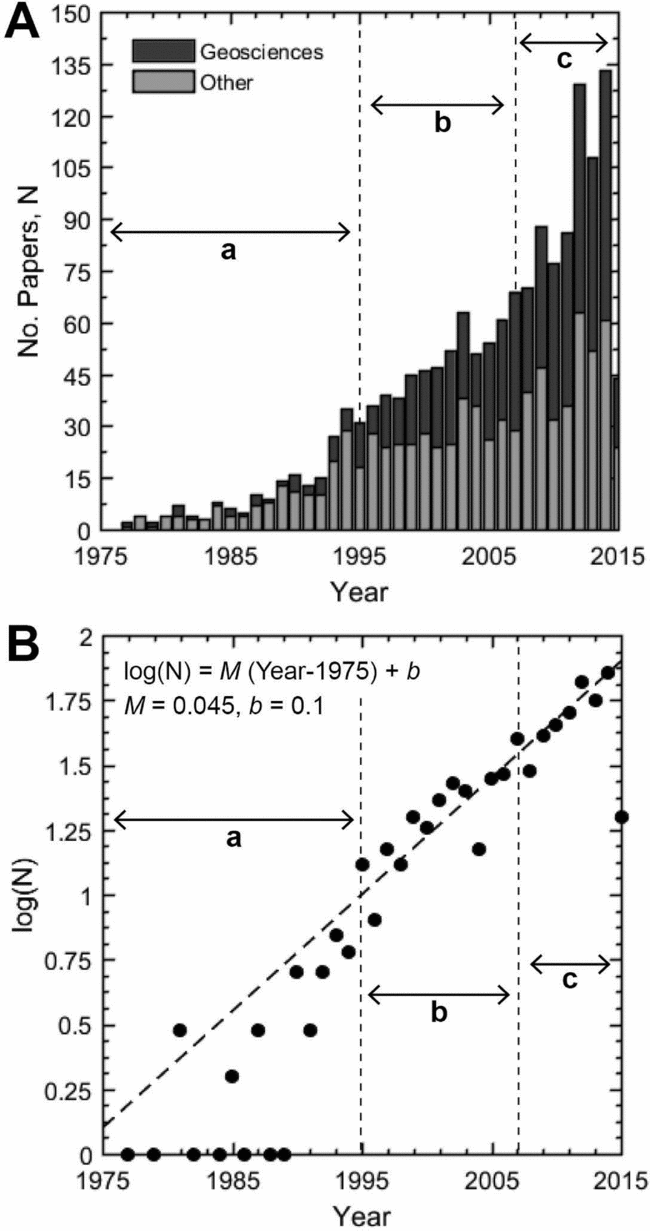
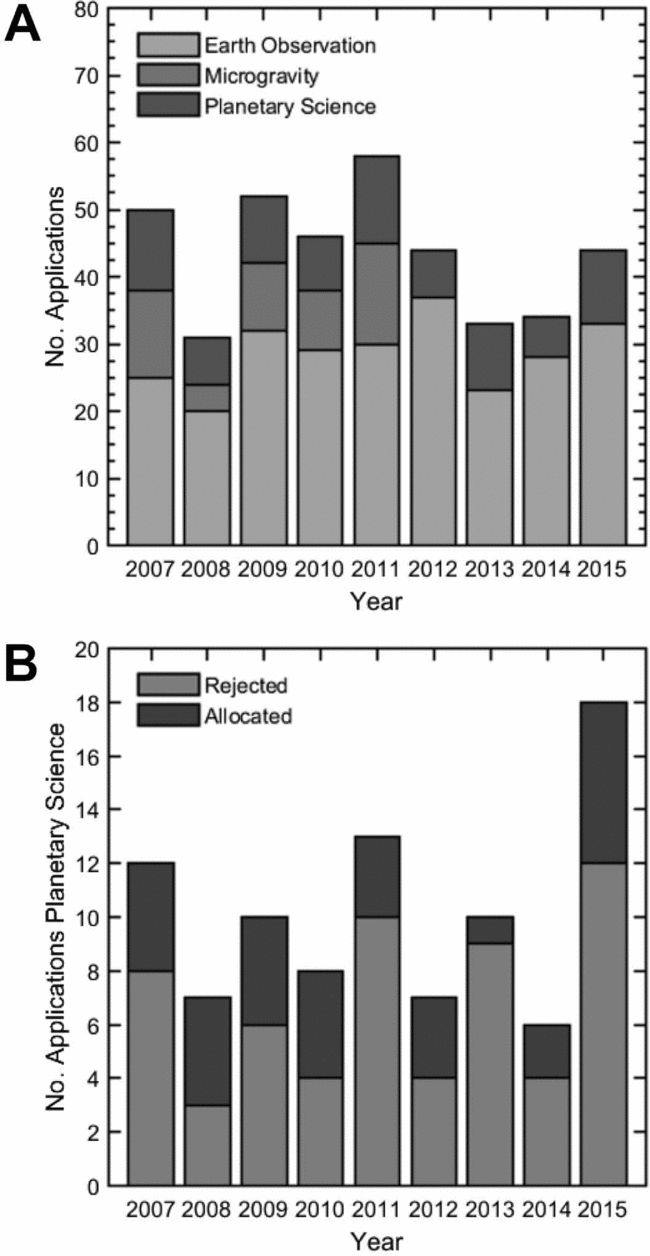
The evolution of the Dutch contribution to the growing field of planetary science is well-reflected in a bibliographic analysis of peer-reviewed scientific papers in the field over the past 40 years (Fig. 1). Fig. 1A shows that planetary science papers from the Netherlands-based scientific community were sporadic, and originated from astronomers, before 1995. In the period since 1995 the number of planetary science papers grew strongly. The main trend in the data is the growth with time of geoscience-oriented studies in a classically astronomy-dominated sector. Most notably, the growth of the field has progressed almost exponentially over the past 10 years (Fig. 1B). This can be taken as a sign of a rapidly maturing subdiscipline. Dutch geoscientists have become increasingly active in planetary exploration, especially since the instigation of the User Support Programme Planetary Science funded by the Netherlands Organisation for Scientific Research (NWO) over the past 8 years. The programme's performance indicators show a continuous interest of the scientific community, which is comparable in magnitude to other established sectors funded by the same programme (Fig. 2).
Bibliographic analysis of planetary science papers published in the Netherlands over the period from 1975 to mid-2015 (data courtesy of K. Abkouwer, UvA Science Library). A. Scientific output in terms of peer-reviewed papers (N) selected using keywords that include the names of planetary objects and their adjective forms, and limited to authors affiliated to Dutch universities. Three phases can be identified in the data: (a) before 1995, period of sporadic studies; (b) 1995–2007, strong growth in the number of geoscience-oriented studies relative to the number of astronomy-based studies; (c) 2007–2015, planetary geosciences growing as an established discipline in the wake of dedicated funding instruments including the NWO User Support Programme. B. The scientific output in Dutch planetary geosciences is shown to roughly adhere to a power law, indicative of a maturing subdiscipline.

Performance indicators of the Netherlands Organisation for Scientific Research – User Support Programme (NWO-GO). Part of the growth of planetary geosciences in the Netherlands is related to the instigation of dedicated funding instruments, such as NWO-GO. A. Histogram of submitted proposals per theme of NWO-GO. The scientific interest in planetary science is of comparable magnitude to subthemes of the Earth Observation cluster. B. More detailed histogram specifying ratios of allocated vs rejected projects per NWO-GO theme. Data provided by the Netherlands Space Office.
Contents of this special issue
The formation of our solar system began when an interstellar molecular cloud started to contract, triggered by the shock wave of a nearby supernova. The resulting gravitational collapse in the cloud started the formation of a protoplanetary disk in which the planets formed by accretion of gas and dust. The radiative heat of the protosun was too high for volatiles to accrete close to the forming star, which led to the formation of silicate and metal-dominated planetary embryos in the inner solar system. Coalescence of multiple planetary embryos eventually formed the present-day terrestrial planets, while beyond the frost line large gaseous planets and icy bodies were formed. The composition, distribution and surface features of these objects exemplify the geological diversity in our solar system.
In this special issue, Kempl et al. (Reference Kempl, Vroon, Van der. Wagt, Zinngrebe, Frost and Van Westrenen2016) kick off with a study closely associated with the early stages of planet formation in our solar system. They provide an overview of current knowledge of the fractionation of silicon isotopes between coexisting metal and silicate at high-pressure, high-temperature conditions. Measurements of the Si isotope composition of solar system materials has been used to trace the conditions of core formation in the Earth and the other terrestrial planets (and larger asteroids), but the authors show that a much larger experimental database will be required to be able to translate these sample measurements to quantitative information on core formation in the early solar system.
We then travel to our closest celestial neighbour, the Moon. The Dutch invention of the telescope in 1608 and its evolution to the astronomical telescope has allowed many astronomers to observe the Moon and speculate about its formation. Rock samples returned by the manned Apollo missions in the 1970s finally provided the materials needed to develop a detailed petrological model of the Moon, and ever more detailed analyses of lunar rocks have shown that the Moon and silicate Earth are very much alike. The similarities between the Moon and silicate Earth are in fact too great to be consistent with the classic version of the Giant Impact Hypothesis of Moon formation. Reuver et al. (Reference Reuver, De Meijer, Ten Kate and Van Westrenen2016) provide new boundary conditions for the formation of the Moon and further develop a hypothesis for Moon formation that is more consistent with the observations than the classic Giant Impact Hypothesis.
Many observations of Mars followed those of Huygens in 1659, including those of the infamous Canalli (‘channels’) that contributed to the idea that intelligent life may exist on Mars. This notion in science did not go unnoticed in contemporary popular culture and resulted in 1898 in H.G. Wells’ classic novel War of the Worlds. Ever since, the question of Martian life has captivated the interests of both the general public and scientists. This scientific interest continued to be fuelled by the advent of space flight when imagery obtained by orbiting spacecraft showed the surface of Mars to have an eerie resemblance to landscapes on Earth. Amongst the many features observed were fluvial, glacial and volcanic landforms, which are tell-tale indicators of past climatic conditions during which the surface environment allowed such processes (and perhaps life too) to flourish. It is therefore not surprising that an appreciable portion of planetary research in general, and Dutch planetary geosciences in particular, currently targets Mars.
The attention given to solving the age-old question of whether or not life may exist on Mars currently focuses on the detection of biomarkers from extinct or extant life and the study of (past) habitable niches. Although technically challenging from orbit, surface explorers have employed and will continue to employ advanced instrumentation to support detection directly at the Martian surface. Hooijschuur et al. (Reference Hooijschuur, Verkaaik, Davies and Ariese2016) provide an overview of the optimal Raman spectroscopic techniques for biomarkers detection on mineral backgrounds that would be suitable for implementation on future landers.
The inability to perform fieldwork for obtaining ‘ground truth’ on other planetary bodies poses an almost existential challenge to field-trained geoscientists in their interpretation of landforms. A commonly used approach in planetary geosciences, in conjunction with remote sensing analyses, therefore relies on the use of landscapes on Earth that resemble those on Mars. This analogy is frequently based on either comparable formative conditions (tectonic, geologic or geomorphic) or comparable environmental conditions affecting them, such as aridity or temperature. Rodriguez & Van Bergen (Reference Rodríguez and Van Bergen2016) discuss the suitability of terrestrial volcanic hydrothermal systems as potential analogues of Martian sulphate-rich terrains. Building on decades of geoscience research, surface interpretations of planetary bodies are based on the premise that the formative processes of those landscapes are properly understood on Earth. An important prerequisite for using terrestrial landscapes is a proper understanding of how the planetary variables (atmospheric pressure, gravity, radiation) affect process dynamics, and how these can be ameliorated by experimental manipulation of relevant parameters. The paper by De Vet (Reference De Vet2016) discusses a unique and abundant sediment type that comprises aeolian landforms on Mars. It places the use of laboratory simulations and analogue materials (i.e. geological substitutes) from Iceland in a synthetic framework for understanding the transport and modification of the glass-rich sediments that comprise the vast, active dune systems in the Martian Northern Lowlands.
The quintessential role of such experimental simulations has been illustrated in various studies and many of them have relied on purpose-built research facilities. Ten Kate & Reuver (Reference Ten Kate and Reuver2016) present an innovative planetary analogue laboratory facility (PALLAS) that will facilitate experimental studies and simulations of the effects of radiation, atmospheric and surface conditions on a variety of scientific niches in planetary sciences. Crossing the asteroid belt we approach Jupiter, where the icy realm of our solar system may be more habitable than we have assumed during the last few decades. Jara Orué & Vermeerssen (Reference Jara Orué and Vermeerssen2016) show how the tides on Ganymede relate to the internal structure of the Galilean moon, which provides a relevant perspective on putative habitable niches in our own solar system.
Beyond our outer solar system, new scientific challenges are still to be found. Initiatives have been set up across the Netherlands to foster collaboration between the fields of astronomy, biology, chemistry and geosciences, most notably through the NWO Planetary and Exoplanetary Science (PEPSci) network. Such developments will allow expertise from the Dutch geosciences to be exploited well beyond the outskirts of our own solar system. At the same time, our scientific community is also actively involved in educating the next generation of planetary geoscientists. In the final paper of this special issue Kleinhans et al. (Reference Kleinhans, Verkade, Van Wessel, Bastings, Marra, Van Gog, Van Westrenen and Reichwein2016) highlight a unique educational approach where primary school children discover the nature and science of planet Earth from an extra-terrestrial perspective, using the classroom game ‘Moon, Mars and Mundus’. Inspiring children at primary school level has been shown to be effective in directing them to future careers in STEM (science, technology, engineering and maths) topics, and this programme certainly has the pedigree to offer both children and the scientific field a bright future.
Outlook
Planetary science has made significant progress over the past decade. Recent space exploration missions to Mercury, Venus, the Moon, Mars, asteroids and the outer planets and their moons have revolutionised our knowledge of the formation, evolution and present-day properties of the interior, surface, atmospheres and exospheres of many bodies in our solar system. Potentially habitable zones have been identified and characterised on Mars and in the interiors of icy moons, and a plethora of biomarkers have been proposed and studied, based on remote sensing observations, in situ observations from landers, and detailed, Earth-based analyses of meteorite and dust samples. Planetary science is also becoming increasingly dependent on the input of multiple subdisciplines of the geosciences, which illustrate the many opportunities for earth scientists to get involved in planetary science. In all, the studies aggregated in this special issue provide the reader with a broad perspective on a flourishing subdiscipline of the geosciences in the Netherlands.
Acknowledgements
We acknowledge the editor of the Netherlands Journal of Geosciences, Professor Ronald van Balen, and editorial assistant Pim Kaskes for their role in the realisation and publication of this special issue. We also thank all authors for their contributions and patience in the realisation of this volume for the Netherlands Journal of Geosciences, and the large team of reviewers that provided constructive criticisms that improved many of the papers compiled in this special issue.