



INTRODUCTION
In general, men are twice as likely to acquire tuberculosis (TB) compared to women [Reference Diwan and Thorson1]. However, there are a few geographical regions where TB notifications are higher in women than men, i.e. sub-Saharan Africa, Afghanistan and the neighbouring western and southeastern provinces of Pakistan and Iran, respectively [2–Reference Alavi-Naini, Sharifi-Mood and Metanat4]. In sub-Saharan Africa, the reasons for a high female-to-male ratio (FMR) in TB is due to the HIV epidemic; 70% of people living with HIV in the region are women, mostly of childbearing age [2]. Explanations for the exception to a global male preponderance in TB notifications are less well understood in Afghanistan and the neighbouring provinces of Pakistan and Iran. This part of Asia (henceforth referred as Pashtun region) is home to ~50 million Pashtun people – the largest ethno-linguistic group in this region [Reference Lewis5]. In Afghanistan, almost two thirds of all adult TB patients are females [Reference Ottmani and Uplekar6]. Prevalence of latent TB infection is similar in both males and females here, as seen elsewhere [7]. However, far more females progress to develop TB disease compared to males [Reference Moradi, Arababadi and Hassanshahi8]. TB case notifications rise steeply between the ages of 15 and 34 years in women compared to men and continue increasing beyond the reproductive age [9].
The FMR is also higher in the neighbouring provinces of Pakistan: Khyber Pakhtunkhwa (KPK) and Baluchistan. Pakistan is among countries with the highest TB burden in the world, with ~400 000 new TB cases and 58 000 deaths due to TB, annually [2]. The FMR in Pakistan of new smear-positive TB cases is 0·95, which is considerably higher than its eastern neighbour, India (FMR 0·44) [Reference Mukherjee10] and most countries with high TB burden (global FMR is 0·53) [2, Reference Codlin11]. Further examination suggests that the FMR varies considerably between different provinces in Pakistan. We recently examined TB notification rates over a 10-year period and found a mean FMR of 0·79 and 0·89 for Sindh and Punjab (the two eastern provinces adjacent to India), respectively [Reference Dogar3]. However, in the western provinces, the mean FMR was 1·35 and 1·43 for KPK and Baluchistan (the two western provinces adjacent to Afghanistan), respectively [Reference Dogar3]. These two western provinces are also home to about two-fifths of all Pashtuns, including ~1·7 million refugees from Afghanistan.
Pashtun culture is mainly based on Sunni Muslim orthodoxy and considered as conservative and patriarchal [Reference Rostami-Povey12]. Recent years of wars in Afghanistan, the rise of religious fundamentalism, and its fall out on neighbouring provinces in Pakistan and Iran caused considerable hardship particularly for Pashtun women, as they saw their rights curtailed by a rigid religious interpretation [Reference Palmer13, Reference Rasekh14]. Moreover, Pashtun women tend to have poorer education, nutritional status, access to healthcare, and health outcomes compared to men [Reference Poureslami15]. They are also likely to use solid fuels for cooking and stay indoors in crowded spaces, which, in addition to the above, could further increase their risk for TB [Reference García-Sancho16–Reference Slama18].
We aimed to examine the associations between the proportionately higher case notifications of pulmonary TB in women compared to men in Pashtun region and ethnicity, while controlling for certain other determinants of women's health, i.e. educational status, access to healthcare, type of fuels used for cooking and poverty. We were interested in exploring the extent to which this gender disparity in TB notifications could be explained by Pashtun ethnicity. Pakistan is probably the best place to study this due to ethno-linguistic diversity and gender differences in TB notifications between its four provinces (Fig. 1).
(a) Female-to-male ratio of notified tuberculosis cases by district of Pakistan (National Tuberculosis Control Programme, 2009). (b) Proportion of Pashtun population by district of Pakistan (Pakistan Demographic and Health Survey, 2007).

METHODS
Design
We used an ecological study design [Reference Hawker19] to examine any associations between FMR in TB notifications and Pashtun ethnicity. We used three existing data sources, i.e. the National TB Case Notification dataset from 2009, the Pakistan Social & Living Standard Measurement (PSLM) Survey 2008–2009, and the Pakistan Demographic and Health Survey (PDHS) 2006–2007, aggregated at the level of population districts.
Settings
Pakistan is administratively divided into four main provinces and two federally administered regions. The provinces are further split into districts and then union councils comprising of the cities and the villages. We analysed data for 110 population districts across the four provinces of Pakistan where each district includes both urban and rural areas. We excluded Federally Administered Tribal Areas (FATA) and Federally Administered Northern Areas (FANA) of Pakistan (constituting 2·2% of total population) due to lack of PSLM and PDHS data.
Data sources
We obtained the National TB Case Notification dataset for 2009 from the Tuberculosis Control Programme (NTP) that provided gender-specific notified number of smear-positive pulmonary TB cases. The NTP is embedded within a network of public healthcare facilities (primary, secondary, tertiary) across the country. This allows case notification data to be routinely collected in all districts and collated at the provincial level. The programme uses standardized surveillance methods and tools developed by the World Health Organization Framework for Effective Tuberculosis Control [20]. Since 2007, private health centres have also been included in this process.
We also obtained datasets from PSLM and PDHS conducted in 2008–2009 [21] and 2006–2007 [22], respectively. Both PDHS and PSLM surveys used standard procedures, methodologies and manuals developed by the Demographic and Health Surveys Programme and World Bank, respectively, to ensure that the data properly reflect the situations they intend to describe and are comparable across countries [23, 24]. The PSLM dataset was publicly available and data from the PDHS was obtained with permission from the National Institute of Population Studies. These surveys are designed to help the Pakistan government evaluate its poverty reduction and other developmental strategies and assess its progress against the Millennium Development Goals. These surveys provide a set of representative, population-based estimates on a number of indicators, including socioeconomic status, demographic characteristics, sexual and reproductive health, nutritional status of mothers and children, at provincial and district levels. A two-staged stratified sampling was adopted for these surveys. Primary sampling units (PSUs) consisted of villages in rural areas, and enumeration blocks in urban areas. In total, 75 188 and 95 000 households were surveyed from 5298 and 1000 sampled PSUs, in PSLM and PDHS, respectively.
Indicators
We calculated the FMR of smear-positive TB cases notified in 2009. Only smear-positive cases were selected, because of their diagnostic reliability. Four indicators, based on the data collected in the PSLM and PDHS surveys, were selected for inclusion in the analysis, Pashtun ethnicity being the main exposure variable. The remaining three covariates were included on the basis of their close approximation to both women's health and gender disparity (Table 1).
Determinants of women's health and ethnicity

Data analysis
First, we conducted a descriptive analysis of all the indicators and checked for skewness in their distribution. Log transformation of the FMR was performed to make it better fit the normality assumption underlying regression. ‘Proportion of Pashtun households’ was observed to have a bimodal pattern, therefore it was categorized into low (⩽15), medium (>15 to ⩽85) and high (>85), based on the natural breakpoints of the variable distribution. Dummy variables were created keeping ‘low proportion of Pashtun’ as the reference group. Multiple linear regression models were used to assess the association between Pashtun ethnicity and FMR of notified smear-positive TB cases while adjusting for the possible confounding effect of FMR of educational status, solid fuel use in the household, and history of tetanus toxoid injection during pregnancy as a proxy indicator for access to healthcare. We interpreted the coefficients from the linear regression model with log natural transformed outcome as the percentage difference in outcome by multiplying them by 100 [Reference Cole25]. All statistical analyses were conducted using SAS v. 9·3 statistical software (SAS Institute Inc., USA).
RESULTS
Table 2 presents population demographic characteristics and relevant indicators for the four provinces of Pakistan. The population in the two western provinces of Pakistan, KPK and Baluchistan, tend to be predominantly rural with households relying more on solid fuels for cooking purposes compared to the two eastern provinces. While in Punjab and Baluchistan, the opposite ends of the spectrum in terms of women's education, access to healthcare and maternal mortality, i.e. the indicators for Sindh and KPK, are relatively similar. TB notification rates peak between the ages of 25 and 34 years in Baluchistan, and 15 and 24 years for the other provinces. The difference between female and male TB notifications is also greatest for the two western provinces in this age group. FMR for TB notifications tends to be similar for all provinces in the older age groups (Fig. 2).
Smear-positive pulmonary tuberculosis case notifications, 2009. Age and gender distribution for (a) Punjab; (b) Sindh; (c) Balochistan; (d) Khyber Pakhtunkhwa.

Demographic characteristics and study indicators across the provinces
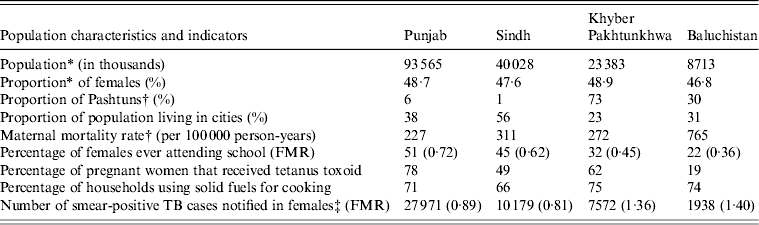
FMR, Female-to-male ratio.
* 2009 population estimates by the National Institute of Population Studies, Pakistan.
† 2007 estimates based on National Demographic and Health Survey, Pakistan.
‡ 2009 estimates based on the National TB programme data (TB07 forms).
Scatterplots of FMR in TB case notifications and each of the four study indicators did not show an apparent linearity (Fig. 3).
Scatterplots of female-to-male ratio of smear-positive tuberculosis cases with the four study indicators (education status, receiving tetanus toxoid during pregnancy, proportion using solid fuel, Pashtun ethnicity) according to the population size of sampling units.

The FMR of notified smear-positive TB cases was significantly higher in districts with a high proportion of women of Pashtun ethnicity and moderately higher in those with a medium proportion [FMR 0·44, 95% confidence interval (CI) 0·27–0·61; FMR 0·18, 95% CI −0·05 to 0·42, respectively], where low proportion of Pashtun ethnicity was the reference category. Districts with a high proportion of Pashtun ethnicity had 44% higher incidence of smear-positive TB in women compared to districts with a low proportion of Pashtun ethnicity, holding the effect of educational status, physical environment and access to healthcare constant. Districts with a medium proportion of Pashtun population were also positively associated with FMR of smear-positive TB cases compared to districts with a low proportion of Pashtun population; however, this was not statistically significant. None of the covariates had any statistically significant independent association with the FMR of smear-positive TB cases (Table 3).
Association (β coefficient with 95% confidence intervals) of Pashtun ethnicity with FMR of notified smear-positive TB cases

FMR, Female-to-male ratio; CI, confidence interval.
DISCUSSION
Concerns have been raised about proportionately higher TB case notifications in females in Afghanistan and parts of Pakistan and Iran (Pashtun region) where Pashtuns [Reference Ullah26] are the predominant ethno-linguistic group and several hypotheses have been proposed as an explanation [Reference Dogar3, Reference Alavi-Naini, Sharifi-Mood and Metanat4, 7, Reference Codlin11]. However, none of these have been tested using rigorous research designs. Our study, although ecological in design, adds further insight to this discussion and supports the hypothesis of a positive association between Pashtun ethnicity and higher FMR of notified pulmonary TB cases. Our findings also suggest possible association of the three pre-defined determinants of women's health with higher incidence of pulmonary TB in women compared to men in Pakistan, but the complexity of the data did not allow statistically significant inferences to be drawn. Of these determinants, a positive correlation was found with solid fuels used for cooking and a negative correlation was found with educational status and access to healthcare. We acknowledge that while future research could confirm our hypotheses, it should also study other unexplained associations.
Possible explanations for the gender disparity in TB notifications observed in Pashtun region could be due to differences in the presentation of pulmonary TB, health-seeking behaviour, and access to healthcare in women compared to men. However, in low-income countries, women with respiratory symptoms are less likely to attend an outpatient clinic, submit a sputum test for screening TB, and have a positive smear test result [Reference Long27–Reference Karim29]. Women tend to have a lower case detection rate for TB than men [Reference Thorson30], and suffer delays in reaching diagnosis even in places where prevalence of TB is similar in both genders. A gender insensitive healthcare system, poverty, and caring responsibilities of women lead to further diagnostic delays [Reference Allotey and Gyapong31]. A study in Nepal found that an active case-finding approach identified almost twice the number of TB cases in females than that identified with a passive approach [Reference Cassels32]. A trend analysis of TB notifications in Pakistan in the last decade found that, with expanding TB programme coverage, more female TB cases were reported [Reference Dogar3]. Our findings also suggest that access to healthcare is poorer in those areas where TB notifications are higher in women than men. In fact, it is likely that the true incidence of pulmonary TB in women may even be higher than that reported on the basis of case notifications in Pashtun region. It should also be noted that the under-reporting or over-reporting of TB cases is not likely to systematically bias the results of the study.
The association between pulmonary TB in women in Pashtun region and their education status, physical environment and access to healthcare is not surprising given the strong association between TB and socioeconomic determinants of health. Determinants such as lack of education through its link to the proximal risk factors of TB [Reference Knut33] make it more likely for a woman to acquire Mycobacterium tuberculosis infection; while others, i.e. physical environment [Reference Pérez-Padilla, Báez-Saldaña and Torres-Cruz34] make them more susceptible to develop TB. Differential distribution of labour and social roles have long been suggested as possible reasons for gender disparity in TB [Reference Hudelson35]. Women, compared to men, tend to take on a carer's role for the sick at home and therefore are more prone to acquire TB infection from other patients. However, there is no evidence to suggest that these determinants are more common in Pashtun women compared to those of other ethno-linguistic origins living in Pakistan. Similarly, women's predominant role in the kitchen could put them at a higher risk of acquiring TB compared to men if using solid fuels for cooking [Reference Lin, Ezzati and Murray36]. Our findings support this association.
Several studies on monozygotic and dizygotic twins clearly indicate that inheritable factors are involved in determining susceptibility and resistance to overt TB after infection [Reference Comstock37]. Therefore, the mechanism of ethnic differences in susceptibility to pulmonary TB can be an inherent susceptibility due to ethnicity per se, or it can be the result of a complex interaction between environmental, immunological and genetic factors [Reference Fares38]. Conditions leading to a poor immune response predispose to TB and a differential prevalence or response to these conditions (as in the case of HIV) could also offer an explanation for gender disparity in TB in the Pashtun region. However, the estimates of TB burden in Pakistan for 2011 showed very low incidence of TB-HIV co-infected cases [39]. Other common reasons for a low immune response in women are repeated pregnancies and poor nutritional status. However, there is no evidence that women in Pashtun region have either poorer nutritional status or higher fertility rates compared to women in other parts of Pakistan. The National Nutritional Survey conducted in 2011 in Pakistan did not identify any disparities in micronutrient levels (e.g. serum ferritin, vitamin D levels) in women between different provinces of Pakistan [40]. Age-specific fertility rates are also comparable across all four provinces in Pakistan with only Baluchistan showing a marginally higher fertility rate [41]. Specific genotypic factors of the host have been studied in TB and have shown that certain genotypes make people either susceptible or resistant to TB with differences on the basis of gender, age and ethnicity [Reference Ben-Selma42, Reference Shamaei43]. However, evidence from such genome-wide linkage and candidate gene studies is lacking for the Pashtun region. A recent cross-sectional analysis of TB data from Sindh (Pakistan) showed that female gender and Pashtun ethnicity were independently associated with higher risk of developing multi-drug resistant TB [Reference Ejaz44].
Our study has several inherent limitations. We relied on TB case notifications rather than the actual incidence of acquiring TB infection or disease. Such data were not available to us and this restricted our capacity to show true correlations. However, we used smear-positive pulmonary TB notifications in order to ensure uniformity of ascertainment. Since ecological studies rely on aggregates of population data, these are often criticized for their inherent bias (ecological fallacy) if used to infer causality. However, we used an ecological design to opportunistically study associations between routinely collected data in order to generate hypotheses which can be tested in future using robust longitudinal studies.
It is important to investigate the reasons behind high TB notification rates in women in Pashtun region due to the differential effect of TB on women. Compared to men, women with TB are more likely to suffer from faster disease progression, higher case fatality [Reference Uplekar45], stigma and discrimination, and worse socioeconomic consequences [Reference Connolly and Nunn46]. Stigma associated with TB negatively influences women's marital prospects and leads [Reference Somma47] to exaggerated concerns about TB transmission causing further social isolation [Reference Weiss48]. Moreover, TB in women has devastating influences on the welfare of the whole family especially young children [Reference Hudelson35]. Higher incidence of TB in women in Pashtun region compared to men can accentuate this gender disparity even further. Epidemiological studies are required using longitudinal study designs to ascertain causal relationships between potential determinants and the incidence of TB in women in this region.
ACKNOWLEDGEMENTS
The authors thank Kate Pickett (Professor of Epidemiology, University of York, UK) for reading and providing helpful edits to the manuscript, and Mona Kannan (Lecturer in Health Statistics, Health Sciences Department, University of York, UK) for her help in statistical data analysis.
This research received no specific grant from any funding agency, commercial or not-for-profit sectors.
DECLARATION OF INTEREST
None.



