




Well into the nineteenth century echoes still lingered in Mexico of a cannon foundry that had once operated in the Philippines, then linked to New Spain through the Acapulco galleon. During the Mexican War of Independence, an old bronze cannon cast in Manila was successfully used by insurgent forces in 1812, while another ancient Filipino piece was employed in October 1864 by Mexican militiamen against the French invaders. In their book, the nineteenth-century Mexican authors Andrés Cavo and Carlos María de Bustamante judged ‘the Manila foundry’ to be ‘the finest we are aware of’.Footnote 1 What factors led to the perception that these Filipino-made pieces were superior to those produced in the Iberian peninsula? What unknowns might surround their Asian manufacture?
From the beginning of the oceanic connection between New Spain (present-day Mexico) and the Philippines, a Hispanic route of exchange between global spaces was established, making the defence of newly acquired territories essential. In 1565, the same year the Hispanic Atlantic–Pacific connection began, the private bronze foundry of the Morel family, located in the San Bernardo neighbourhood of Seville, was contracted to supply all overseas weaponry by the Casa de Contratación, the royal institution that regulated trade and navigation with Spain’s overseas territories.Footnote 2
The weapons were to depart from Seville to New Spain via Veracruz, then be transported overland across the interior of the viceroyalty to the port of Acapulco, and from there shipped on galleons across the Pacific to the Philippines. The duration of the journey varied due to adverse weather conditions at sea. Once the ships reached their destination, the artillery pieces were disassembled and installed in fortified positions. There were considerable problems involved in supplying artillery on a trans-oceanic scale. In particular, I would like to propose that, with the outbreak of the Anglo-Spanish War (1585–1604), arms production capacity in the Iberian peninsula became overburdened, thereby hindering the supply of weaponry to the Pacific. Ultimately, the scarcity of weapons made them far more valuable than we might imagine; this is evident in the early practice of ‘artillery diving’, aimed at recovering armaments from sunken or scuttled ships.Footnote 3 For all these reasons, by the late sixteenth century, the Spanish Philippines was in a state of marked military vulnerability amid growing uncertainties and threats caused by the Imjin War (1592–8). These circumstances led to the establishment of a local royal foundry, strategically vital for preserving the commercial link with New Spain. During this period, several artisans crossed the Pacific to participate in these initiatives, including Hernando de los Ríos Coronel, a cleric, soldier, navigator and cosmographer who cast unique artillery pieces in 1598 in response to fears of a Japanese invasion.
Prologue: the Japanese threat
Following the Spanish foundation of Manila (1571), the conquistador Diego de Artieda recommended to King Philip II of Spain that diplomatic relations be established with Japan, within the broader framework of Hispanic ambitions to dominate East Asia.Footnote 4 Initially, both military and commercial strategies were considered, inspired by the Portuguese model. Certain officials and members of the clergy – such as Governor Francisco de Sande (1576), the Jesuit Gaspar Coelho and the Augustinian Francisco Ortega (1580) – even proposed the partial or complete conquest of Japan, with military support from the Philippines and New Spain. However, growing respect for Japanese military technology and organisation, as reflected, for instance, in the reports and correspondence of Governor Gonzalo Ronquillo de Peñalosa (16 June 1582), led to a reconsideration of these expansionist plans:Footnote 5 ‘The Japanese are the most warlike people around here. They bring artillery and many arquebuses and pikes. They use defensive armour for the body, all of which they have thanks to the ingenuity of the Portuguese, who have shown it to them to the detriment of their souls.’Footnote 6 In fact, when the Spanish captured Seludong (Pre-Hispanic Manila), they discovered that the native resistance included an artillery caster in the Portuguese style named Paulo, a baptised Japanese individual who wore a ‘Theatine’ robe (a long black cassock worn by members of the Catholic Theatine Order).Footnote 7 The episode illustrates a process of acculturation in warfare that emerged on the colonial margins as well as the weaponry expertise that the Japanese had quickly acquired.Footnote 8 In 1584, Francisco Manrique, prior and provincial vicar of the Order of St. Augustine, noted in his correspondence with King Philip II that ‘the people are very clean and polished in their attire, very warlike and brave, and equipped with all kinds of weapons – good arquebuses, lances, katanas that can cut a man in one strike, bows, arrows, morions, and breast and back armour.’Footnote 9 Given these capabilities in military technology, it is not surprising that Japan, from the perspective of the Spaniards coming from New Spain, shifted from being viewed as a viable target for conquest (comparable to any other in the West Indies) to a regional power that needed to be reckoned with.
The Japanese invasion of Korea in 1592, known as the Imjin War, marked a turning point in Japan’s external military projection under the leadership of Toyotomi Hideyoshi. Responding to Hideyoshi’s actions, and amid prior suspicions regarding Japanese activities in the Philippines, Governor Gómez Pérez Dasmariñas (r. 1590–93) ordered the confinement of the Japanese community in Manila to the district of Dilao and the confiscation of all their weapons.Footnote 10 Shortly after the landing of samurai forces in Pusan, a letter from Hideyoshi arrived in Manila demanding tribute under threat of reprisals. In response, the Spanish authorities organised a diplomatic mission, led by the Dominican friar Juan Cobo.Footnote 11
The meeting with Toyotomi Hideyoshi took place in Hizen-Nagoya in mid-1592, against this backdrop of rising tensions. Manila’s envoys met face to face with the man who had invaded Korea with thousands of arquebus-equipped troops and made threats against the Spanish Philippines. Seizing the moment, the Dominican friar warned Hideyoshi of the global power the Spanish could summon, if they wished – at least, this is how Friar Antonio de Remesal presented it in his Historia de la Provincia de S. Vicente de Chiapa y Guatemala:
Father Friar Juan spoke at great length about the greatness and power of the King of Spain, telling him how his vassals – the Portuguese in the East and the Castilians in the West – had discovered and encircled the entire world with fortresses and kingdoms of their own. So much so that, without needing to take ports in foreign kingdoms, the king’s ships and soldiers could traverse the entire circumference of the earth and sea from East to West. This, he said, was the greatest dominion and lordship that any king or prince on earth had ever achieved, for none had managed to accomplish such a feat.Footnote 12
In response, Hideyoshi denied any knowledge of the union of Portugal with the Spanish monarchy (1580), despite evidence indicating that he had been informed of it as early as 1583. His stance may be interpreted as a diplomatic strategy to resist Hispanic pressure. In fact, the dynastic union between Spain and Portugal did not result in an effective integration of their military forces, owing to mutual distrust and a lack of coordination. In this context, an Iberian naval expedition to Japan was hardly feasible, particularly during the early phases of maritime conflict with the Dutch.Footnote 13
The perceived threat of simultaneous naval aggression by Protestant powers and Japanese expansionism within the framework of the Imjin War led the colonial authorities to strengthen Manila’s defences, replacing its palisade with a stone wall. The same decade also saw the construction of major stone fortifications, alongside the development of military infrastructure including gunpowder production, infantry barracks, royal warehouses, an armoury, military shipyards and a royal artillery foundry. From a tactical standpoint, the primary interest of Juan Cobo’s embassy in 1592 was to gain as much time as possible while the construction of the Fort of Santiago was completed and the first large cannons produced at the newly established foundry of Manila were being tested.
For its part, Japan prior to 1592 had an estimated population of some twelve million people, a result of agricultural growth and political consolidation following decades of internal conflict. Under the leadership of Toyotomi Hideyoshi, the country possessed a solid military infrastructure that included armouries, foundries, hundreds of castles and fortified towns (jōkamachi), all equipped with complex defensive systems. Japanese weaponry extended to the widespread adoption of the arquebus (tanegashima or hinawajū) and various types of cannon; by 1592, the country had at its disposal hundreds of thousands of firearms. In addition, it developed powerful warships equipped with artillery, such as the atakebune. For the invasion of Korea, Hideyoshi managed to mobilise approximately 150,000 soldiers in the first wave, and up to 300,000 troops over the course of the conflict – demonstrating the high logistical capacity of Japan.Footnote 14
Faced with the military disadvantage of the Philippines in relation to Japan and following the disappearance of Father Cobo and his vessel off the coast of Taiwan – which left the outcome of the first Philippine embassy unknown – Governor Gómez Pérez Dasmariñas organised a second diplomatic mission in 1593, led by the Franciscan friar Pedro Bautista. This was followed the next year by a third embassy headed by Jerónimo de Jesús.Footnote 15 Japan’s shift from a threatening stance to a negotiation with Manila was undoubtedly influenced by its setbacks during the Imjin War. From the Japanese perspective, these embassies from Manila may be compared to those sent by Korea and Ming China, through which Hideyoshi sought recognition and status. The presence of an embassy could be seen as highly significant: although the Spanish governor may not have regarded it as tributary, it is likely that Toyotomi Hideyoshi interpreted it as such – or at least as having the potential to become so in the future. Both sides benefited from ambiguity, interpreting the embassy to suit their own interests.
Governor Dasmariñas also devised an approach to the Ming authorities, seeking their military support against Japan. However, the governor-general did not live to see it realised, as he was killed in 1593 by mutinous Chinese oarsmen en route to a planned expedition to the Moluccas. These events prompted the dispatch of Captain Fernando de Castro to Canton in order to apprehend the mutineers. Once on Chinese territory, he seized the opportunity to propose a Sino-Spanish military alliance to the imperial authorities against Hideyoshi’s invading forces. Meanwhile, the Japanese forces were retreating in the face of the Korean forces aided by Emperor Wanli’s Chinese army.Footnote 16 Perhaps because it no longer seemed necessary, the Chinese declined the Spanish offer of a military alliance.Footnote 17
In 1597, Hideyoshi’s military campaign on the Korean peninsula was renewed, and in February of that year Japanese officials carried out the execution of twenty-six Christians in Nagasaki on his orders. Under these circumstances, Governor-General Francisco Tello de Guzmán sent another embassy led by Luis Navarrete Fajardo. Hideyoshi’s death in 1598 alleviated the immediate threat of a Japanese invasion, although residual fears persisted. In the years following, Japan expressed an interest in collaborating with the Spanish to acquire knowledge in shipbuilding, motivated by the lessons learned during its naval defeats in the Imjin War. After he had established himself as Japan’s central authority in 1600, Tokugawa Ieyasu summoned the friar Jerónimo de Jesús to an audience. The friar had avoided execution in Nagasaki and remained in hiding in Japan. Tokugawa tasked him with re-establishing commercial relations with Manila, proposing a technical exchange in shipbuilding and the opening of Japanese ports to galleons from Acapulco. No agreement, however, ever came into being.Footnote 18
The Japanese invasions of Korea ended in complete withdrawal in December 1598 but left a lasting imprint on the military imagination of the following decades. The campaigns gave rise to a series of changes within the armies involved, some of which may even be regarded as revolutionary in character. For instance, the Koreans restructured their armies around infantry equipped with arquebuses, in response to the extensive Japanese deployment of this weapon during the war. In parallel, the superiority of Ming artillery compelled the Japanese to devise new tactics of ambush and rapid assault to offset their disadvantage.Footnote 19 From the perspective of those from the viceroyalty of New Spain, Spaniards in the Philippines gained a clearer understanding of Japan’s potential after the Imjin War. Despite its failed invasion of Korea, Japan itself seemed unconquerable. It had become a military power to be respected.
By 1610, Rodrigo de Vivero, a native of New Spain and the first Count of the Valley of Orizaba (in the province of Veracruz), who served as governor of the Philippines from June 1608 to April 1609, wrote in his report to King Philip III that conquering Korea would be far more feasible than attempting to subdue Japan. It seemed that the fanciful proposals which had proliferated in Manila and Mexico during the late sixteenth century had finally collided with reality. From that point onward, the Spanish in Asia – whether born in the American viceroyalty or in Europe – could no longer see themselves as successors to conquistadors such as Cortés or Pizarro. They had become fully aware, through comparison, that the military and technological capabilities of a unified Japan were vastly different from those of the peoples they had encountered in the Americas:
If they were like the Indians of New Spain, with their barbaric ways and customs, there would be little to fear from them. But they are people who use arquebuses, and they wield them with as much skill as the most experienced soldiers. They carry lances and arrows, lances and swords, and daggers they call katanas. And in this, they imitate the Spanish; in courage and diligence, they are no less, nor are they inferior in reason, intellect, or understanding.Footnote 20
The Manila artillery foundry: a consequence of the Imjin War?
The defensive technical system in the early days of Castilian Manila relied on the accumulated experience of local individuals who had previously produced weapons before the Spanish conquest of the city.Footnote 21 It is important to note that prior to the arrival of the Castilians in Luzon — the island on which Manila is located — the region was already familiar with the art of cannon manufacturing. However, the artillery factory of Seludong burned down in 1570 during the siege led by Goiti and Salcedo .Footnote 22 In the wake of this loss, authorities hired local inhabitants who could offer artisanal knowledge. I have mentioned that one of the two cannon foundries in Muslim Manila was run by a Japanese Christian named Paulo; the other was operated by a native known as Panday Pira. He had learned Malay-style manufacturing techniques decades earlier and was involved in the production of lantaka pieces until his death in 1576 during the governorship of Francisco de Sande (1575–80).Footnote 23 There are indications that his sons continued his work, albeit poorly, into the 1580s in a location outside of Manila that has yet to be precisely determined.Footnote 24 Evidence of its existence can be found in the Report of Diego de Zarate (preserved in the Archivo General de Indias in Seville) dated 6 June 1581:
Many tasks that I observe are of great harm to their persons … A foundry has been made for the King to produce artillery all at the expense of the natives, who even supply it with firewood, charcoal … and many other things, and are made to come to Manila in their own canoes at a moment’s notice for materials. They endure no small labour in extracting payment from the hands of the Royal officials. As a result, by order of the authorities, those summoned are subjected to much flogging and beating … and for the King, they are also made to cut much wood.Footnote 25
When the production and supply of indigenous weapons proved insufficient, Western technical knowledge and skills were introduced to the Philippines. In 1584, Manila only had fifteen ancient guns, and the newly founded city of Nueva Segovia had just five cannons.Footnote 26 Until at least 1586, the Robles brothers (Fabián and Damián), bell founders in Manila, worked as independent artisans repairing damaged artillery from the galleons and attempting to produce new weapons, while receiving supplies of lead, bronze, tin, iron, and wax. However, in June 1587 the viceroy of New Spain received orders from Madrid to promptly send a qualified founder to the Philippines, as the skills of the bell-making Robles family were insufficient to meet the demands of the settlement.Footnote 27
Manila’s [one l] merchants were the first to show interest in strengthening defensive systems to safeguard their interests better. They fervently pressured the Crown with constant requests for improved weaponry, gunpowder and fortifications. Manila and its galleons remained underprepared for an attack, a fact laid bare in 1588 when English pirates easily captured the galleon Santa Anna, which had been unarmed.Footnote 28
This European naval threat, together with the growing fear of a Japanese attack during the first phase of the Imjin War (1592–3), explains both the construction of the aforementioned solid stone wall to replace the earlier palisade and the development of a cannon foundry within the city’s walls. Footnote 29 From then on, this stone wall enclosed the grid-like urban layout radiating from the main square, with its interior traditionally referred to as Intramuros. In addition, a system of moats was excavated around the wall’s perimeter, stretching from the coastline south of the city to the banks of the Pasig river. It was an impressive system of fortification, featuring sentry boxes, parapets, and other defensive elements typical of the period, including drawbridges that spanned the moats, further isolating the urban enclosure from the surrounding territory. These works coincided with the construction of the first major stone fortifications, including the circular fort of Nuestra Señora de Guía and the massive fortress of Santiago (built with volcanic tuff stone and brick at the mouth of the Pasig river).Footnote 30 Other innovations included gunpowder production, alongside the establishment of a maestranza (a workshop for repairing gun carriages), an armoury, and royal warehouses.
By the end of 1591, the Royal Artillery Foundry of Manila was also established within an old house adjacent to the convent of San Agustín. The foundry was likely initiated by the sons of Panday Pira and the blacksmith Juan Rodríguez Carrillo, and by 1593 blacksmith master Fernando de Castilo was collaborating on the venture as well. To appreciate the scale of the artillery demand generated by these fortification projects, it is sufficient to note that Fort Santiago alone required some fifty cannon. The European-style fortification works in Manila kept the foundry busy for several years, as it strove to produce nearly 200 pieces deemed essential for an effective defence against invasion.Footnote 31
The impetus behind the Manila foundry can also be understood as resulting from the geopolitical context created by the Japanese invasion of Korea, particularly following the renewed hostilities of 1597–8. The Japanese threat helped to catalyse a concerted effort to strengthen Manila’s defensive and artillery capabilities. But even as new techniques and knowledge were introduced, securing the supplies necessary for production remained an issue.Footnote 32 In 1598, Governor Francisco de Tello sent Ioan Camudio to negotiate with Chinese merchants in Canton to acquire saltpetre and metals for the king’s works.Footnote 33 At roughly the same time, the Florentine merchant and explorer Francesco Carletti noted during his travels to Canton that copper, lead, tin, iron, and brass were purchased at advantageous prices for the production of weapons and tools.Footnote 34 Another account of the supply of materials comes from the Jesuit Pedro Chirino, who in his Relación de las Islas Filipinas y de lo que en ellas han hecho los padres de la Compañía de Jesús observed that China not only provided porcelain and silk but also supplied metals to the Philippines. Meanwhile, merchants purchased copper, saltpetre and steel swords from Japan.Footnote 35
Manila’s authorities in turn consistently expressed concern over the absence of significant mines in the islands.Footnote 36 There are no references to large copper or tin mining operations in the Philippines during the period, while iron was traditionally sourced from China, from Biscay (Spain), and to a lesser extent from Bengal and Siam.Footnote 37 The Hispanic settlement generally relied on Chinese tin and Japanese or Mexican copper to produce its bronze artillery. During the Iberian Union (1580–1640), ‘Calain’ (a fine tin) may have been imported from Macao or Malaca for the royal cannon foundry in the Philippines.Footnote 38
Financing for the cannon foundry did not necessarily come from ‘external’ sources such as the situado sent annually from New Spain as a means of supporting the Philippines’ strategic defence.Footnote 39 The extant evidence also highlights the importance of local financing through various mechanisms. The first involved taxing profits from gambling activities organized by the Sangley (Chinese) community during their New Year celebrations. Authorities used this source of revenue, known as the metua, as a means of supporting cannon founding without imposing any cost on the Royal Treasury.Footnote 40 Another likely source of revenue for Manila’s artillery production came from the government monopoly on the sale of buyo, a mixture of areca nut, lime rind and betel leaves that Filipino natives chewed as a stimulant.Footnote 41
The individuals who worked at the Royal Foundry bridged technical and cultural traditions, and their remuneration placed them within the artisan elite of the city. Table 1 lists the salaries of foundry workers c.1637; by comparison, other artisans of Manila (carpenters, etc.) received considerably lower wages, despite their guild membership. This was especially true for Sangleys, mestizos or Tagalog natives. Apprentices and journeymen earned between 3 and 6 pesos per month (or between 36 and 72 pesos annually), while master artisans received between 6 and 12 pesos monthly (72 and 144 annually). In Cavite, strategically important positions related to port operations were better paid and approached the salaries offered by the Royal Foundry of Intramuros, although as at the foundry Sangleys were generally better paid than the native workers. Master shipwrights could earn 1 peso per day, while caulkers and blacksmiths received between 1 and 1.5 pesos daily, on a par with senior positions at the foundry. Dock workers in Cavite received approximately half a peso per day, which was as good or better than their counterparts at the foundry, although many dock workers were indigenous people conscripted under the polo system (a rotational form of compulsory labour).Footnote 42
List of salaries at the artillery foundry, Manila
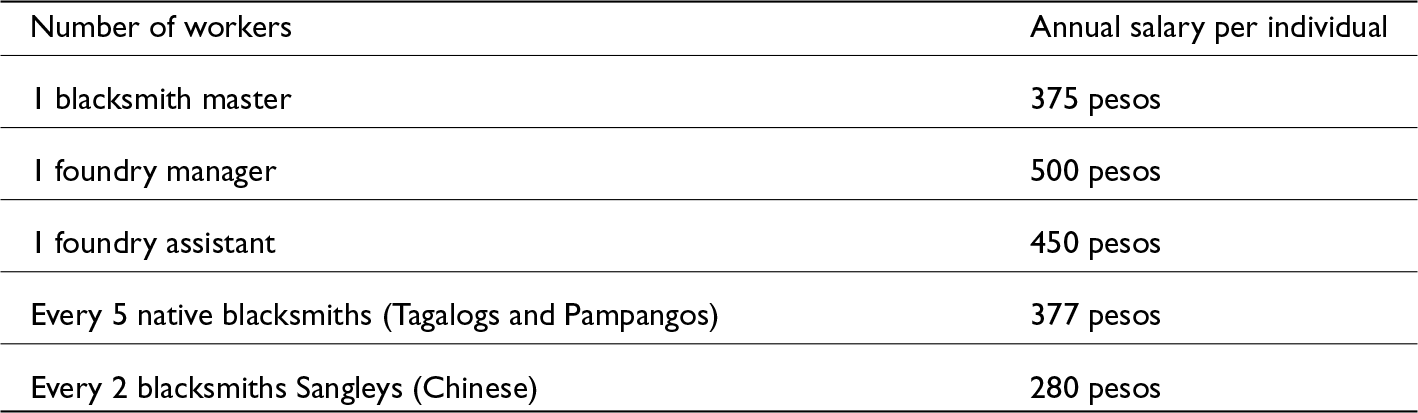
Source: Cesáreo Fernández Duro, Historia de la Armada española desde la unión de los reinos de Castilla y Aragón, iv (Madrid, 1896), 429−30.
When we consider the relationship between long-term production and maritime expansion, it becomes clear that the Manila foundry also supplied the naval artillery market. Artillery manufactured in the Philippines was mounted on local vessels used in naval campaigns against the Muslim kingdoms of the southern archipelago, as well as on the galleons that sailed the route to Acapulco. Upon arrival, some pieces were unloaded for use along the Pacific coasts of New Spain, from where they circulated even further afield.
Moreover, transoceanic production served as a driving force for the global circulation of technical handbooks. Iberian military manuals circulated in Asia, although the specific Spanish or European agents involved in their dissemination remain unknown. For instance, the ruler of Makassar (present-day Indonesia) possessed Spanish military manuals, including an artillery handbook written by Andrés Muñoz El Bueno (since 1593 Chief of Artillery to the Castilian Crown at the Casa de la Contratación in Seville), which was published in 1627 and later translated into the Makassarese language. An artillery manual written by the Spaniard Luis Collado (published in Italian in 1586 and in Spanish in 1592) was partially translated into Chinese, with its contents appearing in a Ming military treatise published between 1606 and 1630. Meanwhile, a treatise on cannon casting authored by the conquistador Sarmiento de Gamboa (1530–92) was in circulation in the Philippines.Footnote 43
In Hispanic frontier areas such as the Philippines, the technical expertise of the master founder represented a direct relationship with the monarchy and served as an initial point of contact with the western European world, fostering its identification with technical advancements in weaponry or military tactics. As a result, certain privileges were offered to foundry craftsmen in addition to remuneration, such as the right to choose their successors, rations in kind, and allotments of cargo space on the galleon to Acapulco, which conferred both prestige and advantageous job opportunities. These arrangements, in turn, helped project a coherent and triumphant image of the Spanish Catholic monarchy, regardless of whether this image corresponded to a reality marked, at times, by considerable uncertainty. Such was the case during the Imjin War, when the fear of a possible Japanese invasion of the Philippines fostered an unprecedented convergence between the technical and artisanal knowledge of the Iberian master founder and the specialised labour of non-European artisans on the margins of the Spanish monarchy.Footnote 44
Fusions and circulations: Ríos Coronel and the Manila gun foundry
The arrival of the Andalusian Hernando de los Ríos Coronel in Manila in May 1588 marked a turning point for artillery manufacture in the Philippines. A soldier who had subsequently trained as a navigator at the Casa de Contratación in Seville, Ríos Coronel served as a pilot on a transatlantic voyage which docked at Veracruz. It is not known exactly how long he stayed in Veracruz or in Mexico City, but he set sail from Acapulco at the beginning of 1588 aboard the galleon Santiago, along with a group of Dominican friars.Footnote 45
Philippine authorities soon recognised Ríos Coronel’s intelligence and made use of his technical skills. He participated in Governor Gómez Pérez Dasmariñas’s failed 1593 expedition to the Moluccas and developed strong political relationships with the Sangley community as a result. As John Newsome suggests, it seems probable that Ríos Coronel spoke Chinese, which would have enabled him to collaborate with skilled Sangley artisans. Perhaps, for this reason, during the governorship of Luis Pérez Dasmariñas (1593–96), Manila authorities tasked Ríos Coronel with hiring and supervising a Chinese sculptor to cast a statue of ‘Our Lady of the Rosary’.Footnote 46 Building on this successful precedent, Ríos Coronel decided to venture into the field of military technology by manufacturing large cannons. Unlike previous founders, he not only relied on Tagalog and Castilian technological expertise but incorporated the labour of Chinese residents eager to join forces against a potential Japanese invasion. This marked a milestone in production and gave global significance to a transoceanic, mestizo artillery technology originating in the Philippines.
In a letter dated 22 June 1598, Ríos Coronel reported to King Philip II on his progress in drafting a book on a type of astrolabe he had invented. He noted that he had already completed the first part but progress was interrupted due to the threat of a Japanese invasion during the Imjin War. The danger instead compelled him to manufacture cannon with the help of Chinese auxiliaries – the first recorded instance of Sangley artisans casting bronze cannon in the Hispanic style. This convergence of experienced labour and transcontinental metal supplies produced cannon widely acknowledged for their superior quality – an enduring legacy of the Imjin War, whose effects extended across temporal and geographical boundaries. Ríos Coronel summarised these events as follows:
I was writing a book on the use of an astrolabe, [an] invention that I understand will benefit the republic, given the great need for such things. Although the many tasks with which the president of these islands, Don Francisco Tello, occupied me might have excused me, I have used my time as best I could. With great effort, I have finished the first part … As for the flat navigation charts, I have not been able to complete them fully. This is because recently news arrived that Japan was advancing upon this city, and we were still without artillery – so essential for our defence –, even though the governor had spent many pesos from His Majesty’s Royal Treasury to cast it … Seeing this, I offered my services using a method I have [with] the Chinese, and I undertook the said casting work with them. It has been about two months since I started, and in one [month], I cast six pieces, continuing to cast them at a very low cost … at twenty-four reales per worked quintal.Footnote 47
The result was artillery pieces often described as equal or superior in quality to those produced at the Royal Cannon Foundry of Seville – a view that endured well into the next century. Governor reports continued to refer to the quality and advantages of the Manila guns throughout the 1600s. Both Pedro de Acuña in 1603 and Gabriel de Curucelaegui in 1688 had ‘good experience with the pieces’.Footnote 48
The bronze cannon casting techniques developed by the Chinese during this period were comparable to those of Europe. Indeed, Ming and early Qing iron casting methods were sometimes even considered superior. At the time, European artillery differed from Chinese models primarily due to ‘Frankish’ innovations, such as breech-loading mechanisms and longer barrel bores which enhanced accuracy. General technological parity facilitated mutual adoption and gave rise to artillery pieces combining the best of European and East Asian traditions – enriched, in this case, with raw materials sourced from the New World.Footnote 49
Bearing in mind that the cost of molten metal could represent more than two-thirds of the total cost of a newly manufactured cannon, the figures provided by Ríos Coronel indicate that the price of worked bronze in Manila (expressed in reales per quintal cast) was considerably lower than that of the Seville foundry. By the late sixteenth century, the cost of a bronze cannon produced in Spain was around 42 reales per quintal of worked bronze – a figure that rose by the mid-seventeenth century to between 180 and 200 reales.Footnote 50 Therefore, aside from their high quality, it is highly probable that another advantage of the artillery produced in the Philippines was its low cost, resulting from access to Asian metal markets.
The metals most commonly used in the casting process included iron from Vizcaya and Siam, Mexican copper from the province of Michoacán, Japanese ‘red’ copper, Chinese tin, and the ‘calain’, obtained from Macao and Malacca. In addition to this unique blend of metals from Asia and the Americas, the human factor was equally significant. Regrettably, the identities of most workers are absent from the Spanish primary sources. Only the name of the master founder in office, or occasionally that of an assistant founder, was recorded. Other labourers remain anonymous, referred to merely as aggregated numbers categorised according to the colonial caste system. Nonetheless, the sources confirm the presence of a diverse labour force comprising indios (Tagalogs and Pampangos), Europeans, Sangleys and coerced workers from New Spain.Footnote 51
Just as the raw materials moved, so too did technical agents, establishing connections and transcending borders in unexpected ways. Between 3 and 5 October 1603, barely five years after Ríos Coronel’s report to the royal court, a rebellion by the Chinese community in Manila broke out. The uprising provoked a massacre of the Chinese population by Hispanic authorities, and these violent events convinced many Sangley residents to leave the island of Luzon altogether. Among the exiles were carpenters, blacksmiths and artisans who had gained experience in Manila’s foundries. Many settled in the coastal province of Fujian on the Chinese mainland, and their presence eventually attracted the attention of Ming authorities.Footnote 52
In 1619, the Deputy Director of Military Affairs in Beijing Huang Kezuan (a native of Fujian), initiated a plan to reverse engineer artillery pieces by systematically recruiting artisans with experience in the techniques for manufacturing Spanish-style bronze cannons at the Royal Foundry of Manila. Beijing officials such as Guan Yingzhen knew that Manila cannons had caused numerous Chinese casualties during the 1603 Luzon Massacre. Some pieces had already been successfully replicated in Fujian. In the decade following the military commissioner of Liaodong, Xiong Tingbi, was asked to dispatch fourteen skilled artisans from coastal Fujian to the imperial capital’s weapons manufacturing bureau. The resulting cannon were then transferred to the northern frontier. By July 1620, a total of twenty-eight bronze cannons in the ‘Luzon style’ had been cast.Footnote 53
These Chinese cannon modelled on their Hispanic counterparts were called Lüsong pao (Lüsong for the Philippine island of Luzon, and pao for cannon). However, the cannon manufactured in the arsenals of the imperial capital were apparently of lesser quality – perhaps due to the absence of Iberian oversight or because the Chinese artisans who had worked at the Manila foundry were low-skilled labourers who lacked the opportunity to acquire the requisite technical precision or detailed knowledge of the designs. The absence of metals from the Americas may have also been a contributing factor to the perceived drop in quality. The fourteen Chinese founders brought to Beijing came from the cities of Tong’an and Quanzhou in Fujian province. Only one name has been preserved: that of a founder, Zeng Shen, whose name is inscribed on the sole surviving Lüsong pao, now kept in the storerooms of the former Royal Artillery Museum (UK). Nevertheless, the conditions along the frontier made it imperative that the armaments project proceed. Footnote 54
With these weapons, the Ming armies confronted the advance of the Jurchen nomadic forces led by Nurhaci along the northern frontier. Although the Jurchen troops were composed mainly of mounted archers and lacked firearms, their swift and well-coordinated assault tactics ultimately outmatched the technical arsenal assembled by the Chinese – their ammunition, various types of cannon, war carts, rockets and arquebuses.Footnote 55 The scholar Huang Yi-Long has argued that these factors explain the Jurchen victory over the Ming. The Ming’s failure to accurately replicate Spanish cannon and deploy them effectively in time for the pivotal 1619 battle of Sarhu and in subsequent battles throughout 1621 must be added to this list. This failure probably directly contributed to the Ming defeats at Shenyang and Liaoyang. Huang also challenged the widespread notion in Chinese historiography that the large-scale introduction of muzzle-loading European artillery was based solely on Jesuit models from Macau, promoted by the bureaucrat Xu Guangqi (a collaborator of the Jesuit Matteo Ricci). Rather, the Ming plan to manufacture Spanish-style cannons in Beijing predated this initiative, albeit with unfavourable outcomes.Footnote 56
Another consequence in China of the artillery technology developed in the Philippines during this period may have been its influence upon the establishment of the Macao Portuguese foundry in 1620, through the recruitment of craftsmen previously employed in the Manila foundry – a hypothesis that requires more detailed investigation. The design of the Portuguese Fort São Tiago and its artillery in Macao also served as a model for later fortification projects during the late Ming period.Footnote 57
One might present this as a typical example of unidirectional technical transfer from Western Europe to East Asia, mediated via Mexico and Macao, situated within the traditional historiographical paradigm of Western technological superiority. However, it is worth recalling that the so-called ‘Spanish-type’ cannon modelled in Manila were in fact based on the labour and technical expertise of non-Hispanic individuals. Indeed, the global history of the Manila foundry also takes us into other unexpected directions. Two centuries later, between February and March 1804, the Prussian traveller Alexander von Humboldt travelled along the Atlantic coast of New Spain and visited the coastal fortress of San Juan de Ulúa, off the city of Veracruz. He recorded in his Ensayo político sobre la Nueva España a discovery that he found both mystifying and fascinating, namely the presence of Asian cannon cast in the Philippines which had made their way to this key Atlantic port:
Among the artillery of the San Juan de Ulúa fortress in Veracruz, some cannon cast in Manila were discovered. Since it was known that before the year 1767, the Spaniards travelling to the Philippine Islands did not round the Cape of Good Hope or Cape Horn, and that since the first expeditions of Magellan and Loaisa, which had departed from Spain, all trade with Asia was conducted via the Acapulco galleon, it was inconceivable how these cannons had crossed the Mexican continent to be transported from Manila to the San Juan de Ulúa fortress. The great difficulty of the route from Acapulco to Mexico City, then to Jalapa and Veracruz, made it unlikely that they had come that way. Through extensive inquiries, it was discovered, both from the chronicle of Tehuantepec written by Father Burgoa and from traditions preserved among the inhabitants of the Isthmus of Coatzacoalcos, that these cannons, cast on the island of Luzon and unloaded at the San Francisco bar, had been taken up the Bay of Santa Teresa and the Chimalapa river. They were then transported to the Malpaso river through the Chivela estate and the Tarifa forest, and, having been re-embarked, were carried down the Coatzacoalcos river to its mouth in the Gulf of Mexico.Footnote 58
Why transport cannon from Manila to Veracruz by sea and land? Why carry them eastward across the breadth of New Spain? Sourcing them from the Royal Cannon Foundry in Seville would have been a more straightforward endeavour that involved only a single, shorter Atlantic crossing. In contrast, moving cannon from Manila required a true transoceanic route that demanded interoceanic and local coordination, including collaboration with indigenous communities in the Isthmus of Tehuantepec. Perhaps the decision was compelled by wartime contingency, when production in the Iberian peninsula was constrained or the Atlantic crossing was not secure.
In fact, the archival record demonstrates that Asian artillery was highly valued by the viceregal authorities in Mexico City and that the movement of cannon from the Philippines – crafted by Chinese (Sangleys), Tagalog and Iberian hands – continued until the early decades of the eighteenth century. In 1731, the Secretary of Council of the Indies, Juan Ventura Maturana, requested information on the operational status of the Manila foundry. The Castellan of Cavite, Juan de Barahona Velázquez, confirmed that the foundry remained active within one of the city’s bastions. Barahona also mentioned that some of the older cannon in the New Spanish port of Acapulco may have been cast in the Philippines in the past. Based on this information, on 5 August 1731, the viceroy of New Spain, Juan de Acuña, Marquess of Casa Fuerte, was instructed to coordinate with the Governor of the Philippines in the casting of ten bronze cannon to be sent to New Spain aboard the galleon. However, the destination was not a Pacific port, but the fortress of San Juan de Ulúa in Veracruz as New Spain’s principal Atlantic fortification. To this end, it was proposed that they be transported across the Isthmus of Tehuantepec.Footnote 59
When did the mobilisation of this Asian artillery to the Atlantic begin? It is likely that this transoceanic circulation commenced at some point during the first half of the seventeenth century. Following the Sangley revolt of 1603, cannon casting in Manila resumed from 1614 onwards, albeit with a change of location from the house adjacent to the church of the Discalced Augustinians to a property next to the ‘old fort’ at the southern corner of the city wall.Footnote 60 The oldest reference to date regarding the transport of cannons from the Pacific to the Atlantic across the Isthmus of Tehuantepec appears in Fray Francisco de Burgoa’s Geográfica descripción, originally published in 1674: ‘from the South Sea to the North Sea (i.e. west to east across New Spain), it is about thirty leagues … from Tehuantepec to the port of [Coatzacoalcos], at the mouth of a mighty river of the same name, where rigging and artillery were customarily unloaded’.Footnote 61
Conclusion: a global aftermath
While the Imjin War cannot be taken as the sole cause of the establishment of the Royal Foundry in the Philippines – concurrent fears of naval attacks on the galleons by the English or Dutch, as well as frontier incursions from Muslim kingdoms in the southern archipelago, must also be acknowledged – it was nevertheless a major catalyst. The anxiety that the Philippines might become the next target of Japanese military expansion led to the emergence of cannon casting in Manila as a geopolitical, economic, technological and symbolic solution, in keeping with a Catholic monarchy that perceived itself as universal.
That large artillery pieces from the Philippines were repeatedly transferred across the Isthmus of Tehuantepec to the Atlantic region of the viceroyalty of New Spain is evident but further investigation is required to complete the picture. Additional transnational research is needed into the interoceanic transfer and circulation of technical knowledge. The mobilisation of these valuable cannon to the coast of Veracruz – cast in Manila by Chinese (Sangley), Iberian and Tagalog communities – continued into the early eighteenth century. This extraordinary transcontinental movement ran in parallel with the dissemination of technical expertise to the Ming imperial capital and China’s northern frontier.
The fear of the military capabilities of Hideyoshi’s Japan, particularly as demonstrated during the Korean campaigns, accelerated the construction of Manila’s fortifications and underscored the need for local armament self-sufficiency. Consequently, it fostered a strategic alliance between Chinese artisanship, the technical direction of Iberian master founders, and an indigenous labour base. Hernando de los Ríos Coronel stood at the centre of this process, marking the beginning of a broader technological mestizaje. Nevertheless, the continued production of the Manila foundry had to adapt to the shifting tides of Spanish imperial economic policy, maritime wartime contingencies, and the foreign policies of Asian suppliers of metal, whose resources combined with those of the Americas.
The artillery pieces from the Royal Foundry of Manila were considered exemplary by the Ming dynasty and were also held in high regard in the viceroyalty of New Spain – to the extent that they were still remembered in Mexico, even after national independence. Several of these distinctive cannon remained in the fortress of San Juan de Ulúa until they were seized as war trophies by the French navy during its second military intervention in Mexico (1862–7). They were transported to Brest and later taken to Paris, eventually becoming part of the collection of the Musée de l’Armée (Les Invalides). At present, a pair of these bronze pieces are still preserved in restricted storage inside the French army’s ‘Joffre Drouot’ military base in Versailles.Footnote 62
On the other side of the Atlantic, one of these Filipino pieces has also been preserved in the small local museum of my hometown, Veracruz, Mexico. However, it remains inadequately catalogued, relegated to a dusty corner and often overlooked by the few tourists who visit. This article has brought to light the technical expertise, cross-cultural collaboration, and global journey that created this remarkable object and carried it there.
Acknowledgements
I would like to thank the anonymous reviewers for their comments; Ana María Hernández, head of the Philippines section at the AGI in Seville; and especially Joshua Batts and Barend Noordam for their patience and scientific leadership. I am grateful to Ting Tiew-wee for assisting with the translation of articles in Chinese and to Christophe Pommier, curator of the artillery department at the Musée de l’Armée in Paris. I acknowledge the academic support of Red Columnaria (Universidad de Murcia), CSG-Red Imperial (Universidad de Navarra) and Red Filipiniana (Universidad Autónoma de México).

 Open access

