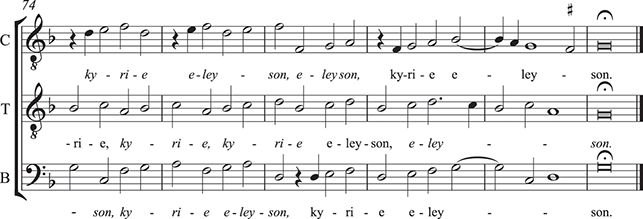
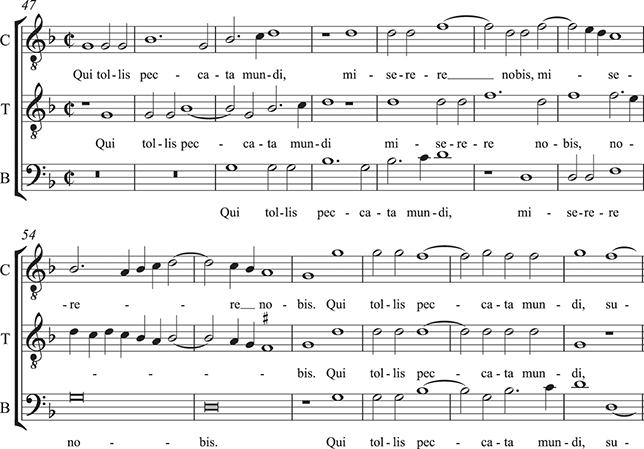
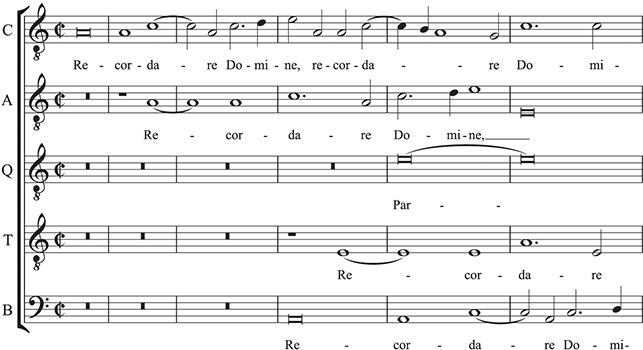
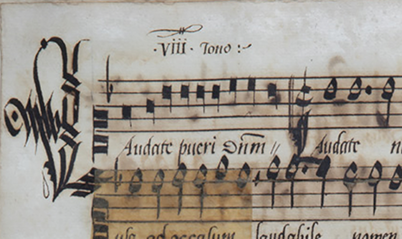
1 Introduction
This Element is inspired by a book: the Biffoli-Sostegni manuscript, MS 27766 of the Bibliothèque du Conservatoire royal de Bruxelles, a fragile but not insubstantial manuscript of music that was acquired in the early years of the twentieth century. Nothing is known of its whereabouts in the nineteenth century. Perhaps it changed hands more than once, circulating in private collections before it was purchased by the library. Nonetheless, we can be certain that it was created in Florence in the sixteenth century; it may have remained there until the early 1800s, when Napoleon’s authorities abolished almost all of Italy’s convents and confiscated their property.
The possessions of Renaissance religious institutions still in existence today are always precious, since so much has been lost or destroyed. Yet the Biffoli-Sostegni manuscript is even more special, since it is the only surviving volume of sixteenth-century polyphony that verifiably began its life in a convent. There are fewer than two dozen manuscripts of convent polyphony remaining from before the beginning of the sixteenth century, mostly from the fifteenth century; and about the same number of prints associated with nuns, mostly from the last quarter of the sixteenth century (Yardley Reference Yardley, Bowers and Tick1986, 26–27; Stras Reference Stras2017a, 196–97).
This scarcity of material makes any source consequential, but it also brings with it the danger of moving from the specific to the general: while it is possible to mine the manuscript for every scrap of information, what it tells us may be more relevant to the musical culture of its original institution than it is to sixteenth-century convent music in the wider sense. But at the very least, the manuscript becomes a proof of concept – that even a modest convent outside of a city centre could have a rich musical life.
1.1 The Manuscript and Its Origins
The Biffoli-Sostegni manuscript is bound in leather and copied on ruled and folded carte reale, approximately A3 size (420 mm x 280 mm). There are 170 leaves in the book, of which 166 have writing on at least one side. The front and back covers both once held an oval medallion, on which was painted a coat of arms (the back medallion is missing). Around each medallion space is embossed a name, in Latin: Sorori Angiolete de Biffolis and Sorori Clementie de Sostegnis – ‘to Suor Agnoleta Biffoli’ and ‘to Suor Clemenzia Sostegni’. The manuscript is loosely organised into two sections, each beginning with a setting of the Mass Ordinary: sixty-six works in four voices (this section also interpolates a three-voice work), then ten three-voice works. A fragment of a two-voice work is copied on a page left blank by the copyist at the end of the book.Footnote 1 The works range in complexity and length, from the strictly homophonic to dense polyphony, including vernacular song, antiphons, responsories, litanies, alternatim psalms and Magnificats for Vespers, and the masses.
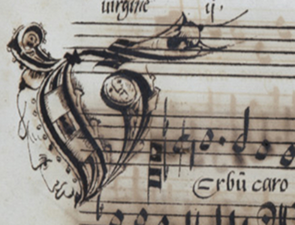
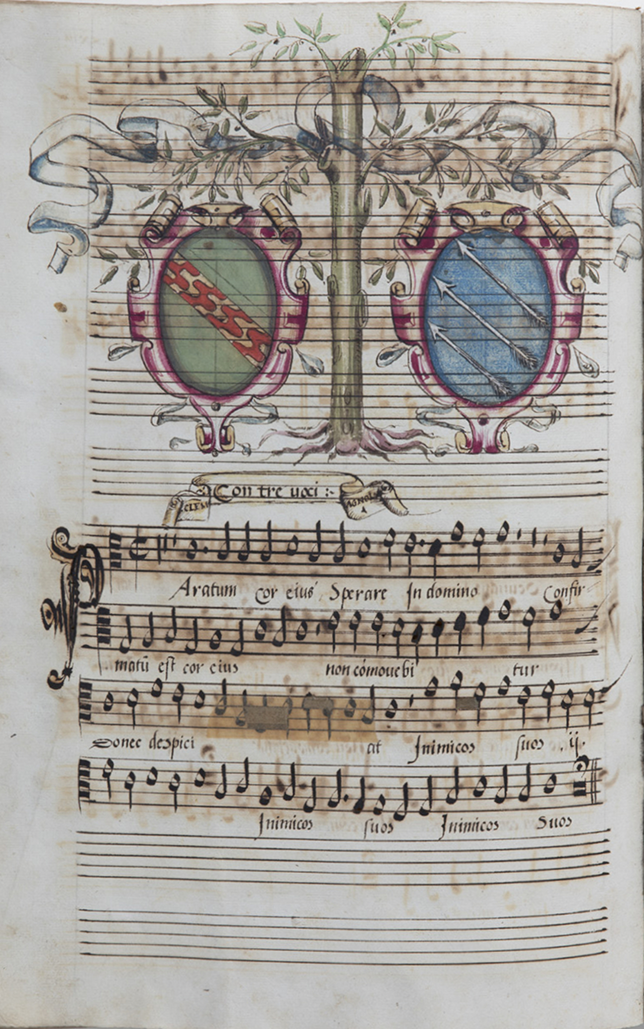
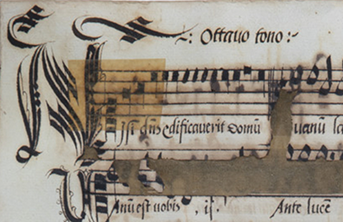
The music is written in choirbook format, with beautiful filigree initials – called ’cadels’ – at the beginning of each separate piece or section. Male grotesques adorn many cadels, but from a few, nuns’ faces peer out, some in the act of singing (Figure 1). Some cadels are decorated further with yellow colour, and on a single page, a larger pen and colour drawing depicts the women’s coats of arms hanging in an olive tree (Figure 2). Many cadels contain tiny inscriptions that both celebrate the nuns and give us further clues about the book’s genesis: the date 1560, and the principal copyist’s name, Antonius Morus – a Latinised form of Antonio Mori, or Moro.Footnote 2
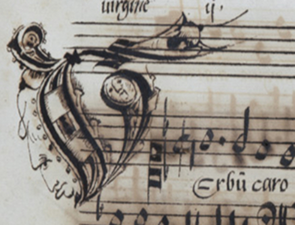
Figure 1 B-Bc MS 27766, 64v: Verbum caro factum est, Tenor, singing nun (Bibliothèque du Conservatoire royal de Bruxelles).
Figure 1Long description
The image shows a small section of a sixteenth-century music manuscript, with a large and ornate letter V at the beginning of two staff systems of music. It opens the word ‘Verbum’, with the rest of the word underlying music to its right. The music is written in the same ink as the letter; it has a rectangular c-clef on the bottom line of the staff, and two flats on the space and line that indicate the notes ‘b’. Above the letter V, the end of another part’s text, with the word ‘uirgine’ and the abbreviation ‘ij.’, is visible.
The left-hand side of the V is a shallow ‘s’ shape, with vertical and horizontal bands. The extreme left is decorated with a male grotesque face in profile, with a heavy triangular brow, sharp, long nose, and a protruding lower lip. The right-hand side of the V is slightly smaller; it curves up from the bottom and widens to form a round space at the top. In the round space, a woman’s face appears to be singing; the thicker lines of the letter seem to form her veil, with a thinner line creating a wimple. The left side of the V has a horizontal extension over the right that ends with a floral flourish.
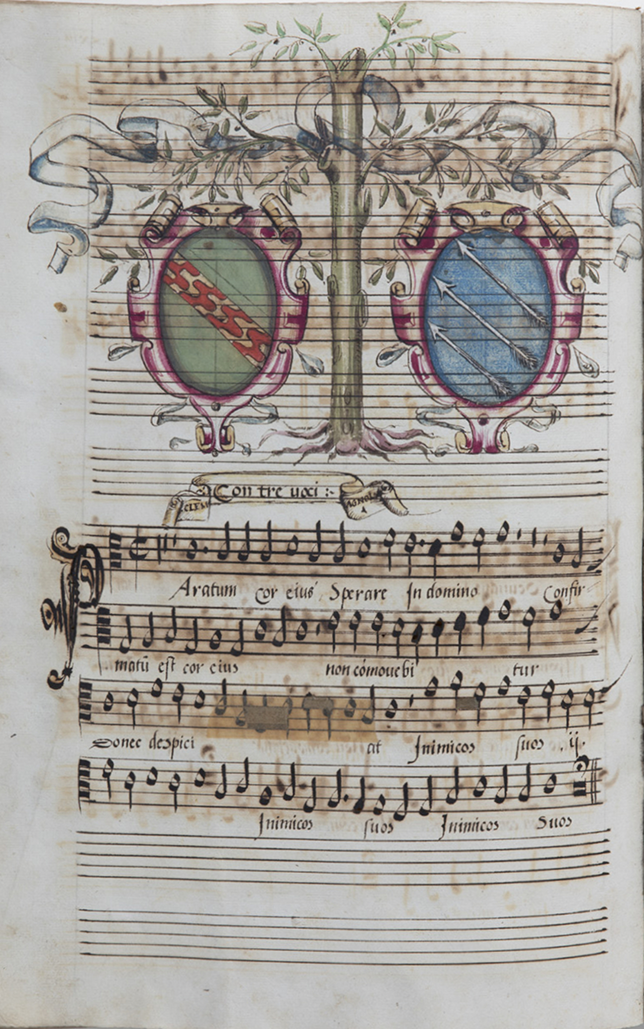
Figure 2 B-Bc MS 27766, 23v: the Biffoli and Sostegni coats of arms (Bibliothèque du Conservatoire royal de Bruxelles).
Figure 2Long description
The image shows a full page of a sixteenth-century music manuscript paper, with twelve hand-ruled staves. There is a pen and watercolour drawing over the top six staves. It is of an olive tree with a central trunk and four branches near the top, around which is wrapped a blue banderole that extends the full width of the page. On either side of the trunk is a coat of arms in a pink and gold escutcheon. The left-hand arms have a green background, with a red and gold diagonal band running downwards left to right. The right-hand arms have a blue background with three silver arrows pointing upwards diagonally right to left.
Beneath the tree is a central banderole shaded with yellow watercolour. On the left-hand edge fold are the letters CLEM; on the right-hand fold are the letters AGNOLE with an A tucked underneath. In the centre of the banderole are the words “Con tre voci :-”
There is music on the seventh to tenth staves. To the left of the seventh and eighth staves is a large letter P. The staves all begin with a C clef on the third line of the staff. The text under the music is “Paratum cor eius, sperare in domino Confirmatum est cor eius, non co[m]movebitur Donec despiciat inimicos suos.”The eleventh and twelfth staves are left blank.
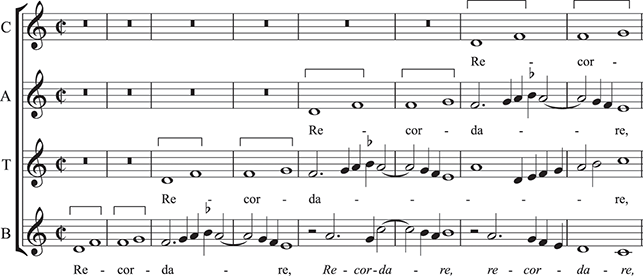
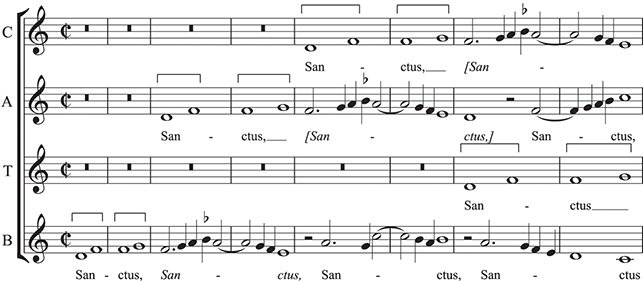
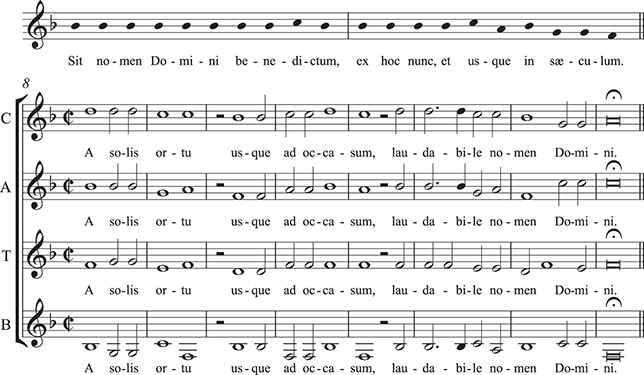
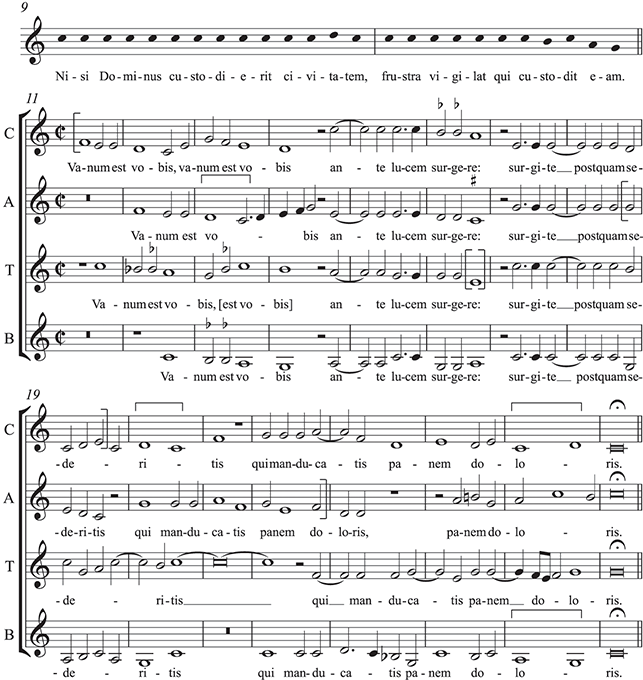
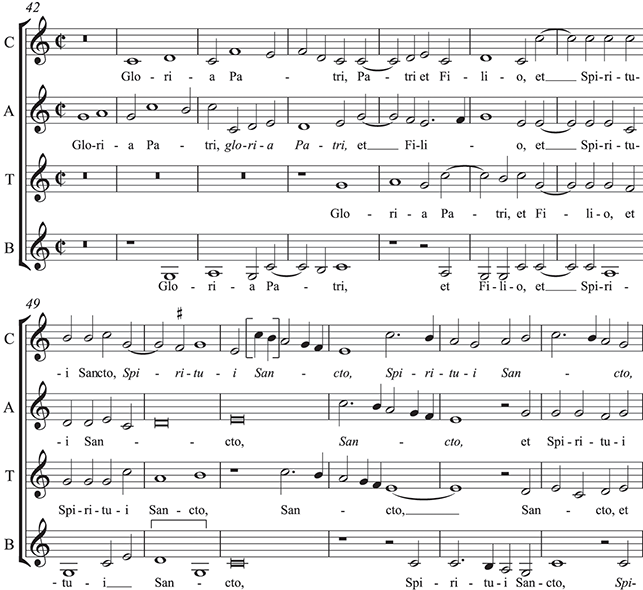
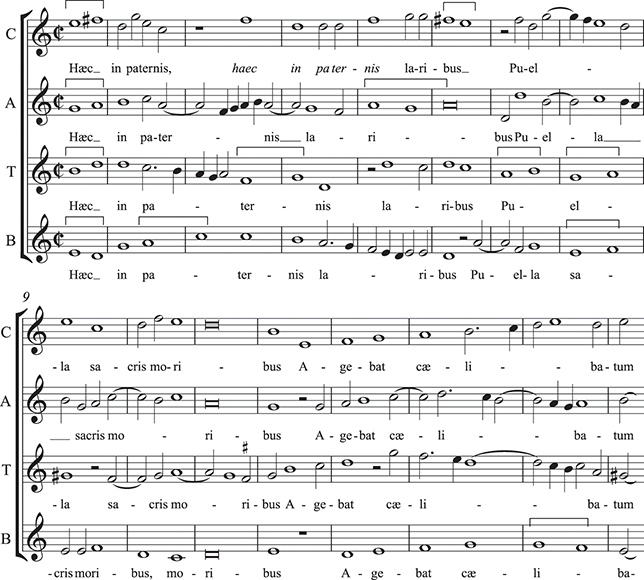
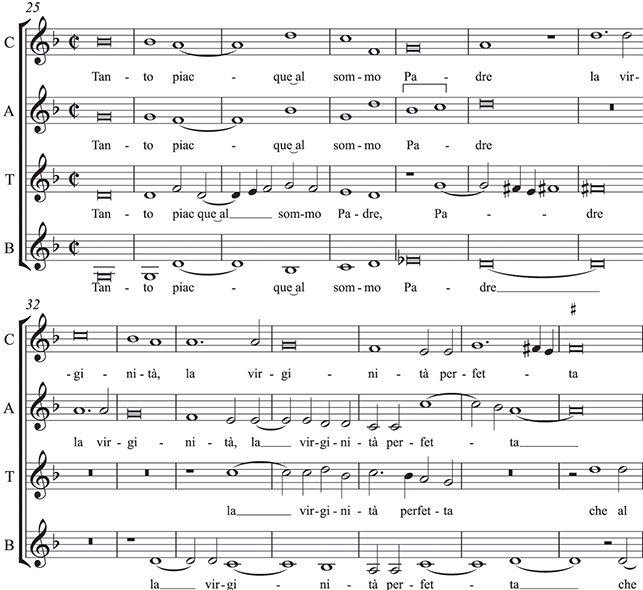
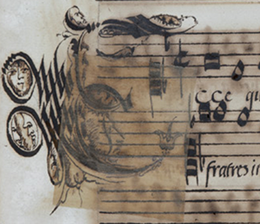
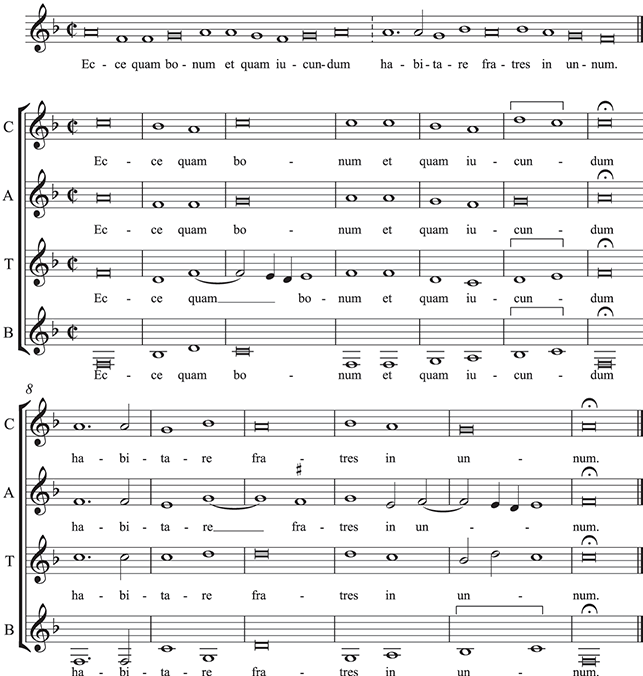
Most of the music is anonymous, with only three composers’ names attached to a handful of works – Moro himself, Francesco Bocchini, and Adriano Willaert. As beautiful as the manuscript is, however, its materials have not easily stood the test of time: the acid in the iron gall ink has eaten away the paper in many places, leaving patches of some pages disintegrating into dust.Footnote 3 This damage has meant that, for the purposes of musicological study and performance, many of the pieces have needed reconstruction, ranging from single notes to extended passages in multiple parts: in the music examples, editorial reconstruction is indicated by vertical square brackets.
The manuscript is not a new discovery: nearly 100 years ago, Charles van den Borren, librarian of the Brussels Conservatoire, noticed the names of the two nuns on its binding and surmised that it came from a Florentine convent (van den Borren Reference Borren1934, 23–26). In 1996, the Italian musicologist Lucia Boscolo published a detailed codicological study, together with an expanded inventory identifying liturgical usage and concordances (Boscolo Reference Boscolo1996).Footnote 4 British scholar Iain Fenlon and American scholar James Haar identified that the copyist, Antonio Moro, had also produced a handful of other important sources of early sixteenth-century secular and sacred music (Fenlon and Haar Reference Fenlon and Haar1988, 127).
I began looking at the Biffoli-Sostegni manuscript in 2015, when I was trying to understand the musical context for another group of works I felt sure had been composed for nuns (Stras Reference Stras2017a; Reference Stras2017b; Reference Stras2018). The names of the two nuns on the binding are from Florentine families, and the set of antiphons for St Clare convinced everyone who had written about the book that it was prepared for a convent of Poor Clares – the second, female order of the Franciscans. However, no further work had been done to establish which Florentine Clarissan convent was home to Suor Agnoleta and Suor Clemenzia.
Close to the beginning of the manuscript, the copyist placed music that suggested the convent could be dedicated to an Apostle: a hymn for the feasts of the Apostles and the Vespers psalms for the Common of Saints. Only two Clarissan convents in Florence fit this description: the rich San Jacopo in via Ghibbelina, right in the centre of town, and the less prestigious San Matteo in Arcetri, which was some distance outside the city. Close to the end of the manuscript, however, is a setting of the Gospel reading for the Feast of St Matthew, which is a rather more substantial clue, as convents would have wanted dedicated music to use for their patronal feast. And indeed, in 2020 I found both Suor Clemenzia and Suor Agnoleta in what remains of San Matteo’s papers. Having identified the manuscript’s origins, I could use other materials preserved in other archives to learn who Suor Agnoleta and Suor Clemenzia were, to understand the world in which they lived, and to place their music in a much clearer context.
The manuscript’s connection to San Matteo also links it to one of the convent’s, and Florence’s, most famous nuns, Suor Maria Celeste Galilei, the eldest daughter of Galileo Galilei. Although Galileo was a scientist, most of his family, including Suor Maria Celeste, were musicians. From the time she entered San Matteo in 1612, Suor Maria Celeste would have been part of the convent’s musical forces, and towards the end of her life she was responsible for the choir. The music of the Biffoli-Sostegni manuscript provides more insight into Suor Maria Celeste’s daily existence and the few references to music in the letters she wrote to her father.
While the manuscript’s historical implications are fascinating in themselves, its contents are also hugely important to the understanding of women’s music-making at the end of the European Renaissance. The works relate to a full range of musical events, from everyday prayers and hymns to the most solemn of the convent’s feasts. There is also a wide range of compositional styles and performance requirements, from very simple harmonisations suitable for people with only the most basic training, to complex polyphony only within the reach of virtuoso singers. The manuscript is clearly dated 1560, but some of the works were composed decades earlier, perhaps even in the fifteenth century. All are for either three or four equal voices, that is, to be sung by a single-sex ensemble of equal maturity, and many appear to have been composed specifically for nuns – perhaps even for (or by) the nuns of San Matteo.
1.2 The Other Primary Sources
The archive of San Matteo in Arcetri is now held by the Archivio di Stato in Florence. It is not large and consists mostly of documents relating to legal disputes from the seventeenth and eighteenth centuries, and the dissolution of the convent by the Napoleonic authorities in 1808. One of the two remaining bundles of exclusively sixteenth-century documents was irretrievably damaged by the disastrous flood of the Arno in 1966. However, the other, a large vellum-bound volume with the word Ricordanze embellished on its cover, is well preserved.Footnote 5 It contains ricordi (or memos) of major financial transactions dating from as early as 1519, with a more organised, itemised ledger beginning in 1530 and ending in 1563. There are further random entries dated into the 1570s, as if the scribe had run out of space elsewhere and just needed a place to preserve some notes.
The Ricordanze contains details of the convent’s household income and expenses, recorded by the convent’s chamberlains (camerlinghe). Crucially, this includes the names of girls entering the convent as choir nuns (monache), servant nuns (serviglie), and boarders (in serbanza).Footnote 6 These entries contain information about the date and, the girl’s family – generally the name of the parent, grandparent, uncle, or aunt placing her in the convent and making her dowry payment. Sometimes, additional payments were made for the girl to have a maestra – a nun who provided for her spiritual and pastoral needs, as well as her education – or for the clothing ceremony, or vestition, in which she received the habit (and perhaps a new name) and took the vows of a novice, and by which she officially moved from her secular to her religious family.
The Ricordanze also provides a vivid record of the expenses for feast days, and for the convent’s testatory obligations: prayers, masses, and other devotions said on behalf of individuals who had given money or property to the convent, normally in their wills, to ensure their souls’ swift passage through purgatory and on to Heaven after death. A much later Sbozzo degli Obblighi (literally, Sketch of Obligations) compiled in 1694 gives details of all the obligations still celebrated by the convent, some of which were established in the fifteenth century.Footnote 7 It serves as a useful cross-reference to some of the entries in the Ricordanze, as well as proof that the nuns were still musically active into the late seventeenth century.
Apart from these two separately bound sources, the records of the Deputati sopra i monasteri and loose bundles of legal documents from San Matteo, also housed in the Archivio di Stato, have helped me to understand the chronology of some of the nuns at the convent. The records of sixteenth- and early seventeenth-century convents’ admissions, professions (the solemnisation of a nun’s vows), and visitations (diocesan inspections) in the Archivio Arcivescovile in Florence are far from complete, but still provide essential information. Various writings by Alessandro de’ Medici, who was Archbishop of Florence between 1574 and 1605, outline the ever more constricting rules for convent life and worship; these include both loose memos and his 1601 Trattato sopra il governo dei monasteri, distributed in manuscript, which formed the practical and ideological basis for many subsequent restrictions on Florence’s convents.Footnote 8
The letters of Suor Maria Celeste Galilei, which span the years between 1623 and her death in 1634, provide detail and context. They exist in various different editions, both Italian and English, as well as digital photographs in an online resource hosted by the Museo Galileo.Footnote 9 The latest source I have used is San Matteo’s Constituzioni, newly printed in 1713; while this version introduces a seventeenth-century theological concept, the nun’s individual Guardian Angel, that would not have been familiar to Suor Agnoleta and Suor Clemenzia, it outlines rules and behaviours consistent with similar sixteenth-century constitutions (Francescani 1713).
Many of the convent’s sources have a memorialising function, both in terms of preserving information and stimulating the memory of people and events. The liturgy works like this, too: not only does the Divine Office repeat daily and weekly, and the whole liturgical cycle return annually, but also the chant melodies and reciting tones are shared, repeated, transformed, so that the nuns’ singing bodies and minds were constantly stimulated by a musical and textual resonance. Sound and memory are constants in religious discipline. With sources spanning over 200 years, any unified concept of daily life at the convent is bound to be wildly conjectural, but I am reminded of the time I spent at the convent of Poor Clares in Arundel in the 2010s, to which I retreated once a month to write my book on women and music in sixteenth-century Ferrara. So much seemed familiar from my sixteenth-century sources. While the hours of the Divine Office now happen at different times of the day, they are still manifested by voices and instruments. When sitting in an external parlour, I could sometimes hear a single nun practising her singing. The sisters still play games of their own devising at community celebrations; they still put on dramatisations of saints’ lives for their most important feasts. There is still a Great Silence, and there is still an Angelus bell.
2 Historical Context for the Biffoli-Sostegni Manuscript
The ex-convent of San Matteo, once governed by the Franciscan rule of St Clare, sits in the hills of Arcetri about a mile south of the medieval walls of Florence. Only the church exterior and a small courtyard remain of the original buildings. It is hard to overemphasise the bucolic peace of the landscape, barely a forty-five-minute walk from the busy city centre. For centuries, the area has been known for its Verdea wine, produced in the vineyards once worked by the convent. In the 1980s, the historian Giovanni Spadolini said: ‘It is a hill that has remained more or less as it was in the fifteenth and sixteenth centuries. With the same cramped and impassable streets: it is impossible to move forward, in two senses. … A place dear to youthful amazement and enchantment’ (Spadolini Reference Spadolini1984, 140).
In the sixteenth century, Arcetri provided several important Florentine families with a place of repose, and an opportunity to indulge cultural pursuits.Footnote 10 In 1565, the composer Giovanni Animuccia dedicated a book of madrigals to two sons of the Neri family, suggesting the boys could sing through them while escaping the heat of the summer city: ‘When you are, in this hot season, either wearied by more serious study or exhausted by more tiring activities, or when you are truly transported to that Paradise of Arcetri, [these works] will give you some relaxation’ (Animuccia Reference Animuccia1565, Aii).Footnote 11 In the same year, the Villa del Poggio Baroncelli, half a mile from San Matteo, was given by Cosimo I de’ Medici to his daughter Isabella de’ Medici Orsini, an accomplished musician and patron of the composer Maddalena Casulana, and it soon became her favoured residence and a hub of creative activity.
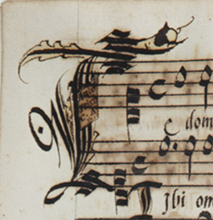
The Biffoli-Sostegni manuscript shows that these echoes of secular music-making in Arcetri of the mid sixteenth century were complemented by the sound of women singing chant and polyphony behind the enclosed walls of San Matteo. Suor Clemenzia and Suor Agnoleta arrived at the convent at a time when it was undergoing renewal and expansion in the 1540s, as Florence itself settled into what would become almost two more centuries of Medici rule. Like many of the choir nuns at their convent, Suor Clemenzia and Suor Agnoleta came from Florentine minor nobility: Suor Clemenzia’s father Roberto was a Medicean administrator, and Suor Agnoleta’s father Francesco was a merchant. The manuscript does not make clear the relationship between the two women, although an inscription in the decorations, ‘ambo felice, C. A. S.’ (‘both happy, Clemenzia, Agnoleta Sorores’) – at the beginning of the hymn of thanksgiving Te Deum laudamus – suggests that it was close (Figure 3). Created almost twenty years after Suor Clemenzia’s entry, the manuscript may have been a collective gift to the community from the two nuns, one that commemorated their friendship, the convent’s mid century prosperity, and its musical identity.Footnote 12 Understanding its music requires a brief summary of the convent’s history in the decades prior to the manuscript’s commission, establishing a context for the works and their potential meanings for the nuns.
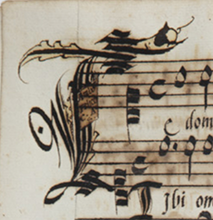
Figure 3 B-Bc 27766, 36v: Te Deum laudamus, Cantus, ‘T’ inscription ‘Ambo felice, C. A. S.’ (Bibliothèque du Conservatoire royal de Bruxelles).
Figure 3Long description
The image shows a small section of a sixteenth-century music manuscript, with a large letter T at the beginning of two staff systems of music. The music is written in a c-clef on the bottom line of the staff. The letter begins with the word ‘Te’ and underneath, on the second line of music, is the word ‘Tibi’. The T has a small plaque on its upright, on which is inscribed the words, ‘Ambo felice, C.A.S’. There is a light yellow water colour on the plaque.
2.1 A Decade of Recovery: San Matteo in the 1530s
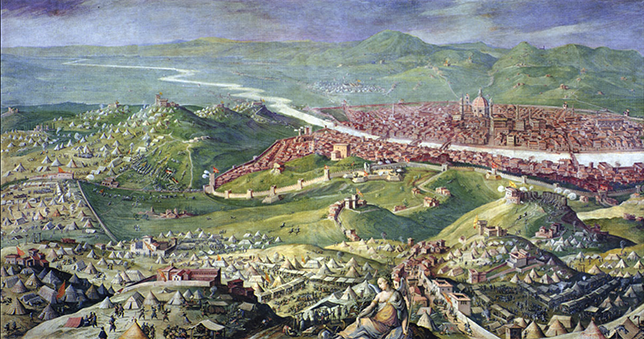
In late summer 1529, the peace of Arcetri was shattered by the arrival of Spanish and Imperial troops, who set camp all along the southern hills. They began the ten-month long Siege of Florence, which eventually restored the Medici family to power. Giorgio Vasari’s painting of the siege, housed in the Palazzo Vecchio, clearly shows San Matteo in the foreground, with troops exercising outside its walls (Figure 4). While some convents closer to the city were destroyed to prevent them providing shelter to enemy troops, San Matteo was merely evacuated to the house of Medici loyalist Bartolomeo Capponi, which had been commandeered by the republicans.Footnote 13
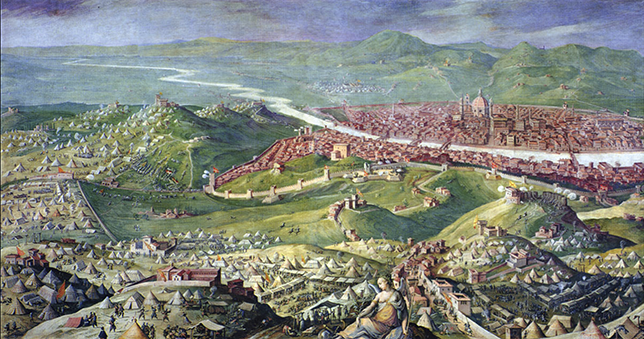
Figure 4 Giorgio Vasari, The Siege of Florence (1556–1562), Sala di Clemente VII, Palazzo Vecchio, Florence (public domain).
Figure 4Long description
The image shows a panoramic view of the city of Florence as the artist imagined in to be during the Siege of 1529-1530. The view is looking north over the river, which runs from the top left-hand corner to just above the mid-point of the right-hand side of the painting. In the distance, there are green hills and a smaller city (perhaps Prato?). The dense city of Florence takes up most of the top right-hand quarter of the painting, its south-west corner extending into the left-hand side. It is possible to identify the cathedral, Santa Maria Novella, Santa Croce, and the bridges across the river. The city walls are visible, curling down the south-west hillside, enclosing a smaller great area. At the bottom edge, in the middle, is a representation of the goddess Flora, sitting with her legs outstretched to the left, holding a palm in her right hand, a staff in her left. She wears a yellow dress, and her right breast is exposed.
Beyond the walls, occupying most of the top left-hand quarter and bottom half of the painting, are many tents, erected in the grounds of multiple buildings and in fields. Soldiers can be seen performing drills among the tents. In the foreground of the left-hand bottom quarter is a walled compound with a church and a bell-gable. The church has a small round window at the top of its front wall, and two larger rectangular windows (this is what identifies it as San Matteo in Arcetri). Soldiers are exercising outside the tents in front of the convent.
When the nuns returned to Arcetri at the end of summer 1530, there was significant work to do on the convent estate, cleaning everything, emptying the wells, reroofing properties, and rebuilding boundary walls. But they also had to bury and commemorate their dead: seven nuns, including the abbess Piera dei Giardelli, died of the plague between 16 August and 15 September, probably brought back from their shelter in Florence. The entries for their masses and offices are the first potential indications of music in the convent’s Ricordanze. In subsequent years, masses are itemised by the name of the deceased nun: here, there are just too many.
In the first eight months after their return, the nuns relied financially on alms from city government, borrowing or begging from donors, a small number of rents, and the sale of a pair of chickens, walnuts and almonds from the remaining trees, and, disturbingly, the mattresses and bedlinen of the dead nuns. Portions of two dowries, for Chiara Rondinelli and Caterina Anselmi, are also recorded, suggesting that these two girls had only recently joined the convent. The expenses to the end of the year (the Florentine new year began on 25 March, the Feast of the Annunciation of the Blessed Virgin Mary) are heavy with the costs of moving, rededicating the church, and repairs across the convent’s entire estate, including all the farms, cottages, and commercial buildings, and – of course – the costs of burials and commemorations. The entries for 1531 show some early signs of recovery: the nuns add earnings from the sale of grain and livestock, from unspecified manual labour, and from spinning. And alongside the funeral masses, the nuns begin again to celebrate their most important sacred feasts: the joint celebration of San Lorenzo and Santa Chiara in August 1531, at which the friars – who had come to celebrate Mass – and the nuns are served eggs, cheese, salad, and beans, with a special ounce of pepper; and the following month when the friars return to celebrate the Feast of San Matteo, they extend resources to buy veal.
A sense of continuity emerges from the pages of the Ricordanze which, as surely as the liturgy turns and renews through the church year, charts the convent’s feast days, greater and lesser, with details of the food and provisions purchased for the nuns, the convent’s famiglia (the seculars who served the convent), and the friars who came to celebrate Mass. As the decade progresses, and their debts accrued during the siege are paid off, expenses for more feasts appear in the books: New Year at Annunciation; Passion Sunday; Palm Sunday; Maundy Thursday, Easter and its Octave; Pentecost, San Giovanni Battista; San Lorenzo and Santa Chiara (on consecutive days, but Chiara is a double feast); the Assumption; San Matteo; San Francesco; the Immaculate Conception of the Blessed Virgin Mary (hereafter BVM); and Christmas. They note more local and non-liturgical celebrations, such as Berlinghaccio (Maundy Thursday), Calendimaggio (May Day), and the Corpus Christi procession of the Compagnia della Santa Annunziata from San Felice.
The orderly progression of the Ricordanze is also reflected in the way obligations recur, notably an ufficio dei morti and masses on the Feast of San Matteo for the soul of one Corsino Amidei, that was established as early as 1318 (Repetti Reference Repetti1845, 163). However, when the Duke of Florence, Cosimo I de’ Medici, introduced a new governance structure for the city’s convents in 1545, the Ricordanze underwent a major change: significantly, it no longer recorded external income to the convent for obligations and payments for the celebrant friars. Presumably, the new rules meant the Ricordanze became one of several accounting books, now recording only household expenses, and that income and expenses derived from external liturgical duties were subsequently kept by the sacristy. Nevertheless, the expenses for feeding the friars are still noted. Moreover, any income and expenses incurred from within the community remain in the Ricordanze, so it is possible to track both new entrants and exits (i.e. deaths), as well as any obligations created by the nuns themselves, such as the masses for the plague nuns, for a Suor Arcangiola de Bartoli (d. 1536) and a Suor Angioletta dei Soldini (d. 1548). The obligation for Suor Arcangiola in 1551 includes the Ricordanze’s only clear payment to a musician, one ‘Bartolomeo sonatore’, probably an organist.Footnote 14
Obligations were not just endowed for the dead. On 16 March 1541, the bell-gable of San Matteo’s church was struck by lightning.Footnote 15 Lighting strikes were common and often deadly, as happened in November 1506, when two nuns in Santa Caterina were killed (Landucci Reference Landucci and Badia1883, 279). In gratitude that no one was injured nor extensive damage sustained, the abbess Suor Dianora de Parigi endowed in perpetuity a Mass of the Immaculate Conception, to be sung annually with the participation of six fratini (boy novices) and their maestro.Footnote 16
Around dinner time when the lighting hit the bell-gable and by the grace of God we survived with our persons and goods, the reverend mother abbess and the whole convent have in their heart to have celebrated every year on the day mentioned above a mass of the conception with six [boy] novices and their master, and to feed the said novices.Footnote 17
In the records for every subsequent year in the Ricordanze, the event is referred to as the ‘messa de’ novizii’ or the ‘messa de’ fratini’, with notes of both income of alms specifically for the Mass and the additional expenses of feeding the novices and paying the celebrant.
The 1694 Sbozzo confirms that a Mass of the Immaculate Conception was still being celebrated on the anniversary of the strike, but there is no longer any mention of boys:
The Reverend Sisters of San Matteo in Arcetri must every year, on 16 March, unless this is a Sunday, in which case it should be the following Monday, have sung in their church the Mass of the Immaculate Conception of the Virgin Mary, and this for the vow made by the same, since on 16 March 1540, on which day at the seventeenth hour when the Benediction had been made, the nuns were at table, lightning struck their bell-gable, and by the grace of God no harm was done to any person or any goods, and this is the origin and the cause why, every year at the stated time, for thanks and the preservation in the future from similar perils, the said Mass must be sung, by loose memoranda seen, and by the word of the same reverend mothers.
A Mass of the Immaculate Conception of the Virgin Mary, every year on the day 16 March, unless it is a Sunday, in which case the next Monday.Footnote 18
The provision for boys is unusual: Suor Dianora may have felt her choir was not sufficiently grand, or she may have needed additional vocal forces for the Mass, since numbers at the convent were still so depleted after the plague. The 1478 census shows that San Matteo housed thirty-two ‘bocche’ (mouths to feed) (Strocchia Reference Strocchia2009, 21), but in 1535, there were only sixteen choir nuns and eight novices, twenty-four in total.Footnote 19 By 1540, their number had increased to twenty-eight: there were three recorded deaths, but seven more girls had joined the convent and some of the 1535 novices had surely professed to become choir nuns. This would seem a large enough number from which produce an adequate choir, but the old and infirm were excused from choral duties, and the youngest may not have been ready to join in polyphony. It took another five years for the convent to return to its 1478 capacity: in 1545, there were thirty-one choir nuns and a single novice.Footnote 20
The pressure of work on community members must have been considerable in these years. Each woman would hold a variety of posts during her life. Elected abbesses appointed other officers to help them run the convent: at minimum, a sacristan in charge of the church and its contents; two chamberlains overseeing the estate and household finances; a choir mistress to oversee the singing of the Holy Office; an infirmary mistress; and a novice mistress. In addition, on top of her daily responsibility to the choir, every nun would have contributed to the convent’s productivity through skilled collective labour, like spinning, and more individual expertise as apothecaries, scribes, musicians, lace-makers, and so on. The oldest, frailest nuns would chaperone external visits in the parlour. Moreover, young girls who were accepted to become choir nuns were placed with a maestra, an older woman who would provide both formal spiritual instruction and pastoral care to her discepola.Footnote 21 Throughout the 1530s and still into the 1540s, there were fewer experienced nuns to shoulder the heaviest burdens.
In 1545, Cosimo I created the Deputati sopra i monasteri, four commissioners who worked directly for the duke, and who appointed trustees to oversee the secular affairs of every convent. Although he overtly left the matter of spiritual government of the convents to archbishops, friars, and diocesan officials, his commissioners and the trustees oversaw all finances, estates, and secular employees, in effect removing absolute agency from the abbess. Trustees were also supposed to ensure that convents did not become overcrowded: in San Matteo’s case, the recruitment of new nuns had to be balanced with the acquisition or construction of new convent buildings.
Nonetheless, after the struggle of the 1530s, by the mid 1540s San Matteo’s financial position had stabilised. It produced wine and textiles, collected rents from its portfolio of shops and farms, and sent grain to the mill it owned with a consortium of other institutions. The convent’s burgeoning prosperity up to the conclusion of the Council of Trent in 1563 (when the Ricordanze’s regular accounts stop) is shown in several ways: the constant payments for new building work, and the nuns’ success in resourcing it through personal donations; the frequency of additional purchases of food for the celebration of feast days – and the quantity and variety of that food; and last, the rapid growth in the number of nuns towards the end of the period. Between 1540 and 1563, there are only seven recorded deaths, but thirty novices are recruited, nine them between 1560 and 1563 alone (more than in the entire decade of the 1540s). By 1563 there are thirty-eight nuns and ten novices, welcoming the priests necessary for sung mass almost every month with meats; poultry; cured sausage; cheeses; eggs; artichokes; fennel and other greens; spices such as cinnamon, ginger, and saffron; cherries and figs; and sugar for making migliacci (sweet cakes made with pigs’ blood). The abundance is particularly noticeable at Carnival and Carnevalino (the period before Advent), contrasting with the more modest fare of eels, dried fish, and kale appropriate for Lent and Advent.
Undoubtedly, the material comforts listed in the accounts are only one side of a more complex story – life in sixteenth-century convents was hard, involving permanent separation from loved ones, hours of manual labour, more hours of singing in the choir, and not a lot of sleep. But this is the world for which the Biffoli-Sostegni manuscript was created in 1560, and it is hard to resist the thought that the musical environment it reveals was also part of the attraction of San Matteo to the families of the nine girls who joined the convent in the subsequent three years.
2.2 Dramatis personæ in the Manuscript
There are very few names in the Biffoli-Sostegni manuscript to which any kind of documentary evidence can be attached. The copyist and composer Antonio Moro, and the donor nuns Suor Clemenzia Sostegni and Suor Agnoleta Biffoli, are the most prominent, but there are also two further composers, Adriano Willaert and Francesco Bocchini, and one other woman, Maddalena, whose names appear.
There is plenty of biographical information available about Adriano Willaert (c. 1490–1562). He was arguably one of the most famous musicians of the first half of the century and was still alive at the time the manuscript was copied, but since his work was so widely available in print, the copyist would not have needed a direct connection to him in order to include his music. Francesco Bocchini is a more obscure figure: he became organist and maestro di cappella at the cathedral in Pisa in 1556, and went on to serve in the same capacity as a cavaliere sacerdote for the Order of Santo Stefano in Pisa in 1571 (Baggiani Reference Baggiani1982, 275–76). Two pieces are attributed to him: Sancta Maria succurre miseris (with the name ‘Franc.o Bocchino’ on 46r) and In illo tempore: Thomas (with ‘Bocchinus meus F.’ on 64r). Although Bocchini is known to have composed many other pieces, these are the only two that survive with his name attached.
Antonio Moro is now best known as the copyist of two other important manuscripts, the Vallicelliana partbooks (I-Rva 35–40) and the ‘P.M.’ manuscript of Lamentations (I-Fn II.I.285), as well as a single Discantus partbook of madrigals (B-Bc 27731). All his work is associated with Florentine patrons. His earliest sources probably date from the late 1520s or early 1530s; the Lamentations manuscript was copied in 1559, the year before the Biffoli-Sostegni manuscript. He signals that one motet in the Biffoli-Sostegni manuscript is his own composition (Sancta Maria succurre miseris, 41v–43r). Nothing else is known about this mysterious man, whose work has nonetheless contributed so much to our current understanding of Florentine music in the sixteenth century.
On 8 July 1541, Clemenzia Sostegni was accepted to become a nun (per monaca) at San Matteo. The Ricordanze notes that her father’s name is Ruberto and that her dowry of 120 fiorini was to be paid in instalments. The first payment included 100 fiorini with an additional eight paid to her maestra, Suor Caterina Anselmi, for furniture and clothing (‘fornimento’). Although the Sostegni had been among Florence’s elite for centuries, Suor Clemenzia’s immediate family are relatively obscure. A Roberto Sostegni appears briefly in the history of Florence’s continued political upheaval: first, in 1537 as a freshly appointed minor official in the civil service of the new duke Cosimo I, and then later that year as the commander of the fortress of the Rocco di Castrocaro, the location of a recent dangerous uprising against Cosimo (Ridolfi Reference Ridolfi1958, 562; Verna and Zaccaria Reference Verna and Zaccaria2018, 54). It may or may not be a coincidence that the commissario of Castrocaro who had suppressed the revolt was Bartolomeo Capponi, in whose house the nuns of San Matteo had sheltered during the siege. Six months later, Maddalena di Giovanni di Ser Piero Sini entered the convent on 20 January 1542. Her dowry of 141 fiorini was paid by her grandfather, and she was allocated Suor Antonia Mori as her maestra.Footnote 22 She was abbess of the convent in the 1590s, serving at least one term just prior to Suor Clemenzia.
On 12 May 1548, Agnoleta Biffoli was accepted per monaca, with a dowry of 156 fiorini, of which forty were for her furnishings and clothing, and for her ‘sacrazione’ or profession – an unusual instance of this expense being paid up front, perhaps indicating that she was slightly older than other girls entering the convent, since profession could happen only once a girl had turned sixteen. Her father is named as Francesco; another document in the archive gives her mother’s name as Lisabetta.Footnote 23 A Francesco di Giovanbattista Biffoli is named in the 1532 Florentine census, living in the quarter of Santa Croce, so this is perhaps her father. When her sister Caterina, who took the name of Suor Cassandra at profession (so as not to confuse her with Suor Caterina Anselmi), joined the convent the following year, his name is given as Francesco di Giovanbattista Biffoli, mercciaio, and his wife’s name is given as Maria. It may be that Caterina was much younger than Agnoleta, since she did not profess until 1558.
2.3 San Matteo at the Turn of the 1600s
The household records of the Ricordanze stop in 1563, perhaps coincidentally the year of the final session of the Council of Trent. It contains a few sporadic notes, up to 1572, of specific donations towards building costs relating to individual nuns – usually given on the occasion of the nun’s profession.Footnote 24 There is little in the archives to fill in the history of San Matteo before the turn of the seventeenth century apart from the records of legal disputes. A brief window is opened between 1599 and 1602, during which time Suor Clemenzia was abbess, revealing her struggles to keep the convent financially stable. She was a key witness in a suit against the convent’s procurator, who was accused of mismanaging the convent’s estate to his own benefit. She also attempted, unsuccessfully, to get permission from the archbishop to sell two unprofitable, flood-prone, and distant farms to raise capital to purchase land from a Florentine magistrate which, she said, would provide all the grain and wine the convent needed. The archbishop’s response counselled against selling Church land and buying secular land, which would be subject to a different tax regime.Footnote 25
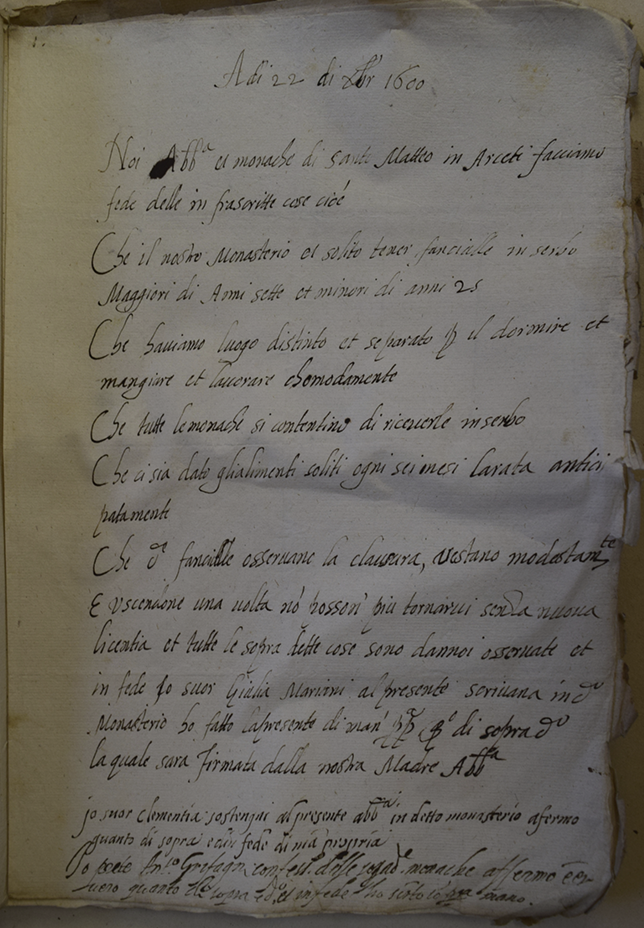
A more serious conflict between the convent and the diocese emerged in the year between 1600 and 1601. On 22 December 1600, Suor Clemenzia signed a document declaring that San Matteo had the necessary accommodation for girls between the ages of seven and twenty-five to be accepted as boarders (educanda), and that they would observe all the rules of enclosed nuns (Figure 5).Footnote 26 Taking in boarders, who paid a semester in advance, was becoming a vital part of the convent economy as well as a social need, and many convents across Florence were expanding their communities in this way. Such boarders were allowed to leave the convent, but if they did, they could not return without an additional license. These licenses were difficult to obtain; in 1604, thirteen-year-old Anna Cini applied for permission to re-enter San Matteo after she had left to attend her sister’s profession ceremony at another convent; she was refused because her reasons for leaving in the first place were ‘nothing but vanity’.Footnote 27
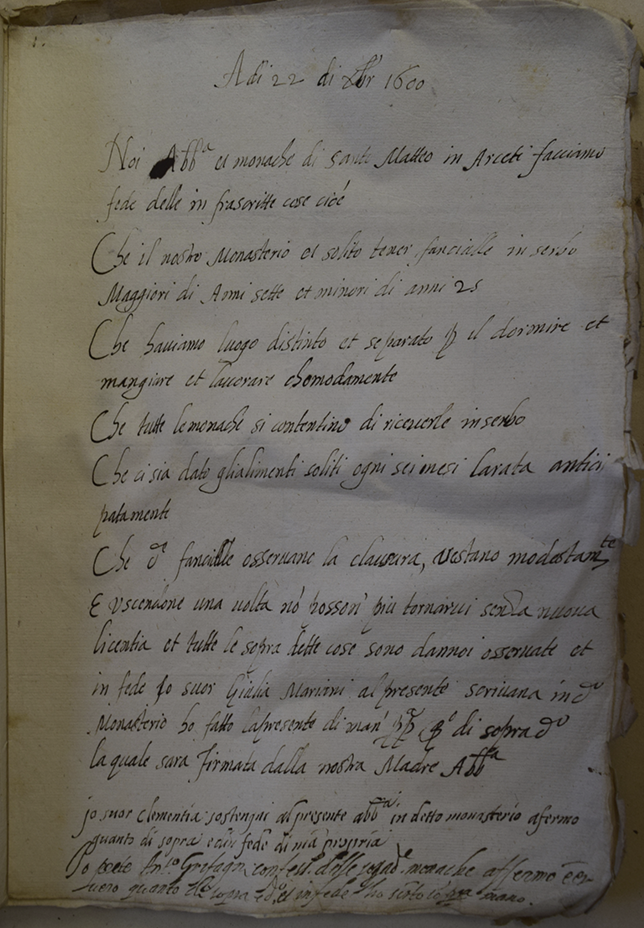
Figure 5 Declaration signed by Suor Clemenzia Sostegni, 22 December 1600 (I-Faav Atti di monache, 6; by permission of the Archivio Storico Arcivescovile di Firenze).
Figure 5Long description
A sheet of yellowing paper, fraying at the edges, which has the date, ‘A di 22 di Xbr’ 1600’ at the top. It contains a list of declarative statements, and at the bottom there are three signature statements in different handwriting: first, the scribe Suor Giulia Mariani; third, the convent’s confessor, Antonio Grifagni, and between them, Suor Clemenzia Sostegni (who spells her surname ‘sostengni’).
Suor Clemenzia pursued boarder recruitment vigorously, but the diocese soon began to refuse or postpone permission for girls to be admitted as nuns. This mattered because, without this permission, she could not collect dowries. On 13 September 1601 in an application to allow Portia Compagni to profess, Suor Clemenzia reveals what she thinks the reason might be: the diocese was pressuring her to commit the convent’s servant nuns to enclosure. She said the community would agree but wanted permission for two older servants to be allowed to enter the church to clean.Footnote 28 On 15 September, the Bishop of Pistoia writes to the archbishop, saying that he’d been to the convent and had pleaded with the nuns to yield. Their response was that they had a license from the Grandduchess Giovanna (1547–1578), and that enclosing their servants would cause grave damage to the convent: servant nuns could beg on behalf of the convent, and such alms were regularly recorded in the Ricordanze.
On 8 February 1602, the archbishop wrote at the bottom of an application: ‘There are many memos relating to these nuns, and we doubt they have the requisite accommodation, and also they are very poor’.Footnote 29 More permissions are specifically refused throughout 1602, but finally, on 8 August, the convent’s governor Camillo Pandolfini wrote to the archbishop confirming that Suor Clemenzia had held a chapter meeting, and that the professed nuns agreed to enclosing their servant nuns, provided two older servants were allowed to sweep and organise the church. The following day, an application for Maria Guardani, who became Suor Maria Clemenzia, was submitted and it was approved less than two weeks later.
A contract from 1608 shows that Suor Clemenzia was again abbess, and that both Suor Agnoleta and Suor Maddalena were still alive. The next contract in the archive that lists all the professed nuns is dated 1619: Suor Maddalena is still alive (she had been at the convent for seventy-eight years), but Suor Clemenzia and Suor Agnoleta are not.Footnote 30
2.4 Suor Maria Celeste Galilei
When, in 1610, Galileo Galilei returned to Florence from his university post in Padua, he had two illegitimate daughters and an infant son for whom he needed to provide, along with many other familial financial burdens. The toddler Vincenzo stayed with his mother, Marina Gamba; Livia (18 August 1601 – 14 June 1659) travelled with Galileo. Ten-year-old Virginia (13 August 1600 – 2 April 1634) was already in Florence with her grandmother, and she had been offered a place as a boarder at the convent of the Nunziantina at forty-two scudi per year, payable six months in advance (G. Galilei Reference Galilei, Favaro and del Lungo1900, 10:306). Galileo set about looking for a permanent home for both his daughters, but their youth was an obstacle; this much was stressed to him by the Cardinal del Monte in 1611 (G. Galilei Reference Galilei, Favaro and del Lungo1901, 11:234, 245). While convents could take girls as young as seven as boarders, girls could not be accepted to become a nun until the age of twelve, or profess fully until they were sixteen (Francescani 1596, 318, 321). Perhaps Galileo was looking to save money in the short term since once they were accepted and their dowries paid, he could remove them from his immediate financial obligations. Or perhaps – since he seemed determined to place them together, and the only way to bypass the Florentine diocesan ban on sisters monachising together was to pay a double dowry for the second daughter – he could not afford the superdowry as well as boarding fees.
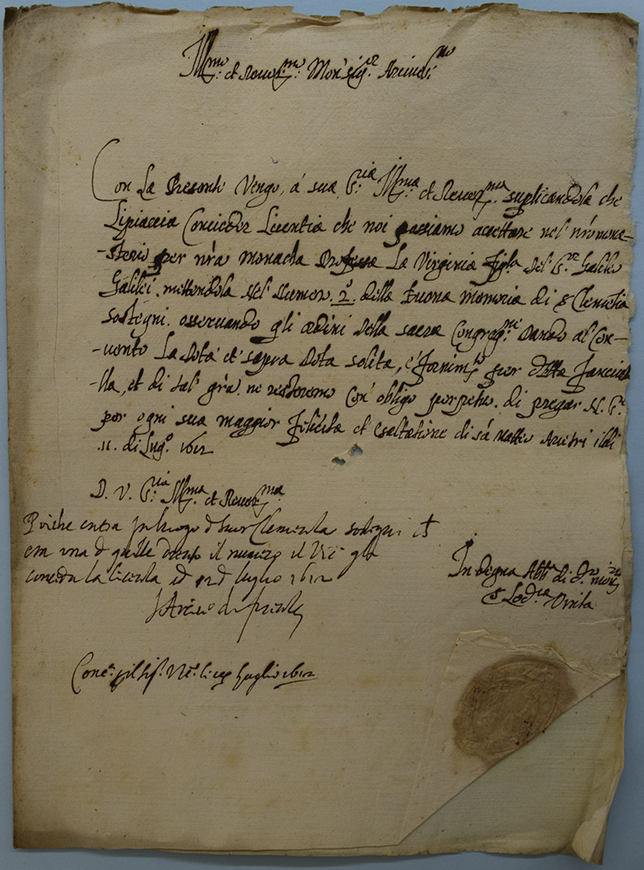
Eventually Galileo turned to the convent of San Matteo, where his niece Suor Chiara Landucci, daughter of his sister Virginia Landucci, was already a novice.Footnote 31 Virginia Galilei was almost twelve years old when her place was secured. A letter dated 11 July 1612, written by the abbess Lodovica Vinta to the archbishop, requests that Virginia, daughter of Galileo Galilei, be permitted to take the place of Suor Clemenzia Sostegni, who must have died very recently (Figure 6).
My most illustrious, worshipped, and reverend Lord
With this letter, I come to your most illustrious and reverend lordship, begging you that it might please you to grant a license, so that we may accept into our convent for our professed nun Virginia, daughter of Mr Galileo Galilei, putting her at place number 2, of the blessed memory of Sister Clemenzia Sostegni, observing the orders of the Sacred Congregation, giving the convent the usual dowry and superdowry, and provisions for this girl. And we will remain in perpetual obligation for this grace, to pray to our Lord for all your greatest happiness and exaltation.Footnote 32
Permission was granted the following day and countersigned by the Vicar General on 19 July 1612.
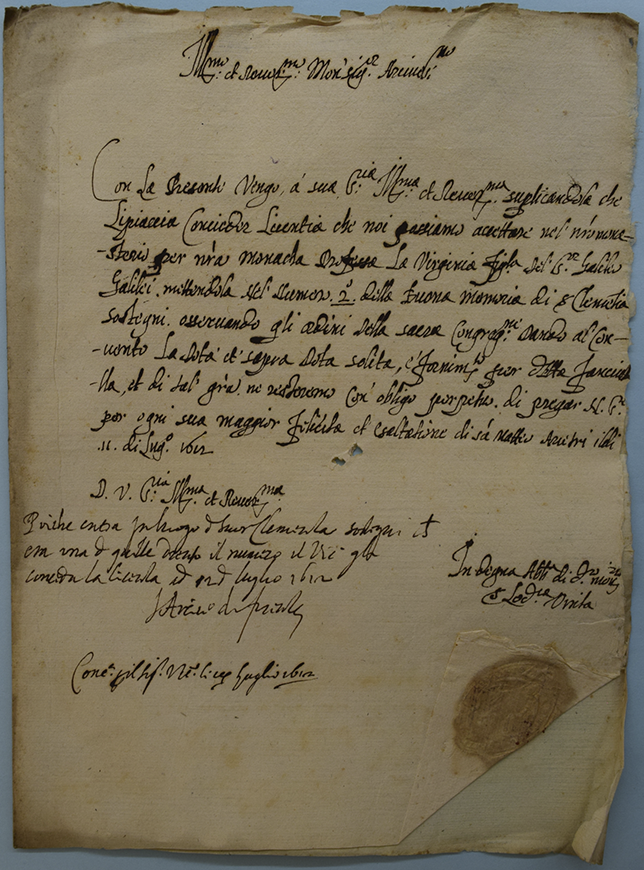
Figure 6 Letter from Suor Lodovica Vinta to Archbishop Alessandro Marzi de’ Medici, 11 July 1612 (I-Faav Atti di monache, 11; by permission of the Archivio Storico Arcivescovile di Firenze).
After some negotiation, in November 1613 a license was obtained for both girls to be accepted, so at this point Livia must have joined her sister; however, there was a delay in formalising their entry into religion (G. Galilei Reference Galilei, Favaro and del Lungo1901, 11:588). On 2 July 1614, Suor Lodovica wrote to Galileo, saying that the convent’s governor was unhappy that the girls had remained at the convent for so long without becoming novices; the norm between acceptance and vestition was a maximum of four months (Francescani 1596, 319). She said she understood that he had been unwell and that family members were at his home helping out; she proposed that both girls have their ceremonies immediately, while the family were still gathered in Florence (G. Galilei Reference Galilei, Favaro and del Lungo1902, 12:80–81). Virginia and Livia duly became Suor Maria Celeste and Suor Arcangela, respectively. The next notice of either girl comes when they professed fully at sixteen, Suor Maria Celeste in October 1616, her sister a year later in 1617.
Suor Maria Celeste’s correspondence with her father amounts to 123 letters, dated between 1623 and 1633. There are tantalising references to music in them, brief and sometimes cryptic, but nevertheless revealing. Suor Maria Celeste was the granddaughter, niece, sister, and cousin of professional musicians (Vincenzo, Galileo, Michelagnolo, Vincenzo, and Michelagnolo’s sons Vincenzo and Alberto); her father was also a skilled musician who played keyboard and lute throughout his life (Fabris Reference Fabris and Corsini2011). On 22 March 1629, she wrote to her father to ask if he would take back the chittarone he had given to her and Suor Arcangela, since it was just gathering dust and she worried it would be damaged every time they were obliged to loan it out (she does not say to whom) (G. Galilei Reference Galilei, Favaro and del Lungo1904a, 14:27). In exchange, she asked for two breviaries ‘since these are the instruments we use every day’, recently printed and containing the newest saints’ offices, so that they might last for as long as she and her sister might live.
The presence of the chittarone is a mystery, but it may have to do with a family prospect that did not materialise. In the summer of 1627, Galileo’s brother Michelagnolo corresponded with him over the possibility of Mechilde, Michelagnolo’s eldest daughter, joining her cousins at San Matteo. It had been proposed that Suor Maria Celeste would be her maestra, and this arrangement seemed to please both young women. Mechilde was sufficiently proficient at the lute to have been offered a place with no dowry in the ‘Jesuit’ convent in Munich where she was educated, based solely on her musical acumen (G. Galilei Reference Galilei, Favaro and del Lungo1903, 13:371–72).Footnote 33 She had left that convent by the following March and was still exchanging greetings with Suor Maria Celeste in April 1628 (G. Galilei Reference Galilei, Favaro and del Lungo1903, 13:410). However, shortly after she disappears from the record and her fate is unknown. It may be that the chittarone was sent in anticipation of Mechilde’s arrival, but since Suor Maria Celeste never received her at San Matteo, the instrument was never used. A few years later, Galileo attempted again to add to the family unit in San Matteo: on 11 March 1631 Suor Maria Celeste wrote that she deeply regretted she could not be maestra to yet another Virginia Landucci, Galileo’s great-niece (G. Galilei Reference Galilei, Favaro and del Lungo1904a, 14:220–21). The archdiocese had yet again put a restriction on new professions at San Matteo, this time because of its extreme poverty (due, it appears, to unpaid dowries, including her cousin Suor Chiara’s).Footnote 34 Young Virginia eventually went to the convent of San Girolamo, or San Giorgio di Spirito Santo, alla Costa, another convent with a fine musical institution and a choir that included Margherita Signorini (religious name Suor Placida), daughter of Francesca Caccini (Cusick Reference Cusick2009, 277–79).
On 18 October 1630, Suor Maria Celeste wrote to her father of new responsibilities given to her by the abbess: she had assumed the direction of the choir and organisation of the Divine Office, and she was teaching four young women to sing canto fermo (G. Galilei Reference Galilei, Favaro and del Lungo1904a, 14:156). This would have involved not just the teaching of notation, but also the learning, by memory, of all the psalms and the reciting tones. She said she would enjoy these tasks more if they were not on top of her existing duties and she complained that her poor Latin was a drawback, but tried to see her constant work as a blessing; she noted that it was ‘the seventh hour of the night’ as she wrote, meaning seven hours after sundown – in late October this would have been well after midnight, as she was preparing for Matins.
The other four direct references to music in Suor Maria Celeste’s letters relate to San Matteo’s organists and its organ, the only instrument permitted in the convent according to the statutes of the order (Francescani 1596, 53). During Lent 1633, the convent lost the eldest of its three organists, Suor Maria Grazia del Pace, the maestra of the Squarcialupi sisters: in February, Suor Maria Celeste wrote that the old nun was very unwell, and to the convent’s great grief, she died at the beginning of March. One of the other two organists then appears, with two requests to Galileo regarding music that reveal a desire for closer ties with the secular musical environment in Florence.
Galileo was intimate with the Florentine musical community, with names such as Girolamo Mei, Jacopo Corsi, Francesca Caccini, and Francesco Rasi (Suor Agnoleta Biffoli’s step-nephew, see Section 2.5) recurring often in his correspondence. Although he never mentions Vittoria Archilei – the prima donna assoluta of Ferdinando I de Medici’s court – she and her husband Antonio must have been known to the Galilei family. On 24 July 1612, the week after Suor Maria Celeste’s position in the convent was secured, their daughter Maria also secured a place at San Matteo.Footnote 35 Suor Maria Eletta, or Madre Archilei, emerges as Suor Maria Celeste’s collaborator in organising music for special days of worship.
On 18 June 1633, the week before the Feast of the Nativity of San Giovanni Battista, the city of Florence’s patronal feast, Suor Maria Celeste wrote, ‘Since where you are there are many excellent masters of music, L’Archilea would like you to obtain something beautiful for her to play on the organ’ (G. Galilei Reference Galilei, Favaro and del Lungo1904b, 15:157). Then, six months later, on 3 December, as the convent was preparing for the Feast of the Immaculate Conception, Suor Maria Celeste’s letter demonstrates a more lively and detailed exchange. She enclosed a motet sent by Suor Maria Eletta (either her own composition, or something she copied from the convent’s repertoire), and said that, by way of trade, the organist nun would like some sort of instrumental composition (Suor Maria Celeste uses three words interchangeably – ‘sinfonia’, ‘ricercare’, and ‘sonate’). She specifies further that it needs to be playable in the lower registers, since the organ was missing at least one note at the top, but she doesn’t know which (G. Galilei Reference Galilei, Favaro and del Lungo1904b, 15:342).
Suor Maria Celeste died on 2 April 1634 from dysentery, a relatively common condition in the convent; she often mentioned that either she or another nun was suffering. Her belongings, inasmuch as a nun could own anything, were apparently distributed to her religious sisters, as a later account book notes the sale of a copy of Galileo’s book Il Saggiatore that had been in the keeping of Suor Maria Celeste’s great friend, Suor Luisa Pitti (Pagnini Reference Pagnini1936, 62). Suor Maria Eletta survived Suor Maria Celeste by at least ten years; she, too, appears to have received financial support from Galileo. A note in San Matteo’s archives, tucked into a file of inventories of the belongings of Cardinal Alessandro Orsini, signed by Vincenzo Galilei and dated 9 May 1644, acknowledges the repayment of twenty-one lire, loaned by Galileo to Suor Maria Eletta on 25 September 1641.Footnote 36
San Matteo was outside the city walls, but only half a mile away from the Villa del Poggio Imperiale, as Isabella de’ Medici Orsini’s 1560s retreat had become. The palace was purchased from the Orsini in 1618, enlarged and remodelled by the Archduchess Maria Maddalena of Austria, and it continued as a locus of female creativity. On 3 February 1625, it was the location for the premiere of Francesca Caccini’s balleto composta in musica, La Liberazione di Ruggiero. A few months later, on 26 May 1625, the Grand Duke heard mass at San Matteo while staying at the Poggio Imperiale (Bonechi 2016, 276). And while, officially, enclosure for the nuns was complete and inviolable, Suor Maria Celeste hints that someone with influence might be able to enter the convent to enjoy the company and recreation: on 12 March 1633, she expresses surprise and a little concern that the wife of the Tuscan Ambassador to Rome, Caterina Niccolini (Galileo’s host during his trial for heresy), was eager to come to San Matteo to watch the nuns perform a commedia – in this case, a play on a religious or moral subject (G. Galilei Reference Galilei, Favaro and del Lungo1904b, 15:66).Footnote 37
2.5 Social and Family Ties
Sixteenth-century nuns maintained and were sustained by social and family structures, some of which they created in the convent themselves, and others that derived naturally from their family relationships outside the convent. The maestra-discepola relationship could be strong: Suor Maria Celeste’s letters illustrate the bond between her friend Suor Luisa Pitti and her maestra Suor Giulia Mariani, 35 years her senior, which involved the younger nun caring for the older one. But close friendships across generations existed outside this formal relationship: Suor Maria Celeste names Suor Luisa and Suor Caterina Angiola Anselmi as her closest friends; Suor Luisa was 17 years older, and Suor Caterina Angiola at least 31 years older than Suor Maria Celeste. These relationships could apparently extend beyond death: when Suor Angioletta de Soldini died in 1548, she left money for masses to be said not only for her own soul, but also that of Suor Arcangiola de Bartoli, who died in 1536.
Naming was another way of creating community. Some girls, for example, Caterina Biffoli, may have been obliged to take a different religious name because the convent already had a nun bearing their first name. The choice might then be a matter of availability. At San Matteo, the name Arcangela belonged to three nuns between 1530 and 1620: the above-mentioned Suor Arcangiola de Bartoli, Suor Arcangela Corsi (secular name Maria, entered 1550), and Suor Arcangela Galilei (secular name Livia, entered 1612). But it also might reflect a desire to honour another nun, or something more personal to the girl herself: Suor Maria Grazia del Pace was born Alessandra, but when she became a nun in 1586 her name was chosen because she was considered ‘graziosa e molto amorevole’.Footnote 38 Maria Guardini, who entered San Matteo in 1602, was given the name Suor Maria Clemenzia, perhaps to honour Suor Clemenzia Sostegni, who was then the abbess. And of course, Suor Maria Celeste’s name honoured her father’s preoccupation with the stars.
Family relationships mattered to nuns, both within and outside the convent. Certain families, particularly the Anselmi, the Buonaccorsi, the Gaetani, and the Rondinelli, sent young women into San Matteo throughout the approximately 120 years of records examined for this study, so that aunts and cousins were often together for their lifetimes. But sisters were also commonly placed together, despite tightening restrictions that eventually required families, like the Galilei, to pay additional sums to secure their positions. At San Matteo, this practice actually seems to have increased even as the rules became tighter: between 1530 and 1600 five pairs of sisters join the convent – Biffoli, Canigiani, Santini, Tanini, and Vinta – but between 1600 and 1620, nine pairs are admitted either as boarders or as nuns, or progressing from one state to the other: Anselmi, Canigiani, Filidolfi, Galilei, Giramonti, Mei, Squadrini, Squarcialupi, and Tani.
Outside the convent, trustees were appointed from the nuns’ family members, but individually nuns also had to rely on their relations for additional financial support, for which they offered continual prayers in return. Suor Maria Celeste’s letters were full of such requests from her to her own father, but his networks were also useful to other nuns; for instance, Suor Polisena Vinta asked for Galilei’s help to secure news of her great-nephew and then complained heartily (when he reassured her that said great-nephew was magnanimous in charity) that neither her great-nephew nor his mother had given anything to her (G. Galilei Reference Galilei, Favaro and del Lungo1904b, 15:247).
Florence was a large, cosmopolitan city, but the closeness of apparently invisible links between families can be surprising. Another Biffoli daughter is intimately connected with the Galilei, in an association that introduces yet another musical element. Gemma di Francesco di Giovannibattista Biffoli could have been around fifteen years younger than Agnoleta, born on 20 April 1549.Footnote 39 As a teenager, Gemma married Geri Bocchineri of Prato, with whom she had at least one child, Carlo, born 8 June 1569. Yet she became a widow before she was 30; in late 1579 her brother asked the archbishop for permission for her to enter the convent of the Annalena in Florence.Footnote 40 This was granted on 15 January 1580, but only on the condition that she did not ‘go in and out’ (‘purché non entri et esca’).
By 1585 Gemma had married again to a minor nobleman from Arezzo, Ascanio Rasi, thereby becoming the stepmother of Francesco Rasi, the singer, composer, and Monteverdi’s original Orfeo. One of Gemma and Ascanio’s daughters was taught to sing by Giulio Caccini, and became a nun at the convent of San Salvi (Kirkendale Reference Kirkendale1993, 560–61). However, family relations gave rise to scandal, when in November 1609, Francesco Rasi began a sexual relationship with the wife of one of Gemma’s servants. Francesco then ordered his men to kill both Gemma and the servant, with only Gemma surviving the attack. He was sentenced to death, but he fled to Mantua where he sheltered at the Gonzaga court for ten years.
In autumn 1620, after Gemma’s death, Cosimo II de’ Medici commuted Rasi’s sentence, and the singer returned to Florence (Kirkendale Reference Kirkendale1993, 594). In what can only be described as a curious turn of events, within a year, Rasi had married Alessandra, the widowed daughter of Carlo Bocchineri – Gemma’s granddaughter. Directly after their wedding in in September 1621, the couple returned to Mantua for the marriage celebrations of Eleonora Gonzaga and Emperor Ferdinand II. Rasi died of a sudden illness barely two months later.
Alessandra eventually returned to Tuscany with her third husband, Giovanni Francesco Buonamici, whom she married in 1623; it was through him that she began her friendship with Galileo Galilei. When Alessandra’s sister Sestilia married Galileo’s son Vincenzo in 1629, the family ties with San Matteo fully intersected: the couple’s children were both Gemma’s great-grandchildren and Suor Maria Celeste’s nephews. It seems likely that Suor Maria Celeste would have known that Sestilia and Alessandra’s great-aunts Suor Agnoleta and Suor Cassandra had also lived at San Matteo.
2.6 The Musical Education of Nuns in Early Modern Florence
We might assume Suor Clemenzia and Suor Agnoleta were musically able, but it seems serendipitous that Suor Clemenzia’s place at the convent was taken by a young woman who was raised in a musical environment. We know nothing of Suor Maria Celeste’s musical education, but she clearly understood music notation and she almost certainly would have had some instrumental tuition.
By the end of the sixteenth century, it was commonplace for girls whose families had sufficient means to be trained in music as a preparation for adult life, whether in a court appointment or – much more frequently – in a convent. In Florence, even the young girls at Santa Caterina, a home for abandoned children, were taught to recite psalms together in regular rhythms (canto fermo) (Rombough Reference Rombough2024, 59). Families could be offered dowry reductions or even waivers to entice musical virtuose; servant nuns might be elevated to choir status because of their outstanding musical aptitude. One abbess of the Florentine convent at Le Murate used secular women as talent scouts. When offering the services of a poor girl with a ‘buon basso’ and ‘venti voci’ – that means, give or take, a three-octave range – her contact said that she would keep the girl in her house to be taught by her musician for a couple of months and then send her on, but if the abbess did not want her, she could be sent back (Stras Reference Stras2018, 227–28).
While it was common for a girl to receive her musical education prior to entering a convent, secular musicians and priests were engaged to teach nuns more often than might be imagined, even as the Counter-Reformation gathered pace at the end of the sixteenth century: for instance, Ercole Pasquini taught at several convents in Ferrara, Orazio Vecchi in Modena, Vincenzo Pinti in Rome, Antonio Brunelli in Pisa. The circumstances of these lessons might have varied: Pasquini’s organ lessons would probably have had to have taken place in the inner convent – for which he was granted a license by the bishop (Stras Reference Stras2018, 300). Others could have taken place at the grate that separated the nuns from the secular world: there is some evidence from late fifteenth- and early sixteenth-century Florence of a cascading model, in which one nun was taught at the grate, and she was then responsible for passing her knowledge on to her sisters (Lowe Reference Lowe2003, 272–73).
In this context, the daughters and nieces of professional musicians had a distinct advantage: they could be taught expertly and for free at home by family members, with as secure a future ahead of them as any family could envisage. Should a marriage opportunity or court appointment not arise, they could find a home for life in a local convent, where they themselves could not only play and sing, but could also teach. This is presumably why we see generations of musician families associated with convents: Piccinini and Bassani nuns in Ferrara, Trombetti nuns in Bologna, Malvezzi nuns in Florence, and why Giaches de Wert’s daughter becomes a celebrated organist.
3 Sound and Music in the Life of the Convent
Suor Clemenzia Sostegni’s dispute with Archbishop Alessandro de’ Medici over enclosure happened in the context of his ongoing programme of reform and restriction at Florence’s convents. The Trattato sopra il governo dei monasteri, written in 1601 and addressed to his Vicar General in Florence, was designed to limit nuns’ contact with the outside world as much as possible, and to deprive them of economic agency. The Trattato’s scope is wide, taking in every aspect of convent life from the quotidian (the arrangements for receiving and storing goods) and the economic (the fine details of how it is possible for a convent to manage finances when property is forbidden) to the extraordinary, such as demonic possession and punishments for extreme error (walling in the guilty nun). Its censorship rules tightly control nuns’ exposure and response to cultural life outside the convent: how they communicated with their relatives, what books they could read, what music they could use in worship, and what they could do for recreation, including the way they incorporated music and drama into community celebrations.
A little over a hundred years previously, the revolutionary Dominican friar Girolamo Savonarola (d. 1498) castigated Florence’s nuns (and its priests) for their use of organs and polyphony in the liturgy (Macey Reference Macey1998). Savonarola nonetheless recognised the value of singing as a way of creating community and promoted instead the existing devotional practice of songs in vernacular Italian, called laude, which were accessible to both secular and religious worshippers.Footnote 41 The long tail of Savonarolan fervour amongst his followers reached well into the sixteenth century, and the lauda as a genre became particularly associated with nuns through the practices at Dominican convents such as the Paradiso in Florence and San Vincenzo in Prato (Macey Reference Macey, Piperno, Ravenni and Chegai2007; Graca Reference Graca2024). But polyphony flourished elsewhere in the city, and traces of its practice can be found in the records of many convents throughout the sixteenth and early seventeenth centuries (Gruppo di lavoro ‘Firenze’ Reference Bryant and Quaranta2006).
Apart from the Biffoli-Sostegni manuscript, there are no liturgical books or chronicles from San Matteo that provide direct evidence of its musical life, but sources such as the Ricordanze, Archbishop Alessandro’s Trattato, the convent’s late seventeenth-century Sbozzo of obligations, and its early eighteenth-century Constituzioni give enough secondary information to build a compelling picture.
3.1 Daily Sounds and Music
The 1713 Constituzioni creates both snapshots of the convent’s present and a retrospective of its past, as both the rhythm and the sound of the life it describes were more or less unchanged from the time of the Ricordanze. San Matteo’s relatively remote location meant that it was mostly undisturbed by the sounds that would have invaded more urban convents – which included ‘words, conversations, desires, levity, and worldy profanity’ that corrupted (8).Footnote 42 The rules around silence (to which an entire chapter is devoted) ensured that the convent’s soundscape was predictable and fit for purpose, privileging the sound of the Divine Office above all others. The regularity of the bell was central to the daily routine within the convent’s walls, calling the nuns to daily prayer – the Constituzioni says that each nun should react to its sound as if she were hearing Christ’s own voice (9). Outside, San Matteo’s physical boundary would have been extended by the bell, its range welcoming a larger spiritual community. And if the bells fell silent, this damaged the convent’s identity – among the punishments outlined in the Trattato for the unruliest convents was tying up their bells so that they could not be rung, externalising the convent’s shame (343v).
The lives of choir nuns at any early modern convent were measured by music: the regular observance of the eight ‘hours’ of the Divine Office, plus the masses the nuns were obliged to hold, kept the community at prayer throughout day and night, every day of the year. Mostly, the hours were recited in chant, but on feast days the major hours (Vespers, Compline, Matins, and Lauds) and masses could contain polyphony and organ music. Somewhere between the practice of chant and polyphony was the practice of extemporised harmonisations of canto fermo, called falsobordone, which singers needed no notation to produce. Both festal and endowed masses could be – depending on the size of the endowment – solemn, sung, or said (solenne, cantata, piane). These terms related more to the involvement of male celebrants: in said masses, the priest did not chant, and the choir could say or sing their texts, or indeed sing something else entirely (Filippi Reference Filippi2017). Said and sung masses could be performed by the convent and their confessor alone, whereas solemn masses required additional priests to act as deacon and subdeacon.
The recitation of the Divine Office was, in essence, the nun’s primary purpose on Earth: monastic institutions bore the responsibility for continuous prayer to safeguard their cities and communities in the protection of God, and to echo the choir of the angels for the faithful on Earth. The Divine Office did not require the presence of a priest. There were rules and advice regarding behaviour and performance, and how the Office sounded mattered, even in a rural convent like San Matteo. San Matteo’s constitution required the nuns to:
go with all speed and punctuality to Choir when the signal is heard, not making the others wait, or that they enter once the Office has begun, or that the number of singers is small, to the detriment of the divine praises, and the scandal of those who hear the scarcity of voices among so many nuns, and that they should sing distinctly, intelligibly without haste, without crashing the notes together [‘senza frastuono di voci’], with the usual pauses, as befits the Divine Offices and to vocal prayers said in common; since they must know that reciting and singing in the Choir of the Holy Virgins is a an echo of the singing that the Angels make to God in Heaven; and since they sing in the presence of the same Angels as the Psalmist says, indeed in the presence of Jesus in the Blessed Sacrament, they must be careful not to give rise to confusion, to utter words, to burst into laughter, things that bring a certain contempt for that Lord, before whom the present Angelic Spirits tremble with profound respect (28).Footnote 43
The Ricordanze is silent on anything to do with daily worship, but it does contain references to obligations, both in terms of income and expenditure, but also in the scattered notes tucked in around the formal ledger. The Constituzioni situates obligations, whether sung or said, and especially prayers said for the deceased nuns, within the nuns’ vow of charity (23). The 1694 Sbozzo degli Obblighi binds together both (some) originals and (more) clean copies of older documents. It is proof of the longevity of some endowments – in 1625, one Gianozzo Burci endowed an annual Mass for a minimum of 400 years, longer than the eventual life of the convent – and the sometimes difficult negotiations around when an obligation ceased. It also gives much more specific details of each obligation it records: Suor Orsina Cennini (d. 1579), for instance, used the income from a farm she inherited to endow two trentals (sets of thirty masses said on consecutive days), one to be said in the choir and the other in the infirmary, with white candles to be distributed to the singers, and a commemorative meal on the morning of the Purification of the Blessed Virgin Mary. While most obligations require at least one Office of the Dead and a single or combination of said, sung, and solemn Requiem Masses,Footnote 44 some testators ask for specific masses or set up quite complex instructions: Suor Laudomina Squarcialupi, who died in 1604, endowed three Masses for the Holy Trinity; in 1612 Domenico di Matteo Bindi, the Prior of the nearby church of San Michele a Monteripaldi, endowed a weekly Mass of the BVM during his life, and then after his death a weekly Requiem Mass, and a daily De profundis with the ‘orazione sacerdotale’ (the prayer Fidelium).
The Ricordanze also records payments to the friars who came to celebrate Mass: a single friar, most often the convent’s confessor, for regular masses and multiple friars for solemn ones, such as those held on the feasts of San Lorenzo, Santa Chiara, and the Immaculate Conception. Sometimes these payments explicitly refer to singing. The annual messa dei fratini (see Section 2.1) required payment for six boys and their maestro; but also beginning in 1538, every year between domenica dell’ulivo (Palm Sunday) and giovedì santo (Maundy Thursday) there is a payment for the ‘friars that come to sing the Passion’, ‘the Passionists’ (‘frati che venono cantorno e passi’, ‘i passionati’), or some other form of words, including ‘the nuns and friars that sing the Passion’ (‘le monache et frati che cantorno el passio’). The Mass Gospel on Palm Sunday, Holy Tuesday, and Holy Wednesday was an enactment of the Passions of Matthew, Mark, and Luke, with priest and deacon taking the role of the Evangelist narrator and Christ, and – in the simplest form – the subdeacon singing the words of all the other characters. However, a tradition of singing the words of the turba (the synagoga, or crowd) polyphonically existed in Florence from the fifteenth century, and Francesco Corteccia had composed a setting for the musicians of the cathedral, Santa Maria del Fiore, in 1527 (Sutherland Reference Sutherland1972). There is no evidence either way to prove or disprove that the nuns of San Matteo sang the turba, but this form of collaboration was not unknown elsewhere in Europe (Volkhardt Reference Volkhardt and Rode-Breymann2009).
3.2 The Practice of Music in Florence’s Convents at the Turn of the Seventeenth Century
While clear records of women and men, specifically nuns and monks, singing polyphony together are rare, they do exist (Schwartz Reference Schwartz and Haggh2001). However, throughout the end of the sixteenth and the beginning of the seventeenth centuries, Florence’s convents frequently employed male musicians to perform (in the public part of the church) when their own resources were lacking (Gruppo di lavoro ‘Firenze’ Reference Bryant and Quaranta2006). Alessandro de’ Medici’s Trattato explicitly forbade musical contact between men and women – not just men teaching at convents, but also nuns singing (‘faccino Choro’) with men ‘as is normal in convents governed by friars’, and – a particular abuse – nuns singing the Epistle when there was no deacon or subdeacon, as ‘this is a grave error and must not be tolerated in any way’ (339r).Footnote 45
Archbishop Alessandro was not, in principle, opposed to nuns’ music-making, but he was determined to control it (Lowe Reference Lowe2003, 273–78). On 24 March 1597, he wrote to his Vicar General, Antonio Benivieni,Footnote 46
I understand that in some of these convents a new form of music and singing has been introduced recently, with a single voice and the help of extraordinary musical instruments, with little edification of good people and against their institution. Therefore, my illustrious Lords and I have resolved to write to you how to deal with this. I and [the Bishop of] Arezzo have tried to provide that which is necessary by gradually removing the excess, so you will not fail to do, and God preserve you.
A month later, Benivieni issued a memorandum to all convents in the diocese:Footnote 47
Reverend Mother Abbess
It seems that what is ordered in the service of God, and to motivate men to devotion, and to keep them in the Churches, sometimes turns into a worldly entertainment, and diverts from those good and devout purposes to which it was ordered to recite the Canonical hours. It also seems that in the distinction of these Canonical hours, the order of the Church is perverted by you to attract the support of the People, because Compline is celebrated with greater pomp than Vespers. Therefore, to repair similar faults and to prevent you from falling further into abuses, proceeding nevertheless with some discretion and distinction, you are commanded that from now on you use music with less melodic effort and ornaments, and more intelligible and closer to the chant. For now, therefore, you will be allowed to use all the keyboard instruments and a set of viols (with all four voices)Footnote 48 to help, supplement and bring out the consonance of your voices. Violins, lutes, and all wind instruments are prohibited, as well as singing with similar ornaments, vernacular materials, and individual voices, except settings of Latin Scripture with the organ. Thus, in addition to the edification of the good, many superfluous expenses will be avoided for individual nuns, and much waste of time and communication with men, by which they are distracted from the purpose of serving God, for which the same nuns have sequestered themselves from the world. And we will confirm the paternal and prudent warning and commandment that came to us from Rome on 24 March 1597, under penalty to you, in cases of transgression, of deprivation of office and rank, and be aware that it cannot be absolved except by us, our superior or successor. May God preserve you in his grace and keep you from error
From the Archbishop on 24 April 1597
[And under the greatest penalties we command you to publish and read in chapter this present letter of ours, so that no one can pretend ignorance.]
The archbishop’s letter claimed that nuns were using a new style of composed music (in canto figurato), with a solo voice, or voices, accompanied by instruments that were not sanctioned by the Church. Alessandro was referring to monody (although this term is never used in the sixteenth and seventeenth centuries to describe new compositions for solo voice) and ‘concertato’ singing. Both the music and the method of performance had changed from that which the nuns had used previously, and Alessandro wanted to restore the status quo, however gradually. Benivieni’s memorandum gives more detail in terms of what kinds of music were forbidden, what practices were deemed acceptable, and what the penalties would be if the convents did not comply. Highly ornamented solo singing was off the table, as were plucked strings, violins, and any wind instruments. Polyphony accompanied on the organ and viols was fine, so long as the words were intelligible, and ideally the chant melody was recognisable. Solo song was only permitted if it were in Latin and accompanied only on the organ. The language of the memo is, in modern terms, passive-aggressive: we command you to do this, but at your discretion; but, if you fail to do this, we will deprive you of your office – and you are to read this out to everyone in chapter (a meeting of all the choir nuns) so that no one can pretend they do not know the rules.
Alessandro’s orders regarding the use of the ‘new form of music’ predate the Trattato by four years. He did not include them in the later document, nor did he include them in the synodial decree of 1603, which outlines the basic rules for worship and sacraments for the whole archdiocese (Archdiocese of Florence 1603). But the Trattato mentions music and singing at several points, when discussing the architecture of the convent church; in setting out appropriate rules for chapel, and what music may be sung in which locations in the convent; and the in specific ceremony for delivering judgement on a community after a visitation.
The first quarter of the treatise deals with enclosure, the means for ensuring the nuns remained forever separate from the outside world. Although nuns were allowed to converse with outsiders in the parlatorio, these rooms were to be newly constructed with a door to the street and a wall of grates that could not be seen from the street, with no door leading into the convent (333v). In among the precise requirements for doors and screens, which would prevent even a slip of paper being passed through, are disparaging comments about the vogue for high choir galleries in the convent’s churches where the nuns could be both out of sight and yet easily heard – instead of an inner choir, separated from the outer church by a wall with grated windows. There is also an instruction for organs to be placed so that they are behind iron bars with the keyboard behind the pipes, in a space with a lockable door, so that not just any nun could access it for practice. It continues, ‘it would be better if they [the organs] were all inside the choir, and that the sound went out through the grates, from where the voices and the psalmody come out, but since it is very expensive, I could not order them to be moved’ (335r).Footnote 49
Alessandro felt that the greatest risk of interaction might occur during the observance of the offices and of masses, whether that interaction was with the public or with priests. In addition to the ban on male/female musical interactions in the convent, he asks his vicar to ensure that convents observe the hours at the appropriate time, especially Matins, which should not be sung either at dawn or just at nightfall – presumably so that outsiders would not congregate to hear the singing, as they would for Vespers and (to Alessandro’s consternation) Compline (338v–339r). So that they do not need to invite more priests than necessary to celebrate Solemn Mass, he gives convents where there is no tradition of music permission only to chant, rather than hiring additional singers or encouraging them to introduce new musical practice. He also sees feast days as a temptation to other kinds of excess: ‘I would remind you that on feast days, no great expenditure should be made on the vestments, no money should be spent on music, no priests should be given food (but instead outsiders should be paid), and the same thing should be observed in the vestition of the nuns and similar occasions’ (338r).Footnote 50
Married women and widows were forbidden to enter the convent, except with the pope’s permission. Unmarried women were allowed to enter the convent as boarders, but if they left for any reason, they would not normally be allowed to re-enter the same convent. The Trattato restates a ban, made by memorandum in 1583,Footnote 51 that no licenses for boarders or novices would be granted between Christmas and Lent, because girls were entering the convents just for the entertainments and leaving before Lent (336v).Footnote 52 But Alessandro did not wish to ban entertainments altogether, as he saw them as a necessary comfort for women who have severed all contact with the world. He sanctioned a variety of different kinds of representations, including processions, tableaux, year-round Nativity scenes, and plays on Bible stories or the lives of the saints. Scripts were to be vetted, and nuns were not allowed to skip the Office to perform, nor were they allowed to remove their habit, wear men’s clothes, or grow their hair out to represent a secular woman (337v–338r).Footnote 53
Convent theatre had been an important element of Florentine culture for centuries, providing an opportunity for nuns to practice a range of creative talents: poetry, music, acting, visual arts, dance, even costumery. Its most ancient roots lay in the drama of the Christmas and Easter stories, but by the turn of the seventeenth century many convents engaged in fully realised dramatic productions, with multi-act plays written by both outsiders and the nuns themselves.Footnote 54 The word ‘rappresentatione’ could encompass a variety of forms, however: Suor Annalena Aldobrandini’s veglie from the convent of San Giorgio di Spirito Santo alla Costa include spoken poetic ‘disputes’, musical floats in procession, audience participation games, and breaks for refreshments (Stras Reference Stras2012). These entertainments were part of the social calendar, often coinciding with the city’s traditional festivals, such as Carnival and Calendimaggio: secular visitors, especially women, would enter the cloister to join the audience of older nuns – younger nuns and novices mostly made up the performing troupes.
One hundred years later, the Constituzioni also sets out requirements for Carnival entertainments: that they are approved by the abbess and the confessor, that they do not require nuns to change their clothes or appearance, and that they do not disturb private devotions or public services, unlike the secular plays, games, dances, and parties that last long into the night. Should such diversions still sound too tempting, the author recalls that the Lord told S. Maria Maddalena de’ Pazzi (a famous sixteenth-century Florentine nun) that nuns who participated in that kind of indecency would be eternally damned (20).
Many sources associated with convents show that, despite repeated attempts to limit nuns’ interactions with the outside world, secular culture freely permeated the convents’ enclosure: this is particularly well demonstrated by the retexting of secular songs, both popular tunes and composed madrigals, into laude, songs with spiritual texts in the vernacular Italian. Communal devotional singing had been embedded in Florentine social and religious practice since the thirteenth century through the activities of the laudesi companies, and took on particular significance during the Savonarolan republic (Wilson Reference Wilson1992; Macey Reference Macey1998; Wilson Reference Wilson2009). Many of the laude published by Serafino Razzi in 1563 and dedicated to Suor (later Saint) Caterina Ricci, the abbess of San Vincenzo in Prato, took their melodies from fifteenth-century Carnival songs, but the aristocratic nuns of San Vincenzo also had access to Florence’s unpublished madrigal repertoire through their families (Macey Reference Macey, Piperno, Ravenni and Chegai2007). Laude could be used in various contexts in the convent: for an audience as part of an entertainment, such as those by Suor Annalena; as part of an organised devotional event, such as a procession or a gathering in front of an altar or statue; and as an accompaniment to manual labour. The Trattato allowed these last two uses, provided they took place in the inner convent, away from the ears of the public (338v).Footnote 55
3.3 Music and Sound in Devotions and Rites
The Ricordanze makes only passing mention of two ceremonies that would have certainly contained music: ‘velazione’ or vestition, and ‘sacrazione’, or profession of a novice, in which she made her final vows and became a full member of the community. These could be very elaborate affairs, and at more prestigious convents within the city walls, external musicians were often hired by the family to ensure a young woman a more opulent transition from one state to the next (see Section 4.5).
The Constituzioni mentions processions in general, which happened on Sundays and ‘on other occasions throughout the year’. But it is more specific about the nature of its communal devotional gatherings, or ‘visits’ (visite). These happened weekly on Fridays in front of the Crucifix,Footnote 56 and on Saturdays before the Virgin Mary; and before the Oratorio of the Infant Jesus (perhaps a painting or a Nativity set – the adoration of the Nativity was a particular Franciscan practice) on the twenty-fifth of every month. The visits were held by the whole community, and involved the singing of ‘litanies, psalms, hymns, laude, and prayers’ appropriate for each occasion (31–32).Footnote 57 The regularity of these visits, and the requirement for the full participation of the convent community, suggests that the texts spoken and music sung would have been committed to memory, perhaps even passed down from generation to generation.
The capacity for collective recitation and singing to promote order, discipline, conformity, and what the constitution calls ‘the beautiful harmony of all the religious virtues’ (13) seems part of what made a community run like clockwork: ‘the individuals and matters of a community are like the many wheels of a clock, and the disorder of one puts all in disorder’ (27).Footnote 58 These qualities would certainly have been useful in the context of the ceremony accompanying the end of a visitation, the last mention of music in the Trattato. At the beginning, the nuns went into the chapterhouse carrying lit candles, intoning the hymn Veni Creator Spiritus. The archbishop’s vicar delivered his initial observations and recommendations to the abbess and the community, who then sang the Te Deum, the ubiquitous hymn of thanksgiving, at the end of his address.
The Constituzioni outlines two additional ceremonies, and it is difficult to know when they first became part of San Matteo’s year (32–33). On New Year’s Eve, the choir nuns came together and recited the Miserere (Psalm 50/51) and disciplined themselves (that is, self-mortification) while praying for forgiveness for their and the world’s ingratitude; once finished, they intoned the Te Deum. Then, after three more days of further meditation and mortification, on the morning of Epiphany (6 January), all the professed nuns, both choir and servant, met in the choir to say the Confiteor (the prayer of confession) and to receive absolution. They then collectively renewed their vows, speaking loudly in unison. The formula for the renewal is printed with asterisks denoting pauses, which the nuns are obliged to observe (‘fermandosi alle pause’), ensuring a collective and orderly enunciation.
Prostrated at your feet,* oh my divine Spouse,* I beg your forgiveness for the omissions* committed by me in the past year,* in the exact observance of my vows.* And longing with their renewal* to renew my spirit in the new year,* in the presence of all the Heavenly Court* and especially of Mary, eternal Virgin* most lovely Lady* Advocate,* and my Mother,* of the Virgins’ Apostle Saint Matthew,* of the Father Saint Francis,* of the Mother Saint Clare,* and of my Holy Guardian Angel,* I make a perpetual vow of Poverty,* of Chastity,* of Obedience.* Meanwhile, I beg you, oh my sweet Jesus,* to accept this my offering,* as you accepted from the Magi* the symbols of these three Vows,* that is Gold,* Myrrh,* and Incense,* and to grant me* a true change of life,* symbolised by the change of Path,* that the Magi made after their gift,* so that travelling by the new path of perfection* I may arrive in Heaven* that you have made my Country, and Homeland.* Amen (34).Footnote 59
4 The Music of the Biffoli-Sostegni Manuscript
Early modern music manuscripts often represent much more than the musical information they contain. While the repertoire is the primary or most immediate focus of the reader, many more issues or questions lie just behind the music: how the music was collected, the order in which it appears, the precision of the copying, the meaning of any non-musical information or images, and so on. The Biffoli-Sostegni manuscript has an index prepared by the copyist; some works appear to be grouped together; there are few obvious copying errors; and its presentation – with a decorative scheme that includes images of nuns and references to their names and relationships – suggests that the copyist was mindful of the community in which his work would reside.
But the music, too, is entwined with the convent’s history and identity. While much of it would be useful to any religious establishment, male or female, some is specific to worship in a convent of Poor Clares, and some of it could have been written for, or even by, the nuns of San Matteo. Moreover, it is possible to find correspondences between some of the works and events described by the historical sources relating to San Matteo, giving us a richer – if still conjectural – understanding of how music figured in the lives of its nuns.
4.1 Equal-Voice Music
Although the Biffoli-Sostegni repertoire shows great variety in genre and style, it is unified by its consistent use of a limited vocal range, known as voci pari (equal-voice) composition. Voci pari polyphony is music written for more than one voice that can be sung by a single-sex group of adult singers, such as might be found in a chapel that employed no boy singers, or in a female convent. Voci pari could be notated in low (Bass and Tenor) or high (Alto and Treble) clefs, but since competent singers could read any clef, repertoire composed in one single-sex environment could readily be adopted in another. Nonetheless, the copyist’s choice of clef can hint at a work’s origin or the composer’s inspiration: of the manuscript’s seventy-eight works, around a third (twenty-three) are written in low clefs, perhaps because they originated in an all-male environment, or because they incorporate a liturgical chant – which are almost invariably notated in low clefs – as one of the voices. The rest are in high clefs, suggesting that they were composed expressly for high voices.Footnote 60
Voci pari polyphony was set apart from other styles even during the sixteenth century. Theorists and teachers writing composition treatises tended to avoid using voci pari works as illustrations and relegated the discussion of voci pari technique to supplementary paragraphs or chapters, because although voci pari composition is subject to the same rules as voci piene (literally, full voices) it is much more likely to bend those rules because of the proximity of the parts. Moreover, publishers began to issue voci pari works in separate volumes, potentially to create and preserve a new market for the format (Stras Reference Stras2017b, 617–19). Nuns could arrange voci piene works by playing the bass part on an instrument (in Italy, usually the organ or a bass viol, or both), by transposing all or some of the voices, or combining these approaches. However, for a small convent such as San Matteo, a repertoire of voci pari music would be ideal, as it would rely less on there being a bass instrument in the convent or a nun to play it.Footnote 61
The range of any individual work in the Biffoli-Sostegni manuscript is never more than a sixteenth (two octaves plus one note) and is usually less than two octaves. The repertoire exhibits the broad sonic characteristics of voci pari music: transitory and unresolved dissonances; the sound (if not the reality) of voices moving in block chords created by voices in the same register crossing each other; and a sense of harmonic stasis created by the same phrase being repeated in close imitation by four voices in turn (Stras Reference Stras2017b, 642–57). Most of the manuscript’s four-voice works, regardless of their length, exploit at least two, if not all three of these techniques.
4.2 The Masses
The most substantial works in manuscript are the two Mass Ordinary settings, one in four voices and the other in three.Footnote 62 They are both what have been called ‘parody masses’, works based on a pre-existing musical model that could be either secular or sacred.Footnote 63 While modern musicians and listeners have to work to understand the implications and resonances of this kind of composition, in its original context the musicians and listeners could experience a mass as a real-time musical event at the same time as summoning the memory of the model (Milsom Reference Milsom2020, 252). This blending of meaning had the potential to imbue liturgical worship with specific affect – and in the case of the two Biffoli-Sostegni masses, with elements of the convent’s recent history that manifested its reliance on divine intervention.
The four-voice Messa sopra Recordare Virgo Mater is the first work in the manuscript (1v–14r); it is followed by the motet from which it is modelled. The anonymous Recordare Virgo Mater sets the Mass Offertory for the Feast of the Immaculate Conception and its prosa, Ab hac familia. The prosa petitions the Virgin to intercede to God on behalf of a community, using the metaphor of life as the sinner’s journey homewards towards Heaven. The Messa con tre voci (hereafter Messa sopra Je le lerray) begins the manuscript’s three-voice section, but its model is not included or identified. This is unsurprising, since the model is a secular French chanson that tells of domestic violence and imprisonment, and (probably) adultery. Je le lerray puisqu’il me bat circulated in manuscripts dating from the first decades of the sixteenth century, in one-, three-, and four-voice versions. A three-voice version attributed to the French court composer Antoine de Févin is included in a Florentine collection that was probably compiled in the late 1510s or early 1520s (I-Fn Magliabechiano XIX.117, 6v–7r).Footnote 64
Both mass models seem to speak to the condition of the convent during the Siege of Florence between October 1529 and August 1530, when the nuns had been evacuated from their estate to the plague-ridden city and billeted in the house of an exiled Florentine noble. Recordare Virgo Mater pleads for an entire household, referring also to a state of exile or being far from home; Je le lerray recounts the experience of aggression, captivity, and potentially even espionage in a feminine voice. The Messa sopra Recordare may well have had an additional importance for San Matteo through its relationship to a motet for the Immaculate Conception. When Dianora de’ Parigi endowed her obligation in thanks for God’s protection from harm after lightning struck the convent bell-gable, she specified a Mass of the Immaculate Conception (see Section 2.1). While there is no proof that the Messa sopra Recordare was the music used for the service, its placement at the beginning of the manuscript, before even the music for St Matthew or St Clare, suggests it was hugely significant to the nuns.
These two works are unusual in the sixteenth-century repertoire, for different reasons: the Messa sopra Recordare because it is almost unique as mass setting for four equal voices notated in high clefs (there are low equal-voice masses in circulation, but not many); the Messa sopra Je le lerray because it is a three-voice mass based on a chanson that uses the compositional technique of imitative counterpoint. While there are plenty of three-voice masses from the later fifteenth century based on chansons, no other treats the model as the basis for pervasive imitative polyphony, as found in the four-voice mass from the late fifteenth century onwards.
The Messa sopra Recordare serves as an excellent introduction to the soundworld of early sixteenth-century voci pari polyphony. The motet’s opening soggetto, or subject, is introduced in imitation at the unison in all four parts: starting with the Bassus, then Tenor, then Altus, and finally Cantus (Example 1a/Audio 1a). In the mass, this opening is cited exactly only in the Sanctus, but the voices are reordered: Bassus, Altus, Cantus, Tenor (Example 1b/Audio 1b). By stacking the melody onto itself, the imitation creates static block sonorities that sound like forbidden parallels – even though any two voices never actually move in parallel fifths, because the voices are all in the same range, the fifths are heard (Example 1c/Audio 1c). This happens first at the end of b. 5, when the Bassus rises to a c, the music’s first aural surprise. It barely avoids parallel fifths with the voice entering beneath it; moreover, the c hints at a dissonant seventh because the d root is already firmly established in the listener’s ear.

Example 1a B-Bc 27766: 14v–15r, Recordare Virgo Mater, bb. 1–8.
Audio 1a B-Bc 27766: 14v–15r, Recordare Virgo Mater, bb. 1–8.

Example 1b B-Bc 27766: 8v–9r, Messa sopra Recordare Virgo Mater, Sanctus, bb. 1–8.
Audio 1b B-Bc 27766: 8v–9r, Messa sopra Recordare Virgo Mater, Sanctus, bb. 1–8.

Example 1c Sounding chords of Messa sopra Recordare Virgo Mater, Sanctus, bb. 1–8.
Audio 1c Sounding chords of Messa sopra Recordare Virgo Mater, Sanctus, bb. 1–8.
The other four sections of the Messa sopra Recordare – the Kyrie, Gloria, Credo, and Agnus Dei – paraphrase the model’s opening in ways that exploit that aural surprise, perhaps acknowledging that this moment would be the one that stayed in the listener’s memory (aptly, occurring on the word recordare ‘remember’). The implied seventh becomes real in b. 7 of the Kyrie and the Credo (Example 2a and Example 2c/Audio 2a and Audio 2c); these two openings are essentially the same apart from some adjustments in rhythm to accommodate the text. The Gloria emphasises the stepwise sounding parallels by repeating them in bb. 5–6 and bb 7–8 (Example 2b/Audio 2b). The Agnus finally leans into the dissonance by delaying but then intensifying it (Example 3/Audio 3). In b. 8 the Altus and Cantus form the d–c interval, following it immediately, if fleetingly, with another seventh c–b, before resting at the end of the bar on a second (the inversion of a seventh) g–a between Tenor and Altus.
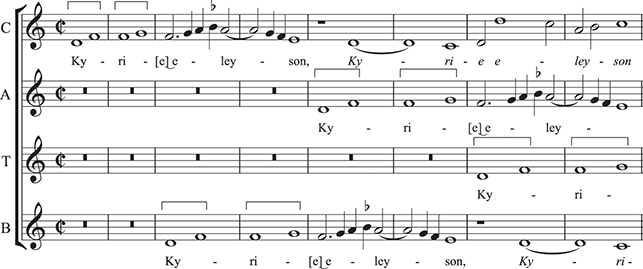
Example 2a B-Bc 27766: 1v–2r, Messa sopra Recordare Virgo Mater, Kyrie, bb. 1–8.
Audio 2a B-Bc 27766: 1v–2r, Messa sopra Recordare Virgo Mater, Kyrie, bb. 1–8.
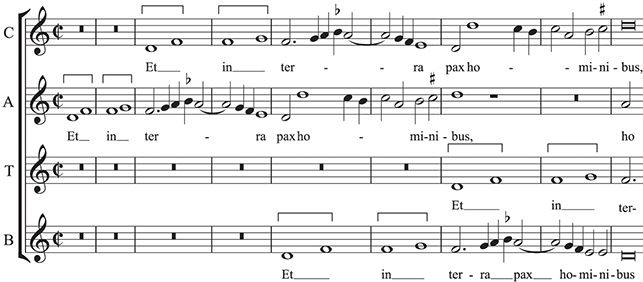
Example 2b B-Bc 27766: 2v–3r, Messa sopra Recordare Virgo Mater, Gloria, bb. 1–8.
Audio 2b B-Bc 27766: 2v–3r, Messa sopra Recordare Virgo Mater, Gloria, bb. 1–8.
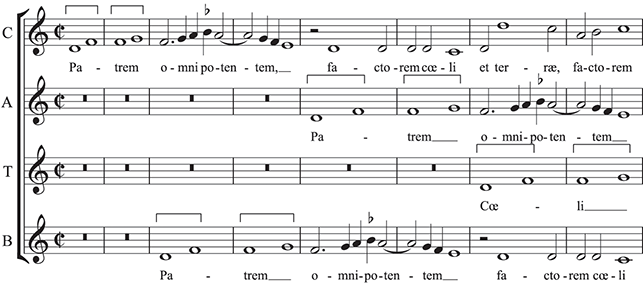
Example 2c B-Bc 27766: 5v–6r, Messa sopra Recordare Virgo Mater, Credo, bb. 1–8.
Audio 2c B-Bc 27766: 5v–6r, Messa sopra Recordare Virgo Mater, Credo, bb. 1–8.
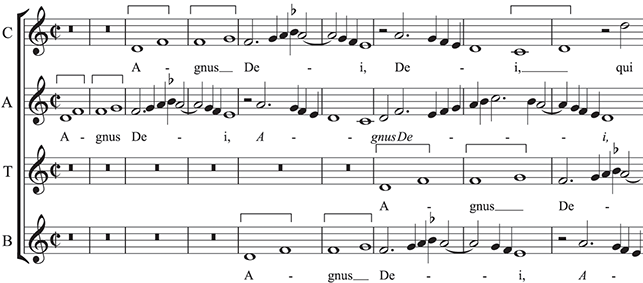
Example 3 B-Bc 27766: 8v–9r, Messa sopra Recordare Virgo Mater, Agnus, bb. 1–9.
Audio 3 B-Bc 27766: 8v–9r, Messa sopra Recordare Virgo Mater, Agnus, bb. 1–9.
The model’s opening, however memorable and striking, is used only at the beginning of each mass section. The rest of the mass uses melodic fragments from the model in different ways but also sets up its own terms of reference for stimulating the listener’s memory: see, for instance, the octave leaps in b. 7 of the Kyrie (Example 2a/Audio 2a) and b. 5 of the Gloria (Example 2b/Audio 2b), which never appear in the model.
The Messa sopra Je le lerray, in contrast, resembles most closely a style of composition Cynthia Cyrus calls ‘chanson reworkings’, which she identifies as a secular, largely Florentine phenomenon of the late fifteenth and early sixteenth centuries (Cyrus Reference Cyrus1990, 4–5). It uses the melody of its chanson model consistently and in its entirety, along with the contrapuntal material of Févin’s three-voice arrangement. The close relationship between chanson and mass then creates a different frame for memory – one that does not just rely on affect and intent (‘recordare’) but potentially on the experience of hearing/singing the original chanson and the context in which that happened.
The melody of Je le lerray is in three sections, the first two comprising two lines each, and the third reprising the first line as a refrain (Example 4a/Audio 4a).Footnote 65 Févin’s arrangement adds two accompanying voices to the melody, and repeats the final refrain, creating the musical form ABA1 (Example 4b/Audio 4b). The Kyrie of the mass retains this three-part structure, embedding the first two lines of the melody in the first ‘Kyrie eleison’ (Example 5a/Audio 5a); the second two lines in the ‘Christe eleison’ (Example 5b/Audio 5b); and the refrain in the second ‘Kyrie eleison’. From the start, then, the whole of the chanson is evoked as God’s mercy is invoked. The Kyrie also incorporates the identifying characteristics of voci pari polyphony: harmonic stasis (bb. 22–27), multiple dissonances (b. 31), and parallels (Example 6/Audio 6, b. 75) – although here they are actual, and not virtual, parallel fifths.
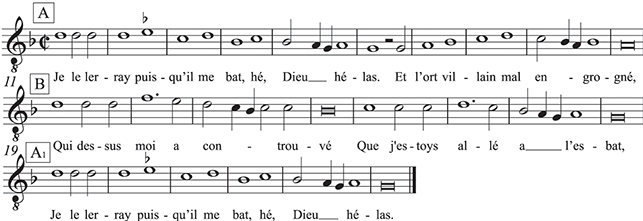
Example 4a F-Pn 9346, 67v: Je le lerray puisqu’il me bat.
Audio 4a F-Pn 9346, 67v: Je le lerray puisqu’il me bat.
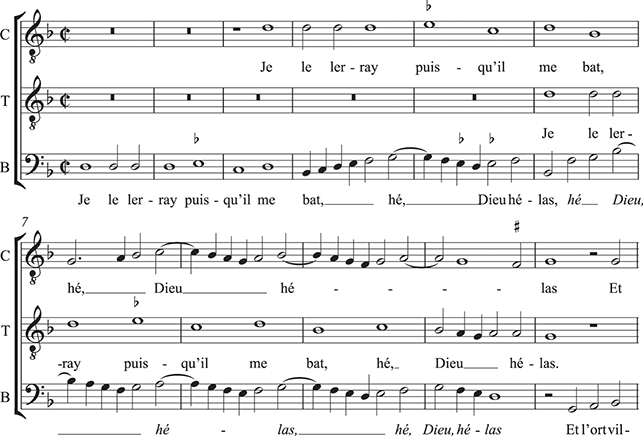
Example 4b I-Fn Magl XIX.117, 6v–7r: Antoine de Févin, Je le lerray puisqu’il me bat, bb. 1–11.
Audio 4b I-Fn Magl XIX.117, 6v–7r: Antoine de Févin, Je le lerray puisqu’il me bat, bb. 1–11.
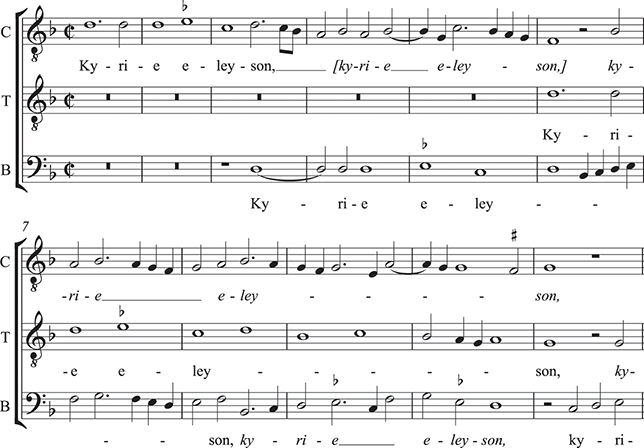
Example 5a B-Bc 27766, 135v–136r: Messa sopra Je le lerray, Kyrie, bb. 1–11.
Audio 5a B-Bc 27766, 135v–136r: Messa sopra Je le lerray, Kyrie, bb. 1–11.
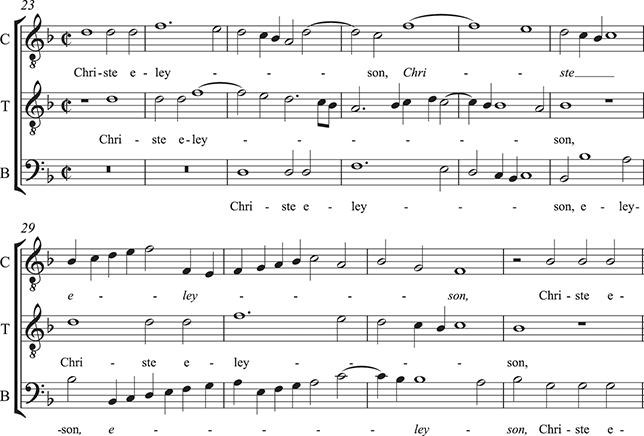
Example 5b B-Bc 27766, 136v–137r: Messa sopra Je le lerray, Kyrie, bb. 23–32.
Audio 5b B-Bc 27766, 136v–137r: Messa sopra Je le lerray, Kyrie, bb. 23–32.

Example 6 B-Bc 27766, 137v–138r: Messa sopra Je le lerray, Kyrie, bb. 74–79.
Audio 6 B-Bc 27766, 137v–138r: Messa sopra Je le lerray, Kyrie, bb. 74–79.
If a comprehensive memory of the three-voice chanson and its association (Florence’s besiegement) is summoned by its use in the mass, the memory could have been supplemented by the composer’s choice of a new melody, unrelated to the chanson, for the ‘Qui tollis peccata mundi’ section of the Gloria. Although the melody starts like the chanson’s B section, its continuation takes it up instead of down (Example 7a/Audio 7a). This melody, transposed up a tone, is identical to the opening subject of Phillipe Verdelot’s motet ‘Recordare, Domine’, a work transmitted in two manuscript sources – one of which was copied by Antonio Moro – that contain repertoire intimately entangled in the politics of 1520s Florence (Example 7b/Audio 7b). Verdelot’s motet calls for God’s help to ‘an end to external war, famine, and pestilence’ and may have been composed between 1527 and 1530, when Florence was ravaged by plague and conflict (Ryan Reference Ryan2019, 308). Its inclusion would potentially have reinforced the contextual meaning of the mass for Florentine citizens who had lived through the siege – again, the word recordare brings a powerful resonance.
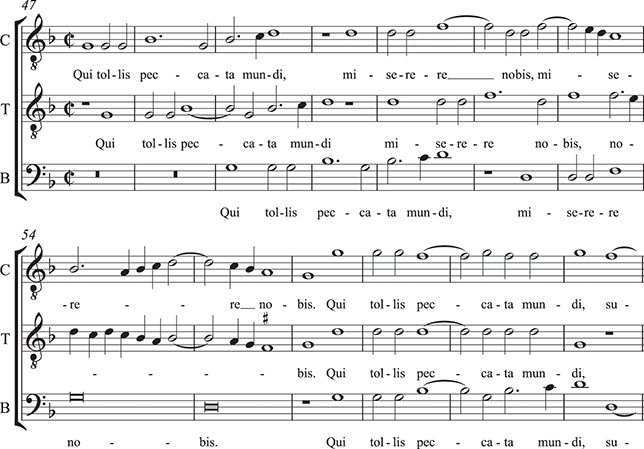
Example 7a B-Bc 27766, 137v–138r: Messa sopra Je le lerray, Gloria, bb. 47–59.
Audio 7a B-Bc 27766, 137v–138r: Messa sopra Je le lerray, Gloria, bb. 47–59.
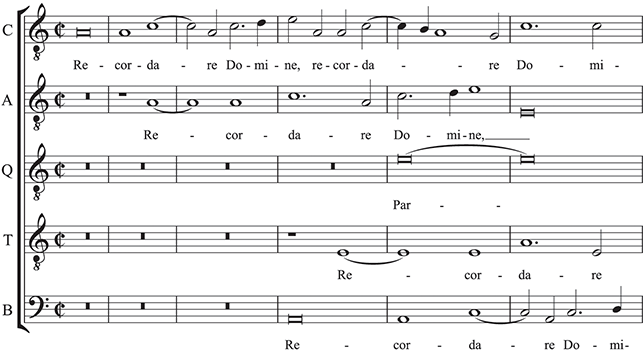
Example 7b I-Rv 35–40, n. 26: Phillipe Verdelot, Recordare Domine, bb. 1–6.
Audio 7b I-Rv 35–40, n. 26: Phillipe Verdelot, Recordare Domine, bb. 1–6.
While these two masses arise from very different models, there is one a spectacular similarity between them: in the Sanctus of both works, a canon at the unison using the same melodic fragment features in two subsections, the Pleni (at ‘gloria tua’) and the Osanna. It appears only once in a single voice in each model and barely features elsewhere in either mass. It is not an unusual melody; it is, however, curious that it crops up in only these places, and in exactly the same places, in two works that are otherwise so utterly different. At a stretch, this similarity could suggest that the composer of one mass knew the other mass, or even that the masses are by the same composer. But it is perhaps less contentious to suggest that the nuns, who would have known and sung these mass settings, themselves would have formed the connection; far from obvious on the page, the echoes are much clearer after repeated listening.
4.3 Other Music for the Mass
Because the Ordinary comprises those sections of the Mass that are common to every day’s worship, it the most recognisable element and the one that receives the most attention from composers. However, there are other portions of the liturgy – the propers, or those that are specific to a feast or a time of year – that can be set to music. There are only a handful of proper settings in the Biffoli-Sostegni manuscript, all of which pertain to important feasts in the convent’s calendar. Hæc dies quam fecit is the Gradual for Easter Sunday; Recordare Virgo Mater is the Offertory for the Feast of the Immaculate Conception; Portas cœli aperuit is the Offertory for the fourth day of the Octave of Easter (although its second part, Hic est panis, is not).Footnote 66 There are two Gospels: In illo tempore: Thomas unus de duodecim (for the Octave of Easter, also the Feast of St Thomas, Apostle) and In illo tempore: dixit Jesus (for the Feast of St Matthew). These works may not have been sung as part of the Mass liturgy, but we cannot rule out that they – or indeed any of the antiphons or hymns included in the manuscript – were sung during a Mass. Non-liturgical motets had long had a place during Mass worship, specifically at the Offertory, the Elevation, and at Communion (Cummings Reference Cummings1981, 45). But even the Low, or Said, Mass – a prime constituent of the many masses the nuns were obliged to hold on behalf of donors, as well as part of their daily worship – could be accompanied by any suitable music (Filippi Reference Filippi2017).
4.4 Music for the Divine Office
The Divine Office, or Opus Dei, was the principal spiritual occupation for monastic institutions, a framework of regular, collective prayer that ensured all the psalms of the Old Testament were recited throughout the week. Unlike the Mass, which could be spoken, the Divine Office was always sung. It was divided into eight services, or hours, spread across the day to allow for other activities, such as other forms of worship, labour, learning, sleeping, and eating.
Nearly all the Office music in the Biffoli-Sostegni manuscript belongs to the service of Vespers. The sixteenth-century monastic Vespers combined fixed elements, the most significant of which was the Magnificat (the Canticle of the BVM), with other elements that changed according to the day. Like the Mass, Office liturgies had antiphons and hymns that were appropriate to specific feast days, and more regular sets of psalms that would be used for specific categories of feasts – for instance, if it were the feast day of a virgin saint, or an apostle. Psalms were invariably paired with an antiphon that was sung both before and after the doxology (‘Gloria Patri et Filio et Spiritui Sancto. Sicut erat in principio et nunc et semper, et in sæcula sæculorum. Amen’) that concluded every psalm and canticle.
The music of the Divine Office was similarly a mix of the regular and the specific. While many antiphons and hymns had distinctive chants, some melodies were adapted to a range of different texts. In their simplest form, the psalms and the Magnificat were recited to one of eight different sequences of notes called psalmtones, distinguished from each other by the specific combination of their beginnings (intonations, or exordia), the note on which the bulk of the verse was recited (the dominant or tenor), and their endings (terminations, or differentiæ). Fluent psalmody relied on memorisation, not just of the tone but also of the psalms themselves; hence often an entire chanted service could be notated with just the antiphons and abbreviated instructions for the psalms, with an indication of their tones and differentiae.
Alongside the festal Mass, Vespers offered convents and public worshippers the best opportunity for making and hearing music. Polyphonic settings of the Magnificat, and of the psalms for major feast days, are common in the sixteenth-century repertoire. Mostly, these settings are alternatim; that is, only alternate verses are set to polyphony, leaving the remaining verses to be sung as chant alone – these chant verses are not notated, but would have been sung from memory. Magnificat antiphons, too, are frequently set polyphonically: as the highlight of the service, they could also function outside the liturgy as a musical symbol of the saint or the feast. The Magnificat itself was the daily repetition, surely significant to nuns, of the BVM’s declaration of her life’s commitment to God.
Vespers is the first service of the festal cycle, sung in the late afternoon the day before the official feast day. As it signalled the end of the working day for many of the faithful, it also anticipated the following morning’s celebration: for the most solemn feasts, after the physical and spiritual challenges of the night offices of Matins and Lauds, the nuns could look forward to a more generous breakfast.
4.4.1 The Psalms and Magnificats
In the four-voice section of the manuscript, there are three sets of Vespers psalms and three settings of the Magnificat; a three-voice Magnificat by Jehan de Billon, one of the few works in the manuscript that has a concordance and attribution in a contemporary print, appears on its own at the end of the three-voice section (it is unattributed in the manuscript). The eighteen four-voice works represent a compendium of compositional styles popular in Florence in the mid sixteenth century. They range from the most austere harmonisations of the psalmtone – so basic they could have been extemporised without music – through unprepossessing, mostly homophonic settings that state the text clearly and succinctly, to grander and more intricate imitative polyphony that moves away from the tone to create a more impressive musical event.
The four-voice psalms and Magnificats are organised into three sets that suggest how they may have been used at the convent, for they present items for specific feast days in the correct order for the liturgy. The first set, for Vespers 1 of the Common of Saints, is followed in the manuscript by the hymn for the Feast of St Matthew, then a Magnificat; the second set, for the Common of Virgins and the BVM, is followed by the Vespers 2 hymn for St Clare, a Magnificat, and then the Vespers 2 Magnificat antiphon for Clare. The third set, for Vespers 2 of the Common of Saints has no hymn but it, too, is immediately followed by a Magnificat. The copyist may have initiated this sequencing, but equally, the music may have been given to him in the convent’s own discrete gatherings.
Approaching these often short, functional works as miniatures of performance, not just composition, shows even a convent with limited resources – a choir, an organ, and an optional bass instrument – could create reasonable musical variety for worshippers. In most of them, at least one polyphonic verse is written for reduced – three, or even two – voices. But the choirmistress would have had other choices she could make: solo voices can be used instead of a full choir; a bass instrument can often replace or support the lowest voice. Moreover, the works’ presentation in the manuscript can reveal more about the way music was created for and performed by convent choirs.
The set for the Common of Virgins offers some opportunities for illustration. The second psalm, the Laudate pueri, has an indication that it is in the Eighth Tone (VIII tono), in this case transposed up a seventh (Figure 7).Footnote 67 This would tell the nuns how to intone the alternate verses, since the Second and Eighth Tones effectively share the same intonation, although notated starting on different pitches. The intonations are not always given by the copyist, and when they are, they are mostly notated without any regard for word stresses; however, in some, he indicates a rhythm by using different note shapes. For the fourth psalm Nisi Dominus, also on the Eighth Tone, the note shapes appear to indicate faster intonation of the word ‘ædificaverit’ and a longer first syllable of the word ‘domum’ (Figure 8).
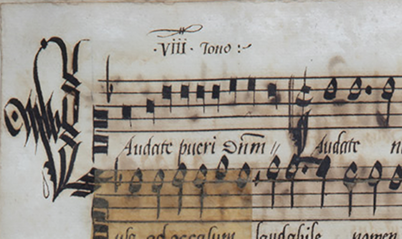
Figure 7 B-Bc 27766, 48v: Laudate pueri, Cantus, indication of psalm tone and transposition (Bibliothèque du Conservatoire royal de Bruxelles).
Figure 7Long description
The image shows a small section of a sixteenth-century music manuscript, with a large letter L at the beginning of two staff systems of music. The music is written in a c-clef on the bottom line of the staff, with a single flat indicating the line for the note ‘b’. The first bar of music is written in black chant notation, and the words underlaid are the beginning of the psalm, ‘Laudate pueri Dominum’. The word ‘Dominum’ is abbreviated. The music continues in white notation, which is also visible on the second system. Above the music are the words, ‘viii Tono’, with a little flourish over the Roman numeral.
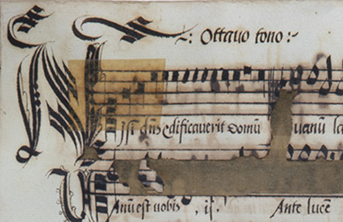
Figure 8 B-Bc 27766, 50v: Nisi Dominus, Cantus, apparent rhythm in intonation (Bibliothèque du Conservatoire royal de Bruxelles).
Figure 8Long description
The image shows a small section of a sixteenth-century music manuscript, with a large letter N at the beginning of two staff systems of music. The music is written in a c-clef on the bottom line of the staff. The first bar of music is written in black chant notation, and the words underlaid are the beginning of the psalm, ‘Nisi dominus edificaverit Domum’. The word ‘dominus’ is abbreviated. The music continues in white notation, which is also barely visible on the second system – most of the notes are missing because there is a hole in the manuscript that has been repaired with tape. Above the music are the words, ‘ottavo tono’.
The Laudate pueri, like most in the set, is predominantly homophonic, with all voices delivering the text simultaneously in a chordal texture. The upper two voices often cross each other and stay close to the psalmtone; the lower two voices offer harmonic support, the Bassus always providing the root (Example 8/Audio 8). The Nisi Dominus is more polyphonically conceived than the other four psalms, with the top three voices in identical ranges sharing responsibility for maintaining the recitation tenor (Example 9/Audio 9). In all but the first verse, the voices enter in imitation, and in the doxology the composer uses close imitation at the unison, creating the harmonic stasis signature of equal-voice polyphony (Example 10/Audio 10, bb. 51–54). The setting also shows a degree of attention to the meaning of the words at ‘Vanum est vobis’ (Example 9/Audio 9). The note B flat (b molle, or soft B), when it alters a B natural that has already been sung, is often used expressively (Blackburn Reference Blackburn, Stras and Blackburn2015). Here, it lends not only an acknowledgement of vanity and performative asceticism, but also a subtle knowingness in terms of the verse’s meaning for religious life: the King James Version reads, ‘It is vain for you to rise up early, to sit up late, to eat the bread of sorrows: for so he giveth his beloved sleep’.

Example 8 B-Bc 27766, 48v–49r: Laudate pueri, bb. 6–15.
Audio 8 B-Bc 27766, 48v–49r: Laudate pueri, bb. 6–15.

Example 9 B-Bc 27766, 50v–51r: Nisi Dominus, bb. 9–26.
Audio 9 B-Bc 27766, 50v–51r: Nisi Dominus, bb. 9–26.

Example 10 B-Bc 27766, 50v–51r: Nisi Dominus, bb. 42–54.
Audio 10 B-Bc 27766, 50v–51r: Nisi Dominus, bb. 42–54.
The Magnificat bundled with the Common of Virgins is also on the Eighth Tone and is composed in imitative polyphony throughout. Because the tone has limited material from which to create the imitative subjects (effectively just the intonation and the termination), the Magnificat appears to share material with the Nisi Dominus: compare the opening of the ‘Sicut erat’ of the Magnificat with the ‘Gloria Patri’ of the psalm (Example 11/Audio 11; Example 10/Audio 10, bb. 42–47). But the Magnificat also uses the compositional technique of cantus firmus, in which one voice intones the verse in long notes while the others engage in imitative polyphony: in the ‘Quia fecit mihi magna’ the Cantus has the psalmtone (Example 12/Audio 12). Cantus firmus composition was, by the middle of the sixteenth century, a somewhat old-fashioned technique, yet still part of a composer’s education: this Magnificat’s careful display of a range of skills might suggest it was composed by someone still learning their craft, potentially even a nun at San Matteo.

Example 11 B-Bc 27766, 58v–59r: Magnificat ottavo tono, bb. 193–98.
Audio 11 B-Bc 27766, 58v–59r: Magnificat ottavo tono, bb. 193–98.

Example 12 B-Bc 27766, 58v–59r: Magnificat ottavo tono, bb. 43–75.
Audio 12 B-Bc 27766, 58v–59r: Magnificat ottavo tono, bb. 43–75.
Another psalm on the Eighth Tone, the third psalm of Vespers 2 for the Common of Saints, In convertendo, presents yet another way in which psalms could be sung in choir – in unmeasured block chords that nonetheless indicate stresses on longer notes (Example 13/Audio 13). This setting has the psalmtone (without the intonation) in the Tenor voice; the other parts are created by common rules for extemporising harmonies known variously as falsobordone or contrappunto alla mente. These rules advise on the intervals the individual voices should make from the Tenor: for instance, the Bassus can alternate fifths and thirds, but can also use octaves and unisons. These rules would allow even moderately skilled ensembles to create simple harmonisations, and it seems almost redundant to notate them fully; but both this psalm and the preceding one, Credidi, appear like this. The other three psalms in the set are like the Nisi Dominus, a mix of homophony and simple polyphony.

Example 13 B-Bc 27766, 113v–113(bis)r: In convertendo, b. 1.
Audio 13 B-Bc 27766, 113v–113(bis)r: In convertendo, b. 1.
4.4.2 The Hymns
There are six hymns in the manuscript: Exultet cœlem laudibus for St Matthew; two settings of En præclara virgo Clara, the Vespers 2 hymn for St Clare; Pange lingua gloriosi for the feast of Corpus Christi; Ave maris stella for feasts of the BVM; and two that have many liturgical, paraliturgical, and extra-liturgical uses: Veni Creator Spiritus and the Te Deum laudamus. Like the psalms and Magnificats, these hymn settings are notated without the alternate chanted verses; they also represent a range of compositional types.
While cantus firmus composition is an older method than imitative polyphony, it remained current throughout the sixteenth century. The settings of Exultet cœlem laudibus, Pange lingua gloriosi, and one of the settings of En præclara virgo Clara are cantus firmus settings of a single verse. The second setting of Clare’s hymn and the Veni Creator Spiritus are also cantus firmus settings, but they set multiple verses – the Veni Creator Spiritus very simple, the En præclara more complex. The first two polyphonic verses of the Ave maris stella are freely composed, but the third includes an elaboration of the hymn melody in the Tenor voice. These three multi-verse settings have separate ‘Amen’ sections; the Veni Creator Spiritus even has a second ‘Amen’ that has been added in red ink. The Te Deum laudamus is different again: it is, like many of the psalms, a simple rhythmicised harmonisation of a recitation tone. It begins based on the hymn’s traditional melody but departs from it in a striking way, in what may be a uniquely Florentine practice.
En præclara virgo Clara seems to be a late addition to Clare’s office: it does not appear in sources before the beginning of the fifteenth century (Boccali Reference Boccali2011, 129–30). Geographically, the closest source to Biffoli-Sostegni is Biblioteca Riccardiana codice 232, a late fifteenth-century Florentine source, where it is placed at the very end of the book, after two hymns for Clare and Francis that have the legend ‘nuper editus’, or ‘newly composed’. Its melody is the hymn Decus morum dux minorum, an early hymn for Francis, from which it also takes its poetic form: each of the six verses ends with the first line of another older hymn; for instance, ‘En præclara virgo Clara / regnat in regno luminum / quam amasti desponsasti / Jesu, corona virginum’. These resonances would remind the nuns of the interconnectedness of their worship, as they summon memories of the feasts of the virgin saints (Jesu, corona virginum), Ascension (Jesu nostra redemptio), Advent (Conditor alme siderum), the BVM (0 gloriosa Domina), Francis (In cælesti collegio), and Pentecost (Beata nobis gaudia).
Using the Ricordanze, we can match the other hymns to the convent year with some confidence. The hymn for Matthew is clearly patronal; the Pange lingua would be useful for the annual visit of the Corpus Christi procession. The Ave maris stella could be used on any number of Marian feasts, but most particularly for the Immaculate Conception, one of San Matteo’s most important liturgies. The simplicity of the Veni Creator Spiritus may reflect how often the hymn was used in the regular business of the convent: not only was it part of the liturgy of Pentecost, it also formed part of the ceremony for any official visit by a male priest or friar other than the confessor; it was sung at the election of the abbess, and at the vestition and profession of new nuns. The Te Deum laudamus was even more ubiquitous, for it was part of the weekly Divine Office, as well as being required for visitations and elections; the nuns of San Matteo would also sing it on 31 December (the feast of St Silvester) as part of their specific devotion (see Section 3.3.3).
The Te Deum is an unusually long hymn, with twenty-nine verses, and its melody is unusually complex. It starts relatively simply with a reciting tone in two halves, the first finishing on A, the second on G, but after several verses, it changes its tonal centre and has two longer complementary melodies that end on E. It is one of the oldest hymns in the liturgy, and it is remarkably stable over time and location: the Te Deum in medieval Italy is almost identical to the Te Deum in early modern England (Aplin Reference Aplin1979). Yet the setting in the Biffoli-Sostegni manuscript presents a different approach: it uses the same melody throughout, always cadencing on A and G, until the very last verse which has three endings on G, A, and G. This simplification almost renders the hymn into song: at the very least, it becomes much easier to sing and remember. These two passages illustrate the difference, from the beginning of the chant (Example 14a/Audio 14a), and from after the traditional melody changes from one form to the next (Example 14b/Audio 14b): the top system gives the chant as rendered in a late fifteenth-century Clarissan manuscript from Florence, now in the Museo di San Marco (I-Fmsm), below the version in the Biffoli-Sostegni manuscript.

Example 14a Te Deum laudamus, verse 1 compared: I-Fmsm MS 551 and B-Bc 27766.
Audio 14a Te Deum laudamus, verse 1 compared: I-Fmsm MS 551 and B-Bc 27766.

Example 14b Te Deum laudamus, verse 19 compared: I-Fmsm MS 551 and B-Bc 27766.
Audio 14b Te Deum laudamus, verse 19 compared: I-Fmsm MS 551 and B-Bc 27766.
There are many polyphonic settings of the Te Deum, but only two others proceed in the same way as the Biffoli-Sostegni setting. Both are found in a contemporaneous manuscript from the Florentine Cathedral that appears to have been for the use of the boy choristers (see Section 4.6). There are traces of the Te Deum being used outside the Church in Florentine culture: it was sung by children in the streets as part of processions and even to conclude devotional plays (sacre rappresentationi), and it is included in fourteenth- and fifteenth-century collections of laude texts created for Florence’s confraternities (Newbigin Reference Newbigin1983, 290; Wilson Reference Wilson and Garfagnini2001, 296). In one of these, the words are preceded by the instruction, ‘to be sung in the manner of Piero di Mariano’, indicating a specific mode of performance or melody that differs from the traditional chant.
4.4.3 The Office of St Clare
Of all the unusual music in the Biffoli-Sostegni manuscript, the twelve antiphons for the two Vespers of St Clare are perhaps the most startling (Clare is accorded a double feast in Franciscan worship, meaning the liturgy lasts for two days). They are unique, as the only known set of polyphonic Vespers antiphons in the sixteenth-century repertoire.Footnote 68 Eleven of them are copied together and appear to have been composed as a set. The twelfth, Salve sponsa Dei, the Magnificat antiphon for Vespers 2, is separated from the main set, physically and stylistically.
Apart from Salve sponsa Dei, the Clare Office items are composed in the early to mid sixteenth-century imitative style, in which the chant is rhythmically adapted and ornamented to fit the polyphonic fabric. They also display the specific characteristics of sixteenth-century equal-voice polyphony: increased and highlighted dissonances, and implied parallelisms, as in the opening breves of Antiphon 3 for Vespers 1, Hæc in paternis laribus (Example 15/Audio 15). The harmonic stasis created by imitative voices at the unison is less apparent here, as the chant melodies do not lend themselves to this kind of treatment. All the antiphons belong to that subset of voci pari writing that does not automatically suggest a bass instrument in accompaniment of higher equal voices, since the Bassus crosses the other parts from time to time.

Example 15 B-Bc 27766, 97v–98r: Hæc in paternis laribus, bb. 1–16.
Audio 15 B-Bc 27766, 97v–98r: Hæc in paternis laribus, bb. 1–16.
The rhymed Office of St Clare was composed in the thirteenth century by Julius of Speyer, using the melodies and poetic structure of his Office of St Francis and occasionally echoing its text (Baroffio and Kim Reference Baroffio and Kim2004). Typically for rhymed offices, the melodies are arranged in a rising modal sequence: for Vespers 1, the psalm antiphons are in Modes 1–5 and the Magnificat antiphon in Mode 6; for Vespers 2, the psalm antiphons are in Modes 2–6 and the Magnificat antiphon returns to Mode 2. In all but one case – the Magnificat antiphon for Vespers 1 Duce cælesti numine – the Biffoli-Sostegni polyphony uses the original melodies. The Biffoli-Sostegni setting of Duce cælesti numine uses a melody in Mode 1, albeit one that is still taken from the liturgy of St Francis: the Biffoli-Sostegni setting may indicate a local variation of the Office.Footnote 69
Whereas the psalm antiphons and the Magnificat antiphon for Vespers 1 share a high cleffing disposition – three treble clefs and a soprano clef (g2g2g2c1) – the Magnificat antiphon for Vespers 2, Salve sponsa Dei, is in low clefs (c4c4F3F4). Salve sponsa Dei is unlike any other work in the manuscript, both visually and aurally. It is written in black chant notation in all four parts, and since chant is always notated in low clefs, this may account for the clef configuration (Figure 9). Because the antiphon melody has a range of over an octave, all the other voices necessarily must cross it – and each other – in an almost continuous progression of parallel sonorities (Example 16/Audio 16). The melody generated by the crossing voices is not reflected on the page: it is a melody of community, not individuality. Even within the characteristics of voci pari polyphony, this setting pushes the boundaries, creating something that is wholly foreign to both the nuns’ usual soundworld and the sound of sixteenth-century polyphony more broadly.
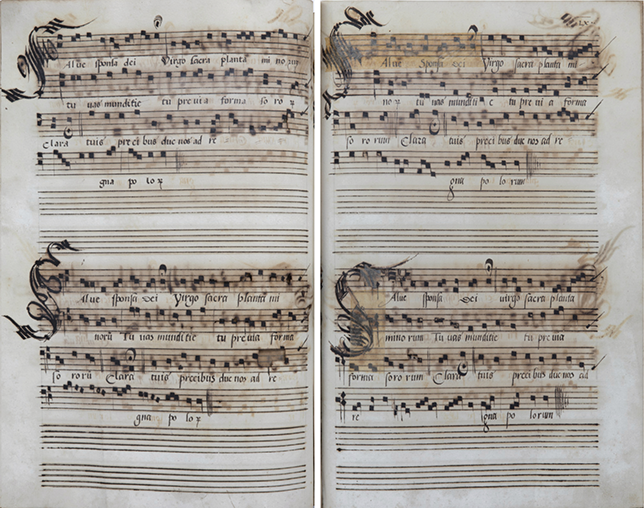
Figure 9 B-Bc 27766, 59v–60r: Salve sponsa Dei (Bibliothèque du Conservatoire royal de Bruxelles).
Figure 9Long description
The image shows two pages of a sixteenth-century music manuscript. The paper is ruled with twelve staves, and on each page there are two vocal parts. All four parts are written in black chant notation. On the left-hand page, the upper part is written with a c-clef on the second line down (a tenor clef), and the lower part is written with a f-clef on the second line down (a bass clef). On the right-hand page, the upper part is written with a c-clef on the second line down (a tenor clef), and the lower part is written with a f-clef on the third line down (a baritone clef). Each part has an elaborate letter S at the beginning, starting the word ‘Salve.’ The text of the two parts on the left-hand page appears to have been finished by a different scribe.

Example 16 B-Bc 27766, 59v–60r: Salve sponsa Dei.
Audio 16 B-Bc 27766, 59v–60r: Salve sponsa Dei.
Salve sponsa Dei is not copied with the rest of the Clare Office; instead, it appears in a correctly ordered sequence with the Vespers psalms for the Common of Virgins and the BVM, one of the En præclara virgo Clara settings, and a Magnificat. This suggests that these two sets are distinct: it is unlikely that the polyphonic psalms and the polyphonic antiphons would have been used in the same liturgical event. It is curious that the eleven antiphons, so clearly composed as a unit, do not include a setting of Salve sponsa Dei; perhaps the polyphonic chant setting existed already in the convent, and was used in preference to a new composition.
The antiphons might also have been useful in another scenario, as a dramatic centrepiece to the convent’s celebration – a musical sacra rappresentazione of the order’s origin story. The whole sequence tells of Clare’s childhood devotion to Francis and her decision to enter religious life; her sister Agnes, who witnesses Clare’s death; and their reunion in Heaven. Salve sponsa Dei, the Magnificat antiphon that was the highlight of the two-day feast, describes Clare’s leadership and her founding of the Clarissans’ spiritual family. While they sang about the meaning of vocation for female religious, the nuns might also have reflected on the relationships between Clare and Agnes. How poignant for Suor Agnoleta, whose sister Caterina followed her into San Matteo – and all the pairs of sisters admitted to the convent over the next hundred years – to sing of a sister’s love, not just with her blood kin but also with her sisters in Christ.
4.4.4 The Lenten Sequence
There is another shorter sequence of works, copied contiguously in the manuscript, that suggests some form of paraliturgical devotion rather than liturgical celebration. Four motets setting texts from Lenten offices – three responsory verses and one antiphon – seem incongruous, as Lent is usually a period of abstinence and enclosure. That being said, the Ricordanze does occasionally record extra expenses for food for the second Sunday of Lent, so perhaps San Matteo’s community were not wholly abstemious or retiring, or perhaps the sequence was used during Carnival.
While settings of Magnificat antiphons can easily be directly incorporated into liturgical worship, the same is not true of settings of some other kinds of office texts: the feast or day to which they belong is sometimes more important than their place in the liturgy. Motets based on office texts might have been sung during/over Low Masses (see Section 3.1), or in a less formal devotional setting. These four settings are unlikely to have been used at Matins, and they are not in liturgical order. Nevertheless, they create a didactic narrative structure (invocation – action – problem – resolution) that explains the deprivation of Lent, perhaps to placate any frustration or dissent with a plea for patience:
1. Venite benedicti patris mei percipite regnum quod vobis paratum est ab origine mundi (‘Come, you blessed of My Father, receive the Kingdom, which was prepared for you from the foundation of the world’). (Responsory verse, First Tuesday of Lent)
2. Jesus autem cum jejunasset quadraginta diebus et quadraginta noctibus postea esuriit (‘Thus Jesus, with fasting for forty days and forty nights, became hungry’). (Antiphon, First Sunday of Lent)
3. Multiplicati sunt qui tribulant me et dicunt non est salus illi in deo ejus exsurge domine salvum me fac deus meus (‘They are many who trouble me and say: There is no salvation for him in his God. Arise, O Lord, make me safe, My God’). (Responsory verse, Passion Sunday)
4. Ecce nunc tempus acceptabile ecce nunc dies salutis commendemus nosmetipsos in multa patientia (‘Behold, now is the acceptable time: behold, now is the day of salvation. Therefore, in these days let us commend ourselves to much patience’). (Responsory verse, First Sunday of Lent)
The Ricordanze notes that every year, as Lent was ending, the convent hosted friars who would sing the Passion (see Section 3.2). At the very end of the manuscript, written by a different scribe to the rest in an informal way, is the choir’s response from the Improperia, or the Reproaches, for Good Friday.
4.5 Motets for Other Feasts and Celebrations
The selection of texts that make up the rest of the manuscript corresponds with more of the convent’s most important feasts and celebrations. While some of these motets have an origin in liturgical chant, they could be used throughout the year in other contexts. For instance, the short antiphon Da pacem, Domine belongs liturgically to the Summer Histories ‘de Machabæis’; between Pentecost and Advent, stories from the Old Testament were read during the Divine Office. However, the antiphon became used as a general exhortation for peace throughout the year – and no doubt, the story of the Judas Maccabaeus and his struggle against Imperial Rome resonated strongly with the Florentine Republic.Footnote 70
Another antiphon that would have been used at least as frequently out of liturgical context as within is Veni sponsa Christi, the Magnificat antiphon for the Common of Virgins. It had a central position in the vestition ceremony, when a girl was formally received as a novice. It might be said or sung as the girl is embraced by the abbess, after she had been sprinkled with holy water, and before she is led into enclosure.Footnote 71 Some sources specify that the abbess or the cantrix should begin the chant, and the choir continue, finishing with an ‘Alleluia’ (Aulisio 1595, 2:*** 3, 29). This appears to be what is indicated in the Biffoli-Sostegni manuscript: the chant incipit is given on the top stave, then the rest of the chant given in black notation. The other three voices are notated in white mensural notation. As brief as it is, it still leans into the dissonances of equal-voice imitation, perhaps with a touch of mischief as it introduces an unprepared dissonance on the word ‘præparavit’ (Example 17/Audio 17). The special place of this motet in the convent’s repertoire is sweetly indicated by a rebus that substitutes a small crown for the word ‘coronam’ in the index.

Example 17 B-Bc 27766, 88v–89r: Veni sponsa Christi.
Audio 17 B-Bc 27766, 88v–89r: Veni sponsa Christi.
Sometimes there is an element of adaptation in the texts that takes them out of the liturgy, perhaps reflecting a local practice. The four-section litany, called Kyrie eleison in the index, is the briefest of litaniæ breves; while it might be a choral opening that is intended to be followed by chant, its invocations do not follow the opening pattern of any printed litany. The Magnificat antiphon for Vespers 2 for St Francis, Salve sancte pater, has interpolated text at the beginning and the end which would make it liturgically invalid yet suitable as an invocation, perhaps during a devotion specific to the Franciscan orders. The motet Inter natos mulierum uses fragments of a Matins responsory and verse for St John the Baptist and adds an ‘Alleluia’ at the end of its two short parts. While Alleluias have a specific liturgical place in the Mass and during the Office at particular times of year, they can also function as a musical refrain in paraliturgical or spiritual works. Here, they lend gravitas to an otherwise simple setting, potentially intended to ornament worship on the feast of the saint, one of Florence’s protectors (the baptistry is dedicated to San Giovanni Battista, the cathedral to Santa Maria del Fiore, the city’s other patron).
4.5.1 Music for the Blessed Virgin Mary
As might be expected, there is a strong concentration of Marian texts: fourteen works, eighteen percent of the manuscript’s total. These may be associated with a particular feast – the Annunciation, Assumption, Nativity, or Immaculate Conception – but often they are interchangeable or assigned to multiple feasts. This group contains the most complex music in the manuscript (apart from the masses); and – perhaps not coincidentally – seven of the nine works that are attributed to a named composer, either in the manuscript or elsewhere (including Adriano Willaert, Costanzo Festa, and Jean Mouton/Pierre Moulu; See Appendix A). It also contains the oldest – Loyset Compère’s (c. 1445–1518) Paranymphus salutatet virginem – and the newest works.
These attributed pieces may have been assimilated into the convent’s repertoire through other sources, but the two settings of Sancta Maria succurre miseris, the Magnificat antiphon for feasts of the BVM, look to have been composed explicitly for nuns, perhaps even for the nuns of San Matteo. One is by Antonio Moro, the copyist of the manuscript, the other by Francesco Bocchini, the maestro di cappella at the cathedral of Pisa. The text of Sancta Maria succurre miseris contains a reference to nuns’ communities: ‘Pray for the people, intervene for the clergy, intercede for women consecrated to God’ (‘Ora pro populo, intervene pro clero, intercede pro devoto femineo sexu’). The two composers respond to the phrase ‘intercede pro devoto femineo sexu’ in different ways, which nonetheless both signal its significance for nuns: Moro with a chromatic inflection on the word ‘femineo’; Bocchini by making the passage longer, with more repetitions, than his treatment of the ‘populo’ and the ‘clero’ (Stras Reference Stras2017a, 210–12).Footnote 72
Only two of the four Marian antiphons for Compline are included in the manuscript: Ave Regina cælorum, which was sung from the Purification of Mary (2 February) to Maundy Thursday, and Salve Regina, which was sung from the Octave of Pentecost to the beginning of Advent; Alma Redemptoris mater, for Advent to the Purification, and Regina cœli, for Easter to Pentecost, are missing. The alternatim setting of Salve Regina is one of the most striking in the manuscript. The practice of setting the Salve Regina in alternating polyphony and chant dated at least as far back as the fifteenth century, but this setting’s style is more congruent with the first half of the sixteenth century in terms of its advanced imitative writing. Although it is written in a three-plus-one disposition – the top three voices sharing the same range, the Bassus a fifth lower – it manages to avoid the trademark sounding parallel intervals of voci pari writing. Yet it also sometimes inverts the expectations of its disposition: often two or three voices will be in extended canon, and unusually this can feature the Bassus acting with two of the higher voices – creating a one-plus-three texture with the highest voice as a descant. Overlapping and frequent dissonances create a restless mood, which contrasts sharply with moments of stark homophony.
The Sancta Maria, letaniæ della Madonna is another curious piece that may have a local resonance. The cantus firmus is the usual litany chant, familiar to modern audiences through Claudio Monteverdi’s Sonata sopra Sancta Maria, but it is not stable, moving between the Cantus, Altus, and Bassus. It departs from the cantus firmus at the fourth invocation, ‘Sancta mater apostolorum’, and the fifth invocation invents a new title for the BVM, ‘Sancta mater navigantum’ (Holy Mother of the seafarers). This reference to sailors seems incongruous for a landlocked convent, yet undoubtedly every nun’s family was to a greater or lesser extent reliant on maritime trade, and Florence’s merchant and military fleet was growing. In January 1560, Cosimo I de’ Medici petitioned the pope for permission to create a new naval chivalric Order, the Cavalieri di Santo Stefano, which was granted in 1561 (Gemignani Reference Gemignani, John and Richard2002, 169–74). The order had its headquarters in Pisa, and its establishment was celebrated in grand fashion at the cathedral in 1562, where Francesco Bocchini was maestro di cappella.
4.5.2 Music Appropriate for the Convent ‘Visits’
Not all the Marian music is technically challenging. The miniature Sancta Dei genitrix begins as canon on the unison then moves lightly through homophony and imitation. Like so many pieces in the manuscript, one voice – here the Tenor – bears the chant melody, which is given a rhythm that allows for imitation, for instance, at the words ‘ad Dominum’ (Example 18/Audio 18).

Example 18 B-Bc 27766, 46v–47r: Sancta Dei genitrix.
Audio 18 B-Bc 27766, 46v–47r: Sancta Dei genitrix.
The Constituzioni refers to a practice of regular ‘visits’, which involved the whole convent gathering in front of a particular altar – the Crucifix, the BVM, and the Nativity – and singing (see Section 3.3). While there is no specific record of these devotions happening in the sixteenth century at San Matteo, similar practices elsewhere are documented contemporaneously (Stras Reference Stras2018, 297). There are several works, including the Sancta Dei genitrix, that would be suited to this type of collective musical activity, some simple enough to be learned by those who did not read music. Almost all the motets could also be used either as part of the liturgy or alongside it, but they highlight the blurred lines, or the continuum, between the materials for formal and informal worship in the relatively closed and cyclical culture of the convent.
Two motets for the Cross are in three voices; a third is in four voices. The simplest of the three remains homophonic throughout: a three-voice setting of Adoramus te Christe, an antiphon for the Feasts of the Invention and the Exaltation of the Cross. The three-voice O crux splendidior is longer and more adventurous, perhaps even more secular, with strings of suspensions, affective phrasing, and a hexachordal pun on ‘sola’ (‘sol-la’) that might please the musically literate (Example 19/Audio 19).

Example 19 B-Bc 27766, 153v–154r: O crux splendidior, bb. 14–42.
Audio 19 B-Bc 27766, 153v–154r: O crux splendidior, bb. 14–42.
The four-voice motet also sets the text Adoramus te Christe but pairs it with the opening of St Gregory’s prayer for Good Friday, Domine Jesu Christe, and the third part of the Sanctus of the Mass Ordinary, the Benedictus. It is the only motet in the manuscript that is a cento, or patchwork, text, and its composition is also a patchwork of falsobordone, imitation, and canon. Although one of the manuscript’s simpler works, it is nonetheless an impressive contribution to the convent’s sonic identity (see Video 1).
There is only one liturgical text for Christmas in the manuscript – Hodie Christus natus est, the Magnificat antiphon for the Octave of Christmas – in a mostly homophonic and straightforward setting. There are, however, three settings of the carol Verbum caro factum est, two in three voices and one in four. The two three-voice versions set the refrain and only one verse of the carol. They have the same melody and are both notated in high clefs: the additional voices weave around each other in imitation, but without any specific reference to the melody.
The four-voice version is also in high clefs, but it is considerably more complex. It has two settings of the refrain, one at the beginning and the other at the end: these are in duple time, contrasting with the natural triple of the traditional melody. Its three verses adopt different strategies: the first is in four voices, with the carol as a cantus firmus; the second is a trio, fully imitative but using fragments of the melody for its material; the third is a duo, with one voice singing the carol, but there is an optional si placet third voice, with the instruction, ‘questa parte si canta piacendovi quando sieno cantate e’l duo’ (‘this part can be sung when you sing the duo, if you wish’). The most surprising moments in the motet come at the cadences in the refrains, when the Tenor carries on with a curious ornament, raising the fifth of the chord by a semitone (Example 20/Audio 20).

Example 20 B-Bc 27766, 64v–65r: Verbum caro factum est, bb. 1–10.
Audio 20 B-Bc 27766, 64v–65r: Verbum caro factum est, bb. 1–10.
4.5.3 The Italian Songs
There are three settings of vernacular spiritual texts – a canzona by Petrarch, a barzelletta first published in 1503 (da Cingoli Reference Cingoli1503), and an anonymous four-stanza text in blank verse (versi sciolti). They might have been used for private devotion, but the blank verse suggests a dramatic context, perhaps a remnant of a sacra rappresentatione. The musical style of all three resembles the early Florentine madrigal of the 1520s and 30s, including those provided by Philippe Verdelot for Niccolò Machiavelli’s plays (Cummings Reference Cummings2004, 143–50). There are many contemporary settings of Petrarch’s Vergine bella, but few as simple and unprepossessing as the one here: it is in four voices with the upper two voices sharing the same range. The text is declaimed succinctly and without ornament; the structure is compact. In contrast, the barzelletta setting, Non è di alcun di gloria degno, is much more mannered. Although the text extols the virtues of virginity, the setting uses similar affective gestures to the setting of O crux splendidior: the chains of suspensions, and the delayed voice introducing the cadential ornament (Example 21/Audio 21). The blank verse, Giesù benign’ e pio, is a Eucharistic poem: the four stanzas are set to two musical parts, verses 1 and 3 to the first part, verses 2 and 4 to the second. Because the setting is almost uniformly homophonic, it is very possible to view it as a solo song, perhaps with lute or keyboard accompaniment.

Example 21 B-Bc 27766, 130v–131r: Non è di alcun di gloria degno, bb. 25–38.
Audio 21 B-Bc 27766, 130v–131r: Non è di alcun di gloria degno, bb. 25–38.
4.6 Reflections on the Music of the Biffoli-Sostegni Manuscript
The Biffoli-Sostegni manuscript contains many anonymous works, alongside ones by local composers and a more disparate repertoire in terms of time and place, showing that the owners, however confined by vows of stability, were in touch with layers of musical activity beyond their walls. The repertoire dates from potentially the last decades of the fifteenth century to that contemporaneous with its copying in 1560, and its sheer range of genres makes a blanket summary of its compositional style impossible. Nonetheless, there are ways to suggest coherence in some of its repertoire, through surface characteristics to technical elements. The similarities in gestures between O crux splendidior and Non è di alcun di gloria degno are a case in point: while we cannot claim that the two pieces were written by the same composer, they may have been gathered into the manuscript because of the recipients’ response to their affect. And there is a cadential ‘signature’ that also appears in several works – the raised fifth that is so surprising in the four-voice setting of Verbum caro factum est also appears in the Messa sopra Je le lerray, and the short Sancta Dei genetrix (compare Example 18 and Example 20).
At least some of the many anonymous settings in the manuscript may have been composed by one of the nuns. Some have minor errors in the contrapuntal writing, which may suggest that their composers were untroubled by the occasional transgression, but the relative simplicity of some settings does not necessarily imply inexperience. Florence’s convents housed many creative women who excelled in art, music, and poetry. Florentine musical tastes, particularly in respect of sacred music, inclined to the austere, with cleanly enunciated text and a modest approach to harmonic or affective ornament (D’Accone Reference D’Accone1983).
There are direct correspondences between the music in the manuscript and other contemporary Florentine sources. The three-voice Verbum caro factum est settings share the Cantus line with the three-voice setting of the carol in the Primo libro de laude spirituali, published by Serafino Razzi in 1563, and dedicated to Caterina de’ Ricci, the (eventually canonised) abbess of San Vincenzo in Prato. There are also a few intriguing similarities with the repertoire in a manuscript for the Florentine Duomo, Archivio musicale dell’Opera di Santa Maria del Fiore, MS II-13.
MS II-13 is presumed to have been copied in the 1540s. After years of inactivity caused by plague and political unrest, the cathedral’s musical institution was re-established soon after Cosimo I de’ Medici was installed as Duke of Tuscany in 1537. MS II-13 has some unusual features that suggest it was compiled for the new boy choristers: a single hymn tune setting is copied out multiple times with the texts of different hymns, and the underlay of the words under the music throughout is extremely careful, with almost no use of the usual ‘ditto’ sign (‘ij’), making it more practical for inexperienced musicians who would not be able to place the words intuitively to the music. The hymns do not correspond precisely with the Duomo’s calendar; rather, they include hymns for the patronal feasts of Florence’s four boys’ confraternities: Saint Raphael, Saint John the Baptist, Saint Nicholas, and the Purification of the BVM. But the manuscript also has four important links to the Biffoli-Sostegni manuscript. First, its setting of Hodie Christus natus est is identical to that in the nuns’ book. Second, MS II-13 also contains psalms that, like the In convertendo of Biffoli-Sostegni, are notated in only breves and semibreves in harmonisations that could be extemporised without notation by experienced singers. Third, it contains two settings of the Te Deum laudamus that, like the Biffoli-Sostegni setting, use only the first part of the chant melody; these two settings are also substantially alike.
Finally, both manuscripts contain settings of the text Ecce quam bonum et quam iucundum. While ostensibly a familiar text from the liturgy, with many uses from a responsory at Matins to a gradual during Mass, the song had a very specific meaning to Florentines, as it had been the cherished anthem of the followers of Girolamo Savonarola. The Duomo setting is a refrain to a number of feast-specific verses (Corpus Christi, Holy Week, etc) that suggest a Eucharistic function (Giacomelli Reference Giacomelli and Garfagnini2001, 395–98); the Biffoli-Sostegni setting is of just the refrain, in which the melody is shared by Cantus and Altus (Example 22/Audio 22). It seems incongruous in a manuscript for a Clarissan convent, given the enmity that existed between the Franciscans and Savonarola’s Dominican followers, but it is not easily dismissed as a neutral expression of communal goodwill. Tucked in the initial E in the Tenor voice is a tiny but unmistakeable portrait of Savonarola (Figure 10). Its presence is inexplicable, except perhaps as another reminder of how Florence’s history and its musical culture resounded in even its most secluded corners.

Figure 10 B-Bc 27766, 87v: Ecce quam bonum, Tenor, portrait of Savonarola (Bibliothèque du Conservatoire royal de Bruxelles).
Figure 10Long description
The image shows a small section of a sixteenth-century music manuscript, with a large letter E at the beginning of two staff systems of music. The music is written in a c-clef on the bottom line of the staff, with two flats indicating the space and line for the notes ‘b’. The E begins the word ‘Ecce’, and the first word on the second system of music is ‘fratres’.
The letter E is highly decorative. It is rounded, but at the beginning of the top ‘horizontal’ there is a small man’s face in profile, facing right. The horizontal finishes with a flourish, lightly coloured with yellow. The left-hand side of the letter has two round flourishes: the top one contains a human face, apparently singing. It is not possible to tell if this is a male or a female face. The bottom flourish contains two men’s faces in profile, facing each other. The right-hand face is better defined, with a prominent brow, a sharp nose, and possibly a beard.
Inside the letter, between the lower horizontal and the central horizontal, is a man’s face in profile. The man wears a cap that covers his ears; his nose is long and triangular, his brow and chin receding. It is identifiably a portrait of Girolamo Savonarola. The face is less distinct than the rest of the letter, as the manuscript has been repaired with transparent tape fully covering the portrait.

Example 22 B-Bc 27766, 87v–88r: Ecce quam bonum.
Audio 22 B-Bc 27766, 87v–88r: Ecce quam bonum.
5 Conclusion
The sounding of music was a powerful and hugely important element of convent life. The music manuscript so beautifully presented to Suor Agnoleta Biffoli and Suor Clemenzia Sostegni in 1560 may still have been in the convent in 1614, when the Galilei sisters were given the white novitiate’s veil. The Ricordanze shows how circular the convent’s economy was, even in the sixteenth century: a dead nun’s ‘belongings’ reverted to the household, and those that had domestic use, such as blankets, mattresses, or small items of furniture, could be ‘purchased’ by the sisters, either for themselves or for their discepole, from the allowance given to them by the convent; other items could be sold outside the convent. While the Biffoli-Sostegni manuscript would technically have become common property the minute it entered San Matteo, we cannot say for certain how long it remained there after Suor Clemenzia’s death. Nevertheless, a book of polyphony for worship and devotion would have been intrinsically useful, particularly given the strictures on newer styles of music laid out in the archbishop’s Trattato; and we might wonder whether there would have been either a market for its very specific repertoire or a desire on behalf of the abbess or sacristan to relinquish it.
Moreover, the liturgical needs of the convent would have changed very little, if at all: Just as they would have done for Suor Agnoleta and Suor Clemenzia, the nuns of San Matteo would have escorted Suor Maria Celeste and Suor Arcangela singing Veni Creator Spiritus; after they had been anointed, their new family would have joined them in singing Veni sponsa Christi, embraced them, and led them into the church, finishing with the Te Deum laudamus. Eventually, they would know entire sections of the liturgy by heart, and they would sing the psalms, hymns, and antiphons as if they were second nature. Even polyphony might be memorised, but a convent choirbook might have an additional role in forging communal bonds: since all the parts are copied on to a single opening of the book, the singers must stand close together, perhaps even touching, all eyes focussed on one source as they raise their voices in collective worship (Video 1).
B-Bc 27766, 84v–85r: Adoramus te, Christe/Domine, Jesu Christe. www.cambridge.org/stras
Alexa Sand noted of medieval women’s devotional books, ‘If the women pictured are at once the women imagined to be looking at the page and the women who wrote and illustrated it, then the reflexive qualities of the image are multiplied, as in a hall of mirrors’ (Sand Reference Sand2014, 116). The Biffoli-Sostegni manuscript adds sound and echo to reflected colour and light; even if was no longer used for worship, its music, words, and images would have had value to the nuns, as prompts to reflect on their community, their daily recitation of the Divine Office and its meaning as God’s work. The tiny nuns’ faces that peer from the letters, recalling the generations that came before; the hymn texts left partial that required the memory to fill in the missing verses; the familiar words that would instantly summon a melody: all these reminders feed into the imagination of the reader even before a note is sung, making the manuscript not just an object for performance, but also a record of San Matteo’s, and all its sisters’, history.
Acknowledgements
I acknowledge with thanks the support of the Leverhulme Trust for the award of an Emeritus Fellowship to complete this research. My gratitude also to the libraries and archives whose staff have been so unfailingly gracious: in Florence, the Archivio di Stato, the Archivio Storico Arcivescovile, the Biblioteca Nazionale Centrale, the Opera di Santa Maria del Fiore, and the Museo di San Marco; in Rome, the Biblioteca Apostolica Vaticana; in Brussels, the Bibliothèque du Conservatoire Royal. At this last institution, I remain indebted to Olivia Wahnon de Oliveira, Hugo Rodriguez, and Isabelle Mattart for their willingness to answer my regular emails asking about updates on MS 27766’s restoration. I am grateful to Marc Busnel for his reproduction of the manuscript seen in the video example. Thanks, too, to the editor of this series, Rhiannon Mathias, and CUP’s Kate Brett, for their patience and kind assistance. An earlier version of some of this work appears as ‘Music, Community, Family, and Friendship at the Clarissan Convent of San Matteo in Arcetri (1540–1630)’, in Women and Music Networks in Europe, edited by Ascensión Mazuela Anguita, 77–95 (Granada: University of Granada Press, 2025).
And as ever, eternal thanks to all the wonderful musicians of Musica Secreta, and to Vidda Le Feber, for their contributions to the audiovisual material in this Element. Full versions of several works discussed appear on Musica Secreta’s albums From Darkness Into Light: Antoine Brumel’s Complete Lamentations of Jeremiah for Good Friday. Musica Secreta, Obsidian CD719, 2019 (Audio 1 and 20, used with permission); Mother, Sister, Daughter. Musica Secreta, Lucky Music LCKY001, 2022 (Audio 15–17).
All other audio examples are drawn from the companion album to this Element: Ricordanze: A record of love. Musica Secreta, Lucky Music LCKY005, 2025.
Rhiannon Mathias
Bangor University
Dr. Rhiannon Mathias is Lecturer and Music Fellow in the School of Music and Media at Bangor University. She is the author of a number of women in music publications, including Lutyens, Maconchy, Williams and Twentieth-Century British Music: A Blest Trio of Sirens (2012), and gives frequent conference presentations, public lectures and radio broadcasts on the topic. She is also the editor of the Routledge Handbook on Women’s Work in Music, a publication which arose from the First International Conference on Women’s Work in Music (Bangor University, 2017), which she instigated and directed. The success of the first conference led to her directing a second conference in 2019.
About the Series
Elements in Women in Music provides an exciting and timely resource for an area of music scholarship which is undergoing rapid growth. The subject of music, women and culture is widely researched in the academy, and has also recently become the focus of much public debate in mainstream media.
This international series will bring together many different strands of research on women in classical and popular music. Envisaged as a multimedia digital ‘stage’ for showcasing new perspectives and writing of the highest quality, the series will make full use of online materials such as music sound links, audio and/or film materials (e.g. performances, interviews – with permission), podcasts and discussion forums relevant to chosen themes.
The series will appeal primarily to music students and scholars, but will also be of interest to music practitioners, industry professionals, educators and the general public.