
Skip to main content Accessibility help
×
  • Cited by 14
    • Show more authors
    • You may already have access via personal or institutional login
    • Select format
    • Publisher:
      Cambridge University Press
      Publication date:
      07 October 2019
      17 October 2019
      ISBN:
      9781108582124
      9781108499361
      9781108713481
      Dimensions:
      (228 x 152 mm)
      Weight & Pages:
      0.64kg, 310 Pages
      Dimensions:
      (229 x 152 mm)
      Weight & Pages:
      0.436kg, 324 Pages
    You may already have access via personal or institutional login
  • Selected: Digital
    Add to cart View cart Buy from Cambridge.org

    Book description

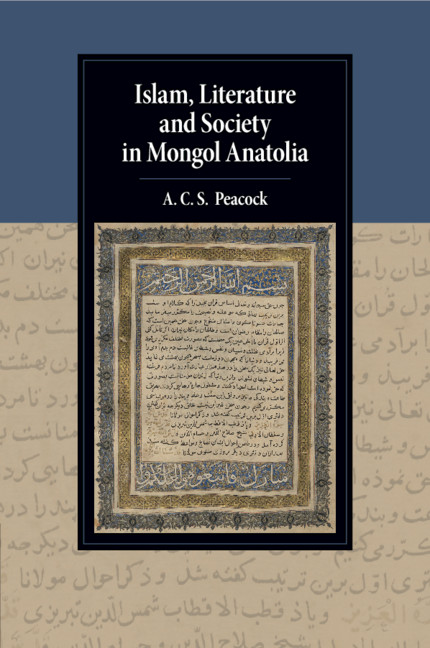
    From a Christian, Greek- and Armenian-speaking land to a predominantly Muslim and Turkish speaking one, the Islamisation of medieval Anatolia would lay the groundwork for the emergence of the Ottoman Empire as a world power and ultimately the modern Republic of Turkey. Bringing together previously unpublished sources in Arabic, Persian and Turkish, Peacock offers a new understanding of the crucial but neglected period in Anatolian history, that of Mongol domination, between c. 1240 and 1380. This represents a decisive phase in the process of Islamisation, with the popularisation of Sufism and the development of new forms of literature to spread Islam. This book integrates the study of Anatolia with that of the broader Islamic world, shedding new light on this crucial turning point in the history of the Middle East.

    Reviews

    'This rich and meticulously researched monograph at last treats Mongol Anatolia in the 13th–14th centuries as a vibrant and multi-faceted society in its own right. The particular originality of the book lies in its analysis of the literary texts being written and read in this period, many previously unknown and still in manuscript, which throw light on the processes of Islamization.'

    Charles Melville - University of Cambridge

    'The most thorough and perceptive study ever published of the decades of Mongol rule in Anatolia. Based on primary sources, many of which have hardly been used by earlier scholars, it throws a flood of light on the process of Islamisation in what would ultimately become Turkey.'

    David O. Morgan - University of Wisconsin-Madison

    'Deploys a depth and variety of source materials and novelty of approach to the study of religious, political, and linguistic change in Mongol Anatolia. Its conclusions differ startlingly from most scholarship on the subject, setting off reverberations that will be felt in scholarly circles far and wide.'

    Scott Redford - SOAS, University of London

    'Peacock has written an erudite, meticulously researched, and insightful work drawing on fascinating new material from rarely used sources. Tackling a wide array of topics from Sufism, vernacular religious literature to apocalyptic thought, this is a major contribution not only to the growing body of work on medieval Anatolia but also to Islamic studies.'

    Sara Nur Yildiz - Max Planck Institute for the History of Science

    'This gripping book is set in one of the darkest periods of Soviet history, the last years of Stalin. Using declassified materials Slaveski vividly shows how remaking Ukraine after the German occupation and the Red Army's defeat of the Wehrmacht was accompanied by corruption, violence and for many destitution. The result, as his brilliant analysis demonstrates, was incessant conflict between central and local authorities. The legacy of the chaotic post-war years is both an historical and contemporary phenomenon. This book is an invaluable contribution to understanding modern Ukraine.'

    John Barber - University of Cambridge

    'This fascinating story of ordinary people fighting back successfully against Stalinist officialdom is an example of how scholars can draw larger implications from local studies. Filip Slaveski's important book offers a fresh approach to Stalinist economy and society. It changes our understanding of Soviet history after World War II by restoring agency to the lowly villagers and revealing the social tensions missed by previous historians.'

    Serhy Yekelchyk - University of Victoria

    Refine List

    Actions for selected content:

    Select all | Deselect all
    • View selected items
    • Export citations
    • Download PDF (zip)
    • Save to Kindle
    • Save to Dropbox
    • Save to Google Drive

    Save Search

    You can save your searches here and later view and run them again in "My saved searches".

    Please provide a title, maximum of 40 characters.
    ×

    Contents

    Metrics

    Altmetric attention score

    Full text views

    Total number of HTML views: 0
    Total number of PDF views: 0 *
    Loading metrics...

    Book summary page views

    Total views: 0 *
    Loading metrics...

    * Views captured on Cambridge Core between #date#. This data will be updated every 24 hours.

    Usage data cannot currently be displayed.

    Accessibility standard: Unknown

    Why this information is here

    This section outlines the accessibility features of this content - including support for screen readers, full keyboard navigation and high-contrast display options. This may not be relevant for you.

    Accessibility Information

    Accessibility compliance for the HTML of this book is currently unknown and may be updated in the future.
