





Introduction
When it comes to the formation of wh-questions, languages can be categorized into wh-in situ and wh-movement languages, depending on whether wh-words remain in their base-generated positions or undergo overt movement. Mandarin Chinese is recognized as a typical wh-in situ language, in which the wh-words stay in their original syntactic position with no overt wh-movement. This contrasts with wh-movement languages such as English, in which the wh-word is typically moved to the front of the sentence in questions (typically Spec-CP). This cross-linguistic variation in wh-question formation makes wh-questions an informative testing ground for understanding how child language develops.
Many children with autism spectrum disorder (ASD) exhibit language difficulties, in addition to social deficits and restricted repetitive patterns (American Psychiatric Association, 2013), which often prompt their parents to seek formal diagnosis and intervention (Kozlowski et al., Reference Kozlowski, Matson, Horovitz, Worley and Neal2011). Subsets of children with ASD have been reported to struggle with wh-movement languages, including English (Jyotishi et al., Reference Jyotishi, Fein and Naigles2017) and Hebrew (Sukenik et al., Reference Sukenik, Morin, Friedmann, Prevost and Tuller2021). Moreover, in French, which exhibits a mixed wh-question system (allowing both wh-in situ and wh-movement), these difficulties are particularly evident in wh-movement constructions (Durrleman et al., Reference Durrleman, Marinis and Franck2016). However, it remains unclear whether children with ASD face similar challenges with wh-questions in wh-in situ languages like Mandarin Chinese.
This study aims to investigate the comprehension of wh-questions—specifically, matrix subject and object wh-questions—in Mandarin-speaking children with ASD compared with their typically developing (TD) peers. Using the eye-movement measures of the intermodal preferential looking (IPL) paradigm (Naigles & Tovar, Reference Naigles and Tovar2012), the present study captures children’s real-time processing of wh-questions while minimizing social and task-related demands, which is particularly important for assessing syntactic comprehension in ASD. Although limited research has investigated the comprehension of wh-questions in wh-in situ languages for autism, such as Japanese (Oi, Reference Oi2010) and Korean (Park, Reference Park2016), none of these studies controls for both social factors and morphological factors (both Japanese and Korean involve morphological cues, i.e., overt case markers). Mandarin Chinese, a morphologically poor language (Li & Thompson, Reference Li and Thompson1981), provides a unique context for examining wh-question comprehension. By investigating Mandarin wh-questions using the IPL method, this study is able to isolate the independent influence of syntactic factors on ASD children’s difficulties with wh-questions. In addition, prior acquisition studies on wh-movement languages have mostly reported that object wh-questions pose more challenges than subject wh-questions for children (e.g., Seidl et al., Reference Seidl, Hollich and Jusczyk2003), a pattern that has been attributed to the distance effect of wh-dependencies (Gibson, Reference Gibson, Marantz, Miyashita and O’Neil2000). By focusing on Mandarin, in which wh-words remain in situ at the surface but are arguably moved covertly to Spec-CP (Huang, Reference Huang1982) and thus entail potential subject-object asymmetry as in wh-movement languages, the study provides a critical test of whether such subject-object asymmetries observed in wh-movement languages extend to a wh-in situ language.
The language-specific features of Mandarin Wh-questions
Mandarin exhibits distinct syntactic and semantic features in the formation and comprehension of wh-questions. Unlike wh-movement languages, Mandarin wh-questions have the same word order as their declarative counterparts, with the wh-words staying in their canonical theta positions, as demonstrated in (1). Both subject and object wh-questions thus have superficially similar sentence structures, retaining a basic SVO (subject-verb-object) word order without overt displacement of wh-words, differing in the syntactic position occupied by the wh-word.
(1)
a.
Shenme
tui-le
xiaoniao? (Mandarin subject wh-question)
what
push-ASP
the bird
“What pushed the bird?”
b.
Xiaoniao
tui-le
shenme? (Mandarin object wh-question)
the bird
push-ASP
what
“What did the bird push?”
c.
Xiaoma
tui-le
xiaoniao. (Mandarin declarative sentence)
the horse
push-ASP
the bird
“The horse pushed the bird.”
In languages such as English, Japanese, and Korean, explicit morphosyntactic cues are provided to differentiate between subject and object wh-questions. English employs syntactic cues such as do-support and subject-auxiliary inversion specifically in object wh-questions (e.g., “Who did John hit?”). Japanese and Korean, both wh-in situ languages, use overt case markers, attached directly to wh-words, clearly indicating grammatical roles (see Fukuda, Reference Fukuda1993; Otaki et al., Reference Otaki, Sato, Ono, Sugisaki, Yusa, Otsuka and Koizumi2023 for Japanese; Choi, Reference Choi2007 for Korean). Crucially, Mandarin provides no overt morphosyntactic cues, such as subject-auxiliary inversion or morphological case marking, to signal the grammatical role (subject vs. object) of the wh-phrase. In addition, Mandarin also lacks prosodic marking that reliably distinguishes subject from object interpretations in wh-questions. Hence, in the absence of explicit morphosyntactic or prosodic cues, Mandarin-speaking children must instead rely on alternative interpretive strategies to identify and comprehend wh-questions. These strategies may include sensitivity to the linear word order and the use of discourse-level contextual information (Li & Thompson, Reference Li and Thompson1981). Although the linear position of the wh-word provides a surface cue to grammatical role in Mandarin, this cue is less reliable than overt morphological marking, especially in complex wh-questions. For example, in embedded wh-questions such as (2), the wh-word shei “who” appears after the matrix verb zhidao “know,” which may initially lead children to interpret it as an object of the matrix clause. However, shei is in fact the subject of the embedded clause (shei mai-le zhebenshu “who bought this book”). In such cases, children may need to integrate additional syntactic information and discourse context to arrive at the correct interpretation.
(2)
Ni
zhidao
shei
mai-le
zhe-ben shu
ma?
you
know
who
buy-ASP
this book
Q
“Do you know who bought this book?”
Furthermore, from a syntactic-semantic perspective, Huang (Reference Huang1982) proposes that Mandarin wh-words undergo covert movement to Spec-CP at Logical Form (LF) to obtain scope, as shown in (3). Therefore, in Mandarin, wh-words remain in situ at the surface level, with their scope determined at LF. In contrast, English requires overt wh-movement in narrow syntax, meaning that wh-phrases are fronted in the structure before interpretation at LF. Notably, unlike the overt movement of wh-words observed in languages such as English, this covert movement leaves no visible displacement of the wh-word to the sentence-initial position, placing increasing interpretive demands that may pose particular challenges and lead to potential subject-object asymmetry for children with language impairments or developmental conditions such as ASD (e.g., Tager-Flusberg et al., Reference Tager-Flusberg, Paul and Lord2005).

The comprehension of Wh-questions in Wh-movement languages
In wh-movement languages, wh-words are moved to the sentence-initial position. This movement creates a syntactic dependency between the moved wh-word (the filler) and its original canonical position (the gap) in the sentence. Comprehending wh-questions involving such movement requires processing this dependency by establishing a relationship between the filler and the gap. The processing difficulty of sentences has long been associated with the length of dependencies, a concept dating back to early proposals on memory limitations in sentence processing (e.g., Miller & Chomsky, Reference Miller, Chomsky, Luce, Bush and Galanter1963; Yngve, Reference Yngve1960) and was later formalized as the distance effect in the Dependency Locality Theory (Gibson, Reference Gibson, Marantz, Miyashita and O’Neil2000). As a result, an asymmetry is often observed in wh-movement languages between subject wh-questions and object wh-questions, as illustrated in the English example (4). Specifically, in subject wh-questions (4a), the gap is closer to the filler, making them easier to process. In contrast, object wh-questions (4b) involve a gap more deeply embedded within the VP, resulting in longer dependencies and greater processing difficulty.

In contrast to this distance effect, a hierarchical account attributes the asymmetry not to the linear distance of the filler-gap dependency but to its structural configuration. Under Relativized Minimality (RM; Rizzi, Reference Rizzi1990; Reference Rizzi and Belletti2004), a filler-gap dependency between X and Y is disrupted if another similar element, Z, hierarchically intervenes, as shown in (5). Importantly, later work has shown that this hierarchical-intervention cost is feature-dependent (Friedmann et al., Reference Friedmann, Belletti and Rizzi2009; Rizzi, Reference Rizzi2018): it emerges robustly with which phrases that contain a lexical NP (e.g., which horse) and therefore share [+NP] features with the intervening subject NP. However, it is greatly reduced—or even absent—with bare who or what pronouns that lack the [+NP] feature. The present study does not directly assess this RM-based intervention account, because our focus is on simple subject and object wh-questions involving bare what pronouns.
(5)
a.
…X…Z…Y…
b.
…filler…intervener…gap…
c.
Z intervenes between X and Y if and only if Z c-commands Y and Z does not
c-command X.
(adapted from Rizzi 1990)
Consistent with the distance-based account, many studies have found that the distance effect contributes to a subject-object asymmetry, i.e., subject wh-questions are acquired earlier than object wh-questions in children’s comprehension of wh-questions in wh-movement languages (e.g., for Dutch: Van Der Meer et al., Reference Van Der Meer, van Atteveldt, Coopmans and Philip2001; for English: Seidl et al., Reference Seidl, Hollich and Jusczyk2003). However, this subject advantage has been reported as inconsistent in studies using online methods (Goodwin et al., Reference Goodwin, Fein and Naigles2012; Jyotishi et al., Reference Jyotishi, Fein and Naigles2017; Seidl et al., Reference Seidl, Hollich and Jusczyk2003). Seidl et al. (Reference Seidl, Hollich and Jusczyk2003) used a split-screen preferential looking paradigm to investigate the early real-time comprehension of subject (e.g., what hit the flower?) and object wh-questions (e.g., what did the apple hit?) in English-speaking infants (N = 60, mean age = 5;7). Seidl and colleagues divided participants into three age groups (13, 15, and 20 months) and identified a developmental progression in infants’ comprehension of wh-questions. Specifically, 13-month-olds showed no appropriate response to either question type. By 15 months, infants responded correctly to subject wh-questions but not object wh-questions. By 20 months, infants responded appropriately to both subject and object wh-questions. The authors attributed the subject advantage at 15 months to greater structural complexity in object wh-questions, such as longer filler-gap dependencies. Using the same stimuli, Goodwin et al. (Reference Goodwin, Fein and Naigles2012) conducted a longitudinal study comparing the comprehension and production of subject and object wh-questions in English-speaking toddlers. The sample included 18 toddlers (age range: 18–23 months, mean age = 20.63 months), who were visited at four-month intervals over three years. Comprehension was assessed with the IPL paradigm. By 28 months, children comprehended both subject and object wh-questions, with no subject-object asymmetry. However, comprehension of subject wh-questions dropped at 36 months, and both question types were comprehended again at 41 months. Jyotishi et al. (Reference Jyotishi, Fein and Naigles2017) also followed English-speaking toddlers longitudinally using IPL, but employed animate rather than inanimate characters in the stimuli to better match typical transitive events (e.g., a bird hugging a horse). Their findings indicated that children reliably understood object wh-questions (e.g., what did the bird hug?) by 28 months and subject wh-questions (e.g., what hugged the horse?) by 32 months. Afterward, their performance stabilized, and they did not find any subject-object asymmetry. Given these mixed results, Nie et al. (Reference Nie, Su, Durrleman and Naiglesto appear) propose that English-speaking TD children may exhibit a period of instability in understanding subject and object wh-questions during early development.
It is well established that children with ASD often face challenges with wh-questions in overt wh-movement languages such as English (Jyotishi et al., Reference Jyotishi, Fein and Naigles2017), Hebrew (Sukenik et al., Reference Sukenik, Morin, Friedmann, Prevost and Tuller2021), and French (specifically wh-movement questions; Durrleman et al., Reference Durrleman, Marinis and Franck2016). These difficulties are primarily attributed to two factors: (1) wh-questions are syntactically complex structures that involve displacement of constituents (Chomsky & Lasnik, Reference Chomsky, Lasnik and Chomsky1995), including wh-words. Children with ASD are particularly sensitive to syntactic complexity, with subsets experiencing language delays and deficits (Kjelgaard & Tager-Flusberg, Reference Kjelgaard and Tager-Flusberg2001), and (2) the pragmatic features of wh-questions (such as grasping that the speaker is expecting them to provide information) pose special challenges due to the social deficits commonly associated with ASD (Tager-Flusberg et al., Reference Tager-Flusberg, Paul and Lord2005).
Early studies found that children with ASD produced significantly fewer wh-questions in spontaneous speech compared to their language-matched TD peers (Tager-Flusberg, Reference Tager-Flusberg and Tager-Flusberg1994), and even verbal autistic children often fail to request information during naturalistic interactions (Wetherby & Prutting, Reference Wetherby and Prutting1984; Wetherby et al., Reference Wetherby, Prizant and Schuler2000). Goodwin et al. (Reference Goodwin, Fein and Naigles2012) assumed that some of these difficulties may stem from methodological challenges, such as joint attention, gesture, and turn-taking—socially related domains well-documented as impaired in children with ASD (e.g., Clark, Reference Clark, Bavin and Naigles2015; Tomasello, Reference Tomasello, Bavin and Naigles2015). To explore the role of social and pragmatic factors in wh-question comprehension, Jyotishi et al. (Reference Jyotishi, Fein and Naigles2017) directly investigated how these elements contribute to the development and understanding of wh-questions. They hypothesized that children who are more attuned to their social and communicative environments are likely to acquire wh-questions earlier. Their findings showed that earlier socialization and communication scores, assessed using the Vineland Adaptive Behavior Scales, strongly predicted children’s successful performance in wh-question comprehension.
On the other hand, research has shown that the comprehension of wh-questions in French-speaking children with ASD is strongly modulated by syntactic complexity (Durrleman et al., Reference Durrleman, Marinis and Franck2016). French is particularly informative because it allows two surface forms: an in situ form (e.g., Tu as poussé qui? “you pushed who”) and a wh-ex-situ form (e.g., Qui tu as poussé? “who did you push”). They tested 15 French-speaking children with ASD and 45 TD peers matched on non-verbal reasoning, and manipulated three graded factors—movement, configurational intervention, and NP-feature similarity, yielding four complexity levels. Accuracy followed this gradient in both groups: structures without movement (object wh-in situ; Level 0) showed ceiling performance, while wh-ex-situ object questions that combined movement with intervention and feature overlap (Level 3) elicited the lowest scores (e.g., 60 % in 4-year-olds vs. 89 % in 8-year-olds). Importantly, object wh-questions were only difficult when the wh-phrase underwent fronting; their in situ counterparts were easier than subject wh-questions. Children with ASD exhibited the same graded pattern as TD children, albeit at a lower overall accuracy. These findings indicate that the chief source of difficulty is the additional syntactic operations required by wh-movement (and the associated intervention effects). Prévost et al. (Reference Prévost, Tuller, Barthez, Malvy and Bonnet-Brilhault2017) also investigated wh-question comprehension in 20 French-speaking children with ASD (6–12-year-olds), 19 age-matched peers with Specific Language Impairment (SLI),Footnote
1
and two TD control groups—15 four-year-olds (TD4) and 15 six-year-olds (TD6). Examples of the object question types tested are as follows:
(6)
a.
wh-
in situ: Le pingouin pousse qui? “The penguin pushes who?”
b.
plain
wh-
fronting:
Qui le pingouin pousse? “Who is the penguin pushing?”
c.
wh-
fronting +
est-ce que
:
Qui est-ce que le pingouin pousse? “Who is the
penguin pushing?”
d.
wh- fronting + est-ce que + stylistic inversion: Qui est-ce que pousse le
pingouin? “Who is the penguin pushing?”
Beyond the ceiling performance observed for wh-in situ object questions (6a), accuracy was also at ceiling for object wh-questions involving plain wh-fronting (6b) and wh-fronting + est-ce que (6c) in every group. Performance dropped only on the maximally complex configuration, where object wh-questions were compounded by wh-fronting+est-ce que+stylistic inversion (6d); all groups shared this decline and did not yield significant group effects. Crucially, non-verbal reasoning did not correlate with any comprehension measure in the ASD group, indicating that the residual difficulties are rooted in language-specific processing rather than general cognition.
Both Goodwin et al. (Reference Goodwin, Fein and Naigles2012) and Jyotishi et al. (Reference Jyotishi, Fein and Naigles2017) used the IPL paradigm to investigate the comprehension of wh-questions in English-speaking children with ASD. Although subject-object asymmetry was not the primary focus of either study, their longitudinal results nevertheless revealed informative developmental patterns in the comprehension of subject and object wh-questions. Their longitudinal data demonstrated unstable comprehension of subject and object wh-questions and an object advantage in children with ASD. Goodwin et al. (Reference Goodwin, Fein and Naigles2012) found that children with ASD did not comprehend object wh-questions until 54 months (visit 6), whereas they showed comprehension of subject wh-questions as early as 41 months (visit 3), but this comprehension remained unstable in the subsequent visits (4–6). In contrast, Jyotishi et al. (Reference Jyotishi, Fein and Naigles2017) reported that children with ASD comprehended both subject and object wh-questions at 41 months (visit 3). However, while subject wh-questions remained challenging in visits 4-6, object wh-questions were not comprehended at 45 months (visit 4) and 49 months (visit 5), but were understood at 53 months (visit 6).
Taken together, previous studies in wh-movement languages have mostly reported a subject-over-object advantage in TD children’s comprehension of wh-questions. This asymmetry may be associated with a longer filler-gap dependency in object wh-questions relative to subject wh-questions, thereby increasing processing demands. However, the mixed results reported in studies using online methods may be related to the unstable comprehension of subject and object wh-questions in the early development of TD children. Research on wh-question comprehension in children with ASD further suggests that their performance is influenced by both syntactic and pragmatic factors. In particular, children with ASD struggle more with comprehension when multiple movement-related operations accumulate (Durrleman et al., Reference Durrleman, Marinis and Franck2016; Prévost et al., Reference Prévost, Tuller, Barthez, Malvy and Bonnet-Brilhault2017). Additionally, children with better social and communicative abilities tend to perform better on wh-question comprehension tasks (Jyotishi et al., Reference Jyotishi, Fein and Naigles2017). Besides, longitudinal data of English wh-questions revealed an object advantage in children with ASD (Goodwin et al., Reference Goodwin, Fein and Naigles2012; Jyotishi et al., Reference Jyotishi, Fein and Naigles2017).
The comprehension of Wh-questions in Wh-in situ languages
Contrary to the subject-object asymmetry in TD children learning wh-movement languages, previous studies in wh-in situ languages have often reported the absence of subject-object asymmetry among TD children (Kim, Reference Kim1995; Nie et al., Reference Nie, Su, Durrleman and Naiglesto appear; Yoshinaga, Reference Yoshinaga1996; Shi & Yang, Reference Shi, Yang, Gong and Kpogo2022). Earlier studies by Kim (Reference Kim1995) and Yoshinaga (Reference Yoshinaga1996), focusing on comprehension in Korean and Japanese, respectively, found no subject-object asymmetry in TD children. Kim (Reference Kim1995) observed similar performance levels for subject and object wh-questions among Korean-speaking children (ages 2–8) and interpreted the lack of asymmetry as evidence against a strictly syntactic account of difficulty, suggesting alternative explanations, such as sentence-initial saliency, might be relevant. Yoshinaga (Reference Yoshinaga1996) also reported equal accuracy in Japanese-speaking children (ages 2–5) for the comprehension of subject and object wh-questions, interpreting this as consistent with computational complexity accounts that posit the absence of syntactic gaps in Japanese.
Similarly, recent comprehension studies of Mandarin-speaking TD children have not found the subject-object asymmetry in wh-question acquisition. Shi and Yang (Reference Shi, Yang, Gong and Kpogo2022) investigated the comprehension of Mandarin wh-questions in preschoolers (ages 3–5) using a character-selection task. They tested subject and object wh-questions involving bare wh-words (shui “who”) and lexically restricted wh-words (na-yi-ge “which one”). Contrary to predictions based on syntactic intervention theories (e.g., Rizzi, 1990, 2004), they found no subject-object asymmetry in comprehension accuracy for either type of wh-question, even among the youngest 3-year-old children tested. The authors proposed several possible explanations for these results, including that Mandarin might not involve covert feature movement for wh-words, or that intervention effects might be weaker or absent at the LF. Nie et al. (Reference Nie, Su, Durrleman and Naiglesto appear) used the IPL paradigm to compare the comprehension of subject and object wh-questions in Mandarin and English-speaking toddlers (ages 1–3). The results also showed that both language groups successfully comprehended both subject and object wh-questions.
Children with ASD are reported to have difficulties with wh-questions in wh-in situ languages like Japanese and Korean (Oi, Reference Oi2010; Park, Reference Park2016). Oi (Reference Oi2010) examined Japanese-speaking children with high-functioning autism spectrum disorder (HFASD) and investigated their responses to different question types in semi-structured conversations with their mothers. The study found that children with HFASD provided more inadequate responses to wh-questions than to yes/no questions. Oi proposed that the social and communicative impairments associated with autism affect their comprehension of questions.
Limited research has examined subject-object asymmetry in wh-in situ languages among children with ASD (Korean: Park, Reference Park2016; Mandarin: Su et al., Reference Su, Xiao and Naigles2022). Unlike the absence of subject-object asymmetry observed in TD children, such asymmetry has been reported in children with ASD in wh-in situ languages. Using the IPL paradigm, studies have found an object-over-subject advantage in children with ASD, particularly in Korean (Park, Reference Park2016) and Mandarin (Su et al., 2022). However, both studies used only a single where control question type for comparison with subject and object what questions. We assumed that this limited control condition might have contributed to the observed object advantage.
In sum, studies among preschool TD children have not reported the subject-object asymmetries in wh-in situ languages, likely reflecting language-specific features or age-related maturation in mastering both types of wh-questions. In Japanese and Korean, TD children can use overt case markers to facilitate the comprehension of both subject and object wh-questions. In contrast, Japanese- and Korean-speaking children with ASD show difficulties with both types of wh-questions, often attributed to their pragmatic deficits. Regarding subject-object asymmetry in children with ASD, recent studies using the IPL paradigm have reported an object advantage. However, this finding may be influenced by the use of only one control type (where questions) in comparison with subject and object wh-questions. Given that Mandarin also has both subject and object where questions serve as the subject and object what counterparts, we methodologically employed both subject and object where questions as controls in the current study (details about the distinction between subject and object where questions in Mandarin are provided in the IPL stimuli section). Moreover, none of these studies has focused on the processing of subject and object wh-questions in children with ASD.
The current study
The present study examines whether covert wh-movement is implicated in Mandarin wh-questions and whether potential processing demands associated with such movement differentially affect TD and ASD children. The predictions derive from two theoretically independent factors: (a) the structural status of covert wh-movement in Mandarin, and (b) children’s ability to overcome potential processing demands associated with object wh-questions.
Research Hypotheses:
Whether covert wh-movement exists in Mandarin, and whether children have overcome the associated processing demands, will jointly determine the presence or absence of subject-object asymmetry and potential group differences between TD and ASD children.
Hypothesis 1 Covert movement exists; both groups have overcome processing demands
If (a) covert wh-movement exists in Mandarin and object wh-questions impose greater structural processing demands, and (b) both TD and ASD children have overcome the increased processing demands associated with object wh-questions,
then no subject-object asymmetry is expected in either group. ASD children are predicted to perform comparably to their TD peers.
Prediction 1:
TD ≈ ASD: subject wh-question ≈ object wh-question
Both TD children and children with ASD can comprehend both types of questions.
Hypothesis 2 Covert movement exists; ASD children have not fully overcome processing demands
If (a) covert wh-movement exists and object wh-questions impose greater structural processing demands, and (b) if ASD children have not fully overcome these demands, then ASD children are expected to show selective difficulty with object wh-questions. In contrast, TD children may have mastered both question types by overcoming the processing demands. This would result in a subject-over-object asymmetry, specifically in the ASD group.
Prediction 2:
TD: subject wh-question ≈ object wh-question
ASD: subject wh-question > object wh-question
TD overall > ASD (particularly for object wh-question)
Hypothesis 3 Covert movement exists; neither group has overcome processing demands
If (a) covert wh-movement exists and object wh-questions impose greater structural processing demands, and (b) both TD and ASD children remain sensitive to the increased processing demands of object wh-questions, then both groups are expected to exhibit a subject-object asymmetry, with comparable performance patterns across groups.
Prediction 3:
TD ≈ ASD: subject wh-question > object wh-question
Hypothesis 4 Covert movement does not exist
If Mandarin wh-questions do not involve covert wh-movement, then no structural asymmetry between subject and object wh-questions is predicted. Then, in this case, both TD and ASD children are expected to perform comparably across question types, without evidence of increased difficulty for object wh-questions.
Prediction 4:
TD ≈ ASD: subject wh-question ≈ object wh-question
Method
Participants and measures
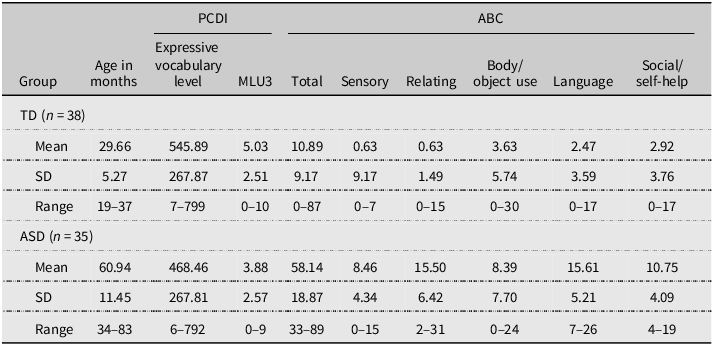
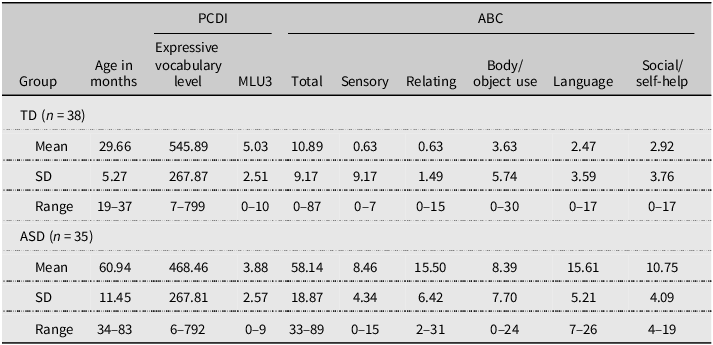
Participants included 35 children with ASD (mean age = 60.94 months, age range = 2;10–6;11 years) and 38 TD children (mean age = 29.66 months, age range = 1;7–3;1 years). The two groups were matched on expressive vocabulary score, quantified with the Putonghua Communicative Development Inventories (PCDI; Tardif et al., Reference Tardif, Fletcher, Zhang and Liang2008): Words and Sentences, t(71) = −1.87, p = .065. The PCDI is modeled after the MacArthur-Bates Communicative Development Inventories and is specifically adapted for Putonghua-speaking populations. The children with ASD were recruited from three autism training centers (Aimier, Xingyuan, and Qihang) in Changsha, China. Recruitment flyers were distributed to the parents of children enrolled at these centers. Parents who expressed interest were then contacted, and only those who signed consent forms moved forward to screening and testing. Experienced child psychiatrists made diagnoses of autism according to the DSM-5 criteria (American Psychiatric Association, 2013). In addition, we measured autistic severity using the Chinese Autism Behavior Checklist (ABC; Yang et al., Reference Yang, Huang, Jia and Chen1993), a parent/teacher screening tool that assesses children’s autism-related behavioral characteristics. All ASD participants scored above the Chinese ABC cut-off of 31, whereas no TD child did. TD children were recruited from BlueSky Art Kindergarten and through word of mouth in Changsha. Caregivers of both groups completed the PCDI after the IPL task to provide expressive vocabulary size and the mean length of the three longest utterances (MLU3). The study received approval from the Medical Ethics Committee of the Second Xiangya Hospital, Central South University. The descriptive statistics (including age, PCDI vocabulary, MLU3, ABC total, and subscale scores) are shown in Table 1.
Participant information
Materials
Standardized assessments
The ABC (Krug et al., Reference Krug, Arick and Almond1980; Chinese version: Yang et al., Reference Yang, Huang, Jia and Chen1993) was administered to assess the child’s autistic behaviors. The parent rating scale of the ABC is one of the most widely used autism screening tools in China (Sun et al., Reference Sun, Allison, Matthews, Sharp, Auyeung, Baron-Cohen and Brayne2013). Individuals with a total score of 62 or more have a high probability of being autistic, and the cutoff score of 31 distinguishes between children who are likely and unlikely to be autistic. The PCDI (Tardif et al., Reference Tardif, Fletcher, Zhang and Liang2008) provided a measure of the child’s language production abilities in Mandarin Chinese via parental report. CDI measures (e.g., the MCDI, the PCDI) have been widely used in language assessments of 1–7-year-olds with ASD learning different languages (e.g., Charman et al., Reference Charman, Drew, Baird and Baird2003; Su et al., Reference Su, Naigles and Su2018).
IPL paradigm
The primary rationale for selecting IPL as the testing tool is its ability to provide a more precise assessment of linguistic knowledge in very young children and those with social deficits, independent of social demands (Naigles & Tovar, Reference Naigles and Tovar2012). This feature is particularly valuable for assessing children with ASD, who often experience significant social and communication challenges. This choice is based on the minimal social, motor, or speech demands involved: children merely watch videos on a screen while listening to a central audio. The operational details of this paradigm are outlined below:
The IPL paradigm (Golinkoff et al., Reference Golinkoff, Hirsh-Pasek, Cauley and Gordon1987; Naigles & Tovar, Reference Naigles and Tovar2012) entails presenting children with two side-by-side videos, with child-directed speech from a central speaker corresponding to only one of the videos. These sentences were prerecorded by a female native speaker and read in a child-friendly voice. The child’s gaze direction and duration are recorded and coded for signs of comprehension. Stimuli were projected onto a portable 150 cm × 120 cm screen using a Lenovo ThinkPad connected to an Epson projector. A central speaker, positioned discreetly behind the screen, relayed the audio. Additionally, a digital camcorder mounted on a small tripod just below the center of the screen captured the child’s face.
IPL stimuli
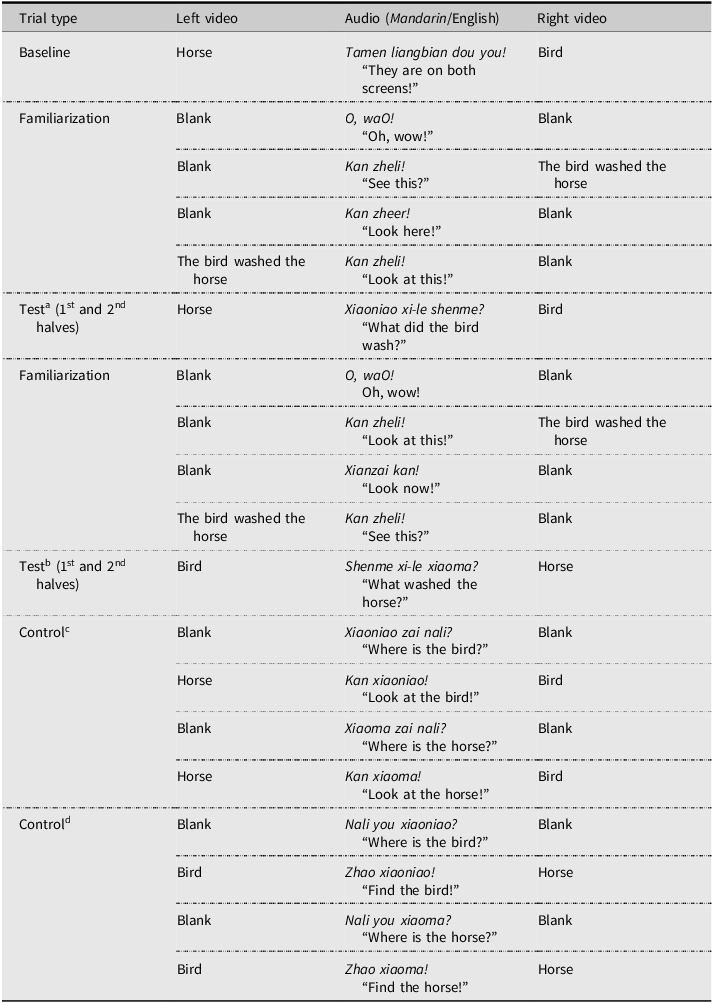
Table 2 presents the layout and trial durations for the wh-question video (adapted from Jyotishi et al., Reference Jyotishi, Fein and Naigles2017). The wh-question video consisted of four phases. First, a baseline trial introduced two animate characters (a costumed bird and a horse). This was followed by a familiarization trial, which showed the transitive action (e.g., the bird washing the horse). In the test trial, the characters appeared side by side while an audio prompt asked either an object wh-question (e.g., xiaoniao xile shenme “The bird washed what?”) or a subject wh-question (e.g., shenme xile xiaoma “What washed the horse?”)—directs the child’s attention, thereby testing their comprehension of the wh-question. The test sentence was presented twice, with blank screens on both sides for the first time before the test trial, and with only one of the two scenes matching the audio stimulus for the second time during the test trial. For analysis purposes, these entire test trials will be further divided into two equal halves (i.e., the first 2 sec comprised the first half and the last 2 sec comprised the second half) to measure the participants’ efficiency of wh-question processing during the test trials. The wh-question video featured four events with four familiar verbs (mo “tickle,” xi “wash,” bao “hug,” and bei “carry”). Finally, to serve as a comparison for the test trials, the control trials posed two types of where questions—an object where question (e.g., xiaoniao zai nali “The bird is where?”) and a subject where question (e.g., nali you xiaoniao “Where is the bird?”). Each child heard four object what questions and four subject what questions (one per verb), along with two object where and two subject where control questions, for a total of 12 trials (8 test trials + 4 control trials).
Sample layout of the wh-question video (adapted from Jyotishi et al., Reference Jyotishi, Fein and Naigles2017)
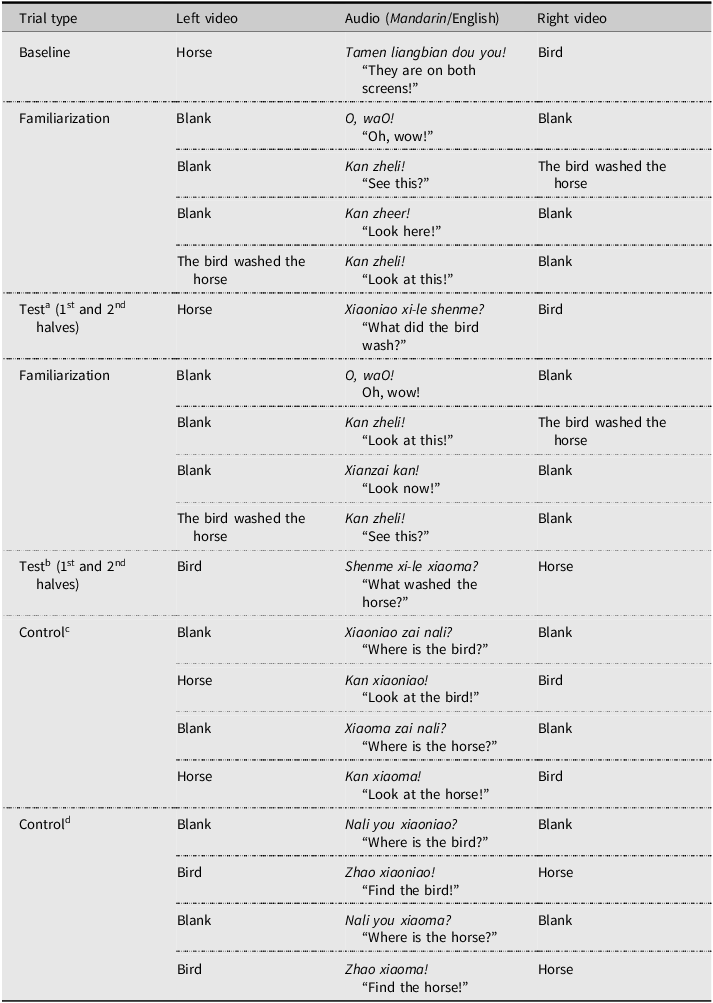
a Object what questions = xiaoma mo-le shenme “What did the horse tickle?”; xiaoniao xi-le shenme “What did the bird wash?”; xiaoniao bao-le shenme “What did the bird hug?”; xiaoma bei-le shenme “What did the horse carry?”
b Subject what questions = shenme bao-le xiaoma “What hugged the horse?”; shenme bei-le xiaoniao “What carried the bird?”; shenme mo-le xiaoniao “What tickled the bird?”; shenme xi-le xiaoma “What washed the horse?”
c Object where questions = xiaoniao zai nali? “The bird is where?”; xiaoma zai nali? “The horse is where?
d Subject where questions = nali you xiaoniao? “Where is the bird?”; nali you xiaoma? “Where is the horse?”
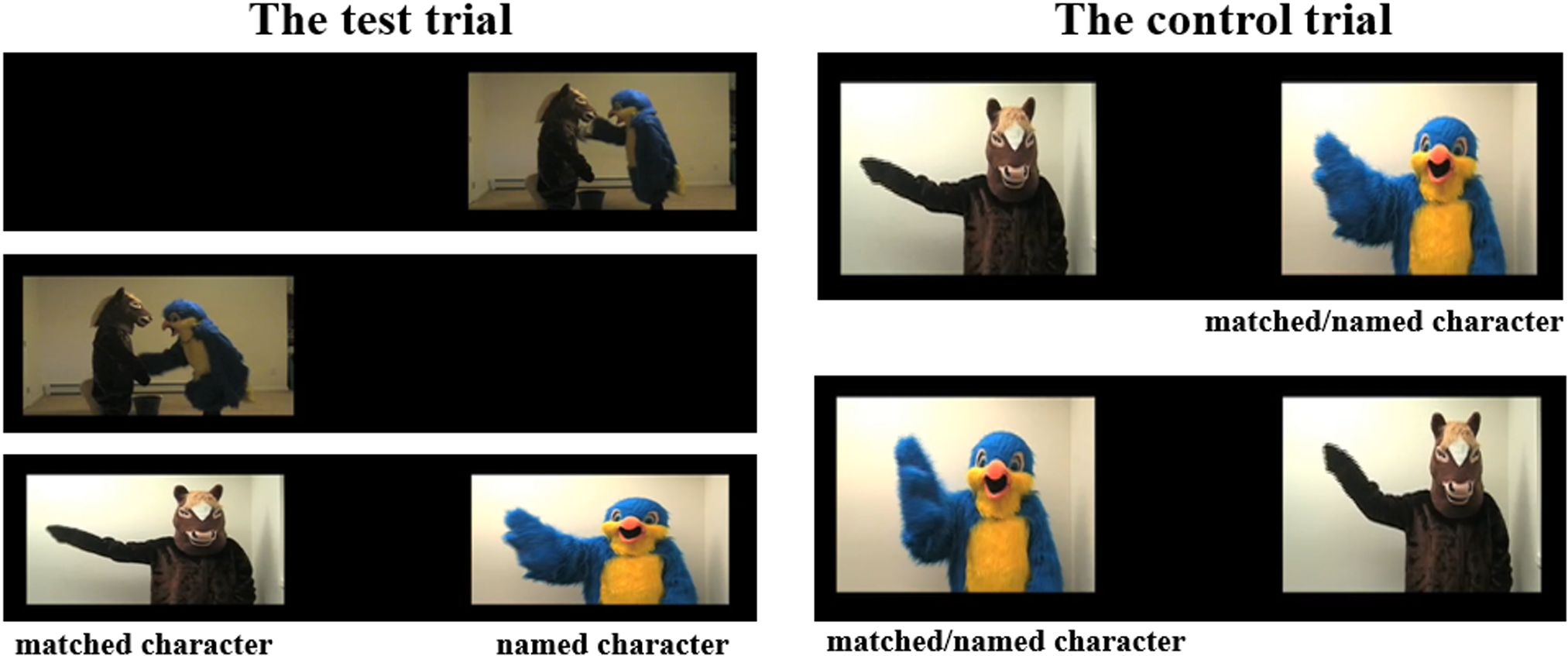
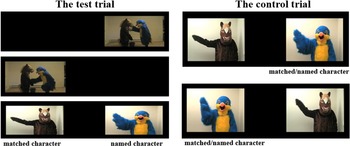
Note that our stimuli differ from those of Jyotishi et al. (Reference Jyotishi, Fein and Naigles2017) by including two types of where-control questions, since wh-words remain in situ in Mandarin Chinese. The grammatical role of the Mandarin word nali “where” determines whether the interrogative is a subject or object question. In a subject where question such as Nali you xiaoniao? “Where is the bird?,” nali occupies the subject position of an existential structure, whereas in an object where question such as Xiaoniao zai nali? “The bird is where?,” nali functions as the complement of the locative preposition zai, as in (7a and 7c). This subject-object distinction in where questions parallels that in what questions (7b and 7d), while making opposite predictions for children’s eye gaze behavior (towards the named item in where questions vs. towards the unnamed item in what questions), thus providing a directly comparable control condition to the what questions (subject-where vs. subject-what; object-where vs. object-what). Take Figure 1 as an example, the left panel shows the sample object wh-question Xiaoniao xi-le shenme “The bird washed what?” from the test trials, while the right panel shows the sample control trial Xiaoniao zai nali “The bird is where?”.
(7)
a.
Nali
you
xiaoniao? (subject where question)
where
have
the bird
“Where is the bird?”
b.
Shenme
xi-le
xiaoma? (subject what question)
what
washed
the horse
“What washed the horse?”
c.
Xiaoniao
zai
nali? (object where question)
the bird
at
where
“Where is the bird?”
d.
Xiaoniao
xi-le
shenme? (object what question)
the bird
washed
what
“What did the bird wash?”
Examples of IPL stimuli in test trials and control trials.
Procedure
The child and his/her parent were accompanied to a testing room, located at the institutions where they were recruited. During the IPL experiment, the children sat on their parents’ laps, and parents were instructed not to interact with their children. The wh-questions video was then presented, which lasted 4 min 9 s. After the viewing session, parents were asked to complete the PCDIs and ABCs to assess their children’s vocabulary knowledge and identify autism-related behaviors, which were collected within 1 week after the IPL experiments.
Coding
The videos capturing children’s visual fixations during the IPL test were recorded and digitized at the Child Language Lab at Central South University. Following the standard IPL coding protocol (Naigles & Tovar, Reference Naigles and Tovar2012), the durations of looking time to the “left,” “right,” “center,” and “away” were meticulously coded offline, frame by frame, using AVI View, a specialized coding software. To reduce potential bias, the audio from the test was muted, allowing coders to assess the direction of eye gaze solely from the child’s silent video, without any cues about the correctness of the gaze direction. However, specific conditions necessitated the exclusion of certain trials: firstly, an individual trial was considered missing if the child did not look at both scenes for at least one second in total; secondly, if a child did not look at the center for a minimum of 0.3 sec, their data for that trial were also excluded. Based on these criteria, 28 test trials (9.21%) and 13 control trials (8.55%) were excluded in the TD group, and 24 test trials (8.57%) and 12 control trials (8.57%) were excluded in the ASD group. These exclusions were comparably distributed across groups and conditions, which are typical figures for IPL studies (usually less than 10%) (Naigles et al., Reference Naigles, Kelty, Jaffery and Fein2011; Su & Naigles, Reference Su and Naigles2019). To ensure intercoder reliability, each video was coded by at least two well-trained research assistants, with discrepancies no greater than 0.3 seconds per item. We assessed intercoder reliability by calculating Cohen’s κ frame by frame. The two independent coders achieved 95.2% raw agreement, with κ = 0.87 (95% CI [0.85, 0.89]), indicating “almost perfect” reliability (Landis & Koch, Reference Landis and Koch1977).
Data analysis plan
We fitted a 2 (Group: ASD vs. TD) × 2 (Question Type: Subject vs. Object) × 2 (Trial Type: Test vs. Control) linear mixed-effects model with random intercepts for participants. The dependent variable was the looking proportion to the named item across what (test) and where (control) trials, with age as a covariate. To examine whether each group demonstrated successful comprehension, within-group comparisons were conducted using paired-samples t-tests to compare looking proportions between where and what trials for subject and object wh-questions. Following the previous English IPL wh-question studies (Goodwin et al., Reference Goodwin, Fein and Naigles2012; Jyotishi et al., Reference Jyotishi, Fein and Naigles2017), successful comprehension was defined as looking significantly less at the named item during what trials than during where trials. Specifically, we compared children’s looking proportion toward the named item (e.g., the bird) during what question trials (e.g., “What pushed the bird?”) with their looking proportion toward the same item during the corresponding where trials (e.g., “Where is the bird?”). In where trials, the named item was the clear visual target, while in what trials, children needed to recognize that the named item was not the focus of the event, resulting in decreased attention to that item.
We evaluated the what-where contrasts using the mixed-effects model, with Bayes Factors computed to quantify evidence for effects of interest. All models were compared to a null model (intercept-only baseline) to assess the strength of evidence for each model relative to this baseline.
To capture children’s fine-grained processing of specific wh-questions, as mentioned, each 4-second test trial was divided into two equal 2-second windows. The first half (0–2 s) reflects children’s initial parsing after hearing the sentence once, while the second half (2–4 s) captures additional integration or reanalysis following the second presentation. As noted above, to demonstrate successful comprehension, children were expected to look significantly less at the named item during the what trials than the where trials. All inferential contrasts reflect test (what)-control (where) comparisons within each wh-question type (e.g., subject what test vs. subject where control; object what test vs. object where control). If this difference appeared in the first half of the wh-test trial, it would suggest rapid processing; if it emerged only in the second half of the wh-test trial, it would indicate slower or delayed comprehension. Such analyses are standard in recent IPL studies to capture processing dynamics that may be obscured by averaging across the full trial (e.g., Candan et al., Reference Candan, Küntay, Yeh, Cheung, Wagner and Naigles2012; Su & Naigles, Reference Su and Naigles2019, Reference Su and Naigles2023; Xie & Su, Reference Xie and Su2025).
We also analyzed latency to first look at the matching versus nonmatching item for both subject and object wh-questions. We also fitted a 2 (Group: ASD vs. TD) × 2 (Question Type: Subject vs. Object) × 2 (Latency: mean matching latency vs. mean nonmatching latency) linear mixed-effects model with random intercepts for participants. The dependent variables were mean matching latency (MLatency) and mean nonmatching latency (NMLatency), with age as a covariate. Paired-sample t-tests compared MLatency and NMLatency, with faster latency to the matching item indicating more rapid comprehension.
To capture individual variations, we conducted a supplementary analysis comparing the number of children who demonstrated comprehension (Comprehenders) with those who lacked comprehension (Noncomprehenders) (see also Jyotishi et al., Reference Jyotishi, Fein and Naigles2017). Difference scores were calculated by subtracting the looking proportion toward the named item during where trials from the looking proportion during what trials (Jyotishi et al., Reference Jyotishi, Fein and Naigles2017). This within-subject comparison controlled for baseline visual preferences and assessed whether children modulated their attention based on the syntactic structure. Positive difference scores indicated better comprehension (i.e., more looking away from the named/nonmatching item during what trials), while negative scores indicated poorer comprehension (i.e., more looking at the named/matching item during where trials).
Finally, to further investigate individual differences, we conducted Pearson’s correlation analyses to examine the relationships between wh-question comprehension and language ability measures via the PCDI as well as autistic behavior scores via the ABC. These measures are commonly assessed in previous IPL studies among children with ASD (Su & Naigles, Reference Su and Naigles2022). All analyses were conducted in R 4.5.1.
Results
Analyses were conducted according to the two research questions: (1) Do children with ASD differ from TD children in their comprehension of Mandarin wh-questions? (2) Is there an asymmetry between Mandarin subject wh-questions and object wh-questions in children with ASD and TD children?
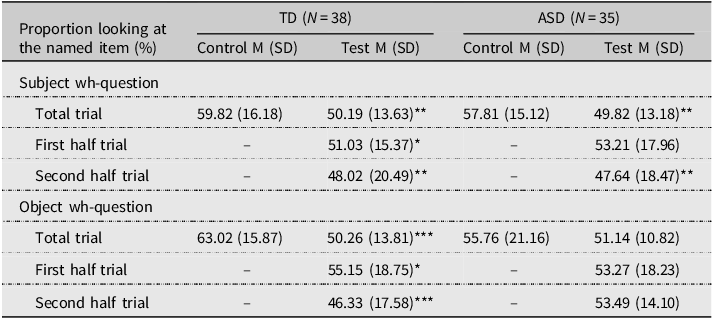
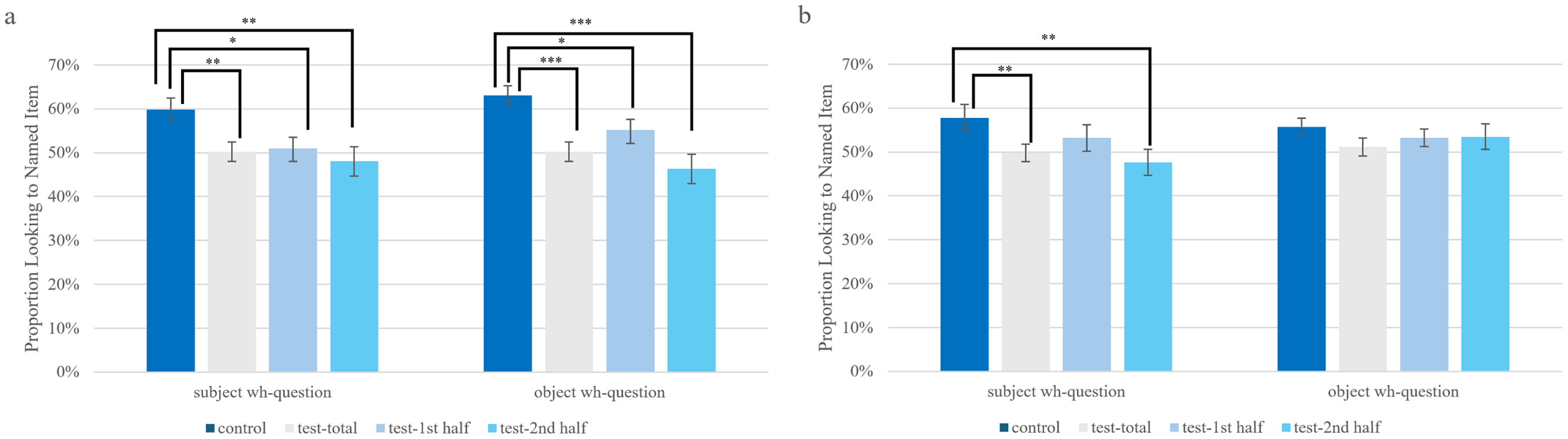
Table 3 presents the descriptive data of the proportion looking at the named item during control (where) and test (what) trials by the ASD and TD groups. To address the research questions, a linear mixed-effects model was conducted with group (ASD or TD) as a between-subjects factor and question type (subject-wh vs. object-wh) and trial type (what-test vs. where-control) as within-subjects factors, with age entered as a covariate. Using the total looking proportion to the named item as the dependent measure, the analysis revealed a significant main effect of trial type, F(1, 211) = 26.57, p < .001. To examine whether each group demonstrated successful comprehension, follow-up t-tests were performed for the ASD and TD groups separately. Following Jyotishi et al. (Reference Jyotishi, Fein and Naigles2017), one-tailed significance testing was used since we expected an effect in a specific direction, i.e., less looking at the named item during the what-test trials. In the TD group, children looked significantly less at the named item during test trials than during control trials, for both object wh-questions (t(37) = −4.41, p < .001) and subject wh-questions (t(36) = −2.79, p < .01), suggesting successful comprehension of both types of wh-questions. Children with ASD also showed a significant difference between control and test trials for subject wh-questions (t(34) = −2.54, p < .01), suggesting sensitivity to this question type. However, no significant difference was found for object wh-questions (t(33) = −1.35, p = .09). Thus, although both groups looked at the named items numerically less during the test than during the control trials for object wh-questions, this difference was statistically significant only for the TD group. These results mirror the pattern observed in the visual plots (see Figure 2) and reinforce the interpretation that TD children successfully comprehended both subject-wh and object-wh-questions, whereas children with ASD, at the group level, exhibited their comprehension of subject but not object wh-questions.
Proportion looking at the named item during control (where) and test (what) trials by the TD and ASD group
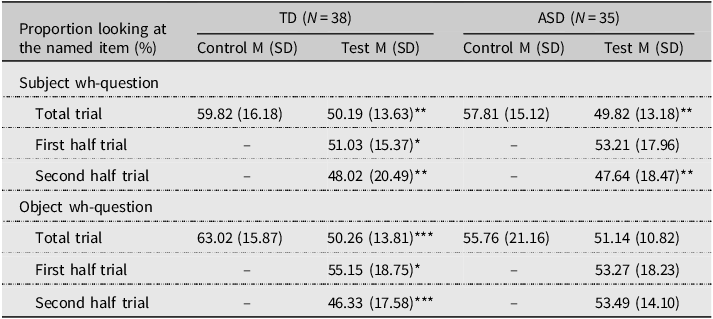
Note: Comparison of control trial vs. test trial. *p < .05; **p < .01; ***p < .001.
Proportion looking at the named item in (a) TD group and (b) ASD group, *p < .05, **p < .01, ***p < .001.
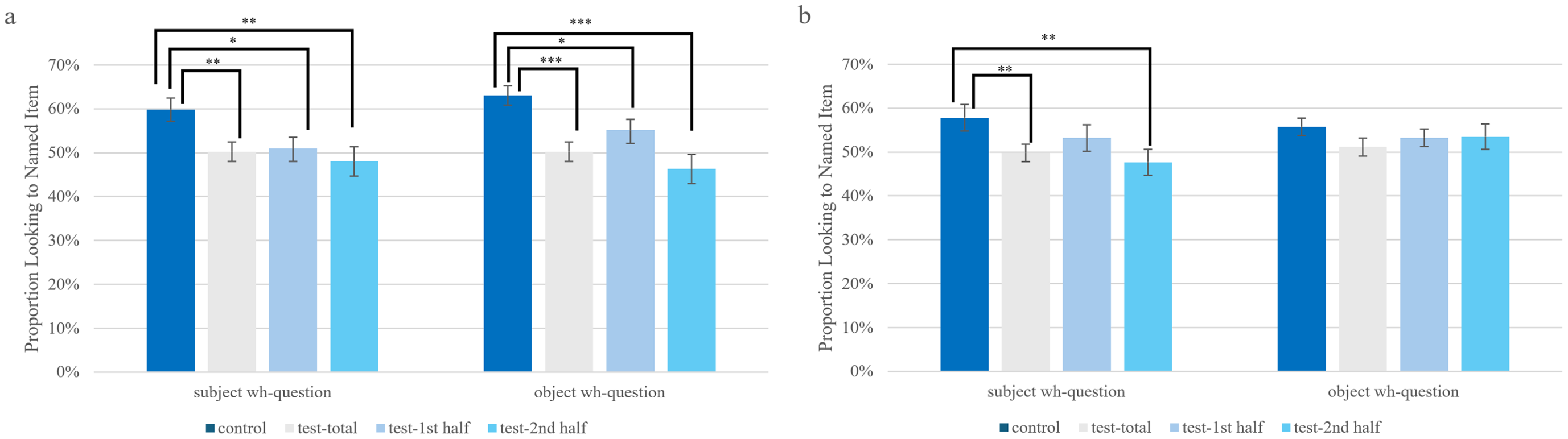
When the total test trials were divided into two halves, using the first-half looking proportion measure, a significant main effect of trial type was also observed, F(1, 210) = 9.01, p < .01. T-tests further revealed that significant differences were observed in both subject and object wh-questions in the TD group (subject-wh: t(36) = −2.33, p < .05; object-wh: t(37) = −2.32, p < .05). In contrast, no significant differences were found in either subject or object wh-questions in the ASD group (subject-wh: t(34) = −1.33, p = .10; object-wh: t(33) = −0.65, p = .26).
For the second-half looking proportion measure, the analysis revealed a significant main effect of trial type, F(1, 211) = 24.09, p < .001, as well as a marginally significant Group × Test Type interaction, F(1, 211) = 3.81, p = .052. The next set of analyses again investigated each group’s looking patterns separately for subject and object-what questions. In the TD group, significant differences were again observed in both subject and object wh-questions (subject-wh: t(36) = −2.60, p < .01; object-wh: t(37) = −4.87, p < .001). However, in the ASD group, the significant difference was present only for subject wh-questions, with no such difference for object wh-questions (subject-wh: t(34) = −2.50, p < .01; object-wh: t(33) = −0.57, p = .29). These results indicate that though TD children comprehended both the subject and object wh-questions, the subject-object asymmetry was evident in the ASD group, as they only showed understanding of subject wh-questions (for both the total looking proportion and the second half of the looking proportion), but not object wh-questions.
To further evaluate the evidence for our factorial structure, we conducted Bayes Factor (BF) model comparisons based on the total looking proportion to the named item, using a common intercept-only (null) baseline model. All reported Bayes Factors therefore quantify the strength of evidence for each candidate model relative to this null model. The model with the strongest support included only the main effect of Trial Type (test vs. control; BF ≈ 10,488.38), providing decisive evidence that Trial Type explains variance beyond the null model (Jeffreys, Reference Jeffreys1961). Models including Group + Trial Type or Question Type + Trial Type also showed very strong evidence relative to the null model (BF > 1000), indicating that these predictors improve model fit over an intercept-only baseline. However, these models did not receive stronger support than the model including Trial Type alone. In contrast, the full model including the Group × Question Type × Trial Type interaction showed only weak evidence relative to the null model (BF ≈ 2.14), suggesting that the inclusion of higher-order interaction terms provides limited additional explanatory value beyond baseline variation. Taken together, the Bayes Factor comparisons indicate that the primary source of evidence in the data is associated with the contrast between test and control trials, with little Bayesian support for more complex interaction structures.
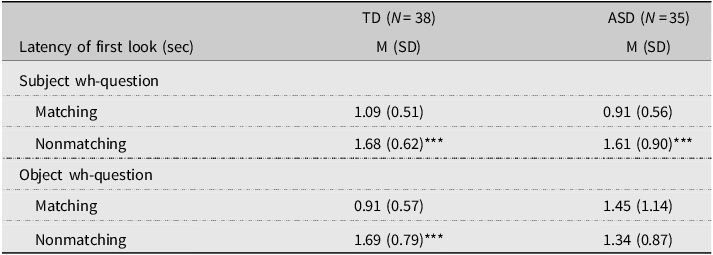
With the latency of first look measure, a mixed-effects ANOVA revealed a significant main effect of group, F(1, 67) = 4.69, p < .05, and a significant main effect of trial type, F(1, 211) = 32.83, p < .001. Furthermore, the interaction between question type and trial type was significant, F(1, 211) = 5.26, p < .05. The interaction between group, question type, and test type was also significant, F(1, 211) = 8.48, p < .01. Paired-sample t-tests were conducted to compare the latency of first looks to the matching versus nonmatching items within each group for subject and object wh-questions (see Table 4). Faster looks to the matching item compared to the nonmatching item were taken as evidence of more rapid processing. For the TD group, significant latency differences were observed in both object (t(37) = −5.57, p < .001) and subject wh-questions (t(36) = −5.64, p < .001). For the ASD group, a significant difference was found in subject wh-questions (t(34) = −3.92, p < .001) but not in object wh-questions (t(33) = 0.43, p = .67).
Latency of first looks (seconds) to matching and nonmatching items for subject and object wh-questions by the TD and ASD groups
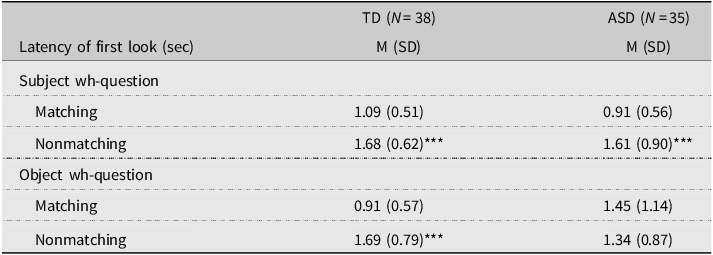
Note: Comparison of matching items vs. nonmatching items. ***p < .001.
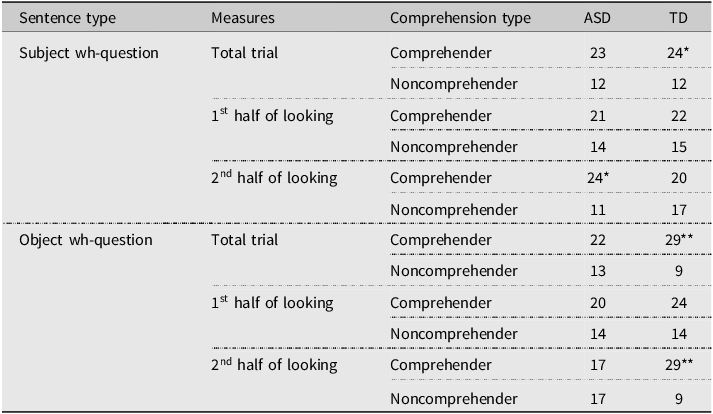
We next compared the number of comprehenders and noncomprehenders within each group using a Chi-square test (see Table 5). For the total test trials of subject what questions, the ASD group (N = 35) showed a numerical majority of comprehenders (N = 23, 65.7%) over noncomprehenders (N = 12, 34.3%), but this trend did not reach significance, χ2(1) = 3.457, p = .063. By contrast, the TD group (N = 36) showed a significant majority of comprehenders (N = 24, 66.7%) over noncomprehenders (N = 12, 33.3%), χ2(1) = 4.000, p < .05. For the total test trials of object what questions, the ASD group (N = 35) again showed a numerical majority of comprehenders (N = 22, 62.9%) vs. noncomprehenders (N = 13, 37.1%), χ2(1) = 2.314, p = .128, whereas the TD group (N = 38) showed a robust significant majority (N = 29, 76.3% vs. N = 9, 23.7%), χ2(1) = 10.526, p < .01. We further divided the total test trials into two halves (first half of looking in test trials and second half of looking in test trials), chi-square tests provided further insights into the number of participants who demonstrated comprehension during each half of the looking period. In the TD group, significant differences were observed during the second half of object wh-question trials (Ncomprehender = 29 vs. Nnoncomprehender = 9, χ2(1) = 10.526, p < .01), but not during the first half (Ncomprehender = 24 vs. Nnoncomprehender = 14, χ2(1) = 2.632, p = .105). For subject wh-question trials in the TD group, no significant differences were observed in either the first half (Ncomprehender = 22 vs. Nnoncomprehender = 15, χ2(1) = 1.324, p = .250) or the second half of the test trials (Ncomprehender = 20 vs. Nnoncomprehender = 17, χ2(1) = .243, p = .622). In contrast, within the ASD group, significantly more comprehenders than noncomprehenders were observed during the second half of the subject wh-question trials (Ncomprehender = 24 vs. Nnoncomprehender = 11, χ2(1) = 4.829, p < .05), while no significant differences were found during the first half (Ncomprehender = 21 vs. Nnoncomprehender = 14, χ2(1) = 1.400, p = .237). For object wh-question trials in the ASD group, no significant differences emerged between comprehenders and noncomprehenders in either the first half (Ncomprehender = 20 vs. Nnoncomprehender = 14, χ2(1) = 1.059, p = .303) or the second half of the test trials (Ncomprehender = 17 vs. Nnoncomprehender = 17, χ2(1) = 0.000, p = 1.000). These results suggest that comprehension dynamics differ between groups and question types, with TD children showing evidence of comprehension in object wh-questions later in the trial and children with ASD exhibiting delayed comprehension in subject wh-questions.
Number of children showing comprehension (comprehenders) or no comprehension (noncomprehenders) of wh-questions (for subject and object wh-questions)
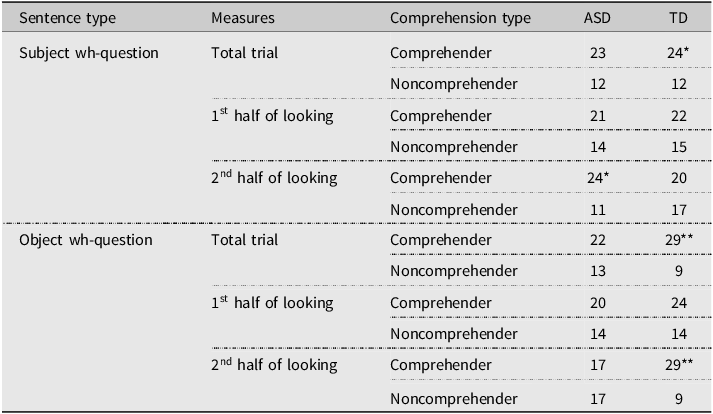
Note: The number of comprehenders outweighing than that of noncomprehenders. Chi-square tests, *p < .05; **p < .01.
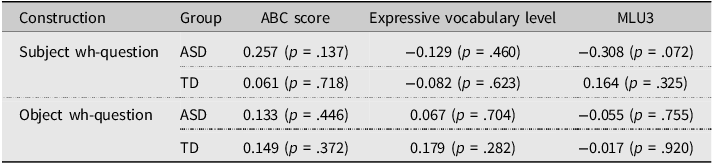
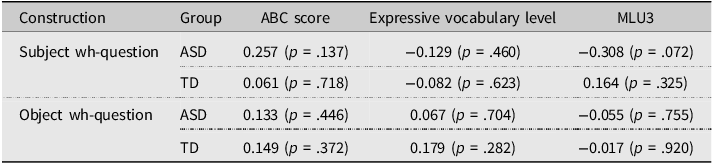
We conducted Pearson’s correlations to examine the relationships between degree of comprehension scores of wh-questions (difference scores for subject and object questions) and measures of general language ability and autism severity. The latter included expressive vocabulary size and MLU3 from the PCDI, as well as total scores from the ABC. No correlations reached significance after false discovery rate correction (all adjusted ps > .19; see Table 6). Overall, these findings suggest that neither language level nor autism severity reliably predicted the degree of comprehension for subject or object wh-questions in either the ASD or TD groups.
Correlations between children’s subject and object wh-questions, and language measures (Expressive vocabulary level and MLU3) and autistic severity (ABC scores) (r values (p values))
Discussion
In this study, our results show that successful comprehension was observed in both subject and object wh-questions in the TD group. However, in the ASD group, children can comprehend subject wh-questions, but not object wh-questions. Together, these results provide evidence for covert movement in Mandarin wh-questions and suggest that children with ASD experience a more pronounced difficulty with the more complex covert movement involving object wh-words fronting in object wh-questions relative to subject wh-questions.
Selective difficulties in object Wh-questions for children with ASD
Our research findings showed that TD children successfully comprehended both subject and object wh-questions. Specifically, they reliably distinguished between what and where trials, looking away from the named item when it was unmatched in the what trials and towards it when it was matched in the where trials. Moreover, this significant effect was present in both the first and second halves of the looking time for both question types, indicating that their processing of subject and object wh-questions was rapid and stable. By contrast, the ASD group showed significant comprehension only for subject wh-questions, and this effect emerged primarily during the second half of the looking, suggesting a slower processing pattern for this question type. Besides, TD children’s latency of first look to the matching item was significantly shorter than their latency to the nonmatching item for both subject and object wh-questions, suggesting their ability to quickly identify the matching item based on the audio stimuli in both question types. However, such a difference in latency was only significant for subject wh-questions in the ASD group, suggesting their sensitivity to subject wh-questions. This pattern consistently indicates that TD children show reliable comprehension and rapid processing for both subject and object wh-questions, while children with ASD can only understand and process subject wh-questions. Furthermore, as a supplementary categorical analysis, chi-square tests indicated that the number of comprehenders in the TD group significantly exceeded the number of noncomprehenders for both subject and object wh-questions. In the ASD group, however, the number of comprehenders did not differ significantly from the number of noncomprehenders for either question type. This discrepancy suggests that although the mean performance of the ASD group on subject wh-questions was significantly different from the comparison where condition, such performance was not consistent across the majority of individuals in the group. Taken together, these findings indicate that while children with ASD retain some ability to comprehend subject wh-questions, this ability is not as robust or widespread as in TD peers and does not extend to object wh-questions. This selective difficulty with object wh-questions is likely related to the longer filler-gap dependency involved in object wh-questions.
These findings of subject-over-object asymmetry converge on an explanation in terms of syntactic dependency processing. Both the IPL looking proportion and latency comparisons consistently showed that children with ASD were weaker than TD children in comprehending and processing wh-questions, especially object wh-questions. TD children, however, exhibited no subject-object asymmetry, performing equally well on both subject and object wh-questions. That is, a subject-over-object asymmetry is found in children with ASD, while no asymmetry is found in TD children. The subject-over-object advantage suggests that children with ASD have more difficulties comprehending object wh-questions than subject wh-questions, even though they also have problems with subject wh-questions, since they only comprehend subject wh-questions during the second half of looking. This is in line with our prediction based on the distance effect of filler-gap dependency when covert wh-movement occurs. Specifically, in object wh-questions, the gap is located deeper in the syntactic structure because the object is embedded within the predicate (VP) of the sentence. This requires the listeners to associate the filler with the gap in a more distant syntactic position. In subject wh-questions, the filler-gap distance is minimal, reducing the cognitive load.
Our findings partly align with studies using the IPL paradigm, which have shown that English-speaking children with ASD exhibit delayed comprehension compared to their language-matched TD counterparts, who demonstrated strong comprehension of wh-questions (see Goodwin et al., Reference Goodwin, Fein and Naigles2012; Jyotishi et al., Reference Jyotishi, Fein and Naigles2017). However, unlike the object advantage in the English IPL studies, the current study reveals a subject advantage in Mandarin-speaking children with ASD. This discrepancy could be related to factors: (1) language-specific features, and (2) the use of only one type of where control question. In English, object wh-questions involve the auxiliary do, which may serve as a strategy for distinguishing subject and object wh-questions. Additionally, English IPL studies use only one type of where question, a factor shared by Su et al. (2022). These typological and methodological differences could account for the contrasting results between previous studies and the present study.
We aimed to explore how individual characteristics influence the ability of children with ASD to comprehend wh-questions. However, no significant correlations were found between early language measures (including expressive vocabulary size, MLU, and ABC language scores) and wh-question comprehension scores in either the ASD or TD groups. First, we hypothesize that the lack of correlation between vocabulary scores from the PCDI and wh-question comprehension may be because the vocabulary used in the wh-question stimuli was simple and limited, requiring only a basic level of vocabulary knowledge. Second, the absence of an association between ABC scores and wh-question comprehension suggests that understanding wh-questions operates independently of autistic behaviors. Finally, the unexpected finding that MLU does not predict wh-question comprehension may be attributed to the fact that MLU primarily reflects children’s language production rather than their comprehension ability.
Evidence for covert Wh-movement in Mandarin-speaking children
The results provide support for covert wh-movement, as evidenced by differences in wh-question comprehension between children with ASD and their TD counterparts. Specifically, the results support hypothesis 2: if covert wh-movement exists in Mandarin and object wh-questions are more complex, ASD children may struggle with object wh-questions, while TD children are expected to master both question types. This would create a subject-over-object asymmetry in the ASD group.
To examine the influence of the syntactic factor, i.e., covert movement in Mandarin wh-questions, potential confounding social and morphological factors were carefully controlled. The first confounding factor, the degree of social deficits, was mitigated by using the IPL paradigm when the IPL setup projects the linguistic audio from a central speaker without direct interaction (neither verbal nor gestural) with the experimenter (Naigles & Tovar, Reference Naigles and Tovar2012). Therefore, it purely assesses the syntactic knowledge of children with ASD. The second factor, morphological cues, is inherently excluded in Mandarin wh-questions, as they lack features like do-insertion or subject-auxiliary inversion in English wh-questions and case marking on wh-words in Japanese and Korean wh-questions. These morphological cues can be used as alternative strategies to play a significant role in helping children identify the grammatical roles of wh-words (see Van Valin, Reference Van Valin2002, for English; Omaki et al., Reference Omaki, Davidson White, Goro, Lidz and Phillips2014, for Japanese and Korean). In contrast, the scarcity of morphological cues in Mandarin can complicate children’s ability to distinguish among different types of wh-questions (Li & Thompson, Reference Li and Thompson1981). Given these considerations, there should be no inherent challenges (socio-pragmatic factors) or strategies (morphological factors) in comprehending Mandarin wh-questions for either group. Nevertheless, the results revealed a clear difference in performance between the two groups. The weaker performance of children with ASD provides preliminary evidence that factors beyond social or morphological ones impact their comprehension of wh-questions. A plausible explanation lies in syntactic factors, namely movement, as subsets of children with ASD are known to struggle with syntactic movement compared to TD children (Diehl et al., Reference Diehl, Friedberg, Paul and Snedeker2015). To further investigate whether syntactic factors underlie the observed differences, we examined potential asymmetries between subject and object wh-questions. If movement indeed occurs in Mandarin wh-questions and children with ASD have not fully overcome processing demands, we would expect subject wh-questions to be easier than object wh-questions, as the latter involve a longer dependency. The results confirmed this prediction: children with ASD showed a subject-over-object advantage in wh-question comprehension. This observed subject-over-object asymmetry provides additional evidence for the presence of covert wh-movement in Mandarin wh-questions. These findings highlight the role of syntactic complexity in influencing wh-question comprehension in children with ASD, while their TD peers at this age of language development may have already mastered both types of wh-questions (see also Nie et al., Reference Nie, Su, Durrleman and Naiglesto appear). If covert movement were equivalent to overt movement, one would predict the same distance effect to arise for both object questions involving wh-in situ and those involving wh-ex-situ (Durrleman et al., Reference Durrleman, Marinis and Franck2016).
In summary, we extended the investigation of children’s wh-question real-time comprehension to a less-studied language, Mandarin, using the IPL setup. First, we found that the comprehension of matrix wh-questions is partially impaired in children with ASD, as they had more difficulties understanding object wh-questions but not subject wh-questions, while TD children comprehended both types of wh-questions. Second, the difficulties in comprehending object wh-questions among children with ASD can be attributed to the increased processing demands of object wh-questions compared to subject wh-questions. Such subject-over-object asymmetry in wh-question comprehension likely reflects differences in movement mechanisms interacting with the filler-gap dependency length: subject wh-questions involve short dependencies, whereas object wh-questions involve longer dependencies. This subject-over-object asymmetry, however, is not observed in TD children, likely because TD children find both types of matrix questions easier to process (see also Nie et al., Reference Nie, Su, Durrleman and Naiglesto appear; Jyotishi et al., Reference Jyotishi, Fein and Naigles2017). Third, the observed differences in wh-question performance between ASD and TD groups, as well as the subject-over-object asymmetry in children with ASD, support the hypothesis of covert wh-movement in Mandarin wh-questions. Given the lack of a relationship between wh-question performance and expressive vocabulary levels, interventions should consider that vocabulary alone may not fully capture the linguistic challenges faced by children with ASD (Durrleman & Zufferey, Reference Durrleman and Zufferey2009; Eigsti et al., Reference Eigsti, Bennetto and Dadlani2007; Tager-Flusberg et al., Reference Tager-Flusberg, Paul and Lord2005).
Future study
The current study found no subject-object asymmetry in Mandarin-speaking TD children, suggesting that they can comprehend and process both subject and object wh-questions. Future studies should examine the role of lexically restricted wh-phrases in influencing this asymmetry. Specifically, the current study used bare wh-words that are not lexically restricted, which may have contributed to the lack of asymmetry observed. Given that previous studies with more complex wh-words (e.g., Jakubowicz & Gutierrez, Reference Jakubowicz and Gutierrez2007 for French; De Vincenzi et al., Reference De Vincenzi, Arduino, Ciccarelli and Job1999 for Italian) have shown a clearer subject-over-object advantage, future work could explore how lexically restricted wh-phrases, such as “which,” influence children’s comprehension and processing of subject vs. object wh-questions. Although a recent study by Shi and Yang (Reference Shi, Yang, Gong and Kpogo2022) found no subject-object asymmetry in Mandarin-speaking TD children, this may be attributed to both the larger age of participants, i.e., preschoolers (who may have already mastered the knowledge of which phrase) and the offline method used (which makes it difficult to capture the fine-grained comprehension and processing of wh-questions). Future work will extend the current design by incorporating lexically restricted which phrases into IPL stimuli to further test subject-object asymmetries in Mandarin-speaking younger children with and without ASD.
Replication package
The data and related materials that support the findings of this study are available on the Open Science Framework at https://osf.io/znqas/.
Acknowledgements
We are grateful to the children, parents, teachers, and therapists who participated in the study, as well as to our research team at Central South University, whose collaboration made this study possible. We also thank Prof. Letitia Naigles for generously providing the original IPL video materials on which the stimuli used in this study were based.
Funding statement
This research was supported by the Hunan Provincial Natural Science Foundation (2024JJ5421), the Changsha Philosophy and Social Science Planning Project (2026CSSKKT11), the National Natural Science Foundation of China (32571264), the Swiss National Science Foundation (SNSF) (grant PR00P1_193104/1), and the Scientific Research Fund of Hunan Provincial Education Department, China (25A0005).
Competing interests
The authors declare no competing interests.
Ethical standards
This study was approved by the Clinical Medical Ethics Committee of Xiangya Hospital, Central South University (no. 2023111426). Written informed consent was obtained from the caregivers of all participating children.

 Open access

