


1. Introduction
A major issue in the circular economy is that customers desire the newest functionality in products. This collides with circular principles that keep the added value in products (e.g., repair, remanufacture) and makes it difficult for circular products to enter the large, primary market for new products without being broken down to their materials (e.g., recycling) (Reference Parker, Riley, Robinson, Symington, Tewson, Jansson, Ramkumar and PeckParker et al., 2015).
Perpetual innovative products (PIP) represent a new design concept in the circular economy, in which used components or subsystems from previous product generations are integrated into new products to deliver improved functionality and performance, while enabling re-entry into the primary market (Reference Lanza, Deml, Matthiesen, Martin, Brützel and HörstingLanza et al., 2024). This can be considered inverted remanufacturing, as it integrates used components and subsystems into new products, which fulfill the customers’ demands for the latest functions. The term “perpetual” does not imply infinite product lifetimes, but rather a design logic that enables continuous, generation-spanning renewal of functionality and performance through the selective integration of used components. In this sense, innovation in PIPs does not stem from reuse per se, but from systematically reconciling value retention with the introduction of new functions that are not achievable through classical remanufacturing and would otherwise require complete material recycling or conventional new product development (NPD).
For the example of a perpetual innovative power tool, such as an angle grinder, the next product generation may comprise new components and subsystems like the spindle bearing assembly, alongside a reprocessed gear stage and a reused drive shaft from the previous generation. Through its design, the PIP is able to fulfill today’s vibration requirements, even though the previous generation, from which the components and subsystems are taken, was not able to do so. This concept requires a lot of changes in the design process compared to remanufacturing and NPD, as integration is only possible by decision-making depending on the state of the used components and subsystems.
The design of a PIP requires a systematic assessment of the used product intended for reuse. Prior to making design decisions, it is crucial to assess whether the components and subsystems can be reused, require reprocessing, or necessitate design changes. This adds a new challenge to traditional design and development models like the Stage-Gate model or V-model (Reference Wynn and ClarksonWynn & Clarkson, 2018), which do not include such assessments. In contrast, classical remanufacturing process models describe the reuse of products in detail (Reference Charter and GrayCharter & Gray, 2008). However, they lack the connection to the next product generation, as they aim to restore the product’s initial condition and thus do not focus on introducing new functionality and performance enhancements. The link between remanufacturing and NPD is established by design for remanufacturing (DfReman) only within the same product generation.
The assessment is a crucial step in the PIP development process, as many unknown interactions between the individually degraded components from used products could affect system behavior and hinder the fulfillment of functional requirements in the new product. Testing has proven useful in NPD, as unknown interactions can be uncovered in efficient ways compared to other activities of product analysis (Reference Chen, Cheung and YiuChen et al., 2020; Reference KtenaKtena, 2011). Testing is understood here as an activity in which a system or component is executed under specified conditions, the results are observed, and an evaluation is made (Reference Tahera, Wynn, Earl and EckertTahera et al., 2018). The primary purpose of testing is to manage and reduce uncertainties to acceptable levels by the end of the process. The problem is that there is too little understanding of the process of how testing can address and mitigate the uncertainties in PIP development. To close this gap, the following research question is derived:
How can testing contribute to revealing and reducing uncertainty when assessing the impact of design changes and inherent degradation during the development of perpetual innovative products?
The aim of this paper is to explore how testing activities can identify and manage uncertainties in PIP development and to outline a systematic process for its integration into the assessment process, based on case studies from a research project.
2. Related work
2.1. Development of perpetual innovative products
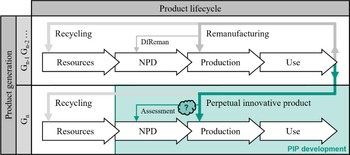
The PIP is a new concept that involves incorporating used components and subsystems from the previous generations (Gn-1, Gn-2, …) into next-generation (Gn) products. It allows classical remanufacturing to bridge the gap between product generations, as seen in Figure 1. Assessing whether components and subsystems can be reused, require reprocessing, or necessitate design changes is essential prior to making design decisions during NPD. However, the various degradation patterns in earlier life cycles introduce many uncertainties in the assessment of used products.
Perpetual innovative products in relation to other circular strategies

Figure 1 Long description
A diagram of the product lifecycle within the circular economy. The diagram is divided into two main sections: Product generation G subscript n and Product generation G subscript n-1, G subscript n-2, and so on. Each section shows a flow from Resources to NPD (New Product Development), Production, Use, and then back to Resources through Recycling and Remanufacturing. The top section represents the traditional product lifecycle, while the bottom section introduces the concept of perpetual innovative products. In the bottom section, after the Use phase, there is an Assessment phase that leads to the creation of a Perpetual innovative product, which then re-enters the lifecycle at the Production phase. The diagram highlights the integration of recycling and remanufacturing processes to maintain the value of products and promote sustainability.
To better position the concept, it is helpful to contrast it with established circular strategies. In circularity concepts, classical remanufacturing restores the current product to its highest possible quality and warranty standards, as it involves not only repair but also reconditioning of its function-critical components and subsystems (Reference Barquet, Rozenfeld and ForcelliniBarquet et al., 2013). The classical remanufacturing process consists of several steps, usually including inspection, fault identification, and reconditioning or replacement of parts when needed (Reference Charter and GrayCharter & Gray, 2008). As the product is kept within the same generation, remanufacturing only ensures that a new product fulfills the requirements of this exact generation. The link between design and remanufacturing is realized through the principles of DfReman, which aims to exploit the full potential of remanufacturing (Reference Nasr and ThurstonNasr & Thurston, 2006). DfReman defines specific principles for integrating remanufacturing requirements into product design, whereby important aspects include disassembly, repairability, and modularization (Reference Ijomah, McMahon, Hammond and NewmanIjomah et al., 2007).
Other circular processes, such as recycling, are able to bridge product generations by providing for new functionalities. However, these processes typically demand substantially more resources and energy, as the value of the product is not preserved. Only in special cases, where new functionalities can be achieved through modules, a value preservation is already possible (Reference Schuh, Mauß, Potente, Schmitz, Adlon, Maetschke, Neumann, Salzwedel, Kozielski, Luckert, Reuter, Schmidhuber and WitthöftSchuh et al., 2023). Although these circular processes already face uncertainties, PIP development introduces additional, unique ones.
2.2. Uncertainties related to perpetual innovative products
In general, uncertainty is an inherent characteristic of design and product development processes, often arising from incomplete, inconsistent, or poor-quality available information (Reference McManus and HastingsMcManus & Hastings, 2006). Such uncertainty can manifest not only in the data itself but also in the ways information is represented and modelled, including ambiguities in description and omissions during modelling (Reference Wynn, Grebici and ClarksonWynn et al., 2011). Furthermore, design data are frequently approximate or predictive rather than verified, leading to uncertainty in assessing information adequacy and reliability (Reference Hu, Mourelatos, Gorsich, Jayakumar and MajcherHu et al., 2020). Reference Wynn, Grebici and ClarksonWynn et al. (2011) elaborate five types of uncertainties in product design: (1) epistemic and aleatory uncertainties, (2) uncertainty in information and description, (3) uncertainty in abstraction and interpretation, (4) uncertainty associated with complexity, and (5) uncertainty associated with lack of trust in knowledge. The detailed descriptions of these uncertainties can be found in (Reference Wynn, Grebici and ClarksonWynn et al., 2011).
During the development of PIPs, numerous uncertainties arise that are closely linked to the assessment of used components and subsystems and their transfer into the next product generation (Reference Heizmann, Beyerer, Dietrich, Hoffmann, Kaiser, Lanza, Roitberg, Stiefelhagen, Stricker, Wexel and ZangerHeizmann et al., 2024). One major concern is uncertainty regarding functional compatibility, where reused components may not fully meet the specifications or environmental conditions of the new application. Integration uncertainties occur when components are embedded into new system architectures, which may lead to geometric misalignments or data incompatibilities at mechanical or digital interfaces. Moreover, the reliability and lifecycle condition of reused parts often remain uncertain, especially when historical usage or degradation data are incomplete or inconsistent. Further, knowledge uncertainties persist due to incomplete documentation or tacit design knowledge. Identifying and reducing these uncertainties is therefore essential to enable effective component and subsystem reuse in PIP development.
2.3. Testing to deal with uncertainty
To reduce uncertainty in product design, it is essential to accumulate and build knowledge about the product. Reference EwinsEwins (2016) states that knowledge can be acquired using various approaches, from theoretical (such as literature-based methods) to numerical (like multibody simulations), modelling, and especially through experimental testing and analysis.
In product design, uncertainties are classified into two types: “epistemic” and “aleatory” (Reference Wynn, Grebici and ClarksonWynn et al., 2011). Epistemic uncertainty arises from a “lack of knowledge” or “lack of definition” (Reference McManus and HastingsMcManus & Hastings, 2006), which can be particularly relevant to new technology and product development. In contrast, aleatory uncertainty pertains to inherent variations within a physical system or environment, such as dimensional variations in machined components (Reference Wynn, Grebici and ClarksonWynn et al., 2011). Learning from testing is crucial for mitigating uncertainties and improving the project outcome (Reference Thomke and BellThomke & Bell, 2001).
Testing can play a role in evaluating an object’s properties (e.g., material or dimensions) and identifying errors or mismatches between expected and measured design parameters. Reference Chen, Cheung and YiuChen et al. (2020) detect the presence of known failure or degradation modes in the intended use environment, while Reference KtenaKtena (2011) reveals information about the direct behavior of a system as well as indirect knock-on. Testing also aids in design refinement (Reference Camburn, Viswanathan, Linsey, Anderson, Jensen, Crawford, Otto and WoodCamburn et al., 2017), which can be achieved through individual or multiple testing efforts (Reference Otto and WoodOtto & Wood, 2001).
In summary, the uncertainties in PIP development pose challenges that testing could address. However, there are no studies that investigate the assessment of used products for developing PIPs. To address this gap, this paper examines how to identify and manage uncertainties arising from design changes and component degradation in PIP development through testing, and proposes a systematic process for the assessment.
3. Materials and methods
3.1. Research context
In this contribution, we investigate the research question based on testing activities carried out in the research project “Circular Factory”. The project pursues a novel vision that aims to preserve the added value of products by analyzing their design and production systems across multiple product generations. In the product development perspective, the analysis includes product architectures, examining the structure and interrelation of components, embodiment-function relations, examining how alterations of geometry and material change the performance, and reliability assessments, examining how degradation influences the remaining useful life.
An angle grinder serves as a representative technical system. Its structure comprises a fast-rotating rotor-bearing assembly connected to a bevel gear stage, translating high rotational speed into usable torque at the tool. Relevant technical parameters include torque, rotational speed, and runtime, with vibration emission and efficiency serving as key characteristics for assessing the functional behavior. The reuse of angle grinders introduces numerous uncertainties due to varied use cases and conditions. Different applications, such as cutting, roughing, and polishing, involve distinct loads, environments, and runtimes. The system’s limited design space results in high functional density, leading to intricate component interactions. These factors make the system challenging to analyze, but ensure that insights are transferable and robust within the circular economy. Thus, both the technical system and the project framework together offer an appropriate and representative basis to address the research question.
3.2. Investigated testing activities
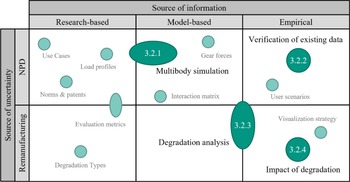
The testing activities in this contribution focused on investigating embodiment-function relations in the angle grinder, describing how specific design changes and inherent degradation affect performance. Different approaches were used, including literature research, analytical and numerical modeling, and experimental testing. These heterogeneous approaches provide a comprehensive basis for exploring how to address uncertainties in the assessment phase. A two-dimensional structured approach was used to categorize the corresponding testing activities, as shown in Figure 2. Since PIP development combines elements of NPD and remanufacturing, the first dimension distinguishes which of the two elements the uncertainty is more attributable to. The second dimension captures the source of information. The three categories are based on the concept of Reference EwinsEwins (2016) and include research-based, model-based, and empirical testing. Given the breadth of activities, it was not feasible to investigate all of them in detail. Therefore, a selection of exemplary activities was carried out. The selected activities were either particularly representative or led to significant insights. As illustrated in Figure 2, the selection favored model-based and empirical activities.
Structured approach for categorizing the individual testing activities

3.2.1. Multibody simulation
The multibody simulation was conducted to address a lack of knowledge regarding the product architecture. Following the initial system analysis, a sensitivity screening was performed to identify key design parameters and interactions. Numerical simulations offer a computationally efficient means for such investigations, enabling rapid iteration across multiple design configurations.
In this testing activity, a multibody simulation model was developed to capture the dynamic behavior of the drivetrain. The model represents the system as a mass-spring-damper assembly with six degrees of freedom, incorporating the motor torque and the gear forces. The simulation was used to evaluate vibration emissions at the fixed bearing of the drive shaft. While the general model structure was based on a related variant of the technical system, significant architectural modifications in the investigated variant required adjustments to model parameters and boundary conditions. The simulation results were of a relative rather than absolute nature, as numerical values did not reflect the real system behavior directly but instead indicated qualitative trends. These findings indicate the potential of multibody simulations to explore dynamic sensitivities within the drivetrain, while also underlining that the quality and validity of the results strongly depend on the chosen model structure and parameterization.
3.2.2. Verification of existing data
To address the uncertainties related to the product’s embodiment and functional behavior after manufacturing. The testing activities focused on measuring norm-related parameters and comparing them with existing manufacturer specifications. The aim was to obtain a realistic yet time-efficient picture of the product’s functional characteristics, highlighting potential discrepancies.
Table 1 shows the measurements of spindle shaft rotational speed for this activity. They were compared to the values stated in the manufacturer’s documentation. The results revealed systematic offset across all settings of the speed controller, as measured speeds consistently fell below the specified values. Furthermore, two distinct levels of offsets were observed. A smaller offset level for the lower settings of the speed controller (1–3), in which the absolute deviation ranged between 282 rpm and 266 rpm. And a bigger offset level for the higher settings of the speed controller (4-6), in which the absolute deviation ranged between 644 rpm and 679 rpm. These observations highlight the indispensable role of empirical testing in establishing a reliable baseline for subsequent investigations, even within NPD.
Rotational speed of spindle shaft indicating deviations

3.2.3. Degradation analysis
The degradation analysis focused on identifying embodiment changes in used components and subsystems. This analysis is relevant for remanufacturing and PIP development in order to assess how a product’s embodiment evolves during its lifecycle. The primary goal was to detect, describe, and quantify the degraded embodiment and to systematically compare it with the reference condition of the new component of the same generation.
This testing activity concentrated on the tooth fracture of the bevel gear. The component was scanned using a Zeiss ATOS Q system, mounted on an automation kit, to emulate instance-specific inspection conditions as expected in a factory environment. The resulting data were processed and visualized as an R–Z projection, as seen in Figure 3. The x-axis displays the radial distance from the rotational axis in mm. and the y-axis represents the relative tooth height (Z) in mm. The reference component, shown in red, aligned well with the nominal characteristics defined in the technical drawing, such as pitch and face angle. In contrast, the degraded component, shown in blue, displayed irregular wear patterns. While there were relatively uniform deviations at the outer radius, the tooth showed significant material loss toward the inner diameter. These findings demonstrate the complex and non-uniform nature of degradation processes at the gear interface.
RZ projection of tooth for new and used component

3.2.4. Impact on degradation
Following the identification of degraded embodiments, it was essential to evaluate the corresponding impact on the product’s functional behavior. Thereby, decisions can be informed on how a degraded component can be included in the next generation. Addressing this uncertainty is exclusive to PIP development, as remanufacturing only aims to restore a component’s initial condition. Because irregular degradation patterns significantly limit the repeatability and predictability, a synthetical replication was used in experimental studies, to systematically analyze this relation. It is acknowledged that synthetic replication simplifies irregular and multi-mechanism degradation, potentially underrepresenting the natural complexity. Therefore, the presented experiment should be understood as a controlled precursor study, to be complemented by a validation using naturally degraded components.
This activity examined the influence of tooth fracture on the vibration emissions of the bevel gear stage. To replicate the actual degradation, a single tooth was modified according to the left side of Figure 4. Two distinct levels of synthetic damage were introduced with the removal of either 50% or 100% of the tooth width. The gear stage subsystem was subsequently tested on a dedicated test bench under defined load conditions, with variables such as deflection and acceleration recorded during operation.
Empirical investigation of synthetic tooth breakage- embodiment variations on the left and acceleration measurements on the right

The right part of Figure 4 illustrates the acceleration signal [m/s2] in the frequency domain [Hz]. Results show that in the case of tooth breakage, a significant difference in the acceleration signal occurred only between the 0% and the 50% tooth-width condition, primarily in the first sideband frequency range. No clear distinction was found between the 0% and the 100% tooth-width condition. This outcome can be explained by the contact dynamics. While the 50% removal interferes with nominal tooth engagement, the high tooth contact ratio (> 2.0) allows the system to compensate for a fully removed tooth. These measurements show the strong influence of degradation patterns on the impact of degradation and its quantification, emphasizing the need for controlled experiments to guide knowledge buildup.
3.3. Analytical approach
An exploratory approach was employed to examine the presented testing activities. Building on the prior categorization shown in Figure 2, the activities were analyzed for recurring themes. This inductive approach enables the generalization of findings across cases while preserving the context-specific aspects. Three key themes were identified and guided the analysis. First, the diversity of testing activities prompted an investigation into the linkage of information from different sources. Second, the observed gap in model-building activities within PIP development drew attention. Third, the recurring theme of degradation warranted a more detailed examination. Insights emerging from this analysis were subsequently mapped onto the PIP development context. Based on the inductive analysis, a four-step process was derived to link testing activities to information generation and decision-making.
4. Results
4.1. Key themes
4.1.1. Information linking from different sources
The activities started with research-based information to address epistemic uncertainty regarding lack of knowledge and complexity. However, uncertainties in interpretation and lack of trust hindered a direct use of this information. Research-based information either served as a basis for gathering other information or had to be verified as a ground of truth by other activities. Therefore, research-based testing is closely related to model-based and empirical activities, as exemplified by the parameter identification and verification of the multibody simulation model.
The multibody simulation model progressed along multiple directions without a clearly defined objective, rather than following a unified strategy. As a result, the process was characterized by incremental adjustments and qualitative interpretation, always cross-checking with other testing activities. The empirical verification of existing data relied on comparative testing using manufacturer specifications. Instead of lengthy preparation, the activity was carried out on an improvised test bench. Although not intended for the simulation model, the insights could still be applied, demonstrating an exploratory connection to model-building. The testing activities in remanufacturing were driven by the individual degradation patterns. A clear sequence from identifying to measuring to evaluating the impact could be seen for the tooth fracture. Nevertheless, this sequence does not automatically translate into a sequence of testing types, as model-based and empirical activities can be interchanged.
4.1.2. Model-building
The multibody simulation and the degradation analysis demonstrated the difficulty of mapping a real technical system in a model. Not only due to degradation phenomena in the embodiment but also because of the demanding parameterization and functional density of the system. Model creation and subsequent analysis were further constrained by the limited quality and level of detail of existing reference models. These limitations resulted in substantial uncertainty concerning the validity and applicability of the multibody simulation, especially when investigating modified configurations such as alternative bearing arrangements or higher rotational speeds. In the initial phase, broad simplified models such as the Laval-Jeffcott rotor proved useful for obtaining insights. However, developing detailed models capable of producing absolute results remained challenging.
A significant gap was identified concerning model-based activities in the context of remanufacturing. As models required fitting to certain degradation patterns and other boundary conditions, adequate data and information were largely unavailable. Therefore, model-based activities only resorted to embodiment deviations, like the degradation analysis, which restricts their use for analyzing the impact of the degradation on the functional behavior. Furthermore, aleatory uncertainties associated with degradation can only be integrated in models using stochastic approaches. Therefore, model definition and scope must be determined deliberately at the beginning of any analysis.
4.1.3. Degradation
Investigations highlighted the need to differentiate between embodiment degradation and its impact on functional behavior. For the meaningful description of embodiment degradation, a distinction between features and characteristics was required. Features such as tooth fracture were evaluated qualitatively, while systematic analysis required decomposition into measurable characteristics. Due to irregular patterns, epistemic uncertainty often arose from a lack of definition rather than a lack of knowledge.
Degradation did not necessarily lead to a worsening of functional behavior. In run-in phases of the tooth fracture study, a temporarily reduced vibration emission was detected. This observation demonstrates the need to distinguish between subsystem-level and system-level performance, as local improvements can coexist with global deterioration. The investigation of functional behavior was also strongly influenced by the specific degradation patterns. This became evident in the suggestion of airborne acoustic measurements to detect tooth fracture. Here, the degradation pattern caused uncertainty regarding complexity in the measurands to detect a change in the dynamic behavior. The activities demonstrated that degradation represents a multidimensional phenomenon that requires both a precise definition of embodiment and a clear understanding of the functional impact.
4.2. Four-stage process
A four-step process is proposed in Figure 5 to link testing activities to information generation and decision-making in PIP development, structuring the transition from data exploration to actionable design decisions. Steps 1 and 2 focus on system understanding and exploration typical of NPD, while steps 3 and 4 incorporate remanufacturing aspects, explicitly considering degradation and impact.
Proposed four-step process integrating NPD and remanufacturing into PIP development

Step 1: Initial system analysis and data consolidation
The first step aims to generate a fundamental understanding of the technical system by consolidating existing data and information through research-based activities. Key questions include: What architectures and interfaces exist? What manufacturing tolerances can be observed? The primary uncertainties addressed are epistemic uncertainties related to lack of knowledge and complexity. Uncertainty in interpretation and lack of trust require close interaction with model-based and empirical activities in step two. The research-based information needs to either serve as a basis or be verified.
Step 2: Model-based and empirical system exploration
The second step focuses on exploring the limits and sensitivities of the system. It primarily draws on model-based and empirical sources. Models are meant for fast iterations, while experimental studies focus on complex or critical scenarios. Key questions include: Which embodiment characteristics are most sensitive? What boundaries of operation are present? This phase addresses epistemic uncertainties related to lack of knowledge and complexity, while introducing additional uncertainties from information transfer and abstraction. Fast iterations, early prototyping, and V&V activities are essential to ensure that the system’s explorative findings can be transferred to subsequent development stages.
Step 3: Degradation assessment
The third step examines degradation regarding both embodiment and functional behavior. Embodiment changes are traced back to specific characteristics to describe and quantify degradation. Key questions include: What degradations occur and how can they be characterized? Research-based information guides the identification of patterns and features. However, this phase mainly combines empirical elements of epistemic and aleatory uncertainty, as degradation often depends on instance-specific usage histories. The impact on functional behavior is evaluated by recreating degradation and design changes to allow for systematic variation. Key questions include: Can reprocessed components fulfill the functional requirements? Testing activities are hypothesis-driven and highly specific, aiming to reduce lack of knowledge, while requiring exponentially increasing effort to investigate individual effects.
Steps two and three are performed iteratively. While system exploration defines how the product architecture may evolve, degradation assessment determines the feasibility of reusing and reprocessing.
Step 4: Knowledge integration and evaluation
The final step consolidates insights from previous stages to support design decisions during PIP development. Key questions include: What confidence level does a certain recombination have? What differences exist between reusing and reprocessing? Integration and evaluation primarily address uncertainties associated with complexity, arising from integrating heterogeneous information. A model-based approach combining expert knowledge and data enables informed decision-making, while empirical V&V activities ensure trust in the results.
5. Discussion
This contribution investigated how testing can reveal and reduce uncertainty in the assessment phase of used products. We answered the research question by highlighting the interplay between uncertainties due to lack of knowledge and definition, the challenges of data interpretation, and the limitations of existing models. Testing in PIP development provides information for understanding system behavior, characterizing degradation, and supporting design decisions. Research-based activities are essential for initial data acquisition, addressing lack of knowledge. Model-based activities explore sensitivities and boundaries, also incorporating design changes. Empirical investigations provide contextualization and verification, especially where models are limited or degradation introduces stochastic variability.
A key insight from the analysis is that uncertainty is multidimensional. While some uncertainties are reducible through knowledge accumulation and iterative testing, others remain inherently probabilistic, such as instance-specific degradation. Effective PIP development, therefore, requires a structured approach that systematically links testing activities to information generation and decision-making. The four-step process addresses this need by integrating system analysis, model-based and empirical exploration, degradation assessment, and knowledge integration. Iteration between steps enables feedback in which new insights refine models and inform hypotheses. The transferability of the process depends on system-specific characteristics such as functional density and architectural complexity. While the overall structure is applicable beyond the presented case, products with lower functional density or more modular architectures may require reduced analytical depth and fewer iterations. Combined with degradation, these aspects define boundary conditions for application.
The findings further suggest that testing in PIP development cannot be fully separated from design exploration, mixing conceptual development and detailed design. Early-stage activities are exploratory, focusing on sensitivity and boundary analysis, while later-stage activities emphasize verification, quantification, and evaluation of reuse potential. Model-based methods facilitate rapid exploration but are constrained by data availability and representational fidelity. Empirical methods, although resource-intensive, are essential to capture degradation phenomena that cannot be predicted or generalized. The combination of these approaches allows for a principled reduction of uncertainty, enabling informed decisions regarding component reuse, functional integrity, and design evolution.
While the study provides important insights, several limitations must be acknowledged. First, the research primarily focuses on the assessment phase in PIP development, without explicitly addressing testing activities in later stages. Second, the fourth step of the proposed process has not yet been implemented in practice. Still, its intended contribution to decision-making can be illustrated using the presented case. For example, vibration signals obtained from empirical testing can be evaluated against threshold values derived from functional requirements. And a targeted analysis of individual frequencies may allow conclusions to be drawn about affected components and embodiment characteristics.
6. Conclusion and outlook
Results emphasize that uncertainty in PIP development is multidimensional, spanning epistemic uncertainties, such as lack of definition, and aleatory uncertainties from stochastic usage histories or instance-specific degradation. By linking research-based, model-based, and empirical activities, testing provides actionable information to address each uncertainty individually. The systematic integration of testing into PIP development within the proposed four-step process illustrates how results are iteratively integrated, connecting early exploration with later evaluation. Since PIP development builds on both NPD and remanufacturing processes, many of the principles discussed here also apply in these contexts, highlighting the broader contribution of the proposed approach.
In the future, research should focus on two main directions. First, irregular degradation patterns observed in reused components need to be systematically characterized to enable reliable decision-making in PIP development. Quantitative approaches integrating the stochastic nature of degradation processes are particularly relevant. Second, degradation assessment and knowledge integration should be further developed. Linking actual degradation data with design knowledge will enhance feedback mechanisms between testing and design, supporting more robust and efficient PIP development.
Acknowledgment
Funded by the Deutsche Forschungsgemeinschaft (DFG, German Research Foundation) – SFB 1574 – 471687386.


 Open access

