





Introduction
Recent scholarship on Central and Eastern European (CEE) civil society demonstrates that shifting political contexts reshape the patterns of civic engagement, documenting how polarization and the “illiberal turn” reconfigure organizational fields, funding streams, and repertoires of contention. Governments, nongovernmental organizations (NGOs), and social movements around the world selectively empower “friendly” organizations and preferred issue agendas while constraining critical ones (Blokker, Reference Blokker, Antoniolli and Ruzza2024; Greskovits, Reference Greskovits2020; Korolczuk, Reference Korolczuk2023; Ślarzyński, Reference Ślarzyński2018), including forms of astroturfing and proxy advocacy that blur the boundary between genuine and orchestrated engagement (Lits, Reference Lits2020). Civic actors respond to these dynamics through isolation, innovation, or open confrontation (Buzogány et al., Reference Buzogány, Kerényi and Olt2022; della Porta & Steinhilper, Reference della Porta, Steinhilper, Porta and Steinhilper2021; Gerő et al., Reference Gerő, Fejős, Kerényi and Szikra2023; Mikecz, Reference Mikecz2024; Moroska-Bonkiewicz & Domagała, Reference Moroska-Bonkiewicz and Domagała2023; Szczygielska, Reference Szczygielska, Krizsán and Roggeband2019). These developments highlight that civil society operates within transnational funding architectures and power asymmetries rather than as an autonomous democratic sphere.
Amid these broader developments, the impact of political conflict on the discourse of civil society—specifically how the term is defined, legitimized, and contested in polarized contexts—remains understudied. While some studies note that political actors and governments employ discursive strategies to control civil society (Korolczuk, Reference Korolczuk2023; Toepler et al., Reference Toepler, Zimmer and Fröhlich2020), few systematically examine how civil society is constructed, negotiated, and redefined in public discourse. This article addresses that gap by analyzing how symbolic elites—scientists, experts, journalists, and politicians (van Dijk, Reference van Dijk, Chilton and Wodak2005)—define civil society through the media, providing a symbolic “window” through which the broader society interprets its role and significance. From their privileged positions, these elites shape public meaning by imposing dominant interpretations and moral-aesthetic norms (Bourdieu & Passeron, Reference Bourdieu and Passeron1977; Czyżewski et al., Reference Czyżewski, Franczak, Nowicka and Stachowiak2014).
This study is situated in scholarship on civil societies that conceptualize such societies as discursive constructions (Baća, Reference Baća2022; Mikuš, Reference Mikuš2018; Rekhviashvili, Reference Rekhviashvili2023; Weber, Reference Weber2013). It examines how the symbolic boundaries that distinguish the civic from the non-civic intersect with Poland’s political conflicts. Methodologically, the study focuses on media discourse, drawing on Bourdieu’s concepts of symbolic violence and the media as a pervasive communication space (Nowicka-Franczak, Reference Nowicka-Franczak2025). The analysis covers press articles from 2015 to 2023, sourced from two ideologically distinct yet mainstream newspapers: Gazeta Wyborcza and Rzeczpospolita. By examining these outlets, this article reveals how the antagonized symbolic elites construct, contest, and redefine civil society through political struggles. It argues that in the post-socialist context—once associated with modernization and democratization—civil society has become a site of political and ideological contestation between liberal-left and conservative-right elites.
Theoretical framework
Civil society as a discursive construct
This study conceptualizes civil society not as a normative ideal or a fixed institutional domain, but as a contested symbolic field shaped by discursive struggles over civic legitimacy and identity. The approach aligns with dynamic, context-sensitive accounts (Baća, Reference Baća2022; della Porta, Reference della Porta2020; Pietrzyk-Reeves, Reference Pietrzyk-Reeves2022) and with Jacobsson and Korolczuk’s (Reference Jacobsson and Korolczuk2017) assertion that civil society is “made up” in discourse. Symbolic elites occupy privileged positions in this discursive labor. Their narratives establish who merits the label civic and, equally importantly, who does not (van Dijk, Reference van Dijk1993). By naturalizing their own interpretations and suppressing alternatives, they draw boundaries between civic and non-civic actors, reinforcing binary distinctions that become especially potent during periods of political polarization (Czyżewski, Reference Czyżewski, Mucha, Narkiewicz-Niedbalec and Zielińska2008).
From this perspective, categories such as NGO, grassroots initiative, or professional association are understood as positions on a discursive map rather than empirical givens. Boundary work is never merely descriptive; it legitimizes concrete policies and resource allocations (Tarkiainen, Reference Tarkiainen2022). Politicians and officials implement laws and funding schemes, yet they are joined by academics, columnists, and think-tank analysts in shaping and sustaining the conceptual frameworks that justify those choices (Nowicka-Franczak, Reference Nowicka-Franczak2025). Hence, struggles over civil society are ultimately contests for symbolic power—the power to define. In Gramsci’s lexicon (Reference Gramsci, Hoare and Nowell-Smith1971), these contests are moves in a protracted war of position aimed at securing or disrupting hegemony within the “integral state.” Though ostensibly semantic, such classificatory acts reshape social hierarchies and guide material flows, functioning as a form of symbolic violence in Bourdieu’s sense (Bourdieu, Reference Bourdieu1984).
Symbolic power does not only entail holding elected office. Elites influence debate from universities or newsrooms, as well as from government benches. Political turnover can weaken or boost particular individuals, yet many discursive actors persist beyond cabinet cycles (Czyżewski et al., Reference Czyżewski, Franczak, Nowicka and Stachowiak2014). They constitute a shifting constellation of actors rather than a unified class, competing for public attention, institutional backing, and epistemic authority.
The symbolic classifications also contribute to civic identity as a linguistically constructed and negotiated set of judgments about social groups (Wójcicka & Czachur, Reference Wójcicka, Czachur, Czachur, Rejter and Wójcicka2024). In the context of civic identity formation, civil society discourse operates through binary classifications of actors as pure or impure, fitting them into predetermined categories of civility (Alexander, Reference Alexander, Lamont and Fournier1992: 290). This distinction is historically contingent, as membership in civil society depends on shifting, context-dependent qualities that govern the performative and aesthetic norms of civic engagement. Symbolic elites exemplify how participation should be conducted, framing some forms of engagement as aesthetically or morally undesirable. Thus, discursive struggles extend beyond who participates: they include how participation is performed. Power is exercised through these classifications, framing actors as either allies or threats to genuine civicness and civility.
Discourse on civil society in a post-socialist context
Civil society in post-socialist Poland was initially conceptualized through the legacies of dissident elitism and modernization ideology, promoting Western-oriented norms as a remedy for Eastern “backwardness” (Eyal et al., Reference Eyal, Szelenyi and Townsley2002; Jacobsson & Korolczuk, Reference Jacobsson and Korolczuk2017; Kopeček, Reference Kopeček, Barsa, Hesova and Slačálek2021; Stoyanova, Reference Stoyanova2018; Zarycki, Reference Zarycki2007). In the 1990s, this post-dissident vision—centered on individual freedoms, self-reliance, and civic competence (Buchowski, Reference Buchowski2006; Czapliński, Reference Czapliński2017; Gawin, Reference Gawin2013; Starego, Reference Starego2016)—fueled a moralizing discourse that sought to divide society into enlightened citizens and those perceived as deficient or prone to populism (Dunn & Hann, Reference Dunn and Hann1996; Lomax, Reference Lomax1997; Radiukiewicz, Reference Radiukiewicz2025). Civil society became a buzzword of democratic newspeak, embedded in neoliberal policy as a virtuous, apolitical domain of formal organizations led by intellectual elites and framed as the third pillar of governance (Baća, Reference Baća2022; Stoyanova, Reference Stoyanova2018; Stubbs, Reference Stubbs, Rill, Šmidling and Bitoljanu2007; Załęski, Reference Załęski2012).
Since 1989, civil society has served as a rhetorical tool to unify the democratic opposition despite internal divides (Gawin, Reference Gawin2013; Szacki, Reference Szacki1997). However, during political crises, it has also been strategically employed by politicians, NGO leaders, and activists to legitimize their own positions and discredit opponents (Korolczuk, Reference Korolczuk, Radkowska-Walkowicz and Wierciński2014; Marzec, Reference Marzec2020). Drawing on a “transitologically informed” vision (Baća, Reference Baća2022), liberal actors have utilized the concept of civil society to exclude right-wing, illiberal, or non-institutionalized forms of activism (Gagyi & Ivancheva, Reference Gagyi, Ivancheva, McCrea and Finnegan2019; Jezierska, Reference Jezierska2015), often portraying them as incompatible with the norms of the liberal public sphere (Kluge & Negt, Reference Kluge and Negt2016; Majewska, Reference Majewska2018; Marzec, Reference Marzec2020) and as uncivic in both content and expression (Marzec & Śmiechowski, Reference Marzec and Śmiechowski2016).
Discourse on civil society in a new context
Throughout Poland’s three post-socialist decades, a Euro-enthusiastic, market-liberal modernization narrative dominated mainstream discourse about civil society, equating European integration with democracy and privatization while extolling free-market self-reliance. Occasional dissenting voices did emerge, yet only the 2015 electoral upheaval produced a durable counter-narrative. Patriotic nationalism, social redistribution, and claims of universal material advancement supplanted the language of Europeanization. Conservative-right commentators accused liberal-left circles of hoarding symbolic and economic privilege at the nation’s expense—often using anti-liberal, anti-Western rhetoric (Zarycki, Reference Zarycki2020). These themes soon crystallized into a coherent alternative project promising cultural sovereignty alongside inclusive growth.
This discursive turn accompanied the rise to power of the Law and Justice party (Prawo i Sprawiedliwość, PiS), which, in coalition with smaller right-wing factions, actively promoted a conservative agenda that diverged from the modernization narratives prevailing since the 1990s. The ruling factions that came to power in 2015 framed their actions as rescuing democracy, positioning themselves as the true voice of “ordinary citizens,” allegedly marginalized by liberal elites and the European Union (Korolczuk, Reference Korolczuk2023). In response, liberal and progressive forces developed a critical counter-narrative of anti-populism, portraying the new conservative elites as boorish, ruthless, and career-oriented. The latter depiction resonated broadly in Western European and international media, reinforcing the symbolic divide (Zarycki, Reference Zarycki2020).
Exclusionary tropes proliferated on both sides. Liberal-left circles often perpetuated a naturalized hierarchy, positioning the educated liberal governing classes as morally and intellectually superior to the so-called folk rabble (Kalb, Reference Kalb2015). Meanwhile, right-wing elites adopted an anti-elitist stance, claiming exclusive legitimacy as the authentic representatives of the people while framing liberal actors as detached, cosmopolitan elites disconnected from national values.
Thus, between 2015 and 2023, Poland experienced a period of significant political intensification. I argue here that, during this time, the prevailing understanding of civil society became contested. These shifts in the political context raise important questions about how civil society is mobilized discursively by liberal-left and conservative-right elites to legitimize their positions and discredit their opponents. In this context, symbolic elites operate in a complex situation: while some are institutionally marginalized, they retain the capacity to impose dominant interpretations of civicness through mainstream media.
Methodology
The data for this study are drawn from two mainstream Polish newspapers: the liberal Gazeta Wyborcza and the conservative Rzeczpospolita. Both dailies have been published regularly for the past thirty years and are considered among the most opinionated newspapers in Poland.
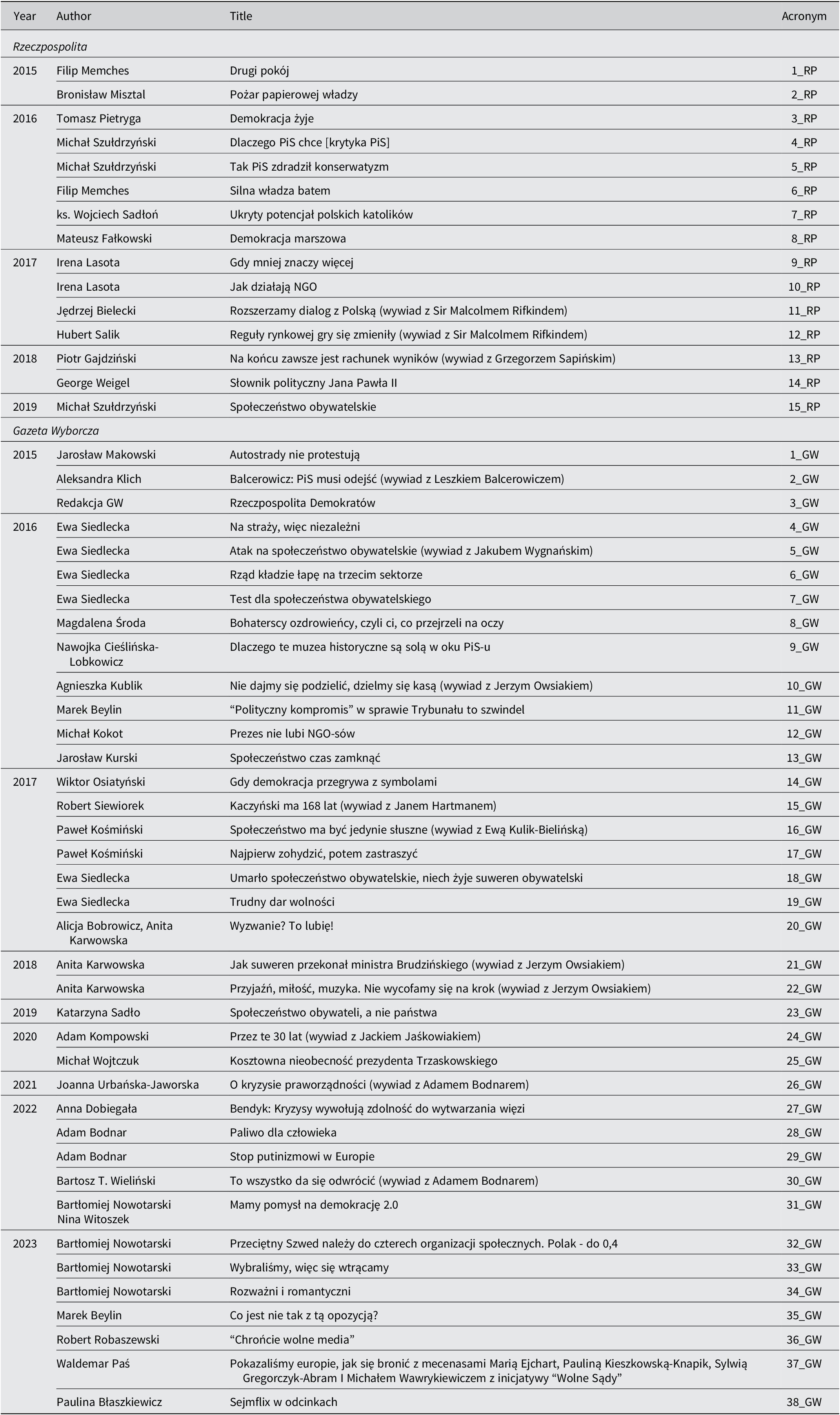
Articles from 2015 to 2023 were selected, coinciding with PiS’s time of governance, and were sourced from the newspapers’ online archives using keyword searches for the term “civil society” (Pl. społeczeństwo obywatelskie). Only texts containing at least three mentions of the term were included, ensuring that civil society was addressed as a central theme. I further limited the selection to articles expressing explicitly political stances or offering programmatic ideas concerning Poland’s civil society. Gazeta Wyborcza yielded 38 articles, and Rzeczpospolita 15—an imbalance reflecting both the respective publications’ differing intensity of engagement with civil society discourse, as well as the broader ideological spectrum present in Rzeczpospolita, where conservative voices were less frequent and required selective identification.Footnote 1 Gazeta Wyborcza contributors were predominantly liberal or liberal-left, focusing on human rights, equality, and civic resistance. Rzeczpospolita featured authors ranging from centrist liberals to culturally conservative and pro-clerical commentators. The authors—mainly journalists, intellectuals, and occasionally politicians or activists—are treated here as symbolic elites.
I analyzed the 53 selected articles to reconstruct their articulated meanings of civil society. I extracted the plots and arguments from each article and employed thematic coding to identify how civil society was described, what entities and actions were included or excluded from its realm, and the justifications provided for these inclusions and exclusions. In my analysis, I am not concerned with the “truthfulness” of the discourse or who provides a more accurate description of civil society. Instead, I aim to reconstruct the discourse and decipher the meanings attributed to what is considered civil society—and what is not.
Liberal-left elites’ idea of civil society
Recent studies on civil society highlight how political actors and elites across CEE increasingly instrumentalize the concept to advance partisan goals or delegitimize opponents (Bill, Reference Bill2020; Meyer et al., Reference Meyer, Moder and Neumayr2020; Roggeband & Krizsán, Reference Roggeband and Krizsán2021; Ślarzyński, Reference Ślarzyński2022). In this context, liberal-left symbolic elites in Poland have largely shifted their narrative about civil society toward a new political goal: opposing PiS. After 2015, civil society came to be framed as a vehicle of resistance, reckoning, and mobilization against PiS.
Force for resistance
Civil society, as a form of resistance, has reordered the hierarchy of legitimate actors. NGOs are no longer the sole—or even the primary—embodiment of civicness. Spontaneous, grassroots movements now enjoy equal, sometimes greater, recognition—a shift echoing earlier critiques of “NGO-isation” and excessive dependence on the state (Jezierska, Reference Jezierska2015; Kaim, Reference Kaim, Misztal and Kościański2011).
PiS acts as a discursive foil, sharpening ideological boundaries. Liberal-left commentators grant civic status to organizations that champion “democratic” and “European” values—pluralism, tolerance, the rule of law—while withdrawing such status from groups aligned with “national-conservative” ideals. The result is a progressive, pro-Western vision that delegitimizes actors deemed informal, confrontational, or ideologically deviant, echoing wider regional patterns that label them as “uncivil” (Baća, Reference Baća2022).
In practice, legitimized NGOs are watchdogs expected to “breathe down the government’s neck” [12_GW], ensure accountability, and defend human rights. They aspire to co-governance—consulting, negotiating, and co-managing policy—rather than merely providing services. Independence is paramount; reliance on state grants risks compromising their critical stance. Liberal-left elites argue that PiS has brought many organizations under state control, creating “fake” NGOs that rubber-stamp government policy while sidelining citizen agency.
While simultaneously dividing the NGO sphere, the liberal-left authors label emerging social movements protesting PiS policies—such as the Committee for the Defense of Democracy—as the “true” civil society. These grassroots efforts are viewed as a powerful response to the government’s authoritarian tendencies. In this framing, civil society forms as citizens respond to PiS’s erosion of democratic values, including the rule of law and civil rights. Civil society becomes a space for citizens to express their values and opposition to the PiS narrative.
A notable rhetorical shift has reframed anti-PiS social uprisings as civic phenomena. This challenges earlier portrayals of civil society as a benign third sector and legitimizes open resistance as a form of civility, provided it conforms to the cultural and aesthetic norms deemed appropriate by liberal elites (Radiukiewicz, Reference Radiukiewicz2019). However, similar narratives have emerged around anti-authoritarian “color revolutions,” widely interpreted as genuine civic engagement (Baća, Reference Baća2022). In this sense, the discourse of Polish liberal-left elites resonates with broader regional debates, asserting that dissident civil society is not confined to Ukraine or Belarus but has reemerged in Poland. They argue that just as workers once resisted authoritarian power, judges have assumed that role during the PiS administration.
Liberal-left symbolic elites also highlight a vision of civil society that is less politicized and professionalized. This stems from observing the conservative-right’s stronger support networks—spaces “where bonds are formed between people, to help each other, to build something” [14_GW]. These networks engage citizens in specific activities, creating opportunities for civic activism and cooperation toward building a better society. Liberal-left elites acknowledge that social ties are often stronger on the right, citing institutions like Radio Maryja or Gazeta Polska clubs. The only comparable progressive instance they recognized is the Great Orchestra of Christmas Charity, which symbolizes civic solidarity.
Political entanglement is sometimes blamed for deepening divisions. From this perspective, internal diversity is seen as essential, with civil society ideally encompassing both liberal-left and conservative-right organizations (e.g., urban movements, the Lech Kaczyński Academic Civic Club, or football fan circles [24_GW]). This vision portrays civil society as a broad, pluralistic space fostering civility understood as compromise rather than ideological confrontation. However, civil society is often framed as vulnerable to state exploitation, as seen in Poland and Hungary, where governments utilize it as a political tool rather than an independent force representing the broader society. Concerns in this context focus on the state strengthening itself at the expense of civic autonomy. This is a major concern for the European Union and pro-democracy countries that send funds directly to organizations supporting democratic values. It also worries parts of Poland’s nongovernmental sector, which criticizes PiS, issues many critical statements in the media, and conveys the country’s situation to foreign organizations and outlets.
Reckoning of the losers
Since 1989, a recurring theme in Polish debates on civil society has been its alleged immaturity (Leśniewicz & Radiukiewicz, Reference Leśniewicz and Radiukiewcz2023; Radiukiewicz, Reference Radiukiewicz, Nai, Grömping and Wirz2025a). The liberal-left press has long sought evidence that Poland has outgrown this deficit, yet the conservative shift of 2015–2023 has reopened the question (Domaradzka, Reference Domaradzka, Bassi, Alves and Cordery2025). After PiS’s initial victory, blame for the sector’s weakness shifted from citizens to previous governments. Commentators argued that Civic Platform (Platforma Obywatelska, PO) had prioritized infrastructure and GDP growth, mistakenly assuming that social development would follow automatically—an assumption that has proven false.
In this context, civil society emerges as a grassroots substitute for an ineffective opposition. Citizens organize marches, form social media groups, and craft alternative narratives, while social organizations that position themselves as political actors are often ignored by these citizens. Liberal-left authors emphasize the opposition’s distrust of civic activism, dismissing organizations and activists as politically insignificant. This, they argue, weakens political effectiveness and squanders grassroots mobilization potential. Following PiS’s loss in 2023, liberal-left elites also urged politicians to recognize “an unprecedented victory for civil society organizations and ordinary people who got involved” [37_GW], asserting that as their involvement and sense of responsibility for public affairs had grown, they should be taken seriously: “It was this grassroots movement of Polish judges, their courageous and steadfast attitude that saved democracy in Poland. In the European Parliament, we have heard comparisons that Polish workers were heroes in the 1980s and Polish judges in recent years” [37_GW].
The reckoning extends to liberal elites themselves. They are criticized for neglecting broad educational efforts and for failing to integrate marginalized communities, fueling conservative and nationalist sentiment. Preoccupied with economic self-interest, they allegedly hollowed out democracy and civil society: “We abandoned the simple people, left them alone with the demons of the past…. Rural and small-town Poland… sits on our necks, swings a whip and a bottle, and kicks us in the kidneys with heavy boots” [15_GW]. From this perspective, civil society’s fragility helped pave PiS’s path to power, and only by rebuilding inclusive, participatory structures can the liberal camp avoid repeating past mistakes.
Mandatory mobilization
Since 2015, symbolic elites have merged their evaluative-disciplinary role (Czyżewski et al., Reference Czyżewski, Franczak, Nowicka and Stachowiak2014) with an explicit mobilizing agenda. Columnists now present themselves not merely as spokespeople for civil society but as its very members. This identification is not only rhetorical but performative: the authors construct a “we” that equates concerned citizens with themselves. Journalists do not just speak for civil society—they position themselves as its voice, conscience, and living presence in the media sphere. Their discourse is not only about a new civil society; they are a civil society themselves. This self-positioning reflects the interventionist style of both principal Polish opinion dailies studied here (Stępińska et al., Reference Stępińska, Szabó and Adamczewska2024).
The liberal-left elites, along with Gazeta Wyborcza, assume the role of tribunes in an engaged civil society. They adopt a civic identity and actively seek to mobilize citizens, calling for action in response to threats against institutional governance, or claiming that the current situation “requires political commitment” [3_GW]. Following van Dijk (Reference van Dijk1993, Reference van Dijk, Chilton and Wodak2005), symbolic elites—including media outlets—do not merely reflect public opinion but shape and mobilize it, acting as both interpreters and actors of civil society. The narrative underscores both a moral duty and the concrete actions that civil society must take to resist authoritarianism and defend liberal democratic values.
This presentation of mobilization points to a clear, normative definition of civility: i.e., true citizens are those who engage in the struggle for democracy. Passivity means absence: “If we remain passive, it is only out of laziness. We cannot assume that others will do the civic work for us” [3_GW]. Media discussions are framed not just as commentary but as a direct means of countering “democratic backsliding.” Citizens are encouraged to protest and financially support segments of civil society marginalized by the government. The shift from state funding to direct citizen support is portrayed as a positive development, reinforcing the authenticity and independence of civic initiatives.
Near the end of the data collection period, the authors positioned legitimized segments of civil society—often described as “assertive” [31_GW]—as a force for institutional repair. Legitimized space is portrayed as both a space for resistance and an agent of systemic change, tasked with creating new institutions and mechanisms, such as deliberative bodies that foster co-governance and improve the balance between citizens and the state, once PiS is defeated. Journalism blurs into advocacy, and civil society discourse functions simultaneously as a diagnosis, a rallying cry, and a blueprint for the post-PiS order. However, the vision of “assertive” civil society as the legitimate agent of institutional repair may inadvertently create a new boundary: only those who meet the normative standards of civic engagement—active, vocal, oppositional—are granted political agency. As a result, the call for co-governance risks becoming exclusive, positioning participation as a privilege of the morally qualified few.
Conservative-right elites’ idea of civil society
The conservative narrative portrays civil society under threat—not from PiS, but from PO, liberal-left elites, and Western ideologies. These influences are depicted as eroding civil society’s authenticity. Conservative symbolic elites play a crucial role in this discourse by identifying the challenges faced by civil society and attributing blame. They hold both politicians and the broader liberal elite responsible, reinforcing a narrative of grievance in which conservatives see themselves as having been deceived, marginalized, and shamed by liberals for not conforming to their “salon.” This critique serves as the foundation for redefining the boundaries between the civic and the non-civic.
Conservative grievances and liberal-left hegemony
Conservative-right authors frame post-1989 politics as a period of liberal-left dominance, during which civil society allegedly became the private project of an urban elite that “preached a cult of civil society—educating Poles, possibly rehabilitating them,” while portraying the state’s role as merely punitive [6_RP]. They accuse liberal publicists of critical and exclusionary approaches to right-wing civil society, denying its civicness. In conservative discourse, civility is portrayed as a tool wielded by liberal elites, promoting certain forms of activism as more “cultural” or “European,” while ridiculing and excluding “patriotic” or religious (Catholic) forms of activism. They argue that regardless of an initiative’s actual value, it is dismissed—e.g., as mere “folklore” [15_RP]—by the “liberal elites” if they did not organize it or if it carries a “patriotic” or Christian character. Conversely, they charge, even small left-wing events—such as an LGBT rally—are amplified by sympathetic media.
When addressing civil society, conservative-right authors emphasize its detachment from “real” societal problems; it is portrayed as inauthentic. Moreover, it is depicted as estranged from local traditions, and specifically from Polish historical experiences, further deepening its crisis of legitimacy. The principal threat, according to conservative-right authors, comes from foreign institutions and “leftist ideologies.”
Criticism of foreign influence
Conservative-right authors argue that authentic civil society emerges from spontaneous, local initiatives rather than external programs. Western—chiefly US—grants and training allegedly produce an “elite NGO” stratum that monopolizes funding and, by extension, the very definition of civil society. NGO professionalization itself is portrayed as a loss of civicness. The NGO elites are depicted as a self-sustaining group that prioritizes grants and influences grassroots involvement. This process is framed as a “colonization” of Eastern Europe by American funders, who are perceived as imposing an authoritarian operational style on NGOs while disregarding local realities. Such metaphorical framings are actively employed in Polish conservative discourse, where postcolonial vocabulary—particularly the notion of “colonization”—is repurposed to delegitimize the liberal norms and civic models promoted by foreign actors.
This metaphor of “colonization” reveals a deeper discursive logic: civil society is not framed as a universal democratic good but as a culturally contingent formation, vulnerable to external capture. From this perspective, the symbolic elites aligned with Western donors impose a hegemonic civic model, incompatible with local norms. As Slačálek (Reference Slačálek and Petkovska2023) illustrates, this rhetoric casts liberalism as a depersonalized, external force that erodes national identity, while simultaneously positioning “the local” as morally and epistemologically superior. It draws on the emotional force of anticolonial resistance to legitimize nationalist claims. Thus, conservative-right authors aim to denaturalize liberal definitions of civil society, portraying them as ideologically loaded and structurally imposed.
Conservative-right critics further assert that professionalization diverts civic energy toward grant compliance—writing proposals, logging training hours, and drafting mission statements to align with donor priorities—while genuine local ties wither. New organizations mushroom, yet many lack community roots. Both foreign and domestic funding streams are portrayed as skewed: too much money goes to administration, and too little reaches grassroots action. True civil society, conservative-right authors contend, cannot be built top-down; it requires sound legislation, a supportive climate, and self-mobilized citizens.
The characterization of “NGO professionalization” draws sharp boundaries between bureaucratic, externally financed actors and “real” citizens engaged in informal, self-organized projects. This dispute mirrors broader post-socialist tensions between top-down modernization and bottom-up community building (Buchowski, Reference Buchowski2006; Zamfir, Reference Zamfir2015). In the latter view, foreign grants, party patronage, and neoliberal welfare outsourcing all entangle civil society in politics and render it inauthentic.
Critique of liberal-left influence
Conservative-right authors attribute civil society’s aberrations to liberal ideology, asserting that it has created an incomplete, agenda-driven civic sphere. They cite “Western political models”—most notably the Soros Foundation—as evidence, portraying such entities as vehicles of an open-society template that purportedly erodes national cohesion. One columnist states, “This is served by initiatives of people like George Soros … projects that implement the concept of an open society” [RP_1].
A primary grievance centers on the rift between liberal intellectuals and the Catholic Church, which remains a key moral authority for the right. Conservatives argue the Church has been marginalized in the civic arena by “leftist slogans and programs alien to Christianity”[7_RP]. They aim to redefine civil society as a space for religious activism, a “hidden” sphere suppressed by ideological bias, administrative obstacles, and financial barriers.
Another recurring theme is Poland’s semi-peripheral and threatened status in relation to Western centers. Conservative-right authors claim that despite limited state and EU support, conservative initiatives have successfully built a grassroots civil society. Since 2015, conservative notions of ideological exclusion by liberal-left elites have begun to shift. One conservative author asked, “If not now, then when?” [7_RP], signaling they perceived an opportunity to develop policies that formally recognize and support conservative civil society. Opinion pieces reflect conservative NGOs’ self-presentation in empirical studies: groups benefiting from the post-2015 redistribution frame their progress as a long-overdue correction of past neglect, rather than a favor obtained through partisan allegiance (Dudkiewicz, Reference Dudkiewicz2020). While professing neutrality, they acknowledge easier access to public funds and decision-makers, interpreting these gains as just rewards for professionalization and civic merit.
Conservative authors also contend that the liberal ideology of civil society has weakened the state, which they view as an essential pillar supporting civil society. A weak state leads civil society’s deterioration and subsequent decline of public institutions. They argue that this dynamic has generated a form of civil activity that fills the gaps left by inadequate institutions, but in the process has become politically entangled and ideologically extreme.
Conservative critique and reclamation
Conservative-right writers critique the liberal narrative to redefine the civic sphere. They categorize NGOs favored by foreign donors and progressive initiatives as “imposed from above,” i.e., inauthentic and left-leaning. However, this delegitimization does not reject the concept of civil society; rather, it seeks to reclaim it. Legitimized actors, in this view, are those rooted in self-initiated, durable ties—a community that takes responsibility for the common good at local, regional, and even continental levels. Civic engagement is framed as collective stewardship, directly involving citizens in policy and resource management.
Civil society is further portrayed as a setting where diverse groups and institutions can cooperate, deliberate, and shape public opinion. It encompasses both secular and religious activism and pursues the “common good” and “public benefit,” concepts derived from Catholic social teaching. While the Church wields influence, it relies on persuasion and value-based projects rather than political pursuits (e.g., Independence March, the Radio Maryja community, and Gazeta Polska clubs [6_RP, 8_RP], all presented as preservers of Poland’s cultural heritage).
This vision, rooted in the 19th-century concept of “organic work,” frames civil society as a tool for national resilience in times of crisis. Right-wing actors recast it as “genuine” civic engagement, as opposed to the external state, influences, and Westernization they accuse the left of espousing. This nationalist framing integrates the popular classes into a populist project of national unity (Marzec, Reference Marzec2020) while delegitimizing “non-genuine” civil society as foreign, elitist, and externally driven. Conservative elites construct their own legitimation thresholds, defining civicness around community ties, religious values, and patriotic engagement.
This narrative aligns with a broader discourse in right-wing media, depicting the Polish people as an essentially Catholic community, excluding religious “others” from civic belonging through symbolic boundary-drawing (Stępińska, Reference Stępińska2023). The discourse rejects modernization as an imposed, top-down model, instead rooting civil society in national, religious, and organic traditions. It opposes universalist civic models, advocating an ostensibly inclusive space that respects local contexts but ultimately reinforces anti-elitist exclusions, rejecting those who do not conform to conservative-right norms. This vision prioritizes a singular vision of national and religious identity by legitimizing exclusionary practices (Krzyżanowski & Ledin, Reference Krzyżanowski and Ledin2017).
From this perspective, right-wing civic engagement is often infused with patriotic fervor. It is also portrayed as being instrumentalized by PiS leaders, who treat civil society not as an independent sphere of social solidarity but as a tool of political power.
One proposed solution to the problematic aspects of civil society—whether linked to right- or left-wing activism—is to strengthen state institutions. In this view, the state and civil society should cooperate rather than oppose each other in addressing social issues. In contrast to the liberal vision of NGOs as democracy’s watchdogs, the conservative narrative casts the state as a “natural protector of citizens” in their various roles—as consumers, residents, and workers—providing the necessary foundation for a well-functioning civil society. The oft-invoked liberal dichotomy between the state and the civic sphere is thus dismissed as artificial. Cooperation, not confrontation, is presented as the optimal arrangement: a robust state underwrites effective, rooted, and morally anchored civic life, while grassroots initiatives, in turn, bolster national cohesion.
Conclusion
The post-2015 upsurge of political conflict in Poland has rekindled an intense debate over civil society. Liberal-left elites have been compelled to defend and amend their long-standing views, while conservative-right elites have seized the opportunity to introduce an alternative narrative into the mainstream. The imbalance in coverage—Gazeta Wyborcza devoted significantly more space to the topic than Rzeczpospolita—signals the stronger media position and greater agenda-setting capacity of liberal-left symbolic actors. Conservatives interpret this position as evidence of a pre-existing and persistent cultural asymmetry between the two analyzed discourses.
Empirically, these camps structure their arguments through the dominant frames of liberal-left resistance, reckoning, and mobilization, and conservative-right grievance, reclamation, and community stewardship. Yet the two conceptualizations are deeply intertwined; each largely reflects the other and structures civil society through parallel, exclusionary dichotomies—good/bad citizens, authentic/manipulated actors, civic/anti-civic engagement. Moreover, both shrink the idea of civil society to a symbolic battleground enlisted to legitimize partisan identities, eclipsing its plural, everyday forms.
What both narratives ultimately share is a striking silence about the market. Once civil society is cast as a partisan resource for either restraining or reinforcing the incumbent government, the central stakes shift to controlling public levers—budgets, grant streams, regulatory design—while the economic field that quietly predetermines access to those levers fades from view. This silencing mirrors the post-1989 semantic split between the market and civil society (Załęski, Reference Załęski2012).
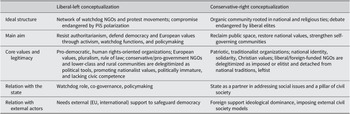
Both discourses on civil society draw on rival traditions (Pietrzyk-Reeves, Reference Pietrzyk-Reeves2012). The liberal-left aligns with the classical liberal model, grounding civil society in individual autonomy, negative freedom, and formal equality before the law. It portrays civil society as a space of self-organization distinct from the state, emphasizing watchdog functions, pluralism, and rights-based legitimacy. The conservative-right, in turn, selectively appropriates elements of the republican tradition, envisioning civil society as an ethical and political community rooted in national identity, shared obligations, and civic virtue understood as responsibility and solidarity. It assumes close cooperation with the state and a moral horizon of civic belonging (Table 1).Footnote 2 From a Gramscian perspective, the two discourses appear to be less than competing models; rather, they represent rival maneuvering in a prolonged war of position. Each bloc naturalizes its preferred civic imagery—rights-based pluralism on one side, solidaristic nationalism on the other—seeking not to create a universally better model but to secure cultural dominance that will eventually translate into law, NGO funding, and government policy.
The main elements of civil society conceptualizations

From a national perspective, the discourse on civil society is deeply politicized. However, these disputes are not fleeting campaign skirmishes; they echo long-standing modernization tensions. Viewed through this lens, the discourse reveals its ideologization. The politicized and ideologized framing of civil society acts as an “invisible barricade” (Hopewell, Reference Hopewell2016), employing exclusionary definitions of civicness and civility. Crucially, this discursive struggle obscures the diversity of civic engagement beyond national-level contestation, narrowing the horizon of what counts as legitimate participation and silencing a broad range of actors outside the headline conflict—local service NGOs, labor initiatives, neighborhood commons, and non-aligned social enterprises.
By foregrounding high-profile watchdogs, patriotic associations, and protest movements, both narratives reinforce the impression of a polarized civic sphere and obscure the plural, decentralized character that civil society often assumes on the ground. Such selective vision not only reflects political polarization but also actively deepens it, constricting the symbolic space for alternative forms of engagement and, over time, risking the erosion of the pluralistic capacity that underpins democratic resilience. Recognizing these silences is key to understanding how symbolic elites shape not only the discourse on civil society but also the very possibilities for civic engagement.
It is equally important to consider the position of the authors whose narratives are analyzed. Many are not merely journalists or commentators but also active participants in the civic sphere they describe. As symbolic elites, they both define civil society (Bourdieu, Reference Bourdieu1984; van Dijk, Reference van Dijk1993) and remain embedded within the boundaries they construct. Their statements often blur the line between speaking about civil society and speaking on its behalf. Such symbolic classifications contribute to civic identity formation externally—by labeling others—and internally, as acts of self-definition and alignment. The category of “we” invoked in their texts encompasses themselves and their milieu, reinforcing the antagonistic and affectively charged division of the civic field. Acknowledging these layered dynamics is therefore essential; it alerts researchers to the definitional power exercised by symbolic elites in the press and challenges civic organizers and policymakers alike to reopen the muted economic and grassroots dimensions of Poland’s civic life (Table 2).
List of the analyzed articles
Funding statement
This research draws in part on data collected within the project “Civil Society as a Limit? Discourse on Civil Society in Poland after 1989” (2021–2022), conducted under the program “Lost in Transition: Social Sciences, Scenarios of Transformation, and Cognitive Dissonances in East Central Europe after 1989,” hosted by the Centre for Advanced Study Sofia and supported by the Porticus Foundation.
Competing interests
There are no relevant financial or non-financial competing interests to report. I used ChatGPT (OpenAI, model GPT-5.1) to assist with specific stages of the writing and revision process. The tool is publicly available at: https://chat.openai.com. It was used solely for language editing. I made all conceptual decisions, data interpretation, and theoretical framing. I used the tool from March to October 2025.
Ethical standard
The research did not involve human participants and/or animals.

 Open access

