

1.0 INTRODUCTION
A passenger aircraft will, or should, be designed to meet the requirements of customer airlines. Safety goes without saying, and airlines will have different needs for take-off and landing performance at the airports relevant to their route structure. However, an almost universal requirement is to improve significantly on the direct operating costs of their current fleet and also to meet a mix of mission requirements in terms of number of passengers, seating layout, and range. The manufacturer has to collate the requirements of potential launch customer airlines into a ‘Design Mission’ and a direct operating cost (DOC) target, usually in the range of 15% to 20% less than existing competitive equipment. As an example, after discussions with both potential customer airlines and the major international airports, the Design Mission for the Airbus A380 was fixed as requiring to carry 550 passengers in a three-class layout, plus a certain amount of freight, from Singapore to London against adverse winter winds. This would satisfy the majority of other route requirements around the world without unduly penalising the operating economics through defining an aircraft with too heavy or large a structure to carry enough fuel for ultra long range. For example, Europe to Sydney, Australia, in one stage would not be satisfied.
The DOC target for the A380 was indeed set to be in the range of 15% to 20% better per passenger-kilometre than the Boeing 747-400 in service in the late 1990s at the time of freezing the design of the A380. Whilst specifying a larger aircraft and newer engines helped significantly in reducing the DOC, the target could not be reached without the introduction of new technologies such as increased use of carbon fibre reinforced polymer and advanced metallic alloys to reduce weight, advanced integrated aerodynamics, improved systems etc.
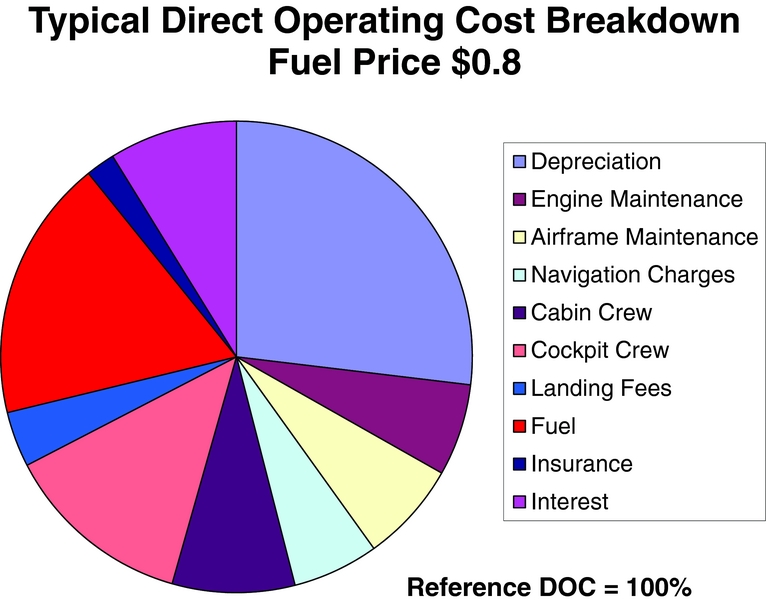
A typical traditional buildup of the contributions to the DOC of an aircraft is shown in Fig. 1, in this case for the mission of a medium-range, 150-seat aircraft. For the purposes of this paper, attention will only be drawn to the contributions due to fuel used and those affecting the purchase price of the aircraft.
Typical traditional buildup of contributions to direct operating cost of an aircraft.
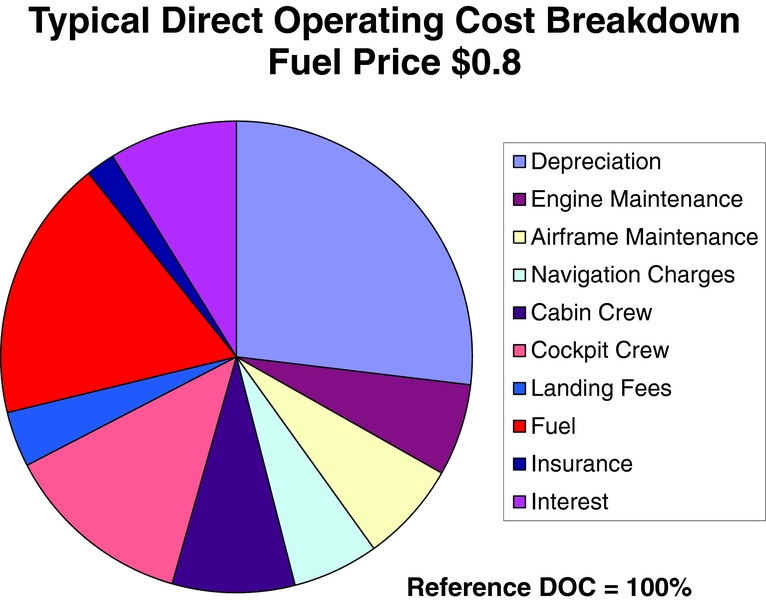
The three sectors ‘Depreciation’, ‘Interest’, and ‘Insurance’ (to the right of the fuel sector) are all a function of the first price, and so it may be seen that for this traditional example, the cost of fuel, although the second-largest single sector, is actually significantly smaller than the total effect of purchasing the aircraft. Therefore, there has been a very important drive for the manufacturer to reduce the manufacturing cost and hence the selling price of the aircraft at a level that still enables him to stay in business, even if this had some effect on the aircraft fuel burn. (In comparing this example with others, it may be noted that this buildup for costs is very sensitive to utilisation, or flight hours per annum, which have been improving dramatically in recent years, reducing the relative importance of first-price dependent terms.)
This paper goes on to explore the additional demands of the 21st century on the design optimisation of a new passenger aircraft and in particular how that might affect the balance between performance and cost and what other aspects are becoming more and more important.
2.0 THE ADDITIONAL DEMANDS OF THE 21ST CENTURY
The demand to meet required missions at minimum cost whilst satisfying the requirements of the passengers for safety, reliability, and comfort standards will still, of course, continue to be important in the design of future passenger aircraft. However, over the last two decades, the effect of aircraft operation on the environment has become an increasingly important aspect of airline requirements, driven by the concerns of the general public and governments and hence resulting or threatened legislation. Noise around airports has been an issue for many years, now being joined by air quality in affecting the population living close to airports. These local effects are already the subject of regulation under the auspices of International Civil Aviation Organization (ICAO) agreements and are being taken into account in the current design of aircraft and engines. These and specific national regulations can be expected to be progressively tightened in the future. Of rapidly increasing significance has been the effect of emissions in the upper atmosphere and the potential effect on climate change and global warming, which affects the whole population. Indeed, ICAO is in the process of reaching an agreement on a regulation limiting the carbon dioxide emitted by new transport aircraft designs(1).
2.1 Summary of the impact on climate change
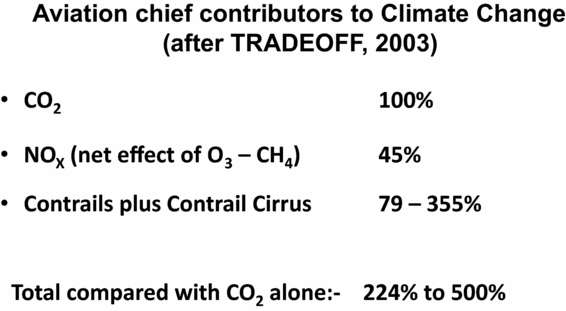
Whilst there has been much comment in the media regarding the impact of aviation, particularly in the United Kingdom and to a lesser extent in Europe, the United States and elsewhere, the current consensus is that commercial aviation currently contributes about 2% to 3% of the carbon dioxide produced by man. However, the total effect on global warming is probably more like 3% to 5% when taking into account the effects of oxides of nitrogen from combustion and of contrail cirrus cloud formation. Future predictions range up to the order of 15% to 30% depending on the continuing growth in air traffic, expected to exceed twice the passenger-kilometres of today, and depending on other sectors meeting their targets for CO2 reduction. So the aviation sector cannot be complacent about its relatively small current contribution and indeed is not!
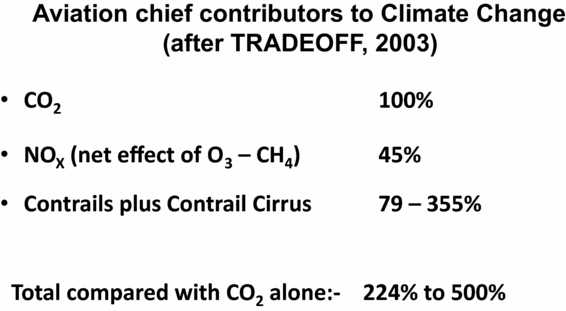
The chief contributors to climate change from aviation are summarised in Fig. 2, compared with the basic contribution from CO2. Oxides of nitrogen NO and NO2 (collectively NOx) have a beneficial effect in countering the effects of methane but also have a warming effect through a reaction at high altitude to produce ozone. The net effect is a warming influence that is still the subject of ongoing research.
Relative contributions to climate change from aviation.
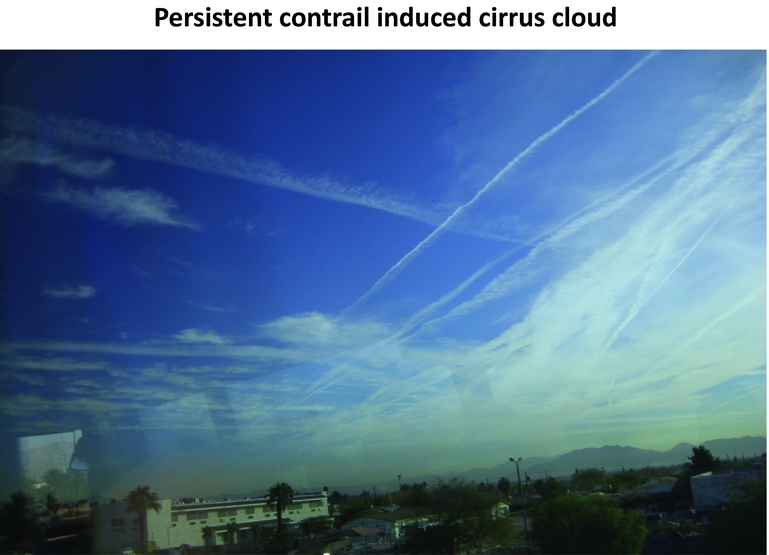
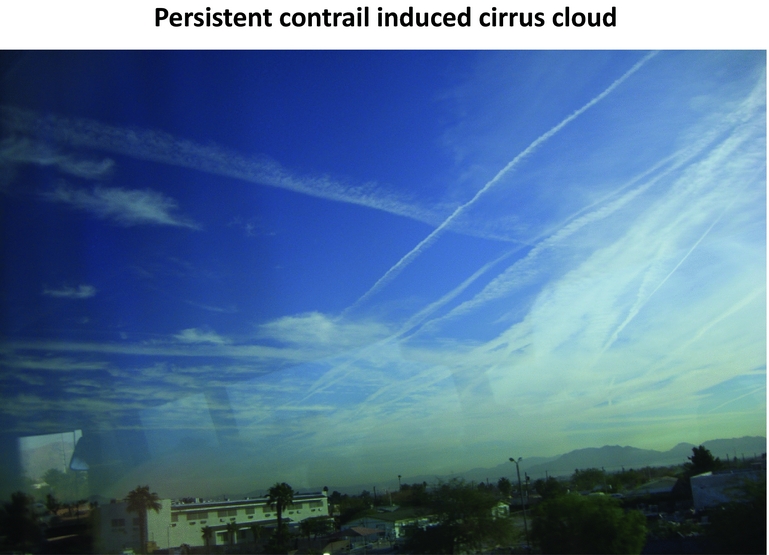
The effect of contrails and subsequent longer-lived cirrus clouds (Fig. 3) has been the subject of intensive research over the last several years, and the conclusions are firming up into there being a significant contribution from this source, of the order of at least the same amount as CO2. There is little that can be done in aircraft design optimisation to reduce the effects of contrail cirrus; the way forward is almost certainly to concentrate on ‘tactical’ air traffic control to reroute around the zones in the atmosphere where conditions favour their production, that is, supersaturated with water vapour at temperatures where ice crystals will precipitate out. The rerouting can be an increase or decrease in altitude as well as a lateral change. However, of course this will inevitably mean an increase in CO2 and NOx production, and we are still not yet sufficiently sure of the science to be able to give the right guidance in this respect. Nonetheless, in applying the current state of knowledge, a case study in the EU REACT4C programme(Reference Grewe2) showed that with minor rerouting of North Atlantic traffic in one particular 24-hour period, a 25% reduction in the warming effect of that traffic could be obtained, for a very minor (+½%) economic impact. This is therefore an issue to be considered in the future development in air traffic control systems.
Example of persistent contrail induced cirrus cloud.
2.2 Oil prices
The second additional major issue for future aircraft design is the price of fuel. For the foreseeable future, kerosene will be the only viable fuel for passenger aircraft, due to its excellent energy density by volume and by weight. It is probable, looking at least 10 to 20 years ahead, that the kerosene will be produced from fossil oil, biomass, or waste products, but in all cases the effective cost is certain to increase substantially.
It is salutary to note that most aircraft in service, including the Boeing 787 and the Airbus A380, were designed in a period of relatively low oil prices (albeit recognising the almost inevitable increase in fuel costs and the need to reduce the environmental impact). The cost of aviation fuel since the year 2000 is shown in Fig. 4.
Cost of aviation fuel since the year 2000.
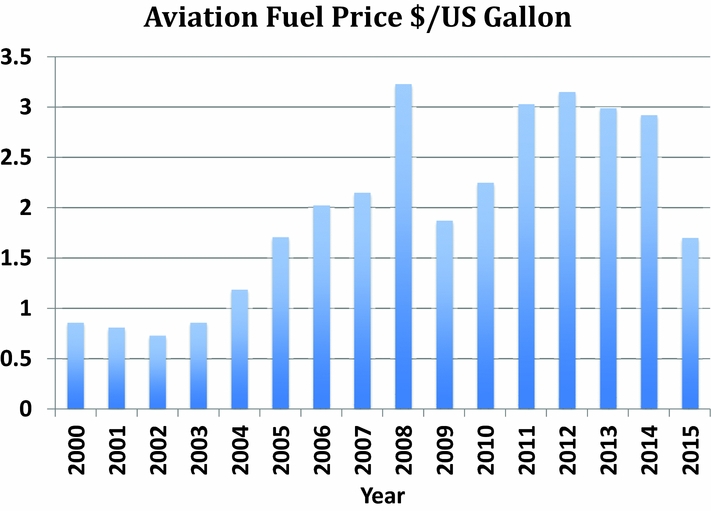
The design of the A380 was frozen just before 2000 and that of the Boeing 787 around 2003 when the fuel price was still of the order of $0.8 per US gallon.
Since then the fuel price rose to a peak of $4 in 2008 (with an average for the year of $3.2 – Fig. 4), then fell back but stabilised at around $3, or over three times the traditional cost of fuel – admittedly uncorrected for inflation. Even with the dramatic fall in the oil price at the end of 2014, at the time of closing for publication of this paper, the fuel cost of $1.74 per US gallon is still twice the traditional cost, or a 58% increase, inflation corrected. In the medium to long term, the effective price of fuel can only be expected to increase again, either through the increasing pressure of demand over supply or by the addition of environmental levies by the world's governments. Much has been said in the last two to three years about the possibilities of using biomass to produce a ‘drop-in’ replacement for fossil kerosene, producing a near-neutral CO2 fuel. This is certainly an exciting possibility, but all indications are that even if it becomes viable in the necessary quantities, the cost is going to be extremely high and will not affect the pressure to reduce fuel burn.
For once, therefore, there is a complete synergy between these two additional demands for the 21st century. Much is already being done to reduce NOx as a product of combustion through improved combustor technologies to improve airport local air quality, which will also have benefits at high altitude. There will be both extreme economic and environmental pressure to reduce fuel consumption. The production of contrail cirrus will almost certainly also need to be addressed, most likely through route management on a tactical basis. The inevitable increase in CO2 emissions due to the route deviation and the net warming effect will then also be minimised by reducing fuel consumption. The remainder of this paper will concentrate on the overwhelming resulting demand to reduce fuel burn.
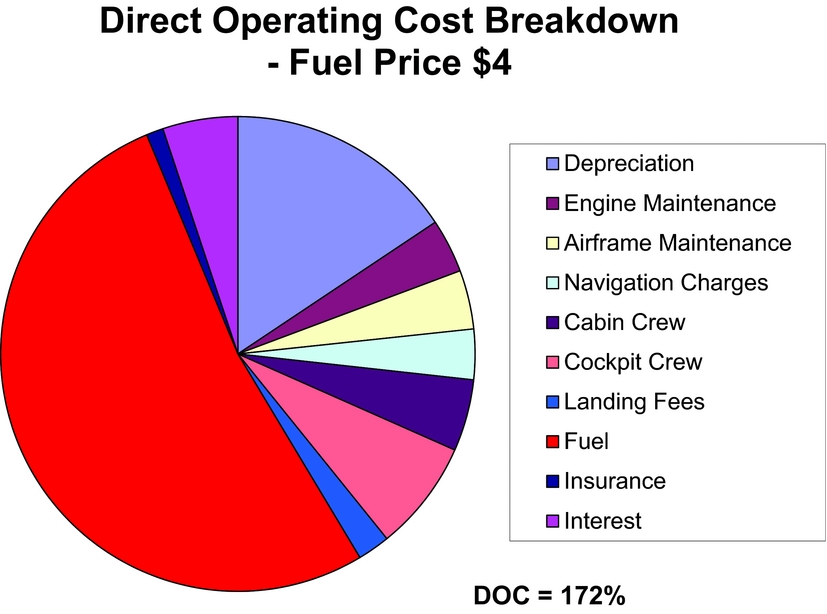
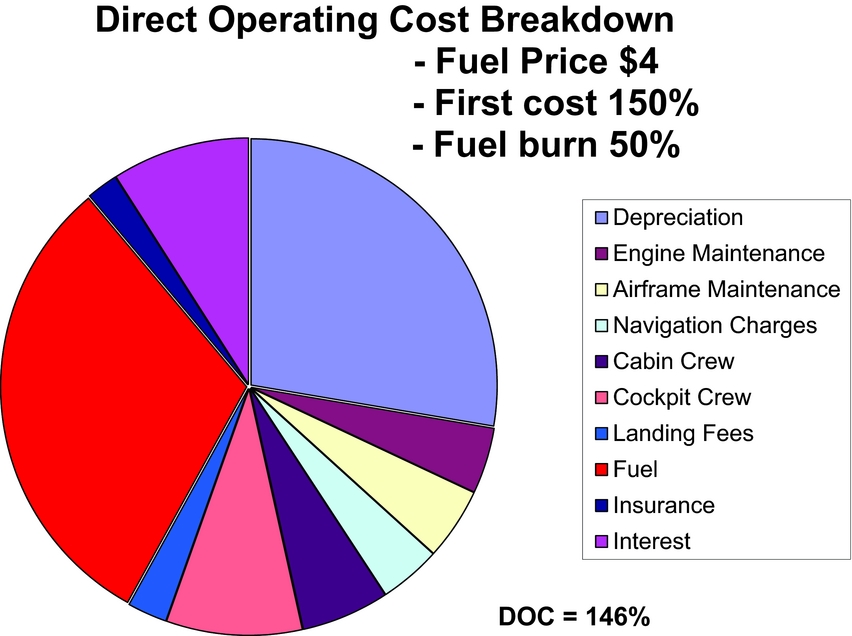
How will this affect aircraft optimisation? As an example, let's look at the effect of increasing the fuel price to, say, $4 per US gallon on direct operating costs. Taking the 150-seater example shown in Fig. 1, with everything kept the same except the increase in fuel cost, we get the result shown in Fig. 5.
Effect on direct operating costs of increasing fuel price to $4 per US gallon.

The DOC has increased by 72% and inevitably the fuel cost has become the dominating sector, contributing just over half the DOC. Suppose there was another option available, to incorporate new low-weight or aerodynamic technologies leading to halving the fuel burn, which, however, led to an increase in the purchase price of the aircraft by 50%. Would the deal be of benefit to the airline? The new result is shown in Fig. 6, the answer being a resounding yes!
Indicative effect of new technologies affecting fuel burn and costs.

The DOC is now reduced to a 46% increase and the fuel and first price-dependent sectors are more in balance once again.
We have already seen something of this effect in the runaway success of the Boeing 737 Max and the Airbus A320 ‘NEO’ (New Engine Option). Mainly due to the new engines, the ‘NEO’ development of the A320 family offers a 15% reduction in fuel burn for a list price increase of the order of $8 million. Such an exchange at the traditional fuel price of $0.8 per US gallon would not have been of any economic value to an airline, but it certainly is at recent and anticipated fuel prices. Analysis by Flightglobal Ascend(3) suggests that at an oil price of $55 a barrel (around $1.6 per US gallon for aviation fuel), the A320neo still breaks even compared with the A320ceo (Current Engine Option). At the time of writing, the oil price appears reasonably stable around $60 a barrel with aviation fuel at $1.74 a US gallon.
3.0 RESEARCH TARGETS
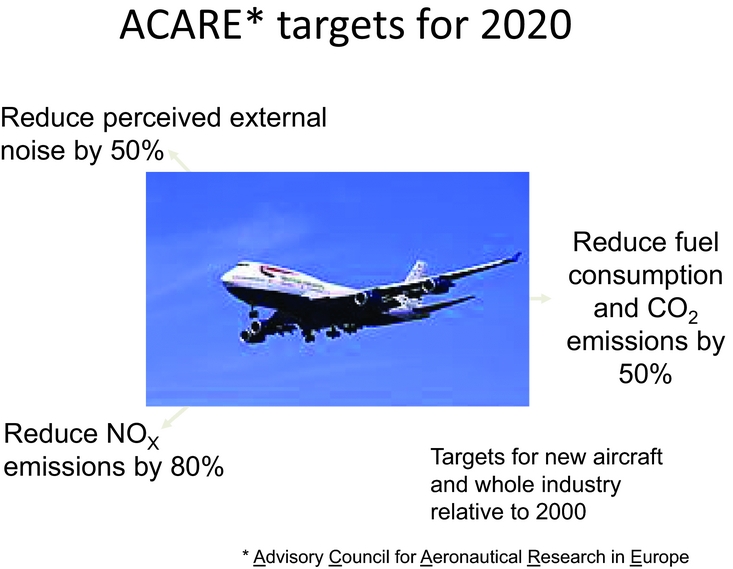
Since the year 2000, the European Union has supported ‘stretch’ targets for research to improve civil aviation, the ACARE targets, for aircraft entering service in 2020 relative to those that were being delivered in 2000. The ACARE environmental targets are shown in Fig. 7.
ACARE environmental targets.

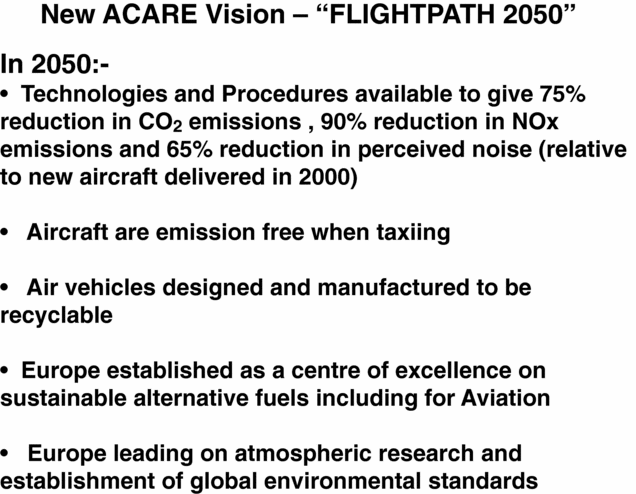
We are now three-quarters of the way towards 2020, so how is progress? Major European research programmes are still ongoing, and there is enough progress to demonstrate that with the technologies and aircraft configurations being explored, some of which are described later in this paper, the targets are achievable and probably can be beaten, but not by 2020! It is likely to be well into the third or fourth decade before there is a significant number of such aircraft in service, and that will depend on the continuing drive from governments and airlines alike to ensure it happens. The review carried out by ACARE in 2011, ‘Flightpath 2015’, resulted in more demanding goals but in a longer timescale – Fig. 8. The three previous goals have been strengthened and joined by others, the most important of which are the last two, referring to biofuels and to leading in atmospheric research and developing environmental standards.
‘Flightpath 2015’ goals.
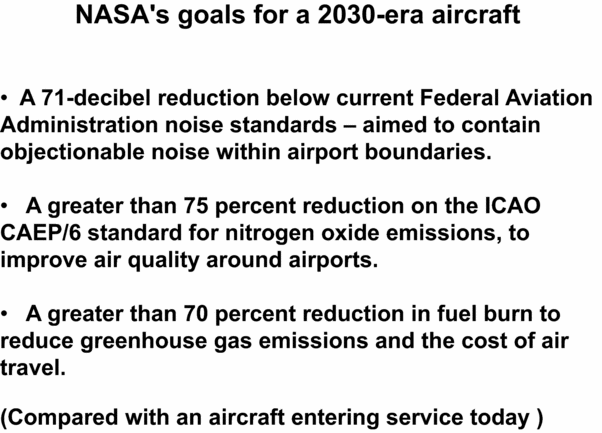
Similarly, in 2011, NASA in the United States issued environmental goals for aviation – Fig. 9. Their target date is “for a 2030 era aircraft” and the goals are relative to 2011 in-service standards rather than 2000. Also, reducing costs is mentioned alongside reducing emissions. However, the main thrust of these targets is very similar in the direction aviation research will be driven on both sides of the Atlantic.
NASA environmental goals.
4.0 THE MAJOR PARAMETERS AFFECTING FUEL BURN
As previously stated, the remainder of this paper will concentrate on the optimisation of aircraft to reduce fuel burn, concluding by giving some examples of the major relevant technologies and the direction that may be taken by aircraft configurations in the future. This can best be introduced by going back to basics and starting with an inspection of the fundamental Breguet range equation – Fig. 10 – which holds true for any flying vehicle that has to support its own weight and carry its own fuel.
Breguet range equation.
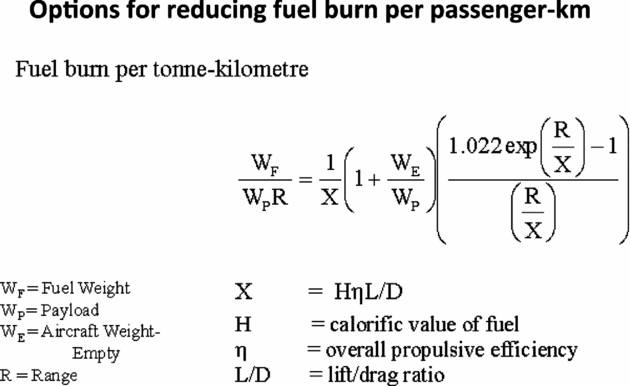
The parameter on the left-hand side of the equation is the fuel burn per unit payload per kilometre flown. The value of 1.022 has been introduced to allow for additional fuel used in climb and around the airport for both take-off and landing. A possible future optimum for this value might be 1.015, but the difference will not affect the conclusions significantly.
So it may be seen that the fuel efficiency will depend on the parameter ‘X’, the aircraft empty weight per unit payload, and the design range. It will also depend on the reserve fuel weight carried, but since in a normal flight it is constant through the complete mission, it can simply be considered as an addition to the aircraft empty weight. Nonetheless, on a long-range mission, the reserve fuel is a significant weight and looking at ways in which it can be safely reduced will be productive. ‘X’ is itself a product of three other variables: the fuel calorific value, the aircraft lift/drag ratio, and the propulsive efficiency.
As mentioned in Section 2.2, kerosene will be the fuel of choice for many years to come, and hence the fuel calorific value, or energy content per unit weight, can be considered a constant. Liquid hydrogen might be an option in the distant future, depending of course on its production process not emitting any significant contributions to climate change. This is considered briefly in Section 6.
4.1 Design range
The aircraft design range has a fundamental effect on fuel efficiency. This was introduced by Greener by Design more than a decade ago as a possible way to reduce fuel burn(Reference Green4). The effect is twofold. Firstly, for a long-range mission, the aircraft is carrying the weight of the fuel for the later part of the flight over the earlier part. This results in an increased fuel burn per kilometre due to the heavier average total weight of the aircraft. Secondly, due to the increased take-off weight for a given payload, the structure weight of the aircraft will be increased, and to fulfil its mission, the wing area and weight will increase. These two effects will combine to increase the fuel burn per unit payload per kilometre flown for a long-range mission by in the order of 25% compared with the aircraft designed for the ‘optimum’ range for fuel efficiency. Such an aircraft turns out to be one designed for about 5,500 km when carrying its maximum payload. Size has a relatively small influence on this value. At present, this is an aircraft the airlines do not want as it lies between the short- to medium-range 150-seater requirement and the larger long-range twin-aisle aircraft able to operate over much longer ranges as well as those around 5,000 km to 6,000 km. A very thorough exercise has been done by DLR in Germany(Reference Linke, Langhans and Gollnick5) showing the benefits that can be obtained by using such an aircraft. The problem, of course, is in airline and public acceptance of, for example, going from London to Australia in three stages instead of two! This could perhaps be a matter for future international regulation – no aircraft should be designed for a range longer than, say, 6,000 km! This also raises the issue of seating layout, since the aircraft fuel efficiency per passenger carried is much better for the passenger payload being close to the maximum payload rather than significantly less as it currently is in a three-class layout. Whilst the A380 design mission was to carry 550 passengers in a three-class layout, it is capable of carrying 845 in an all-economy class with an equivalent improvement in fuel burn per passenger in the order of 30% to 40%, albeit over a somewhat shorter maximum range. However, this is more an issue for the airlines and once again possible regulation, rather than for the manufacturer.
Another interesting option raised by the effect of design range is the possibility of air-to-air refueling of civil aircraft. There are obvious safety and operational issues to be considered here, including the operation and fuel used by the tanker aircraft, but the possibilities are explored by Nangia(Reference Nangia6). As long as an adequate level of safety can be guaranteed, this could be more acceptable to the public insofar as intermediate stops to refuel are no longer necessary.
4.2 Weight reduction
Reducing the aircraft empty weight has a first-order effect on improving fuel burn, as is obvious from inspection of the Breguet range equation (Fig. 10). Weight reduction through use of improved or new materials has been a continuing trend for many years but has more recently accelerated through the much wider use of carbon fibre reinforced polymer (CFRP) in the aircraft primary and secondary structure. This has resulted in an increased percentage of composites (mainly but not only CFRP) in the aircraft weight buildup, from of order 15% in the late 20th century through 25% in the A380 to about 50% of structure weight for both the Boeing 787 and the Airbus A350, which entered service in January 2015. This latter step forward has been due to the confidence to make the main load-bearing wing box and the fuselage pressure shell from CFRP. Whilst replacing aluminium alloys with CFRP has the potential to reduce weight by as much as 30%, for various reasons the current benefits are nothing like that large and future development will be to force along the learning curve to develop much more of the basic potential of the material. Needless to say, metals are fighting back, for example, aluminium lithium alloys particularly suitable for fuselage applications. In general we can expect further significant weight improvements from advanced materials, particularly as the operating economics will encourage their use even when they inevitably incur increased costs (see Section 2.2). The current use in the latest projects will have reduced empty weight by about 7%, reducing fuel burn by about 5%.
The other avenue to reducing weight is through new, more radical aircraft configurations. The major advance on the horizon in this regard is the blended wing body, which is dealt with later on.
4.3 Propulsion efficiency
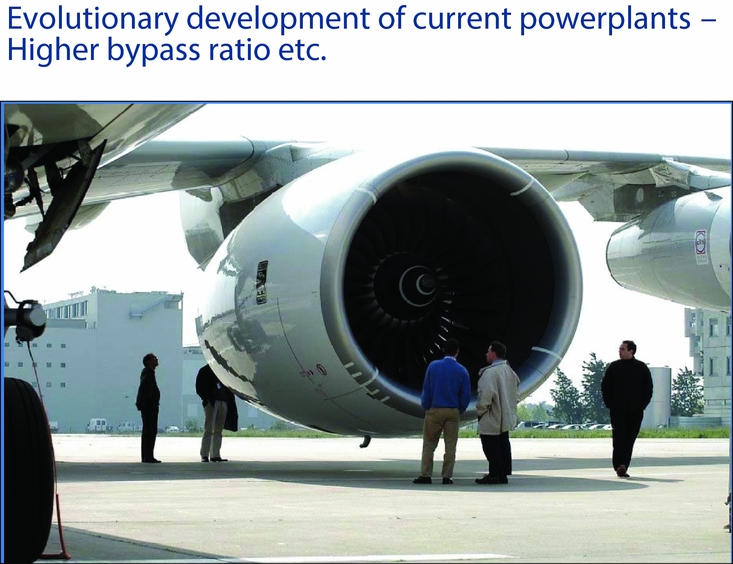
This is a major subject in its own right and will only be covered here insofar as it affects the overall optimisation of aircraft design. Basically, two development routes are opening up. One is the continued evolution of the current type of high-bypass-ratio turbofan (Fig. 11).
High-bypass-ratio turbofan.
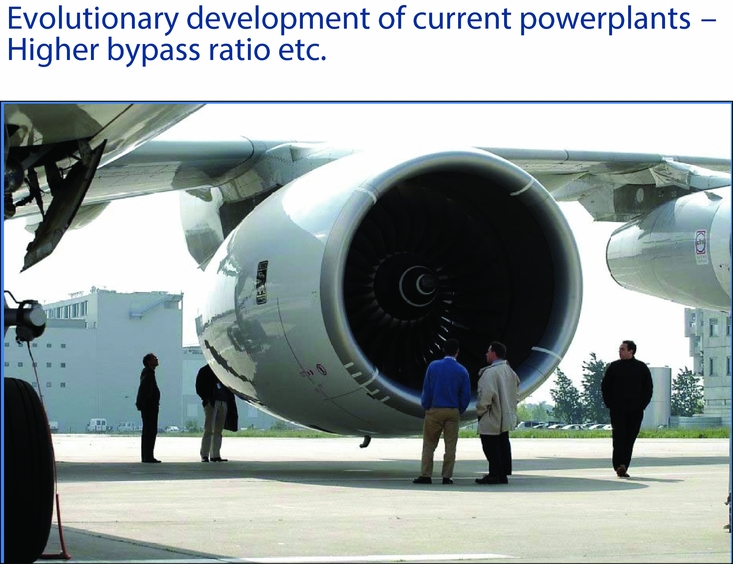
This will include improvements to the power-producing core through increased pressure ratios and higher temperatures (through advanced aerodynamics in the compressor, combustor, passages, turbine blade design; advanced materials again; and turbine blade cooling systems). More efficient engine cycles are also being researched with intercooling of the main airflow, for example, although the additional weight and size of heat exchangers remain a significant problem. Increasing the bypass ratio, that is, increasing the fan diameter to improve the Froude propulsive efficiency, is still an option before the resulting fan cowl becomes so large and heavy that its weight and drag negate the basic improvement in the power-plant-specific fuel consumption. The bypass ratio for the B787 and A350 have now increased to 9 compared with around 6 for previous-generation turbofans, and certainly increasing to about 15 should be possible whilst showing an overall fuel burn benefit.
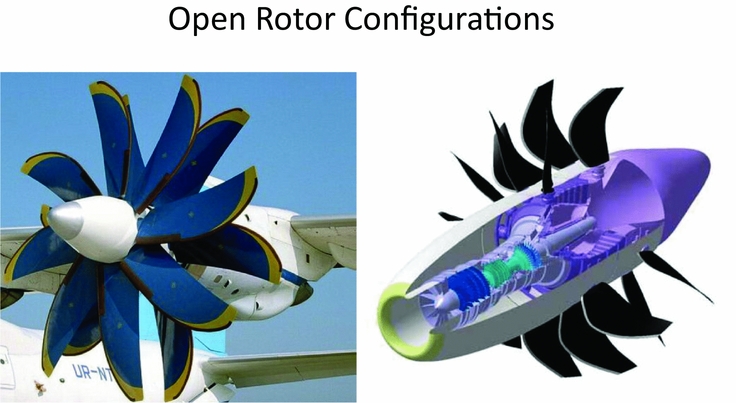
The second route is to remove the outer cowl of the turbofan and go back to propellers, or ‘open rotors’ as they are now referred to (Fig. 12).
Open rotor concepts.

These were first flight tested in the 1980s when fuel prices hit $2 a US gallon (approximately $4 in current dollars) for a while. However, their external and internal cabin noise problems and increased maintenance costs meant that they were not worth pursuing when the fuel prices fell back to less than $1 once again. Effective bypass ratios in the order of 50 are possible, giving the better Froude efficiency of moving a greater proportion of the total airflow more slowly though the propulsion system to produce the thrust. The tip vortices from the propeller blades reduce the efficiency partially, but the energy going into swirl is minimised by having two counter-rotating sets of blades, either in a forward- or aft-mounted layout (Fig. 12).
A major issue with open rotor propulsion is noise, both externally and internally in the cabin. However, with the advance in computational fluid dynamics methods giving improved blade designs, and with configuration changes such as using different blade numbers, ‘clipping’ the rear rotor diameter, and optimising the rotor spacing, the engine manufacturers are reporting good results in current research on this topic. Active noise suppression systems are also now available to reduce cabin noise, particularly with discrete tones as likely from the propeller blade passing frequencies.
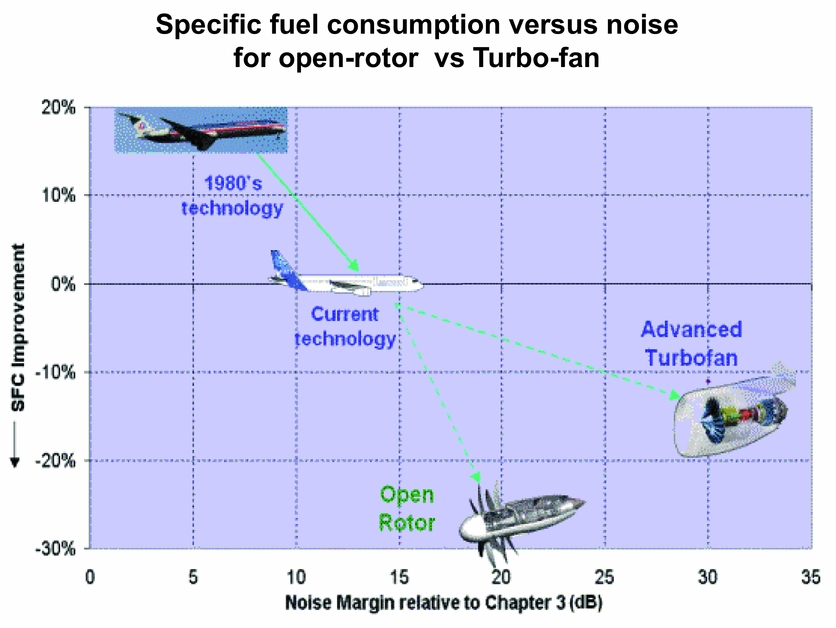
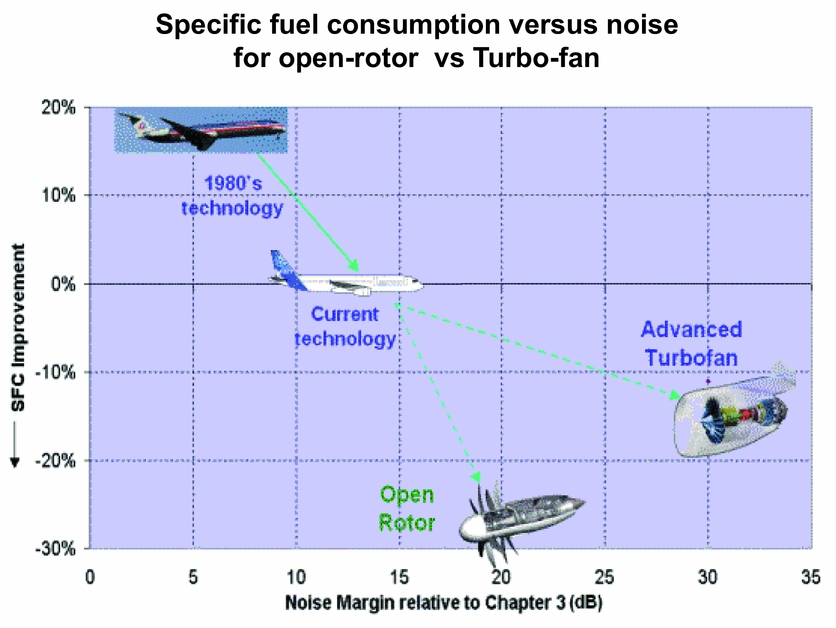
The advantages of either the evolutionary turbofan or the open rotor routes are summarised in Fig. 13 (with thanks to Rolls-Royce). It is expected that either route will be able to meet near-future airport noise regulations, but the turbofan will always be the quieter whilst the open rotor has the potential advantage of at least a further 10% improvement in fuel efficiency. The latest predictions from Rolls-Royce are for fuel burn improvements of up to 20% for turbofans (relative to a year 2000 datum), in the order of 30% for open rotors and 25% for their ‘Ultrafan’ concept intermediate between the two.
Open rotor and turbofan development.
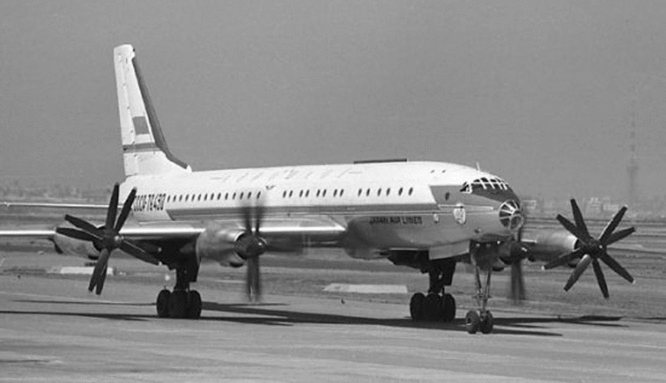
Even with advanced computational capabilities, there are limits to the diameter and/or flight Mach number for the open rotor, as the blade tips must not move at more than a limited supersonic speed; otherwise, shock waves and induced flow separations will give unacceptable drag, noise, and vibration. This implies that they will be more appropriate for twin-engine aircraft up to around the 150-seat class, probably at somewhat reduced flight Mach numbers compared with today, perhaps M = 0.7 to 0.75 rather than 0.78 to 0.80. Larger aircraft would have to consider multiple propulsion units and probably an absolute maximum cruise Mach number of 0.80. There is a precedent here: the Russian Tupolev Tu-114 swept-wing four-engine aircraft with counter-rotating turboprop engines (Fig. 14) carried 120 passengers from Moscow to Cuba (for example) at a Mach number of 0.70. Maximum Mach number was 0.78 and maximum passenger capacity 220. However, the cabin and external noise levels were very high.
Tupolev Tu-114.
Thus, either future propulsion option will mean that the airframe must be optimised in the presence of larger-diameter propulsion units than previously, particularly with the open rotor.
As already mentioned, the open rotor allows a substantial improvement in the Froude propulsive efficiency; that is, it is more efficient to obtain the thrust by moving a large mass of air relatively slowly than moving a small mass of air very quickly relative to the flight speed of the vehicle. This has led to a further development starting to get more attention, ‘distributed propulsion’. This could also allow propulsion systems more integrated with the airframe and re-energise the low-velocity air leaving the surfaces of the aircraft, also historically shown to be an efficient way of producing the thrust. The obvious way of doing this is with a set of relatively small open rotor powerplants along the trailing edge of the wing, but there are other interesting possibilities, which are dealt with in Section 6.
4.4 Lift/drag ratio
The last major parameter to be operated on is the aerodynamic lift/drag ratio. To a first order, the optimum lift/drag ratio can be broken down into more useable further parameters. Starting with the well-known nondimensional drag equation Cd = Cdo + kCL2/πA, a dimensional form of the same equation is given in Fig. 15.
Dimensional form of drag equations.
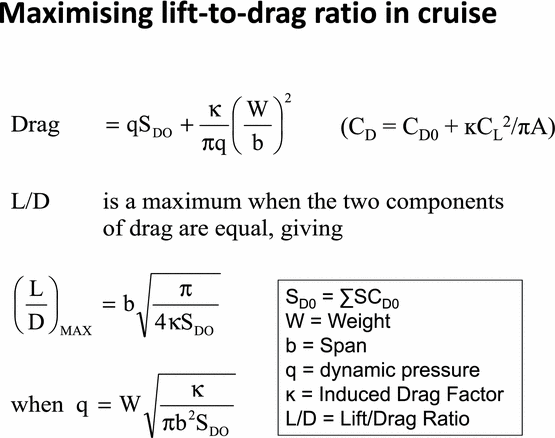
This is a simplification of course, ignoring other terms such as drag due to compressibility and shock waves, which, however, at the maximum lift/drag ratio for a modern passenger jet are relatively small.
Remembering that the lift L is equal to the weight W, and rearranging and differentiating with respect to W gives the equation for the maximum lift/drag ratio (L/D)max, given in the third line in Fig. 15. We can now inspect the crucial parameters: span, induced drag factor, and ‘drag area’. The latter is the sum of the surface wetted area of the various parts of the aircraft multiplied by the nondimensional drag coefficient at zero lift (CDo) applicable to that part (e.g. the fuselage, wing, tailplane etc.). Again approximating, on a well-designed aircraft there is some variation in the local values of CDo, but with turbulent boundary layers, an average value of CDo is in the order of 0.0035, representing the skin friction drag plus some form drag due to the shape of the parts of the aircraft. Although drag area is an often-used concept, we will look at this in the two parts, the total surface area of the aircraft and the average zero lift drag coefficient CDo based on that surface area.
4.5 Maximising the lift/drag ratio
4.5.1 Span
Referring to Fig. 15, the span of the aircraft should be as high as possible. Unfortunately, as the span goes up, the weight of the wing also increases, particularly if this is without increasing the chord lengths, to keep the surface area to a minimum (ie, by increasing the aspect ratio). To reduce wing weight, one would like to reduce the flight Mach number so as to reduce the wing sweep-back and/or go to higher thickness-to-chord ratios. Also, using lighter, stronger materials such as CFRP will help the overall configuration optimising at a higher span. Poll(Reference Poll7) has shown that typically improvements in lighter-weight wing materials through the years have been used to increase the span and aspect ratio in pursuing better range capability and fuel burn reduction rather than using the weight reduction per se.
4.5.2 Induced drag factor
Again, for a well-designed civil transport, this is already close to the optimum of 1.0 (increased somewhat to allow for the inevitable increase in viscous form drag as a function of lift coefficient). There is nothing further to advise for this parameter other than to ensure that the total distribution of lifting loads and hence vortex drag of the complete aircraft are considered (eg, for the wing plus the tailplane) when optimising drag and weight(Reference Jupp8).
4.5.3 Wing tip design
Before leaving the induced drag factor (Section 4.5.2) completely, a word is necessary on wing-tip design, as it may be considered that the use of winglets or other wing-tip devices can reduce the apparent induced drag factor. Jones(Reference Jones and Lasinski9) (among other authors) has, however, shown that to a first order, there is a direct correspondence between winglets and a span extension. Winglets with a total height of three units have a similar effect on induced drag reduction AND wing bending moments as a span extension of two units. Their prime use is therefore when the aircraft is span limited for airport operational reasons: this applies to the latest members of the 737 and A320 families, the A330 neo, the A350, and the A380. Boeing actually favours a swept horizontal tip extension to a winglet on their developed versions of the 747 and 777, even to the extent of having a folding wing tip on the 777X project (although in this case the height of the 50% taller winglets is probably impractical). It is the author's opinion that for a given overall projected span and projected wingtip device height, any difference between devices is likely to be second order and very dependent on the aerodynamic and structural weight and flexibility characteristics of the application(Reference Jupp8).
4.5.4 Surface area and zero lift drag coefficient
Both of these parameters need to be optimised to minimise the overall drag area. Clearly there are interactions between the two as well as with other drag components. However, if a different configuration offers a significant reduction in total wetted surface area, then there is the possibility of significant drag reduction. This is addressed later. As long as the aircraft is well designed with regard to interference drag between components and general excrescence drag (aerials, gaps and steps etc.), then the options for the drag coefficient are to reduce the fully turbulent skin friction drag coefficient or to generate areas of laminar flow. Whereas the value of turbulent drag coefficient is in the order of 0.0035, typical values for laminar flow are in the order of 0.0005, which is just 14% of typical turbulent flow values (note, these are for Reynolds numbers in the order of 107 typical of wing-like surfaces rather than traditional cylindrical fuselages, which will be an order of magnitude higher, but for which fully laminar flow would be impossible). Operating on the drag of turbulent boundary layers is the subject of ongoing research, but two current examples are the application of low friction paint and adding a layer with impressed longitudinal grooves (riblets). Either of these has a relatively minor effect on drag reduction but may find more favour as the reduction in fuel burn becomes ever more important compared with maintenance or structural inspection issues. However, these possibilities are unlikely to change the aircraft configuration significantly and are not pursued further in this paper.
4.5.5 Natural laminar flow
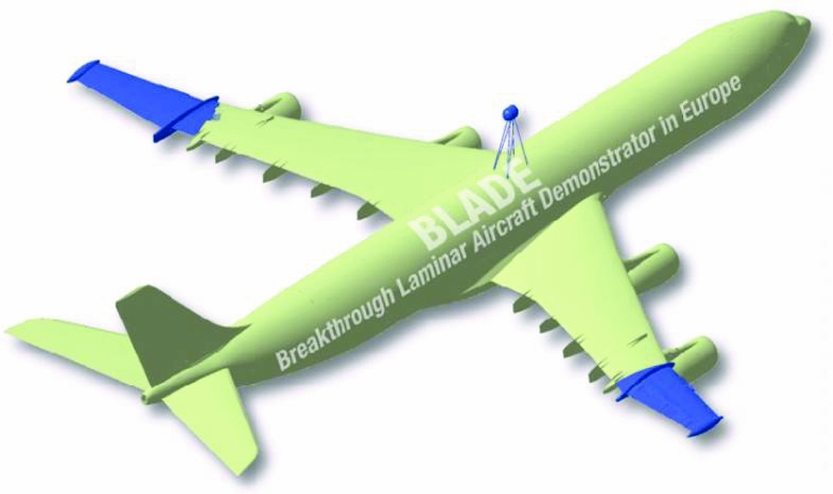
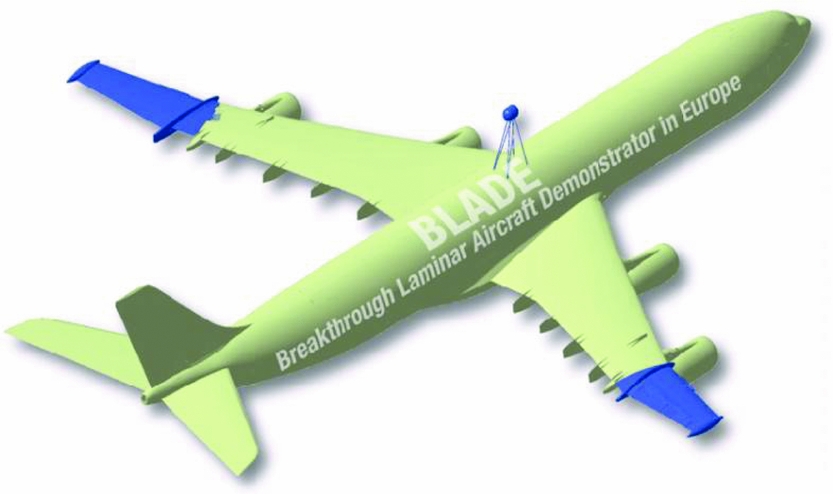
The reduction in drag if laminar boundary layers can be maintained from the leading edges is so dramatic that even maintaining laminar flow over a relatively small proportion of the aircraft surfaces can be worthwhile. However, for any wing-like surfaces, at the typical flight Reynolds numbers of a large passenger aircraft (i.e. 100 seats plus), the surface smoothness must be extremely good. This then implies significant problems of manufacturing with adequate smoothness and maintaining those standards through the life of the aircraft. On swept wings, contamination by spanwise turbulent flow along the leading-edge stagnation zone and cross-flow instabilities are two mechanisms that will inhibit laminar flow. The latter will probably restrict leading sweepback to less than approximately 20°. The former can be ameliorated by bump or slot devices to bleed the leading-edge flow across the chord at intervals across the span. However, to obtain significant areas of natural laminar flow, it is generally accepted that the leading-edge sweepback will need to be quite low. It also once again implies aircraft with a lower Mach number capability than today's jet transports but nonetheless is perhaps adequate for relatively short-range applications, perhaps 0.65 to 0.7 rather than the 0.75 to 0.80 currently. The most likely application would be over the forward part of the nacelles of ducted propulsion units and the first part of the fin, tailplane, and wing chords, particularly on the outer wing. Laminar flow is already reputed to be achieved on the Boeing 787 nacelle leading edges, and the major EU ‘Clean Skies’ research programme intends to flight-test laminar flow outer wing panels using a heavily modified Airbus A340 aircraft (Fig. 16).
Modified Airbus A340 for laminar flow tests.
4.5.6 Hybrid and full laminar flow
There have been several examples over the last few decades of successful flight tests on both sides of the Atlantic to prove the aerodynamics of maintaining larger areas of laminar flow by suction through the surface to remove the low-energy turbulent flow close to the surface. The typical application is suction through the upper surface of the leading-edge area in front of the front spar of the load-carrying/fuel tank wing box, that is, applied to the first 15% to 20% of the wing chord to maintain laminar flow over about the first 50% of chord. Maintaining laminar flow over more of the surface to the trailing edge will require suction over more of the chord with an increase in structural complexity and weight and is not at present seriously being considered to the author's knowledge.
Applying hybrid laminar flow over the wing upper surfaces, both surfaces of the tailplane and fin, and the nacelles (if ducted propulsors) would reduce cruise fuel burn by about 15%. The aerodynamics have been well proved, but there are many other operational problems to be overcome, as well as structural and system complexities and additional significant costs. Nonetheless, the Boeing 767-900 has this technology applied to the leading-edge zone of the fin and tailplane, but at the time of closing for publication, Boeing has decided against using it on the 777X, presumably as the economic tradeoff did not work for that application.
5.0 THE POSSIBLE IMPACT ON FUTURE CIVIL TRANSPORT CONFIGURATIONS
Having reviewed the directions for the important parameters in reducing fuel burn, what will be the possible impact on the design and particularly the configuration of future civil passenger aircraft? Some of the general design repercussions have already been implied in the preceding sections: weight reduction through the use of advanced materials or system concepts, reduction of turbulent skin friction drag, and application of laminar flow concepts, which may not significantly affect the overall configuration of today's aircraft.
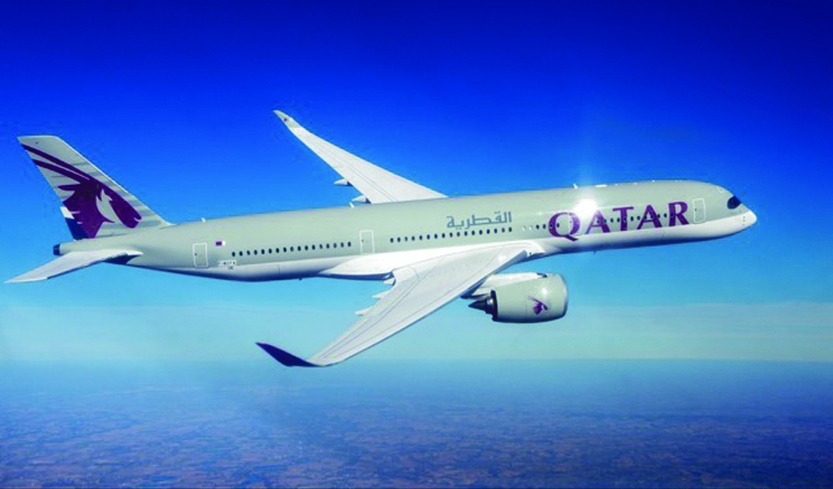
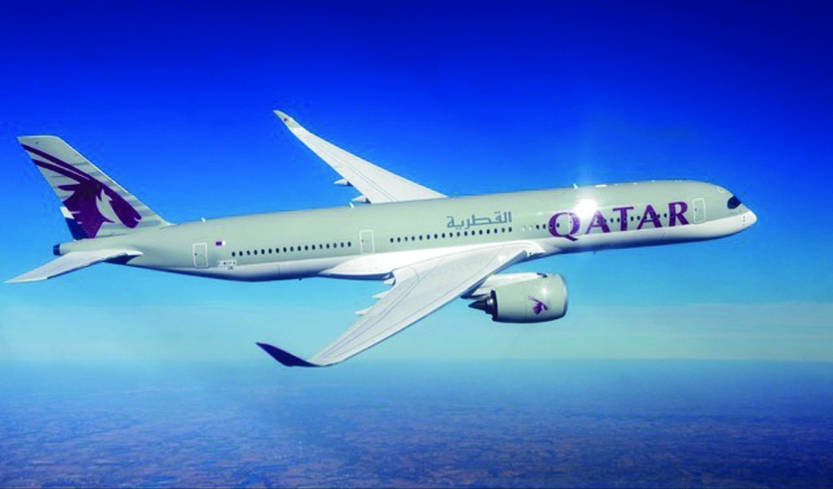
We can expect to see the classic tubular fuselage/low-swept back wing/rear tailplane and fin/underwing engines layout for many years. The latest large transports, the Airbus A380 and A350 (Fig. 17) and the Boeing 787 Dreamliner projects, perhaps with evolutionary improvements, will probably remain in service for several decades. What other options might we anticipate?
Airbus A350 - in service January 2015.
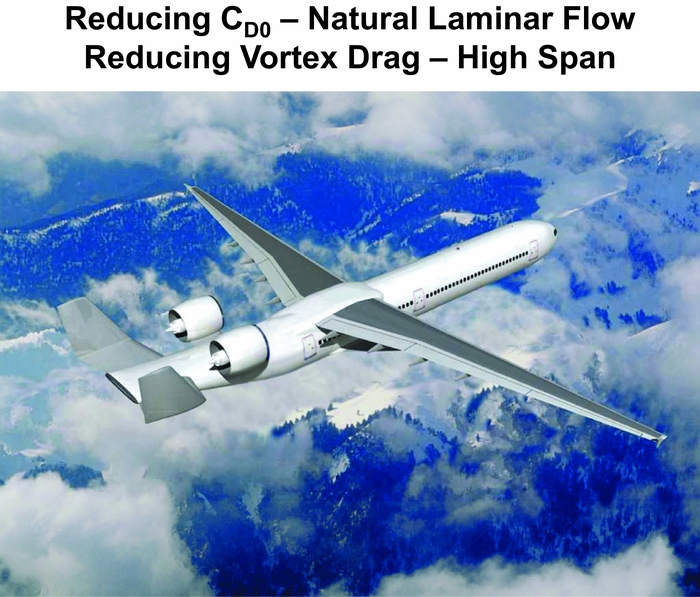
The first major move forward will probably be in the 150-seat short/medium-range class, although a possible entry into service date has been delayed beyond 2020 (probably well beyond?) with both Airbus and Boeing having committed re-engined versions of their very successful A320 and 737 projects. Boeing was more limited than Airbus by the room under the wing for larger-diameter ducted propulsors, but significant improvements in fuel burn in the order of 15% are claimed by both manufacturers with the new engines and a package of more minor modifications. A follow-up aircraft will have to demonstrate major fuel burn improvements relative to the latest versions of the A320neo and the 737 Max. That will not be easy. Boeing's problem of space under the wing for the 737 Max leads into the first significant configuration issue – allowing enough space for the efficient integration of large-diameter propulsion units. This may force the change to high-wing or rear-engine configurations (Fig. 18).
EU NACRE programme concept for low fuel burn.

Open rotors mounted on the wing have the problem of increasing the air speed over the wing and hence the effective Mach number seen by the wing. Interference drag will then have to be minimized, leading at least to some reduction in the potential fuel burn improvement with this type of propulsion. Rear-engine installations will have their own problems, for example an increase in the risk of a double-engine failure from a blade loss or disk burst from one engine. Heavy propulsion units at the rear will also cause layout and loading problems.
For the 150-seater-sized aircraft, there is probably no radically new configuration that will reduce the wetted surface area significantly. Canards with a forward horizontal control surface have been looked at many times but never yet proved to show an advantage. There is certainly the possibility of generating natural laminar flow over some surfaces for this class of aircraft as reviewed in Section 4.5.4.
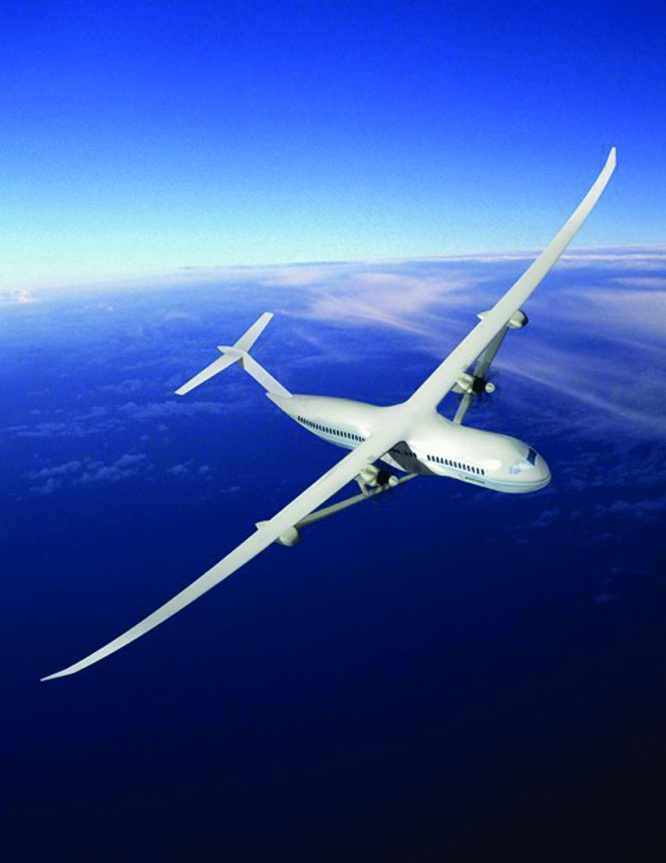
This could be combined with a very high-aspect-ratio wing with zero sweepback to give a substantial reduction in wing drag but subject to the issues already reviewed earlier. Such a layout was one subject of the NACRE EU Framework 6 research programme (Fig. 18). In response to a NASA call, Boeing has also proposed a very high-span zero-sweep configuration, probably in association with natural laminar flow, in their ‘SUGAR’ proposal (Subsonic Ultra Green Aircraft Research), but also applying the ‘braced wing’ concept to reduce wing weight (Fig. 19).
NASA - Boeing ‘SUGAR’ proposal.

So the next-generation 150-seater aircraft may look very different from those in service today, with the passengers having to accept some modest increase in flight times.
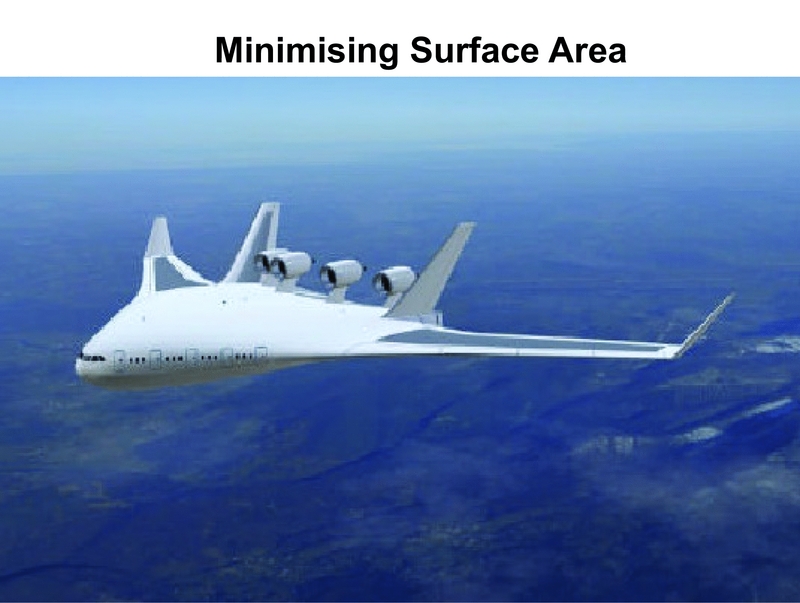
Although probably even further into the future than a radically different 150 seater, the prime competitor to the classic configuration for longer-range larger aircraft is of course the ‘blended wing body’ (Fig. 20). Some studies have suggested that for a given payload capacity and the same number of passengers, the wetted surface area of such a configuration could be in the order of 70% that of a classic layout, with local drag coefficients that would be little different. Also, with the payload and fuel load distributed more across the span, and with the integration of the control surfaces, there are significant opportunities for weight reduction, partially balanced by the need to maintain a smooth aerodynamic surface whilst designing an efficient structure to resist the cabin pressurisation loads. As suggested in the concept in Fig. 20, there is also the possibility of using the airframe for shielding the noise of the propulsion units for take-off and landing, although the ease and costs of engine maintenance will be compromised. The likely power plants would be large-diameter ducted propulsors in this case, due to the limits in diameter and hence power output of open rotors and a limit to the achievable Mach number.
‘Blended wing body’ concept.

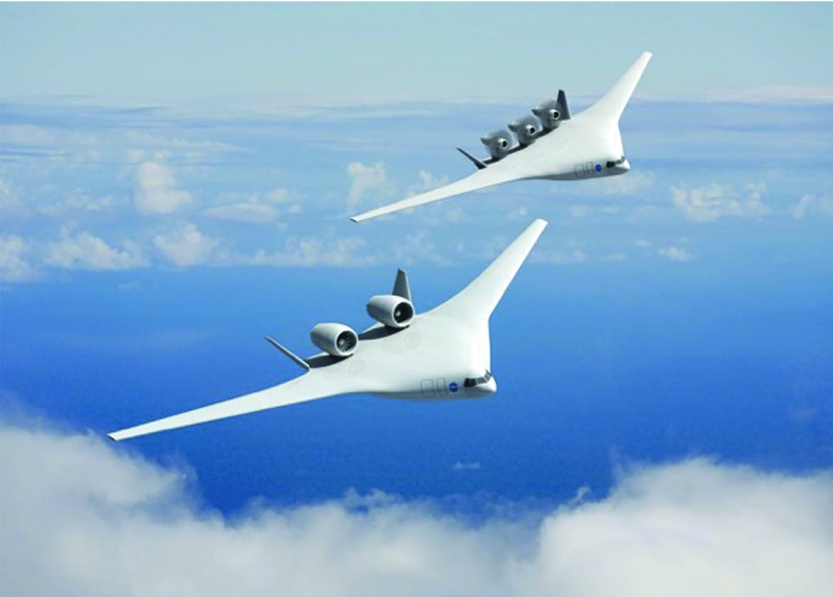
There is a possible middle ground between aircraft for the shorter-range missions and the intercontinental very long-range vehicles, for which the blended wing body concept would still be applicable. As reviewed in Section 4.1, design range has a significant effect on fuel efficiency and a 250- to 300-seat blended wing-body aircraft designed for perhaps 5,500 km (3,000 nautical miles approximately) could cover much of the world's routes with excellent fuel burn. Such a design might look something like the one shown in Fig. 21 (with thanks to NASA). (This also suggests the possibility of a further application of open rotor propulsion units but shows the problem of needing more units due to the probable thrust limitations reviewed in Section 4.3).
NASA blended wing body concepts.

6.0 YET FURTHER LONG-TERM POSSIBILITIES
With the research horizon now extending as far out as 2050, other possible technologies and configurations are getting some attention. Considerable research was done in the late 20th century on liquid-hydrogen-powered aircraft. Assuming the liquid hydrogen can be produced in an environmentally sustainable way, this is a long-term possibility. Apart from handling a flammable cryogenic liquid, the main problem is the volume required to carry the same energy content as kerosene, but it may be practical in the volume within a large blended wing-body configuration outboard of the passenger cabin, for example. The costs etc. would probably only be realistic if a liquid hydrogen infrastructure was in place for reasons other than aviation.
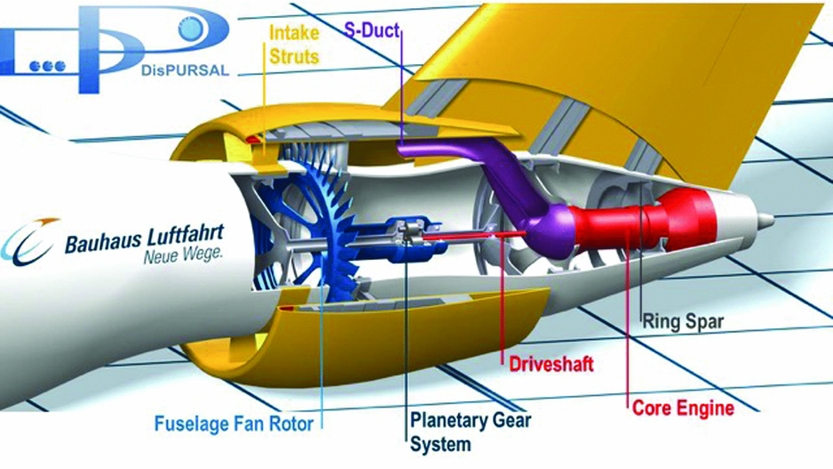
Distributed propulsion was referred to in Section 3. Consultants Bauhaus and Luftfahrt are looking at both blended wing and rear-fuselage-mounted arrangements. The latter is shown in Fig. 22 (reproduced from Isikveren 2015(Reference Isikveren, Seitz, Bijewitz, Mirzoyan, Isyanov, Grenon, Atiault, Godard and Stückl10)), as a means both to increase the effective bypass ratio and to restore the momentum loss in the fuselage boundary layers. There are many tradeoffs here of course, the weight and propulsion system complexity being major issues.
‘Wake-filling’ rear fuselage propulsion concept.

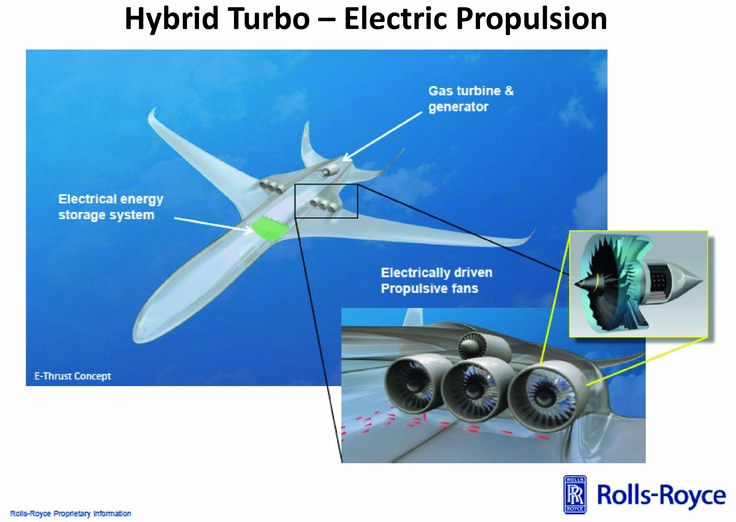
Regarding wing-mounted distributed propulsion, the ‘E-Thrust’ project being looked at by Airbus and Rolls-Royce is one of the more forward looking – Fig. 23. This is an example of what is being referred to as hybrid turbo-electric propulsion. All-electric propulsion systems may never prove practical for large aircraft as the discharge rates and energy storage capacity of batteries per unit weight need to be better by orders of magnitude to be viable, and similarly for fuel cells and their fuel source. However, a hybrid system looks more interesting with a single or twin large turbine powerplant driving a generator and powering a smaller set of batteries and/or direct to electric-motor-powered propulsion fans. It would still need improvements in battery technology and higher-temperature (i.e. that of liquid nitrogen) superconducting cables to start to be a serious contender.
Airbus - Rolls-Royce ‘E-Thrust’ project.

The improved efficiency comes from the effective increase in bypass ratio (i.e. the flow rate through the fans compared with the flow rate to the turbine generator set), the wake momentum deficit recovery, and that take-off and climb thrust would come from the turbines plus prestorage in the batteries (during descent?), which would also help in the case of an engine failure. The turbine power generators would then be working at peak efficiency for more of the flight time, but of course system weight, generator, and cabling losses will offset the benefits to a greater or lesser extent.
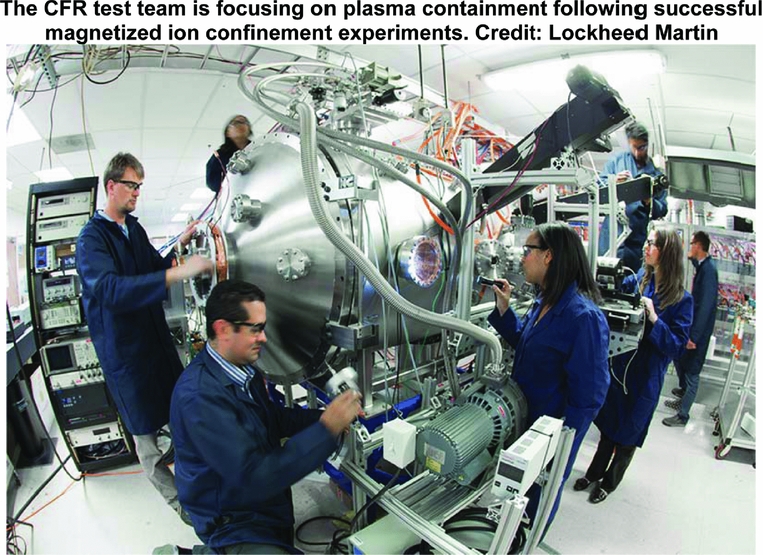
One area of ongoing research that, at least for large aircraft, could completely solve the issue of environmental problems and fuel availability was announced by the Lockheed Martin Skunk Works in October 2014–Fig. 24 (as reported in Ref. 11). This is their ‘Compact Nuclear Fusion Reactor’ (CFR). Based on Lockheed Martin's timeline, the CFR prototype could be ready by early 2020. By 2025, a 100 MW compact fusion reactor, small enough to fit on a truck, could be in production. This would also then be sufficiently small to power ships or large aircraft and would overcome concerns over radioactive fission materials being released in a crash. The announcement, however, has been greeted with some scepticism, but it seems unlikely that a highly regarded company like Lockheed Martin would make a public announcement without a belief that fusion was within reach. We shall see!
Lockheed Martin ‘Compact Nuclear Fusion Reactor’ research.

7.0 CONCLUDING REMARKS
This paper is intended as a general introduction to the requirements for future passenger aircraft design. Due to both the substantial increase in fuel prices and the threat of climate change, it is reasoned that the most significant driver for the optimisation of future passenger aircraft designs will be to substantially reduce fuel burn even with the almost inevitable increase in cost and selling price. Weight reduction through advanced materials and application of advanced propulsion units are trends that are already well underway, although with little change in overall aircraft configuration. In the next two to three decades, we may also expect to see more change in the look and performance of aircraft to incorporate more radical technologies, such as laminar flow, the unducted propulsor, or the blended wing-body concept. One never gets something for nothing however, and whilst very substantial reductions in fuel burn should be possible, the travelling public may have to accept some reduction in speed and an increase in journey times to achieve the maximum improvement.
ACKNOWLEDGEMENTS
The author wishes to thank Dr John Green, of the Royal Aeronautical Society's Greener by Design Committee, for some of his work embodied in this paper. The author also wishes to thank Rolls-Royce for Figs 7, 13, and 23; Airbus SAS for Figs 11, 16, 17, and 18; Bauhaus Luftfahrt e.V. for Fig. 22; and the remaining original authorities for illustrations obtained from the Internet.
This paper is a major update of “21st Century Challenges for the Design of Passenger Aircraft”, first given by the author at the ICAS 28th Congress – Brisbane, Australia 2012.