

Introduction
The deleterious impacts of climate change are unevenly distributed across communities and neighborhoods in the United States. One notable divide falls along racial and ethnic lines. Communities of color (Latines, Black Americans, Asian Americans, and Native Americans) disproportionately bear the consequences of the growing climate crisis (EPA 2021). Much of this disparity can be attributed to where minority communities live and work, as they are heavily concentrated in areas with high levels of pollution and poor air quality. Take, for example, the fact that African Americans and Latines, on average, experience poorer housing (Reardon et al. Reference Reardon, Fox and Townsend2015), health (Macias-Konstantopoulos et al. Reference Macias-Konstantopoulos, Collins, Diaz, Duber, Edwards, Hsu, Ranney, Riviello, Wettstein and Sachs2023), education (Bushnell Reference Bushnell2021), and job prospects (Weller Reference Weller2019) relative to white people in the United States. Additionally, African Americans are 34% more likely than others “to live in areas with the highest projected increases in childhood asthma diagnoses due to climate-driven changes in particulate air pollution” (EPA 2021). Similarly, Latines are “43% more likely than non-Hispanic and non-Latino individuals to currently live in areas with the highest projected labor hour losses in weather-exposed industries due to climate-driven increases in high-temperature days” (EPA 2021). Additionally, Lazri and Konisky (Reference Lazri and Konisky2019) find that Black people, Latines, and Asian Americans consistently express higher levels of concern for the environment, relative to white people. Other studies also show that racial and ethnic minorities exhibit greater levels of acceptance that global warming is occurring, relative to white Americans (Ballew et al. Reference Ballew, Leiserowitz, Roser-Renouf, Rosenthal, Kotcher, Marlon, Lyon, Goldberg and Maibach2019; Flynn et al. Reference Flynn, Slovic and Mertz1994). Given minorities’ relative exposure to the effects of climate change, we hypothesize that people of color are more likely than white people to show concern towards climate change (H1).
We also expect that one’s political leanings help to explain their attitudes towards climate change and the environment. Dunlap et al. (Reference Dunlap, McCright and Yarosh2016) find that Democrats and liberals across all racial and ethnic groups are more supportive of climate policy than Republicans or conservatives. Thus, we expect that for each racial group, Democrats (e.g., Black Democrats vs. Black Republicans, Latine Democrats vs. Latine Republicans, etc.) will be more concerned about the environment than their Republican counterparts (H2).
Our third and final hypothesis centers on how intersectional identities among women of color affect political attitudes and beliefs. We motivate this hypothesis based on the body of research documenting a “gender gap” in attitudes about the environment and climate change (Echavarren Reference Echavarren2023; McCright and Xiao Reference McCright and Xiao2014; Xiao and McCright Reference Xiao and McCright2015), with women expressing greater concern about the environment than men. While far less attention has been paid to the way multiple marginalized identities can affect views on climate change, one notable exception is a recent study by Chisty (Reference Chisty2026), who found that Black women reported the greatest perceptions of climate risks relative to Black men and other women of color.Footnote 1 We build upon and expand Chisty’s research by disaggregating “women of color” to examine how the unique intersectional identities of Asian American/Pacific Islander women, Black women, and Latine women shape their attitudes towards climate change and global warming. Given that these intersectional identities are uniquely shaped by each group’s historical and lived experiences, coupled with their position in the racial hierarchy (Hancock Reference Hancock2016), we believe it is critical to acknowledge these distinctions in our empirical analyses. As such, we hypothesize that Asian American/Pacific Islander women, Black women, and Latine women will be more likely than their male counterparts to be concerned about climate change (H3).
Our research contributes to and builds on the existing literature in three important ways. First, we empirically analyze these hypotheses using two datasets: public data containing a substantial oversample of the major racial/ethnic minority groups in the U.S. using the 2020 Collaborative Multiracial Post-Election Survey (CMPS) as well as the Climate Change in the American Mind: National Survey Data on Public Opinion (CCAM), which contains a rich and extensive battery of survey items that tap into one’s attitudes and beliefs towards the environment. Second, our study contributes to our understanding of how one’s racial/ethnic identity, independently and conditionally, based on partisanship and gender, explains their views on climate change and the environment. Finally, the CCAM data enables us to develop a more nuanced understanding of the various attitudinal aspects of the environment and climate change.
Data and Research Design
We test our three hypotheses using two large-scale datasets. First, we use the 2020 CMPS, which includes over 800 unique questions asked of voters and non-voters across the U.S. Notably, it contains “large and generalizable samples of racial and ethnic groups in the United States” (Frasure et al. Reference Frasure, Wong, Vargas and Bareto2020). The CMPS summary statistics presented in Appendix A1 highlight just how sizable these oversamples are—26.3% of the sample is Black (N = 4,613), 23.9% Asian American and Pacific Islander (AAPI) (N = 4,198), 22% white (N = 3,925), and 22.1% Latine (N = 3,881). Thus, not only are these sample sizes across racial/ethnic groups similar, but they are far larger than those of other existing surveys that gauge public opinion in the U.S. (e.g., the American National Election Studies and the General Social Survey). We also augment this dataset with the 2008–2022 Climate Change in the American Mind: National Survey Data on Public Opinion (CCAM), a cross-sectional nationwide survey that examines American perceptions of climate change through a social and political lens (Ballew et al. Reference Ballew, Leiserowitz, Roser-Renouf, Rosenthal, Kotcher, Marlon, Lyon, Goldberg and Maibach2019). As such, the CCAM data offers a rich and detailed battery of survey items on climate change policy opinions and preferences, as well as items on one’s anxiety and concerns about the environment and climate change. The surveys were conducted once in 2008 and then twice a year from 2010 to 2022 for U.S. adults aged 18 and older (Yale Program on Climate Change Communication (YPCCC) & George Mason University Center for Climate Change Communication (Mason 4C) 2022).
While the CCAM data lends itself well to our study because of its extensive questions on the environment, its samples of racial/ethnic minorities are not as large as those in the CMPS data, especially regarding respondents’ intersectional identities. The CCAM survey primarily sampled white Americans (73.4%), followed by Latine respondents (10.2%), Black Americans (8.9%), and those who identify as other (6.6%).Footnote 2 Given that Asian Americans and Pacific Islanders were grouped into the “other” category, which also included American Indian, Native Alaskan, and those who reported being some other race, we only analyze Black, Latine, and white climate change opinions using the CCAM data. The summary statistics for all variables used in our analysis are in Appendix A2.
For our dependent variables, we examine six survey items that assess individuals’ concerns over the environment, climate anxiety and exposure, and their beliefs regarding climate change.Footnote 3 From the 2020 CMPS, we leverage three environment-related questions: 1) respondents were asked to identify the three most important issues to them, including climate change as well as various political and social issues (e.g., healthcare, unemployment, and immigration) that they believe the new administration should address. Additionally, respondents are asked whether they 2) supported a bold national climate change policy that should or should not be enacted by Congress and the President; and to 3) rate their anxiety over climate change from 1–10, with a 1 denoting feeling the least amount of anxiety and a 10 denoting feeling the most amount of anxiety. Our last three dependent variables are drawn from the CCAM data, which asks respondents: 4) whether they believe that climate change is happening; 5) the extent to which they discuss climate change with their family and friends; and, 6) how often they hear about climate change being discussed in the media (TV, movies, radio, newspaper/news, websites/magazines).Footnote 4
Turning to our main explanatory variables of interest, we test our first hypothesis (H1) by focusing on one’s self-reported racial and ethnic identity (Black American, white American, Asian American/Pacific Islander, and Latine) as our primary independent variables. The ethnic/racial identity variables are constructed as categorical variables, with white respondents serving as the reference group in our models. With regard to H2, we model the interaction between one’s partisan identification (Democrat and Republican) and a respondent’s self-reported racial/ethnic background (i.e., race/ethnicity × party identification). Here, the omitted category is white Republican. Finally, the main independent variable of interest that we construct to test H3 is the interaction between a respondent’s self-reported race/ethnicity and their gender (race/ethnicity × gender), where gender is a categorical variable. The omitted category is white men. Along with these primary independent variables, our models also include several control variables (coded as categorical variables), age, ideology, income, education, and partisanship, to account for the potential role that one’s demographic characteristics may play in explaining attitudes towards climate change.
As for our estimation strategy, we use logit analyses for the five questions assessing climate change attitudes and preferences, as we collapsed the response categories into a dichotomous measure.Footnote 5 However, the response to the climate anxiety question was a scale that ranged from 1 to 10, so we use an OLS model for that regression. We then calculate the predicted probabilities (i.e., predicted scores for the OLS model) and present them as first difference estimates to assess the magnitude of the effects of race/ethnicity, as well as their interactive effects with gender and partisanship.
Results
We begin by discussing the results assessing H1, which posits that people of color are more concerned about the environment than white people. The logistic regression results can be found in Appendix D. In Table D1, the logit estimates indicate that the coefficient indicating one’s race/ethnicity is a statistically significant and consistent predictor of their climate change attitudes. The logit coefficient for Black respondents is statistically significant at conventional levels in all six models; moreover, the logit coefficient for Latine respondents is statistically significant in all but one of our models. The coefficient capturing Asian American/Pacific Islander identity also reaches statistical significance in all three models where it is included.
What is crucial to note, however, is that the direction of these effects varies, therefore challenging our expectations that people of color would be uniformly more concerned about the environment than white Americans. For example, while Latines, Black Americans, and Asian American/Pacific Islanders exhibit a greater probability of supporting a bold climate change policy relative to white Americans, they are less likely than white Americans to rank it as one of their most important issues. White respondents are also more likely than Black respondents to discuss climate change and more likely than Black and Latine respondents to report seeing climate change in the media. One possible explanation for these findings follows from Maslow’s Hierarchy of Needs Theory. It asserts that people of color are preoccupied with other basic and pressing issues, such as jobs and the economy; as such, they may be less likely to prioritize climate change relative to other issues in their issue preferences, in their discussions, or in the things they remember observing in the media (Hershey and Hill Reference Hershey and Hill1978; Kreger Reference Kreger1973). Still, while there is some mixed support for H1, we do find evidence that people of color are more concerned about the environment than white respondents when examining survey questions that ask exclusively about climate change opinions.
Finally, when asked how anxious they are about the climate (measured on a scale from 1–10, with a 1 indicating the least anxiety and a 10 indicating the most anxiety), Latine and Asian American/Pacific Islander respondents report statistically significantly higher climate anxiety than do whites. Given that ethnic/racial minorities bear the brunt of the negative consequences associated with climate change, it is understandable why they feel more anxious about climate change than white Americans.
To determine the substantive effect that one’s ethnic/racial identity plays in shaping their climate change attitudes, Figure 1 presents the average first differences in the predicted probability estimates for the five climate change questions for Black and Latine people, relative to white people.Footnote 6 Figure 1 also shows the first difference estimates for Asian American/Pacific Islanders on their probability of supporting bold climate policy and of ranking climate change as a top issue relative to white Americans. And for our final question tapping into one’s level of climate anxiety, we interpret the OLS coefficients measuring a respondent’s race/ethnicity directly, since this question was measured on a scale that ranged from 1 to 10.Footnote 7
First difference estimates for climate change attitudes by racial/ethnic identity. Estimates represent the average first difference in predicted probabilities of expressing a given climate change opinion relative to white people. Error bars represent 95% CIs.

Across these various attitudes on climate change, the most pronounced differences between communities of color and white people are in their preferences for a bold climate change policy at the national level. Both Asian American/Pacific Islander and Latine respondents were 7.1 percentage points more likely than white respondents to advocate for such a policy. Likewise, Black people exhibited a higher probability of supporting this issue, relative to white Americans, by 6.1 percentage points. When it comes to the belief that climate change is happening, the first difference estimates are not as substantial. We find a 1.3 percentage-point difference between Black and white respondents, and a 1.1 percentage-point difference for Latine individuals. Finally, with regard to the substantive differences in one’s racial/ethnic identity and climate anxiety levels, we find a 0.62 increase on the 1–10 climate anxiety scale for Asian American/Pacific Islanders, and a 0.37 increase on this scale for our Latine respondents.
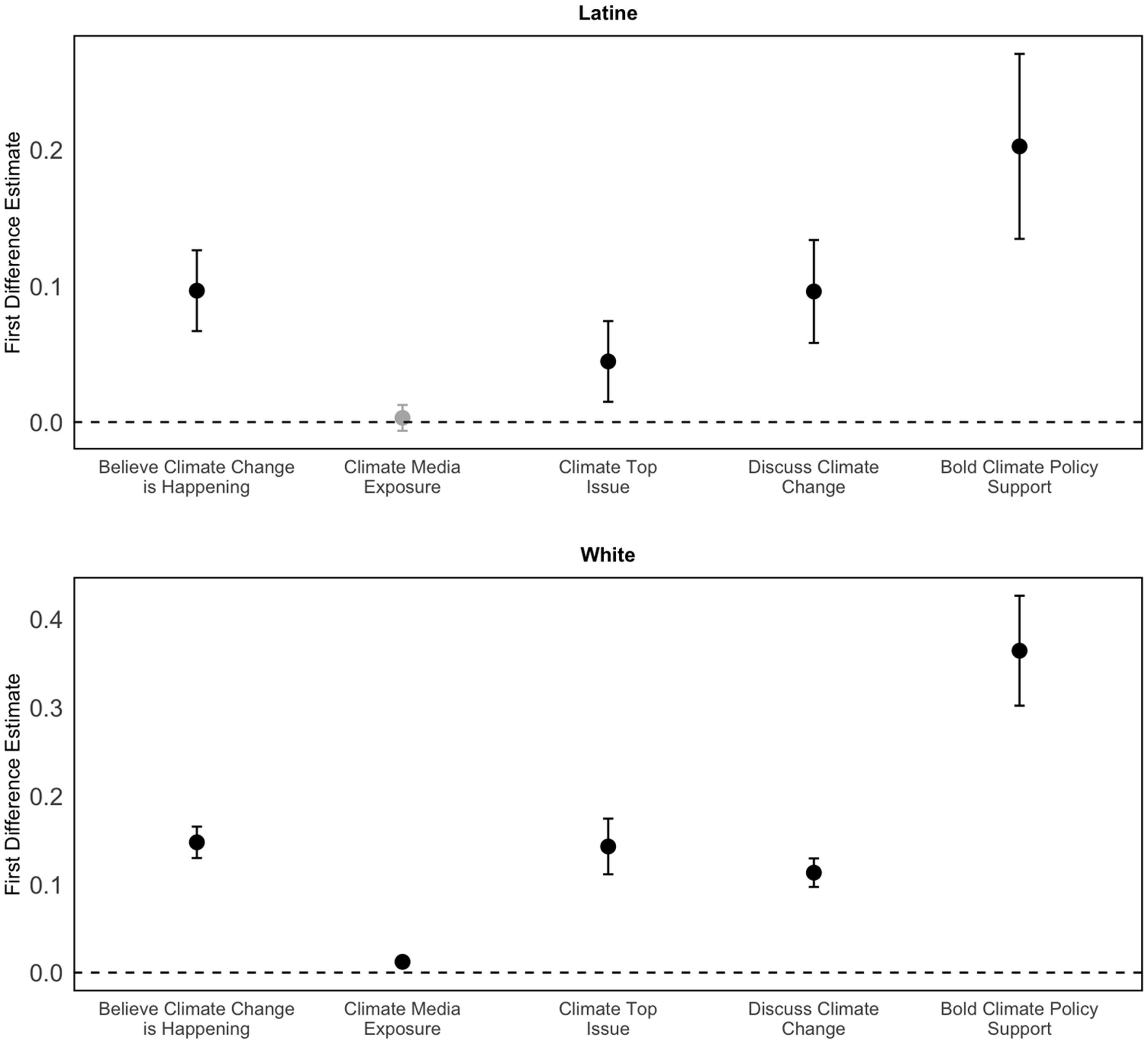
We now move on to the results evaluating our second hypothesis. Recall that H2 examines the probability that one’s partisan and ethnic/racial identity affects their climate change opinions. The logit estimates are available in Table D2. We once again calculated first difference estimates for ease of interpretation. The estimates presented in Figures 2 and 3 represent the average first difference in the predicted probability of expressing a given climate change opinion for Democrats, relative to Republicans within each ethnic/racial group.Footnote 8 Our findings suggest that the issue of climate change is highly polarized along partisan lines, lending support to H2. The partisan gulf is widest and most consistent among white Americans (Figure 2). White Democrats are 14.7 percentage points more likely than white Republicans to believe that climate change is happening. This difference widens further when it comes to political preferences. With a 36.4 percentage-point gap, white Democrats are much more likely than white Republicans to support a national bold climate change policy.
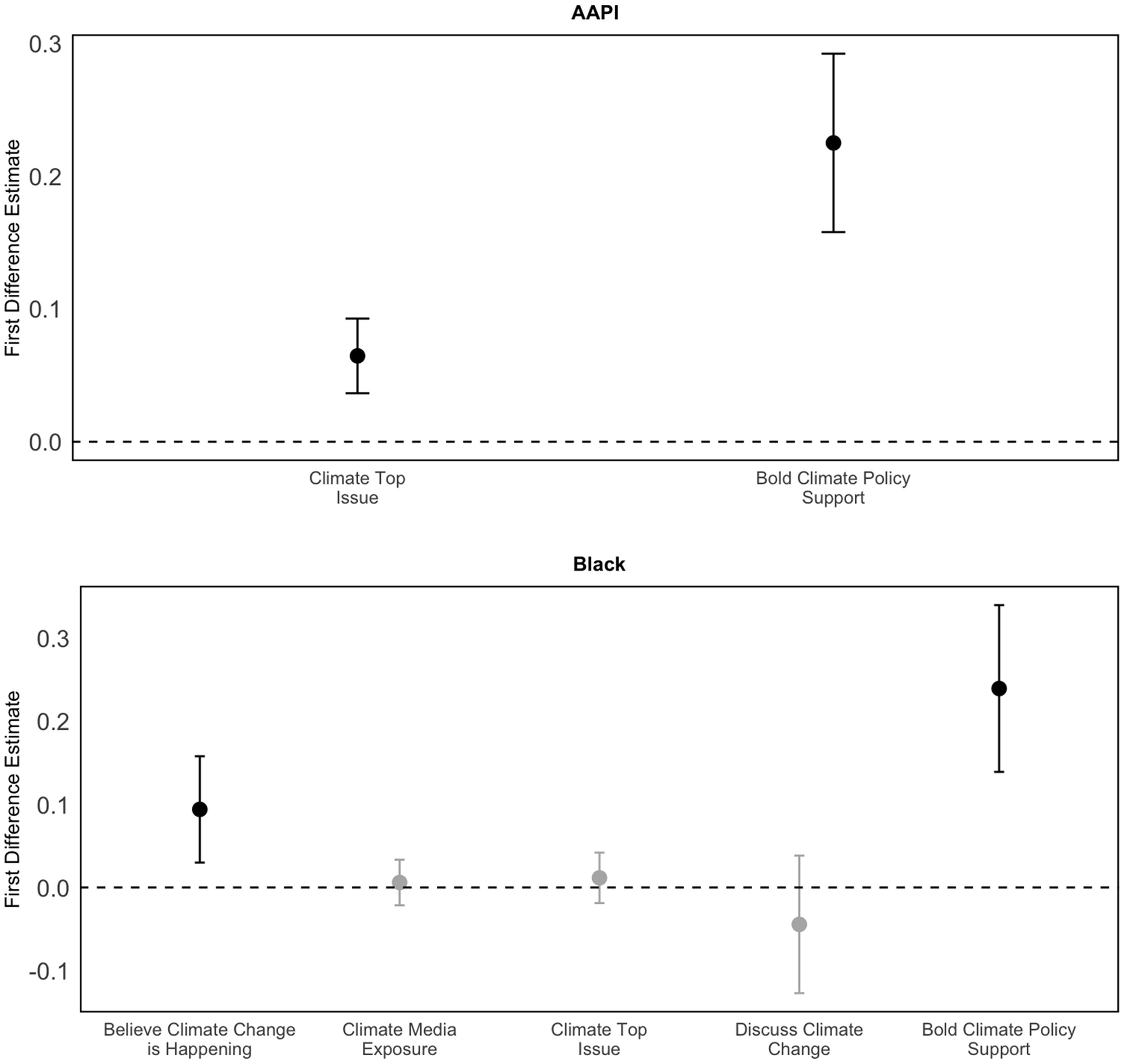
First difference estimates for climate change attitudes by racial/ethnic identity × partisanship. Estimates represent the average first difference in the predicted probabilities of expressing a climate change opinion for a given racial/ethnic group, and taking the difference in predicted probability between those who identify as a Democrat vs those who identify as a Republican. Error bars represent 95% CIs.

First difference estimates for climate change attitudes by racial/ethnic identity × partisanship. Estimates represent the average first difference in the predicted probabilities of expressing a climate change opinion for a given racial/ethnic group, and taking the difference in predicted probability between those who identify as a Democrat vs those who identify as a Republican. Error bars represent 95% CIs.

In line with this heightened level of concern and belief based on partisanship among racial/ethnic groups, white Democrats are 14.3 percentage points more likely to identify climate change as their top issue and 11.3 percentage points more likely to discuss climate change compared to white Republicans. Although the magnitude of the effects is not nearly as substantial, white Democrats are 1.2 percentage points more likely to be exposed to climate change in the media (TV, movies, radio, newspapers/news, websites, magazines, etc.) than white Republicans.
Latine respondents show a similarly polarized—though somewhat compressed—version of this pattern. Latine Democrats and Republicans diverge sharply on belief in climate change, as Democrats are 9.7 percentage points more likely than Republicans to believe that climate change is happening. The largest gap can be seen in the support for a bold climate change policy—Latine Democrats are 20.2 percentage points more likely than Latine Republicans to support such a policy. Additionally, Latine Democrats are 4.5 percentage points more likely to identify climate change as a top issue and 9.6 percentage points more likely to discuss climate change than Latine Republicans. Latine Democrats also exhibit slightly higher average climate anxiety scores, with a 1.1 point difference compared to Latine Republicans. Notably, the Latine partisan gaps follow the white gap, suggesting that partisan identification plays an important role in these two communities.
The picture shifts meaningfully among Black respondents (Figure 3), where the partisan divide—while still present—is not nearly as pronounced as among White Americans and Latines. This difference likely reflects the fact that nearly two-thirds of Black respondents in the sample identify as Democrats, making it difficult to empirically assess partisan differences among Black respondents. Where differences do emerge, they follow the familiar direction: Black Democrats are 9.4 percentage points more likely to believe in climate change and 23.9 percentage points more likely to support a bold climate change policy than Black Republicans. The gap in climate change belief is consistent with what we see among white and Latine respondents, suggesting that a Republican identity carries similar weight on climate belief regardless of race.
Nevertheless, Asian American/Pacific Islander respondents present similar partisan gaps as those observed among whites and Latines in describing their climate change attitudes. Asian American/Pacific Islander Democrats are 6.5 percentage points more likely to identify climate change as a top issue and 22.5 percentage points more likely to support a bold climate change policy. With the smallest point gap (relative to differences among whites and Latines), Asian American/Pacific Islander Democrats only exhibit a 1-point higher average anxiety score than Asian American/Pacific Islander Republicans.
Belief in climate change follows a consistent pattern across groups—Democratic partisans in every ethnic/racial community converge near the same ceiling, while Republican skepticism varies notably by ethnic/racial group. The first difference estimate capturing belief in climate change amongst Latine and Black Democrats compared to their Republican counterparts is roughly the same (9.7 and 9.4 percentage points, respectively), while for white people, the difference is 14.7 percentage points. That white Republicans are the most skeptical suggests that Republican identity is highly intertwined with climate disbelief among white Americans specifically. Where we find the most consistent and strongest differences between Democrats and Republicans is in the support for a bold climate change policy. The first difference estimates indicate a 20+ percentage point difference for Asian American/Pacific Islander, Black, Latine, and white Democrats, relative to their Republican counterparts. These partisan differences in environmental attitudes likely explain why Latkin et al. (Reference Latkin, Dayton, Scherkoske, Countess and Thrul2022) find that climate change activism (e.g., contacting government officials, voting, and signing a petition) is greater among Democrats than among Republicans.
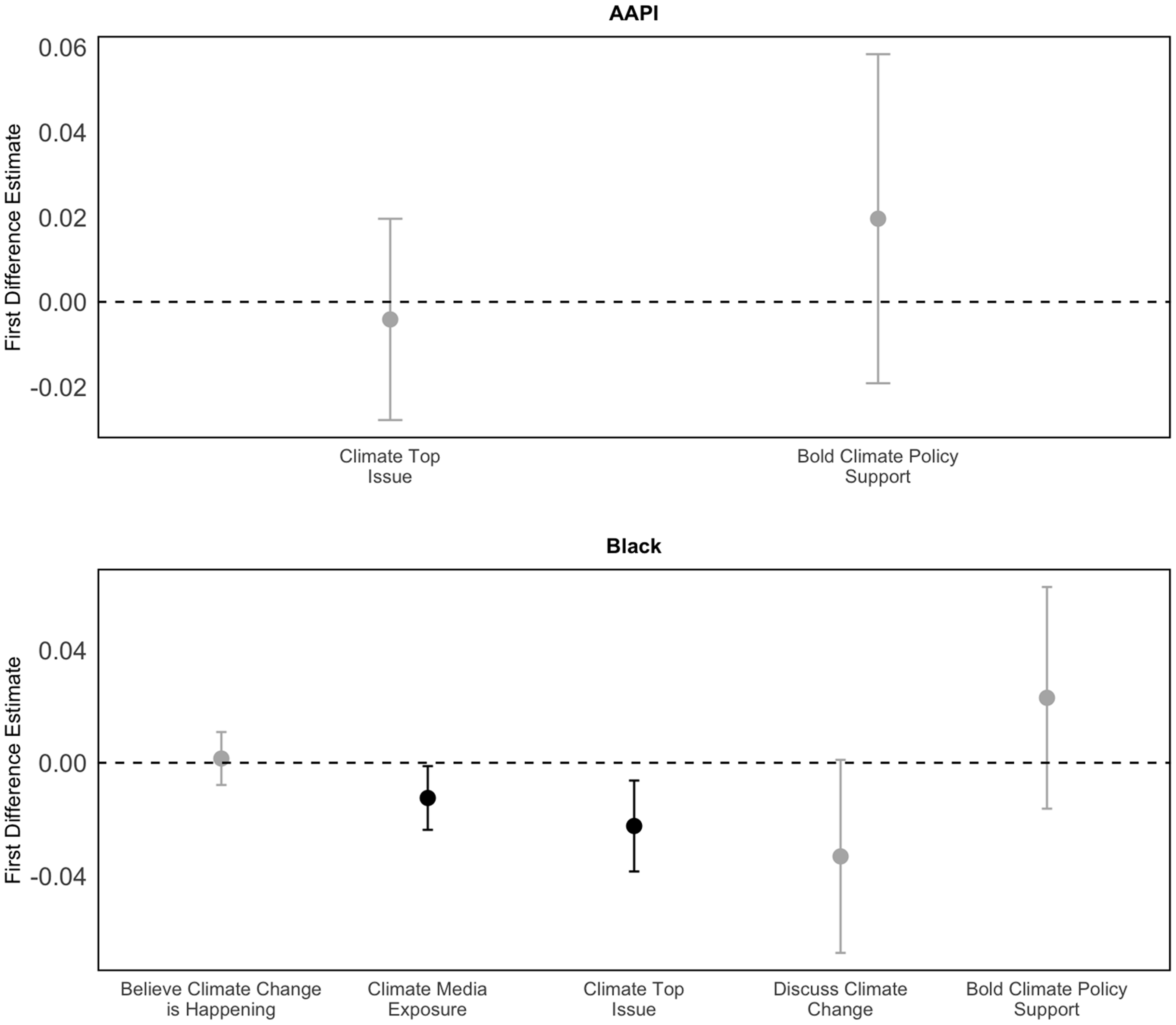
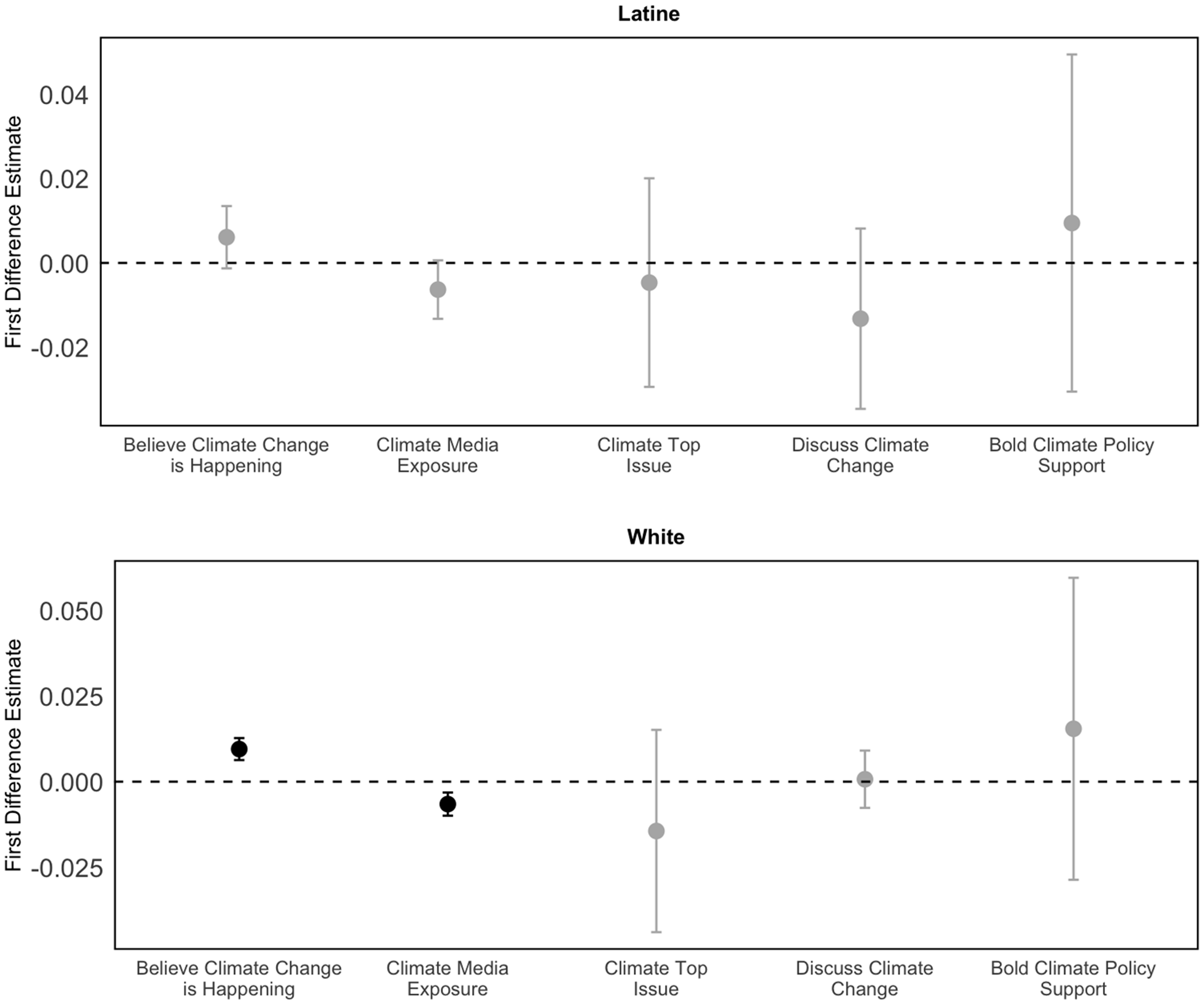
Finally, we discuss the results assessing our third hypothesis (H3) concerning how the intersectional identity of gender and race/ethnicity affects one’s level of concern about the environment. The logit estimates can be found in Table D3, and we present the first difference estimates in Figure 4 (Asian American/Pacific Islander and Black respondents) and Figure 5 (Latine and Black respondents).Footnote 9 These estimates represent the average first difference in the predicted probability of expressing a climate change opinion for women, relative to men within each ethnic/racial group.
First difference estimates for climate change attitudes by racial/ethnic identity × gender. Estimates represent the average first difference in predicted probabilities of expressing a given climate change opinion within racial/ethnic identities, comparing women to men. Error bars represent 95% CIs.

First difference estimates for climate change attitudes by racial/ethnic identity × gender. Estimates represent the average first difference in predicted probabilities of expressing a given climate change opinion within racial/ethnic identities, comparing women to men. Error bars represent 95% CIs.

Despite our expectation that one’s gender and racial identity would affect climate change attitudes, our findings offer only minimal support for this contention. White women are 0.9 percentage points more likely than white men to believe in climate change. And amongst women of color, gender differences only emerge when asked about their feelings of anxiety and distress as a result of climate change. Both Latine and Asian American/Pacific Islander women exhibit a higher likelihood of stress and anxiety about climate change relative to their Latine and Asian American/Pacific Islander male counterparts. Latine women report a 0.4 point higher climate anxiety score than Latine men, and Asian American/Pacific Islander women have a 0.2 point higher climate anxiety score than Asian American/Pacific Islander men.
Discussion and Conclusion
Our research demonstrates that people of color believe in, are concerned about, and support concerted efforts to address climate change to a greater extent than white Americans. Black Americans, Asian American/Pacific Islanders, and Latines are all more likely to support a bold climate change policy at the national level. Believing that climate change is happening is also greater among Black and Latine people than it is among white people. Additionally, Latine and Asian American/Pacific Islander respondents report higher levels of climate anxiety compared to white Americans. Latines are also more likely to discuss climate change frequently than white Americans. Given that African American and Latine communities face the greatest exposure to climate-related risks that threaten their health and well-being (Bushnell Reference Bushnell2021; Macias-Konstantopoulos et al. Reference Macias-Konstantopoulos, Collins, Diaz, Duber, Edwards, Hsu, Ranney, Riviello, Wettstein and Sachs2023; Morello-Frosch and Obasogie Reference Morello-Frosch and Obasogie2023; Weller Reference Weller2019), it follows that they express greater concern about climate change and are more supportive of efforts to combat its deleterious effects, relative to white Americans. As Breakey et al. (Reference Breakey, Hovey, Sipe and Nicholas2024) note, the historical legacies of structural racism (e.g., redlining) continue to play a role in explaining why communities of color disproportionately bear the brunt of adverse environmental exposures today.
While our findings reinforce the existing research, which highlights the racial divide on climate change opinion, they also shed some new light by demonstrating that Asian Americans/Pacific Islanders, Black Americans, and Latine people are not homogeneously pro-environment. Important nuances exist, especially as it relates to their levels of anxiety and stress over climate change, and the frequency of discussing these issues with their friends and family. Our empirical approach heeds the call of Junn and Masuoka (Reference Junn and Masuoka2024), who stress the importance of analyzing each ethnic/racial group on its own when possible and of avoiding treating people of color as a monolith.
We also hypothesized that intersectional identities, as they pertain to partisanship and gender, could further shape climate-related preferences. Across all four racial/ethnic groups, Democratic partisanship is consistently associated with stronger climate beliefs, greater policy support, and higher climate anxiety (except among Black respondents) than Republican affiliation. But the magnitude of those differences varies in telling ways. The partisan divide is most dramatic among white Americans and closely mirrored among Latines and Asian American/Pacific Islanders, with more muted (and differently structured) among Black Americans.
Regarding intersectional identities of race/ethnicity and gender, we find limited support for our expectation that Asian American/Pacific Islander women, Latine women, and Black women would be more concerned about the environment than their male counterparts. Only on the question of climate anxiety do we find notable differences by gender for Latine and Asian American/Pacific Islanders, such that women report higher levels of anxiety than do their male counterparts. One possible reason why our results are not as robust as expected may be that women of color’s stronger ties to other social and political movements may limit their capacity to focus on climate change activism (Berry and Gross Reference Berry and Gross2020; Hardy-Fanta Reference Hardy-Fanta1993; Jones Reference Jones2020; Montoya and Guerrero Reference Montoya and Raquel2023; Zlolniski Reference Zlolniski, Rodríguez, Sáenz and Menjívar2008).
While our research focused specifically on the conditional effects of partisanship and gender within each group, our analysis examining partisan and gender distinctions within a given ethnic/racial group only scratched the surface. Future studies could examine how opinions on climate change are informed by each ethnic/racial group’s unique historical and political experiences in the U.S. In the case of groups with substantial immigrant populations, such as Latines and Asian American/Pacific Islanders, generational status, country of origin, and degree of political incorporation may also affect their attitudes on climate change.
The “climate gap,” which Morello-Frosch and Obasogie (Reference Morello-Frosch and Obasogie2023) describe as the inequitable effects of climate change on racially marginalized groups, shows few signs of waning. As such, not only is it critical for activists and community leaders to mobilize affected communities into political action and for political elites and elected officials to take meaningful and substantive steps to address this pressing issue, but unpacking what mechanisms drive climate change opinion for those who bear the brunt of its effects is also of critical importance.
Supplementary Material
The supplementary material for this article can be found at https://doi.org/10.1017/rep.2026.10079
Funding statement
This research was supported by funding from UC San Diego’s School of Social Sciences’ Policy on Special Initiatives Grant and from the Political Science Department.



 Open access

