




Introduction
In 1604 ce, after successfully completing a mission to the court of Sultan Ibrahim Adil Shah II (r. 1580–1627; hereafter Ibrahim), Mughal envoy Asad Beg Qazvini (d. 1631?) returned to Emperor Jalal al-din Muhammad Akbar’s (r. 1556–1605) court with several gifts from the Deccan. By 1600, the Mughal ruler, determined to expand his empire, had already seized parts of the Deccan peninsula’s Ahmadnagar sultanate and was now focused on conquering the adjoining Bijapur kingdom. Ibrahim, having just emerged from a decade of internal political chaos, sought to prevent any military confrontation with the Mughals. To this end, he paid a generous tribute to Akbar and presented the Mughal envoy with various luxury goods and commodities. Along with nine coconuts, nine lārī coins, nine hūn (gold) coins, and nine khans (embroidered blouse pieces), among other gifts, Asad Beg produced a newly minted Adil Shahi gold coin called hūn-i nauras.Footnote 1 Its legend bore the following inscriptions:
zi nauras muhr(-i) ʿādilkhān shāhī
jagat gurū dād(-i) ilāhī
From nauras (comes) the seal of the royal Adil Shah
the world’s spiritual guide, divine justiceFootnote 2
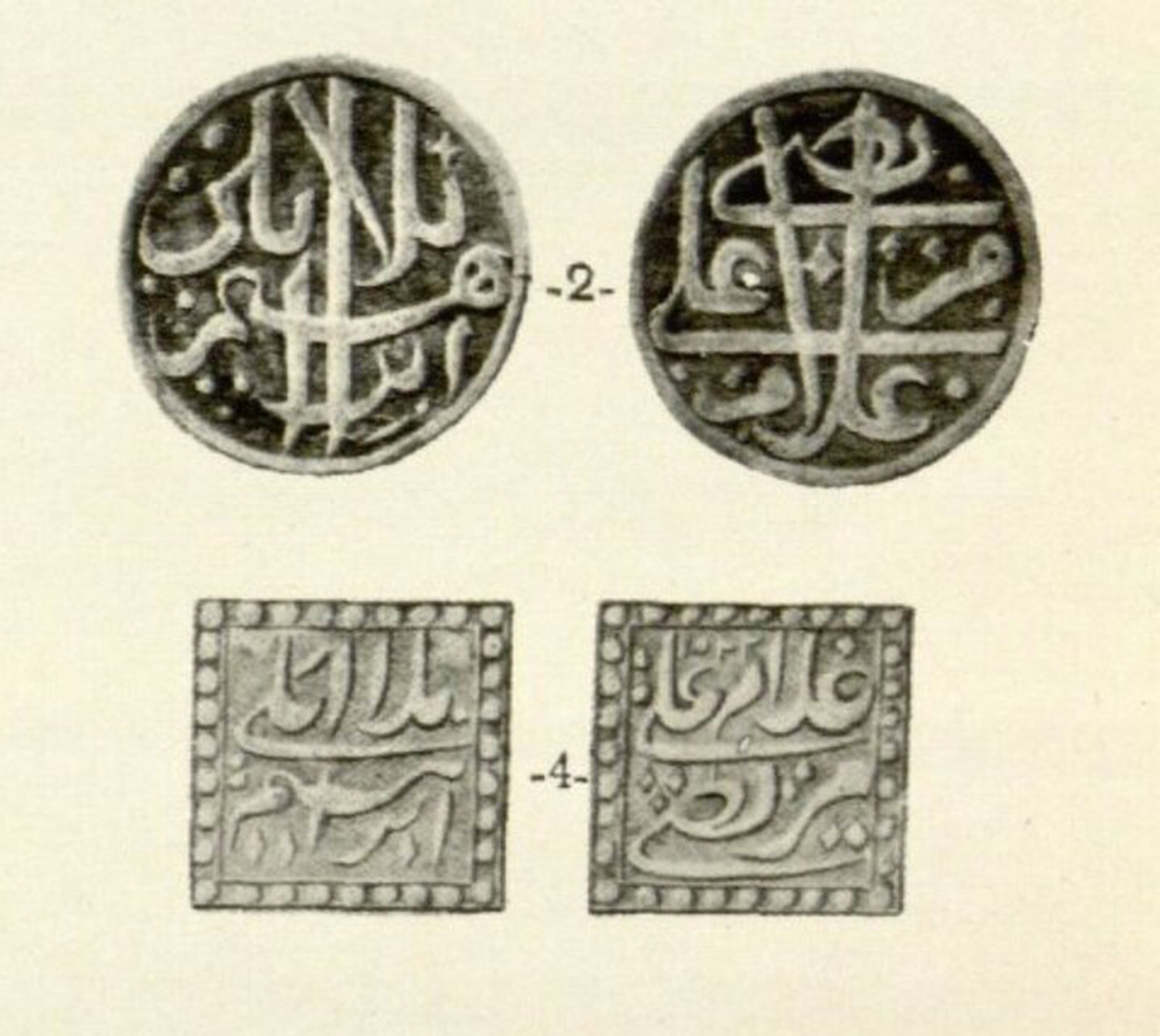
During this same period, copper coins—with Ghulām ʿAlī Murtażā (slave of Ali), a common Adil Shahi invocation of Hazrat Ali, on the reverse and Ibrāhīm ablā balī (protector of the weak) on the obverse—circulated in the Bijapur sultanate (Figure 1). Interspersed with standard Islamic invocations on these Bijapur coins are the Sanskrit-derived words nauras, jagat gurū, and ablā balī that were not found on any previous Deccan sultanate numismatic objects.
Ibrahim Adil Shah II copper coins with Ibrahim ablā balī on the obverse and Ghulām ʿAlī Murtażā on the reverse.
When modern scholars commenced studying late sixteenth-century Adil Shahi coins, they had difficulty interpreting these Indic phrases. Scholar Muhammad Ismail realized that ablā balī was an epithet for the sultan when he encountered the following couplet from Ibrahim’s self-composed Dakani musical work Kitāb-i Nauras (Book of the Nine Rasas; circa 1580s):
tirlok jāpat tūva nānv pāven prān kī purān
achraju mahābīr ablā balī tūnhīn sāchū avatār Footnote 3
The three worlds repeat your name and obtain the ancient knowledge of life
Oh wonder! Great hero, protector of the weak, you are the true incarnationFootnote 4
Similarly, jagat gurū too was an appellation for Ibrahim in the Kitāb-i Nauras and was commonly used in courtly circles to refer to the ruler.Footnote 5
Not restricted to coins, from the 1580s, several artefacts, events, and institutes in Bijapur bore the title nauras. On the cultural front, apart from the Kitāb-i Nauras, the sultan decreed the construction of Nauraspur, a city four miles west of Bijapur, to house all his artists, and a palace called Nauras Mahal.Footnote 6 Ibrahim named a musical note naghma-i nauras, celebrated a festival called ʿīd-i nauras, and wine drinking was termed amal-i nauras.Footnote 7 He attached the nauras epithet to several state insignia and administrative departments: nishān-i nauras became the official, yellow-coloured emblem of the state, the royal flag bore the name ʿalam-i nauras, and the sultanate renamed the accounts and revenue department as ḥisāb-i nauras.Footnote 8 Concurrently, Bijapur’s courtiers incorporated the nauras symbol in their own undertakings; one section of Ibrahim’s prime minister Shahnavaz Khan’s palace in Bijapur was named nauras bihisht.Footnote 9
In its aesthetically oriented Sanskrit meaning, the nau ras were the nine (nau) ‘juices’ or the essence (rasas) of an artistic work that evoked various emotions in the audience.Footnote 10 The earliest known articulation of rasa theory is found in Bharata’s treatise on drama and performing arts, Nāṭyaśāstra (Scientific Treatise on Performing Arts; circa 500 bce–5 ce). In time, rasa became ubiquitous across all artistic forms, yet it had not been applied to material political artefacts until Ibrahim’s reign. These nauras-related activities thus beg the question: why does a Sanskrit aesthetic concept feature so prominently in late sixteenth-century Bijapur, especially on state insignia?
Until recently, scholarship on Ibrahim—shaped largely through a modern epistemic framework organized around a Hindu-Muslim binary—treated nauras as the ruler’s aesthetic obsession and attachment to Hindu religion. As such, it is explained as arising out of an ‘eccentric’, ‘religiously unorthodox’, ‘artistically absorbed’, and Hindu-phile sultan’s indulgence in leisure over statecraft.Footnote 11 It is often this veneration of Hindu divinities that resulted in Ibrahim’s characterization as ‘culturally lost’, ‘not really a Muslim or Hindu’, and as a promoter of ‘syncretism’.Footnote 12 Furthermore, the ‘abstraction’ of Bijapur’s cultural sphere is often juxtaposed to Mughal rationality and penchant for displaying the specificities of history.Footnote 13 More importantly, scholars have reinforced disciplinary boundaries by treating music and aesthetics as separate from the sphere of political kingship in Bijapur; this tendency is evident from the leading role art and literary historians played in the study of nauras in the Deccan. Placing the sultan in rigidly perceived categories has hitherto offered an inadequate and incomplete understanding of why Ibrahim chose nauras for his kingship practice. An entirely new set of insights emerge when we locate the Bijapur sultan within a web of interconnected cultural networks and consider the shifting modes of sovereignty in the early modern Islamicate sphere in tandem with aesthetic theories and the arts. Arguing against the assumption that political kingship and music occupied separate domains, I draw on premodern music theories from the Indic and Islamicate spheres to establish that music and the concept of rasa were constitutive of articulations of royal sovereignty in Bijapur.
In this article, I argue that the sultan harnessed the astral and divine powers associated with rasa via the domain of music to bestow himself with authority and consequently transform and consecrate the royal body. As a result, he fashioned a strikingly new form of cosmic kingship and socio-political ethos in Bijapur. Artefacts of this novel approach in Bijapur include Ibrahim’s numismatic output and seals. In the Islamicate world, kingship was juridically recognized by two principal activities: sikka, striking of coins, and khutba, the ruler’s name being read in the Friday prayer sermon.Footnote 14 With legends of coins bearing proclamations of a ruler’s imperial aspirations, political rhetoric, or new oaths of sovereignty, Bijapur’s coins gesture towards a new ethos emanating out of the Adil Shahi court.Footnote 15 Simultaneously, on an administrative level, a chief and early signifier of this identity is his official seal ‘Ibrāhīm Nauras’ from 1586—a time of tense courtly power struggles among Bijapur nobles and regents—found imprinted in several books and documents housed in his personal library (jāmadārkhāna).Footnote 16
Ibrahim’s nauras project represents the earliest known instance in the Indo-Islamicate world in which music and politics coalesced to articulate an expression of kingship. Such a creation did not emanate from a singular impetus but was an example of transregional and transtemporal attempts at cosmic kingship—a form of sovereignty in which authority derived from celestial auspiciousness and a divine mandate to rule, rather than dynastic or juridical legitimacy alone—manifest in Timurid and Mughal courts. Amir Timur (r. 1370–1405) had yoked astrological sciences to Mongol and ʿAlid practices to fashion himself as the ṣāḥib qirān (Lord of the Auspicious Conjunction).Footnote 17 Akbar had inaugurated the ṣulḥ-i kull embodied kingship practice in 1582 by drawing upon his Timurid-Mongol past and utilizing Neoplatonic, ishrāqī (Illuminist) philosophy, ḥikmat (universal knowledge), and the taḥqīq (inquiry) principles of philosopher Ibn Arabi (d. 1240) to create a universal model of kingship.Footnote 18 Witness to a benefic astral Saturn-Jupiter conjunction in 1582 and the beginning of the new Islamic millennium in 1592, Ibrahim was surrounded by aspiring astrocrats and millennial ideologies.Footnote 19 In other words, the sultan had ascended the throne at an astrally charged period at the dusk of the sixteenth century and he utilized the millenarian zeal to manifest his own aesthetically derived cosmic kingship practice. It is within this broader context that nauras must be understood.
One of the key motives of Adil Shahi nauras was to present Ibrahim as a divinely ordained ruler, legitimized by both Islamicate and Indic standards.Footnote 20 Although grounded in Sanskritic aesthetic traditions, nauras in Bijapur was also expected to resonate with Persianate sensibilities. In the Persian language, the sultan interpreted it as a new (nau) arrival (ras).Footnote 21 Cultural and political artefacts, institutions, and events bearing the title nauras subsequently proliferated, functioning as a metonymy for Ibrahim’s kingship. Nauras operated as a symbolic language of sovereignty in which the sultan cast himself as its living embodiment and his Kitāb-i Nauras emerged as a key text articulating this project of self-fashioning. In Indic thought, ideal rule took shape from the constitutive relationship between the body of the king and proper functioning of the state.Footnote 22 Ibrahim’s declaration of possessing divine rasas and being born of the Hindu goddess of music and learning, Sarasvati, and the patron of intellectuals and the arts, Ganpati, in the Kitāb-i Nauras presents him as a figure of godly perfection on earth and the ultimate source of nauras. By yoking the Indic and Islamicate approaches to kingship, the sultan sought to surpass the dominant Islamic political identity assumed by past Deccan rulers and augment the region’s Islamic sovereignty practice under which these sultans possessed a position below divinely appointed charismatic leaders like Hazrat Ali and the caliph in the hierarchy of authority.Footnote 23
Although nauras as a metonym of Indo-Islamicate kingship was unique to Ibrahim, the urge to unite a heterogenous populace under one cultural umbrella was not new in Bijapur. An earlier attempt to tether together various groups and competing factions to create a common Indic and Islamicate shared courtly culture emerged during his predecessor Ali Adil Shah I’s (r. 1558–1580) reign. The Nujūm-al ʿUlūm (Stars of the Sciences; circa 1570), a book of esoteric science thought to be authored by Ali Adil Shah I, was one of the manifestations of this experiment.Footnote 24 Another was a Dakani translation (circa 1560s) of a thirteenth-century Sanskrit musical treatise Sangītaratnākara (Repository of Musical Gems).Footnote 25 Ibrahim endeavoured to continue and build upon this broader social project of forging a common culture, albeit in his own idiosyncratic manner.
The article commences by explaining the emergence of this new nauras phenomenon in the 1580s. It then locates nauras within a sequence of earlier Deccan sultanate sovereignty practices to demonstrate its divergence from prior Islamic rituals. The discussion next turns to the apperance of the term as a shared ethos that aspired to yoke the heterogenous courtly population of Bijapur and project the sultanate as a unified region imbued with creative force. More specifically, the article argues that although this political articulation of nauras in relation to music was a wholly fresh expression of embodied kingship in the Deccan sultanates, politics and music had close connections to embodiment and ethical kingship in Indic and Islamic thought. The final section examines the various ways in which the sultan and his artistic corps disseminated Ibrahim’s nauras to a diverse audience.
One of the main interventions of this article is that it unites the fields of cosmic kingship, music, and rasa which were assumed by historians of the Deccan to be mutually exclusive. No scholarly work so far adequately delineates nauras as metonymic cosmic kingship conceived and systematically promoted in Ibrahim’s reign. Moreover, most scholarship on Indo-Islamicate sovereignty and practices of kingship focuses on the Mughal empire, constructed as the metropole, with fleeting references to contemporaneous ‘peripheral’ regional courts. Although relatively few studies have examined kingship in the Deccan sultanates, the last three decades have witnessed a notable surge of scholarly interest in this topic.Footnote 26 My article is located within this emerging body of scholarship.
Recent scholarship on Ibrahim attempts to reframe Bijapur as a socio-political centre and present its ruler as an important and status-conscious patron in a succession of intercultural production within the overlapping Indic and Persianate civilizational networks.Footnote 27 In recent years, Keelan Overton and Roy Fischel have challenged the ‘eccentric’ interpretations of nauras and attempted to provide a more nuanced understanding of the sultan. Fischel is also one of the first to interpret nauras as a ‘political language’ and provides useful insights into its deployment in Bijapur.Footnote 28 Yet, an analysis of the term’s meaning, its function in shifting Bijapur’s sovereignty practices, or reasons for its conceptualization in the late sixteenth century remain unexplored.Footnote 29 This article aims to fill this lacuna. Before investigating these matters, however, we must first examine the Bijapur milieu in the last quarter of the 1500s.
Reasons for the birth of Bijapur’s nauras
As a ruler poised at the confluence of various cultures, Ibrahim’s nauras emerged during the last quarter of the sixteenth century, which witnessed a precarious balance of forces between courtly factions in Bijapur as well as external threats of Mughal invasion. Like most of the subcontinent’s kingdoms, the Deccan sultanates were composed of a multi-ethnic, multireligious, and multilingual population. The first ruler of the Bijapur state, Yusuf Adil Shah (r. 1490–1510), married a Maratha noblewoman, Punji Khatun, who proved to be an important political figure in Bijapur’s early years.Footnote 30 She encouraged the entry of Marathas into higher positions of administrative power and served as a powerful regent of Ismail Adil Shah (r. 1510–1534) upon her husband’s death. Along with the young sultan’s foster-aunt, Iranian émigré Dilshad Agha, Punji Khatun thwarted a coup against her son by leading her men to victory. In her later years, she was a key adviser to her grandson, Ibrahim Adil Shah I (r. 1534–1558).Footnote 31 Brahmins generally oversaw the finance and accounting department in Ibrahim Adil Shah I and II’s reigns and served as advisers as well. When the English merchant and traveller, Ralph Fitch (1550–1611), arrived at Ibrahim’s Bijapur court, he noted that the sultan had ‘many Gentiles in his court and they bee [sic] great idolaters’.Footnote 32 In this account, he was gesturing towards Brahmins, who, from the commencement of the Bahmanid empire, headed the state accounts department. The other chief cultural force in Bijapur was the Iranian-origin contingency. During Ibrahim’s time, the Iran-born Shahnavaz Khan Shirazi (d. 1611) was the ruler’s jumla al-mulk (prime minister) and chief architect of Nauraspur. On the artistic front, Iranian émigré poet Nur al-din Muhammad Zuhuri Turshizi (d. 1616?) helped articulate nauras to a larger Persianate audience, and painter Farrukh Husayn (d. 1615) created the iconic images of the sultan as well as goddess Sarasvati. In terms of military service, habshīs served as elite military slaves in Bijapur and ascended to great heights of power in the Adil Shahi court; habshī noblemen Ikhlas Khan and Dilavar Khan served as regents for a young Ibrahim.Footnote 33
Although sites of innovative collaboration and kinship, these centres also witnessed simmering resentments between individuals and open conflicts between heterogeneously configured factions over state politics and administrative positions. In 1580, Iranian émigré Kishvar Khan Lari killed another influential Iran-origin commander of Bijapur, Mustafa Khan Ardistani.Footnote 34 Ibrahim’s ascension to the Bijapur throne at the tender age of nine too resulted from Ali Adil Shah I’s alleged assassination by a habshī slave.Footnote 35 The young ruler thus spent the first ten years of his reign as a ward of various regents, of whom three attempted to usurp the kingdom’s control.Footnote 36
Together with internal threats to power, Ibrahim also found his kingdom prey to Nizam Shahi, Qutb Shahi, and Mughal ambitions. Both Ahmadnagar’s sultan Murtaza Nizam Shah (r. 1565–1588) and Golconda’s ruler Muhammad Quli Qutb Shah (r. 1580–1612) took advantage of Bijapur’s domestic chaos during Ibrahim’s initial ruling years and laid siege to the region before being forced to retreat in defeat. A more perilous foe emerged in the form of Mughal ruler Akbar, who, after consolidating the subcontinent’s northern zone, turned his attention to a southern expansion. Apart from territorial acquisition, the Mughals also coveted the important Bijapur ports of Chaul and Dabhol connected to vital seaports across the western Indian Ocean. Goods from this international trade included horses, pearls, grains, rice, pepper, spices, metals, dyes, and silk, while Bijapur exported diamonds from its own mines.Footnote 37
The successful annexation of Gujarat between 1573–1574 further strengthened Akbar’s resolve; he commenced his military operations against the Deccan sultanates in 1593 after they refused to accept his authority peacefully. By 1600 he had annexed Berar, temporarily captured Ahmadnagar city, and appointed his son Daniyal (d. 1605) as governor of these regions.Footnote 38 To avoid impending seizure, Ibrahim reluctantly agreed to give his daughter’s hand in marriage to Daniyal in 1601, a move that brought temporary relief to the Bijapur sultanate. In 1605, after Akbar’s death, his successor Nur al-din Muhammad Salim Jahangir (r. 1605–1627) demanded the sultan send a Bijapur delegation to offer condolences followed by felicitations for the new Mughal ruler’s accession. Ibrahim dispatched a reply that offended Jahangir, who threatened war. Shaken by the outcome and desirous of a de-escalation, the sultan sought support from the Safavid emperor, Shah Abbas I (r. 1588–1629), whose petition through diplomatic channels to the Mughals on behalf of Bijapur prevented the end of Adil Shahi dominion.Footnote 39 Thus, accounts of Mughal encroachment on Deccan terrain detail a history of attrition and inability to annex this southern region completely.Footnote 40
Despite being a political underdog, Bijapur still emerged as a pivotal cultural entrepôt in the subcontinent; in particular, Adil Shahi ports not only promoted trade that bolstered Deccan state coffers but also served as entry points for artists, mystics, and enterprising individuals into the subcontinent, especially from various Iranian regions. Esteemed artists, such as Adil Shahi poet laureate Zuhuri Turshizi ventured first to Ahmadnagar through sea routes and then made his way to the Bijapur court. Other artists, such as Urfi Shirazi (d. 1590), first served in Ahmadnagar and stayed briefly in Bijapur before succumbing to the lures of the Mughal court.Footnote 41
With the anxieties of sieges or possibilities of complete subjugation looming large, Ibrahim’s reign was significantly punctuated with patterns of a defensive political and military stance against more powerful actors. Cognizant of Bijapur’s delicate political position, Ibrahim still had to address questions of governing an ethnically, religiously, and linguistically diverse population. He was exposed to the machinations of scheming Bijapur courtiers in his early years as a monarch. After Ali Adil Shah I’s death, dowager Queen Chand Bibi (d. 1599) took charge of the young king.Footnote 42 Like Punji Khatun and Khunza Humayun Shah (d. 1569?), regent to Murtaza Nizam Shah I (r. 1569–1588) from Chand Bibi’s natal royal family in Ahmadnagar, the Adil Shahi dowager was an instrumental figure and mastermind in orchestrating the political manoeuvrings during the early years of Ibrahim’s rule. She was responsible for the young sultan’s early education and one of her first acts was to entrust the regency and affairs of the state to nobleman Kamal Khan. Soon after gaining power, however, the regent attempted to usurp the throne and was eventually killed and replaced by his rival Kishvar Khan. The latter nobleman too succumbed to the lures of royal authority, sent Chand Bibi to prison, and seized power before being overthrown by Ikhlas Khan with the support of the recently freed Chand Bibi. After regaining her power, the dowager queen chose Iranian newcomer Afzal Khan Shirazi as prime minister to divest power from the local opposition groups within Bijapur. Afzal Khan, however, was accused of treason by Ikhlas Khan and hanged. This act resulted in a civil strife between some Iranian émigrés and the local nobles. Once more, Chand Bibi intervened and selected Shah Abu al-Hasan, son of eminent Ismaili Shiʿi scholar Shah Tahir who had ties to the Safavid and Nizam Shahi court, as a regent. This regency too did not last too long. The leader of another local faction, Dilavar Khan, who sought control of the kingdom, imprisoned and killed Shah Abu al-Hasan and emerged as the new regent. In 1590, a politically and administratively savvy Ibrahim managed to defeat his regent and finally end the chequered period of regency in Bijapur.Footnote 43
It is in the midst of this political turmoil in the 1580s that Ibrahim’s nauras surfaced across Bijapur. Nonetheless, this raises the question of why the sultan did not continue to rely exclusively on Islamic sovereignty practices as articulated by earlier Adil Shahi sultans or, further back, by the Bahmanid rulers?Footnote 44 Moreover, why did Ibrahim not draw upon the Persianate universalism associated with ishrāqī philosophy, as promoted by Ali Adil Shah I’s courtier, the polymath Fath Allah Shirazi (d. 1589), or taḥqīq available through the network of Chishti Sufi poets at court?Footnote 45 No work like the Mughal Akbarnāma, meticulously crafted by Akbar’s minister and confidante Abu al-Fazl ibn Mubarak (d. 1602), emerged in Bijapur to justify nauras through Neoplatonic, ishrāqī, taḥqīqī, or other Islamic cosmological frameworks.Footnote 46 In other words, why did the sultan not take advantage of Islamic scholars or the incoming mystics and intellectuals from various Iranian regions to develop a kingship model? A focus on the Deccan seaports, located strategically between the Safavid and Mughal domains, essentially elucidates an important trend: as Safavid persecution of non-Shiʿis and their intolerance for religious pluralism increased, many radical free-thinkers, Sufi mystics, and political messianists—Nuqtavis and Azar Kayvanis—moved to the subcontinent. Others, like the scholars of ishrāqī thought, moved for improved opportunities. Many came and served in Deccan courts before moving on to other, more lucrative, centres such as the Mughal domain. Eminent ishrāqī philosophy scholar, Fath Allah Shirazi, was a member of both the Adil Shahi and Mughal courts. Ibrahim could have retained the services of Shirazi after Ali Adil Shah I’s death but instead did not maintain the relationship, which resulted in the émigré scholar’s move to Akbar’s court.Footnote 47
This was also the time when the Timurid sovereignty model eclipsed the caliphal one in most of the subcontinent, which required novel modes of royal enactment to be recognized in this new world order. Turco-Mongol Amir Timur, who established the Timurid empire (1370–1507), had fashioned himself as the ṣāḥib qirān or the Lord of the Auspicious Conjunction as a form of sacred kingship.Footnote 48 By the mid-fifteenth century, Timurid courtiers synthesized cosmological sciences and lettrism (ʿilm al- ḥurūf), thereby universalizing sovereign claims across thought systems and disciplines.Footnote 49 Replicated by Mughal emperor Akbar for his kingship practice, the term ṣāḥib qirān made an appearance in Bijapur as well. Zuhuri in Sih Nasr (Three Prose Compositions) refers to Ibrahim in this cosmological form: ‘az bām-i sukhan kūs-i ṣāḥib qirānī bih nāmash ṣadā dāda’ (the kettle drum announces the name of the Lord of the Auspicious Conjunction from the rafters).Footnote 50 Despite this appellation in Zuhuri’s work, the sultan did not mimic the Timurid-Mughal model in Bijapur.
Following his exposure to divisive internal politics and the uncertainty of continuing his rule in the face of such ruthless ambition, Ibrahim sought a unique idiom of sovereignty that aimed to unite Bijapur and invest the king with greater divine sanction than afforded by the Islamic models. In previous kingship practices, the Deccan sultans assumed a lower rank than divinely appointed charismatic leaders who, in turn, derived authority from God. Coins and seals from Ali Adil Shah I’s reign demonstrate his Shiʿi inclinations, with an extant coin bearing an invocation to Hazrat Ali and a seal displaying the names of the 12 imams.Footnote 51 Shiʿi inflected khutbas in this period included reading the Friday sermon in the name of the reigning monarch who transacted on behalf of the Hidden Imam.Footnote 52 Early Bahmanid rulers purportedly pledged allegiance and swore an oath of investiture to the Caliph.Footnote 53 In both cases, the imams and the Caliph—as divinely appointed charismatic leaders—had precedence over the Deccan rulers. Ibrahim needed an act that would enable him to move beyond a perception of subordination and exert greater control over the nobility, courtly factions, powerful households, and other political and religious elites. The intent was not to eschew the Islamic practices of khutba and sikka and antagonize various Muslim communities. Rather, it was to integrate these traditions with Indic concepts that endowed the sultan with an elevated, pan-cosmic divine origin. Unlike many of his Adil Shahi predecessors who followed Shiʿism, Ibrahim identified as a Sunni yet envisioned a broader ecumenical framework through which diverse religious affiliations could be reconciled. This enabled him to extol prophet Muhammad’s four companions while concurrently professing his servitude to Hazrat Ali and fashioning himself asablā balī.Footnote 54
The sultan was equally careful to avoid mimicking Turco-Mongol or contemporary Mughal practices. Unlike Akbar’s court, there was no move in Bijapur for Ibrahim to assume the status of mujtahid (an authority to decide religious matters),Footnote 55 surpass the decrees of the ʿulemāʾ (theological and legal scholars), or shift major policies.Footnote 56 Ibrahim desired something that could be culturally translatable on the conceptual, symbolic, and linguistic plane to ensure the comprehensibility of a common courtly ethos for all. With this end in view, as an accomplished musician, poet, calligrapher, and discerning patron, Ibrahim tapped into the dynamic and polyvalent platform afforded by the Deccan’s artistic tableau to craft and articulate a kingship where the fine arts would be, in large measure, generative of political symbols. Brought up in a court teeming with people from diverse backgrounds, Ibrahim appears to have identified significantly with Marathi and Indic culture. Asad Beg, Akbar’s emissary to Bijapur in the early 1600s, states that the sultan spoke fluent Marathi and understood Persian perfectly but had some problems conversing in it.Footnote 57 Having developed an avid interest in classical music since childhood and being immersed in Maratha-Kannadiga culture, Ibrahim had also developed a reverence for goddess Sarasvati.Footnote 58
On the cultural front, Bijapur’s creative sphere was a space where artists trained in Indic, Persianate, and European traditions could reside together and collaborate on various projects, evident chiefly from the Adil Shahi pictorial corpus from Ali Adil Shah I and Ibrahim’s times.Footnote 59 Soothing ragas strummed from the spherical mouths of Persianate tanbūrs in Bijapur while Islamic prophets and Sufi saints found praise in the poetic vernacular dohrā form. In the architectural sphere, remnants from the Chalukyan (r. 543–757) dynasty’s monuments that dotted Bijapur’s landscape were repurposed by the Adil Shahis, especially Ali Adil Shah I.Footnote 60
Ali Adil Shah I most probably was an immediate inspiration for Ibrahim’s own nauras project. The former sultan commissioned two texts that engaged with astrology and music respectively: the Nujūm al-ʿUlūm and an illustrated Dakani translation (circa 1570) of a thirteenth-century Sanskrit musical treatise, Sangītaratnākara written by Sharngadeva at Devagiri’s (Daulatabad) Yadava court.Footnote 61 Like his successor and predecessors, Ali Adil Shah I had to rule over a diverse population and courtiers, who were, in some instances, divided into competing factions. Described in Shirazi’s Tazkirat al-Mulūk (Biography of Royal Domains, circa 1608–1612) as an intelligent man with militaristic prowess and a penchant for reading, the sultan had a vast library and was quite attached to his books.Footnote 62 He used knowledge systems based on his personal intellectual inclinations as means to merge disparate groups in Bijapur.
As Emma Flatt argues, the Nujūm al-ʿUlūm was a multilayered text with several functions. On a practical and individual level, it provided courtiers with tools to succeed at court through the use of metaphysical forces or the acquisition of knowledge. Simultaneously, this work served to bind together the peripatetic multicultural populace within a single court culture for a sustained period. With this text, Ali Adil Shah I could deploy the powers of the stars to govern effectively and produce an ethically focused courtly corps connected to the same intellectual and cosmic worldview.Footnote 63 Ali Anooshahr conjectures that Ali Adil Shah I, given his deep interest in the esoteric which resulted in the creation of astrological text Nujūm al-ʿUlūm, may have absorbed the views of his courtier, ishrāqī philosopher Fath Allah Shirazi—later enlisted by Akbar to lend intellectual support and ‘politico-ideological justification’ to the ṣulḥ-i kull project—on tanāsukh (metempsychosis) and cyclical time.Footnote 64 Yet, this project came to an abrupt halt with Ali Adil Shah I’s death in 1580. Chapter 7 of the Nujūm al-ʿUlūm was dedicated to music and ragas but was not completed.Footnote 65 Nonetheless, Chapter 3 does contain images of several musical instruments projected as ritual objects dedicated to cakrams or astrological diagrams that were created to ascertain the relationship of the celestial sphere on ritual objects.Footnote 66
The occult and music unite once more in the Dakani translation of Sangītaratnākara. Katherine Butler Schofield views the pictorial corpus of select rāgas (musical modes) and their corresponding rāginīs (female companions) combining with the sonic aspects to possess affective powers. Rooted in the transcendental, the rāgas’ affective powers were thought to unleash when combined with esoteric sciences and, in turn, used by rulers to control their kingdoms and subjects.Footnote 67
Ibrahim, who inherited his predecessor’s royal library, perhaps drew inspiration from these music-related images and their corresponding knowledge systems.Footnote 68 It should be noted that perusal of the Kitāb-i Nauras reveals that Ibrahim did not acknowledge any connection to Nujūm al-ʿUlūm or the translated music treatise. These texts diverged significantly in terms of genre, style of composition, and form. Barring the need to create a convergent court culture, Ibrahim made no attempt to situate nauras as a direct continuation of Ali Adil Shah I’s esoteric work or the illustrated musical treatise.
Instead, Ibrahim harnessed his innate musical talents and commenced to create a sovereign space by means of concrete artistic and musical modes.Footnote 69 To construct such an environment, the sultan first needed a concept that was not only recognized locally but had a translocal and transtemporal presence. The polyvalent term nauras emerged as an apt measure from an array of aesthetic idioms available to him to craft his new sovereignty practice.
Timing was also important to launch this project. Several doubts exist for 1582 emerging as the Kitāb-i Nauras’s date of creation, given that the sultan was only 11 at the time.Footnote 70 Nonetheless, in light of this work’s importance as an expression of Ibrahim’s kingship, 1582 takes on another meaning: 1582, or 990 Hijri, marked an important, once-in-a-millennia conjunction of Saturn and Jupiter, which was considered auspicious in the Indo-Persianate courts. Its significance stemmed from the belief that this astrological event marked the arrival of a divinely guided universal ruler. In the north, Mughal emperor Akbar celebrated this event by issuing coins and commissioning a millennial history, the Tarīkh-i Alfī (History of the Millennium).Footnote 71 Taking advantage of this benefic event, the Bijapur sultan most likely chose 990 Hijri to signal the importance of the Kitāb-i Nauras, a metonymic source detailing the king’s divine nauras identity. Like Ibn Turka’s (d. 1432) genre-defying instructive treatise, Munāẓara-yi bazm u razm (Debate of the Feast and Fight; circa 1426) which detailed the Timurid astrological-lettrist ideology through the literary debate format, the Kitāb-i Nauras serves as a gateway to Ibrahim’s ideology, identity, and creativity in literary form.Footnote 72
Although Ibrahim’s predecessors had used Indic elements to craft a shared vocabulary, none had so consciously blurred cultural distinctions to transfigure a classical Indic knowledge system or artistic theory for solving problems of statecraft.Footnote 73 None had so closely identified with non-Islamic symbols and transformed them into a metonymy that emerged on political institutes or coins. What then was so meaningful about music and the rasas as to make Ibrahim turn to this particular aesthetic theory to create a framework of sovereignty?
Adil Shahi recasting of nauras
In the premodern and early modern Indic domain, the sonic properties of music possessed the power to connote both affective as well as cosmically sovereign power. As Katherine Butler Schofield indicates, in its observable capacity, music possessed the affective power to elicit a response from listeners through embodying the aesthetics of rasa and bhāva (emotion). On a metaphysical level, practitioners and theorists thought music possessed occult powers exerted through the medium of various sciences such as astrology, tantric rituals, and humoral medicine.Footnote 74 Similarly, the esoteric aspects of sound in Islamicate thought, which derived from the Pythagorean theory of music and spheres stated that the mathematical proportions that governed the harmonious and concordant movement of the seven celestial planets through the 12 zodiac constellation houses corresponded to the movement of the seven notes and the 12 acoustical positions on the notational octave on the earthly plane. In other words, the realms of music, cosmology, and astrology were intrinsically linked. Butler Schofield astutely observes that fifteenth-century Iranian intellectual Jalaluddin Davani’s (d. 1502) prescriptive text, Akhlāq-i Jalālī (Ethical Treatise of Jalal; circa 1467–1477), continued to rely on this Pythagorean music model by weaving the seven musical notes into his discussion on justice in the larger discourse on the ethics of kingship.Footnote 75 The akhlāq tradition was an important Persianate literary genre that encompassed writings on statecraft, philosophy, and politics, while also detailing norms of comportment, behaviour, and urbanity.Footnote 76 The Akhlāq-i Jalālī, together with other widely circulating works of this genre, such as Akhlāq-i Nāṣirī (Ethical Treatise of Nasir; circa 1200s) and celebrated poet Sadi Shirazi’s (d. 1291) Bustān (the Garden, circa 1257) and the Gulistān (Rose Garden: circa 1258), constituted a core component of elite reading curricula in the early modern Indian subcontinent.Footnote 77 Although a complete catalogue of Ibrahim’s royal library has not survived, the sultan’s collection included a comprehensive compendium (kulliyāt) of Sadi Shirazi’s works.Footnote 78 Given the widespread popularity of Akhlāq-i Jalālī, it is plausible to associate the perfection of musical notes with the figure of the ruler within Persianate intellectual frameworks.
In the Indic aesthetic sphere, rasa was not only integral to aesthetic theory but also carried connotations of religious and royal authority. First appearing in the Vedas, the term originally arose from the botanical domain and meant a plant-derived ‘sap’ or ‘juice’.Footnote 79 The term obtained a deeper connotation a few centuries later. In Chapter 7.8 of the Bhagavad Gita, Krishna—the celebrated earthly royal manifestation of VishnuFootnote 80—while declaring his omnipotence and absolute spiritual authority, states: ‘I am rasa in water’ (raso’ham apsu).Footnote 81 This declaration suffuses this term with greater religious overtones, which anticipates the later premodern depictions of Krishna as the ultimate embodiment of all rasas.Footnote 82 The ubiquity of the Bhagavad Gītā—a prominent sacred text of Hindu religious thought embedded within the epic Mahābhārata—across the subcontinent’s Indic and Islamicate courts in conjunction with the links between divinity, power, and rasa ensured that Indic kings and heroes were associated with or described in rasa terms. Before we encounter some of these examples and how Ibrahim utilized nauras, it is vital to learn about rasa.
In the realm of Sanskrit aesthetics, rasa is an intensified emotional and sensory awareness evoked by an array of literary, pictorial, dramatic, dance, or musical arts, delineated first by Bharata in the Nāṭyaśāstra, the seminal text for performance arts. This concept is predicated on the ability of the artist to convey an emotion (bhāva) and the audience to experience it as an analogous aesthetic sensation. In the words of the influential poet-theorist Abhinavagupta (circa 1000): ‘stable emotion is rasa’.Footnote 83 From the nascent theorizing phase of rasa, scholars viewed artworks as expressions of the poet’s own emotions. Eminent poet Anandavardhana (circa 875) states: ‘If the poet is filled with passion, the whole world of his poem will consist of rasa; if not, it will be completely devoid of it.’Footnote 84 Early thinkers desired to understand how rasa arose in the character or performer but a shift occurred in the early eleventh century when scholar Bhatta Nayaka (circa 900) began privileging the viewer’s or reader’s mental experience or ‘savouring’ of artistic works.Footnote 85 The theoretical pendulum swung back to the performer’s experience of rasa by the time of renowned early modern theorist and poet Bhanudatta (fl. 1500s) who allegedly found patronage in Deccan Sultan Ahmad Nizam Shah’s (r. 1490–1510) Ahmadnagar court.Footnote 86 In his treatise Rasataranginī (River of Rasa), the poet—whose posthumous fame extended from Akbar’s empire to the seventeenth-century Golconda literary domain—asserts that not only was art a ‘phenomenon pertaining to characters’ but that it produced corporeal reactions: ‘An emotion is a transformation conducive to rasa. “Transformation” refers to a modification and is of two sorts, bodily or internal.’Footnote 87 Thus, emotions and rasa were intimately linked to the performer’s body in early modern Sanskrit aesthetics. By the sixteenth century, rasa had become redefined as a way to transform the body; it was no longer just about emotional experience.
Such an embodiment of rasa is evident in key northern Indian literary texts. In a dohā verse from celebrated Avadhi poet Tulsidas’s (d. 1623) masterpiece Ramcaritamānasa (circa 1570s), the poet portrays the god-hero Ram as an embodiment of the śṛṅgāra (erotic) rasa:
nārī bilokahīn harashī hiyān nija nija ruci anurūpā
janū sohat singār dharī muratī parama anūpā
With joy in their heart the women saw Him
according to the attitude of mind each had towards Him,
as if the erotic sentiment itself had appeared
in an utterly incomparable form.Footnote 88
Hari (Vishnu) as the hero is similarly the embodiment of the śṛṅgāra rasa in renowned Braj poet Keshavdas’s (d. 1617) Rasikapriyā (circa 1591):
pratham singār suhasya ras karuṇa rudra su bīr
bhay bīmats bakhaniye adbhut sānt sudhīr
navahu ras ke bhāv bahu tinke bhinn vicār
sabko keśavdās harī nāyak hai sringār
Prime is erotic love, then laughter, compassion, wrath
Valor [sic], aversion, horror, wonder and enduring silence
The nine rasas take varied forms and meanings
Says Keshavdas among all these
the almighty Hari, the hero
is erotic loveFootnote 89
This corporeal aspect of rasa was the key factor that most likely resonated with Ibrahim.
Additionally, in Indic thought, the human bodily form was vaunted as the epitome of manifested perfection.Footnote 90 Royal male bodies were held to even higher standards of exemplariness and thought to enchant people, especially women, into submission.Footnote 91 Deccan sultanate court cultures, in accordance with Persianate royal practices, also cultivated an ethic of courtliness which encouraged the perfection of body of soul.Footnote 92 Linking rasa to the body thus would signal the triple perfection of Ibrahim: as a royal male, a consummate artist, and a reflection of aesthetic excellence. Ibrahim was thus refashioning the rasa model to achieve self-perfection and enact a new form of kingship. For the sultan, stable emotions that produced rasa possessed an innately unifying dimension that rose above man-made divisions. In song 46 of the Kitāb-i Nauras, he sings:
bhākā nyārī nyārī bhāv ek
kahā turk kahā barhaman
Languages differ but emotion (bhāva) remains the same
Whether a Turk or a BrahminFootnote 93
The task ahead of him then was to embody the aesthetic, for which he sought divine help.
As a devotee of goddess Sarasvati, Ibrahim prayed to her daily in his palace. Marathi chancery documents in his time commenced with the invocation: aj pūjashrī Sarasvati (to the reverence-worthy Sarasvati).Footnote 94 The sultan even commissioned the celebrated artist Farrukh Husayn to paint an image of goddess Sarasvati. Similarly, he invoked other gods from the Hindu pantheon in various state projects. An Adil Shahi Kannada epigraph from 1604 found on a royally sponsored charitable well in the Rayarabhavi Village of Bilage Taluk contained invocations to Ganpati and Krishna.Footnote 95 Yet, Sarasvati was not solely an object of devotion for the sultan.
In Indic sovereignty practices, it was common for rajahs to appear as descendants of Hindu gods in the subcontinent; the Aravidu dynasty of neighbouring Vijayanagar (r. 1542–1646) drew their lineage from Vishnu, an exalted god of the Hindu trinity.Footnote 96 In Sarasvati, Ibrahim found an ideal source who personified both the arts and divine power. Within her hallowed body converged the worlds of song and poetry, mediated by performance.Footnote 97 Invoking the goddess fit perfectly into the imperial identity he wanted to create for his nauras-infused kingdom. Nonetheless, he did not merely venerate her but claimed divine descent from her. In song 56, Ibrahim meticulously weaves a verbal self-portrait of his divinity:
In the Kedar Rāga:
ek kar daḍī vādan dūje pānī pustak pekhat
navras gāvat utpati
kesar vastar dasan syām nakh lalaī
mehendī gunī paritī
kanṭh ḍhāl phatik jap māl
nagar bidyāpūrī vāhan hāthī
Ibrāhīm ko got pitā dev gurū Ganpatī
mātā pavitra Sarsvatī
A musical instrument in one hand, while in the other water
And a book from which he reads and sings original songs of nauras
Donning a saffron-hued robe, his teeth are black,
Nails painted henna red and he possesses all excellent qualities
With a crystal rosary around his neck,
A resident of Bidyapur [Bijapur] and an elephant as his vehicle
Ibrahim, from the lineage of father—the guide of god—Ganapati,
and divine mother SarasvatiFootnote 98
By casting patrons of art and the intellect, lord Ganapati (Ganesha) and goddess Sarasvati, as his parents, the ruler proclaims that he is an innate source of artistic impetus and thereby rasa. Furthermore, by composing this song in rāga Kedar, another name for Shiva, Lord of Dance (Naṭarāj) and Ganesha’s father, he further reinforces his claims to descent from divine artistic lineage through a non-verbal musical gesture. Born of these celestial beings, Ibrahim carries on his body all the symbols associated with Sarasvati; the four-handed goddess often appears in visual images with a musical instrument, a water pot, a book, and a crystal rosary on each palm. Yet he is careful not to cast himself as an incarnation of feminine divinity. Mediating between his divine image and earthly existence, he does not let the listener forget that he is a sultan tethered firmly to his land; the ruler’s abode is not the celestial Kailash, where Shiva resides, but Bidyapur, a term used by the sultan to refer to Bijapur. Like most gods in the Hindu pantheon, he has an animal vehicle; in his case it is the elephant, which symbolized sovereignty in the subcontinent. Through these acts, Ibrahim blurs the lines between self and culture, divinity and mortal kingship, weaving all these identities in an inextricable bind as he renders his body constitutive of rasa. Art, aesthetics, and the royal body are one and the same for him. Beyond the musical domain, Ibrahim often appears in several of his portraits with at least one of Sarasvati’s symbols. In this manner, Ibrahim forged a radically new divine lineage and birth for himself. Unprecedented in Adil Shahi history it was through such activities that Ibrahim harnessed the powers of rasas for his practice of embodied kingship.
Ibrahim, however, was not the only king to project himself as an embodiment of rasa. In Braj poet Padmakar’s (circa 1753 –1833) praise poem Himmatbahādurvirudāvalī dedicated to Rajput King Anupgir Gosain (b. 1734), the ruler is portrayed as an embodiment of rasa:
jaga autaryau ju anūpa hai, mahipāla navarasa-rūpa hai
nija nāikana ju simgāra hai, ari lakhata bīra apāra hai
lakhi dīna karunā-batsa hai, khala-katala mem bībhatsa hai
nija khilavatina mem hāsa hai, bhaya- rūpa durajana-pāsa hai
haya caṛhata adbhuta hota hai, sara leta rudra-udota hai
siva-bhajana sānta sujāna hai, jihi kī samāna na āna hai
himmata bahādura nṛpa balī, jihim sena satruna kī dalī
He has taken unprecedented form in the world;
as a king he embodies the nine rasas.
His women find him irresistible (śṛṅgāra),
his enemies, indomitable (vīra)
Seeing the helpless he is compassionate (karuṇā);
in slaughtering the vile he is disgusting (bībhatsā)
With close friends he is comic (hāsya);
for opponents he is terror incarnate (bhaya)
On horseback, he inspires wonder (adbhuta)
lopping off heads, he is fierce (rudra)
Adept at chanting Siva-bhajans, he is quiescent (śānta);
there is no one else like him.
Himmat Bahadur is a powerful king, who destroys enemy armiesFootnote 99
Through this Rajput example, it becomes clear that the idea of embodied rasa was not simply restricted to heroes of epics and love poetry but used as a way to describe rulers in the early modern subcontinent.
Disseminating nauras
Despite emphasizing an Indic model of kingly identity in the Kitāb-i Nauras, glimpses of Ibrahim’s transcultural identity abound in the songbook and his royal life. He also desired nauras to reach a broader transregional audience. The opening verse and song from the Kitāb-i Nauras unite key figures from both the Hindu and Islamic traditions: the sultan invokes the blessings of Sarasvati and Prophet Muhammad before performing his melodies.Footnote 100 Mosques and Sufi hospices were equally patronized in his time and Ibrahim also arranged the marriage of one of his daughters to a descendant of the Deccan Sufi saint Gesudaraz (d. 1422).Footnote 101 Muslim and Brahmin nobles Shahnavaz Khan and Antu Pandit formed part of his core advisory council while the ruler welcomed several Europeans to his court; he housed Dutch painter Cornelis Claesz Heda from 1610 to 1622.Footnote 102 Additionally, Portuguese Fernão Lopes was a physician in his court.Footnote 103
On the literary front, Ibrahim encouraged several poets to create masnavīs (narrative poems) in the burgeoning vernacular Dakani language and these artists utilized the nauras motif across various texts. Court poet Abdul Dehlavi’s (fl. 1580–1620) prefatory section of the Dakani masnavī Ibrāhīm nāma contains a few lines that evince Ibrahim’s creation of nauras. Additionally, the word nau recurs consistently:
laqab shāh ʿadil barahim milāʾye
kiyā ḥarf-e nau rūp mil kar khudāye
jitā kuch siryā jagat-e nau bhed dis
so vo sab khudā ne kiye shāh bas
so is the huā rūp-e nauras utār
nava rūp parkaṭ ho nau budh bicār
catur shāh-e nauras birahnā rang bhar
dekhyā cāshnī-e lāzmīn gagan par Footnote 104
Shah Ibrahim Adil provided the title
Created a word of new appearance
Whatever appears as perfect
in the new world of discernment
God provided it to the Shah
From this the form of nauras emerged
May new forms, new knowledge and thoughts appear
The wise king of nauras painted over bareness
A much needed taste was seen in the skyFootnote 105
Similarly, Adil Shahi poet Hasan Manjhu Khalji, who adopted the pen name Hans, also has several references to nau across his narrative poem Pemnem (Laws of Love, circa 1591–1604). Whereas Dehlavi used nau chiefly to mean ‘new’, Hans used it to signify the number nine. The poem contains 199 dohās and 1,999 caupāīs or quatrains.Footnote 106 Hans praises the 99 names of God (hamd allāh dahan rab al-ʿālamīn/ navad nau nām hai sīrīn sab) and claimed that he wrote the narrative poem in the year 999 ah (1590/91 ce).Footnote 107 In the broader literary circle, minor poets Rashid from Qazwin and Abdul Qadir chose nauras and naurasī as their takhalluṣ (poetic appellation).Footnote 108
On the Sanskrit literary front, Pandit Narhari composed a work titled Nauras Manjarī (Floral Cluster of Nine Rasas; circa 1600s) and dedicated it to the sultan.Footnote 109 Divided into six chapters, or ullāsas, the first one commences with a praise of the sultan followed by three dedicated to describing the varieties and characteristics of nāyaks (heroes) and nāyikās (heroines). The fifth chapter discusses the theory of rasas and the sixth explicates upon bhāvas. In this work, Narhari addresses Ibrahim as jagatgurū or viśvagurū (teacher or leader of the universe) and rasanidhī or the treasure of rasas. In verse 10, Narhari equates the ruler’s sound or voice as filled with the essence of the nine rasas:
Gurorvānīsudhāsārāḥ sārāḥ navrasa ime.Footnote 110
In verse 25, the poet states:
Tavanmānasa-rāja-haṁsa [ah]itam gītam kuraṅgīdṛśām
tāvatkokilkūjitam vijayate guñjāravashcalijāḥ
yāvat sūrikavindracakratilakālankārcūḍāmaṇeḥ
śromada viśvagurorgiraḥ samuditā rasyāḥ śrutaun śrutaḥ Footnote 111
The singing of doe-eyed women
intermingled with the mind’s royal swan
triumphs only so much.
The cuckoo’s cooing triumphs only so much
and likewise the buzzing born from big black bees
Only so much. That is,
as the lofty rasa-filled words
of the glorious guru of the world
who is the crest-jewel amongst the ornaments
decorating the forehead of the circle
of the lords among the sage-poets
words that are not heard within the VedasFootnote 112
Through these verses, Narhari echoes the sultan’s self-fashioning by embodying rasa within Ibrahim’s body and praises the ruler for creating new words not even found in the Vedas.
The sultan was also careful to relay nauras to a larger Persophone audience, especially émigré Iranian artists. He commissioned Zuhuri to prepare a Persian prefatory essay to the Kitāb-i Nauras, the Sih Na sr. In the last essay of this prose work, Khān-i Khalīl, Zuhuri presents six successful émigré figures in Ibrahim’s court to reinforce the notion of Bijapur as the ideal axis mundi of the artistic world.Footnote 113 The title plays on Ibrahim’s name and alludes to the hospitality and magnanimity of Prophet Abraham (Ibrahim), whose epithet is Khalil. Just as Abraham spread a generous table for his friends so that they could partake in God’s bounty, Ibrahim surrounded himself with important artists, signalling their elevated status during his reign. Ambitions of constructing a kingdom devoted culturally and politically to the arts thus finds its initial voice in Zuhuri’s work, which introduced Ibrahim’s attempt at cosmic kingship performed through nauras to a broader Persianate audience.
Although never explicitly verbalizing Ibrahim’s corporeal connection to the rasas, in his second essay, Gulzār-i Ibrāhīm, Zuhuri describes the sultan as the prophet Abraham and draws an abstract analogy between the ruler and the rasas; just as there are nine rasas in Indic art, Ibrahim embodied nine qualities that announced his pre-eminence as a ruler. His virtues included faith in Allah, submission to the teachings of Muhammad, ‘pomp and glory, greatness, and magnificence’, justice, bravery, munificence, his external beauty, his innate goodness, and the acquisition of ‘excellences and perfection’.Footnote 114 Balance is always maintained in descriptions with attention given to never alienating the target audience from nauras but explaining the concept in terms familiar to them. Zuhuri takes special care to list every nauras reference using Arabo-Persian garden of Paradise expressions. Each page of the Kitāb-i Nauras is a garden and ‘nightingales of eloquence’ sing ‘on the flower of his [Ibrahim’s] writing’. Gardens in Islamic thought are earthly reminders of the garden of Paradise and the Qurʾan contains various references to these spaces. These sites were also symbols of perfection; by equating nauras with gardens, Zuhuri signals the divine excellence of the ethos, and implicitly that of Ibrahim.
Later in his work, the poet lists the peerless qualities of his patron using astral terminology; Ibrahim is equal to ʿarsh ṭāram (firmament of the highest heaven), aflāk khiyām (canopy of the spheres), and possesses kayvān himam ([the] resolve of Saturn) and berjis shiyam ([the] nature of Jupiter).Footnote 115 The sultan also has mirrikh ḥasham (Mars as his attendants), khurshīd ʿalam (the sun as his banner), nāhid nagham (melodies like Venus), ʿuṭārid raqam (writing like Mercury), and qamar khadm (the Moon as his retinue).Footnote 116 He is a khalīl naval (benefactor like Abraham), yūsuf jamāl ([has the] beauty of Joseph) dāʾūd alhan ([is] a melody master like David), and sulaimān makān ([holds the] rank of Solomon). Zuhuri ends this encomium with ʿadl afzā (augmenter of justice) and ẓulm kah (diminisher of tyranny).Footnote 117 Yet, the poet crucially distinguishes the latter’s uniqueness as a wondrous music producing emperor of Bijapur while introducing the concept of nauras:
khāmoshī rā var āvarde bih āvāz
bih nauras shāhryār-i naghma
gar iksir-i sarod o sur sāzand
zi khāk-i pāk-i bījāpūr sāzand
The king of melody, through nauras
Has filled silence with music
If he creates the elixir of melody and tune
He creates it from the hallowed soil of BijapurFootnote 118
While detailing the freshness of the Kitāb-i Nauras, Zuhuri is careful to provide a Persian interpretation of the term nauras:
vajah tasmiya īn kitāb ānkih hindiyān na shiraye majtamaʿ rā nauras
mīgūyand va fārsiyān agar nauras-i nihāl-i fażl va kamālash dānand bih
jast va bain māʿni kih īn shāhid-i be ʿaib az pardaye ʿaib bih jalva gāh
va ṭaur-i nau rasīda nauras khvāndand ham rū ast.Footnote 119
The reason why this book is called by this name is that the Indians call
a mixture of nine juices ‘Nauras,’ and if the Persians believe it to be the
fresh fruit [ripening] of the tree of his learning and perfection, it is appropriate; and in this sense also this beloved of perfect beauty has newly appeared on the stage of existence from behind the curtain of invisibility; if it is called Nauras it is also right.Footnote 120
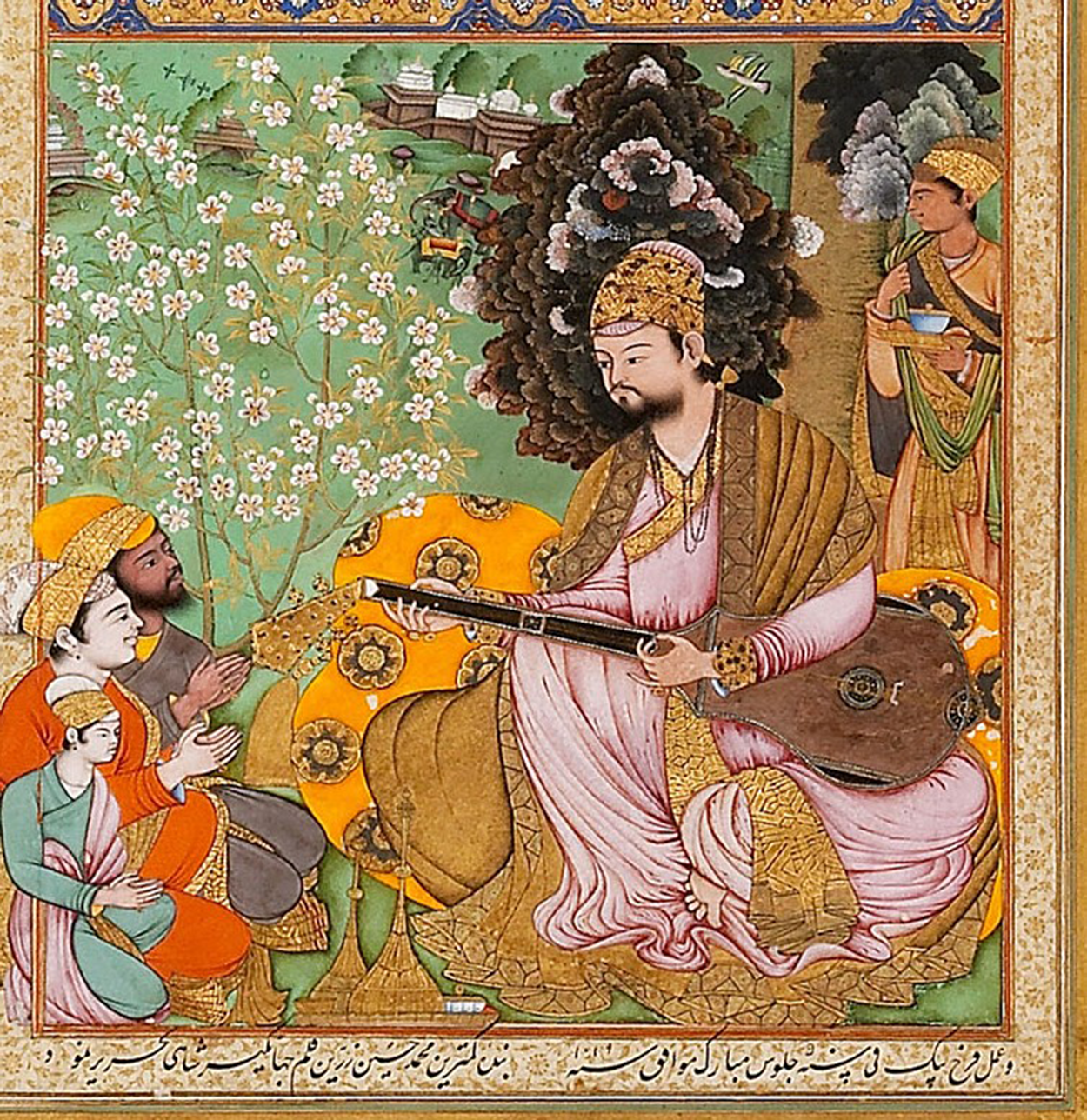
Apart from the textual and social dimensions of aesthetic embodiment, Ibrahim’s engagement with the rasas was also carefully depicted in pictorial form that fused Indic and Islamicate cultural symbols with the king’s body. In several paintings, artists faithfully mimicked Ibrahim’s musical self-portrait; the sultan routinely appears in a loose robe (qabā) and strands of the Indic prayer beads rudrākśas around his neck or musical instruments in hand (Figure 2).
Close up of Sultan Ibrahim Adil Shah II playing the tambur, 1595–1600 ce, Bijapur.
After all, it was common in the Deccan to adopt sartorial practices from other cultures; Vijayanagar kings donned long robes and conical hats during their public appearances in the fourteenth and fifteenth centuries. As Philip Wagoner argues, this change in dress codes did not suggest conversion but signalled the rajahs’ participation in the larger Islamicate socio-political networks and consolidation of relationships with the mercantile, military, and political communities from the larger Islamicate world present at the Vijayanagar court.Footnote 121
Like the Vijayanagar royal sartorial choices, Ibrahim’s cross-cultural garb, in pragmatic terms, acted as the external reflection of his affiliation to his multicultural subjects. On a metaphoric level, his body may be viewed as the state itself where various cultures and identities converged and resided in harmony. Conjugating the royal body, divine powers, and the arts, Ibrahim’s nauras emerged as a rationalized manoeuvre to equate culture, state, and government unequivocally with Ibrahim’s self-styled aesthetic and divine royal body. The aim was to assert ultimate dominion over his kingdom, quell challenges arising from political cleavages, and recruit artistic talent, especially from the Persianate zone.
Conclusion
At first glance, Ibrahim’s nauras appears as an eccentric and merely aesthetic venture of a besotted king. Yet, when we broaden the socio-geographic tableau spatially and temporally, this seemingly ‘eccentric’ action emerges as being more calculated and well-conceived. Ibrahim deployed the polyvalent nauras as a node that connected aesthetics, authority, divinity, and the royal body to inaugurate a unique approach to cosmic kingship in Bijapur. At the heart of these narratives and self-fashioning lies deep concerns about governance and effective translations of concepts and idioms of kingship across vast yet intersecting socio-political zones. Many of the Neoplatonists, Illuminists, and Sufi groups who informed Akbar’s policies, such as Fath Allah Shirazi, passed through the Deccan. Despite their presence, the idiom that developed under Ibrahim took on an Indic universal framework. Yet the impetus behind it was the same. The goal was to elevate the king above courtly factions and religious differences. This action did not mean that Ibrahim halted or completely altered all practices of Islamic kingship; some of his seals, for instance, contained Qurʾanic verses and khutbas continued in his reign.Footnote 122 Despite displaying such sensitivities, Ibrahim encountered resistance from more dogmatic interpreters of Islam; Shah Sibghat Allah (d. 1606), an orthodox Shattari Sufi, allegedly castigated Ibrahim for the latter’s Hindu inclinations.Footnote 123 Nevertheless, these complaints from dogmatic Muslims did not stop Ibrahim’s nauras from emerging as a form of cosmic kingship in Bijapur.
The inscription of nauras on cultural, political, and administrative institutes and objects reflects Ibrahim’s desire to highlight the centrality of his nauras infused body, and present himself as the source of ultimate authority in Bijapur. So entwined was it with the body of the king that this practice was suspended upon the sultan’s death and the accession of his successor Muhammad Adil Shah (r. 1627–1656) to Bijapur’s throne. Essentially, the appearance of nauras on coins and Ibrahim’s emphasis on justice—dād ilāhī and ablā balī—a central tenet of Islamic kingship, signals the emergence of new form of embodied sovereignty that was comprehensible to his Indic, Persianate, and larger Islamicate subjects.
In examining the nauras project, I studied the subject of sovereignty and governance from aspects that appear to be strikingly divergent from each other: music, rasa, and cosmic kingship. In the past, these assumed differences prevented scholars from probing these connections. Furthermore, a circumscribed view of ‘regional’ sultanates had hitherto resulted in limiting Ibrahim’s vision to mere idiosyncrasy. This article has endeavoured to present a fresh expression of millennial cosmic kingship by taking into account ideas of authority and divinity associated with the arts and aesthetic theories. It is only by probing each element in this equation without resorting to Hindu-Muslim binaries or eschewing the view of aesthetics through a narrow performative arts lens that the rationale behind Ibrahim’s project comes to the fore. In doing so, this article brought together the world of social history, music theory, and performance studies for the first time in the context of Bijapur. This shift in methodological perspective is an important addition not only to the study of early modern Indo-Islamicate polities but could be expanded to the Indic sphere and beyond the subcontinent’s boundaries.
Acknowledgements
I would like to thank A. Azfar Moin for encouraging me to write this article and for his editorial guidance. I would also like to thank Syed Akbar Hyder, Sumit Guha, Dalpat Rajpurohit, and Deborah Hutton who provided insightful comments on earlier drafts. This article also benefitted greatly from the observations, suggestions, and critique of the three peer reviewers of this journal.
Competing interests
The author declares none.


 Open access

