

Introduction
The political year of 2023 in Sweden was arguably the quietest of its kind since the early 2010s. The three-party right-of-centre government, relying on support from the Sweden Democrats (SD) through the Tidö agreement from 2022, was able to work without serious disturbances or internal divisions. The Cabinet remained completely unchanged. The main questions about the government majority constellation, for example how long SD would tolerate being outside government, were not discussed openly. Not unpredictably, support for the government declined, and the red-green opposition parties were ahead in the polls, often by clear margins, throughout the year. The most important concerns were related to the deteriorating security situation, with the war between Russia and Ukraine showing no signs of coming to an end. The application to join NATO was delayed due to resistance from Turkey and Hungary, but it had widespread support in Parliament, with only the Left Party (V) opposed. Intensified efforts to strengthen the military defence were largely uncontroversial.
Election report
There were no major elections or referenda in 2023.
Cabinet report
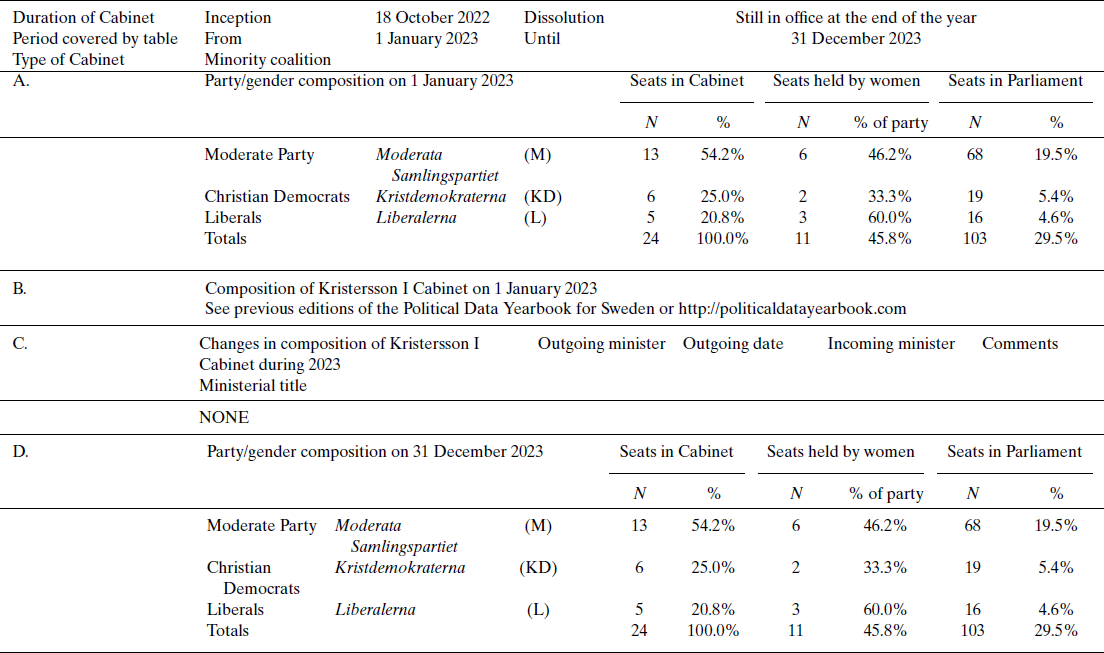
The Kristersson I Cabinet remained intact throughout 2023, without changes (see Table 1). The government reform agenda, outlined in the Tidö Agreement between the governing parties and SD was a key priority, and important steps were taken to combat crime and further reduce migration. The ‘Tidö parties’ had a slender majority in Parliament, which was further reduced when an SD member of Parliament defected (see Parliament Report), but faced no serious threats and did not suffer defeats in parliamentary votes. Not unexpectedly, the government suffered a backlash in opinion polls, a trend noticeable already in late 2022. The opposition was consistently in the lead, at times with a margin of over 10 percentage points. As such, this was not a major problem, with three years of the election period remaining, but poll ratings for the smaller government parties were a concern. The Christian Democrats (KD) and Liberals (L) were often below the 4 per cent representational threshold; the latter being on less than 3 per cent in several polls towards the end of the year. Relations among the government parties remained good, however. There were some signs of tension between, especially, L and the government support party SD, but no serious crises.
Cabinet composition of Kristersson I in Sweden in 2023

Source: Swedish Government Website (2024).
Parliament report
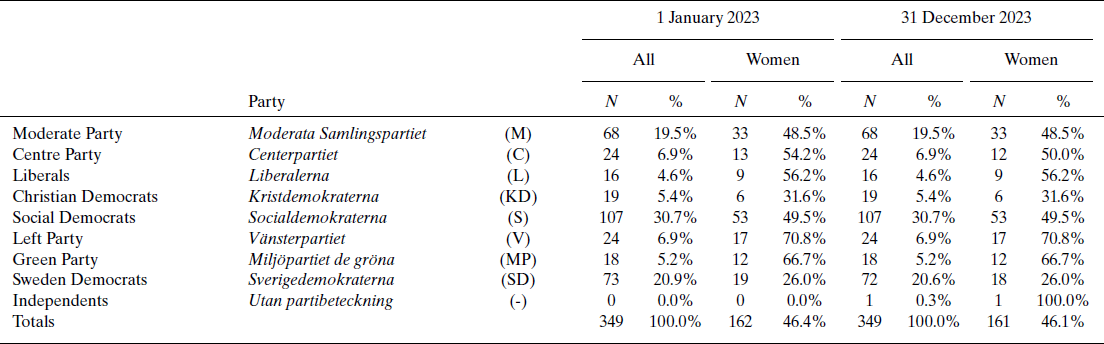
The composition of the Riksdag remained almost completely unchanged throughout 2023 (see Table 2). The one exception was SD member Elsa Widding, who announced on 1 May that she was leaving her party but would stay on in Parliament as an independent. Widding criticised her former party for not standing up for her against criticism by the Minister for Education Mats Persson (L). Persson had, on social media, criticised the fact that Widding had attended a conference, which the minister characterised as a forum for conspiracy theories, arguing that Widding displayed a ‘contempt of knowledge’ (Westerberg & Carp Reference Westerberg and Carp2023). The consequences of Widding's defection were limited. The government parties and SD still had an absolute majority of one seat, and Widding was not expected to vote with the opposition.

Political party report
There were two party leadership changes in 2023 (see Table 3). The first was in the Centre Party (C), whose leader since 2011, Annie Lööf, announced shortly after the 2022 election that she would stand down and leave politics. In part, this was due to a disappointing result in the 2022 election, plus the fact that she had been in her position for 12 years, making her the second longest-serving party leader behind Jimmie Åkesson of SD. In addition, however, she had frequently suffered threats and abuse, notably for her pro-migration stance. It emerged, for example, that a man convicted of murdering the national co-ordinator for psychiatry in 2022 had also had Lööf as an intended target (Zuiderveld et al. Reference Zuiderveld, Jönsson and Nordstrand2022). The process to select Lööf's successor began in late 2022. Three candidates entered the race, but two withdrew, and Muharrem Demirok was appointed unanimously at the party conference on 2 February. Born in Stockholm with a Turkish father and Swedish mother, Demirok lacks the rural and agricultural background traditionally associated with his party. He was elected to Parliament in 2022, but his main political experience comes from local politics in the city of Linköping. The appointment of Demirok did not signify any important change of political direction for the party. Similarly to Lööf, he combines a strong rejection of SD with an essentially pro-market position on economics and welfare. The change did not have a positive effect on the party's popularity, with poll ratings for the remainder of 2023 oscillating marginally above the 4 per cent threshold (Botsjö & Radlovacki Reference Botsjö and Radlovacki2023).
Changes in political parties in Sweden in 2023

Sources: Botsjö and Radlovacki (Reference Botsjö and Radlovacki2023); Rohwedder (Reference Rohwedder2023).
In June, Per Bolund announced that he would not stand for re-election as male spokesperson for the Green Party (MP) at the party congress scheduled for November. No explicit reason was given, except that he wanted to give his successor enough time to prepare for the next election. Several candidates stood for the position, but Daniel Helldén and Magnus P. Wåhlin soon emerged as the main contenders. The latter had got one-third of the votes when standing against Bolund in 2019 (see Widfeldt Reference Wildfeldt2019). This time the vote, held on 18 November, was much closer. After a preferential voting process, where two other candidates were eliminated, Helldén was victorious in the final count with 131 votes against Wåhlin's 130. Stenevi was re-elected unanimously, but Helldén's narrow victory was indicative of divisions in the party. Elected to Parliament in 2022, he was best known for his involvement in local politics in Stockholm where he had caused controversy over restrictions on inner-city driving, increased pedestrianisation and more bicycle lanes. Helldén's political profile is focused on climate-related issues, which contrasts with Stenevi's broader left-green approach, with more emphasis on LGBT (Lesbian, Gay, Bisexual and Transgender) rights and anti-racism. There were reports of a frosty relationship between Helldén and Stenevi, although they appeared to reconcile at the party congress (Rohwedder Reference Rohwedder2023).
Institutional change report
There were no institutional changes in 2023.
Issues in national politics
A deteriorating security situation, with no signs of an end to the war in Ukraine, meant that national defence remained high on the political agenda. The issue was not as such politicised, with very limited opposition to increased defence expenditure. Only the Left Party was critical of the fact that Sweden was set to join NATO, and public opinion was strongly pro-NATO (SCB 2023). In the main budget, presented in September, the government described the security situation as the most serious since the Second World War. Accordingly, the budget included an increase of 27 billion SKr to the military defence. Contributions would be made to NATO, and the government projected that Sweden would meet the NATO target of defence expenditure amounting to 2 per cent of gross domestic product (GDP) in 2024 (Swedish Government 2023a). The NATO accession process was not, however, completed by the end of the year. The ratification by existing NATO countries had in most cases been a formality, but Turkey and Hungary raised objections. In the former case, the main issues were related to what Turkey saw as Swedish softness to terrorism. Among other things, Turkish authorities demanded the extradition of Kurdish migrants residing in Sweden, with alleged terrorist links. The Swedish response was that extraditions are not decided by the government but by the courts. Some deportations did take place, but these were of criminals, and the Turkish demands were not met in full. The Turkish resistance was exacerbated by a series of Koran burnings and public displays of dummies depicting the Turkish President Erdogan. Attempts to stop them met with legal obstacles, in essence because the burnings were covered by the constitutionally protected freedom of expression. Relations between Sweden and Turkey became increasingly strained. This was temporarily alleviated in July, when an agreement was reached between the two countries, in time for the NATO summit in Vilnius. The agreement included a commitment to a bilateral Security Compact against terrorism, and a Swedish commitment not to support the Gülen Movement, and the Kurdish militia the People's Defence Units (YPG) with its political branch the Democratic Union Party (PYD), all of which have supporters resident in Sweden. The distancing from YPG/PYD differed from the approach by previous governments led by the Social Democrats and was criticised by the opposition, but the debate was relatively short-lived (Nilsson Reference Nilsson2023). The Swedish commitment against terrorism was further manifested by an amendment of anti-terrorist legislation, making it illegal to promote, strengthen, support or help funding terrorist organisations. The law change was criticised for being vague, but was decided by a large parliamentary majority and took effect from 1 June (SVT 2023; Swedish Parliament 2023). Also included in the Swedish–Turkish agreement were commitments to increased economic co-operation and arms export. Sweden would, in addition, support closer contacts between Turkey and the EU, with a view towards future Turkish EU accession (NATO 2023). Turkey supported the Swedish application at the NATO summit, and President Erdogan submitted a protocol to Parliament for approval of the Swedish membership in October (Spike Reference Spike2023), but the subsequent process of parliamentary ratification was slow and not completed at the end of 2023.
The Hungarian resistance to Swedish NATO accession could be summarised as a counter-reaction against allegations of a democratic deficit in Hungary. Sweden had expressed such criticism, but so had the EU as well as other EU countries. The EU had withheld funds to Hungary as ‘punishments’ for the alleged issues with democracy, and it appeared that Hungary was trying to use the fact that Sweden chaired the EU presidency from January to June 2023 to get access to the missing funds. This was not something Sweden could, or was prepared to, do much about, and no such steps were taken during the presidency period. Representatives of the ruling party Fidesz repeatedly accused Sweden of ‘lies’ about Hungary. A delegation of Hungarian parliamentarians visited Sweden in March, but the differences remained, and the Hungarian Parliament had not ratified the Swedish membership by the end of 2023 (Spike Reference Spike2023).
The Swedish presidency of the EU Council during the first half of 2023 passed without much controversy or even attention. Important issues included migration, climate and support to the Ukrainian defence against the attack by Russia. At the end of the presidency, the Swedish government highlighted work on the Fit for 55 climate package and a migration and asylum pact. Both had been subject to long processes, which were not complete at the end of the Swedish presidency, but the government claimed that important progress had been made. They were finalised later in 2023–2024 (Camut & Wax Reference Camut and Wax2023; Swedish Government 2023b). Although the direct impact of Sweden's presidency should not be overstated, the Swedish EU Commissioner for Home Affairs, Ylva Johansson, played an important part in the process leading to the migration pact (O'Carroll Reference O'Carroll2024).
The Hamas attack on Israel on 7 October, leading to the war in Gaza, triggered a polarised debate, which largely followed the left-right divide. Broadly defined, the Palestinian diaspora in Sweden has been estimated at 80,000 (Lindholm Reference Lindholm2021), and several pro-Palestinian demonstrations and manifestations took place. There were also expressions of support for Israel. A few days after the Hamas attack, the Swedish government announced that development aid to Palestine would be suspended and subject to a review, but humanitarian aid would continue (Swedish Government 2023c).
Violent gang crime remained high on the agenda. The total number of fatal shootings in 2023 was 54. This was eight fewer than in 2022, but some of them received extensive media attention, and September was the deadliest single month on record with 11 fatalities (SVT 2024). The fight against organised crime was a top priority for the government, and the Minister of Justice, Gunnar Strömmer of the Moderate Party (M), emerged as one of its most high-profile representatives. One of the countermeasures was the creation in December 2022 of an Advisory Board against organised crime. The government, police, prosecution service, customs, the Economic Crime Authority and the Tax Agency had permanent representation, while other authorities and organisations could be invited to certain meetings. Set to serve for 18 months, it met seven times during 2023. Its main purpose was to co-ordinate the effort against what many viewed as a crime wave (Swedish Government 2023d).
The economy slowed down in 2023. In March 2024, the National Institute of Economic Research reported a negative growth in the GDP of 0.2 per cent. For 2024, however, a recovery was projected with a positive growth of 0.8 per cent. Further growth was projected for 2025 and 2026 (NIER 2024). Inflation was very high early in the year. Measured as 12-month changes in the consumer price index (CPI), it was above 10 per cent until April, but it then declined (SCB 2024). At least in part, this was due to counter-measures by the central bank Riksbanken. At the beginning of 2023, the policy interest rate was 2.5 per cent. It was raised by Riksbanken four times, reaching 4 per cent in late September, and remained at that level for the remainder of the year. This was problematic for many property owners, and there were public expressions of discontent. Inflation did decline, the December CPI of 4.4 per cent being the lowest of the year, but it was still above Riksbanken’s target rate of 2 per cent (Riksbanken 2024). The public purse remained in good shape. The National Debt Office reported a fiscal surplus at the end of 2023 of 19 billion SKr. This was the third annual surplus in a row, albeit 145 billion smaller than in 2022 and deficits were forecast for the next few years, mainly due to the overall economic downturn. The Swedish economy was well prepared for such challenges, however. National debt sank from 1093 to 1028 billion SKr, which relative to GDP was a reduction from 18 per cent in 2022 to 16 per cent at the end of 2023. The latter is the lowest level since the 1960s (National Debt Office 2024). Unemployment increased, however. In December 2023 it was 8.0 per cent of the workforce, compared to 7.3 per cent a year earlier. Youth unemployment (under 25) was the second highest in Europe at 22.5 per cent (Eurostat 2024).


 Open access

