

For 150 years, the Mineralogical Society of Great Britain and Ireland has documented advances in the Mineral sciences, from classical crystallography and descriptive mineralogy to modern studies using synchrotron radiation, electron microscopy and computational methods. Founded in 1876, the Society developed alongside major changes in the Earth sciences and in analytical chemistry and Mineralogical Magazine has reflected those developments throughout its history. Papers published in the journal have ranged from mineral descriptions and crystal structures to experimental studies, geochemistry, petrology and planetary materials, illustrating the broad scope of modern mineralogical research.
This special issue marking the 150th anniversary of the Mineralogical Society brings together contributions that span crystal chemistry, structural mineralogy, alteration processes, new mineral discovery, meteoritics and the history of mineralogical collections. Together, the papers show both the continuity of mineralogical research and the ways in which the field continues to develop through new analytical methods and interdisciplinary approaches.
The issue opens with the contribution of Bindi and Hazen (Reference Bindi and Hazen2026), who examine the future of mineralogical crystallography in the twenty-first century. The paper traces the development of crystallography from early morphological studies to present-day multimodal approaches capable of probing mineral structures at atomic scales and under dynamic conditions. Synchrotron methods, electron microscopy, in situ experimentation and computational modelling now allow increasingly detailed investigation of mineral structures and their behaviour, extending crystallographic studies into areas including planetary science, biomineralsation and materials research.
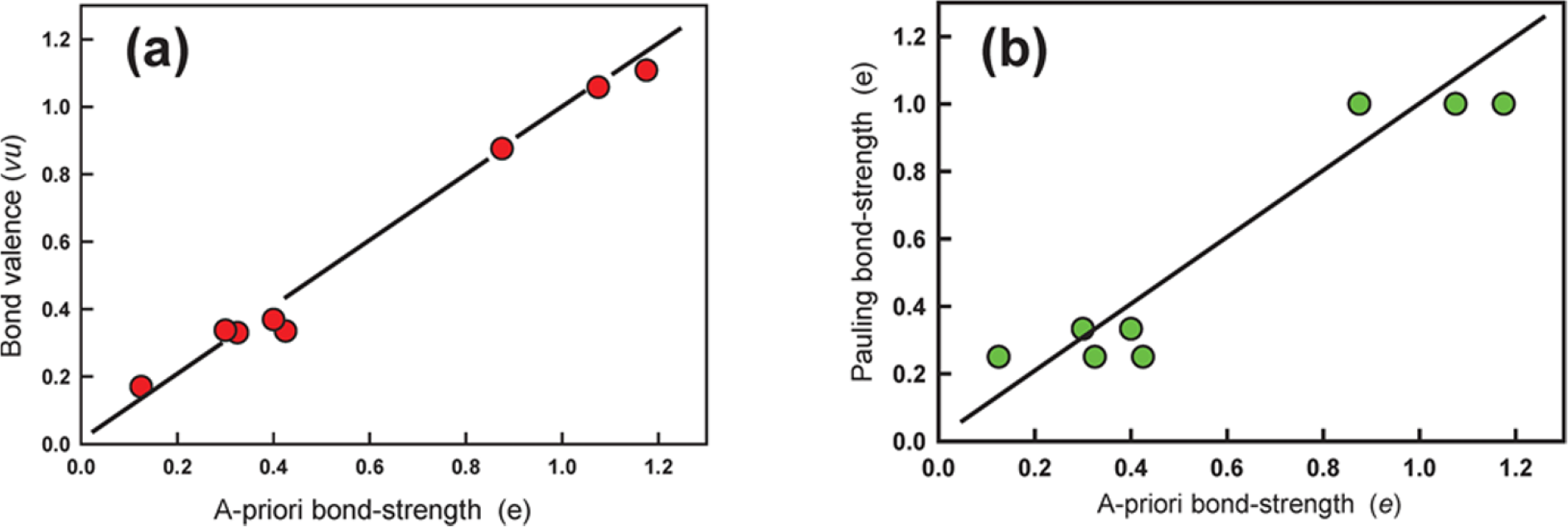
A broad crystal-chemical perspective is also presented in Hawthorne’s “Crystal Chemistry: New rules for the 21st century”. Revisiting many of the concepts that have shaped crystal chemistry since the work of Pauling and Goldschmidt, Hawthorne (Reference Hawthorne2026) discusses bonding, coordination and structural topology within a revised framework of three rules based on bond strengths and Lewis acid–base interactions. The paper continues a long tradition of mineralogical research in which observations derived from minerals contribute directly to broader chemical theory (Fig. 1).
Relationship between a priori bond strengths and observed bond valences in diopside, illustrating the crystal-chemical approaches discussed by Hawthorne (Reference Hawthorne2026). The comparison between bond-valence parameters and Pauling bond strengths highlights how bond topology and local bonding environments can be used to evaluate structural stability and bonding behaviour in minerals (figure 6 in Hawthorne, Reference Hawthorne2026).

Figure 1 Long description
The image A shows a graph with the x-axis labeled 'A-priori bond-strength (e)' and the y-axis labelled 'Bond valence (v.u)'. Red data points are plotted along a diagonal line, ranging from approximately 0.2 to 1.2 on both axes. The image B shows a graph with the x-axis labelled 'A-priori bond-strength (e)' and the y-axis labelled 'Pauling bond-strength (e)'. Green data points are plotted along a diagonal line, ranging from approximately 0.2 to 1.2 on both axes.
Chukanov and Pekov (Reference Chukanov and Pekov2026) review work on sulfur-bearing species in tectosilicates using a multimethodic approach including spectroscopic, diffraction and electron microprobe methods, and wet chemical analyses. Their investigation documents the diversity of sulfur species, from the common SO42– to the less common S2– anion, present within sodalite-, cancrinite- and scapolite-group minerals and shows how modern analytical techniques continue to reveal structural and chemical complexity in minerals that have been studied for many decades.
Several contributions examine crystal-chemical transformations and alteration processes in minerals. Grey (Reference Grey2026) investigates the role of the M 2(PO4)2Φ8 cyclic tetramer as a structure-building unit in phosphate minerals associated with triphylite alteration. By tracing structural relationships through hydrothermal and supergene assemblages, the paper demonstrates the persistence of crystallographic motifs across multiple stages of alteration. Nazarchuk et al. (Reference Nazarchuk, Siidra and Baikina2026) investigate the low- and high-temperature evolution of löweite using in situ single-crystal and powder X-ray diffraction. Their work examines the structural response of this hydrated sulfate mineral over a wide temperature range and highlights the value of in situ experimental methods in mineralogical studies. Stability under low vacuum conditions are an interesting finding suggesting the mineral could be found on Mars.
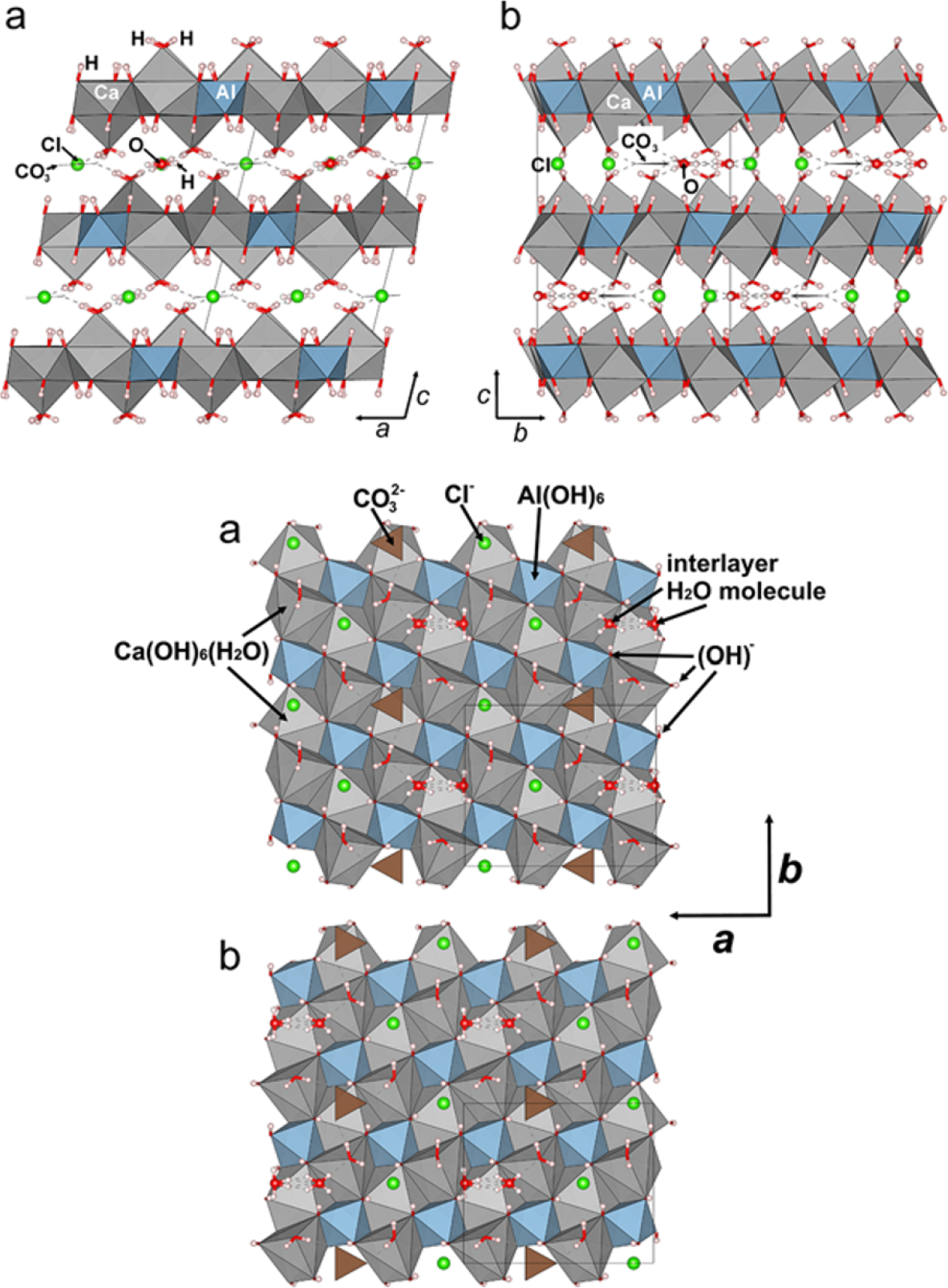
The reinvestigation of hydrocalumite by Zhitova et al. (Reference Zhitova, Sheveleva, Zolotarev, Ferraris, Kupchinenko, Sysoeva, Bocharov, Krivovichev and Pekov2026) provides another example of how modern analytical methods continue to refine understanding of historically known species. Using single-crystal diffraction, Raman spectroscopy and electron microprobe analysis, the authors clarify the ordering of interlayer species within this layered double hydroxide and reassess the role of multiple anions within the structure (Fig. 2). They note this mineral study began in Ireland 90 years ago and is a good example of science progressing through many different scientific societies over the years.
Crystal structure of hydrocalumite illustrating the layered arrangement of Ca–Al hydroxide polyhedra and the distribution of interlayer carbonate groups, chloride anions and H2O molecules. The structure highlights the complexity of layered double hydroxides and the role of interlayer species in stabilising hydrated mineral structures (see figures 4 & 5; Zhitova et al., Reference Zhitova, Sheveleva, Zolotarev, Ferraris, Kupchinenko, Sysoeva, Bocharov, Krivovichev and Pekov2026).

Figure 2 Long description
The image consists of two illustrations depicting the crystal structure of hydrocalumite. The first illustration shows a layered arrangement of Ca–Al hydroxide polyhedra with interlayer carbonate groups, chloride anions and HO molecules. The second illustration shows a top view of the structure, highlighting the distribution of interlayer species such as CO subscript 3 superscript 2 minus, Cl superscript minus, Al(OH) subscript 6 superscript 3 minus and interlayer HO molecules.
Links between mineralogy, petrology and geochemistry are represented by the contribution of Bhattacharjee et al. (Reference Bhattacharjee, Chakrabarty, Mitchell, Araoka, Kon, Hoshino, Satori and Jiang2026) on the Khaderpet carbonatite of southern India. Combining mineralogical observations with trace-element geochemistry and isotopic data, the study reconstructs a complex history involving magmatic crystallisation, crustal contamination, hydrothermal alteration and supergene overprinting. The paper illustrates the increasingly integrated nature of modern mineralogical investigations, where crystallography, mineral chemistry and isotope geochemistry are combined to interpret geological processes.
New mineral descriptions remain a central part of Mineralogical Magazine, and several contributions in this issue continue that tradition. Kampf et al. (Reference Kampf, Favreau, Ma and Stanley2026) describe almagreraite, a new Cu–Zn–Mn oxide mineral with a nolanite-related structure from the Sierra Almagrera district of Spain. Galuskina et al. (Reference Galuskina, Kusz, Książek, Jančev, Petrov, Zieliński and Galuskin2026) introduce babunaite-(Nd), the first rare-earth arsenate in the scheelite group, discovered in metamorphic rocks of North Macedonia. The occurrence of the mineral and the role of tungsten substitution in stabilising the structure provide new information on rare-earth arsenate crystal chemistry. Galuskin et al. (Reference Galuskin, Muszyński, Kusz, Książek, Galuskina and Zieliński2026) describe kopernikite, K(Ti7Cr3+)O16, a new priderite-group mineral from the Morasko IAB-MG iron meteorite found in Poland. The mineral occurs within graphite–troilite nodules and crystallised from phosphate-rich melt domains enriched in K, Ba, Ti and Cr. The study expands the mineralogical diversity recognised from the Morasko meteorite and examines the crystal chemistry of hollandite-type tunnel structures formed under meteoritic conditions.
Mineralogy’s broader public reach is explored by Missen et al. (Reference Missen, McKinnon, Gorick, Bank, Neuhaus and Dempsey2026) through the development of ‘Mineral Cup’, a mineral-themed online competition that has grown into an international outreach initiative. The paper examines how social media and visual communication have introduced mineralogy to audiences beyond the traditional academic sphere and highlights the importance of public engagement within the Earth sciences. Minerals with cultural significance do well, alongside eye-catching or unusual features resulting in catchy nicknames such as ‘meat rock’ for the 2024 victor rhodochrosite. The conclusions note the need for volunteers and funding to keep the momentum going.
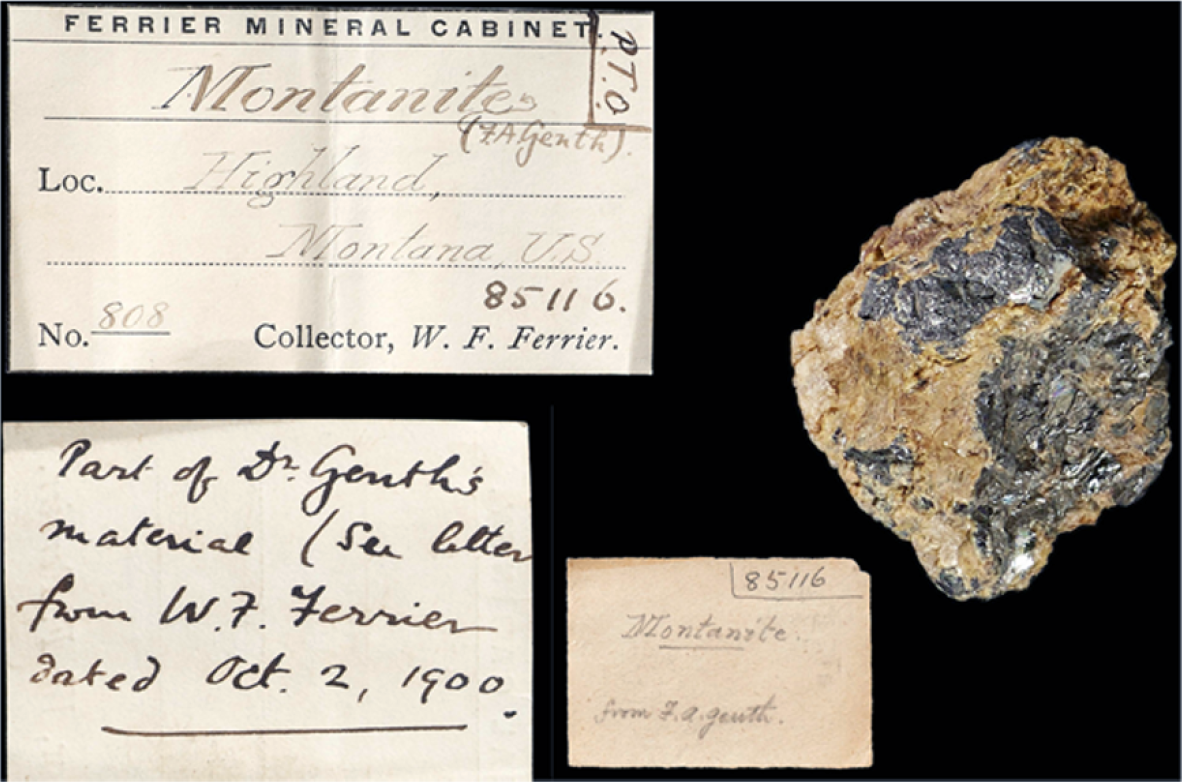
The issue concludes with a contribution centred on the history of mineralogical collections. In their study of montanite, Rumsey et al. (Reference Rumsey, Missen and Mills2026) revisit one of the earliest known tellurium oxysalts and examine the challenges associated with reconstructing nineteenth-century mineralogical investigations and identifying historical type material. The paper highlights the continuing scientific importance of museum collections and archival records within modern mineralogical research (Fig. 3) and provides a decision making chart for investigation of dispersed material and uncertain facts.
Archival labels and associated specimen for BM 85116 (montanite from Highland, Montana), documenting exchanges between Genth, Colonel Ferrier and the British Museum during the late nineteenth century. The preserved handwritten labels provide important provenance information for reconstructing the history of early mineral collections and type material (figure 6, Rumsey et al., Reference Rumsey, Missen and Mills2026, © Trustees of the Natural History Museum, London).

Figure 3 Long description
The image shows archival labels and a mineral specimen. The top label reads 'Ferrier Mineral Cabinet' and identifies the mineral as 'Montanite (F.A. Genth)' from 'Highland, Montana, U.S.' with the number '85116' and collected by 'W.F. Ferrier.' Another label mentions 'Part of Dr. Genth's material (See letter from W.F. Ferrier) dated Oct. 2, 1900.' A smaller label shows '85116 Montanite from F.A. Genth.' The mineral specimen is displayed alongside these labels.
Together, these papers illustrate the wide range of modern mineralogical research, from crystal chemistry and alteration processes to meteoritics, new minerals and historical collections. They also demonstrate the continued importance of careful mineralogical observation, structural analysis and analytical development across the Earth sciences.
Over the past century and a half, mineralogical research has progressed from hand specimens, optical mineralogy and contact goniometers to synchrotron diffraction, atom-probe methods and high-resolution electron microscopy. Despite these changes in scale and technique, many of the central questions remain the same: how minerals form, how their structures control their properties and what they reveal about geological processes. The contributions assembled in this issue show that these questions continue to drive mineralogical research across a wide range of disciplines.
As the Mineralogical Society enters its next 150 years, the mineral sciences remain closely connected to developments in crystallography, geochemistry, materials science, environmental research and planetary science. This special issue reflects both the history of the Society and the continued role of mineralogy as a fundamental part of the Earth sciences.
Declaration
The author acknowledges the use of AI to identify improvements in the language and writing style.