

Introduction
Vermouth is one of the most important flavoured wines in commerce and has been gaining market share worldwide in recent years.Footnote 1 Defined as a ‘fortified, herb-flavoured wine, available in many different types and qualities’ (Robinson Reference Robinson2006, 732), it is often obtained from a white or red wine base with a perfect aroma and flavour to which aromatic substances of vegetable origin are added (Bassi and Becchetti Reference Bassi and Becchetti1985). Used mainly as a medicinal drink since Roman times,Footnote 2 aromatised wines developed significantly in the Middle Ages thanks to the herbal techniques practised in monasteries. The origins of the name can be traced back to late fifteenth-century Germany: Wermut in German refers to its main aromatic component, wormwood or absinthe (Artemisia absinthium). The ‘wermut wein’ travelled from Bavaria to the French court – where the spelling changed to vermouth – and Central Europe, before arriving in Piedmont and Tuscany in the eighteenth century, thanks to the relations between the two ruling houses and the Viennese court (Mainardi and Berta Reference Mainardi, Berta, Mainardi and Berta2018a).
During the eighteenth century, vermouth proliferated thanks to a more ‘aristocratic’ and less medicinal consumption, especially at the Savoy court in Piedmont, a region with plenty of artemisia and muscat grapes – the basic ingredients of the first vermouths (Piccinino Reference Piccinino2015). Despite its ‘aristocratic’ connotations, from the beginning, it was conceived as a standardised product thanks to the entrepreneur Antonio Benedetto Carpano, the first to start fortifying Asti muscat wine in the late eighteenth century (Villani Reference Villani1957). Over the next century, the commercial expansion of vermouth began, gradually conquering important parts of world markets until it became an iconic global consumer product in the 1950s (Mainardi and Berta Reference Mainardi, Berta, Mainardi and Berta2018b).
How can we explain this extraordinary success, and what made vermouth known throughout the world as one of Italy's excellences as early as the nineteenth century? What consumer dynamics influenced the gradual spread of this long-standing product and its rise to become an international emblem of the aperitif?
In reality, the standardisation processes that distinguish the production of vermouth production began long before the establishment of the Italian wine industry towards the end of the nineteenth century (Simpson Reference Simpson2011; Conca Reference Conca Messina, Conca Messina, Le Bras, Tedeschi and Piñeiro2019; Maffi, Tedeschi and Vaquero Piñeiro Reference Maffi, Tedeschi and Vaquero Piñeiro2021a; Vaquero Piñeiro, Tedeschi and Maffi Reference Vaquero Piñeiro, Tedeschi and Maffi2022). The industrialisation of production processes and advances in transport made global expansion more affordable. What characterises vermouth is the fact that it was born as a market-driven product (Jaworski, Kohli and Sahay Reference Jaworski, Kohli and Sahay2000), capable of capturing an expanding commercial segment, if not creating a new market niche: a market that remained purely urban for a long time. The fortification process allowed vermouth to be transported over long distances, unlike ordinary wines. The structural characteristics of vermouth also better suited the tastes of upper-class female consumers at the end of the nineteenth century. Finally, vermouth proved to be well positioned in a segmented market of high-end products and vermouths made from low-quality wines (Strucchi Reference Strucchi1909; Ottavi Reference Ottavi1895), recalling the peculiarities of recently identified iconic food products (Magagnoli Reference Magagnoli2017). Piedmont, and especially the province of Turin, was the area of origin of most of the producers; in addition to Carpano, the leading players in the sector included Cora, Martini & Rossi, Cinzano and Gancia. The geographical connotation of Turinese vermouth remained for a long time in the perception of the consumers, even abroad (Mainardi Reference Mainardi2022), where vermouth developed a strong reputation as a ‘special wine’, initially among the Italian immigrant communities in particular.
The industrial and aristocratic origins of the vermouths of Turin gradually gave way to a more bourgeois connotation, reflected in the practice of aperitifs; modernity found new life in the Futurist cultural (and communication) sphere, especially in the presentation of some famous cocktails containing vermouth, such as Brucioinbocca, Un Ritto and Avanvera (Marinetti Reference Marinetti and Colombo1932). These aspects have persisted over time and are now re-emerging without losing their authenticity (Soster, Borio and Bosticco Reference Soster, Borio, Bosticco, Mainardi and Berta2018). It is no coincidence that the longevity of vermouth can be traced back to a tradition that was consolidated – and considered authentic – by the original labels, which often reproduce the factories of the first industrial revolution (an expression of modernity) but which already, at the end of the eighteenth century, included the concept of ‘the invention of tradition from a market-driven perspective’ (Ceccarelli, Grandi and Magagnoli Reference Ceccarelli, Grandi and Magagnoli2013; Chiapparino Reference Chiapparino2015; Locatelli and Tedeschi Reference Locatelli, Tedeschi, Marache, Meyzie and Villeret2018).
This trend calls for an in-depth study of the diffusion of this agricultural product, with its peculiar technical characteristics, including from the perspective of the consumption dynamics that have allowed its gradual global success. Over the last few decades, important international contributions have enriched the literature on consumption; in addition to important reviews (Trentmann Reference Trentmann1994), these also include more specific studies focusing on the relationship between food and globalisation (Nuetzenadel and Trentmann Reference Nützenadel and Trentmann2008; Inglis and Gimlin Reference Inglis and Gimlin2009; Segers, Bieleman and Byust Reference Segers, Bieleman and Byust2009; Oddy and Drouard Reference Oddy and Drouard2016). Moreover, the evolution of food consumption is becoming an important field of research in Italy (Scarpellini Reference Scarpellini2011), offering useful insights into the socio-economic links between globalisation processes, migration flows, and food and wine consumption (Scarpellini Reference Scarpellini2016, Reference Scarpellini, Cavazza and Scarpellini2018). The circulation of consumer goods in the food and beverage sector among different social classes has also been the subject of recent research, which has sought to interpret these dynamics in the light of the articulated internationalisation process of Made in Italy products (Maffi and Fagnani Reference Maffi and Fagnani2023).
In terms of the social dynamics of the diffusion of consumer goods, Georg Simmel's theory of fashion as a form of imitation and social equalisation revealed the effects of the emulation of the upper classes by the lower and middle social classes (Simmel Reference Simmel1904). In particular, the concept of social distinction, whose complexity has subsequently been studied by Pierre Bourdieu (Reference Bourdieu1979), can explain why the symbolic consumption of certain foods or drinks is more important than their ability to satisfy food needs in the strict sense. Although the relationship between food and society has been analysed from both a sociological (Naccarato and LeBesco Reference Naccarato and LeBesco2012) and a cultural (Capatti and Montanari Reference Capatti and Montanari1998) perspective, there are no in-depth studies on the wine sector from this viewpoint.
Some goods in the food and beverage sector (especially those exported and consumed by Italian immigrants abroad) can also be analysed from other perspectives, such as socio-political theory; a transnational approach, in particular, can show that food practices play a very important role in such contexts owing to their many social, economic, cultural and political facets (Cinotto Reference Cinotto2018; Garvin Reference Garvin2023). Some recent publications have thus focused on the great relevance of Italian cultural identity in terms of food consumption abroad (Naccarato, Nowak and Eckert Reference Naccarato, Nowak and Eckert2017; Chiaricati Reference Chiaricati2023). It is no coincidence that several scholars have redefined these complex phenomena by placing them within the framework of deterritorialised dynamics of nation-state building, highlighting processes in which nation-building took place by crossing the political and geographical boundaries of the state (Waldinger Reference Waldinger2015). Similarly, the use of brands (not only food brands) could also be understood as an indirect tool for strengthening and consolidating the cultural identity of a nation (Sáiz and Castro Reference Sáiz, Castro, Sáiz and Castro2022). As Fernand Braudel (Reference Braudel1991) said many years ago, the dynamics of food consumption were part of a broader process of national identity construction that took place not only within national borders but also abroad.
Against this theoretical backdrop, the article describes the economic and socio-cultural dynamics through which a typical Made in Italy food product, such as Italian vermouth, gradually spread internationally during the nineteenth century, changing from a local product to an iconic drink at a global level after the Second World War. Based on these premises, we have decided to use both quantitative sources, which allow us to trace the dimensions and geographical trajectories of the product's expansion, and qualitative sources capable of offering real evidence of the process of progressive cultural affirmation. The former have mainly been taken from the various bulletins and newspapers of Italian wine producers: Enotria, for the period between 1921 and 1928; Commercio vinicolo (later Corriere vinicolo) for the years between 1929 and 1960; the Annuario Vinicolo, in the years 1930–42, 1951–2 and 1961–3; the Bollettino di informazioni commerciali of the Italian Ministry of Agriculture, Industry and Commerce for the interwar period; and the recently digitised collection of the Ufficio italiano marchi e brevetti of the Central State Archives in Rome. These sources have been supplemented by an analysis of some American newspapers and the catalogues of a select number of international exhibitions. The discussion will proceed in chronological order: the first section is dedicated to the intense international expansion of vermouth at the beginning of the twentieth century and the conquest of US markets. Next, we will focus on the controversial international dynamics that changed the way vermouth was marketed in the interwar years. In the last section, we will examine the subsequent process of commercial affirmation at an international level and the relative socio-cultural connotations that determined the success of vermouth in the postwar period in terms of conquering the collective imagination.
The markets of the Americas: from pioneering in the nineteenth century to the success of the early twentieth century
Although the internationalisation of vermouth began in the 1930s, its gradual establishment only began in the last decade of the twentieth century. Italian vermouth producers made a name for themselves at the Universal Expositions, which provided a strategic context in which to promote typical Italian products on a global scale, thanks also to the various recognitions and prizes for excellence – later used on labels and as advertising tools (Teughels and Scholliers Reference Teughels and Scholliers2017).Footnote 3 In 1838, Italian vermouth was introduced in the United States by the Cora brothers, who marketed the product mainly through pharmacies. It then became known to a wider public through several international exhibitions, starting with the Exhibition of the Industry of All Nations held in New York in 1853, the first universal exhibition organised in America, in which four representatives of Italian vermouth companies participated (including Carpano). However, the rise in popularity of vermouth was not instantaneous; in New York, the desire for a ‘more modern drink than mere whiskey or beer’ was not satisfied until vermouth became a success among bartenders in the following decades (Ford Reference Ford2015).
Several prizes were awarded to the Italian companies competing at the San Francisco International Exposition of 1876: the vermouth sold by Vittorio Rossi from Alessandria was considered ‘very good, of fine bouquet, and kept in very good condition’; Francesco Cinzano's ‘vermouth made from white wine’ was deemed ‘of very delicate flavor, good quality and prepared with the greatest care’; that produced by Martini Solà & Co. described as ‘a tonic wine, well made, of full flavor’ (Walker Reference Walker1880, 220). In Europe, too, Italian vermouth companies tried to distinguish themselves by participating in high-profile events, such as the Antwerp International Exposition of 1882 (Esposizione universale di Anversa 1885). This was not altogether successful, as emerges from some of the letters of Raffaele De Cesare, president of the 6th Group of the International Jury of the exhibition: ‘it can be said that we obtained two great diplomas for our meal wines, but the exhibition of these was not altogether comforting. Without the help of the vermouths and the Marsalas, we ran the risk of making a bad impression’ (La morale 1885, 46).
A few years later, Emilio Franchi, an immigrant and exponent of a dynamic and growing ethnic entrepreneurship in the US, brought the first American-made vermouth to the World's Colombian Exposition, held in Chicago in 1893 (Johnson Reference Johnson1897) and attended by some 20 million people. With the ability to exhibit the prizes won in these competitions, some companies strengthened their internationalisation strategy. By 1902, the Martinazzi company, which exported vermouth to New York, had already won numerous prizes in various European cities, such as the Grand Diplôme d'Honneur in Vienna (1900) and Ostend (1901), and the Gold Medal at the Paris Universal Exposition in 1900 and the Italian General Exposition in Turin of 1898 (Chiaricati Reference Chiaricati2023). At the latter event, Carpano stood out among the leading producers of vermouth, and the 1911 International Exhibition in Turin – organised in honour of the 50th anniversary of the Unification of Italy – was a further occasion to celebrate the success of Piedmontese vermouth (Balocco Reference Balocco2011). Vermouth from Turin played a leading role at exhibitions in Piedmont, often cited for its established reputation as a ‘beverage very pleasing to the palate and sought after on foreign markets’ (Ministero di Agricoltura 1879, 5).
The Universal Expositions paved the way for the progressive commercial affirmation of vermouth, which had been slow until the 1890s and then gradually intensified. With regard to vermouth, some producers had used internationalisation and branding strategies to good effect. The four best-known companies – Carpano, Martini & Rossi, Gancia and Cinzano – experimented with a variety of commercial penetration strategies. Martini & Rossi opened branches in Buenos Aires (1884), Geneva (1886) and Barcelona (1893), and introduced advertising to promote its products, beginning with the work of renowned illustrators such as Marcello Dudovich, Jean Droit and Leonetto Cappiello (Varini Reference Varini, Mellinato, Prosperi and Varini2021). The company later increased its production capacity with the opening of a distillery at Montechiaro d'Asti, which in 1901 joined the existing plant at Pessione, which by the early 1920s was producing around 15 million litres.Footnote 4
This was an urban market, often dominated by a small number of companies, although there were occasional openings for smaller producers. On the US West Coast market, Martini & Rossi and Cora – who already in December 1905 had landed an ‘enormous shipment of vermouth’ in San Francisco, the largest in the city's history, amounting to 1,500 casesFootnote 5 – were joined by the De Angeli brothers from Trieste, whose vermouth was marketed by the import company Tomanovich & Co.Footnote 6 These were signs of the intense expansion of vermouth on the international markets, which gradually accounted for a growing share (reaching an average of around ten per cent) of the total wine exported from Italy,Footnote 7 with some large companies playing a leading role, especially Cinzano. Official statistics from the Italian Ministry of Finance recorded an export volume of 94,176 hectolitres by Cinzano in 1912, equal to 57.6 per cent of the total 163,329 hectolitres exported by Italy, an increase of 27 per cent compared to the previous year.Footnote 8
In the overall context of vermouth exports, those to South America accounted for the main share until the First World War; the Argentine market dominated, being the second-largest market in the world for Italian wine. Argentina was one of the countries to which Italy exported its wines in bottles. In general, these were not only the ‘typical refined wines’ popular among Italian immigrants but also the so-called ‘special’ wines such as Marsala and vermouth; the latter were particularly unrivalled among aperitifs. In the five years from 1907 to 1911, Argentina absorbed an average of 218,217 hectolitres of wine in casks, 165,700 flasks of wine, 100,000 bottles of Marsala and no less than 5.8 million bottles of vermouth.Footnote 9
In the United States, the continuous increase in wine exports was due above all – as emerges from the 1903 report by the Italian ambassador in Washington, Mayer des Planches – to vermouth from Turin, ‘of which shipments were increasing not only in bottles but also in casks, whereas a few years ago this article was imported almost exclusively in bottles’, and to Chianti, ‘of which we often received consignments of 400 to 500 cases at a time’.Footnote 10 The many local imitations of vermouth impeded a further potential expansion of the sector; they often did not explicitly bear the name of an Italian company, merely claiming an Italian provenance. The extraordinary price competition triggered by this phenomenon drastically reduced the profit margins of vermouth producers. The excessive tariff protection granted to domestic wines – amounting to 100–150 per cent – was considered the main reason for the preference for American wines among Italian immigrants (a community of around 1.2 million). This was due to the low average spending power of these consumers, who bought wines in large quantities and were more sensitive to the duty increase. This situation favoured a different type of packaging, even in very small casks (50 and 100 litres), as in the case of Marsala. The 1916 promotional poster of the Bosca company urged consumers to be wary of the local imitations that were widespread in New York, where Bosca had begun exporting its products in 1890, as well as Buenos Aires.Footnote 11 These were also the two cities where the most important Italian oenological laboratories on the American continent were located, which played an important role in the fight against counterfeiting through the certification system and helped producers to promote Italian wines within immigrant communities (Maffi, Tedeschi and Vaquero Piñeiro Reference Maffi, Tedeschi, Vaquero Piñeiro, Lachaud-Martin, Marache, McIntyre and Pierre2021b).
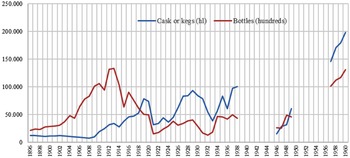
In fact, imitations and adulterations spread in a similar way in Argentina, where domestic factories were set up to emulate Italian products (Chiaromonte Reference Chiaromonte1906),Footnote 12 but these practices also affected some European countries such as Spain and France (Mainardi and Berta Reference Mainardi, Berta, Mainardi and Berta2018b). They were facilitated by the sale of alcoholic drinks in casks; this was a common practice in the alcoholic beverage industry in the late nineteenth and early twentieth centuries, when the regulatory system was relatively weak (Da Silva Lopes, Lluch and Martins Pereira Reference Da Silva Lopes, Lluch and Pereira2020). The issue of imitation and counterfeiting, moreover, is particularly relevant to the Italian food and wine sector, with questions relating to the variegated array of ‘copycat products’ purchased because they are believed to be Italian, according to the documented phenomenon of Italian Sounding (Magagnoli Reference Magagnoli and Belfanti2013, Reference Magagnoli2017).Footnote 13 A change in the type of packaging from bottles to casks was particularly pronounced during the Great War, not only because of the growing practice of emulation but also as a result of the shortage of glass (Figure 1).
Vermouth export in kegs or casks and bottles (1896–1960). Authors’ adaptation from Enotria 1928; Il Commercio Vinicolo 1929; Annuario Vinicolo 1930–1, 1933–4, 1934–5, 1937–8, 1938–9, 1941–2, 1951–2, 1961 and 1962–3.

Between the end of the nineteenth century and the First World War, vermouth was exported mainly to South America and the United States,Footnote 14 partly because of the important role played by the Italian immigrant community in the dynamics of consumption.Footnote 15 These geographical areas broadly correspond to those of the so-called Convergence Club, a group of countries or geographical regions characterised by certain rather homogeneous parameters of economic growth and industrialisation (Baumol and Wolff Reference Baumol and Wolff1988). In the particularly intense phase of globalisation in the late nineteenth century, both northern Italy – the centre of vermouth production and consumption – and the main non-European destinations for vermouth exports, such as North and South America (mainly Argentina), were part of this Convergence Club (Dowrick and DeLong Reference Dowrick, DeLong, Bordo, Taylor and Williamson2003).
Vermouth thus presents itself as a Made in Italy product that spread internationally, following a pattern linked to the globalisation process at the end of the twentieth century, to the economic development of certain areas and their growing purchasing power, and finally also to the dynamics of the diffusion of consumer goods typical of Italian immigrant communities, particularly relevant for products in the food and beverage sector (Scarpellini Reference Scarpellini2016; Chiaricati Reference Chiaricati2023). These aspects have been emphasised by historians who have, for example, described the food consumption model adopted by Italian immigrants in the US as a means of realising their dreams (Diner Reference Diner2001): eating well and in abundance, consuming those expensive foods that in their homeland were reserved only for the elite, such as meat, white bread and quality wine. The consumption of vermouth was part of this basket of goods, as demonstrated by a number of literary articles published in American newspapers, testifying to the growing popularity of this product among the American population, not just among immigrants.Footnote 16 Vermouth was served before meals not only as an aperitif but also for its value as an instrument of sociability, loaded with symbolic meanings; these referred to the aristocratic nature of the drink's Italian origins, linked to its Savoy ancestry and the tradition of offering the ‘vermouth of honour’ at ceremonies and institutional events. For example, during the lavish banquet organised by the Italian community of Seattle in 1905 in honour of Captain Camillo Corsi, commander of the cruiser Umbria anchored in the city's bay, the vermouth that accompanied the antipasto was savoured by officers and eminent US public figures.Footnote 17
The decline of the global market in the interwar period
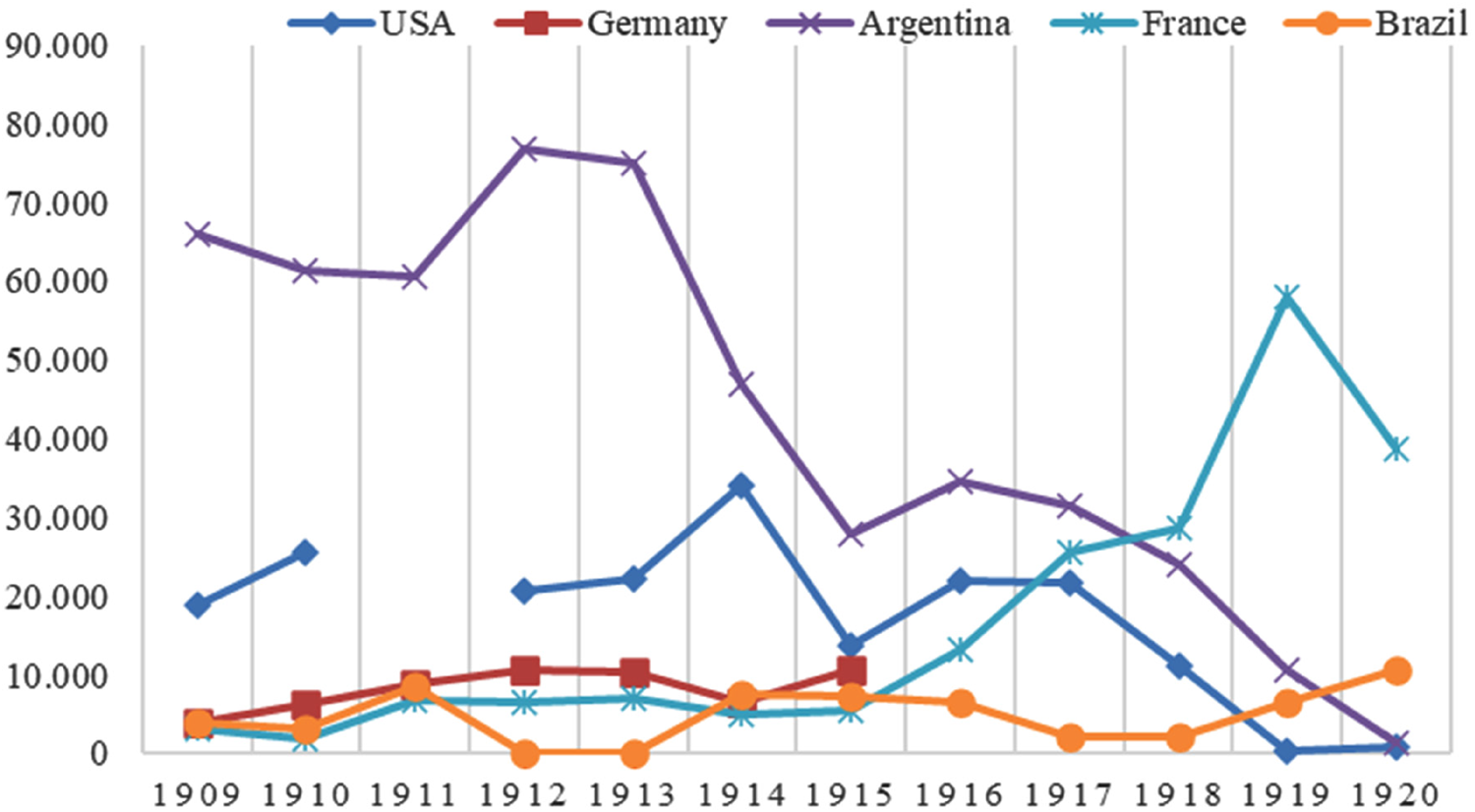
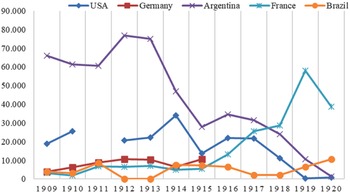
Vermouth exports fell sharply after the First World War. This process had already begun before the Great War, adding to a more general decline that had characterised various markets except France, the only growing market for Italy (Figure 2). The fall in Argentinian imports undoubtedly contributed to this downturn. Its tightening of the protectionist policy had indirect effects both on the progressive diffusion of vermouth produced locally by Italian immigrants and on the massive productive delocalisation of some Italian companies.Footnote 18 Cinzano, for example, opened a branch in Buenos Aires in 1921 to take advantage of the low cost of labour and avoid the high customs duties.Footnote 19
The main destinations of Italian vermouth exports (1909–20). Authors’ adaptation from Cotone Reference Cotone1922.
In 1925, Arturo Marescalchi – one of the greatest experts in winemaking – complained that ‘this … ingenious and enjoyable Italian speciality … loses out every year in exports given that some of our leading industrialists, in order to escape the high foreign customs barriers, went to set up their vermouth production in foreign countries’.Footnote 20 In addition, attempts were made to ‘encourage the creation abroad … of other similar types of vermouth’. The proliferation of imitations and frauds also reflected a growing trend in the registration of vermouth brands, which experienced its first substantial increase in Italy in the 1920s.Footnote 21
The other major non-European market – the United States – was devastated by Prohibition, which had been in force since January 1920 and had led to a collapse in alcohol imports. An article published in the Washington Evening Star in 1921 raised the issue of alcoholism and highlighted the ineffectiveness of the American Prohibition policy. In a context of self-management among families, a sort of agreement was proposed to begin a voluntary process of de-alcoholisation, changing the dosage of cocktails by including vermouth as a component to be added to Scotch and gin.Footnote 22 In those years, the American vermouth market had changed; non-alcoholic vermouth, made from a mixture of bitter spices and produced by the leading Italian companies in the sector, was imported in small quantities.Footnote 23
The collapse in bottled vermouth exports that began during the First World War (bottles exported in 1926 were around 23 per cent of those exported in 1913; see Figure 1) was only partly counterbalanced by the growth in exports in casks (from 34,294 to 61,958 hectolitres in the same period). This increase was due to at least two factors: in almost all states, the customs procedure privileged the cask category, while the relative geographical proximity facilitated transport in cheaper containers. For distant destinations such as China, Japan, India and Australia, the shipment of bottled vermouth was preferred. This transformation occurred while, during the 1920s, domestic consumption of the product had increased significantly. During this decade, wine experts witnessed the rise of modern manufacturing methods that could improve the quality of the product: from pasteurisation (to prevent potential fermentation) via cooling (which allowed vermouth to be quickly clarified thanks to modern refrigerating machines) to purification and filtration.Footnote 24
The Bollettino di informazioni commerciali mentioned the strength of the Italian vermouth industry, especially in the higher quality sector,Footnote 25 while the media outlets carrying promotional messages expanded; radio, the periodical press, cinema and music became the preferred tools for brand affirmation, while illuminated signs placed in the most crowded locations (e.g., arenas, velodromes, stadiums), as well as on public transport – metro and tram – increased the products’ visibility and fame. In the first half of the twentieth century, Martini & Rossi opened branches and warehouses in Nice, Marseilles, Brussels, London, The Hague, Mainz and Bordeaux, New York, Hong Kong and Shanghai. The classic sweet-tasting vermouth, the quintessence of the full Martini range, was complemented by a dry version, a popular ingredient in the preparation of cocktails. Carpano's industrial expansion, which began at the beginning of the twentieth century, was accompanied by a powerful advertising campaign that made it famous throughout the world (Soleri Reference Soleri1989). The star of the company's advertising of the time was ‘King Carpano’, created by Armando Testa, but one of the best-known wine labels is undoubtedly that of Punt e Mes (a red dot and a half). In those years, Gancia – another Piedmontese company, renowned since the 1860s for its ability to efficiently combine the production of vermouth with that of sparkling wine – had become a major vermouth producer (around 50,000 hectolitres a year),Footnote 26 taking advantage of its strong commercial penetration of foreign markets, particularly in the Americas (Cirio Reference Cirio1990).
Vermouth, Marsala and Chianti also spread in northern Europe and managed to boost, or at least defend, Italian wine exports. In Norway, the 880 litres exported in 1918 had risen to almost 400,000 litres in 1924,Footnote 27 while in Denmark the commercial weakness of Italian wines due to strong competition from Spain and especially France was mitigated by the popularity of the three above-mentioned products and some sparkling wines.Footnote 28 The countries of Central Europe, Switzerland and especially Germany also increased their imports of Italian vermouth: in Switzerland, it doubled between 1922 and 1923 to over 3,500 hectolitres,Footnote 29 while the German market exploded within a few years, going from just 148 hectolitres of imported vermouth in 1923 to almost 6,000 in 1925,Footnote 30 reflecting the economic recovery of the Weimar Republic after the dramatic crisis of 1923.
Hence, in the mid-1920s, there were important opportunities for wine exports to Germany, even if the market fell victim to competition from Spain, France and – to some extent – Hungary. Yet, the Italian wine sector failed to take full advantage of the opening up of the German market owing to the excessively high selling price of its products and, above all, the lack of commercial organisation.Footnote 31
In this context, the statistics of Italian vermouth – recognised as a special and prestigious product – grew, being penalised neither by competition from vermouths from other countries, nor by locally produced vermouths, which suffered from the high price of sugar and alcohol. According to F. Doerrer, head of an association of more than 200 wine retailers in Germany, ‘inferior wines and those against which the chemical offices might too often raise objections, should be avoided at all costs: their export, either as a pure substance or a mixture, should be prevented. They can only bring our wine exports into disrepute’.Footnote 32
The economic depression that followed the 1929 crisis had a negative impact on the marketing of alcoholic beverages and – as can be seen in Figure 1 – Italian vermouth exports were also affected. Some of the most export-oriented companies were hit by the crisis and the ensuing trade and fiscal policies (increased customs duties, internal taxes, difficulties in collecting debts, reduced solvency of traders and representatives), to the extent that some were again forced to delocalise production: Cinzano, for example, moved to Brazil (Caballo Reference Caballo1957). In Italy, many companies opted for a lower level of product quality, facilitated by the lack of a precise legal definition of the term ‘vermouth’. The use of inferior wines and lower alcohol and sugar content allowed them to make significant cost savings, at the expense of quality and, consequently, to lower their prices.
However, this negative turning point was only temporary, as Italian wine exports – including those defined as special – began to recover from 1934 onwards, a trend to which the reopening of the American market following the abolition of Prohibition in December 1933 had contributed. As official reports from the customs registers reveal, vermouth was in line with this positive trend, especially in terms of the packaging in bottles: from 12,906 bottles exported in 1932 to 17,855 in 1933 and 45,018 in 1934.Footnote 33 The growth in exports of vermouth in casks was the result of sales in Great Britain, Germany, Belgium and the United States in particular: from 12,401 hectolitres in 1933 to 16,795 hectolitres the following year.
The Italian vermouth industry also benefited from the political context: the Fascist regime provided a socio-economic framework in which Italian wines and liqueurs represented ‘autarkic’ alternatives to the various commodities and food practices from abroad. The fashion for cocktails from the US had taken hold in Italy during the Fascist ventennio, symbolising the glamour and ‘freedoms’ associated with American popular culture, as well as the cosmopolitanism to which the Italian middle class aspired (Griffith Reference Griffith2020, Reference Griffith, Inglis and Kei Ho2024). In such a context, ‘in marketing cocktails a la italiana’, Brian J. Griffith observes:
[F]igures such as Marinetti and Grassi, as well as heavy spirits manufacturers such as Martini & Rossi and Cinzano, not only strategically recontextualized these quintessentially North American beverages as ‘Italian’, they articulated and helped firmly establish a repertoire of thoroughly Italian-style cocktails, which, unlike Fascism, survived as cultural artifacts of the interwar years well into the post-WWII decades. (Griffith Reference Griffith, Inglis and Kei Ho2024, 99)
The contribution of vermouth to this socio-cultural evolution was not limited to its fundamental role as a component of Italian-style cocktails, particularly successful in the US (57 per cent of the 46,000 hectolitres of alcohol exported from Italy in 1937 was vermouth),Footnote 34 but it also extended to consumption practices in which it was recognised as a significant end product regardless of the brand that marketed it. In fact, the ceremonial practice of the ‘vermouth of honour’ retained its symbolic value even in the years leading up to the outbreak of the Second World War, to the extent that it helped to overshadow even the tensions arising from international disputes. In June 1936, not long after Emperor Haile Selassie of Ethiopia had delivered his famous speech to the League of Nations in Geneva, in which he condemned the Italian military aggression against his country that had forced him into exile, Selassie offered his institutional guests in London Italian vermouth, a choice that did not leave the international press indifferent.Footnote 35
The second postwar period: an international commercial success based on the conquest of the collective imagination
During the Second World War, vermouth exports again fell dramatically. While in Great Britain this phenomenon favoured the replacement of vermouth with Scotch whisky in cocktails (e.g., in Scotch Martini), in the United States the dwindling supply of Italian and French vermouth led to an upturn in local production, which increased tenfold between 1939 and 1943 (Amerine Reference Amerine1974; Adair Bevan Reference Adair Bevan2019).
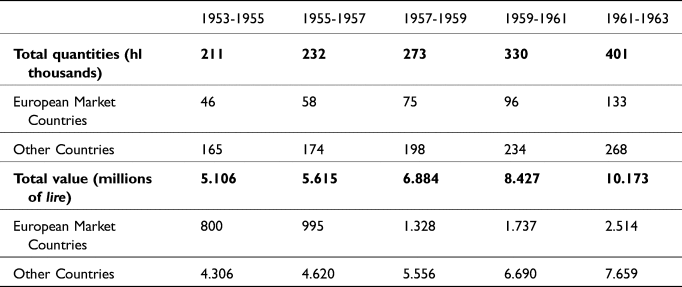
After the Second World War, the share of vermouth in total overseas wine sales rose steadily to over ten per cent, a steady upward trend that reflected the expansionary tendency of wine exports and was up from the low levels of 1946 (Figure 1). Marescalchi pointed out that Turin's vermouth exports to France, Belgium, England, Spain and the East, although growing strongly, would have had greater opportunities for expansion if they had not been penalised by the shortage of raw materials, such as sugar and alcohol, and by inadequate rail transport (Marescalchi Reference Marescalchi1949, 148–149). During the 1950s, exports grew rapidly and reached a peak in the early 1960s (Table 1). They almost doubled between 1953 and 1963, both in terms of quantity and total value, with an increasing share going to countries in the European Common Market area.
Italian vermouth exports (three-year averages), 1953–63. Authors’ adaptation from Il Corriere Vinicolo, 19 September 1968

Looking at the overall picture of the countries to which vermouth was exported, we can see that the Federal Republic of Germany, Great Britain and the United States were the main recipients, with a clear distinction also in terms of packaging, namely in casks, demijohns or tankers for the first two countries, and in bottles for the latter (Table 2).
Italian vermouth export in bottles (hundreds) and in casks, demijohns, tankers (hectolitres), 1958–61. Authors’ adaptation from Annuario Vinicolo 1961, 1962–3
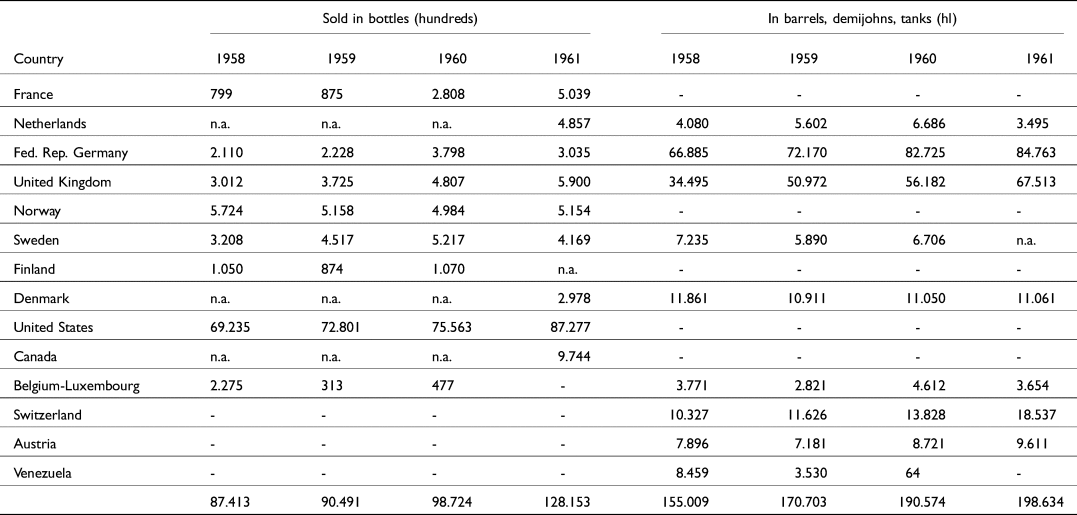
In reality, this preference for the German market was the result of a progressive consolidation of Italian exports that had been building since at least the 1950s. Germany was a destination for significant flows of vermouth from various European areas. Vermouth imports almost tripled from 1953 to 1960, both in quantity and value. Italy remained Germany's main supplier between 1954 and 1961. Vermouth came almost exclusively from Italy and France, with the former having a dominant market share (between 85 per cent in 1954 and 77 per cent in 1961).Footnote 36
The extraordinary growth in purchases of Italian vermouth in Germany seems to reflect the expansive tendency of the second wave of Italian immigration, which was mainly directed towards the German territory after the bilateral agreement of 1955, and which subsequently seems to have determined the influence of Italian gastronomy in Germany in the last decades of the twentieth century. However, unlike the American case, the food consumption of the Germans – traditionally inclined to buy Italian products but with a bias towards Italian immigrants – seemed to be driven more by another phenomenon: the boom of German tourism in Italy since the 1960s and its indirect effects in terms of the hedonistic-cultural connotations of the Italian lifestyle model and its culinary entanglements (Scarpellini Reference Scarpellini2016).
These were the years when brands began to appear on television (Da Silva Lopes Reference Da Silva Lopes2007) and advertising investments became more substantial in order to consolidate the market positions of companies. Apart from the recurring marketing campaigns of the best-known brands (Martini, Cinzano, Bosca) in the United States, newspaper advertisements confirmed the widespread consumption of the drink as an aperitif, aimed at stimulating the appetite,Footnote 37 while some articles emphasised its frequent use as an ingredient in innovative food recipes, a sort of alchemic component capable of ‘transforming ordinary foods into culinary triumphs’.Footnote 38 Thus, Italian chefs working in America had begun to use Italian vermouth, which was generally sweet, as an ingredient in desserts.Footnote 39
At the time, the drink was very popular; in August 1956, some journalists waiting in Washington DC for the US president's press conference even searched the city's bars in vain for a good vermouth.Footnote 40 It is not surprising that it was the aperitif par excellence at parties or even important dinners, served either on its own or in combination with other liqueurs as the basis for cocktails.Footnote 41 ‘[He] puts the vermouth bottle next to the gin and lets the vermouth shadow fall on the gin,’Footnote 42 journalist Robert Sylvester commented when inviting people to try the ‘very dry Martini’ prepared by barman Cavanagh at the Gay Coffee Shop in Montauk Point on New York's Fire Island.
An article published in the Washington Evening Star in 1955 commented on the scarcity of professional butlers in the United States, indirectly demonstrating the widespread popularity of the Martini cocktail (and vermouth as its key ingredient) among members of the American upper class.Footnote 43 It reported the case of a wealthy industrialist who had high expectations of the liquor he drank and was keen on finding a butler up to the task: ‘I'm a man to whom a perfect Martini means a great deal,’ he said during the job interview, ‘can you guarantee you will never let me down?’ The candidate replied proudly: ‘My last employer, sir, invariably drank six Martinis before dinner. I was with him for nine years. And in all those nine years, sir, I used exactly two bottles of vermouth.’ He was eventually hired.
The international popularity of the Martini cocktail began in the prewar period, when it even sparked a legal dispute between Martini & Rossi and the other main producers (Cinzano, Cora, Gancia) for the exclusive use of the cocktail brand (Griffith Reference Griffith, Inglis and Kei Ho2024). This extraordinary strength of the brand increasingly required legal protection through the registration of trademarks, which were meant to protect the company name and products, as well as labels and commercial slogans (Schroeder Reference Schroeder, Bently, Davis and Ginsburg2008). Among the more structured companies, Martini & Rossi stood out for its strong use of trademarks, which were distributed over time in a rather linear way,Footnote 44 demonstrating that it was conceived from the beginning as a key element of the overall branding strategy, equal to marketing (Low and Fullerton Reference Low and Fullerton1994; Carioscia et al. Reference Carioscia, Muratore, Rubino, Tondo, Volpe and Pellicelli2012). The trademark was used abroad to protect the company from counterfeiting and, at the same time, to assert a clear corporate identity, no longer exclusively linked to the country of origin (Varini Reference Varini, Mellinato, Prosperi and Varini2021). The creation of a direct link with the end consumer that could reduce the negotiating power of intermediaries in the supply chain was common to other beverage sectors and to a model increasingly based on product marketing (Mollanger Reference Mollanger2018).
Regardless of product marketing strategies, the collective imagination had already been conquered by the mechanisms of social distinction and emulation. An article in the Evening Star, with the telling title ‘Love begins at 40’, listed the qualities for which single 40-year-old women were inclined to prefer mature men; at the top of the list was the ability to include the right amount of vermouth in a Martini cocktail, understood as one of the essential skills that a man must possess to be appealing, reflecting his ability to value things.
He is more experienced. He knows when to snap for a waiter, when to wear a loud sport coat, and how much vermouth to put in a Martini. He has read more books, seen more of the world. Unlike Oscar Wilde's cynic, he knows the price of everything and the value, too.Footnote 45
The press often praised the social appeal of vermouth and cocktail specialists. ‘If you're lost and dying on the desert or ocean all you need to effect your rescue is some gin and vermouth,’ was the sarcastic comment of an Evening Star journalist at the East-South Regional Restaurant Exposition in Washington DC in 1954, a trade show that attracted some 7,500 trade visitors. The moment someone dared to mix a little vermouth and gin in a cup, someone else would no doubt appear out of nowhere to inform them that they didn't know how to make a Martini.Footnote 46 It was, after all, a rather popular saying, and the legend of the Martini mixer kit given by the Brazilian authorities to travellers visiting the Amazon jungle had the same ending: ‘[S]omebody's absolutely certain to pop up and tell you, “Don't make it that way: make it this way”.’Footnote 47
The same notion returned in the amusing anecdote about a memorable ‘accident’ that happened to Gregory Peck during the filming of Cape Fear in Hollywood in 1961. At the end of a take, Peck poured a random amount of vodka into a jug, added some ice cubes and, without looking, freely poured vermouth from a bottle. The teetotal director Lee Thompson did not notice anything until prop man Eddie Keyes, who owned a bar near the studios, shouted ‘Oh, no, he can't do that! Mr Peck.’ He then said patiently: ‘If you mix a Martini like that you will be incurring the ridicule of millions of home experts all over the world.’ After ten minutes of ‘training’, Peck repeated the operation, paying much more attention to the mixing. He put ice cubes in the jug and stirred to cool it, poured in the vodka after measuring it out and allowed just a few drops of vermouth to seep from the bottle. ‘Better,’ Keyes said, ‘but I still wouldn't offer you a job in my bar.’Footnote 48
In the 1960s, Italian-style cocktails continued to expand on both sides of the Atlantic Ocean, thanks also to appearances in Hollywood films and a presence in the most frequented salons in both Europe and the United States (Griffith Reference Griffith, Inglis and Kei Ho2024). The cases reported here show how the myth of vermouth and its use as an essential ingredient in the cocktail par excellence – often identified with the Martini – were part of a secular ritual that had become firmly established internationally by the late 1950s and early 1960s. It was a very fashionable drink that required specific canons of preparation, which contributed to creating a mechanism of social distinction linked not only to class but also to the professional standards of cocktail specialists.
Conclusion
Thanks to its unique evolution, vermouth has become an increasingly important product on today's international market, both as an ingredient in cocktails and as a consumer product in its own right. Two elements distinguish it from other fortified aromatised wines: longevity and reputation. Indeed, few agricultural products have survived for 200 years without losing their original characteristics, and they tend to be niche products. Originally a Piedmontese product consumed mainly by the aristocracy and the emerging bourgeoisie, during the globalisation phase of the nineteenth century, vermouth became an increasingly exported consumer good and a global emblem of Made in Italy excellence, thanks also to the prizes won at international exhibitions. Since the last decades of the nineteenth century, vermouth producers have adopted a market-driven strategy, partly because of the product's intrinsic characteristics; the commercial success in American markets (i.e. the United States, Argentina and Brazil) was mainly due to its popularity among Italian immigrants, as was the case for many other agricultural products (Zanoni Reference Zanoni2018). The irreversible collapse of vermouth exports to Argentina during the First World War led not only to a radical change in packaging, with casks gradually replacing bottles, but also to a clear redefinition of the geographical map of vermouth exports, with European and American demand playing an increasingly important role. The internationalisation of the Italian wine sector was particularly slow in the first half of the 1920s. In this context, however, vermouth gradually carved out spaces of autonomy and continued to effectively represent Italian wine excellence abroad, despite the challenges posed by the customs procedures of some important markets.
As a result of the progressive commercial success of Italian vermouth after the Second World War, it became an international icon – especially through the Martini brand – also thanks to a media representation that, over time, managed to profoundly influence the collective imagination. Our analysis of some American newspapers has shown how deeply rooted the mechanism of social distinction associated with vermouth consumption was in the 1950s. The massive and judicious use of advertising allowed companies to construct the product's market from a social point of view, progressively orienting consumer choices. Despite the commercial difficulties caused by the various protectionist measures, the heterogeneous policies applied specifically to the alcoholic beverages market, the widespread practices of imitation and counterfeiting, and the impact of the war not only on its marketing but also on the availability of the materials used for its packaging, vermouth has managed to maintain an appeal that – in the wake of globalisation – will make it one of the most resilient and popular Made in Italy products in the medium to long term.
Translated by Andrea Hajek
Acknowledgements
The research behind this article was funded by PNRR-M4C2- I1.1 – MUR Call for proposals n. 104 of 02-02-2022 – PRIN 2022 – ERC sector SH6 – Project title: Trademarking Made in Italy. Trademarks and industrialization in Italy (1860s–1960s) – Project Code 20223LYF7W – CUP Code D53D23000410006 – Funded by the European Union – NextGenerationEU.
Competing interests
The authors declare none.
Omar Mazzotti is Research Fellow at the Department of Economics and Management, University of Parma, Italy. He also teaches Economic History at the University of Bologna, at the Forlì Campus. His main research interest is the history of agriculture, with particular reference to agricultural education. Recently he published La viticulture dans la région de Romagne dans la seconde moitié du XIXe siècle: savoirs, transmission, et transformations techniques, in M. Figeac-Monthus, M.-A. Chateaureynaud. C. Piot, P. Dávila, L. M. Naya (eds.), Vigne, vin et éducation du XVIIIe siècle à nos jours, La Geste Éditions, 2022.
Luciano Maffi is Professor in Economic History and Global History at the Department of Economics and Management, University of Parma, Italy. He also teaches Economic History at the Catholic University of the Sacred Heart in Milan, Italy. His main research interest is the history of the primary sector and food production in Modern and Contemporary history. He recently published (with P. Tedeschi, M. Vaquero Piñeiro), A History of Italian Wine. Culture, Economics, and Environment in the Nineteenth through Twenty-First Centuries, Palgrave, 2022.
Stefano Magagnoli is Full Professor of Economic History at the Department of Economics and Management, University of Parma, Italy. His research of the last two decades focused on food history, with particular reference to the ‘invention of typicality’ and reputation. Recently he co-edited Réputation et marché. Produits, origines et marques: perspectives historiques, Presses Universitaires du Septentrion, 2022, and Eating on the Move from the Eighteenth Century to the Present, Routledge, 2023.


 Open access

