





1 Introduction
A set
$X \subseteq \mathbb {N}$
 is k-automatic if the language of base-k expansions of elements of X, viewed as strings over the alphabet
$\{0, 1, \ldots , k-1\}$
is k-automatic if the language of base-k expansions of elements of X, viewed as strings over the alphabet
$\{0, 1, \ldots , k-1\}$
 , is accepted by some finite-state automaton. These sets, and their definability properties, have played an important role in both model theory and in theoretical computer science. A key structural insight, due to Büchi in [Reference Büchi10] and Bruyère in [Reference Bruyère8], is that the k-automatic subsets of
$\mathbb {N}^n$
, is accepted by some finite-state automaton. These sets, and their definability properties, have played an important role in both model theory and in theoretical computer science. A key structural insight, due to Büchi in [Reference Büchi10] and Bruyère in [Reference Bruyère8], is that the k-automatic subsets of
$\mathbb {N}^n$
 are exactly those definable in the structure
$(\mathbb {N}, +, V_k)$
are exactly those definable in the structure
$(\mathbb {N}, +, V_k)$
 , where the unary function
$V_k:\mathbb {N}\to \mathbb {N}$
, where the unary function
$V_k:\mathbb {N}\to \mathbb {N}$
 returns the largest power of k that divides n.
This correspondence has far-reaching consequences: it shows, for example, that
$(\mathbb {N}, +, V_k)$
 admits a decidable theory. The broader project of understanding expansions of Presburger arithmetic by automatic sets has a long and rich history. One such result is the Cobham–Semenov theorem [Reference Cobham11] which asserts that if a set
$X \subseteq \mathbb {N}^n$
admits a decidable theory. The broader project of understanding expansions of Presburger arithmetic by automatic sets has a long and rich history. One such result is the Cobham–Semenov theorem [Reference Cobham11] which asserts that if a set
$X \subseteq \mathbb {N}^n$
 is definable both in
$(\mathbb {N}, +, V_k)$
is definable both in
$(\mathbb {N}, +, V_k)$
 and in
$(\mathbb {N}, +, V_\ell )$
and in
$(\mathbb {N}, +, V_\ell )$
 , for multiplicatively independent bases k and
$\ell $
, for multiplicatively independent bases k and
$\ell $
 , then X is already definable in Presburger arithmetic; that is, it is definable in
$(\mathbb {N}, +)$
, then X is already definable in Presburger arithmetic; that is, it is definable in
$(\mathbb {N}, +)$
 . Other such results include the fact that the structure
$(\mathbb {N},+,V_k,V_{\ell })$
. Other such results include the fact that the structure
$(\mathbb {N},+,V_k,V_{\ell })$
 defines multiplication when k and
$\ell $
defines multiplication when k and
$\ell $
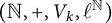
 are multiplicatively independent, due to Villemaire in [Reference Villemaire19], which was then strengthened by Bès in [Reference Bès7], in which he proves that
$(\mathbb {N},+,V_k,\ell ^{\mathbb {N}})$
are multiplicatively independent, due to Villemaire in [Reference Villemaire19], which was then strengthened by Bès in [Reference Bès7], in which he proves that
$(\mathbb {N},+,V_k,\ell ^{\mathbb {N}})$
 defines multiplication when k and
$\ell $
defines multiplication when k and
$\ell $
 are multiplicatively independent.
There exists a natural hierarchy of structures expanding Presburger arithmetic by non-Presburger-definable k-automatic sets. At the top lies
$(\mathbb {N}, +, V_k)$
 , which completely captures k-automaticity and exhibits some degree of model-theoretic complexity (e.g., it has TP
$_2$
, which completely captures k-automaticity and exhibits some degree of model-theoretic complexity (e.g., it has TP
$_2$
 ). At the bottom lies
$(\mathbb {N}, +, k^{\mathbb {N}})$
). At the bottom lies
$(\mathbb {N}, +, k^{\mathbb {N}})$
 , where
$k^{\mathbb {N}} = \{ k^n : n \in \mathbb {N} \}$
, where
$k^{\mathbb {N}} = \{ k^n : n \in \mathbb {N} \}$
 , a reduct that has NIP and in which the definable sets are comparatively tame (see Lambotte–Point [Reference Lambotte and Point15, Theorem 2.32] and Semenov [Reference Semenov18]).
In this article, we show that for expansions of
$(\mathbb {N}, +)$
 by a single unary k-automatic set
$X \subseteq \mathbb {N}$
by a single unary k-automatic set
$X \subseteq \mathbb {N}$
 that is not eventually periodic, the hierarchy collapses. Specifically, we prove the following dichotomy holds.
Theorem 1.1 Let
$X\subseteq \mathbb {N}$
 be a k-automatic set that is not eventually periodic. Then either
$(\mathbb {N},+,X)$
be a k-automatic set that is not eventually periodic. Then either
$(\mathbb {N},+,X)$
 defines all k-automatic sets, or X is definable in
$(\mathbb {N},+,k^{\mathbb {N}})$
defines all k-automatic sets, or X is definable in
$(\mathbb {N},+,k^{\mathbb {N}})$
 .
.
The main ingredients for proving this theorem are characterizations of sparse and non-sparse languages, as well as the definable sets of
$(\mathbb {N},+,k^{\mathbb {N}})$
 and
$(\mathbb {N},+),$
and
$(\mathbb {N},+),$
 respectively. In particular, we use that sets definable from sparse ones are precisely those definable in
$(\mathbb {N},+,k^{\mathbb {N}})$
respectively. In particular, we use that sets definable from sparse ones are precisely those definable in
$(\mathbb {N},+,k^{\mathbb {N}})$
 . On the other hand, sets not definable from a sparse one necessarily define an additive basisFootnote
1
for the natural numbers that is not eventually periodic and from such a set we show that one can define all automatic sets. We also make key use of the fact that to check whether a k-automatic set X is Presburger-definable (i.e., definable in
$(\mathbb {N},+)$
. On the other hand, sets not definable from a sparse one necessarily define an additive basisFootnote
1
for the natural numbers that is not eventually periodic and from such a set we show that one can define all automatic sets. We also make key use of the fact that to check whether a k-automatic set X is Presburger-definable (i.e., definable in
$(\mathbb {N},+)$
 ) it suffices to check only that it has period
$p\geq 1$
) it suffices to check only that it has period
$p\geq 1$
 on an interval that is bounded in terms of p and X.
The outline of this article is as follows. In Section 2, we provide background on automata and Presburger definability, in addition to other relevant concepts required to prove Theorem 1.1. In Section 3, we prove Theorem 1.1 in a key special case: namely, when X is the set of natural numbers whose base-k expansions are accepted by a cycle language; that is, a regular language accepted by a deterministic finite-state automaton with one final state that is equal to its initial state (see Section 2 for definitions). In Section 4, we prove the general case. Finally, in Section 5, we make some observations that follow from our main result and a direction for further inquiry.
2 Preliminaries
2.1 Presburger arithmetic
Presburger arithmetic refers to the first-order theory of natural numbers with addition. It was introduced by Presburger in [Reference Presburger16], who provided a recursive axiomatization and proved that the theory is both consistent and complete.
Definition 2.1
Presburger arithmetic is the first-order theory of the structure
$(\mathbb {N}, +)$
 .
.
Throughout this article, we consider first-order formulas in Presburger arithmetic only in terms of the sets they define in the standard model. Non-standard models will not concern us.
There is a number-theoretic characterization of the sets definable in Presburger arithmetic, due to Ginsburg and Spanier [Reference Ginsburg and Spanier13].
Definition 2.2 A subset X of
$\mathbb {N}^d$
 is said to be linear if it is of the form:

where
$x, y_1, \dots , y_n$
 are fixed vectors in
$\mathbb {N}^d$
are fixed vectors in
$\mathbb {N}^d$
 .
.
A subset of
$\mathbb {N}^d$
 is semilinear if it is a finite union of linear sets.
Theorem 2.3 [Reference Ginsburg and Spanier13]
A subset of
$\mathbb {N}^d$
 is definable in Presburger arithmetic if and only if it is semilinear.
In this article, we focus on the one-dimensional case. In this setting, semilinear sets correspond precisely to eventually periodic sets.
Definition 2.4 A subset X of
$\mathbb {N}$
 is eventually periodic if there exist
$N, p \in \mathbb {N}$
is eventually periodic if there exist
$N, p \in \mathbb {N}$
 such that
$n \in X$
such that
$n \in X$
 if and only if
$n + p \in X$
if and only if
$n + p \in X$
 for all
$n \geq N$
for all
$n \geq N$
 .
.
Thus, we have the following result, which also follows from quantifier elimination for Presburger arithmetic (see Theorem 32F in [Reference Enderton12]).
Corollary 2.5 Let
$X \subseteq \mathbb {N}$
 . Then X is Presburger-definable if and only if X is eventually periodic.
2.2 Finite automata
This article will study regular languages by way of the corresponding finite automata. As such, we begin with a definition of the non-deterministic finite automaton (NFA).
Definition 2.6 An NFA is a tuple
$\mathcal {A} = (Q, I, \Sigma , \delta , F)$
 where:
-
• Q is a finite set of elements called states;
-
• $I \subseteq Q$
 is the set of start states or initial states;
 -
• $\Sigma $
is a finite alphabet; -
• $\delta : Q \times \Sigma \to \mathcal {P}(Q)$
is a function called the transition function; -
• $F \subseteq Q$
is a set of accept states or final states.




Definition 2.7 An NFA
$\mathcal {A} = (Q, I, \Sigma , \delta , F)$
 is called deterministic, or a DFA, if I has exactly one element and if
$\delta (q, y)$
is called deterministic, or a DFA, if I has exactly one element and if
$\delta (q, y)$
 has at most one element for all
$q \in Q, y \in \Sigma $
has at most one element for all
$q \in Q, y \in \Sigma $
 .
.
We first recall that for an NFA
$\mathcal {A} = (Q, I, \Sigma , \delta , F)$
 , we can inductively extend the function
$\delta : Q \times \Sigma \to \mathcal {P}(Q)$
, we can inductively extend the function
$\delta : Q \times \Sigma \to \mathcal {P}(Q)$
 to a function from
$Q \times \Sigma ^*$
to a function from
$Q \times \Sigma ^*$
 to
$\mathcal {P}(Q)$
to
$\mathcal {P}(Q)$
 by declaring that, for a word
$v\in \Sigma ^*$
by declaring that, for a word
$v\in \Sigma ^*$
 and
$y\in \Sigma $
and
$y\in \Sigma $
 :
:

If
$\mathcal {A}$
 is deterministic, this extended
$\delta $
is deterministic, this extended
$\delta $
 maintains the same property that its output is always at most a singleton set.
A run of
$\mathcal {A}$
 on a word
$w \in \Sigma ^*$
on a word
$w \in \Sigma ^*$
 is a finite sequence
$(q_0, q_1, \dots , q_{|w|})$
is a finite sequence
$(q_0, q_1, \dots , q_{|w|})$
 of states, with
$q_0 \in I$
of states, with
$q_0 \in I$
 a start state, such that, for
$1 \leq i \leq |w|,$
a start state, such that, for
$1 \leq i \leq |w|,$
 we have
$q_i \in \delta (q_{i-1}, w_i)$
we have
$q_i \in \delta (q_{i-1}, w_i)$
 . A run is accepting if
$q_{|w|} \in F$
. A run is accepting if
$q_{|w|} \in F$
 ; if any accepting run exists, we say that
$\mathcal {A}$
; if any accepting run exists, we say that
$\mathcal {A}$
 accepts w. If
$\mathcal {A}$
accepts w. If
$\mathcal {A}$
 does not accept a word w, we say that it rejects w. We may also speak of runs from states other than initial states; a run from q means a run in the automaton
$\mathcal {A}'$
does not accept a word w, we say that it rejects w. We may also speak of runs from states other than initial states; a run from q means a run in the automaton
$\mathcal {A}'$
 that replaces I with
$\{q\}$
that replaces I with
$\{q\}$
 .
.
A language L is regular if and only if there exists a finite automaton
$\mathcal {A}$
 such that L is the set of words accepted by
$\mathcal {A}$
such that L is the set of words accepted by
$\mathcal {A}$
 . It is a well-known fact due to Rabin and Scott that we may without loss of generality take
$\mathcal {A}$
. It is a well-known fact due to Rabin and Scott that we may without loss of generality take
$\mathcal {A}$
 to be deterministic.
Fact 2.8 Let
$\mathcal {A}$
 be any NFA. There exists a deterministic finite automaton
$\mathcal {A}'$
be any NFA. There exists a deterministic finite automaton
$\mathcal {A}'$
 such that
$\mathcal {A}$
such that
$\mathcal {A}$
 and
$\mathcal {A}'$
and
$\mathcal {A}'$
 accept precisely the same words.
We will also need two facts about the sizes of deterministic finite automata after transformations are applied to the corresponding languages.
Lemma 2.9 Let L be a regular language whose deterministic finite automaton
$\mathcal {A}$
 has M states. Let u be any word. Then the language
$\{v : uv \in L\}$
has M states. Let u be any word. Then the language
$\{v : uv \in L\}$
 has a deterministic finite automaton with
$(M+1)$
has a deterministic finite automaton with
$(M+1)$
 states.
Proof Let
$\mathcal {A} = (Q, I, \Sigma , \delta , F)$
 . We define the DFA
$\mathcal {A}'$
. We define the DFA
$\mathcal {A}'$
 on
$\Sigma $
on
$\Sigma $
 as follows. First, add a new state
$q_u$
as follows. First, add a new state
$q_u$
 to Q to obtain the set of states in
$\mathcal {A}'$
to Q to obtain the set of states in
$\mathcal {A}'$
 ;
$q_u$
;
$q_u$
 will be the initial state. The final states of
$\mathcal {A}'$
will be the initial state. The final states of
$\mathcal {A}'$
 will be those in F; if (and only if)
$u \in L$
will be those in F; if (and only if)
$u \in L$
 , we also add
$q_u$
, we also add
$q_u$
 as a final state. Finally, the transition function of
$\mathcal {A}'$
as a final state. Finally, the transition function of
$\mathcal {A}'$
 agrees with that of
$\mathcal {A}$
agrees with that of
$\mathcal {A}$
 on its domain, and for each symbol
$\sigma \in \Sigma $
on its domain, and for each symbol
$\sigma \in \Sigma $
 , we add a transition from
$q_u$
, we add a transition from
$q_u$
 to
$\delta (I, u\sigma )$
to
$\delta (I, u\sigma )$
 on
$\sigma $
on
$\sigma $
 .
.
We claim that
$\mathcal {A}'$
 recognizes
$\{v : uv \in L\}$
recognizes
$\{v : uv \in L\}$
 . Let
$uv \in L$
. Let
$uv \in L$
 . If v is empty, then
$u \in L$
. If v is empty, then
$u \in L$
 and hence the empty word is recognized by
$\mathcal {A}'$
and hence the empty word is recognized by
$\mathcal {A}'$
 . Otherwise, let
$v = \sigma w$
. Otherwise, let
$v = \sigma w$
 . Then
$\delta (I, u\sigma w) \in F$
. Then
$\delta (I, u\sigma w) \in F$
 ; so
$\delta (\delta (I, u\sigma ), w) \in F$
; so
$\delta (\delta (I, u\sigma ), w) \in F$
 ; so
$\delta (q_u, \sigma w) \in F$
; so
$\delta (q_u, \sigma w) \in F$
 , as needed. The proof when
$uv \notin L$
, as needed. The proof when
$uv \notin L$
 is analogous.
Lemma 2.10 Let
$L_1$
 be a regular language whose deterministic finite automaton
$\mathcal {A}_1$
be a regular language whose deterministic finite automaton
$\mathcal {A}_1$
 has
$M_1$
has
$M_1$
 states, and let
$L_2$
states, and let
$L_2$
 be a regular language whose deterministic finite automaton
$\mathcal {A}_2$
be a regular language whose deterministic finite automaton
$\mathcal {A}_2$
 has
$M_2$
has
$M_2$
 states. Then the language
$\{w : w \in L_1 \leftrightarrow w \in L_2\}$
states. Then the language
$\{w : w \in L_1 \leftrightarrow w \in L_2\}$
 has a deterministic finite automaton with
$M_1 \cdot M_2$
has a deterministic finite automaton with
$M_1 \cdot M_2$
 states.
Proof Let
$\mathcal {A}_1 = (Q_1, I_1, \Sigma , \delta _1, F_1)$
 and
$\mathcal {A}_2 = (Q_2, I_2, \Sigma , \delta _2, F_2)$
and
$\mathcal {A}_2 = (Q_2, I_2, \Sigma , \delta _2, F_2)$
 . We will construct a new automaton
$\mathcal {A}_3 = (Q_3, I_3, \Sigma , \delta _3, F_3)$
. We will construct a new automaton
$\mathcal {A}_3 = (Q_3, I_3, \Sigma , \delta _3, F_3)$
 . Let
$Q_3 = Q_1 \times Q_2$
. Let
$Q_3 = Q_1 \times Q_2$
 ,
$I_3 = I_1 \times I_2$
,
$I_3 = I_1 \times I_2$
 , and let
$\delta _3((q_1, q_2), \sigma ) = \delta _1(q_1, \sigma ) \times \delta _2(q_2, \sigma )$
, and let
$\delta _3((q_1, q_2), \sigma ) = \delta _1(q_1, \sigma ) \times \delta _2(q_2, \sigma )$
 . Note that this definition naturally extends to words;
$\delta _3((q_1, q_2), w) = \delta _1(q_1, w) \times \delta _2(q_2, w)$
. Note that this definition naturally extends to words;
$\delta _3((q_1, q_2), w) = \delta _1(q_1, w) \times \delta _2(q_2, w)$
 .
.
Let
$F_3 = \{(q_1, q_2) \in Q_3 : q_1 \in F_1 \leftrightarrow q_2 \in F_2\}$
 . Then we note that
$\mathcal {A}_3$
. Then we note that
$\mathcal {A}_3$
 recognizes w iff the single element of
$\delta _3((q_1, q_2), w)$
recognizes w iff the single element of
$\delta _3((q_1, q_2), w)$
 is in
$F_3$
is in
$F_3$
 . This is true if and only if the equivalence
$\delta _1(q_1, w) \in F_1 \leftrightarrow \delta _2(q_2, w) \in F_2$
. This is true if and only if the equivalence
$\delta _1(q_1, w) \in F_1 \leftrightarrow \delta _2(q_2, w) \in F_2$
 holds; but this is precisely when
$w \in L_1 \leftrightarrow w \in L_2$
holds; but this is precisely when
$w \in L_1 \leftrightarrow w \in L_2$
 .
.
Call an NFA trim if every state can be reached by some path from the start state and, for each state, there exists a final state that can be reached from the state in question. Call an NFA or DFA recognizing the language L minimized if it has the smallest number of states possible among all automata that recognize L (within the class of NFAs and DFAs, respectively). Note that for any NFA, there exists an equivalent trim automaton and an equivalent minimized automaton, and these can be made deterministic up to allowing the transition function to be a partial function.
Definition 2.11 The digraph structure of a finite automaton
$\mathcal {A} = (Q, I, \Sigma , \delta , F)$
 is the directed graph
$(Q, \Delta ),$
is the directed graph
$(Q, \Delta ),$
 where
$p \Delta q \iff \exists \sigma \in \Sigma : q \in \delta (p, \sigma )$
where
$p \Delta q \iff \exists \sigma \in \Sigma : q \in \delta (p, \sigma )$
 .
.
We may use digraph terminology to apply properties of the digraph structure to the automaton. For example, a strongly connected component of
$\mathcal {A}$
 is a maximal subset
$S \subseteq Q$
is a maximal subset
$S \subseteq Q$
 such that, for all
$p, q \in S,$
such that, for all
$p, q \in S,$
 there exists a path from p to q, or equivalently a word w such that
$\mathcal {A}$
there exists a path from p to q, or equivalently a word w such that
$\mathcal {A}$
 runs from p to q on w. We define a leaf of the digraph structure to be a strongly connected component with no outgoing transitions to states in a different strongly connected component.
Within this article, it will be very useful to examine the internal structure of an automaton in terms of which words run to which individual states. So we will define two classes of languages.
Definition 2.12 Let
$\mathcal {A} = (Q, I, \Sigma , \delta , F)$
 be a finite automaton and
$p, q \in Q$
be a finite automaton and
$p, q \in Q$
 . The path language
$L_{p \to q} \subseteq \Sigma ^*$
. The path language
$L_{p \to q} \subseteq \Sigma ^*$
 is the set of words w on which there is a run from p to q in
$\mathcal {A}$
is the set of words w on which there is a run from p to q in
$\mathcal {A}$
 . In the case that
$p = q$
. In the case that
$p = q$
 , we call this the cycle language.
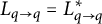
It is elementary that path languages are always regular. Moreover, note that
$L_{q \to q} = L_{q \to q}^*$
 .
.
Definition 2.13 An induced subautomaton of an automaton
$\mathcal {A}=(Q,I,\Sigma ,\delta ,F)$
 corresponding to some
$Q' \subseteq Q$
corresponding to some
$Q' \subseteq Q$
 is the automaton
$(Q', I', \Sigma , \delta |_{Q'}, F \cap Q'),$
is the automaton
$(Q', I', \Sigma , \delta |_{Q'}, F \cap Q'),$
 where
$I'$
where
$I'$
 is the union of
$Q' \cap I$
is the union of
$Q' \cap I$
 along with all elements of
$Q'$
along with all elements of
$Q'$
 to which there is an incoming transition from outside of
$Q'$
to which there is an incoming transition from outside of
$Q'$
 .
.
2.3 Encoding sets of natural numbers
Our results in this article relate to the encoding of natural numbers via the base-k expansion. We define this, and our notations related to it, here.
Definition 2.14 Given a natural number
$k\ge 2$
 , we let
$\Sigma _k=\{0,\ldots ,k-1\}$
, we let
$\Sigma _k=\{0,\ldots ,k-1\}$
 . A base-k expansion of a natural number x is a word
$w_n w_{n-1} \dots w_0$
. A base-k expansion of a natural number x is a word
$w_n w_{n-1} \dots w_0$
 over the alphabet
$\Sigma _k$
over the alphabet
$\Sigma _k$
 such that:

In this case, we say that
$x = [w]_k$
 .
.
Note that the above definition defines
$[w]_k$
 by treating w as a most-significant-digit-first (MSD-first) representation. Some previous work has used the opposite least-significant-digit-first representation, so in order to ensure that the reader understands what our convention is in this article, we instruct the reader to assume that MSD-first representations are in use in all cases. By example:
$[120]_3 = 1 \cdot 3^2 + 2 \cdot 3^1 = 15$
by treating w as a most-significant-digit-first (MSD-first) representation. Some previous work has used the opposite least-significant-digit-first representation, so in order to ensure that the reader understands what our convention is in this article, we instruct the reader to assume that MSD-first representations are in use in all cases. By example:
$[120]_3 = 1 \cdot 3^2 + 2 \cdot 3^1 = 15$
 , not
$7$
, not
$7$
 .
.
We will commonly apply this notation to sets as well. So given a language
$L\subseteq \Sigma _k^*$
 , we let
$[L]_k$
, we let
$[L]_k$
 denote the set of natural numbers of the form
$[w]_k$
denote the set of natural numbers of the form
$[w]_k$
 with
$w\in L$
with
$w\in L$
 . We say that a set
$X\subseteq \mathbb {N}$
. We say that a set
$X\subseteq \mathbb {N}$
 is k-automatic if there is a regular sublanguage L of
$\Sigma _k^*$
is k-automatic if there is a regular sublanguage L of
$\Sigma _k^*$
 such that
$X=[L]_k$
such that
$X=[L]_k$
 .
.
We note that there is a well-known dichotomy for regular languages: if L is a regular language and if
$|L_{\le n}|$
 denotes the number of words in L of length at most n, then either
$|L_{\le n}|$
denotes the number of words in L of length at most n, then either
$|L_{\le n}|$
 is polynomially bounded in n, or else there is a constant
$C>1$
is polynomially bounded in n, or else there is a constant
$C>1$
 such that
$|L_{\le n}|\ge C^n$
such that
$|L_{\le n}|\ge C^n$
 for infinitely many n. More generally, this dichotomy can be stated as follows.
Theorem 2.15 [Reference Bell and Moosa6, Proposition 7.1]
Let L be a regular language. The following are equivalent:
-
(1) $\ f_{\mathcal {L}}(n) = O(n^d)$
for some natural number d. -
(2) $\ f_{\mathcal {L}}(n) = o(C^n)$
for every C > 1. -
(3) There do not exist words $u, v, a, b$
with
$a, b$
nontrivial and of the same length and
$a \neq b$
such that
$u\{a,b\}^{*} v \subseteq L$
. -
(4) Suppose $\Gamma = (Q, \Sigma , \delta , q_0, F )$
is an automaton accepting L in which all states are accessible. Then
$\Gamma $
satisfies the following:$(*)$
If q is a state such that
$\delta (q,v) \in F$
for some word
$v,$
then there is at most one nontrivial word w with the property that
$\delta (q,w) = q$
and
$\delta (q, w') \neq q$
for every nontrivial proper prefix
$w'$
of w. -
(5) There exists an automaton accepting L that satisfies $(*)$
. -
(6) L is a finite union of languages of the form $v_1w_1^* v_2w_2^* \dots v_mw_m^* v_{m+1}$
, where
$k \geq 0$
and the
$v_i$
’s are possibly trivial words and the
$w_i$
’s are nontrivial words.











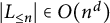
We say that a regular language L is sparse if
$|L_{\le n}| \in O(n^d)$
 for some natural number d, and we will say that a k- automatic subset X of
$\mathbb {N}$
for some natural number d, and we will say that a k- automatic subset X of
$\mathbb {N}$
 is sparse if
$X=[L]_k$
is sparse if
$X=[L]_k$
 for some sparse regular sublanguage of
$\Sigma _k^*$
for some sparse regular sublanguage of
$\Sigma _k^*$
 .
.
There is a fundamental connection between k-automatic sets and the definable sets in an expansion of Presburger arithmetic, which was discovered by Büchi [Reference Büchi9] and formally proven by Bruyère [Reference Bruyère8].
Fact 2.16 Let
$V_k$
 send every positive integer x to the largest power of k dividing x. A set
$X \subseteq \mathbb {N}$
send every positive integer x to the largest power of k dividing x. A set
$X \subseteq \mathbb {N}$
 is k-automatic if and only if it is definable in the structure
$(\mathbb {N}, +, V_k)$
is k-automatic if and only if it is definable in the structure
$(\mathbb {N}, +, V_k)$
 .
.
Therefore, the definable sets in
$(\mathbb {N}, +, V_k)$
 can be understood via the theory of finite automata. This result is fundamental to the study of base-k arithmetic; for instance, it gives us an effective correspondence between formulas in the language of
$(\mathbb {N}, +, V_k)$
can be understood via the theory of finite automata. This result is fundamental to the study of base-k arithmetic; for instance, it gives us an effective correspondence between formulas in the language of
$(\mathbb {N}, +, V_k)$
 and finite automata, and hence a decision algorithm in this language. The reducts of this structure are the subject of this article.
We shall need one more result, proven by Bès in [Reference Bès7].
Fact 2.17 [Reference Bès7, Theorem 3.1]
Let
$X \subseteq \mathbb {N}$
 be k-automatic but not definable in
$(\mathbb {N}, +)$
be k-automatic but not definable in
$(\mathbb {N}, +)$
 (i.e., not eventually periodic). Then the structure
$(\mathbb {N}, +, X)$
(i.e., not eventually periodic). Then the structure
$(\mathbb {N}, +, X)$
 defines the set
$k^{\mathbb {N}} = \{k^n : n \in \mathbb {N}\}$
defines the set
$k^{\mathbb {N}} = \{k^n : n \in \mathbb {N}\}$
 .
.
2.4 Semenov’s characterization
Semenov [Reference Semenov18] gives a characterization of the one-dimensional sets definable from
$(\mathbb {N}, +, k^{\mathbb {N}})$
 , which will be very useful to us. We first define the following subclass of regular languages.
Definition 2.18 Let k be a natural number. A k-Semenov-type language is a sublanguage of
$\{0,\ldots ,k-1\}^*$
 of the form:

where
$p, \ell , m, c \in \mathbb {N}$
 ,
$u_1, \dots , u_p, v_1, \dots , v_p$
,
$u_1, \dots , u_p, v_1, \dots , v_p$
 are finite words over the alphabet
$[k]:=\{0,\ldots ,k-1\}$
are finite words over the alphabet
$[k]:=\{0,\ldots ,k-1\}$
 , and
$\Sigma _{\ell ,m,c}$
, and
$\Sigma _{\ell ,m,c}$
 is the set of all words of length a multiple of
$\ell $
is the set of all words of length a multiple of
$\ell $
 that are the base-k expansion (without leading zeros) of a word congruent to
$-c$
that are the base-k expansion (without leading zeros) of a word congruent to
$-c$
 modulo m, where we take
$\Sigma _{\ell ,m,c}$
modulo m, where we take
$\Sigma _{\ell ,m,c}$
 to be the empty language when
$m=0$
to be the empty language when
$m=0$
 or
$\ell =0$
or
$\ell =0$
 . We suppose without loss of generality that
$\Sigma _{\ell ,m,c}$
. We suppose without loss of generality that
$\Sigma _{\ell ,m,c}$
 does not include leading zeros, increasing p if necessary so that any string of zeros preceding an element of
$\Sigma _{\ell ,m,c}$
does not include leading zeros, increasing p if necessary so that any string of zeros preceding an element of
$\Sigma _{\ell ,m,c}$
 is absorbed into
$v_p^*$
is absorbed into
$v_p^*$
 .
.
Theorem 2.15 allows us to observe the following fact.
Fact 2.19 [Reference Semenov18]
A one-dimensional set
$X \subseteq \mathbb {N}$
 is definable in
$(\mathbb {N}, +, k^{\mathbb {N}})$
is definable in
$(\mathbb {N}, +, k^{\mathbb {N}})$
 if and only if
$X = [L]_k$
if and only if
$X = [L]_k$
 , where L is a finite union of k-Semenov-type languages. In particular, if U and V are, respectively, a sparse regular sublanguage of
$\{0,\ldots ,k-1\}^*$
, where L is a finite union of k-Semenov-type languages. In particular, if U and V are, respectively, a sparse regular sublanguage of
$\{0,\ldots ,k-1\}^*$
 and a sublanguage of
$\{0,\ldots ,k-1\}^*$
and a sublanguage of
$\{0,\ldots ,k-1\}^*$
 consisting of base-k expansions (without leading zeros) of a set definable in
$(\mathbb {N},+,k^{\mathbb {N}})$
consisting of base-k expansions (without leading zeros) of a set definable in
$(\mathbb {N},+,k^{\mathbb {N}})$
 , then
$[UV]_k$
, then
$[UV]_k$
 is definable in
$(\mathbb {N}, +, k^{\mathbb {N}})$
is definable in
$(\mathbb {N}, +, k^{\mathbb {N}})$
 .
.
3 Proof of the dichotomy for cycle languages
In this section, we’ll prove the following result.
Theorem 3.1 Let
$\mathcal {A}=(Q,\{q_0\},\Sigma _k, \delta ,W)$
 be a DFA which reads strings left-to-right. If
$p\in Q$
be a DFA which reads strings left-to-right. If
$p\in Q$
 and
$X=\{[w]_k \colon w\in L_{p\to p}\}$
and
$X=\{[w]_k \colon w\in L_{p\to p}\}$
 , then either X is definable in
$(\mathbb {N},+,k^{\mathbb {N}})$
, then either X is definable in
$(\mathbb {N},+,k^{\mathbb {N}})$
 or
$V_k$
or
$V_k$
 is definable in
$(\mathbb {N},+,X)$
is definable in
$(\mathbb {N},+,X)$
 .
.
We give an overview of how we shall prove Theorem 3.1. We show that if X is a set of natural numbers that is not Presburger definable and that corresponds to a cycle language for an automaton with input alphabet
$\Sigma _k$
 for some k, then (after replacing k by a power if necessary) we may assume that there is a distinguished letter
$a\in \{0,\ldots ,k-1\}$
for some k, then (after replacing k by a power if necessary) we may assume that there is a distinguished letter
$a\in \{0,\ldots ,k-1\}$
 such that we can define a function
$F: X\to k^{\mathbb {N}}$
such that we can define a function
$F: X\to k^{\mathbb {N}}$
 , which is a very close definable approximation to the function
$V_{k,a}|_X$
, which is a very close definable approximation to the function
$V_{k,a}|_X$
 , where
$V_{k,a}$
, where
$V_{k,a}$
 is the map that takes a natural number n as input and outputs
$k^i$
is the map that takes a natural number n as input and outputs
$k^i$
 , where i is the unique nonnegative integer with the property that the base-k expansion of n ends with exactly i copies of the digit a.
Having defined this map F, we show that we can extend F to a definable approximation of the function
$V_{k,a}$
 on
$X_{\le P}$
on
$X_{\le P}$
 , where P is a natural number and
$X_{\le P}$
, where P is a natural number and
$X_{\le P}$
 is the set of all numbers that are sums of at most P elements of X. Now we use a theorem of Bell et al. [Reference Bell, Hare and Shallit5] to show that if X is not sparse, then we can define an approximation of
$V_{k,a}$
is the set of all numbers that are sums of at most P elements of X. Now we use a theorem of Bell et al. [Reference Bell, Hare and Shallit5] to show that if X is not sparse, then we can define an approximation of
$V_{k,a}$
 on all of
$\mathbb {N}$
on all of
$\mathbb {N}$
 . From here, we can show that one can define
$V_k$
. From here, we can show that one can define
$V_k$
 and so we deduce that one can define all k-automatic sets from X.
To prove Theorem 3.1, we may assume that X is the set of base-k expansions of a non-empty cycle language, and hence there is some word w such that
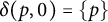
$\delta (p,w)=\{p\}$
 for a fixed state
$p \in Q$
for a fixed state
$p \in Q$
 . We henceforth let

and so
$X=[L]_k$
 .
.
Since L is non-empty, there is some non-empty word
$w\in \Sigma _k^*$
 such that
$\delta (p,w)=\{p\}$
such that
$\delta (p,w)=\{p\}$
 . Possibly by replacing k by a power, we may assume without loss of generality that w is a letter
$a\in \{0,1,\ldots ,k-1\}$
. Possibly by replacing k by a power, we may assume without loss of generality that w is a letter
$a\in \{0,1,\ldots ,k-1\}$
 . Furthermore, the pigeonhole principle gives that there is some positive integer i such that
$\delta (q,0^i)=\delta (q,0^{2i})$
. Furthermore, the pigeonhole principle gives that there is some positive integer i such that
$\delta (q,0^i)=\delta (q,0^{2i})$
 and
$\delta (q, (k-1)^i)=\delta (q,(k-1)^{2i})$
and
$\delta (q, (k-1)^i)=\delta (q,(k-1)^{2i})$
 for all
$q\in Q$
for all
$q\in Q$
 . Thus, we may replace k by a power and henceforth assume the following hold:
-
(i) There is a distinguished letter $a\in \{0,\ldots ,k-1\}$
with the property that (2) $$ \begin{align} \delta(p,a)=\{p\}. \end{align} $$
-
(ii) We have $\delta (q,00)=\delta (q,0)$
for all
$q\in Q$
. -
(iii) We have $\delta (q,(k-1)(k-1))=\delta (q,k-1)$
for all
$q\in Q$
. -
(iv) We also assume that $\mathcal {A}$
is minimal.







We shall say that a word
$w \in \Sigma ^*$
 is idempotent (with respect to the automaton
$\mathcal {A}$
is idempotent (with respect to the automaton
$\mathcal {A}$
 ) if for all states
$q \in Q$
) if for all states
$q \in Q$
 , we have
$\delta (q, ww) = \delta (q, w)$
, we have
$\delta (q, ww) = \delta (q, w)$
 . That is, applying the transition corresponding to w twice has the same effect as applying it once. In particular, in our setting, we assume that the words
$0$
. That is, applying the transition corresponding to w twice has the same effect as applying it once. In particular, in our setting, we assume that the words
$0$
 and
$k-1$
and
$k-1$
 are idempotent in this sense.
We now let f denote the characteristic function of the set X. Then
$f:\mathbb {N}\to \{0,1\}$
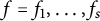
 is k-automatic and hence there are finitely many maps
$\ f=f_1,\ldots , f_s$
is k-automatic and hence there are finitely many maps
$\ f=f_1,\ldots , f_s$
 such that, for each
$c\ge 0$
such that, for each
$c\ge 0$
 and each
$j\in \{0,\ldots , k^c-1\},$
and each
$j\in \{0,\ldots , k^c-1\},$
 we have
$f(k^cn+j)=f_i(n)$
we have
$f(k^cn+j)=f_i(n)$
 for some
$i\in \{1,\ldots ,s\},$
for some
$i\in \{1,\ldots ,s\},$
 which depends on c and j, by [Reference Allouche and Shallit2, Theorem 6.6.2]. We call these maps
$f_1,\ldots ,f_s$
which depends on c and j, by [Reference Allouche and Shallit2, Theorem 6.6.2]. We call these maps
$f_1,\ldots ,f_s$
 , the kernel of the map f. We may assume without loss of generality that X is neither sparse nor eventually periodic. In particular, since X is not Presburger definable,
$(\mathbb {N},+,X)$
, the kernel of the map f. We may assume without loss of generality that X is neither sparse nor eventually periodic. In particular, since X is not Presburger definable,
$(\mathbb {N},+,X)$
 defines the set
$k^{\mathbb {N}}$
defines the set
$k^{\mathbb {N}}$
 by Fact 2.17. In addition, there exists some natural number b such that each
$f_i$
by Fact 2.17. In addition, there exists some natural number b such that each
$f_i$
 can be realized as
$f(k^r n+j)$
can be realized as
$f(k^r n+j)$
 for some
$r,j$
for some
$r,j$
 with
$r\le b$
with
$r\le b$
 .
.
For the remainder of the proof, we divide the proof into three cases:
-
(I): $\delta (p,0)=\{p\}$
; -
(II): $\delta (p,0)=\varnothing $
or
$\delta (p,0)=\{p'\}$
, where
$p'$
is in a different strongly connected component from p; -
(III): $\delta (p,0)=\{p'\},$
where
$p'$
and p are in the same strongly connected component.





We note that, in Case (I), we can take
$a=0$
 and this simplifies the proof of this case somewhat, but we will handle cases (I) and (II) simultaneously.
3.1 Proof in cases (I) and (II)
Throughout this section, we assume the following:
-
• One of cases (I) or (II) above holds.
-
• X is not definable in $(\mathbb {N},+,k^{\mathbb {N}})$
.

It follows that
$k^{\mathbb {N}}$
 is definable in
$(\mathbb {N},+, X)$
is definable in
$(\mathbb {N},+, X)$
 by Fact 2.17.
We now define a series of functions
$F_R: X\to k^{\mathbb {N}}$
 for
$R \in \mathbb {N}$
for
$R \in \mathbb {N}$
 as follows. If
$0\in X$
as follows. If
$0\in X$
 , we take
$F_R(0)=1$
, we take
$F_R(0)=1$
 , and for
$n\ge 1$
, and for
$n\ge 1$
 in
$X,$
in
$X,$
 we take
$F_R(n)$
we take
$F_R(n)$
 to be the largest
$k^i\in k^{\mathbb {N}}$
to be the largest
$k^i\in k^{\mathbb {N}}$
 such that
$k^{i-1}\le n$
such that
$k^{i-1}\le n$
 and for all
$0 \leq r \leq R$
and for all
$0 \leq r \leq R$
 and for all words v with
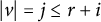
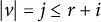
$|v|=j\le r+i$
and for all words v with
$|v|=j\le r+i$
 , we have


We note two things about
$F_R$
 :
:
-
• For $n\ge 1$
,
$k^0$
(i.e.,
$i=0$
) has the property that for all
$r\ge 0$
and all words of length at most r with
$|v|\le r$
, the condition in Equation (4) holds, and so
$F_R(n)\ge 1$
for all n. Therefore,
$\min _R F_R(n)$
is well-defined; we denote this
$F(n)$
. -
• Note that because $F_R$
is defined as the largest
$k^i$
such that a universal quantification over
$r \leq R$
holds, we must have that
$(F_R(n))_R$
is monotone decreasing (in R).


We will now show that, due to the pumping lemma, the point at which the sequence
$(F_R(n))_R$
 stabilizes is uniform in n.
Lemma 3.2 Let
$\mathcal {A}'$
 be a deterministic finite automaton recognizing L with set of states Q, and let
$M = (|Q|+1)^2$
be a deterministic finite automaton recognizing L with set of states Q, and let
$M = (|Q|+1)^2$
 . Then
$F_M$
. Then
$F_M$
 and F are identical.
Proof Fix n. By the above remarks, this is equivalent to the claim that for all
$R> M$
 ,
$F_{M}(n) = F_{R}(n)$
,
$F_{M}(n) = F_{R}(n)$
 .
.
We proceed by induction on R. Assume that
$F_{M}(n) = F_{M+1}(n) = \dots = F_{R-1}(n)$
 . We need to show that
$F_{R-1}(n) = F_{R}(n)$
. We need to show that
$F_{R-1}(n) = F_{R}(n)$
 . Let
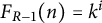
$F_{R-1}(n) = k^i$
. Let
$F_{R-1}(n) = k^i$
 ; it suffices to show that for
$r = R$
; it suffices to show that for
$r = R$
 and for all words v with
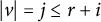
$|v| = j \leq r + i$
and for all words v with
$|v| = j \leq r + i$
 , the appropriate condition (either (3) or (4)) is satisfied.
We first consider the case where
$|v| \leq r$
 . In this case, we need to show that
$k^r n + [a^{r-|v|}v]_k \in X \iff v \in L$
. In this case, we need to show that
$k^r n + [a^{r-|v|}v]_k \in X \iff v \in L$
 . Let
$[u]_k = n$
. Let
$[u]_k = n$
 ; then equivalently, we want
$ua^{r-|v|}v \in L \iff v \in L$
; then equivalently, we want
$ua^{r-|v|}v \in L \iff v \in L$
 .
.
Let
$L' = \{a^{r'-|v'|}v' : ua^{r'-|v'|}v' \in L\}$
 . By Lemma 2.9, the automaton for
$L'$
. By Lemma 2.9, the automaton for
$L'$
 has at most M states.
Consider the string
$a^{r-|v|}v$
 . Note that this string has length
$r = R> M$
. Note that this string has length
$r = R> M$
 , so by the pumping lemma, we may write
$a^{r-|v|}v = xyz,$
, so by the pumping lemma, we may write
$a^{r-|v|}v = xyz,$
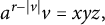 where y is nonempty and each
$xy^mz \in L' \iff xyz \in L'$
where y is nonempty and each
$xy^mz \in L' \iff xyz \in L'$
 . Then
$xz = a^{r'-|v'|}v'$
. Then
$xz = a^{r'-|v'|}v'$
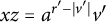 for some
$r' < r$
for some
$r' < r$
 . We know that
$ua^{r'-|v'|}v' \in L \iff v \in L$
. We know that
$ua^{r'-|v'|}v' \in L \iff v \in L$
 by inductive assumption, so
$ua^{r-|v|}v \in L \iff xyz \in L' \iff xz \in L' \iff ua^{r'-|v'|}v' \in L \iff v \in L$
by inductive assumption, so
$ua^{r-|v|}v \in L \iff xyz \in L' \iff xz \in L' \iff ua^{r'-|v'|}v' \in L \iff v \in L$
 .
.
Now we consider the case where
$|v|> r$
 . In this case, we need to show that
$k^r n - [a^{j-r} 0^r]_k + [v]_k \in X \iff v \in L$
. In this case, we need to show that
$k^r n - [a^{j-r} 0^r]_k + [v]_k \in X \iff v \in L$
 . Let
$v = v_0 v_1$
. Let
$v = v_0 v_1$
 , where
$|v_1| = r$
, where
$|v_1| = r$
 ; then the condition
$k^r n - [a^{j-r} 0^r]_k + [v]_k \in X$
; then the condition
$k^r n - [a^{j-r} 0^r]_k + [v]_k \in X$
 may be rewritten as
$k^r (n - [a^{j-r}]_k + [v_0]_k) + [v_1]_k$
may be rewritten as
$k^r (n - [a^{j-r}]_k + [v_0]_k) + [v_1]_k$
 . Let
$w_{j,v_0}$
. Let
$w_{j,v_0}$
 be a word such that
$[w_{j,v_0}]_k = n - [a^{j-r}]_k + [v_0]_k$
be a word such that
$[w_{j,v_0}]_k = n - [a^{j-r}]_k + [v_0]_k$
 ; then we want to show that
$w_{j,v_0} v_1 \in L \iff v_0 v_1 \in L$
; then we want to show that
$w_{j,v_0} v_1 \in L \iff v_0 v_1 \in L$
 .
.
In this case, we set
$L^{\prime }_{j,v_0} = \{v_1 : w_{j,v_0}v_1 \in L \leftrightarrow v_0 v_1 \in L\}$
 . By Lemmas 2.9 and 2.10, the automaton for
$L^{\prime }_{j,v_0}$
. By Lemmas 2.9 and 2.10, the automaton for
$L^{\prime }_{j,v_0}$
 has at most M states. Because
$|v_1| = r = R> m$
has at most M states. Because
$|v_1| = r = R> m$
 , we apply the pumping lemma and let
$v_1 = xyz$
, we apply the pumping lemma and let
$v_1 = xyz$
 with y nonempty and
$xy^mz \in L^{\prime }_{j,v_0} \iff xyz \in L^{\prime }_{j,v_0}$
with y nonempty and
$xy^mz \in L^{\prime }_{j,v_0} \iff xyz \in L^{\prime }_{j,v_0}$
 for all m, in particular,
$xz \in L^{\prime }_{j,v_0} \iff xyz \in L^{\prime }_{j,v_0}$
for all m, in particular,
$xz \in L^{\prime }_{j,v_0} \iff xyz \in L^{\prime }_{j,v_0}$
 .
.
Let
$v_1' = xz$
 , and let
$|v_1'| = r' < r$
, and let
$|v_1'| = r' < r$
 . Let
$j' = j + r' - r$
. Let
$j' = j + r' - r$
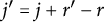 . Then:

By inductive assumption,
$k^{r'}n - [a^{j'-r'}0^{r'}]_k + [v_0v_1']_k \in X \iff v_0 v_1' \in L$
 , that is,
$w_{j,v_0}v_1' \in L \iff v_0 v_1' \in L$
, that is,
$w_{j,v_0}v_1' \in L \iff v_0 v_1' \in L$
 . Therefore,
$xz = v_1' \in L^{\prime }_{j,v_0}$
. Therefore,
$xz = v_1' \in L^{\prime }_{j,v_0}$
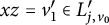 . It follows that
$xyz = v_1 \in L^{\prime }_{j,v_0}$
. It follows that
$xyz = v_1 \in L^{\prime }_{j,v_0}$
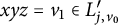 , so
$w_{j,v_0} v_1 \in L \iff v_0 v_1 \in L$
, so
$w_{j,v_0} v_1 \in L \iff v_0 v_1 \in L$
 , as required.
Intuitively, F is trying to capture (imperfectly) the length of the largest suffix of the base-k expansion that consists entirely of a’s. We note that using geometric series, it is not difficult to show that the limiting map F is definable in
$(\mathbb {N},+,X)$
 .
.
Lemma 3.3 Under the assumptions above, the map F is definable in
$(\mathbb {N},+,X)$
 .
.
Proof We will construct, step-by-step, several definable functions and relations that ultimately give us
$F_R$
 for a fixed R when put together. As
$F = F_M$
for a fixed R when put together. As
$F = F_M$
 by the previous lemma, we conclude that F itself is definable. Throughout this proof, we work in the expanded language
$\{+,-,\equiv _n, (x \mapsto nx)_{n \in \mathbb {N}},<,X, k^{\mathbb {N}}\}$
by the previous lemma, we conclude that F itself is definable. Throughout this proof, we work in the expanded language
$\{+,-,\equiv _n, (x \mapsto nx)_{n \in \mathbb {N}},<,X, k^{\mathbb {N}}\}$
 . We do this without loss of generality because it is elementary to show that the relations
$<,>, \leq , \geq , \neq $
. We do this without loss of generality because it is elementary to show that the relations
$<,>, \leq , \geq , \neq $
 , modular equivalence
$\equiv _n$
, modular equivalence
$\equiv _n$
 modulo a constant n, multiplication
$nx$
modulo a constant n, multiplication
$nx$
 by a constant n, the graph of the partial function
$-$
by a constant n, the graph of the partial function
$-$
 , and all natural number constants themselves are definable in Presburger arithmetic, and because Fact 2.17 guarantees that we can define
$k^{\mathbb {N}}$
, and all natural number constants themselves are definable in Presburger arithmetic, and because Fact 2.17 guarantees that we can define
$k^{\mathbb {N}}$
 in
$(\mathbb {N},+,X)$
in
$(\mathbb {N},+,X)$
 .
.
-
• Let $\ell (x)$
be the smallest
$k^i \in k^{\mathbb {N}}$
such that
$x < k^i$
. The graph of this function is defined by the formula
$y \in k^{\mathbb {N}} \wedge \forall p_i \in k^{\mathbb {N}} \: (p_i> x \leftrightarrow p_i \geq y)$
. Note that if v starts with no leading zero,
$\ell ([v]_k)$
is encoded by the word
$10^{|v|}$
. -
• Let $L(x, y)$
be the binary relation that holds precisely when there is a word v with length j such that
$[v]_k = x$
,
$k^j = y$
, and
$v \in L$
. The definition of this relation depends on whether we are in case (I) or (II). If case (I) holds, then for all v, we have
$v \in L \iff 0v \in L$
. Therefore, in this case,
$L(x, y)$
is defined by the formula
$y \geq \ell (x) \wedge x \in X$
. If case (II) holds, then no word beginning with
$0$
is in L. Therefore, in this case,
$L(x, y)$
is defined by the formula
$y = \ell (x) \wedge x \in X$
. -
• Let $a(x, y)$
be the partial function where, if
$x = k^i$
and
$y = k^j$
, then
$a(x, y) = [a^{i-j}0^j]_k$
. For example,
$a(7, 4) = [aaa0000]_k$
. Notice that
$a(i, j) = [a]_k (k^j + \dots + k^{i-1}) = [a]_k \frac {k^i-k^j}{k-1}$
. Because
$[a]_k$
and
$(k-1)$
are constants, we therefore define the graph of a by the formula
$x \in k^{\mathbb {N}} \wedge y \in k^{\mathbb {N}} \wedge (k-1) z = [a]_k (x - y)$
. -
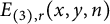
• Fix an arbitrary constant r. Let the relation $E_{(3),r}(x, y, n)$
hold if there is a word v with length j such that
$[v]_k = x$
,
$k^j = y$
, and equivalence (3) holds. Note that
$k^r$
is a constant here. Then
$E_{(3),r}$
is defined by the formula
$y \geq \ell (x) \wedge (k^r n + x - a(y, k^r) \in X \leftrightarrow L(x, y))$
. -
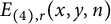
• Fix an arbitrary constant r. Let the relation $E_{(4),r}(x, y, n)$
hold if there is a word v with length j such that
$[v]_k = x$
,
$k^j = y$
, and equivalence (4) holds. Note that
$k^r$
is a constant here. Then
$E_{(4),r}$
is defined by the formula
$y \geq \ell (x) \wedge (k^r n + a(k^r, y) + x \in X \leftrightarrow L(x, y))$
. -
• Fix an arbitrary constant r. Let the relation $E_r(x, y, n)$
hold if there is a word v with length j such that
$[v]_k = x$
,
$k^j = y$
, and equivalence (3) or (4) holds depending on whether
$j> r$
. Then
$E_r$
is defined by the formula
$(y> k^r \wedge E_{(3),r}(x, y, n)) \vee (y \leq k^r \wedge E_{(4),r}(x, y, n))$
. -
• Let the relation $A_r(n, z)$
hold if
$z = k^i$
,
$k^{i-1} \leq n$
, and for all v with
$|v| = j \leq r + i$
, we have
$E_r(x, y, n)$
when
$[v]_k = x$
and
$k^j = y$
. Then
$A_r$
is defined by the formula
$z \in k^{\mathbb {N}} \wedge \ell (n) \geq z \wedge \forall x \: \forall y \: ((y \in k^{\mathbb {N}} \wedge \ell (x) \leq y \wedge y \leq k^r z) \to E_r(x, y, n))$
. -
• Let the relation $A_{\leq R}(n, z)$
hold if
$A_{r}(n, z)$
holds for all
$r \leq R$
. Then for a fixed R,
$A_{\leq R}$
is defined by the formula
$A_0(n, z) \wedge A_1(n, z) \wedge \dots \wedge A_R(n, z)$
. -
• The function $F_{R}(n)$
returns the largest
$z = k^i \in k^{\mathbb {N}}$
such that
$k^{i-1} < n$
(equivalently
$k^i < kn$
) and such that
$A_{\leq R}(n, k^i)$
holds. Then the graph of
$F_{R}$
is defined by the formula
$z \in k^{\mathbb {N}} \wedge z < kn \wedge A_{\leq R}(n, z) \wedge \forall z' \: ((z' \in k^{\mathbb {N}} \wedge z' < kn \wedge A_{\leq R}(n, z')) \to z' \leq z)$
.







































Example 1 We give an example to show how to compute the function F in a special case. Consider the case when
$k=3$
 and when our distinguished letter is
$a=1$
and when our distinguished letter is
$a=1$
 and when X is the set of natural numbers whose base-k expansion is in the cycle language of the state
$q_2$
and when X is the set of natural numbers whose base-k expansion is in the cycle language of the state
$q_2$
 of the automaton in Figure 1, where we again read strings from left-to-right. We claim that
$F(22)=F([211]_3)=3$
of the automaton in Figure 1, where we again read strings from left-to-right. We claim that
$F(22)=F([211]_3)=3$
 .
.
An automaton with cycle language at
$q_2$
 having
$F(22)=3$
having
$F(22)=3$
 .
.

Then if we take
$n=[211]_3=22$
 ,
$F(n)=3$
,
$F(n)=3$
 . To see this, notice that if
$r\ge 0$
. To see this, notice that if
$r\ge 0$
 and v is a word with length at most
$r+1$
and v is a word with length at most
$r+1$
 with
$|v|= r+1$
with
$|v|= r+1$
 , then
$3^r n - [1^{|v|-r}0^r]_3 + [v]_3$
, then
$3^r n - [1^{|v|-r}0^r]_3 + [v]_3$
 has ternary expansion
$21v$
has ternary expansion
$21v$
 , which is in the cycle language of the state
$q_2$
, which is in the cycle language of the state
$q_2$
 if and only if v is. If
$|v|\le r$
if and only if v is. If
$|v|\le r$
 , then

has ternary expansion
$21^{2+r-|v|} v$
 , which is again in the cycle language if and only if v is. It follows that
$F(22)\ge 3$
, which is again in the cycle language if and only if v is. It follows that
$F(22)\ge 3$
 . To see that
$F(22)<9$
. To see that
$F(22)<9$
 , observe that for
$r=0$
, observe that for
$r=0$
 ,
$v=00$
,
$v=00$
 , then
$n - [11]_3+[v]_3 = [200]_3$
, then
$n - [11]_3+[v]_3 = [200]_3$
 , which is not in X, while
$[00]_3$
, which is not in X, while
$[00]_3$
 is. Thus,
$F(22)=3$
is. Thus,
$F(22)=3$
 , as claimed.
We now return to the proof of Theorem 3.1 in cases (I) and (II). By definition of the map F, we also have implication:

for
$n\in X$
 .
.
As mentioned earlier, we view the function F as a (definable) proxy for the function
$V_{k,a}$
 on the set X, where
$V_{k,a}(n)=k^i$
on the set X, where
$V_{k,a}(n)=k^i$
 if the base-k expansion of n has a suffix of length i consisting entirely of a’s and no longer suffix with this property. As it turns out, we can show that F approximates
$V_{k,a}$
if the base-k expansion of n has a suffix of length i consisting entirely of a’s and no longer suffix with this property. As it turns out, we can show that F approximates
$V_{k,a}$
 up to multiplicative constants.
Lemma 3.4 There is a natural number
$\beta \ge 1$
 , depending only on X such that, for
$n\in X,$
, depending only on X such that, for
$n\in X,$
 we have
$F(n)\ge V_{k,a}(n)/k^{\beta }$
we have
$F(n)\ge V_{k,a}(n)/k^{\beta }$
 .
.
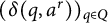
Proof Since there are only finitely many distinct vectors of sets
$(\delta (q,a^r))_{q\in Q}$
 for
$r\in \mathbb {N}$
for
$r\in \mathbb {N}$
 , by the pigeonhole principle, there exist natural numbers
$r_1,r_2$
, by the pigeonhole principle, there exist natural numbers
$r_1,r_2$
 , with
$r_1<r_2$
, with
$r_1<r_2$
 , such that
$\delta (q,a^{r_1}) = \delta (q,a^{r_2})$
, such that
$\delta (q,a^{r_1}) = \delta (q,a^{r_2})$
 for all
$q\in Q$
for all
$q\in Q$
 . We claim that we can take
$\beta =r_2$
. We claim that we can take
$\beta =r_2$
 .
.
If
$n=0,$
 there is nothing to prove, so we may assume that
$n\in X$
there is nothing to prove, so we may assume that
$n\in X$
 is positive. In addition, if the base-k expansion of n is of the form
$a^m$
is positive. In addition, if the base-k expansion of n is of the form
$a^m$
 for some
$m\ge 1$
for some
$m\ge 1$
 , then it follows from the definition that
$F(n)\ge V_{k,a}(n)/k=k^{m-1}$
, then it follows from the definition that
$F(n)\ge V_{k,a}(n)/k=k^{m-1}$
 . Thus, we may assume that n has at least one base-k digit not equal to a.
Let
$wja^m$
 denote a base-k of n that is in L, where
$w\in \Sigma ^*$
denote a base-k of n that is in L, where
$w\in \Sigma ^*$
 is a possibly empty word and
$j\in \Sigma _k\setminus \{ a\}$
is a possibly empty word and
$j\in \Sigma _k\setminus \{ a\}$
 . We claim that
$F(n) \ge k^{m-r_2}$
. We claim that
$F(n) \ge k^{m-r_2}$
 . If
$m\le r_2$
. If
$m\le r_2$
 , the claim is clear, since
$F(n)\ge 1$
, the claim is clear, since
$F(n)\ge 1$
 for all
$n\in X$
for all
$n\in X$
 , so we assume that
$m>r_2$
, so we assume that
$m>r_2$
 .
.
Since
$\delta (p,wja^m)=\{p\}$
 , by definition of
$r_1$
, by definition of
$r_1$
 and
$r_2$
and
$r_2$
 , there exists
$m_0< r_2$
, there exists
$m_0< r_2$
 such that
$\delta (p,wja^{m_0})=\{p\}$
such that
$\delta (p,wja^{m_0})=\{p\}$
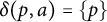
 . Moreover, since
$\delta (p,a)=\{p\}$
. Moreover, since
$\delta (p,a)=\{p\}$
 , we in fact have
$\delta (p,wja^{e})=\{p\}$
, we in fact have
$\delta (p,wja^{e})=\{p\}$
 for all
$e\ge m_0$
for all
$e\ge m_0$
 .
.
To show that
$F(n)\ge V_{k,a}(n)/k^{r_2}= k^{m-r_2}$
 , let
$r\ge 0$
, let
$r\ge 0$
 and let
$v\in \Sigma _k^*$
and let
$v\in \Sigma _k^*$
 be a word of length at most
$m-r_2+r$
be a word of length at most
$m-r_2+r$

We must show that the conditions in Equations (3) and (4) hold.
First, if
$|v|>r,$
 then
$k^r n - [a^{|v|-r}0^r]_k + [v]_k$
then
$k^r n - [a^{|v|-r}0^r]_k + [v]_k$
 has base-k expansion of the form
$wja^{e}v$
has base-k expansion of the form
$wja^{e}v$
 for some
$e\ge m_0$
for some
$e\ge m_0$
 and since
$wja^{e}$
and since
$wja^{e}$
 is in L, we see that
$wja^e v \in L$
is in L, we see that
$wja^e v \in L$
 if and only if
$v\in L$
if and only if
$v\in L$
 . Thus, since we are in either case (I) or (II), we see that

in this case.
Next, if
$|v|\le r$
 , then
$k^r n + [a^{r-|v|} v]_k$
, then
$k^r n + [a^{r-|v|} v]_k$
 has base-k expansion
$wja^e v$
has base-k expansion
$wja^e v$
 with
$e\ge m_0$
with
$e\ge m_0$
 and so as in the previous case, we have that
$k^r n + [a^{r-|v|} v]_k\in X\iff v\in L$
and so as in the previous case, we have that
$k^r n + [a^{r-|v|} v]_k\in X\iff v\in L$
 .
.
Thus,
$F(n)\ge k^{m-r_2} = V_{k,a}(n)/k^{\beta }$
 .
.
We now have shown that
$F(n)/V_{k,a}(n)$
 is bounded below by
$1/k^{\beta }$
is bounded below by
$1/k^{\beta }$
 for some
$\beta $
for some
$\beta $
 that depends only on X and not on n. We will next show that this ratio is bounded above, although this requires our assumption that the set X not be eventually periodic.
We first require a monotonicity result.
Lemma 3.5 For
$w\in L$
 and all
$i\ge 1$
and all
$i\ge 1$
 ,
$F([wa^i]_k) \ge k^i F([w]_k)$
,
$F([wa^i]_k) \ge k^i F([w]_k)$
 .
.
Proof Since
$w\in L\implies wa\in L$
 , it suffices to prove the result when
$i=1$
, it suffices to prove the result when
$i=1$
 and the general result will then follow by induction.
Let t be such that
$k^t=F(n)$
 , where
$n=[w]_k$
, where
$n=[w]_k$
 with
$w\in L$
with
$w\in L$
 . Then Equations (3) and (4) give that for all
$r\ge 0$
. Then Equations (3) and (4) give that for all
$r\ge 0$
 and all words v of length at most
$r+t$
and all words v of length at most
$r+t$
 with
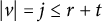
$|v|=j\le r+t$
with
$|v|=j\le r+t$
 , we have

if
$j>r$
 ; and we have

if
$j\le r$
 .
.
Now let
$m=kn+a$
 , so
$m=[wa]_k$
, so
$m=[wa]_k$
 . Then for
$r\ge 0$
. Then for
$r\ge 0$
 and a word v of length at most
$r+t+1$
and a word v of length at most
$r+t+1$
 , if
$|v|>r,$
, if
$|v|>r,$
 then
then

and so we see that this is in X if and only if
$v\in L$
 .
.
Similarly, if
$|v|\le r,$
 then
then

and so this is X if and only if
$v\in L.$
 It follows that
$F(kn+a) = F([wa]_k) \ge kF([w]_k)$
It follows that
$F(kn+a) = F([wa]_k) \ge kF([w]_k)$
 , and the general result now follows.
We now give an argument that shows that when
$F(n)$
 takes some value, we can find an
$n'$
takes some value, we can find an
$n'$
 in X such that
$F(n')\ge F(n)$
in X such that
$F(n')\ge F(n)$
 with the property that
$n'$
with the property that
$n'$
 is bounded above by
$F(n')$
is bounded above by
$F(n')$
 up to a multiplicative constant.
Lemma 3.6 Let
$n\in X$
 . Then there is a fixed natural number
$\alpha $
. Then there is a fixed natural number
$\alpha $
 , depending only on X, such that whenever
$F(n)= k^y> V_{k,a}(n)$
, depending only on X, such that whenever
$F(n)= k^y> V_{k,a}(n)$
 , there exists
$n'\in X$
, there exists
$n'\in X$
 with
$F(n')\ge F(n)$
with
$F(n')\ge F(n)$
 ,
$V_{k,a}(n)=V_{k,a}(n')$
,
$V_{k,a}(n)=V_{k,a}(n')$
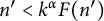
 , and
$n' < k^{\alpha }F(n')$
, and
$n' < k^{\alpha }F(n')$
 .
.
Proof We claim we can take
$\alpha :=M+2$
 , where M is the number of states in our minimal automaton
$\mathcal {A}$
, where M is the number of states in our minimal automaton
$\mathcal {A}$
 . By definition of
$F(n),$
. By definition of
$F(n),$
 we have
$n\ge k^{t-1}$
we have
$n\ge k^{t-1}$
 and so every base-k expansion of n has at least t digits. We pick a base-k expansion
$wu$
and so every base-k expansion of n has at least t digits. We pick a base-k expansion
$wu$
 of n in
$L,$
of n in
$L,$
 where
$w,u\in \Sigma _k^*$
where
$w,u\in \Sigma _k^*$
 and
$|u|=t$
and
$|u|=t$
 . When analyzing Equations (3) and (4), the main difficulty that arises is that carries can occur, either when performing additions or subtractions.
We first note that we may assume that the prefix w is non-empty: if not,
$n=[u]_k <k^{t+1}$
 and so if we take
$n'=n,$
and so if we take
$n'=n,$
 we have
$n'< k^{\alpha } F(n)= k^{\alpha } F(n')$
we have
$n'< k^{\alpha } F(n)= k^{\alpha } F(n')$
 , so the result is clear in this case.
Thus, we assume that w is non-empty and, in this case, it can be written uniquely in the form
$w=w_0 c^{\ell }$
 for some
$\ell \ge 0$
for some
$\ell \ge 0$
 , where
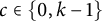
$c\in \{0,k-1\}$
, where
$c\in \{0,k-1\}$
 and
$w_0$
and
$w_0$
 is either empty or a word whose last letter is in
$\{1,2,\ldots ,k-2\}$
is either empty or a word whose last letter is in
$\{1,2,\ldots ,k-2\}$
 .
.
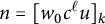
Thus, we now write
$n=[w_0 c^{\ell }u]_k$
 . We consider the cases when
$w_0$
. We consider the cases when
$w_0$
 is empty and when it is not empty separately. To ease arguments, we write
$w_1\sim _L w_2$
is empty and when it is not empty separately. To ease arguments, we write
$w_1\sim _L w_2$
 to mean that either
$w_1$
to mean that either
$w_1$
 and
$w_2$
and
$w_2$
 are both in L or neither is in L.
Case A:
$w_0$
 is not the empty word.
In this case, we write
$w_0 = w_0' s,$
 where
$s\in \{1,2,\ldots ,k-2\}$
where
$s\in \{1,2,\ldots ,k-2\}$
 . Since our minimal automaton
$\mathcal {A}$
. Since our minimal automaton
$\mathcal {A}$
 has at most M states, there is some word
$w_0"$
has at most M states, there is some word
$w_0"$
 of length
$<M$
of length
$<M$
 such that
$\delta (q_0,w_0')=\delta (q_0,w_0")$
such that
$\delta (q_0,w_0')=\delta (q_0,w_0")$
 . We now take
$n' = [w_0"s c^{\min (\ell ,2)} u]_k$
. We now take
$n' = [w_0"s c^{\min (\ell ,2)} u]_k$
 . Notice that
$n' < k^{t+M+2}$
. Notice that
$n' < k^{t+M+2}$
 , so it suffices to show that
$F(n')\ge k^t$
, so it suffices to show that
$F(n')\ge k^t$
 .
.
It now suffices to verify that Equations (3) and (4) hold for words v of length
$t+r$
 for
$n'$
for
$n'$
 . We only consider Equation (3), since Equation (4) is verified in a similar manner.
Since
$F(n)=k^t$
 , by Equation (3), we have for
$r\ge 0$
, by Equation (3), we have for
$r\ge 0$
 and
$|v|\le t+r$
and
$|v|\le t+r$
 , if
$|v|>r,$
, if
$|v|>r,$
 then
then

is in X if and only if
$v\in L$
 . Moreover, observe that the quantity
$k^r [u]_k - [a^{j-r}0^r]_k + [v]_k$
. Moreover, observe that the quantity
$k^r [u]_k - [a^{j-r}0^r]_k + [v]_k$
 is greater than or equal to
$-k^{t+r}+1$
is greater than or equal to
$-k^{t+r}+1$
 and is at most
$2\cdot k^{r+t}-1$
and is at most
$2\cdot k^{r+t}-1$
 .
.
We now look at various subcases.
Subcase (i):
$k^r [u]_k - [a^{j-r}0^r]_k + [v]_k<0$
 ,
$c=k-1$
,
$c=k-1$
 , and
$\ell \ge 2$
, and
$\ell \ge 2$
 . In this case,

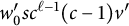
either has base-k expansion of the form
$w_0' s c^{\ell -1} (c-1) v'$
 or of the form
$w_0' s c^{\ell } v'$
or of the form
$w_0' s c^{\ell } v'$
 for some
$v'$
for some
$v'$
 which depends on u and v but not on
$\ell \ge 2$
which depends on u and v but not on
$\ell \ge 2$
 . In particular, since
$k-1$
. In particular, since
$k-1$
 is idempotent with respect to
$\mathcal {A}' $
is idempotent with respect to
$\mathcal {A}' $
 we see that
$w_0' s c^{\ell -1}(c-1) v'\sim _L w_0" s c (c-1)v'$
we see that
$w_0' s c^{\ell -1}(c-1) v'\sim _L w_0" s c (c-1)v'$
 and
$w_0' s c^{\ell -1}v'\sim _L w_0" s ccv' $
and
$w_0' s c^{\ell -1}v'\sim _L w_0" s ccv' $
 . Thus, we see that
$k^r n' - [a^{j-r}0^r]_k + [v]_k\in X \iff v\in L$
. Thus, we see that
$k^r n' - [a^{j-r}0^r]_k + [v]_k\in X \iff v\in L$
 in this case.
Subcase (ii):
$k^r [u]_k - [a^{j-r}0^r]_k + [v]_k<0$
 ,
$c=k-1$
,
$c=k-1$
 , and
$\ell <2$
, and
$\ell <2$
 .
.
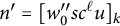
This case is handled similarly to Subcase (i), but where we now use
$n'=[w_0" s c^{\ell } u]_k$
 .
.
Subcase (iii):
$k^r [u]_k - [a^{j-r}0^r]_k + [v]_k<0$
 ,
$c=0$
,
$c=0$
 , and
$\ell \ge 2$
, and
$\ell \ge 2$
 . In this case,

either has base-k expansion of the form
$w_0' (s-1) (k-1)^{\ell } v'$
 or of the form
$w_0' s c^{\ell } v'$
or of the form
$w_0' s c^{\ell } v'$
 for some
$v'$
for some
$v'$
 which depends on u and v but not on
$\ell \ge 2$
which depends on u and v but not on
$\ell \ge 2$
 . Then, using the fact that
$c=0$
. Then, using the fact that
$c=0$
 is idempotent with respect to
$\mathcal {A}'$
is idempotent with respect to
$\mathcal {A}'$
 we see as in Subcase (i) that if
$n'=[w_0" s 0^{\ell }]_k$
we see as in Subcase (i) that if
$n'=[w_0" s 0^{\ell }]_k$
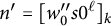 , then
$k^r n' - [a^{j-r}0^r]_k + [v]_k\in X \iff v\in L$
, then
$k^r n' - [a^{j-r}0^r]_k + [v]_k\in X \iff v\in L$
 .
.
Subcase (iv):
$k^r [u]_k - [a^{j-r}0^r]_k + [v]_k<0$
 ,
$c=0$
,
$c=0$
 , and
$\ell <2$
, and
$\ell <2$
 .
.
This case is handled similarly to Subcase (ii), but where we now use
$n'=[w_0" s c^{\ell } u]_k$
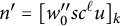 .
.
Subcase (v):
$k^r [u]_k - [a^{j-r}0^r]_k + [v]_k\ge 0$
 ,
$c=k-1$
,
$c=k-1$
 , and
$\ell \ge 2$
, and
$\ell \ge 2$
 .
.
In this case,

either has base-k expansion of the form
$w_0' (s+1) 0^{\ell } v'$
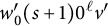 or of the form
$w_0' s (k-1)^{\ell } v'$
or of the form
$w_0' s (k-1)^{\ell } v'$
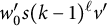 for some
$v'$
for some
$v'$
 which depends on u and v but not on
$\ell \ge 2$
which depends on u and v but not on
$\ell \ge 2$
 . In this case, we argue as in Subcase (i) with
$n'=[w_0" s c^{2}u]_k$
. In this case, we argue as in Subcase (i) with
$n'=[w_0" s c^{2}u]_k$
 .
.
Subcase (vi):
$k^r [u]_k - [a^{j-r}0^r]_k + [v]_k\ge 0$
 ,
$c=k-1$
,
$c=k-1$
 , and
$\ell < 2$
, and
$\ell < 2$
 .
.
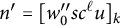
Here, we argue similarly in Subcase (iv) with
$n' = [w_0" s c^{\ell }u]_k$
 .
.
Subcase (vii):
$k^r [u]_k - [a^{j-r}0^r]_k + [v]_k\ge 0$
 ,
$c=0$
,
$c=0$
 , and
$\ell \ge 2$
, and
$\ell \ge 2$
 .
.
In this case,

either has base-k expansion of the form
$w_0' s 0^{\ell -1} 1 v'$
 or of the form
$w_0' s 0^{\ell } v'$
or of the form
$w_0' s 0^{\ell } v'$
 for some
$v'$
for some
$v'$
 which depends on u and v but not on
$\ell \ge 2$
which depends on u and v but not on
$\ell \ge 2$
 . Then we argue as in the earlier subcases with
$n'=[w_0" s 0^2 u]_k$
. Then we argue as in the earlier subcases with
$n'=[w_0" s 0^2 u]_k$
 .
.
Subcase (viii):
$k^r [u]_k - [a^{j-r}0^r]_k + [v]_k\ge 0$
 ,
$c=0$
,
$c=0$
 , and
$\ell <2$
, and
$\ell <2$
 .
.
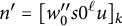
This is done as in the previous subcase with
$n'=[w_0" s 0^{\ell } u]_k$
 .
.
Case B:
$w_0$
 is the empty word. This case is done similarly to Case A, where we take
$n' = [c^{\min (\ell , 2)} u]_k$
is the empty word. This case is done similarly to Case A, where we take
$n' = [c^{\min (\ell , 2)} u]_k$
 . Thus, we have found
$n'\in X$
. Thus, we have found
$n'\in X$
 with
$F(n')\ge k^t$
with
$F(n')\ge k^t$
 and
$n'\le k^{M+2}k^t.$
and
$n'\le k^{M+2}k^t.$

Definition 3.7 We say that two positive integers
$n_1, n_2$
 are
$(k,a)$
are
$(k,a)$
 -equivalent if there is some
$i\ge 0$
-equivalent if there is some
$i\ge 0$
 such that either
$n_1=k^i n_2 + (k^i-1)a/(k-1)$
such that either
$n_1=k^i n_2 + (k^i-1)a/(k-1)$
 or
$n_2= k^i n_1 + (k^i-1) a/(k-1)$
or
$n_2= k^i n_1 + (k^i-1) a/(k-1)$
 .
.
This notion of
$(k,a)$
 -equivalence is easily seen to be an equivalence relation, and intuitively, it says that
$n_1$
-equivalence is easily seen to be an equivalence relation, and intuitively, it says that
$n_1$
 and
$n_2$
and
$n_2$
 are equivalent if the base-k expansion of one can be obtained from the other by either appending a suffix of a’s at the end or by deleting a string of a’s at the end.
In the following lemma, we will use Mahler series to prove that an automatic set that is periodic on a sufficiently long interval is necessarily eventually periodic. A power series
$h(t)\in \mathbb {Z}[[t]]$
 is k-Mahler, if it satisfies a nontrivial equation

with
$P_0P_r\neq 0$
 and
$P_0,\ldots ,P_r$
and
$P_0,\ldots ,P_r$
 polynomials in t. If
$h(t)$
polynomials in t. If
$h(t)$
 is the characteristic function of a k-automatic set, then
$h(t)$
is the characteristic function of a k-automatic set, then
$h(t)$
 is k-regular [Reference Allouche and Shallit1] and thus k-Mahler [Reference Becker4]. For a power series
$f(t)\in \mathbb {Z}[[t]],$
is k-regular [Reference Allouche and Shallit1] and thus k-Mahler [Reference Becker4]. For a power series
$f(t)\in \mathbb {Z}[[t]],$
 we write
$f(t)=O(t^N)$
we write
$f(t)=O(t^N)$
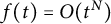 to mean that
$f(t)\in t^N\mathbb {Z}[[t]]$
to mean that
$f(t)\in t^N\mathbb {Z}[[t]]$
 .
.
Lemma 3.8 Let T be a k-automatic set and let
$C\ge 0$
 . Then there exists a natural number N depending only on T and C, such that if there is some
$p \ge 1$
. Then there exists a natural number N depending only on T and C, such that if there is some
$p \ge 1$
 such that
$n+p \in T\iff n\in T$
such that
$n+p \in T\iff n\in T$
 for
$n\in [Cp, Np)$
for
$n\in [Cp, Np)$
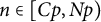 , then T is eventually periodic.
Proof Let
$h(t)\in \mathbb {Z}[[t]]$
 be the characteristic function of T. Then h is k-Mahler and so it satisfies a nontrivial k-Mahler equation as given in Equation (6).
The condition that
$j+p \in T\iff j\in T$
 for
$j+p\in [Cp,Np)$
for
$j+p\in [Cp,Np)$
 says that
$h(t) (1-t^p) = q(t) + O(t^{(N-1)\ell })$
says that
$h(t) (1-t^p) = q(t) + O(t^{(N-1)\ell })$
 for some polynomial q of degree
$<(C+1)p$
for some polynomial q of degree
$<(C+1)p$
 . Then

Multiplying through by
$1-t^{p k^r}$
 , we then see

Now let M denote the maximum of the degrees of
$P_0,\ldots ,P_r$
 . Then the left-hand side has degree at most
$M+k^r p(C+1)$
. Then the left-hand side has degree at most
$M+k^r p(C+1)$
 . Thus, if
$M+k^{r} p(C+1) < (N-1)p$
. Thus, if
$M+k^{r} p(C+1) < (N-1)p$
 , then the left-hand side must be identically zero. In particular, taking
$N\ge M+k^r(C+2)+1$
, then the left-hand side must be identically zero. In particular, taking
$N\ge M+k^r(C+2)+1$
 gives that the left-hand side vanishes. But now we claim that
$h(t)$
gives that the left-hand side vanishes. But now we claim that
$h(t)$
 must be equal to
$q(t)/(1-t^{\ell })$
must be equal to
$q(t)/(1-t^{\ell })$
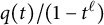 . To see this, we note that, if this is not the case, then we may write
$h(t) = q(t)/(1-t^{\ell }) + t^e h_0(t)$
. To see this, we note that, if this is not the case, then we may write
$h(t) = q(t)/(1-t^{\ell }) + t^e h_0(t)$
 with
$h_0(0)\neq 0$
with
$h_0(0)\neq 0$
 and
and

Then since

and

we must have

But notice that all terms in the left-hand side other than
$P_0(t) t^{e} h_0(t)$
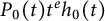 vanish to order at least
$ek$
vanish to order at least
$ek$
 at
$t=0$
at
$t=0$
 , while
$P_0(t) t^{e} h_0(t)$
, while
$P_0(t) t^{e} h_0(t)$
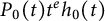 vanishes to order at most
$t^e + \mathrm {deg}(P_0)\le e+M$
vanishes to order at most
$t^e + \mathrm {deg}(P_0)\le e+M$
 at
$t=0$
at
$t=0$
 . Since
$e+M < ke$
. Since
$e+M < ke$
 , we get that
$h(t)=q(t)/(1-t^p)$
, we get that
$h(t)=q(t)/(1-t^p)$
 , and so
$h(t)$
, and so
$h(t)$
 is a rational function whose coefficients lie in
$\{0,1\}$
is a rational function whose coefficients lie in
$\{0,1\}$
 and so the sequence of coefficients of
$h(t)$
and so the sequence of coefficients of
$h(t)$
 is eventually periodic. Thus, T is eventually periodic.
We now show that when X is not eventually periodic that
$F(n)/V_{k,a}(n)$
 is bounded above. This is the most technical part of the proof of Theorem 3.1 in cases (I) and (II) and is done via two technical lemmas.
Lemma 3.9 Suppose that there are natural numbers M and P such that for all words
$v, v'$
 with
$|v'|=|v|=p \le M$
with
$|v'|=|v|=p \le M$
 and
$[v']_k=P+[v]_k$
and
$[v']_k=P+[v]_k$
 , we have

Then
$x\in X\iff x+P\in X$
 for all
$x\in [kP, k^M-P).$
for all
$x\in [kP, k^M-P).$

Proof Suppose that v and
$v'$
 are words with no leading zeros such that
$[v']_k = [v]_k+P$
are words with no leading zeros such that
$[v']_k = [v]_k+P$
 and
$|v|,|v'| \le \log _k(\min (F(n_i)k^c, F(n_j)))$
and
$|v|,|v'| \le \log _k(\min (F(n_i)k^c, F(n_j)))$
 . We now consider cases (I) and (II) separately.
When we are in Case (II): In this case, let
$v,v'$
 be words with no leading zeros such that
$[v']_k = [v]_k+P$
be words with no leading zeros such that
$[v']_k = [v]_k+P$
 and
$[v']_k=m$
and
$[v']_k=m$
 . If
$i=|v|=|v'|,$
. If
$i=|v|=|v'|,$
 then by construction,

and since we are in case (II), we see that
$[v]_k\in X\iff [v']_k\in X$
 . On the other hand, if v and
$v'$
. On the other hand, if v and
$v'$
 don’t have the same length, then we similarly have
$0^{|v'|-|v|}v\in L \iff v'\in L$
don’t have the same length, then we similarly have
$0^{|v'|-|v|}v\in L \iff v'\in L$
 and since we are in case (II),
$0^{|v'|-|v|}v\not \in L$
and since we are in case (II),
$0^{|v'|-|v|}v\not \in L$
 and hence
$v'\not \in L$
and hence
$v'\not \in L$
 and so
$[v']_k\not \in X$
and so
$[v']_k\not \in X$
 in this case. Thus, we always have that if
$m\in X$
in this case. Thus, we always have that if
$m\in X$
 and
$m>P,$
and
$m>P,$
 then
$m-P\in X$
then
$m-P\in X$
 . Now suppose that
$m-P\in X$
. Now suppose that
$m-P\in X$
 but
$m\not \in X$
but
$m\not \in X$
 . Now pick the smallest positive integer s such that
$k^s> P$
. Now pick the smallest positive integer s such that
$k^s> P$
 . We claim that
$X\cap [k^s, k^M)$
. We claim that
$X\cap [k^s, k^M)$
 is empty. To see this, suppose that this is not the case and pick the smallest
$m\in X\cap [k^s, k^M)$
is empty. To see this, suppose that this is not the case and pick the smallest
$m\in X\cap [k^s, k^M)$
 . Since
$m\in X\implies m-P\in X$
. Since
$m\in X\implies m-P\in X$
 for
$m>P$
for
$m>P$
 , we see that
$m\in [k^s, k^s+P)$
, we see that
$m\in [k^s, k^s+P)$
 . Hence,
$m-P<k^s$
. Hence,
$m-P<k^s$
 and so if v and
$v'$
and so if v and
$v'$
 are base-k expansions of
$m-P$
are base-k expansions of
$m-P$
 and
$m,$
and
$m,$
 respectively, and
$v'$
respectively, and
$v'$
 has no leading zeros, then if
$|v|=|v'|,$
has no leading zeros, then if
$|v|=|v'|,$
 then v necessarily has a leading zero. And so from the argument above since
$v\not \in L,$
then v necessarily has a leading zero. And so from the argument above since
$v\not \in L,$
 we then have
$v'\not \in L$
we then have
$v'\not \in L$
 and so
$m\not \in X$
and so
$m\not \in X$
 , a contradiction. Thus,
$X\cap [k^s, k^M)$
, a contradiction. Thus,
$X\cap [k^s, k^M)$
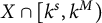 is empty and since
$k^s\le kP$
is empty and since
$k^s\le kP$
 ,
$x\in X\iff x+P\in X$
,
$x\in X\iff x+P\in X$
 for all
$x\in [kP, k^M-P)$
for all
$x\in [kP, k^M-P)$
 . Thus, the result follows when we are in Case II. When we are in Case (I):
Let
$m<k^{M}-P$
 be a positive integer and let
$v,v'$
be a positive integer and let
$v,v'$
 be words with
$[v]_k=m$
be words with
$[v]_k=m$
 and
$[v']_k=m+P$
and
$[v']_k=m+P$
 . Since we are in case (I), we may pad v with leading zeros and assume that
$|v|=|v'|$
. Since we are in case (I), we may pad v with leading zeros and assume that
$|v|=|v'|$
 . Then we see that

and since we are in case (I), we see that
$[v]_k\in X\iff [v']_k\in X$
 . Hence, we have that
$m\in X$
. Hence, we have that
$m\in X$
 if and only
$m+P\in X$
if and only
$m+P\in X$
 for all
$m<k^M-P$
for all
$m<k^M-P$
 . So the result follows in this case.
Lemma 3.10 If X is not eventually periodic, then
$F(n)/V_{k,a}(n)$
 is bounded above.
Proof Suppose, toward a contradiction, that
$F(n)/V_{k,a}(n)$
 is not bounded above. Then there exists a sequence
$n_1, n_2, n_3, \ldots $
is not bounded above. Then there exists a sequence
$n_1, n_2, n_3, \ldots $
 in X with
$F(n_i)/V_{k,a}(n_i)> k^{i}$
in X with
$F(n_i)/V_{k,a}(n_i)> k^{i}$
 for all i. By Lemma 3.6, we can replace each
$n_i$
for all i. By Lemma 3.6, we can replace each
$n_i$
 by a corresponding
$n_i'$
by a corresponding
$n_i'$
 and assume additionally that
$n_i < k^{\alpha } F(n_i)$
and assume additionally that
$n_i < k^{\alpha } F(n_i)$
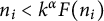 for some fixed
$\alpha $
for some fixed
$\alpha $
 that does not depend on i and depends only on X.
In particular, by Lemma 3.5, we have

for all
$r\ge 0$
 . Moreover, since
$n_i < k^{\alpha } F(n_i)\in k^{\mathbb {N}}$
. Moreover, since
$n_i < k^{\alpha } F(n_i)\in k^{\mathbb {N}}$
 , we have

Thus, by Equation (5), we see that

and so

for all
$r\ge 0$
 .
.
In particular, if
$n_i < n_j$
 and
$n_i$
and
$n_i$
 and
$n_j$
and
$n_j$
 are
$(k,a)$
are
$(k,a)$
 -equivalent, then we must have

for some
$r\ge 0$
 and so from the above, we have

Thus, since
$n_j\to \infty $
 and
$F(n_j)/V_{k,a}(n_j)\to \infty $
and
$F(n_j)/V_{k,a}(n_j)\to \infty $
 , we may refine our sequence
$(n_i)$
, we may refine our sequence
$(n_i)$
 if necessary that we may assume that they are pairwise
$(k,a)$
if necessary that we may assume that they are pairwise
$(k,a)$
 -inequivalent. Now, for each positive integer n, we let
$t(n)$
-inequivalent. Now, for each positive integer n, we let
$t(n)$
 denote the unique natural number t such that
$k^{t-1}\le n < k^{t}$
denote the unique natural number t such that
$k^{t-1}\le n < k^{t}$
 . Then the sequence
$(n_i/k^{t(n_i)})$
. Then the sequence
$(n_i/k^{t(n_i)})$
 lies in the compact set
$[1/k,1]$
lies in the compact set
$[1/k,1]$
 and so by the Bolzano–Weierstrass theorem, it has a convergent subsequence. In particular, since X is not eventually periodic, by Lemma 3.8, there is a natural number N such that whenever
$p>0$
and so by the Bolzano–Weierstrass theorem, it has a convergent subsequence. In particular, since X is not eventually periodic, by Lemma 3.8, there is a natural number N such that whenever
$p>0$
 is such that
$x\in X \iff x+p\in X$
is such that
$x\in X \iff x+p\in X$
 for all
$x\in [pk, M),$
for all
$x\in [pk, M),$
 we necessarily have
$M<Np$
we necessarily have
$M<Np$
 .
.
Choose
$\epsilon \in (0,1/2k)$
 so that

we see that we may find
$(k,a)$
 -inequivalent
$n_i$
-inequivalent
$n_i$
 and
$n_j$
and
$n_j$
 in this subsequence (by assumption) such that

and we may assume in addition that
$n_i<n_j$
 and that
$n_i> (a+1)(1+k\epsilon )/\epsilon $
and that
$n_i> (a+1)(1+k\epsilon )/\epsilon $
 . We let

Then, after multiplying both sides of Equation (10) by
$k^{t(n_j)}$
 , we have

In particular,

and

Now we let
$P:=n_i k^c + (k^c-1)a/(k-1) - n_j$
 , which is bounded above by
$kn_j \epsilon + ak^c$
, which is bounded above by
$kn_j \epsilon + ak^c$
 . We consider only the case when
$P>0$
. We consider only the case when
$P>0$
 , with the case when
$P<0$
, with the case when
$P<0$
 being handled similarly. Then since
$F(n_i)\ge k^i$
being handled similarly. Then since
$F(n_i)\ge k^i$
 , we see that
$F(k^c n_i+(k^c-1)a/(k-1))\ge k^{i+c}$
, we see that
$F(k^c n_i+(k^c-1)a/(k-1))\ge k^{i+c}$
 by Lemma 3.5. Thus, using Equations (3) and (4) with
$r=0$
by Lemma 3.5. Thus, using Equations (3) and (4) with
$r=0$
 , we see that for all words v with
$|v|=p \le \log _k(\min (F(n_i)k^c, F(n_j))),$
, we see that for all words v with
$|v|=p \le \log _k(\min (F(n_i)k^c, F(n_j))),$
 we have

Thus, by our definition of
$P,$
 we have

for
$|v| =p \le \log _k(\min (F(n_i)k^c, F(n_j)))$
 . But by definition of
$n_j$
. But by definition of
$n_j$
 , we also have

for
$|v| =p \le \log _k(\min (F(n_i)k^c, F(n_j)))$
 . It follows that if
$v,v'$
. It follows that if
$v,v'$
 are words of the same length
$p\le \log _k(\min (F(n_i)k^c, F(n_j)))$
are words of the same length
$p\le \log _k(\min (F(n_i)k^c, F(n_j)))$
 with
$[v']_k=[v]_k+P$
with
$[v']_k=[v]_k+P$
 then
then

It now follows from Lemma 3.9 that
$x\in X\iff x+P\in X$
 for all
$x\in [kP, \min (F(n_i)k^c, F(n_j))-P)$
for all
$x\in [kP, \min (F(n_i)k^c, F(n_j))-P)$
 . Observe that, by Equation (12), we have

Recall that we refined our sequence of
$n_{\ell }$
 ’s earlier and so we have
$n_i> (a+1)(1+k\epsilon )/\epsilon $
’s earlier and so we have
$n_i> (a+1)(1+k\epsilon )/\epsilon $
 and thus we have
$P(N+1)< 2kn_j (N+1)\epsilon $
and thus we have
$P(N+1)< 2kn_j (N+1)\epsilon $
 .
.
Now, by our choice of
$n_{\ell }$
 ’s, we have
$F(n_j)> k^{-\alpha } n_j$
’s, we have
$F(n_j)> k^{-\alpha } n_j$
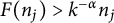 and, by our choice of
$\epsilon ,$
and, by our choice of
$\epsilon ,$
 we then have
$2k (N+1)\epsilon n_j < F(n_j)$
we then have
$2k (N+1)\epsilon n_j < F(n_j)$
 . We similarly have

since
$\epsilon <1/2k$
 . Thus, we again have
$2k(N+1)\epsilon n_j < k^c F(n_i)$
. Thus, we again have
$2k(N+1)\epsilon n_j < k^c F(n_i)$
 . Hence,
$P(N+1) < \min (F(n_j), k^c F(n_i))$
. Hence,
$P(N+1) < \min (F(n_j), k^c F(n_i))$
 . It follows that
$x\in X\iff x+P\in X$
. It follows that
$x\in X\iff x+P\in X$
 for
$x\in [kP, PN)]$
for
$x\in [kP, PN)]$
 , but by our choice of
$N,$
, but by our choice of
$N,$
 this cannot hold since X is not eventually periodic.
We now show that
$V_k$
 can be defined using the map F, continuing with the notation introduced above and under the assumption that X is neither Presburger definable nor sparse.
By Lemmas 3.4 and 3.10, the ratio
$F(n)/V_{k,a}(n)$
 is bounded above and below for
$n \in X$
is bounded above and below for
$n \in X$
 , and hence there exists a finite set of integers
$\{i_1, \ldots , i_r\}$
, and hence there exists a finite set of integers
$\{i_1, \ldots , i_r\}$
 such that

for all
$n \in X$
 .
.
Define
$\tilde {X}$
 as follows:

where t is the largest natural number such that
$k^t \le n$
 . We note that we can define X from
$\tilde {X}$
. We note that we can define X from
$\tilde {X}$
 via the rule

where s is the unique nonnegative integer such that

We note that the map from
$\tilde {X}$
 to X and the map from X to
$\tilde {X}$
to X and the map from X to
$\tilde {X}$
 described in Equations (14) and (15) are inverses of one another and so these maps give bijections between the sets.
We define a map
$\tilde {F}: \tilde {X} \to k^{\mathbb {N}}$
 by
by

where t is again the largest natural number such that
$k^t \le n$
 .
.
Both
$\tilde {X}$
 and
$\tilde {F}$
and
$\tilde {F}$
 are definable in the structure
$(\mathbb {N}, +, X, k^{\mathbb {N}})$
are definable in the structure
$(\mathbb {N}, +, X, k^{\mathbb {N}})$
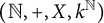 by construction, and since X is k-automatic but not Presburger definable, it follows from Fact 2.17 that
$k^{\mathbb {N}}$
by construction, and since X is k-automatic but not Presburger definable, it follows from Fact 2.17 that
$k^{\mathbb {N}}$
 is definable in
$(\mathbb {N}, +, X)$
is definable in
$(\mathbb {N}, +, X)$
 . Thus, to complete the proof of Theorem 3.1, we assume that X is neither sparse nor eventually periodic and show that
$V_k$
. Thus, to complete the proof of Theorem 3.1, we assume that X is neither sparse nor eventually periodic and show that
$V_k$
 is definable using
$\tilde {X}$
is definable using
$\tilde {X}$
 and
$\tilde {F}$
and
$\tilde {F}$
 .
.
Lemma 3.11 Adopt the notation above and suppose that X is neither sparse not eventually periodic. Then the following hold:
-
(i) $\tilde {F}(n)/V_k(n)$
is bounded above and below by constants for
$n \in \tilde {X}$
; -
(ii) $\tilde {X}$
is not sparse; -
(iii) if $n \in \tilde {X}$
, then
$kn \in \tilde {X}$
; -
(iv) $\tilde {F}(kn) \ge k \cdot \tilde {F}(n)$
for
$n \in \tilde {X}$
.
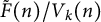




Proof Let
$n \in \tilde {X}$
 and let t be the unique natural number such that
$k^t \le n < k^{t+1}$
and let t be the unique natural number such that
$k^t \le n < k^{t+1}$
 . We take
$m := n + \frac {k^t - 1}{k - 1}a$
. We take
$m := n + \frac {k^t - 1}{k - 1}a$
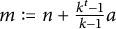 and note that m lies in X by definition of
$\tilde {X}$
and note that m lies in X by definition of
$\tilde {X}$
 . By definition,

Notice that if the base-k expansion of n ends with precisely s zeros, then the base-k expansion of m ends with exactly s copies of a. Hence,

Since
$F(m)/V_{k,a}(m)$
 is bounded above and below for
$m \in X$
is bounded above and below for
$m \in X$
 by Lemmas 3.4 and 3.10, we deduce that
$\tilde {F}(n)/V_k(n)$
by Lemmas 3.4 and 3.10, we deduce that
$\tilde {F}(n)/V_k(n)$
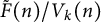 is also bounded above and below. This proves part (i).
To prove part (ii), we note that, by Equation (15), we have a surjective map h from the positive elements of X to the positive elements of
$\tilde {X}$
 given by

where s is the unique integer satisfying

As noted by Equations (14) and (15), the map h is injective and since
$h(m)\le m$
 , we see that the number of elements in
$\tilde {X}$
, we see that the number of elements in
$\tilde {X}$
 up to a positive integer x is at least as large as the number of elements in X up to x, and so
$\tilde {X}$
up to a positive integer x is at least as large as the number of elements in X up to x, and so
$\tilde {X}$
 is not sparse since X is not sparse.
For part (iii), suppose
$n \in \tilde {X}$
 , so that
$m = n + \frac {k^t - 1}{k - 1}a \in X$
, so that
$m = n + \frac {k^t - 1}{k - 1}a \in X$
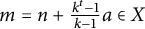 . Then

Since
$m \in X$
 and X is closed under the map
$n \mapsto kn + a$
and X is closed under the map
$n \mapsto kn + a$
 , it follows that
$km + a \in X$
, it follows that
$km + a \in X$
 , and hence
$kn \in \tilde {X}$
, and hence
$kn \in \tilde {X}$
 . This proves (iii).
Finally, for part (iv), note from the above that

Since
$F(kn + a) \ge kF(n)$
 holds for all
$n \in X$
holds for all
$n \in X$
 and
$m \in X$
and
$m \in X$
 , we conclude that

This completes the proof of part (iv).
Lemma 3.12 Adopt the notation above. If X is neither sparse nor eventually periodic, then there exists a subset
$Y\subseteq \mathbb {N}$
 and a map
$H:Y\to k^{\mathbb {N}}$
and a map
$H:Y\to k^{\mathbb {N}}$
 with the following properties:
-
(i) Y and H are both definable in $(\mathbb {N},+,X)$
; -
(ii) for $n\in Y$
,
$H(n)/V_k(n)$
takes only finitely many distinct values and
$H(n)\le V_k(n)$
for all
$n\in Y$
; -
(iii) the set $Y_0$
of
$n\in Y$
for which
$H(n)=V_k(n)$
is not sparse and contains
$1$
; -
(iv) if $n\in Y_0$
, then
$kn\in Y_0$
.









Proof By Lemma 3.11, there exists a non-sparse set
$\tilde {X}$
 with a definable map
$\tilde {F}: \tilde {X}\to k^{\mathbb {N}}$
with a definable map
$\tilde {F}: \tilde {X}\to k^{\mathbb {N}}$
 such that
$\tilde {F}(n)/V_k(n)$
such that
$\tilde {F}(n)/V_k(n)$
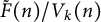 is bounded above and satisfies properties (iii) and (iv) in the statement of the lemma. In particular,
$\tilde {F}(n)/V_k(n)$
is bounded above and satisfies properties (iii) and (iv) in the statement of the lemma. In particular,
$\tilde {F}(n)/V_k(n)$
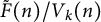 assumes finitely many values for
$n\in X$
assumes finitely many values for
$n\in X$
 , say
$k^{p_1},\ldots ,k^{p_e}$
, say
$k^{p_1},\ldots ,k^{p_e}$
 with
$p_1<p_2<\cdots < p_e$
with
$p_1<p_2<\cdots < p_e$
 . We let

Then since
$\tilde {X}$
 is not sparse, at least one set
$T_i$
is not sparse, at least one set
$T_i$
 is not sparse and we let j denote the largest index for which
$T_j$
is not sparse and we let j denote the largest index for which
$T_j$
 is not sparse. Then
$T_i$
is not sparse. Then
$T_i$
 is sparse for
$i>j$
is sparse for
$i>j$
 and hence definable in
$(\mathbb {N},+,X)$
and hence definable in
$(\mathbb {N},+,X)$
 , since X is not Presburger definable. We now take

Then
$T_i'$
 is again sparse for
$i>j$
is again sparse for
$i>j$
 and therefore definable in
$(\mathbb {N},+,X)$
and therefore definable in
$(\mathbb {N},+,X)$
 . Thus, we can define the set

in
$(\mathbb {N},+,X)$
 , and for
$n\in X_0$
, and for
$n\in X_0$
 , we have
$\tilde {F}(n)/V_k(n)$
, we have
$\tilde {F}(n)/V_k(n)$
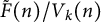 is bounded above by
$k^{p_j}$
is bounded above by
$k^{p_j}$
 and, moreover, this value is achieved on a non-sparse subset of
$X_0$
and, moreover, this value is achieved on a non-sparse subset of
$X_0$
 .
.
We now claim that, if
$n\in X_0$
 and
$s\ge 0,$
and
$s\ge 0,$
 then
$k^s n\in X_0$
then
$k^s n\in X_0$
 . To see this, suppose that
$n\in X_0$
. To see this, suppose that
$n\in X_0$
 and
$k^s n\not \in X_0$
and
$k^s n\not \in X_0$
 . Then
$n\in X_0\subseteq \tilde {X}$
. Then
$n\in X_0\subseteq \tilde {X}$
 , so
$k^s n\in \tilde {X}$
, so
$k^s n\in \tilde {X}$
 by Lemma 3.11(iii) and thus
$k^s n\in \tilde {X}\setminus X_0$
by Lemma 3.11(iii) and thus
$k^s n\in \tilde {X}\setminus X_0$
 . It follows that
$k^s n\in T_i'$
. It follows that
$k^s n\in T_i'$
 for some
$i>j$
for some
$i>j$
 and so there is some
$\ell $
and so there is some
$\ell $
 such that
$k^{s+\ell } n\in T_i$
such that
$k^{s+\ell } n\in T_i$
 . But this gives
$n\in T_i'$
. But this gives
$n\in T_i'$
 by definition and hence
$n\not \in X_0$
by definition and hence
$n\not \in X_0$
 , a contradiction.
Since we can define
$k^{\mathbb {N}}$
 in
$(\mathbb {N},+,X)$
in
$(\mathbb {N},+,X)$
 by Fact 2.17, we see we can define the set

and the map
$H:Y\to k^{\mathbb {N}}$
 given by

for
$n\in X_0\setminus k^{\mathbb {N}}$
 and
$H(n)=n$
and
$H(n)=n$
 for
$n\in k^{\mathbb {N}}$
for
$n\in k^{\mathbb {N}}$
 . This completes the construction of the set Y and the map H, which satisfy properties (i)–(iv).
We can now finally prove our main result of this section. Namely, we show that under the following assumptions on
$X\subseteq \mathbb {N}$
 , the structure
$(\mathbb {N},+,k^{\mathbb {N}})$
, the structure
$(\mathbb {N},+,k^{\mathbb {N}})$
 defines the function
$V_k$
defines the function
$V_k$
 . Those assumptions are that X a k-automatic, but not definable in
$(\mathbb {N},+,k^{\mathbb {N}})$
. Those assumptions are that X a k-automatic, but not definable in
$(\mathbb {N},+,k^{\mathbb {N}})$
 , and furthermore there is an automaton
$\mathcal {A}$
, and furthermore there is an automaton
$\mathcal {A}$
 recognizing X such that either
$\delta (p,0)=\{p\}$
recognizing X such that either
$\delta (p,0)=\{p\}$
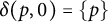 for some state p in
$\mathcal {A}$
for some state p in
$\mathcal {A}$
 , or there exist states p and
$p'$
, or there exist states p and
$p'$
 in
$\mathcal {A}$
in
$\mathcal {A}$
 such that
$\delta (p,0)=\varnothing $
such that
$\delta (p,0)=\varnothing $
 or
$\delta (p,0)=\{p'\}$
or
$\delta (p,0)=\{p'\}$
 , where
$p'$
, where
$p'$
 is in a different strongly connected component from p.
Proof of Theorem 3.1 in Cases I and II
We may assume without loss of generality that X is neither sparse nor eventually periodic. Hence, by Lemma 3.12, we can define a set Y such that properties (i)–(iv) from the statement of the lemma hold. So there is a set
$Y_0$
 (as described in Lemma 3.12) of
$n\in Y$
(as described in Lemma 3.12) of
$n\in Y$
 for which
$H(n)=V_k(n)$
for which
$H(n)=V_k(n)$
 contains
$1$
contains
$1$
 and is not sparse. Note that this
$Y_0$
and is not sparse. Note that this
$Y_0$
 is not a priori definable in
$(\mathbb {N},+,X)$
is not a priori definable in
$(\mathbb {N},+,X)$
 since we do not assume that
$V_k$
since we do not assume that
$V_k$
 is definable in this structure, though
$Y_0$
is definable in this structure, though
$Y_0$
 is clearly k-automatic. By [Reference Bell, Hare and Shallit5], there is a natural number P such that every natural number is a sum of at most P elements from
$Y_0$
is clearly k-automatic. By [Reference Bell, Hare and Shallit5], there is a natural number P such that every natural number is a sum of at most P elements from
$Y_0$
 .
.
Now we define a map
$G:\mathbb {N}\to k^{\mathbb {N}}$
 by the rule

for
$n\ge 1$
 and where we take
$G(0)=1$
and where we take
$G(0)=1$
 . By construction, this map G is definable in
$(\mathbb {N},+,X)$
. By construction, this map G is definable in
$(\mathbb {N},+,X)$
 , since both Y and the map H are.
We claim that
$G(n)=V_k(n)$
 , which will complete the proof of the theorem, since we will then have defined
$V_k$
, which will complete the proof of the theorem, since we will then have defined
$V_k$
 and all k-automatic sets are definable from
$V_k$
and all k-automatic sets are definable from
$V_k$
 . Notice that if
$V_k(n)=k^j$
. Notice that if
$V_k(n)=k^j$
 and if
$i_1+\cdots +i_r=n$
and if
$i_1+\cdots +i_r=n$
 with
$i_1,\ldots ,i_r\in Y$
with
$i_1,\ldots ,i_r\in Y$
 , then we must have
$V_k(i_s) \le k^j$
, then we must have
$V_k(i_s) \le k^j$
 for some s. Since
$H|_Y \le (V_k)|_Y$
for some s. Since
$H|_Y \le (V_k)|_Y$
 , we then see that
$H(i_s)\le k^j$
, we then see that
$H(i_s)\le k^j$
 and so
$\min (H(i_1),\ldots ,H(i_r))\le k^j$
and so
$\min (H(i_1),\ldots ,H(i_r))\le k^j$
 . Thus, we see that
$G(n)\le V_k(n)$
. Thus, we see that
$G(n)\le V_k(n)$
 . We now show that
$G(n)\ge V_k(n)$
. We now show that
$G(n)\ge V_k(n)$
 . Write
$n=k^s n_0$
. Write
$n=k^s n_0$
 with
$s\ge 0$
with
$s\ge 0$
 ,
$n_0\ge 1$
,
$n_0\ge 1$
 , and
$k\nmid n_0$
, and
$k\nmid n_0$
 . Then we can write
$n_0 = i_1+\cdots + i_r$
. Then we can write
$n_0 = i_1+\cdots + i_r$
 for some
$r\le P$
for some
$r\le P$
 and
$i_1,\ldots ,i_r\in Y_0$
and
$i_1,\ldots ,i_r\in Y_0$
 . Then
$i_1 k^s, \ldots , i_r k^s \in Y_0$
. Then
$i_1 k^s, \ldots , i_r k^s \in Y_0$
 and so by definition of the set
$Y_0$
and so by definition of the set
$Y_0$
 , we have
$H(i_j k^s) = V_k(i_j k^s)\ge k^s$
, we have
$H(i_j k^s) = V_k(i_j k^s)\ge k^s$
 for
$j=1,\ldots ,r$
for
$j=1,\ldots ,r$
 , and so
$G(n)\ge \min (V_k(i_1 k^s), \dots , V_k(i_r k^s))\ge k^s$
, and so
$G(n)\ge \min (V_k(i_1 k^s), \dots , V_k(i_r k^s))\ge k^s$
 . Thus, we obtain the desired lower bound. This completes the proof for the cases in question.
3.2 Proof of Theorem 3.1 in Case (III)
In this section, we give the proof of Theorem 3.1 in Case (III). To handle Case (III), we require a few basic lemmas.
Lemma 3.13 Let Z be a k-automatic subset of
$\mathbb {N}$
 that is not Presburger definable and let
$\mathcal {A} = (Q, \{q_0\}, \Sigma _k, \delta , W)$
that is not Presburger definable and let
$\mathcal {A} = (Q, \{q_0\}, \Sigma _k, \delta , W)$
 be a trim, minimized, deterministic automaton that accepts precisely the words that are base-k expansions of elements of Z. Then, for each
$q\in Q$
be a trim, minimized, deterministic automaton that accepts precisely the words that are base-k expansions of elements of Z. Then, for each
$q\in Q$
 , the set
$Z_q:=[L_{q \to q}]_k$
, the set
$Z_q:=[L_{q \to q}]_k$
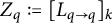 is definable in
$(\mathbb {N}, +, Z)$
is definable in
$(\mathbb {N}, +, Z)$
 .
.
Proof Let E denote the language accepted by
$\mathcal {A}$
 . Fix
$u\in \Sigma _k^*$
. Fix
$u\in \Sigma _k^*$
 such that
$\delta (q_0,u)=q$
such that
$\delta (q_0,u)=q$
 . Since
$\mathcal {A}$
. Since
$\mathcal {A}$
 is minimal, the mapping
$q \mapsto \chi _q(w)$
is minimal, the mapping
$q \mapsto \chi _q(w)$
 , defined by

separates the states. Therefore, there is a finite set of words
$w_1, \dots , w_r \in \Sigma _k^*$
 such that each state
$q \in Q$
such that each state
$q \in Q$
 is uniquely determined by the vector
$(\chi _q(w_1), \dots , \chi _q(w_r))$
is uniquely determined by the vector
$(\chi _q(w_1), \dots , \chi _q(w_r))$
 .
.
Our goal, then, is as follows: given a word v, consider what happens when
$\mathcal {A}$
 is run on
$uvw_i$
is run on
$uvw_i$
 for each i. If v is in
$L_{q \to q}$
for each i. If v is in
$L_{q \to q}$
 , then the run of
$uvw_i$
, then the run of
$uvw_i$
 will begin at
$q_0$
will begin at
$q_0$
 , proceed to q, perform some cycle on the word v that ends back at q, and then end at
$\delta (q, w_i)$
, proceed to q, perform some cycle on the word v that ends back at q, and then end at
$\delta (q, w_i)$
 . If v is not in
$L_{q \to q}$
. If v is not in
$L_{q \to q}$
 , then
$uvw_i$
, then
$uvw_i$
 will instead end at
$\delta (q', w_i)$
will instead end at
$\delta (q', w_i)$
 , where
$q' = \delta (q, v)$
, where
$q' = \delta (q, v)$
 . By our choice of
$w_i$
. By our choice of
$w_i$
 , this means that whether
$v \in L_{q \to q}$
, this means that whether
$v \in L_{q \to q}$
 can be determined by whether each
$uvw_i$
can be determined by whether each
$uvw_i$
 is accepted by
$\mathcal {A}$
is accepted by
$\mathcal {A}$
 , or equivalently, whether each
$[uvw_i]_k$
, or equivalently, whether each
$[uvw_i]_k$
 is in Z.
It suffices, therefore, to show that the relation between
$[v]_k$
 and the tuple
$([uvw_i]_k)_i$
and the tuple
$([uvw_i]_k)_i$
 is definable in
$(\mathbb {N}, +, Z)$
is definable in
$(\mathbb {N}, +, Z)$
 , as then, we can define whether
$[v]_k \in Z_q$
, as then, we can define whether
$[v]_k \in Z_q$
 by deciding whether for each i we have
$[uvw_i]_k \in Z$
by deciding whether for each i we have
$[uvw_i]_k \in Z$
 if and only if
$\delta (q, w_i) \in W$
if and only if
$\delta (q, w_i) \in W$
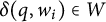 . Note that this relation is not a function, because
$[\bullet ]_k$
. Note that this relation is not a function, because
$[\bullet ]_k$
 is not one-to-one, due to the possibility of leading zeros. We will therefore instead define, for each i, the ternary relation of triples
$([v]_k, [10^{|v|}]_k, [uvw_i]_k)$
is not one-to-one, due to the possibility of leading zeros. We will therefore instead define, for each i, the ternary relation of triples
$([v]_k, [10^{|v|}]_k, [uvw_i]_k)$
 , from which the previous relation is definable. This is given by the following formula in
$(x, y, z)$
, from which the previous relation is definable. This is given by the following formula in
$(x, y, z)$
 :
:

Note that the multiplications by
$[u]_k$
 and
$k^{|w_i|}$
and
$k^{|w_i|}$
 are constant multiplications and hence Presburger-definable. The only remaining matter is how we mean to use
$y \in k^{\mathbb {N}}$
are constant multiplications and hence Presburger-definable. The only remaining matter is how we mean to use
$y \in k^{\mathbb {N}}$
 in the above formula. But because Z is k-automatic and not Presburger-definable,
$k^{\mathbb {N}}$
in the above formula. But because Z is k-automatic and not Presburger-definable,
$k^{\mathbb {N}}$
 is definable in
$(\mathbb {N},+,Z)$
is definable in
$(\mathbb {N},+,Z)$
 by Fact 2.17.
Lemma 3.14 Let
$\mathcal {A} = (Q, \{q_0\}, \Sigma _k, \delta , W)$
 be a trim, minimized, deterministic automaton and let
$q,q',q"\in Q$
be a trim, minimized, deterministic automaton and let
$q,q',q"\in Q$
 be in same strongly connected component. Then we have:
-
(a) If $[L_{q'\to q'}]_k$
is definable in
$(\mathbb {N},+,k^{\mathbb {N}}),$
then so is
$[L_{q\to q"}]_k$
. -
(b) If $[L_{q'\to q'}]_k$
is sparse, then so is
$[L_{q\to q"}]_k$
.


Proof We will once again use Fact 2.17 to work in the expanded language
$\{+,<,k^{\mathbb {N}}, \ldots \}$
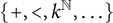 . To prove (a), since
$q'$
. To prove (a), since
$q'$
 and q are in the same strongly connected component, there is some word
$u\in L_{q'\to q}$
and q are in the same strongly connected component, there is some word
$u\in L_{q'\to q}$
 and so if w is a word with no leading zeros, then
$[w]_k\in [L_{q\to q'}]_k$
and so if w is a word with no leading zeros, then
$[w]_k\in [L_{q\to q'}]_k$
 if and only if
$0^i w\in L_{q\to q'}$
if and only if
$0^i w\in L_{q\to q'}$
 for some i. By the pumping lemma, there is some pumping length p such that we can take
$i<p$
for some i. By the pumping lemma, there is some pumping length p such that we can take
$i<p$
 . Then

Then
$n=[w]_k\in [L_{q\to q'}]_k$
 if and only if

(here
$k^{p}$
 and
$[u]_k$
and
$[u]_k$
 are constants). Since
$[L_{q'\to q'}]_k$
are constants). Since
$[L_{q'\to q'}]_k$
 is definable in
$(\mathbb {N},+,k^{\mathbb {N}})$
is definable in
$(\mathbb {N},+,k^{\mathbb {N}})$
 , we then see that
$[L_{q\to q'}]_k$
, we then see that
$[L_{q\to q'}]_k$
 is definable in
$(\mathbb {N},+,k^{\mathbb {N}})$
is definable in
$(\mathbb {N},+,k^{\mathbb {N}})$
 .
.
Similarly, let
$w'$
 be a word such that
$\delta (q",w')=q'$
be a word such that
$\delta (q",w')=q'$
 , which is guaranteed to exist because
$q', q"$
, which is guaranteed to exist because
$q', q"$
 are in the same strongly connected component. Let v be a word without leading zeros that may or may not be in
$L_{q\to q"}$
are in the same strongly connected component. Let v be a word without leading zeros that may or may not be in
$L_{q\to q"}$
 , and let
$n = [v]_k$
, and let
$n = [v]_k$
 . Then:

So
$L_{q\to q"}$
 is also definable in
$(\mathbb {N},+,k^{\mathbb {N}})$
is also definable in
$(\mathbb {N},+,k^{\mathbb {N}})$
 .
.
To prove (b), observe that by [Reference Bell and Moosa6, Proposition 7.1(3)], if
$L_{q \to q'}$
 is not sparse, then there exist words
$u,v,a,b$
is not sparse, then there exist words
$u,v,a,b$
 with
$a,b$
with
$a,b$
 distinct and of the same length such that
$L_{q\to q'}\supseteq u\{a,b\}^*v$
distinct and of the same length such that
$L_{q\to q'}\supseteq u\{a,b\}^*v$
 . But now since
$q,q'$
. But now since
$q,q'$
 are in the same strongly connected component, there exists
$w\in L_{q'\to q}$
are in the same strongly connected component, there exists
$w\in L_{q'\to q}$
 and
$w' \in L_{q'\to q"}$
and
$w' \in L_{q'\to q"}$
 and so
$L_{q'\to q'}\supseteq wu\{a,b\}^*vw'$
and so
$L_{q'\to q'}\supseteq wu\{a,b\}^*vw'$
 , which, again using [Reference Bell and Moosa6, Proposition 7.1(3)], contradicts that
$L_{q'\to q'}$
, which, again using [Reference Bell and Moosa6, Proposition 7.1(3)], contradicts that
$L_{q'\to q'}$
 is sparse.
We are finally able to prove Theorem 3.1 in Case (III). As a reminder, this is the case where we assume that
$0$
 is idempotent with respect to
$\mathcal {A}$
is idempotent with respect to
$\mathcal {A}$
 and that
$\delta (p, 0)$
and that
$\delta (p, 0)$
 contains a distinct state
$p'$
contains a distinct state
$p'$
 in the same strongly connected component as p.
Proof of Theorem 3.1 in Case (III)
We let
$p'\in Q$
 be such that
$\delta (p,0)=\{p'\}$
be such that
$\delta (p,0)=\{p'\}$
 . Since
$0$
. Since
$0$
 is idempotent, we have
$\delta (p',0)=\{p'\}$
is idempotent, we have
$\delta (p',0)=\{p'\}$
 and, by assumption, p and
$p'$
and, by assumption, p and
$p'$
 are in the same strongly connected component. Since
$\delta (p',0)=\{p'\}$
are in the same strongly connected component. Since
$\delta (p',0)=\{p'\}$
 , we see that the cycle language
$L_{p'\to p'}$
, we see that the cycle language
$L_{p'\to p'}$
 falls into Case I, and hence is either definable in
$(\mathbb {N},+,k^{\mathbb {N}})$
falls into Case I, and hence is either definable in
$(\mathbb {N},+,k^{\mathbb {N}})$
 , or it defines
$V_k$
, or it defines
$V_k$
 . If expanding
$(\mathbb {N},+)$
. If expanding
$(\mathbb {N},+)$
 by a predicate for
$[L_{p'\to p'}]_k$
by a predicate for
$[L_{p'\to p'}]_k$
 generates the same definable sets as
$(\mathbb {N},+,k^{\mathbb {N}})$
generates the same definable sets as
$(\mathbb {N},+,k^{\mathbb {N}})$
 , then by taking the subautomaton induced by this strongly connected component containing
$p'$
, then by taking the subautomaton induced by this strongly connected component containing
$p'$
 (but where we take our initial state to be p and our final state to be p) we see by Lemma 3.13 that
$[L_{p\to p}]_k$
(but where we take our initial state to be p and our final state to be p) we see by Lemma 3.13 that
$[L_{p\to p}]_k$
 defines
$[L_{p'\to p'}]_k$
defines
$[L_{p'\to p'}]_k$
 over
$(\mathbb {N},+)$
over
$(\mathbb {N},+)$
 , and hence also defines
$V_k$
, and hence also defines
$V_k$
 . Thus, we may assume that
$[L_{p'\to p'}]$
. Thus, we may assume that
$[L_{p'\to p'}]$
 is definable in
$(\mathbb {N},+,k^{\mathbb {N}})$
is definable in
$(\mathbb {N},+,k^{\mathbb {N}})$
 , and hence, by Lemma 3.14, so is
$[L_{p\to p}]_k$
, and hence, by Lemma 3.14, so is
$[L_{p\to p}]_k$
 . Thus, we have proven the dichotomy in this case.
4 Proof of dichotomy: General case
We now show how to prove Theorem 1.1 from Theorem 3.1. More precisely, we prove that if X is a k-automatic set that is not definable in
$(\mathbb {N},+,k^{\mathbb {N}})$
 , then X defines
$V_k$
, then X defines
$V_k$
 .
.
We need two lemmas before giving the proof of the general dichotomy.
Lemma 4.1 Let
$\mathcal {A} = (Q, \{q_0\}, \Sigma _k, \delta , F)$
 be a deterministic, trim, strongly connected automaton. If there exists a state
$q \in Q$
be a deterministic, trim, strongly connected automaton. If there exists a state
$q \in Q$
 and a character
$c \in \Sigma _k$
and a character
$c \in \Sigma _k$
 such that
$\delta (q, c) = \varnothing $
such that
$\delta (q, c) = \varnothing $
 , then there exists a “forbidden subword” for
$\mathcal {A}$
, then there exists a “forbidden subword” for
$\mathcal {A}$
 , that is, a word w such that no word accepted by
$\mathcal {A}$
, that is, a word w such that no word accepted by
$\mathcal {A}$
 contains w as a subword.
Proof We will construct w iteratively. Begin by letting
$w_0 = \varepsilon $
 . Enumerate the states in Q as
$Q = \{q_1, \dots , q_n\}$
. Enumerate the states in Q as
$Q = \{q_1, \dots , q_n\}$
 .
.
Our goal is to construct each
$w_i$
 such that
$\delta (q_j, w_i) = \varnothing $
such that
$\delta (q_j, w_i) = \varnothing $
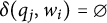 for each
$1 \leq j \leq i$
for each
$1 \leq j \leq i$
 . So to construct
$w_i$
. So to construct
$w_i$
 from
$w_{i-1}$
from
$w_{i-1}$
 , consider
$\delta (q_i, w_{i-1})$
, consider
$\delta (q_i, w_{i-1})$
 , that is, determine which state
$p_i$
, that is, determine which state
$p_i$
 , if any, results from running the word
$w_{i-1}$
, if any, results from running the word
$w_{i-1}$
 starting from
$q_i$
starting from
$q_i$
 . (By determinism, there is at most one such state.) If there is no such state, we may let
$w_i = w_{i-1}$
. (By determinism, there is at most one such state.) If there is no such state, we may let
$w_i = w_{i-1}$
 . Otherwise, note that by strong connectedness and determinism of
$\mathcal {A}$
. Otherwise, note that by strong connectedness and determinism of
$\mathcal {A}$
 , there is a word
$v_i$
, there is a word
$v_i$
 such that
$\delta (p_i, v_i) = \{q\}$
such that
$\delta (p_i, v_i) = \{q\}$
 .
.
We then let
$w_i = w_{i-1} v_i c$
 . Note that:

Moreover, note that suffixing words onto
$w_{i-1}$
 does not change the fact that
$\delta (q_j, w_i) = \delta (q_j, w_{i-1}) = \varnothing $
does not change the fact that
$\delta (q_j, w_i) = \delta (q_j, w_{i-1}) = \varnothing $
 for
$j < i$
for
$j < i$
 . In other words, we achieve the desired effect that
$\delta (q_j, w_i) = \varnothing $
. In other words, we achieve the desired effect that
$\delta (q_j, w_i) = \varnothing $
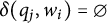 for each
$1 \leq j \leq i$
for each
$1 \leq j \leq i$
 .
.
We claim that no word accepted by
$\mathcal {A}$
 contains
$w_n$
contains
$w_n$
 as a subword. Consider any word of the form
$uw_nv$
as a subword. Consider any word of the form
$uw_nv$
 , and let i be such that
$\delta (q_0, u) = q_i$
, and let i be such that
$\delta (q_0, u) = q_i$
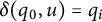 . Then when
$\mathcal {A}$
. Then when
$\mathcal {A}$
 is run on this word:

So the word
$uw_nv$
 is rejected by
$\mathcal {A}$
is rejected by
$\mathcal {A}$
 .
.
For the next lemma, recall that in the context of Semenov’s characterization defined in Section 2.4,
$\Sigma _{\ell ,m,c}$
 is the set of all words of length a multiple of
$\ell $
is the set of all words of length a multiple of
$\ell $
 that are the base-k expansion (without leading zeros) of a word congruent to
$-c$
that are the base-k expansion (without leading zeros) of a word congruent to
$-c$
 modulo m.
Lemma 4.2 Let
$\ell , m, c$
 be integers with
$m, \ell> 0$
be integers with
$m, \ell> 0$
 , and let
$u \in \Sigma _k^*$
, and let
$u \in \Sigma _k^*$
 . Then the language
$L = u \Sigma _{\ell , m, c}$
. Then the language
$L = u \Sigma _{\ell , m, c}$
 has no “forbidden subword,” that is, every
$w \in \Sigma _k^*$
has no “forbidden subword,” that is, every
$w \in \Sigma _k^*$
 is a subword of some word in L.
Proof Given
$w \in \Sigma _k^*$
 , we will find an element of L containing w as a subword. Pick M such that
$\ell M> |w|$
, we will find an element of L containing w as a subword. Pick M such that
$\ell M> |w|$
 and such that
$(k-1) k^{\ell M - |w| - 1} \geq m+1$
and such that
$(k-1) k^{\ell M - |w| - 1} \geq m+1$
 . Now consider the language
$M = uw\Sigma _k^{\ell M - |w|}$
. Now consider the language
$M = uw\Sigma _k^{\ell M - |w|}$
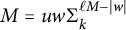 . Every word in M has w as a subword, so it will suffice to show that
$L \cap M$
. Every word in M has w as a subword, so it will suffice to show that
$L \cap M$
 is nonempty.
By definition of L and M,
$L \cap M$
 will contain precisely those words
$uwv$
will contain precisely those words
$uwv$
 such that
$|v| = \ell M - |w|$
such that
$|v| = \ell M - |w|$
 and
$wv \in \Sigma _{\ell , m, c}$
and
$wv \in \Sigma _{\ell , m, c}$
 . Note that the length condition of
$\Sigma _{\ell , m, c}$
. Note that the length condition of
$\Sigma _{\ell , m, c}$
 is satisfied, because
$|wv| = |w| + |v| = |w| + \ell M - |w| = \ell M$
is satisfied, because
$|wv| = |w| + |v| = |w| + \ell M - |w| = \ell M$
 is a multiple of
$\ell $
is a multiple of
$\ell $
 . The remaining condition on v is that
$wv$
. The remaining condition on v is that
$wv$
 must be the base-k expansion without leading zeros of a word congruent to
$-c$
must be the base-k expansion without leading zeros of a word congruent to
$-c$
 modulo m. In other words,
$L \cap M$
modulo m. In other words,
$L \cap M$
 will be nonempty as long as there is a word v of length
$\ell M - |w|$
will be nonempty as long as there is a word v of length
$\ell M - |w|$
 beginning with a nonzero character and such that
$[wv]_k \equiv -c \pmod {m}$
beginning with a nonzero character and such that
$[wv]_k \equiv -c \pmod {m}$
 .
.
Consider the set:

and observe that we may write:

that is, S is a set of consecutive integers. By a counting argument,
$|S| = (k-1) k^{\ell M - |w| - 1} \geq m+1$
 . Because S is a set of more than m consecutive integers, it follows that some
$s \in S$
. Because S is a set of more than m consecutive integers, it follows that some
$s \in S$
 is congruent to
$-c$
is congruent to
$-c$
 modulo m. So by letting v be such that
$[wv]_k = s$
modulo m. So by letting v be such that
$[wv]_k = s$
 , we obtain a word
$uwv \in L \cap M$
, we obtain a word
$uwv \in L \cap M$
 .
.
We now prove Theorem 1.1.
Proof of Theorem 1.1
Assume toward a contradiction that there is some k-automatic set X that is not definable in
$(\mathbb {N},+,k^{\mathbb {N}})$
 but which does not define
$V_k$
but which does not define
$V_k$
 , and pick a minimal DFA
$\mathcal {A}$
, and pick a minimal DFA
$\mathcal {A}$
 that accepts the language L consisting of words whose base-k expansion lies in X. By Lemma 3.13, we have that X defines
$X_q:=[L_{q\to q}]_k$
that accepts the language L consisting of words whose base-k expansion lies in X. By Lemma 3.13, we have that X defines
$X_q:=[L_{q\to q}]_k$
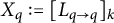 for all
$q\in Q$
for all
$q\in Q$
 . Hence, by Theorem 3.1, since X does not define
$V_k$
. Hence, by Theorem 3.1, since X does not define
$V_k$
 , we have that
$X_q$
, we have that
$X_q$
 is definable in
$(\mathbb {N},+,k^{\mathbb {N}})$
is definable in
$(\mathbb {N},+,k^{\mathbb {N}})$
 for all
$q\in Q$
for all
$q\in Q$
 .
.
We let
$C_1,\ldots , C_s$
 denote the strongly connected components of
$\mathcal {A}$
denote the strongly connected components of
$\mathcal {A}$
 . Recall that some
$C_i$
. Recall that some
$C_i$
 are leaves, which, by Definition 2.11, are strongly connected components containing a transition to a different strongly connected component. We claim that if
$q \in C_i$
are leaves, which, by Definition 2.11, are strongly connected components containing a transition to a different strongly connected component. We claim that if
$q \in C_i$
 for such a component,
$X_q$
for such a component,
$X_q$
 must be sparse.
To this end, fix such an i and
$q \in C_i$
 , and let
$p \in C_i, y \in \Sigma _k$
, and let
$p \in C_i, y \in \Sigma _k$
 be such that
$\delta (p, y)$
be such that
$\delta (p, y)$
 lies outside
$C_i$
lies outside
$C_i$
 . Then
$X_q$
. Then
$X_q$
 is recognized by the automaton formed by taking
$C_i$
is recognized by the automaton formed by taking
$C_i$
 as the set of states, modifying
$\delta $
as the set of states, modifying
$\delta $
 to a new transition function
$\delta '$
to a new transition function
$\delta '$
 containing only transitions within
$C_i$
containing only transitions within
$C_i$
 , and making q the only initial and final state; in particular, note that
$\delta '(p, y) = \varnothing $
, and making q the only initial and final state; in particular, note that
$\delta '(p, y) = \varnothing $
 .
.
By Lemma 4.1, there is a word w that is not a subword of any word accepted by this new automaton, and therefore by the contrapositive of Lemma 4.2, the language of
$X_q$
 contains no subset of the form
$u\Sigma _{\ell ,m,c}$
contains no subset of the form
$u\Sigma _{\ell ,m,c}$
 . We saw earlier that
$X_q$
. We saw earlier that
$X_q$
 was definable in
$(\mathbb {N}, +, k^{\mathbb {N}})$
was definable in
$(\mathbb {N}, +, k^{\mathbb {N}})$
 , so by Fact 2.19,
$X_q$
, so by Fact 2.19,
$X_q$
 is a union of sparse sets and is thus sparse. Furthermore, by Lemma 3.14,
$L_{q\to q'}$
is a union of sparse sets and is thus sparse. Furthermore, by Lemma 3.14,
$L_{q\to q'}$
 must be sparse for all
$q,q'\in C_i$
must be sparse for all
$q,q'\in C_i$
 .
.
Now, to each word w in L, we associate a finite sequence of states
$(p_1, q_1, p_2, q_2, \dots , p_n, q_n)$
 and a finite sequence of characters
$(\sigma _1, \dots , \sigma _{n-1})$
and a finite sequence of characters
$(\sigma _1, \dots , \sigma _{n-1})$
 such that the run of w in
$\mathcal {A}$
such that the run of w in
$\mathcal {A}$
 :
:
-
• begins in the initial state $p_1$
; -
• proceeds to $q_1$
, in the same strongly connected component as
$p_1$
; -
• transitions on the character $\sigma _1$
to
$p_2$
, in a different strongly connected component; -
• proceeds to $q_2$
, in the same strongly connected component as
$p_2$
;⋮
-
• finishes in $q_n$
, an accept state.


There are only finitely many choices of the finite sequences
$(p_1, q_1, p_2, q_2, \dots , p_n, q_n)$
 and
$(\sigma _1, \dots , \sigma _{n-1})$
and
$(\sigma _1, \dots , \sigma _{n-1})$
 , so we see that L is a finite union of languages of the form

where:
-
• $p_i$
and
$q_i$
are in the same strongly connected component; -
• $\sigma _i\in \Sigma _k$
and
$\delta (q_i,\sigma _i)=p_{i+1}$
for
$i=1,\ldots ,n-1$
; -
• $q_i, p_{i+1}$
are in different strongly connected components.




We therefore aim to achieve a contradiction by proving that for each such language M, the corresponding set
$[M]_k$
 is definable in
$(\mathbb {N}, +, k^{\mathbb {N}})$
is definable in
$(\mathbb {N}, +, k^{\mathbb {N}})$
 . This will show that X itself is definable in
$(\mathbb {N}, +, k^{\mathbb {N}})$
. This will show that X itself is definable in
$(\mathbb {N}, +, k^{\mathbb {N}})$
 , directly contradicting a premise.
Consider one such
$M = L_{p_1 \to q_1} \sigma _1 L_{p_2 \to q_2} \sigma _2 \dots L_{p_{n-1} \to q_{n-1}} \sigma _{n-1} L_{p_n \to q_n}$
 , and note that each
$p_i$
, and note that each
$p_i$
 is in the same strongly connected component as the corresponding
$q_i$
is in the same strongly connected component as the corresponding
$q_i$
 . Recall that each
$X_{p_i}$
. Recall that each
$X_{p_i}$
 is definable in
$(\mathbb {N}, +, k^{\mathbb {N}})$
is definable in
$(\mathbb {N}, +, k^{\mathbb {N}})$
 ; by Lemma 3.14, so is
$L_{p_i \to q_i}$
; by Lemma 3.14, so is
$L_{p_i \to q_i}$
 . Moreover, note that
$L_{p_1 \to q_1}, \dots , L_{p_{n-1} \to q_{n-1}}$
. Moreover, note that
$L_{p_1 \to q_1}, \dots , L_{p_{n-1} \to q_{n-1}}$
 are path languages within strongly connected components of
$\mathcal {A}$
are path languages within strongly connected components of
$\mathcal {A}$
 that are not leaves, in which case we showed earlier that each of them is sparse.
Therefore, the language
$M' = L_{p_1 \to q_1} \sigma _1 L_{p_2 \to q_2} \sigma _2 \dots L_{p_{n-1} \to q_{n-1}} \sigma _{n-1}$
 is sparse, because it is a concatenation of sparse languages (cf. [Reference Bell and Moosa6, Proposition 7.1(6)]). So
$M = M'L_{p_n \to q_n}$
is sparse, because it is a concatenation of sparse languages (cf. [Reference Bell and Moosa6, Proposition 7.1(6)]). So
$M = M'L_{p_n \to q_n}$
 is the concatenation of a sparse language and a language whose corresponding subset
$[L_{p_n \to q_n}]_k \subseteq \mathbb {N}$
is the concatenation of a sparse language and a language whose corresponding subset
$[L_{p_n \to q_n}]_k \subseteq \mathbb {N}$
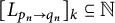 is definable in
$(\mathbb {N}, +, k^{\mathbb {N}})$
is definable in
$(\mathbb {N}, +, k^{\mathbb {N}})$
 . By Fact 2.19,
$[M]_k = [M'L_{p_n \to q_n}]_k$
. By Fact 2.19,
$[M]_k = [M'L_{p_n \to q_n}]_k$
 is also definable in
$(\mathbb {N}, +, k^{\mathbb {N}})$
is also definable in
$(\mathbb {N}, +, k^{\mathbb {N}})$
 , and so as stated above, we achieve our contradiction, because X is shown to be a finite union of sets definable in
$(\mathbb {N}, +, k^{\mathbb {N}})$
, and so as stated above, we achieve our contradiction, because X is shown to be a finite union of sets definable in
$(\mathbb {N}, +, k^{\mathbb {N}})$
 .
.
5 Further results
The characterization established in the previous section has consequences in the realms of both definability and decidability. Bès previously established in [Reference Bès7] that for k and
$\ell $
 multiplicatively independent natural numbers, the structure
$(\mathbb {N},+,V_k,\ell ^{\mathbb {N}})$
multiplicatively independent natural numbers, the structure
$(\mathbb {N},+,V_k,\ell ^{\mathbb {N}})$
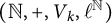 defines multiplication and hence is undecidable. Using a theorem of the third-named author showing that under the same hypotheses
$(\mathbb {N},+,k^{\mathbb {N}},\ell ^{\mathbb {N}})$
defines multiplication and hence is undecidable. Using a theorem of the third-named author showing that under the same hypotheses
$(\mathbb {N},+,k^{\mathbb {N}},\ell ^{\mathbb {N}})$
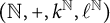 does not define multiplication [Reference Schulz17], we extend that result with the following corollary.
Corollary 5.1 If
$k, \ell \in \mathbb {N}_{>1}$
 are multiplicatively independent, and
$X \subseteq \mathbb {N}$
are multiplicatively independent, and
$X \subseteq \mathbb {N}$
 is k-automatic and
$Y \subseteq \mathbb {N}$
is k-automatic and
$Y \subseteq \mathbb {N}$
 is
$\ell $
is
$\ell $
 -automatic, then the structure
$(\mathbb {N},+,X,Y)$
-automatic, then the structure
$(\mathbb {N},+,X,Y)$
 defines multiplication if and only if either X is not definable in
$(\mathbb {N},+,k^{\mathbb {N}})$
defines multiplication if and only if either X is not definable in
$(\mathbb {N},+,k^{\mathbb {N}})$
 or Y is not definable in
$(\mathbb {N},+,\ell ^{\mathbb {N}})$
or Y is not definable in
$(\mathbb {N},+,\ell ^{\mathbb {N}})$
 .
.
Using results of Hawthorne [Reference Hawthorne14] relating definability in
$(\mathbb {Z},+,k^{\mathbb {N}})$
 to stability of the structure
$(\mathbb {Z},+,X),$
to stability of the structure
$(\mathbb {Z},+,X),$
 where
$X \subseteq \mathbb {N}$
where
$X \subseteq \mathbb {N}$
 is k-automatic, we also obtain a further characterization of definability of
$V_k$
is k-automatic, we also obtain a further characterization of definability of
$V_k$
 in such expansions of
$(\mathbb {Z},+)$
in such expansions of
$(\mathbb {Z},+)$
 .
.
Corollary 5.2 Suppose that
$X \subseteq \mathbb {N}$
 is k-automatic. Then exactly one of the following holds:
-
(1) The structure $(\mathbb {Z},+,X)$
is stable. -
(2) The structures $(\mathbb {Z},+,X)$
and
$(\mathbb {Z},<,+,k^{\mathbb {N}})$
define the same sets. -
(3) The structure $(\mathbb {Z},+,X)$
defines
$V_k$
.


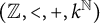


Proof First, we note that in [Reference Hawthorne14], Hawthorne shows that if
$X \subseteq \mathbb {N}$
 is k-automatic, the structure
$(\mathbb {Z},+,X)$
is k-automatic, the structure
$(\mathbb {Z},+,X)$
 is stable if and only if X is sparse. In the case that X is not sparse, by results of Bell et al. in [Reference Bell, Hare and Shallit5], there exist natural numbers
$m,d,N$
is stable if and only if X is sparse. In the case that X is not sparse, by results of Bell et al. in [Reference Bell, Hare and Shallit5], there exist natural numbers
$m,d,N$
 such that every natural number
$n>N$
such that every natural number
$n>N$
 that is a multiple of d can be written as the sum of at most m elements of X. From this, we can define
$\mathbb {N}$
that is a multiple of d can be written as the sum of at most m elements of X. From this, we can define
$\mathbb {N}$
 in
$(\mathbb {Z},+,X)$
in
$(\mathbb {Z},+,X)$
 . Having defined
$\mathbb {N}$
. Having defined
$\mathbb {N}$
 , we may now apply Theorem 1.1 to the induced structure on
$\mathbb {N}$
, we may now apply Theorem 1.1 to the induced structure on
$\mathbb {N}$
 . Hence, we conclude that either
$(\mathbb {Z},+,X)$
. Hence, we conclude that either
$(\mathbb {Z},+,X)$
 defines the same sets as
$(\mathbb {Z},<,+,k^{\mathbb {N}})$
defines the same sets as
$(\mathbb {Z},<,+,k^{\mathbb {N}})$
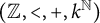 in the case that
$\mathbb {N} \setminus X$
in the case that
$\mathbb {N} \setminus X$
 is sparse, or else
$(\mathbb {Z},+,X)$
is sparse, or else
$(\mathbb {Z},+,X)$
 defines
$V_k$
defines
$V_k$
 .
.
This corollary prompts us to ask the following question.
Question 5.3 If
$X \subseteq \mathbb {Z}$
 is recognized by an automaton with alphabet
$\Sigma = \{-,0,\ldots , k-1\}$
is recognized by an automaton with alphabet
$\Sigma = \{-,0,\ldots , k-1\}$
 , does the above trichotomy hold?
We note that for
$X \subseteq \mathbb {Z}^2$
 , this is not the case. For
$k\in \mathbb {N}_{>1}$
, this is not the case. For
$k\in \mathbb {N}_{>1}$
 , consider
$<_k:=\{(x,y)\in \mathbb {Z}^2: V_k(|x|)<V_k(|y|)\}$
, consider
$<_k:=\{(x,y)\in \mathbb {Z}^2: V_k(|x|)<V_k(|y|)\}$
 . By results of [Reference Alouf and d’Elbée3], the structure
$(\mathbb {Z},+,<_k)$
. By results of [Reference Alouf and d’Elbée3], the structure
$(\mathbb {Z},+,<_k)$
 is dp-minimal for all
$k>1$
is dp-minimal for all
$k>1$
 , so
$V_k$
, so
$V_k$
 cannot be defined in this structure. However, the classic ordering
$<$
cannot be defined in this structure. However, the classic ordering
$<$
 of the integers is also not definable in this structure, yet the structure is nevertheless unstable.
It is also natural to ask whether Theorem 1.1 holds when we consider a k-automatic set
$X\subseteq \mathbb {N}^m$
 with
$m>1$
with
$m>1$
 . One of the obstacles in proving the higher-arity analog is the fact that Semenov only gives a nice characterization of one-dimensional definable sets in [Reference Semenov18]. This prompts the following question.
Question 5.4 Suppose
$X\subseteq \mathbb {N}^m$
 , with
$m>1$
, with
$m>1$
 , is k-automatic. If the unary sets definable in
$(\mathbb {N},+,X)$
, is k-automatic. If the unary sets definable in
$(\mathbb {N},+,X)$
 are precisely the unary sets in
$(\mathbb {N},+,k^{\mathbb {N}})$
are precisely the unary sets in
$(\mathbb {N},+,k^{\mathbb {N}})$
 , is X necessarily definable in
$(\mathbb {N},+,k^{\mathbb {N}})$
, is X necessarily definable in
$(\mathbb {N},+,k^{\mathbb {N}})$
 ?
?
As illustrated by the structure
$(\mathbb {Z},+,<_k)$
 , this question has a negative answer when we replace
$X \subseteq \mathbb {N}^m$
, this question has a negative answer when we replace
$X \subseteq \mathbb {N}^m$
 with
$X \subseteq \mathbb {Z}^m$
with
$X \subseteq \mathbb {Z}^m$
 (for
$m>1$
(for
$m>1$
 ).
).
It is also quite natural to ask whether we can effectively decide whether a given k-automatic set
$X \subseteq \mathbb {N}$
 is definable in
$(\mathbb {N},+,k^{\mathbb {N}})$
is definable in
$(\mathbb {N},+,k^{\mathbb {N}})$
 . By Semenov’s characterization of definable unary sets in
$(\mathbb {N},+,k^{\mathbb {N}})$
. By Semenov’s characterization of definable unary sets in
$(\mathbb {N},+,k^{\mathbb {N}})$
 , we know that for any
$X \subseteq \mathbb {N}$
, we know that for any
$X \subseteq \mathbb {N}$
 definable in this structure, there is a set Y definable in Presburger arithmetic such that the symmetric difference of X and Y is sparse. Hence, this decidability question boils down to deciding whether there exists some
$N \in \mathbb {N}$
definable in this structure, there is a set Y definable in Presburger arithmetic such that the symmetric difference of X and Y is sparse. Hence, this decidability question boils down to deciding whether there exists some
$N \in \mathbb {N}$
 after which
$\{x \in X:x>N\}$
after which
$\{x \in X:x>N\}$
 is periodic, as demonstrated by our results. Certainly, we can write down an algorithm that enumerates all X definable in
$(\mathbb {N},+,k^{\mathbb {N}})$
is periodic, as demonstrated by our results. Certainly, we can write down an algorithm that enumerates all X definable in
$(\mathbb {N},+,k^{\mathbb {N}})$
 , but deciding whether X is definable in
$(\mathbb {N},+,k^{\mathbb {N}})$
, but deciding whether X is definable in
$(\mathbb {N},+,k^{\mathbb {N}})$
 for an arbitrary X definable in
$(\mathbb {N},+,V_k)$
for an arbitrary X definable in
$(\mathbb {N},+,V_k)$
 seems strictly trickier.



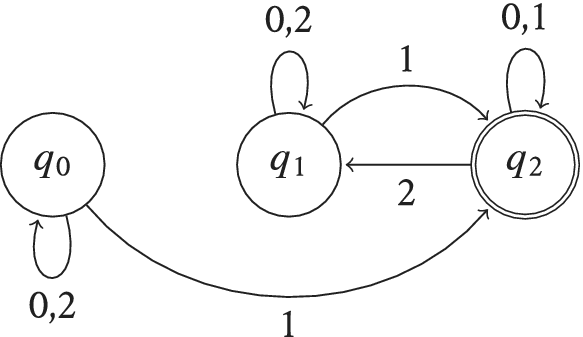


 Open access

