

1. Introduction
Policy debates about the role of private schools in the UK education system have pursued three directions, regarding fairness, charitable status and public benefit. The Charities Act 2006 and 2011, which put some aspects of common law into statutory form, has brought these streams together and set the parameters within which the mainstream policy discussion is now pursued. It has confirmed that advancement of education is a charitable purpose but also re-affirmed private schools’ requirement to provide a ‘public benefit’ that is unrestricted by the ability to pay for it.Footnote 1 The trustees of private schools with charitable status are given considerable autonomy in deciding what activities they will undertake to fulfil their public benefit obligations. While the public benefit criterion remains under the purview of the courts, private schools’ autonomy to deliver public benefit in their own ways is manifest in the revised Charity Commission guidelines (2013a, 2013b). This context makes it important to understand schools’ objectives in the provision of public benefit. This paper sets out a simple framework for analysing the value of charitable activities to the schools, and investigates how headteachers in a range of private schools and other informed stakeholders interpret public benefit objectives and obligations. It provides a valuable case-study of the problems associated with the pursuit of welfare state policies through charities which are legally independent.
Since the 1980s elements of competition and quasi-market forces have been introduced into English educational policy, including in the recent decade the conversion of many schools into ‘academies’ and the foundation of ‘free schools’, whose systems of governance placed them largely beyond the control of local government. Yet, while providing state schools with some independence, this movement afforded only a limited convergence with the private (that is, fee-paying) schools. Over the same period private schools, which had evolved over centuries into an exclusive system across the UK which was quite separate from central or local government (Gathorne-Hardy, Reference Gathorne-Hardy1977; Walford, Reference Walford2002), have enjoyed a resurgence in their prosperity, largely free from the potential political threats to their continued existence that had sometimes characterised earlier postwar decades. Bolstered by the increased resources of wealthy parents and an increased demand for education, private schools still educate only seven per cent of all school students at any one time, but they have been able to charge very much more than in earlier decades. The vast majority of their pupils gain admission by paying annual fees averaging nearly £13,000 for day pupils in 2014 and £29,000 for boarders (ISC, 2014). These high fees, alongside large endowments, ensure that private schools are very much better resourced than state sector schools. Private school pupils disproportionately gain places in elite universities (Sullivan et al., 2015). They are, and have been for some time, massively over-represented in elite positions in business, the justice system, the media, the civil service, and in the political classes (Donnison, Reference Donnison1970; Douglas, Reference Douglas1956: 900; Sutton Trust, 2014a, 2014b). They earn a substantial premium in the labour market compared with state school pupils (Green et al., Reference Green, Machin, Murphy and Zhu2012). Thus, private schools are a significant channel through which inequality is reproduced in the UK.
At the same time, however, almost all the private schools have maintained the legal status of a charity. The preamble to the 1601 Charitable Uses Act, which included education as a charitable purpose, has been held to justify an 80 per cent remission of business rates and exemption from VAT on educational activities and from corporation tax and taxation of investments. As Manville (Reference Manville1982) points out, though charitable status incurs a loss of revenue to the state, the rationale is that it frees the state from providing a social service and the cost that that would require. Therefore, the debate about charitable status points to the considerable cost to the state of these exemptions and seeks to set it off against the (also considerable) value of the education provided. A further consideration in this private/state balance surrounds the value of the training the state provides for teachers who are then employed in the private system (Green et al., Reference Green, Machin, Murphy and Zhu2008).Footnote 2
Public benefit is a criterion that organisations must demonstrate in order to achieve charitable status. This requirement for charities was re-affirmed by the 2006 Charities Act. The Charity Commission guidelines of 2008 interpreted public benefit in terms of a range of activities, pre-eminent among them the provision of bursaries (2008). The Independent Schools Council (ISC), an umbrella association of private schools, resisted this prescription of appropriate public benefit activities. The focus on bursaries was a particular target, the argument being that the wealth of private schools varied, and not all private schools would be able to provide them. The ISC sought a judicial review of the guidelines’ interpretation of the law and, in 2011, the Upper Tribunal ruled that the provision of education was a charitable activity, that trustees of private schools must pursue activities to do this in a way that promoted unrestricted public benefit, and that these activities must be more than tokenistic. While the Charity Commissions retains the power to tell private schools that their activities do not meet the public benefit criterion, they cannot instruct them to undertake specific activities which, as Sloan points out, ‘appears to empower trustees at the expense of the Charity Commission’ (Reference Sloan2012: 47).
The deliberations around the Charities Acts and the Tribunal hearing have thus brought together the themes of fairness, charitable status and public benefit and set the direction for future policy. Issues of social justice, privilege and social mobility are crystallised into conflicts over the relationship between private and state schooling (BBC, 2012; Blunkett, Reference Blunkett1997; Blunkett and Davidson, Reference Blunkett and Davidson1995; Taylor and Davidson, Reference Taylor and Davidson1994). Private school trustees and their headteachers can now decide what activities they will focus on in pursuance of public benefit; a resolution that exposes potential contradictions surrounding the use of charity law to achieve educational and welfare goals (Dunn, Reference Dunn2012).
The future interaction of private and state education, and its significance for social justice and social mobility, will therefore be determined in large part by decisions taken within the schools. In this context, the purpose of this article is to examine the schools' own objectives, and the meanings they themselves attach to ‘public benefit’. Section 2 sets out a framework in which schools pursue public benefit activities for both public and private advantages, where they perceive that these outweigh the costs. In Sections 3 to 5 we address the questions posed by this framework through in-depth, semi-structured interviews with headteachers and others from a range of private schools, in order to shed light on how their public benefit obligations are likely to be interpreted in the future.
2. A framework for the determination of public benefit activity
For the private schools, public benefit comprises activities defined as charitable – in this case, the advancement of education (Charity Commission, 2013a) – and these may stem from altruistic motives, or from self-interest, or both. One can think of the public benefit activities decision arising out of a calculation of the benefits and costs to the school, subject to the regulatory constraint, where the benefits can include the school's public service to a wider community as well as any private benefits to the school. Yet an understanding of these public benefits is hampered by lack of evidence as to how the schools themselves perceive them. Our overall question motivating this paper, then, is: what are the objectives of private schools that are driving their public benefit decisions?
The public service element conceivably takes a variety of forms which can be broadly grouped as a) needs-based bursaries, b) sharing resources, activities and expertise – including through ‘partnerships’, and c) fundraising and volunteer activities. Recipients of bursaries are perhaps the most direct beneficiary. Evidence from the Assisted Places SchemeFootnote 3, for example, suggests that, overall, children who participated did indeed receive a better education than they would have if they had attended a state school (Power et al., Reference Power, Whitty and Wisby2006, Reference Power, Sims and Whitty2013). Set against these positive benefits are the potential external harms. Debate in this context has focused on the potential loss of beneficial peer effects in state schools when hard-working pupils are transferred to the private sector.Footnote 4 One issue, then, is what activities do schools perceive as providing public benefits, and are any harms perceived, arising from private schools fulfilling their obligations under the 2011 Charities Act? How do private schools perceive the effects of their public benefit activities in relation to their altruistic public service goals for education?
Public benefit activities may, however, also have private value to the school, apart from the satisfaction of any charitable preference. In part the provision of bursaries is not so much charity as a conventional economic strategy for price discrimination similar, for example, to reduced train fares for students (Pindyck and Rubinfeld, Reference Pindyck and Rubinfeld1989: 375–385). By tailoring fees, net of bursaries, to the consumer's ability to pay, the school raises more net income than it could if it charged a fixed price to all consumers. The enrolment of high-performing children is also a potential source of positive peer effects for full-fee-paying pupils, and more generally for the reputation of the school. Other public benefit activities – those which display what the school offers – may also have reputational advantages and might be useful marketing tools. Intensive activities, such as those involved in formal private-public partnerships, can be seen as an efficient sharing of resources, a process of learning and knowledge transfer, similar to regional business alliances. In what ways, then, do private schools also see public benefit activities as having private value for the school?
The cost of public benefit activities, both financial and time opportunity costs, has then to be balanced against their advantages. It is how the key actors see the benefits and costs to the schools, in the context of the attempts by government to influence the charitable sector through legislation, that will determine what private schools do. One significant factor in determining the outcome is the school's wealth, as determined by past surpluses and charitable endowments: the richer the school, the more public benefits it can finance without asking parents of current pupils for subsidies. Another potential factor is the continuing external regulation: the Charity Commission's insistence that there must be more than ‘token’ public benefits for a school to be permitted to function as a charity. What is unclear, however, is whether this external regulation is viewed as a binding constraint on what they do. Would schools engage in public service activities anyway, even in the absence of pressure from the Charity Commission?
3. Methods
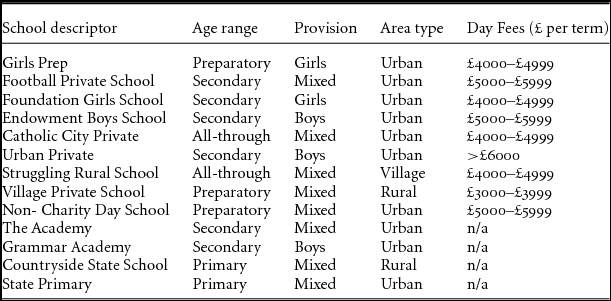
To address these questions surrounding private schools’ interpretation of, and objectives for, public benefit we carried out in-depth interviews with selected headteachers in English private schools as our primary participants. In practice, what private schools do may be influenced also by governors and trustees, interpreting the wishes of a founder, and in the context of influence from fee-paying parents, which may lead to compromise. However, these influences will be channelled through the head, who will be aware (as our interviews show) of the views of other relevant actors. Our interviews were semi-structured, covering school context, public benefit objectives, perceived effects, regulation and funding issues; they were carried out between November 2013 and November 2014. Our sample included a range of school types, including a mixture of single sex and co-educational schools and those educating primary and secondary ages, and varied according to fees charged, size and location (rural/urban). All but one had charitable status. The schools, which are listed anonymously in Table 1 with their characteristics, were recruited through personal and professional contacts and via a private school membership organisation. We also consulted the school trustees’ annual reports to the Charity Commission: as with all charities, these contain some limited narrative reporting on public benefit activities (Morgan and Fletcher, Reference Morgan and Fletcher2013). To obtain the perspectives of other key stakeholders, we interviewed headteachers of four state schools (also listed in the table) and, for an informed sector perspective, the directors of two private school associations.

Every private school head we spoke to was supportive of the notion that they should provide public benefit in some form, and reported that their school did indeed provide public benefits. Not being a large or representative sample, we derive no population-relevant conclusions about the distribution of public benefit activities, but the in-depth interviews enabled us to identify and interrogate the meanings, objectives and motivations held by our participants. For representative data, we turn where required to some limited information on public benefit activities reported in the Independent Schools Census.
4. Forms, beneficiaries and potential harms of public benefit
The interviews revealed a variety of understandings of the meaning of public benefit and of public benefit activities, including bursary provision, resource and expertise sharing, charitable functions, and formal partnerships. In this section we report how our participants understood the benefits of each form, and the potential harms; their perspectives on funding and regulation of public benefit are described in Section 5.
Bursaries
Bursaries are intended to open up private schools to those who would normally be unable to attend, including hardship cases among pupils already in private school who would otherwise need to leave. In 2014 some 8 per cent of private school pupils across the UK received means-tested bursary assistance, 13 per cent of these attending for free (ISC, 2014: 21).Footnote 5 Given the known wealth variation among schools, it was not surprising to find that, while all schools we spoke to provided at least one bursary, the volume and value varied considerably. The three largest schools offered the most bursaries while, at the other end of the scale, a small village school had always had some hardship bursaries available for current pupils’ families but had been saving funds to offer a full bursary, means-tested and ability-based, for ‘somebody who wouldn't normally have access to the school’.
Benefits for bursary pupils
One issue surrounding bursaries is whether they in fact provide real benefits to individuals, yielding a better education to beneficiaries than they would have received in state education. Unsurprisingly, all private school headteachers were positive about the benefits for their bursary-receiving pupils, and this is consistent with the more formal evidence from recent research, that private schools on average benefit those transferred from the state sector (Power et al., Reference Power, Whitty and Wisby2006, Reference Power, Sims and Whitty2013). Thus, the head of a small prep school felt the child who receives a bursary will benefit from the small class sizes (a maximum of 20), the range of specialist teachers in drama, modern languages, music, sport and art from kindergarten to 11, and the school's facilities, such as ICT suites, halls, libraries, classroom spaces and sports grounds. He also mentioned that, because they prepare students to take competitive entrance exams, they ‘get them to a high academic standard’. He was also keen to point out that they offer a holistic education, and are not purely results-driven. Another school head felt the small class sizes and the attention that pupils get would be the main benefit for the scholarship children.
There's a lad playing football out there for us now. He's in the top 0.1 percentile in the country and, if we're honest, the local primary school would say ‘we're having real difficulties stretching him’. So we've now got him sitting in a class of six with us and we'll be able to differentiate for him completely. So he'll get in effect his own little work programme. So, in that sense, it's done him a favour.
Such advantages are thus perceived by headteachers as genuine public benefits, consistent with their schools’ visions and with their obligations under charity law. The same head, for example, said that although it was ‘a slightly old fashioned view’ he construed this bursary as ‘noblesse oblige’ – meaning that the privileged have a responsibility to the socially disadvantaged. Even during financial hardship the school had sought to retain some bursary positions. For similar reasons, two headteachers from well-endowed private schools told us they recruited top students from local state schools for their bursary programmes.
Bursaries can vary, however, in their generosity. One school promoted ‘thin’ bursaries, which consist of a 10 per cent reduction in fees, claiming that these aided the ‘squeezed’ middle classes, defined by the headteacher as professional working parents with a combined income of £80,000. Another was disparaging of this kind of practice, offering only bursaries covering all costs incurred (e.g., uniforms, trips, etc). Bursaries may not always stem from purely altruistic reasons. Partial bursaries may enable schools to bring in revenue by filling places that might otherwise go empty – the price discrimination motive. In a different school, with small economic means, partial bursaries were largely used for current pupils whose parents had fallen on hard times. Since these bursaries were often not publicised, quite how much public benefit these bursaries really provided, in terms of opening up a private education to anyone, seemed questionable. The provision of bursaries, it should be noted, necessitated devoting some effort to means-testing parents who apply: one private school head was evidently wary of deception. There was also some scepticism from one state school headteacher, who was dubious about how ‘in-need’ the bursary pupils in her local area really were, and, separately, whether such pupils gained a better education in the private sector:
[The private school] are saying they're giving the bursaries to children who wouldn't have that opportunity – are they really?
Nevertheless, not all private schools pick from the top ability range, and the same state school head praised a nearby private school that focused on special educational needs. Elsewhere, the head of a rural private school noted that 33 per cent of his pupils had an identified special need, and felt that these pupils benefited from what the school offered:
. . .that's a very high proportion compared to local state schools. So although that's not a charitable end, it seems charitable you know, that these children really need quite a lot of help and we give it to them.
Benefits for other pupils and to the school
Many of the private school headteachers reported that increasing the diversity of their student body via bursaries benefited their school as a whole, and that parents looked for this when considering the school. As one head remarked:
. . .it is something people look for when I talk to them at open day, they like the fact that the school is outward facing, . . . that it's in touch with the real world, and they worry about, you know, sending their son or daughter to a sort of privileged bubble where they're only going to mix with the same sorts of people and not really be aware of their community.
While headteachers saw the value to society of reducing exclusivity within schools, they also felt their school benefited as a whole. Thus, another participant states:
We are mindful of our obligations. . .It's a much more healthy balance of pupil body and gives that real feeling of community, otherwise the danger would be it would be a rarefied strata of society that was being educated in a particular way, which isn't good ultimately for social cohesion, isn't good for the school itself.
In fact, some participants implied that they saw little conflict at the margin between altruism and self-interest in their bursary programmes. Thus, for example, the head of one of the wealthier schools remarked:
I'd almost say that is simply an enlightened self-interest anyway, you are making your school better by making it a better social mix in preparation for the 21st century.
Similarly, the head of one of the poorer private schools reports multiple aims, including improved recruitment, and:
. . .to broaden access to the school, to open us up to parents that wouldn't ordinarily have been able to afford the fees. . .to readjust our ability profile slightly. . .open to anyone in a state school, and the criteria is the top 25 per cent of the ability range. . .[and] we wanted to fulfil our charitable aims.
Sharing resources and expertise
Across the UK some nine out of ten private schools share physical and human resources, activities or expertise with state schools, and many also with local communities (ISC, 2014: 22). Among our participants, most indeed shared their facilities and expertise, sometimes for free and in other cases for a charge. This sharing of physical resources included varied examples, such as swimming pools, playing fields, music facilities and science laboratories, typically made available after normal school hours to state schools (along with community groups). Shared staff resources comprised areas where private schools had the most expertise, such as in specialist advanced teaching, extra-mural topics such as debating skills, or university application preparation guidance. While the ISC characterises all such interactions as ‘partnerships’, such sharing is likely to be most active in schools that participate in formal partnerships – arrangements involving multiple schools that are planned collectively. Some formal partnerships have their origins in seed-funding provided by the Labour government in the late 1990s.
Benefits of resource-sharing
We encountered a variety of understandings about the extent to which resource-sharing activities constituted public benefit. For some, this sharing was at the core of the definition of public benefit. For example, the head of one preparatory school stated that public benefit:
. . .[is] about giving what you have so that other people can benefit from it. . .It can be providing something that another institution needs that you have. . .Rather than throwing some money at something. . .it's a much more fundamental thing. . .it's sharing what you have, whether that's facilities, expertise, opportunities, resources, staffing. . .
Other school headteachers took a similar attitude, sometimes referring back to original foundation principles of serving the poor, and clearly were also generous in making available their facilities. However, another private school head reported that these activities were marginal because they cost the school nothing. Though he was happy to oblige the local community, inviting state school pupils to events in the school grounds or allowing sports clubs to use their facilities, he did not regard such sharing activities as fulfilling their charitable goals; rather, disposing of income was the true measure of public benefit and, although he complied, he was uneasy about offering his facilities:
. . .it's quite tricky to have people come and pay you a visit and muck around in your fields and woods without feeling like Lord of the Manor, sort of entertaining the gardeners. . .
With regard to formal partnerships, their relation to headteachers’ conceptions of public benefit was also differentiated. Four of the schools we interviewed were involved in formal partnerships, some seeing it as part of public benefit provision, while others simply saw it as the way their school worked within a collaborative environment. Our participants reported that their successful formal partnerships entailed a mutually-profitable exchange, rather than necessarily a redistribution of the private schools’ superior resources:
. . .we have worked together persistently for 10 years. . .on working together as teachers and as pupils so that everyone benefits, and it's not crumbs from the rich man's table. . .it's to do with partnership, collaboration.
Where barriers to participation arose, this was, in one head's view, because of ideological resistance and the disparities in schools’ resources. He had been interested in working with the Local Authority, but this floundered, in his opinion due to a lack of understanding about how the private sector worked. He felt state schools perceived the private sector as having greater resources and so anticipated only a charitable relationship. He wanted a reciprocal exchange, but felt that the perceptions would be hard to circumvent:
There is a lot of reticence from state primaries that see the wealthy independent school down the road. . . . the perception often is that you're a school that's got small numbers, you've got the resources. . . . And when you hear things like that you just think, well, we've got so many issues here, so many barriers to break down.
A higher form of expertise sharing is involved in the rarer instances where a private school is sponsoring an academy or free school in the state sector.Footnote 6 Sponsoring entails making legal commitments, devoting management resources and assisting with governance; such high-level engagement is likely to be accompanied by other forms of resource-sharing engagement. Our participants also had varied perceptions of this form. Some were confident that the academic aspirations and performance of bright pupils in the state schools benefited, for example, by making sure that a potential A* candidate was no longer satisfied with getting a B. Yet even those with a positive approach to academy sponsorship, noted the limitations of what they were doing. One informant reported that his school's expertise was not well suited to raising the grades of the less able. In his judgement:
. . .(they had) reached the plateau because we were probably at our best looking after their top 40 per cent; we were doing nothing for those children below that.
Another noted that it was not easy to convey the aspirational ethos to a sponsored school, without a substantial level of resource-transfer, which was constrained by the sponsoring school's own finances.
Other participants were more critical of academy sponsorship, not least because of the emphasis placed on it in public discourse. Both the head and assistant head of one school were angry at allegations that the only public benefit that should count was sponsoring an academy. They felt this attitude is patronising to the state sector, and that the private schools' skillset are not best suited to this endeavour, since they are not used to running mixed-ability schools. They pointed to examples of sponsorship that had not worked out for this reason.
Benefits to the private schools
While resource sharing and partnerships do offer public benefits, they also have private benefits for the schools. Our participants were conscious of these, and it informed their thinking and practices. Thus, inviting guests onto the grounds often had the effect of advertising the school, serving as a recruitment and marketing technique. As one head reported, the visitors are:
. . .gaining the benefit of the use of the facilities, and secondly some may well think that it would be great to have an education here. . .so they might well apply for a scholarship. . .and some may well also apply for a supported place.
The head of another school recognised that there was some (in his view unjustified) skepticism over private schools' intentions, but conceded that there was a degree of self-interest in his school's community work, as it benefits the school and its pupils:
We think the sort of stuff that we're doing in the community is the right thing to be doing anyway, but actually, it's also the right thing for our pupils in terms of their education. . . all sixth formers do voluntary work and the lessons they learn from it in terms of their awareness of their local community, their confidence, their ability to sort of mix with people from all walks of life, is really important.
Yielding these benefits for the volunteers may go some way to making for a more equal relationship, rather than a top-down paternalistic patronage. As the head noted:
It's about finding what's going to be mutually beneficial in terms of the links. What we don't want to do is sort of patronise them by going in and saying, ‘you know we'll sponsor your academy’ or ‘we'll tell you how to run the school’.
Nevertheless, the choices the school makes about the types of links that it fosters reveal another degree of self-interest that is perhaps somewhat less reciprocal:
. . .most of the links that we have, which are schemes which we run, are with primary schools, and the reason for that rather than going for older age groups is they've already chosen the school to which they're going to go. And obviously with. . .Year 5’s and 6’s, we've got parents who might consider sending their children to us anyway, so it's sort of in our interest. . .
The Assistant Head of the same school noted that he had to think about the needs of the school:
I always have to think what is in it for us. That sounds rather selfish but it's not really, because you've got to reflect and think, well. . .we can't have staff working 7 days a week, is it really practical that we're overworking our facilities the whole time?
In short, our participants revealed that part of the function of these public benefit activities concerned the private school's own recruitment, the social makeup of the school, and/or the broadening of the education offered to their own pupils. As the head of a state school noted, they (the private schools) have an ‘end game’.
Fundraising for other charities and volunteering
Curiously echoing the early practices of, especially, girls' schools in the Victorian era (Gathorne-Hardy, Reference Gathorne-Hardy1977: 255), some schools mentioned in-school charity fund-raising activities, and pupils' volunteer work in the community as contributing to their public benefit. For example, asked how she delivers public benefit in practice a private school head included in her response:
. . .how we do it is fundraising for the girls’ chosen charities, so they will choose which charities they want to support. Going out to visit our local elderly people's home – there are two near here. . . . We go at Harvest and take all the Harvest gifts and sing. We go at Christmas. We go for visits.
While there are obvious beneficiaries – the recipients of the charitable funds and of the volunteer services – headteachers also anticipated longer-term benefits that are both private and public. Such activities gelled with the long-conceived tradition of inculcating ‘character’ and a charitable orientation in their children, helping them to grow into socially-responsible adults. It was part of the schools' mission:
. . .but it's not only public benefit but it's more long term in terms of opening these things up to children so that they will begin to think about them on their own and what they can do as adults. . .it's so that they will make a difference as young adults.
Although our participants were proud of their charitable and volunteering activities, and construed them as genuine public benefits, it remained unclear whether they were confident that such activities would be legally interpreted as fulfilling the public benefit criterion, even in the new regime following the judgement of the Upper Tribunal in 2011. Indeed, such activities are widespread also in state sector schools, even if the size of charitable sums raised is typically smaller for understandable reasons.
Potential harms
While our private school participants were generally positive about the value to society of public benefit activities, some were conscious of potential harms. In the case cited above – the scholarship for the football-playing smart child – the head recognised the direct loss for the primary school, though held that this was in the child's interests:
The school there will be sad to lose him because he'll do wonders for their SATS scores, but they were honest enough to say that ‘it's a difficult environment for us to challenge him sufficiently’. So we've got him.
Another private school head, who felt that educationalists are largely collaborative, also agreed with critics who feared that there could be a problem when private school scholarships cream the best pupils from state schools via bursaries or scholarships. Yet, since he was subject to a competitive education market he had a responsibility to look after the survival of his school:
I do see their point. To be brutal, our objectives are different. . .to ensure that the school survives and does what it does for all of its pupils. In order to do that it simply has to attract enough people, and if we pinch one or two able students from local schools, OK, we are competitive with them I suppose.
Another head went further, being explicit that taking the ‘best, brightest’ boys from the state sector could have a negative impact on the other pupils in state schools:
I do know that the siphoning off of an elite in a school can mean that there are no role models left to be the very makers of excellence for the rest.
Other private school headteachers noted resistance from state school headteachers to join with public benefit activities, either for ideological motives or from practical reasons of competition. This resistance was indeed manifest in the understanding of one of our state school participants from a rural region, whose school had experienced harmful competition. Stemming initially from a visit to the local private school to use the photography facilities, the host private school initiated marketing to her pupils. Bursaries, she thought, creamed off the state school's best pupils. The head was disappointed by what had ended up being a detrimental relationship.
. . .they're very business-like, the private sectors, extremely business-like, and they caused a lot of problems for us. . .we paid for it heavily. It's not performing their charity. . .it's doing the exact opposite. . . They're actually making us not viable because they pinch my top [pupils]. . .So they're not doing the charity work.
Following this experience, this head was very uncertain about attempting new links with the private sector, feeling that they were not going to offer something that would not also benefit themselves. ‘True charity’ for her, meant that there was no ‘end game’, that the private school would give without trying to fulfil its own agenda.
5. Funding and regulating public benefit provision
Following the Upper Tribunal decision of 2011, private schools were left in the legal position of being required to provide more than tokenistic public benefits for those that could not afford their fees (Charity Commission, 2013a: 21). All private schools with charitable status, then, are having to decide, either explicitly or implicitly, not just what public benefits to provide but what resources to devote to them. Three, partly contradictory, features emerged from our interviews: that the level of funding is often vague; that it is largely self-determined rather than externally constrained; and that, nevertheless, there was a wide pool of resentment at public benefit regulation.
Vagueness and uncertainty surrounding the level of public benefit emerged, not just because this external regulation is imprecise, nor merely because minor sharing activities are hard to account for without a strict system of time-keeping. Rather, for some, a lack of cost quantification was desirable because it enabled headteachers to follow their own agenda, up to a point, without having to always bring trustees on board. Thus, one informant from a large school noted:
. . .what we manage is to be able to do these things without quantifying them too much. . .running on a tighter budget you wouldn't be able to hide it the way we hide it. . .my governors would start thinking hang on a minute. . .I mean they must be sure that although they are. . .committed to what we're doing and proud that we are at the forefront of the academies movement in this country and wanting us to remain there. . .there come moments when they have to ask the question what is the price here, our duty is to govern this place.
Given our participants’ assessments that most public benefit activities also had private value for their schools, it thus emerged that the headteachers’ and trustees’ preferences were the prime factors driving the level and type of provision. None of our participants reported that they had had to devote more than they wished; while one school without charitable status appeared to engage extensively in public benefit activities. Many stressed forcefully that they were doing what they did for public benefit from their own volition, not because of the Charity Commission's regulation.
Thus, among our participants, the requirement for the level to be more than tokenistic was perceived to be making little or no practical difference. A concomitant of this importance of self-determination is that the level of provision is likely to be related to the level of the school's wealth – something which was indeed reflected in the views and activities of our small sample. The schools with richer endowments were aware of the advantage this gave when it came to funding public benefits. By contrast, in a poorer school, where scholarships are paid from fee income, their introduction had caused some friction with parents. Thus one head supported the charitable intention but noted:
We're just not a rich school at all, living slightly hand to mouth, making a little surplus this year for the first time in four years. . .I'm sure that the big rich schools will be much more generous in their provision. . .how can we go away dishing out largesse left, right and centre when we haven't got any money. It's very, very, very, very difficult.
With similar financial constraints, one head noted the depressing impact of the withdrawal of state funding support for public benefit activities; another harked back to the Assisted Places Scheme phased out from 1997, which had channelled substantial state resources into support of means-tested places in private schools.
Although there is the perception that it is the schools that decide, rather than the regulator, the debate on public benefit since the passing of the 2006 Charities Act may still have had some effect. There is evidence that reporting has been changed: many independent schools, along with other charities, were induced to attend to the narrative explanations provided in trustees’ annual reports, even if only about 15 per cent of education and training charities are fully compliant with the narrative requirement (Morgan and Fletcher, 2013). Moreover, it remains possible that the debate influenced the norms which governed some headteachers’ and trustees’ decision-making. Some of our participants indicated that they were working to a norm of around 5 per cent of turnover, although it is unclear where this figure originates from. Despite the fact that the Charity Commission never released an official benchmark, and the Tribunal established that it did not have the powers to do so, the Charity Commission's pilot assessments in 2009 (Charity Commission, 2009a, 2009b) appeared to point in this direction. The Sutton Trust report on fees remissions discovered an average of 7.8 per cent of total income spent on bursaries, but with a large differentiation across schools, with more than a quarter offering less than 5 per cent in fee remissions and another quarter offering more than 10 per cent (Davies et al., Reference Davies, Noble, Slack and Bigurs2010: 3).
Nor does the absence of a binding constraint on funding stop the headteachers from expressing anger at the requirements apparently imposed on them by the Charity Commission, even in their modified form in 2013. In addition to the more widespread generic objection to intervention or regulation of any kind, headteachers objected to having a uniform obligation laid upon all private schools, given the heterogeneity of their endowments. Thus one head noted:
. . .it's not ever through want of trying, it's because we sometimes just can't. . . We're always open to new ideas and suggestions, but we've got to still be treated within the context of the school that you operate in.
Another noted:
I don't think you can have a blanket thing that says ‘all schools need to do this, this, this and this to be able to fulfil that public benefit’.
The headteachers especially objected to being told what their moral obligations were by politicians. As one informant remarked:
. . .Adonis is the other dangerous character here, where he talks about sort of the moral obligation for England's schools to make state education better.Footnote 7
Another agreed:
. . .it's not BUPA's job to make the NHS better, so in what sense do we have a moral responsibility? As it happens, personally we think it is the right thing to do because we think it's good for the community and it's good for the schools, it's in line with our founder's ethos. . .To what extent does the private sector have a duty, a moral duty, to make the public sector better? It wouldn't apply outside of education, would it?
Alongside headteachers’ resentments, they insisted their trustees’ priorities and their foundation's mission came before those of politicians and regulatory bodies. Thus, wanting no legal constraint, one informant's advice for his fellow headteachers was:
. . . there should be a test [of public benefit] but . . . I don't want you to be bound by law to have to do this, I want you to look at your foundational mission statements and think about what will make sense for you in your community, and surely unto the degree that you can according to how wealthy you are. . .
Finally, many participants expressed frustration with the terms in which the debate had been framed, which both focused largely on bursaries and appeared to vilify private schools. As one participant related with some passion:
. . .I mean it really makes me cross when people talk about public benefit and meeting the public benefit requirements and all that. Because every single person nowadays, if a school does something, says that they're only doing it to justify their ‘public benefit’. And if you do lots of things, like we do, people say ‘oh, you're only doing it for public benefit’ and . . . it's been made to seem like a cynical ploy. . .
6. Conclusion
Following the resolution by the Upper Tribunal of the issues surrounding charitable private schools, and the limitations imposed on the powers of the industry regulator, schools were left only with the obligation to provide some ‘more than tokenistic’ public benefit, a minimum that could not be standardised and quantified across schools. They could decide what form their public benefit activities would take in order to meet the court's interpretation of the public benefit standard. Their decisions regarding this are framed by their own perceptions, their trustees’ obligations and visions and the schools’ circumstances. It was in this context that we sought to investigate how schools’ headteachers understood and carried out public benefits.
There are three general findings. First, schools interpret public benefit widely to include pupils in state schools, people living in local communities, the beneficiaries of other charities supported by their pupils, and society in general via their endeavours to raise socially responsible adults. Second, however, our participants generally coupled their understanding of public benefit with a perception that these activities were also of private benefit to the school and its pupils, through a broadening of horizons, an improved social mix or a mutual sharing of resources. Some partial bursaries could be interpreted as revenue-maximising tactics. Curiously, none of our participants raised the potential peer effects from scholarship pupils, although they did refer to the detrimental effect on the state sector of losing bright students.
Third, as a consequence, we detected clear signs of headteachers balancing the advantages (public and private) of public benefit activities against their costs, just as they would any other area of activity. The headteachers were able to articulate broadly the benefits and costs of different activities. While several headteachers acknowledged the negative effects their practices could engender in state schools, their duty to their own school's interests usually came first. While they varied in their decisions depending on their, and their trustees’, wishes and on their endowments, all opted for some form of provision rather than none, and many articulated for us the limits imposed by the costs.
External constraints were not perceived to be binding. That is, the extent to which they were generally pursuing public benefit strategies was not affected by the ‘more than tokenistic’ presumption of the law. In this context, participants’ resentment of such regulation seems at first curious, particularly when set against the experiences of the third sector and the state education sector, where there has been increasing pressure to professionalise, become more accountable and incorporate auditing, monitoring and evaluation practices (Laurie and Bondi, Reference Laurie and Bondi2005; Wilde, Reference Wilde2013). The vehemence of the rebellion of private schools against regulatory measures stems, perhaps, from the extent of their influence, and from a more general anxiety about state intervention, where independence is perceived to be fundamental to their identity.
These findings highlight the difficulties that are likely to face policy-makers who contemplate the use of charitable law and public benefit requirements as a prime instrument for the redistribution of educational resources. What might change matters? A large increase in schools’ endowments would allow much more public benefit to be distributed. However, only a few schools with the richest and most well-disposed pupils and alumni donors are likely to be able to deliver in this way. Alternatively, to ramp up the scale of integration and redistribution would require a substantial change in private schools’ perspectives. Neither of these seem at all likely. We conclude that public benefit delivery, with the law as it now stands, is unlikely to result in a significant change in the disposition of educational resources.

 Open access

