

Introduction
The travel of ideas across national borders has been a central theme in global and transnational sociology during the past decades. In particular, sociological institutionalism has paid attention to the way governments copy policy models from each other [e.g. Krücken and Drori Reference Krücken and Drori2009]. A plethora of research shows that much of political decision-making is interdependent in the sense that “policy decisions in a given country are systematically conditioned by prior policy choices made in other countries” [Simmons, Dobbin and Garrett Reference Simmons, Dobbin, Garrett, Simmons, Dobbin and Garrett2008: 7]. This is evidenced by the fact that national states are surprisingly isomorphic —for instance, with each having the same organisational structures: a government, a legislative body, ministries, etc.— and that ideas constantly flow between states, local governments, and other organisations (public and private), throughout the world [Krücken and Drori Reference Krücken and Drori2009]. Consequently, some have argued that, instead of talking about separate national societies, we should conceive of the modern world as a single world society, driven by world-cultural values and principles such as human rights, as codified by the United Nations. Indeed, according to world society theory, in consequence of these ideas spreading, a world society has formed, with the process being particularly rapid in the post-war era. Particular emphasis has been placed on the establishment of the United Nations system, which started an explosion of all manner of international governmental and non-governmental organisations (IGOs and INGOs), which have served as major conduits in the travel of ideas [Boli and Thomas Reference Boli and Thomas1999].
This view of globalisation, shared by many scholars, places considerable emphasis on the post-WWII era. For example, cultural anthropologist Arjun Appadurai [Reference Appadurai1996] considers globalisation to be a recent occurrence. According to him, it began in the late 20th century in tandem with rapid advances in media and communication technology, such as the development of television, computers, and mobile phones, coupled with changes wrought in migration patterns as people began to flow back and forth all over the world. Appadurai claims that developments in these two spheres —media and migration— fundamentally changed human life and gave rise to the phenomenon now called globalisation. Accordingly, the bulk of research on the global spread of international standards has been focused on the post-war era, thereby strengthening the assumption that this constitutes a fairly recent development.
On the other hand, it has been pointed out that the prevailing situation has deep historical roots in early Western Christendom and that the global isomorphism grounded in the inter-state system began to crystallise organisationally in the second half of the 19th century [Boli and Thomas Reference Boli and Thomas1999]. The institutionalisation of mass schooling [Ramirez and Meyer Reference Ramirez and Meyer1980] is a case in point: as Ramirez and Boli [Reference Ramirez and Boli1987] point out, state-sponsored education for the masses was adopted in virtually every Western European country, from Prussia (1763) to Belgium (1914), irrespective of the great variation in societal characteristics and histories [for discussion, see also Meyer, Ramirez and Soysal Reference Meyer, Ramirez and Soysal1992; Meyer Reference Meyer1992].
Scholars of world society theory have conceptualised globalisation and interdependent decision-making through scrutiny of the spread of “world models” [e.g. Meyer, Ramirez and Soysal Reference Meyer, Ramirez and Soysal1992: 129] or “worldwide models” [Meyer et al. Reference Meyer, Boli, Thomas and Ramirez1997]. In this research tradition, the concept of model refers both to general principles such as equality or human rights [Hafner-Burton and Tsutsui Reference Hafner-Burton and Tsutsui2005] and to specific standards pertaining to, for instance, environmental protection [Frank, Hironaka and Schofer Reference Frank, Hironaka and Schofer2000], appropriate categories for use in curricula [Ham and Cha Reference Ham and Cha2009], and the organisation of sovereignty [Meyer, Ramirez and Soysal Reference Meyer, Ramirez and Soysal1992: 129]. In this connection, “world” or “worldwide” alludes to the fact that such models are marketed as universally applicable, regardless of the variations in domestic factors [Boli and Thomas Reference Boli and Thomas1997]. Increased isomorphism can then be considered to be a consequence of the diffusion of world models.
It is important to step back for a moment here: has decision-making in diverse national contexts indeed become increasingly interdependent in recent decades, and what role do “world models” play in any such trend? Diffusion research does not answer such questions because it leaves the black box of actual decision-making unopened. To address matters such as how policies adopted elsewhere are taken into account in debates on national policy decisions, we need to apply a bottom-up approach to policymaking. Research undertaken from this perspective shows that adopting ideas from others is not framed as simply enacting exogenous models but rather as learning from others’ successes or failures to be better in international competition and to keep up with “modernisation” [Alasuutari Reference Alasuutari2016]. In this process, policies are not merely transferred but, rather, “translated” to suit local conditions [Czarniawska and Joerges Reference Czarniawska, Joerges, Czarniawska and Sevón1996; Czarniawska and Sevon Reference Czarniawska and Sevón1996] or “domesticated” to them [Alasuutari and Qadir Reference Alasuutari and Qadir2013]. One can examine globalisation from this angle by studying whether it has become increasingly commonplace for policy proposals to be debated via references to the international community and to policies adopted elsewhere. Interestingly, in contrast to what one would expect in light of the discussion of rapid globalisation within the past few decades, analysis of how “bills” or “draft laws” were debated in each of six countries in 1994-2013 revealed no signs of a developmental trend: while nation-to-nation differences do exist, roughly 80% of “second reading” debates featured a reference to the international context [Alasuutari Reference Alasuutari2016: 100-104].
The question arises, then, of when decision-making began showing increasing interdependence between national contexts. How far back in history do we have to go to find the time when the international context was starting to become important for those considering national policy decisions? One problem in tackling this question involves the availability of data. For this article, we addressed it by utilising an excellent dataset, the “Historic Hansard” corpus, which contains all records of the UK Parliament from 1803 to 2005. We searched for evidence of the ways in which the example of other countries is taken up in contexts wherein policies are debated.
As discussed in further detail later in this paper, our analysis suggests that interdependent decision-making has been an integral part of British policymaking throughout the time span examined here. In fact, references to other countries were more frequent in parliamentary debates very early in the 19th century than at any point since. Policies proposed for Britain were justified or criticised in terms of the good or bad examples set by other countries. However, understanding and conceptualising policies as “models” has more recent origins: references to particular models, such as those from other countries, show a particularly strong increase from the 1950s onward. Other textual corpora analysed in this article suggest that the way the idea of model rose to prominence is not peculiar to the British parliament but a world-cultural trend that began in the latter half of the 20th century. This suggests that the global spread of the idea of conceptualising political decision-making as a choice from among various exportable models was a precondition to branding and promoting specific models and “best practices,” which have contributed to global isomorphism.
Our discussion focuses, firstly, on the theoretical background for our work. Once this grounding is complemented with an introduction to the data and study methods, we can present the results and discuss their overall significance and contribution to previous research.
Institutional conditions for synchronisation of national policies
The bulk of research on interdependent decision-making concentrates on studying the diffusion of various models, the aim being to identify the variables that account for the pattern their spread has followed. Empirical studies typically paint a picture of developing or “Third World” countries as conforming to models that flow from “the West” [e.g. Bradley and Ramirez Reference Bradley and Ramirez1996; Meyer, Ramirez and Soysal Reference Meyer, Ramirez and Soysal1992; Tsutsui and Wotipka Reference Tsutsui and Wotipka2004]. Proceeding from these descriptions, world society theory conceptualises global change in terms of models and scripts gradually permeating the entire world and coming to construct all organisations and nation-states in accordance with them such that diverse countries and organisations become increasingly isomorphic [Drori, Meyer and Hwang Reference Drori, Meyer and Hwang2006].
By means of these studies, world society theory contributes to the discussion on globalisation by highlighting the increasing saturation of our world by parallel institutions and practices. The vast variability between countries and regions in the actual effects of all the models enacted is explained by hypocritical conformism: nations want to appear “modern” in the eyes of the international community even though the reforms modelled may be ill-suited to local conditions or their implementation may require more resources or motivation than available [Meyer Reference Meyer2004]. The outcome is an endemic decoupling or loose coupling of aims and means, and between principles and practices [Bromley and Powell Reference Bromley and Powell2012; Hafner-Burton and Tsutsui Reference Hafner-Burton and Tsutsui2005; Hafner-Burton, Tsutsui and Meyer Reference Hafner-Burton, Tsutsui and Meyer2008; Koenig Reference Koenig2008]. On the other hand, this conformism evident in the will to be “modern” and hence to follow worldwide models does not simply entail the absence of real change. Practices may actually change even when formal decisions have not been taken [Schofer and Hironaka Reference Schofer and Hironaka2005; Schofer et al. Reference Schofer, Hironaka, Frank, Longhofer, Amenta, Nash and Scott2012].
The body of research described above has contributed greatly to our understanding of the modern world as a single albeit complex whole. However, the top-down approach also has its downsides. By depicting the global dynamics of change from the perspective of diffusion, it adds little to our understanding of the processes occurring on the ground. Therefore, further research is needed that approaches these phenomena from another angle: how and why do local actors end up enacting policies that are often quite similar to those adopted elsewhere, such that global fashions are created in consequence of the local decisions? In some cases, this phenomenon may be due to external pressure (for instance, from international creditors), but, as Maman and Rosenhek [Reference Maman and Rosenhek2007, Reference Maman and Rosenhek2011] point out, even the alleged necessity of bending to external pressure is mediated through and translated by players in the local political field. More generally, it can be said that decision-making is interdependent between nation-states because political actors justify their views by referring to authoritative views or to facts linked to the alleged successes or failures of other countries. Therefore, it is important to understand how references to the international community and to events or trends outside one’s own country are used as a means to convince others of what is “the right thing to do” in the national context. It is partly through this aspect of national policymaking that policies in one country become synchronised with those adopted in others.
From this bottom-up stance, the point is not that the world society is increasingly isomorphic but that it already functions as a complex system. Through all the links to and information about events taking place elsewhere, actors are part of that society and culture at large: across national and regional borders, they share numerous concepts by which to conceive of the world and to define themselves as actors.
Known models that have been given a name are part of this system but not as objects that are devised and then transplanted to other places. As Czarniawska and Sevón [1996: 6] note, such physicalist notions, triggered by the concept of diffusion, evoke a further train of physical metaphors, such as “saturation” or “resistance”. Rather, models given names should be thought of as brands that serve as ready reference points in discussion of policy options. They trigger a discursive field within which policies are debated —a field that is transnational. Whether any individual country chooses this or that model or combines the strengths of several models is irrelevant. In fact, as scholars of policy transfer research point out, policies are constructed and localised for national contexts, so a later use of a model with a certain name may be quite different from the original one [Cook Reference Cook2008; McCabe Reference McCabe2007; Ogden, Walt and Lush Reference Ogden, Walt and Lush2003]. The point is, instead, that, through the transnational discursive policy fields within which local actors debate choices, countries relate their policies decisions taken in other countries, and thus national policies are synchronised with each other.
As discussed by Strang and Meyer [Reference Strang and Meyer1993], there are certain institutional prerequisites to transnational diffusion of ideas. According to their article, one key condition is “theorisation,” by which they mean the conscious development and specification of abstract categories and the formulation of patterned relationships such as chains of cause and effect. According to Strang and Meyer, if there is no creation of general models, cultural categories are less likely to arise and it is much more difficult to propose their application to various local contexts. In addition, it could be suggested that the transnational spread of named models is contingent on global diffusion of the idea that policy decisions are choices between or combinations of distinct models, each defined both precisely and abstractly enough and also justified by arguments or scientific assessments addressing their effectiveness. At the same time, successful diffusion of a model also depends on its public image or brand: if a model becomes viewed as an imperative and as a “modern” way to organise society, it is enacted even if proof of its efficiency is lacking. Furthermore, strong brands, often partially built on emotions, organise the discursive field. This is why they can aid in “selling” a reform in several ways: by drawing a parallel with the local reform and a known model or by juxtaposing the reform with it.
Data and methods
For the study presented here, we approached the question of how actors refer to the international context in political argumentation by analysing data with corpus-linguistic methods. Our primary dataset was drawn from a collection of 7.6 million speeches (1.6 billion words in all) delivered before the British parliament between 1803 and 2005. This Hansard corpus was compiled into a linguistic resource at the University of Glasgow from the official edited reports of parliamentary proceedings in connection with the SAMUELS project [Alexander and Davies Reference Alexander and Davies2015]. According to the documentation, the corpus comprises “nearly all speeches” delivered before Parliament by nearly 40,000 individual speakers in the course of the two centuries it covers. Due to its origins as the official and full record of British Parliamentary debates, the Hansard corpus can be considered a complete dataset: it is not a sample drawn from a population; rather it is the full population. Consequently, the trends observed in the Hansard corpus represent true frequency changes in parliamentary discourse. The dataset has been carefully annotated with various linguistic metadata, which allow not only searches for specific predetermined words and phrases but also queries for lemmata, word classes, semantic fields, and collocates.
To complement the Hansard data, which represent forms of talk and argumentation in a single country, we used other datasets to assess whether the trends identified in the Hansard corpus speak only to discursive changes specific to the UK parliament or instead reflect global cultural trends. To that end, we used two corpora. The first is the material in the Google Ngram Viewer database, which is a subset of more than 15 million books that have been digitised, selected on the basis of the quality of their optical character recognition. The resulting corpus covers more than five million books and upwards of 500 billion words [Michel et al. Reference Michel, Yuan kuI, Aiden, Veres, Gray, Pickett, Hoiberg, Clancy, Norvig, Orwant, Pinker, Nowak and Aiden2011]. Secondly, we used the Corpus of Historical American English (COHA), which includes roughly 450 million words from 1820 to 2000.
To identify passages in which foreign countries are referred to as good or bad examples or models, we performed searches for the word “example” and “model” with the names of countries and of corresponding nationalities as collocates (for example, both “France” and “French”). The collocate span—that is, the number of words preceding or following the query word— was set to 6. It is important to note that the results returned included all instances of mentions of a given country in the context of the word “example” and “model”: the country might have been cited as an example to follow, as an example of what not to do, or (less commonly) as following an example set by or a model developed in some other nation. In addition, speakers frequently cite specific events, practices, and traditions in foreign countries that, while not direct references to those countries being examples, arguably fall under the general category of utilising information about foreign countries for its ostensible value to British decision-making.
Following the structure of the corpus, we examined the Hansard corpus decade by decade. The volume of UK parliamentary debates has been increasing since the early 19th century, and each decade has its own characteristic total word count; consequently, comparing by raw frequencies (that is, absolute numbers of hits) across decades would have been misleading. Therefore, we used standardised frequencies per million words when investigating the trends across the timeline. Because we were interested in the frequency of references to countries in the context of example-giving, and not in evaluating the strength of the association between the word “example” and specific countries, we did not calculate formal statistical figures for these associations.
The methods we employed ensure that both the frequency information and the retrieval of specific instances are all-inclusive; since we did not examine arbitrary brief extracts from speeches and then extrapolate from said data, we are able to present definitive findings as to the frequencies at which specific topics were referred to at any given time and, consequently, track the trends over time. The benefits yielded by using a large, comprehensive dataset are particularly noteworthy when the matter at hand accounts for a very small portion of the full range of possible topics in the source data, because the natural “burstiness” of low-frequency thematic content in large corpora can easily lead to significant inaccuracies if random samples are used exclusively. The instances retrieved were analysed further by qualitative means, for a comprehensive view of the specific discursive contexts. For instance, by investigating the words appearing close to the word “model,” we could document the onset of new ways of using that word and, hence, its new meanings. In addition to addressing the key research questions, our study contributes to the growing body of literature on the cross-disciplinary use of corpus-linguistic methods [e.g. Baker et al. Reference Baker, Gabrielatos, Khosravinik, Krzyzanowski, Mcenery and Wodak2008].
Other countries as examples
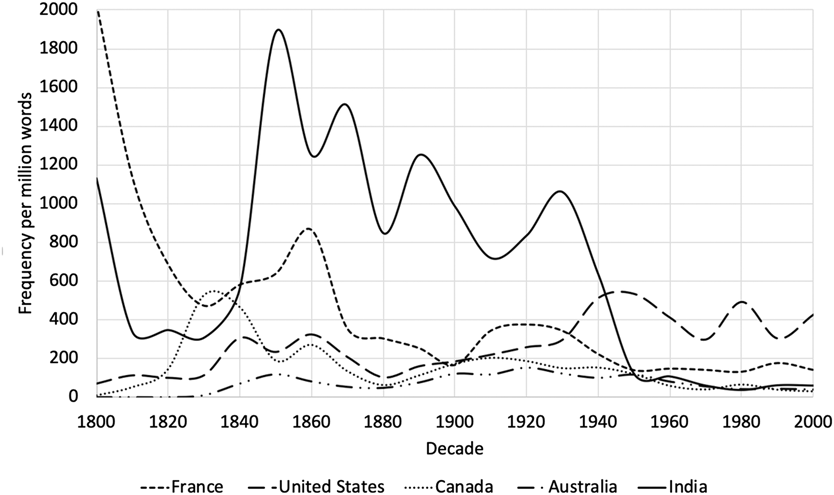
In the Hansard corpus, mentions of other countries had already reached their peak at the very beginning of the time window studied—that is, in 1803 (see Figure 1). Therefore, our data do not permit us to study the situation in, say, the 18th century. It can, of course, be assumed that references to other countries, European ones in particular, were frequent early on (for instance, because of frequent wars in Europe in which Britain was involved). Also unsurprisingly, France has been an important reference point and was frequently mentioned in the debate reports and other documents. Nevertheless, until the 1940s, India was the country referred to most often. However, we must bear in mind that in those years it was part of Great Britain and, hence, all issues related to it were considered a part of domestic politics.
References to various countries in the Hansard corpus
Naturally, not all references to other countries are part of argumentation on national policies. They may be made in connection with foreign policy—for instance, how Britain should defend itself against its enemies or how it should manage relations with its allies. This is why we searched for mentions of the countries in combination with the term “example” within six words. Excerpts from speeches thus identified indicate that this search indeed generates the right kind of hits, identifying mentions of other countries as a means of arguing for or against specific domestic policy initiatives.
The excerpt below, from 1845, offers an example of such argumentation. Here, a speaker favouring a new law intended to eliminate restrictions on civil rights aimed at the Jewish population invokes other countries’ policies as examples that Britain should follow.
[…] taken place in France, in Belgium, in the United States, and, above all, in Holland, where for a great number of years persons of the Jewish persuasion have, without restriction, been admitted to high offices, and where not only has no public inconvenience been felt therefrom, but where the principle has, as I believe, met with the full and general concurrence of all persons of liberal and enlightened minds: less liberal has been the policy of the Austrian States regarding the Jews: […]. But in Germany, Prussia has set the example, and there persons of the Jewish religion are admitted into the Schools and Universities, and are permitted to read lectures in the Universities, and to take degrees: most admirable and instructive have been the results, for some of the most eminent and learned of men, distinguished in literature and science, have thereby been reared (House of Lords 1845).
Another example is found in the extract below, in which the speaker cites the French government’s measures to improve safety in mining in his advocacy of a new law aimed at reducing mine accidents. He stresses the investments that France’s government had made to improve occupational safety in mines. By emphasising that such government-funded investments in occupational safety are lacking in the British mining industry (and indeed in industry in general), the speaker argues that the British system is lagging behind other countries in terms of industrial-safety policies.
[A]nd where men have to find the whole of the cost, they are naturally very anxious to keep the whole of the control in their own hands: I suggest that in order to smooth the way the Government should consider the advisability of providing a portion of the cost: do not let us forget that large and expensive experiments have been carried out by the coal-owners in various parts of the country, with a view to finding out the effect of blown-out shots upon coal dust in the generating of explosions: in other countries—France, for example—the Government have come very generously to the assistance of coal-owners in erecting galleries to enable them to carry on their experiments: nothing of the kind has […] been done in this country: we have been very backward indeed in the matter of providing financial assistance to enable employers of labour, not only in coal-mining but in other industries, to carry on experimental work with a view to proving the efficiency of appliances for protecting and safeguarding the lives and limbs of their workpeople (House of Commons 1910).
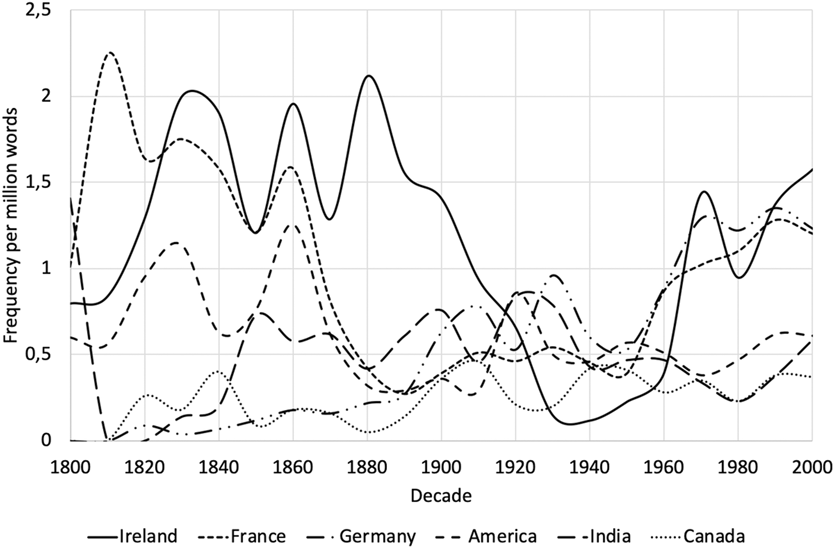
The changes in the frequency with which mentions of these types exist in the data (see Figure 2) show that, except at the very beginning of the timeline, France held the number-one place, to be surpassed later by Ireland and, in the latter part of the 19th century, India and Germany. The US and Canada also figure as countries cited as examples in one way or another. It is noticeable too that, in discussions of examples for domestic policies, mentions of other countries were most frequent in the 19th century, then dipped considerably at the turn of the century. A new upswing in this kind of talk is evident from the 1950s onward, but its prevalence has still not reached the earlier peak levels. From that standpoint, it could be argued that 19th-century British policymaking showed more interdependence or cosmopolitan leanings than it does at present.
References to various countries with “example” within six words of them in the Hansard corpus
Another way to invoke other countries as something a nation can learn from is to refer to particular “models” that others have enacted. These might be named after the country in question, or they may carry another proper name, as in the case of the “Westminster model” of parliament. Just as in the talk about examples, other countries’ policies can be described either as suitable or unsuitable for domestic policy. The extract below is one example.
Sir, the question of the establishment of a Minister of Justice is one which is considered by all parties to be full of difficulty. The model upon which such a department must be framed—the Ministry of Justice in France, for instance—has functions and powers totally incompatible with the Constitution of this country. It is impossible that a Ministry of Justice, such as exists in France, could be established in this country. It has power, for instance, over all magistrates; it names them, and removes them, and it has functions which are quite inconsistent with our practice. With regard to the appointment of a public prosecutor, no steps have as yet been taken for that purpose (House of Commons 1858).
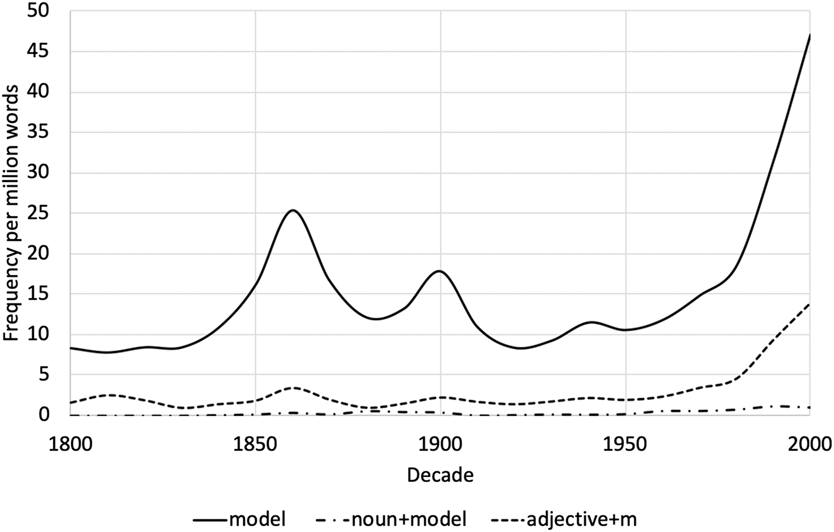
To determine how frequent talk of this nature was during the relevant time period, we searched for hits for “model” alone or adjacent to adjectives and nouns. The results (see Figure 3) show that talk about models started becoming particularly commonplace in the 1950s, and a rapid rise in its popularity has been underway since 1980. The earlier peak, in the 1850s, can be accounted for by two issues in particular: discussion of the mass schooling referred to earlier in this paper and debates on what the constitutions of British colonies, such as Australia, should be modelled upon. The dotted line in the graph describes the frequency of hits for “model” prior to an adjective. The most common adjectives are, in decreasing order of frequency, “new,” “American,” “good,” “social,” “economic,” “German,” “working,” “British,” “European,” “particular,” “perfect,” “Scottish,” “best,” “old,” “different,” “English,” “French,” “better,” “useful,” and “very”.
The frequency of “model” (represented by the continuous line), plotted alongside that of its appearance next to an adjective (line with dots and dashes) and next to a proper name (line with dots) in the Hansard corpus
In comparison with talk in which other countries are utilised as examples that “we” should follow or avoid, “model talk” is often more abstract. Rather than merely suggesting that “our” policy is modelled on the policy of another country, as if the policy of that country had been used as a cast to produce its replica, talking about a model with a set name implies that we have a conception of the mechanisms through which the policy in question functions. Accordingly, a model might be named after a country, but it could also be given a name that points to its key features, as is the case in the excerpt below.
The German exports incentive scheme works in two parts: first, there is a return to the exporters of the turnover tax of 4 per cent; in addition, a small export incentive payment, ranging from 1 per cent to 3 per cent, is made by the German Government to exporters. If they can do it, why cannot we? A similar thing is going on in France.
The main argument that I want to convey to my right hon. Friend the President of the Board of Trade is a little article which appeared in a newspaper the other day: “The Australian Government is to grant extensive tax concessions to exporters as a major incentive to encourage exports. Mr. Menzies, the Prime Minister, is likely to give the full details of the scheme’s operation before his departure overseas later this month. It is believed that tax concessions will bring new producers into the export drive. The concessions are part of a wide range of plans to increase trade”. That is precisely what I should ask my right hon. Friends to do. Even if they have been unimpressed by the German and French model, will they promise to look with sympathy at the scheme which is to be announced in Australia, and, whether or not they are terribly impressed with it, will they give some thought to recognising that we have tried and failed in merely trying to talk ordinary industrialists into the export market? If we can do this, I am certain that the results which will flow will be more than well worth while (House of Commons 1961).
In this extract, the speaker alludes to the German and French models, but the type of model in question is also referred to with the qualifier “export incentive,” and the way it is expected to function is explained. In this manner, the concept of model is assigned a meaning that closely approaches a theory as to how a policy is supposed to change actors’ behaviour and hence the economy of the country. This expansion in the meaning of the term “model” seems to account for its more frequent use from the 1950s onward in the British parliament.
The global rise of the concept of model
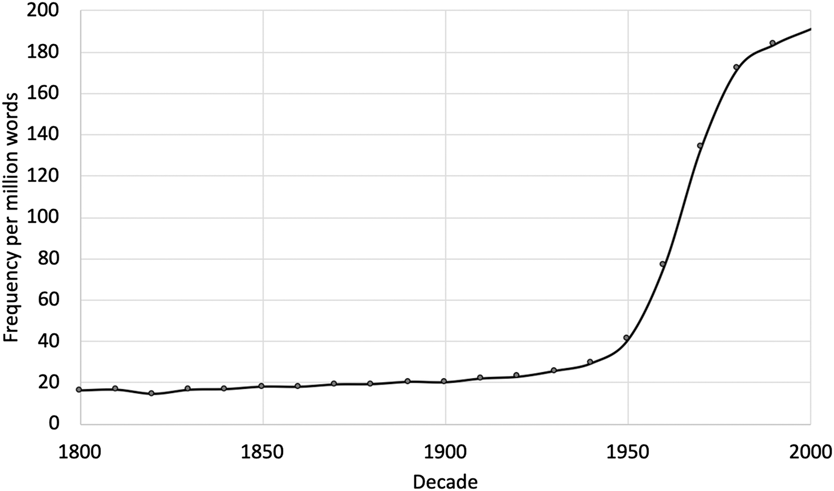
As interesting as this increased use of the concept of model is, one could still argue that it is peculiar to talk in the British parliament. To ascertain whether a more general cultural trend exists that is reflected in British parliamentary discourse, we turned to other data sources. Indeed, it does seem that talk about models also grew more commonplace in the latter part of the 20th century on the larger stage. As the Google Books American English corpus [Davies Reference Davies2011] shows, the rise in the frequency of the word “model” has increased especially from the 1950s onward (see Figure 4 below). The same pattern can be found in the COHA corpus.
The term “model” in the Google Books American English corpus
In quite a strong parallel to what was found the Hansard corpus, the additional data shows that the word “example” was commonly used throughout the two centuries studied whereas the word “model” has been used increasingly often since the 1950s. Changes in the frequency with which “example” has been used from one era to another may well depend on how fashionable idioms such as “for example” have been at various times, whilst the word “model” does not come with similar baggage: it can be argued that its usage tells us about the popularity of a certain conceptualisation. According to the Oxford English Dictionary, the word “model” has had no less than 17 different senses as a noun. One definition is of particular interest here, namely sense eight, defined as “A simplified or idealized description or conception of a particular system, situation, or process, often in mathematical terms, that is put forward as a basis for theoretical or empirical understanding, or for calculations, predictions, etc.; a conceptual or mental representation of something”. It is first attested in 1901.
Scrutiny of the instances of the word “model” suggests that its greater use is particularly due to increased talk about serially produced items—e.g., makes of car or types of above-knee prostheses produced (Committee on Prosthetics Research and Development 1960). Such usage of the term shows a mixing or merging with the idea of a system that can be captured by some kind of formula or graphical depiction. In the latter sense of the word, a model is a simulation, created by reducing the reality under consideration to a small number of parameters and then testing how well the simplified analogue predicts the behaviour of the real thing. In ordinary language, however—for instance, in talking about policies—the term “model” is treated as a simple description of how the technique in question produces certain outcomes.
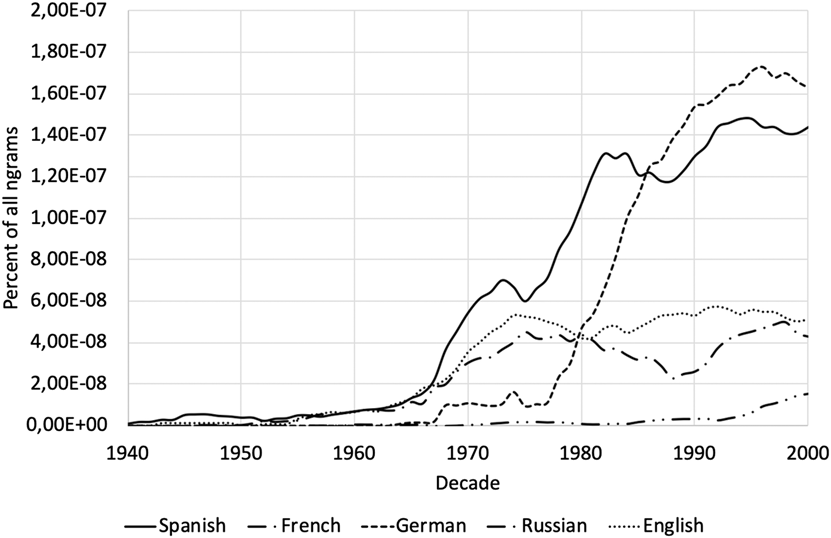
As indicated by the frequencies of the term “policy model” in the Google Books corpora we examined (see Figure 5 below), talk about politics is one area in which this way of speaking about “models” has become increasingly commonplace from the 1950s onward. Furthermore, such talk is not restricted to the English language. As our data revealed, the corresponding term has, in fact, become much more popular in German and Spanish than it is in English, French, or Russian.Footnote 1 One might conclude that this is because, for instance, an English-speaker can talk simply of policies rather than policy models; the latter is less idiomatic. Whether or not this is true, the 1950s-1960s were a turning point with regard to all of these languages, after which the term entered more common use.
The frequency of the 2-gram “policy model” in various languages in the Google Books corpora
It seems evident that the headway of the concept of model into political vocabulary from the 1950s onward can be traced to particular developments in scientific thinking and language, although the concept went through several transformations before it came to depict an exportable “policy recipe”. A starting point for this overall trajectory can be found in the latter part of the 19th century, when natural scientists, especially physicists, adopted a new way of trying to understand and explain the objects of their investigation by drawing parallels and using illustrations. In the seminal paper “On Faraday’s Lines of Force,” from 1856, James Clerk Maxwell advocated the idea that when there is partial similarity in mathematical form between two sets of laws, it is possible to devise “physical analogies” —that is, to illustrate one domain via the other [Epple Reference Epple, Gray, Hashagen, Hoff Kjeldsen and Rowe2015]. The notion of analogies was taken up by many authors, and, in addition to these, scholars began to talk about “interpretations,” “images,” and “systems”. However, explicit use of the terms “model” and “modelling” was not the everyday stuff of scientific discourse until 1933, when H. P. Robertson discussed cosmological models in a widely read review article [Gray et al. Reference Gray, Hashagen, Hoff Kjeldsen and Rowe2015: 2768]. After this, conceiving of a model as a mathematical system that reduces reality to the “essential” components (expressed, for instance, by differential equations) and simulates the natural realm became ubiquitous. Inspired by the work of John Maynard Keynes [Reference Keynes1936], the macroeconomic models created from the 1950s onward are a good example. The idea of local polities as exportable models is yet another turn in this line of thought. Firstly, it is assumed that a scientist or policy analyst’s model that encompasses the local socio-economic system accounts for its success; then, this model is promoted as a recipe for those who want to copy that success. The construction and proliferation of policy models that began in the 1950s appears to have started once this manner of thinking became considerably more prevalent. Since talk about politics as a matter of choices between or combinations of individual models started to become commonplace in that decade, it is only natural that national institutional environments and policy choices within them are increasingly often described as named models. For instance, sociologists started speaking of various welfare models at that time. Later on, talk about the “neoliberal model” became prominent. For instance, at the time we write this, the Scopus database of peer-reviewed literature yields 11,768 hits for the word “neoliberal” and 206 for the string “neoliberal model”. These concepts proliferate in political debate too. Consider this example from discussions in Australia’s parliament:
The road they are going down […] will only mean a second-class safety net or social welfare model of health for the poor. Everyone else—Australian families under financial pressure and families with kids—will have to fend for themselves because the quality of health care that they get will be entirely dependent upon the disposable income they have and how much they can afford.
We have made this absolute commitment: you can be reliably assured that, under a Labor government, bulk-billing will be restored. The restoration of bulk-billing is absolutely our highest health priority. The Minister for Ageing can smirk, but what has always been their public policy attitude to health has been exposed: charity, not universal care (Parliament of Australia 2003).
In the quotation above, the speaker alludes to key concepts, such as universalism, in terms of which scholars and politicians alike characterise welfare models, regardless of the country. The global proliferation of these concepts means that, on the one hand, policy solutions associated with such concepts spread worldwide, even though this does not necessarily entail the actual practices adopted in individual polities being similar to each other. As scholars of world society theory have pointed out, decoupling between principles and practices and between aims and means is endemic [Bromley and Powell Reference Bromley and Powell2012; Hafner-Burton and Tsutsui Reference Hafner-Burton and Tsutsui2005; Hafner-Burton, Tsutsui and Meyer Reference Hafner-Burton, Tsutsui and Meyer2008]. On the other hand, this means that politics is discussed and policies are described and evaluated by means of the same concepts all over the globe.
Discussion
Our findings help to clarify the ways in which MPs and other actors whose voices are heard in British parliamentary speeches and in various documents make their arguments by referring to other countries and the international context. The evidence suggests that there has been a long-term development in which proposals to learn from policies of other countries have evolved from referencing case examples to referencing policies that are constructed and branded as models in their own right, as if these were blueprints on the basis of which one can obtain the same result in the “recipient” country by following the given plans. The idea of transferable models caught on particularly strongly in the 1950s and has yet to lose its hold. With this technical or technocratic language utilised in political rhetoric, a promise is conveyed that policies are well-researched, evidence-based blueprints that serve the nation’s interests. In that sense, they appear to depoliticise politics into technical questions surrounding which of the models or practices are the best ones to choose.
Our finding that the “model discourse” became increasingly popular in the post-war era is in line with the argument made in world society theory that the flow of worldwide models began expanding after World War II, enhancing the global spread of rationalistic world culture and deepening the structural isomorphism of national states. In this school of thought, the creation of the United Nations and the entire organisational ecology of IGOs and INGOs was crucial to this development because these organisations served as the conveyor belts of worldwide models.
The results of our study take us further than this, however. That references to other countries in the Hansard corpus have not increased in the past 200 years adds another chapter to the story, showing that political decision-making in the UK parliament has long exhibited interdependence with other national contexts. Hence, the change that took place during the post-World War II era was not in the quantity of references to the international context of decision-making but in the way of making those references. Rather than referring to the policy decisions of other countries as examples from which to glean a sense of what to do or avoid doing, actors began articulating policies as models. That is, scientists and policy analysts alike started to consider features of policies in a given area and polity as elements of a model whereby scientists are able to assess and measure the influence of specific acts within the system on society at large. Such construction and packaging of models through “theorisation” resulted in “named models” spreading more and more, but it also brought about global diffusion of the idea that policymaking entails choices between distinct named models. The other two corpora used for our study verified nicely that the changes evident from the Hansard corpus with regard to forms of talk reflect a general historical trend: both the Google Books and the COHA corpora show that the word “model” has become increasingly popular from the 1950s onward. Furthermore, evidence surrounding the use of the term “policy model” in the Google Books English, French, German, Russian, and Spanish corpora shows that this transnational trend is indeed linked with accounting for policymaking in terms of models.
The rise in prevalence of the idea of model in political talk that began in the 1950s appears to have been caused by two trends that are interlinked. Firstly, the creation of the UN system meant that governance on a global scale became increasingly based on “soft power” [Nye Reference Nye2004], with governments being consulted through knowledge production rather than being threatened with force. Such persuasion work relied on the authority of science, which created demands for a “hard science of society” and hence for exportable policy models. Secondly, as discussed in greater depth earlier in this paper, the assumption, now commonplace, that policies can be modelled, exported, and imported was partially an outgrowth of the idea of the model that developed in the natural sciences in the 1930s, from which it spread to economics. From there, in the 1950s, it eventually entered the global political vocabulary.
The results of this study have two implications. Firstly, it sheds more light on the formation of contemporary politics and policymaking, in which policies are justified by depoliticising them into choices between scientistic models, circulating throughout the world. This does not mean that decisions are increasingly evidence-based. They may also be based on questionable assumptions about models and their transferability, and politicians may cast doubt on expert knowledge by presenting “alternative facts,” but that is precisely because truth has become a central political battlefield. Secondly, at a more theoretical level, the study suggests that since “model talk” is part of the rhetoric by which policies are justified, one should be careful in using concepts such as “worldwide model” as the researchers’ own analytical categories when discussing the global travel of ideas. It is more accurate to say that national policies get synchronized with each other and that the construction of named models plays a key role in this process.



