


Introduction
Prominent theories of democratic representation highlight the quality of communication between representatives and represented as one key normative criterion for judging a political system (Mansbridge Reference Mansbridge2003; Pitkin Reference Pitkin1967). One important form of such communication concerns how legislators explain their policy decisions to constituents (Fenno Reference Fenno1978). The communication of policy explanations can enhance acceptance of decisions and trust in decision makers (Esaiasson et al. Reference Esaiasson, Gilljam and Persson2017), and can contribute to system support more broadly (Easton Reference Easton1965). Yet, Mansbridge (Reference Mansbridge2003) cautions that legislator–constituent communication meets democratic standards only if it provides equal opportunities for access and is non-manipulative. Unequal responsiveness to constituents or strategically tailored explanations may therefore undermine core democratic norms.
Motivated by these concerns, a growing experimental literature examines potential inequalities in how legislators respond to constituent correspondence about policy. Although there are a variety of settings in which legislator–constituent policy communications can take place, most studies focus on direct written correspondence between legislators and constituents. This type of communication is normatively important because it is a much-used (Cain et al. Reference Cain, Ferejohn and Fiorina1983; Fox Reference Fox2015), direct, interpersonal mode of communication where the asymmetrical information structure and the absence of public scrutiny make inequality and manipulation particularly troubling. It is also a setting amenable to experimental variation in constituent prompts and characteristics, and to unobtrusive measurement of legislator responses.
Early studies of legislator–constituent policy correspondence focused on the United States, a candidate-centred political system where weak parties create incentives for personalised campaigning. A key finding of these studies is that US legislators tailor the content of their replies based on legislator–constituent policy congruence, emphasising reinforcing behaviour when addressing supportive constituents and compensating behaviour when addressing incongruent ones (Grose et al. Reference Grose, Malhotra and Van Houweling2015). Such tailoring can shift perceptions in ways that advantage legislators and may constitute a subtle but normatively troubling form of communicative manipulation (Grose et al. Reference Grose, Malhotra and Van Houweling2015, 741).
Legislators’ reactions to constituent policy correspondence may be quite different in Europe’s more party-centred parliamentary systems. Indeed, recent experimental research on legislator–constituent policy communications in European systems points to more basic party-related response inequalities: legislators report being less willing to respond to hypothetical voters whose opinions are incongruent with their party’s policy position (Öhberg and Naurin Reference Öhberg and Naurin2016) and are observed to be more responsive to voters who support their political party (Schakel et al. Reference Schakel, Baumann, Bolet, Campbell, Louwerse and Zittel2025; Bolet and Campbell Reference Bolet and Campbell2024).
However, existing European studies leave open important questions about legislator–constituent policy communication. First, those that analyse legislator self-reported behaviour in hypothetical scenarios (Öhberg and Naurin Reference Öhberg and Naurin2016) do not reveal how legislators behave when confronted with real queries. Secondly, those that analyse observed legislator behaviour in response to queries from fictitious constituents (Bolet and Campbell Reference Bolet and Campbell2024; Schakel et al. Reference Schakel, Baumann, Bolet, Campbell, Louwerse and Zittel2025) encounter problems measuring substantive responsiveness in systems where legislators typically send holding replies and will not reply substantively unless they have been provided with full address details. Thirdly, these studies provide little evidence on whether European legislators vary the nature of their substantive explanations, as documented in the US context.
In this paper, we contribute evidence from the United Kingdom that speaks to these open questions. We report results from a large-scale audit study focusing on whether and how MPs respond to real policy queries from real constituents who vary in their policy positions. Our recruitment of real constituents as confederates alleviates ethical and measurement concerns associated with fictitious constituent designs. It enables us to better identify inequalities in MPs’ substantive response rates and in MPs’ substantive response content.
Drawing on a framework grounded in Westminster system incentives, we theorise that, when deciding whether and how to reply to constituent policy correspondence, MPs weigh procedural costs, valence benefits, and policy-spatial considerations. Based on these considerations and existing empirical research, we expect MPs to be more likely to respond to constituents who are congruent with their party on the policy issue under discussion. We additionally theorise that, in a party-centred system where information about party positions is more accessible than information about MPs’ personal positions, MPs may strategically tailor response content, emphasising personal agreement when corresponding with congruent constituents and ‘hiding behind the party’ when corresponding with incongruent ones. These expectations apply most clearly to loyalist MPs, who constitute the overwhelming majority in Westminster.
However, the results of our audit study, conducted during the Brexit negotiations, offer little support for either expectation. Across nine salient policy issues, we find little evidence that MPs are more responsive to constituents who agree with their party’s position. We also find little evidence that MPs systematically vary how much they emphasise themselves versus their party depending on constituent–party policy congruence.
Our study makes both substantive and methodological contributions. Substantively, we provide rare behavioural evidence on whether variation in policy congruence generates inequalities in legislator–constituent communication. Existing research suggests that it may generate unequal responsiveness and strategic content manipulation, calling into question the extent to which legislator–constituent communication satisfies democratic norms. We show that, in the British case, there is little evidence that policy congruence affects responsiveness in ways that would raise normative concerns about equality of access to this type of communication. There is also little evidence that policy congruence affects the personal versus party emphasis of MPs’ policy explanations in ways that would raise concerns about manipulation. From this perspective, our findings are normatively encouraging regarding the role that legislator–constituent policy communications can play in parliamentary democracies.
Methodologically, our design speaks to ongoing debates about the ethics and validity of audit experiments with political elites (see symposia in John and Foos Reference John and Foos2022). By collaborating with real constituents who approved messages sent on their behalf, we avoid identity deception and substantially reduce misrepresentation concerns inherent in studies using fictitious senders. This approach also allows us to measure substantive responses more accurately in a system where MPs typically require a valid constituency address before replying. Our ‘real constituent’ audit design therefore offers a more ethical and valid approach for studying elite responsiveness and can inform the design of future work on legislator–constituent communication.
Evidence on Legislator–Constituent Policy Communication
Legislator–constituent communication has long been theorised as central to representation, with distinct roles for service- and policy-related communications (Fenno Reference Fenno1978). Over the past fifteen years, a large experimental literature has examined how legislators respond to service- and policy-related constituent messages that vary in content or sender characteristics. Early experimental studies carried out in the United States document communication inequalities reflecting legislators’ personal vote-seeking incentives. US legislators tend to prioritise broad, electorally safe service activities over divisive policy explanations (Butler et al. Reference Butler, Karpowitz and Pope2012), respond less in safe districts (Dropp and Peskowitz Reference Dropp and Peskowitz2012), and engage in selective communication with constituents from whom they anticipate electoral returns (Broockman Reference Broockman2013; Gell-Redman et al. Reference Gell-Redman, Visalvanich, Crabtree and Fariss2018).
US studies that focus on policy-related communications specifically highlight subtler inequalities linked to legislator–constituent policy congruence. Grose et al. (Reference Grose, Malhotra and Van Houweling2015) show that while policy congruence seldom affects whether US legislators respond to policy queries, it meaningfully shapes the content of responses: legislators emphasise compensating behaviour when addressing incongruent constituents and reinforcing behaviour when addressing congruent ones. Such tailoring can shift perceptions in politically beneficial ways and may therefore constitute the type of manipulative communication that can degrade the quality of democratic deliberation (Mansbridge Reference Mansbridge2003).
More recently, a growing number of experimental studies examine policy-related communication in European parliamentary democracies (see, for example, Breunig et al. Reference Breunig, Grossman and Hänni2022; Bolet and Campbell Reference Bolet and Campbell2024; Giger et al. Reference Giger, Lanz and De Vries2020; Öhberg and Naurin Reference Öhberg and Naurin2016; Schakel et al. Reference Schakel, Baumann, Bolet, Campbell, Louwerse and Zittel2025).Footnote 1 Two broad findings emerge from these European studies. First, even in party-centred contexts, personal vote incentives can matter. For example, German MPs elected via majoritarian tiers are more responsive to policy queries than those elected via closed-list proportional representation (Breunig et al. Reference Breunig, Grossman and Hänni2022), while candidates for the Swiss federal legislature prioritise responses to constituents over non-constituents more where electoral competition is high (Giger et al. Reference Giger, Lanz and De Vries2020).
Secondly, a number of European studies suggest that responsiveness to constituent policy communications does depend on constituent–legislator political congruence, albeit legislator party affiliation plays an important role here. Öhberg and Naurin (Reference Öhberg and Naurin2016) argue that the party-centred politics of European parliamentary democracies means that the position a legislator’s party takes on an issue will play a crucial role in shaping the legislator’s incentives when a constituent raises that issue. Consistent with this, they provide evidence that constituent–party policy congruence matters: Swedish legislators report being more likely to reply to hypothetical constituents taking positions congruent with their party. Other recent research from Schakel et al. (Reference Schakel, Baumann, Bolet, Campbell, Louwerse and Zittel2025) attests to the importance of party considerations. Using behavioural audit studies, they find that MPs across Germany, the Netherlands, and the United Kingdom are more responsive to co-partisan constituents. Bolet and Campbell (Reference Bolet and Campbell2024) provide further evidence that this partisan bias in responsiveness is linked to personal vote-seeking incentives in the United Kingdom, showing that the bias is concentrated among non-local MPs who lack alternative bases for cultivating a personal vote.Footnote 2
Despite these advances, important gaps remain in our understanding of how political congruence generates inequalities in legislator–constituent policy communication in European parliamentary systems. First, evidence from Öhberg and Naurin (Reference Öhberg and Naurin2016) on the effects of constituent–party policy congruence relies on self-reported legislator response intentions faced with hypothetical scenarios. We still lack experimental evidence from European parliamentary contexts on how legislators respond behaviourally to actual policy enquiries that vary in terms of constituent–party policy congruence. Secondly, while Schakel et al. (Reference Schakel, Baumann, Bolet, Campbell, Louwerse and Zittel2025) and Bolet and Campbell (Reference Bolet and Campbell2024) examine real response behaviour, their designs rely on fictitious constituent queries. This poses particular measurement challenges in a country like the United Kingdom, where MPs typically require a valid address before sending substantive replies. In this type of setting, studies using fictitious senders often capture procedural holding responses rather than substantive communication. For instance, Schakel et al. (Reference Schakel, Baumann, Bolet, Campbell, Louwerse and Zittel2025) report that 73 per cent of UK MP responses were procedural address requests, leaving open the question of whether there would be more or less pronounced partisan inequalities in substantive responses. Thirdly, while the US literature documents strategic tailoring of policy explanations, we still know little about whether legislators in European parliamentary systems vary the content of their explanations in response to political incongruence.
To address these limitations, we conduct an audit study of British MPs using real constituents as confederates. Our design enables credible measurement of both substantive responsiveness and content tailoring in a party-centred parliamentary democracy.
Legislator–Constituent Policy Communication in a Westminster System
Here, we outline a series of assumptions about how the British context shapes MPs’ incentives in responding to constituent policy queries. We then discuss how these assumptions lead us to expect communication inequalities.
Electoral and Procedural Incentives
One starting assumption we make is that MPs incur some non-zero procedural cost if they reply to a constituent policy query. Replies take time and effort for the MP or their staff. British MPs receive substantial volumes of constituent policy queries (Crewe Reference Crewe2015; Fox Reference Fox2015).Footnote 3 The high volume of correspondence MPs receive, combined with the limited number of staff they have (Cain et al. Reference Cain, Ferejohn and Fiorina1987), may result in a communication ‘overload’ (Fox Reference Fox2015). As such, when deciding whether and how to respond to constituent policy queries, MPs must choose how to target limited resources.
Our next assumption is that MPs’ decisions regarding how to target these limited resources are subject to electoral incentives. This assumption is also made in other recent studies of MP–constituent communications (Bolet and Campbell Reference Bolet and Campbell2024; Breunig et al. Reference Breunig, Grossman and Hänni2022; Schakel et al. Reference Schakel, Baumann, Bolet, Campbell, Louwerse and Zittel2025). It says that an MP considers how different possible reactions to a constituent policy query affect the likelihood that the constituent votes for them in the next election (rather than voting for the candidate of another party or abstaining).Footnote 4
Electoral incentives encompass MPs’ personal vote-seeking incentives. Although the co-dependence of legislature and executive means that British elections are party-centred (Cox Reference Cox1987), the single-member district plurality system allows British voters latitude to condition electoral choices on individual candidate attributes (Proksch and Slapin Reference Proksch and Slapin2015). MPs thus have incentives to cultivate a personal vote through their activities, and interview evidence shows that MPs from the UK and other Westminster systems believe they can build an electorally consequential one (Cain et al. Reference Cain, Ferejohn and Fiorina1983; Kam Reference Kam2009). While constituency service is typically seen as the primary route for building a personal vote (Cain et al. Reference Cain, Ferejohn and Fiorina1987), a growing literature suggests that personal vote-seeking motivations can help explain MPs’ policy-related behaviour, including dissenting votes (Kam Reference Kam2009; Slapin et al. Reference Slapin, Kirkland, Lazzaro, Leslie and O’Grady2018), parliamentary speeches (Slapin and Kirkland Reference Slapin and Kirkland2020), and policy communications with constituents (Bolet and Campbell Reference Bolet and Campbell2024).
When it comes to decisions about about whether and how to respond to constituent policy queries, we argue that MPs’ electoral incentives can be usefully broken down into a series of components. First, we assume that MPs expect any substantive reply to a constituent to have some positive effect on their valence appeal to that constituent, and therefore on the constituent’s likelihood of voting for them. Regardless of whether a reply reveals agreement or disagreement with the constituent, the act of replying is likely to be valued by most constituents given voters’ general expectations that MPs should be responsive to constituent communications (Campbell and Lovenduski Reference Campbell and Lovenduski2016; Cain et al. Reference Cain, Ferejohn and Fiorina1987).
Secondly, we assume that MPs also weigh up the impact of any response to a constituent policy query on their policy-spatial electoral appeal to that constituent. Here we distinguish between the effects of information about party policy position and an MP’s personal policy position. If an MP replies with information about their party’s stance on the issue in question and this stance is (in)congruent with that of the constituent, the MP will expect this information to increase (decrease) their policy-spatial appeal to the constituent, and to increase (decrease) the constituent’s likelihood of voting for them. Likewise, if an MP replies with information about their personal stance on the issue in question and this stance is congruent (incongruent) with that of the constituent, they will expect this information to increase (decrease) their policy-spatial appeal to the constituent, and to increase (decrease) the constituent’s likelihood of voting for them.
Crucially, we argue that British MPs will perceive the electoral impact of information about personal policy position as greater in absolute magnitude than the electoral impact of information about party policy position. In a party-centred system like the British one, party policy positions are widely disseminated through national media, meaning that constituents can often infer a party’s stance on a salient issue regardless of whether an MP provides explicit information on this. In contrast, MPs’ individual positions are less widely reported (Cain et al. Reference Cain, Ferejohn and Fiorina1987, 193) and therefore more difficult for voters to learn about in the absence of direct information from MPs. In other words, from an MP’s perspective, providing information about one’s own stance can shift constituent policy-spatial evaluations more dramatically than reiterating party policy.Footnote 5
We further argue that the party-centred nature of a Westminster system affords MPs strategic discretion regarding whether to emphasise personal or party policy position in any response they provide to a constituent policy query. We call this the MP v. party emphasis of an MP’s response, and suggest that MPs have incentives to tailor their emphasis depending on which has the more positive (or less negative) impact on their policy-spatial appeal to the constituent. An MP can choose to personalise the content of a response and reveal their own policy position. Or they can refrain from doing so by sticking to a discussion of party policy, covering information similar to what the constituent is likely to learn anyway based on national media coverage of party leaders’ speeches and party manifestos. The latter approach is less viable in a US-style candidate-centred system.
There are, of course, objections to the assumptions we lay out here. For one thing, some perspectives might question whether MPs’ view personal policy-spatial appeals as having a meaningful impact on a constituent’s probability of voting for them. Some argue that the norm of party discipline in a Westminster system leads constituents to discount policy-related behaviour of their MP (see, for example, Norton Reference Norton1993). As a result, constituents focus the policy-spatial component of their electoral decision-making squarely on party positions, so that MPs have little scope to build a personal vote through personal policy-spatial appeals to their constituents.
However, more recent research suggests that MPs do engage in personalised policy-spatial appeals to their constituents. Slapin et al. (Reference Slapin, Kirkland, Lazzaro, Leslie and O’Grady2018) argue that MPs use parliamentary dissent ‘as a mechanism to communicate policy stances to voters for electoral gain’ (Slapin et al. Reference Slapin, Kirkland, Lazzaro, Leslie and O’Grady2018, 17), and that MPs use speeches to explain their dissenting position to constituents. If MPs use actions like parliamentary dissent and speech as a means to enhance their personal policy-spatial appeal to constituents, it is plausible that they will use constituent policy correspondence in a similar way. Parliamentary dissent is a potentially high-cost act in terms of MP career advancement (Benedetto and Hix Reference Benedetto and Hix2007; Kam Reference Kam2009). Emphasising personal positions in constituent correspondence is a relatively low-cost act, and one which an MP may benefit from whether or not the position they reveal deviates from the position of their party.
Another objection is that there are additional forms of tailoring MPs could employ in their responses to constituent policy queries. They may vary emotional tone, as they do for electoral advantage in parliamentary speeches (Osnabrügge et al. Reference Osnabrügge, Hobolt and Rodon2021). Or they may vary which additional policy messages they mention, as documented in the US context (Grose et al. Reference Grose, Malhotra and Van Houweling2015). Yet we argue that tailoring of MP–party emphasis choice is a straightforward and institutionally plausible strategy in a party-centred parliamentary democracy. Evidence from campaign communication further shows that British politicians strategically vary the balance between personal and party appeals (Milazzo and Townsley Reference Milazzo and Townsley2018). We theorise that such behaviour extends to legislator–constituent policy correspondence.
In sum, we argue that MPs weigh up procedural costs alongside valence and policy-spatial electoral appeals when choosing whether to respond to particular types of constituent policy queries and, if so, how much emphasis to place on party versus personal position in their response. Based on these assumptions, we turn to developing expectations on how MPs make these choices, contingent on the policy positions expressed by their constituent.
Expectations for Loyalist MPs
We focus on developing expectations for the case of a party loyalist MP, where the MP has voted with their party leadership on the issue raised by the constituent. In this case, because the MP’s position on the issue is the same as that of their party, a constituent letter that takes a position (in)congruent with the MP’s party is also (in)congruent with the MP’s own position. This will be by far the typical case, given the high levels of party cohesion in Westminster (Benedetto and Hix Reference Benedetto and Hix2007; Cowley Reference Cowley2002; Kam Reference Kam2009). Indeed, most MPs are party loyalists even on the contentious issues we study in this paper. In Section SI.1 of the Supporting Information, we outline expectations for the rarer situations where the MP dissents from their party on the issue raised by the constituent.
Consider a scenario where the MP is a loyalist on an issue and receives a query about that issue from a congruent constituent. The MP can choose to reply or not, and in any reply can emphasise their personal or party agreement with the constituent on the issue. Providing a reply entails a procedural cost, but this is set against three expected benefits. First, any substantive reply enhances the MP’s electoral appeal to the constituent in valence terms. Secondly, providing information that the MP’s party agrees with the constituent can be expected to increase the probability of electoral support from the constituent because it increases their policy-spatial perspective appeal to the constituent. Thirdly, providing additional information that the MP themself agrees with the constituent can also be expected to increase policy-spatial appeal and therefore the probability of electoral support from the constituent. Furthermore, the third benefit is likely to be greater than the second, because the constituent is less likely to learn about the MP’s personal policy position in the absence of information from the MP. We therefore expect that a party loyalist MP faced with a congruent letter should have a relatively high likelihood of replying and of emphasising their personal agreement with the constituent when doing so.
Conversely, an incongruent constituent letter provides a party loyalist MP with few opportunities to positively impact the constituent’s likelihood of voting for them. A substantive reply will generate valence benefits, but from a policy-spatial perspective, providing information that the MP or their party disagrees with the constituent’s position can be expected to reduce the probability of electoral support from the constituent. We therefore expect that a party loyalist MP faced with an incongruent letter should have a relatively low likelihood of replying.
Furthermore, if a party loyalist MP does reply to an incongruent letter, we expect them to emphasise party over personal policy position. Highlighting that the MP personally disagrees with the constituent’s position is likely to have a greater negative impact on the probability of electoral support from the constituent than information that the party disagrees with the constituent’s position: the constituent may eventually learn the party’s position but is less likely to learn about the MP’s stance. Therefore, the MP has an incentive to de-personalise any response, framing the incongruent position as the responsibility of their party leadership, thereby shifting blame for the incongruence onto the party.
In sum, our framework predicts that party loyalist MPs will be more responsive to congruent constituents and, conditional on responding, more likely to personalise their responses to congruent constituents. Because most MPs in our study are loyalists, these expectations also guide our predictions for aggregate effects across MPs and issues.
Research Design
To evaluate our expectations, we developed and pre-registeredFootnote 6 a large-scale audit experiment in the United Kingdom between 14 November 2018 and 3 July 2019. Our design directly addresses key gaps identified in prior research: by using real constituents rather than fictitious senders, we are able to measure substantive responses and content accurately in the UK context, where MPs generally require a valid address before replying. This allows us to test not only inequalities in responsiveness, but also the ‘MP versus party’ emphasis decision central to our theoretical framework.
Brexit was the main topic of contention within British politics at this time, dominating the parliamentary and wider political agenda, and being highly salient for the British public (Ipsos 2018, 2019, 2020). The topic was widely debated and various subtopics emerged as negotiations took place. In particular, debates focused on the merits of the UK’s decision to leave the European Union in the June 2016 referendum, and on the type of Brexit deal – ‘soft’ or ‘hard’ – the United Kingdom should pursue for its future relations with the European Union. In keeping with the history of debates about European integration in the United Kingdom, there were serious intra-party splits – within the Conservative and Labour parties – over the issue, leading to significant rebellions and defections. The May government’s Brexit deal suffered three major defeats in the House of Commons, losing three ‘meaningful votes’ in January and March 2019 (with respective Conservative rebellions – the number of MPs voting against the government – of 118, 75, and 37 (Aidt et al. Reference Aidt, Grey and Savu2021)). The UK public was also deeply and evenly divided over the merits of Brexit throughout this period (What-UK-Thinks 2022). Given the high salience of the Brexit topic, MPs may plausibly have perceived communications on this topic as potentially consequential for constituents’ electoral choices.
Experimental Design
Recruitment of constituents, treatments, and drafting of letters to MPs We recruited participants who were MPs’ real constituents and able to vote in UK General Elections. Participants were fully informed about the purpose of the experiment and consented to participate. With the help of ninety-nine student ambassadors, we recruited 1,573 constituents using a survey in four waves.Footnote 7
In the survey, participants provided their name, email address, and postcode, and indicated their position on nine salient political issues linked to contemporaneous Brexit-related parliamentary debates: a second referendum; Single Market membership; Customs Union membership; freedom of movement; deregulation; immigration levels; skills-based immigration; and two issues relating to university tuition fees. These issues were chosen to capture major policy cleavages at the time and to align with ongoing parliamentary business.Footnote 8
Once participants had indicated their opinion on these nine issues, they approved (or declined to approve) a pre-written template email on each issue, and agreed for us to send the email on their behalf. For each one of the issues, each participant was randomly shown one of eight possible letter templates aligned with their respective position. The letters were carefully – and differently – worded in order to manifest the treatment condition that each one needed to express; that is, either agreement or disagreement with a position on one of the issues. We define the treatment as whether the position expressed in the email is aligned with the party leadership’s position on the issue, or not. It is coded 1 if aligned and 0 if unaligned. Since MPs could receive more than one letter expressing the same position on the same issue – which depended on how many of their constituents signed up – we randomly assigned, first, different opening and closing sentences and, secondly, alternative wordings expressing agreement or disagreement. This differentiation in treatment wording was used to ensure that we varied the alignment with the MP’s party position rather than anything specific about the wording of the position. For each of the issues, the pro- and anti-positions in the letters represented the core opposing views then prevailing in UK politics. The letters were sent to the MP on their behalf by creating an email account with their names, and the email address was used for this purpose alone and not any other.Footnote 9
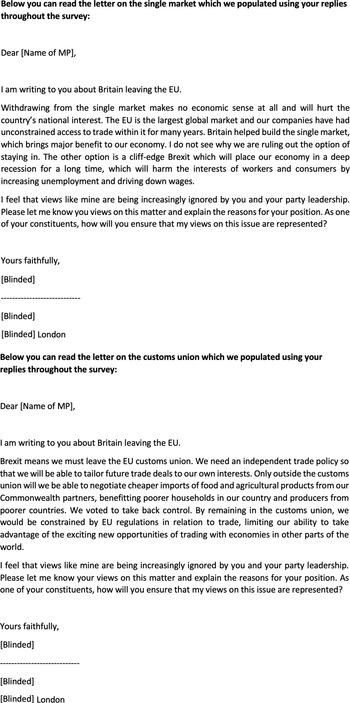
At any point in the survey, participants were able to indicate discomfort with the email wording, and in this case, the issue was dropped for the specific participants, and no email was sent on their behalf. Hence, our design works similarly to ‘write to your MP’ campaigns initiated by interest groups online, which encourage participants to sign pre-written emails. Two anonymised sample email templates approved by subjects are displayed in Figure 1.
Example emails approved by subjects.

Figure 1. Long description
The textbox shows two example emails approved by subjects to be sent from them as constituents to their MPs. The first letter makes some arguments against leaving the EU single-market and then asks the MP how they will represent the constituent’s views. The second letter makes some arguments in favour of leaving the EU customs union and then asks the MP how they will represent the constituent’s views.
Once there were at least two respondents in the same constituency who expressed an opposing opinion on one of the nine issues and approved emailing, the MP was included in the sample and sent two (or any multiple of two) emails on the issue taking opposing stances. The sending of emails to the same MP on the same issue was spread out over a multiple-day period so as to avoid violating the non-interference assumption within MPs. Our final experimental sample includes 102 MPs (fifty-two Labour, forty-seven Conservatives, and three others), who received between two and ten emails.
Experimental ethics The recruitment of real constituents who express genuine opinions on issues mitigates ethical concerns faced by audit experiments with political elites, namely that MPs are usually deceived into dealing with ‘fictitious constituents’ and therefore spend time answering requests that are not meaningful to their work as MPs (Bischof et al. Reference Bischof, Cohen, Cohen, Foos, Kuhn, Nanou, Visalvanich and Vivyan2022). While recruiting real constituents as confederates does not solve the issue of activity deception, it avoids identity and misrepresentation deception during the communication process (Bischof et al. Reference Bischof, Cohen, Cohen, Foos, Kuhn, Nanou, Visalvanich and Vivyan2022; Landgrave Reference Landgrave2020), and it also increases the validity of the measurement instrument (John and Foos Reference John and Foos2022). Only a minority of UK MPs provide meaningful replies to constituents who do not share a valid address within their constituency (a majority would request the address, which researchers would then be unable to provide). Since we are interested in analysing the content of responses, we considered a confederate design superior in terms of ethics and measurement validity.
Additionally, we also believe that there is some benefit for MPs to learn constituents’ true attitudes and interact with them. This design choice, however, has the drawback that we were only able to recruit constituents who wanted to email their MPs in some constituencies, but not in others. As shown in the systematic comparison of the sample to all MPs in terms of constituency characteristics and geography in Supporting Information Tables SI 4 and SI 5, our sample of MPs is not representative of the population of all UK MPs. Most obviously, the geographical areas containing the universities which seeded the constituents are over-represented in our sample. However, in terms of the theoretically most important characteristics, specifically partisanship and electoral marginality, the sample mean is very similar to the overall constituency average.
We could not avoid activity deception via informed consent because we did not want MPs to change their behaviour in response to being studied. However, the recruitment of real subjects directly deals with one of the most common objections to audit experiments with political elites and also increases the costs of the study, in both time and money, which we think will prevent ‘run of the mill’ experiments with little adequate justification. In the end, we see the ethics of audit experimentation as a trade-off between costs and benefits (Crabtree and Dhima Reference Crabtree and Dhima2022; Landgrave Reference Landgrave2020). Audit experimentation would be impossible with the full consent of all participants, and we are willing to incur some costs because we judge that the expected benefits from this study outweigh the potential harms induced by activity deception. Throughout this study, we endeavoured to minimise ethical costs, wherever possible. The study was reviewed and approved by the ethics committees of Durham University, the University of Nottingham, and King’s College London.
Measuring MP Positions and Loyalty
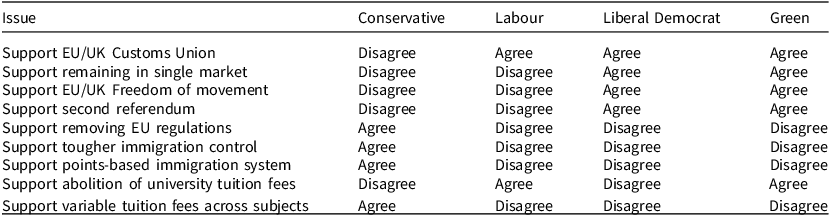
The MPs included in our audit study are drawn from the four UK-wide parties: the Conservatives, Labour, the Liberal Democrats, and the Green Party.Footnote 10 Party-dominated UK politics means that on most issues, parties make more frequent and fully developed position statements than do most individual MPs. Table 1 lists the positions of these political parties on the nine issues included in our analysis, based on qualitative coding of 2017 General Election manifestos.
Coded positions of political parties on the Nine issues in the audit study

To measure MP loyalty, we examined each MP’s alignment with their party leadership’s position. Where divisions (roll-call votes) have taken place relating to a particular issue in the House of Commons, we can empirically observe and more precisely measure whether or not an MP has publicly aligned themselves with the position of their party leadership on that issue through their vote in the division. Some divisions implied positions on more than one issue. For each of these divisions, we inspected contemporary media reports concerning the division to code whether each party whipped their MPs to vote in a particular way, and coded the position taken by the party leadership on the division based on the voting behaviour of the party leader or – where they were absent for the division – that of other frontbenchers and key allies (for example, for the Conservatives under Theresa May, we inspected the voting behaviour of May herself, plus Chancellor Philip Hammond and May’s de facto Deputy Prime Minister, David Lidington).
Using Public Whip, a parliamentary informatics project that analyses and publishes the voting history of MPs in the Parliament of the United Kingdom, we searched all Commons divisions taking place during the 2017–19 Parliament up to the launch of our experiment, and identified forty-three divisions where an ‘aye’ vote indicated a clear pro or con position on at least one of the nine issue statements above. Public Whip also allowed us to record the voting behaviour of each MP on each division. Detailed information on our coding approach can be found in Supporting Information Section SI.4.
Measuring Responsiveness
All email MP responses were forwarded to a Gmail account, where we identified substantive MP responses separate from other non-substantive ones such as standardised automated emails or general mass emails from MPs to their constituents. Responses received by email were forwarded to the participants once the fieldwork was completed. We also followed-up with participants about postal responses, and where participants supplied copies of these, they were transcribed to be included in the analysis. We received responses to 392 of our messages, including 44 responses sent by post only. This means that our design is well powered across MPs as a whole, as it is able to detect smaller average treatment effects (ATEs) of about 0.04 with a power of 0.7.Footnote 11
Measuring MP Versus Party Reference in Response
The (log) ratio of MP self- versus party mentions in responses is measured via text analysis using a dictionary approach. We adapt Slapin and Kirkland’s (Reference Slapin and Kirkland2020) approach to distinguish first- versus third-person language by combining several of their dimension keywords to arrive at four MP versus party dictionaries (more information on the dictionaries and descriptive statistics of the measure is provided in Supporting Information Section SI.10).
Results
MP Responsiveness
Our first set of expectations relates to the impact of constituent–party policy congruence on MP responsiveness and is generated assuming MPs behave at least partially strategically.Footnote 12
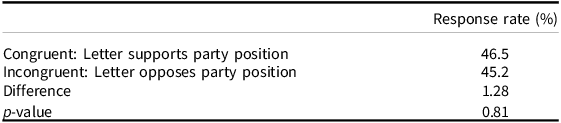
As Table 2 reports, of the 624 messages sent to MPs in our experiment, we recorded a substantive MP response in 286 cases: 242 by email and a further 44 by mailed letter only. Thus, our measured response rate is about 46 per cent. Relatively little is known about most aspects of UK MPs’ responsiveness to constituency correspondence on policy, including whether this response rate is typical. A survey of letter-writers who used the Write To Them web service to contact their MP regarding both service and policy matters in 2015 finds that, averaging across MPs, 50 per cent of letter-writers report receiving a response from their MP.Footnote 13 Previous studies in the United States have reported similar response rates (see, for example, Grose et al. Reference Grose, Malhotra and Van Houweling2015).
Overall MP response rates including holding responses and restricted to substantive responses only

However, our response rate is lower than the approximately 90 per cent rate that Habel and Birch (Reference Habel and Birch2019) reported in their study of constituency service requests. It is also lower than the 78 per cent that Bolet and Campbell (Reference Bolet and Campbell2024) report in their study of policy enquiries. There are a number of plausible reasons for these differences. First, the fact that Habel and Birch (Reference Habel and Birch2019) include holding replies and Bolet and Campbell (Reference Bolet and Campbell2024) include procedural address requests in their response rates accounts for part of the difference. However, as shown in Table 2, including holding replies would increase our response rate to about 63 per cent, which is still lower than these other studies report. Secondly, Habel and Birch (Reference Habel and Birch2019) studied constituency service requests, whilst our experiment and Bolet and Campbell (Reference Bolet and Campbell2024) study policy inquiries, and it is possible that MPs may be more responsive to service request correspondence. Finally, the inquiries were made in different general political contexts, with our inquiries made whilst there was a general increase in volumes of correspondence that MPs reported receiving as a result of the Brexit debates. The Write To Them surveys show some evidence of variation in response rates in different years up to 2015, with the response rate in 2015 being the lowest in their records, falling from a peak of 63.5 per cent in 2005.Footnote 14
Our main expectation on responsiveness is that on average across all MPs, responsiveness will be greater to policy queries that are congruent with the MP’s party’s position, compared to policy queries from an incongruent position. Table 3 provides initial evidence for this hypothesis, showing the average response rates for both congruent and incongruent letters. As expected, the response rate to the congruent letters is higher than for the incongruent letters, but this difference is small and statistically non-significant.Footnote 15
Do MPs respond differentially to letters their party agrees/disagrees with?

To more rigorously assess this hypothesis, we estimate linear probability models of the following form:
 $${\rm reply}_{i} = \beta {\rm congruent}_{i} + \alpha _{{\rm mp}\left [i\right ]} + \tau _{{\rm order}\left [i\right ]} + \phi _{{\rm position}\left [i\right ]} + \epsilon _i$$
Our unit of analysis is the constituent letter i. The outcome variable, reply i , is a binary indicator of whether an MP sends a substantive response to letter i. The key predictor of interest is congruent i , a binary indicator for whether the letter takes a policy position congruent with the MP’s party (1), or not (0). The coefficient β estimates the intention-to-treat effect of constituent–party policy congruence on MP responsiveness. We also include three types of fixed effects in the regression specification. First, since some MPs may be generally more responsive than others, we include fixed effects for the MP to whom letter i is sent (α mp[i]). Secondly, to account for the possibility that an MP may be less likely to respond to a constituent letter when they have already received other constituent letters from our audit study, we include fixed effects for letter order (τ order[i]), categorised in three groups: whether letter i was the first sent to the MP, the second through sixth sent to the MP, or was beyond the sixth sent to the MP. Finally, since MPs may be more or less likely to respond to letters taking certain positions on certain issues, we include fixed effects for each position on each issue (ϕ position[i]). Because individual constituents can send multiple letters in our design, we cluster standard errors by letter-sender.Footnote 16
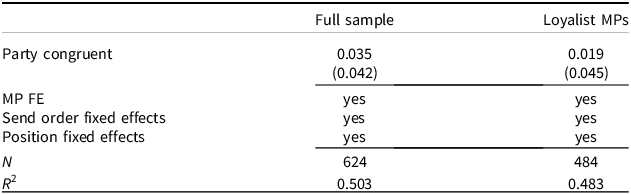
The first column of Table 4 presents results when we estimate this regression specification on the full sample. We find a lack of evidence for the expectation that the average effect of constituent–party policy congruence will be to increase the probability of an MP responding substantively to the constituent’s letter. While the point estimate of 0.035 for the constituent–party congruence treatment effect is, as expected, positive, it is also small in magnitude – implying only a 3.5 percentage point change in probability of response – and is non-significant. Based on the estimated 95 per cent confidence interval, it is plausible that the constituent–party congruence treatment has an impact ranging between a 4.7 percentage point reduction and an 11.8 percentage point increase in the probability of an MP response. In other words, based on our data, even the largest plausible positive treatment effect is quite modest.Footnote 17
Linear probability models of MP responsiveness

***p < 0.001; **p < 0.01; *p < 0.05.
Although the subsamples of cases where MPs are either extreme or opposing dissenters from their party on the issue raised in a letter are too small to run informative regression models (n = 24 and n = 54, respectively), we do have sufficient cases where the MP is a party loyalist to estimate a regression on this subsample (n = 484).Footnote 18 Table 4 presents results for the same regression specification estimated on this subsample. Our theoretical expectation is that the positive effect of constituent–party policy congruence on the probability of MP response should be particularly clear among loyalist MPs. However, again, we find a lack of support for theoretical expectations. The point estimate for the constituent–party congruence treatment effect is again small (0.019) and non-significant. Based on the estimated 95 per cent confidence interval, it is plausible that the constituent–party congruence treatment has an impact ranging between a 7 percentage point reduction and a 10.7 percentage point increase in the probability of an MP response. The largest plausible positive treatment effect is therefore again quite modest, even among the set of MPs where, according to the theory, it should be clearest.Footnote 19
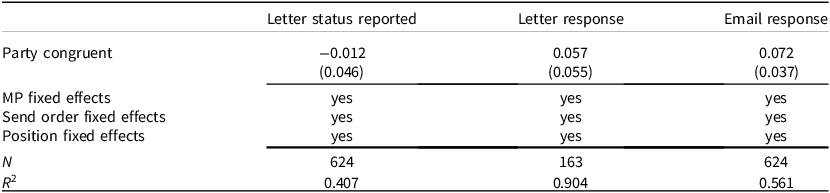
Our analysis so far focuses on substantive MP responses via either physical letter or email. We noted earlier that, while we know whether an MP sent a substantive email response for every case in our experiment, there are cases where we do not know for sure whether or not an MP sent a mailed letter response because the constituent did not respond to our follow-up request for such information. One might be concerned that this may induce measurement biases masking a constituent–party congruence effect.
First, it could be that constituent participants’ likelihood of responding to our follow-up request for information on MP letters might be associated with constituency–party policy congruence: for example, if the constituent disagrees with their MP’s party on a policy, negativity bias may make them more likely to recall – and respond to follow-up requests for information about – interactions with their MP relating to that policy. If this was the case, and if MPs sometimes send mail rather than email their responses, we would over-estimate the rate of MP non-response when the constituent is policy incongruent with the MP’s party, which in turn could attenuate our estimate of the effect of constituency–party policy congruence on overall MP responsiveness. The first column of Table 5 speaks against this alternative explanation for our observed null result. It re-estimates Equation 1 with a new outcome variable: a binary indicator for whether the constituent participant who sent policy query i responds to our follow-up question as to whether or not they have received a mailed letter response from their MP. The coefficient on constituent–party congruence is small (−0.01) and non-significant. There is little evidence that constituents are more (or less) likely to respond to our requests for updates on mailed letter responses when they are congruent with their MP’s party.
Linear probability models of: whether constituent reports letter response status; MP letter response among cases where status is known; MP email response among cases where it is known

***p < 0.001; **p < 0.01; *p < 0.05.
Secondly, it could be that MPs are more likely to send mailed letters – instead of emails – in response to party congruent constituent queries. If our main response measure is more likely to register a false negative when an MP responds only by mailed letter, this would attenuate our estimate of the effect of constituent–party policy congruence on MP responsiveness. The second column of Table 5 speaks against this concern. It re-estimates Equation 1 on the subsample of cases where the constituent participant explicitly told us whether or not they had received a mailed letter from their MP, with an outcome variable that measures whether a mailed letter was received (1) or not (0). The estimated coefficient on constituent party congruence is again small in magnitude (0.06) and non-significant. As such, focusing only on MP mailed letter responses where we can confidently measure their presence or absence, our results are similar to those from our main analysis. The third column of Table 5 also shows that the estimated treatment effect is similar when we focus only on whether or not a constituent received a substantive email response, on which we have no missingness.
In sum, our analysis of MP responsiveness in our experiment provides little evidence that this differs depending on whether or not the constituent policy stance is congruent with that of the MP’s party.
Self- versus Party Mentions in Responses
Our second set of expectations relates to the nature of MP responses. On average, we expect MPs to emphasise their position relative to their party’s position when the constituent’s position is congruent (as opposed to incongruent) with the MP’s party.
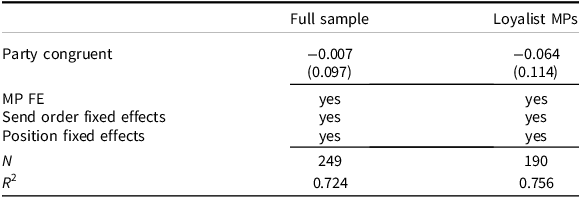
To assess these expectations while adjusting for MP, send-order, and issue-position fixed effects, we re-estimate the regression specification from Equation 1, but with the log ratio of MP versus party mentions as the outcome variable. The first column of Table 6 reports the results when the regression model is estimated on all observed response texts in the experiment. The estimated coefficient on the constituent–party congruence treatment is non-significant, wrongly signed, and close to zero. The 95 per cent confidence interval for the coefficient runs from −0.2 to 0.19. Thus, even the largest plausible positive or negative effects are small, with about 20 per cent of the outcome variable’s standard deviation.
OLS models of log ratio of MP v. party mentions in observed responses

***p < 0.001; **p < 0.01; *p < 0.05.
The second column of Table 6 reports results from the same regression estimated on the subsample of observed response texts from loyalist MPs. Once more, the estimated coefficient on constituent–party congruence has the wrong sign and is non-significant. The coefficient’s 95 per cent confidence interval (−0.29 to 0.17) once more indicates that even the largest plausible positive or negative effects are relatively small relative to the standard deviation of the outcome variable in this subsample, which is 0.95.Footnote 20
Thus, our analysis of MP response texts reveals that counter to expectations, the emphasis MPs place on themselves versus their parties does not vary notably depending on constituent–party policy congruence. In Supporting Information Section SI.10, we show that this finding persists when we measure the standardised difference in the number of MP versus party mentions, and when we study the length of MP response texts. We therefore not only find little evidence of conditional responsiveness but also little evidence of conditional response wording, at least with respect to emphasis on MP versus party.
Discussion and Conclusion
Moving beyond the well-studied US context, we examine legislators’ direct policy-related communications with constituents in a parliamentary democracy characterised by strong parties and residual personal vote incentives. Building on prior research, we theorise that MPs might react strategically to constituent correspondence by varying both their responsiveness and the emphasis they place on personal versus party positions, depending on constituent–party policy congruence. To test these expectations, we implemented a pre-registered audit experiment in the United Kingdom using real constituents as confederates, enabling accurate measurement of substantive responses and response content.
Our findings provide no support for these expectations. UK MPs were no more nor less likely to respond to constituents whose positions diverged from their party’s stance, nor did they adjust the personal versus party emphasis of their explanations in ways consistent with strategic differentiation. Across nine salient policy issues during the Brexit negotiations, both responsiveness and the nature of responses appear largely insensitive to constituent–party congruence. These well-powered null results contrast with evidence from the United States, where legislators frequently vary both responsiveness and content according to constituent congruence, and suggest that such inequalities do not arise in the UK’s parliamentary setting.
How should we interpret these null findings? One possibility is that electoral strategic considerations of the kind we theorise play a limited role in shaping UK MPs’ correspondence with constituents. Our exploratory analysis in Supporting Information Section SI.11 finds little association between constituency marginality and responsiveness, consistent with the idea that MPs prioritise general valence benefits or public service provision over fine-grained strategic targeting. Resource constraints may also limit the feasibility of systematic tailoring: MPs receive high volumes of correspondence, have comparatively limited staff support, and may therefore adopt routinised rather than individually crafted communication practices. Evidence from interviews and office visits suggests substantial heterogeneity in workflow but little indication that strategic tailoring is a common or institutionalised practice.
Another possibility is that, as many constituent letters in our study concerned Brexit-related issues, MPs may have faced unusually high informational and temporal pressures. However, we do not believe this explains our results. In the United Kingdom, MPs typically require a valid constituency address before providing substantive replies (Habel and Birch Reference Habel and Birch2019), meaning that studies relying on fictitious constituents often capture only procedural holding responses rather than genuine communication behaviour. Our use of real constituents removes this constraint and allows us to observe MPs’ actual engagement with policy queries. If anything, the high salience of Brexit should have heightened MPs’ awareness of the potential electoral consequences of their communications, making strategic differentiation more – not less – likely. That we do not observe such behaviour therefore strengthens the conclusion that constituent–party incongruence does not meaningfully shape MPs’ correspondence strategies.
Another possibility is that the specific political context of our study played a role. Because Brexit was highly salient, MPs may have been particularly attentive to the general electoral consequences of responding, reducing their incentives to differentiate across constituents. At the same time, the salience of these issues makes it unlikely that MPs lacked sufficiently clear party cues to employ party-centred explanations where desired. If anything, the combination of salience and internal party contestation could have increased opportunities for MPs to shift responsibility to party leadership. That we do not observe such behaviour strengthens the conclusion that constituent–party incongruence does not meaningfully shape MPs’ correspondence strategies.
A final question concerns generalisability. Although Brexit imposed exceptional temporal pressures on MPs, these constraints could affect overall response rates but cannot explain the absence of differential responsiveness or content tailoring. More broadly, the incentives we examine are not unique to Brexit: UK MPs operate in a party-centred environment where personal position-taking is visible primarily when strategically communicated. Our results therefore speak to broader patterns of communication in Westminster-style systems and may generalise to parliamentary democracies with similar institutional features, including those with weaker personal vote incentives under closed-list proportional representation.
Legislator–constituent communication plays a central role in representative democracy, yet it satisfies democratic norms only when access is equal and explanations are not manipulative. US research has raised concerns that strategic content tailoring can obscure legislators’ true positions and generate inequalities across constituents. Our findings suggest a more reassuring conclusion for the UK case. We find no evidence that MPs either differentiate their responsiveness on the basis of constituent–party congruence or tailor the personal versus party emphasis of their responses in ways consistent with strategic manipulation. This indicates that, at least in this context, direct communication between MPs and constituents may play a more equitable and democratically constructive role than existing theories imply.
Supplementary material
The supplementary material for this article can be found at https://doi.org/10.1017/S0007123426101598.
Data availability statement
Replication data for this article can be found in Harvard Dataverse at: https://doi.org/10.7910/DVN/EDR2E3 (Cohen Reference Cohen2026).
Acknowledgements
We thank three reviewers and the editor for helping improve the paper. We are grateful for comments from participants at the MPSA ‘Experiments and Political Elites’ workshops in 2016 and 2017 and the ‘Comparative Research on Political Elites’ workshop at the Hertie School in Berlin in 2019. We particularly thank Dan Butler, Christian Grose, and Simon Munzert. We also thank Jon Slapin and Peter John for their comments on the paper. For research assistance, we thank David Caldwell, Alisha Esshaki, Yasmina O’Sullivan, Martha Radford-Kirby, and all student ambassadors.
Author Contributions
All authors contributed equally to the article. Authors are listed in alphabetical order.
Financial support
This work was supported by the British Academy (grant number SG163019). Daniel Bischof was additionally supported by the Swiss National Science Foundation (SNF Ambizione Grant No. 179938).
Competing iInterests
None.
Ethical standards
Participants were fully informed about the purpose of the experiment and consented to participate. The study was reviewed and approved by the ethics committees of Durham University, the University of Nottingham, and King’s College London.



 Open access

