1 Introduction
1.1 Biases in Philippine English Studies
“In order to understand social life in the twenty-first century,” Blackledge and Creese (Reference Blackledge, Creese and Canagarajah2017) write, “we need to understand mobility, and understanding mobility requires attention to the movement of linguistic and other semiotic resources” (p. 31). They urge us to seriously consider the realities of everyday social contexts, where communication does not always occur through language practices neatly delineated by geographically bounded territories. Rather, linguistic practices today are shaped by transnational flows (Bolander, Reference Brook, Schreier, Hundt and Schneider2020) and diasporic communities (Zipp, Reference Zipp, Schreier, Hundt and Schneider2020), among others, that blur conventional boundaries. In this Element, I attempt to offer a more multifaceted understanding of the complex everyday realities of Philippine Englishes (PhEs) – a nomenclature that encompasses diverse substrate-influenced regional, social, and hybrid varieties of English across the Philippines (Gonzales, Reference Gonzales2017) – within the purview of mobility.
In sociolinguistics, mobility generally refers to the dynamic movement and circulation of people, linguistic resources, practices, and ideologies across geographic, social, cultural, digital, and political spaces (Blackledge & Creese, Reference Blackledge, Creese and Canagarajah2017; Blommaert, Reference Blommaert2010; Canagarajah, Reference Canagarajah2017). This movement enables motion, as one can be in motion only if they have the capacity to move. Mobility has three characteristics: (1) linguistic, referring to how languages travel, spread, and adapt across borders; (2) discursive, concerning the movement of texts, symbols, and ideologies; and (3) sociolinguistic consequences, such as multilingualism, identity negotiation, language contact, and the emergence of hybrid varieties. Within these characteristics, ordinariness and unexpectedness (Heller, Reference Heller and Heller2007a; Pennycook, Reference Pennycook2012) become central concerns because mobility inherently brings complexity and unpredictability, with language shifting from stable systems to resources in constant motion. At the same time, the complex and unpredictable nature of language mobility is not exceptional but rather ordinary.
In the relevant literature, human mobility has different types, ranging from overseas tourism, study abroad experiences, trade, and commerce, to labor migration (Johnstone & Pollack, Reference Johnstone and Pollak2016). These types vary significantly in their sociolinguistic consequences owing to many factors such as geography, demographics, and so on (Starr, Reference Starr and Onysko2021). In the context of mobility, languages are unbound. When people move across borders, they are taking their languages with them. Their languages and other linguistic resources flow across time and space, unrestrained from an imposed structure (Canagarajah, Reference Canagarajah2017). They can be appropriated by people at a specific time and place for meaning-making purposes. In this sense, languages are regarded as “mobile resources” (Blommaert, Reference Blommaert2010) for the construction of meanings and negotiation of identities and relationships.
Mobility is not new in the field of World Englishes (WE). For instance, in the Bloomsbury World Englishes Volume 1: Paradigms (Schneider & Heyd, Reference Schneider and Heyd2021), there are sections devoted to post-national framings and transnational ties. The Cambridge Handbook of World Englishes (Schreier et al., Reference Schreier, Hundt and Schneider2020) also stands out for including three chapters that address topics closely related to mobility: Zipp (Reference Zipp, Schreier, Hundt and Schneider2020) discusses how English is used in migrant and diasporic communities; Fox (Reference Fox, Schreier, Hundt and Schneider2020) highlights that the mobility of English is always situated within multilingual settings; and Bolander (Reference Brook, Schreier, Hundt and Schneider2020) explores how English operates in transnational contexts, emphasizing its role in global mobility and interactions across borders.
This Element seeks to contribute to the ongoing conversations by considering mobility as a process that shapes PhEs through the following mechanisms:
(1) Labor Migration – A type of human mobility that is intensified by globalization is labor migration. In a globalized economy, talented people, often from developing countries, move across borders to work for industries in developed countries, thereby contributing to global and local economies. As workers from diverse backgrounds cooperate in shared workplaces, language becomes important in this domain. Moreover, language is an important form of human capital in labor migration (Piller & Lising, Reference Piller and Lising2014). This importance is manifested, for instance, in language policies that are implemented in educational systems by governments to regulate, manage, and calibrate the increasing global flows of workers to and from their borders (Lorente, Reference Lorente and Canagarajah2017).
(2) Multilingualism – In conditions where a large number of people migrate to work across myriad borders, multilingualism is the norm (Blackledge & Creese, Reference Blackledge and Creese2014). Migrant workers adopt and adapt their English – one of the most dominant languages in a globalized workforce – and other languages in their repertoire to engage with diverse communities in host countries; henceforth, languages are influencing one another. Language contact within the context of “transnational multilingualism” (Heller, Reference Heller, Auer and Wei2007b) can occur at two levels. The first is the international level, where speakers of different nationalities use English as a lingua franca (e.g., a Filipino nurse and a German patient at a hospital in Ireland). The second level is the intranational, where speakers of the same nationality communicate in English and their home languages (e.g., a Filipino engineer and a Filipino priest at a Catholic church in Indonesia). Both levels involve a heterogenous array of linguistic processes with outcomes that are largely unpredictable.
(3) Transnationalism – Language has an important role in the establishment of nation-states. Oftentimes, the population of a nation-state is assumed to speak a single language, which serves as the national or official language, and a carrier of the ethnic/national culture, history, and collective values, as well as serving as the foundation for the government of the state. However, in the context of globalization where international organizations and corporations operate on an international scale, the idea of a nation-state has become more and more complicated. This complication emerges from the phenomenon of transnationalism, the idea that refers to the complex connections across national borders that are facilitated by the cross-boundary flows of people, products, and ideas (Basch et al., Reference Basch, Schiller and Blanc1994). The exponential growth of transnationalism in our globalizing world is seen as weakening the nation-state. While the modern nation-state was burrowed into the complex interface of territory, ethnicity, and language, the increasing rate of the cross-border flows of people, products, and ideas significantly challenges this interface (Brook, Reference Brook, Schreier, Hundt and Schneider2020; Park & Wee, Reference Park and Wee2009).
To be able to comprehend PhEs through the lens of mobility, there is certainly a need first to take stock of its past and present state. In 1969, the linguist Teodoro A. Llamzon wrote the monograph, Standard Filipino English, which presents evidence that the spoken English of educated Filipinos has acquired distinct forms and functions that are intelligible to other educated Filipinos and traditional “native speakers” of English. He pointed out the emergence of a Filipino variety of English that was systematic and rule-governed, a claim that was highly controversial at that time. However, Hidalgo (Reference Hidalgo1970) argued, among other things, that Llamzon’s criteria for selecting “educated Filipino” participants lacked scientific rigor. Criticisms aside, Llamzon’s (Reference Llamzon1969) study is considered groundbreaking in that it is the first to identify English in the Philippines as a variety, consequently establishing a clearing ground for fellow linguist Andrew Gonzalez (Reference Gonzalez1972) to rename the variety from “Standard Filipino English” to “Philippine English.”
Since Llamzon’s (Reference Llamzon1969) precedent-setting study, researchers have embraced a plethora of approaches which, to adapt Bolton’s (Reference Bolton, Schneider and Heyd2021) taxonomy of WE approaches, include English studies, corpus linguistics, features-based studies, the sociology of language, Kachruvian studies, applied linguistics, lexicography, literary studies, and critical studies, All these approaches, along with representative studies for each approach, are synthesized in Table 1.
| Approach | Focus | Examples |
|---|---|---|
| English studies | Analysis of PhE from diachronic and historical perspectives | Borlongan (Reference Borlongan2016), Borlongan and Dita (Reference Borlongan and Dita2015), and Martin (Reference Martin, Buschfield, Hoffman, Huber and Kautzsch2014a) |
| English corpus linguistics | Descriptions of PhE based on an established corpus | Bautista (Reference Bautista, Lourdes, Bautista, Llamzon and Sibayan2000), Bautista (Reference Bautista and Lourdes2004), and Dita (Reference Dita, Rüdiger, Neumaier, Leuckert and Buschfeld2025) |
| “Features-based” approaches | Descriptions of PhE through dialectological and variationist methodologies | Llamzon (Reference Llamzon and Bautista1997), Rañosa-Madrunio (Reference Rañosa-Madrunio2004), and Tayao (Reference Tayao, Lourdes, Schneider, Burridge, Kortmann, Mesthrie and Upton2004) |
| The sociology of language | PhE in relation to issues such as language maintenance/shift and identity | Gonzalez (Reference Gonzalez and Bautista1996, Reference Gonzalez2004, Reference Gonzalez, Bautista and Bolton2008) |
| Kachruvian studies | A pluricentric approach to PhE, highlighting both the sociolinguistic realities and creativity of Filipinos | Bautista (Reference Bautista, Lourdes and Bautista1996), and Martin (Reference Martin, Bolton, Botha and Kirkpatrick2020, Reference Martin2024) |
| Applied linguistics | The exploration of the implications of World Englishes for language learning and teaching, and other domains | Bernardo (Reference Bernardo2024), Dayag (Reference Dayag2010), and Hernandez (Reference Hernandez, Khine and Liu2022) |
| Lexicography | The codification of PhE vocabulary | Bolton and Butler (Reference Bolton and Butler2004), Cruz and Bautista (Reference Cruz and Bautista1993), and Salazar (Reference Salazar2017) |
| Literary studies | The expression of PhE in literary works | Abad (Reference Abad and Bautista1997), Abad-Jugo (Reference Abad-Jugo2024), Martin (Reference Martin, Bautista and Bolton2008), and Tope (Reference Tope, Bautista and Bolton2008) |
| Critical studies | PhE linked to issues of post/colonization, neoliberalism, gender, and social class | Canilao (Reference Canilao2020), Martin (Reference Martin2014b), Martinez (Reference Martinez2024), Tupas (Reference Tupas2004), Tupas and Salonga (Reference Tupas and Salonga2016), and Tinio (Reference Tinio, Wee, Goh and Lim2013) |
Table 1 suggests the breadth of approaches that research on PhEs has accumulated. This breadth is supported by a robust body of literature, as demonstrated in two of the most recent works on PhEs. The first is the special issue on PhEs in the World Englishes journal, edited by Martin and Cruz (Reference Martin and Cruz2024). The second is a volume on the development, structure, and sociology of PhEs, edited by Borlongan (Reference Borlongan2023). Both works demonstrate the comprehensiveness of PhEs research. It is likely accurate to assert that PhEs are one of the most thoroughly researched postcolonial varieties of English (Tay, Reference Tay and Cheshire1991), consistently strengthening its disciplinary credentials through sustained scholarly attention.
The notion of mobility foregrounds the national bias that has shaped much of the scholarship on PhEs. A closer reflection reveals that the field has dominantly drawn on notions that tend to be understood from a nation-state perspective. Mair (Reference Mair, Schneider and Heyd2021) calls this perspective explicitly the “national bias” (p. 29) in WE research. The national bias is a spin-off from the idea of “methodological nationalism,” an assumption that “national social units represent the ‘natural’ order of the world, which involves taking these social units as a priori in the methodologies of scientific research” (Schneider, Reference Schneider2019, p. 3). The disciplines of social sciences, including linguistics and sociolinguistics, of which WE is a subfield, have been framed in methodological nationalism by presuming that the world is ordered along national categories, with such categories geographically imagined in locatable territories (Cresswell, Reference Cresswell2006; Schneider, Reference Schneider2019).
The national bias in PhEs studies carries the problematic assumption that language variation is exclusively territorial in that it occurs among Filipino speakers of English within the Philippines. This is not always the case, however, as variation can cut across national boundaries (Mair, Reference Mair, Schneider and Heyd2021; McArthur, Reference McArthur2003; Mesthrie & Bhatt, Reference Mesthrie and Bhat2008). Consider, for instance, the simplification of word-final consonant clusters, which, according to Gardiner and Deterding (Reference Gardiner, Deterding, Bolton, Botha and Kirkpatrick2020), is a phonological feature of both PhE and Indian English. Variations in PhEs, in other words, might be as typical of other varieties. Thus, the significance of national boundaries in the framing of PhEs is questionable considering that there are “interactions across Englishes” (Meierkord, Reference Meierkord2012) in circumstances where “natural” links between languages and their territories are weak due to the global flows of linguistic resources, such as migration and the Internet.
Another bias in the study of PhEs is the monolingual one. This bias is deep-seated in the corpus linguistics-based approach to PhEs. Both Mair (Reference Mair, Schneider and Heyd2021) and Lising (Reference Lising and Borlongan2023) criticize this monolingual proclivity, which is built into the design of established corpora such as the International Corpus of English (ICE), on which many studies about the development of standard or educated PhE rely. The guidelines for spoken ICE corpora require compilers to consider monolingual English data. Traces of non-English languages should be tagged as <indig> for “indigenous.” This methodological regulation indubitably suggests that corpus-based PhE studies have “purified” the data toward monolingualism (Lising, Reference Lising and Borlongan2023; Mair, Reference Mair, Schneider and Heyd2021).
PhEs culled from contrived monolingual corpus-based data are extremely difficult to uphold in theory and practice. Typically, natural conversations among Filipinos are in translingual fashion, most commonly realized as Taglish (the mixing of Tagalog and English), which Thompson (Reference Thompson2003) identifies as an unmarked communicative practice. Depending on educational background and social class status, Filipinos routinely draw on one or more Indigenous languages alongside varying amounts of English. For instance, when catching up with my family through Facebook Messenger, I shuttle between PhEs, colloquial Tagalog, and a swathe of emojis. A monolingual way of studying PhEs is also an anomaly considering that English coexists with what Ethnologue (Reference Ethnologue2025) counts as 175 Indigenous and nine non-Indigenous living languages in the archipelago. Theoretically, this coexistence signifies that the status, functions, and variations of PhEs are influenced and shaped by a highly multilingual ecology.
This is not to overlook the important contributions of corpus-based studies to PhEs. Much of what we know about its grammar, vocabulary, and pronunciation comes from detailed analyses of monolingual data in large corpora. However, what I seek to foreground in this Element is the necessity of complementing such approaches with perspectives that reflect the fluid and often multilingual nature of everyday language use among Filipinos, especially those in diasporic contexts. Corpus-based research is useful, but it often falls short of capturing the textured, mobile, and hybrid communicative practices that characterize speech in real-life interactions. Hence, this Element proposes a repositioning – toward approaches that can better accommodate the realities of linguistic diversity and mobility.
Now, what can we do to address the national and monolingual biases in PhEs studies? On theoretical and methodological grounds, this is an important question to raise because viewing PhEs along national and monolingual lines, as I have previously explained, does not fully capture the complexity and dynamism of PhEs and its speakers.
I propose to approach these increasing complexities and continuing dynamism as Philippine Englishes-in-motion, an echoing of Blommaert’s (Reference Blommaert2010) “language-in-motion” that assumes the mobility of language resources in transnational contexts. “Language-in-motion” is a conceptual departure from “language-in-place” that, on the other hand, assumes languages in a fixed and stable space (Blommaert, Reference Blommaert2010). The core assumption of Philippine Englishes-in-motion is as follows: The mobility of Filipinos across transnational spaces involves the movement of PhEs and other communicative resources (such as Indigenous languages, registers, and sociolects) within their multilingual repertoire. The usage patterns of speakers of PhEs interact with the linguistic resources of other interlocutors from diverse communities, potentially resulting in a wide range of linguistic and sociolinguistic outcomes.
Philippine Englishes-in-motion is both an analytical approach and as a way of referring to varieties of English mobilized by Filipinos in transnational spaces. As an approach, Philippine Englishes-in-motion allows for the analysis of PhEs not as a national variety but as a range of communicative practices that are constantly being shaped by processes involving labor migration, multilingual interactions, and transnationalism. At the same time, as a descriptor of varieties, Philippine Englishes-in-motion refers to evolving varieties of English used by Filipinos across global diasporic contexts. This dual conceptualization is intentional and essential, allowing for a more complex understanding of PhEs – one that avoids the limitations of nation-state and monolingual framings.
The notion of Philippine Englishes-in-motion that I am propositioning here is, in fact, long overdue. As will be discussed in Section 2, the Philippine government, under the rule of the former dictator Ferdinand Marcos, Sr., formalized overseas labor migration in 1970. Initially, labor migration was viewed as a temporary response to the growing social and economic challenges of the time. However, as the remittances sent by overseas Filipino workers helped stabilize the struggling Philippine economy, the government chose to make it a permanent policy and practice. Since then, state-sponsored migration has grown significantly, with Filipino migrant workers now spread across nearly 100 countries (Tyner, Reference Tyner2004). Considering this long and enduring history of the Filipino diaspora, it is about time that we study the development of PhEs beyond the nation-state. What has not been studied in depth yet is the dispersion and development of PhEs that have been opened up through the export of labor – one of the many aspects of globalization. PhEs in relation to globalization-induced labor migration evade descriptions within Kachru’s (Reference Kachru1982) “Three Circles Model,” leading to the repositioning of PhEs within the remit of the “sociolinguistics of globalization” (Blommaert, Reference Blommaert2010).
The need to study PhEs from a transnational perspective, specifically in the labor migration context, has been articulated by Schneider (Reference Schneider and Borlongan2023) in his statement:
Interestingly, PhE has also been transported abroad by significant speaker numbers, and the agents in this process are not educated elite members. … Currently, it is estimated that there are about 2.3 million ‘Overseas Filipino Workers’ (OFWs) … who labor in the Gulf States, in Hong Kong, Singapore, and elsewhere, often under harsh conditions – males often as construction workers or in other kinds of manual jobs, females predominantly as house helpers. While most of them are poorly educated and hence not fluent speakers of PhE, in many or most jobs, a minimum communicative ability in English is desired. … To my knowledge, the linguistic ramifications of these migration movements have hardly ever been investigated.
Schneider’s (Reference Schneider and Borlongan2023) observation about the lack of scholarly inquiry into PhEs in the context of labor migration is on point. So far, there are three publications along this line of inquiry, and they are the following:
(1) Leung (Reference Leung2012) compares kindergarteners and secondary school students in Hong Kong who have had Filipino maids with those who have not, in order to probe the impact of exposure to PhE. One major finding is that children with Filipino maids outperformed those without such exposure on listening tasks involving American English, British English, and Hong Kong English. They also performed well on stimuli spoken in PhE.
(2) Starr et al., (Reference Starr, Theng and Wong2017) investigate the development of sociolinguistic knowledge among local and expatriate children in Singapore. They find no correlation between having a Filipino maid and children’s ability to identify PhE and other English varieties. All local children, regardless of whether or not they have Filipino maids at home, are found to be skilled at identifying PhE due to the fact that Filipino workers have a visible presence in the service sector and other areas of the labor market in Singapore.
(3) Lorente (Reference Lorente2018) looks at how Filipino maids in Singapore use language resources to negotiate their roles as well as navigate their way through a cross-cultural employer-employee relationship. From the interviews, she finds that they juggle three varieties: (1) PhEs, which Filipino maids are proud of because they approximate standard American English, (2) Singapore English, which they consider incomprehensible and undesirable, and (3) American English, which they aspire to be proficient in because they think it would increase their chances of moving from Singapore to Canada. Overall, the findings reveal a transnational system that is built on inequalities of English, class, gender, and race.
These studies offer useful insights into PhEs when they travel across transnational borders, specifically in countries like Hong Kong and Singapore, where English is a linguistic capital. They also help us understand how English is inextricably woven with the material and social lives of Filipino domestic workers. In broad strokes, this Element shares some resemblance to these studies. It is similar to Leung (Reference Leung2012) and Starr et al., (Reference Starr, Theng and Wong2017) in that it explains the sociolinguistic consequences of deterritorialized PhEs on individual and societal levels. Furthermore, it is similar to Lorente (Reference Lorente2018) in terms of rendering attention to power and inequality.
While this Element builds on the groundwork that these studies have already laid, it differs from them in some aspects. First, this Element follows what Mufwene (Reference Mufwene2001) calls a “feature pool” to describe the linguistic selection processes that are involved when variable features of PhEs are in contact with other languages spoken by Filipino migrants and non-Filipinos in Japan, a country that has a long history of importing Filipino workers. Such processes transpire at the levels of phonology, lexicon, grammar, and discourse in their “everydayness” (de Certeau, Reference de Certeau1984). By everydayness, I take into account communicative practices of PhEs in various settings (e.g., workplace, place of worship, and supermarket), and different interlocutors (e.g., coworkers, family members, and friends). The reason for this is that Filipino migrants are not just human bodies within the confines of the workplace. They can be members of a religious organization, supporters of a political group, nongovernment organization volunteers, husbands or wives of a Japanese national, parents, and so on. How and why they use PhEs must be understood in relation to mobile and multiple roles, connections, trajectories, and pathways that define their daily experiences.
There is also a difference in terms of the representation of speakers of PhEs. While past studies concentrate on Filipino domestic workers, this Element, on the other hand, presents Filipino migrants from diverse backgrounds. As will be described in Section 3, the cohort of participants in my study is heterogenous with regard to occupation, age, gender, place of residence in Japan, language repertoire, and ethnolinguistic membership. This heterogeneity mirrors the contemporary Philippine migration in Japan, from privileged expatriates to those with precarious social and economic prospects. In addition, this attention given to diversifying the representative profile of Filipino migrant workers is meant to break tendencies of stereotyping, homogenizing, and essentializing them. Filipino migrants are a polyphony of elite and less elite residents. They are as diverse as the linguistic resources they bring with them to other countries. They differ substantially in their histories with and use of English. They have motivations that are not static and given. Just how diverse or varied Filipino migrant workers are is aptly illustrated by Faist (Reference Faist2000), who said that migrants’ lives:
may be related to improving and securing: wealth (e.g. income), status (e.g. prestigious job), comfort (e.g. better working and living conditions), stimulation (e.g. experience, adventure, and pleasure), autonomy (e.g. high degree of personal freedom), affiliation (e.g. joining friends or family), exit from oppression of all kinds, meaningful life (e.g. improving society), better life for one’s children, and morality (e.g. leading a virtuous life for religious reasons)
Another aspect that sets apart this Element from previous studies is its unpacking of global and local factors that influence the evolution of PhEs beyond national borders. In this sense, Buschfeld and Kautzsch’s (Reference Buschfeld and Kautzsch2020) “Extra- and Intra-territorial Forces Model” covers the ground for transnational PhEs as it provides a lens that examines the different external and internal factors at work in the entrenchment and development of PhEs in Japan. As will be explained in Section 6, some of these factors have to do with demographics, labor migration policies, English-oriented schooling, and many others.
Guided by concerns of mobility and its entanglements with migration, multilingualism, and transnationalism, this Element will focus on the following key points:
(1) PhEs scholarship has traditionally been influenced by monolingual and national biases. For this reason, it is imperative to examine PhEs through the lenses of mobility, labor migration, multilingualism, and transnationalism, taking into account the multilingual competencies and dispositions of Filipinos dispersed across Japan.
(2) In Japan, PhEs interact not only with other varieties of English but also with non-English languages, leading to complex and dynamic linguistic selections (Section 4).
(3) The mobility of PhEs across Japan involves movement across orders of positioning (Section 5). Filipino migrants actively mobilize their linguistic resources to navigate diverse communicative needs and audiences, shaping their roles and positions in the spaces they occupy.
(4) Both external and internal factors influence the spread and evolution of PhEs in Japan, indicating that their mobility is not a neutral process (Section 6).
What, exactly, might we accomplish if we seriously consider PhEs in light of the concerns raised in these key points? In Section 1.2, I will specifically discuss how studying PhEs in Japan can offer, among other insights, a perspective that nuances widely held beliefs about English in Japan.
Before progressing to the next section, I find it important to acknowledge that I bring my own biases and subjectivities into the writing of this Element. As a Filipino migrant for more than a decade, I have personally witnessed how PhEs circulate across different spaces – from workplaces and social interactions to online communities – and how these dynamics are far from neutral. Having lived and worked in Japan for many years, I have been able to witness how PhEs are not a static linguistic form, but rather a dynamic resource that adapts and shifts according to context. In my interactions with kababayans (fellow Filipinos), non-Filipinos, and people from diverse backgrounds, I have seen how PhEs enhance communication, bridge cultural divides, and play a role in the negotiation of identities within a multilingual environment. My dual perspective (as both an insider and an observer) allows me to explore the nuances of PhEs in Japan.
I also recognize that my position as a university professor affords me privileges not shared by all Filipino migrants in Japan. I have gainful employment, in contrast to those with precarious working conditions. I am also mindful of the power dynamics at play in my interactions with the research participants, aware that my identity as an academic (a position of relative privilege within Japanese society) may influence the ways I shape my relationships with them and how they communicate their everyday linguistic practices to me.
While my academic position offers me certain affordances not accessible to many of the Filipino migrants I have engaged with, I do not claim to speak for them or to encapsulate the full range of migrant experiences. Instead, I aim to amplify the linguistic practices that Filipino migrants themselves enact and negotiate in their everyday lives. The insights offered in this Element are therefore shaped not solely by my own interpretations, but also by the recorded interactions, linguistic choices, and metacommentaries of the participants. In this way, I strive to balance my interpretive lens with a commitment to representing the complexity and heterogeneity of migrant voices, without reducing them to a singular narrative.
By making my positionality explicit, I hope to provide readers of this Element with a clearer understanding of the lenses through which I interpret the data, thereby offering greater context to the research findings. I approach my work with a reflexive mindset, and through this, I invite readers to engage with, critique, and build upon this Element from diverse perspectives, contributing to more complex conversations about PhEs.
1.2 Philippine Englishes in Japan
Filipinos in Japan are both multilingual and diglossic. They commonly speak Filipino, Japanese, English, and various Indigenous languages such as Ilocano, Kapampangan, Waray, and Hiligaynon. The Japan Statistical Yearbook 2024 reports that Filipinos constitute the largest group of foreign residents from countries where English is widely used (Japan Statistics Bureau, 2024), as shown in Table 2. This suggests that Filipinos are the largest English-speaking migrant community in Japan. This demographic pattern underscores the presence of PhEs in Japan, suggesting that Japan’s engagement with English is not solely shaped by “native speaker” norms but also by the varieties brought by this diverse migrant group from the Global South.
| Country | Number of residents |
|---|---|
| Philippines | 298,740 |
| United States | 60,804 |
| India | 43,886 |
| Pakistan | 22,118 |
| United Kingdom | 18, 959 |
| Malaysia | 11,045 |
| Canada | 10,926 |
| Nigeria | 3,672 |
| New Zealand | 3,497 |
| Singapore | 3,306 |
Note: Data were collected from Japan Statistics Bureau (2024).
The study of PhEs in Japan may carry some implications, one of which could be its potential to nuance the following prevailing assumptions about English in Japan:
(1) Japan is a monolingual country – a belief likely to be reinforced by the dominance of Japanese as the official and most widely spoken language;
(2) English in Japan is a “foreign” language – often based on the idea that English originates predominantly from Western, so-called native-speaking countries;
(3) Japanese people do not speak English or possess limited proficiency – a belief frequently supported by standardized test scores, which are commonly interpreted as indicative of broader communicative limitations; and
(4) English is not part of Japanese people’s identity repertoire – perhaps stemming from the perception that English is inherently “foreign” and is treated as an academic subject rather than a language embedded in daily life.
Although these perceptions are pervasive, they overlook the complexity of Japan’s linguistic ecology, which reflects “a tension between a highly monolingual norm embedded in a multilingual normal” (Kraft & Flubacher, Reference Kraft, Flubacher, McKinney, Makoe and Zavala2024, p. 372). The role and status of English in Japan are more multifaceted than often assumed, and the presence of PhEs offers a valuable lens through which to nuance these beliefs.
One commonly held perception that this study seeks to nuance is the view of Japan as a strictly monolingual society (Heinrich, Reference Heinrich2012). While Japanese remains the dominant language in daily life, the presence of English varieties, such as PhEs, Indian English, and Pakistani English, highlights the country’s growing linguistic diversity. Filipino migration to Japan has been a driving force behind the circulation of PhEs, with Filipino communities fostering environments where these varieties are spoken and heard. This migration further disrupts the notion of Japan as culturally and linguistically isolated, illustrating the interconnectedness between Japan and the Philippines.
The present study not only complicates the monolingual belief but also problematizes other commonly held views, such as the notion of English as a Foreign Language (EFL). Edwards and Seargeant (Reference Edwards, Seargeant, Schreier, Hundt and Schneider2020) describe EFL as an oversimplified categorization. The dominant discourse that English is a “foreign” language largely stems from studies in the field of language teaching, such as Matsuda’s (Reference Matsuda2003) research, where Japanese high school students view English as belonging to “native speakers.” In contrast, Seargeant (Reference Seargeant2009) argues that Japanese students’ attitudes toward English are merely seen as a result of classroom instruction, overlooking “other sources of information which might influence the students’ views” (p. 94). Pennycook (Reference Pennycook2007) similarly challenges the idea of EFL, highlighting how English is reclaimed and appropriated in Japan through “transcultural flows,” visible in Japanese pop culture, music, fashion, public signs, and even labor mobility. These “other sources of information” (Seargeant, Reference Seargeant2009) and “transcultural flows” (Pennycook, Reference Pennycook2007) could, in my view, include PhEs. By encountering PhEs in everyday contexts, Japanese people may experience English beyond the classroom. Over time, this exposure to PhEs could help stabilize English as a shared global language. This is not far-fetched; as Yano (Reference Yano and Seargeant2011) observes regarding the status of English in Japan, “And by learning other cultures and by interacting with users of other languages, we can extend and enrich our conceptual systems, namely, the way we view and interpret events, the way we cut up reality or the way we categorize our experience” (p. 141).
Examining PhEs in Japan also offers valuable insights into how English evolves through migration. Adopting a transnational perspective helps us understand that English in Japan is neither static nor confined to formal educational settings. The role of PhEs in professional spaces, such as multinational corporations, and in Filipino community spaces demonstrates how English is actively used, adapted, and localized, rather than remaining a “foreign” or academic language. This aligns with a broader trend in Japan where English is increasingly seen as a functional tool for communication rather than a language governed by “native-speaker” norms (Konakahara & Tsuchiya, Reference Konakahara and Tsuchiya2020; Yano, Reference Yano and Seargeant2011).
Moreover, the growing role of PhEs in Japan highlights the bilingual and multilingual realities that exist alongside Japan’s monolingual image. PhEs, alongside Japanese and other languages, form part of a more complex linguistic identity that Japanese people can and do engage with. This perspective adds depth to the simplistic view of English as an isolated linguistic entity and shows how it is integrated into everyday life, both as a communicative tool and as part of an identity repertoire (Heinrich, Reference Heinrich2012; Pennycook, Reference Pennycook2007; Seargeant, Reference Seargeant2009).
As previously mentioned, the concept of Philippine Englishes-in-motion can be exemplified through the communicative practices of Filipino migrants in Japan. In Section 2, I offer a concise overview of this highly mobile and diverse diasporic group.
2 Filipino Migrants in Japan
In 2016, I summoned the courage to make a significant life change and relocated to Japan. I joined the ranks of 237,103 Filipinos living in the country (Catolico, Reference Catolico2016), taking up a professorship at a private university. The allure of a significantly higher salary than my previous job in the Philippines was a key factor in my decision. Coming from a lower middle-class background, the prospect of a better income was a practical consideration. While my current work circumstances are more privileged than other Filipinos, my move to Japan reflects a shared experience: The pursuit of a better life.
The pursuit of a better life is deeply rooted in the country’s colonial history, which has shaped not only social and economic structures but also cultural mindsets. Centuries of Spanish, American, and Japanese rule instilled a relatively collective belief among Filipinos that opportunities, prosperity, and even superior knowledge exist beyond the nation’s borders (The Filipino Story, 2025). Even after gaining formal independence, this colonial legacy persisted, fostering a mindset in which working overseas became synonymous with upward mobility and financial stability. This historical and cultural conditioning has contributed to a global Filipino presence, with millions seeking opportunities in foreign lands under the assumption that everything good comes from the outside (The Filipino Story, 2025).
Over the decades, the number of Filipinos seeking a better life in Japan has steadily increased. In 2024, there were 341,518 Filipino residents in Japan, reflecting an increase of 19,742 from the end of 2023 (Immigration Services Agency, 2024). Filipinos represent Japan’s fourth-largest demographic of foreign residents, following Chinese, Korean, and Vietnamese nationals. While these numbers are telling, this section does not aim to regurgitate statistics in detail. The real challenge lies not in the figures, but in the stories they obscure. Behind the data are complex narratives shaped by state policies and interventions, as well as by collective and individual aspirations for survival, stability, and mobility.
The story of systematic labor migration begins in the 1970s, during the martial law regime of President Ferdinand Marcos, Sr. From 1970 onward, socioeconomic conditions worsened, as evidenced by the nearly 800,000 families residing in slum areas, the importation of 400,000 tons of rice, and the devaluation of the peso by more than 300 percent (Roth, Reference Roth1973). Marcos signed the Labor Code of the Philippines on May 1, 1974, to tackle the rising poverty rates. This legislation established the Overseas Employment Development Board (OEDB) within the Department of Labor. The OEDB was tasked with developing a structured program for the overseas employment of Filipino workers and was granted the authority and responsibility to promote their employment abroad through a comprehensive market promotion and development strategy (Lu, Reference Brian James2024). At that time, approximately 36,000 Filipinos moved abroad for work (Lorente, Reference Lorente2018). What began as a relatively temporary movement has since evolved into a global phenomenon, with state-sponsored labor migration expanding so significantly that Filipino workers can now be found in nearly every country around the world.
Marcos’ dictatorial regime and subsequent administrations saw export labor as an all-encompassing solution to various pressing economic challenges. A primary reason for this is that it helps reduce domestic unemployment and underemployment. Through labor migration, the government tackles the shortage of job openings in the country. Another significant benefit is the economic impact of remittances. Filipino workers abroad send substantial financial support to their families, which helps raise the standard of living for many households. These remittances play a vital role in the Philippine economy, acting as a stable source of foreign currency and bolstering local consumption and savings. Additionally, the government views overseas employment as a strategy for poverty alleviation. By facilitating access to international labor markets, the government offers Filipino workers higher-paying jobs, improving their economic situation and quality of life.
Under the Marcos government, poverty was deeply gendered, with women facing higher levels of poverty than men. This inequality drove many women to seek work opportunities abroad, especially in Japan, a global economic powerhouse. As a result, the migration narrative has been shaped by the intersections between class and gender from the very beginning. In the 1970s, Japan began accepting relatively young Filipino women (Filipina) entertainers, pejoratively called “Japayuki.” During the early years of their migration, many Filipinas worked as strippers and prostitutes. However, by the 1980s, the roles of Filipina workers shifted, with many transitioning to positions as bar hostesses, where engaging in commercialized sex was no longer a predominant part of their work (Suzuki, Reference Suzuki, Yamashita, Minami, Haines and Eades2008). After 1982, Filipina migrants began arriving in significant numbers to work as cultural dancers, vocalists, and band members in clubs and bars in Japan’s lucrative entertainment industry.
From February 22 to 25, 1986, widespread protests against Marcos and his family, known as the People Power Revolution, took place in the Philippines. While the economy collapsed during this period of civil unrest, Japan entered a phase of rapid economic growth, marking the start of the “bubble economy,” characterized by near-zero inflation, soaring asset prices, and rapid credit expansion. With a substantial rise in income and purchasing power, Japanese men in rural areas of northern Japan, where the population was rapidly declining, began searching for Filipina brides, triggering a wave of “matrimonial diaspora” (Anderson, Reference Anderson, Ember, Ember and Skoggard2005). By 2006, when international marriages between Japanese men and foreign women reached a peak of 35,993, the Philippines was the largest source of brides, accounting for 33.8 percent of the total (Kim et al., Reference Viktoriya, Balgoa and Yamamoto2022). Recently, some Filipina wives have redefined themselves by taking on roles as Assistant Language Teachers in schools (Balgoa, Reference Balgoa and Hiratsuka2023).
In the 1990s, migration to Japan expanded, with a significant number of Filipino men employed as construction and factory workers (Mori, Reference Mori1995). This expansion suggests that the narrative of migration during this era is skewed by gender: Filipino men predominantly occupy construction and factory jobs, whereas Filipinas’ employment is almost entirely concentrated in the service sector. By 1993, women had once again overtaken male migrants, working as entertainers with three to six-month contracts. Although some Filipino men were also involved in entertainment, it was primarily women who were more vulnerable to human trafficking and exploitation. As a result, Japan introduced stricter regulations on entertainer visas in 2005, making it more difficult for both Filipino men and women to legally work in the country’s entertainment sector.
Since 2005, there has been a noticeable change in Filipino migration patterns, with a growing number of Filipinos moving to Japan for skilled labor, healthcare, and caregiving jobs, while the once-significant influx of entertainers has substantially declined due to stricter visa regulations. This shift is evident in the distribution of Filipino migrants across different categories, as illustrated in Table 3, which presents the six leading categories of Filipino migrants in Japan according to their residence status as of December 2023.
| Status of residence or visa category | Number |
|---|---|
| Permanent resident | 139,534 |
| Technical intern training | 35,932 |
| Spouse of Japanese national | 26,201 |
| Specified skilled worker | 21,367 |
| Engineer/Specialist in Humanities/International Services | 9,633 |
| Designated activities | 4,701 |
Note: Data were collected from Japan Statistics Bureau (2023).
The largest segment of Filipino migrants in Japan consists of permanent residents (PR). Within this group are two types: those who have achieved this status after living in the country continuously for ten years, and those classified as “highly skilled professional,” who benefit from expedited pathways to permanent residency. “Highly skilled professional” is a designation created by Japan’s immigration agency for individuals with expertise in fields such as science, technology, engineering, medicine, business, and academia (The Ministry of Justice, n.d.). Filipino migrants with PR status have the freedom to work in any industry or occupation, including self-employment, without restrictions. In contrast to Filipino migrants on temporary or work visas, they are not tied to specific employers or job categories.
The second largest group consists of Filipino migrants on a technical skills training visa. These workers are sponsored by Japan’s Technical Intern Training Program (TITP), which was established in 1993 to invite people from developing countries to Japan to learn about its technologies and expertise. The TITP aims for participants to apply the knowledge and skills acquired in Japan when they return to their home countries (Japan International Trainee and Skilled Worker Cooperation Organization, n.d.). Typically, small- and medium-scale businesses, especially in rural parts of Japan, benefit from this program due to their pressing need for workers. Unfortunately, there have been reports and criticisms that TITP is often used by companies to bring in cheap labor, as participants are categorized as “interns” or “trainees” and, as a result, do not receive the same wages or benefits as regular Japanese employees despite performing similar tasks.
Spouses of Japanese nationals also form a significant group of Filipino migrants. They are married to Japanese citizens and hold renewable visas that range from six months to five years. They have not yet fulfilled the necessary requirements to become PR. These requirements include a residence period (living in Japan for at least three to five years) and financial stability, meaning they and their Japanese spouse must have sufficient income or assets to support themselves without depending on public assistance.
Another large group of Filipino migrants are those holding a Specified Skilled Worker Visa. They are employed in sectors facing labor shortages, such as caregiving, construction, and hospitality, where they perform tasks that require a significant level of expertise or experience. To qualify, they must pass a specialized skills examination.
The next largest group comprises Filipino migrants holding an Engineer/Specialist in Humanities/International Services visa. These relatively elite migrants work in white-collar positions within Japanese companies, applying their specialized knowledge and expertise. They are employed as language teachers in eikaiwa (private English language schools), interpreters, designers, systems engineers, computer programmers, and accountants. Unlike other groups, they typically have more stable employment contracts and earn above-minimum wages and benefits.
The sixth largest group consists of Filipino migrants on a designated activities visa, which includes athletes, domestic servants for diplomats, and nurses and caregivers under the Japan–Philippines Economic Partnership Agreement (JPEPA). Established in 2009, this program facilitates the migration and exchange of Filipino healthcare workers to Japan for up to three years (The Japan Foundation Manila, 2025). The JPEPA is funded by the Japanese government, while the Philippine government is responsible for the initial screening and interviews of Filipino applicants, selecting a pool of candidates. The Japanese government then matches the candidates with participating hospitals in Japan. Once both the applicant and employer agree on the terms for training and work, they sign a contract. Candidates undergo three months of Japanese language training in the Philippines, followed by an additional six months of language lessons and an introduction to Japanese nursing courses (Embassy of Japan in the Philippines, 2024). After completing the six-month training in Japan, each candidate is assigned to a designated hospital.
Despite these recent developments in the trajectories of Filipinos in Japan, the stereotype of Filipinas as workers in the sex trade, or Filipinos as economically disadvantaged or lower class, continues to endure in Japan. However, what the national imagination overlooks is the interesting plot twist in migrant profiles, which have evolved from stigmatized wives, entertainers, and construction and factory workers to a more diverse range of Filipino migrants with elite and less elite social statuses. Although they come from different backgrounds, they are united by a common thread: The pursuit of a better life that the Philippine government fails to provide.
The shifting migrant profile not only challenges persistent stereotypes but also positions Filipino migrants as a crucial part of Japan’s response to its demographic problem. Based on a report published by Nikkei Asia, the working-age population, defined as individuals between the ages of fifteen and sixty-four, has fallen to seventy-four million, marking a 15 percent decrease from its peak in 1995, with projections suggesting a further decline of eighteen million by 2050 (Lang, Reference Lang2024). In effect, more companies are looking to diversify their workforce. According to a 2023 survey by the Japan External Trade Organization, 28.4 percent of responding companies plan to increase their hiring of foreign workers in the next two to three years. In terms of visa status, 22.2 percent of companies indicated they would hire “highly skilled professionals,” while 11.1 percent planned to hire “specified skilled workers,” and 10.5 percent intended to recruit “technical trainees” (Lang, Reference Lang2024). It is highly likely that Filipinos will make up a significant portion of these workers, and consequently, the Filipino diaspora will remain a formidable force in ensuring Japan’s future sustainability.
When Filipinos move to Japan, they bring not only their laboring bodies and affective states but also their sociolinguistic resources. Through interactions with other speakers who likewise possess diverse linguistic resources, Filipino migrants actively engage in processes of selection, adaptation, or rejection of specific linguistic features within the shared multilingual environment. The following section outlines the case sample of Filipino migrants in Japan, which constitutes the empirical basis of this Element. The data generated from this sample are subsequently analyzed to examine these sociolinguistic processes.
3 The Case Sample
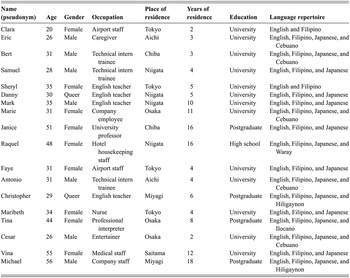
Eighteen randomly selected Filipino migrants in Japan participated in the present study. As Table 4 shows, the sample is heterogeneous in terms of occupation, age, gender, place, and duration of residence in Japan. As I mentioned in Section 1, the heterogeneity of the case sample is a crucial aspect, as it mirrors the current patterns of the Filipino diaspora in Japan.

Table 4Long description
The study includes 18 participants whose identities are anonymized using aliases. Each participant is characterized by age, gender, occupation, place, and length of residence, educational background, and language repertoire.
The data for the present study consisted of audio-recorded conversations by the participants. Over two months, they recorded their daily conversations across various settings (e.g., workplaces and homes) using a digital recorder, ensuring that the recordings took place under natural conditions. The participants notified their interlocutors that the conversations would be recorded for research purposes and assured them that names and other identifying information would be anonymized.
I collected the voice recordings each week and archived them on an external drive. After the two-month data collection period, 257 recordings were obtained, with an average of 15 recordings per participant. Of the 257 recordings, 90 percent involve face-to-face interactions, while the remaining are online interactions. Regarding the interlocutors, 75 percent of interactions are classified as “international” (between Filipinos and individuals of other nationalities), while 25 percent are considered “intranational” (among Filipinos).
The total duration of the recordings per participant averaged two hours. The recordings were subsequently transcribed by my research assistants employing basic transcription symbols outlined here, with Japanese utterances rendered in romanized Japanese:
English translation []
Laughter @@@
Short pause (.)
Long pause (…)
Syllable or word louder than
surrounding speech by the same speaker Upper case (e.g., HELLO)
Syllable or word quieter than
surrounding speech by the same speaker Degree sign (e.g., °hello°)
Inaudible (XXX)
The audio-recorded interactions were supplemented by two rounds of semi-structured, individual interviews conducted in Filipino and English, both languages familiar to all participants. The first session, conducted before the participants recorded their daily interactions, focused on questions such as (1) Describe your experience migrating from the Philippines to Japan; (2) In what contexts do you use English in Japan?; and (3) Do you think your English is influenced by the languages of the people you interact with in Japan? The second session took place after the two-month data collection period. The questions were aimed at obtaining more context on specific audio-recorded interactions, such as (1) How would you characterize your relationship with this person?; (2) What do you think was the person’s intention in this conversation?; and (3) How do you interpret what this person said? Both interview sessions, also transcribed by my research assistants, served as emic metacommentary, allowing participants to provide their own interpretations, meanings, and explanations of their language practices.
With the participants and methodologies established, I now proceed to the core analysis. Section 4 explores the ways Filipino migrants negotiate PhEs within Japan’s linguistic ecology, revealing the dynamics of feature selection, adaptation, and rejection in interaction.
4 Linguistic Selections
To analyze the linguistic selection processes in Philippine Englishes-in-motion, I employ Mufwene’s (Reference Mufwene2001) model of the “feature pool.” According to his model, languages or varieties have various features, including phonetic, phonological, morphological, grammatical, lexical, and discoursal elements. When speakers of different languages or varieties interact, these features mix into what he calls a “feature pool.” Mufwene suggests that such contact leads to competition among features that serve the same function. Over time, certain features are selected by speakers, either ad hoc in individual interactions or more systematically in recurrent interactions, while others may be discarded. This competition and selection process ultimately contributes to the formation of linguistic varieties or the evolution of existing ones. Originally, Mufwene’s model was conceptualized to account for the development of pidgins and creoles. However, he contends that all instances of contact between different linguistic systems undergo similar restructuring processes.
At the outset, it is important to clarify what is meant by “feature,” a complicated matter, but one that requires some qualification for the purposes of this discussion. The features I present in the subsequent data analysis are framed within a broader understanding. According to Bamgbose (Reference Bamgbose1998), a linguistic form becomes a recognized feature of a variety once it has undergone codification, among other things. From this perspective, a form is considered a feature of PhEs only when it appears in dictionaries, textbooks, large corpora databases, and other “authoritative” sources. However, drawing on Saraceni (Reference Saraceni2015), codification should not be a necessary condition for a form to be regarded as a feature. Many features of PhEs are not codified, yet they still reflect sociocultural practices and specificities, and lived realities. As such, uncodified PhE features – which can be emergent or incipient instances of language change – cannot be regarded as trivial in any sociolinguistic inquiry. Such types of features reveal what people do when they use forms that they identify as English.
Attending to uncodified PhE features aligns with Hundt’s (Reference Hundt, Seoane and Suarez-Gomez2016) call for greater openness to examining forms that occur infrequently and sporadically, rather than privileging those with higher frequency. She observes that when scholars encounter low-frequency usages that do not easily fit established grammatical patterns, these are often dismissed as mere performance “errors.” Yet such low-frequency phenomena are also worthy of scholarly attention.
It is likewise necessary to account not only for the putatively distinct features of PhE but also for those that exhibit convergence with other varieties. The Electronic World Atlas of Varieties of English (Kortmann et al., Reference Kortmann, Lunkenheimer and Ehret2020) serves as a useful reference, particularly when examining grammatical features shared across English varieties worldwide. A Handbook of Varieties of English, Volume 1: Phonology (Schneider et al., Reference Schneider, Burridge, Kortmann, Mesthrie and Upton2004) provides another valuable reference for phonological features shared across different regions. In this volume, Mesthrie (Reference Mesthrie, Schneider, Burridge, Kortmann, Mesthrie and Upton2004) highlights that PhEs share specific phonological features with other varieties, such as the unextended [ɔ] or [o] sounds (also found in Nigerian English, Indian English, Malaysian English, and Singapore English), as well as the treatment of /θ/ and /ð/ as sounds other than interdental fricatives (a feature also observed in Malaysian and Singapore English).
This broader conceptualization of features (codified, uncodified, distinct, shared) aligns with the core ideas in the mobility paradigm that I mentioned in Section 1.1 – ordinariness and unexpectedness – which acknowledge that forms and meanings circulate fluidly and emerge in unanticipated contexts. In real-life communication, one ordinarily encounters not only the expected, codified, and shared features but also the unexpected, uncodified ones.
As its name suggests, Philippine Englishes-in-motion recognizes that features are in motion, unpredictable, and constantly in flux. Some are already known, documented, and studied, while others arise spontaneously and unexpectedly. In this Element, I present various types of features of PhEs to reflect this dynamic and inclusive view.
4.1 Linguistic Selection Processes
What can emerge through contact is the likelihood that features are selected, modified, and rejected from a range of available linguistic features (such as vocabulary, syntax, pronunciation, etc.) from different languages or those within the speakers’ linguistic repertoire. In this section, I present evidence of such linguistic selections derived from selected recordings of conversations involving the participants mentioned in the previous section, as well as a rearticulation of findings from my previous study (Martinez & Martin, Reference Martinez, Martin, Rüdiger, Neumaier, Leuckert and Buschfeld2025).
The voice recordings provide rich insights into three linguistic processes through which features are altered or repurposed, each of which will be exemplified here.
(1) When a PhE feature becomes a potential source of communication breakdown, it may be substituted with a feature from another variety of English, which is not necessarily an Inner Circle English variety.
(2) When a PhE feature is introduced to an interaction, non-Filipino speakers may acquire it through repeated exposure, or even after a single instance of contact.
(3) PhE features may be merged with features from other varieties of English and non-English languages, resulting in hybridized forms and meanings.
Table 5 offers an overview of the findings related to the linguistic selection processes outlined here. Some of the supporting evidence is presented here, while other evidence could not be discussed in detail due to space constraints.

Table 5Long description
Three linguistic selection processes emerged from the data: feature substitution to mitigate communicative breakdown, feature acquisition through interactional exposure, and feature hybridization. The first process involves lexico-semantic substitution, exemplified by the replacement of Philippine English lexical items with Japanese English equivalents. The second process encompasses phonological acquisition as well as morphological and syntactic acquisition, with examples reflecting Philippine English phonology and grammar. The third process includes hybridized phonology and code-switching. Hybridized phonology is characterized by the integration of phonological features from both Japanese English and Philippine English. Code-switching involves alternation between Philippine English and other Indigenous languages, such as Tagalog, Cebuano-Bisaya, and Ilocano.
4.1.1 Lexico-Semantic Substitution
When a PhEs feature could cause a communication breakdown, it may be substituted with a feature from another variety of English. As demonstrated in Excerpt 1, the variety is not necessarily one of the Inner Circle varieties of English. Clara and her friends – Abigail (female, Filipino), Yuki (female, Japanese), and Yasuko (female, Japanese) – randomly decided to dine together at a family restaurant during their lunch break. The four women first met at work and have since become close friends.
(1) Clara: looks oishi [Japanese: ‘delicious’]
(2) Abigail: di ba? [Tagalog: ‘right?’]
(3) Clara: what to order
(4) Yuki: there’s steak
(5) Clara: I think I like steak
(6) Yuki: Beef or pork?
(7) Abigail: No steak for me. I’m on diet.
(8) Clara: Diet ka? [Tagalog: ‘You’re on diet?’] @@@
(9) Abigail: Yeah @@@
(10) Clara: Beef steak. Do they have unli rice?
(11) Yasuko: °sorry?°
(12) Clara: unli rice, unlimited rice
(13) Yasuko: unli (.) sorry, I don’t know.
(14) Abigail: like (.) you ask another rice for free (.) again and again.
(15) Yuki: okawari, okawari rice
(16) Yasuko: Okay, okay, wakatta [Japanese: ‘got it’]
(17) Clara: How to say it?
(18) Yuki: O(.) ka(.) wa(.) ri rice
(19) Clara: I see. @@@ Okawari rice, daijobou? [Japanese: ‘Is it OK?’]
(20) Yasuko: Yes, yes, no problem. Just pay extra 250 yen.
This interaction highlights multilingual and multicultural nuances as Clara and her friends discuss their meal choices, often shifting between English, Tagalog-based Filipino, and Japanese. At the start of the conversation, Clara mixes English and Japanese, creating a casual and relaxed tone, followed by playful exchanges about food choices.
A key moment occurs when Clara asks about “unli rice” (short for “unlimited rice,” an uncodified PhE feature for all-you-can-eat rice) in line 10. Yasuko, unfamiliar with the term, asks for clarification, suggesting a linguistic and cultural gap. Abigail explains, and Yuki bridges the gap further by introducing the Japanese English equivalent, “okawari rice” (refill rice) in line 15. Yasuko affirms her understanding, showing how “unli rice” is effectively substituted with “okawari rice” in this multilingual negotiation.
In situations like in Excerpt 1, where a communication breakdown is possible, Filipino speakers might initially use a PhE feature, only to realize it is unfamiliar to other interlocutors. It is then replaced with a term from another English variety, which may not necessarily be an Inner Circle variety but one that is accessible in the linguistic ecology. Replacing a PhE term (unli rice) with a Japanese English term (okawari rice) is linguistically feasible because both terms have comparable meanings. Lexically, both expressions refer to the act of obtaining additional rice after the first serving. Semantically, they fall within the same domain of food service practices, particularly those involving refills. In both respects, they convey the idea of asking for or being given more rice. This lexico-semantic substitution fosters mutual respect as the group navigates cultural and linguistic differences, mainly when Yasuko is unfamiliar with certain PhE features. The lighthearted tone remains throughout, with everyone working together to ensure that all participants understand the meal options.
Lexico-semantic substitution is also evident in Excerpt 2, which presents a conversation between Eric and his three colleagues – Rojo (male, Indian), Kazuki (male, Japanese), and Joseph (male, Filipino) – all of whom are professional caregivers. Kazuki extended an invitation for them to have lunch at his apartment, located across from the care facility. As they dine, they watch a Japanese talk show on television.
(1) Eric: He dances like bold actor. @@@
(2) Rojo: Who?
(3) Eric: That one.
(4) Kazuki: Perm hair?
(5) Eric: Hai. [Yes] Bold actor @@@
(6) Rojo: (…) Why?
(7) Joseph: Uh (.) Just like AV actor.
(8) Kazuki: Oh @@@
(Martinez & Martin, Reference Martinez, Martin, Rüdiger, Neumaier, Leuckert and Buschfeld2025, p. 272)
Eric describes the dance moves of someone on a talk show, referring to the person as a “bold actor” (line 1). The term “bold actor” appears to be a variant of “bold star,” which refers to an actor or actress in the Philippines, typically from the 1980s to early 2000s, who starred in sexually explicit films. While “bold actor” carries this local connotation, it seems unclear and amusing to the group.
In line 7, Joseph attempts to repair the initial misunderstanding by introducing “AV actor” (short for “adult video actor”), a phrase commonly used in Japan to refer to performers in pornographic films, thereby making the reference clearer. Kazuki responds with laughter, indicating that the group has finally reached a shared understanding.
This exchange highlights a moment when a PhE feature causes some confusion, but the group resolves it by substituting lexico-semantic features to understand each other. In the phrase “bold actor,” the adjective bold is a feature of PhEs meaning “erotic,” added to the Oxford English Dictionary in 2018 (Salazar, Reference Salazar and Borlongan2023). This phrase is not immediately understood by everyone. To resolve this, Joseph introduces the comparable Japanese English term “AV actor” until they reach a shared understanding.
While “AV actor” resolves the communicative gap, it is important to acknowledge that using this term risks flattening the cultural nuances embedded in the original expression, as the connotations of the two terms are not perfectly aligned. In the Philippine context, “bold actor” often carries ironic or nostalgic overtones rooted in 1980s–2000s popular media discourse, while “AV actor” in Japan refers more directly to adult film performers. Thus, the resolution is pragmatic, though culturally imprecise.
In Excerpts 1 and 2, the lexico-semantic substitution was supplied by interlocutors who did not utter the PhE word that was an initial source of misunderstanding. Additionally, the data demonstrates instances of self-repair, where the PhE speaker provides the substitution without help from others. This is exemplified in Excerpt 3. Christopher and his friends – Aki (female, Japanese), Lina (female, Bulgarian), and Corey (male, American) – are English teachers employed by different dispatch companies. They are making plans for the weekend.
(1) Christopher: Ten minute walk from my apato [apartment]
(2) Corey: Quite close
(3) Christopher: That’s right.
(4) Corey: I’ll take the bus to the park.
(5) Lina: Which park? Funaoka?
(6) Corey: Not there, that’s too far
(7) Aki: Shiroyama
(8) Christopher: Yup, that’s the place.
(9) Aki: What are you bringing?
(10) Lina: Sandwiches for us. Is that fine? (XXX)
(11) Corey: I’ll bring fruits
(12) Christopher: Me, soft drinks and juice.
(13) Aki: What is it?
(14) Christopher: What?
(15) Aki: Soft (.) and juice
(16) Christopher: Soft drinks, I mean (…) cola.
(17) Aki: Ah, CO-LA. That’s nice, Fanta, Pepsi.
(18) Christopher: Alright, Fanta and Pepsi. I like Fanta, too.
(19) Corey: Coke for me, Chris.
(20) Christopher: Sure, sure. Lina?
(21) Lina: Coke’s fine, too.
In this exchange, the group decides what to bring for the picnic: Lina offers sandwiches, Corey volunteers fruit, and Christopher says he will bring “soft drinks” and juice (line 12). In the Philippines, “soft drinks” refers to carbonated beverages, but this uncodified PhE feature is unfamiliar to Aki, who asks for clarification. Christopher then substitutes “cola” (line 16), a term widely used in Japan as a generic label for soda. This self-repair demonstrates his strong awareness of lexical affinities and helps ensure mutual understanding.
The Excerpts 1–3 clearly show that the process of lexico-semantic substitution involves significant instances of feature rejection. PhEs words such as “unli rice” (Excerpt 1), “bold actor” (Excerpt 2), and “soft drinks” (Excerpt 3) were initially excluded or discarded by non-Filipino interlocutors due to their misalignment with social and cultural expectations. However, this rejection is mitigated by the substitution of these terms with alternatives from Japanese English, which holds a more familiar and accessible position within the shared linguistic ecology.
Instructively, features with similar lexico-semantic properties alone do not necessarily resolve communication breakdowns. As illustrated in Excerpts 1–3, successful communication depends greatly on the willingness of people to work together in navigating differences. This sense of collaboration is crucial, especially since interlocutors cannot rely solely on linguistic features to overcome communicative challenges. Tomasello (Reference Tomasello2008) emphasizes that beyond linguistic forms and structures lies a fundamental cooperative principle – an underlying drive to collaborate that enables communication to succeed. Applied to Excerpts 1–3, this suggests that what is common goes beyond comparable lexicology; it includes shared intentions, mutual attention, and aligned motives. Shared objectives in communication brought the participants and their interlocutors together, fostering collaboration in achieving meaning across differences.
4.1.2 Phonological and Grammatical Acquisition of PhEs
Because phonology is inherently intuitive, non-Filipino speakers, particularly in immersive settings, may gradually incorporate phonological features of PhEs, depending on their exposure to and interaction with PhE speakers. Excerpt 4 features a conversation between Bert and Shuichiro (male, Japanese). The two originally met at a Catholic church in Chiba and have developed a close friendship over time.
(1) Shuichiro: Eigo no menyū wa arimasu? [Japanese: ‘Do you have an English menu?’]
(2) Staff: Hai, shōshō omachi kudasai. [Japanese: ‘Yes, please wait for a moment.’]
(3) Shuichiro: Here’s the menu.
(4) Bert: Arigato [Japanese: ‘Thank you.’] (…) I order this ramen. You?
(5) Shuichiro: Hmm (.) maybe miso ramen. You?
(6) Bert: This picture
(7) Shuichiro: Oh, shoyu ramen. Good choice.
(8) Bert: Hai, suki (.) suki. [Japanese: ‘Yes, I like, I like.’] Shoyu is soy sauce?
(9) Shuichiro: Me too
(10) Bert: @@@
(11) Shuichiro: Kyō wa oyasumi? [Japanese: ‘Today is your day off?’]
(12) Bert: Eh? [Japanese: ‘Huh?’]
(13) Shuichiro: Today, your holiday?
(14) Bert: Ah, yes. Day off every Wed-nes-day.
(15) Shuichiro: It’s good. (…)
(16) Bert: How about you?
(17) Shuichiro: Same. Wed-nes-day too. Eto (.) kinyōbi [Let me see. Friday]. Wait.
(18) Bert: Friday
(19) Shuichiro: Yes, yes, Friday. Wed-nes-day and Friday.
In the conversation, Bert tells Shuichiro that Wednesdays are his regular day off, pronouncing “Wednesday” as “Wed-nes-day,” syllable by syllable (line 14). Tayao (Reference Tayao, Lourdes, Schneider, Burridge, Kortmann, Mesthrie and Upton2004) suggests that this spelling-to-sound tendency is typical of “basilectal speakers” of PhE, who are often from lower socioeconomic backgrounds and have less formal education. However, based on the interview data, Bert is a licensed civil engineer in the Philippines and comes from a middle-class family, making it difficult to categorize him as a basilectal PhE speaker. In this context, Tayao’s (Reference Tayao, Lourdes, Schneider, Burridge, Kortmann, Mesthrie and Upton2004) framework of phonological variation in PhE – neatly dividing speakers into “acrolectal” (highly educated speakers), “mesolectal” (speakers from middle-class backgrounds), and “basilectal” (speakers with less education) – may need to be reassessed.
Shuichiro also mentions that Wednesday is his day off (line 17) and pronounces it like Bert, showing how quickly PhE pronunciation features can be learned. In line 19, he repeats “Wednesday” the same way, again using this PhE feature. However, this acquisition may not be solely attributed to the influence of PhEs, as Japanese phonological patterns also simplify complex English syllables by reducing unstressed sounds or altering syllable structure. Additionally, it is well documented that many varieties of English spoken in Africa, South Asia, and Southeast Asia employ a syllable-timed rhythm rather than a stress-timed one, which may also explain this phenomenon (Mesthrie, Reference Mesthrie, Schneider, Burridge, Kortmann, Mesthrie and Upton2004).
There is also evidence of the acquisition of the substitution of /θ/ with /t/ – another codified phonological feature of PhE (Shahruddin et al., Reference Shahruddin, Ran, Low and Borlongan2023). Excerpt 5 presents a conversation between Faye and Akemi (female, Japanese). The two are colleagues employed at the same airport but in different departments.
(1) Faye: Long day
(2) Akemi: Right
(3) Faye: What’s that?
(4) Akemi: A report
(5) Faye: Oh (…)
(6) Akemi: By the way, can you help me check this sentence here?
(7) Faye: Sure (XXX)
(8) Akemi: Here. How do I say this? Forty
(9) Faye: Oh okay. Forty three [triː] thousand six hundred ninety one.
(10) Akemi: One more @@@ not fast.
(11) Faye: Sorry
(12) Akemi: Not good in numbers.
(13) Faye: Okay. Forty (.) three [triː] (.) thousand
(14) Akemi: Forty three [triː] thousand
(15) Faye: Six (.) hundred (.) ninety (.) one
(16) Akemi: Six hundred ninety one
(17) Faye: Can you say it again? One more time
(18) Akemi: Forty (.) three [triː] (.) thousand (.) six hundred nine (.) ty one
(19) Faye: That’s right!
(20) Akemi: Forty three [triː] (.) thousand (.) six (.) hundred ninety one
(21) Faye: That’s right! @@@ What is it for?
(22) Akemi: (XXX) presentation next week. I’m nervous!
Faye and Akemi engage in a casual exchange that shifts into a pronunciation practice session. After some small talk, Akemi asks Faye for help in pronouncing a figure from a report she prepared. Faye carefully models the pronunciation of “forty-three thousand six hundred ninety-one,” breaking the number down into smaller chunks (lines 13–16). Akemi repeats after her several times, gradually improving her pacing until Faye confirms she got it right. The interaction demonstrates not only peer assistance but also how everyday workplace exchanges can become spaces for informal language learning.
An interesting detail in this interaction is Akemi’s adoption of Faye’s pronunciation of three as /triː/. In PhE, the interdental fricative /θ/ in three is commonly realized as an alveolar stop /t/, as in tree. Faye consistently uses this feature, and Akemi reproduces it in her repetitions. This suggests that Akemi is acquiring this PhE feature, also found in Malaysian English and Singapore English (Mesthrie, Reference Mesthrie, Schneider, Burridge, Kortmann, Mesthrie and Upton2004), showing how direct interaction facilitates the transfer of phonological features across speakers in multilingual settings.
Just as phonological features of PhEs can be picked up in real-time interactions, so too can grammatical patterns, especially in collaborative workplace settings. This is illustrated in Excerpt 6. Raquel and her colleague, Win (female, Myanmar national), were on duty at a four-star hotel in Niigata. According to Raquel, she had been working with Win for less than a year. Win, a graduate student at a university, was employed part-time at the hotel.
(1) Raquel: Many rooms to clean today.
(2) Win: That’s right. Not many staff today, Tanaka-san [Mr. Tanaka] said.
(3) Raquel: I hope they hire more staff, ne [Japanese: ‘right?’].
(4) Win: Right.
(5) Raquel: How many rooms are assigned?
(6) Win: I saw your name yesterday before I leaving. Hachi. [Eight]
(7) Raquel: HACHI? [Japanese: ‘Eight?!’] EH, HACHI. [Japanese: ‘Huh, eight?!’] Only five before.NANDE? [Japanese: ‘Why?’]
(8) Win: Shōganai ne. [Japanese: ‘It can’t be helped.’] Hachi [Japanese: ‘Eight’] too, same, same.
(9) Raquel: (XXX) I’m going up now. Close the lights, Win-chan, onegai. [please]
(10) Win: Hai. [Japanese: ‘Yes.’] Gambatte ne. [Japanese: ‘Do your best, okay?’]
The conversation between Raquel and Win represents an informal exchange in which they discuss their respective work responsibilities at the hotel. It begins with Raquel observing that there are a significant number of rooms to clean, to which Win agrees, explaining that there are fewer staff members on duty that day, as indicated by their supervisor, Mr. Tanaka.
As the conversation progresses, Raquel informs Win that she is heading upstairs to begin her work and requests that Win “close the lights” (line 9). This is a syntactical variant of a more established PhE feature – “open the light” – which is a direct translation of the Filipino idiom buksan ang ilaw (Gonzalez, Reference Gonzalez, Bautista and Bolton2008). In this PhE expression, “close” is used instead of “turn off” or “switch off,” which are more common in other varieties of English. While “close” typically means to shut or seal something, in PhEs, it has extended its meaning to include the action of turning off electrical devices, such as lights.
Initially, I assumed that “close the lights” was an isolated instance of linguistic contact. However, upon reviewing subsequent voice recordings submitted by Raquel, it became evident that this expression had been adopted by Win. This is evident in Excerpt 7, where Raquel, Win, and Yuna (female, Japanese) briefly talk at the hotel where they work before leaving for the day.
(1) Yuna: Samoi. [Japanese: ‘It’s cold.’]
(2) Win: Samoi mecha. [Japanese: ‘Super cold.’] Don’t like.
(3) Raquel: Too cold. KAZE YABAI! [Japanese: ‘It’s too windy!’]
(4) Win: Huh?
(5) Raquel: Windy, windy, too many wind
(6) Win: Ah, right. (…)
(7) Yuna: Raquel-san, home?
(8) Raquel: Hai. [Japanese: ‘Yes.’] Just waiting for friend to pick me up.
(9) Win: New boyfriend? @@@
(10) Raquel: @@@ I hope
(11) Win: Ja, [Japanese: ‘Well’] I’m going too. I finish closing the lights in storage.
(12) Raquel: Hai, arigato. [Japanese: ‘Okay, thank you.’]
(13) Yuna: Arigato [Japanese: ‘Thank you.’] Otsukaresama deshita [Japanese: ‘Thank you for your hard work.’]
Win announces that she is leaving, stating that she has finished “closing the lights” (line 11) in the storage room. This expression likely became part of her linguistic repertoire through frequent exposure in everyday work conversations, a process that may or may not have involved conscious effort.
The findings also show that result to – a persistent feature of PhE (Bautista, Reference Bautista, Lourdes, Bautista, Llamzon and Sibayan2000; Dita, Reference Dita, Rüdiger, Neumaier, Leuckert and Buschfeld2025) – can be acquired by non-Filipino speakers. To illustrate this, Excerpt 8 is a conversation between Janice, Stephen (male, American), and Honoka (female, Japanese), all of whom are university professors.
(1) Stephen: Did you get a chance to look at the survey?
(2) Honoka: About the student engagement?
(3) Stephen: Yeah
(4) Janice: Looks like (.) I don’t know (.) not training students to use Google Meet result to (.) you know, lower participation
(5) Stephen: How about improving the design of online tasks (…) could result in higher participation, I guess.
(6) Honoka: Yeah, I agree with Janice (.) we train our students how to use Google Meet, then see if (.) see if (.) if it results to better participation.
(7) Janice: Yeah
The three professors discuss the results of a survey on student engagement in online classes using Google Meet. Janice remarks that not training students on the platform may “result to” lower participation, and Stephen suggests that improving the design of tasks could increase it. Honoka agrees with Janice, suggesting the importance of training students first to boost online engagement.
What is striking in this conversation is that Honoka was exposed to two features: “result to” (PhEs), as used by Janice (line 4), and “result in” (American English), as used by Stephen (line 5). By virtue of social prestige, Honoka could have just selected the latter. However, she instead adopted “result to,” reflecting her alignment with PhEs. This choice reflects how speakers acquire and deploy features not solely based on prestige.
Buschfeld (Reference Buschfeld, Schreier, Hundt and Schneider2020) remarks that frequency of exposure, age, and ethnicity are some factors in the acquisition of linguistic features. Building on this, the data suggest that social relationships also play an important role in the acquisition of PhEs. Bert and Shuichiro (Excerpt 4) share a close friendship strengthened by their shared religious identity, while Faye and Akemi (Excerpt 5) had known each other even before they began working at the airport. Their friendship provides an environment for natural and spontaneous bilingual interactions, which are essential for language acquisition.
The same logic applies to Raquel and Win (Excerpts 6 and 7). Win may have unconsciously acquired the expression “close the lights” as a result of her close relationship with Raquel, a connection underscored by Raquel’s use of the affectionate nickname “Win-chan” (Excerpt 6, line 9). In Japan, -chan is an informal honorific that conveys warmth and familiarity, typically reserved for individuals with whom the speaker shares a personal bond. Similarly, in Excerpt 8, Honoka’s acquired use of “result to” may reflect her long-standing rapport with Janice, with whom she has worked for more than seven years.
The Excerpts 4–8 suggest that while frequent exposure, age, and ethnicity are important factors in language acquisition (Buschfeld, Reference Buschfeld, Schreier, Hundt and Schneider2020), the closeness and familiarity between the speakers may also play a crucial, and perhaps larger, role in the acquisition of PhEs.
4.1.3 Hybridized Phonology
The data also provide evidence that PhEs features can be combined with features from other English varieties. These combinations can also incorporate features of non-English languages, resulting in the creation of hybridized forms. To illustrate, let us examine Excerpt 9, an exchange between Samuel, Taiki (male, Japanese), and Benso (male, Indonesian). Taiki is the manager of the paper production company hosting Samuel and Benso as technical interns. He invited them to have drinks at an izakaya (a casual Japanese pub) after work. Samuel had only recently arrived in Japan at the time of this after-work drinking event.
(1) Taiki: Choose, please. (XXX) Anything okay. (XXX)
(2) Samuel: Arigatogozaimasu. [Japanese: ‘Thank you very much.’] (…) Torikawa and beer.
(3) Taiki: Okay. Benso-san?
(4) Benso: Nankotsu, onegaishimasu. [Japanese: ‘Nankotsu, please.’]
(5) Taiki: (XXX) Torikawa wa ikutsu? [Japanese: ‘How many pieces of torikawa do you want?’]
(6) Samuel: (…) Uhm (.)
(7) Benso: He’s asking how many torikawa.
(8) Taiki: One? Two? Three?
(9) Samuel: Uhm (.) Five [paɪbu]. Is it okay?
(10) Taiki: Hai [Japanese: ‘Yes’] @@@ Daijobu [Japanese: ‘It’s okay.’](Martinez & Martin, Reference Martinez, Martin, Rüdiger, Neumaier, Leuckert and Buschfeld2025, pp. 274–5)
In this conversation, the group discusses their food order. Samuel chooses torikawa (grilled chicken skin) along with beer, and Benso selects nankotsu (chicken cartilage), illustrating their specific preferences within the ordering process. When asked how many pieces of torikawa, Samuel answers “five” (line 9), pronouncing it as /paɪbu/. He substitutes the consonants /f/ with /p/ and /v/ with /b/, a phonological feature of PhE (Tayao, Reference Tayao, Lourdes, Schneider, Burridge, Kortmann, Mesthrie and Upton2004), and simultaneously uses a feature of Japanese English by adding the vowel /u/ to the end of the closed syllable. According to Kita (Reference Kita2019), adding a vowel to a closed syllable is common among Japanese English speakers because this tendency is closer to the Japanese consonant-vowel pattern. The hybridized phonology gains uptake, as Taiki confirms that ordering five pieces of torikawa is perfectly fine (line 10). This instance of hybridized phonology, where features from both PhE and Japanese English are blended, demonstrates how multilingual speakers adapt their speech in response to diverse linguistic influences. Rather than signaling a complete shift in the phonological system, the blending reflects context-sensitive linguistic flexibility that facilitates communication.
Another example of hybridized phonology in the data is the substitution of /ð/ with /d/ in PhE, combined with vowel insertion typical of Japanese English. Excerpt 10 serves as a case in point. It presents a conversation between Maribeth and her Japanese partner, Otoki.
(1) Maribeth: This [dɪs] table looks good, papa.
(2) Otoki: Nani? [Japanese: ‘What?’]
(3) Maribeth: Here, look.
(4) Otoki: Where XXX the table?
(5) Maribeth: This [dɪsu] (.) table, see.
(6) Otoki: Ah, kore [Japanese: ‘Oh, this.’]
(7) Maribeth: Hai [Japanese: ‘Yes’]. It’s elegant, ne. [Japanese: ‘right?’]
(8) Otoki: Yeah. Should we buy?
Maribeth and Otoki are shopping and come across a table that catches Maribeth’s attention. She points it out and comments that it looks good, while Otoki, switching between English and Japanese, asks which one she means. Maribeth shows him the table, and Otoki acknowledges it before she adds that it looks elegant. In the end, Otoki agrees with her impression and suggests that they consider buying the table.
There is a noticeable shift in pronunciation from PhE to a hybrid of PhE and Japanese English. In line 1, Maribeth pronounces this as /dɪs/, where the voiced dental fricative /ð/ in American English is replaced by the alveolar stop /d/. She later modifies her pronunciation by blending PhE and Japanese English features, producing /dɪsu/ with an epenthetic vowel added at the end. As previously mentioned, this vowel insertion reflects the influence of Japanese phonology, which follows a CV (consonant + vowel) structure (Kita, Reference Kita2019). To fit this CV pattern, an extra vowel is inserted after a final consonant in English words.
4.1.4 Code-Switching
Kirkpatrick and Lixun (Reference Kirkpatrick and Lixun2021) remark that most speakers of a particular variety of English are multilingual, having learned English as an additional language. Within communities of speakers who share similar linguistic backgrounds, it is natural for them to alternate between English and their native languages. Such code-switching practices not only facilitate communication but also serve as an important marker of social and cultural identity.
Filipinos, for example, frequently switch between English and various Philippine languages. The most extensively studied form of this practice is Tagalog-English code-switching, or Taglish, with linguistic research on the topic dating back to the 1970s and 1990s (e.g., Bautista, Reference Bautista, Lourdes and Bautista1998; Pascasio, Reference Pascasio1978). Thompson (Reference Thompson2003) explored both the linguistic aspects of Taglish and its social effects, particularly in reinforcing certain ideologies. In what follows, I aim to examine code-switching in my data from a different perspective. In transnational contexts, code-switching not only reflects the social networks Filipinos engage with but also highlights how language plays a role in the formation of migrant “communities of practice” (Lave & Wenger, Reference Lave and Wenger1991).
In Japan, interactions between PhEs and other Philippine languages illustrate the formation of these communities, where speakers of the same Indigenous languages (e.g., Hiligaynon and Ilocano) connect, build shared interests, and develop social ties. These communities are not just for socializing but also for shaping migrant identities.
Excerpt 11 illustrates the concept of communities of practice, as seen in the conversation between Marie and her Filipino friends, Antonio (male) and Isabel (female), after Sunday mass at a Catholic church in Osaka.
(1) Isabel: Tapos na ka sa imo ginabuhat? [Cebuano-Bisaya: ‘Are you done with what you’re doing?’]
(2) Marie: Hapit na ko mahuman sa akong report, [Cebuano-Bisaya: I’m almost done with my report] pero kailangan pa nako i-check ang grammar. [Tagalog: ‘but I still need to check the grammar.’]
(3) Isabel: Humanon na, sis, [Cebuano-Bisaya: ‘Finish it already, sis’] para awra na [Tagalog: ‘so you can look good.’]
(4) Antonio: I-finalize na Christmas party, oy. [Tagalog: ‘Hey, let’s finalize plans for the Christmasparty.’]
(5) Marie: Tinuod [Cebuano-Bisaya: ‘True.’] (XXX)
(6) Antonio: Next next week na, wa pa ta’y emcee [Cebuano-Bisaya: ‘we still don’t have an emcee’]
(7) Marie: Si kuwan [Tagalog: ‘That guy’] (.) si Jaycee
(8) Antonio: Kinsa si Jaycee? [Cebuano-Bisaya: ‘Who is Jaycee?’]
(9) Isabel: Pamangkin nako siya, wa pa nimo na-meet. [Cebuano-Bisaya: ‘He’s my nephew. You haven’t met him.’]
The exchange in Excerpt 11 centers on preparations for the Christmas party at the church and is characterized by a blending of PhE with other languages within an intranational setting. In line 6, Antonio uses the phrase “next next week,” an uncodified but familiar PhE feature denoting the week after next. This syntactical construction employs reduplication to indicate future time in a direct manner. Such repetition aligns with a broader linguistic pattern found in Indigenous languages like Cebuano-Bisaya and Tagalog, where duplication is frequently used for emphasis and clarity. Additionally, this PhE expression is integrated into the Cebuano-Bisaya and English phrase “wa pa ta’y emcee” [We still don’t have an emcee.], exemplifying Bislish – a hybridized form of Bisaya and English (Bolivar, Reference Bolivar, Buschfeld and Kautzsch2020).
The dynamic blending of PhE, Tagalog, and Cebuano-Bisaya operates within two closely interconnected communities of practice: one centered around Filipino Catholic identity and the other around ethnolinguistic and cultural affiliation.
Beyond their shared identity as Filipino Catholics, the participants’ interaction is also shaped by their distinct ethnolinguistic and cultural backgrounds, particularly their connection to Cebu. All three were born and raised in Cebu, a province in the Central Visayas region of the Philippines, where both Cebuano-Bisaya and English are widely spoken. In my interview with Marie, for instance, she noted that many Filipino migrants at the church speak Cebuano-Bisaya and frequently gather in informal groups to socialize. These gatherings serve as spaces for discussing personal matters, as well as political and economic developments back in Cebu. Such interactions highlight how language functions not only as a means of communication but also as a tool for maintaining cultural ties and fostering a sense of community among migrants.
Excerpt 12 further illustrates how shifts between PhEs and other Philippine languages reflect migrant identities shaped through participation in communities of practice. In this instance, Tina, based in Osaka, engages in a video call with her friends Michelle (female, Filipino) and Carlo (male, Filipino), both of whom reside in Tokyo.
(1) Tina: Umayka pay laeng? Agawidakon idiay Pilipinas inton Sabado. [Ilocano: ‘Are you still coming? I’m going home to the Philippines this Saturday.’]
(2) Michelle: Excited ka, manang? [Ilocano: ‘sister?]
(3) Carlo: Wen, wen, [Ilocano: ‘Yes, yes’] pasabuy man! [Ilocano: pasabuy please!]
(4) Tina: Awan problema [Ilocano: ‘No problem.’]
(5) Carlo: Pasabuy man ti matcha para pamilya [Ilocano: ‘Pasabuy some matcha for my family’]
(6) Michelle: Me too, please
(7) Tina: Ania nga brand? [Ilocano: ‘What brand?’] XXX
(8) Carlo: Any brand, manang. [Ilocano: ‘sister’]
In this excerpt, Tina tells her friends that she is going home to the Philippines on Saturday. Carlo eagerly asks Tina to “pasabuy” items for him and his family, specifically matcha (green tea powder). Michelle joins in, requesting some as well. Tina positively responds and asks which brand they prefer. The exchange shows a playful interaction among the friends, mixing Ilocano, English, and the term “pasabuy” – a widely used but uncodified PhE vocabulary meaning to buy something on someone’s behalf.
The mix of PhE and Ilocano unfolds within two closely connected communities of practice: the first structured around balikbayan identities and the second anchored in Ilocano social networks. By asking Tina to purchase goods on their behalf, Carlo and Michelle enact the social role of the balikbayan, a Filipino temporarily returning to the Philippines, which was added to the Oxford English Dictionary in 2015 (Salazar, Reference Salazar and Borlongan2023). This exchange reflects the cultural practice of sharing resources across borders, positioning Tina as the returning migrant who facilitates the transfer of gifts and goods within Filipino communities. At the same time, the dominant use of Ilocano for greetings, questions, and requests signals membership in a shared Ilocano-speaking community. Tina, Michelle, and Carlo, all from Ilocos Norte, a province in the northern Philippines where Ilocano is widely spoken, thus draw on their linguistic and cultural resources to maintain social bonds, demonstrating how Ilocano social affiliations are enacted alongside transnational balikbayan identities.
Based on the available data, the picture so far is this: The ecologies of PhEs in Japan exhibit considerable heterogeneity, encompassing lexico-semantic substitutions made by PhEs speakers or other interlocutors, the phonological and grammatical acquisition of PhEs by non-Filipinos through both one-time and repeated interactions with Filipino migrants, and the emergence of PhEs in hybrid forms within both international and intranational settings. These processes suggest that there are no constraints on the typology of PhEs. As we have also seen, the linguistic selections are highly variable, shaped by Filipino migrants with diverse backgrounds. Philippine Englishes-in-motion encapsulates this variability, reflecting linguistic selection processes involving the acceptance, adaptation, and rejection of features, which are influenced by communicative goals (e.g., resolving misunderstandings), social relationships (e.g., friendship), issues of identity (e.g., ethnolinguistic identities), and communities of practice (e.g., Filipino Catholics).
5 Social Positions
While the previous discussion zeroed in on how PhE features are selected, rejected, and modified in different contexts, understanding their mobility also requires examining how they are used to negotiate social roles and relationships. The spread and adaptation of these features involve not just linguistic choices but socially meaningful actions. This brings us to Positioning Theory (Harré & Van Langenhove, Reference Harré and Van Langenhove1999), which provides a framework for analyzing how Filipino migrants use PhEs to position themselves and others during interaction.
Building on the ideas of speech acts (Searle, Reference Searle1979) and the zone of proximal development (Vygotsky, Reference Vygotsky1978), Positioning Theory is about how people “position” themselves and others in social situations through language (Harré & Van Langenhove, Reference Harré and Van Langenhove1999). It is a way of understanding roles, relationships, and power in everyday interactions. For example, in a workplace, a senior employee might say, “I’ll handle this project,” positioning themselves as responsible and in charge. A coworker might respond, “I’ll follow your lead,” positioning themselves as supportive or subordinate. Positioning Theory, in short, demonstrates that identity and relationships are constantly created and negotiated through the ways we speak and act with others.
In Positioning Theory, the term “position” refers to the cluster of social roles that a person is perceived to hold in a particular interaction (Harré & Van Langenhove, Reference Harré and Van Langenhove1999; Hirvonen, Reference Hirvonen2016). It concerns what someone is allowed or expected to do or say in a given situation, and how others interpret or respond to those actions. Positions are dynamic – they can change within an interaction or from one interaction to another, depending on what is said or how people behave. They are also relational – a person’s position is defined in relation to others in the interaction. Furthermore, positions are negotiated – people position themselves and others through what they say, how they say it, and the actions they take.
Positioning acts can be interpreted in various ways; for this Element, however, I will focus on two approaches: (1) orders of positioning and (2) self- and other positioning.
In (1), there are three levels of positioning: first-, second-, and third-order (Harré & Van Langenhove, Reference Harré and Van Langenhove1999. First-order positioning occurs when someone initially takes on a role during the interaction. Second-order positioning happens when that role is contested or renegotiated by someone else in the interaction. Third-order positioning happens when someone outside the current conversation takes on a role, often by referring to something that happened earlier.
In (2), self-positioning refers to how a person defines or presents their own role, whereas other-positioning refers to how one assigns roles or identities to others. These two are codependent, as positioning oneself usually requires establishing the positions of others (Harré & Van Langenhove, Reference Harré and Van Langenhove1999).
The conceptual power of Positioning Theory in studying the movement of PhEs across transnational spaces lies in its ability to connect language, identity, and social context. It helps explain how Filipino migrants use features of PhEs to position themselves and others – for example, as competent, polite, or professional speakers – depending on the situation. These features are not fixed; their meaning changes through interaction, and the same feature can signal different things based on how others interpret it. Positioning Theory is especially useful for tracing how PhEs features travel within and across interactions, explaining how some features retain old meanings while gaining new ones. In what follows, I will illustrate these abstract discussions with specific data from the study.
5.1 Orders of Positioning
Danny and Mark, both Filipinos, are English teachers employed at the same eikaiwa (English conversation school). Danny is five years younger than Mark. While Mark has resided in Japan longer than Danny, both individuals began their employment with the company in the same year.
Throughout the conversation between Danny, Mark, and Marina (female, Japanese), the word “sir” is commonly used. In PhE, one of the many possible realizations of “sir” is /ser/, where the vowel resembles the short “e” sound as in “bed” or “set,” contrasting with the American English pronunciation /sɜːr/. In Excerpt 13, I examine how this particular phonological feature is enacted across different positioning orders.
(1) Danny: Uy [Tagalog: ‘Hi’], sir Mark, may problem sa scheduling [Tagalog: ‘there’s a scheduling problem’]
(2) Mark: What’s the problem?
(3) Danny: Marina-san here said that one of the teachers suddenly resigned.
(4) Mark: OH MY, who RESIGNED?
(5) Marina: Sofia sensei [Japanese: ‘Teacher Sofia’]
(6) Mark: I don’t know her personally
(7) Danny: So, sir, she has classes this Saturday.
(8) Mark: Okay (.) And?
(9) Danny: Marina was wondering if you can sub
(10) Mark: Danny, you know naman [Tagalog: ‘you obviously know’] that I don’t want to work on weekends.
(11) Danny: I know, sir
(12) Mark: Ikaw na lang [Tagalog: ‘Just you’], Danny
(13) Danny: I have classes that day, sir Mark
(14) Mark: Is there no one else? (…) Okay, fine.
(15) Marina: Thank you, SIR MARK, SIR DANNY! Onegaishimasu [’Japanese: ‘please’], sorry for the trouble. I’ll inform Luke.
(16) Danny: It’s alright.
In this brief workplace exchange, Danny informs Mark about a teacher’s sudden resignation and a scheduling issue. They discuss who can cover the class, with Mark reluctant to work on the weekend and Danny also unavailable. Eventually, Marina thanks them both for handling the situation.
As illustrated in Table 6, the term “sir” shifts meaning across the orders of positioning, reflecting different levels of respect and authority within the interaction.
| Order of positioning | Function of “sir” |
|---|---|
| First order | Establishes Mark’s authority or superior role |
| Second order | Reaffirms Mark’s authority while negotiating responsibility |
| Third order | Recasts both Danny and Mark as authority figures |
Danny addresses Mark as “sir” (line 1), which immediately positions the latter as a superior or authority figure within the institutional hierarchy. This constitutes first-order positioning, as the term “sir” frames Mark as the person with the authority to resolve the issue.
Danny repeats “sir” (lines 7, 11, and 13) while navigating Mark’s resistance. Each repetition reaffirms Mark’s authority, yet at the same time functions as a negotiation strategy by shifting the responsibility back onto him. This reflects second-order positioning, since the authority established in the first order is now being contested and renegotiated in light of Mark’s reluctance.
Finally, Marina invokes “sir” for both Mark and Danny (line 15), even though Danny had not previously been positioned as a superior. This constitutes third-order positioning, as she reconfigures both men as higher-status figures who collaboratively contribute to solving the scheduling problem.
The following conversation illustrates a well-known PhE feature, “comfort room” (CR), which means a room equipped with a toilet and washing facilities (Bautista & Butler, Reference Bautista, Lourdes and Butler2000), and how it is used to position the participants and their interlocutors within the interaction. In Excerpt 14, Tina is accompanied by her partner Allan (male, American) and her friend Brandon (male, Filipino) as they dine at a fast-food restaurant.
(1) Tina: Are we all good?
(2) Brandon: Yup
(3) Allan: I’m good.
(4) Brandon: (XXX) Excuse me, I need to go to CR.
(5) Tina: Sure
(6) Allan: Need to go what?
(7) Brandon: CR (.) I’ll be back.
(8) Tina: Short for comfort room.
(9) Allan: Sorry?
(10) Tina: C for comfort, R for room
(11) Allan: Oh, okay. (XXX) So CR’s a smoking area?
(12) Tina: It’s toilet. In Manila, we call it CR.
(13) Allan: Oh @@@ that’s interesting
(14) Tina: I know. @@@ It’s just how it is.
(15) Allan: You’ve never told me that before.
Here, Brandon indicates his intention to leave briefly to use the CR. While Tina readily acknowledges his statement, Allan does not recognize the term and requests clarification. Tina explains what CR means, eliciting Allan’s surprise and interest in this PhE feature.
Brandon’s deployment of the term “CR” exemplifies multiple orders of positioning within the conversation (Table 7). At the first-order level, “CR” positions him as a member of the PhEs-speaking community, assuming a shared understanding with Tina, who immediately recognizes the term (lines 4–5). At the second-order level, the term acquires sociolinguistic salience when Allan does not recognize it, thereby casting him as an outsider to PhEs and highlighting how such lexical items signal insider knowledge and cultural familiarity. At the third-order level, the interaction assumes a metalinguistic dimension as Tina explicates the term letter by letter (line 10), framing herself as a cultural mediator who explains the expression to Allan.
| Order of positioning | Function of “CR” |
|---|---|
| First order | Signals Brandon as a PhEs speaker |
| Second order | Casts Allan as an outsider to PhEs |
| Third order | Frames Tina as a cultural mediator |
In Excerpts 1–14, the different orders of positioning encompass multiple interlocutors within a single conversation. However, positioning can also manifest across separate conversations, where the same individual engages in reflective role-shifting. Excerpts 15 and 16 feature Janice’s conversations with Yoko (female, Japanese) and Daryl (male, Filipino), respectively. In Excerpt 15, Janice speaks with Yoko, the department coordinator at the university where she works. In Excerpt 16, she has a video call with her son, Daryl, who is studying in the Netherlands.
(1) Janice: Yoko-sensei, [Japanese: ‘Professor Yoko’I I sent the draft of the test [tʰɛst] to your email two days ago. I haven’t received any feedback.
(2) Yoko: Is that so? I’ll check it later (.) swamped with student essays.
(3) Janice: Okay, I understand. Thanks.
(Martinez & Martin, Reference Martinez, Martin, Rüdiger, Neumaier, Leuckert and Buschfeld2025, p. 274)
In Excerpt 15, Janice reminds Yoko about the test draft she emailed, and Yoko notes being busy with student essays. Janice acknowledges her explanation courteously.
(1) Janice: Kumusta bagong cellphone mo? [Tagalog: ‘How’s your new cellphone?’]
(2) Daryl: Di ko pa nabubuksan iyong box. [Tagalog: ‘I haven’t opened the box.’] Later, ma.
(3) Janice: (…) Do you have a test [tɛst] tomorrow? Homework? Basta huwag laging cellphone ha.[Tagalog: ‘Don’t use your cellphone always.’]
(4) Daryl: Okay, ma.
(Martinez & Martin, Reference Martinez, Martin, Rüdiger, Neumaier, Leuckert and Buschfeld2025, p. 274)
Here, Janice checks on Daryl’s new cellphone and reminds him not to overuse it, while Daryl responds politely, acknowledging her advice.
Janice’s pronunciation of the word “test” varies depending on her audience. In her professional setting, she articulates it as /tʰɛst/, with aspiration of the voiceless stop /t/, aligning with American English phonological patterns. In contrast, during her conversation with Daryl, she pronounces the word without aspirating the /t/, a feature associated with PhEs (Shahruddin et al., Reference Shahruddin, Ran, Low and Borlongan2023; Tayao, Reference Tayao, Lourdes, Schneider, Burridge, Kortmann, Mesthrie and Upton2004).
In the interview, I asked Janice to comment on her pronunciation changes. She explained that her variation in pronunciation is intentional: At work, she adopts a pronunciation that closely aligns with American English, while at home, she uses a more familiar PhE accent. This phonological alternation demonstrates how Janice negotiates linguistic identity across different social contexts.
Based on the foregoing discussion, the following movement of “test” across orders of positioning emerges, as shown in Table 8.
| Order of positioning | Function of “test” |
|---|---|
| First order | Situates Janice as a competent speaker of PhEs and American English |
| Second order | Depicts Janice in her professional and maternal roles |
| Third order | Portrays Janice as aware of and responsive to the languages valued in each setting |
In first-order positioning, Janice instinctively aligns her speech with the linguistic norms of her environment. In her academic department, which includes many white American colleagues, she adopts American English pronunciation to align with the dominant standard. In contrast, at home, she speaks with a PhE accent and incorporates Tagalog, creating a familiar linguistic space with her son. These choices go beyond accent; they reflect her competence in both PhEs and American English.
In second-order positioning, others ascribe roles and expectations to Janice based on their interpretation of her language use. Yoko, as the department coordinator, likely expects a certain level of linguistic professionalism that aligns with institutional norms rooted in American English. While Excerpt 15 provides limited phonological data from Yoko, Janice’s perception of departmental norms shapes how she anticipates being evaluated. At home, Daryl’s use of “ma” (short for mama or mother) reflects warmth and closeness, portraying Janice as a caring figure in a relaxed and personal setting.
In third-order positioning, Janice explicitly reflects on the strategic nature of her linguistic performance. She understands that her adoption of an American English accent at work is not only about clear communication but also about navigating institutional expectations. During the interview, she remarked, “Baka mawalan ako ng trabaho dito” [Tagalog: “I might lose my job here”], suggesting that speaking with a marked PhEs accent might be perceived as less professional. Although said jokingly, this comment highlights the pressure many Filipino migrants, especially those whose work involves frequent use of English, feel to conform linguistically in order to retain professional legitimacy. Conversely, Janice is also aware that speaking with an American English accent at home might feel “strange” or overly formal to her son. She associates her register (PhEs and Tagalog) with warmth, familiarity, and maternal authority – an emotional and linguistic bond she does not wish to disrupt.
The orders of positioning surrounding Janice’s use of the word “test” reflect broader ideological forces. Her deliberate modulation of accent reveals an awareness of how linguistic capital functions in transnational settings. By downplaying her PhEs accent at work, she aligns with institutional norms that privilege American English, a phenomenon Tupas (Reference Tupas2004) refers to as “Unequal Englishes.” Within this framework, linguistic variation is not just a matter of phonetics. It is also a negotiation of power, legitimacy, and survival in multilingual, racialized, and classed spaces.
Ultimately, Janice’s case illustrates how phonological variation, while seemingly minor, becomes a powerful site of identity work, shaped by both institutional constraints and personal affiliations. Through her conscious shifts in pronunciation, she navigates professional credibility, maternal connection, and the broader realities of being a PhEs speaker in Japan.
5.2 Self and Other Positioning
Self and other positionings not only shape identities but also reveal much about societal views on language, status, and cultural affiliation. This is evident in Excerpt 17, which features a banter between Antonio and his Filipino friends, Michelle (female) and Zorayda (female).
(1) Michelle: Di ko alam ano lulutuin bukas. [Tagalog: ‘I don’t know what to cook tomorrow.’]
(2) Zorayda: Huwag na masyado mag-effort. [Tagalog: ‘Don’t put in too much effort.’]
(3) Antonio: Pa-deliver [dɛˈlɛvər] na lang. [Tagalog: ‘Just have food delivery.’]
(4) Zorayda: Ano? [Tagalog: ‘What?’] @@@ deliver [dɛˈlɛvər] @@@
(5) Michelle: @@@ De-LI-ver, kaloka ka. [Tagalog: You’re funny.]
(6) Antonio: Sa amin sa Cebu [Tagalog: ‘In our place in Cebu’], deliver (dɛˈlɛvər)
(7) Zorayda: O sige na, pa-deliver [dɪˈlɪvɚ] na nga lang, [Tagalog: ‘Alright then, just have food delivery’] less stress
The conversation starts with Michelle expressing uncertainty about what to cook the next day. Zorayda responds lightly, advising not to overthink it. Antonio suggests using food delivery, pronouncing “deliver” as /dɛˈlɛvər/, with the second vowel like the /ɛ/ in “bed,” making it particularly noticeable. Zorayda and Michelle laugh at Antonio’s pronunciation, with Zorayda playfully imitating him and Michelle teasing him by using the standard /dɪˈlɪvɚ/, which aligns more closely with American English and what is often treated as standard PhE. Antonio responds by framing his pronunciation as typical of Cebu, his hometown.
Antonio’s pronunciation of “deliver” functions as a marker of self-positioning, signaling affiliation with his regional identity in Cebu. By framing his variant as common in his local community, Antonio constructs a sense of linguistic legitimacy tied to place and group belonging. Conversely, from the perspective of his peers, Antonio’s pronunciation is treated as humorous and nonstandard. Through laughter and correction, Zorayda and Michelle momentarily position themselves as linguistic authorities, upholding an American English-influenced variety of PhE.
Although the teasing is playful, the interaction is not entirely egalitarian. What appears to be friendly banter also reveals subtle power dynamics, where linguistic norms, often aligned with metropolitan or elite usage, are used to establish boundaries of correctness. In this moment, Antonio is othered as a speaker whose English deviates from the perceived norm. Yet, by asserting “Sa amin sa Cebu” (“In our place in Cebu”), Antonio engages in resistant positioning, reaffirming the legitimacy of regional variations of PhEs and pushing back against homogenizing standards of “correct” English.
This episode illustrates how linguistic variation within PhEs in transnational contexts can become a site of identity negotiation, where self- and other-positionings reflect broader issues of language hierarchy, regional pride, and the complex social meanings embedded in everyday speech.
PhEs can also be a tool for self- and other-positioning, particularly in relation to individuals’ socioeconomic status. Excerpt 18 illustrates this dynamic in an interaction involving Vina, her daughter Ashley, and a Filipino freelance worker named Manoling.
(1) Vina: Dumating na ba si kuya na gagawa ng tiles? [Tagalog: ‘Has kuya, the one who will do the tiles in the kitchen, arrived?’]
(2) Ashley: Dunno. Parating na yata [Tagalog: ‘He might be arriving soon.’]
(3) Vina: Let me know when kuya arrives ha
(4) Ashley: Ma, I think he’s here (…) Kuya, pasok [Tagalog: ‘Kuya, please come in.’]
(5) Manoling: Ohayogozaimasu. [Japanese: ‘Good morning.’]
(6) Vina: Ohayogozaimasu [Japanese: ‘Good morning.’] (…) Nagsasalita ka Tagalog? [Tagalog: ‘Do you speak Tagalog?’]
(7) Manoling: Yes, boss. Taga Zambales ako. [Tagalog: ‘I’m from Zambales.’]
(8) Vina: Ay talaga, saan sa Zambales? Taga Pampanga kami. [Tagalog: ‘Oh really, where in Zambales? We’re from Pampanga.’]
(9) Manoling: Sa Iba [Tagalog: ‘In Iba’], boss.
(10) Vina: Marami ako kaibigan doon, kuya. [Tagalog: ‘I have many friends there, kuya.’]
This exchange, in Japanese, Tagalog, and English, revolves around the arrival of Manoling, a freelance worker installing kitchen tiles. Vina asks in Tagalog if he has arrived, and Ashley replies with a mix of English and Tagalog. When Manoling enters, Ashley addresses him as “kuya,” a PhE term used to refer to an older brother or an older man, which was added to the Oxford English Dictionary in 2015 (Salazar, Reference Salazar and Borlongan2023).
Vina asks Manoling if he speaks Tagalog. He confirms and uses the term “boss,” which is particularly salient in PhE sociolinguistic contexts. Although “boss” is not exclusive to PhE, it has acquired unique social meanings in Filipino interactions, especially in informal work settings. Among working-class Filipinos, “boss” is often used to address employers or customers, signaling deference while simultaneously establishing rapport. In this case, Manoling’s use of “boss” suggests an awareness of social hierarchies among co-ethnic migrants in Japan. It also reflects a respectful stance toward Vina, who, as the interview data show, holds a high-paying position at a multinational company and lives in an affluent part of Tokyo.
In contrast, Vina addresses Manoling as “kuya,” a Tagalog kinship term for an older male that conveys familiarity and respect. While “kuya” traditionally evokes family or brotherly ties, it is frequently used by middle- and upper-class Filipinos to refer to workers or service personnel. This usage serves a dual function: It softens the power differential through linguistic intimacy while still signaling class-based distance. In this context, Vina’s use of “kuya” acknowledges their shared cultural background, but it also affirms her higher social status by invoking a culturally appropriate but class-inflected form of respect.
Ashley’s use of English and her code-switching between Tagalog and English reflect her upbringing in an elite international school environment. Her speech positions her as a second-generation Filipino migrant aligned with globalized, middle- to upper-class social circles. The contrast between Ashley’s English, Vina’s fluent multilingualism, and Manoling’s deferential tone underscores the stratified roles of Filipino migrants in Japan.
What might appear on the surface as a cordial exchange is undergirded by a web of social positioning. Through the PhEs “boss” and “kuya,” both Manoling and Vina navigate their respective places within diasporic hierarchies. Manoling’s use of “boss” reveals his awareness of unequal relations while maintaining professional courtesy. Vina, on the other hand, uses “kuya” to invoke cultural commonality while maintaining a subtle assertion of authority. The interaction reflects how PhEs, embedded in multilingual practice, serve as a resource for enacting, negotiating, and at times complicating social distinctions within Filipino communities in Japan.
The conversation in Excerpt 19 illustrates how Filipino migrants strategically position themselves and others in relation to social class and migrant identity, particularly through the contrast between the codified PhE term “OFW” (an initialism for Overseas Filipino Worker) and “expat” (short for expatriate). In Excerpt 19, Sheryl has a lighthearted exchange with her friends Aiko (female, Japanese) and Lulu (female, Filipino).
(1) Aiko: Nice, where did you buy this skirt?
(2) Sheryl: I forgot the store, but in the Philippines.
(3) Aiko: Eeeeh, sugoi. [Japanese: ‘Wow, cool.’]
(4) Sheryl: You like it?
(5) Aiko: Yeah, pretty
(6) Lulu: Momsh, very, very OFW pormahan mo ngayon [Tagalog: ‘Momsh, you’re dressed like an OFW today.’] @@@
(7) Sheryl: Hello, EXPAT ako, noh! [Tagalog: ‘I’m an expat, you know!’] BASHER ka! [Tagalog: ‘You’re a basher!’]
At the center of this interaction is an act of other-positioning, with Lulu jokingly casting Sheryl as an “OFW.” While “OFW” is officially used by the Philippine government to refer to all overseas Filipino workers – regardless of occupation – the term has become socially marked. In popular discourse, “OFW” is often associated with lower-income, labor-intensive occupations such as caregiving, factory work, and domestic service. By describing Sheryl’s fashion style as “very, very OFW,” Lulu playfully aligns her with this working-class migrant image. Humor, in this case, operates as a softening device that allows social commentary without overt confrontation, yet the classed undertones remain clear.
Sheryl, in turn, engages in self-repositioning by calling Lulu a “basher” (a Filipino slang term for a harsh critic), thereby rejecting the label “OFW” and asserting a more prestigious identity as an “expat.” Unlike “OFW,” which is a government-imposed classification rooted in labor export policies, “expat” is often a self-adopted label that suggests professional mobility, autonomy, and long-term relocation. It tends to be associated with higher socioeconomic status, greater educational attainment, and professional employment in white-collar or creative industries. By declaring that she is an “expat,” Sheryl distances herself from the working-class connotations of “OFW” and aligns with a more cosmopolitan, middle- or upper-class migrant identity.
This moment reflects a class-inflected discourse within the Filipino diaspora in Japan, where labels like “OFW” and “expat” are not merely descriptors but markers of social position. The term “OFW” carries the institutional and historical baggage of labor migration, while “expat” invokes notions of agency, privilege, and professional advancement. Importantly, the distinction between these terms also mirrors global racialized patterns in which “expat” is typically applied to Western professionals, while non-Western migrants, even those in highly skilled jobs, are often labeled as “migrant workers.” Sheryl’s use of “expat” reflects an attempt to claim this symbolic capital, illustrating how Filipino migrants appropriate and contest these categories for their own positioning.
The presence of Aiko, a Japanese interlocutor, adds another layer to the interaction. Sheryl’s repositioning may be read not only as a response to Lulu’s teasing but also as a performance of identity in front of a non-Filipino friend. In multilingual and multicultural settings, Filipino migrants may be especially attuned to how they are perceived and may engage in self-positioning that asserts a more desirable image. Here, “expat” becomes a way for Sheryl to frame herself as modern, mobile, and professionally accomplished, not just to Lulu, but perhaps to Aiko as well.
Overall, this brief but telling exchange reveals the subtle yet powerful ways in which Filipino migrants use PhEs and other languages to navigate and negotiate social hierarchies. Lulu’s humorous framing of Sheryl as an “OFW” and Sheryl’s playfully defensive assertion of being an “expat” reflect deeper tensions around class, respectability, and identity within the diaspora. While laughter and teasing are central to the interaction’s tone, they also serve as tools through which boundaries are drawn, contested, and reimagined.
So far, the available data suggest that the mobility of PhEs within and across interactions are influenced by a complex interplay of factors that shape how Filipino migrants position themselves and others within social interactions. These factors include occupation, social class, ethnicity, power and authority, and accent, each of which plays a significant role in how a Filipino migrant is perceived and how they negotiate their social position in daily interactions.
A more thorough understanding of linguistic selection and positioning involving PhEs requires attention to the conditions that enabled their entry and diffusion in Japan. These dynamics cannot be accounted for in isolation from the broader sociolinguistic forces that underlie their emergence. In this regard, Buschfeld and Kautzsch’s (Reference Buschfeld and Kautzsch2020) Extra- and Intra-Territorial Forces (EIF) Model, an add-on to Schneider’s (Reference Schneider2007) Dynamic Model, offers a useful framework for analyzing the spread and development of PhEs in Japan. I will discuss these forces in Section 6.
6 Forces Behind Philippine Englishes in Japan
In describing the evolution of English in Japan, Ike and D’Angelo (Reference Ike, D’Angelo, Buschfeld and Kautzsch2020) observe that the “ownership of English remains Inner Circle-oriented” (p. 192), suggesting that English in Japan continues to be shaped by Inner Circle norms. While this perspective holds some validity, their claim overlooks the sociolinguistic reality that English in Japan is not confined to Inner Circle varieties but includes non-Inner Circle varieties, such as PhEs. I argue that linguistic developments may not necessarily follow a trajectory that is defined by Inner Circle Englishes. In fact, given that the three largest foreign resident groups in Japan are Chinese, Vietnamese, and Korean nationals (Immigration Services Agency, 2024), it is more likely that speakers from the Outer and Expanding Circles will influence the English used by Japanese people.
Moreover, Ike and D’Angelo’s (Reference Ike, D’Angelo, Buschfeld and Kautzsch2020) discussion further neglects the increasing multilingualism in contemporary Japan, where multiple varieties of English coexist alongside non-English and non-Japanese languages. Although some Japanese speakers exhibit negative attitudes toward “non-native” Englishes (Honna, Reference Honna2008), in everyday practice, PhEs are adopted and embraced, as demonstrated in Section 4. There is also evidence indicating that Japanese people also hold positive attitudes toward PhEs (Watanabe, Reference Watanabe2024). Aside from language attitudes, many factors contribute to the spread of PhEs, necessitating a more comprehensive examination of its sociolinguistic implications.
This section examines the “orchestra” of factors influencing the spread and development of PhEs in Japan through the lens of the EIF Model. Like an orchestra, these “extra-territorial” (any factor entering Japan from the Philippines) and “intra-territorial” factors (any factor operating on a national and regional level in Japan) are brought together to create a relatively cohesive explanation of Philippine Englishes-in-motion. Drawing on multiple data sources, including government policy resolutions, press releases, official statistics, company websites, newspaper articles, and interview data, the analysis identifies a range of extraterritorial and intra-territorial forces shaping the presence and evolution of PhEs in Japan (see Table 9).
| Extraterritorial forces | Intra-territorial forces |
|---|---|
| (1) Collusion of state and non-state institutions in “languaging labor export” | (1) Overlapping issues of an aging population and labor shortage |
| (2) Mushrooming of English schools in the Philippines catering to Japanese students | (2) Elevated status of English in schools |
| (3) Japan Exchange and Teaching Program as an entry point for Filipino English teachers | (3) Incentivization of English in workplaces |
| (4) Bilateral labor agreements as sociolinguistic conduits | (4) Formation and dispersal of Catholic communities |
6.1 Collusion of State and Non-state Institutions in “Languaging Labor Export”
In a board resolution dated July 27, 2007, the Technical Education and Skills Development Authority (TESDA), the government agency responsible for managing and overseeing technical education and skills development in the Philippines, approved the establishment of the Language Skills Institute (LSI), later renamed the National Language Skills Center. The LSI’s mandate is to provide training programs in various languages, including English, Nihongo (Japanese), Korean, Mandarin, Spanish, Russian, and Arabic (Technical Education and Skills Development Authority, 2007). The inclusion of “other languages as needed” in this list suggests that language training is driven by job market demands, particularly in capitalist economies where linguistic competencies are tailored to labor-export needs.
The language training programs aim to enhance the linguistic competencies of potential overseas Filipino workers, preparing them to communicate effectively in the languages predominantly spoken in labor-receiving countries. Initially, TESDA established thirty-one LSIs nationwide, a number that has grown, underscoring the government’s commitment to preparing Filipinos for labor markets abroad. However, while TESDA spearheads this initiative, it also receives additional funding from foreign embassies and private organizations (Indino, Reference Indino2007). This supplementary funding highlights what I call the “languaging of labor export” – a process through which language instruction is framed not merely as an educational tool, but as a strategic means of preparing workers for the global labor market. In this process, the Philippine government, in collusion with non-state actors, positions language not only as a communicative tool but also as a commodity essential for labor mobility.
This intersection of language training and labor export creates a structure in which language, particularly English, becomes a bridge to migration and employment opportunities. The Philippines’ investment in language training programs underscores the crucial role that language plays in preparing individuals for the international job market, where proficiency in multiple languages often increases employability. But it also indirectly contributes to the spread of PhEs. As Filipinos trained for specific jobs in Japan, such as nurses and caregivers, are exposed to Japanese language programs, they simultaneously maintain and use PhEs in their professional and social contexts.
Non-state actors, particularly the Japan Foundation Manila (JFM), have played a significant role in facilitating this process. Established in 1996, JFM initially received funding from the Japanese government, but it began operating as a nongovernmental organization in 2003. In 2011, JFM started organizing preparatory Nihongo language training programs for Filipino nurses and caregivers, acknowledging the growing need for multilingual workers in Japan’s healthcare sector. Interestingly, Maribeth (female, nurse) and Eric (male, caregiver), two participants in my study who underwent this Nihongo training, also use PhEs in their workplaces in Japan, highlighting how the languaging of labor export extends beyond Japanese to include PhEs, which becomes an important mode of communication in their professional environments.
Maribeth and Eric have taken part in the JFM’s Nihongo training program. An interesting point they mentioned during the interview is that, despite being trained to communicate in Nihongo, they also use PhEs in their workplaces.
Maribeth: Tinawag ako ng manager ko noong isang linggo, sabi niya, kausapin ko raw iyong pasyente na taga-Sweden. Naging interpreter ako that time, kung ano iyong sinasabi ng doktor na Hapon, tina-translate ko sa English. Naintindihan naman ng pasyente, sa awa ng Diyos. [Tagalog: ‘The manager called me last week and told me to speak with the patient from Sweden. I became the interpreter at that time. Whatever the Japanese doctor said, I translated into English. The patient understood, thank God.’]
Eric: Once a week may pa-games ako sa mga elderly. Parang regular program na siya sa pinapasukan ko kasi nga bored na iyong mga matatanda. English ang ginagamit ko sa games. Naiintindihan naman nila kahit paano. [Tagalog: ‘Once a week, I organize games for the elderly. It has become a regular program at the place where I work because the elderly are getting bored. I use English in the games, and they understand it to some extent.’]
Maribeth mentioned that one of her Japanese patients has developed a strong rapport with her and occasionally communicates with her in English. Eric noted that there are instances in which he has assisted Japanese nurses by translating medical jargon from Japanese to English. In such scenarios, Filipino healthcare workers assume roles that necessitate switching between English and Japanese.
Filipino healthcare workers like Maribeth and Eric, having undergone Nihongo training programs, jointly facilitated by the Philippine government and non-state actors, enter Japan with varying degrees of Japanese proficiency. However, their preexisting competence in PhEs – languages they have been formally exposed to since childhood – ensures that PhEs remain an important resource in their daily work and social interactions. The interaction between Japanese and PhEs highlights the dynamic nature of multilingual communication in their professional and social environments, further emphasizing the spread of PhEs in Japan.
By framing these instances as exemplified above within the languaging of labor export within this context, it becomes clear that PhEs are not just languages spoken in the Philippines, but a globalized form of English that is increasingly being used by Filipinos in Japan and other countries as they navigate labor markets. TESDA’s language programs, with their focus on labor migration and multilingualism, are an important mechanism by which PhEs become embedded in the international labor ecosystem. This framing highlights that language training programs designed for migrant workers, while primarily focused on languages like Nihongo, also unintentionally facilitate the spread of PhEs in workspaces where Filipino migrants are employed, particularly in caregiving and nursing sectors in Japan.
Thus, the process of languaging labor export not only prepares Filipinos for employment in Japan but also promotes the use of PhEs as a strategic communicative resource. It underscores the way PhEs circulate globally, not as a passive byproduct of migration but as an active element in the multilingual tapestry of labor markets. This global circulation of PhEs is also evident in reverse flows of mobility, particularly in the growing number of Japanese students traveling to the Philippines to study English, as discussed in the next section.
6.2 Mushrooming of English Schools in the Philippines catering to Japanese Students
Cebu, where some participants in my study were born and raised, is home to a variety of nonformal institutions offering a range of English language courses tailored to Japanese students, including conversation, grammar, business English, and preparation for standardized examinations. These institutions are commonly referred to by various names, such as “English academy,” “ESL school,” “English institute,” and “English learning hub.” One notable aspect of Cebu’s English schools is their business collaborations with hotels, shopping malls, beach resorts, and travel agencies, allowing Japanese students the opportunity to combine English study with leisure activities like travel and accommodation. As such, studying English in Cebu is marketed in Japan as an all-inclusive package, blending education with relaxation.
While Japanese-operated English schools are also present in Metro Manila and Baguio, Cebu accounts for approximately 70 percent of the market (Cacho, Reference Cacho2023). Popular English schools in Cebu include Happy Life Cebu Academy, QQ English, and Howdy English Academy, which was commissioned by the Philippines’ Department of Tourism to host a tour for Japanese high school teachers in 2024, showcasing how English is taught by Filipino teachers (The Japan Times, 2024). The overwhelming presence of English schools for Japanese students underscores the role of the Philippines as a key producer of language education, while Japan remains a primary consumer in the globalized market for language learning.
The proliferation of English schools, which Lim (Reference Lim, Schreier, Hundt and Schneider2020) describes as “new contact sites for Asian Englishes with other Asian Englishes” (p. 91), is a major driver in the spread of PhEs in Japan. Japanese students in Cebu’s English schools engage intensively with Filipino instructors, who typically speak standard PhE, often through a one-on-one teaching model. This immersion increases the likelihood that students will acquire features of PhEs, including its pronunciation, vocabulary, and syntax. Upon returning to Japan, students may retain these features and use them in various social settings, influencing peers in workplaces, schools, and informal interactions. However, it is worth noting that Japanese students may also encounter other varieties of English, such as American or British English, and the interaction between these varieties can complicate the extent to which specific PhE features are retained and used in Japan. Further research into how these multiple English varieties influence students’ language use upon returning to Japan would provide a more nuanced understanding of the spread of PhEs.
Another avenue for the diffusion of PhEs is the migration of Filipino teachers from Cebu to Japan. Many teachers who work at these language schools in Cebu later move to Japan to become Assistant Language Teachers (ALTs) in eikaiwa schools, or to work in public or private schools. These teachers bring PhEs with them, further contributing to the linguistic diversity within Japan’s educational institutions. Christopher, one of the participants in the present study, leveraged his experience teaching at an ESL school in Cebu to secure a teaching position in Japan. He notes:
Christopher: I worked before at (name of English school in Cebu omitted) for two and a half years. My teaching experience there was a valuable addition to my resume. During my interview with my current employer in Japan, she told me that having previous experience teaching Japanese students was an advantage. I believe teaching ESL to Japanese learners in Cebu became my passport to Japan, and I’m really thankful for that experience.
Filipino teachers moving to Japan represents a significant form of horizontal transmission of PhE, particularly in educational contexts. Filipino ALTs in Japanese schools are likely to use PhEs in their teaching and interactions with students, further entrenching its presence in Japan.
Additionally, platform-based ESL schools such as RareJob, Eigox, and DMM Eikaiwa employ Filipino instructors, many of whom have experience teaching at English schools in Cebu and other parts of the Philippines. RareJob, for example, has employed over 17,000 Filipino tutors since its establishment in 2007 (RareJob, 2025), demonstrating the extensive reach of PhEs in Japan through online learning platforms. These platforms make English language education more accessible and flexible, particularly for young Japanese learners and working professionals who study English after work hours. Through remote learning, Filipino instructors bring PhEs directly into Japanese homes, making it more likely for students to be exposed to and retain certain features of PhEs in their speech.
In the globalized economy, Japan’s demand for English language skills fuels the growth of language education industries in the Philippines. As these English schools proliferate, both physical and digital, they serve as important sites for the circulation of PhEs in Japan.
6.3 Japan Exchange and Teaching Program as a Gateway for Filipino English Teachers
While Christopher used his experience as a teacher in one of Cebu’s English schools to gain entry and employment in Japan, some Filipinos take a different route by applying through the Japan Exchange and Teaching (JET) Program, a Japanese government initiative that recruits nationals from more than forty countries to work in Japan, primarily as ALTs. There are also nonteaching positions, such as Coordinator for International Relations and Sports Exchange Advisor.
The JET Program has a political dimension that often goes unmentioned in discussions about its role in language education and cultural exchange. In the 1980s, Japan and the US were engaged in a trade conflict. As part of trade negotiations, Japan offered the JET Program as a symbolic gesture to the US, allowing young Americans to work in Japan and experience its culture firsthand (Fujimoto-Adamson, Reference Fujimoto-Adamson2020). The program was later expanded to include the Philippines in 2014, and other countries, but its origins reflect Japan’s broader economic and diplomatic strategies. This political context adds another layer to understanding the JET Program – not just as an educational initiative, but also as a tool for soft diplomacy.
As shown in Figure 1, the trend in the number of Filipino ALTs in the JET Program from 2021 to 2024 indicates a general increase, with some fluctuations along the way (The Japan Exchange and Teaching Program, 2024). Between 2021 and 2022, the number dropped from eighty-one to fifty teachers. However, it rebounded to eighty-one in 2023. A sharp rise to 122 in 2024 suggests an expansion of the program, possibly due to increased demand for Filipino English teachers, relaxed entry policies, or enhanced diplomatic relations between the Philippines and Japan.
Figure 1 Number of Filipino Assistant Language Teachers (ALTs) in the JET Program, 2021–2024.
Note: Data were collected from the Japan Exchange and Teaching Program (2024).
As of 2024, Filipinos constitute the fourth-largest cohort of ALTs in the JET Program, following participants from the United States, UK, and Canada (The Japan Exchange and Teaching Program, 2024). Beyond simply filling teaching posts, Filipino ALTs bring with them educated varieties of PhE, thereby broadening the linguistic resources available in Japanese schools. Their growing presence between 2023 and 2024 signals not only a demographic shift but also a rising openness to recognizing PhEs in Japanese educational contexts.
ALTs in the JET Program are employed on relatively short-term contracts, with a maximum duration of five years. Upon completing their contracts, some Filipino ALTs choose to remain in Japan rather than return to the Philippines. Many transition to more stable positions in local schools, securing direct employment through local boards of education or private institutions. One of the participants, Mark, follows this career trajectory, with the JET Program serving as a gateway to a more extended teaching career in Japan.
The growing number of Filipino ALTs in the program, coupled with their continued employment beyond JET, highlights the expanding and enduring presence of PhE in Japan’s education system. As more Filipino ALTs secure teaching positions outside the JET framework, they further contribute to sustained exposure to PhEs among Japanese students. This trend underscores that PhEs are not merely transient linguistic resources in Japan’s English language education.
Filipino ALTs also bring a multilingual perspective to their classrooms, as many are proficient in Filipino, English, and various Indigenous languages. This multilingual disposition offers an opportunity to challenge the prevailing view of English in Japan, which is often perceived as a monolithic, native-speaker-centric language. By incorporating their own linguistic backgrounds into teaching practices, Filipino ALTs can help reshape the way English is understood and taught in Japan, encouraging a more inclusive and pluralistic view of language learning.
Furthermore, as the presence of Filipino ALTs expands, their impact on the way English is taught in Japan becomes increasingly evident. By positioning PhEs as a viable and relevant resource in the teaching of English, Filipino teachers contribute to the diversification of English language education, shifting students’ perceptions away from a singular “native speaker” norm toward a more global understanding of English. This transformation is not only reflective of the multilingual nature of English today but also reinforces PhE’s role in fostering a more inclusive and flexible approach to English proficiency.
The spread of PhEs in Japan is mediated not only by educational programs such as JET but also by formal labor agreements. Section 6.4 explores this dynamic further.
6.4 Bilateral Labor Agreements as Sociolinguistic Conduits
Bilateral labor agreements – such as the JPEPA and the TITP – facilitate the entry and potential spread of varieties of PhE in Japan, albeit indirectly. A detailed discussion of these bilateral labor agreements will not be undertaken here, as their nature and provisions have already been examined in Section 2. A pertinent point I would like to make here is that, although the JPEPA and TITP agreements require proficiency in Japanese as a key criterion for employment, this does not preclude the introduction and circulation of PhEs within Japan’s linguistic ecology. There are two specific mechanisms through which this process occurs.
First, these agreements enable the migration of Filipino professionals, including caregivers, nurses, and technical interns, who bring with them their linguistic resources. As they interact with Japanese colleagues, clients, and fellow foreign workers, they introduce PhEs into multilingual and multicultural environments. While English is not the dominant language in most Japanese workplaces, it serves a purpose in multinational corporations, tourism, education, and specialized sectors with international connections – a point elaborated in Section 5.7. Within these contexts, Filipino migrants use features of PhEs, shaping how English is perceived and practiced. This is illustrated in Excerpt 6, which captures a workplace interaction at a hotel, where Raquel communicates in PhE with colleagues from Myanmar and Japan.
Second, the continued growth of Filipino communities in Japan, particularly as a result of sustained labor migration, has led to the formation of various social spaces – such as churches, community gatherings, and online networks – where PhEs are actively used and circulated. Over time, as these social spaces expand, PhE’s visibility within Japan’s broader linguistic ecology increases, influencing local perceptions of PhE and its varieties.
While the primary aim of these labor agreements is economic, they also function as sociolinguistic conduits for PhEs. Filipino migrants contribute to the presence of PhEs in Japan, helping reshape how English is taught, perceived, and used. However, the spread of PhEs is not without challenges. In certain formal sectors, Japanese preferences for “native-speaker” norms in English can present barriers to PhE’s full integration. Additionally, Filipino workers’ proficiency in Japanese often influences how they code-switch between languages, with English (especially PhEs) becoming more prominent in informal or international contexts, while Japanese remains dominant in local interactions.
Nonetheless, bilateral labor agreements not only facilitate the mobility of Filipino workers but also contribute to the growing presence of PhEs in Japan. Through professional and social interactions, Filipino migrants help introduce PhEs into Japan’s multilingual environment, where it is gradually integrated into various social, educational, and professional domains.
Extraterritorial factors are often conditioned by intra-territorial factors, underscoring the complex interplay between global structures and domestic imperatives. For example, the bilateral labor agreements between Japan and the Philippines can be understood as extraterritorial mechanisms that are largely driven by Japan’s internal demographic challenges, particularly its aging population and persistent labor shortages. These demographic concerns are discussed more thoroughly in Section 6.5.
6.5 Overlapping Issues of an Aging Population and Shrinking Labor Force
The job advertisement shown in Figure 2 is from an outsourcing agency accredited by the Philippine government. The advertisement specifies the qualifications required for Filipinos seeking employment as farmers in Japan and provides the monthly salary in Philippine pesos, which approximately translates to 170,000 yen. This advertisement was shared on a Facebook page with 74,000 followers, and upon reviewing the comments, I observed that there were more than 100 responses, reflecting the considerable interest among Filipinos in pursuing agricultural work opportunities in Japan.

Figure 2 Screenshot of a job posting for Filipino farmers.
Note: Screenshot taken from Philippine Go Network (2024).
This job posting must be understood within the broader context of Japan’s enduring challenges related to an aging population and labor shortages. According to an article in Nippon, Japan’s farming population has been steadily declining over the decades, alongside an increase in the average age of farmers (Nippon Communications Foundation, 2018). The article cites data from a 2015 census by the Ministry of Agriculture, Forestry, and Fisheries, which revealed that 2.09 million individuals were engaged in agriculture, representing a 60 percent decrease compared to thirty years earlier. Additionally, 63.5 percent of those employed in agriculture were aged sixty-five or older, a figure 3.3 times higher than it was three decades ago. The census also indicated that the average age of agricultural workers had increased by 7.2 years over the past decade, reaching sixty-seven. This demographic shift is particularly pronounced in Japan’s highland and mountainous prefectures, where over 70 percent of farmers are aged sixty-five or older. The article highlights that the aging farming population, combined with a decline in labor availability, is a primary factor contributing to the rise in unused and abandoned farmlands across the country.
Local city offices in Japan (shiyakusho) provide assistance to Filipino farmers and others employed in industries badly affected by aging demographics and shrinking labor force, particularly in relation to English use. While the degree and type of assistance may vary by prefecture, some common ways in which local city offices help Filipino migrants include the following:
(1) Multilingual Information and Support – Some local city offices provide information in multiple languages, including English and Filipino (Tagalog), to help Filipino migrants access essential services. This includes brochures, websites, and posters explaining how to use local services, rights, and community resources.
(2) English-Speaking Staff – In areas with large foreign populations, local city offices employ English-speaking staff who can assist Filipino migrants in navigating local services and communicating effectively. This ensures that Filipino migrants can seek help without facing language barriers.
(3) Cultural Exchange and Multicultural Events – Many local city offices organize multicultural events that feature English-language activities, offering Filipino migrants a chance to use their PhE and interact with the local Japanese community.
These efforts indicate a growing recognition of the importance of English in helping Filipinos integrate and access essential services. On this matter, English serves as a valuable resource for overcoming communication barriers between Filipino migrants and local authorities, enabling them to navigate their new environment, access public services, and integrate more easily into Japanese society. Although Japanese is the dominant language, English remains a crucial resource in supporting the integration of Filipino migrants in Japan, especially since many Filipinos are more fluent in PhEs than in Japanese, particularly during the early stages of migration.
The ways in which Filipino migrants use English underscore its wider importance in Japan, serving not only as a means of societal integration but also as a language whose status is rising within the Japanese educational system, a trend explored in Section 6.6.
6.6 Elevated Status of English in Japanese Schools
In 2025, the city of Tsukubamirai in Ibaraki Prefecture, situated northeast of Tokyo, implemented a program to deploy ALTs to all kindergartens and daycare centers within its jurisdiction (Nobuta, Reference Nobuta2025). This program builds on an earlier effort in 2023, when ALTs were assigned to only three public kindergartens. The expanded program now includes both public and private institutions. The responsibilities of ALTs extend beyond formal instruction, as they are also expected to engage with children in English during daily routines and activities, thereby promoting early exposure to and familiarity with the language.
The city’s across-the-board implementation of introducing English to children as young as zero to five years old in daycare and three to five years old in kindergarten represents a significant departure from prevailing educational norms in Japan. Traditionally, English has been a compulsory subject beginning in junior high school (grades 7–9) and continuing through senior high school (grades 10–12), with optional implementation in some elementary schools. This shift suggests an elevation in the perceived status of English, as evidenced by measures aimed at early language exposure and acquisition during the foundational years of a child’s development.
A noteworthy aspect of this move toward early English exposure is the prominent involvement of Filipino teachers. As part of the Tsukubamirai Municipal Government’s initiative, a total of twenty-two ALTs, all Filipinos, were deployed across all kindergartens and daycare centers within the city (Nobuta, Reference Nobuta2025). This strategic inclusion of Filipino teachers reflects Japan’s reliance on foreign teachers to implement early English language education and signals the growing visibility of Filipino migrants in the country’s educational system. It also reveals broader trends in language policy, where early English instruction is promoted as part of Japan’s globalization efforts. At the same time, it illustrates how transnational labor, particularly from English-speaking countries like the Philippines, is mobilized to meet local education policy goals and reflects shifting ideologies surrounding English in Japan.
Japan’s Ministry of Education, Culture, Sports, Science and Technology (MEXT) clearly articulates the purposes of teaching and learning English as promoting cultural exchange and understanding, as well as fostering academic achievement. These objectives are explicitly outlined in the MEXT’s Course of Study, which serves as a framework for curriculum and educational guidelines in Japan. However, there is a noticeable shift in this direction. The Tsukubamirai Municipal Government, which implemented the early English language education program discussed earlier, has stated that the primary objective of the initiative is to cultivate future workers (Nobuta, Reference Nobuta2025). This development suggests a growing tendency for English language education in Japan to align with neoliberal objectives, where the study of English is increasingly grounded in economic rationality. Filipino ALTs, many of whom have been primed by an educational system in which English is framed as a tool for economic advancement, are particularly familiar with and attuned to this neoliberal mindset. Evidently, Japan is recalibrating its approach to English teaching and learning to serve the interests of global and local job markets, reflecting a shift toward economically driven imperatives. This observation brings us to the next intra-territorial factor.
6.7 Incentivization of English in Workplaces
In Japan, English has increasingly become essential for work-related purposes, particularly as globalization and international business demands rise. Several Japanese companies use English as their official internal language and have implemented incentives to encourage employees to enhance their English proficiency. The following are some examples of these companies:
(1) HENNGE K.K., an IT company, declared English as its official language in 2013. It has introduced various support programs, including full subsidies for English learning expenses and an English language allowance ranging from 120,000 yen to 1,080,000 yen per year, depending on proficiency levels (HENNGE, 2023).
(2) Softbank, a multinational conglomerate, offered substantial bonuses of up to $10,000 to employees who scored above 900 out of 990 on the Test of English for International Communication (TOEIC), aiming for all 17,000 employees to achieve scores over 800 within three years (Nagata, Reference Nagata2013).
(3) Rakuten, an e-commerce company, implemented an “Englishnization” policy in 2010 requiring employees to speak English, providing free English conversation classes tailored to various worker groups, with the goal of having all 7,000 employees proficient by 2012 (Mikitani, Reference Mikitani2021).
(4) Money Forward Inc., a company specializing in financial technology services, introduced mandatory English communication within its computer engineering division, offering free weekly English lessons and allowing employees to complete homework during work hours to support this transition (Turner, Reference Turner2025).
A key feature of these initiatives is the central role of PhEs, particularly in companies with diverse, multilingual workforces. For example, HENNGE has subsidized English studies in Cebu, and Rakuten employs Filipino staff, both of which contribute to the circulation of PhEs within their corporate environments. In this way, PhEs become part of the multilingual landscape in Japan’s increasingly globalized workforce.
As an increasing number of companies in Japan mandate the use of English among their employees, more Japanese professionals are turning to platform-based English schools to enhance their business and workplace English skills, which are defined along the lines of TOEIC. Faye, one of the participants in my study, used to teach TOEIC preparation courses to Japanese professionals before moving to Japan to work as airport staff.
Faye: First time ko narinig ang TOEIC, noong nag-work ako online. Hindi naman uso sa atin yan, di ba? Kailangan ko pa pag-aralan, kasi may mga Japanese clients daw kami na interesado sa TOEIC. Noong una, tanong ko bakit TOEIC? Hayun pala, sabi ng Japanese student ko, need niya raw mataas na TOEIC score para ma-promote sa company niya. Mabuti nga at nakakuha siya ng mataas na score.
[The first time I heard about TOEIC was when I started working online. It’s not really popular here, right? I still needed to study it because we had Japanese clients who were interested in TOEIC. At first, I asked why TOEIC? It turns out, my Japanese student said she needed a high TOEIC score to get promoted in his company. Fortunately, she was able to achieve a high score.]
PhEs can and do spill over into Japan, even in contexts where the instructional focus is on American English, such as TOEIC preparation. While Filipino teachers may be tasked with teaching American English norms to align with test-oriented curricula, their own linguistic practices often embody features of PhE. These include phonological patterns, lexical choices, and discourse styles, such as specific ways of giving instructions, asking questions, managing classroom interactions, and framing English culturally, especially in multilingual settings. In classroom interactions, such features subtly influence the communicative environment, not necessarily through explicit instruction, but through accents, expressions, pragmatic norms, and classroom discourse management.
This tendency toward flexibility and inclusivity in language use is mirrored in the corporate world, where language proficiency is increasingly seen as a tool for connection rather than a barrier to entry. Mickey Mikitani, chairman and CEO of the Rakuten Group, captured this evolving perspective in 2021:
We have to be one team. That is why I want everyone to be able to communicate in English. Of course, I’m not saying it has to be perfect English. I, for one, make many grammatical errors. But that’s fine. I don’t worry about it. As long as we can understand each other, we don’t need “native” English to do great things together.
Mikitani’s statement suggests a possible shift in Japan’s corporate world, where English may be increasingly regarded as a tool for global business success. His emphasis on communication over “perfection” points to a potentially more inclusive stance, one that appears to accommodate diverse English varieties, including PhEs, often labeled as “non-native.” By emphasizing mutual understanding rather than “perfect English,” Mikitani’s view seems to resonate with broader tendencies in Japan’s business environment that place greater value on effective communication than on strict adherence to “native-speaker” norms.
At the same time, this perspective illustrates how English in Japan’s corporate world can be framed less as a rigid standard and more as a flexible resource for collaboration. In such contexts, PhEs and other “non-native” varieties of English may be positioned not as deviations but as useful linguistic resources – or, in Mikitani’s words, as tools for doing “great things together.”
Beyond corporate settings, the spread of PhEs also intersects with social and religious networks, shaping the formation and dispersal of Catholic communities in Japan, as explored in Section 6.8.
6.8 Formation and Dispersal of Catholic Communities
There is a popular joke that says if you are looking to meet a Filipino overseas, just head to a church. Filipinos, in general, have a strong cultural connection to their faith, especially the Catholic Church. This connection dates back to the Spanish colonial era, which lasted more than 300 years in the Philippines. During this period, the Spanish introduced Catholicism to the archipelago, which quickly became deeply intertwined with Filipino identity and daily life. Many Filipinos, regardless of where they are in the world, seek out churches as places of community, comfort, and connection to their roots. It is not uncommon to find Filipino communities gathering for Mass, social events, or volunteer work, making churches “a magnet for Filipino aggregation” (Anderson, Reference Anderson, Ember, Ember and Skoggard2005, p. 811).
Filipino migrants in Japan attend English-language Masses, with 178 churches offering them across the country as of 2025 (see Table 10). The Tokyo Diocese has the most, reflecting the growing Filipino migrant population and the church’s response to their needs. While some Filipinos also attend Masses in Tagalog, these are fewer in number, with dioceses like Sapporo, Fukuoka, Nagasaki, and Naha not offering them at all. Whether in English or Tagalog, these Masses help migrants connect with the liturgy and maintain their spiritual ties. They also provide a sense of comfort, cultural continuity, and shared faith through familiar hymns, prayers, and interactions with fellow Filipinos.
| Diocese | Number of churches offering Mass in English | Number of churches offering Mass in Tagalog |
|---|---|---|
| Sapporo | 1 | 0 |
| Sendai | 1 | 2 |
| Niigata | 9 | 1 |
| Saitama | 22 | 4 |
| Tokyo | 23 | 4 |
| Yokohama | 32 | 3 |
| Nagoya | 17 | 21 |
| Kyoto | 15 | 4 |
| Osaka Takamatsu | 19 | 1 |
| Hiroshima | 16 | 6 |
| Fukuoka | 10 | 0 |
| Nagasaki | 4 | 0 |
| Oita | 3 | 1 |
| Naha | 6 | 0 |
| Total | 178 | 47 |
Note: Data were collected from the Catholic Bishops’ Conference of Japan (2025).
Filipino migrant parishioners often form the heart of a community that facilitates the exchange of information about life in Japan and provides opportunities for social interaction, including engagement with Japanese parishioners. Before and after Mass, many Filipino congregants gather to reconnect with friends, share updates, and offer mutual support. However, it should be noted that not all parishioners may participate in these gatherings in the same way, as some may not form close ties with other churchgoers or may engage in different social activities. In some churches, Filipino newspapers and magazines are made available after services, contributing to the circulation of community-relevant information. Additionally, vendors may offer prepared Filipino dishes, reinforcing cultural ties and creating a familiar, communal atmosphere within the church setting.
Within liturgical services, Filipino migrants, including priests, lectors, and choir members, play key roles, often using PhEs during scriptural readings, homilies, prayers, and interpersonal interactions with fellow parishioners of diverse national backgrounds. English, particularly in multicultural parishes, also functions as the default medium for announcements, social gatherings, and informal conversations. Within these contexts, PhEs are commonly spoken and heard. Some churches distribute newsletters, prayer guides, and bulletins authored or translated by Filipino clergy or parishioners, which may feature linguistic characteristics aligned with PhEs norms, including vocabulary choices, grammatical structures, and discourse conventions.
In these ways, Catholic churches in Japan serve not only as spiritual and social anchors for Filipino migrants but also as spaces where PhEs are actively used, transmitted, and made visible in a transnational context. The role of Filipino migrants in these religious spaces, along with the ways in which PhEs circulate, highlights the complex dynamics of language use in multicultural communities and underscores the growing visibility of PhEs in Japan’s multilingual landscape.
To draw a final point, the spread of PhEs in Japan is shaped by a mix of external and internal factors. On the one hand, external influences, such as the collaboration of state and non-state institutions and the proliferation of English schools catering to Japanese students, play a significant role in spreading PhEs across various spaces in Japanese society. On the other hand, internal factors, such as the issues of an aging population and labor shortages, as well as the incentivization of English in workplaces, help solidify its status in Japan. These elements work together to create a dynamic linguistic ecology where PhEs continue to evolve, adapt, and diffuse both locally and globally.
7 Opening Lines of Inquiry
In the previous sections, I have laid the foundations of what I call Philippine Englishes-in-motion, and having established this groundwork, it is now time to move forward and pursue pathways for future research.
The lines of inquiry I present here fall into two categories. The first includes questions that address gaps identified in the current study and point to directions for future work. The second, discussed briefly, comprises broader sociolinguistic questions, covering identity, language variation, socioeconomic mobility, education, language policy, and attitudes, which may not directly arise from the data but are nonetheless important for scholarly investigation. I begin by considering the first category of questions.
One notable gap concerns the limited transnational scope of the current analysis. Philippine Englishes-in-motion is set against the backdrop of Filipino migrants in Japan. Yet, a truly transnational perspective necessitates moving beyond Japan and other historically established labor-receiving countries to consider PhEs in unexpected sites. For example, what might the study of PhEs reveal in Kyrgyzstan, where a small cohort of Filipinos is employed as teachers and dentists (Department of Foreign Affairs, 2018)? Similarly, how do PhEs manifest in Iceland, where around 2,000 Filipinos work within the healthcare and hospitality sectors (Yap & Ragavendran, Reference Yap and Ragavendran2025)?
Beyond cross-border movement, intra-mobility or the mobility within the Philippines itself also warrants attention. As discussed, Philippine Englishes-in-motion is largely interpreted in terms of transnational mobility. However, it is important to recognize that mobility is not always transnational. It can also involve intra-mobility, that is to say, the movement of Filipinos within different communities in the Philippines. This aspect deserves attention, as internal migration also shapes language practices. In light of this, future studies may investigate the following questions: Which features of PhEs are most likely to spread or change as a result of internal migration? How do the frequency and direction of intra-regional mobility influence the visibility and acceptance of uncodified PhEs features? In what ways do urban and rural contexts mediate the linguistic outcomes of intra-mobility?
Another area left underexplored in the present study is the role of interlocutor type in shaping language use. Section 3 highlighted two types of interactions based on interlocutors: international (between Filipinos and speakers of other nationalities) and intranational (among Filipinos). I have not, unfortunately, attended to how linguistic selections may differ across these contexts. Accordingly, future research could address the following questions: How do language choices and pragmatic strategies vary between international and intranational interactions involving Filipinos? To what extent do phonological, lexical, morphosyntactic, and interactional patterns shift depending on the interlocutors’ nationalities? What insights do these differences offer regarding the sociolinguistic functions of PhEs in transnational versus domestic settings?
In terms of modality, the current study focuses primarily on physical interactions while digital contexts remain underexplored. Yet the mobility of PhEs is also evident in digital media spaces, such as forum-based chats, short message services, online fanfiction, online gaming, and social media. Future research could ask: How do linguistic selections differ between physical and digital interactions? To what extent do digital platforms influence the emergence and spread of PhEs features? Does the modality affect the modification or retention of certain features of PhEs?
Closely related to modality is the dimension of time, which the current study does not address in depth. The foregoing analysis considers linguistic selections at a single point in time, overlooking temporal dynamics. This opens up additional questions for future research: How do selections, rejections, or modifications of PhEs features evolve over longer periods of socialization or exposure to other varieties of English? Are certain PhEs features becoming stabilized or fading in transnational contexts?
The present study also analyzes the specific ways in which PhEs features are selected, rejected, and modified, as discussed in Section 4. However, I have not fully examined the potential factors that make these linguistic choices possible. Accordingly, future research could address the following questions: To what extent do Filipino migrants’ linguistic choices reflect prior exposure to Japanese English features through media (e.g., anime, film, music, social media) before migration? Are hybrid phonologies perceived as markers of cultural affiliation, or are they experienced by Filipino migrants as natural outcomes of navigating multilingual environments? Are hybridized features context-specific (e.g., casual versus workplace settings), or do they persist across different domains of interaction?
In Section 5, I demonstrated that the movement of PhEs across different orders of positioning is shaped by factors such as power and authority, perceptions of legitimacy, income, and ethnicity. Future research could ask: How do intersectional factors, including gender, age, education, and length of residency, influence the orders of positioning in PhEs interactions? How does the order of positioning of PhEs in Japan compare with that of other English varieties? How do larger social and institutional structures shape the ways PhEs speakers are positioned in Japanese society, and how, in turn, does this influence their social experiences and opportunities?
Finally, Section 6 outlined eight forces contributing to the spread of PhEs in Japan. Among them, I would like to further foreground the formation and dispersal of Catholic communities, given that religion constitutes a central aspect of life for many Filipino migrants. While PhEs are prevalent in these religious spaces, it is important to consider how their use affects non-Filipino parishioners and the church’s overall language policy. Future research could ask: How do Japanese or other non-Filipino members perceive PhEs during Mass and in social settings? Do they adopt PhEs features, or is it regarded as exclusive to the Filipino community?
I now turn to the second category of questions. Regarding identity, future research could ask: How do speakers of PhEs maintain, negotiate, or transform their Filipino identities in multilingual and transnational settings? How do specific linguistic features reflect social identities, and how does PhEs function as a marker of cultural and transnational belonging? In terms of language variation, how does contact with diverse communities, sociolinguistic factors, or the relative age of migrant communities influence the use and perception of PhEs? How do these factors shape broader patterns of language change in transnational contexts? Concerning equity and socioeconomic mobility, how does PhEs affect access to opportunities, reflect global hierarchies of English, and impact migrants’ upward mobility and treatment in host-country workplaces? In education and language acquisition, how do Filipino migrant children and teachers negotiate multiple languages, adapt to dominant English varieties, and utilize PhEs in learning and teaching? Regarding language policy, how do institutions manage PhEs, what official guidelines exist, and how do national policies influence its acceptance? Finally, in relation to language attitudes, how do perceptions of PhEs vary across groups, shape confidence and willingness to use it, and evolve as Filipino migrants integrate into host societies and transnational networks?
The inquiries in the previous paragraph are not meant to be exhaustive or standard; rather, they are only a sample of the broader themes or issues being explored and should not be seen as a comprehensive or final set of questions. In other words, these inquiries serve as starting points or guiding principles for further exploration rather than as definitive or rigid frameworks. The diversity of questions within the two categories reflects the complexity and dynamic nature of the subject at hand.
Throughout this Element, I have primarily focused on the concept of Philippine Englishes-in-motion, and hopefully, I have clearly demonstrated that nation-based and monolingual perspectives are too narrow for the complexities of contemporary times, emphasizing the need to broaden our focus to include varieties of English, diverse semiotic resources, and communities of practice that transcend traditional national borders. However, this does not imply that the nation-based approach is fundamentally flawed. In my view, political borders continue to exert an influence on mainstream awareness, and the political recognition of languages still plays a crucial role in shaping the identity of entire nations. Outside the walls of scholarship and the classroom, languages are persistently regarded as fixed entities within fixed boundaries. The essential point, then, is not to dismiss PhEs and their traditional epistemologies, but rather to reimagine the possibility that our existing lenses are inadequate for understanding contemporary practices involving PhEs and their intersections with other communicative resources. Philippine Englishes-in-motion urges us to foresee what may unfold, where PhEs are not static or confined but are constantly moving, circulating, crossing, and flowing, linked, in the process, to power, identity, and belonging.
Writing this Element means many things to me, both deeply personal and broadly social. This Element is, at its heart, about the movement of people, language, and meaning. It is about the journeys Filipino migrants make, not only across national borders but also across linguistic and cultural terrains that are constantly shifting beneath their feet. To speak of Philippine Englishes-in-motion is to speak of lives in motion – lives like those of the thousands of Filipinos who have made Japan their home, however temporary or permanent that home may be. In the quiet strength of construction and factory workers, teachers, nurses, caregivers, entertainers, white-collar employees, airport staff, and hotel personnel, I find stories of adaptation and assertion. And language, particularly English shaped by Philippine histories and global flows, is one of the tools they carry with them. For many migrants, PhEs are not simply a medium of communication. They are a bridge between worlds, a vessel of identity, and sometimes, a shield. In Japan, where linguistic and racial boundaries are sharply felt, using PhEs is largely a matter of choice. It is in these everyday choices that we see languages in motion, not static or standardized, but potently alive with possibilities and meanings.
This Element strives to recognize and honor motion, not as something to be romanticized, but as a lived, complex reality. Motion carries weight and nuance, shaped by histories of displacement, survival, and resilience. Its consequences are profoundly personal, yet undeniably collective. From this understanding, I invite readers of this Element to listen closely to the voices of Filipino migrants and to see in their use of English not a deficit, but a resource, one that speaks to lives entangled with colonialism and globalization, yet also reaching toward futures imagined through connection, care, and dignity. In problematizing PhEs, I aim to affirm what many Filipino migrants already know: That their languages matter and that their ways of languaging, layered, complex, negotiated, and hybrid, should not be dismissed as peripheral but recognized as meaningful. They offer insights into what it means to live, to long, and to belong in a world where borders are real, but languages flow through them anyway.
Acknowledgments
I extend my deepest gratitude to the research participants, who so generously shared their lives with me, each one striving, with resilience, to carve out moments of happiness amidst the everyday rhythms of life in Japan. I also dedicate this Element to the countless Filipino migrants scattered across the globe, whose tireless comings and goings speak of a steadfast hope for a more dignified life, one that our homeland has too often failed to promise.
University of Regensburg
Edgar W. Schneider is Professor Emeritus of English Linguistics at the University of Regensburg, Germany. His many books include Postcolonial English (Cambridge, 2007), English around the World, 2e (Cambridge, 2020) and The Cambridge Handbook of World Englishes (Cambridge, 2020).
Editorial Board
Alexandra D’Arcy, University of Victoria
Kate Burridge, Monash University
Paul Kerswill, University of York
Christian Mair, University of Freiburg
Christiane Meierkord, Ruhr University
Raj Mesthrie, University of Cape Town
Miriam Meyerhoff, Victoria University of Wellington
Daniel Schreier, University of Zurich
Devyani Sharma, Queen Mary University of London
Sali Tagliamonte, University of Toronto
Bertus van Rooy, University of Amsterdam
Lionel Wee, National University of Singapore
About the Series
Over the last centuries, the English language has spread all over the globe due to a multitude of factors including colonization and globalization. In investigating these phenomena, the vibrant linguistic sub-discipline of “World Englishes” has grown substantially, developing appropriate theoretical frameworks and considering applied issues. This Elements series will cover all the topics of the discipline in an accessible fashion and will be supplemented by on-line material.