

In recent years, scholars working on populism have devoted increasing attention to the so-called ‘inclusion–moderation thesis’, which posits that populist parties become similar to mainstream parties once they move from the opposition to government (Akkerman et al. Reference Akkerman, de Lange, Rooduijn, Akkerman, de Lange and Rooduijn2016a). The expectation is that the degree of populism displayed by these parties is lower in government than in phases of opposition. As the growing strength of the populist radical right led to several cases where those parties joined national governments, many authors explicitly focused on the effect on the populist radical right (Akkerman et al. Reference Akkerman, de Lange and Rooduijn2016b). Yet the outcome of research has proven to be rather inconclusive on this question. Some researchers report that there are no coherent and substantial differences between communication in government and opposition of populist parties (Schwörer Reference Schwörer2021), while others have reported moderation effects (Bobba and McDonnell Reference Bobba and McDonnell2016; Thomeczek Reference Thomeczek2025).
This article aims to nuance the inclusion–moderation thesis. We argue that some of the inconclusive results are related to the fact that researchers have been focusing on different periods in their analysis (e.g. Bernhard Reference Bernhard2020; Schwörer Reference Schwörer2021). We expect that populist parties that rely on coalition partners will reduce their populist communication in opposition as soon as they have realistic government prospects – the anticipated moderation effect. This means that these parties anticipate government participation and then strategically reduce their levels of populist rhetoric before they enter office to present themselves as trustworthy partners. We thus hypothesize that populist parties in opposition will less frequently rely on populist communication when they have a prospect of government.
We test this hypothesis by focusing on two radical-right parties in Western Europe, the Freedom Party of Austria (FPÖ) and the Swiss People's Party (SVP), which found themselves in very different institutional settings, making it a most different case research design. In the Austrian parliamentary system, the FPÖ is a typical opposition party that is occasionally included in governments, most recently from 2017 to 2019, the period on which we are focusing. In contrast, the SVP has been part of every Swiss government since its foundation in 1971. However, there was one phase when the party was officially in opposition for one year, in 2007/2008 – a highly relevant period with the backdrop of our analysis. We collected press releases published by these parties over a period that included phases in opposition and in government. We perform a manual content analysis of a random sample of press releases based on the ideational approach to populism (Hawkins et al. Reference Hawkins2018; Mudde Reference Mudde and Rovira Kaltwasser2017) and provide evidence that these parties generally reduced their levels of populist communication when they had credible government prospects. While our overall findings support our hypothesis, further analyses reveal that it can only be sustained as far as the SVP is concerned, which may be surprising to the reader, as the Swiss case is so peculiar and may offer fewer incentives for moderation. Despite the fact that we observe a similar pattern for the FPÖ on a descriptive level, the results of the multivariate analysis show no significant effect between those phases in opposition and in government.
The remainder of this article is organized as follows. In the next section we outline the ideational approach to populism that is used in this study. We thereafter develop our theoretical argument. After that we focus on the two selected parties for our empirical analysis, and the subsequent section is dedicated to the data and measurements. We then present the findings of our study, which we summarize and discuss in the final section.
Populist communication and the ideational approach
Populism was a contested concept for decades. Only recently, the ideational approach became the most prominent approach in empirical research on populism (Hawkins et al. Reference Hawkins2018; Mudde Reference Mudde and Rovira Kaltwasser2017). It regards populism as a ‘unique set of ideas’ (Hawkins and Kaltwasser Reference Hawkins, Kaltwasser and Hawkins2018: 3) that works as a mental map through which one can understand the political reality (Mudde and Rovira Kaltwasser Reference Mudde, Rovira Kaltwasser, Freeden, Stears and Sargent2013: 498–499). One of the main advantages of the approach is that it works as an umbrella for different perspectives, such as the communicational–discursive (Hawkins Reference Hawkins2010; Jagers and Walgrave Reference Jagers and Walgrave2007), performative–stylistic (Bracciale and Martella Reference Bracciale and Martella2017; Moffitt and Tormey Reference Moffitt and Tormey2014) and ideological perspectives (Canovan Reference Canovan1981; Mudde and Rovira Kaltwasser Reference Mudde, Rovira Kaltwasser, Freeden, Stears and Sargent2013). The lowest common denominator on which all ideational perspectives agree is that two main concepts underpin populist ideas: ‘the people’ and ‘the elite’ (Canovan Reference Canovan1981: 294; Rooduijn Reference Rooduijn2019: 363–364). In the words of populists, ordinary people, who are described as ‘good’, are oppressed by the ‘evil elite’, which works against the people's interests (Hawkins et al. Reference Hawkins2018: 3). Therefore, populism is built on core concepts of people-centrism and anti-elitism.
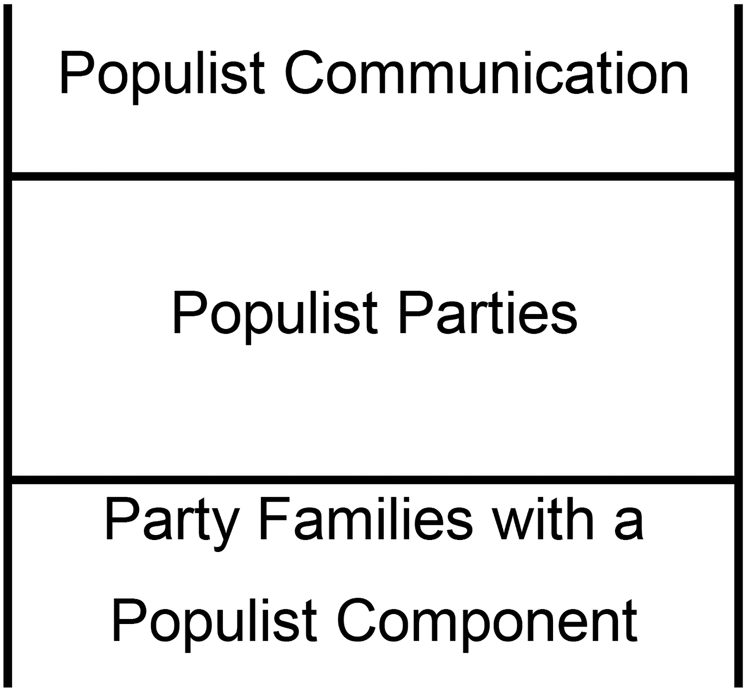
While the core concepts of the ideational approach highlight what constitutes populism, those concepts can manifest themselves in many forms. We may analyse populist rhetoric in party manifestos or presidential speeches, define parties as populist, and speak of a populist style when populist politicians wear clothes like ‘common people’. Stijn van Kessel (Reference van Kessel2014) conceptualized a ladder of abstraction of populist manifestations (see Figure 1), building on the work of Giovanni Sartori (Reference Sartori1970). In his illustration, populist communication is at the top of the ladder. Populist communication is present if the core elements of populism are combined in, for example, a speech. It has low intension (few properties) and high extension (applicable to many cases); it is, therefore, a ‘light’ Sartorian concept. ‘Populist party’ is a concept that balances extension and intension. A party may be defined as populist if it uses populist communication coherently over time. Nevertheless, there is a clear qualitative difference between populist and non-populist parties: The latter may use populist communication sporadically, while a populist party uses populist communication across time and space.
The Ladder of Abstractions of Populist Manifestations.
Source: Adapted from Van Kessel (Reference van Kessel2014).

In this article, we follow the argument that ‘populist communication’ (or its synonyms: ‘populist rhetoric’, ‘populist discourse’) is defined as the ‘discursive communication of populist ideas’ (de Vreese et al. Reference de Vreese2018: 425), which are composed of people-centrism and anti-elitism. However, only if both elements are present may we speak of ‘full’ populist communication.Footnote 1 While the policy effects of populist radical-right parties in government have already received scholarly attention (Akkerman et al. Reference Akkerman, de Lange and Rooduijn2016b), we focus on their populist communication. We expect that their usage of populist communication is dependent on strategic considerations, based on government perspective within its oppositional status. However, we believe that the changes are gradual – as populist parties, we expect that both parties use populist rhetoric regularly, and we expect their status as a populist party to be independent of the question of their status in government or opposition. This is at least the case for the two parties we are analysing; nevertheless, long-term developments (e.g. a decade of continuous government experience) may alter the classification of a populist party.
Populists in government and opposition: Revisiting the ‘inclusion–moderation thesis’
One particular way mainstream parties can deal with populists is to engage actively with them (Mudde and Rovira Kaltwasser Reference Mudde and Rovira Kaltwasser2017: 116). Such strategies can range from policy co-optation to active cooperation, for example in coalition governments (Downs Reference Downs2002: 38–40). There are different motivations behind such strategies. Engaging with populist arguments or populist actors can be seen as a symbolic act of recognition, which often acknowledges that exclusionary strategies, such as the cordon sanitaire, have not been successful. The success of populists typically indicates that these actors pose legitimate questions that those from the mainstream have ignored (Rovira Kaltwasser Reference Rovira Kaltwasser and Rovira Kaltwasser2017: 500). Some mainstream parties, therefore, find a co-optation strategy, namely moving in the direction of populist parties programmatically, tempting. However, empirically, the success of such strategies is doubtful (Krause et al. Reference Krause, Cohen and Abou-Chadi2023), as mainstream parties can alienate their core voters with radicalization (Chou et al. Reference Chou2021).
The strongest form of formal cooperation is governing together in a coalition. Mainstream parties can decide to form a government with populist parties for different reasons. One motivation can be to force a division within the populist challenger and create a radical and a moderate wing, and then to integrate the moderate forces (Rovira Kaltwasser Reference Rovira Kaltwasser and Rovira Kaltwasser2017: 498). This view is based on the assumption that populism is an advantage in opposition but becomes a disadvantage in government (Heinisch Reference Heinisch2003). Voters of populist parties can become dissatisfied with the compromises their party had to make in a coalition. A recent study showed that populist parties suffer electorally from governmental participation and that those losses are even stronger for radical populist parties (Riera and Pastor Reference Riera and Pastor2022). In the early 2000s in Austria, the FPÖ's first governmental participation resulted in the government's breakdown and the party splitting up (Duncan Reference Duncan2010). The FPÖ's most recent time in government did not last for the full term either and ended after only two years, with a series of scandals (Eberl et al. Reference Eberl, Huber and Plescia2020).
There is also the question of the effect of government participation on the populist party itself, a question that research has recently turned to. The inclusion–moderation thesis postulates that including radical parties in government could be a strategy to moderate their radicalism (Tepe Reference Tepe2019). The literature identifies two mechanisms behind inclusion–moderation (Akkerman et al. Reference Akkerman, de Lange, Rooduijn, Akkerman, de Lange and Rooduijn2016a: 3–4). Firstly, from the perspective of parties as vote maximizers, spatial competition focuses on the political centre. Therefore, including radical parties in the electoral competition can force them to become more centrist (Tepe Reference Tepe2019). Secondly, participating in government coalitions will pressure those parties to compromise and distance themselves from radical positions, highlighting the underlying ‘optimism’ of inclusion–moderation regarding the transformative power of democratic systems (Tepe Reference Tepe2019). One may add that the incentives to moderate are much stronger in coalition agreements compared to single-party governments, where populist parties need to make few compromises (Kriesi Reference Kriesi2018: 20).
Research has focused on potential moderation effects: (a) regarding (primary and secondary) policy issues (the ‘thick’ ideology), and (b) regarding populist communication (the ‘thin’ ideology; see Capaul and Ewert Reference Capaul and Ewert2021: 783). One of the main conclusions from the seminal work of Tjitske Akkerman (Reference Akkerman, Akkerman, de Lange and Rooduijn2016a), which summarizes the findings for nine West European case studies, including our two cases (Akkerman Reference Akkerman, Akkerman, de Lange and Rooduijn2016b; Mazzoleni Reference Mazzoleni, Akkerman, de Lange and Rooduijn2016), is that moderation regarding programmatic positions rarely occurs. This is confirmed by Raphael Capaul and Christian Ewert (Reference Capaul and Ewert2021) regarding core policies of the radical right. In contrast, a populist communicational moderation strategy may be easier to implement compared to a policy change regarding key issues, since voters may punish a shift regarding a secondary aspect of the party's ideology less severely (Capaul and Ewert Reference Capaul and Ewert2021: 783).
The empirical evidence for inclusion–moderation in terms of populist communication, on the other hand, is mixed (Capaul and Ewert Reference Capaul and Ewert2021). Findings from cross-national studies typically report no such evidence. Jakob Schwörer (Reference Schwörer2021) analysed this question by focusing on Facebook communication by four populist parties (the FPÖ, the Italian Five Star Movement, Spain's Podemos and the New Zealand First (NZF) party). Although some of these parties used specific elements less frequently while in power, there was no universal trend for all parties. For the FPÖ, Schwörer contrasted the government phase with the prior oppositional phase but found relatively similar patterns for both phases. Matthijs Rooduijn and Tjitske Akkerman (Reference Rooduijn and Akkerman2017) reported that governing parties are not significantly less likely to use populist rhetoric in their manifestos (see also Rooduijn et al. Reference Rooduijn, de Lange and van der Brug2014, n. 16). Magdalena Breyer (Reference Breyer2023), on the other hand, reports the opposite for oppositional parties in German-speaking countries, focusing on parliamentary speeches. In contrast, results from individual cases in Switzerland, Italy and Germany suggest that populist parties become more moderate in power. Giuliano Bobba and Duncan McDonnell (Reference Bobba and McDonnell2016) found that populist communication by Forza Italia and Lega Nord (now Lega) decreased after they formed a coalition government in 2008 and increased again after they returned to opposition. Jan Philipp Thomeczek (Reference Thomeczek2025) shows that regional branches of German left-wing populist Die Linke are more populist where they are in opposition, compared to those in government. At the Swiss regional level, Laurent Bernhard (Reference Bernhard2020) showed that the Geneva Citizens' Movement, a regional right-wing populist party, used more populist discourse during its time in opposition than during its early phase in office.
We identify three shortcomings of the current literature. Firstly, we believe that the inconclusive findings stem from the fact that they come from at least two different perspectives. The first perspective is on populist communication and analyses whether it is more prevalent among oppositional parties, compared to governing parties (Breyer Reference Breyer2023; Rooduijn et al. Reference Rooduijn, de Lange and van der Brug2014; Rooduijn and Akkerman Reference Rooduijn and Akkerman2017). The second perspective aims to track the changes in populist communication within a certain populist party (Bernhard Reference Bernhard2020; Bobba and McDonnell Reference Bobba and McDonnell2016; Schwörer Reference Schwörer2021; Thomeczek Reference Thomeczek2025). This perspective rather asks if populist parties, instead of parties in general, are more populist in opposition than in their phase in government. We believe that this second perspective is more relevant and that it should be analysed with a focus on populist parties only, as they use populist communication more often, compared to mainstream parties, which may use populist communication only rarely. Therefore, the analysis of populist communication focuses on the variation of something that occurs rather rarely in the first place.
Secondly, some of the contradicting results may stem from different analytical time perspectives (Capaul and Ewert Reference Capaul and Ewert2021: 782). Focusing on broader periods can help us to identify causal effects which have not been addressed so far. This is especially problematic for comparative analyses: the group of populist parties in government may be less populist than those in opposition simply because they were always less radical. By analysing a broad period that covers the time when the government status of a party changed as well as the period before and after this phase, we can analyse the point in time when moderation starts.
Finally, as also implied by Capaul and Ewert (Reference Capaul and Ewert2021: 793), we believe that a dichotomous distinction between phases of government and opposition can be misleading. If we expect changes in populist communication connected to populist parties taking power, we would not expect that populist communication is decreased on the first day of government, but that the change would have begun earlier, namely when a government perspective became realistic. Populist parties need to present themselves as trustworthy coalition partners before taking power, and therefore moderation is also a precondition and not only an effect of joining government (which could, in addition, also be observed).
This leads us to our hypothesis. We do not expect to find clear evidence for the ‘classic’ inclusion–moderation thesis. Indeed, the state of the art is quite mixed, and our reflections on the theoretical foundations lead us to expect more fine-grained differences. We argue that the incentive of populist parties to moderate their populist communication hinges on the existence of credible prospects of joining government. While such credible prospects are the result of various factors, the possibility of populist parties to govern typically also depends on other parties (e.g. potential coalition partners) in most parliamentary liberal democracies. Therefore, (successful) rhetorical moderation needs to start before joining government. Populist parties must persuade potential coalition partners and (more moderate) voters that they are trustworthy and willing to tone down their radical rhetoric. This phase of moderation starts while in opposition, but only when the party sees a realistic government option. Therefore, we propose the following hypothesis:
Hypothesis 1: Radical-right populist parties in opposition reduce their level of populist communication when they have credible government prospects.
Generally, we expect our hypothesis to be valid for all populist parties, not only radical-right populist parties. However, since our two case studies are both radical-right populist parties, we formulate this hypothesis for this specific party family.
Radical-right populist parties and their incentive to join government: The cases of the FPÖ and the SVP
Our empirical analysis focuses on two populist radical-right parties, which offer ideal conditions to test our hypotheses: the FPÖ and the SVP. The two selected parties share several features. Both parties were ‘born’ in strong consensus-democratic settings (Lijphart Reference Lijphart1999). Most fundamentally, both have experienced a radicalization under charismatic leaders in the last decades and have successfully adopted a populist strategy that pits the people against established elites by emphasizing the issues of national identity, immigration, crime and European integration (Albertazzi and McDonnell Reference Albertazzi and McDonnell2015). While different party strategies exist, we identify another important precondition for analysis, namely that both parties followed an office-seeking strategy (Strom Reference Strom1990). Furthermore, both parties have government experience, which indicates that mainstream parties are generally willing to cooperate with the populist radical right. As a consequence of their governing practices, both parties have also experienced splits (see below). Yet the FPÖ and the SVP differ when it comes to their likelihood of entering government, making them two most-different cases in this regard. While the latter stands for a quasi-permanent government party, the FPÖ has, so far, only governed three times in Austrian history. Nevertheless, during our analysed time periods, party officials have underlined that they employ office-seeking and voiced the intention to join (FPÖ) or return to (SVP) government (OE24.at 2017; SVP 2008a). Before we outline the trajectories of the FPÖ and the SVP in the next section, we would like to highlight that the conditions outlined above are specific configurations and preconditions to observe moderation when populist parties have government prospects. Parties such as the German Alternative for Germany (AfD) or Spanish Vox are subject to a cordon sanitaire strategy (Downs Reference Downs2002) by mainstream parties. In the absence of mainstream coalition parties, those parties would not face any incentive to moderate for government and are better characterized as vote- and policy-seeking parties.
The FPÖ, founded in 1956, was initially dominated by Nazi sympathizers, German nationalists and libertarians, meaning that it played a marginal role in Austrian politics in its early phase as a politically isolated ‘ghetto party’ (Luther Reference Luther and Dachs1991). It was only in the late 1960s and early 1970s that it became more acceptable and considered a potential coalition partner for both the Social Democrats (SPÖ) and Conservatives (ÖVP), as its liberal wing grew stronger. In 1970, the party supported an SPÖ minority government and in 1983 it even entered government as a junior partner of the Social Democrats. However, this experience in office exacerbated the conflict between the liberal and the nationalist wing. At the 1986 Convention, the latter succeeded in getting the young and charismatic Jörg Haider elected as party leader, an event that marked the end of the government coalition between the SPÖ and FPÖ.
Over the following years, Haider transformed the FPÖ from a libertarian-nationalist party into a right-wing populist protest party (Heinisch and Hauser Reference Heinisch, Hauser, Decker, Henningsen and Jakobsen2014), thereby decisively managing to expand its support base. Invariably the third party from 1956 to 1983 with vote shares ranging from only 5.0% to 7.7%, the party's electoral rise took off in 1986 (9.7%) and peaked in 1999 (26.9%) when the party came second for the first time in its history. The spectacular ascent of the FPÖ transformed the duopoly of the SPÖ and the ÖVP into a party system characterized by three parties of roughly equal size, of which two are typically needed to form a government (Hafez and Heinisch Reference Hafez, Heinisch, Bernhard, Betz and Biard2019). Despite protests at both the national and the international level, the ÖVP agreed to govern with the FPÖ in 2000, a coalition that eventually lasted until 2007 (even though Haider and numerous cabinet members left the FPÖ in 2005 to form the oppositional Alliance for the Future of Austria, BZÖ).
After a period of so-called ‘grand coalitions’ between the SPÖ and the ÖVP, the FPÖ's most recent experience in government started in 2017. Under the leadership of Heinz-Christian Strache, the party again formed a coalition with the ÖVP. In the 2017 legislative elections, the FPÖ managed to achieve its second-best result ever, winning 26.0% of the vote. The election campaign was dominated by immigration issues, where the ÖVP challenged the FPÖ regarding its issue ownership (Bodlos and Plescia Reference Bodlos and Plescia2018). This suggests that the ÖVP moved programmatically towards the FPÖ. While the results of the Chapel Hill Expert Survey from 1999 to 2019 (Jolly et al. Reference Jolly2022) suggest little movement of the two parties regarding cultural green-alternative-libertarian–traditional-authoritarian-nationalist (GAL–TAN) issues between 2014 and 2019 (see Figure A1 in the Supplementary Material), the parties were in fact closer programmatically in 1999, one year before they formed their first coalition government. Thus, while we should recognize the ÖVP's strategy to adopt more anti-immigration stances and to ‘steal’ this issue from the FPÖ, it should be noted that both shortly before (2014) and after (2019) its latest time in power, the FPÖ was considered a classic far-right (populist) party, while the ÖVP is neither populist nor far right (Rooduijn et al. Reference Rooduijn2023).
After the 2017 elections, negotiations between the FPÖ and ÖVP, which attained 31.5%, took almost two months. The coalition programme was presented on 16 December and the swearing-in of the new government led by Sebastian Kurz (ÖVP) occurred two days later. Yet the coalition collapsed in May 2019 due to ‘Ibizagate’, a scandal that involved Strache (Eberl et al. Reference Eberl, Huber and Plescia2020). On 17 May, two German media outlets published a video filmed in July 2017 that showed Strache in Ibiza (Spain) trying to convince a Russian woman (reportedly a niece of an oligarch) to buy the Kronen Zeitung, a tabloid with the highest newspaper circulation in Austria. In return for benevolent reporting and payments to his party, Strache suggested that he could offer public contracts once the FPÖ entered government. On 27 May, the cabinet was ousted from office as a result of a vote of no confidence. In the subsequent snap election held in September, the FPÖ's electoral performance went down to 16.2%. The party had to settle for the opposition benches again, since the ÖVP decided to form a coalition with the Greens.
The development of the SVP has some parallels with the FPÖ's development, but there are also fundamental differences. Founded in 1971, basically as a successor to the Party of Farmers, Traders and Independents (BGB), the SVP was a party from the moderate right in its early years. It primarily represented the interests of small business owners and farmers in the Protestant areas of the German-speaking part of Switzerland. At the national level, the party underwent radicalization in the 1980s and 1990s. This process occurred under the decisive influence of the so-called ‘Zurich wing’ led by Christoph Blocher, its charismatic leader (Kriesi et al. Reference Kriesi, Lachat, Selb, Bornschier and Helbling2005). The party focused on the core issues of the populist radical right by immediately and relentlessly resorting to provocative campaigns against the government and mainstream parties. This strategy paid off in electoral terms. Indeed, the SVP's vote share increased continuously from 1987 (11.0%) to 2007 (29.0%), thereby becoming Switzerland's strongest party.
Among the radical right in Western Europe, the SVP represents the paradigmatic case of a long-serving government party (Bernhard et al. Reference Bernhard, Biancalana, Mazzoleni, Albertazzi and Vampa2021; Mazzoleni and Skenderovic Reference Mazzoleni, Skenderovic and Delwit2007). Since its founding, the party was only in opposition (i.e. not part of the federal government) for a short period between December 2007 and December 2008. Due to the principle of concordance – according to which the largest parties are represented in the Federal Council according to their electoral strength – its radicalization did not prevent it from being part of the seven-member cabinet. Quite to the contrary, as a result of its rise the party managed to obtain a second government seat at the expense of the shrinking Christian Democrats after the 2003 federal elections. Under the so-called ‘magic formula’, an informal elite arrangement established in 1959, the SVP (and its predecessor organization) had only one representative, while the Liberals, the Christian Democrats and the Social Democrats were granted two seats each. By threatening to go into opposition the SVP imposed Blocher as a new government member with the new term starting in 2004 (Church Reference Church2004).
Four years later and even though the SVP emerged as the big winner from the 2007 federal elections, a centre-left coalition ejected Blocher from the Federal Council. A small majority of MPs concluded that he could not be ‘domesticated’ via government participation (Church Reference Church2008). On 12 December, the parliament replaced Blocher with Eveline Widmer-Schlumpf, a moderate party member. Due to the ousting of its leader, the SVP did not accept Widmer-Schlumpf as a party representative in the Federal Council. As a reaction to her exclusion from the SVP's parliamentary group, some members of the moderate wing split from the party and founded the Conservative Democratic Party (BDP). The latter supported not only Widmer-Schlumpf but also Samuel Schmid, the other moderate government member elected under the banner of the SVP. The main result of these dramatic events by Swiss standards was that the SVP found itself in opposition for the first time in its history.Footnote 2 Yet this status only lasted 12 months, as Schmid was forced to resign for health reasons. On 10 December 2008, Parliament replaced him with Ueli Maurer, an intimate of Blocher.
To summarize, the development of the FPÖ and SVP was somewhat similar: it was characterized by radicalization in the 1980s and relatively early government experiences. We recognize the latter as a feature they share with some other radical-right parties, such as Italian Lega, but it distinguishes them from many other European counterparts such as the German AfD, Dutch Forum for Democracy, French Rassemblement National and Spanish Vox, which have never been in government. However, the periods of interest are the rather non-typical phases: the transition of the SVP from government to opposition (and back) in 2007/2008 and the transition of the FPÖ from opposition to government (and back) from 2017 to 2019. Regarding our hypothesis, the question is, when did the two parties have government prospects while in opposition? In Austria, the ÖVP announced snap elections on 15 May 2017. At that time, the FPÖ was leading the polls with around 30% of the votes. During the campaign, the ÖVP overtook the FPÖ and took first place (Bodlos and Plescia Reference Bodlos and Plescia2018: 1355).
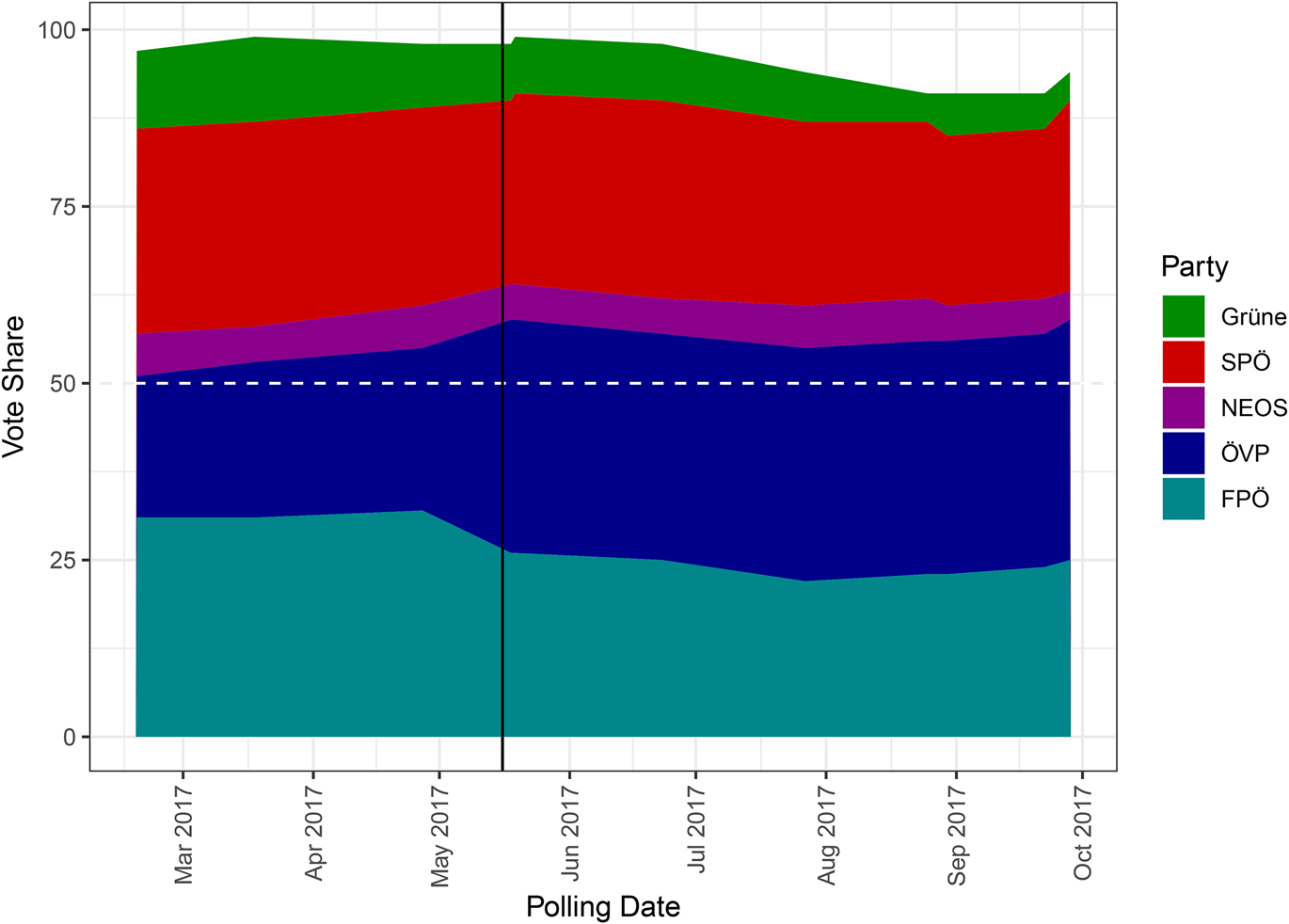
Although the FPÖ eventually only received the third most votes, falling behind the SPÖ (26.9%) marginally with 26% of the votes, pollsters predicted a comfortable majority for a potential ÖVP/FPÖ coalition throughout the whole campaign, as displayed in Figure 2. During the campaign, ÖVP leader Sebastian Kurz had already voiced his intention to govern with the FPÖ; another coalition between the ÖVP and SPÖ was deemed unlikely, as the current government ended in disagreement (Die Welt 2017). According to Norbert Hofer, FPÖ vice chairman and author of the 2017 manifesto, an agreement between the FPÖ and ÖVP ‘could be reached swiftly’ (OE24.at 2017). Thus, when the snap elections were announced on 15 May (Reuters 2017), the FPÖ was confronted with a realistic government perspective, and, according to the polls, this perspective was given throughout the whole campaign. This stands in contrast to the 2013 campaign, when such a coalition did not have a majority. We argue that the announcement of the snap elections is the point when the FPÖ had incentives to moderate its populist rhetoric to appear as a trustworthy government partner, which marks the start of the phase when it had government perspective.
Development of Austrian Polls during Campaign (2017).
Source: Unique Research Polling Institute.

In the case of the SVP, the government perspective suddenly opened up in autumn 2008 when the party had been in formal opposition for about nine months. On 24 September the National Council (the lower house) rejected the 2008 federal armament programme. This surprising decision came about as a rather exceptional ‘unholy alliance’ between the radical right (especially the SVP) and the left (mostly Social Democrats and Greens). Due to this setback for the Swiss armed forces, rumours arose about the possible resignation of Schmid. Although a large majority of the Council of States had supported the armament programme a few days earlier – rendering likely a so-called ‘agreement conference’ between MPs of the two councils to find a compromise solution – Swiss political pundits thought that Schmid was politically tarnished (Strebel Reference Strebel2008). His statement, according to which he did not intend to resign, ‘at least for the time being’, did not sound very reassuring (Swissinfo.ch 2008). On 30 September the SVP's parliamentary group announced that it would reclaim a seat in government if there was a vacancy. At the beginning of November, Schmid had to undergo gallbladder surgery. Shortly afterwards, on 12 November, he announced his resignation from the Federal Council as of the end of 2008.
Data and measurements
In this analysis, we focus on populist communication in press releases. Of the various text types of political parties, press releases allow parties to react flexibly and rapidly to political developments. This enables them to be flexible regarding tonality and issue coverage (Norris et al. Reference Norris1999). Other frequently used text types in political communication research are manifestos and social media. They are not suitable for the analysis of our research question. Social media party profiles such as Facebook did not exist when the SVP was in opposition in 2008 (its Facebook page was created in 2012). Since manifestos are published during election campaigns, there was no ‘new’ manifesto when the SVP went back to power, as this did not happen following a general election. Testing our hypothesis using press releases could come with a disadvantage that we may not observe de facto moderation (Capaul and Ewert Reference Capaul and Ewert2021: 786), which could happen ‘quietly’ in the background – for example at the level of party members (although social media data and manifestos would suffer from the same problem). This could be a potential downside, as we may not be able to identify moderation that happened outside public communication.
This analysis focuses on a manually coded dataset of 1,048 FPÖ and SVP press releases. We focused on press releases sent out by the national branch. Regarding the SVP, we focused on its phase in opposition, which lasted from 12 December 2007 to 1 January 2009, the phase 1.5 years before going into opposition and the phase 1.5 years after its return to government. We included all press releases sent out during its phase in opposition (n = 159), and a large sample of roughly equal size from the two other phases (pre-oppositional phase: 162 out of 189, post-oppositional phase: 159 out of 235). Press releases were collected using WebScraper.Footnote 3 For the FPÖ, we proceeded similarly, focusing on its time in government from 18 December 2017 to 3 June 2019. Since the FPÖ was much more active in terms of press releases, we were only able to code a subset of press releases. Our goal was to have a sample of roughly the same size as for the SVP. We randomly selected 159 (out of 1,141) press releases while the FPÖ was in government, 209 (out of 1,569) from the 1.5 years before it was in office and 201 (out of 2,525) from the 1.5 years after it left government.Footnote 4 Since the FPÖ was much more active regarding press release frequency, our sample includes around 11% of all FPÖ press releases, but around 83% of all SVP press releases.
We measure populist communication using manual content analysis, following the approach of previous other studies (e.g. Bernhard Reference Bernhard2020; Bracciale and Martella Reference Bracciale and Martella2017; Schwörer Reference Schwörer2021). We identified three variables related to populism, derived from the ideational definition: (1) appraisal of the people; (2) references to popular sovereignty/the power of the people; and (3) criticism of the elite/establishment (see codebook in the Supplementary Material). In addition, the texts were coded for their main issue.Footnote 5 For our analysis, we identified two core issues that are related to right-wing populist parties. Those are the European Union and immigration, which are core issues of the populist radical right (Biard and Bernhard Reference Biard, Bernhard, Bernhard, Betz and Biard2019: 2) related to their far-right ideology (Mudde Reference Mudde2007). Furthermore, we also coded for references to a particular ongoing or planned referendum/initiative campaign, which is strongly instrumentalized by the SVP and often combined with populist rhetoric (Honsel Reference Honsel2018).Footnote 6 All variables were binarized for the analysis.
The coder was trained in four iterative rounds consisting of 20 texts each, with reliability checks after each round. The final round of reliability shows satisfying results, with all variables passing the 0.7 threshold for Gwet's AC1, a chance-corrected reliability coefficient that takes the marginal probability into account (Gwet Reference Gwet2014), which is useful for checking the reliability of events with comparatively low trait prevalence such as populism (Habersack and Werner Reference Habersack and Werner2022). Since populist communication is highly context-specific, we decided to measure populist communication on the document level as opposed to the level of quasi-sentences, as proposed by the Manifesto Project. Following up on the recent academic discussion on the formation of populism indices (Bernhard and Chueri Reference Bernhard and Chueri2024), we focus on two different conceptualizations of populism. As discussed above, we define populism as a combination of people-centrism and anti-elitism, which represents the lowest common denominator among scholars of the ideational approach. Firstly, building on a conditional logic, we formed a measure of ‘full populism’ if both core dimensions were addressed in a text. We define people-centrism as an appraisal of the people and/or reference to popular sovereignty and anti-elitism as a critical portrayal of the elite/establishment. Secondly, we constructed an additive measure that counts how many of our three variables were identified in a given text.
The following example from a press release by the SVP demonstrates the coding process (SVP 2008b). In this text, the SVP strongly attacks a report by the United Nations (UN) which criticizes xenophobia in Switzerland. There are several references to anti-elitism: the SVP criticizes the UN as a whole, but also warns the ‘federal council, career diplomats and do-gooders from the administration’ to criticize internal politics of other foreign countries. The report would stigmatize ‘the Swiss people’ as a whole (people-centrism) as xenophobic. The SVP asks rhetorically if Switzerland should accept this, as the country is ‘a haven of direct democracy’ (popular sovereignty).
Regarding our independent variable and in line with the literature on the inclusion–moderation thesis, we will first compare the phases in opposition of the two parties with their phases in government. Next, we will draw on a more fine-grained distinction within these phases, to track changes in populist communication in as much detail as possible. We will continue with a first descriptive presentation of our analytical results and then test these results in a more complex multivariate perspective.
Empirical analysis
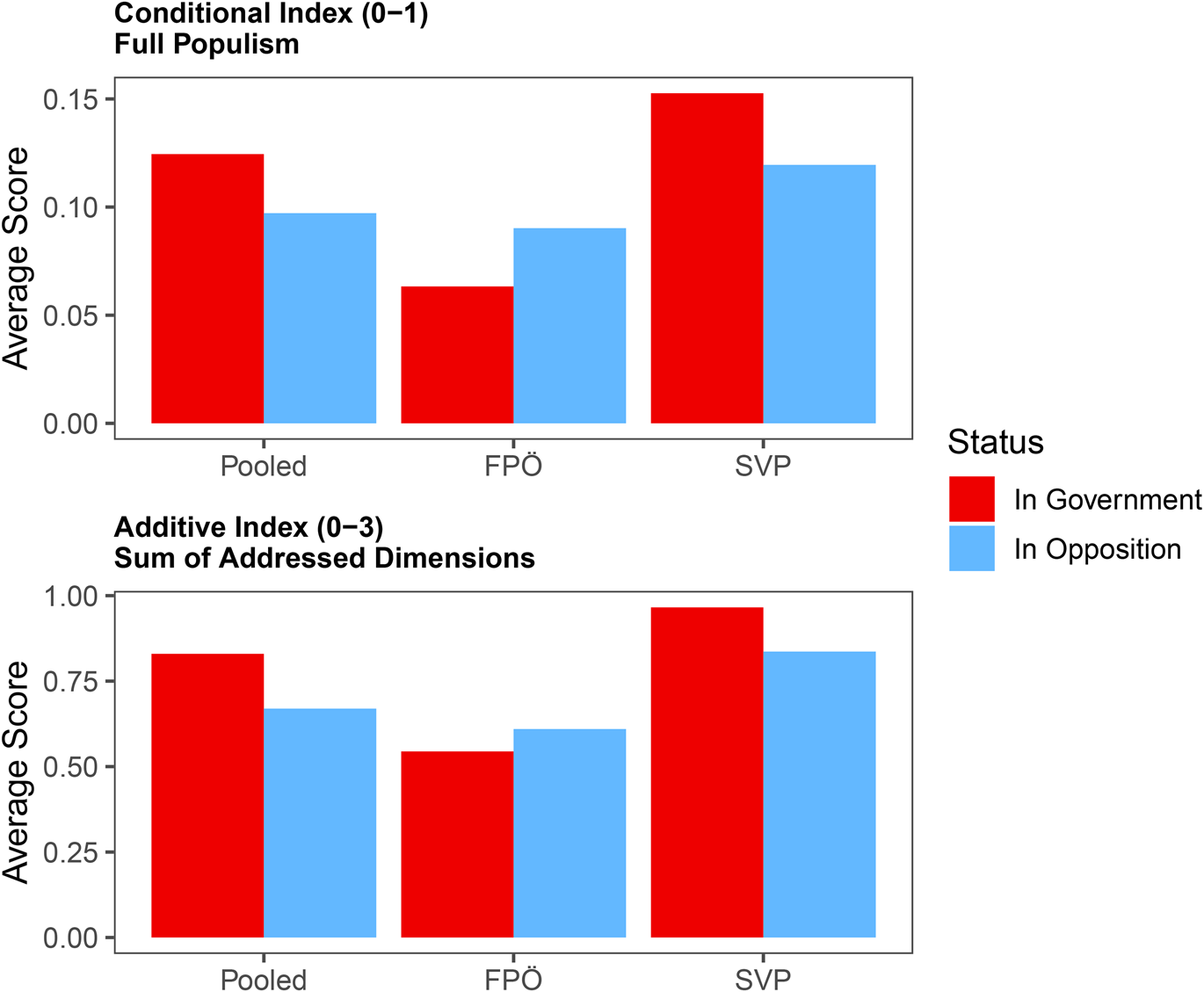
We start our analysis with an overview of the phases of government and opposition. The two plots in Figure 3 contain the average index scores for the pooled dataset, and the two individual scores for the parties. Both plots show that the two parties under scrutiny follow a diverging pattern. While the scores for the FPÖ indicate that the party was slightly less populist in government and more populist in opposition, the opposite seems to be the case for the SVP. Another visible pattern is that the values for the SVP are all higher compared to the FPÖ, indicating the SVP generally includes populist communication more frequently in its press releases. This could be connected to the fact that the Swiss political system offers more opportunities for populist rhetoric, which is why some have described Switzerland as a ‘populist paradise’ (Albertazzi Reference Albertazzi, Albertazzi and McDonnell2008). For the government phase of the SVP, the additive index reaches almost 1, indicating that the party includes, on average, one populist element in its press releases. Overall, differences are larger for the conditional index.
Usage of Populist Communication by Status (Government/Opposition).

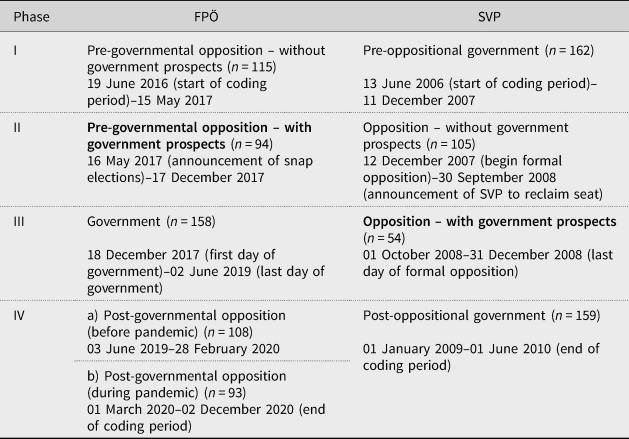
As expected, looking at the differences between phases of government and opposition does not provide us with clear evidence. One of the reasons could be that the dynamics within the phases are more complex and could cancel each other out during aggregation. This could also be the reason why previous studies found contradicting evidence for the inclusion–moderation thesis. In addition, the aggregated phases are hard to compare between the two parties. For the SVP, the government phase, which denotes its typical status, includes both the time before and after the party was in opposition, which was quite an exceptional phase for the party. The opposition phases of the FPÖ aggregate both the time before and after the party was in power. It could be that the SVP's post-oppositional government phase follows other dynamics than the pre-oppositional government phase. Likewise, the oppositional phase of the FPÖ consists of two different phases, namely the pre-government and the post-government oppositional phase. Therefore, we proceed by aggregating the results per party in four individual phases. These phases are summarized in Table 1. Within the pre-governmental oppositional phase, we expect that the parties became only more moderate when they had a realistic government perspective, as outlined above. As the post-government opposition for the FPÖ also covers the first year of the COVID-19 pandemic, an external shock that could have impacted populism, we further differentiate within this phase.
Overview of Four Analysed Phases of the SVP and FPÖ

Note: Phases where moderation is expected are in bold.
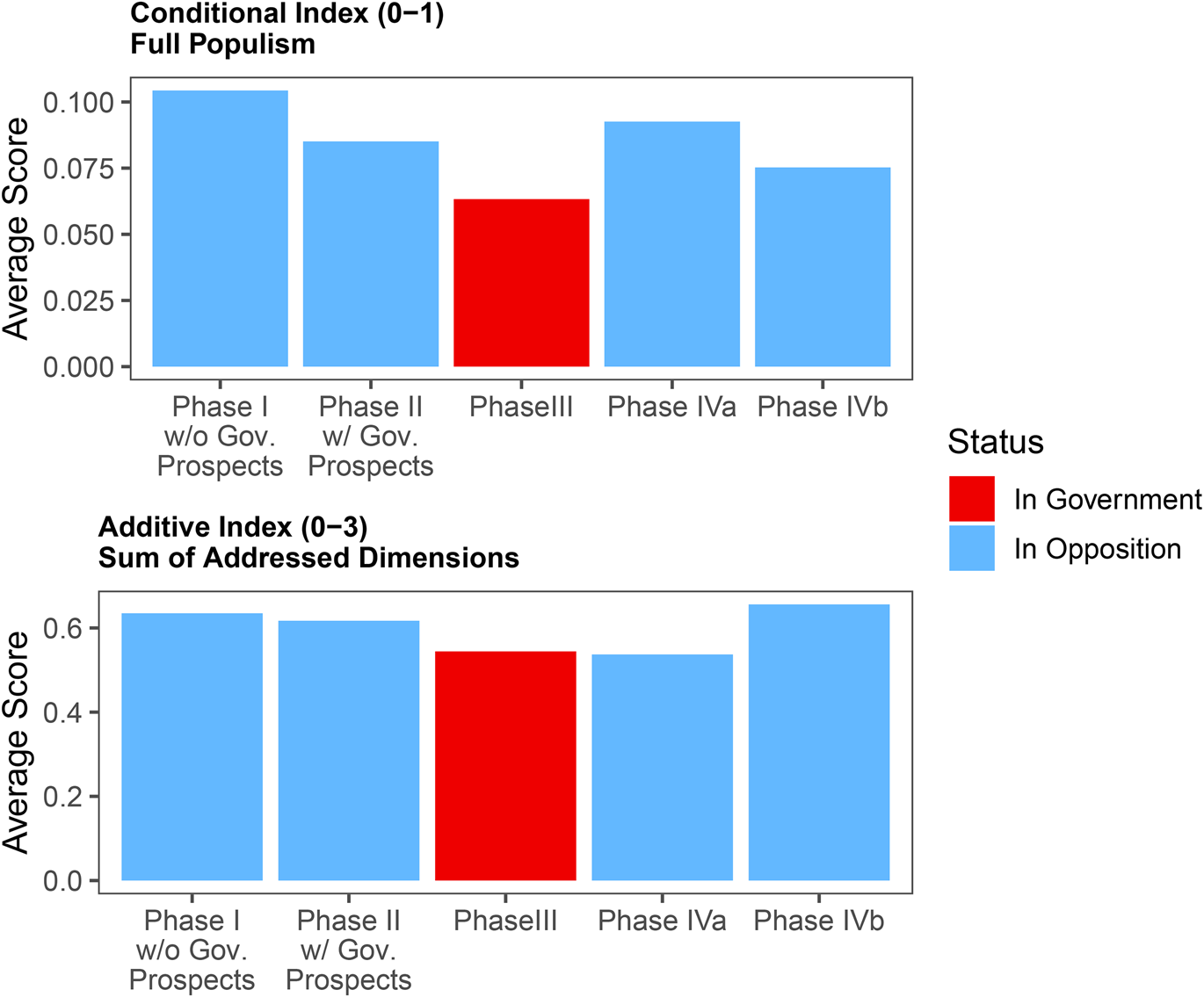
The results for the FPÖ are displayed in Figure 4. Looking at the conditional and additive index, we see stronger differences for the conditional index. The plots suggest that the FPÖ became less populist before joining the government and reached its lowest point during its phase in government. After quitting the government, the conditional index suggests that the party used more full populist communication, which dropped again with the beginning of the pandemic. The additive index implies the opposite. A closer look at the individual variables reveals that references to people-centrism increased strongly from Phase IVa to Phase IVb (from 0.32 to 0.53), while the average score of anti-elitism dropped (from 0.19 to 0.12). Overall, the results of the FPÖ indicate that the party indeed became less populist in opposition when it had government prospects, which was the phase before taking power. However, the differences are clearer when looking at the conditional index and are rather small regarding the additive index.
Usage of Populist Communication by Status (FPÖ, Four Phases).

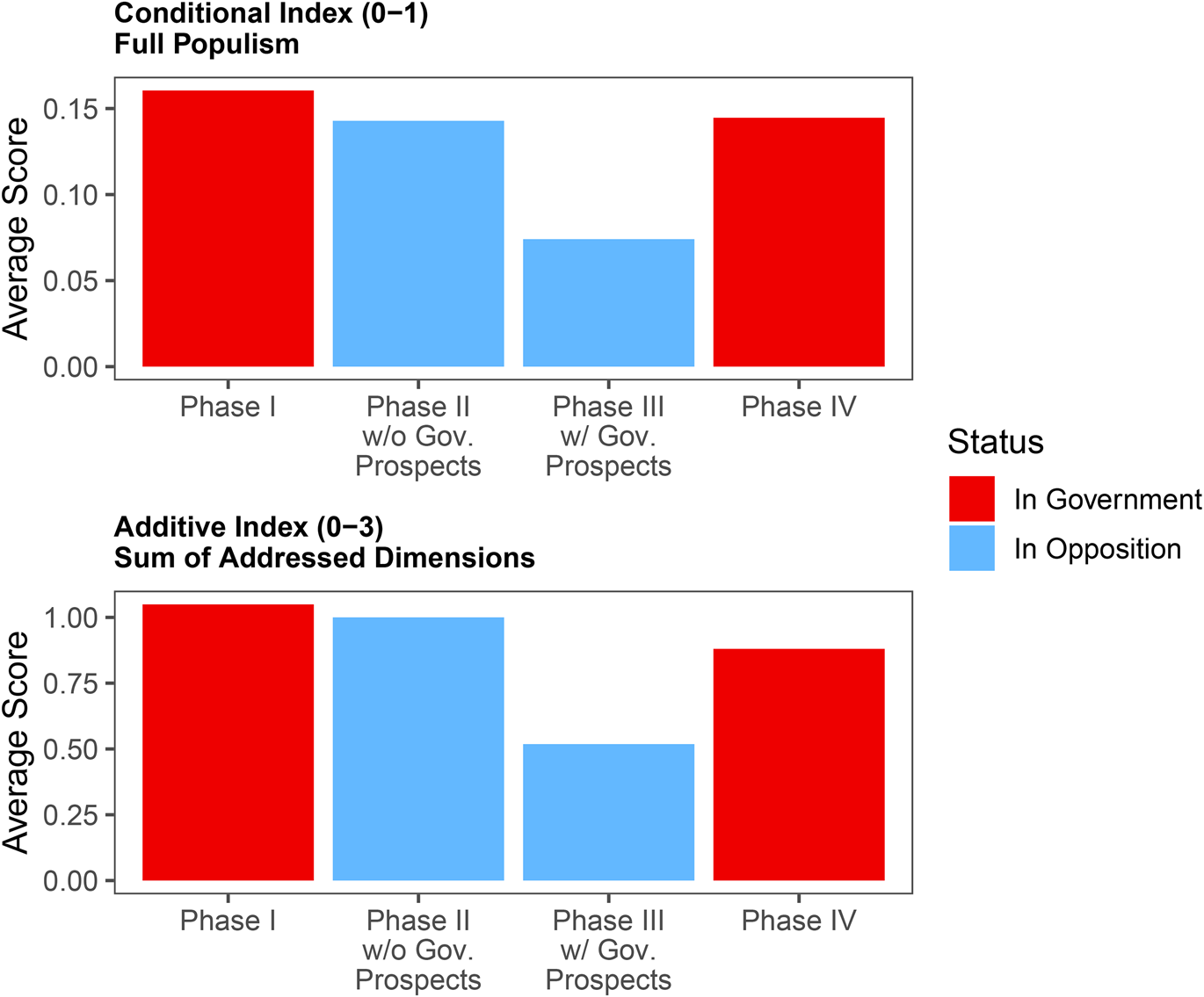
We proceed with the results for the SVP, which are summarized in Figure 5. Here, the overall picture is much clearer. Both populism indices point in the same direction. The SVP used populist communication regularly in government and slightly decreased its populist rhetoric in the first opposition phase. In the second opposition phase, when it saw the opportunity to rejoin the government, the party used populist communication much less frequently compared to the initial opposition phase. Back in government, the party used populist communication more frequently again, although the overall level was somewhat lower compared to the first government phase, which could be interpreted as another sign of moderation.
Usage of Populist Communication by Status (SVP, Four Phases).

What can we conclude from the descriptive analysis? Comparing the phases in government and opposition suggests opposing patterns: while the SVP used populist communication more frequently in government than in opposition, the opposite was the case for the FPÖ. Grouping these phases in four periods (five for the FPÖ due to the pandemic) allows a more fine-grained analysis. Here, the results suggest that both parties became less populist in opposition when they saw the opportunity to govern, although this is much clearer for the SVP than the FPÖ.
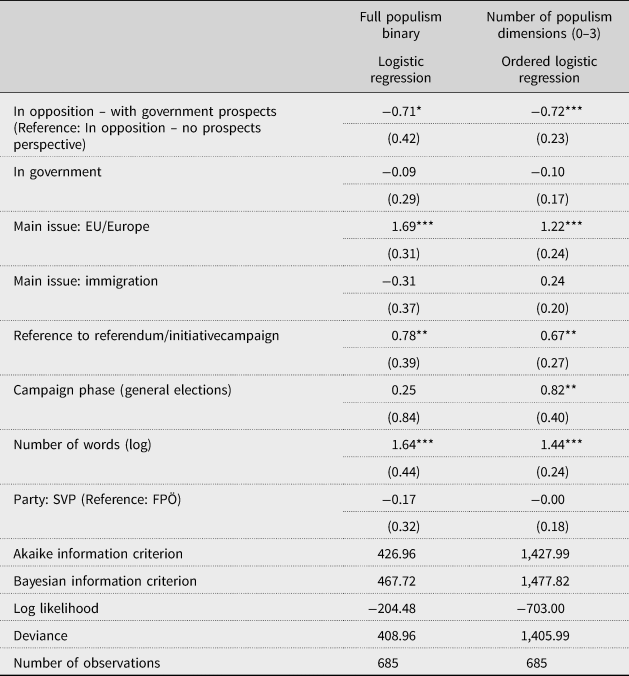
To test whether these differences are statistically significant, we ran multivariate models that also control for other factors. We start with a pooled model that includes both parties. To make the phases for both parties comparable, we restrict this pooled dataset to three phases: the first oppositional phase before taking power without government prospects, the second oppositional phase before taking power where both parties had government prospects and the following phase in government. Besides the mentioned issue-related variable (EU, immigration, referendums), we control for text length, which is likely to be positively correlated with the likelihood of using populist rhetoric (Bonikowski and Gidron Reference Bonikowski and Gidron2016) and general election campaigns (phase six weeks before election days), which could also be a confounder (Schmuck and Hameleers Reference Schmuck and Hameleers2020). Furthermore, we control for party, as the SVP tends to use more populist rhetoric. We ran two logit regressions for the full populism conditional index and an ordered logit regression for the additive index. The results are summarized in Table 2.
Regression Models for Pooled Dataset

Notes: *** p < 0.01; ** p < 0.05; * p < 0.1.
Compared to the oppositional phase without government prospects, the coefficients for the oppositional phase with government prospects are negative and statistically significant in both models. This means that there is evidence that the two parties used populist rhetoric less frequently (no matter how this is operationalized) when they saw the opportunity to join the government.
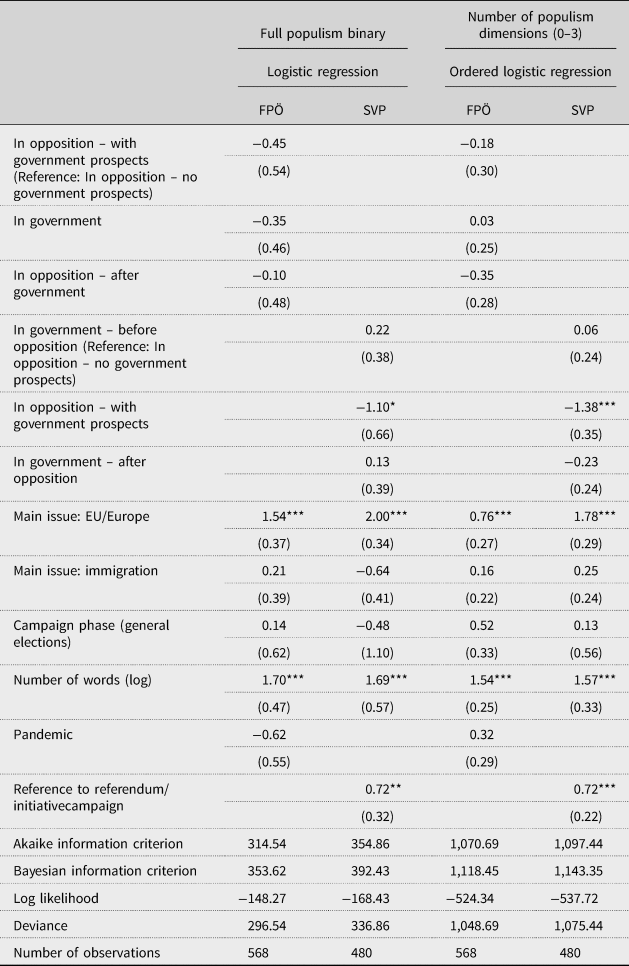
We then ran these models again for the two individual party datasets, using the individual four-phase classification. For the FPÖ, we removed the referendum/initiative variable, because this issue was only addressed once by the party. We also added a pandemic dummy, which denotes if an FPÖ press release was published after 1 March 2020, which should control for pandemic-related effects on populism. The results are summarized in Table 3. In both models, we used the oppositional phase without government prospects as a reference for the four-phases variable. The effect is significant in both SVP models compared to the phase in opposition with government prospects. Thus, the SVP used significantly less populist rhetoric in opposition when it had an opportunity to rejoin the government, compared to the previous oppositional phase without government prospects. By contrast, we do not find any significant result for the FPÖ. The expected difference is most likely to be visible for the full populism conditional index, as we saw in Figure 4. Although the estimated coefficient points in the same (negative) direction as for the SVP, the standard errors are too large to tell if this difference is different from 0 (i.e. statistically significant). The same applies to the FPÖ's phase in government.
Regression Models for Individual Party Dataset

Notes: *** p < 0.01; ** p < 0.05; * p < 0.1.
Conclusion
In recent years, academic work has focused on the inclusion–moderation thesis, which postulates that governmental participation has a moderating effect on populist parties. This leads to the expectation that moderation is also reflected in populist rhetoric, which should decrease in government. While previous studies have failed to report coherent effects, we have addressed the shortcomings of this literature. Rather than focusing only on the dichotomy between government and opposition, we have proposed a more nuanced framework. We have argued that populist rhetoric is unlikely to be decreased when a given populist party joins government. Rather, we expect that parties from the radical right anticipate government participation and adapt their strategic communication accordingly. Hence, we posit that moderation occurs before these parties are in office. Yet, merely aggregating phases of government and opposition can easily mask such differences (Capaul and Ewert Reference Capaul and Ewert2021). Therefore, we suggest that phases in government and opposition should be analysed more carefully, as effects can cancel each other out. Our focus was on the oppositional phase. We argued that populist parties moderate in opposition when they see an opportunity to join government. We analyse this hypothesis using two most different cases: the SVP, which typically governs and was only in formal opposition once, and the FPÖ, a typical populist radical-right oppositional party, which recently joined an Austrian government for the third time. Both parties also fulfil important conditions for our analysis: they both voiced intentions to govern with others parties (i.e. followed an office-seeking strategy) and already had potential mainstream coalition partners.
We present evidence that right-wing populist parties decrease their populist rhetoric when they have an opportunity to join government. Running the models for the two individual parties, we find robust evidence for such an effect regarding the SVP. During the party's phase in opposition, the party showed strong signs of moderation when a Swiss government member announced plans to step down, which presented the party with an opportunity to rejoin the government. For the FPÖ, the findings turned out to be less straightforward. Overall, the differences between the phases were smaller compared to the SVP, and the results were also relatively dependent on the operationalization of populism. Therefore, we cannot report any robust effects for the FPÖ.
At first, these results are somewhat surprising, given that in the traditional oversized Swiss coalitions there are fewer incentives for moderation. Therefore, the SVP can be considered a ‘hard case’ for testing our hypothesis. We nevertheless find evidence for our hypothesis, whereas the situation is more complex in Austria, the seemingly more straightforward case. However, on the other hand, the SVP essentially needed to reach out to more ideologically distant parties (especially to the crucial ones placed in the political centre) in the elections to the Federal Council than in Austria, where the FPÖ only depended on the the ÖVP to form a government coalition. This suggests that a higher ideological proximity with parties by which support is needed leads radical parties to more strongly reduce their populist communication.
Besides these substantial considerations, our findings could be attributable to the fact we were only able to analyse a comparatively small sample of the FPÖ press releases, as the party has sent out about ten times more press releases than the SVP. However, another problem is that the FPÖ's phase back in opposition also coincided with the beginning of the COVID-19 pandemic, which may have affected party communication strategies. Lastly, it is also possible that de facto moderation (Capaul and Ewert Reference Capaul and Ewert2021: 786) happened in the case of the FPÖ but is only visible in other communication channels. In both cases, we nevertheless observed that populist communication levels returned to ‘normal’ after the FPÖ went back to opposition and the SVP rejoined the government. This illustrates that parties react to exceptional changes in their strategic environment in predictable ways.
Our framework has shed new light on the inclusion–moderation thesis, as it shows that moderation can have already occurred before populist parties take office. Furthermore, our analysis has revealed that moderation can be overseen if the analysis is reduced to the simple dichotomy between government and opposition. We therefore invite future studies to adapt this framework of anticipated moderation to other populist parties that have recently joined national coalition governments to inspect the generalizability of our arguments. A highly interesting case in this regard is Geert Wilders' Freedom Party (PVV) in the Netherlands. His party is undoubtedly populist (and far right), but there is at least anecdotal evidence that the PVV may have become more moderate before joining the current Dutch government (Kirby Reference Kirby2023). Finally, we also encourage future studies to be more reflective on the operationalization of populism, as our results partially depend on the decision to use conditional or additive indices. In some cases, effects may only be driven by certain subdimensions, which would be nevertheless interesting but should be discussed transparently.
Supplementary material
The supplementary material for this article can be found at https://doi.org/10.1017/gov.2025.3.
Acknowledgements
A first version of this manuscript was presented at the ECPR General Conference 2023. We would like to thank the participants for their valuable feedback. In particular, we would like to thank the discussant, Jakob Schwörer, and Lisa Zehnter for her intensive feedback. Lastly, we would like to thank our coder, Adrian Léon Thömmes, and the two anonymous reviewers for their constructive criticism.


 Open access

