

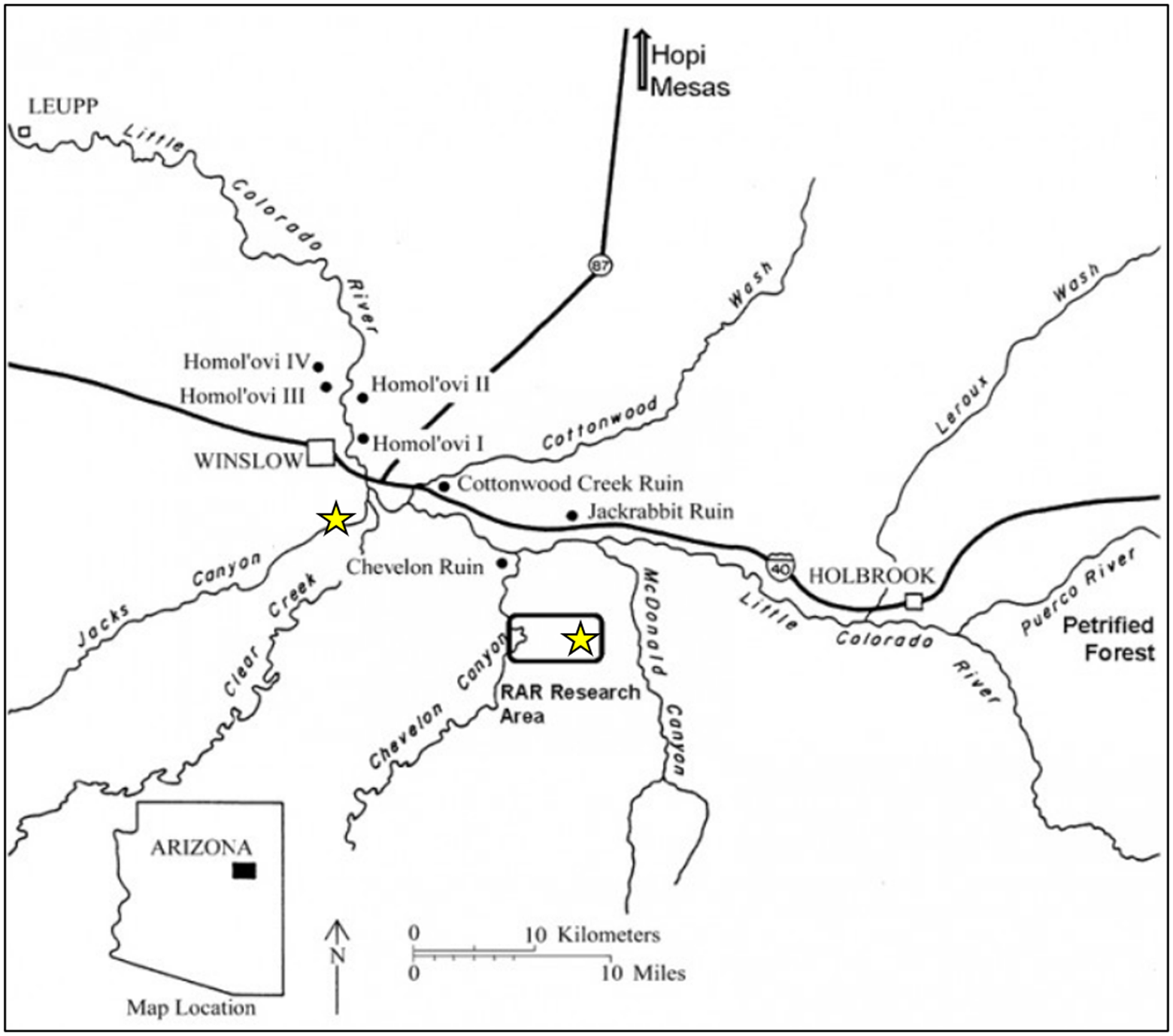
In 2019, we launched the Northern Arizona Paleoindian Project (NAPP) to explore the potential for employing a collector-collaboration research design to expand our understanding of Paleoindian archaeology between Winslow, Arizona, and Petrified Forest National Park (PEFO) (Figure 1). Interest in the area stems from surface surveys conducted by the Rock Art Ranch (RAR) National Science Foundation Research Experiences for Undergraduates (NSF REU #1262184) that recovered four broken Clovis points and 20 other Paleoindian points clustered around Chevelon Canyon and the smaller tributary Bell Cow Canyon. This suggested that there may be significant potential for Paleoindian archaeology in the region and compelling reasons to expand the scope of the research to assess whether the concentrations on RAR were an anomaly or representative of the distribution across the landscape (Soza Reference Soza2018; see also Fisher Reference Fisher2016; Wandler et al. Reference Wandler, Smiley and Vance2011).
Regional overview map with approximate field survey locations marked with yellow stars (map modified from Soza Reference Soza2018).
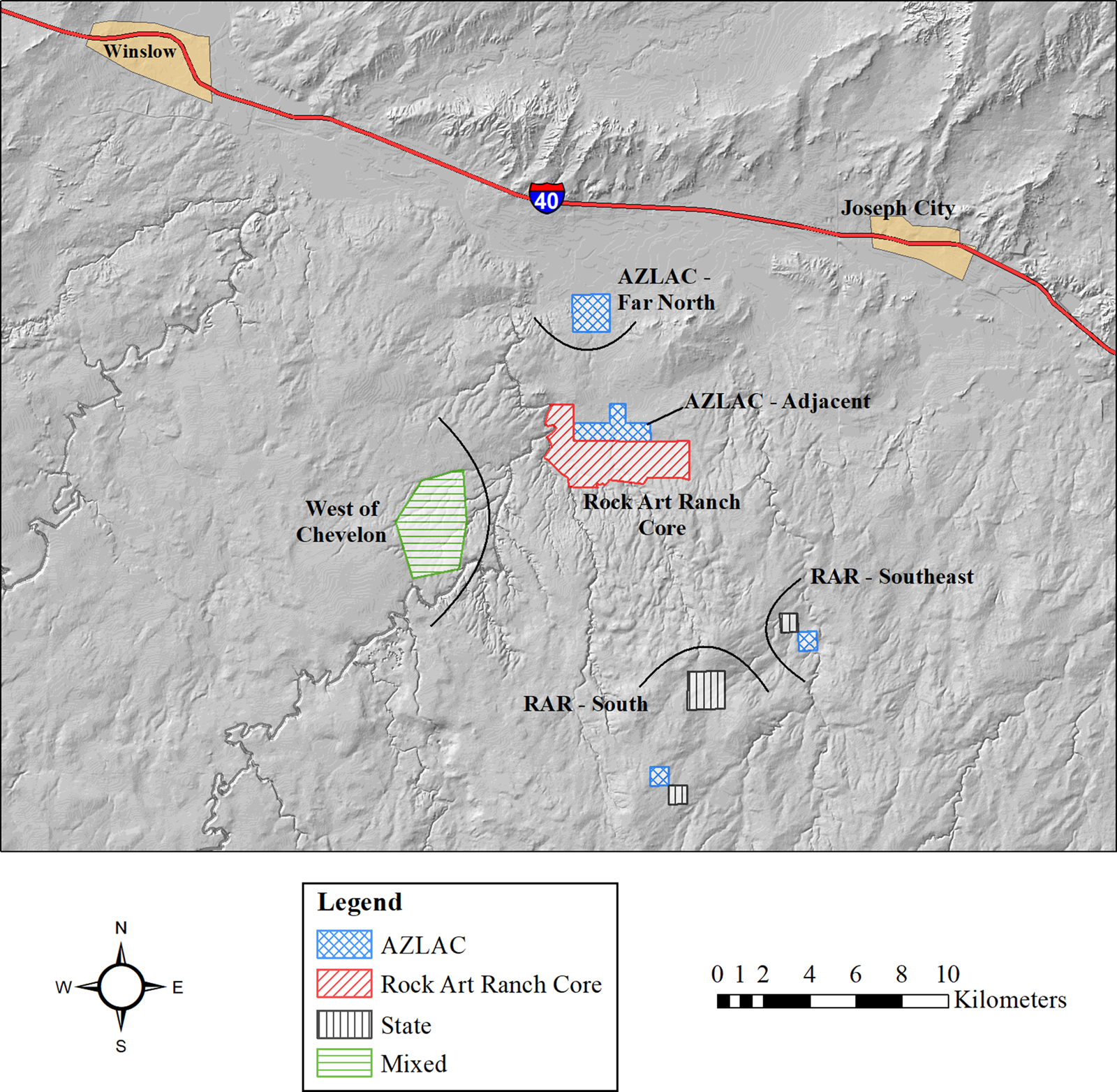
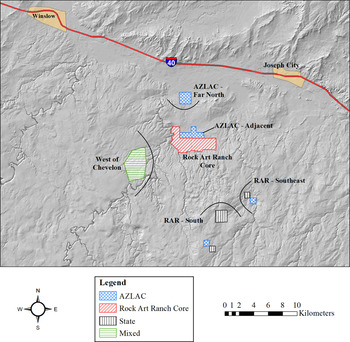
Expanding research and surface surveys in the study area is complicated by land ownership patterns that have broken jurisdiction into a patchwork of parcels with mixed ownership (Figure 2). Near RAR, there are Arizona State parcels, Hopi federal grazing lands, state lands, private individual parcels, and the US Department of Agriculture (USDA) Forest Service lands. Parcels range from private individual plots often less than 100 acres to larger grazing plots and active ranch lands that are both privately and corporately owned. The patchwork parcel arrangement is further complicated by large tracts of lease lands under proximal control of the lease holders and legal control of the title holders, and grazing and active ranch lands such as RAR are often a combination of privately owned and leased lands managed as a single parcel. Some of these large parcels are controlled by families that have been on the land for nearly 100 years.
Map shows survey locations and ownership for fieldwork conducted during the Rock Art Ranch (RAR) Research Experience for Undergraduates (REU). Aztec Land and Cattle Company (AZLAC) holds many parcels in the study area. Hopi grazing lands are northwest of the RAR core. Mixed private and leased lands are adjacent to the south and east of the core. (Map by Joshua Conver. Courtesy of the Homol'ovi Research Program, Arizona State Museum.)
Given this geographic and historic context, we decided to survey the local archaeological record using a collector-collaboration research model patterned after Bonnie Pitblado in Idaho and Colorado (Pitblado Reference Pitblado2014; Pitblado and Jones Reference Pitblado and Jones2009; Pitblado et al. Reference Pitblado, Cannon and Fowler2011), and the USDA Forest Service and the University of Nebraska in the Great Plains (Douglass et al. Reference Douglass, Kuhnel, Magnani, Hittner, Chodoronek and Porter2017). Two primary reasons drove this decision. First, much of the landscape has been collected over the past 150 years, and many of these materials still reside in private collections distributed around the region and elsewhere. Second, we can only access private lands and collections with owner permission and cooperation.
We launched the study with the assistance of a University of Arizona School of Social and Behavioral Sciences Small Faculty Grant in May 2019. Our methodology employed a three-tiered approach to evaluate the local archaeological record for Paleoindian remains. First, we conducted public archaeology events to meet local individuals with collections. Second, we evaluated the collections for Paleoindian materials on-site at the event when possible or visited the owner's home if they preferred. Third, we ground truthed collection-based findings through field survey.
In March 2020, the COVID-19 pandemic stopped the world and halted all research efforts. Although this was not ideal for data collection, it has provided us two and a half years for self-reflection and assessment of our research practice. We distill three important findings from this study regarding archaeological practice. First, as demonstrated in other contexts, collector collaboration can produce usable data relevant to our research questions and provide opportunities to contribute to broader cultural preservation missions (e.g., Douglass et al. Reference Douglass, Kuhnel, Magnani, Hittner, Chodoronek and Porter2017; Kreiser Reference Kreiser2018; Pitblado Reference Pitblado2014). Second, integrating legacy collections into our work is an ethical responsibility for professional archaeologists, but efforts and outcomes need to be driven by the community in a manner that elevates Indigenous voices, prioritizes engagement, and allows consideration of specific research questions. Third, archaeologists engaging with collectors are in a unique position to salvage information from these legacy collections and draw together disparate stakeholders with challenging histories to begin negotiating equitable and culturally appropriate curation plans for these private collections.
We begin by outlining the research area, land ownership, and archaeological background for the study area. We then present our three-part methodological approach for assessing the density of Paleoindian materials in the study area. Initial results and discussion focused on Clovis materials from this study highlight the effectiveness of the methodological approach, ethical arguments for engaging with legacy collections, and consideration of the role of professional archaeologists in this discussion. We conclude with an assessment of the project to date and consider its future directions.
RESEARCH AREA
Rock Art Ranch (RAR) sits 8 km (5 mi.) south of I-40 outside Joseph City, Arizona (see Figure 1). RAR is the core of the research area that currently extends west to Winslow and east to the PEFO/Snowflake/Holbrook area. This region is an important cultural landscape densely packed with critical archaeological sites clustered around the confluence of Chevelon Canyon and the Little Colorado River. Patchwork parcel land ownership and the deep history of the research area create a complex web of stakeholders tied together along geographic, temporal, and legal dimensions.
Indigenous people moved into the region at least 13,000 years ago and potentially as much as 7,000 years earlier (Bennett et al. Reference Bennett, Bustos, Pigati, Springer, Urban, Holliday and Reynolds2021), and they still occupy significant portions of the landscape today. The much-reduced Navajo and Hopi reservations are to the north, whereas the Fort Apache and San Carlos reservations sit to the south, and the Zuni reservations are to the east. Historically, the nearby Homol'ovi Settlement Cluster plays prominently in some Hopi migration narratives, and connections to modern Pueblos to the east are well documented (Hopkins et al. Reference Hopkins, Kuwanwisiwma, Koyiyumptewa, Bernardini, Wesley, Koyiyumptewa, Schachner and Kuwanwisiwma2021). It is also not unusual to catch glimpses of the San Francisco peaks from the study area reminding us that Sunset Crater and Walnut Canyon are situated 129 km (80 mi.) to the west. Sites such as the Homol'ovi Settlement Cluster (e.g., Adams Reference Adams1989, Reference Adams2002; Adams and Hayes Reference Adams and Hayes1991), Chevelon Pueblo (e.g., Adams Reference Adams2016), Jackrabbit Ruin (Adams Reference Adams2002), and Cottonwood Creek Ruin (Lange Reference Lange1989) are documented in tribal oral histories and were excavated through the Arizona State Museum and, more recently, in partnership with tribes from around the region (e.g., Adams Reference Adams1989, Reference Adams, Kuwanwisiwma, Ferguson and Colwell2018; Bernardini et al. Reference Bernardini, Koyiyumptewa, Schachner and Kuwanwisiwma2021).
Within our immediate research area, much of the landscape is privately held and is not typically subject to cultural resource surveys mandated by the 1966 National Historic Preservation Act (NHPA) or the 1969 National Environmental Policy Act (NEPA). Few other legal mechanisms can compel landowners to provide access to archaeologists for research or survey purposes, so much of the landscape in the study area remains unknown to professional archaeologists. Previous archaeological investigations in adjacent areas demonstrate that these unsurveyed lands could contribute significant data relevant to many different cultures and time periods.
BACKGROUND
Understanding of Clovis in northeastern Arizona remains ephemeral because few archaeological sites and artifacts have been reported in this region (Adams Reference Adams1985; Haynes Reference Haynes2011; Lange Reference Lange1989). In 1967, archaeologists had documented a total of 31 Clovis points from both surface and buried contexts within the state of Arizona (Agenbroad Reference Agenbroad1967). More than five decades later, the total had grown to 109 (Haynes Reference Haynes2011). Although the total numbers of known Clovis points have steadily increased, our understanding of the Arizona Paleoindian record remains biased, in part, because of the intense focus on buried megafauna sites in the San Pedro River valley, such as Lehner (Haury et al. Reference Haury, Sayles and Wasley1959; Mead et al. Reference Mead, Vance Haynes and Huckell1979), Naco (Haury et al. Reference Haury, Antevs and Lance1953), and Murray Springs (Agenbroad and Haynes Reference Agenbroad and Haynes1975). Combined, these sites produced nearly 40% (43) of the total Clovis points recovered in the state of Arizona (Haynes Reference Haynes2011). Haynes's report also highlights that most Clovis finds in the state of Arizona from outside of the San Pedro River valley are concentrated around Flagstaff, Sierra Vista, and Tucson, and that there is a paucity of points reported from the NAPP study area (Haynes Reference Haynes2011). Additionally, Clovis finds are often isolates (e.g., Geib Reference Geib1995; North et al. Reference North, Foster, Lindly and Mitchell2005; Roth Reference Roth1993), or in the case of the modified point near Chevelon Ruins, clearly out of original context (Hesse Reference Hesse1995).
The RAR research in combination with the Blue Mesa and Rainbow Forest Clovis sites in PEFO (Fisher Reference Fisher2016; Wandler et al. Reference Wandler, Smiley and Vance2011) suggest that this region has substantial potential for expanding our understanding of Clovis on the southern Colorado Plateau. For example, two Clovis points recovered by the REU are made from petrified wood likely sourced from around PEFO, 60 km (37 mi.) east (Soza Reference Soza2018), and a contact reported recovering a petrified wood Clovis point from RAR in the 1970s. A point manufactured from petrified wood in the Murray Springs assemblage may suggest a connection between Clovis people at the Rainbow Forest and hunting activities in the San Pedro River valley, approximately 400 km to the south (Fisher Reference Fisher2016; Haynes and Huckell Reference Haynes and Huckell2007). There are also reports of two dusky red chert points at the Naco site (Haury et al. Reference Haury, Antevs and Lance1953) and a red, opaque jasper point at the Lehner site (Haury et al. Reference Haury, Sayles and Wasley1959). The material sources for these points are listed as unknown, but they should be reexamined to assess whether they are additional petrified wood points. In addition, Downum (Reference Downum1993) reports a gray to black banded rhyolite or petrified wood point from approximately 150 km to the west in Wupatki National Monument outside of Flagstaff. If these connections between the RAR/PEFO corridor and the San Pedro River valley sites can be demonstrated, we may be able to begin building mobility and range models for Clovis people on the southern Colorado Plateau that extend south of the Mogollon Rim into the San Pedro River valley.
METHODS
In May 2019, we conducted two weeks of fieldwork with a core crew that included Matthew J. Rowe—an assistant professor of practice at the University of Arizona and the project director—one graduate student, and two undergraduates from the University of Arizona School of Anthropology. Throughout the fieldwork, multiple volunteers, landowners, and other University of Arizona students and faculty also contributed to the project. The NAPP also conducted several exploratory weekend trips before the summer work of 2019 to plan and conduct limited survey and several follow-up visits to maintain contacts. At this point, the project has spent approximately 30 days in the study area.
We entered the field during the summer of 2019, with field activities scheduled that reflect our tripartite research design. The first category was public archaeology and outreach to build project visibility and develop potential contacts. The second category was assessment of personal collections to gain a broad survey of Paleoindian potential in the region. The third category was pedestrian survey to reevaluate known locales and to ground truth reports of Paleoindian finds from legacy collections or contacts.
Public Archaeology and Outreach
Public archaeology and outreach have the express goals of connecting with northern Arizona collectors and their collections and enhancing our visibility, which is essential to project success. Research in this region is nearly impossible without landowner support and public participation. For this reason, we worked with the Homol'ovi Chapter of the Arizona Archaeological Society (AAS) and Homol'ovi State Park to host two public events in the study area. Both partners bring substantial resources and infrastructure to support public archaeology. On May 15, 2019, we presented a talk called “Standing on a Corner Looking for Paleoindians: A Citizen Scientist Survey” at the monthly meeting of the Homol'ovi Chapter of the AAS at the Winslow Historical Society and Museum. Three days later, we held a public archaeology event at Homol'ovi State Park, where we invited visitors to try flintknapping and to test the accuracy of their atlatl.
Event publication, location, and timing were coordinated with the AAS and Homol'ovi State Park. At each event, we encouraged local landowners and collectors to bring lithic artifacts for identification. We gathered contact information from each participant and photographed all the materials that they brought. We also inquired about provenance and whether the individual would be open to having us survey their property. Although the research goal for these events focused on identifying Paleoindian artifacts, secondary goals included opening lines of communication and engaging with the local community to build a broader network and support the outreach and public engagement activities of our partners.
We also conducted outreach among local landowners and collectors through the AAS and personal contacts of E. Charles Adams, who has worked in the region for decades. Both the outreach and public archaeology events had the same goals of connecting with local stakeholders and gauging interest in participation. Success was measured by numbers of contacts collected and potential generated for moving into the next stage of the methodology. This portion of the methodology is reliant on building personal relationships and strengthening local network connections. Additionally, opportunities to partner with local groups involved in cultural resource preservation and education are common and can greatly increase the potential for successful outreach and collaboration.
Collection Review
Assessing local collections for Paleoindian artifacts is the second step in our methodology. Assessment of smaller collections of artifacts typically occur at public events, but larger collections often necessitate visits to private homes. For this discussion, we divide the collections into smaller collections and legacy collections. We define legacy collections as those that have been collected over multiple generations and contain artifacts the current holder has collected and/or inherited from parents or friends over decades (e.g., Childs Reference Childs2015; Fisher et al. Reference Fisher, Harris, Schreg and Knipper2015).
Artifacts in private collections raise ethical concerns (e.g., Pérez et al. Reference Pérez, Harrod and Martin2009; Shott Reference Shott2018; Shott and Pitblado Reference Shott and Pitblado2015; Vitelli and Colwell-Chanthaphonh Reference Vitelli and Colwell-Chanthaphonh2006; Watkins Reference Watkins2015). It is common knowledge that the Homol'ovi Settlement Cluster and other sites throughout the region were looted for years before significant legislation and enforcement discouraged the activities. Rumors suggest that legacy collections in the region contain much of this material and that sites on private land may still be vulnerable. We took two steps to help mitigate potential for interacting with bad actors and active looters. First, we established connections and access to several legacy collections through recommendation of officers from the Homol'ovi Chapter of the AAS. The chapter supports the regional site monitoring program and is an active partner in preservation and protection of the archaeological record. This vetting provided confidence that the individuals with the collections were not involved in illegal activities or commercial endeavors. Second, we partnered with Homol'ovi State Park to hold an open recruitment event, expecting that most bad actors and active looters would self-select out of potential interactions with state agents.
We photographed the contents of each collection using a Nikon D3100 digital camera. Non-Paleoindian artifacts were photographed in groups or in the frames in which they were displayed to provide a visual record of those materials. Paleoindian artifacts were then photographed individually, when possible, and standard measurements were taken. In many cases, the artifacts were permanently mounted, making it impossible to take some measurements or individual photographs. We then recorded the provenance of the Paleoindian artifacts and, when relevant to our study area and possible, requested a field visit. Locational data from collections-based survey are treated similarly to a predictive model, and reports from collections and collectors are considered high-probability areas that help inform survey decisions. Additionally, collection information gives us a broad picture of the regional archaeological record and a sample of research potential.
Verification through Field Survey
The third step to our methodology is to conduct surface surveys to evaluate collections-based data. This step allows us to evaluate current potential for Paleoindian archaeology in the region and establish specific context for materials collected during surface survey. We conducted pedestrian surveys of locations at Rock Art Ranch and two private properties south of Winslow near Clear Creek (Figure 1). Survey crews varied from six to 10 people and included local collectors, landowners, archaeological society members, and students and faculty from the University of Arizona School of Anthropology. Survey areas were a mix of new, unsurveyed areas and known locales on privately owned land with explicit owner permission and owner participation. Surveys of new areas were conducted with survey crews spaced at roughly 10 m intervals, with the goal of evaluating each area for archaeological evidence and—more specifically—Paleoindian lithic concentrations and potentially buried sites.
During 2019, field surveys included at least one collector, students and faculty from the University of Arizona, members of the AAS, and the landowner. Including local collectors in surveys of new property was often required because they served as agents to acquire landowner permission and access to the parcel. Collectors also brought us to high-potential areas where they had recovered Paleoindian artifacts. We used these field sessions to introduce the collectors to field documentation protocols, systematic survey strategies, and debitage analysis. Conversations in the field ranged from survey strategy to landscape analysis and discussion of the known Paleoindian time frame. Field sessions provide opportunities to talk about treatment of the archaeological record, including the need to avoid digging, to stay away from settlements and architecture, and to record what one finds.
RESULTS
Each tier in the methodological process produces different outcomes and data critical to investigating the archaeological record in this region. Geographic constraints require landowner participation, and trust must be established before collectors will share information with the project. Collection review provides a broad overview of the archaeological record, but it typically lacks reliable context. Review of collection data through surface survey helps establish better context and review current archaeological potential.
Public Archaeology and Outreach
Between the two events, we collected eight sets of contact information. Events were open to the public, and exact numbers of visitors was not recorded. Approximately 20 individuals, mostly consisting of active AAS members, attended our public talk, and dozens of visitors to Homol'ovi State Park stopped by to try flintknapping and the atlatl range. Many of the people we spoke with at the second event were there primarily to visit the park, but they dropped by to see what was happening. During this event, we spoke with many people from out of state and had a chance to discuss the local archaeological record. In so doing, we hope we also added richness to their park experience. This result demonstrates the synergistic effects of partnering with local institutions.
Collection Review
During the 2019 field season, we engaged with seven local collections that ranged from a handful of lithic flakes picked up from a yard to multigenerational collections with thousands of individual artifacts. Five of the collections were evaluated at the public events and ranged from seven to 33 projectile points, some flake tools, and a mammoth vertebra. None of these collections contained diagnostic Clovis material, but some Middle and Late Paleoindian materials were present.
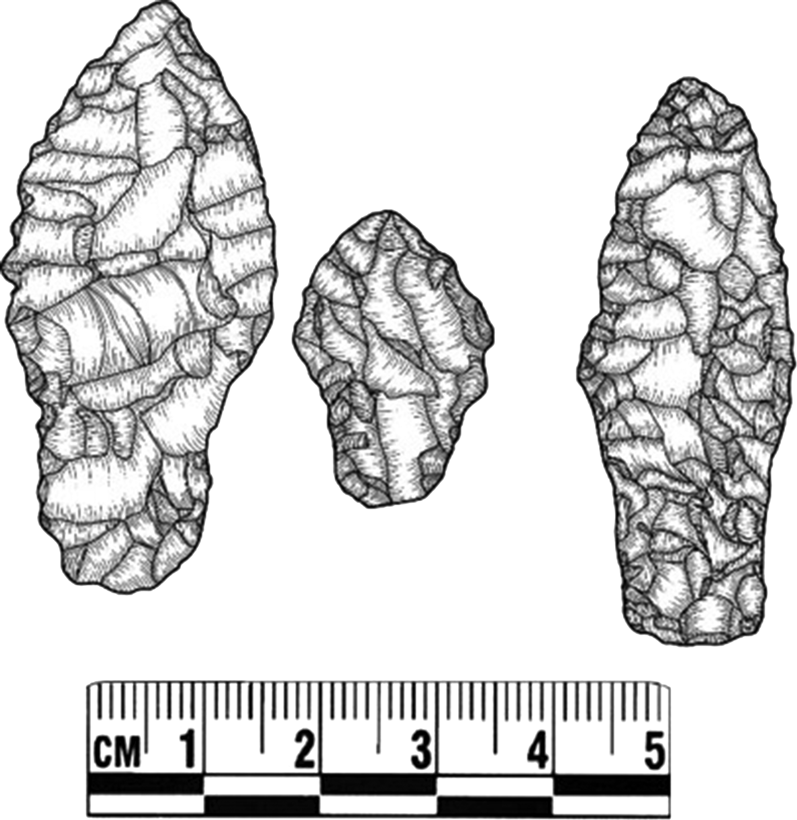
Two of the collections were large legacy collections that contained small amounts of Paleoindian materials, including possible Clovis and Western Stemmed. The largest collection included one fluted Clovis base that came from an unspecified location south of Phoenix, and a possible Clovis biface (Figure 3) from the area between Snowflake and Holbrook. The collection also contained several lanceolate style forms that may be Agate Basin or Eden and two Western Stemmed, Lake Mohave variants (see Figure 4) found between Snowflake and Heber, Arizona. One of the Lake Mohave points was made from basalt, whereas the other appears to be a local caramel-colored chert.
Fluted point base from an unspecified locale south of Phoenix and a possible Clovis preform housed in a local legacy collection (image by Kassi S. Bailey).

Western Stemmed variants from the Holbrook-Heber area, southeast of the NAPP study area, housed in a local legacy collection (image by Kassi S. Bailey).
The other large collection consisted of almost entirely personal finds from around Winslow. This collection was more limited, but it also had not been as well curated as the first. The collector was also in process of incorporating a collection of artifact frames that were being passed on to them after the owner died. It included several frames of hypertrophic bifaces made from Edwards chert and several Folsom points made from petrified wood. These artifacts are almost certainly replicas given their size (~20 cm in length), the presence of mixed types but similar material, and an extraordinarily flat cross section that suggests that they had been constructed from slabbed raw material. Unfortunately, their origin story was lost with the owner. Other frames in this collection contained hundreds of points, such as obsidian assemblages from the Great Basin, but there was no indication of their origin.
Verification through Field Survey
During the 2019 field season, we conducted surveys on RAR and two additional properties outside of Winslow, Arizona. We collected 56 artifacts that included 17 projectile points and artifacts attributable to Paleoindian and early archaic clusters, 15 bifaces, and 21 other artifacts that were primarily Middle to Late Archaic Pinto and San Jose points. The Paleoindian artifacts included one fluted Clovis base, a nearly complete Plainview, three Eden bases in close association, and seven Western Stemmed variants. Artifacts remain property of the landowners, according to Arizona law, and will either be returned to the landowner or transferred to long-term curation through appropriate legal processes.
REVIEW AND ASSESSMENT
Preliminary results suggest that our methodology can produce data relevant to our research questions. The three-part methodological approach helps develop data sources from regional collections and ground truths collections data to help enhance reliability. The methodological structure not only has many inherent opportunities to support cultural preservation efforts and but is widely applicable.
Public Archaeology and Outreach
Partnering with established institutions brings significant resources and knowledge to this type of research project. These institutions help enhance visibility and public connections while providing an official umbrella that may also help filter out participants engaged in clearly illegal digging. These partnerships can work together to share information about cultural preservation efforts and conduct public outreach and education. Finding partners among public institutions is not difficult, and research missions often align with broader agency goals.
The collector-collaboration model has helped develop a research network in the study area to expand our understanding of Paleoindian archaeology. The current NAPP network includes the authors of this article, two landowners who helped survey their properties, AAS members, RAR, and former collectors—although members often fit more than one category. Contacts were primarily generated through the AAS and Dr. Adams. Research in our study area is entirely dependent on engaging local landowners, avocational groups, and state and local institutions, and it cannot be conducted without this collaborative network. Direct engagement allows us to meet landowners, discuss their situation, review any materials they may have collected off their property, and seek permission to survey their property.
Patchy land ownership and checkerboarded parcels complicate large-scale, landscape-level survey projects such as the one we hoped to accomplish with the NAPP. The initial piecemeal approach to building the network was encouraged by land-ownership issues, limited funds, and some uncertainty about whether our research and engagement goals would be met. The logic was to build on the Rock Art Ranch collaboration and, through collector collaboration, gradually expand the network of participants and parcels surveyed. Although the motivation behind this approach was entirely pragmatic, in review, we see the colonial roots in this design: it privileges current landownership patterns established after Indigenous people were moved to reservations and fails to engage Indigenous communities until “need” arises. This approach is a clear failure in engagement.
Collection Review
The legacy collections we reviewed had developed through decades of activity. One collection contained complete or nearly complete ceramic vessels of unknown origin, but the other large collection only contained lithic artifacts and/or ceramic sherds. The condition of the large collections examined during 2019 varied. One collection was a well-curated, multigenerational collection with written records and labels for most of the materials. Frames and artifacts had paper labels with numbers connected to handwritten records with coded locations. This collection did include some inherited materials that had less precise provenance.
We were told that artifacts in the collections had been collected from private lands either by the owner or with the owners’ permission. In most cases, our contact was the primary collector, but several collections contained materials collected by an acquaintance or relative who passed them on to the current holder. In nearly all the collections we examined, permission to collect artifacts from the land had been acquired verbally and often several decades ago. We attempted to establish the origins of as much of the material as possible, but in some cases, the original collector had passed away, and the specific origin of the material was lost. One legacy collection had relatively detailed provenance information recorded in notebooks, whereas the other was less organized and was in process of incorporating undocumented materials inherited from a neighbor who had recently died. The smaller collections varied in terms of record keeping, although the collectors tend to have strong recall for general locations (e.g., “this field here” or “in this area”) and the material they have collected in the area.
Archaeologically, collecting has caused a great deal of damage in the region and often destroys much of the archaeological context, thereby imposing significant limits on the usefulness of the information generated from these materials. Destruction of the archaeological record further disenfranchises Indigenous people from their past and their cultural landscapes. Digging into sites for recreation and commercial purposes is clearly unethical and prohibited under the Society for American Archaeology's (SAA) Principles of Archaeological Ethics (Society for American Archaeology 1996).
As we consider the standards of our work with collectors, we are guided by the SAA principles of ethics as they apply to legacy collections. SAA Principle 1: Stewardship makes no distinction between collections and in situ resources. Stewardship of legacy collections requires working toward stabilization and recording of these collections to help preserve what information is still associated with the materials and to help arrange for long-term ownership and preservation plans. SAA Principle 3: Commercialization is a concern when working with legacy collections, and it requires vigilance and education on our part. SAA Principle 7: Records and Preservation means that we have obligations to engage with these collections to document, record, and stabilize whatever provenance and contextual information is associated with them before it is passed further from the original collector's hands. Principle 8: Training and Resources also applies because these collections provide excellent opportunities to educate students and avocational archaeologists about record keeping, preservation, artifact documentation and analysis, and other critical professional skills.
It is also clear that decades of looting and collecting have damaged the archaeological record in this region and that these original actions cannot be supported by professional ethics. Historic looting and collecting have not only clear impacts on current Indigenous communities but also the additional impact of erasing a rich cultural heritage and evidence of deep connections to the landscape. Furthermore, the same ethics that discourage unnecessary excavation of in situ materials and collecting also demand that we engage with legacy collections and the products of decades of collecting activity to find a more equitable and agreeable disposition for these materials among the stakeholders in the region (Labelle et al. Reference Labelle, Zimmerman, Vitelli and Hollowell-Zimmer2003).
Concerns about the fate of these northern Arizona legacy collections have been discussed (e.g., Childs Reference Childs2015; Fisher et al. Reference Fisher, Harris, Schreg and Knipper2015), and they will continue to provide inspiration for ethical discussion. Our engagement with multigenerational collections demonstrates the painful reality that artifacts tend to lose all provenance upon ownership transfer. Generally, our collaborators have remarkable recall of where they found specific artifacts but, in both cases, where artifacts had been passed to a new owner, provenance is completely lost. One inherited collection had multiple frames of points that included both obvious reproductions and hundreds of projectiles points with no provenance. In the other example, personal finds were carefully cataloged and had good provenance, but inherited items had only vague locations (e.g., “south of the Phoenix area somewhere”).
Additional concerns in working with collections include the need to be wary of potential fakes and of adding commercial value and contributing to the artifact trade (Daniel Reference Daniel2016). These concerns are best mitigated by working directly with collectors. The collections reviewed for this study demonstrate that collections are most endangered during transfer. Collections without explicit transfer plans often end up lost, sold, or broken up by family members that have little knowledge of the collection's origin. Professional archaeologists are in a good position to help explore long-term options for large private collections.
One observation from this work and discussions with other archaeologists throughout the United States is that many of these collectors are aging and beginning to think about the transfer of their collections. Because the development of cultural preservation laws—such as ARPA in 1979—curtailed the activities of some collectors, the more extensive private collections likely predate the NHPA. Increasingly, collections acquired before the NHPA are unlikely to be held by their original owners or are on the verge of transfer. Without action, we may be on the brink of losing provenance for significant portions of the archaeological record held in these legacy collections.
Verification through Field Survey
Preliminary field survey suggests that the region holds significant Paleoindian remains, and expansion of our methodology can produce data relevant to questions about Paleoindians in the study area. Surveys conducted in 2019 found similar distributions of materials associated with drainages and exposed bedrock features. The nature of this pattern is currently uncertain, but it repeats patterns observed in the RAR REU sample (Soza Reference Soza2018). Exposed bedrock ledges and flats along drainages often contain palimpsests of lithic debitage and diagnostic artifacts from vastly different ages. Movement of loose sand and limited soil is exposing bedrock surfaces near drainages, suggesting some possibility that Paleoindian materials were sitting in buried strata that have been exposed close to the drainages. It is also likely that Paleoindian materials are moving during seasonal monsoons and concentrating in cache basins near the drainages. This pattern is a surface visibility bias. We also cannot discount redistribution or reuse by later cultures. More research is needed to determine the depositional context of these materials.
Collector-collaborators within our network bring many contributions to this project. For example, they can gain access to parcels through connections in the community that would take us significant effort to obtain. Given that the scope of our survey coverage is primarily limited by access, quick expansion of this range supports broader survey. Second, many families and collectors have been on the land for decades, have spent a great deal of time collecting artifacts from those lands, and have built up large collections of materials. Understanding the scale and contents of those efforts is critical to understanding the regional archaeological record because this collection represents a significant taphonomic impact (Shott Reference Shott2017; Shott and Pitblado Reference Shott and Pitblado2015). Third, they bring intensive knowledge of the landscape and have built an understanding of the place that professional archaeologists are unlikely to reach through brief field sessions. With this knowledge, they have also developed significant survey skills and understanding of general artifact distributions.
Within the NAPP network, collaboration means that participants have meaningful involvement in developing information and sharing those findings through publications and public engagement. Surveying parcels together establishes roles for each member in data collection and provides the opportunity to develop a shared set of ethics and practice for the network. Through these efforts, members in the network have begun seeking landowner permission in writing—in addition to the more traditional verbal permission—and they have started collecting more precise provenance for finds. These changes help establish the legality of the collectors’ practice and improve the quality of their data.
Collectors within our network closely resemble responsible resource stewards, as outlined by the SAA Responsible Artifact Collectors Task Force (Pitblado et al. Reference Pitblado, Shott, Brosowske, Butler, Cox, Espenshade and Neller2018). They have a strong interest in the local archaeological record and would like to see their knowledge incorporated into the broader understanding of the region. We are working together to improve data collection systems and using our time in the field to refine recording techniques, conduct more systematic survey, and review the environmental context of their finds. This approach builds on the SAA best practices of respectful engagement and collaboration (Pitblado et al. Reference Pitblado, Shott, Brosowske, Butler, Cox, Espenshade and Neller2018).
Professional archaeologists have a unique opportunity to connect local collectors and legacy collections with tribal entities to help guide decisions about collections and collecting activities. Tribal voices should be driving discussions about the long-term fate of these materials, but they are often either not part of the conversation or not fully considered by collectors. Professional archaeologists are well positioned to elevate and connect tribal voices with collector communities, and we have ethical obligations to facilitate those conversations.
CONCLUSION
Engaging with collectors and existing collections is an extension of our ethical obligations to preserve all parts of the archaeological record and to try to prevent further destruction or damage. Legacy collections around the United States are in danger of losing what provenance they have, which should motivate actions to collect and preserve this information. Use of private collections does raise concerns for addressing some research questions (e.g., Hegmon et al. Reference Hegmon, McGrath and Munson2017), but collaboration can build reliable data by ground truthing collector finds and observations with site visits and using information as guidance for targeting limited survey resources.
Ultimately, we see that collector collaboration has the potential to develop useful and reliable archaeological data relevant to our original questions, but engagement with the community has revealed that the more important and ethical work is to help build bridges between Indigenous communities and collectors to help repair more than a century worth of impacts and insults stemming from decades of unrestrained looting. From the broader perspective of practice, we that see our approach to collector collaboration must be driven by communities at multiple levels, and that the project should be driven by the needs of regional stakeholders instead of specific research agendas.
In light of lessons learned, we are redesigning the project to draw from community-based participatory research (Atalay Reference Atalay2012) and collector collaboration in order to shift our focus to seeking ethical and culturally appropriate long-term curation plans for legacy collections in this region. We see this as a critical priority and an ethical obligation shared among the archaeological community. With this shift, we make the continuation of the project contingent on active and ongoing tribal collaboration. We also believe this shift can continue to allow our pursuit of research questions about the earliest peoples in the region. Engagement with this process should continue to produce relevant data through our three-part methodology, even as our focus turns to ethical and culturally appropriate long-term collection stabilization.
Acknowledgments
We would like to thank Brantley Baird, owner of Rock Art Ranch, who has generously provided the project with hospitality and shelter on numerous occasions as well as unfettered access to his lands in support of this research. We would also like to thank Darlene Brinkerhoff, Paula Beall, and the Homol'ovi Chapter of the Arizona Archaeological Society for their support and assistance with this project. We also extend great appreciation to Kenn Evans II and Homol'ovi State Park for their assistance with the public archaeology event. Thanks also go to Gloria Kurzhals, Piggy Verin, Manny Walton, Andrea Garland, Andy Moree, and Allison Leibrandt for their contributions to the project. Finally, we thank the University of Arizona College of Social and Behavioral Sciences Research Institute, which supported this project through a Faculty Small Grant.
Data Availability Statement
Data reported in this article are currently available from the corresponding author upon reasonable written request. Data will ultimately be made available through the Paleoindian Database of the Americas.



 Open access

