

We begin, as is traditional in the Indigenous circles within which we move, by introducing ourselves so that our readers may know something about where we come from and may situate us within our communities (Kovach Reference Kovach2021).
Aaniin, Boozhoo. Sarah Hazell Ndizhnikaaz. Nbissing Ndoonibaa. Hello, welcome. My name is Sarah Hazell. I am from Nipissing First Nation. I am an archaeologist and anthropologist with 25 years of experience working in the Middle East, the Canadian Arctic, Alaska, and northern Ontario. Working with my own nation on an archaeological field school beginning in 2016 made me realize that youth and community members have a strong desire to learn more about archaeology and their long-term occupation of our homelands. I also discovered that no other opportunities existed for communities in northeastern Ontario to be similarly engaged. This experience led to my recent work, which focuses on bringing archaeological educational and capacity building opportunities to Indigenous communities in Ontario. By working alongside First Nations, I hope to build a critical mass of people and knowledge that can be mobilized to address and correct systemic heritage and cultural inequalities and injustices.
Aanii. Greetings. My name is Alicia Hawkins, and I am a settler archaeologist who has been working in Ontario and other regions for more than 30 years. Like many of my peers, my professional career was built on researching the archaeological past of Indigenous peoples. As an academic, I have been privileged to be in a position to contribute volunteer labor to archaeological organizations, including, most recently, the Ontario Archaeological Society (OAS). I believe that my position affords me the opportunity to both attempt to redress heritage injustice and share archaeological knowledge and experiences—two things that coalesce in the projects that we describe below.
We first met when Sarah was in the early stages of a graduate career and Alicia was a newly minted PhD. The cooperative work that we describe is based on a working relationship that has developed over decades. It arises out of dissatisfaction with the state of heritage management in our region: we observe that the people whose cultural heritage forms an estimated 80% of the archaeological landscapes, sites, and artifacts in our province are systematically excluded from meaningful, informed, and timely involvement in planning to care for that heritage (Warrick Reference Warrick2017). In Ontario, exclusion is observable in existing practices and policies within the regulatory framework, the education system, and private sector archaeology (Hawkins Reference Hawkins2019; Supernant and Warrick Reference Supernant and Warrick2014). For example, archaeological collections are frequently stored at great distances from the communities where they originated, often without the knowledge—even of their existence—of descendant First Nations.
Archaeological Training as Service
We suggest that we are both in positions—different as they may be—to help to correct this injustice by serving Indigenous communities and contributing to decolonization and reconciliation practices (Atalay Reference Atalay2006, Reference Atalay2012). Many communities in northeastern Ontario have received very little exposure to archaeology. Consequently, our starting point was to provide foundational archaeological training that focuses on youth so that they are aware of potential career paths as Indigenous Archaeological Monitors and/or heritage stewards. More broadly, our service is to provide community members—including First Nations government workers and elders—with archaeological training and education to foster an informed critical mass needed to radically change the practice of archaeology from one that is dominated by a business model in which archaeological resources are managed and harvested by outsiders to one in which cultural heritage protection is handled by Indigenous descendants, the rightful stewards of ancestral belongings. We are committed to and take a long view of our work given the slow pace of bureaucratic change, as evidenced by the amount of time the Canadian, provincial, and territorial governments are taking to implement recommendations outlined in the United Nations Declaration on the Rights of Indigenous Peoples (UNDRIP; United Nations 2008) and the Calls to Action of the Truth and Reconciliation Commission of Canada (2015).
Although our work is broadly categorized as training, there are several specific areas in which we are attempting to change the current system. Most generally, the training sessions we describe below—training archaeological monitors and working with legacy collections—are designed to inform Indigenous participants about what archaeology is, how it can be practiced, and how it can be of use to Indigenous communities. We see this work as fundamental because justifiable distrust about archaeology exists within Indigenous communities in our region. We suggest that the issues do not necessarily lie with the discipline itself but rather with how it has been practiced. Historically, there has been a lack of communication with communities (Warrick Reference Warrick2012:159); it was not until 2011 that the government required any form of consultation for cultural resource management (CRM) projects (Ontario Ministry of Tourism and Culture 2011a). Furthermore, research archaeology has been carried out to satisfy academic curiosity rather than to address questions of interest to communities (Noble Reference Noble1982).
Second, we use our position to inform First Nations about the current practice of archaeology in the province, and we demonstrate how, if they wish, they can access information about known archaeology projects and sites in their territories. For example, the MinistryFootnote 1 will provide a list of current projects to First Nations that make a request, but most do not because they are unaware they can. This is a serious flaw in the current system because private sector archaeologists are not required to engage with Indigenous communities until very late in the investigation, unless there is a direct request by a First Nation (Ontario Ministry of Tourism and Culture 2011a, 2011b).
Third, we strategize with community members and representatives about how they can obtain information about and take control of archaeological belongings in a system that regularly excludes them. In particular, we consider (Ontario Ministry of Tourism and Culture 2022) licensing, obtaining information about the location of registered sites in their territories, and curatorial matters.
Finally, our approach focuses on education, which we describe below, but equally important are the community relationships developed in the course of this work.
In both the monitoring training and the collections work, three principles underlay our project design. First, it was necessary to work with First Nations government organizations to ensure that there was full understanding and agreement about the project. Second, the projects needed to be properly resourced, and it was incumbent upon us to seek necessary funding. Third, advertising the projects and selecting participants would be led by our Indigenous partner organizations.
Partner Organizations
The initiatives that we describe here involve both non-Indigenous archaeologists and participants from numerous First Nations. We were able to bring this diverse group of people together thanks to the preexisting connections between organizations and the networks within those organizations.
The Ontario Archaeological Society (OAS) is a volunteer charitable organization that promotes ethics in archaeology (https://ontarioarchaeology.org/the-organization/). In 2017, the membership of the OAS voted overwhelmingly for a change in the organization's Statement of Ethical Principles. Specifically, members supported language that paralleled statements in UNDRIP Article 11 (United Nations 2008; OAS Statement #3) and the principle of free, prior, and informed consent (OAS Statement #5; Ontario Archaeological Society [OAS] 2017). We wanted to make sure that this was not simply a feel-good measure, intended to assuage the guilt of settler archaeologists. Instead, the support for these changes was treated as an indication of a commitment by members of the Ontario archaeological community to work toward tangible change in the discipline. We considered the support for the modified statement of ethical principles as equivalent to an invitation to call on members to participate in decolonizing initiatives.
One of the tangible outcomes was the signing of a collaborative relationship protocol agreement with the Anishinawbek Nation (AN; Anishinawbek Nation and Ontario Archaeological Society 2018). The AN is a political territorial organization that advocates for 39 member First Nations across Ontario (https://www.anishinabek.ca/). Because of this formal agreement, the OAS was able to work with the AN to determine interests in different initiatives. Critically, the AN provided support for a funding application aimed at training.
A third essential organization in these projects is the Ojibwe Cultural Foundation (OCF; https://ojibwe-cultural-foundation.myshopify.com/). Established in 1974, the OCF is located in M'Chigeeng First Nation on Mnidoo Mnising (Manitoulin Island). It serves as a cultural hub for Anishinaabe people from First Nations on the island and beyond. The physical premises contains a gallery, a studio space, an outdoor amphitheater, a healing lodge, a conversation space, and a curation facility. The activities that the OCF facilitates include a wide range of workshops that are united by promoting Anishinaabe culture through art and language (Beam and Brooks Reference Beam and Brooks2018). On weekdays, there is often lunch, and community members drop in to share food, stories, and laughter and—importantly—to encourage language revitalization by speaking Anishinaabemowin.
CASE STUDY 1: INDIGENOUS ARCHAEOLOGICAL MONITOR (IAM) TRAINING
Indigenous communities in southern Ontario (e.g., Mississaugas of the Credit First Nation, Chippewas of the Thames First Nation, Caldwell First Nation) had made requests for the OAS to provide archaeological training for Indigenous Archaeological Monitors (IAMs) for some time. IAMs are common on many cultural resource management projects in southern Ontario, where they are paid by the proponent, but they represent the interests of their nations by observing and reporting on archaeological fieldwork (Devries Reference Devries2014). The OAS was able to meet these requests for training by calling on volunteers from within the organization because members were happy to share their knowledge. However, the opportunities were limited to First Nations located in the most populated southern part of the province, and the curriculum was designed and delivered by non-Indigenous archaeologists. Recognizing that mining, forestry, and highway expansion are having a significant impact on Indigenous archaeological sites in the north and that the OAS had not previously offered opportunities there, we proposed reimagining and providing trainings in this region (Figure 1).
First Nations in Ontario (open circles) and the home communities of participants in the Indigenous Archaeological Monitor trainings in 2019 and 2021 (red stars). Data from the government of Ontario, the government of Canada, Canadian Community Maps contributors, Esri, United States Geological Survey, Esri Canada, HERE, Garmin, Food and Agricultural Organization, National Oceanic and Atmospheric Administration, Enivonmental Protection Agency, National Resources Canada, and Parks Canada. Note that the center of the symbols indicates addresses on First Nation reserves, not the reserve boundaries or the extent of traditional territories.

Project Design
A common pathway for archaeological training is the university field school; we assert that these are both inaccessible to and inappropriate for many members of Indigenous communities. They are inaccessible when they require enrollment in university programs, are costly, and involve travel to a field site at some distance from home communities. They are inappropriate because they assume that participants should pay, rather than be compensated for their labor, and because most serve a large non-Indigenous student body for whom the curricular needs are different. We therefore developed a different model. Our course design grew out of the one-week IAM training offered in southern Ontario, which covered legislation and regulation, culture history, artifact identification, human and animal osteology, the business of archaeology, the role of the Ontario government, health and safety, and cemeteries and burials.
Recognizing that a significant barrier to participation is the inability of potential trainees to take unpaid time away from work and families, the OAS sought funding for the project. The budget allowed for both training in the home territories of the participants and payment of the trainees. We doubled the length of the southern program and tailored it to the needs of northeastern communities. We included additional topics, such as field relations between CRM archaeologists and IAMs, Anishinabek history, Indigenous lands and treaties, artifact microscopy, and palaeobotany. Significantly, we also added an applied day of training, surveying an area of interest to the First Nations on their lands, followed by artifact processing. Most importantly, the curriculum was adapted to present Indigenous perspectives on archaeology, with a critical lens examining how the current practice favors non-Indigenous “owners”/caretakers of Indigenous belongings over the rightful descendant Indigenous stewards. We worked with First Nations representatives from all the communities where we offered training to ensure that the material was delivered in a culturally sensitive manner, and we included opportunities for elders and knowledge keepers to participate.
An important goal of the trainings (as important as teaching archaeology) was to build relationships between archaeologists, heritage specialists, and members of northern First Nation communities—enduring relationships that could serve communities. Unlike extractive research models, in which communities are contacted, often on short timelines to provide input on non-Indigenous-driven projects, we aimed to address a need in our region and to develop connections with communities to work long term on issues important to them.
The program was designed to serve six First Nations communities located in the northeast and to train 72 participants over a two-year period. Ideally, this would mean we trained 12 people in three communities over two summers, when youth would be more likely to be available.
Northeastern Ontario is a vast region with many small First Nations. An immediate concern, after we received funding, was to determine where the trainings should occur. Fortunately, the AN facilitated communication with member communities and invited us to attend its annual meeting. As a result of this, we were invited to Mississauga First Nation to meet with their representatives, along with staff from Sagamok Anishnawbek (SA) and Serpent River First Nation (SRFN). After the meeting, all communities agreed to participate in the project, and two neighboring communities chose to partner for a training because it was unlikely that each community would attract 12 participants. A third training emerged from meetings with staff at the OCF. In our meeting with the curator, we asked if they would be interested in our project, and they enthusiastically agreed. The OCF provided an ideal solution to our participation goals because it had an existing platform for garnering participation.
Implementation
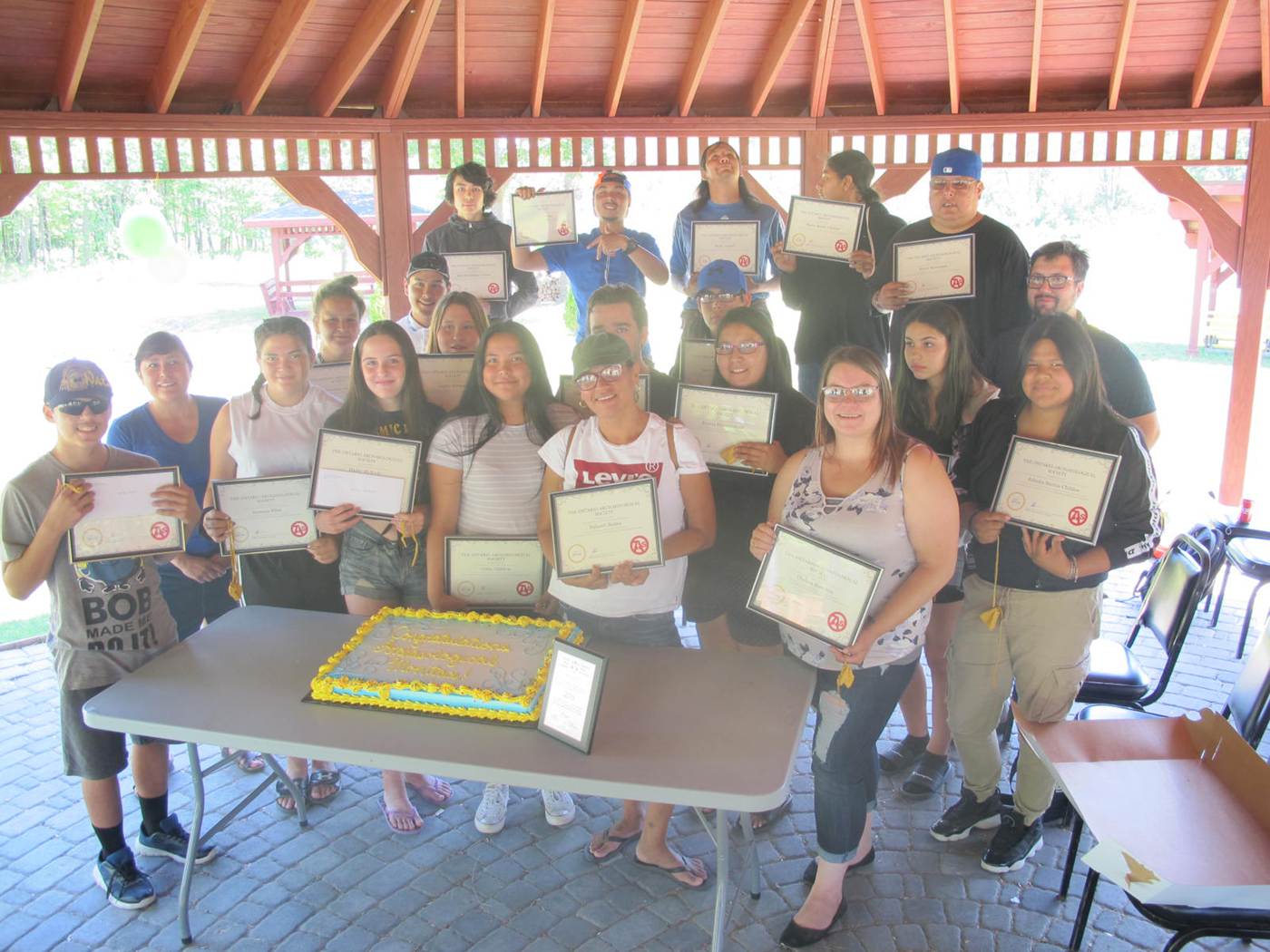
In the summer workshops of 2019, we trained over 50 participants from 11 different First Nations, exceeding both of our goals in terms of enrollment and representation of communities (Figure 2). Trainees ranged in age from 14 to 75. It was a welcome surprise to us that some elders wanted to take part in the entire training, and they shared their knowledge, experience, and wisdom generously. Another unexpected demographic and community buy-in derived from First Nation governments or organizations that paid their employees to attend. These people frequently came from lands and resources or culture departments. Their participation afforded the project an opportunity to address real day-to-day issues that communities were facing about political, cultural, skills, and economic issues in the heritage sector. Importantly, one government employee continued participating in subsequent trainings to deliver the module on Anishinabek history. Finally, we did not anticipate the generosity of all three communities, which provided opportunities for field trips, daily lunches and snacks, and feasting and celebrating during the training (Figure 3).
Test pitting component of the Indigenous Archaeological Monitor training at Mississauga First Nation. Test pitting occurred at the Chiblow 2, where elders observed the work and placed semaa (tobacco) in test pits before they were refilled. (Photo by Alicia L. Hawkins.)

Indigenous Archaeological Monitors at Mississauga First Nation show their certificates before ending the training with a fish fry. (Photo reproduced from the Ontario Archaeological Society website: https://ontarioarchaeology.org/reconciliation-2/; photo by Alicia L. Hawkins.)
During the fall of 2019, we reached out and met with Dokis First Nation and Atikameksheng Anishnawbek, which are located in our funder's catchment area. They expressed interest in participating in our 2020 workshops. However, in-person training became a concern the following spring because of the pandemic, and we decided to put the project on hold for the health and safety of the communities. By the beginning of 2021, the risks of holding in-person workshops were still unclear, and we determined that we had to make a massive change to the training delivery. Our experiences in other virtual teaching gave us some insight about the possibilities for conducting remote workshops, and the decision was made to move the training entirely online. Although we lost the ability to provide applied field survey training, we expanded our roster of topics to include the application of drones in surveying, seriation/time, mapping, photography, rock art, artifact and feature digitization, and site formation. By reallocating costs associated with in-person instructed workshops, virtual training had two significant benefits: we could afford to train more people, and we were able to train people in communities that could not meet the 12-person threshold and were far from any other community.
Our plan for 2021 was to offer the training to the communities we had met with in late 2019 for a joint virtual training early in the summer and to use our connection with the OCF to draw on their sizeable membership and social media presence to hold a final online workshop at the end of August before youth returned to school. Consequently, we reengaged with Dokis First Nation and Atikmeksheng Anishnawbek. We also offered the workshop to Sarah's home nation of Nipissing First Nation (NFN), with the proviso that we would not pay participants because they were not located in our funding district. NFN paid their own members to join the workshop, again demonstrating the strong desire for archaeological training in the north. For the first virtual workshop, we certified 19 participants from three different nations. Significantly, by this time, we had three additional Indigenous trainers who were able to deliver modules, increasing our critical and Indigenous perspective of archaeological practice in Ontario.
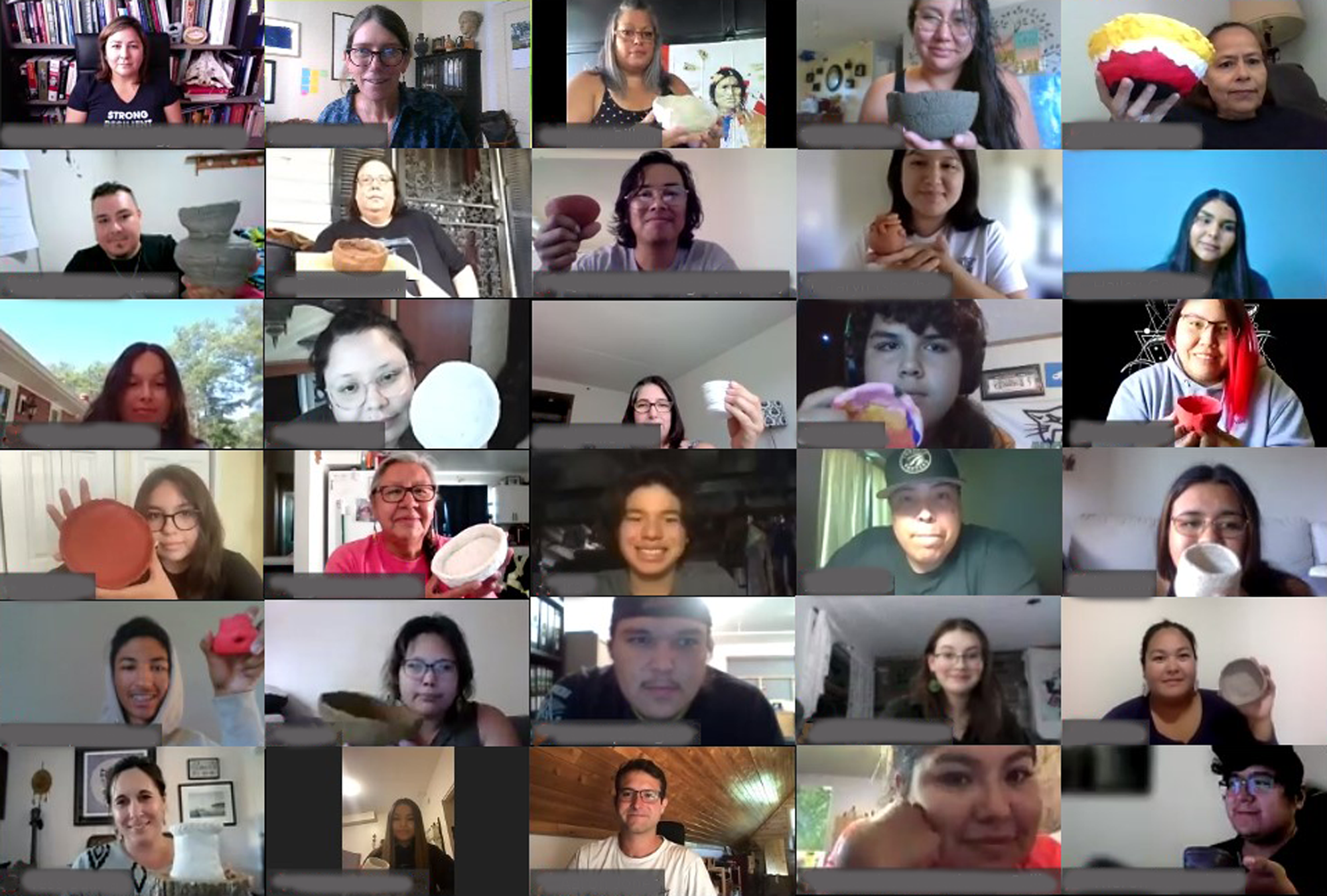
The final training in August 2021 was a great way to end the project. Word of mouth about the workshops resulted in six First Nations government employees who were paid to enroll and participate by their employers. Thirty additional people were certified from a combination of Manitoulin First Nations and several new communities, including Batchewana, Brunswick House, Garden River, Mattagami, and Missanabie Cree First Nations, and Netmizaaggamig Nishnaabeg (Figure 4).
Participants in the 2021 online training demonstrating the ceramic pots created as part of the workshop. (Zoom photo montage by H. Goulais.)
Project Outcomes
Despite the limitations imposed by the pandemic, the total number of IAMs certified exceeded 100 people from 21 different First Nations located in our granting catchment area over a three-year period, surpassing our original goal of 72 participants from six First Nations (Figure 1). Prior to our project, archaeological workshops had not been offered in northeastern Ontario. Consequently, this alone represents a significant leap in regional capacity building. Our focus on identifying and removing potential barriers for participation contributed to the project's success—that is, we were able to provide wages to attendees; we were able to certify them, providing them with a record of their participation; and we delivered the training in their home communities.
Many other positive outcomes were achieved from this project. We connected communities with the Ontario government so that they can (1) be regularly notified when CRM projects are occurring on their territories and (2) request data sharing agreements and engage in repatriation opportunities. Over the course of the training, we used our approach to include more Indigenous representation and perspectives. We also identified an important training gap for First Nation government employees, who have had little exposure to or knowledge of archaeology. To this end, we delivered additional trainings in November 2021 and July 2022.
As for our long-term goals, we continue to work with several of the communities to create more training and research opportunities on archaeological issues for which they require service. Our community relationships have also importantly led to collaborative public and scholarly outreach in the form of a podcast (Crandell Reference Crandell2021) and a conference presentation (Hazell et al. Reference Hazell, Toulouse, Recollet and Malleau2021). We have heard informally that several of the participants have taken part in archaeological CRM projects in our region or are pursuing undergraduate education in archaeology. Additionally, we are regularly contacted by Indigenous and non-Indigenous organizations who want to implement archaeological best practices during surveys and excavations.
CASE STUDY 2: ARTIFACT CATALOGING
A detailed history of the practice of archaeology in Ontario is beyond the scope of this article, but a few points will help to contextualize the artifact cataloging project that we describe below. Until the mid-1970s, there was no legislation focused on protection of archaeology within the province, and most archaeology was conducted either by universities or museums, or by staff from provincial parks. Beginning in the 1970s, the government of Ontario hired regional archaeologists, who staffed offices around the province, including in northern centers of Thunder Bay, Kenora, Cochrane, and Sault Ste. Marie (Noble Reference Noble1982). These archaeologists engaged in rescue excavations (Ferris Reference Ferris, Willems and van den Dries2007), but they also undertook survey and research excavations. Collections from these excavations were stored in regional government archaeology facilities. Standardized reporting was not required in the past. Although in many cases there are reports and catalogs of artifacts recovered, it is also clear that significant excavations occurred for which no final reports were ever filed.
The eventual closure of the northeast regional archaeology offices in the 1990s led to the artifact collections from many significant sites languishing in a series of locations in Sault Ste. Marie and Sudbury over the course of decades. In 2008, government archaeologists at the Ministry recognized that it was no longer tenable to store collections from northeastern Ontario in an unstaffed warehouse in Sudbury, Ontario. Government staff emphasized to licensed archaeologists the importance of proper curation of archaeological collections, and it was hard to do so when it could be argued that care of collections by government archaeologists did not meet these same standards (Government of Ontario 2022). Initially, the Ontario government planned to move the collections from Sudbury, in northeastern Ontario, to a facility more than 500 km away in London, Ontario. However, when First Nations communities learned of this plan, they requested that the collections instead be moved to the OCF (Beam and Brooks Reference Beam and Brooks2018).
In 2019, we visited the OCF to borrow artifacts from the La Cloche site for 3D scanning and printing as a part of the IAM program. At that time, the curator at the OCF expressed both a willingness for collections to be used in this way and a desire to make the collections more accessible to community members. Why, after all, were they being housed at the OCF if they were simply sitting in boxes? Anong Beam, the former executive director of the OCF, expressed that the artifacts in the collections are important to community members broadly because they “speak to a time before trauma” (Anong Beam, quoted in Hawkins Reference Hawkins2018 ).This can only be the case, however, if the artifacts are accessible.
Project Development
We began, at that time, to try to envision a project that would have several goals:
(1) To assist the OCF so as to better understand what exists in the collections, especially where maps and catalogs are lacking
(2) To further build capacity within local First Nations, by focusing on artifact identification and analysis
(3) To work toward culturally appropriate and sensitive uses for the artifacts, such as exhibits
(4) To assist the OCF, where desired, with information that might support decision-making about the future of the collections, possibly including deaccessioning
(5) Following the guidance of elders affiliated with the OCF, to find resources to help rehouse artifacts in materials that would be considered more culturally appropriate (e.g., breathable materials instead of plastic)
One of the large collections housed at the OCF comes from the La Cloche site on the north shore of Lake Huron. This site is directly adjacent to Sagamok and within its territory (Conway Reference Conway1975, Reference Conway2016). Through the IAM training program, we both established a good working relationship with SA staff and learned that the nation is actively engaged researching its history. It seemed logical then, to propose a project on artifact cataloging by working with SA.
Implementation
For a week in August 2022, we were joined by nine participants from six First Nations, two First Nations staff, and one non-Indigenous graduate student to begin the process of opening the boxes and cataloging the contents.
We began with a prayer in Anishnaabemowin led by an elder from the OCF. Before we started unpacking the boxes, they were opened and smudged. As workshop facilitators, we did not ask for these things to be done; our partners at the OCF led us, showing how to begin this process “in the good way.”
Over the course of five days, we worked together to count, identify, list, and describe the artifacts in 10 of the 42 bankers’ boxes of collections from La Cloche. In that short time, participants cataloged 18,675 objects. These consist of a wide range of artifacts, including Middle Woodland pottery, chert flaking debris, nails, window glass, kaolin pipe fragments, and animal bones. We even discovered a desiccated earthworm that had been carefully curated since the 1970s! Where the information was present on bags or labels, we recorded locations of artifacts and attempted to link these to the only map we found in one of the few available reports.
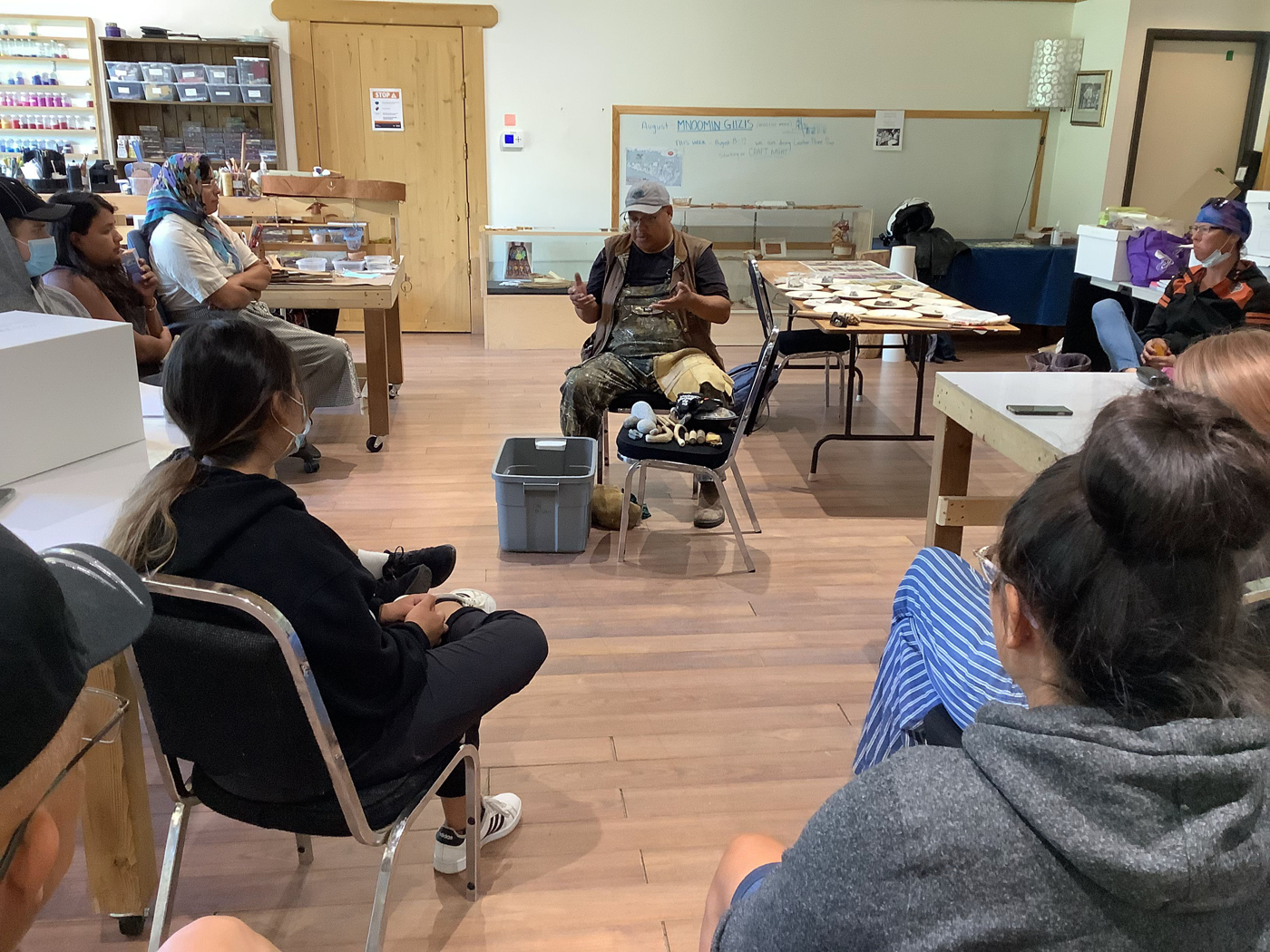
We saw the workshop as an opportunity to share knowledge: not necessarily our own but that of the workshop participants and that of the people at or associated with the OCF. On Mondays, a language group met at lunchtime. After lunch, the group posted large sheets of paper with terms for some of the things we might find and walked us through how to pronounce some of these words (Figure 5). We drew on the expertise of the historian from SA to provide us with context about the La Cloche site. We asked the OCF curator to share her insights and perspectives. One of the participants is a flintknapper, and we were thrilled to incorporate a knapping demonstration (Figure 6). To close the workshop, a local Anishinaabe artist explained how pigment (including red ochre) is made into paint. Together, the participants repainted the artwork in front of the OCF, using materials similar to those used by their ancestors in production of rock art, and possibly reenacting the type of rejuvenation that occurred at rock art sites in northern Ontario (Figure 7).
Anishnaabemowin words for things we may encounter or think about as part of the artifact cataloging workshop. (Photo by Alicia L. Hawkins.)

Cataloging workshop participant demonstrates flintknapping for other participants at the Ojibwe Cultural Foundation. (Photo by Alicia L. Hawkins.)
Artifact cataloging participants complete the workshop by repainting the artwork outside the Ojibwe Cultural Foundation with an ochre paint. (Photo by Sarah M. Hazell.)

We asked each person to photograph an object that they felt was meaningful to them or that they would like to know more about, in part so that participants could learn about artifact photography and to facilitate additional research. The artifacts selected were incredibly diverse: from chipped stone to farm equipment. They remind us that each belonging has some kind of story, was part of a place in the past, and served a purpose.
Future Plans
At the end of our week together, we wanted to hear about how this project could continue—and if it should. Education was felt to be valuable, and participants suggested that Kenjgewin Teg (Kenj; https://www.kenjgewinteg.ca/about), an Indigenous educational center on Mnidoo Mnising, would be an appropriate location for learning, in part because land-based learning could be easily integrated into courses through Kenj. Older participants expressed that they had a long-standing interest in heritage and that it was unfortunate that when they were younger, there were no local educational opportunities in the heritage field. Participants suggested that knowledge sharing about La Cloche and the belongings found there could come in alternative formats, including exhibits, a storyboard, or a children's book. Connecting language to the project was also underscored as a way of asserting and, in some cases, reclaiming identity.
Participants felt that the inclusive path we chose, in which different people shared knowledge, was valuable: future projects should also bring together multiple people and perspectives. The project was not simply about compiling lists; crucially, other learning was involved. They asked us to think of alternatives to computer-based cataloging, such as voice recordings.
Finally, participants expressed that they felt a responsibility to care for belongings and landmarks; this type of work is part of regaining knowledge. One way of caring may include deaccessioning. For example, this collection contains a large number of industrially manufactured items associated with non-Indigenous occupation of the fur trade post. It was suggested that it might be possible to record the objects but only to curate examples of the different types. We anticipate that a process of deaccessioning such as this is likely to take time because there are government regulations that need to be addressed. Another important way of caring for the belongings would be to return some of the items to the earth. Most importantly, in our view, is the process that must occur within Indigenous communities—in this case, the OCF and SA—to discern the appropriate and desired future of the artifacts. If called upon, we are committed to assisting with the process, and we anticipate that we may be able to advocate to the government to permit repatriation and deaccessioning, which would open the way for reburial.
CONCLUSIONS
In considering how the Indigenous Archaeological Monitoring and Artifact Cataloging projects have unfolded over the last several years, we can make both positive and negative observations. First, there is clearly an appetite for archaeological training. Although the funded program for IAM training concluded in 2021, we continue to receive requests for nonfunded training from First Nations around the province. Because we had an established curriculum that could be used for online delivery, we were able to provide two additional opportunities for northern communities despite limited resources.
These projects would not have been possible without the knowledge, expertise, and generosity of volunteers from the archaeological community. These people traveled hundreds of kilometers to deliver modules at our in-person trainings, making their contribution even more meaningful. Virtual trainings, on the other hand, were delivered over Zoom, and we were able to include many more experts, including people from different parts of Ontario and several individuals from Europe. For instance, we had 19 volunteers deliver modules on speciality topics for our online workshops. The variety of specialities compensated for the more impersonal virtual platform, and participants welcomed new topics, faces, and experiences every day of the two weeks. We are grateful for their sensitive and respectful approach to knowledge sharing with First Nations participants. Non-Indigenous allies are a critical component of our workshops, and we will continue to foster those relationships.
We focused on youth, particularly in the IAMs, but we note that older adults also joined to an extent beyond what we originally anticipated. In addition to their roles as knowledge keepers, some elders also participated as archaeological trainees. This seemed to happen almost organically, such as at Mississaugi First Nation, where the training was held outdoors on the pow-wow grounds. A group of grandmothers (Gookmisnaanik) watched from a short distance away, joining in when they wanted to make contributions. There were many instances of participation by people who were related, either closely (mother–daughter; sister–brother) or more distantly (the ubiquitous cousins); in some cases, the projects provided opportunities to reconnect with family. Knowledge about the workshops was spread by word of mouth through kin networks. In future programs, we will aim to build in more opportunities for intergenerational participation.
Our curriculum was broad, and over time, we realized that participants in the program had different backgrounds and priorities. Our program was developed for youth, but given the consistent interest in the training from members of First Nations government, we anticipate that future training will include modules tailored to the different backgrounds and interests. For example, the legislative context was considered somewhat dry for the younger participants, but it was one of the most important modules for First Nations staff.
There are 133 First Nations in Ontario, and others with a land base outside the province but with historical roots in Ontario. This can make training and programming complex: the priorities, traditions, and governance structures are not the same across communities. Even determining whom to approach about archaeology is not straightforward. We liaised first with First Nations umbrella organizations, such as the AN and the OCF. Information was transmitted through well-established networks within those communities, and when individual communities expressed an interest, we began a conversation directly with them. Our relationship with the OCF was particularly fruitful: it hosted two trainings and the cataloging workshop. We believe the strength of this relationship lies both in the friendships (relationships of trust) we have built with folks at the OCF over several years and in the idea that we are trying to tangibly assist the OCF with the material in its care.
Finally, there were positives and negatives of holding virtual training, which developed as a direct result of restrictions imposed by the pandemic. The major advantage of online workshops was that we could mobilize and reallocate finances to serve a much broader pool of applicants, allowing us to host over 100 participants from more than 20 First Nations. Although this led to the inclusion of additional foundational and cutting-edge archaeological topics, we were able to see that participants over the course of two weeks experienced Zoom fatigue. Luckily, this was not enough of a deterrent to learning given that most participants (over 95%) completed the workshops.
The success of these initiatives, we believe, stems from not rushing the relationship-building process, and this is our biggest take-home message for our readers. Because of the time we took to make connections with communities, our “service” did not feel like “work”—either to participants or to us. We had opportunities to create friendships, relationships, and alliances from which everyone could benefit. It is on this basis that we continue to look to future projects—to doing them in the good way, with no strings attached. Although these funded projects are now complete, we believe that one of the aspects of our service is finding the means to support future initiatives, which we are now engaged in doing.
Acknowledgments
Many people and organizations have been involved in these programs. We are grateful to the OAS, which has been a host organization for the training programs, and to the many OAS volunteers and others who delivered one or more modules over the course of the trainings. Anishinawbek Nation facilitated our connecting with the many First Nations in northeastern Ontario. Sagamok Anishnawbek, Mississauga First Nation, Mississaugas of the Credit First Nation, Nipissing First Nation, Dokis First Nation, Atikameksheng Anishnawbek First Nation, and the Ojibwe Cultural Foundation hosted trainings, either in person or virtually. Chi-miigwetch to the many participants—elders, youth, First Nations government staff, and others—who came together to learn and share. Archaeological fieldwork was undertaken under license P-081 to Alicia L. Hawkins.
Funding Statement
The Ontario Trillium Foundation provided the $270,000 CAD GROW grant that supported the IAM training program. We thank the University of Toronto Mississauga and the Social Sciences and Humanities Research Council (through the Manitoulin Island Summer Historical Institute grant to C. Podruchny) for support of the artifact cataloging project, which had a budget of approximately $36,000.
Data Availability Statement
This article outlines two case studies pertaining to the training of individuals from First Nations in Ontario. We did not collect data per se; however, a program review of the Indigenous Archaeological Monitor training was produced for the Ontario Archaeology Society and is available from the OAS by request. The catalog produced for the La Cloche materials is available from the Ojibwe Cultural Foundation and Alicia L. Hawkins by request.
Competing Interests
The authors declare none.


 Open access

