


Introduction
Eleonora’s Falcon Falco eleonorae is a common breeder on islands and coasts of the Mediterranean Sea and Macaronesia, while during the winter (austral summer) it is mainly found in Madagascar and adjacent islands (Walter Reference Walter1979). Although the species is classified as Least Concern (IUCN 2012), with the exception of its breeding period, the rest of its annual life cycle remained poorly studied until recently. Since 2008 the migratory journey undertaken by individuals from Italy, Spain and Greece (Gschweng et al. Reference Gschweng, Kalko, Querner, Fielder and Berthold2008, López-López et al. Reference López-López, Limiñana and Urios2009, López-López et al. Reference López-López, Limiñana, Mellone and Urios2010, Kassara et al. Reference Kassara, Fric, Gschweng and Sfenthourakis2012, Limiñana et al. Reference Limiñana, Mellone, López-López and Urios2012) was revealed with the aid of satellite telemetry. This new technology has also enabled scientists to investigate the species’s wintering habits on a quasi-daily basis for the first time (Gschweng et al. Reference Gschweng, Kalko, Berthold, Fielder and Fahr2012, Kassara et al. Reference Kassara, Fric, Gschweng and Sfenthourakis2012, Mellone et al. Reference Mellone, López-López, Limiñana and Urios2012), a task that would have been almost impossible with traditional field surveys (but see Zefania Reference Zefania2001).
In a previous study, we showed that four falcons originating from Greece tended to occur more often in the humid submontane forests of Madagascar during the wintering period 2009–2010, in spite of individual variability in space-use (Kassara et al. Reference Kassara, Fric, Gschweng and Sfenthourakis2012). The findings of two recent studies have revealed a similar distribution pattern for three Spanish (Mellone et al. Reference Mellone, López-López, Limiñana and Urios2012) and seven Italian Eleonora’s Falcons (Gschweng et al. Reference Gschweng, Kalko, Berthold, Fielder and Fahr2012). According to their results, the occurrence in the north and northeastern part of the country is associated with the climate of the area (Gschweng et al. Reference Gschweng, Kalko, Berthold, Fielder and Fahr2012) in addition to particular habitat types (Mellone et al. Reference Mellone, López-López, Limiñana and Urios2012).
In view of these findings, herein we extend our previous work by considering not only the vegetation, but also the topography and climatic conditions in Madagascar to better understand the ecological requirements of the species during the wintering period. In particular, we used a niche-based technique, Maxent (Phillips et al. Reference Phillips, Anderson and Schapire2006), to model the distribution pattern of four Eleonora’s Falcons previously tagged with solar transmitters (see Kassara et al. Reference Kassara, Fric, Gschweng and Sfenthourakis2012 for a detailed description) within their wintering grounds in Madagascar. Maxent is a niche-based method that has recently gained popularity since (a) it doesn’t require absence data for model-building, (b) it performs well even at small sample sizes and (c) it can reconstruct non-linear, complex interactions between the response variable and a set of environmental variables (Elith et al. Reference Elith, Graham, Anderson, Dudík, Ferrier, Guisan, Hijmans, Huettmann, Leathwick, Lehmann, Li, Lohmann, Loiselle, Manion, Moritz, Nakamura, Nakazawa, Overton, Peterson, Phillips, Richardson, Scachetti-Pereira, Schapire, Soberón, Williams, Wisz and Zimmermann2006). In spite of the fact that the cost of satellite transmitters remains an obstacle for large-scale projects that would otherwise allow for sound inferences at the population or even at the species level, such methodological approaches allow for the description and quantification of habitat selection even with small and unbalanced sample sizes. Maxent is well adapted to satellite telemetry data (Edrén et al. Reference Edrén, Wisz, Teilmann, Dietz and Söderkvist2010, Friedlaender et al. Reference Friedlaender, Johnston, Fraser, Burns, Halpin and Costa2011, Jiguet et al. Reference Jiguet, Barbet-Massin and Chevallier2011, Gschweng et al. Reference Gschweng, Kalko, Berthold, Fielder and Fahr2012), which, coupled with proper data sub-sampling in cases where a small number of individuals have been tracked (Edrén et al. Reference Edrén, Wisz, Teilmann, Dietz and Söderkvist2010), makes it a powerful tool for the investigation of species-habitat relationships or even for the development of effective and targeted field surveys. The landscape of Madagascar has been greatly altered since humans colonised the country and the majority of the pristine rainforests has been clear-felled (Green and Sussman Reference Green and Sussman1990, Harper et al. Reference Harper, Steininger, Tucker, Juhn and Hawkins2007) for shifting cultivation and logging (Jarosz Reference Jarosz1993). Although the rate of deforestation has slowed down in recent years (Conservation International et al. 2007), forest fragmentation still remains a challenge (Harper et al. Reference Harper, Steininger, Tucker, Juhn and Hawkins2007). Taking into account methodological challenges in classical habitat selection studies due to the restricted number of tracked individuals, if successful, our methodological approach will facilitate future monitoring schemes as well as conservation practices (Gschweng et al. Reference Gschweng, Kalko, Berthold, Fielder and Fahr2012). Thus, to this end, we tested model transferability by contrasting model predictions with the 95% and 50% home range areas formerly estimated for the three Spanish Eleonora’s Falcons in the independent study by Mellone et al. (Reference Mellone, López-López, Limiñana and Urios2012).
Methods
Data preparation
Out of 2,204 telemetry locations received in total via the Argos system during the wintering period 2009–2010 for four Eleonora’s Falcons from Greece (Kassara et al. Reference Kassara, Fric, Gschweng and Sfenthourakis2012), we restricted the data pool to 561 locations of high positional accuracy (i.e. LCs 1–3) for the subsequent analyses. In particular, we excluded locations received two days after/prior to arrival/departure from the wintering grounds (Gschweng et al. Reference Gschweng, Kalko, Berthold, Fielder and Fahr2012). With the aim of reducing spatio-temporal autocorrelation, we considered consecutive locations that were received outside a two-hour window and located at least 1,000 m apart. In order to achieve equal representation of the four falcons in the resulting data pool, we created random subsamples of the available telemetry locations per bird that equalled the number of locations of the animal with the smallest sample size (i.e. 34 locations; Edrén et al. Reference Edrén, Wisz, Teilmann, Dietz and Söderkvist2010). We repeated the procedure 100 times with replacement, which resulted in 100 subsamples of telemetry locations for the subsequent analyses. We also generated a random ‘pseudo-absence’ data set of 10,000 points across the landscape of Madagascar with the Hawth’s Tools extension for ArcGIS 9.2 (Beyer Reference Beyer2004), subject to the constraint that they be located at least 1,000 m apart from each other as well as from the telemetry locations. In continuation, we overlaid a grid of 1 km x 1 km resolution that covered the entire country and considered every grid cell containing at least one telemetry location as ‘presence cell’ and every grid cell containing at least one ‘pseudo-absence’ point as ‘background cell’ for model-building for each of the 100 subsamples.
Eleonora’s Falcon is an insectivorous species during most of its annual cycle (Ristow Reference Ristow, Chancellor and Meyburg2004). It has been repeatedly observed hawking insects near wetlands, lakes, rivers, as well as over forested, herbaceous, and cultivated areas during the breeding season (Mayol Reference Mayol1977, Besson Reference Besson1982, Ristow and Wink 1992-94, Xirouchakis Reference Xirouchakis2005, Mas Reference Mas2006), the migration season (Archer 1937 in Stresemann Reference Stresemann1954; references in Ristow and Wink 1992–94) and at its wintering quarters (Thorstrom and Rene de Roland Reference Thorstrom, Rene de Roland, Chancellor and Meyburg2000, Zefania Reference Zefania2001). In addition, according to two previous studies, during the wintering periods 2008–2009 and 2009–2010 the four falcons from Greece as well as three falcons from Spain were mainly distributed in high altitude areas in Madagascar (Gschweng et al. Reference Gschweng, Kalko, Berthold, Fielder and Fahr2012, Kassara et al. Reference Kassara, Fric, Gschweng and Sfenthourakis2012, Mellone et al. Reference Mellone, López-López, Limiñana and Urios2012). Therefore, we considered as candidate predictors of habitat suitability for the occurrence of Eleonora’s Falcons across Madagascar the elevation, slope and aspect of the terrain, as well as the percentage of land cover within each grid cell (Table 1). We extracted the aforementioned topographical variables from a Digital Elevation Model of 90 m x 90 m resolution (http://srtm.csi.cgiar.org/) and calculated their corresponding mean values within each 1-km2 grid cell. We also used a vegetation raster layer of 29 m x 29 m resolution produced by the Madagascar Vegetation Mapping Project (http://www.kew.org/gis/projects/mad_veg/datasets.html) to calculate the percentage of each land cover class within each 1-km2 grid cell. We only considered those vegetation classes that were present within the presence cells for model building. We also considered the mean climatic conditions during the wintering period, from November to April (WorldClim database, Hijmans et al. Reference Hijmans, Cameron, Parra, Jones and Jarvis2005). As in Gschweng et al. (Reference Gschweng, Kalko, Berthold, Fielder and Fahr2012), we calculated the average and extreme values for the mean, maximum and minimum monthly temperature, as well as for the monthly precipitation, for each 1-km2 grid cell (Table 1).
Description of the variables regarded as potential predictors of habitat suitability for the occurrence of Eleonora’s Falcon across Madagascar. Variables passing the test for multicollinearity, and thus used for model-building, are indicated with an asterisk.

Model building
We first checked for the existence of multicollinearity among the candidate predictors, which could potentially overshadow the effect of a particular predictor, by calculating Spearman’s correlation coefficient (r). Then we contrasted the landscape configuration within the presence and background cells using Maxent 3.3.3k (Phillips et al. Reference Phillips, Anderson and Schapire2006). In particular, we trained the Maxent model with 75% of each presence sub-sample (training data set) and evaluated its predictive performance with the remaining 25% (test data set). Data splitting was conducted at random once per presence subsample. We ran Maxent under default settings, except that we set the regularisation parameter (β) to 2 in order to reduce over-fitting given the restricted number of animals (Elith et al. Reference Elith, Phillips, Hastie, Dudík, Chee and Yates2011). We also increased the number of maximum iterations to 2,000 to achieve algorithm convergence. We chose the logistic output, which approximates the output of logistic regression, but rather than estimating directly the probability of occurrence of a target species, it quantifies habitat suitability for its occurrence across the study area in question (Phillips et al. Reference Phillips, Anderson and Schapire2006), i.e. Madagascar.
During model training, variable selection was based on a jackknife procedure which evaluates the explanatory information in each variable when used in isolation and the information lost when omitted from a given model. The same jackknife analysis was repeated for the test data sets in order to check whether the variables chosen when the model was fitted to the training data set were equally important when the model was fitted to the test data set. We report results as averages of the 100 Maxent models (hereafter, final model).
Model evaluation
As a measure of model predictive power, we chose the Area Under Curve (AUC score; Hanley and McNeil Reference Hanley and McNeil1982). The AUC score ranges from 0.5, for models that predict no better than random, to 1.0, for models with perfect predictive power. Nonetheless, the AUC score has been criticised as a metric of model accuracy, because being a rank-based measure it does not account for the degree to which the predicted values have been calibrated (Lobo et al. Reference Lobo, Jiménez-Valverde and Real2008, Phillips and Dudík Reference Phillips and Dudík2008), while it tends to be biased when the spatial extent to which models are carried out is large as in our case (Lobo et al. Reference Lobo, Jiménez-Valverde and Real2008). Thus, we also investigated the predicted values of habitat suitability within the 95% and 50% home ranges of the four Greek falcons (see Kassara et al. Reference Kassara, Fric, Gschweng and Sfenthourakis2012 for a detailed description), as well as within the 95% and 50% home ranges of three Spanish falcons (reproduced from Figure 1 of Mellone et al. Reference Mellone, López-López, Limiñana and Urios2012, with permission from the British Trust for Ornithology) tracked during the wintering periods 2008–2009 and 2009–2010. Given that Mellone’s et al. (Reference Mellone, López-López, Limiñana and Urios2012) satellite telemetry project coincided partially in time with the current study, such comparisons could serve as an indication of how well the resulting final model generalises to other populations of the species.
The relative importance of the candidate variables averaged over 100 Maxent models and quantified via (a) the explanatory power of each variable when used in isolation and (b) the loss in the gain when a particular variable is dropped from the model, judging by both the training and test data sets.

Finally, we computed four landscape metrics with the Patch Grid Analyst for ArcGIS 9.2 (Elkie et al. 1999) in an attempt to understand landscape structure within all available presence grid cells of the Greek falcons better. In particular, we estimated the percent cover, patch size and number, as well as the mean proximity index for each vegetation class, which is a measure of the degree of isolation and fragmentation.
We implemented spatial analyses with ArcGIS 9.2 (ESRI 2006) and statistical analyses with SPSS 18.0 (SPSS 2009). For the latter, mean values and standard deviations are reported with statistical significance level set to α = 0.05. All data were projected at UTM 38S zone.
Results
The initial data pool of the 561 telemetry locations received during the wintering period 2009–2010 occurred in 472 grid cells. Each of the 100 sub-samples used for the model-building process contained half of the available presence grid cells (221.03 ± 4.30). The preliminary check for multicollinearity revealed no strong correlations among the candidate variables (Spearman r < 0.6), but for the temperature variables which were highly intercorrelated among each other (0.75 < r < 0.98), as well as with the topographical variable “elevation” (-0.97 < r < -0.77). Thus, we only included the variable “elevation” in the model-building process, which was thereafter also considered as a proxy for any possible effect of the temperature variables on Eleonora’s Falcon occurrence.
When used on its own, the variable maximum monthly precipitation (PRECmax) had the greatest explanatory power both for the training and test data sets, followed by elevation (ELEV), the percent cover of humid forest (class14), minimum monthly precipitation (PRECmin), the percent cover of degraded humid forest (class16) and of cultivation (class4) (Figure 1a). The final model lost the most explanatory power when the variable elevation (ELEV) was dropped from the model, followed by the minimum monthly precipitation (PRECmin), maximum monthly precipitation (PRECmax) and the percentage cover of cultivation (class4), degraded humid forest (class16) and of humid forest (class14) (Figure 1b).
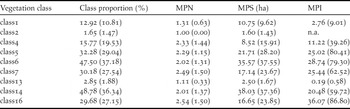
Judging by the corresponding response curves, habitat suitability increased sharply in areas above 800 m altitude (ELEV), which receive at least 28 mm of rainfall during the driest month (PRECmin) and at least 250 mm of rainfall during the wettest month (PRECmax) of the period November–April. In addition, habitat suitability varied proportionally with the percentage cover of degraded humid forest (class16). The same applies for the percent cover of intact humid forest (class14) and cultivation (class4), but in these cases the increase in habitat suitability was more subtle (Figure 2). Actually, all these vegetation classes did not occur over extended areas within the presence grid cells, but were distributed in relatively fragmented and isolated patches (Table 2).
Figure 2. Response curves of the predicted habitat suitability across the range of values for the six most important predictors: elevation (ELEV), maximum (PRECmax) and minimum (PRECmin) monthly precipitation for the period November–April, percent cover cultivation (class4), percent cover humid forest (class14) and percent cover degraded humid forest (class16). Each graph illustrates how the response variable (i.e. habitat suitability) varies with each predictor while all other predictors are held at their mean sample value. Grey lines represent response curves for all 100 bootstrapped Maxent models, while the bold black lines represent the resulting mean curve.


Landscape structure within 472 presence grid cells, summarised by the average proportion of each vegetation class (Class proportion), mean number of patches (MPN), mean size of patches (MPS) and the mean proximity index (MPI). Smaller values of MPI are indicative of more fragmented and isolated patches. Standard deviations are reported in parentheses. Vegetation class abbreviations as in Table 1.
The Maxent models fitted the training data sets very well (training AUC = 0.942 ± 0.005), while their predictive power was quite high (test AUC = 0.906 ± 0.018). If we consider as areas of high likelihood of Eleonora’s Falcon occurrence grid cells with average predicted suitability values greater than 0.75, then it is very likely that Eleonora’s Falcons will be observed in only 0.53 % of Madagascar. These areas are distributed along a north-south axis (Figure 3a) in what is known as the humid submontane forest ecoregion. Although most of them occur within the 95% Greek home range areas (90.81 %), the 95% Spanish home range areas also contain a considerable amount (58.58 %, pooled years) (Figure 3b).
(a) Predicted habitat suitability for Eleonora’s Falcon occurrence across Madagascar based on the telemetry locations received from four satellite-tracked individuals originating from Greece during the 2009–2010 wintering period. (b) The 95% home range areas and (c) 50% home range areas of the four Greek falcons (adapted from Kassara et alю 2012) as well as of three Spanish falcons that overwintered in Madagascar during 2008–2009 and 2009–2010 are overlaid (reproduced from Figure 1 of Mellone et al. Reference Mellone, López-López, Limiñana and Urios2012, with permission from the British Trust for Ornithology).

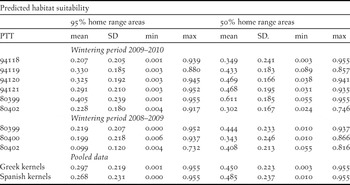
During the wintering periods 2008–2009 and 2009–2010, the formerly estimated home range areas of the four Greek and the three Spanish Eleonora’s Falcons overlapped to a great extent (Figures 3b, 3c; Tables S1, S2 in the online supplementary material) for spatial overlap of individual home ranges). The average predicted habitat suitability within the 95% home range areas was estimated at 0.297 (SD = 0.219) for the Greek falcons and at 0.268 (SD = 0.231) for the Spanish falcons (Table 3). Within the core areas of their home range areas (i.e. 50% contours), the average predicted habitat suitability was estimated at 0.450 (SD = 0.223) for the Greek falcons and at 0.485 (SD = 0.231) for the Spanish ones (Table 3).
Predicted habitat suitability for Eleonora’s Falcon occurrence within the 95% and 50% home ranges of four Greek and three Spanish falcons during the wintering periods 2008–2009 and 2009–2010.
Discussion
Eleonora’s Falcon is one of two non-resident representatives of the Falconidae family in Madagascar (Fergusson-Lees and Christie Reference Fergusson-Lees and Christie2001). Previous field surveys linked its presence to the eastern highlands, although there have also been sporadic occurrence reports from the rest of the country (Zefania Reference Zefania2001). While habitat selection patterns are hard to investigate through field surveys in such large study areas, quite recently three satellite telemetry projects (Gschweng et al. Reference Gschweng, Kalko, Berthold, Fielder and Fahr2012, Kassara et al. Reference Kassara, Fric, Gschweng and Sfenthourakis2012, Mellone et al. Reference Mellone, López-López, Limiñana and Urios2012) have contributed a more detailed description of the location of the species across its wintering grounds.
In a previous study based on the Global Land Cover Project 2000 classification, we showed that four Eleonora’s Falcons originating from Greece were located more frequently than by chance in humid submontane forests (Kassara et al. Reference Kassara, Fric, Gschweng and Sfenthourakis2012). Here, thanks to the availability of a more recent and detailed vegetation classification scheme (Madagascar Vegetation Mapping Project), the consideration of topographic and climatic variables, as well as the application of a newly introduced methodology (Maxent), we investigated their distribution pattern more thoroughly. In addition, having applied a proper data sub-sampling we were able to generalise our results in spite of the low number of individuals.
In particular, we showed that the Greek falcons prefer elevated areas receiving high amounts of rainfall during the wintering period and consisting of a mosaic of pristine or degraded humid forest and cultivation. A closer look at the landscape structure within the areas where the four Greek falcons were detected revealed that they occurred in rather fragmented and isolated patches of the aforementioned vegetation classes. Thus, our results verify the hypothesis put forward by Mellone et al. (Reference Mellone, López-López, Limiñana and Urios2012) in their recent study, in which they attributed habitat selection of three Spanish falcons within the core of their home range areas to a “spill-over effect” of insect prey from primary forests to nearby degraded humid forests and cultivation. Even if habitat fragmentation proves profitable for Eleonora’s Falcons in the short-term by providing better hunting opportunities in open habitats (like degraded forests and cultivation) located close to insect-rich habitats (primary forests) (Mellone et al. Reference Mellone, López-López, Limiñana and Urios2012), further shrinkage of pristine humid forests and subsequent land-use changes could ultimately lead to reduced species richness (Edwards et al. Reference Edwards, Larsen, Docherty, Ansell, Hsu, Derhé, Hamer and Wilcove2011, Gibson et al. Reference Gibson, Lee, Koh, Brook, Gardner, Barlow, Peres, Bradshaw, Laurance, Lovejoy and Sodhi2011). Habitat destruction, followed frequently by habitat fragmentation, has been repeatedly linked with biodiversity loss (Mittermeier et al. Reference Mittermeier, Gil, Hoffmann, Pilgrim, Brooks, Mittermeier, Lamoreux and Fonseca2004). This also holds true for forest insect species (Holloway et al. Reference Holloway, Kirk-Spriggs and Vun Khen1992) upon which Eleonora’s Falcon feeds (Thorstrom and Rene de Roland Reference Thorstrom, Rene de Roland, Chancellor and Meyburg2000, Ristow Reference Ristow, Chancellor and Meyburg2004 and references therein), such as winged termites, ants (Watt et al. Reference Watt, Stork, Eggleton, Srivastava, Bolton, Larsen, Brendell, Bignell and Watt1997) and beetles (Didham et al. Reference Didham, Hammond, Lawton, Eggleton and Stork1998). Eleonora’s Falcon is also commonly found foraging near watercourses (Mayol Reference Mayol1977, Besson Reference Besson1982, Ristow and Wink 1992–94, Mas Reference Mas2006) that attract insects such as dragonflies that are also included in the species’ diet (Walter Reference Walter1979, Zefania Reference Zefania2001, Ristow Reference Ristow, Chancellor and Meyburg2004). Although the vegetation classes “water” and “wetlands” were not among those most informative of the species’ occurrence, the predicted habitat suitability around areas such as Lake Aloatra within the Central Plateau, was relatively high. Thus, we cannot exclude the possibility that Eleonora’s Falcons also exploit such foraging areas during the wintering period, although less consistently than the humid submontane forests and cultivation of the eastern highlands (Zefania Reference Zefania2001).
In previous studies, both the Spanish and the Greek Eleonora’s Falcons used multiple centres of activity (Kassara et al. Reference Kassara, Fric, Gschweng and Sfenthourakis2012; Mellone et al. Reference Mellone, López-López, Limiñana and Urios2012), which could be the result of seasonal differences in food availability (Gschweng et al. Reference Gschweng, Kalko, Berthold, Fielder and Fahr2012). For instance, swarms of winged termites provide an abundant yet ephemeral food source (Olson and Alvarenga Reference Olson and Alvarenga2006) for Eleonora’s Falcons, which tend to emerge after rainfall (Eggleton and Davies Reference Eggleton, Davies, Goodman and Benstead2001). Precipitation proved to be an important predictor for the four Greek falcons’ presence in the current study, as well as for seven Italian falcons in the study by Gschweng et al. (Reference Gschweng, Kalko, Berthold, Fielder and Fahr2012). Actually, due to a greater number of tracked individuals, which allowed for a multi-temporal approach, the latter study revealed that the seasonal movements of the Italian falcons were determined, among other things, by the rainfall pattern across the country which in turn affected vegetation phenology and food availability during the wintering period (Gschweng et al. Reference Gschweng, Kalko, Berthold, Fielder and Fahr2012). Thus, our results provide further evidence for the effect of seasonality in food availability.
In addition, although considering also the underlying probability distribution of the falcons’ occurrence would have been more informative of the actual space use (Fieberg and Kochanny Reference Fieberg and Kochanny2005), the percentage of between-group spatial overlap of the estimated 95% home range areas of the four Greek Eleonora’s Falcons and the three Spanish falcons was at the same level as the percentage of within-group spatial overlap (Tables S1, S2). Eleonora’s Falcon global population numbers approximately 15,000 breeding pairs (Dimalexis et al. Reference Dimalexis, Xirouchakis, Portolou, Latsoudis, Karris, Fric, Georgiakakis, Barboutis, Bourdakis, Ivovič, Kominos and Kakalis2008), of which approximately 70% are believed to overwinter in Madagascar (Walter Reference Walter1979). Given that the final Maxent model predicted only a few highly suitable areas for the species’ occurrence, it comes as no surprise that the home ranges of falcons originating from different breeding regions overlapped to such a great extent. Thus, even at such a low sample sizes as the one used in the current study, Maxent can produce reliable predictions, transferable in time as well as to other populations of the species (Gschweng et al. Reference Gschweng, Kalko, Berthold, Fielder and Fahr2012). Satellite telemetry data are by default dependent, correlated in space and time, and available in many cases for only a few individuals (but see Jiguet et al. Reference Jiguet, Barbet-Massin and Chevallier2011). Hence, a proper sub-sampling of the data ensuring equal representation of all individuals in the data pool used for subsequent analyses, as well as a careful interpretation of the results is essential even with such efficient modelling techniques.
The importance for species-ecosystem interactions to be better explored and understood is even more crucial in landscapes such as those of Madagascar that have been extensively altered ever since humans colonised the country (Jarosz Reference Jarosz1993). Deforestation within the eastern rainforest, which originally extended over an area of 11.2 million hectares prior to human colonisation was estimated at 32% in the 1950s and 66% in the mid-1980s (Green and Sussman Reference Green and Sussman1990). A more recent study showed that almost half of the humid, dry and spiny forests of Madagascar occur in patches less than 500 km2, while most of these patches were found close to non-forest edges in the 2000s (Harper et al. Reference Harper, Steininger, Tucker, Juhn and Hawkins2007). The same authors argue that humid forests are less severely affected by deforestation and fragmentation in comparison to dry and spiny forests (Harper et al. Reference Harper, Steininger, Tucker, Juhn and Hawkins2007). Still, these figures would have been promising given that the political, social, and environmental interests are in line, which, as history has shown, is not the case for the eastern highlands of Madagascar (Jarosz Reference Jarosz1993, Vågen Reference Vågen2006).
Besides, the impact of forest management policies on the insect fauna of Madagascar, non-targeted pest control practices are known to have adverse food chain effects that could affect Eleonora’s Falcon in the long term. Locust outbreaks in the country have been mitigated by spraying with fipronil (among other insecticides) that was considered responsible for the decline of termites and consequently of insectivorous vertebrates, in a case study in south-western Madagascar (Peveling et al. Reference Peveling, McWilliam, Nagel, Rasolomanana, Raholijaona, Rakotomianina, Ravoninjatovo, Dewhurst, Gibson, Rafanomezana and Tingle2003). An estimation of the risk of indirect poisoning of Eleonora’s Falcon from insecticides in its wintering grounds would be premature at this stage since hard data are currently lacking. Still, carry-over effects related to habitat deterioration or decreased quality of sexually mature individuals while still at their wintering quarters are expected to have severe consequences in species showing strong migratory connectivity (Webster et al. Reference Webster, Marra, Haig, Bensch and Holmes2002) such as Eleonora’s Falcon. Thus, understanding the ecological requirements of Eleonora’s Falcon during the wintering period via satellite tracking projects coupled with species distribution models such as Maxent can be regarded as an essential first step to a holistic approach of the species’ conservation, as well as a guide for fieldwork in target areas. The inclusion of factors related to age or sex-depended idiosyncrasies (van Toor et al. 2011) and temporal variability in available resources (Gschweng et al. Reference Gschweng, Kalko, Berthold, Fielder and Fahr2012) could allow for refined predictions that are closer to the realised niche of the species in the future.
Supplementary Material
The supplementary materials for this article can be found at journals.cambridge.org/bci
Acknowledgements
We are most grateful to Dr Marion Gschweng (Ulm University) for demonstrating tagging techniques and for commenting on a previous version of this manuscript. We would like to thank two anonymous reviewers for their fruitful comments on a previous version of the current manuscript. We also wish to express our gratitude to the local church authority for giving permission to make use of the church building during the tagging of the falcons and to Olga Karagianni for mediating the arrangements. The work was funded by the A.G. Leventis Foundation through project “Survey and Conservation of Seabirds in Greece. All experiments and observations made for this study comply with current laws of Greece.



