

On a busy intersection in the affluent Polanco neighborhood of Mexico City, between Reforma Avenue and the Periférico freeway, and next to the Campo Marte military camp and its memorial to fallen soldiers, rows of large, rusted steel walls adorn what was previously an unused section of the Bosque de Chapultepec Park. While millions of drivers and pedestrians pass through the area every day as part of their commute, few are aware that this space now marks the state-sanctioned Memorial a las Víctimas de la Violencia (hereafter El Memorial), built in 2012 to commemorate the victims of the so-called war on drugs begun in 2006. Initiated by the Felipe Calderón administration (2006–2012), continued during Enrique Peña Nieto’s tenure (2012–2018), and followed by the recent establishment of the Guardia Nacional—a national police force under military control—at the start of the Andrés Manuel López Obrador government (2018–), the strategy to confront the drug cartels with an enlarged military presence has claimed more than 250,000 lives related to organized crime violence since 2006. It has also led to the disappearance of more than 82,000 individuals by January 2021 according to reports from the Comisión Nacional de Búsqueda (Secretaría de Gobernación, 2021).
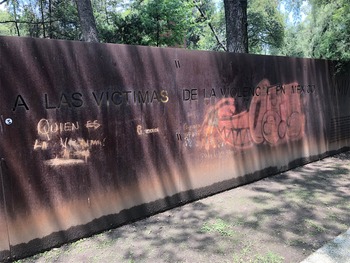
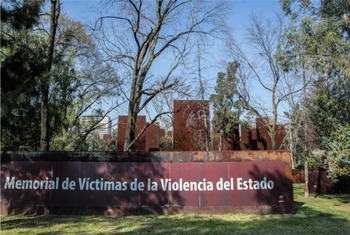
The massive steel plates, which look like they have been “dropped from the sky by an angry God” (Reference CaveCave 2013), do not include any names. The only permanent inscriptions on a few of them are the name of the memorial and quotes by renowned international authors and intellectuals that attempt to evoke general questions about death, memory, and mourning. Visitors can request a piece of chalk from the security guards that are ever-present as one walks through the space and use it to express their reactions directly on the steel plates (Figure 1). Traces of a variety of drawings and phrases are present on some of the walls, but the rain washes them away, eerily demonstrating the state’s power over memory and forgetting rather than the power of ordinary citizens to actively resignify this place. There are also traces of graffiti, some of which are erased by the government agency that manages the memorial (the Comisión Ejecutiva de Atención a Víctimas, CEAV), whenever messages are considered offensive or arguably run counter to the purpose of the memorial.Footnote 1
El Memorial a las Víctimas de la Violencia, steel plate with the title of the memorial and traces of graffiti, one of which asks “Who is the victim?” Photo by the authors, July 2017.

El Memorial in Polanco was a government response to the growing mobilization of Mexican civil society groups demanding justice for the victims of homicide and enforced disappearance, including their identification, decriminalization, and a space for collective mourning and public recognition in the context of the war on drug cartels. Yet the memorial remains largely unused and unrecognized by the sectors of civil society that originally demanded a commemorative space. The Movimiento por la Paz con Justicia y Dignidad, led by Javier Sicilia, a poet whose son was killed by members of a drug gang in Cuernavaca, Morelos, in 2011, had envisioned a space for communal mourning that could represent and mobilize society around the ongoing violence and its many victims, victims who were often portrayed by the government and the media as collateral damage, as criminals who killed each other, or as “deserving” of what happened to them (speech by Reference SiciliaJavier Sicilia, October 14, 2011).
Sicilia’s group hoped to develop a project led by victims of murder, abductions, extortion, disappearance, forced displacement and marginalization (Reference SiciliaSicilia 2011) focused on community participation and cultural development—what the architect Miquel Adrià calls a “place for a social catharsis in the face of violence and pain; a memorial that recognized that what was being commemorated was still happening; and a space that allowed mechanisms for building it day by day as an open process, an open wound; a work in progress that needed to be permanently inhabited.”Footnote 2 Instead, a controversial and rushed process resulted from the administration’s urgency to complete the project before Calderón’s National Action Party (Partido Acción Nacional, PAN) left office in 2012, ceding control back to the Institutional Revolutionary Party (Partido Revolucionario Institucional, PRI)—historically known for repressing past efforts to uncover the truth behind state involvement in massacres and disappearances. Calderón’s memorial project included a hasty contest (boycotted by many architects due to concerns about the process), as well as a problematic choice of location next to a military camp (when military officials have been accused of being the perpetrators of the violence or accomplices of drug cartels), far removed from the communities most affected by the violence.
Referred to by critics of the project as the “memorial of the state,”Footnote 3 a “bogus gesture,”Footnote 4 a “staging,”Footnote 5 or simply a “pretty park,”Footnote 6 for many memory activists El Memorial has become a reference point for a movement toward a different kind of commemorative project. In Mexico, questions of memory and public space had not been at the center of public debates and previous activism around these questions had mostly been suppressed by the state, particularly in the aftermath of the 1968 student massacre and the Dirty War of the 1970s (i.e., the “first period of disappearances,” Reference De Vecchi GerliDe Vecchi Gerli 2018, 15). In part, as de Vecchi Gerli (Reference De Vecchi Gerli2018, 25) claims, this is the case because Mexico’s transition to democracy did not lead to “deep structural change” and took place without a framework of transitional justice, whereas other countries have faced “military dictatorships or internal wars with more defined beginning and ending points” (see also Reference SorensenSorensen 2018; Reference Allier MontañoAllier Montaño 2009; Reference GellmanGellman 2019). Accordingly, De Vecchi Gerli (Reference De Vecchi Gerli2018, 7) asserts that while “scholars around the world have studied the battles for memory around the disappeared and around state violence more broadly in Latin America and elsewhere … the Mexican case has been neglected.”
While debates about memory surrounding the Dirty War in Mexico were underdeveloped in the absence of a framework of transitional justice, the current “second period of disappearances” (Reference De Vecchi GerliDe Vecchi Gerli 2018, 15) has seen an emergence of memory debates in the context of different forms of violence and high levels of impunity resulting from corruption and an ineffective criminal justice system in which victims and their families are presumed guilty and often mistreated by authorities. At the core of this discussion is the question of how, and for what purpose, the state, civil society organizations, and the families of the victims would actively foster the creation of sites of memory for victims of multiple forms violence that continue in the present.
Like de Vecchi Gerli (Reference De Vecchi Gerli2018), we focus on “who the agents of memory are and through which vehicles” they make their narrative about the past heard. However, rather than simply employing an angle of a “politics of memory”—who gets to shape the narrative about the past—we suggest a focus on a particular vehicle of memory activists more accurately reflected in the concept of a “politics of time” (Reference BevernageBevernage 2014, Reference Bevernage2015; Reference Wagner-PacificiWagner-Pacifici 2017; Reference HiteHite 2017). The memory activists we describe in the following sections are not simply concerned with how to remember the past but with delineating the past from both the present and the future in the first place. As Bevernage (Reference Bevernage2014, 18) has shown, measures and practices associated with transitional justice do not simply address a given past but are involved in “actively constituting and regulating the categories of past and present.”
Questions as to why, how, and when the disappearances and deaths are to be memorialized are most of all complicated by the fact that the violence is ongoing and is manifested in various ways. As Reguillo (Reference Reguillo2014) has shown, the tendency to speak of one violence (in the Mexican context and beyond) is often misguided, given major differences in “modes of operation and consequences.” Reguillo (Reference Reguillo2014) demarcates at least four types of violence: structural violence against the poor and marginalized; historic violence, based on long-lasting claims of inferiority of certain groups; disciplining violence, a form of violence that forces into submission by exemplary punishment (for example, the assassinations of women in Ciudad Juárez); and diffuse violence, “whose origin is impossible to attribute to anything other than phantasmagoric entities (narcos, terrorism), and which is almost impossible to prevent because it does not follow an intelligible pattern.” Enciso (Reference Enciso2017) points out that this lack of a clear definition of what constitutes violence in the context of the war on drug cartels has political consequences in terms of building a clear political agenda. Similar to other cases of state violence and organized crime in Latin America, including Colombia or Peru, in this context distinctions between victims and perpetrators are blurry, while peacemaking and memorialization efforts are still threatened by criminal organizations and state actors (Reference JelinJelin 2002; Reference Lacy and Riaño-AlcaláLacy and Riaño-Alcalá 2006; Reference BoudreauxBoudreaux 2016). The struggle over memory in this context is to a large extent a struggle over what and who needs to be remembered in the first place—even if these questions are often displaced and negotiated in debates about aesthetics, funding, and modes of commemoration.
In what follows, we examine and contrast three sites of memory, understood as “places where groups of people engage in public activity through which they express ‘a collective shared knowledge of the past’” (Reference Winter, Radstone and SchwarzWinter 2010, 312) and where they challenge this collective knowledge. We show how specific commemorative approaches foster or preclude associations between different forms of violence and how activists have used forms of memory protest and a “politics of time” to challenge both premature calls for closure and ambiguous claims of responsibility. The three sites, which we visited between July 2015 and September 2018, conducting interviews on-site and off-site with activists, architects, and government officials, illustrate a politics not simply concerned with commemorative acts but with struggles over different temporal horizons.
The Politics of Time
The first notion of a politics of time describes a challenge to the traditional sequencing of transitional justice. In many Latin American cases the question of memorialization arose after regime change or after an end to large scale violence. In the Mexican case we see a departure from this sequence. The creation of El Memorial is arguably a symptom of a broader contemporary tendency to engage in the “present’s immediate self-historicization,” which Hartog (Reference Hartog2015) described as “presentism.” However, it is also a deliberative attempt to imply an end to as well as a transition out of a specific period or regime. The attempt to address, name, and historicize ongoing forms of violence whose beginnings (and ends) and whose perpetrators and victims are often hard to delineate has proven difficult from both political and aesthetic perspectives, and consequently has been highly contested. This debate raises questions about the sequencing of specific transitional justice measures, for example with regard to evidentiary questions that remain unresolved but are often a condition for commemorative efforts (Reference Buchenhorst, Moradi, Buchenhorst and Six-HohenbalkenBuchenhorst 2017). It also raises the question of whether some of the spaces introduced below are best understood as memorials in the traditional sense, that is, as sites with a primarily commemorative function.
This leads to the second, closely related, understanding of “presentism” (Reference ChallandChalland 2016). While places like the Memorial New’s Divine or the Memorial por los Desaparecidos de Baja California discussed below are memorials in terms of the aesthetic and language they use, they are also meant to be spaces that actively prevent the constant reproduction of victims and that potentially create authority other than that of the state. They introduce a transformative, present- and future-oriented element in the creation of commemorative spaces, without, however, falling into the trap of forgetting or even justifying past victims through some notion of progress.
Lastly, Mexican sites of memory turn into historical claims about what event, type of violence, or time span is being remembered in the first place. With regard to making sense of the current violence resulting from the drug war as a temporally delineated sociopolitical phenomenon, activists have introduced a much broader historical trajectory that places current victims in a larger context of state violence. Increasingly, they draw connections between the two periods of disappearances by directly linking the two periods through specific semantic interventions, such as Comité 68’s inclusion of names of victims of state violence since the 1950s in El Memorial with a primary focus on the victims of the drug war. With Wagner-Pacifici (Reference Wagner-Pacifici2017, 4), we can call this process “carrying events forward.”
The architect Mario Ballesteros observes that “in Mexico, we’re used to monuments and closure.”Footnote 7 Yet, in the context of the war on drugs, civil society groups and activists have challenged this tendency both by intervening directly in state-sanctioned spaces such as El Memorial and by creating alternative memorials with a focus on the communities affected by different forms of violence in the places where events have taken place or are still taking place. Examples include the Embroidering for Peace network; the six “antimonuments” on Reforma Avenue in Mexico City to commemorate the forty-three students from Ayotzinapa, the victims of the ABC childcare facility fire, the disappearance of two youths on a highway in Guerrero, the victims of femicide, the sixty-five victims of a mine explosion in Coahuila, and the Tlatelolco student massacre of 1968; the Plaza de los Desaparecidos in Monterrey, or the plates with names of the disappeared surrounding the Estela de Luz in Mexico City, among others.
While the state memorial in Mexico City seems to eschew aesthetically any concrete assertions about the nature of the violence, it also manages to shield the state from responsibility and to determine which victims are grievable. Memory activists respond to these shortcomings not only to question the state’s allocation of grief (Reference ButlerButler 2009) but to extend the public’s understanding of violence, either by tying it to a long history of unaccounted state violence or by broadening the scope of state responsibility to questions of urban poverty and neglect and thus responsibilities for the future.
Some of the activists have focused on providing the abstract site of El Memorial with a more tangible narrative by adding names, by renaming the memorial itself, and by linking current violence to a longer, yet specific trajectory of state crimes dating back to the 1950s. They thus challenge the state’s effort to actively engage in the (increasingly global) aesthetics of countermonuments (Reference Assmann, Conrad, Assman and ConradAssmann and Conrad 2010) before questions of what is to be remembered are resolved or even debated. They also challenge the state’s attempt at closure—its “temporal Manichaeism” (Reference BevernageBevernage 2015) that seeks to “[unburden] the present by burdening the past” (Reference BevernageBevernage 2014, 20)—by turning El Memorial into an ongoing archive of victims.
While in this first case, abstraction stands in the way of identifying specific perpetrators, the second site, the New’s Divine memorial in Mexico City, exhibits the mirror image of this dynamic. The memorial project is based on a specific instance of police violence in the outskirts of Mexico City, and the initiators’ vision was to turn this contained event with nameable actors into a symbol and symptom of the violence of urban neglect more generally. Whereas the abstraction of El Memorial in light of the ongoing violence represented an effort to conceal, here abstraction is meant to reveal. Moreover, understood as a direct reaction to El Memorial by architect Sergio Beltrán, here a “participatory memorial” is not simply about increasing access to the debate around what is being remembered but renews focus on the functional and communal value of the site as a space for cultural programming, education, and political engagement.
The interventions in the Maclovio Rojas plot in Tijuana by the RECO artist/activist collective and the Asociación Unidos por los Desaparecidos de Baja California, also attempt to create a space for memory and mourning directly in the location where the acts of violence took place, while at the same time addressing issues of urban renewal and rebuilding social ties among communities. Similar to the New’s Divine memorial in terms of developing a memorial in a marginalized area of the city, and balancing the different interests of state and nonstate actors and families of the victims, the Memorial por los Desaparecidos in Tijuana also faces the challenge of its location in an area where drug cartels and criminal activity are constantly present. The activists and families of victims face threats, the participation of residents of the area is limited, and the appropriate use of the site itself is still debated, not least because the site contains victims’ remains and processes for their identification continue to be explored.
Commemorative spaces or public displays that resist the dichotomies reproduced in state-sanctioned memorials can have several functions, as exemplified by numerous movements in Latin America that challenge state narratives in existing memorials and museums (Reference JelinJelin 2002). The examples of responses to the state memorial presented below represent moments when “memory work becomes memory protest” (Reference WüstenbergWüstenberg 2017, 18; italics in original). Through contentious tactics, like the repurposing of existing memorials, these acts can provide what Karl (Reference Karl2014b, 730) has called “rehumanization.” They also provide places to engage in rituals of mourning that mark an end to the domination over the bodies of the victims by others. Boudreaux (Reference Boudreaux2016, 396) also shows that activist interventions such as the graffiti memorials in Juarez demonstrate publicly that the victims’ lives had meaning and are grievable, and can also invite reflections on the social and political conditions that caused the death or disappearance (see also Reference TaricaTarica 2015).
“Memory-activist practices,” Gutman (Reference Gutman2017, 14) claims, “differ from more ‘traditional’ and official commemorative practices by their interactive nature, their accessibility, and their aim to reach the participation of current residents of the sites where violent events once took place.” Moreover, by going beyond commemorative issues, memory activists are creating what Gutman (Reference Gutman2017, 22, 149) calls “oppositional knowledge” in these alternative commemorative spaces where activists use memory as “a weapon of the weak,” in James Scott’s (Reference Scott1987) terms. Through the oppositional knowledge evoked by the interventions depicted below, activists broaden claims about the grievability of victims—beyond the state’s definition of victims as “collateral casualties” (Reference SiciliaSicilia 2011)—but they also assign state responsibility, seek forms of justice beyond the state, and address questions of social justice and urban renewal to deepen the understanding of the conditions of violence and offer tools to address them. This is what makes their memorials presentist: they aim to directly address and redress the current and future conditions that are conducive to creating the expandable bodies that often fall victim to the “narco-machine” (Reference ReguilloReguillo 2014) and to the state’s response.
As we will show, however, these efforts come with their own risks and tensions: they work with and against the state at the same time; they attempt to depict wide-ranging and often structural violence while acknowledging the necessity to mourn individual victims; and they often take place in the cultural sphere where they run the risk of depoliticizing the larger debate on narco-violence.
Memorial a las Víctimas de la Violencia
Memorialization has been acknowledged as an important tool in the context of mass human rights violations and is often seen as a symbolic form of reparation for the victims (Reference Brett, Bickford, Ševčenko and RiosBrett et al. 2007). However, memorials are also expected to be future oriented: in an imagined ideal-type, the cathartic, victim-focused, and mourning-related functions of sites of memory are to be carefully balanced with the didactic and social functions for society as a whole (Reference Brett, Bickford, Ševčenko and RiosBrett et al. 2007). Increasingly, memorials in transitional contexts are supposed to perform plurality and commitment to deliberation by incorporating “in the design of territorial markers a level of ambiguity that invites active engagement of the public, offering an opportunity for expression of a variety of sensibilities,” as Jelin (Reference Jelin2007) has argued specifically for the case of the Southern Cone of South America.
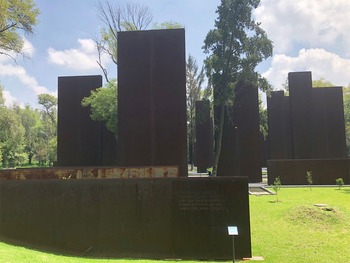
The state-sanctioned memorial in Mexico City, designed by the architects Julio Gaeta and Luby Springall, performs adherence to an open concept of memorials (Figure 2). Its openness is mostly performed through abstraction, tying into the broader aesthetics of counter-monumental architecture (Reference StevensStevens 2009). The abstract design shows the influence of Richard Serra’s sculptures and Peter Eisenman’s Memorial for the Murdered Jews of Europe, renowned and controversial in its depiction of absence, as well as other recent “non-representational and self-thematic” (Reference PickfordPickford 2012) memorials, particularly in Uruguay, Argentina, and other countries that Gaeta and Springall visited as part of their research.Footnote 8
El Memorial a las Víctimas de la Violencia viewed from the Periférico freeway. Photo by the authors, July 2017.

In many ways, the critique of other abstract memorials can be rehashed here: a lack of establishing historical relations to a specific event risks becoming “aesthetically autonomous or self-referential or ‘merely formal’ or—the antithesis of bearing any historical relation—myth” (Reference PickfordPickford 2012, 421). As Stevens (Reference Stevens2009, 159) claims, such an “absence of expressive symbolism … [is] problematic … when abstract designs are meant to commemorate important … events for a broad public.” Similar to other abstract memorials, El Memorial depicts absence without the concreteness attached to real relations of power (Reference CrownshawCrownshaw 2008, 224).
The broad, existential quotes on the steel plates about forgiveness, death, mourning, and peace, ranging from Gandhi to Martin Luther King and a number of well-known Mexican and Latin American authors, signify to the visitor that El Memorial taps into a vague “moral internationalism” (Reference CrownshawCrownshaw 2008, 216) that remains historically unspecific. These appear as an “uninformed and disorganized pastiche” of vague phrases taken out of context, some of which appear “crudely nationalistic” and “self-satisfying” (Reference RodríguezRodríguez 2015). This becomes particularly problematic in light of the demands of the social movements that had focused on balancing a broad depiction of violence with a more explicit naming of specific perpetrators and victims, since many cases remain unreported or undocumented (including migrants and victims of trafficking whose identities are unknown), and local government archives are often inaccurate or limited. There is, however, very little information at this site.
Some of the memorial’s most widely criticized features, such as the choice not to include names, are justified by the designers in references to an open memorial concept. Government officials from the office created to support victims (including care for the memorial space), as well as the architects, claim that names were left out so as to not “exclude anyone”Footnote 9 but also so that “victims are not next to perpetrators, and so that we know it is ongoing.”Footnote 10 This indicates the tensions between the evidentiary and expressive functions (Reference Buchenhorst, Moradi, Buchenhorst and Six-HohenbalkenBuchenhorst 2017) of this memorial site.
Even if, according to Buchenhorst (Reference Buchenhorst, Moradi, Buchenhorst and Six-Hohenbalken2017), questions of evidence and representation rarely fall into perfectly delineated phases,Footnote 11 they are nonetheless prone to a certain sequencing whereby memorialization and aesthetic questions mostly follow after some efforts of historical contextualization have been made. However, the aesthetic “paradigm” linked to countermonuments has itself “become normative, redeployed in diverse geographical and political contexts to do very different kinds of work” (Reference Stevens, Franck and FazakerleyStevens, Franck, and Fazakerley 2012, 968), even where, as in Mexico, evidentiary debates about the nature of the event to be remembered are far from settled. In this context, the process of gathering such evidence often falls on the families of victims themselves (Reference Schwartz-Marin and Cruz-SantiagoSchwartz-Marin and Cruz-Santiago 2016; Reference RobledoRobledo 2017).
Cullen Benitez (Reference Cullen Benitez2013, 44) claims that the memorial ultimately “does not tell the story of the conflict, not even the government’s version, which conceived it in the first place.” Instead, visitors are encouraged to engage and shape the memorial according to the original concept, “open to the city and open to the appropriation by the citizens” (Gaeta and Springall, quoted in Reference EdelsonEdelson 2013). In fact, those entering the grounds can ask for chalk to express their own reactions or messages on the steel slabs. Ironically, by inviting temporary graffiti, the site plays with a mode of expression that, in other commemorative spaces in Mexico, has been linked to the delinquency of the victims and therefore often been deciphered as a posthumous confirmation of the criminality of the victim (Reference BoudreauxBoudreaux 2016). But, as the architect Arturo Ortiz Struck argues, “the place is besieged” and the presence of security police throughout the space “makes it impossible to inhabit it.”Footnote 12
The space of potential civic engagement has thus been created with specific limits in mind, not least in the selection of its location, “where unless you know where to look for it, you are unlikely to stumble across it” (Reference PerkinsPerkins 2013). Moreover, the choice of placing the memorial next to a military park is, to many, a clear statement that the administration actively disregarded the role of the military and the state in the violence. (Springall, however, claims a different symbolic significance: “If the military has contributed to the violence, the memorial is right next to them to remind them every day.”Footnote 13) In this sense, the memorial actually departs from a countermonumental language, which more often than not derives no “symbolic meaning from any specific external arrangements” (Reference Stevens, Franck and FazakerleyStevens, Franck, and Fazakerley 2012, 960). Furthermore, the memorial’s placement in one of the most affluent neighborhoods of Mexico City, “the most foreign area to this conflict,” avoids a direct confrontation with those most vulnerable to the narco-machine, although its failure in this regard is also an inherent admission of the role of class in the conflict (Reference Cullen BenitezCullen Benitez 2013, 42).
In its arguably more straightforward symbolism, the memorial thus does make specific historical claims. One of the few concrete references in the memorial is the inscription of the names of three civil society groups considered to be supportive of the Calderón government—Alto al Secuestro, Mexico SOS, and Fundación Camino a Casa—all of them founded after 2005 with a focus on issues of crime and security. All other organizations of families’ victims and activists working on these issues were left out or eventually disengaged on their own because they were disappointed with a process that envisioned their participation merely as a way to legitimize the state’s project. “Society is in charge of making the memorial,” the architects claim in their description of the memorial (Archdaily 2013). However, in this context, many activists found that engagement with an illegitimate memorial would give too much ground to the state-sponsored view of violence. While some of them take the invitation to (re)appropriation seriously—that is, they take on the proposed countermonumental features of the state memorial—others carry out their memorial activism elsewhere.
Comité 68
Comité 68 is an organization founded by a group of activists, intellectuals, and artists to commemorate the victims of the 1968 and 1971 student massacres in Mexico City and the Dirty War of the 1970s. With the main goal of bringing the perpetrators to justice and ensuring that these events are publicly remembered, the group created an archive of victims of state violence collected through oral histories and primary documents and has helped build a legal case against Mexican officials such as President Luis Echeverría (1970–1976). Building on their work around public memory, which has mainly consisted of commemorative marches, publications, and a stele dedicated to the victims of the 1968 massacre in Tlatelolco Plaza, members of Comité 68 decided to intervene in the space of El Memorial to reclaim and eventually transform it. Their main goals were to challenge the state’s narrative by drawing a link between the drug war and state violence dating back to the 1950s, similar to what organizations such as HIJOS México (Hijos por la Identidad y la Justicia contra el Olvido y el Silencio) have claimed in relation to spaces like the Museo Casa de la Memoria Indómita in Mexico City, inaugurated in 2012, or the new 1968 memorial museum, M68, inaugurated in 2018, which link the violence of 1968 and 1971 to current events. As Karl (Reference Karl2014a, 12–13) and others have shown, this historical continuity lies not only in the use of “governmental discourse that disguises counterinsurgency methods similar to the Dirty War of the past” but also in “the perpetuation of a system of structural impunity,” the cartels’ adoption of state methods from the Dirty War, and even in the overlap of personnel.
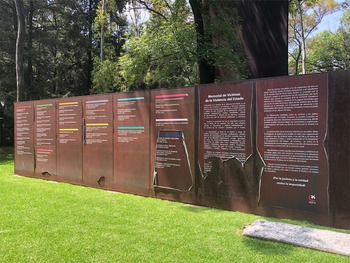
In a response to a memorial to victims but without victims, members of the Comité 68 placed canvases with the names of 7,978 victims of political persecution, torture, extrajudicial killings, forced disappearances, femicides, and criminal negligence on the steel plates in El Memorial (Figure 3). The list goes back to the 1950s and also includes events that occurred after the inauguration of the memorial, such as the disappearance of forty-three students from Ayotzinapa. In its most recent intervention in 2017, the Comité also added a large canvas on the first and last steel walls of the memorial—the ones most visible to the drivers and pedestrians passing by—with their own title for the memorial (Figure 4), which builds on the existing title to emphasize the role of the state: Memorial to the Victims of State Violence (our emphasis).
Comité 68’s interventions in El Memorial. Photo by the authors, July 2017.

Comité 68’s interventions in El Memorial. Photo by the authors, July 2017.

Comité 68 saw this intervention as an opportunity to give the space a new meaning and to repurpose it, in line with the proposed openness of the design. Dulce González, who coordinates the Comité’s actions, explains that through these interventions it is no longer an institutional memorial, it is a “seized memorial,” where memory is built “through our own archives; we name our victims and assign responsibility.” Part of the project is also focused on bringing together different groups and social movements that have been working on similar efforts separately: “Ideally we would want all the organizations working on this issue to reappropriate the space so that it means something for everyone, all sectors involved across society, not just the victims. To make the memorial their own. We see it as a call for justice, to not forget who the perpetrators of violence are and their crimes.”Footnote 14 Comité 68’s long-term vision is to have a space in the memorial for the archive with the materials that they have gathered over several decades to document state violence and recognize and name its victims.
Although more organizations have joined their most recent efforts, support for the Comité’s actions is still rejected by some activist groups including the Movimiento por la Paz and H.I.J.O.S. México, who see a danger in such actions legitimizing the space, which is precisely how Gaeta and the CEAV refer to the Comité’s actions: “The memorial is being used by groups that represent the victims; therefore it serves its purpose.”Footnote 15 In fact, the Comité purposely designed the canvases so they could blend in with the steel walls and it informed the CEAV of its intention of placing the canvases there. Some of the most recent interventions, including the canvases with the title “Memorial to the Victims of State Violence”, fell off the steel plates after a few weeks, partly because of the materials used. However, the activists claim that the caretakers of the memorial removed the canvases as an “act of repression” and that this was not the first time that they tampered with Comité 68’s interventions in the memorial because “our installation makes them uncomfortable.”Footnote 16 The canvases were replaced and laid on the steel plates again a few days before the commemoration of the fiftieth anniversary of the 1968 student massacre.Footnote 17
The current contestation of the space itself limits Comité 68’s ability to transform the dominant narrative, given the controversy around the process of creating the memorial, its location, the absence of support from other organizations working toward similar goals, and the state’s own actions to contain or block the activists’ installations. In a more explicit rejection of the memorial, other interventions have taken on different commemorative spaces where all of the assumptions and design choices of the state-sponsored project can be questioned or at least approached radically differently. In this sense, they are countermonuments or “dialogic memorials” (Reference Stevens, Franck and FazakerleyStevens, Franck, and Fazakerley 2012) in that they react to the specific shortcomings and values of another memorial by creating alternative public spaces.
Memorial New’s Divine
The Memorial New’s Divine, in the low-income Mexico City neighborhood of Nueva Atzacoalco, commemorates the deaths of nine youths and three police officers and critical injuries to sixteen individuals as a result of a police raid inside a discotheque. Police brutality and negligence of government authorities at various levels were blamed for the fact that an ill-conceived police operation resulted in death by suffocation when the police closed the doors of the establishment to prevent the youths from leaving the premises. At first sight, the Memorial New’s Divine does not fit into the landscape of memorials for victims of narco-violence. However, the police raid, which took place on June 20, 2008, cannot be understood outside the context of the drug war, as it was part of a strategy from the Mexico City government—led by an opposition party of the Left— to demonstrate their effectiveness in dealing with organized crime with small-scale targeted operations through the local police, as opposed to the direct confrontations and violence involving federal police, the army, and the marines, as seen in other parts of the country.
What happened at the New’s Divine was a reflection of the larger problems faced by residents of impoverished areas of the city, where youths have limited opportunities for recreation and encounter the state mostly in the form of policing. The neighborhood is considered a marginal zone in the city, at the border between Mexico City and the State of Mexico and largely abandoned by both in terms of public space, services, and security. The raid that took place at the New’s Divine was the result of a false representation of the club as a place involved in small-scale drug trade. It was an easy target that could support the city government’s message around attacking narco-violence, but the architect Sergio Beltrán, who led the memorial project, claims that it was also the result of “structural neglect by the state, exemplified in a very tangible moment.”Footnote 18 Thus, the project, which began right after El Memorial was inaugurated, was an attempt to create a different kind of memorial directly in the place where violence happened and to address the broader reasons why it did.
Beltrán envisioned the New’s Divine site as a direct countermemorial to El Memorial, expressed in his distinction between monuments and memorials and his emphasis on a participatory, community-focused approach. According to this distinction, Beltrán places El Memorial firmly in the camp of the monumental, with its awe-inspiring architecture, monologic claim making, and focus on a passive reception in society (Reference Beltrán GarcíaBeltrán García 2013). His idea was a memorial space that would be representative of a continuous violence and that would raise questions about how to better respond to that reality:
How to create better infrastructure for social equality, how do we include more voices in the design of our cities, how do we make sure voices are not being silenced, how do we create a memorial as an exercise in opening up the decision-making process to more people, and mostly to people who are usually disenfranchised and excluded. It is an opportunity to challenge. To create services that are democratic and public. To avoid the monument and create healthier spaces. To design our city to become more socially equitable.Footnote 19
In a vision reminiscent of what DiSalvo (Reference DiSalvo2010) has called “political design,” Beltrán aims to lay a foundation for questions different from the ones in El Memorial by striving “to articulate the elements that are constitutive of social conditions” (Di Salvo 2010, 9).
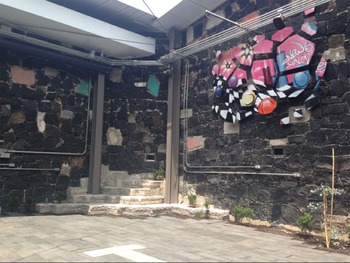
The design process, in which families of the victims as well as NGOs and local government institutions such as INJUVE (Instituto de la Juventud de la Ciudad de Mexico) were involved, focused on using original materials from the site, including parts of the murals that decorated the walls of the club, original signs, and parts of the door that was closed and trapped people inside (Figure 5). The door includes a brief description of the event, the names of the authorities responsible for the raid, and the names of the twelve victims—a controversial issue given that some of the families did not want the three police officers’ names next to the names of the youths, reflecting the ongoing debates about who is considered a victim and by whom, and who can make claims for public memorialization in this context.
Walls of Memorial New’s Divine with repurposed graffiti. Photo by the authors, June 2015.

Although the material for the door is the original one, the door was redesigned so it cannot be blocked again. In Beltrán’s vision, the closed door may remind us of the tragic past, but when it is opened in its redesigned form, the original layers of the door disappear, pointing toward future transformation. Similarly, the passage that leads into the memorial focuses on the events that took place that day, yet it leads into an open area with interactive space for study, art, dance and group activities and a projector for films (and the explicit recognition of spaces for disabled persons, drawing attention to the living victims of the tragedy). Like other memory activists, Beltrán articulated a vision for a “free space for debate and creative cultural work outside the boundaries of state order” (Reference GutmanGutman 2017, 149), although the project inevitably had to rely on support from the city government in terms of resources and strong participation in the inauguration of the space. INJUVE continues to have a role in organizing workshops and events in the space together with civil society groups like Espacio Libre Independiente Marabunta AC, focused on improving the quality of life for vulnerable groups, with a particular focus on issues of delinquency and addiction.
In its insistence on memorials as not just symbols but tools for action, advocacy, and social transformation, Beltrán’s design not only echoes other architects’ interventions in the memorial debate but also bears similarities to iterations of debates on memorials more globally, namely in juxtaposing “living memorials” with “wasted space” and monumentality (Reference ShankenShanken 2002). Moreover, whereas the countermonumental language employed by El Memorial depends on a specific aesthetic literacy of the visitor (often implicitly evoking class and status differences), this is not the aim in Beltrán’s case, who is focused on creating a space that “is not just a building … [but] an institute, city council, documentary, cultural program and a public space, a problem-solving tool that gets the ‘never again’ narrative closer to everyday realities.”Footnote 20
The violence addressed in the memorial is structural, in Reguillo’s sense, and a consequence of systemic geographical neglect; at the same time, this remains a memorial for a specific event with a clear narrative and nameable perpetrators as well as victims. Beltrán aims to strike this delicate balance between the commemoration of specific individuals and a more general expression of “the complexity of violence in everyday life,”Footnote 21 with a particular focus on avoiding a space that is, as Crownshaw (Reference Crownshaw2008, 212) once put it, “overpersonalized at the expense of a wider historical context.” Bold, Knowles, and Leach (Reference Bold, Knowles and Leach2002, 130) have shown how commemorative individualization can stand in the way, to the extent that sometimes “the process of active countermemorializing must involve the repression of individualized experience … together with the claims to unique and exceptional status.” Tarica (Reference Tarica2015) also makes this point regarding the efforts to bestow dignity and agency on the victims of the war on drugs in the Mexican case. While the Comité 68’s efforts focused on making the state-sponsored memorial more tangible by adding names and dates, Beltrán’s aim was to counter the state’s commemorative message by transcending the single instance at the New’s Divine nightclub. Consequently, he faced pushback from victims and the victims’ families.
In addition, in Beltrán’s view, the families of the victims saw this memorial mainly as a way to keep the criminal case open. Most of the stakeholders were interested in the claims around the memorial space in relation to the legal case but not so much in its functions as a way to keep alive the memory of the tragedy and create a stronger infrastructure for vulnerable youth today: “Very few of the people with decision-making power are interested in using it or giving it its daily life. The professed desire of creating social programs to help avoid tragedies such as this turned out not to be as honest as it was once presented.”Footnote 22
Beltrán argues that in Mexico, the notion of focusing on creating policies and programs for the future is too distant and utopian: “This has to do with how immature our institutions are, and how people view those institutions; they don’t expect more from those institutions. And this is one key reason that the memory work oriented toward social transformation in Mexico is challenging.”Footnote 23 While the place has established daily programming and courses that are in line with the idea of recreational and social use, most of the larger events that have taken place (more limited in number than originally planned) have been exclusively cultural, without necessarily furthering the political message of the memorial. At different times since its inauguration, the memorial has been used actively, for example by local youth organizations that aim to address the political context of the violence, but it has also had periods without any programming or involvement by the community.
The Memorial to the Victims of Disappearance in Baja California: Remembrance, Reconciliation, and Rebuilding
A similar focus on urban renewal, community involvement, and social transformation is present in the work of memory activists at the Maclovio Rojas plot in Tijuana. The space is located on the outskirts of this border city, on a dirt road, past rows of abandoned plots and unfinished houses, and behind a locked makeshift fence made of uneven pieces of plywood. At the entrance of the space, which was not open to the public when we visited in 2016, there is a house with a mural of Gandhi and a sign that reads comedor comunitario (community kitchen). The community kitchen and the murals on the surrounding wall are part of a project led by a group of activists and researchers from the Universidad Autónoma de Baja California (UABC), together with the Asociación Unidos por los Desaparecidos de Baja California and the relatives of victims of enforced disappearance. Like the Memorial New’s Divine, the Memorial por los Desaparecidos de Baja California is located in the exact place where the events occurred, although in this case it has been impossible to name and identify the victims who were killed there, as explained below. Despite efforts to transform and reclaim this space, until its inauguration in 2018, it was largely abandoned and remains a contested site where families of the victims, organized crime, state authorities, members of the community and activists have competing interests and claims.
The Maclovio Rojas plot was one of the main sites were the drug cartels brought dead bodies with the purpose of eliminating any trace of the murder. In a space disguised as an auto-repair shop, a man nicknamed El Pozolero would dissolve the bodies in acid and deposit the remains in a pit on the ground, making it nearly impossible to find any remains that could be identified through DNA. Months after El Pozolero was captured by Mexican police, he made statements indicating the precise location of this and other sites. His main description of the place as a coop (gallera) with brick walls, in an area known for its many galleras used to prepare roosters for cockfights, alerted Fernando Ocegueda, whose son had disappeared in Tijuana. Ocegueda, head of the Asociación Unidos por los Desaparecidos made up of 170 families of victims in Baja California, began a months-long search for the place. Like many other relatives of victims across the country, they did not trust Mexican authorities to engage in serious efforts to find the place and investigate it thoroughly (Reference Schwartz-Marin and Cruz-SantiagoSchwartz-Marin and Cruz-Santiago 2016; Reference RobledoRobledo 2017; Reference Ocegueda, Enciso and NietoOcegueda 2017). Ocegueda and other relatives eventually found the Maclovio Rojas plot, brought their own picks and shovels, and started breaking the concrete blocks that covered the pits. Once they saw what was inside, they called the police. Days later, forensic examiners were brought to examine the remains and concluded that no identification was possible; the pits were closed again.
For many families, these efforts to produce evidence represented an attempt to find closure. Their connection to this place was intensified by the fact that it was the closest indicator of the possible location of their relatives’ remains. The idea for a memorial emerged shortly after their discovery.Footnote 24 As a result of the Asociación Unidos por los Desaparecidos’s efforts, the government agreed to grant them the right to use the land, but not without backlash from the community around the plot, as many of the houses nearby continue to be used for drug-related activities as well as illegal cockfights. With a grant from UABC and support from the federal government, a project for a memorial and a community center was developed.
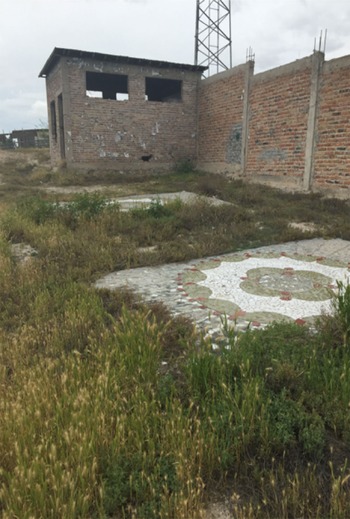
The pits were covered with a new block of concrete decorated with colorful mosaics (Figure 6). This was part of the project of reconciliation, remembrance, and rebuilding that the UABC had begun under the name RECO (standing for the words reconciliar, recordar, reconstruir). However, the funding promised by the government never materialized, and the space remained mostly abandoned until new excavations began in 2017 to conduct further forensic tests. Ocegueda visualized the memorial space as he walked through it when we visited it in 2016: “We just need to finish building the wall here, so the space can be more private.” In the brick room where the bodies were dissolved he envisioned a chapel: “We already have the structure. It’s so easy to just complete it.”Footnote 25 After months of being abandoned and years of advocacy, the memorial space was officially inaugurated in 2018 with plates including the names of victims of disappearance in Baja California.
Memorial por los Desaparecidos de Baja California in its initial stages. Photo by the authors, April 9, 2016.

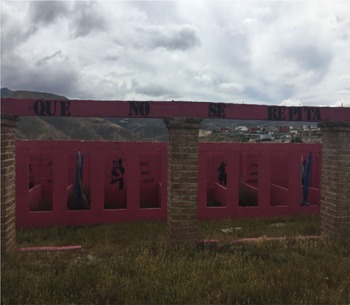
Across from it are the ruins of the rooster pens, with overgrown plants and trash. They were painted in bright pink and with stencils made by community members and the UABC (Figure 7). They represent images of young kids playing, a pregnant woman, a family. Each of them with a figure in black, a shadow, representing one of the disappeared, and a question: “What happened here?” “How could this happen?” “Where are you?” Above them are the words “Que no se repita” (It must not happen again). In the open space that remains, Ocegueda imagined having a community center with an acknowledgement of the identified victims: “All the pictures of the disappeared would be hung here. Then they will have a name.” Alluding to the dichotomy of good deaths versus bad deaths he noted: “People will know that they were not criminals. They will be dignified. Their mothers will feel at peace, finally.”
Memorial por los Desaparecidos de Baja California in its initial stages. Photo by the authors, April 9, 2016.

Although in this case there was no direct reference point in terms of envisioning a memorial, the families’ efforts were guided by the intention to find a way to dignify the space. After the government agreed to give them the lot, thanks to the collaboration between the UABC, the families, and the attorney general’s office, a plan was put together to donate 2.5 million pesos for the project. Architects at the UABC drew up a number of plans for the site. But the project was stalled. At the time of our interview, Ocegueda expressed a fear that the community in the area would take the plot away from them, arguing that they weren’t using it and showing the tensions of the efforts to build the memorial in a context of impunity and continuing violence: “They probably want another rooster pen here. There’s so much money to be made from the rooster fights. And who’ll go to the fights and bet on the roosters? Los matones [the murderers], the criminals … and the police. That’s why no one said anything about what was happening here. They all knew but everyone is afraid.”
Despite the lack of government funding and the threats from the criminal organizations, which left graffiti threats or dead animal bodies wrapped in blankets inside the plot, the UABC group continued to organize targeted actions in the space, mostly focused on art projects that bring the community together. Alfonso Díaz Tovar, the coleader of the project, explained that they had settled into using the space more as a community center rather than building the memorial they had once imagined—and which they had already begun to design.Footnote 26 He highlighted the challenging context in which they tried to develop this project, as many locals preferred to forget an event that potentially stigmatized their community, and in the midst of recurring threats from the criminal organizations that did not want attention drawn to the space.
The memorial and the space for mourning that Ocegueda and other relatives of the victims advocated for developed in parallel to the RECO activists’ focus on the need to create opportunities for the youth in the area, repair the social fabric of the local community, and provide alternatives for youth at risk of getting involved (or already involved in) organized crime, but they were all acutely aware of the struggle for the space and the government’s lack of interest.
Ocegueda continued to advocate for support from the government to build the memorial as a necessary step to dignify the memory of the victims and for the families to have a place to mourn: “It’s a place of identity for the families and for the victims. Even if it won’t take away the pain of my son’s disappearance, it helps me somewhat to know this will not be forgotten.” By contrast, Alfonso Díaz Tovar did not expect any response from the state or collaboration with it. In his view, the project seeks to build “a type of justice the state authorities are no longer a part of.”Footnote 27 In this case, the memory activists’ challenge of developing memory projects as a form of resistance in the absence of institutional support is exacerbated by the fact that different forms of violence persist in the space where the events that are being commemorated occurred. The presence of organized crime and its direct threats to projects that draw attention to the area limit the ability of memory activists to fully realize their vision for the memorial, including projects for community participation and social transformation, with or without government support. Moreover, remaining questions about the identity of the victims and current processes to reopen the pits and examine the remains present a further challenge to decisions about when and how the space can become a memorial, and which victims are being commemorated in such a space.
Conclusion
Reguillo (Reference Reguillo2014) describes the violence of the “narco-machine” as situated in a “de-localized space that is impossible to symbolize.” We have aimed to describe this struggle over symbolization as one of state-sanctioned narratives and their active rejection in memorial sites. The puzzle as to why the state and activists would engage in debates over memorialization while the different forms of violence are ongoing, and at a time when evidentiary concerns are arguably more pressing than commemorative ones, remains central. Participants at the 2016 Violencia y Paz conference in Mexico City—scholars, public officials, and activists—raised exactly this question when discussing pathways to address the country’s crisis (Reference EncisoEnciso 2017), and it has gained traction again in the aftermath of a transition to the Left with the government of López Obrador. Activists such as Sicilia have come to the fore again to confront the government’s promises, which remain unfulfilled despite some minor steps such as establishing the physical and virtual platform Sitios de Memoria,Footnote 28 which would address pending questions around documentation, truth, justice, and reparations for the victims of violence. And yet, we have seen that the memory work that reacts against the state’s effort to provide partial closure is successful in highlighting these very concerns. The Comité is providing an ongoing archive to an otherwise uninformative site, illustrating the possibility of commemorative sites to also address ongoing evidentiary issues, while the New’s Divine project shows that commemoration and direct interventions into the conditions of different forms of violence are not mutually exclusive: the memorial is addressing not only the past but the present. At the same time, the failure to create the intended site of memory without state funding, in the case of the Memorial por los Desaparecidos in Tijuana; the tensions with the victims evoked by New’s Divine’s ambitious, forward-looking project; and the reluctance of the local community in Tijuana to support a memorial amid threats from organized crime are just three examples of the limits and challenges of the projects we have portrayed.
Moreover, as Gutman (Reference Gutman2017, 151) has shown in the context of a different memory activism, “acting autonomously from the common sense in order to reframe it can … lead to isolation and further marginalization of those who produce counterclaims” (see also Reference RuferRufer 2012). To be sure, the primary intention of both Beltrán and RECO is to intervene locally. Yet memory activism arguably also depends on its ability to bring about “normative change” or even “normative transferal” in institutions (Reference WüstenbergWüstenberg 2017, 16, 21), especially if its goal is to address conditions of structural violence that cannot be tackled by local solutions alone. In fact, the recent discourses and actions of the government imply, at least modestly, that the demands of civil society are not without impact; this is demonstrated by the establishment of CEAV and the passage of laws such as the 2012 Ley General de Víctimas and the 2017 Ley General en Materia de Desaparición Forzada,Footnote 29 even though their implementation is still limited by a weak judicial system and a context of widespread impunity and corruption. In terms of the specific efforts by memory activists, the Comité’s direct intervention in El Memorial a las Víctimas de la Violencia has perhaps enjoyed the widest exposure, but it also runs the risk of normalizing a memorial space many other activists consider illegitimate and thereby potentially preventing broader coalitions.
We followed these projects of Mexican memory activism in a nascent, dynamic phase, which means that questions remain open of how efforts like those of New’s Divine, the Comité, and RECO will eventually contribute to a reframing of the different forms of violence in the country and to the creation of alternative frameworks to address it. What remains apparent in all these projects is that commemorative work in the context of ongoing forms of violence is not just about the engagement with a politics of memory—that is, who gets to tell the story about the past—but, more importantly, with a politics of time. The activists described in this article not only discard premature notions of closure and expand the historical horizon within which we make sense of different types of structural, historic, or narco-related violence but remind us that their intervention is urgent and indeed “presentist”: making the multiple conditions of violence present in both a physical and temporal sense and addressing them with past, current, and future victims in mind.
Acknowledgements
Authors are listed in alphabetical order to indicate equal authorship. We are grateful to the activists, architects, scholars, and government representatives who participated in interviews conducted during field trips and site visits in Mexico City and Tijuana between June 2015 and September 2017. Benjamin Nienass would like to thank the Humanities Center of the University of Rochester for generously supporting this research during his fellowship. Previous versions of this article were presented at the Jesse L. Rosenberger Work-in-Progress Series, Humanities Center, University of Rochester, February 8, 2018; at the conference “Making Home in Wounded Places: Memory, Design, and the Spatial,” Parsons School of Design, the New School, March 3–4, 2017; at the Cultural Studies Association Annual Meeting, Washington, DC, May 25–27, 2017; and at the workshop “Memoria en Movimiento: Recordando desde y para las Américas,” May 26, 2016, the New School. We are grateful for the feedback and suggestions from participants at these events. We thank Marianna Poyares, Tatiana Llaguno, and Matthew Zuccaro for their research assistance. Finally, we thank Benoit Challand, Pablo Domínguez Galbraith, Lindsey Freeman, Danielle House, Ana Sofía Rodríguez, Sandra Rozental, Markus Schulz, Magali Sarfatti Larson, Pablo Sierra, Arturo Ortiz Struck, and four anonymous reviewers for comments on drafts of the paper.

 Open access

