

1. Introduction
Conventional wisdom holds that democracy is closely associated with welfare provision, yet authoritarian regimes also offer welfare benefits to their citizens, often with significant variation in coverage and enforcement (Mares and Carnes, Reference Mares and Carnes2009; Knutsen and Rasmussen, Reference Knutsen and Rasmussen2018). This paper starts with the puzzle of when and how authoritarian states selectively enforce welfare policies, focusing on the strategic role of bureaucratic forbearance. Welfare policies can serve as tools for autocrats to maintain social control and legitimacy, yet noncompliance by firms or citizens often undermines these efforts (Gallagher et al., Reference Gallagher, Giles, Park and Wang2015). Enforcement therefore becomes crucial, but bureaucrats—tasked with implementing these policies—often face career incentives and possess discretionary power that can weaken enforcement (Yang, Reference Yang2021). Using China as a case, this paper examines how bureaucratic incentives shape the uneven implementation of social insurance policies in an authoritarian state.
China’s social insurance system is facing an unfolding crisis. Despite the country’s establishment of an employment-based scheme in the late 1990s, firm compliance with contribution requirements has remained persistently low. Recent surveys suggest that fewer than 30% of firms pay adequate premiums.Footnote 1 This weak enforcement is puzzling, especially given the state’s growing extractive capacity and the importance of welfare provision in maintaining stability (Lü and Landry, Reference Lü and Landry2014; Pan, Reference Pan2020). Why, then, would an authoritarian state tolerate such widespread evasion? Furthermore, why is enforcement so weak and uneven across jurisdictions (see Figure 1)?
Firms’ participation rates in social insurance programs across regions. Panel (a) shows the percentage of firms participating in the unemployment insurance program across Chinese prefectures and cities, while Panel (b) shows the percentage of firms participating in the medical insurance and pensions programs.

Existing literature suggests two reasons: capacity and willingness. The capacity approach argues that weak capacity has prevented the state from fully enforcing policies (Levitsky and Murillo, Reference Levitsky and Murillo2009). While a state may have overall strong capacity, that capacity can vary subnationally and across different state agencies (Bersch et al., Reference Bersch, Praça and Matthew2017). The second approach, instead, focuses on the state’s discretion and willingness to enforce policies. In her seminal work on “forbearance,” Holland (Reference Holland2016) finds that politicians may intentionally withhold capacity to enforce policies in order to reap electoral benefits. More broadly, scholars have argued that enforcement is not automatic but shaped by political priorities and trade-offs (Lipsky, Reference Lipsky2010; Dewey et al., Reference Dewey, Woll and Ronconi2021; Yang, Reference Yang2021; Feierherd, Reference Feierherd2022; Lopez-Cariboni, Reference Lopez-Cariboni2024).
We extend the theory of “forbearance” into an authoritarian context. Previous studies on forbearance mostly focus on democracies (Smulovitz, Reference Smulovitz2015; Holland, Reference Holland2016; Feierherd, Reference Feierherd2022). We argue that forbearance also exists in authoritarian countries, with different incentives and characteristics. While forbearance in developing democracies is motivated by politicians’ electoral incentives, its equivalent in China is driven by local officials’ career incentives, not in the form of securing votes from poor constituencies, but through courting business interests and promoting local economic growth that surpasses political competitors in neighboring jurisdictions. Consequently, forbearance on social insurance policies is not necessarily pro-poor but exhibits a pro-business bias.
Furthermore, we argue that the effects of interjurisdictional competition on social insurance forbearance are heterogeneous across different firm types. The effects are significant among domestic private firms and foreign firms, which are under severe market competition and sensitive to labor costs. However, the effect is less obvious among state-owned enterprises (SOEs), which operate under a “soft budget constraint (yusuan ruanyueshu)” and charged with “social responsibilities (shehui zeren).” Therefore, bureaucratic forbearance can lead to unintended consequences, such as increased disparities in social insurance protection between SOE employees and workers in the private sector (Huang, Reference Huang2013).
We conduct our empirical analysis at two levels: firm and individual. To our knowledge, this is one of the first systematic analyses of social insurance contributions at the firm level in an authoritarian country. We use data from the China Industrial Enterprise Survey (CIES), which covers all industrial firms with annual sales of over 5 million yuan (710 thousand USD). Conditioning on local state capacity and other city- and firm-level factors, we find that city leaders facing stronger economic competition from peer cities are more likely to withhold social insurance enforcement in their jurisdictions. This aligns with their career incentives, as leaders at the same level compete for promotion, and economic growth has been a major performance indicator for cadre evaluation.Footnote 2
While the CIES allows for firm-level analysis, its social insurance data ends in 2007. To extend the analysis to more recent years, especially after the implementation of the Labor Contract Law in 2008 (when social insurance enforcement was expected to be strengthened) and the leadership transition in 2013 (when promotional incentives might have changed), we exploit individual-level data from the China Family Panel Studies (CFPS), a nationally representative survey from 2012 to 2015. We found consistent evidence that city-level economic pressures led to significantly lower social insurance coverage for firm employees. This suggests that forbearance on social insurance policies and the underlying bureaucratic incentives have persisted despite major legal and political changes.
In addition, we show that the effect of interjurisdictional competition on social insurance forbearance is most salient among domestic private firms and foreign-invested firms compared to SOEs. Local officials understand that premiums constitute a significant labor cost,Footnote 3 especially for private firms that rely on low-cost labor and lack state backing. While SOEs are expected to fulfill public mandates, private and foreign firms are more sensitive to cost pressures. Yet they are important to local growth and employment, providing officials with strong incentives to favor them. Compared to standard industrial policies such as tax breaks or subsidies, forbearance can be more hidden and flexible. The fact that the socialist state is willing to compromise on labor standards by defying its own policies also signals to investors its strong commitment to business interests.
Our paper has broader implications for the study of inequality, state capacity, and China’s growth model. First, we contribute to debates on inequality by highlighting an often-overlooked dimension: disparities in risk and protection. While much of the literature centers on income and wealth inequality (Meltzer and Richard, Reference Meltzer and Richard1981; Piketty, Reference Piketty2013; Solt, Reference Solt2016), recent work has emphasized unequal exposure to economic insecurity (Hausermann and Schwander, Reference Hausermann and Schwander2012; Pontusson and Weisstanner, Reference Pontusson and Weisstanner2018). We focus on gaps in social insurance protection, showing that uneven enforcement has widened the gap in protection across workers, even as some may accept lower coverage in exchange for slightly higher pay. Moreover, we identify a paradoxical driver of this inequality: the state and its policy enforcement. Scholars have debated whether variations in inequality can be explained by economic factors such as skill-biased technological changes (Autor, Reference Autor2019) or political factors such as political coalitions (Thelen, Reference Thelen2012; Iversen and Soskice, Reference Iversen and Soskice2015) and organized interests (Hacker and Pierson, Reference Hacker and Pierson2010; Hope and Martelli, Reference Hope and Martelli2019). We bring the state back into this debate and suggest that the state itself plays a vital role in shaping inequality. In a strong, authoritarian state where politicians lack electoral incentives to serve the poor while having career incentives to favor business interests, policies initially designed to address inequality can be hollowed out, exacerbating inequality.
Second, this paper contributes to the broader understanding of forbearance and state capacity as a strategic choice by political actors (Boone, Reference Boone2003; Suryanarayan, Reference Suryanarayan2017; Hassan, Reference Hassan2020; Gottlieb, Reference Gottlieb2024; Nathan, Reference Nathan2023). While traditional views treat state capacity as a fixed national endowment, often measured by institutional presence or bureaucratic quality (Evans, Reference Evans2012), more recent work highlights subnational and agency-level variation (Bersch et al., Reference Bersch, Praça and Matthew2017; Dasgupta and Kapur, Reference Dasgupta and Kapur2020). Yet most studies do not distinguish between potential capacity and deployed capacity—the capacity that is actively deployed and used. Building on Williams (Reference Williams2021), we argue that deployed capacity is a function of full capacity and willingness, and it is the concept that matters more for policy outcomes. Our study examines the conditions under which the state actors would be willing to “supply” more or less capacity to enforce policies, and we demonstrate that there are weak capacities by design.
Finally, this paper reflects on China’s growth model and its impact on bureaucratic performance and labor protection. While previous literature suggests that political decentralization and interjurisdictional competition are key to China’s economic success (Montinola et al., Reference Montinola, Qian and Weingast1995; Zhou, Reference Zhou2004), we show that these same mechanisms can produce bureaucratic underperformance—local officials deliberately not enforcing certain policies, especially those related to labor protection. Contrary to the view that economic liberalization benefits abundant labor (e.g., Rogowski (Reference Rogowski1987)), our findings align with emerging work on how domestic political incentives mediate globalization’s effects (Mosley and Uno, Reference Mosley and Uno2007; Hacker and Pierson, Reference Hacker and Pierson2010; Dean, Reference Dean2016). Specifically, we show that “trickle-down” mechanisms such as the social insurance system may distribute benefits and protection unevenly and regressively. For low-skilled workers in the private sector, who are most vulnerable to economic hardship and need social protection the most, forbearance induced by China’s growth model has made their conditions relatively worse.
2. Theory
2.1. Two approaches to weak enforcement
Weak policy enforcement is a common problem in the developing world. Existing explanations tend to follow two approaches: low state capacity and selective enforcement, or forbearance.
The capacity-based approach attributes weak policy performance to limited state capacity. A weak state may undersupply resources to enforcement agencies, poorly select or monitor its agents, or lack embeddedness with social groups that foster compliance (Evans, Reference Evans1997; Fearon, Reference Fearon, Przeworski, Manin and Stokes1999; Tsai, Reference Tsai2007; Rothstein and Varraich, Reference Rothstein and Varraich2017; Dasgupta and Kapur, Reference Dasgupta and Kapur2020). Applying this logic to the Chinese context, the capacity-based explanations usually focus on the administrative capacity of the social insurance agency (Tang and Feng, Reference Tang and Feng2019), institutional fragmentation and the principal-agent problem (Zhuang and Ngok, Reference Zhuang and Ngok2014), and lack of compliance from firms and employees (Mao et al., Reference Mao, Zhang and Zhao2013; Rickne, Reference Rickne2013). For example, Tang and Feng (Reference Tang and Feng2019) find that by switching the responsibility of collecting social insurance payments to the tax agency, which generally has a higher administrative capacity than the social insurance agency, social insurance extraction can be better enforced.
However, this approach assumes that stronger capacity will automatically lead to better enforcement. What it overlooks are bureaucratic agency and incentives. Even high-capacity states may choose not to enforce certain policies. For example, East Asian developmental states—a type of state known for its high-quality bureaucrats and strong capacity—tend to have poor records of enforcing labor-protecting policies (Caraway, Reference Caraway2009; Song, Reference Song2012), a problem that seems to go beyond the lack of capacity.
The forbearance approach remedies some inadequacies of this literature by shifting focus from what the state can do to what it chooses to do. Scholars argue that states sometimes intentionally withhold enforcement, despite having the capacity to do so. For example, in Latin America, politicians may tolerate street vending and squatting as an informal form of redistribution that helps win votes (Holland, Reference Holland2016). Here, enforcement becomes a strategic choice, influenced by competing priorities and political incentives (Zacka, Reference Zacka2017; Dewey et al., Reference Dewey, Woll and Ronconi2021).
Moreover, the forbearance approach highlights that weak enforcement is not a failure per se, but can serve broader policy goals (Dewey et al., Reference Dewey, Woll and Ronconi2021; Feierherd, Reference Feierherd2022; Lopez-Cariboni, Reference Lopez-Cariboni2024). For example, authorities in Latin America relaxed labor policies in response to trade liberalization and increased competitive pressure (Ronconi, Reference Ronconi2012). Similarly, labor standards were lifted or selectively enforced in Italy to address broader social challenges, such as unemployment and immigration (Ceccagno, Reference Ceccagno2017).
However, much of this literature is democracy-focused, relying on electoral accountability as the incentive for forbearance (Smulovitz, Reference Smulovitz2015; Feierherd, Reference Feierherd2022). In authoritarian regimes, where leaders face fewer pressures from voters and seek to maintain tight control, forbearance is more puzzling. Autocrats are not typically seen as responsive to societal demands (De et al., Reference De, Bueno, Smith, Siverson and Morrow2005). Moreover, forbearance requires the state not to sanction noncompliers, which seems detrimental to authoritarian rule. Weak enforcement discourages quasi-voluntary compliance by suggesting that violators will not be caught, which may add to the cost of social control significantly (Levi, Reference Levi1989). The incentives of forbearance in authoritarian states therefore need to be more closely examined.
A few recent studies have shed light on forbearance in authoritarian states. Lopez-Cariboni (Reference Lopez-Cariboni2024) shows that autocratic leaders offer less forbearance regarding electricity theft during economic shocks than their democratic counterparts, and argues that it is because of fewer electoral incentives and longer time horizons. Yet there can be other forms of political incentives for autocratic leaders to forbear. Shen (Reference Shen2022), for instance, examines regulatory forbearance toward China’s polluting industries. She argues that while politicians in democracies are reelection-maximizing, their Chinese counterparts are promotion-maximizing and use forbearance to maximize their chance of getting promoted.
A related literature on authoritarian forbearance has delved into labor protection. Scholars have found that most East Asian authoritarian states—such as Singapore, Malaysia, and Vietnam—tend to have more protective laws than the rest of the world while achieving fewer actual protections (Caraway, Reference Caraway2009, Reference Caraway2010). The gap between de jure and de facto labor protection in the region has been attributed to weak enforcement of the laws. However, the underlying reasons for this weak enforcement remain ambiguous, and there’s a lack of direct examination into the roots of authoritarian forbearance.
We build on this literature by theorizing that in China, forbearance of social insurance policies stems from bureaucratic incentives rather than electoral accountability. Specifically, local officials have career incentives to promote economic growth and appease firms, often at the expense of social insurance enforcement, to improve their promotion prospects. Ironically, while forbearance in developing democracies may function as informal welfare for the poor, in China, it undermines formal protection and yields regressive consequences on Chinese workers.
2.2. Weak enforcement of China’s social insurance policies
We develop a theory of forbearance under autocracy through an application to China’s social insurance policies. China is the largest authoritarian country in the world and its working population plays a key role in global production. Enforcement of social insurance policies in China is highly important (Huang, Reference Huang2013, Reference Huang2014; Gallagher et al., Reference Gallagher, Giles, Park and Wang2015; Yang and Shen, Reference Yang and Shen2021), as weak enforcement has eroded the country’s safety net and fueled social unrest.Footnote 4
China’s modern social insurance system was introduced in the 1990s, replacing a socialist-era scheme that primarily covered SOE workers while excluding those in the growing non-state sector (Li et al., Reference Li, Feng and Gizelis2007; Zhou and Zhang, Reference Zhou and Zhang2017). Economic reforms during this period also led to massive SOE layoffs, sparking widespread protests and threatening regime stability (Chen, Reference Chen2000; Cai, Reference Cai2002; Hurst and O’Brien, Reference Hurst and O’Brien2002; Zhu, Reference Zhu2025). In response to these challenges, the central government launched reforms that established five key insurances, including pensions, healthcare, unemployment, work injury, and maternity. They were extended to cover all urban employees, including those in the private sector (Zhang et al., Reference Zhang, Zhang and Bingwen2019). A major institutional change was the introduction of a cost-sharing model in which employers, employees, and the state all contribute, with employers being the primary contributors.
To enforce premium collection, the state enacted a new labor law in 1998 and the Interim Regulation on the Collection and Payment of Social Insurance Premiums (1999–2019) in 1999.Footnote 5 These measures transferred enforcement responsibilities from labor unions to local governments, typically at the city level.Footnote 6 Local authorities were granted discretion over whether the social insurance bureau or the tax bureau would serve as the collection agency.
Despite central mandates, local enforcement was notably weak. By 2004, the coverage rates for pensions, medical, unemployment, and work injury insurances among urban workers were only 36.6%, 27.8%, 23.7%, and 15.3%, respectively (Wu, Reference Wu2023). High contribution costs deterred compliance: in 2008, employers in Shanghai paid an additional 39.5% of a worker’s salary for social insurance (Wu, Reference Wu2023). Firms often evaded these costs with worker consent, offering slightly higher wages instead of paying long-term benefits. Moreover, the social insurance bureau was the primary agency for collecting premiums at that time, which may have faced capacity constraints. Unlike the tax bureau, the social insurance bureau lacks access to extensive firm information, allowing room for firms to misreport data on employee numbers and salaries and evade social insurance payments.
In an effort to improve enforcement, the state implemented the Labor Contract Law in 2008, mandating firms to incorporate social insurance obligations into labor contracts.Footnote 7 Following the Labor Contract Law, the state also introduced the Social Insurance Law in 2010, outlining the obligations of both employers and employees regarding social insurance contributions. Moreover, the state gradually transferred the responsibility of collecting social insurance premiums from the social insurance bureau to the tax bureau, thereby enhancing enforcement capacity (Tang and Feng, Reference Tang and Feng2019).
These measures, while reduced the number of firms completely evading social insurance contributions, had limited effectiveness in ensuring that firms pay the full amount of premiums. Instead, firms can still partially evade social insurance obligations. For example, a local government may establish standards for wage base on which social insurance premiums should be collected, usually with the minimum wage base set at 60% of the local average income. Many firms then choose to underreport employees’ wages and only pay the minimum required amount. Additionally, some firms may create new accounts or benefits for employees, avoiding depositing their entire salary into designated salary accounts.
2.3. Bureaucratic forbearance and how it works
Persistent weak enforcement of social insurance policies cannot be explained by capacity constraints alone. Instead, evidence suggests that local governments often intentionally withhold enforcement. This bureaucratic forbearance is evident in three ways. First, enforcement is chronically weak: Nationwide surveys show that a large share of firms do not comply with mandated contribution levels. For example, the China Enterprise Social Insurance White Papers reported that 61% of firms in 2015 did not pay premiums based on employees’ actual wages. This figure further rose to 75% in 2016 and 76% in 2017.
Second, enforcement is uneven across jurisdictions and firms. With significant autonomy in policy implementation, some localities have set employer contribution rates below the national standard (e.g., lowering the 20% pension rate) to attract investment and maintain economic competitiveness. Some city governments have also made explicit commitments to business owners, allowing them to take gradual steps to enroll in social insurance programs and only pay the minimum amount required.Footnote 8 Moreover, enforcement is selective across firms. Studies find that domestic private firms have faced especially lax enforcement compared to SOEs, allowing them to “avoid as much as possible” (Wu, Reference Wu2023).
Third, enforcement is inconsistent and reversible over time. Qualitative evidence shows no consistent enforcement mechanism at the local level. Local officials primarily “resort[ed] to the politics of persuasion” to encourage firms’ compliance (Duckett, Reference Duckett2001, p. 298). Specifically, they often “had to resort to negotiations and a combination of repeated pleas” to convince some firms to join the program (Duckett, Reference Duckett2001, p. 228). In addition, punishments often lack credibility: Firms found to have made no contributions were simply asked to pay the arrears, and there was also “no effective strategy for targeting of defaulters in subsequent audits” (Nyland et al., Reference Nyland, Smyth and Zhu2006, p. 201).
Moreover, these enforcement efforts were easily reversible, as they depended heavily on bureaucratic initiative and could be withdrawn through reduced effort or suspended audits, even after formal enforcement mechanisms were introduced. Such reversals are often framed by policymakers and state media as necessary to reduce business burdens and support economic growth, especially during economic shocks.Footnote 9 This was particularly evident during the COVID-19 pandemic, when growth pressures intensified. In Wuhan, for example, local officials waived all employer pension contributions for 2020.Footnote 10 In Shanxi, authorities extended deadlines, allowed deferred payments, and instructed agencies to treat firms as compliant during the grace period.Footnote 11 Our data similarly show that some firms contribute in one year but not the next. For instance, among firms that paid unemployment insurance in a given year, approximately 18% ceased payment in the subsequent year. The reversal rate was around 9.5% for medical insurance and pensions. These figures suggest that enforcement is not only weak and uneven but also subject to ad hoc reversals.
The administrative structure of the social insurance system further facilitates this forbearance. To enroll in the social insurance system, firms must register with the local collection agency, open a designated bank account, and submit information on employee headcount and salaries. Once approved, they are expected to pay premiums monthly and update records regularly.Footnote 12 In practice, however, the system relies heavily on self-reporting, and these records can be easily manipulated. Firms may under-report the number of workers or their wages, or simply avoid updating records when hiring or granting raises, especially given that audits are infrequent and discretionary (Nyland et al., Reference Nyland, Smyth and Zhu2006; Wu, Reference Wu2023). Workers may not be aware of reduced or missing contributions, as employer payments typically go into pooled public accounts rather than individual ones.Footnote 13 In some cases, workers and firms even collude: Workers may willingly forgo benefits in exchange for higher take-home pay, especially if they are uncertain about receiving future payouts (Gallagher et al., Reference Gallagher, Giles, Park and Wang2015; Yang, Reference Yang2021).
Can weak, uneven, and reversible enforcement be driven by firm-side noncompliance alone? We argue that even if firms are the immediate decision-makers in suspending or lowering contributions, this behavior is likely responsive to local officials’ behavior or expectations about enforcement. Firms respond to bureaucratic signals (Lin and Milhaupt, Reference Lin and Milhaupt2021; Lin, Reference Lin2025). In regions where officials signal leniency, firms anticipate low risk of audits or penalties and adjust their behavior accordingly. In this sense, noncompliance is not solely a firm-driven act of evasion but a joint outcome shaped by local enforcement behavior.
2.4. Political root of bureaucratic forbearance
When would a local government choose not to (strictly) enforce social insurance policies? A key consideration is local officials’ career incentives. Unlike elected officials, Chinese local officials are selected and promoted by their upper-level principals. Promotion is highly competitive, as officials at the same level need to compete for a limited number of positions at the upper level (Lü and Landry, Reference Lü and Landry2014). The Chinese cadre evaluation system heavily emphasizes economic performance, particularly GDP growth rate, as a primary criterion for advancement (Wang, Reference Wang2015; Landry et al., Reference Landry, Xiaobo and Duan2018). Regardless of whether GDP growth directly results in promotion (Maskin et al., Reference Maskin, Qian and Chenggang2000; Li and Zhou, Reference Li and Zhou2005; Xu, Reference Xu2011; Shih et al., Reference Shih, Adolph and Liu2012; Jia et al., Reference Jia, Kudamatsu and Seim2015; Jiang, Reference Jiang2018; Bo, Reference Bo2019), the system creates strong shared perceptions that growth is essential, prompting officials to prioritize it above other goals.
Under this system, officials are highly sensitive to GDP growth pressure, which can be understood in absolute and relative terms. Absolute pressure reflects pressure against oneself and is shaped by tenure. Although local officials nominally serve 5-year terms, actual tenure is often uncertain. As a result, officials tend to intensify growth-promotion efforts the longer they remain in office, making “years in office” a useful proxy for absolute pressure (Keng et al., Reference Keng, Pang and Zhong2016). While the tenure-based approach captures absolute pressure, it overlooks that promotion also depends on relative performance. As Lü and Landry (Reference Lü and Landry2014) note, with a fixed number of leadership positions, officials must not only meet performance benchmarks but outperform their peers, i.e., other city leaders in the same province.
We argue that the relative performance approach more accurately reflects promotion pressure in China. As Zhou (Reference Zhou2004) points out, political advancement functions as a zero-sum tournament, in which one official’s success indicates the other competitors’ failure. Therefore, what matters is not absolute but relative performance. Since city leaders typically compete within the same province, falling below the provincial average in GDP growth intensifies the pressure to stimulate the local economy.
Forbearance on social insurance policies has been widely perceived as an informal pro-business policy, which local officials believe will benefit the local economy and thus their careers.Footnote 14 In this case, forbearance has distinct advantages compared to other pro-business policies. Unlike tax breaks (Chen and Zhang, Reference Chen and Zhang2021) or subsidies (Hou and Li, Reference Hou and Siyao2023) that draw from the current government budget, the costs associated with social insurance forbearance are borne by a large number of employees, with its detrimental effects only possible to manifest in the future. Forbearance can also be flexible and revokable (Holland, Reference Holland2017), enabling government officials to adjust based on their own interests.
Will forbearance backfire on officials’ promotion? Local officials often face the challenge of balancing two objectives: achieving economic growth and maintaining social stability. One might ask whether under-enforcement of social insurance could lead to unrest such as large-scale worker protests, and therefore pose risks to local officials’ career advancement.
We argue that while local officials take protests seriously, those triggered by social insurance grievances are relatively rare and manageable.Footnote 15 China’s authoritarian system maintains a highly effective apparatus of control and repression, which makes collective action difficult. Local officials often rely on tools such as surveillance, intimidation, and the detention of activists to preempt or suppress unrest (King et al., Reference King, Pan and Roberts2013; Xu, Reference Xu2021), without needing to change long-term enforcement behavior. By contrast, growth-related incentives are more immediate, measurable, and institutionalized within cadre evaluations, and therefore often outweigh the potential risk of protest.Footnote 16
Based on the theory developed above, we derive the following hypothesis:
Hypothesis 1: City leaders facing stronger GDP growth pressure are more likely to forbear firms from making social insurance payment, conditioning on local state capacity and other city- and firm-level covariates.
2.5. Selectivity in bureaucratic forbearance across firm type
Local officials not only determine “when” to grant social insurance forbearance but also “to whom,” based on their career incentives. We anticipate that the impact of GDP growth pressure on inducing forbearance varies among three types of firms: SOEs, domestic private firms, and foreign firms. To begin with, GDP growth pressure is unlikely to induce forbearance among SOEs. SOEs operate under direct government oversight and encounter less severe market pressures. Moreover, they are mandated to prioritize “social responsibility” with stability at its core. Therefore, SOEs may not be the direct target of bureaucratic forbearance on premium collection.
In contrast, career incentives have prompted local officials to grant forbearance to domestic private firms and foreign firms. Domestic private firms employ the majority of low-skilled labor in China and face intense market competition (see our statistics in the next section). They are integral to the local economy, prompting officials to extend them forbearance on social insurance. Moreover, foreign firms are important engines of local economic growth, and their investment and innovation are also crucial indicators in the cadre evaluation system (Chen, Reference Chen2018). Hence, promotion-seeking officials are likely to alleviate their burden of labor costs through forbearance.
Therefore, we derive the following hypothesis:
Hypothesis 2: The effects of GDP growth pressure on bureaucratic forbearance are heterogeneous across firm ownership types; the effects will be most significant among domestic private firms and foreign firms, while appearing weaker or null for state-owned enterprises.
3. Empirical analysis
This section tests our main hypotheses about the bureaucratic forbearance of China’s social insurance policies. We begin our analysis in 2001, two years after the initiation of China’s modern social insurance reforms, to allow for policy adjustments at the local level. We argue that interjurisdictional competition led local officials to exhibit a higher level of forbearance regarding firms’ premium collections. This effect is more pronounced among foreign firms and domestic private firms than among SOEs.
3.1. Data and methods
We leverage the CIES from 2001 to 2007. Collected by China’s National Bureau of Statistics (NBS), CIES is one of the most comprehensive micro-level databases on industrial firms in China. It includes all industrial firms with annual sales exceeding 5 million yuan (710 thousand USD), representing the most granular level at which firm statistics in China are directly collected rather than estimated.Footnote 17 The sum of firm-level industrial indicators from CIES corresponds to 95%–98% of the aggregate amount reported by the National Statistical Yearbook. In addition, the CIES relies on firms’ direct and mandatory reporting to China’s central statistical authority. That is, all above-scale industrial firms are required to submit detailed financial and operational data through standardized forms (Nie et al., Reference Nie, Jiang and Yang2012), thereby avoiding potential manipulation by local officials (Wallace, Reference Wallace2016).
Most importantly for our purpose, the CIES reports contributions to social insurance programs at the firm level. This is one of the few firm-level census datasets that include such information in an authoritarian context, making it a valuable resource. Consistent with existing qualitative evidence, firms were pretty open about their nonparticipation in social insurance programs across cities and years. This is likely because noncompliance with social insurance contributions has been widespread and often normalized—a common perception in China is that “the law does not punish the masses (fa bu ze zhong).” Furthermore, as mentioned earlier, the enforcement is mostly lenient. Specifically, noncompliance rarely results in meaningful penalties: even firms identified through audits were typically only required to make retroactive payments, with little evidence of systematic follow-up or effective targeting of defaulters in subsequent audits (Nyland et al., Reference Nyland, Smyth and Zhu2006). Finally, the NBS is a statistical authority rather than a regulatory one. It does not have the mandate or power to directly penalize firms based on their reports, and it is in fact strictly prohibited to share sensitive firm-level information for purposes other than “statistics” (i.e., data collection, organization, and analysis).Footnote 18 These data are also not publicly disclosed, which further reduces the perceived risk of self-reporting noncompliance.
We measure our outcome of interest in two ways: a dummy variable indicating whether a firm participated in social insurance programs in a given year, and a continuous variable calculating the rate of contribution for participating firms (contribution at time t divided by total wage at t − 1).Footnote 19 Given the available data in CIES, we create these variables for both unemployment insurance (2001–2007) and medical insurance and pensions (2004–2007) as our outcome of interest. It is also worth noting that our measurement strategy follows the same logic as in studies such as Tang and Feng (Reference Tang and Feng2019). Even if firms systematically overreported their social insurance contributions, our measures would represent an upper bound of compliance, which further underscores the prevalence of forbearance. Moreover, we would generally expect overreporting to attenuate the estimated effects of interest in our firm-level analysis. In other words, the potential presence of overreporting likely leads us to present conservative estimates.
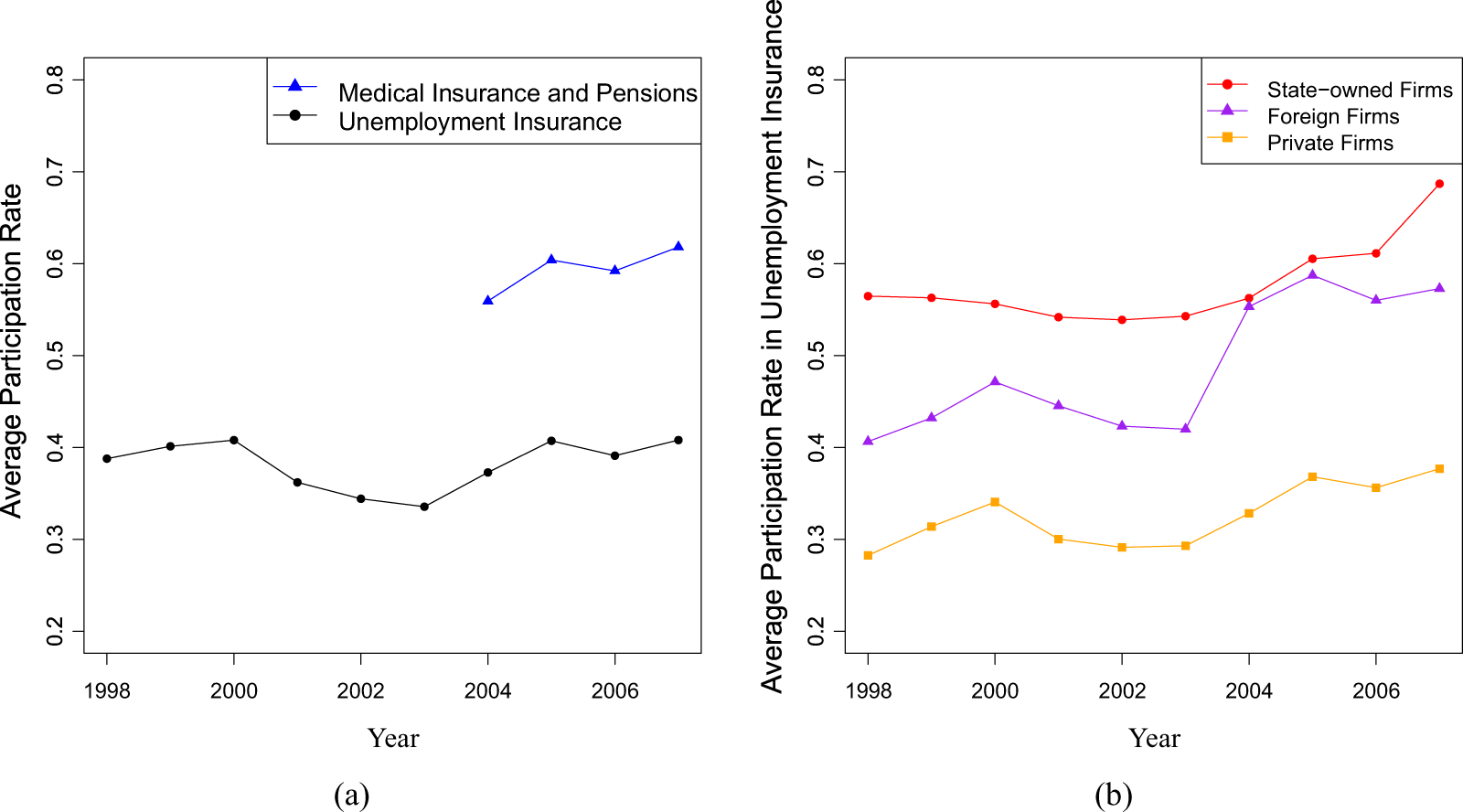
Figure 2 shows the time trend of firms’ participation rate in social insurance schemes. Panel (a) demonstrates that the average participation rate in unemployment insurance has been fluctuating around 40% across the country. The average participation rate in medical insurance and pensions in the last three years was higher but still about 60%. Additionally, we find that almost 80% of firms contributed less than 10% of total wage payments to medical insurance and pensions combined, which is significantly lower than the 20% threshold required for pensions alone in most cities. Given that the nation- and province-wide stipulations have been in place for multiple years, it is surprising to see the persistence of such low contribution rates. Panel (b) disaggregates the trend by ownership types. Consistent with our expectations, SOEs took the lead in social insurance participation, while domestic private firms performed the worst. The implications for the labor force are tremendous, considering that domestic private firms accounted for over 80% of the firm population and 70% of employment in the world’s most populous economy.
Firms’ participation rates in social insurance across years and ownership types. Panel (a) shows firms’ average participation rates in unemployment insurance, medical insurance, and pensions across all available years. Panel (b) demonstrates firms’ average participation rates in unemployment insurance across years and ownership types.

For our key treatment variable, we follow existing literature by measuring interjurisdictional competition as the lagged difference in GDP growth rates between provincial averages and individual cities. We label this variable as GDP growth pressure whose larger positive values indicate greater pressure from peers within the same province.Footnote 20 As discussed in our theory section, this measure can better capture the “relative” performance of local leaders, which may play a bigger role in political promotion. That being said, we also include well-known measures of promotional pressures such as absolute GDP growth rates, turnover years, and the number of years in office. The next section offers further discussions about alternative measures of interjurisdictional competition, and our results remain robust.
Finally, we collect a battery of control variables from multiple sources. We first include firm-level characteristics that are important for firms’ participation rates in social insurance, including total output, employment, wages, and profits. We then merge the dataset with the China City Statistical Yearbook that contains key information about government deficits, business taxes, aggregate FDI, etc. Last but not least, we add individual attributes of Chinese mayors from the Chinese Government Official Data, including education, ethnicity, and gender. The variable about political connections with provincial superiors come from Jiang (Reference Jiang2018). Appendix A provides the summary statistics of our variables.
3.2. Interjurisdictional competition and bureaucratic forbearance
To examine our key hypothesis, we first conduct firm-level analysis by regressing firms’ participation dummy and contribution rate on interjurisdictional competition across cities in the same province. We subset our sample for non-provincial capitals, because (1) mayors of provincial capitals might be of higher ranks and (2) provincial capitals enjoyed natural advantages in GDP growth competitions and were hard to compare with other cities. As mentioned earlier, we control for a series of covariates at firm, city, and mayor levels, as well as firm and year fixed effects.Footnote 21 All continuous variables are log- or inverse hyperbolic sine-transformed when skewed. Overall, our model specification leverages fine-grained variation at the firm level, allowing us to estimate how a given firm changes its social insurance payment due to the changes in citywide GDP growth pressure over years. The causal identification relies on the assumption that with our rich set of control variables, there are no other time-varying confounders. Unless otherwise noted, all of the standard errors in our statistical analysis are clustered at the city level, the level where GDP growth pressure took effect.
To account for the capacity-based explanation—the major alternative to forbearance, we adopt several approaches. First, we include in our regression a common measure for government capacity, extraction of business taxes (% of GDP). If local governments were able to extract more taxes from each firm, they should, at least in theory, also possess a stronger capacity to enforce premium collection. Therefore, we label this variable as Capacity. Second, as some provinces have delegated the authority of premium collection from social insurance bureaus to tax bureaus, we include a dummy (Tax Agency) to represent such transition. Since tax bureaus have been perceived to be more capable of collecting payments from firms, their takeover would indicate a major boost for bureaucratic capacity (Tang and Feng, Reference Tang and Feng2019). Finally, we leverage other objective measures of capacity such as the number of doctors and hospitals in a given city-year in our analysis of medical insurance and pensions.
The statistical results in Table 1 confirm our hypothesis that interjurisdictional competition significantly lowered firms’ participation in and contribution rate to these insurances. The effect size is also notable: Based on the binary measure in columns (1) and (3), being left behind by 4 percentage points in GDP growth rate (the average pressure level) led to at least a 2.4 percentage point decrease in a firm’s participation in the given city-year. This would translate to about an 11 million yuan decrease in a typical city-year in China during this period. Added together, this accumulated to significant deficits in social insurance funds as we observe today. Moreover, columns (2) and (4) show that economic competition also lowered firms’ contribution rates. Firms tended to shrink social insurance coverage for their employees when promotion incentives prompted government officials to forbear.
Interjurisdictional competition and social insurance (firm level)

Note: *p < 0.1; **p < 0.05; ***p < 0.01.
Our results also lead to interesting implications. We observe that the negative effect of “absolute” GDP growth might suggest that harder economic conditions led to wider coverage of these insurances, consistent with our conventional wisdom. However, if “relative” GDP growth pressure was also present, then bureaucratic forbearance could in fact offset the former effect. This effect turns out to be more significant and substantial. Even though these two variables are moderately negatively correlated (see Appendix A.3), we disentangle two distinctly different effects, where “relative” performance often dominates “absolute” performance in reducing firms’ labor costs induced by social insurance policies.
In contrast, most of the capacity variables do not have a statistically significant and positive effect on firms’ social insurance participation or contribution rate. The extraction of business taxes appears insignificant in explaining premium collection based on the estimated coefficients on Capacity. We also find that the transition to tax authority actually led to more rampant forbearance for firms’ participation, though they might extract more premiums for medical insurance and pensions from existing participants. Finally, in Appendix B.2, we also find no significant effect of city-level medical resources on firm-level participation in medical insurance and pensions.
Our firm-level analysis exploits within-firm variation in social insurance contributions over time and alleviates many concerns about firm-level confounders. Furthermore, we conduct a series of additional analyses in Appendix B. We find consistent empirical support for bureaucratic forbearance when using the full sample without winsorization, allowing more flexible and non-linear functional forms, accounting for dynamics (leads and lags) in two-way fixed effects models, controlling for firms’ political connections via subsidies and state capital, considering party secretary characteristics and labor strikes, and excluding new firms, firms with extreme values, and those with changed ownership or location. We also find consistent evidence when considering firms with multiple branches as well as suggestive evidence for the implied effects of social insurance contribution on GDP growth.
Firm-level data on social insurance contributions is only available through 2007, due to changes in CIES questions. The timing aligns with the implementation of the 2008 Labor Contract Law, which aimed to strengthen labor protections, formalize employment relations, and enhance enforcement of employer obligations, including social insurance contributions. To examine whether similar patterns of bureaucratic forbearance persisted in the wake of the Labor Law and under new leadership after 2013, we conduct additional analysis using individual-level data from 2012 to 2015 in the next section. Although these datasets are not directly linked, they allow us to triangulate evidence from multiple sources and time periods to assess the robustness of our theoretical argument.
3.3. Individual-level evidence for bureaucratic forbearance
We now supplement our firm-level analysis with individual-level surveys. Specifically, we leverage the CFPS, a nationally representative survey launched by Peking University. Introducing this survey data brings unique advantages to our analysis. On the one hand, our CFPS data extend from 2012 to 2015, enabling us to test our hypotheses even after the 2008 Labor Law and the 2013 leadership turnover. On the other hand, individual-level surveys help us avoid potential misreporting by firms, offering a convincing robustness check.
We “replicate” our firm-level analysis with the individual survey data. We first limit our analysis to all firm employees across all occupation categories. We then create an outcome variable indicating whether a firm employee received any of the three types of social insurance in a given year: unemployment insurance, medical insurance, or pensions. Once again, although these individuals are entitled to social insurance coverage through their employers, over three quarters of them report not participating.
Compared with firm-level analysis, our main specifications control for individual fixed effects in addition to city and year fixed effects, enabling us to account for mostly constant demographic variables across these years that might explain social insurance coverage, including education, gender, party membership, and hukou (household registration) status. Individual fixed effects also help address concerns that unobserved, stable characteristics—such as personal preferences, work ethics, or other cultural traits—might confound the relationship between city-level economic development and individual-level outcomes. Substantially, we are “fixing” one person and estimate whether she is more or less likely to obtain social insurance when she lives in the city-year experiencing higher GDP growth pressures. Most city- and mayor-level variables remain consistent with those used in the previous firm-level analysis.Footnote 22 We expect that GDP growth pressure at the city level would decrease the probability of firm employees securing their social insurance.
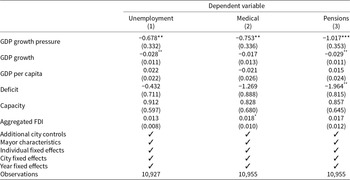
Table 2 presents consistent evidence for our main hypothesis. When city-level economic competition became more intense, firm employees in the given city-year were less likely to secure these social insurances, even after controlling for individual fixed effects and other city and official covariates. We also find that the effect of absolute GDP growth is less significant and the effect of capacity is not significant. Hence, the impact of bureaucratic forbearance extends beyond the firm level to directly affect individuals employed by these firms.
Interjurisdictional competition and social insurance (individual level)

Note: *p < 0.1; **p < 0.05; ***p < 0.01.
3.4. Selectivity of bureaucratic forbearance
To explore heterogeneous effects across different subgroups of firms, we differentiate firms based on ownership types. We do so by investigating firms’ ownership types at the time of their initial registration. Although there are different ways to categorize ownership types in China, we choose to use the registration type as it is most directly related to a firm’s social insurance status. We then conduct a subsample analysis using the same model specification as in our firm-level analysis.
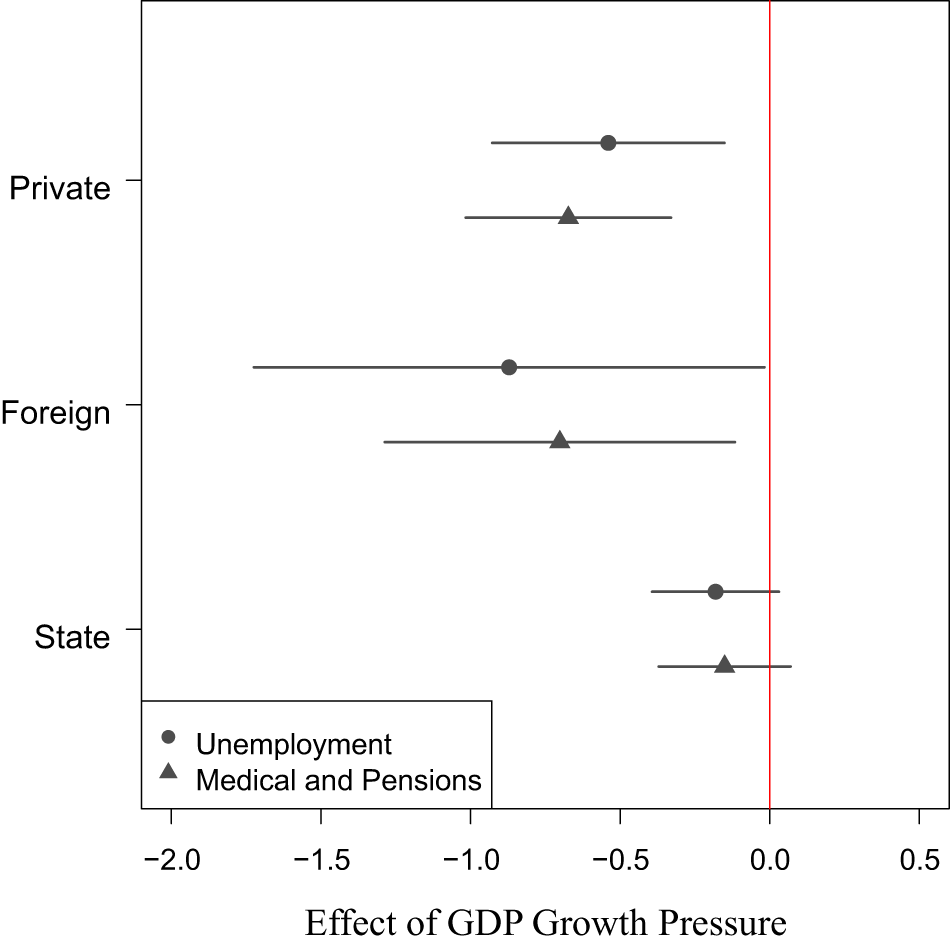
Figure 3 presents the estimation results. Consistent with our hypothesis, the effects of GDP growth pressure on social insurance forbearance are significant and substantial for private firms, whether domestic or foreign, whereas such effects are statistically indistinguishable from zero for SOEs. Local officials were likely to forbear the former groups of firms as they relied more heavily on affordable labor. These heterogeneous effects have unintended distributional consequences. First, it widened the gap between SOE employees and workers in the private sector in terms of their social insurance protection. Second, given the demographics of workers in different firms, employees in private firms (especially domestic ones) tend to be more vulnerable. The number of low-skilled workers in domestic private firms is three times higher than that in SOEs,Footnote 23 making them more susceptible to job market uncertainties. Therefore, these effects highlight how China’s new social insurance scheme might further stratify the labor market and even exacerbate inequality, the very problem it was designed to address (Huang, Reference Huang2013).
Effect of GDP growth pressure on social insurance participation across different ownership types (subsample analysis). GDP growth pressure is negatively associated with social insurance participation across firms of different ownership types, especially for private and foreign firms.

4. Discussions and robustness checks
4.1. Different measures of interjurisdiction competition
As shown earlier, we find that the “relative” performance of local officials better captures promotional pressures and thus the underlying incentives to forbear firms’ social insurance payments. While we have leveraged GDP growth rate differentials between provincial averages and individual cities, it is possible that local officials were more susceptible to pressures from neighboring competitors. For example, Luo and Qin (Reference Luo and Qin2021) find that the probability of promotion is negatively associated with the economic performance of neighboring jurisdictions. Therefore, for each city, we recalculate our measure of GDP.
Growth pressure by taking the difference between its GDP growth rate and that of its closest city, or the average difference from its two closest cities. In Appendix C.1, we uncover similar results showing that economic competition has led to more pervasive forbearance in social insurance policies.
4.2. Different administrative levels
While the overall policy guideline has designated premium collection to city-level governments, official commentaries suggest that county-level officials also had substantial discretionary power in certain localities.Footnote 24 To check whether bureaucratic forbearance mostly took place among city officials, we “replicate” our analysis at different administrative levels. Specifically, we aggregate our firm-level variables to the city level and estimate the same specification with the same set of covariates in Appendix C.2.1. In addition, we calculate GDP growth pressures among counties and re-estimate our firm-level models in Appendix C.2.2. County panel covariates are from China County Statistical Yearbook. The results confirm that the city-level GDP growth pressure significantly reduced social insurance coverage at the conventional level, whereas the county-level GDP growth pressure did not. This provides consistent evidence that city-level governments were primarily responsible for collecting social insurance premiums and had the discretion to forbear firms’ payments during competitive years.
4.3. Does labor matter?
While local officials might forbear firms’ social insurance payments in the hope of better economic performance, such forbearance was exercised at the cost of workers. If workers were able to organize collective action for their right and welfare based on the law, it could severely threaten the career prospects for local bureaucrats. Hence, local officials should at least balance their approach to firms and workers. To test this implication, we collect reported labor strike data at the city level from StrikeMapFootnote 25 and merge them with our individual-level survey data based on all the years available. We estimate the same model but with lagged labor strikes as an additional explanatory variable.
As presented in Appendix C.3, we find that labor strikes do not have a substantial effect on firms’ social insurance participation or contribution. Nor do they alter our substantial findings much. This is consistent with the observation that the large amount of labor in China has had limited bargaining power vis-a-vis government officials or firms (Gallagher, Reference Gallagher2004). Of course, it is not to say that labor strikes were inconsequential to local officials. It was more likely that local officials managed to control the impact of labor protests at their early stages while selectively co-opting workers through other means of compensation than social insurances. All in all, labor seemed to have limited power in negotiating their social insurances that were critical during economically difficult times.
5. Conclusion
This study extends the theory of forbearance to an authoritarian context and examines its different incentives and characteristics. We then apply our theory to China’s social insurance policies: Although the state has strong coercive capacity and stringent labor regulations, enforcement of these policies remained strikingly weak over an extended period since the market reform, resulting in substantial deficits in social insurance funds and undermining labor welfare as well as long-term stability.
We argue that weak enforcement of China’s social insurance policies is rooted in forbearance. Unlike democracies where forbearance could be motivated by a pro-poor coalition between office-seeking politicians and welfare-seeking voters, forbearance in China operates under different incentive structures and generates different distributional consequences. Specifically, promotion-seeking local officials are incentivized to offer forbearance regarding firms’ social insurance payments as a convenient tool to promote local economic growth, which is a key determinant of their career prospects. The same incentives also shape when and to whom they grant forbearance across various types of firms.
We support our claims by presenting the first firm-level analysis of China’s social insurance payments. While previous studies have acknowledged that firms or employers are important stakeholders in China’s employment-based social insurance system, little has been done to examine their actual behavior. Leveraging an officially conducted, large-scale survey on Chinese industrial firms, we find that local officials are more likely to offer forbearance regarding firms’ social insurance payments when they face stronger economic competition from other cities in the same province, conditioning on local state capacity and a series of other controls at the city and firm level. This reflects their career incentives as relative GDP performance is the key to their promotion. We also supplement our firm-level analysis with individual-level surveys that yield essentially the same results.
In addition, we also uncover interesting variation across firms with different ownership types. The forbearance-inducing effect is most salient among domestic private firms and foreign firms, which are most sensitive to labor costs and exposed to the greatest market competition. In contrast, the effect disappears among SOEs. This potentially results from their socialist legacies of being pro-labor, or/and they are probably operated in a less market-oriented way which prioritizes other social functions such as stabilizing the economy rather than being profit-maximizing. Because forbearance regarding firms’ social insurance payments is distributed unevenly across firms, it is likely to generate unintended distributional consequences. Specifically, it may exacerbate labor market inequality and dualization between state employees and workers in the private sector, the latter of which is further deprived of labor protection.
For external validity, while our empirical focus is on China, the theoretical framework may extend to other authoritarian contexts where bureaucrats have both the autonomy and incentives to distort policy enforcement. A closely comparable case is Vietnam, where decentralization, merit-based evaluations, and revenue-driven incentives have encouraged local officials to prioritize economic growth, even at the expense of central mandates (Malesky, Reference Malesky2008; Duong, Reference Duong2023). These institutional features may similarly lead to forbearance, including the under-enforcement of social insurance policies.Footnote 26 Historical evidence from Meiji Japan also points to bureaucratic forbearance, where bureaucrats tolerated widespread infanticide by reclassifying deaths as stillbirths, not due to low capacity, but to avoid social unrest and maintain a façade of legality (Drixler and Matsuzaki, Reference Drixler and Matsuzaki2025).
One limitation of our empirical analysis is that we are unable to directly observe local enforcement intensity, such as audits and penalties, due to data constraints. This limits our ability to fully disentangle government enforcement behavior from firm-side compliance behavior. While we draw on qualitative evidence and institutional analysis to support our interpretation of bureaucratic forbearance, we highlight the need for better administrative data in future research to more precisely identify how local bureaucrats exercise discretion over enforcement.
Despite empirical constraints, our findings underscore the broader importance of understanding the causes and consequences of forbearance. As noted earlier, forbearance is the temporary withholding of enforcement. It can be a myopic strategy of the government to reconcile competing objectives at certain points in time, which is neither socially sustainable nor cost-free. With rampant labor law violations and growing social unrest, the Chinese central government had to update the labor law in 2008 and introduce the new Social Insurance Law in 2010, aiming to strengthen policy enforcement and maintain social order. However, as Holland (Reference Holland2017) points out, forbearance may form a self-sustaining vicious cycle when a sufficiently large group has benefited from and actively perpetuates it, and it can be difficult for the state to reverse the direction. Understanding why, when, and to whom forbearance occurs is therefore crucial for escaping that forbearance trap.
Supplementary material
The supplementary material for this article can be found at https://doi.org/10.1017/psrm.2026.10091. To obtain replication material for this article, please visit https://doi.org/10.7910/DVN/P07AMQ.
Acknowledgements
The authors would like to thank participants of the 2022 Annual Conference of the Midwest Political Science Association and the 2022 Cambridge Chinese Politics Workshop. For insightful comments, we would like to thank Bo Feng, Mary Gallagher, Peter Hall, Mai Hassan, Danny Hidalgo, Alisha Holland, Xian Huang, Duy Minh, Ben Schneider, Kathleen Thelen, Jeremy Wallace, Yuhua Wang, Saul Wilson, Ariel White, Yujeong Yang, Changdong Zhang, and Hongshen Zhu. Xiao Peng has provided excellent research assistance. All errors are our own.
Data availability statement
The firm census data that support the findings of this study are available through China’s National Bureau of Statistics and its authorized data sellers. The individual survey data are collected and provided by the Institute of Social Science Survey (ISSS) at Peking University, which is available at https://www.isss.pku.edu.cn/cfps/en/ with the permission of ISSS. Both datasets are not publicly available due to government and university regulations.
Funding statement
The authors received no financial support for the research, authorship, and/or publication of this article.
Competing interests
The authors declare none.




 Open access

