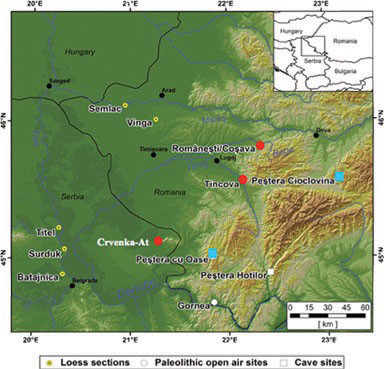


The location of the site of At; black circles indicate larger settlement areas; blue squares indicate locations of early human skeletal remains; red circles indicate important Early Upper Palaeolithic findspots; yellow dots indicate important loess profiles (modified from Kels et al. 2014: fig. 1).

Between 2014 and 2015, the Universities of Cologne and Belgrade, and the Vršac Museum, conducted small-scale excavations at the site of At in Vršac, north-western Serbia (Figure 1). Part of the larger site-complex of Crvenka-At, the site of At is the closest Early Upper Palaeolithic site to Peștera cu Oase in Romania, where the oldest directly dated modern human remains in Europe were found (Trinkhaus et al. 2012). The wider site complex of Crvenka-At was previously known from lithic artefacts collected during sand-quarrying in the nineteenth and twentieth centuries (Reference MihailovićMihailović 1992), and from a small archaeological excavation in 1984 (Reference RadovanovićRadovanović 1986); additionally, excavations during the 1970–1980s located late Vinča (c. 5500–4500 BC) settlements and sporadic Starčevo (c. 6200–5500 BC) finds. The purpose of our excavations was to locate and study intact archaeological deposits associated with these early settlements.
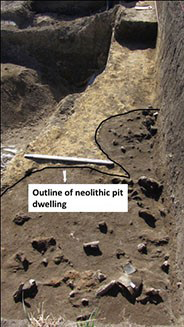
At II level 7 showing a pit dwelling, northern view.

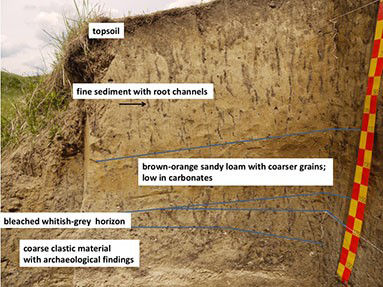
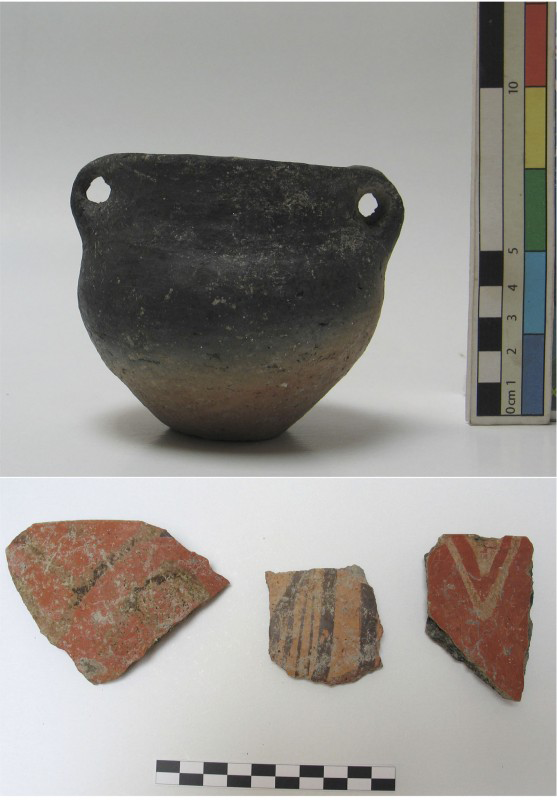
A series of 2 × 5m trenches dug in the old sandpits (Figure 2) identified preserved deposits dating to the Vinča and Starčevo Cultures of the Late and Early/Middle Neolithic, as well as two layers of Early Upper Palaeolithic material (Figure 3), with analogies to artefacts held in the Vršac Museum. The Neolithic strata yielded numerous pottery fragments, stone and bone tools, and faunal remains. Removal of the humus uncovered a rich layer of finds belonging to the final phases of the Vinča Culture (Vinča D). Three complete vessels with distinctive Vinča characteristics stand out: a miniature vessel (pithos-like), a small jar with two handles (‘black-topped’; Figure 4), and an almost-complete bowl. Underneath, the remains of a Middle Neolithic settlement with several subterranean circular pits was discovered. Currently, there is evidence for a single Starčevo semi-subterranean house with two rooms. Other features may be storage or waste pits. The largest room contains locally sourced stones used in the clay mixture used to make vessels. Two bone spatulas, with differently shaped tips, suggest that this was possibly the house of a potter. Vessel assemblages consist of spherical and conical pots and bowls, with barbotine, impresso and painted decorations (Figure 4). A pig mandible was pressed into the bottom of one of the pits.
Palaeolithic stratigraphy of the site of At I, trench 3, western view.

Small jar with two handles from At II (top) and Starčevo painted pottery (bottom).

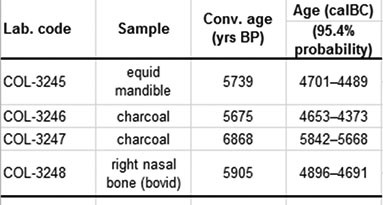
Faunal analysis indicates the use of domesticated animals at the site (Bos taurus, Ovis aries, Sus scrofa dom). Although most of the upper occupation appears to be Neolithic, two small mountain crystal bladelets suggest Epipalaeolithic-period use of the site as well. Radiocarbon (AMS) analyses of four samples gave dates for both cultures (Figure 5). Three samples, taken from the pit dwelling and the waste pit with the pig mandible, date the Vinča layer to 4896–4373 cal BC, confirming activity during the late phases of this culture. The sample from the bottom of the Starčevo pit dwelling is dated to 5842–5668 cal BC, also suggesting activity during the final phases of the Early/Middle Neolithic. These results also support previous radiocarbon (AMS) dates (Whittle et al. 2002).
Radiocarbon dating results for samples; radiocarbon dates are calibrated using the OxCal v 4.2.4, IntCal13 atmospheric curve.

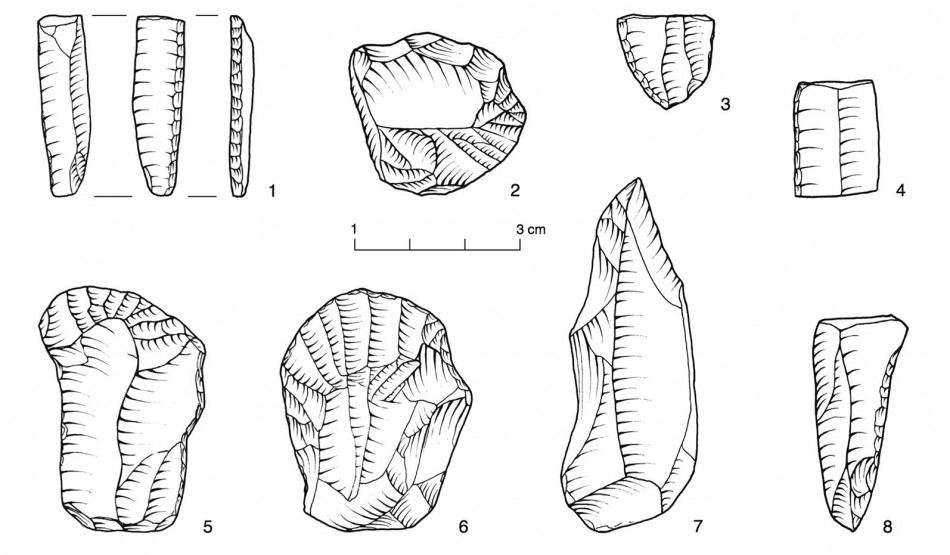
Excavations below the Neolithic levels at the sites of At I and II also uncovered lithic artefacts and faunal remains of the Aurignacian phase of the Early Upper Palaeolithic, including several bladelet cores (e.g. thick endscrapers, nosed endscrapers), blades and endscrapers (Figure 6). Our preliminary assessment and comparisons with the blades in the local museum collection suggest that most or all of the blades come from single-platform cores, and the high blade-to-flake ratio confirms that they probably belong to the Aurignacian (Reference MihailovićMihailović 1992; Mihailović et al. 2011), and therefore date broadly to c. 45–35 kya. The raw materials used to make the blades in this collection include Balkan flint, Banat flint, quartzite, radiolarite and rhyolite; most are not associated with the local Vršac Mountains, and possibly came from Carpatho-Balkanides sources to the east and south-east.
Early Upper Palaeolithic artefacts from the site of At 2015 excavations.

Some of these lithics, with considerable fluvial polish, were recovered from high energy-related hydraulic deposits of fine to coarse sands, including pebbles of up to 20mm diameter. Others were found in fresh condition within finer-grained, well-sorted sandy deposits (Chu et al. 2014). Bone preservation in these levels is poor; identified species include Bos primigenius and Equus sp., suggesting a temperate, flood-plain forest environment.
The absence of any cultural residues associated with the Peștera cu Oase human fossils means that the site of At has the potential to provide important contextual information about the nature of settlement, paleoecology and behaviour of early modern humans in south-eastern Europe.
Overall, these test excavations confirm the existence of a remarkable open-air site inhabited during the Early Upper Palaeolithic, as well as two Neolithic phases. This work sheds light on the behaviour of early human settlers and the first Balkan farmers, and their connections to the landscape and neighbouring communities.
Future plans
For the Neolithic phases of the site, excavations will focus on the Starčevo pit dwelling. The recovery of more ceramic material will help to improve the reliability of traditional typologies of the Starčevo Culture and its development. Analyses of the faunal and floral remains will shed light on the daily life of the first Balkan farmers, and help to determine whether climate change caused a break of nearly a millennium between the first and last Neolithic settlers.
For the Palaeolithic layers, we plan to evaluate the sediment dynamics, geomorphology and topography of the area in order to understand the original context of the Aurignacian settlement and the taphonomic processes that have taken place. Dating of the artefacts using sedimentological and pedological analyses, and optically stimulated luminescence dating, is currently underway.
Acknowledgements
Fieldwork was supported by the Deutsche Forschungsgemeinschaft through the Collaborative Research Center 806 ‘Our way to Europe’. This work was also supported by the Ministry of Education, Science and Technological Development of the Republic of Serbia (177023). Thank you to U. Hambach, S. Marković, I. Obreht, J. Bösken, D. Jovanović and P. Fischer. Artefact drawings courtesy of S. Dragosavac and Anja Rüschmann.