




Introduction
Patient trust is defined as a situation in which the patient believes that the physician has his/her best interests in mind (Mechanic and Meyer Reference Mechanic and Meyer2000). Particularly, when faced with a serious illness, such as cancer, patients may feel compelled to literally risk their lives to trust their physicians (Hillen et al. Reference Hillen, Onderwater and van Zwieten2012b). An optimal trusting relationship between the patient and the oncologist leads to improved information exchange and adherence to physician recommendations (Hall et al. Reference Hall, Zheng and Dugan2002). A literature review suggested that cancer patients’ trust in physicians should be studied more systematically and theoretically, mainly due to the large methodological differences between studies (Hillen et al. Reference Hillen, de Haes and Smets2011).
The Trust in Oncologist Scale (TiOS) is the most frequently used instrument to assess trust in physicians in cancer care. The original version of the TiOS was Dutch, with 18 items (Hillen et al. Reference Hillen, Koning and Wilmink2012a). Subsequently, the English (Hillen et al. Reference Hillen, Butow and Tattersall2013) and Italian versions (Bani et al. Reference Bani, Rossi and Cortinovis2021) were developed, with adequate reported reliability and validity. The TiOS comprises 18 items and includes 4 aspects of theoretical trustworthiness – “Fidelity” (the oncologist acts in the best interest of the patient), “Competence” (the oncologist’s medical skills), “Honesty” (telling the truth and avoiding intentional falsehoods), “Caring” (oncologists’ involvement, empathy, and devotion to the patient), and 2 “Global Items” as an overall trustworthiness assessment (Hillen et al. Reference Hillen, Koning and Wilmink2012a) However, subsequent studies could not clearly distinguish the TiOS dimensions (Hillen et al. Reference Hillen, Butow and Tattersall2013) (Bani et al. Reference Bani, Rossi and Cortinovis2021), and most results supported one-dimensionality of the construct, a shortened version with 5 items has been developed (Hillen et al. Reference Hillen, Postma and Verdam2017). Thus, the TiOS and TiOS-Short Form (TiOS-SF) are reliable and validated instruments.
In Japan, a communication skill training program has been developed to build trust between patients and oncologists (Fujimori et al. Reference Fujimori, Akechi and Akizuki2005, Reference Fujimori, Akechi and Morita2007); the program reportedly decreased the patients’ depressive symptoms and increased their satisfaction (Fujimori et al. Reference Fujimori, Shirai and Asai2014), but it was not possible to examine whether it changed the patients’ trust in their physicians. Furthermore, there have been no reports of validated and useful tools to assess trust in physicians in cancer care in Japan, and there are insufficient tools to evaluate the effectiveness of communication intervention studies.
This study purported to develop a Japanese version of the TiOS (TiOS-J) and the TiOS-SF (TiOS-SF-J) and to test its validity and reliability to assess trust in cancer care physicians in Japan.
Methods
Subjects and procedure
We conducted a cross-sectional, web-based survey. First, in March 2016, a web-based survey company (Macromill, Ltd.) recruited patients with cancer from all over Japan. Two weeks later, some participants were asked again to retake the survey to assess the test–retest reliability. To conduct factor analysis on a scale with 18 items, the minimum number of respondents was set at 10 times the number of items (180). A total of 633 eligible registrants received email requests for our survey. Two weeks later, the same subjects were partially retested again to examine reliability.
This study was conducted in compliance with the Declaration of Helsinki and ethical guidelines for epidemiological research; it was approved by the Institutional Review Board and Ethics Committee of the Seirei Mikatahara General Hospital. E-consent was obtained from all participants.
Instruments
Trust in Oncologist Scale–Japanese
The TiOS consists of 18 items, and all items are answered on a 5-point Likert scale (“strongly disagree” = 1 to “strongly agree” = 5). When completing the questionnaire, the participants were asked to focus on their primary physician (the oncologist they visited most often). For example, items such as “Your doctor is very careful and precise.” The TiOS was originally developed and validated in Dutch, comprising 16 items with theoretically driven 4 factors (“Fidelity,” “Competence,” “Honesty,” and “Caring”) and 2 “Global Items” (Hillen et al. Reference Hillen, Koning and Wilmink2012a). Then it has since been validated in English (Hillen et al. Reference Hillen, Butow and Tattersall2013) and Italian (Bani et al. Reference Bani, Rossi and Cortinovis2021). Herein, the English version of TiOS was translated into Japanese using a forward-backward procedure (Beaton et al. Reference Beaton, Bombardier and Guillemin2000). At first, 2 independent consultants translated the English version into Japanese. Then, one oncologists (TO) and 2 palliative care physicians (MM and TM) and one clinical psychologist (MF) selected the best of the Japanese version. This was followed by 2 independent consultants back-translating the Japanese into English. Lastly, one oncologists (TO) and 2 palliative care physicians (MM and TM) and one clinical psychologist (MF) selected the best of the English version and requested confirmation from the original author (MAH) to detect any discrepancies and for approval.
The Trust in Oncologist Scale Short Form-Japanese
The TiOS-SF is a five-item, reliable, and valid short form for the TiOS, with one item from each dimension and one global item developed in Dutch (Hillen et al. Reference Hillen, Postma and Verdam2017); confirmatory factor analysis (CFA) supported the one-dimensionality of the Italian version (Bani et al. Reference Bani, Rossi and Cortinovis2021). In this study, the TiOS-J was conducted; 5 items corresponding to the TiOS-SF-J were used in the analysis.
Patient Satisfaction Questionnaire-Japanese
Satisfaction with oncologists was measured using the five-item Patient Satisfaction Questionnaire (PSQ) to measure satisfaction by addressing patients’ needs, active involvement, quality of the information received, emotional support received, and global interaction (Ong et al. Reference Ong, Visser and Lammes2000) (Zandbelt et al. Reference Zandbelt, Smets and Oort2004). The PSQ is a Visual Analogue Scale (VAS), ranging from 0 to 100, which was used in prior studies as a measure of convergent validity for TiOS (Bani et al. Reference Bani, Rossi and Cortinovis2021; Hillen et al. Reference Hillen, Butow and Tattersall2013, Reference Hillen, Koning and Wilmink2012a). As this study was a web-based survey and the VAS was not available, a Likert scale was developed. Responses were marked on an 11-point Likert scale (“not at all satisfied” = 0 to “extremely satisfied” = 10). The PSQ was translated into Japanese following a forward-backward procedure (Beaton et al. Reference Beaton, Bombardier and Guillemin2000). Internal consistency in this study was demonstrated by a Cronbach’s α coefficient of 0.96. The reliability and validity of the PSQ-J has been confirmed (Kamo et al. Reference Kamo, Fujimori and Asai2023).
Willingness to recommend oncologist
Patients’ reported willingness to recommend the oncologist to others was assessed with one item: “Would you recommend this doctor to a cancer patient you know?” It was rated on a 5-point Likert scale (“strongly disagree” = 1; “strongly agree” = 5).
Trust in health care
Patients’ trust in health care was assessed with one item, “How much do you trust the current Japanese health-care system?” which was rated on a 5-point Likert scale (“very little trust” = 1 to “a great deal of trust” = 5).
Physician compassion questionnaire
Physician Compassion was measured by the Physician Compassion Questionnaire (PCQ), which was originally developed by Fogarty et al. (Reference Fogarty, Curbow and Wingard1999) and consists of 5 items. It was answered on an 11-point Likert scale: warm = 0/cold = 10, pleasant = 0/unpleasant = 10, compassionate = 0/distant = 10, sensitive = 0/insensitive = 10, and caring = 0/uncaring = 10, where lower scores indicate a more compassionate attitude. This measure has been used to determine the perception of compassion in clinical studies on physicians’ communication (Bruera et al. Reference Bruera, Palmer and Pace2007). Internal consistency was demonstrated using a Cronbach’s α coefficient of 0.97. The Japanese version of PCQ was created by the same forward-backward procedure as TiOS-J after checking with the original author.
Patients’ health-related quality of life (Functional Assessment of Cancer Therapy-General)
Patients’ health-related quality of life (QoL) was measured using the Functional Assessment of Cancer Therapy-General (FACT-G) (Cella et al. Reference Cella, Tulsky and Gray1993), which comprises 27 items with 4 subscales: physical well-being (7 items), social/family well-being (7 items), emotional well-being (6 items), and functional well-being (7 items). Each item is scored on a 5-point Likert scale ranging from 1 (not at all) to 5 (very much) after processing the reversal item; higher scores indicate better global QoL. The reliability and validity of the Japanese version of the FACT-G have been confirmed (Fumimoto et al. Reference Fumimoto, Kobayashi and Chang2001). The FACT-G is a scale that can assess cancer-specific QoL and was adopted because it is applicable to all cancers regardless of cancer type, and its Japanese version was standardized.
Statistical analysis
Descriptive statistics, including skewness and kurtosis, were calculated for all 18 items of the TiOS-J. The Shapiro-Wilk test was performed to test normality. The associations between patient characteristics and the TiOS-J total score were examined using an unpaired t-test and one-way analysis of variance, as appropriate. According to TiOS English (Hillen et al. Reference Hillen, Butow and Tattersall2013) and Italian(Bani et al. Reference Bani, Rossi and Cortinovis2021) validation studies, we expected no correlation between trust and sample characteristics.
To evaluate validity, exploratory factor analysis (EFA) using maximum-likelihood method and CFA were used to test construct validity. We used AMOS 28.0 (IBM) for graphics. It is recommended that the criteria for an acceptable model fit are goodness-of-fit index (GFI) ≥ 0.90, adjusted goodness-of-fit index (AGFI) ≥ 0.85, comparative fit index (CFI) ≥ 0.95, and root mean square error of approximation (RMSEA) ≤ 0.08 (Schermelleh-Engel et al. Reference Schermelleh-Engel, Moosbrugger and Müller2003). Nonparametric indicators were used because TiOS-J did not show normality. We used Spearman’s correlation coefficients between PSQ-J, willingness to recommend an oncologist, trust in health care, and number of physician consultations. Moderately positive associations between trust and these correlates would indicate good concurrent validity (Hillen et al. Reference Hillen, Koning and Wilmink2012a).
To evaluate reliability, Cronbach’s α and the test–retest correlation of the TiOS-J/TiOS-SF-J were used.
The associations between TiOS-J/TiOS-SF-J, physicians’ compassionate attitude, and patients’ health-related QoL were examined using Spearman’s correlation coefficients for exploratory analyses.
Data were analyzed using SPSS version 28.0 (IBM). Statistical significance was set as a p-value of <0.05.
Results
Sample characteristics
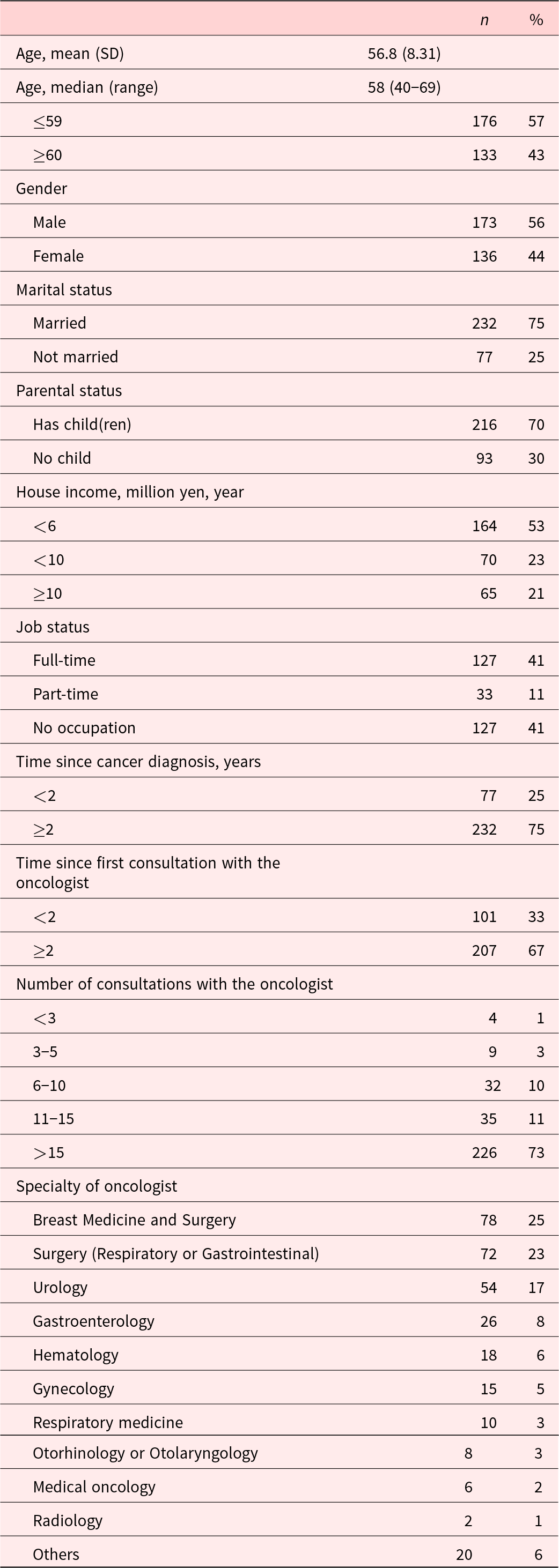
Table 1 summarizes the sample characteristics of all participating cancer patients. There were 309 participants, meeting the minimum number of 180 required for the analysis. The median age at the time of the survey was 58 years (range:40–69 years). The survey to verify the reliability of the retest method was distributed to 156 subjects, of whom 103 responded. The median age at the time of the survey was 58 years (range: 41–69 years). The mean trust based on 18 items was 3.58 (SD = 0.87, range 1–5). No individual patient attributes were significantly associated with the TiOS-J total scores (age: t = 0.23, p = 0.82; gender: t = −0.45, p = 0.66; marital status: t = −1.22, p = 0.22; parental states: t = 0.29, p = 0.77; time since cancer diagnosis: t = 1.31, p = 0.19; time since first consultation with the oncologist: t = 0.71, p = 0.48).
Sample characteristics (N = 309)

Validity
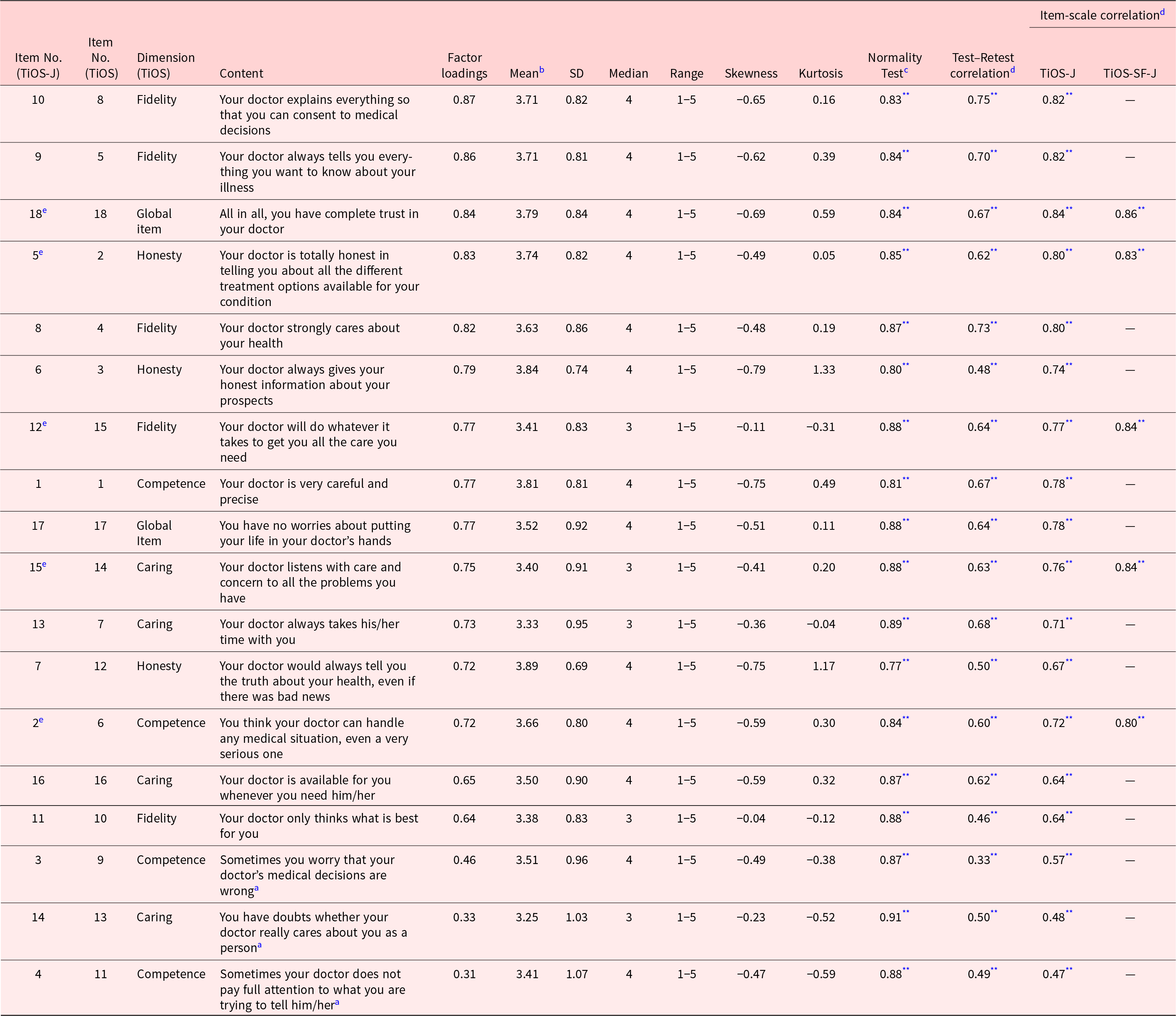
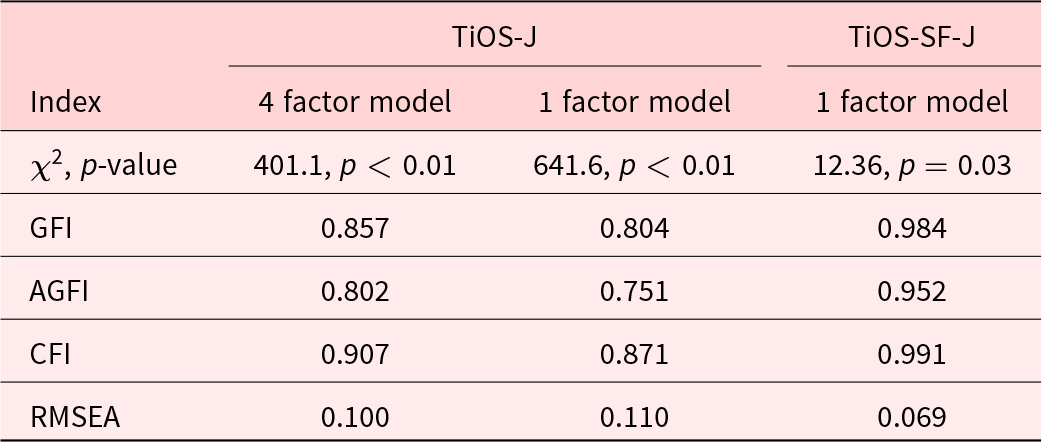
With regard to construct validity, Table 2 shows the results of the EFA on the 18 items of the TiOS-J. The distribution was left-skewed, and the Shapiro-Wilk test was nonsignificant, indicating that not all items were normally distributed. Three reverse-scored items had small factor loadings, but a one-factor structure could be considered. Table 3 shows the results of CFA for the 3 models. The theoretically driven four-factor model and EFA-driven one-factor model of the full-form TiOS-J did not result in an acceptable fit. The one-dimensional TiOS-SF-J resulted in an acceptable fit (χ 2 (5) = 12.36, p = 0.03, GFI = 0.984, AGFI = 0.952, CFI = 0.991, RMSEA = 0.069) in CFA.
Factor loadings, descriptive statistics, and test–retest/item-scale correlation

TiOS-J, Trust in Oncologist Scale–Japanese version; TiOS, Trust in Oncologist Scale Dutch Original version; SD, standard deviation.
a Reverse-scored items.
b Five-point likert scale: 1 = totally disagree, 2 = disagree, 3 = as much agree as disagree, 4 = agree, and 5 = strongly agree.
c Shapiro-Wilk test (If less than the significance level, this variable is not normally distributed).
d Spearman’s ρ.
e Short form item.
** p < 0.01.
Confimatory factor analysis of TiOS-J/TiOS-SF-J

GFI, goodness-of-fit index; AGFI, adjusted goodness-of-fit index; CFI, comparative fit index; and RMSEA, root mean square error of approximation.
Table 4 shows the concurrent validity of the TiOS-J/TiOS-SF-J. The TiOS-J had a Spearman’s correlation coefficient of 0.83/0.79 with patient satisfaction (PSQ-J) (p < 0.01), 0.61/0.60, with willingness to recommend the oncologist (p < 0.01), and 0.36/0.34 with trust in health care (p < 0.01).
Concurrent validity of TiOS-J/TiOS-SF-J

TiOS, Trust in Oncologist Scale; PSQ, Patient Satisfaction Scale.
a Five-point likert scale: 1 = <3, 2 = 3−5, 3 = 6−10, 4 = 11−15, 5 = >15.
** p < 0.01.
Reliability
Regarding the reliability of TiOS-J and TiOS-SF-J, the Cronbach’s alpha values were 0.94 and 0.89, respectively; their respective test–retest values were 0.82 and 0.78. The Cronbach’s alpha values of the theoretically driven 4 factors of the TiOS-J were 0.90, 0.69, 0.87, and 0.73, respectively.
Table 2 shows item-scale correlations of TiOS-J and TiOS-SF-J that ranged from 0.47 to 0.84 and 0.80 to 0.86, respectively.
Association between physician compassion, patient’s quality of life, and TiOS-J/TiOS-SF-J
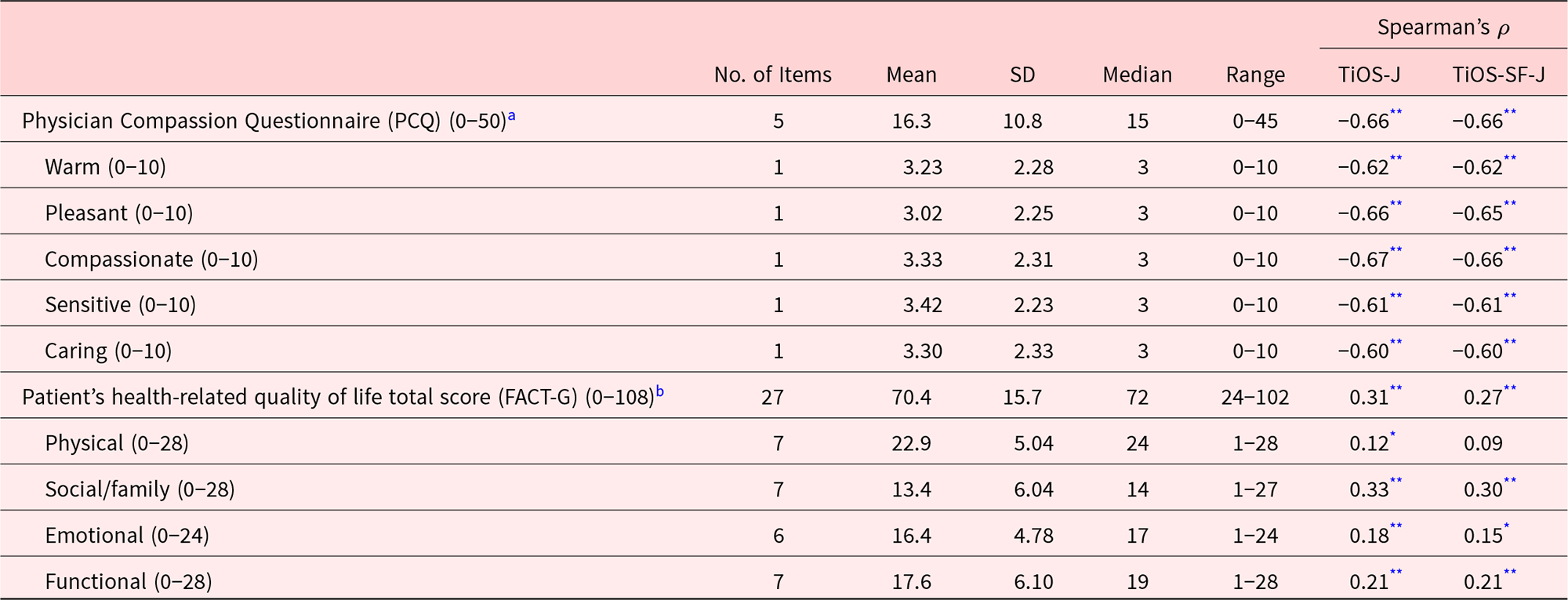
Table 5 shows the results of Spearman’s correlation coefficients. Physician’s compassionate attitude total and each item had a negative correlation between −0.60 and −0.67 (p < 0.01)/−0.60 and −0.66 (p < 0.01) with total scores of TiOS-J/TiOS-SF-J. Patient’s health-related QoL and each subscale items had a positive correlation of 0.12–0.33/0.09–0.30 with the total scores of TiOS-J/TiOS-SF-J.
Association between physician compassion, patient’s quality of life, and TiOS-J/TiOS-SF-J

FACT-G, Functional Assessment of Cancer Therapy-General.
a Lower scores indicate better compassionate attitude.
b Higher scores indicate better global quality of life.
* p < 0.05.,
** p < 0.01.
Discussion
In this study, the Japanese version of the TiOS-J and TiOS-SF-J were developed, and its validity and reliability were tested; both were found to be adequate.
Regarding construct validity, the EFA suggested a one-factor structure for the 18-item version of the TiOS-J. However, the one-factor structure had a lower fit than the four-factor structure in the CFA, and only the shortened five-item version showed an acceptable fit for a one-dimensional model. Thus, the TiOS-J was found to have a one-factor structure, and the shortened version was also valid. In a previous study, the theoretically proposed 4-factor structure was reasonably well reflected in the original Dutch version by CFA (Hillen et al. Reference Hillen, Koning and Wilmink2012a) but was not detectable in the subsequent English (Hillen et al. Reference Hillen, Butow and Tattersall2013) and Italian versions (Bani et al. Reference Bani, Rossi and Cortinovis2021). The short forms were created in Dutch and Italian, both of which were unidimensional. This study reproduced a similar one-factor structure.
Regarding concurrent validity using external criteria, the results replicated those of previous studies, showing strong associations with “satisfaction with the oncologist” and “willingness to recommend the oncologist,” with correlation coefficients of 0.6 or higher; weak associations were seen with “trust in health care,” and no associations were found with “the number of oncological consultations.”
For reliability, the alpha coefficient for internal consistency was high for both the full 18-item version of the TiOS-J and the shortened 5-item version, and high test–retest correlations were found after 2 weeks.
Patient TiOS-J scores were strongly associated with physicians’ compassionate attitudes but moderately associated with patients’ health-related QoL. In summary, it is clear that “trust in an oncologist” is strongly associated with the attitude of physicians rather than with the QoL of patients.
The limitations include the following sample biases. First, this was a web-based survey, not a mail survey of cancer patients recruited at the oncologist’s hospital as in previous studies (Hillen et al. Reference Hillen, Butow and Tattersall2013, Reference Hillen, Koning and Wilmink2012a) (Bani et al. Reference Bani, Rossi and Cortinovis2021), comprising a panel of patients from a web-based survey company who self-reported being cancer patients. Thus, the fact that this study was a response to a survey company that was not associated with the primary physician might explain why TiOS-J scores were in the 3-point range for all items, which is lower than the 4-point range in previous studies (Hillen et al. Reference Hillen, Butow and Tattersall2013, Reference Hillen, Koning and Wilmink2012a) (Bani et al. Reference Bani, Rossi and Cortinovis2021). Other cultural differences among countries require further study. The second limitation of the study is that not only the younger generation (under 40) but also the elderly (over 70) were not included in the study since the procedure was to end recruitment as soon as the target number was reached.
In conclusion, this study indicated that the TiOS-J and TiOS-SF-J are valid and reliable instruments for measuring patients’ trust in their oncologists. Further studies are expected to be conducted with this questionnaire to understand physician–patient relations in oncology. Since trust in one’s doctor is expected to vary depending on the severity of the cancer (e.g., stage) and the status of the second opinion, the relationship between the trust scale and these variables is a topic for future research.
Author contributions
TO, MM, MM, TM, and YU designed this study. MAH, the original author to develop the TiOS questionnaire, permitted this study and confirmed the Japanese version of the questionnaire after backward translation. MA, MF, and YK analyzed and interpreted the data. All authors have read and approved the final manuscript.
Funding
This study was supported by a Health, Labour and Welfare Sciences Research Grant (Cancer Policy Research Project) “Research on psycho-psychological and social problems faced by cancer patients, focusing on social factors that may be the cause or related factors, and aiming at correcting them” (H26-cancer-policy-general-002, Principal Investigator: YU) and JSPS KAKENHI Grant Number JP19H03878.
Competing interests
The authors have no conflicts of interest to declare.


 Open access

