





Introduction
This article presents a comprehensive compilation of all radiocarbon dates obtained from various archaeological excavations at the Salapunku site, located within the Historic Sanctuary – National Archaeological Park of Machu Picchu (HS-NAPM). The dataset includes samples from multiple sectors, which are often interpreted as distinct sites. The radiocarbon data discussed here originate primarily from funerary contexts and residential areas. Our objective is to provide a consolidated resource that addresses a noticeable gap in existing research, where detailed chronological information remains limited. For this reason, we have oriented the article toward the broader cultural history of the region. The Salapunku area is particularly significant for understanding patterns of population movement, owing to its strategic location at the so-called gateway to the lower Vilcanota Valley, which provides access to the Amazonian selva. Its lower elevation makes the area especially attractive for settlement and travel; in the Vilcanota Valley, the climate is notably more temperate than in Cusco, and the vertical landscape offers access to a wide range of microclimates (Murra Reference Murra1972).
Our interest in this part of the Vilcanota Valley originated through our objective to understand the origins of the Inca presence in the Cordillera Vilcabamba. The Salapunku area seemed to be the center of pre-Inca prosperity. Analyzing radiocarbon samples acquired over the last few years presents a long history of occupation going back millennia before the Inca. The only radiocarbon data to date comes from the Huayllabamba Valley, from the Huillca Raccay archaeological site. The dates obtained in the 1980s and 1990s indicated a solid human presence as early as 500 BCE and earlier (Bronk Ramsey et al. Reference Bronk Ramsey, Pettitt, Hedges, Hodgins and Owen2000; Kendall Reference Kendall1984). However, due to limitations of the radiocarbon method at the time, the margin of error remained between ± 50–60 years. Our results and previous results from the neighboring Huayllabamba Valley provide insights into cultural dynamics before the Inca conquest of the regionFootnote 1. Aside from showing a persistent human occupation in the Cordillera Vilcabamba, we were able to map out a timeframe for the early human presence in the Archaic period and capture the earliest manifestations of Killke-style associated materials in the Cusco region.
This project confirmed the presence of a substantial population in the region during pre-Inca times and identified evidence for the earliest human occupation of the valley. Accordingly, this article presents the complete set of radiocarbon results from Salapunku, aiming to provide a foundation for future researchers interested in the pre-Inca settlement of the area.
Introduction to the regional problem of human occupation in Central Andes
Some of the latest publications have contributed much to Lake Titicaca’s research on early altiplano communities in the altiplano area in terms of their chronology and social relations (Haas et al. Reference Haas, Stefanescu, Garcia-Putnam, Aldenderfer, Clementz, Murphy, Llave and Watson2017). At the same time, a more holistic approach represented by Contreras combines paleoclimatic data with up-to-date knowledge of ENSO from a landscape perspective (Contreras Reference Contreras2010; Roosevelt et al. Reference Roosevelt, Lima Da Costa, Lopes Machado, Michab, Mercier, Valladas, Feathers, Barnett, Imazio Da Silveira, Henderson, Silva, Chernoff, Reese, Holman, Toth and Schick1996). Of particular interest from the point of view of this publication were the findings from southern Peru (Arequipa region), where Rademaker confirmed the remains of manufacturing workshops in an isolated and challenging Puna environment of gatherer-hunter communities in the Pucuncho Basin (Aldenderfer and Flores-Blanco Reference Aldenderfer and Flores-Blanco2011; Meinekat et al. Reference Meinekat, Miller and Rademaker2022; Rademaker et al. Reference Rademaker, Hodgins, Moore, Zarrillo, Miller, Bromley, Leach, Reid, Álvarez and Sandweiss2014). Questions remain on the overall nature of human occupation during the Archaic Period, which may have ranged from permanent settlements to nomadic camps (Moore Reference Moore, Rocek and Bar-Yosef1998).
The Cusco region lacks absolute dating for Archaic Period sites, and chronologies rely on artifact seriation. Only a few contexts in the Cusco region have been studied so far. However, the neighbouring Ayacucho region has received much more intensive study. The closest, best-known, and most studied early site is in the Pikimachay area (Capcha and Nami Reference Capcha and Nami2022; Lynch Reference Lynch1992; MacNeish Reference MacNeish1970, Reference MacNeish1971, Reference MacNeish1976, Reference Macneish1992; Yataco Reference Yataco2011, among the others). Furthermore, bordering the Cusco region, the Altiplano and the southern Andes have also received detailed attention (Aldenderfer and Flores-Blanco Reference Aldenderfer and Flores-Blanco2011; Meinekat et al. Reference Meinekat, Miller and Rademaker2022; Rademaker and Hodgins Reference Rademaker, Hodgins, Harvati, Jäger and Reyes-Centeno2018; Rademaker and Moore Reference Rademaker and Moore2019; Rademaker et al. Reference Rademaker, Hodgins, Moore, Zarrillo, Miller, Bromley, Leach, Reid, Álvarez and Sandweiss2014; Sutter Reference Sutter2021) including the latest developments from Soro Mik’aya Patjxa (Haas et al. Reference Haas, Klink, Maggard and Aldenderfer2015, Reference Haas, Stefanescu, Garcia-Putnam, Aldenderfer, Clementz, Murphy, Llave and Watson2017) (Figure 1a). Therefore, it is surprising how much we know about the early human presence in nearby regions and how little we know about the beginnings of the population in Cusco.
(a) Sites discussed in the text: (b) the area of Historic Sanctuary – National Archaeological Park of Machu Picchu (HS-NAPM) with location of Salapunku site marked with arrow; (c) the exact location of Salapunku and its relation to other local sites (Del Solar Velarde 2024). Images from Google Earth.

The most detailed analysis of the regional Archaic period, directed by Brian Bauer, focuses on the Kasapata site in the Cusco Valley (Bauer Reference Bauer2007). The Kasapata site is located in the Huatanay River Valley, southeast of modern Cusco city, at an elevation of 3400 masl. Based on this analysis, Bauer outlined the Archaic period between 9000 and 2200 BCE, and further subdivided it into three additional parts: Early Archaic Period (9500–7000 BCE), Middle Archaic Period (7000–5000 BCE), Late Archaic Period (5000–2200 BCE) with first radiocarbon data between 4690 BCE and 4340 BCE (at 95.4%) (Bauer Reference Bauer2007). Kasapata remains the only site with absolute dating from the Archaic period in Cusco.
Field research directed by Alan Covey, conducted under the Hanan Cuzco project, also provides insights into the region’s Archaic period, particularly in the Sacred Valley, Huaypo Lagoon, and Xaquixaguana areas (Covey Reference Covey2014). While much of the project focused on ceramics recovered from field prospecting, this research introduced essential questions regarding early human presence on the Xaquixaguana plateau. Based on lithic artifacts, preceramic hunting activity would have occurred on the plateau above 3500 m a.s.l.; a settlement would have possibly existed in the valley by this time. However, modern construction and urban development have altered most valley-bottom areas, erasing any possible Archaic period data (Covey and Griffis Reference Covey, Griffis and Covey2014). The research conducted on sediments from the Huaypo Lagoon indicates that before 4500 BCE, climatic conditions were unfavorable for plant cultivation. However, during this period, the first records of Amaranthaceae pollen, i.e., quinoa, appear (Mosblech et al. Reference Mosblech, Chepstow-Lusty, Valencia and Bush2012). The period when pollen from cultivated plants appears aligns with Bauer’s dating of the end of the Archaic Period in the Cusco region. Evidence of such remains may indicate the beginnings of a sedentary life.
While the data presented is still insufficient to outline the dynamics of human change during the Archaic period in the Cusco region, it is relevant to the context of the Salapunku site. The long-standing human presence at Salapunku suggests its desirable location in a river valley and along the mountainside. Based on the results presented, people likely established their settlements (permanent or temporary) in this area during the Archaic period, and settlements persisted until the Inca period.
Research context
This investigation establishes a chronological and methodological foundation for the study of human presence in the present-day Department of Cusco from the Archaic to the Inca period. The archaeological survey and collection of samples were conducted in 2017 as part of the investigation project “Programa de Investigaciones Arqueologicas e Interdiciplinarias en el Santuario Histórico de Machupicchu – PIAISHM” (Bastante Reference Bastante2018). The results of the individual samples were examined over the following years as part of a joint investigation with the Peruvian Ministry of Culture (DDC-Cusco). Human bone was not available for radiocarbon dating due to reburial following excavation, which is a mandatory procedure under the guidelines of the Peruvian Ministry of Culture. As the remains were no longer accessible for sampling, charcoal associated with the original context was selected for analysis. Although direct dating of human remains is ideal, the use of associated materials is a widely accepted alternative when such remains cannot be analyzed. Newly obtained radiocarbon results were modelled with the Huayllabamba Valley dates from the Huillca Raccay site, which helped us capture the region’s cultural history. Data from the Huayllabamba Valley were obtained as part of the Cusichaca project led by Ann Kendall in the 1970s and 1980s (Bronk Ramsey et al. Reference Bronk Ramsey, Pettitt, Hedges, Hodgins and Owen2000; Hey Reference Hey1999; Kendall Reference Kendall1984). As a result of this combination of results from various projects, we have a better understanding of the dynamics of cultural change over the millennia in the area now within Machu Picchu National Archaeological Park. Based on research in the region to date, we have been able to outline several commonalities between areas such as Kasapata (Bauer Reference Bauer2007) and Hanan Cuzco (Covey Reference Covey2014).
While the site of Machu Picchu is eminently essential, at least 60 archaeological sites are connected by more than 300 km of Prehispanic roads within the Historic Sanctuary – National Archaeological Park of Machu Picchu (HS-NAPM, Bastante Reference Bastante2018). The HS-NAPM area includes a sequence of human occupation since the Late Formative Period (Bastante and Fernandez Flores Reference Bastante and Fernandez Flores2018), with most sites closely associated with the Inca or Late Horizon. However, a deeper history can be drawn from the Salapunku site.
Salapunku Archaeological Monument
Salapunku is located in the HS-NAPM on the right bank of the Vilcanota River, at km 83 of the Cusco-Hydroelectric railway (Figure 1 b–c). Salapunku is divided into twelve sectors and covers an area of more than 107 ha. Each sector could be considered a separate site due to its different functions, locations, and communication access (Bastante Reference Bastante2018). Located at the boundary of the archaeological park, this area at the base of Nevado Verónica (Waqyawillke) is a natural choke point controlling access to the Vilcanota Valley (Bastante and Fernandez Flores Reference Bastante and Fernandez Flores2018). Initial archaeological work indicated that the Inca occupation was the most recent. Before the Inca, excavations show evidence of the Killke-style materials (relative dating 900 to 1200 CE) and earlier occupations going back to the Formative period (Bastante and Fernandez Flores Reference Bastante and Fernandez Flores2018). This research established a relative chronology based on typological analyses of pottery and other artifacts. The analysis of these materials also provided a clear idea of the function of the Salapunku, which demonstrated complex social organization along with administrative and religious activities.
An essential element of the regional landscape is rock art. The area is particularly rich with cave remains of various kinds. A revealing characteristic of the site is the change and transformation of space over time. While it is impossible to directly link rock art to specific archaeological remains, typological analysis suggests that it may have been created in the early days of human presence in the region (Echevarría López et al., Reference Echevarría López, Bastante and Ziółkowski2022). At least five examples of rock art at Salapunku, including paintings and petroglyphs, are ascribed to the Prehispanic period (Bastante and Echevarría Reference Bastante, Echevarría, Astete and Bastante2020).
Chamanqhata sector
Since 2007, HS-NAPM specialists have conducted interdisciplinary research in different sectors of Salapunku, focusing on architecture and ceramic materials to establish a series of occupations that date back to the late Formative Period and continue until the Inca. However, no absolute dating supports these hypotheses.
Chamanqhata, or sector VIII of the Salapunku site covers an area of 3.9 hectares and includes enclosures, an irrigation canal, and funerary contexts in rock shelters (Bastante Reference Bastante2018). This sector is located at an average altitude of about 2780 m a.s.l. on a relatively steep slope descending into the Vilcanota River valley. The investigations carried out in 2017 in the Chamanqhata Sector have identified a set of architectural units with semicircular and semi-quadrangular margins with straight and curved corners. All three occupational sequences in the Chamanqhata Sector of Salapunku (Bastante Reference Bastante2018) are discussed below.
Material and methods
We applied two types of analysis, one involving a detailed archaeological analysis based on excavations and the other involving radiocarbon dating. These two methods of chronological analysis, relative and absolute, allowed us to refine the boundaries of the cultural history sequence.
Archaeological excavations and analysis
Two archaeological units (UE01 and UE07) excavated in 2017 within the project PIAISHM yielded radiocarbon samples from proper archaeological contexts. Due to the invisibility of cultural layers, excavations were conducted by arbitrary levels of 10–15 cm. Occasionally, breaks in levels were made if there was a significant change in artifacts. At this point, we emphasize the importance of specific samples and results. These samples are pieces of organic matter, such as wood or charcoal, that contain radiocarbon (14C), which begins to decay as soon as an organism dies. By examining the amount of radiocarbon remaining in a sample, it is possible to estimate the time since death, which allows for establishing a chronology in archaeological studies.
UE01 was located near structures built into a rock overhang (Figure 2). The unit’s layout was situated towards the southwest side of the sector and covered an area of 21.60 m2. The cultural material comprised lithic elements associated with many scattered human bones and 39 ceramic fragments. The UE07 layout covered the internal area of enclosure R-08 with a quadrangular area of 7.09 m2 (Bastante Reference Bastante2018).
(A–B) The cave where UE01-2017 was located (photo by D. Sieczkowska-Jacyna); (D) the location where samples 04 and 05 were taken; (D–E) associated materials (PIAISHM archives).

In both cases, organic material (charcoal) for radiocarbon analysis was found associated with burial contexts. Below is a description of the various excavation contexts from which the dating material was taken.
UE01-2017
This unit’s first layer (01) included Inca material culture, such as ceramic vessels and metal objects, which complements the radiocarbon dates for this layer, indicating an occupation dating to the late Inca or Early Colonial period (Sample 02 and 03). The material associated with this burial is Inca (primarily for domestic use), but artifacts such as wooden drinking cups (kero) and shawl pins continue into the Colonial period (Figure 2d–e). As such, valuable artifacts may have been treasured objects, the period between their production and the moment of burial cannot be established without more information. For the next layer (02), no material sufficient for radiocarbon dating was obtained.
For the excavations in the funerary context (layer 03), excavations were conducted in arbitrary layers (see Figure 2c for more detail and the locations of radiocarbon samples 04 and 05). Sample number 04 was associated with an adult male buried with stones (cantos rodados). Torres (Reference Torres2017) described these andesite stones as mortero and mano de moler. There are visible traces of destruction and poor preservation of bone material related to the subsequent taphonomic processes. The skeleton has deep marks left by muscle insertions in the upper and lower limbs, suggesting a history of intense physical activity (Torres Reference Torres2017). The burial corresponds to an individual placed in an extended ventral decubitus position, with the upper limbs below the thorax (Torres Reference Torres2017). The burial was sealed within a crack in the outcrop, ensuring its preservation. The second burial is located below sample 4 and is directly associated with sample 05. This poorly preserved young individual exhibiting cranial deformation was anatomically articulated, indicating a primary burial (Torres Reference Torres2017). No additional grave goods exist, though guinea pig bones found nearby may be associated (Socha Reference Socha2017; Torres Reference Torres2017). The radiocarbon samples were charcoal associated with peri-funeral activities. The two described contexts were deposited practically together (one on top of the other) behind a stone structure.
UE07-2017 (Structure 08)
Samples for radiocarbon dating were taken from the deepest layer of the excavation unit, that is, from the third layer associated with the Killke occupation based on associated materials. The recovered cultural material for this third layer is composed of a small quantity of domestic ceramic fragments ascribed to the Late Intermediate Period (Bastante Reference Bastante2018).
The excavations at Salapunku during the 2016 and 2017 seasons have also defined three occupational sequences in the Chamanqhata sector. The oldest sequence consisted of early architecture and an occupation floor with a small amount of cultural (lithic) material tentatively dated to the Formative Period. The second occupation is from the Late Intermediate Period. A rock and soil fill levels the area for a subsequent floor and buildings associated with domestic pottery material. The third occupation occurred briefly during the Late Horizon dated by association with diagnostic inca ceramics on a surface covered with collapsed architecture. (Bastante et al. Reference Bastante, Astete, Fernandez Flores, Usca, Astete and Bastante2020).
Radiocarbon dating
A detailed description of each sample is described in Table 1. The samples for radiocarbon dating were prepared in the Dendrochronological Laboratory at AGH University Kraków. After selecting the appropriate material for radiocarbon analysis, all prepared samples were cleaned and rinsed in deionized water. The chemical pre-treatment of the samples includes the acid-base-acid procedure (ABA) (Jull et al. Reference Jull, Burr, Beck, Hodgins, Biddulph, Gann, Hatheway, Lange and Lifton2006). In the first step, all samples were treated with 2% HCl at 75°C, then rinsed with deionized water until neutral. Next, the samples were treated with 0.1M NaOH at 75°C and rinsed with deionized water until neutral. Finally, the samples were treated again with 2% HCl at 75°C, then rinsed with deionized water until neutral. The duration of each chemical step was 1 hr and washing around 30 min. After the ABA procedure, the samples were dried and prepared for the next step. To ensure quality results, control samples from material with a known radiocarbon content were added to each of the prepared batches of samples. We used IAEA C3, and vitrinite samples (Krąpiec et al. Reference Krąpiec, Rakowski, Huels, Wiktorowski and Hamann2018) to control the background of the whole procedure. All control samples were also prepared using the ABA method.
Description of the radiocarbon-dated samples

For combustion to CO2, samples were transferred into pre-baked (900°C) quartz ampules together with CuO and Ag, evacuated to a pressure of 10-5 mbar, sealed, and combusted for 4 hr at 900°C in a muffle oven (Krąpiec et al. Reference Krąpiec, Rakowski, Huels, Wiktorowski and Hamann2018). The resulting CO2 was released under a vacuum and cryogenically purified for subsequent graphitization. The reduction of CO2 to graphite was done using a 5-port vacuum system (Krąpiec et al. Reference Krąpiec, Rakowski, Huels, Wiktorowski and Hamann2018) using H2 and Fe powder as catalysts. About 200 mbar of CO2 (corresponding to 1 mg C in this system) was used, and the H2/CO2 ratio for the reduction was ∼3 (by volume), and the Fe/C ratio of 2 (by mass). The water produced during this process was removed using a cryogenic trap.
The produced graphite was then pressed into the cathode and measured using the AMS system at the Center for Applied Isotope Studies at the University of Georgia, Athens, Georgia, USA (Labcode UGAMS; Cherkinsky et al. Reference Cherkinsky, Culp, Dvoracek and Noakes2010). The 14C contents are reported as Δ14C per mil (‰) deviations from the standard sample, 0.7459 NBS oxalic acid (SRM- 4990C) activity. Age correction, isotopic composition correction (δ13C, measured by the AMS system), and Δ14C values were calculated using formulas presented by Stuiver and Polach (Reference Stuiver and Polach1977). The OxCal 4.4 software (Bronk Ramsey Reference Bronk Ramsey2009) was used to determine the calendar age of the samples and to construct the chronology of the occupation of this site. One sample was analyzed at the laboratory at the University of Waikato, and the entire analysis process was carried out on-site.
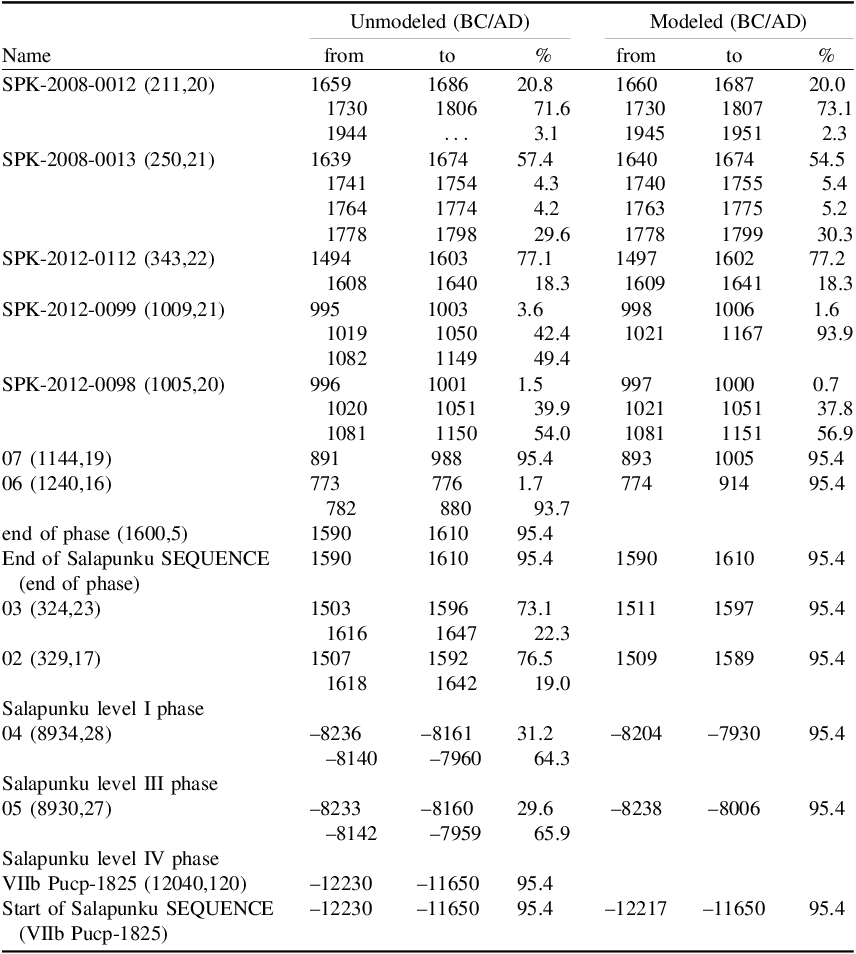
The calculation is based on a mixture of IntCal20 and SHCal20 calibration curves (Hogg et al. Reference Hogg, Heaton, Hua, Palmer, Turney, Southon, Bayliss, Blackwell, Boswijk, Bronk Ramsey, Pearson, Petchey, Reimer, Reimer and Wacker2020; Reimer et al. Reference Reimer, Austin, Bard, Bayliss, Blackwell, Bronk Ramsey, Butzin, Cheng, Edwards, Friedrich, Grootes, Guilderson, Hajdas, Heaton, Hogg, Hughen, Kromer, Manning, Muscheler, Palmer, Pearson, van der Plicht, Reimer, Richards, Scott, Southon, Turney, Wacker, Adolphi, Büntgen, Capano, Fahrni, Fogtmann-Schulz, Friedrich, Köhler, Kudsk, Miyake, Olsen, Reinig, Sakamoto, Sookdeo and Talamo2020). The corresponding mixing ratio has been determined in our previous study (Ancapichún et al. Reference Ancapichún, Pawlyta, Rakowski and Sieczkowska2022), and the share between air parcels coming from the NH and SH is described by uniform probability with a proportion of 50% ±24%. The results of calibration and modelling are presented in Table 2 and Figure 3. When constructing the model for the Salapunku site, the radiocarbon date of the sample VIIb Pucp-1825 12040±120 BP (Le Neün et al., Reference Le Neün, Dufour, Zazzo, Tombret, Thil, Wheeler, Cucchi and Goepfert2023) was used as the lower boundary for human presence in the Andes. The year 1600 AD was used as the upper boundary. OxCal script for the model construction is provided in the supplemental material.
Results of the radiocarbon calibration and modelling for Salapunku radiocarbon dated samples

OxCal 4.4 multiplot of the radiocarbon calibration and modelling for Salapunku radiocarbon dated samples (A). Dates published at Radiocarbon Database for Central Andes (andesc14.pl) from Bronk Ramsey et al. Reference Bronk Ramsey, Pettitt, Hedges, Hodgins and Owen2000, Hey Reference Hey1999 and Kendall Reference Kendall1984, calibrated using the same mix of IntCal20 and SHCal20.

Results and discussion
Table 1 presents the results of archaeological and radiocarbon studies of funerary contexts at Chamanqhata from UE01 and UE07. The previous section provides a more detailed description of excavation units.
Samples 02 and 03 associated with Inca material confirmed the initial hypothesis—Sample 02: (1507–1592 CE) 76%; (1618–1642 CE) 19%, and Sample 03: (1503–1596 CE) 73%; (1616–1647 CE) 22%—this period indicates a time between the end of the Inca period and the beginning of the colonial period. The samples from both burial contexts (04 and 05) dated to the beginning of the seventh millennium BCE, which in Andean chronology would correspond to the transition between the Early Archaic and Middle Archaic phases—Sample 04: (8236–8161 BCE) 31%; (8140–7960 BCE) 64% and Sample 05: (8233–8160 BCE) 29%; (8142–7959 BCE) 66%. Thus, it can be concluded that these contexts are not from the Formative Period (2200–900 BCE) as previously assumed but date to the Archaic period.
The construction of the associated enclosure indicates a specific funerary practice not commonly attributed to the Archaic. At the same time, the preservation of the material is good due to the well-sealed stone burial. What is particularly important was the source of the sample: charcoal residue mixed with the ash of funerary activities (Bastante Reference Bastante2017; Torres Reference Torres2017). The stone tools, possibly for food processing, likely indicate an emergent funerary practice. Since radiocarbon dating indicates a period between the Early and Middle Archaic phases, such tools imply the beginnings of a sedentary lifestyle in the Vilcanota Valley region. Nevertheless, one element introduces a certain amount of uncertainty to our conclusions. Cantos rodados, morteros, and manos de moler are still used for food processing throughout South and Central America. Thus, we lack artifacts that complement or confirm the early dates of this context, requiring further research to be carried out. The presented results constitute all obtained dates from all samples from the entire excavations between 2008 and 2017.
Furthermore, we note several notable parallels between Salapunku, the Kasapata project, and the Hanan Cuzco project, suggesting possible shared cultural practices or regional traditions. In all three sites, andesite served as the principal material for lithic tool production, indicating either similar resource availability or technological preferences. Additionally, evidence from both Kasapata and Salapunku points to funerary practices that may have included the sprinkling of ash over the bodies of deceased community members, hinting at comparable mortuary traditions within the broader cultural landscape (Bauer Reference Bauer2007). During the Middle Archaic Period at Kasapata, there were traces of cantos rodados and charcoal, which burned the bones in the burials (Bauer Reference Bauer2007). Similar cantos rodados were found in the burials at Salapunku. Samples indicating the Archaic dating of Salapunku come from the ash and charcoal layer, which would have been part of burial-associated events (Bastante Reference Bastante2017; Torres Reference Torres2017). Similar uses of ash and charcoal in the Archaic period have been found at Pampa de los Fósiles, Telarmachay, or Baño Nuevo-1 (Briceño Rosario and Millones Reference Briceño Rosario and Millones1999; Chauchat and Demars Reference Chauchat and Demars2006; Chauchat and Wing Reference Chauchat and Wing2006; Chauchat et al. Reference Chauchat, Wing, Lacombe, Demars, Uceda and Deza2006; Santoro et al. Reference Santoro, Standen, Arriaza and Dillehay2005).
The Salapunku skulls are intentionally deformed (Torres Reference Torres2017), a practice well documented across the Andes in cultures such as the Moche, Tiwanaku, Chiribaya, Inca, and others (Fehir Reference Fehir2014; Schijman Reference Schijman2005; Torres-Rouff 2020). One of the earliest and best-recognized cases of Archaic cranial modifications is that of Lauricocha in Central Andes (Cardich Reference Cardich1996). Also, Lauricocha is the oldest example of burials in the region in the anatomical position (Cardich Reference Cardich1996). In Salapunku’s context, the individuals were also buried in anatomical positions (Torres Reference Torres2017).
Archaic period funerary deposits include animal remains at both Kasapata and Salapunku (Santoro et al. Reference Santoro, Standen, Arriaza and Dillehay2005). In the context of Salapunku, however, due to the complex superposition of layers and the limited burial space, it is possible that these remains (guinea pig) are younger and do not belong to the funerary context. Depositing guinea pigs was a relatively common pattern for burials in pre-Hispanic times (Sandweiss and Wing Reference Sandweiss and Wing1997). Collecting these numerous elements presents a funerary practice that includes many elements common across later Andean contexts
The presence of artifacts associated with the Late Intermediate Period and radiocarbon dates for UE07-2017, called Structure 08, allows us to propose some hypotheses. Identified as Killke associated dating (Bastante Reference Bastante2017) with relative dating of 900–1200 CE (Rowe Reference Rowe1944), the absolute radiocarbon dates are earlier than the proposed 900–1200 CE range (Rowe Reference Rowe1944, Bauer Reference Bauer2008). In the context of UE07, within the entire structure studied, both the architecture (of Structure 08) and the ceramic material indicate a link to the Killke. However, the results of the radiocarbon analysis for charcoal elements from pottery-related contexts date between 700 and 900 CE: Sample 07: (891–988 CE) 95% and Sample 06: (773–776 CE) 2%, (782–880 CE) 93%.
If confirmed, our results shift the timeline of the Killke presence in the Cusco region. If Salapunku’s Killke affiliation holds, we have an example of a very early stage of this regional development. Here, we would like to emphasize a particular issue that is important to us. We only want to highlight that our goal was to present dates that can be used as a tool for further analysis. At the same time, we are particularly interested in projects that study the transitions between the Inca and earlier cultures in the Cusco area (Vranich & Sillar, Reference Vranich and Sillar2016). We believe that our dates may be complementary to these findings.
Due to the wide range of radiocarbon dates obtained, we decided to search for more samples from the Salapunku site that would allow us to construct a cultural history. In 2022, new permissions to date the material stored in the Manuel Chavez Ballón Museum in Machupicchu Pueblo warehouses made it possible to produce a more complete picture of the region’s settlement patterns. Different materials—short-lived species and a fragment of vegetal fabric—produced radiocarbon ages between 1005±20 BP and 1009±21 BP, respectively (Table 1).
The archaeological excavation identified the samples as belonging to a period associated with the Inca presence in the region. At the same time, dating showed that the samples were much older. They can likely be related to Killke associated contexts, but since they are organic remains (a cord and a piece of wood), they are impossible to match in style. Settlement continuity is reflected in five dates from small maize cobs, which indicate their cultivation in the colonial period and even later. The presence of cultural contexts in the post-Inca period shows that this area of today’s Salapunku site was still occupied in the colonial period (after 1572 CE).
The samples obtained allowed us to create an initial cultural history of the region. For this reason, we decided to include data from the Cusichaca project from the 1970s. The sixteen samples were from the Huillca Raccay site in the Huayllabamba Valley, also known as the Cusichaca Valley, which lies within the boundaries of the Machu Picchu National Archaeological Park. These dates, taken in the 1970s, are not as precise as modern ones, but their inclusion extended cultural continuity in this region for over two thousand years. Although the samples are from various contexts, the application of modelling and the latest advances in date calibration have enabled us to establish an occupation range extending back to before 700 BCE. When combined with the Salapunku dates, this offers us a compelling picture of persistent occupation in this region over the past 2500 years (Figure 3B). This is exciting in the context of the development dynamics in the Cordillera Vilcabamba area because it shows that the space between the valleys functioned as an important cultural center.
Conclusion
Previous research shows that Inca and other occupations have been dated relatively based on associated artifacts. Our study complements these findings with absolute dating and extends the occupation of the area back in time. One achievement was the discovery of Killke-style associated material and dating that pushes its origin back a century earlier than previously thought. The very early context from UE07 may be one of the first examples of this Killke in the Cusco area. Another notable achievement relates to the earliest dates associated with human presence in the area. The dates from UE01 associated with human burials were dated to the Early to Middle Archaic transition, becoming the earliest radiocarbon dating of its kind in the Cusco region. As noted above, the dates come from charcoal found in funerary contexts whose form - body in anatomical position and lacking any offerings other than perhaps a stone object - is characteristic of early burials. Different periods of human occupation, from the Archaic to the Late Colonial, have also been found in the Salapunku area, but in the absence of absolute dates have been mistakenly attributed to other archaeological cultures.
This area is promising for future work, not least in terms of decent preservation, low erosion, and the accumulation of later natural and cultural layers. It still contains valuable information that will refine the chronology of the various occupation moments.
Supplementary material
To view supplementary material for this article, please visit https://doi.org/10.1017/RDC.2025.10153
Acknowledgments
This research was conducted within the Archaeological and Interdisciplinary Research Program at the Historic Sanctuary of Machu Picchu of the Decentralized Direction of Culture of Cusco (DDC-Cusco) from the Peruvian Ministry of Culture, supported by the Center for Andean Studies at the University of Warsaw (CEAC UV), under an agreement between the DDC-Cusco and the CEAC UV.
We thank the Polish Ministry of Education and Science (formerly Ministry of Science and Higher Education) for funding the maintenance of a special research facility, the Center for Andean Studies of the University of Warsaw in Cusco, under Grants SPUB:/SP/458023/2020, SPUB/SP/491871/2021, and SPUB/SP/530636/2022.
The research project to establish the chronology of the development of the Inca domination in the Vilcabamba region is funded by the National Science Centre of Poland, within the framework of the OPUS grant entitled Chronology of the Inca expansion in Cordillera de Vilcabamba (Peru) number 2020/37/B/HS3/01622.
We are extremely grateful for the fieldwork help provided by the Machu Picchu National Archaeological Park employees for support and invaluable assistance.
We also want to thank the two anonymous reviewers who contributed many valuable suggestions to the final version of the manuscript.




 Open access

