

In ancient cultures, metal objects were often used as markers of status. The Andean case is no different: the Lord of Sicán (Shimada Reference Shimada1995) and Sipán (Alva Reference Alva2015) as well as the Ladies of Cao (Fundación Wiese Reference Wiese2022) and Huarmey (Giersz Reference Giersz2017) were elite individuals buried with numerous objects made of different materials, particularly gold and other metals. The manufacture of metal objects requires knowledge of various disciplines, such as mining, metallurgy, physics, and chemistry—knowledge that the ancient metallurgists mastered and applied empirically to make objects that were placed inside funerary bundles as offerings that can be analyzed today. The esteem and value that the ancient Peruvians placed on metals is due not only to the specialization and difficulty that their transformation entailed but also to the meaning these materials had within the Andean worldview, in which they were related to the stars, their gods, and nature (Vetter Reference Vetter, Pérez, Arciello, Simarro and de Rueda2021; Vetter and Carcedo Reference Vetter, Carcedo and Carrizo2021). It is for these reasons that only the elite could carry objects made with such precious materials.
Funerary bundles are typically analyzed by unwrapping (see, e.g., Frame et al. Reference Frame, Guerrero Zevallos, del Carmen Vega Dulanto and Landa Cragg2004). However, this process is destructive and requires more space and conservation interventions. In addition—and for these reasons—in 2020 the Ministerio de Cultura of Peru introduced policy guidelines that prohibit the opening of bundles, except for those that are highly damaged and in need of conservation (see Ministerio de Cultura 2020). Therefore, it is becoming increasingly necessary to adopt other methodologies for the analysis of funerary bundles.
In this context, this study demonstrates the use of computed tomographic scanning (CT-scan, or CT) as a new way of studying the metal artifacts found inside bundles. This methodology allows researchers to identify the objects and to propose interpretations of their possible use(s) and constitutes a noninvasive and nondestructive alternative to the traditional analysis of funerary bundles and the artifacts they contain. It is the first systematic application of this way of studying metal objects in funerary bundles in Peru, which allows information recovery as well as visualization of the individual within and the associated artifacts and textiles while preserving the bundle as a closed context.
However, we recognize that the application of CT to the study of metal artifacts presents challenges. First, metals should ideally be studied using high-energy X-rays, but clinical CT-scanners—which are the only scanners available for scanning mummy bundles in Peru—are optimized for visualizing a living human body and reducing the patient’s exposure to radiation, so they can only generate moderate- and low-energy X-rays. Furthermore, a single scan is a trade-off between visualizing low-density elements (such as textiles and soft tissue) and high-density elements (such as bone and metal). In addition, it is not currently possible to accurately discern the type of alloy or metal used to make an observed object based on its X-ray attenuation coefficient (measured in Hounsfield units by clinical scanners). The optimization of scanning technique and improved methods of analyzing the scans are areas of active research by the Mummies as Microcosms project (see the following text; Nelson et al. Reference Nelson, Watson, Williams, Gauld, Motley, Poeta and Seston2021; Watson et al. Reference Watson, Fuentes, Nelson, Williams, Gauld, Motley, Poeta, Gómez, Baldeos and Pozzi-Escot2022).
The Bundles and Their Context
Funerary bundles, also known as fardos in Spanish, are bundles of textiles of varying sizes and shapes that contain the remains of one or more individuals (there are a few exceptions in which human remains are not present) along with the artifacts that their society chose to bury with them. Adult and older nonadult individuals are generally positioned in a seated/flexed position, while the youngest nonadults (age <3–5 years) are placed in an extended position. These bundles first appeared during the Middle Horizon (AD 600–900) on the central coast of Peru and remained the preferred form of burial until the time of the Spanish conquest (AD 1532).
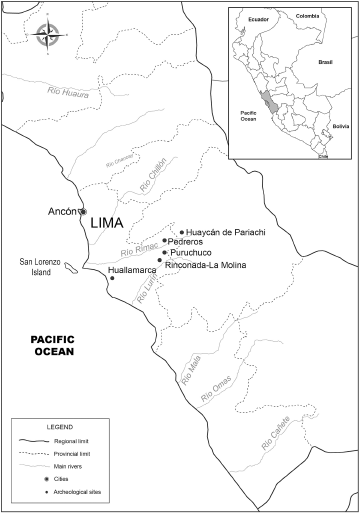
The sample studied here comprises 85 bundles that were found on the central coast and date between AD 1100 and AD 1532. The bundles, represented by scans drawn from the Mummies as Microcosms project led by Andrew Nelson (Nelson et al. Reference Nelson, Watson, Williams, Gauld, Motley, Poeta and Seston2021) and scans carried out by the Horus Group (Sutherland et al. Reference Sutherland, Cox, Lombardi, Watson, Valladolid, Finch and Zink2014), come from the sites of Ancón, Huaycán de Pariachi, Puruchuco, Rinconada La Molina, Pedreros, Huallamarca, and the Rímac Valley (Figure 1). (In some cases, the information about the bundles’ contexts is limited to the valley where they were found).Footnote 1 Of these 85 bundles, 26 contained at least one metal object: that is, 30.6% of the sample featured metal artifacts.
Map with location of the sites mentioned in the research. Prepared by Antonio Encinas based on the authors’ information.

The bundles were recovered during archaeological excavations carried out in the twentieth and twenty-first centuries and are presently stored in different museums in and around the city of Lima. Unfortunately, over time, much of the information from the contexts in which they were recovered has been lost. However, understanding the bundle as a unitary context—in the form of a microcosm that houses cultural and biological information—allows us to integrate the results and shed new light on the meaning of metal offerings as part of the funeral process (Nelson et al. Reference Nelson, Watson, Williams, Gauld, Motley, Poeta and Seston2021; Watson Reference Watson2019). For this reason, in the present study we have taken a bioarchaeological/biocultural analytical approach (Martin et al. Reference Martin, Ryan, Harrod and Ventura2013). The observations resulting from the metal objects were related to the biological sex and age of the individual buried with them (see Vogel and Cutright Reference Vogel, Cutright and Bolger2013).
Computed Tomography and Its Use in Mummy Studies
At present a series of noninvasive and nondestructive methods are potentially available for the study of funerary bundles and their context. Such methods include X-ray imaging (Conlogue, Lombardo et al. Reference Conlogue, Lombardo, Hennessy, Viner, Giaimo, Ronald and Gerald2020), magnetic resonance imaging, terahertz image modeling (Beckett and Conlogue Reference Beckett and Conlogue2020; Öhrström et al. Reference Öhrström, Von Waldburg, Speier, Bock, Suri and Rühli2015; Rühli Reference Rühli2015), and CT-scanning (Conlogue, Nelson, and Lurie Reference Conlogue, Nelson, Lurie, Ronald and Gerald2020), among others. CT offers the advantage of collecting spatial information of the bundle in three dimensions, allowing researchers to perform virtual autopsies in a way that facilitates the detailed observation of the object(s) of interest thus avoiding the superposition of objects that occurs with plain-film X-ray images. In addition, magnetic resonance imaging requires water molecules in the subject whereas mummy bundles are thoroughly desiccated, and, for its part, terahertz imaging would not penetrate the bundles.
CT also offers higher-contrast resolution and therefore greater detail than X-rays (Öhrström et al. Reference Öhrström, Von Waldburg, Speier, Bock, Suri and Rühli2015). The use of this technique on Egyptian mummies dates back to 1977 (Lewin and Harwood-Nash Reference Lewin and Harwood-Nash1977), but its application to Andean individuals is more recent and, as yet, less common (e.g., Dageforde et al. Reference Dageförde, Vennemann and Frank2014). One of the first works to highlight the use of the CT-scan for the study of Peruvian funerary bundles and mummies was Appelboom and Struyven’s (Reference Appelboom and Struyven1999) study of an Andean mummy housed in a museum in Belgium. Their study highlighted the ability of CT-scans to isolate entities such as anatomical features and to perform nondestructive “dissection” of specimens in any plane, which is especially important when the individual is positioned in a seated/flexed position within the bundle.
CT-scanning has become an important element of the analytical arsenal in the field of mummy studies as well as archaeometry in general. A full review of examples is beyond the scope of this paper, but the interested reader is directed to Chhem and Brothwell (Reference Chhem and Brothwell2008) and the case studies in Beckett and others (Reference Beckett, Gerald, Conlogue and Andrew2021) for examples of the use of CT in other areas of archaeology and cultural heritage more broadly.
The CT-scans included in the present study pertain to a series of scanning campaigns from 2012 to 2019. Three different scanners were used: a Philips Brilliance 64, a Toshiba Aquilion, and a Siemens Somatom Definition AS. The specifics of the parameters used also varied from study to study, from 80 to 140 kVp, from 20 to 580 mAs, and from 0.5 mm to 2.0 mm slice thickness. One of the aims of the Mummies as Microcosms project (Nelson et al. Reference Nelson, Watson, Williams, Gauld, Motley, Poeta and Seston2021) is the standardization of the technique for tomographic scanning of funerary bundles.
To visualize the CT-scans, we used Osyrix Lite 11.0 and Dragonfly 3D World, version 2024.1, and particularly the windowing and leveling tools within these programs. We frequently viewed objects in “slab view,” in which several individual slices are stacked to produce an image that looks like an X-ray. This is useful when the object is thicker than an individual slice and when thickness is variable. We also performed image segmentation in Dragonfly using thresholding and the various ROI tools. Colors shown in the figures in this article are based on look-up tables matched to the original grayscale and so are not accurate representations of the actual color of the object.
One goal of the present study was to use CT-scanning of intact funerary bundles to test the hypothesis that metals are one of the few indicators of social status in past Andean societies. Therefore, adequate analysis of the bundled individuals had to take into account the type of metal object, associated offerings, and other funerary treatment of the individual’s body combined with the osteobiographic information (age, sex, etc.) of the individual contained within.
The Findings and Their Interpretation
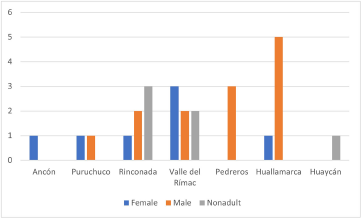
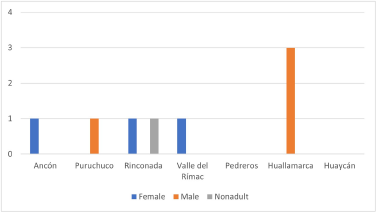
The bundles identified as containing metal objects are currently in the collections of the Museo de Ancón (N = 1), the Museo de Sitio Huaycán de Pariachi (N = 1), and the Museo de Sitio Arturo Jiménez Borja–Puruchuco (N = 24). Of this last group, two belong to the Puruchuco site itself, six to Rinconada La Molina, three to Pedreros, six to Huallamarca, and seven to the greater Rimac Valley (specific site unknown; Figure 2). The individuals concerned date to the Late Intermediate period (AD 1000–1450) and the Late Horizon period (AD 1450–1532).
Sex distribution of individuals in bundles containing at least one metal artifact. (Color online)

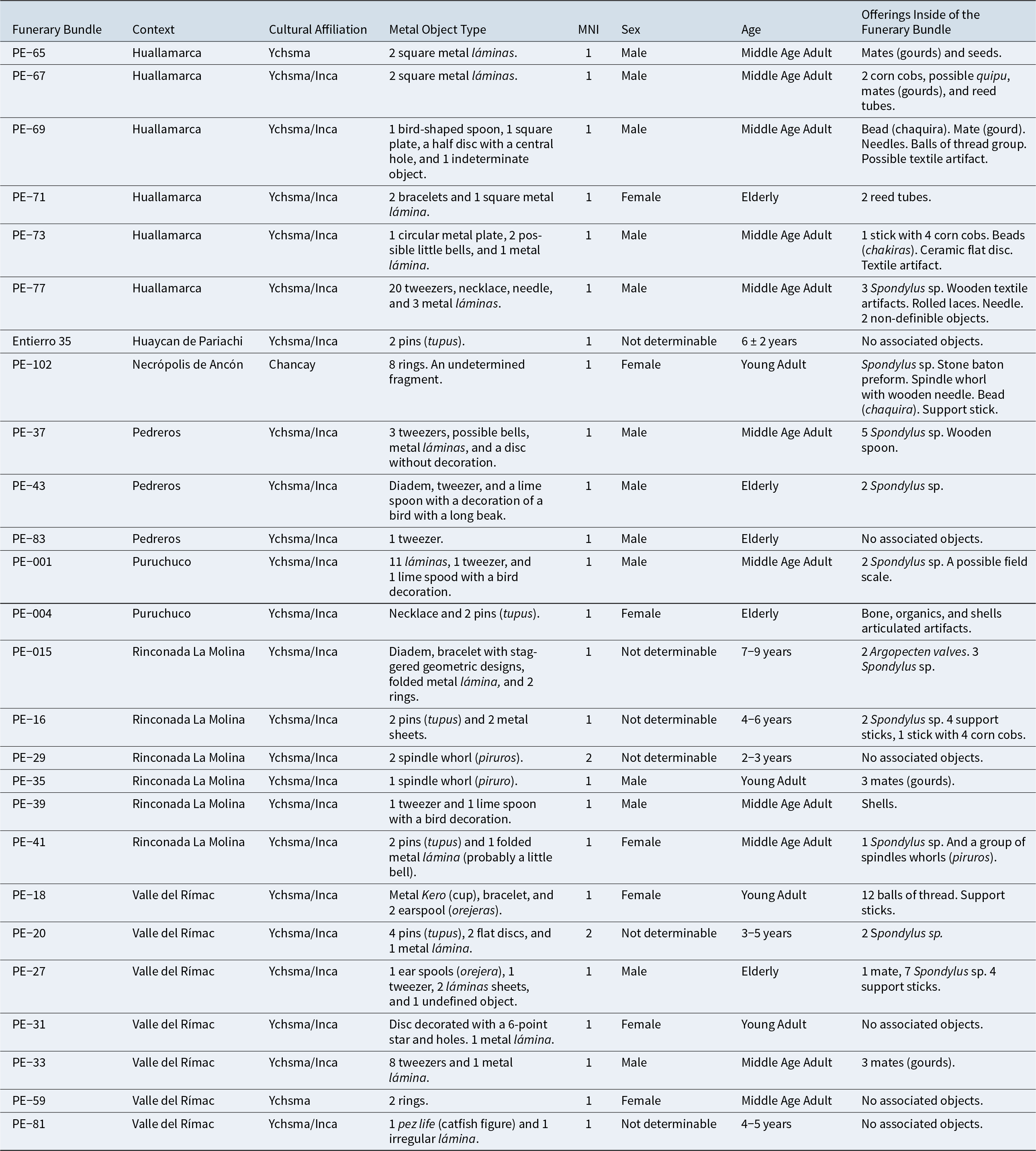
Details of the sample are presented in Figure 2 and Table 1. The focal study sample comprised the 26 bundles identified as containing metal objects, of which seven corresponded to individuals who are identifiable as female (27%), the majority (13) are identifiable as male (50%), and six are nonadults (23%; two bundles contain two nonadult individuals each).
Sample Details of the Central Coast Bundles with Metal Objects from the Late Intermediate/Late Horizon Period (AD1100–1532).

Note: MNI = minimum number of individuals.
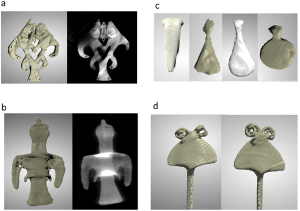
Among the 26 bundles, the following metal objects could be identified: bracelets, ear spools (orejeras in Spanish), plates, metal sheets or foils (láminas), garment pins (tupus in Quechua), tweezers (pinzas), headbands, and lime spoons (paletas de calero; tools used to place lime in a quid of coca leaves to release the alkaloids contained within), among others (Figure 3 and Table 1). The most common objects regardless of sex or age at the time of death were láminas and tweezers. In some cases, it was possible to determine consistent relationships in the type of associated objects (tweezers and lime spoons). We note that Vetter and Barraza (Reference Vetter and Barraza2024) recently showed that there is no definite relationship between the sex or age of the individual contained in the bundle and the presence or absence of tweezers because the use and function of these objects is varied.
Examples of artifact visualizations (artifact visualizations by Andrew Nelson): (a) a pez life (probably catfish representation) from PE 81. The left image is the 3D model and the right image is a “slab” view of stacked individual slices. The figure is 9.5 cm from top to bottom; (b) a bird bird-shaped artifact from PE 69. The left image is the 3D model and the right image is a “slab” view of stacked individual slices. The figure is 9.2 cm from top to bottom; (c) images of a selection of tweezer shapes from PE 77 (the individual with 20 tweezers). From left to right, a triangular shape (2.1 cm from top to bottom), a wedge shape (3.8 cm from top to bottom), a tear-drop shape (3.1 cm from top to bottom), and a round shape (3.1 cm from top to bottom); (d) the two crescent-shaped tupu heads with spiral tips from PE 20 (left, 3.8 cm wide; right, 4.1 cm wide). (Color online)

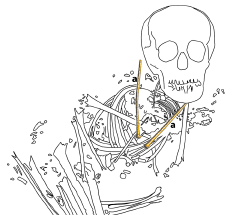
Two types of metal objects demand special attention: the tupus and the tweezers. The tupu consists of a shaft and a head that was used to fasten textile garments. Tweezers are small two-sided, round-edged tools joined by a hinge at one end (see Figure 3c). They are thought to have been used for grooming (especially the beard), but may have had other functions. Tupus are found in bundles containing female individuals, although we note that three of the nonadult bundles—one with two nonadults—contained tupus. The latter bundle, known as PE-20 from an unknown site in the Rimac Valley, is interesting because it includes not only a pair of nail-headed tupus (representative of the central coast) but also a pair of crescent-headed tupus with two spirals at the tip of each crescent (a form associated with the Inca period; Figure 3d). Another example of a pair of nail-headed tupus associated with nonadults is found in Bundle CF 35 from Huaycán de Pariachi (Figure 4).
Bundle CF-35, a non adult individual from Huaycán de Pariachi with two nail-headed tupus (a). (Line drawing by Rosa Arboleda; 3D artifact segmentation by Andrew Nelson). (Color online)

The diversity of forms of tupus present in Andean bundles is striking, and includes one in the shape of a crescent moon with a spiral present in a funerary bundle from Huallamarca (RN89947 in Museo de Sitio Huallamarca, not included in this sample; Motley et al. Reference Motley, Nelson and Watson Jiménez2023). In addition, it seems that the Huallamarca Bundle PE-20, containing two nonadults, had two associated metal disks and two Spondylus sp. valves (half shells) positioned above the skull of one of the individuals. Although it is not possible to identify the sex of these nonadults, they are likely to be female individuals due to the presence of tupus. These objects are generally placed at shoulder height with the head of the pin resting on the individual’s chest to fasten the blanket, or lliclla (Quechua: a woman’s manta textile), as they were usually worn in life (Vetter and Carcedo Reference Vetter and Carcedo2009). In the case of PE-20, they are positioned at or near chest height.
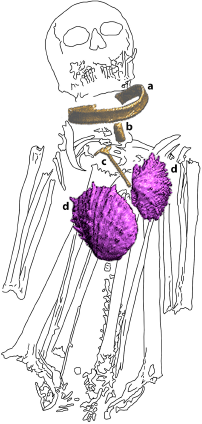
In this sample, though not always more generally, the tweezers are found exclusively in bundles with male individuals. Three of the bundles also contain lime spoons with long-beaked bird designs. One of them, Bundle PE-43, from Pedreros, also has a headband that has been displaced as well as two halves of a full Spondylus sp. shell (Figure 5). The association of lime spoons and tweezers is also observed in contemporary funerary contexts in Armatambo, Pachacámac, among other sites. As mentioned in previous publications (e.g., Vetter Reference Vetter2018), the tweezers and the lime spoon were generally attached to a string and hung around the wearer’s neck, although in some cases the tweezers were placed in the hands of individuals. It is also worth noting that tweezers have also been linked to female individuals on the north coast during the same period (Vetter Reference Vetter and Pinedo2022; Vetter and Barraza Reference Vetter and Barraza2024).
Bundle containing a male individual, from Pedreros, PE-43. This individual has a headband (a), a rectangular tweezer (b), associated with a lime spoon shaped like a bird with a long beak (c), and Spondylus sp. (d). (Line drawing by Rosa Arboleda; 3D artifact segmentation by Andrew Nelson). (Color online)

There are few published investigations of metal objects and their positioning on the individual’s body, which limits our ability to offer comparative interpretations. In addition, there is a need for more research into taphonomy (decomposition of the body), and the potential changes in the original position of the metals inside the funerary bundle over time following burial. One of the few studies to focus on this area, based on X-ray images and CT-scans, was carried out by Jo Motley (see Motley Reference Motley2022; Motley et al. Reference Motley, Nelson, Williams, Gauld, Poeta, Gomez, Baldeos, Fuentes and Pozzi-Escot2021). With regard to the present study, although some bundles contain tweezers that are located at the height of the individual’s neck or in the individual’s hand, in many others these items are located elsewhere on the individual’s body (sometimes in several positions). That is, some tweezers are at the height of the ribs, while others are between the radius and ulna, near the knee, associated with the foot, or between the femur and the acetabulum. These tweezers may well have moved during decomposition, recovery, or curation, which illustrates the need for caution due to the constant movement that the bundle undergoes between its excavation and its resting place in storage (museum taphonomy; see Motley Reference Motley2022).
Two bundles, PE-77, from Huallamarca, and PE-33, from an unknown site in the Rimac Valley, are striking due to the number of tweezers they contain. In PE-77, containing a male individual, we have identified 20 tweezers of varied shapes: triangular, round, rectangular, and teardrop (see Figure 3c for a selection). The variety of forms of Andean tweezers is so wide that it is not possible to assign a specific use to each of them (Vetter and Barraza Reference Vetter and Barraza2024). Yet to the best of our knowledge, no other studies in the archaeological literature have reported as large a number of different tweezers associated with a single individual as that observed in PE-77. In addition to the tweezers, a needle, a quadrangular lámina, and two láminas joined to each other were identified in this bundle. Among the nonmetallic inclusions were two Spondylus sp. valves (one on the head and one on the lower part of the face) and a complete Spondylus sp. shell (both valves) located under the head. This bundle also contained wooden tools, cords wrapped in a kind of cane or reed, and a wooden container with textile artifacts inside (possible needles).
In previous publications (Vetter Reference Vetter and Pinedo2022; Vetter and Barraza Reference Vetter and Barraza2024), we pointed toward evidence that tweezers, besides playing an important role in an individual’s facial cleansing, were also utilized within the textile craft for tasks such as fastening fibers. This finding reaffirms the need to reconsider the division of certain types of labor, such as textile production, based on biological sex. In the PE-33 bundle, also corresponding to a male, there are eight round and rectangular tweezers together with a rectangular plaque but no other associated materials.
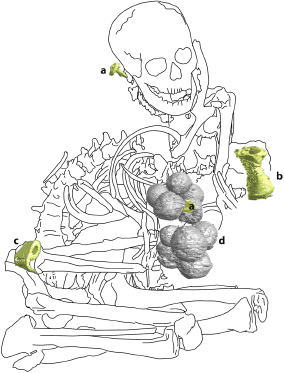
A single bundle, PE-18, from an unknown site in the Rimac Valley, contains a cup (kero; Quechua), located at the height of the left forearm, near a cluster of balls of thread (Figure 6). The cup is crushed and deformed, but the upper third shows embossing. The individual in the bundle is female, wearing two earspools: the right one is complete and in its original location, while the left one is fractured, with the tubular part associated with the ear and the disk displaced toward the thread balls, near the cup. This individual also has a bracelet near her right elbow. She has 12 thread balls that relate to textile activities. A female individual bundled with similar artifacts, allowing her to be identified as a weaver, was excavated by Hudtwalker (Reference Morán and Antonio2009) on San Lorenzo Island off the coast of Lima. This individual also had three cups (keros) and two bowls, as well as a Spondylus sp. and two Conus shells, feather garments, and two shell bracelets (Hudtwalker Reference Morán and Antonio2009).
Bundle of a female individual, from the Rímac Valley, PE-18. This individual has earspools (a), a cup (b), a bracelet (c), and balls of thread (d). (Line drawing by Rosa Arboleda; 3D artifact segmentation by Andrew Nelson). (Color online)

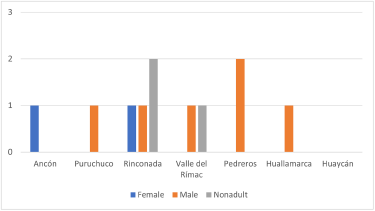
Other bundles in the present sample likewise show a relationship with textile activities. One example is Bundle PE-29, from Rinconada La Molina, within which are two nonadults, positioned to face each other. The individual located on the right side has two metal spindle whorls (piruros; Quechua) in their oral cavity, while a probable textile instrument that resembles a backstrap loom batten can be seen toward the outer layers of the bundle. Likewise, the female individual in Bundle PE-41 (mentioned previously) has two tupus in addition to a set of low-density ceramic or wooden spindle whorls on her right side. Among the male individuals, there is a bundle, PE-77 (mentioned previously), which contains objects related to the textile crafts. Overall, of the 26 bundles with metal objects, 31% have instruments related to textile work. Among the individuals associated with these instruments, 12% are females, 15% males, and 4% nonadults (Figure 7). However, this result is skewed by the three male individuals with textile implements from Huallamarca.
Bundles containing implements for textile manufacture. (Color online)

Most bundles contain numerous small rectangular, quadrangular, or irregular metal láminas, irrespective of biological sex or age. These are found in the eye orbit, inside the mouth, on the neck, on the arms, on the hands, and elsewhere on the body. Despite this broad bodily distribution across the individuals in our sample, they most often occur in the eyes and mouth (Watson Reference Watson2019). Of the 11 láminas found in the bundle of a male individual, Bundle PE-001, from Puruchuco, two show an embossed bird. This individual also has metal láminas in the eye orbits, as well as a lime spoon with the figure of a long-beaked bird at chest height. Other láminas present in this bundle are rectangular; one is shaped like a fish and another like a bird, and all have holes for sewing to fabric.
Metal disks are found with females, males, and nonadults alike. In the case of one female individual, contained in Bundle PE 31, from an unknown site in the Rimac Valley, one metal disk is observed with a hole in the middle, as well as an embossed six-pointed star.Footnote 2 Because of its location, it is possible that it is a frontal ornament (on a headband). Other cases are of male individuals. One of them, in Bundle PE-37, from Pedreros, also wears a disk as a frontal ornament,Footnote 3 while another, in Bundle PE-69,Footnote 4 from Huallamarca, only has half of a disk in the same location. Bundle PE-20 contains two nonadults and two Spondylus sp. valves and two disksFootnote 5 that are located together above the skull of one of the individuals.
Headbands, metal ribbons that are placed on the forehead, are associated with one nonadult (in Bundle PE-15, from Rinconada La Molina) and one male individual (in Bundle PE-43, from Pedreros; see Figure 5), while necklaces with metal beads are associated with one female (in Bundle PE-004, from Puruchuco, a metal ribbon) and one male (PE-77, from Huallamarca) individual.
A metal bracelet is associated with a nonadult individual, contained in Bundle PE-15, from Rinconada La Molina. The bracelet shows a design composed of three staggered parallel geometric elements that could represent a pez life (a common figure in Andean iconography, possibly representing a catfish; see Figure 3a).
Finally, in one bundle, PE-102, which contains a female individual from Ancon, rings appear in large quantity (eight) associated with the fingers of both hands. This bundle also exhibits a Spondylus sp. valve, a preform of a (stone?) club, spindle whorls (ceramic?) with wooden needles, and a support stick that crosses the bundle vertically. The upper end of this stick is blunt and the lower end is serrated (three peaks). One of the nonadults in Bundle PE-15, from Rinconada La Molina, has two rings, but these are located next to a folded lámina inside a Spondylus sp. valve. This same individual is the one with a diadem/headband and the pair of bracelets with embossed designs, as mentioned in the previous paragraph.
There are other examples of objects being placed within a Spondylus sp. shell, especially among the Chimú people (north coast), who placed metal objects, especially miniatures made of silver, inside a Spondylus sp. valve. Although in the case of PE-15 the object is not a miniature, it is interesting to observe this form of offering inside a bundle because they have generally been found to be associated with other funerary or architectural contexts (Narváez Reference Narváez Vargas2017) rather than inside fardos.
Another status marker is the Spondylus sp. shell. Although this is a bivalve and not a metal, we know that during the Ceramic period this type of shell was highly coveted by the ruling elites as an offering in funerary or architectural contexts or as a raw material to make prestigious objects for use in ornamentation such as pectorals, rings, beads, and capacocha idols, among others. Hocquenghem (Reference Hocquenghem, Castro and Tísoc2021) suggested that this type of material represented the social status of the person who carried it, in addition to fulfilling a symbolic sumptuary function. Of the bundles studied here, 11 contained Spondylus sp., made up of female individuals (18%), nonadults (27%), and most male individuals (55%; Figure 8). An example of this is bundle PE-27, from an unknown site in the Rimac Valley, which contained seven Spondylus sp. shells and metal objects, such as a right ear spool, one pair of round tweezers, two láminas, and an undefined metal object. Another bundle, PE-37, from Pedreros, contained a large quantity of Spondylus sp., including a bivalve specimen and five single valves, as well as metal objects such as three tweezers, bells, láminas, and a disk.
Bundles containing Spondylus sp. (Color online)

Inside the bundles, the Spondylus sp. valves are usually distributed throughout the body. In the examples mentioned in the preceding text, they are found at the height of the chest and in the neck, but in other cases they can be observed on the legs, the back, the pelvic area, and the head. Some authors, such as Díaz and Vallejo (Reference Díaz and Vallejo2004), consider Spondylus sp. an indicator of a Late Horizon (AD 1450–1532) date. However, the analysis of bundles from several sites on the central coast, such as the Ancón Necropolis (Watson Reference Watson2019), Pachacámac (Nelson et al. Reference Nelson, Watson, Williams, Gauld, Motley, Poeta and Seston2021, Reference Nelson, Motley, Watson, Williams, Kirgis, Huchet and Gauld2023, which includes carbon dates; Watson et al. Reference Watson, Fuentes, Nelson, Williams, Gauld, Motley, Poeta, Gómez, Baldeos and Pozzi-Escot2022), and Puruchuco, provide evidence that the presence of Spondylus sp. is not a marker of chronological differentiation in funerary bundles.
Discussion
There has been little research on metal objects in relation to their position on an individual’s body, which hinders comparisons and interpretations. As such, ours is one of the first large-scale studies that uses noninvasive and nondestructive techniques to analyze metal offerings arranged inside funerary bundles found in the Andean area. In so doing, it was possible to associate some objects with the sex of the individual, such as tupus with female individuals. Metal objects have also been identified with nonadults, but the characteristics of sexual dimorphism are not morphologically determinable, and therefore it is not possible to delve deeper into the presence of tupus by sex in this age group with any real certainty.
A limitation of this research methodology is the impossibility of ascertaining the specific type of metal or alloy used to make each of the artifacts. Nonetheless, we still maintain that CT-scanning is an important means of shedding new light on the metal objects placed inside funerary bundles in a way that maintains their integrity and closed context, which renders removal for archaeometric undesirable. Based on the study of known objects found along Peru’s central coast and currently stored in various collections and museums (e.g., Vetter Reference Vetter and Pinedo2022; Vetter and Carcedo Reference Vetter and Carcedo2009, Reference Vetter, Pérez, Arciello, Simarro and de Rueda2021), we have been able to create a database for comparisons of these artifacts. As a result, even if we do not know the specific alloy used, in most cases it has been possible to identify the type of artifact as well as its purpose, manufacturing technique, and decoration. Manufacturing techniques can be reconstructed based on the shape and pattern of variability in the density of the objects (laminated or cast). As for decoration, the 3D reconstructions of CT-scans allow us to visualize certain iconographic features on the surface (see Figures 3a and 3b).
In this context, exploratory comparative studies of metal objects of differing alloys and characteristics provide our best possible means of identifying the metal or alloy with which the objects were manufactured. Although differentiating on the basis of Hounsfield density units (see Gostner et al. Reference Gostner, Bonelli, Pernter, Graefen and Zink2013) is no simple task, experimental work with artifacts of known density may allow us to differentiate between copper and gold objects. This is one of the active lines of research of the Mummies as Microcosm project, based on standardized data capture and processing techniques such as dual energy scanning (Friedman et al. Reference Friedman, Nguyen, Nelson, Granton, Blair MacDonald, Hibbert, Holdsworth and Cunningham2012) and deep learning segmentation algorithms (artificial intelligence; Cong et al. Reference Cong, Yan, Fitsgerald, De Man and Wang2020).
The complexities involved in the production of metal objects and the meaning attributed to such artifacts in the Andean worldview allow us to understand why these materials are most commonly associated with funerary contexts involving elite or ruling individuals, as well as contexts of ritual symbolism such as the closure of an architectural space or offerings to a huaca, among others. In the case of funerary contexts, which is the concern of the present study, the metal object–individual relationship has an important social meaning. Metal is a material whose production involves considerable knowledge and, often, labor (as in the Moche and Sicán elite tombs, which are characterized by large numbers of metal objects—in some cases totaling more than half a ton in weight; Shimada Reference Shimada1995). In addition to their utilitarian nature, metals in the Andean worldview were associated with the realm of the gods, so it is clear that the individuals who could and should possess metal objects were those who wielded considerable political, social, and religious power.
On Peru’s central coast, no tombs containing large numbers of sumptuary metal objects have been discovered. This stands in contrast with the north-coast tombs of the Lords of Sipán (Alva Reference Alva2015) and the Lady of Cao (Fundación Wiese Reference Wiese2022) dating to the Early Intermediate period, that of the Lady of Huarmey (Giersz Reference Giersz2017) from the Middle Horizon period, and those of the Lord of Sicán from the Late Intermediate period (Shimada Reference Shimada1995). While not detected in abundance, the presence of metal objects in central coast tombs from the Late periods is still an evident indicator of status, especially where the deceased individual was also associated with Spondylus sp., which is also an indicator of status. It should be recalled that of the 85 bundles studied here, only 26 (or 30.6%) of these contained metal objects, while only 11 (12.8%) bundles contained both such indicators of status (metal and Spondylus sp.), indicating clearly that these were exceptional individuals.
In general, the objects found in these fardos have been identified on the central coast in other nonfunerary contexts across the same periods (Vetter Reference Vetter, Vetter, Téllez and Vega-Centeno2011, Reference Vetter2018, Reference Vetter and Pinedo2022). Several of the objects associated with the individuals are linked to the textile craft, including thread balls, piruros, needles, and possible scales, among others. This suggests that some individuals who were involved in textile manufacturing may also have attained high status. Yet beyond the general association between metal objects and an individual’s status in the context of the central coast, other factors may also have explained the use of metals as more utilitarian elements, such as tweezers, needles, or hooks. This attests to the importance of a comprehensive approach to interpreting the presence of funerary offerings.
Finally, the use of CT-scanning permits the collection, in a nondestructive manner, of valuable information about the hidden treasures inside each of the bundles studied. This method has allowed the detailed analysis and systematization of information from 85 fardos, optimizing research time, reducing costs, and preserving the structural integrity of these bundles.
Acknowledgments
The authors wish to express their gratitude to María Fe Córdova, Alcides Álvarez, the Museo de Sitio Arturo Jiménez Borja–Puruchuco, the Museo de Ancón, the Ministerio de Cultura del Peru, and the Horus Group. The Horus Group, represented by Dr. Gregory Thomas, has authorized Dr. Lucía Watson Jiménez to use the DICOM data files arising from the CT scans of 90 bundles and mummies from the Andean area. Many thanks to the three anonymous reviewers, whose comments greatly improved this article.
Funding Statement
The research presented here received no specific grant funding from any funding agency, commercial, or not-for-profit sectors. However, AJN would like to acknowledge the Social Sciences and Humanities Research Council of Canada for supporting his work in Peru.
Data Availability Statement
Once the Mummies as Microcosmos project is completed, the data will be available through the IMPACT global database of mummy studies (Nelson and Wade Reference Nelson and Wade2015).
Competing Interests
The authors declare none.

 Open access

