


The caseload pressure discussed in Chapter 5 weighs heavily in China’s judicial clampdown on divorce. As a docket-shrinking machine, the divorce twofer has been embraced with particular vigor in regions with the heaviest dockets, as others have noted: “Under circumstances of ‘many cases, few judges,’ divorces vastly increased judges’ workload and put stress on judicial resources. As they faced the enormous pressure of their dockets, many judges did their utmost to alleviate their backlogged cases, which precipitated the emergence of the ‘two trial’ [二次诉讼] norm” (Reference HeHe 2019:92; also see Reference LiuLiu 2012:84).
Thus far I have identified and summarized several explanations for the divorce twofer: limited judicial resources relative to caseloads, political ideology, performance evaluation criteria, and safety concerns. To empirically test the extent to which these endogenous institutional norms and pressures account for the decoupling of judicial practices from formal laws in China’s divorce courts would require information on variation in both the explanation and the outcome. For example, evidence that variation in political ideology (the explanation) maps onto variation in rates at which courts granted divorce petitions (the outcome) would constitute empirical support for my argument. Variation could be temporal (over time) or geographical (over subnational units, such as provinces or courts). Even if we were to find, however, that changes over time in the character and strength of political ideology coincide with changes in judicial behavior, or that geographical variation in political ideology corresponds with variation in judicial behavior, such evidence might be only circumstantial. After all, many things change over time and vary by region. Further compounding the empirical challenge, measuring variation in political ideology, judicial performance evaluation systems, and judges’ perceived safety threats from potentially violent divorce litigants would be difficult if not impossible.
By contrast, enough information on judges and their caseloads is available to assess the influence of “many cases, few judges” on the divorce twofer. This chapter provides empirical support for my paradoxical argument that the divorce twofer ultimately saves time and effort – at least for judges.
Routinizing six-month cooling-off periods on first attempts and granting divorces on second attempts (Reference HeHe 2009) confers multiple judicial benefits. First, the one-judge simplified civil procedure used to deny petitions consumes minimal human resources. Second, swiftly denying divorce petitions conserves time for other, more time-consuming types of cases that (unlike divorce) have a limit of one first-instance trial. Third, few petitioners returned to court after the statutory waiting period. Finally, judges devoted less time and wrote shorter decisions when they denied divorces than when they granted divorces or tried other types of cases.
The last section of this chapter shows that adjudicated denials were not the only way judges made cases disappear. Cases also disappeared when plaintiffs withdrew their petitions.
The cost of courts’ imperative to maximize judicial efficiency has been disproportionately borne by women. Divorce litigation has been a casualty of clogged courts, and women in turn have been casualties of divorce litigation. We will see in this chapter that courts have sacrificed divorce cases in pursuit of judicial efficiency. We will also see that women’s lawful rights and interests have been disproportionately sacrificed at the altar of efficiency by virtue of their overrepresentation among plaintiffs filing for divorce and their relatively high risk of facing pressure to withdraw their petitions.
In media narratives and scholarly accounts, the judicial clampdown on divorce reflects growing alarm on the part of China’s leaders about rapidly rising divorce rates and courts’ responsiveness to ideological calls for family harmony and marital preservation (Reference CaoCao 2018; Reference KuoKuo 2018; Reference ShiShi 2020; Xinhua 2019). To be sure, China’s ideological opposition to divorce has deep roots (Chapters 2 and 3). The empirical findings I present in this chapter, however, suggest the divorce twofer was initially driven by “many cases, few judges” as early as – and possibly earlier than – the late 1990s and early 2000s. The 18th National Congress of the Chinese Communist Party in 2012 saw Xi Jinping reintroduce a familiar political ideology promoting socialist family values (Chapter 3), which has further encouraged and provided convenient cover for China’s judicial clampdown on divorce.
I have three primary tasks in this chapter. First, I provide evidence that the divorce twofer is part of courts’ repertoire of coping strategies. Second, I demonstrate how the divorce twofer has helped judges clear their dockets. Third, I show that the divorce twofer is not limited to adjudicated denials of first-attempt petitions, but extends to petition withdrawals. Both methods of swiftly closing divorce cases have disproportionately targeted female plaintiffs.
The Divorce Twofer is Another Innovative Response to Clogged Courts
China’s judicial clampdown on divorce unfolded rapidly. The solid line in Panel A of Figure 6.1 shows that, between 1990 and 2006, the rate at which divorce petitions were denied in first-instance divorce adjudications was essentially flat at around 30% (that is, 70% of divorce petitions were granted). Denial rates climbed steeply after 2006, more than doubling to 62% by 2018.Footnote 1 The dashed line in Panel A represents divorce rates, which had begun climbing in 2003, when the Marriage Registration Regulations were amended to lower barriers to uncontested divorce (Chapter 1). As we can see, divorce adjudication outcomes almost perfectly tracked divorce rates. Panel B reconfigures the identical information in a couple of ways. First, rather than depicting the clampdown on divorce in terms of petition denial rates, it shows rates at which divorce petitions were granted. Second, it transforms the two time-series lines in Panel A into a scatterplot. Both panels show that, in the 13 years between 1990 and 2002, China’s crude divorce rate grew from 0.69 to 0.90 (per 1,000 population). Then, in the 16 years between 2003 and 2018, China’s crude divorce rate tripled from 1.05 to 3.20. Given the near-perfect correlation between the two trends, attributing the judicial clampdown on divorce to rising divorce rates has certainly been tempting. Indeed, media reports (Reference CaoCao 2018; Reference KuoKuo 2018; Xinhua 2019) and published scholarship (Reference LiLi 2015) alike suggest that growing alarm on the part of political leaders about rising divorce rates ultimately gave rise to the domestic relations trial reforms and its supporting ideological discourse concerning marital stability, household harmony, and civilized families (Chapter 3).
Time-series correlations of decisions to deny/grant divorce petitions
Note: Divorce outcomes are limited to first-instance adjudicated decisions to grant or deny divorce petitions; mediations and withdrawals are excluded. The same patterns persist when the rate at which adjudicated petitions were denied is replaced with the rate at which all petitions were denied (i.e., including mediation and withdrawals).

China’s clogged courts were not a consequence of its rapidly rising divorce rates, which in turn were not the driving force behind the divorce twofer. The association between courts’ clampdown on divorce and divorce rates is, at a minimum, indirect and, at most, a causal mirage. As we know from Chapter 2, only a small fraction of all divorces happen in court. Using official divorce statistics, we can easily disaggregate China’s total crude divorce rate into two components: (1) a court crude divorce rate calculated from contested divorce disputes processed by courts and (2) a Civil Affairs crude divorce rate calculated from uncontested, voluntary, mutual-consent divorces processed by the Civil Affairs Administration (Chapter 1). China’s total crude divorce rate has been driven exclusively by Civil Affairs divorces. The court divorce rate remained essentially flat in the 20 years between 1999 and 2018 at about 0.5 (per 1,000 population). The Civil Affairs divorce rate, however, grew from 0.4 to 2.7 over the same time period (Ministry of Civil Affairs of China, various years). Between 2004 and 2018, after the amendment of the Marriage Registration Regulations in 2003, only 22% of all divorces in China were processed by courts (Ministry of Civil Affairs of China, various years).Footnote 2
The volume of divorce cases in China’s courts has remained remarkably stable over time, and has thus shrunk as a share of all civil cases. In the 20 years between 1999 and 2018, the overall volume of concluded first-instance civil cases grew by 146% and the number of divorces granted by the Civil Affairs Administration grew by 698%. By contrast, in the same time period, the number of first-instance divorce cases concluded by courts grew by only 15%. As a consequence, concluded first-instance divorce cases as a share of all concluded civil cases shrank from 24% to 11% in the same time period (CLY, various years; Ministry of Civil Affairs of China, various years). As we saw in Chapter 3, the 2020 Civil Code shifted the cooling-off period from courts to the Civil Affairs Administration, possibly reflecting official recognition of a mismatch between where most divorces occur and where the clampdown on divorce has been applied.
Although divorce cases have not contributed to the problem of clogged courts, judges have exploited them as a solution for clogged courts. Courts have clamped down on divorce as a convenient means of lightening their dockets clogged by other kinds of cases, and have invoked ideological discourse about marital preservation to justify doing so (Chapter 7). If courts have been under ideological pressure to deny divorce petitions, judges in the most clogged courts have welcomed it the most. Denying a divorce petition takes little time, frees up judicial resources for cases that cannot be so easily swept aside, and is easily justified by China’s enduring ideological call to “oppose frivolous divorce” and to “prevent the abuse of the freedom of divorce” (Chapters 2 and 3). In the typical ideological language of judges, they deny first-attempt divorce petitions to “prevent frivolous divorces that hot-headed couples will end up regretting” and because “a momentary argument or brief conflict may lead couples to rush to court blindly and impulsively, a court that carelessly grants divorces might summarily deny couples the opportunity to repair their marriages” (Reference Jiang and ZhuJiang and Zhu 2014:86).
Panels A and B in Figure 6.1 therefore exemplify correlation without causation. Courts clamped down on divorce not because of rising divorce rates but rather because of rising caseloads, to which, as we just saw, divorce litigation contributed relatively little. Panels C and D in Figure 6.1 show that the correlation between first-instance adjudicated divorce outcomes and court caseloads is likewise almost perfect. Average caseload per judge would be an even better measure but is not consistently available during the period of analysis. Total caseloads, however, is a reasonable proxy measure for judges’ workload given how stable the population of judges was (at about 200,000) over this time period.
Panel C shows that both the rate at which divorce petitions were denied and the volume of concluded cases began their rapid and sustained ascent after 2006. Once again, the identical trends are depicted in Panel D as a scatterplot after inverting divorce adjudication outcomes into rates at which divorce petitions were granted. Both panels show that the judicial clampdown on divorce noticeably intensified at the same time that caseloads grew particularly rapidly following the 2007 litigation fee reform (Chapter 5). Another conspicuous jump in caseloads corresponds with the 2015 case filing registration reform (Chapter 5).
Figure 6.1 depicts variation over time. I have argued so far that the association it shows between divorce rates and adjudicated divorce outcomes (Panels A and B) is causally spurious and that caseloads are a better explanation of the judicial clampdown on divorce (Panels C and D). Evidence from subnational variation strongly supports my central argument that the origins of China’s divorce twofer can be traced back to “many cases, few judges.” Courts that clamped down the hardest on divorce were precisely those with the heaviest dockets. Let us begin with a two-province comparison of Henan and Zhejiang before turning to analyses of variation among all 31 provincial-level units and 150 basic-level courts within Henan and Zhejiang.
We already know from Chapter 5 that judges’ average caseloads were far heavier in Zhejiang than in Henan. Figure 6.2 shows that the judicial clampdown on divorce was also earlier and stronger in Zhejiang than in Henan. We can see in Panel A that Henan’s clampdown closely tracked the national trend. In Henan, rates at which first-instance divorce adjudications resulted in granted divorces remained stable at around 74% between 1999 and 2006, modestly higher than the national average. Then, just as we saw in Figure 6.1, the clampdown on adjudicated divorce began in 2007. Until recently, Zhejiang’s clampdown was one of the most extreme in China. Henan’s clampdown intensified rapidly after 2011 and caught up to – and eventually surpassed – Zhejiang’s. Average rates at which Henan’s courts granted divorces dipped below the national average in 2012 and fell below Zhejiang’s in 2016. By 2018, Henan was among the least divorce-friendly provinces in China in terms of adjudicated outcomes. By contrast, Zhejiang’s courts had been unfriendly to divorce plaintiffs for at least a couple of decades. Zhejiang’s clampdown had already been underway from the earliest point at which data are available. Zhejiang’s courts granted divorces in only 57% of first-instance adjudications in 1999, and bottomed out at 36% in 2013. To put this in more concrete terms, of all plaintiffs whose divorce petitions were adjudicated between 2007 and 2018, the proportion who left court still married increased from 35% to 62% in China as a whole, from 32% to 69% in Henan, and from 56% to 61% in Zhejiang.
Proportion of divorce petitions (%) granted
Note: Data are limited to first-instance adjudicated decisions to grant or deny divorce petitions; mediations and withdrawals are excluded. Zhejiang’s 2001 data point is omitted because it is undoubtedly erroneous. Data disaggregated by province are unavailable for years prior to 1999.
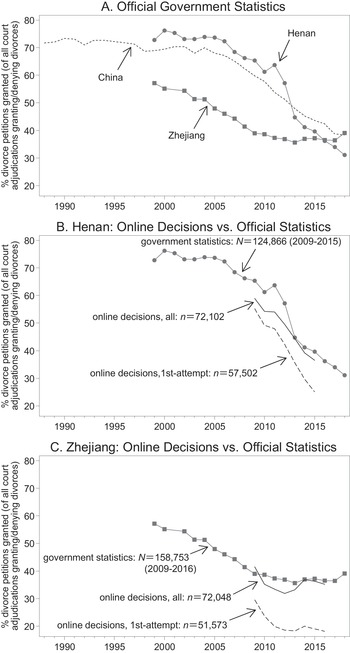
By benchmarking my sample of divorce adjudications posted online against all divorce adjudications, Figure 6.2 also lends further confidence to the representativeness of my two provincial samples (see Chapter 4). Panel B shows that granted divorces as a proportion of all adjudicated divorce petitions from 2013 to 2015 in my Henan sample (40%) closely approaches the proportion of granted divorces in the true population of divorce adjudications reported by the Ministry of Civil Affairs (41%). These three years account for 64% of all divorce adjudications in my Henan sample. Likewise, Panel C shows that the proportion of adjudicated divorce petitions approved by courts from 2014 to 2016 in my Zhejiang sample (36%) is similarly close to the approval rate in official sources (37%). These three years account for 58% of all divorce adjudications in my Zhejiang sample.
Finally, Panels B and C show that the clampdown disproportionately targeted first-attempt divorces – the key defining characteristic of the divorce twofer. Prospects for successfully divorcing on the first attempt (depicted by dashed lines) were relatively unlikely. Indeed, divorcing on the first try was increasingly an exercise in futility: among adjudicated first-attempt divorce petitions, only 25% were granted in Henan in 2015 (Panel B) and only 18% were granted in Zhejiang in 2016 (Panel C).
So far, the contrast I have shown between Henan and Zhejiang’s courts both in the weight of their caseloads and in the extent of their clampdown on divorce supports the core argument of this chapter, namely that the latter is a consequence the former. The view from these two provinces, of course, offers only a limited vantage point. In the remainder of this section, I analyze more rigorously the effect of caseloads on the judicial clampdown on divorce at different levels of subnational variation. I zoom out and broaden the field of view to encompass all of China’s 31 provincial-level units. I also zoom in to a view of 150 basic-level courts within Henan and Zhejiang. Subnational units at both levels afford a clear and consistent view of the strong relationship between judges’ routine practice of denying first-attempt divorce petitions and the weight of their caseloads. We will see that the gaps between the two provinces in rates at which divorce petitions were granted are explained away by corresponding differences in average caseloads per judge.
In both sets of analyses of subnational variation, the volume of court cases was a function of general population size and economic conditions. The volume of court cases, in turn, influenced the size of the population of judges, albeit only secondarily. The population of judges was, above all, a function of the general population. By definition, the population of judges and the volume of court cases determined judges’ average annual caseloads (cases per judge). Finally, judges’ annual average caseload was strongly associated with judges’ routine denial of first-attempt divorce petitions. In other words, the intensity of the judicial clampdown on divorce was a function of the weight of judges’ average caseload, which in turn was a function of the number of judges and the number of court cases, which in turn were functions of population size and economic conditions. I will now present this sequence of empirical findings in greater detail.
Caseloads Were Strongly Associated with Both Population and Economic Conditions
Table 6.1 contains regression models predicting the annual volume of court cases at the provincial and court levels.Footnote 3 At the provincial level, Model 1 shows that Zhejiang closed 309,000 more cases than Henan did in 2011. At the court level, Model 1 shows that Zhejiang’s courts on average closed almost 8,000 more cases than Henan’s courts did. Model 2 introduces per capita GDP. When per capita GDP is held constant in Model 2, the gap between Zhejiang and Henan shrinks, suggesting that Zhejiang’s heavier caseloads were a consequence of its more dynamic economic conditions (and that Henan’s lighter caseloads were a consequence of its weaker economic conditions). Model 3 introduces population size. The huge boost it gives to R2 values suggests that population is the more important determinant of caseload size. Its introduction also reopens the gap between Zhejiang and Henan (albeit only slightly in the court-level model). Given that Zhejiang’s population is considerably smaller than Henan’s, Model 3 tells us that the gap in case volumes between the two provinces would have been even greater if their populations had been the same size.Footnote 4 In all models, including separate ones for courts in Henan and Zhejiang (Models 4 and 5, respectively), both per capita GDP and population size significantly contributed to case volumes. Doubling per capita GDP (comparable to the difference between the two provinces) was associated with an increase of 157,435 cases at the provincial level and an increase of 2,073 cases at the court level.Footnote 5
| (1) | (2) | (3) | Henan | Zhejiang | |
|---|---|---|---|---|---|
| (4) | (5) | ||||
| Provinces, 2011 | |||||
| Province | |||||
| Zhejiang (yes = 1) | 309.14 | 122.75 | 455.85** | ||
| Other (yes = 1) | −167.41 | −222.21 | 203.17+ | ||
| Cf.: Henan | |||||
| Per capita GDP, logged | 256.67* | 227.13*** | |||
| Population, millions | 7.94*** | ||||
| Constant | 515.97+ | −2,118.28+ | −2,560.53*** | ||
| R2 | .12 | .29 | .90 | ||
| N | 31 | 31 | 31 | ||
| Courts, Henan and Zhejiang | |||||
| Zhejiang (yes = 1) | 7.75*** | 5.97*** | 6.17*** | ||
| Per capita GDP, logged | 2.29** | 2.99*** | 1.85** | 2.95*** | |
| Population, millions | 13.46*** | 5.19*** | 15.87*** | ||
| Constant | 3.92*** | −20.11* | −36.35*** | −18.90** | −31.11*** |
| R2 | .31 | .37 | .73 | .57 | .67 |
| n | 94 | 94 | 94 | 26 | 68 |
Note: Provinces include autonomous regions and centrally administered cities (Beijing, Shanghai, Tianjin, and Chongqing). Court-level models are limited to basic-level courts. In court-level models, per capita GDP refers to 2014 values. Per capita GDP was not available for Wenzhou’s Ouhai District in Zhejiang Province. In court-level models, closed cases refer to 2014 for Henan and to 2012–2014 for Zhejiang. See Chapter 4 for more information on measures. “Cf.” denotes the omitted reference category.
+ P < .10 * P < .05 ** P < .01 *** P < .001, two-tailed tests
These effects are unsurprising. More people means more litigation. More economic activity also means more litigation. First-instance civil cases have far outnumbered criminal and administrative cases, and have accounted for the vast majority of all cases in China’s court system. Growth in the volume of civil cases has been driven by contract disputes in general and debt disputes in particular. In my collections of court decisions, contract disputes as a share of all first-instance cases were far more numerous in Zhejiang than in Henan (60% and 37%, respectively in 2014). Within the category of contract disputes, debt was by far the largest subcategory in both provincial collections.Footnote 6
The Supply of Judges Was Only Weakly Associated with Caseloads
According to the SPC’s 2002 Several Opinions Concerning Strengthening the Construction of the Profession of Judges, slots for judges in the state personnel system are supposed to be allocated “on the basis of a comprehensive consideration of China’s circumstances, caseloads, land areas and population sizes of court jurisdictions, levels of economic development, and other factors” (Reference TangZ. Tang 2014:45; Reference Xu, Huang and LuXu, Huang, and Lu 2015:133). This loose formula was reaffirmed in the SPC’s 2004–2008 second five-year outline for court reform (Reference LiuLiu 2019:104) and added to the 2018 amended Organic Law of People’s Courts (Article 46). In practice, however, judge quotas for courts have been determined primarily according to the number of people in their jurisdictions. To be sure, judge quotas have also been associated with caseloads, but largely because caseloads themselves have been associated with population size. Population size has been the primary determinant of the number of judges. For this reason, judges in China’s more developed regions have been burdened with heavier per capita caseloads. Further compounding the problem, personnel slots for judges have been typically determined according to the officially registered population (户籍人口) and not according to the population of actual residents. Such a method punishes courts in more prosperous areas such as Zhejiang that receive migrants and rewards courts in less prosperous areas such as Henan that send migrants (Reference Fan and JinFan and Jin 2012:99).
Table 6.2 contains regression models predicting judge population. Model 1 shows that Zhejiang had 5,731 fewer judges than Henan at the provincial level and that Zhejiang’s courts averaged 5.65 fewer judges than Henan’s courts did. Model 2 introduces the volume of closed cases, which appears to be positively and strongly associated with the population of judges. Controlling for – i.e., holding constant – the volume of closed cases also widens differences between Henan and Zhejiang in numbers of judges at both provincial and court levels. Because caseloads have been so much heavier in Zhejiang than in Henan at both provincial and court levels, the coefficients in Model 2 tell us that Henan’s judges would have outnumbered Zhejiang’s by an even greater margin had the volume of cases been the same in the two provinces. In Model 3, the effect of general population size wipes out all other effects at the provincial level and greatly shrinks them at the court level. Because, as we saw from the previous analysis, population size is a key determinant of case volume, the former explains away the effect of the latter at the provincial level and attenuates the effect of the latter at the court level. Among courts that were otherwise seemingly identical in terms of population and economic conditions, an increase of 1,000 cases was associated with an average increase of only 1.6 judges. Courts averaged about 4,000 cases in Henan and about 11,500 cases in Zhejiang. According to Model 4, a caseload increase of 1,000 (or about 25%) would have added only about seven judges in Henan. According to Model 5, a caseload increase of 3,000 (or about 25%) would have added only about six judges in Zhejiang. In short, large differences in caseloads were associated with only small differences in numbers of judges.
| (1) | (2) | (3) | Henan | Zhejiang | |
|---|---|---|---|---|---|
| (4) | (5) | ||||
| Provinces, 2011 | |||||
| Province | |||||
| Zhejiang (yes = 1) | −5,731.00 | −8,585.86** | −655.98 | ||
| Other (yes = 1) | −7,245.24* | −5,699.24** | −1,288.97 | ||
| Cf.: Henan | |||||
| Closed cases, 1,000s | 9.23*** | −2.83 | |||
| Population, millions | 126.00*** | ||||
| Per capita GDP, logged | 1,028.92 | ||||
| Constant | 13,231.00*** | 8,466.20*** | −7,695.65 | ||
| R2 | .17 | .67 | .88 | ||
| N | 31 | 31 | 31 | ||
| Courts, Henan and Zhejiang | |||||
| Zhejiang (yes = 1) | −5.65 | −28.79*** | −15.49** | ||
| Closed cases, 1,000s | 2.99*** | 1.60** | 7.17* | 1.87*** | |
| Population, millions | 38.24*** | 33.50 | 27.18** | ||
| Per capita GDP, logged | −0.54 | −6.61 | −1.34 | ||
| Constant | 63.85*** | 52.15*** | 38.17 | 83.30 | 35.25 |
| R2 | .01 | .48 | .60 | .63 | .65 |
| n | 94 | 94 | 94 | 26 | 68 |
The models indicate that Henan’s larger population was the main reason why it had more judges than Zhejiang even though Zhejiang closed 60% more cases than Henan (825,110 versus 515,966). At the provincial level, population was the key determinant of personnel slots for judges. Population growth of 1 million people was associated with an extra 126 judges (Model 3). Put another way, for a province to gain an additional 1,000 judges, it would have needed a population increase of 8 million. At the level of the court, an additional population of 1 million was associated with an additional 38 judges (Model 3). Within the two provinces, however, a population difference of 1 million between court jurisdictions was quite rare. For this reason, we should instead interpret the effect in terms of a population increase of half a million, which would have yielded an average of 19 more judges. This is a substantively large effect given that, in both provincial samples, courts averaged about 60 judges and that court jurisdictions averaged about 600,000 people. A population increase of this amount was associated with an additional 17 judges in Henan (Model 4) and 14 judges in Zhejiang (Model 5).
In short, the supply of judges has had little to do with demand for their services. Judges have been allocated mechanically primarily according to population size, without due consideration of variation in caseloads among provinces and court jurisdictions with similar populations. Figure 6.3 depicts the sheer extent of the correlation between the judge counts and population size at both provincial and court levels: .93 at the provincial level (Panel A) and .78 at the court level (Panel B). Consistent with the regression results, correlations between the number of judges and caseloads were weaker: .74 at the provincial level and .51 at the court level (scatterplots omitted).
Association between judge population and general population
Note: Panel A, N = 31 provinces. Panel B, n = 150 basic-level courts (80 in Henan and 70 in Zhejiang). In Panel B, Henan r = .81, Zhejiang r = .74. On sources of numbers of judges, see Chapter 4. Court codes in Panel B are listed with their corresponding court names in supplementary online material at https://decoupling-book.org/. Panel B excludes courts of special jurisdiction and economic and technological development district courts.

Henan and Zhejiang in 2011 illustrate the primacy of population size. At the provincial level (Panel A), Henan had the most judges in China because it was so populous (ranked third) even though its volume of closed cases was somewhat less remarkable (ranked seventh). Meanwhile, Zhejiang was in the middle of the pack in terms of judge counts (ranked 12th) because it was also in the middle of the pack in terms of population size (ranked tenth) even though its volume of closed cases was somewhat more remarkable (ranked fourth). Similarly, Sichuan had slightly more judges than Jiangsu because its population was slightly larger, even though Jiangsu’s courts closed far more cases than Sichuan’s. Finally, Chongqing had more judges than Shanghai because its population was larger even though Shanghai’s courts closed far more cases than Chongqing’s.
These provincial patterns extend to the court level (Panel B). Consider one of the busiest courts in Henan, Zhengzhou’s Erqi District People’s Court (1c). Other courts in Henan that closed fewer cases had more judges simply because they had larger populations.Footnote 7 Consider the busiest court in Zhejiang, Hangzhou’s Xiaoshan District People’s Court (1h), which also happened to be a relatively populous court jurisdiction. Other courts in Zhejiang with considerably lighter dockets nonetheless had similar numbers of judges because they were similarly populous.Footnote 8
In areas such as Erqi and Xiaoshan with disproportionately heavy caseloads relative to their population sizes, an imbalance between cases and judges resulted in heavy average workloads. Judge-level caseloads by definition are determined by the number of judges and the number of cases. They are simply calculated as the number of closed cases divided by the number of judges. Critics have advocated for a system that better calibrates the supply of judges to the actual work of courts (Reference ZhangZhang 2016b:60). Across contexts of similar population size, similar numbers of judges despite wild variation and explosive growth in cases is the crux of the “many cases, few judges” problem. A widening imbalance between cases and judges has resulted in far heavier average caseloads per judge in Zhejiang than in Henan. Among all basic-level courts with available data, the average caseload per judge was 65 in Henan (26 courts) and 200 in Zhejiang (70 courts). The average volume of closed cases in Henan’s basic-level courts (3,582 cases among 57 courts with available data in 2014) was only about one-third the average annual volume of closed cases in Zhejiang (10,334 cases among 87 courts with available data in 2012–2014). And yet, among the 150 basic-level courts depicted in Figure 6.3, the average number of judges per court was nearly identical in Henan and Zhejiang (57.4 and 57.8, respectively) because the average population in their jurisdictions was also nearly identical (575,754 and 592,746, respectively).Footnote 9 Numbers of judges and volumes of closed cases for all courts depicted in Panel B are available with the supplementary online material at https://decoupling-book.org/.
Table 6.3 contains models that are tautological insofar as the outcome (cases per judge) is defined by two regressors (closed cases and judge counts). The key point of Table 6.3 is to demonstrate that differences between Henan and Zhejiang in average cases per judge are attributable to differences in caseloads between the two provinces. At the provincial level, Model 1 shows that judges in Zhejiang handled an average of 71 more cases than judges in Henan did in 2011. At the court level, Model 1 shows the difference to be 132 a few years later. The introduction of judge counts in Model 2 did not change anything: on its own, the number of judges was unrelated to cases per judge and did not explain away any of the gaps between Henan and Zhejiang at either the provincial level or the court level. The insignificance – and even irrelevance – of judge counts is unsurprising given that they varied so little between areas with similar populations. Cases per judge were driven not by judge counts but rather by caseloads. When per capita GDP and population size – which we know from Table 6.1 are key determinants of caseloads – are introduced in Model 3, the gap between Henan and Zhejiang shrinks and the effect of judge count becomes statistically significantly negative. Among provinces and courts with seemingly identical populations and economic conditions, those with fewer judges have more cases per judge simply because per capita GDP and population size are proxies for caseloads. For the very same reason, the effect of per capita GDP shrinks dramatically and the effect of population disappears when caseloads are added to Model 4.Footnote 10 At the same time, caseloads explain away the gap between Henan and Zhejiang in its entirety at the provincial level and almost entirely at the court level. Among provinces that were otherwise seemingly identical in terms of judge counts, population size, and economic conditions, a caseload increase of 300,000 cases (roughly the difference between Henan and Zhejiang in 2011) was associated with an average increase of 33 cases per judge (300 × .11 = 33; Model 4). Among courts that were otherwise seemingly identical in the same ways, an increase of 7,500 cases (roughly the average difference between courts in Henan and courts in Zhejiang included in the analysis) was associated with an average increase of 89 cases per judge (7.5 × 11.93 = 89; Model 4). The same patterns persisted in separate models for each province (Models 5 and 6). Next we will see that differences between Henan and Zhejiang in their use of the divorce twofer stemmed to a significant degree from differences in average caseloads per judge.
| (1) | (2) | (3) | (4) | Henan | Zhejiang | |
|---|---|---|---|---|---|---|
| (5) | (6) | |||||
| Provinces, 2011 | ||||||
| Province | ||||||
| Zhejiang (yes = 1) | 71.00+ | 76.65+ | 31.33 | −16.52 | ||
| Other (yes = 1) | 17.77 | 24.91 | 2.94 | −16.63 | ||
| Cf.: Henan | ||||||
| Judges, 1,000s | .99 | −9.21** | −7.45*** | |||
| Per capita GDP, logged | 44.93*** | 18.71* | ||||
| Population, millions | 1.16*** | 0.09 | ||||
| Closed cases, 1,000s | 0.11*** | |||||
| Constant | 39.00 | 25.95 | −409.64*** | −120.95 | ||
| R2 | .14 | .15 | .74 | .85 | ||
| N | 31 | 31 | 31 | 31 | ||
| Courts, Henan and Zhejiang | ||||||
| Zhejiang (yes = 1) | 132.47*** | 133.14*** | 94.59*** | 16.14+ | ||
| Judges | .12 | −1.17*** | −2.03*** | −1.06*** | −2.93*** | |
| Per capita GDP, logged | 49.99*** | 17.94*** | 5.28 | 16.39** | ||
| Population, millions | 137.23*** | 27.85 | 8.36 | 19.53 | ||
| Closed cases, 1,000s | 11.93*** | 13.02*** | 14.53*** | |||
| Constant | 65.00*** | 57.45** | −475.52*** | −59.03 | 20.96 | 1.96 |
| R2 | .50 | .50 | .71 | .88 | .88 | .87 |
| n | 94 | 94 | 94 | 94 | 26 | 68 |
Note: Provincial judge counts used both as an independent variable and to calculate the dependent variable are not limited to frontline judges but include all judges. Court-level judge counts refer to frontline judges wherever available. Also see note under Table 6.1.
+ P < .10 * P < .05 ** P < .01 *** P < .001, two-tailed tests
Judges’ Tendency to Grant Divorces Was Negatively Associated with Their Caseloads
The final set of regression models presented in Table 6.4 strongly suggests that China’s judicial clampdown on divorce was part of the mix of coping strategies courts adopted to deal with an acute imbalance between the supply of and demand for judges. Model 1 assesses the association between divorce rates and adjudicated divorce outcomes.Footnote 11 Although these were highly correlated over time at the national level (albeit only coincidentally, Figure 6.1), they were uncorrelated at the provincial level in 2011 (Table 6.4, Model 1). A change of 1 per-mille point in the crude divorce rate – a massive change given that the crude divorce rate was 2.1‰ in 2011 – was associated with a 1.1 percentage point increase in the rate at which courts granted divorce petitions. No subsequent model includes the provincial divorce rate because it remained irrelevant even when I did include it (details omitted). In short, regional variation in divorce rates does not map onto regional variation in the extent of the judicial clampdown on divorce.
| (1) | (2) | (3) | (4) | (5) | Henan | Zhejiang | |
|---|---|---|---|---|---|---|---|
| (6) | (7) | ||||||
| Provinces, 2011 | |||||||
| Crude divorce rate (‰) | 1.06 | ||||||
| Per capita GDP, logged | −16.95*** | −15.71** | −4.71 | ||||
| Province | |||||||
| Zhejiang (yes = 1) | −26.40 | −14.99 | −4.46 | ||||
| Other (yes = 1) | −5.12 | −1.77 | 0.52 | ||||
| Cf.: Henan | |||||||
| Cases per judge, 100s | −26.07* | ||||||
| Constant | 55.75*** | 235.78*** | 63.72*** | 224.92*** | 122.23* | ||
| R2 | .01 | .33 | .10 | .36 | .50 | ||
| N | 31 | 31 | 31 | 31 | 31 | ||
| Courts, Henan and Zhejiang | |||||||
| Per capita GDP, logged | −6.57*** | −3.26+ | −1.07 | −2.81 | 0.04 | ||
| Zhejiang (yes = 1) | −15.05*** | −12.51*** | −7.25+ | ||||
| Cases per judge, 100s | −5.26* | −31.33+ | −4.74* | ||||
| Constant | 98.92*** | 37.01*** | 71.23*** | 51.73* | 86.88 | 30.89 | |
| R2 | .13 | .23 | .25 | .29 | .22 | .10 | |
| n | 94 | 94 | 94 | 94 | 26 | 68 |
Note: Crude divorce rate is not significant in any provincial-level model (details omitted). Divorce outcomes are limited to first-instance adjudicated decisions to grant or deny divorce petitions; mediations and withdrawals are excluded. In court-level models, divorce outcomes are limited to first-attempt adjudications. Official provincial data disaggregated by attempt are unavailable. Provincial judge counts used to calculate cases per judge are not limited to frontline judges but include all judges. Court-level judge counts refer to frontline judges wherever available. Also see note under Table 6.1.
+ P < .10 * P < .05 ** P < .01 *** P < .001, two-tailed tests
Model 2 shows that per capita GDP was strongly and negatively associated with courts’ tendency to grant divorce petitions at both provincial and court levels. Model 3 shows the gap between Henan and Zhejiang in the rate at which divorce petitions were granted: 26 percentage points at the provincial level in 2011 (all first-instance petitions) and 15 percentage points at the court level in 2009–2016 (first-attempt petitions). Subsequent models show that both the effect of per capita GDP and the gap between the two provinces were attenuated by average caseloads per judge. In Model 4, the effects of per capita GDP and the dummy variable for Zhejiang are both attenuated by their mutual presence simply because Zhejiang’s per capita GDP is so much higher than Henan’s. The effects of both variables, however, are obliterated by the introduction of average cases per judge in Model 5. The introduction of average cases per judge in Model 5 explains away both the effect of per capita GDP and the gap between Henan and Zhejiang. These results tell us that the judicial clampdown in divorce would have been a lot more similar in Henan and Zhejiang had their average caseloads per judge been the same. In other words, an important reason why divorce was so much harder to obtain in Zhejiang’s courts was because its judges were so much more overworked.
At the provincial level, an increase of 50 cases per judge was associated with a decrease of 13 percentage points in the rate at which divorce petitions were granted (0.5 × −26.07 = −13). At the court level, an increase of 100 cases per judge was associated with a decrease of 5 percentage points in the rate at which divorce petitions were granted (1 × −5.26 = −5). Because Henan’s caseloads were so much lighter than Zhejiang’s, there were no two courts in Henan that differed by 100 cases per judge. Differences of 30 between courts in Henan were more common. According to Model 6 (for Henan), an increase of 30 cases per judge was associated with a decrease of 9 percentage points in the rate at which divorce petitions were granted (0.3 × −31.33 = −9). In Zhejiang, by contrast, differences of as much as 200 between courts were not uncommon. According to Model 7 (for Zhejiang), an increase of 200 cases per judge was associated with a decrease of 9 percentage points in the rate at which divorce petitions were granted (2 × −4.74 = −9).
Figure 6.4 depicts the bivariate relationship between divorce petition grant rates and average caseloads per judge both among provincial-level units (Panel A) and courts (Panel B). Clearly visible in Panel A is a cluster formed by Zhejiang, Jiangsu, and Shanghai with the lowest rates in the country at which courts granted divorce petitions. They were among China’s provincial-level units – which also included Beijing, Chongqing, and Guangdong – with the heaviest caseloads per judge. These six places were the very same to top the list of heaviest caseloads per judge in 2019 (Reference SunSun 2019). But it was the three provincial-level units in the prosperous coastal Yangtze Delta region that formed a sort of judicial cabal by clamping down on divorce as a coping strategy. When all 31 provincial-level units are ranked according to rates at which they granted first-instance divorce petitions, Zhejiang, Jiangsu, and Shanghai occupied the bottom three spots in every year between 2002 and 2012 (Ministry of Civil Affairs of China, various years). They occupied the top three spots in a ranking of “the marketization level of each province from 2008 to 2014” (Reference LiuTang and Liu 2019:21, 26). Consequently, their judges had the heaviest caseloads and dealt with them in part by denying a considerable majority of divorce petitions.Footnote 12 The orderly pattern depicted in Panel A gradually weakened after 2012 when courts across the country began to experience caseload spikes and as China’s domestic relations trial reforms got underway (Chapter 3). As a consequence of both processes, courts began to converge in their treatment of first-attempt divorce petitions, thus forming the nationwide clampdown depicted in Figures 6.1 and 6.2. Zhejiang, Jiangsu, and Shanghai were all early adopters of the divorce twofer as an innovative response to heavy caseloads. Over time, many provinces, including Henan, expanded the three-province judicial cabal into a national one.
Association between percentage of divorces granted and cases per judge
Note: Axes are scaled according to the natural logarithm of values. All data depicted in Panel A are from 2011. Panel B Y-axis data were aggregated from 2009 to 2016. Panel B X-axis data are from various years. On sources of closed cases per judge, see Chapter 4. Panel A N = 31. Panel B n = 95 basic-level courts (26 in Henan and 69 in Zhejiang). In Panel B, Henan r = –.47 (p = .02), Zhejiang r = –.29 (p = .02). Court codes in Panel B are listed with their corresponding court names in the supplementary online material at https://decoupling-book.org/. Panel B excludes courts of special jurisdiction and economic and technological development district courts.

In Panel B, as in the regression results, the relationship between judges’ average caseloads and the rate at which divorces were granted emerges across Henan and Zhejiang combined and within each province separately. Consider, for example, the contrast between two courts in Henan: Luoyang’s Xigong District People’s Court (3c) and Xinxiang’s Fengqiu County People’s Court (7j). They closed about the same number of cases in 2014 (3,700 cases). However, because the population of Fengqiu County was about double the population of Luoyang’s Xigong District, Fengqiu’s court had about twice as many judges as Xigong’s. With an average caseload per judge almost double that of Fengqiu (107 versus 61), Xigong’s rate of granting first-attempt divorce petitions (22.5%) was less than half of Fenqiu’s (56.7%). Now consider the contrast between two courts in Zhejiang: Taizhou’s Luqiao District People’s Court (10d) and Wenzhou’s Yongjia County People’s Court (3f). Luqiao’s court closed more cases (about 12,100) than Yongjia’s (about 9,200). However, because Yongjia’s population was about double Luqiao’s, its court had considerably more judges than Luqiao’s (about 75 and 48, respectively). Consequently, Luqiao’s average caseload per judge (251) was double Yongjia’s (123). Not surprisingly, therefore, Luqiao’s rate of granting first-attempt divorce petitions (9.1%) was only a small fraction of Yongjia’s (47.1%). The supplementary online material (available at https://decoupling-book.org/) contains all numerical values in this paragraph as well as those available for every other court in the two-province sample.
We can also see in Panel B that variation between Henan and Zhejiang is greater than variation within each province. Some of the differences between the two provinces in average caseloads per judge could be an artifact of differences in how judge counts were reported. Henan’s judge counts may have encompassed all court personnel bearing the title of judge, whereas Zhejiang’s courts may have restricted counts to frontline judges who conducted trial work. Such reporting differences, which were certainly not universal, would account for only a small portion of the massive gap. More specifically, even if we make the false assumption that every judge count in Henan included all judges and every judge count in Zhejiang was limited to frontline judges, a reasonable upward adjustment to Zhejiang’s judge counts would reduce the average caseload per judge in the sample from 197 to about 150, which is still more than double Henan’s average caseload per judge of 65. To illustrate further, now consider two typical courts. The jurisdictions of Henan’s Fengqiu County People’s Court (7j) and Zhejiang’s Shengzhou Municipal People’s Court (6g) were of nearly identical population size in 2014 (733,147 and 731,200, respectively). For this reason, their judge counts were similar: 61 and 53, respectively. However, because Shengzhou’s court closed more than four times as many cases as Fengqiu’s, their average caseloads per judge were vastly different (162 and 61, respectively). Adjusting Shengzhou’s frontline judge count upward would yield an estimated total judge count of 71. Even after making such an adjustment, Shengzhou’s average caseload per judge would have still been double that of Fengqiu (121 and 61, respectively).Footnote 13 As we would expect, and as we can see in Figure 6.4, Shengzhou’s rate of granting first-attempt divorces (32.5%) was only a little over half that of Fengqiu (56.7%).
Figure 6.5 brings together in the form of a path model the key findings from the preceding series of regression analyses. It shows both the direct effect of average caseloads per judge and the indirect effects of judge counts, case counts, economic conditions, and general population size. And it tells us why Zhejiang’s courts clamped down harder on divorce than Henan’s courts did. Average caseloads per judge, a key determinant of the rate at which courts granted divorce petitions, were far heavier in Zhejiang than in Henan because courts in both provinces had similar numbers of judges even though Zhejiang’s courts handled far more cases than Henan’s courts did. Courts in both provinces had similar numbers of judges despite vastly different volumes of litigation because judge counts were determined primarily according to population size. Finally, Zhejiang’s higher volume of civil litigation responsible for its heavier caseloads stemmed from its more dynamic economic conditions.
Path model of factors contributing to the judicial clampdown on divorce

The remainder of this book is devoted primarily to the consequences of the divorce twofer – the dashed arrows stemming from the “judicial clampdown on divorce” box in Figure 6.5. The next section of this chapter follows the dashed arrow to the “judges’ gains” box by demonstrating several concrete ways in which the divorce twofer helped judges clear their dockets. The last section of this chapter and all subsequent chapters follow the dashed arrow to the “women’s costs” box.
The Divorce Twofer Lightened Judges’ Workloads
To some degree, judges toiling under heavy caseloads welcomed divorce cases because they could get rid of them so quickly. We saw in Chapter 3 that divorce is the only type of case for which a do-over is permitted. Judges can easily brush off divorce cases, but no such leeway exists for nondivorce cases, which are generally allowed only one first-instance trial. A nondivorce case is rarely tried twice by a court of first instance, and usually only when a court of second instance remands it back for retrial. By contrast, adjudicated denials of first-instance divorce petitions could conceivably become “Groundhog Day” cases refiled and retried in perpetuity in basic-level courts. Casting aside divorce cases that could be refiled as soon as six months later has allowed judges to score points on their performance evaluations for efficiency and simplified procedure utilization while simultaneously allowing them to focus their efforts on more pressing cases ineligible for do-overs. The divorce twofer thus became an informal practice – an “unspoken rule,” an “unwritten convention” (Chapter 3) – that in some areas was even codified into a quasi-formal procedure. I will show that judges benefitted from denying divorce petitions in two ways. First, most of the divorce petitions they denied never returned to court. Second, denying divorce petitions took far less time and effort than granting divorces. I will then demonstrate that routinely denying divorce petitions, which have been filed primarily by women, has allowed judges to turn their attention to nondivorce cases, which have been filed primarily by men. After all, judges who belong to civil divisions are responsible for handling every kind of civil case. They have privileged the kinds of cases that tend to be filed by men at the expense of divorce cases, which tend to be filed by women. As a result, judges and male litigants have been the winners and female plaintiffs have been the losers of the divorce twofer.
The Divorce Twofer Made Cases Disappear
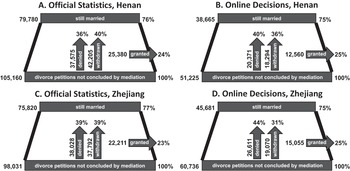
Figures 6.6 and 6.7 depict as pyramids the outcomes of first-instance divorce filings in court. Unlike my earlier analyses of divorce outcomes, which were limited to adjudications, the pyramids also include petitions withdrawn by plaintiffs. I limit the pyramids to decisions made after 2013 because this is when Henan’s courts consistently posted caiding decisions to grant plaintiffs’ requests to withdraw petitions. Withdrawn petitions are vastly underrepresented in prior years (Chapter 4). Recall from Chapter 1 that mediation is the first step after a divorce petition is filed. The primary purpose of mediation at this stage is to achieve marital reconciliation, which, if successful, would typically result in a petition withdrawal. Some plaintiffs withdraw their petitions at the trial stage. Judges also engage in mediation for the purpose of hammering out the terms of a divorce. Of all first-instance divorce cases handled by courts in recent years, about one-third resulted in mediation agreements. Despite the prevalence of mediation agreements in divorce litigation, they are exceedingly scarce in my samples of court decisions because courts are prohibited from posting them online (Chapter 4). Mediations are therefore not included in the pyramids. Divorces were granted in the vast majority (about 90%) of cases concluded by mediation agreements in recent years; about two-thirds of all divorces granted by courts resulted in mediation agreements and not in adjudicated verdicts. Consequently, the absence of mediation agreements skews the appearance of the pyramids in a few ways: the pyramids undercount both the total number of divorce petitions and the total number of granted divorces, and therefore misrepresent the overall rate at which courts granted divorce petitions. Had Henan’s 56,142 mediations been included in Figure 6.6, the overall rate at which courts granted divorces would have appeared as 47% in Panel A. Likewise, had Zhejiang’s 55,944 mediations been included in Figure 6.6, the overall rate at which courts granted divorces would have appeared as 48% in Panel C (Ministry of Civil Affairs, various years).
Outcomes of divorce petitions by source of data (official government statistics versus online decisions)
Note: Data are limited to first-instance decisions. Cases concluded by mediation agreements are excluded. Data are also limited to 2014–2015 for Henan and 2014–2016 for Zhejiang. Percentages do not always total 100% (and the sum of “denied” and “withdrawn” do not always equal “still married”) owing to rounding error.
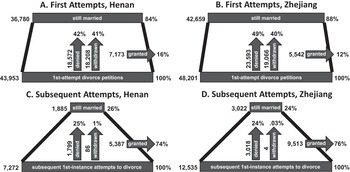
Outcomes of divorce petitions by attempt (first versus subsequent)
Note: Data are limited to first-instance decisions. Cases concluded by mediation agreements are excluded. Data are also limited to 2014–2015 for Henan and 2014–2016 for Zhejiang. Percentages do not always total 100% (and the sum of “denied” and “withdrawn” do not always equal “still married”) owing to rounding error.
In other words, a little over half of all people who filed for divorce in court remained married after the conclusion of the process. As we can see in Figure 6.6, after excluding cases concluded by mediation agreements, about three-quarters of remaining divorce-seekers left court still married. Note the remarkable consistency between official statistics and the online court decisions in my samples – yet another indication of the representativeness of my data.
For all the reasons discussed earlier, judges would benefit from the divorce twofer even if every single petition they denied came back like a boomerang after the statutory six-month waiting period. Judges would benefit even more if only a portion of them returned. As it turns out, divorce courts were leaky. Only a small proportion of plaintiffs whose petitions were denied returned for another attempt. Some of them may have given up and stayed married, often but not always while physically separated. Others may have pursued “divorces by agreement” in the Civil Affairs Administration after “agreeing” to give up child custody, property claims, or both (see Chapter 9). According to one scholar, “the most important reason why women choose to divorce in the Civil Affairs Administration is because they want to get rid of their husbands and their insufferable marriages as quickly as possible. … For many women, giving up their rights to economic compensation is the cost of freedom from an agonizing marriage” (Reference ZhangZhang 2011:78; for the same argument, see Reference LiLi [2022] and Reference WangWang [2013:175]). To be sure, divorce cases also moved in the opposite direction. Many plaintiffs indicated in their divorce petitions that they filed for divorce in court only after their negotiations for an uncontested “divorce by agreement” in the Civil Affairs Administration had broken down. Women in both scenarios commonly discounted their claims to child custody and marital property as the price of divorce (see Chapter 10).
Official government statistics on divorce depicted in Figure 6.6 (Panels A and C) do not disaggregate first attempts from subsequent attempts. Because they include all divorce decisions, the pyramids in Figure 6.6 double-count a certain number of litigants who appear in both first-attempt and subsequent-attempt cases. They also include repeat players who are not double-counted. Some of the subsequent-attempt cases included in Figure 6.6 were spawned by prior cases that had been concluded prior to 2014. I can, of course, identify repeat players in my samples of court decisions. Among the cases represented by Panel B (for Henan) and Panel D (for Zhejiang), 14% and 21%, respectively, of the litigants were returnees.Footnote 14
Figure 6.7 showcases the docket-shrinking property of the divorce twofer. Panels A and B depict first-attempt decisions and thus contain no repeat players. Panels C and D depict subsequent-attempt decisions and thus consist exclusively of repeat players. Figure 6.7 thus disaggregates the pyramids in Figure 6.6 (Panels B and D) constructed from my samples of court decisions.Footnote 15 Subsequent attempts are not limited to second attempts. Some plaintiffs succeeded or gave up after three or even more attempts.
Two noteworthy patterns emerge from Figure 6.7. First, plaintiffs tended to remain married in first-attempt adjudications and to accomplish their mission to divorce in subsequent-attempt adjudications. This, of course, is a defining characteristic of the divorce twofer.Footnote 16 According to a study of divorce cases in a basic-level court in Zhejiang’s provincial capital of Hangzhou, 81% of plaintiffs who returned after a failed first attempt were successful on the second attempt (Reference LiuLiu 2012:81; Reference ZhangZhang 2013). Second, courts are sieves for divorce cases. Among the first-attempt petitions judges denied, most never returned to court. Courts would not be leaking divorce cases if, in Figure 6.7, the bottom bars representing subsequent-attempt divorce cases (Panels C and D) were equal to the top bars representing all the first-attempt divorce cases in which litigants failed to divorce and thus remained married (Panels A and B). Even if we exclude petitions withdrawn by plaintiffs, the number of returnees (7,186 in Henan and 12,531 in Zhejiang) pales in comparison to the number of plaintiffs whose petitions had been denied in first-attempt adjudications (18,572 in Henan and 23,593 in Zhejiang). These numbers make sense only if a sizeable share of petitioners never returned to court.Footnote 17 Indeed, according to a study of divorce cases in a basic-level court in Zhejiang’s provincial capital of Hangzhou, only 22% of plaintiffs whose first-attempt petitions were denied returned to file a second first-instance petition (Reference LiuLiu 2012:81; Reference ZhangZhang 2013).
Table 6.5 shows once again that courts denied the majority of first-attempt divorce petitions and granted the majority of subsequent-attempt divorce petitions.Footnote 18 More importantly, it shows the uniquely low rates at which first-attempt divorce petitions were granted, not only compared to subsequent-attempt divorce petitions, but also compared to other types of civil cases. Successful first-attempt divorce cases were truly exceptional. Courts in both provinces granted plaintiffs’ petitions in first-attempt divorce cases at rates that were less than half of the win rates enjoyed by plaintiffs in every other type of case except administrative litigation.Footnote 19
| Case type | % Petitions granted | % Simplified procedure | Cases |
|---|---|---|---|
| Henan (2009–2015) | |||
| Divorce, first attempts | 37 | 39 | 55,179 |
| Divorce, subsequent attempts | 76 | 27 | 14,198 |
| Other marriage and family | 91 | 29 | 17,866 |
| Contracts | 93 | 24 | 187,165 |
| Torts and other rights-related | 95 | 19 | 110,714 |
| Criminal | 99 | 41 | 193,944 |
| Administrative litigation | 37 | 0.2 | 9,103 |
| Total | 89 | 30 | 588,169 |
| Zhejiang (2009–2017) | |||
| Divorce, first attempts | 20 | 83 | 50,207 |
| Divorce, subsequent attempts | 73 | 74 | 19,914 |
| Other marriage and family | 89 | 76 | 12,059 |
| Contracts | 97 | 60 | 1,060,004 |
| Torts and other rights-related | 93 | 80 | 133,058 |
| Criminal | 99 | 62 | 231,148 |
| Administrative litigation | 38 | 1 | 11,509 |
| Total | 94 | 62 | 1,517,899 |
Note: “% petitions granted” refers to the plaintiff win rate. For divorce cases, only a granted divorce counts as a win. Other claims in divorce petitions, such as child custody, property division, or civil damages, are not considered. For nondivorce civil cases and administrative litigation cases, any awarded claim counts as a granted petition. In other words, partial wins count as wins. In the criminal context, it refers to guilty verdicts (nonacquittals).
First-attempt divorce trials were also exceptional in their sparing use of collegial panels. As low-hanging fruit for quick-and-easy adjudicated denials using the simplified procedure, first-attempt divorce petitions have helped courts to economize on scarce judicial resources. Simplified procedure utilization rates in Table 6.5 suggest that, among all the types of cases they handled, courts devoted the fewest judicial resources to first-attempt divorce cases. By contrast, contract disputes in both provinces were much more likely to be tried according to the ordinary civil procedure. Compared to how they treated divorce cases, courts attached far more importance to contract disputes. As we will see shortly, contract disputes happened to be filed overwhelmingly by men, whereas, as we already know, divorces were filed overwhelmingly by women.
Subsequent-attempt divorce trials more closely resembled the civil trials of other types of cases in terms of both win rates and the use of the simplified procedure. Note also that in Table 6.5 administrative litigation cases were practically never tried according to the simplified procedure. The original 1989 Administrative Litigation Law required the use of collegial panels (Article 46). Only after the amended version of the law took effect on July 1, 2017, at the very end of the period of analysis, were solo judges permitted to apply the simplified procedure in administrative litigation cases (Article 83).
The Divorce Twofer Reduced Judge Effort
The divorce twofer was a docket-shrinking machine not only by making cases disappear. By allowing judges to deny so many first-instance divorce petitions in a relatively perfunctory manner, the divorce twofer also reduced the effort they put into first-instance divorce trials, and thus freed up time and effort for them to deal with other kinds of cases they deemed more important.
Table 6.6 contains mean and median durations of time from when civil cases were filed to when judges rendered adjudicated verdicts. Note the generally high degree of consistency between means and medians, suggesting that time distributions are not overly skewed one way or the other. I disaggregate times to close cases by type of procedure (ordinary versus simplified) because of Zhejiang’s dramatically higher simplified procedure utilization rates (Chapter 5). Overall case closing times were slower in Henan (in the “total” column) only because its simplified procedure utilization rates were so much lower. Across the two provincial samples, case closing times among cases of the same type tried according to the same procedure were generally similar.
| Civil case type | Ordinary procedure | Simplified procedure | Total | ||
|---|---|---|---|---|---|
| Granted | Denied | Granted | Denied | ||
| Henan (2009–2015) | |||||
| Divorce, first attempts | 113/114 | 93/90 | 59/58 | 52/51 | 81/72 |
| (n) | (7,071) | (8,679) | (1,993) | (10,110) | (27,853) |
| Divorce, subsequent attempts | 107/109 | 105/105 | 57/57 | 59/58 | 91/85 |
| (n) | (3,945) | (1,114) | (1,553) | (793) | (7,405) |
| Other marriage and family | 103/104 | 106/104 | 59/59 | 59/60 | 88/80 |
| (n) | (4,844) | (518) | (2,638) | (288) | (8,288) |
| Contracts | 104/103 | 118/121 | 56/55 | 74/68 | 89/81 |
| (n) | (50,175) | (3,463) | (25,703) | (1,338) | (80,679) |
| Torts and other rights-related | 109/109 | 116/119 | 62/61 | 68/70 | 96/89 |
| (n) | (28,633) | (1,337) | (11,095) | (339) | (41,404) |
| Total | 106/106 | 102/100 | 58/57 | 56/53 | 89/82 |
| (n) | (94,668) | (15,111) | (42,982) | (12,868) | (165,629) |
| Zhejiang (2009–2017) | |||||
| Divorce, first attempts | 114/111 | 117/116 | 51/45 | 37/33 | 51/38 |
| (n) | (3,657) | (3,552) | (5,084) | (34,517) | (46,810) |
| Divorce, subsequent attempts | 119/117 | 120/122 | 49/43 | 45/40 | 64/51 |
| (n) | (3,777) | (495) | (9,395) | (4,590) | (18,257) |
| Other marriage and family | 128/129 | 141/149 | 58/52 | 61/56 | 70/62 |
| (n) | (1,507) | (125) | (7,208) | (1,021) | (9,861) |
| Contracts | 121/119 | 136/142 | 47/40 | 71/70 | 74/64 |
| (n) | (329,097) | (4,100) | (568,157) | (18,476) | (919,830) |
| Torts and other rights-related | 126/134 | 135/143 | 67/61 | 72/71 | 76/68 |
| (n) | (12,915) | (1,303) | (85,535) | (5,202) | (104,955) |
| Total | 121/119 | 128/130 | 50/42 | 51/43 | 73/62 |
| (n) | (350,953) | (9,575) | (675,379) | (63,806) | (1,099,713) |
Note: A large number of cases are omitted from this table owing to missing filing dates. Dates could be reliably extracted from only a portion of all decisions. See note under Table 6.5 for the definition of “granted” and “denied.”
Thanks to the divorce twofer, judges in both provinces closed first-attempt divorce cases faster than they closed any other type of civil case (according to means/medians in the “total” column). Once again, Zhejiang’s relatively enthusiastic embrace of the divorce twofer is evident in its remarkably swift adjudicated denials. The mean/median time from initial case filing to adjudicated denial using the simplified procedure was 52/51 days in Henan and 37/33 days in Zhejiang. Among all first-attempt divorce cases tried according to the ordinary procedure, decisions to deny petitions were about 20 days faster in Henan and, strangely, a few days slower in Zhejiang than decisions to grant petitions.Footnote 20 Compared to divorces granted using the ordinary procedure, first-attempt denials using the simplified procedure cut the duration of time to an adjudicated decision by over one-half (about 60 days) in Henan and by two-thirds (about 80 days) in Zhejiang. Finally, among all first-attempt divorce cases tried according to the simplified procedure, the mean/median amount of time saved by denying petitions compared to granting them was one week per case in Henan and about two weeks per case in Zhejiang.
The aggregate time savings from the divorce twofer has therefore been immense in both provinces. Multiplying mean or median savings in time gained from denying first-attempt divorce petitions by the volume of adjudicated denials of first-attempt divorce petitions in the two samples yields millions of days in total time savings. Of course, the time necessary to adjudicate subsequent-attempt divorce petitions spawned by first-attempt denials must be subtracted from this amount of time savings. However, as we know, most first-attempt adjudicated denials never come back. Those that do return are generally both less burdensome, and thus benefit judges’ volume and efficiency scores, and are at lower risk of leading to social unrest or “extreme incidents” that would hurt judges’ performance evaluations (Chapter 3).
To any estimate of the divorce twofer’s total net time savings must be added the amount of time additional judges and lay assessors – whose efforts were spared by the solo judges who single-handedly denied first-attempt divorce petitions using the simplified procedure – would have otherwise spent as members of collegial panels in trials granting first-attempt divorces. Needless to say, judges’ labor accounts for only a small portion of the duration of time from case filing to adjudicated decision. We do not know the true time savings gained by the divorce twofer, because we do not know how much time judges actually devoted to cases. We know only when cases were filed and when decisions were finalized; the court decisions do not reveal exactly how judges allocated their time in the interim. Surely, though, the divorce twofer benefitted judges not only by conserving a real measure of their scarce supply of time and effort but also by increasing their simplified procedure utilization rates, shortening their case closing times, and thereby boosting their performance evaluation scores.
The relative brevity of judges’ written decisions in first-attempt divorce adjudications further suggests that the amount of time and effort saved was substantial. Table 6.7 contains mean/median numbers of characters – almost all Chinese, of course, but also some Latin letters, Arabic numerals, and symbols – per court decision. I disaggregate length of court decision by type of procedure for the same reason I disaggregated time to decision in the previous analysis. The written decisions of cases closed using the ordinary procedure were generally longer than those of cases closed using the simplified procedure. Regardless of how judges ruled and which procedure they used, their first-attempt divorce decisions were shorter than those of any other type of civil case. In particular, their decisions to deny first-attempt divorce petitions were shorter than their decisions in any other type of case. In both provinces, written decisions that denied first-attempt divorce petitions were generally about 20–30% shorter than those that granted first-attempt divorces. Not only were adjudicated denials shorter in length, but, as we will see in Chapter 7, they also contained a considerable amount of recycled and rehashed boilerplate text justifying marital preservation in therapeutic, moral, and ideological terms. Although subsequent-attempt divorce decisions were longer than first-attempt divorce decisions, much of the text they contained was redundant. Because many of the facts do not change – or require only minor revisions – between attempts, judges simply copy and paste portions of their first-attempt decisions into their subsequent-attempt decisions.
| Civil case type | Ordinary procedure | Simplified procedure | Total | ||
|---|---|---|---|---|---|
| Granted | Denied | Granted | Denied | ||
| Henan (2009–2015) | |||||
| Divorce, first attempts | 1,181/1,043 | 935/860 | 1,247/1,152 | 908/849 | 1,021/915 |
| (n) | (16,222) | (17,618) | (3,978) | (17,361) | (55,179) |
| Divorce, subsequent attempts | 1,462/1,291 | 1,222/1,100 | 1,435/1,314 | 1,140/1,063 | 1,392/1,241 |
| (n) | (8,177) | (2,195) | (2,592) | (1,234) | (14,198) |
| Other marriage and family | 1,642/1,382 | 1,759/1,491 | 1,387/1,257 | 1,421/1,257 | 1,576/1,341 |
| (n) | (11,451) | (1,162) | (4,785) | (468) | (17,866) |
| Contracts | 1,916/1,564 | 2,471/2,098 | 1,422/1,239 | 1,711/1,573 | 1,837/1,506 |
| (n) | (131,534) | (11,393) | (41,951) | (2,287) | (187,165) |
| Torts and other rights-related | 3,102/2,846 | 2,309/1,975 | 2,598/2,438 | 1,660/1,485 | 2,971/2,725 |
| (n) | (85,654) | (4,490) | (19,962) | (608) | (110,714) |
| Total | 2,243/1,859 | 1,620/1,161 | 1,731/1,455 | 1,036/896 | 2,017/1,616 |
| (n) | (253,038) | (36,858) | (73,268) | (21,958) | (385,122) |
| Zhejiang (2009–2017) | |||||
| Divorce, first attempts | 1,308/1,109 | 1,107/1,035 | 1,635/1,379 | 1,149/1,069 | 1,213/1,090 |
| (n) | (4,606) | (4,091) | (5,447) | (36,063) | (50,207) |
| Divorce, subsequent attempts | 1,721/1,384 | 1,551/1,337 | 1,765/1,525 | 1,440/1,316 | 1,670/1,430 |
| (n) | (4,649) | (605) | (9,844) | (4,816) | (19,914) |
| Other marriage and family | 3,152/2,259 | 3,695/3,251 | 2,182/1,830 | 2,342/1,980 | 2,440/1,927 |
| (n) | (2,606) | (271) | (8,081) | (1,101) | (12,059) |
| Contracts | 1,902/1,411 | 4,258/3,581 | 1,698/1,372 | 2,978/2,533 | 1,823/1,406 |
| (n) | (417,877) | (8,398) | (613,259) | (20,470) | (1,060,004) |
| Torts and other rights-related | 4,001/3,585 | 4,588/3,965 | 3,205/2,995 | 3,089/2,781 | 3,375/3,089 |
| (n) | (24,386) | (2,812) | (99,897) | (5,963) | (133,058) |
| Total | 2,014/1,450 | 3,408/2,701 | 1,908/1,504 | 1,905/1,358 | 1,965/1,481 |
| (n) | (454,124) | (16,177) | (736,528) | (68,413) | (1,275,242) |
The Divorce Twofer Disproportionately Impacted Women
When judges sacrificed divorce cases in response to their heavy caseloads, they did not do so in a gender-neutral manner. Women were disproportionate casualties of the divorce twofer. Table 6.8 shows female representation among plaintiffs and defendants by case type. Among plaintiffs, women were concentrated in divorce cases. In Henan, divorce cases accounted for 17% of all plaintiffs but for 29% of all female plaintiffs in first-instance civil adjudications. In Zhejiang, divorce cases accounted for 5% of all plaintiffs but for 11% of all female plaintiffs in first-instance civil adjudications. Women also went to court in large numbers as both plaintiffs and defendants in “other marriage and family cases,” which consisted primarily of disputes related to child custody, inheritance, eldercare, adoption, and relationship breakups among unmarried couples (e.g., betrothal gifts among couples who called off their marriage engagement as well as property division and child custody among cohabiting couples who split up). Commensurate with their overrepresentation among plaintiffs filing for divorce, women were underrepresented among plaintiffs filing for relief in contract, tort, and administrative disputes. These patterns provide further evidence that judges attached greater importance to and took more seriously cases filed by men than cases filed by women. Drawing on and reinforcing cultural stereotypes, judges could more easily justify the divorce twofer by characterizing the divorce petitions of women as “frivolous” and “impulsive,” and therefore without legal merit.
| Case type | Plaintiffs | Defendants | ||||
|---|---|---|---|---|---|---|
| % Female | Plaintiffs | Decisions | % Female | Defendants | Cases | |
| Henan (2009–2015) | ||||||
| Divorce, first attempts | 66 | 52,196 | 52,150 | 34 | 52,145 | 52,106 |
| Divorce, subsequent attempts | 67 | 13,402 | 13,386 | 33 | 13,379 | 13,372 |
| Other marriage and family | 43 | 22,814 | 16,610 | 48 | 27,602 | 16,612 |
| Contracts | 23 | 143,597 | 118,569 | 21 | 228,155 | 132,763 |
| Torts and other rights-related | 39 | 158,084 | 95,171 | 13 | 131,187 | 86,638 |
| Criminal | – | – | – | 8 | 251,385 | 182,073 |
| Administrative litigation | 31 | 13,527 | 6,915 | – | – | – |
| Total | 38 | 403,620 | 302,801 | 17 | 703,853 | 483,564 |
| Zhejiang (2009–2017) | ||||||
| Divorce, first attempts | 67 | 8,476 | 8,476 | 33 | 8,506 | 8,477 |
| Divorce, subsequent attempts | 69 | 3,474 | 3,459 | 31 | 3,491 | 3,480 |
| Other marriage and family | 57 | 2,547 | 1,625 | 47 | 3,432 | 1,659 |
| Contracts | 25 | 190,519 | 160,067 | 32 | 402,694 | 226,152 |
| Torts and other rights-related | 42 | 37,803 | 22,869 | 19 | 31,317 | 20,890 |
| Criminal | – | – | – | 11 | 83,689 | 58,655 |
| Administrative litigation | 31 | 5,134 | 2,702 | – | – | – |
| Total | 30 | 247,953 | 199,198 | 28 | 533,129 | 319,313 |
Note: Litigant sex is limited to reported values in all case types except divorce. In divorce cases, reported values of litigant sex are supplemented with a highly reliable method of inferring litigant sex detailed in Chapter 4. Most discrepancies between numbers of plaintiffs, defendants, and decisions are accounted for by organizational litigants (e.g., plaintiffs in contract disputes that are companies or rural credit cooperatives). Some, but relatively few, are also caused by parsing errors or errors in the court decisions. Whereas divorces include only one plaintiff and one defendant, other types of cases often include multiple plaintiffs and multiple defendants.
Moreover, the divorce twofer disproportionately impacted rural women. Not only were divorce cases concentrated in rural courts, but women’s representation among plaintiffs filing for divorce was greater in rural areas than in urban areas (Chapter 4). Because contract disputes were overrepresented in urban courts, judges in rural courts dealt with women seeking divorce on a more regular basis than their urban counterparts did. As we will see throughout this book, women’s vastly poorer outcomes in rural courts likely stemmed at least in part from the greater durability of patriarchal cultural beliefs in rural areas.
Petition Withdrawals Were Part of the Divorce Twofer
Petition withdrawals benefitted judges in the same way adjudicated denials did. The pyramids in Figures 6.6 and 6.7 depict two judicial pathways to marital preservation: adjudicated denials and withdrawn petitions. Both pathways helped judges swiftly clear their dockets and gain points on their performance evaluations (Reference Kinkel and HurstKinkel and Hurst 2015:57). As discussed earlier, a third pathway, mediated denials, was extremely rare by the mid-2010s. Petition withdrawals, like adjudicated denials, conserved judicial resources and expedited case closing times. But petition withdrawals also offered additional benefits to judges.
From the standpoint of judges, withdrawn petitions have been even more desirable than adjudicated denials for at least four reasons. First, they were far more likely to be presided over by a solo judge, and thus greatly reduced workloads. Second, they further shortened case closing times because petition withdrawals can be closed without any consideration whatsoever of substantive legal matters (Reference WangX. Wang 2016:52). Third, owing to the previous reason, the decisions judges wrote to approve them were extremely short, typically only a few sentences (Chapter 4). When plaintiffs did not show up for their trials, judges – who regarded them as having voluntarily waived their right to a trial despite receiving a court summons – handled their cases as petition withdrawals in accordance with the Civil Procedure Law (Article 143). Far more often, however, judges wrote in their decisions simply that the plaintiff had requested to drop the case, sometimes adding that the plaintiff’s request was “voluntary.” Fourth, owing to the foregoing reasons, performance evaluation systems reward withdrawals more than adjudicated denials. At the same time, because they do not include holdings on the litigants’ legal claims, petition withdrawals cannot count against judges as “incorrectly decided” cases (Reference WangX. Wang 2016:52).
Given judges’ incentives to maximize withdrawn petitions, many withdrawals were neither voluntary nor initiated by plaintiffs; these must be understood as adjudicated denials by another name, and therefore as part of the divorce twofer. As we know from Chapter 2, courts are required to attempt to achieve mediated reconciliation. When a judge’s persuasive efforts are successful, the plaintiff withdraws her divorce petition, and the couple goes home ostensibly reconciled. Victims of domestic violence are often coerced and intimidated into “voluntarily” dropping their cases (Reference Chen and DuanChen and Duan 2012:34). Courts are not the only organizations responsible for mediating marital conflict. Local police as well as mass organizations such as villagers’ committees and urban residents’ committees also routinely conduct mediation for the purpose of achieving marital reconciliation and preventing divorces. Such mediation efforts, however, often serve to reinforce the coercive control of abusive husbands (Reference ChenChen 2009; Reference HanHan 2017).
In private, abusive husbands sometimes threaten even worse violence – including death – if their wives file for divorce. Consider, for example, the husband who beat his wife, breaking her ribs, for questioning him about his habit of patronizing prostitutes. “As soon as she raised the issue of divorce, he grabbed a knife and roared, ‘In life your body belongs to the Shi family, in death your ghost belongs to the Shi family!’ From this point on, although he continued to beat her black and blue on a regular basis, she dared not utter the word divorce again” (Reference LiLi 2003:3). After abused women filed for divorce, their husbands often threatened the same consequences unless they withdrew their divorce petitions. In court, however, wife-beaters were often on their best behavior, apologizing for their wrongdoing, begging for another chance, and promising to be better husbands. Judges often gaslighted female plaintiffs by downplaying their claims of violence and commending their husbands’ apparent commitment to self-improvement and reconciliation (Chapter 7). Even when abusive husbands made threats of violence in court, judges nonetheless encouraged wives to drop their petitions in consideration of the safety of both the wives and the judges (Reference HeHe 2017; also see Reference 484DiamantDiamant [2000b:336] and Chapter 3). They may have tried to comfort plaintiffs by pointing out that, according to the Measures of People’s Courts on Collecting Litigation Fees, the court fee for a petition withdrawal was only half that of an adjudicated denial decided by a collegial panel, which would be a possible or even likely alternative outcome. Judges have thus colluded with perpetrators of domestic violence by exerting pressure on female plaintiffs to withdraw their petitions (Reference LiLi 2022).
To summarize, abusive husbands who used intimidation tactics to end their wives’ pursuit of divorce found support from judges with a vested interest in maximizing petition withdrawals. Despite the nonvoluntary nature of many withdrawn divorce petitions, judges often explicitly – and dishonestly – indicated in their written decisions that “the plaintiff’s voluntarily application to withdraw the lawsuit is lawful and hereby approved by the court.” Variations of this sort of language include “the plaintiff voluntarily applied to withdraw the petition” and “the plaintiff’s withdrawal of the petition is voluntary and does not contravene the law.”
Domestic violence is invisible in caiding decisions because they contain no information about the nature of plaintiffs’ legal complaints. In their subsequent-attempt divorce petitions, however, plaintiffs sometimes characterized their prior withdrawals as less than voluntary. In female plaintiffs’ portrayals of their prior petition withdrawals, judges acted to support male defendants’ efforts to intimidate their wives into withdrawing their petitions.
Each of the following cases refers to a prior case that had been handled by the court as a withdrawn petition. Some of the plaintiffs, fearing for their lives, were no-shows in court. Although the plaintiffs in these cases had never requested to withdraw their petitions, the courts’ presumption – supported entirely by the law – was that their failure to appear in court was tantamount to withdrawing their petitions. Other plaintiffs, compelled by abusive husbands, dropped their cases before they even went to trial. Because judges “regarded withdrawn lawsuits as having never happened in the first place” (Reference WangX. Wang 2016:52), they sometimes denied subsequent-attempt divorce petitions as if they were first-attempt divorce petitions. The following examples foreshadow many themes of this book. They illustrate judges’ tendency to affirm reconciliation potential and to disaffirm the breakdown of mutual affection (Chapter 7). They illustrate judges’ tendency to ignore evidence of domestic violence (Chapters 7 and 8). They illustrate the formation of a population of female abuse victims forced into hiding for their own safety, whom I call “marital violence refugees” (Chapter 9). And they illustrate judges’ tendency to grant child custody to abusive husbands whose children were left in their sole physical custody after their wives fled to safety (Chapters 10 and 11).
In my first example, the defendant successfully intimidated the plaintiff into withdrawing her petition. In her subsequent-attempt petition, she claimed that the domestic violence began when, after exchanging one sentence with a guy at work, her husband suspected they were having an affair. He not only beat her, but also choked her and forced her to drink poison. She stated that only by begging for her life was she spared. After this, all she had to do was exchange words with someone of the opposite sex for her husband to suspect they were having improper relations. She claimed that her husband’s jealousy and suspicion precipitated numerous beatings, which ultimately made her unable to live in her marital home. Forced to leave, she moved to the county seat (the urban area of Henan’s Song County), where her husband found her and beat her again. At this point she no longer dared return home, and started drifting from place to place (流浪) for the next seven years. The court affirmed the plaintiff’s testimony by writing:
In August 2003, the defendant beat the plaintiff when he suspected she was having secret relations with someone else, after which the plaintiff moved back to her natal family. The defendant’s numerous efforts, with the help of family and friends, to bring her back home were fruitless. Since then, the plaintiff has been a migrant worker, and has continuously lived apart from the defendant. In October 2004, the defendant organized a group of friends and family to find the plaintiff in the urban center of Song County, and beat her again when they found her.
In the same year she filed for divorce. “Out of fear of encountering the defendant and getting viciously beaten by him, the plaintiff lacked the courage to appear in court for her trial. In the end the court disposed of the case as a petition withdrawal.” The court granted the divorce but awarded child custody to the defendant (Decision #843766, Song County People’s Court, Henan Province, July 12, 2011).Footnote 21
Another court granted a plaintiff’s second divorce petition after she had “voluntarily” withdrawn her prior petition under the defendant’s threats of violence. As she put it (in the third person): “In 2006, the plaintiff filed for divorce with the Yancheng Court. Owing to the defendant’s threats, the plaintiff later withdrew her petition. After doing so, the defendant not only failed to change his ways, but the conflicts intensified.” The court granted this – the plaintiff’s second – divorce petition (Decision #867215, Luohe Municipal Yancheng District People’s Court, Henan Province, November 22, 2011).Footnote 22
Another plaintiff described the reason for her so-called petition withdrawal.
In the fall of 2012, the defendant, in a fit of anger, beat me with a knife in one hand and a chair in the other hand. When his own mother tried to stop him, he kicked her, causing her to sustain a bone fracture. I previously filed for divorce in 2012, on the 17th day of the first month of the lunar calendar. Under duress from the defendant’s threats, I dared not appear in court. The court disposed of the case as a petition withdrawal.
The plaintiff supported her allegations with audio recordings. The defendant did not appear in court, and the court denied the plaintiff’s divorce request (Decision #1163699, Fangcheng County People’s Court, Henan Province, May 15, 2014).Footnote 23
A plaintiff from elsewhere in Henan recounted a similar experience (referring to herself in the third person). “In 1994, the plaintiff filed for divorce, but under duress from the defendant’s threats dared not appear in court. In order to escape the defendant’s domestic violence, the plaintiff left home in 2010, and both sides have been physically separated ever since.” The court denied the plaintiff’s divorce request on the grounds that the foundation of marital affection was solid owing to over 20 years of marriage, that conflicts over minor life issues do not rise to the level of the breakdown of mutual affection, and that they still had reconciliation potential if they invested more effort and care into their marriage (Decision #1075264, Xinyang Municipal Shihe District People’s Court, Henan Province, October 21, 2013).Footnote 24
In the words of another plaintiff, owing to her husband’s domestic violence,
I lost confidence in life. The tears washing my face all day blur my vision. On several occasions I considered suicide, but when I thought of my septuagenarian mother and my young children, I decided instead to use the legal arsenal to protect my rights. In November 2010, in pursuit of my freedom, I filed for divorce in court. While the case was pending, the defendant showed up and caused a ruckus several times at my natal family’s home. Under duress from his threats, I had no choice but to withdraw my petition. After withdrawing my petition, the defendant intensified his cruelty and almost killed me with his domestic violence.
On her second litigation attempt, she submitted photographic evidence of an injury caused by domestic violence and testimony from two people who witnessed the defendant hitting and threatening her. The court refused to admit the photographic evidence on the grounds that it could not prove the cause of the injury, and refused to admit the witness testimony on the grounds that it could not be corroborated. Citing the plaintiff’s lack of evidence supporting her claim of the breakdown of mutual affection and “the definite marital foundation of both sides thanks to their over 20 years of marriage and three children they had while living together,” the court denied the plaintiff’s divorce petition (Decision #1029697, Xun County People’s Court, Henan Province, August 29, 2013).Footnote 25
In its ruling on a plaintiff’s second divorce petition, another court referred to its successful achievement of “mediated reconciliation” on the prior attempt. The plaintiff’s version of events, however, was quite different.
After marrying, the defendant frequently carried out domestic violence against the plaintiff. Time and again, the plaintiff put up with it, and the defendant’s temper only got worse. His tendency to beat the plaintiff broke her heart. When they were both migrant workers in Guangdong, the plaintiff, unable to tolerate the defendant’s abuse, called the police for help, and they became physically separated as a result. During their separation, they were unable to agree on the terms of a divorce. After the plaintiff filed for divorce with the Taikang County People’s Court, the defendant verbally threatened the safety of the plaintiff and her family. Under duress from his threats, the plaintiff withdrew her petition. The defendant showed no contrition or willingness to change. Viewing this marriage as beyond salvageable, the plaintiff once again left the defendant, and they remain physically separated. Domestic violence has caused the breakdown of mutual affection.
Citing a lack of evidence to support the plaintiff’s claims, the court denied the plaintiff’s second petition and called on husband and wife to build mutual understanding, respect, and compassion, and to cherish their marriage (Decision #1297014, Taikang County People’s Court, Henan Province, September 4, 2014).Footnote 26
If courts colluded with abusive husbands by turning a blind eye to their threats of violent retaliation against their divorce-seeking wives and by persuading female plaintiffs to withdraw their petitions, we should expect to find that women were more likely than men to drop their lawsuits. Although the pyramids in Figure 6.7 combine both female and male plaintiffs, we have good reasons to expect that their shapes vary by plaintiff sex. Chapter 8 is devoted to analyzing rates at which judges granted first-attempt divorce petitions. It assesses the extent to which and explains why judges, in first-attempt divorce trials, were less likely to grant women’s petitions than they were to grant men’s petitions. In the remainder of this chapter, I will assess differences between female and male plaintiffs in rates at which plaintiffs withdrew petitions. My assessment is limited to the Henan sample because only a miniscule number of caiding decisions in the Zhejiang sample report litigant sex, and the information they contain is too skimpy to infer litigant sex using the method described in Chapter 4.
We can see from Panel A of Figure 6.7 that the petition withdrawal rate was 41% among all first-attempt divorce petitions in the Henan sample closed in 2014 and 2015. Disaggregating by plaintiff sex, the rates were 42% and 38% for female and male plaintiffs, respectively (a highly statistically significant difference of 4 percentage points). Figure 6.8 temporally extends the analysis to the entire 2009–2015 period of time and depicts variation by court context. The lines in Panel A of Figure 6.8 (for female and male plaintiffs) do not represent changes over time in withdrawal rates. Rather, they represent changes in the disclosure of caiding decisions approving petition withdrawals. They correspond closely with Figure 4.3, which shows that Henan’s courts posted caiding decisions online before provincial regulations prohibited them from doing so in 2010, and then resumed posting them in late 2014 after the SPC authorized them to do so (Chapter 4).
Proportion of plaintiffs (%) withdrawing divorce petitions
Note: n = 72,711 first-attempt divorce adjudications and caiding decisions by 161 basic-level courts. Panel A is smoothed with moving averages. For more information on the scatterplot points in Panel B, see the note under Figure 4.5. Panel B contains best-fit lines for female and male plaintiffs.

In Figure 6.8, we are concerned not with withdrawal rates per se (which we know are inaccurate, particularly prior to 2014) but rather with differences in withdrawal rates by plaintiff sex. Panel A shows that withdrawal rates between 2009 and 2015 averaged 27% for women and 21% for men (a highly statistically significant difference of 6 percentage points). Panel B shows that this gap persisted across rural and urban courts.
Summary and Conclusions
This chapter provides one explanation for why, over time, courts became increasingly loath to grant divorces. Mounting caseloads, not rising divorce rates, drove the judicial clampdown on divorce. As they toiled under ever-heavier dockets, judges increasingly turned to and benefitted from the divorce twofer. As part of a larger judicial toolkit of coping strategies (Chapter 5), the divorce twofer has helped make the work of judges more manageable. As a judge in Anhui explained,
we’re simply too busy. The case filing system has caused cases to pour into courts in huge numbers while the quota system has caused a reduction in the number of presiding judges. As a result, judges are all dealing with huge backlogs of cases that must meet trial deadlines. Barely able to scratch the surface of cases, judges save the most trouble by denying first-attempt divorce petitions.
The divorce twofer has helped courts economize on scarce human resources in part because the simplified procedure, which requires only one judge, has been applied at higher rates in first-attempt divorce trials than in any other type of first-instance civil trial. Additional benefits judges have enjoyed from denying first-attempt divorce petitions include briefer written decisions and shorter times to finalize and issue them. Judges were able to write these decisions quickly not only because they were so short, but also because, as we will see in Chapter 8, they reused so much generic text, much of it grounded in political ideology. As judges put it, by preserving marriages, they were protecting family harmony and, in so doing, maintaining social stability.
From the standpoint of judges, perhaps best of all was the extent to which the divorce twofer served to shrink dockets by virtue of the small share of plaintiffs who returned for a second attempt after an unsuccessful first attempt – following either an adjudicated denial or a petition withdrawal. Efficiency increases for judges were associated with efficiency declines for litigants. We will see in Chapter 9 that swift denials of divorce petitions resulted in substantial delays for plaintiffs.
Compared to plaintiffs who filed for divorce in parts of China with less per capita litigation, those in Zhejiang have been punished for no reason other than being in Zhejiang. Their divorce prospects were dimmer simply because judges have been allocated to courts principally according to the populations of their jurisdictions and only secondarily according to their caseloads. For this reason, courts in the Yangtze Delta areas of Zhejiang, Jiangsu, and Shanghai, which were afflicted most severely by the problem of “many cases, few judges,” have clamped down on divorce harder than courts almost everywhere else in China.
Meanwhile, women everywhere have disproportionately borne the cost of the divorce twofer. Women were both overrepresented among plaintiffs filing for divorce and more likely than men to withdraw their petitions. As we will see in Chapter 8, their divorce petitions were also more likely than men’s to be denied. Denying divorce petitions and facilitating petition withdrawals are not the only ways courts have harmed female divorce-seekers. Courts have also harmed women when granting divorces. Promulgated in 2011, the SPC’s third Judicial Interpretation of Several Issues Concerning the Application of the Marriage Law stipulated conditions under which housing no longer counted as joint marital property. Real estate titled to only one spouse and either purchased in its entirety prior to marriage or purchased after marriage with the assistance of the parents of that spouse became redefined as individual property (Reference FincherFincher 2014:47–48; Reference ZangZang 2020:1216). Legal scholars have decried this new rule for its practical effect of dispossessing women of property and shoring up the patriarchal family (Reference YangYang 2011). Taisu Reference ZhangZhang (2012:37–41) argues that the harm it inflicted on women was an unintended consequence of the SPC’s primary intent to enhance judicial efficiency by simplifying the determination of property ownership, and thus to help courts cope with the problem of “many cases, few judges.” When granting divorces, courts’ child custody determinations have also harmed women (Chapters 10 and 11).
Although I have shown that China’s divorce courts are leaky, I have no way of systematically tracking and ascertaining the fates of the large share of adjudicated denials and petition withdrawals that did not return as subsequent-attempt petitions. Perhaps some divorce petitions were indeed frivolous, and for this reason did not reappear in court. Judges would surely be tempted to take the small proportion of repeat players as proof that the divorce twofer, by giving impulsive plaintiffs a chance to cool off, saves marriages. Undoubtedly some couples did reconcile. Undoubtedly some plaintiffs turned to the Civil Affairs Administration after “voluntarily agreeing” to waive claims to child custody, property, or both. Finally, undoubtedly some couples failed to reconcile but remained married – either living under the same roof or physically separated – only because plaintiffs were unable to find a way to divorce. The prevalence of these outcomes is an empirical blind spot of my research.
A second empirical blind spot concerns divorce petition withdrawals. Caiding decisions are devoid of any information concerning litigants’ claims and supporting evidence necessary to support an explanation for why women were at significantly higher risk than men of withdrawing their lawsuits. While this gender difference is consistent with my argument that women often withdrew their divorce petitions under the duress of their abusive husbands, we cannot entirely rule out that women were less serious than men about following through with their lawsuits. This alternative explanation is the public narrative, grounded in gender stereotypes, about irrationally suspicious women filing for divorce frivolously as a scare tactic to keep their husbands in line (Chapter 3), and is difficult to square with the Sisyphean determination – so prominently on display in each subsequent chapter of this book – of so many women to divorce their abusive husbands.


 Open access